15 963 résultats
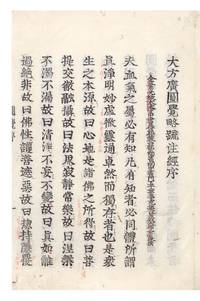
670514; 13 folding leaves. Two parts in one vol. Large 8vo cont. or later dark wrappers dyed with persimmon juice shibubiki new stitching. Japan probably Kyoto: printed with moveable types ca. 1615-40. A very rare edition printed with moveable types apparently unrecorded in the standard bibliographies of the story - or legend - of the creation of the first statue of Siddhartha Gautama or Gautama Buddha the founder of Buddhism. The statue executed while Buddha was still alive was commissioned by King Udayana of Kaushambi a contemporary of Buddha. It was the very first image of Buddha and is especially important as it was carved from life. Copies of this statue made their way to China with the spread of Buddhism and later as we shall see to Japan. The text provides a history of the creation of the first statue of Buddha which is perhaps the most famous of all Buddha images. King Udayana commissioned the statue "so that he could gaze upon the sacred form of the Buddha while the latter was off preaching to his mother in the heaven of Indra. Buddha's disciple Maudgalyayana transported thirty-two craftsmen up to the heavenly realm so that they could observe the special marks of the Buddha firsthand thereby insuring the representational accuracy of the image they created. When the Buddha eventually returned to the earth King Udayana's statue rose into the air to greet him of its own accord and the Buddha proclaimed that it would one day help to transmit his teachings."-Brown ed. The Oxford Handbook of Religion and the Arts p. 371. We learn that the statue was carved out of sandalwood and that later copies were made of gold silver bronze lead tin or iron as well as of wood. This text was translated by the Khotanese monk Tiyunbanruo d. 691 or 692 whose original Sanskrit name was Devendraprajna. Khotan was an ancient Iranian Saka Buddhist kingdom on the branch of the Silk Road that ran along the southern edge of the Taklamakan Desert near modern-day Xinjiang. Tiyunbanruo came to Luoyang the "Eastern Capital" of the Tang dynasty of China in about 688 with a considerable reputation as a Buddhist missionary and set up a bureau to translate Buddhist texts into Chinese. An earlier edition of this text was published in Beijing in 1593 and only one copy is known at the BnF. This book was probably printed and issued as a way to reinforce the legitimacy of the famous Buddha statue of the temple of Seiryoji in the Saga fields of Kyoto. It is one of the chief objects of religious veneration in Kyoto. A copy of the original statue also commissioned by King Udayana was brought from the castle at Kaushambi in north-central India to China by Hsuan-tsang in 645. The statue moved many times and ultimately arrived at Kaifeng the Sung capital. The Japanese monk Chonen 938-1016 who spent the years 983-86 in China studying and collecting texts had worshiped the statue in Kaifeng and commissioned men in 984 to carve a copy to bring back to Japan. The copy was ultimately installed at Seiryoji and according to Japanese tradition the Chinese "original" and Chonen's copy had miraculously changed places - the Seiryoji Buddha was actually the authentic example commissioned by Udayana. The Seiryoji Buddha is "probably the most important best-documented and best-preserved sculpture now existing which represents the school and tradition of Buddhist sculpture connected with the sacred Udayana image of the living Buddha of which Hsuan-tsang brought a copy to the court at Ch'ang-an."-Henderson & Hurvitz "The Buddha of Seiryoji: New Finds and New Theory" Artibus Asiae Vol. 19 No. 1 1956 p. 43-and see the whole fascinating article. As mentioned above this rare work is printed with moveable types. It was at one time owned by the great Japanese dealer Shigeo Sorimachi. The chitsu has the characteristic handwriting on the label of Sorimachi's assistant Mr. Mori who has written: "Zozo kudoku kyo. Genna kan'ei chu kan. Kokatsu ban" "Creation of the Statue a Pious Act. From Genna to mid-Kan'ei edition ca. 1615-40. Moveable type". It is not cited by Kazuma Kawase Kokatsuji-ban no kenkyu Study of the Early Typographic Editions of Japan 1967 the definitive bibliography of Japanese moveable type books. There is no copy in WorldCat nor the Union Catalogue of Early Japanese Books. In very good condition. The first ten folding leaves which are a little stained have some repaired worming and strengthening. The following leaves have some worming some carefully repaired and others as the worming lessens not repaired. Several characters affected by the worming. As mentioned above the wrappers have been dyed with persimmon juice which serves a dual purpose: to strengthen the paper and act as an insect repellent. ❧ Wang Zhenping "Chonen's Pilgrimage to China 983-986" Asia Major Third Series Vol. 7 No. 2 1994 pp. 63-97. Martha L. Carter The Mystery of the Udayana Buddha Naples: 1990. unknown books
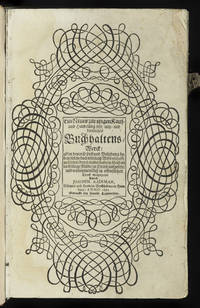
3399Title within elaborate calligraphic woodcut border title a little soiled & frayed around edges. 242 leaves the last a blank. Small folio cont. blind-stamped panelled pigskin over wooden boards binding somewhat soiled pigskin at one corner worn away remains of clasps & catches. Hamburg: A. Lichtenstein 1682. First edition extremely rare of this large and comprehensive Hamburg manual of accounting techniques. Only two other copies seem to be extant: one at the British Library and the other Tübingen. The book was a success and a second edition was published in 1714 under the title Der Werth-geschätzte Handels-Mann. Joachim Rademann was a chartered accountant at Hamburg. At the end of this his first published work he describes himself a "young man" and according to Schröder he married in 1683; otherwise nothing seems to be known of his life. Based on Christoph Achatius Hager's treatise Buchhalten uber proper Commission und Compagnia Handlungen first published at Hamburg ca. 1625 Rademann's book takes into consideration the changes and innovations that trading and coinage had seen since then and focuses on practical matters. The general ledger section comprises a Memorial a Journal and a Hauptbuch; the associated accounts include a Cassa-Buch cash journal a Banca-Buch bank account an Unkostenbuch book of charges a Monat-Buch monthly journal and a Factura-Buch and Rechnungs-Copey-Buch books of invoices. Precise examples taken from actual trading accounts at Hamburg are given throughout. "Rademann dispenses with long theoretical preambles and instead when differentiating between debtor and creditor points to the works of Hager and Gebhardt Overheiden. To the associated accounts Rademann adds the Portbuch von Briefe today's petty cash book. In the Memorial Rademann follows his predecessor Hager but adds a wealth of detail. The same applies to the Journal.The impersonal accounts that follow are remarkable not only for their multitude but also for the exceptionally delicate and skillful handling of the accounts. Rademann's work is nothing short of excellent."-Penndorf Geschichte der Buchhaltung in Deutschland p. 219 in trans. Very good copy of this extremely rare book. First fifteen leaves with light dampstaining. ⧠Hausdorfer 198. Historical Accounting Literature 28. Hoock/Jeannin II R.1. 1. Humpert 396. Schröder VI 3077 1. Not in Goldsmiths Kress or Rapp. hardcover books
667022 leaves including some blanks or pages ruled in ink for entries. Agenda format 315 x 100 mm. stitched as issued uncut. Nuremberg: 1598. A fascinating document of a type that rarely survives: the manuscript account book for the spring 1598 Leipzig fair of Hans Straub I or the Elder 1541-1610 the prominent Nuremberg gold- and silversmith alderman and son-in-law of Wenzel Jamnitzer the best-known German goldsmith of his time. The first leaf bears Straub's hallmark interwined initials "HS" over an arrow pointing upward within a plain shield & also containing the inscription "No. 72". Our manuscript sheds important light on the business relations in the late 16th century between the Nuremberg goldsmiths and their trade at the Leipzig fairs. Our account book is a list of sales orders and expenditures of Nuremberg goldsmith Hans Straub the Elder during the Leipzig Easter fair held in May 1598. While Straub is not expressly named he can be identified by his hallmark on the first leaf. At the fair trade was done in goblets rings knife-sheaths cutlery jewelry gemstones etc. Several business partners are named including the Nuremberg goldsmiths Heinrich Hahn Haan David Lauer and Paulus Koch. As an example of a transaction we see that the council of Halle paid over 33 florins for a goblet. In 1596 Straub was elected Alderman of the Artisans the most elevated and honorable office to which a Nuremberg artisan could aspire. Straub retained this position until his death in 1610. In 1569 he married Anna daughter of the famous goldsmith Wenzel Jamnitzer. On his father-in-law's death in 1585 Straub inherited his casting molds and used them extensively in his own creations. Despite his long period of activity relatively few pieces made by Hans Straub have survived see Nürnberger Goldschmiedekunst 1541-1868 2007 ed. by Karin Tebbe et al. Vol. I p. 409. In fine condition. ❧ The mark is similar to Marc Rosenberg Der Goldschmiede Merkzeichen Frankfurt 1925 Vol. III no. 3969. unknown books
159866701598. 22 leaves including some blanks or pages ruled in ink for entries. Agenda format 315 x 100 mm. stitched as issued uncut. Nuremberg: 1598.<br/> <br/> A fascinating document of a type that rarely survives: the manuscript account book for the spring 1598 Leipzig fair of Hans Straub I or the Elder 1541-1610 the prominent Nuremberg gold- and silversmith alderman and son-in-law of Wenzel Jamnitzer the best-known German goldsmith of his time. The first leaf bears Straub’s hallmark interwined initials “HS†over an arrow pointing upward within a plain shield & also containing the inscription “No. 72â€. Our manuscript sheds important light on the business relations in the late 16th century between the Nuremberg goldsmiths and their trade at the Leipzig fairs.<br/> <br/> Our account book is a list of sales orders and expenditures of Nuremberg goldsmith Hans Straub the Elder during the Leipzig Easter fair held in May 1598. While Straub is not expressly named he can be identified by his hallmark on the first leaf. At the fair trade was done in goblets rings knife-sheaths cutlery jewelry gemstones etc. Several business partners are named including the Nuremberg goldsmiths Heinrich Hahn Haan David Lauer and Paulus Koch. As an example of a transaction we see that the council of Halle paid over 33 florins for a goblet.<br/> <br/> In 1596 Straub was elected Alderman of the Artisans the most elevated and honorable office to which a Nuremberg artisan could aspire. Straub retained this position until his death in 1610. In 1569 he married Anna daughter of the famous goldsmith Wenzel Jamnitzer. On his father-in-law’s death in 1585 Straub inherited his casting molds and used them extensively in his own creations. Despite his long period of activity relatively few pieces made by Hans Straub have survived see Nürnberger Goldschmiedekunst 1541-1868 2007 ed. by Karin Tebbe et al. Vol. I p. 409.<br/> <br/> In fine condition.<br/> <br/> ⧠The mark is similar to Marc Rosenberg Der Goldschmiede Merkzeichen Frankfurt 1925 Vol. III no. 3969. unknown
1669B6290London: Printed by John Macock for the Author Ogilby. c.1669. A fine attractive and handsome copy with text and plates clean and crisp. Edition: First or 1669 Edition in English. Binding: Contemporary mottled full calf rebacked expertly saving the original spine spine with seven raised gilt bands; compartments densely gilt ornamentated; with gilt lettered title on brown morocco label on two and three. Blind dentelle pattern tooled on edges of covers; pasted and free endpapers marbled. <br><br><br> Notes: John or Johann Nieuhof 1618 – 1672 is best known for the account of his journey from "Guangzhou"Canton to Peking in 1655-1657 which enabled him to become an authoritative Western writer on China. The book was first published in Dutch in 1665 by Johan's brother Hendrik and the Amsterdam based publisher and printer Jacob van Meurs. The publication was successful several edited editions followed geared towards commercial interests also translated into French German Latin and eventually into English. The English version was not published by Van Meurs but by John Ogilby instead. The book consists of the notes and illustrations that Nieuhof made in his position as a steward on Peter de Goyer and Jacob de Keizer's embassy to the emperor of China. The work itself is split into two parts. The first part contains the written account of the embassy led by Peter de Goyer and Jacob de Keizer to the emperor of China. It details the entire journey from "Guangzhou"Canton to Peking and back again. This part also contains descriptions and depictions of all that the embassy came to pass on its trip. The second part consists of an overview of China describing bridges mountains temples customs and costumes supported by illustrations. Prior to this period the image of the Chinese in Europe was dominated by fantasy illustrations. Many subsequent artists and architects based their work on Nieuhof's pictures. The present copy John Ogilby’s translation and the first Edition in English. Apart from 'An embassy from the East-India Company…’ Nieuhoff’s account of his journey it also includes ‘A Narrative of the Success of an Embassage sent by John Maatzuyker's de Badem General of Batavia…’ and Kircher’s ‘An Appendix or Special Remarks taken at large out of Athanasius Kircher/ His / Antiquities of China.’<br><br> Size: Folio 418 x 270mm. Illustration: engraved frontispiece portrait of John Ogilby by Lilly and engraved by Lombart; engraved illustrated title signed and dated by ‘W.enceslas Hollar 1668.’; printed title in red and black ink; map of China signed by Hollar double page dedication leaf to King Charles; with 17 full-page and 2 double-page plates. 121 in-text illustrations throughout as well as head-piece vignettes and rubricated historiated initials at openings of dedication and sections; one endpiece.<br>Wide margined large paper copy; main text jumps from 184 to 205 without loss of content. References: Cordier Sinica II 2347; Lust 536; Wing N1153 Transation: John Ogilby’s Englis Pages: PP. illustrated title blank printed title blank map; dedication leaf to King Charles; 327 bl.; 1-18; appendix 1-106 19 ill. Category: Book Voyages General; Book Asia Far East Printed by John Macock for the Author [Ogilby],. unknown
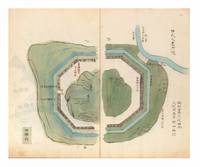
773260 double-page two have flaps & several single-page illus. using brush & washes of many colors. 30; 31.5; 31 folding leaves. Three vols. Large 8vo 308 x 210 mm. orig. decorated semi-stiff boards manuscript titles on upper covers new stitching. Japan: Author's Prefaces dated 1699 & 1709; Postfaces by Nobutomo Ban dated 1813 & 1841.<br/> <br/> A most interesting and attractively illustrated manuscript. In the late 17th century the brother of Kotaku Hosoi Chimei d. ca. 1697 a samurai in service to the Koriyama fiefdom visited the Nara area and was saddened by the disrepair of the many mausoleums tombs and tumuli of former emperors. Chimei began a survey of grave sites and his work came to the notice of the shogun Tsunayoshi Tokugawa 1646-1709 who in 1697 ordered a series of fences to be built around these sites in Yamato no kuni including Nara Kyoto Osaka Hyogo and other areas. These fences - pictured in many of our manuscript's illustrations - were designed to protect the sites from further ruin and robbings.<br/> <br/> Upon Chimei's death his brother Kotaku 1658-1735 calligrapher and Confucian scholar took over the survey which is contained in the first two volumes of our manuscript. At the beginning of the first volume is a list of all the mausoleums recorded by the Hosoi brothers with the names of the emperors and the locations arranged not chronologically but by region. Also included are descriptions of the grave sites and the existing structures. <br/> <br/> Each volume includes an attractive series of double-page brush and color-wash illustrations of the 35 actual sites. In the second volume two of the illustrations contain flaps under which are shown the interiors of the stone burial chambers. Measurements are given along with details of ownership. Most notable is a fine double-page illustration of the famous Takamatsuzuka circular tomb.<br/> <br/> The third volume is an addendum written by Nobutomo Ban 1773-1846 Confucian scholar of kokugaku the study of Japanese history and samurai retainer who was famous for the quality of his historical research especially in archeology and religious studies. In this volume there are 25 fine double-page illustrations in brush and color wash and some black & white diagrams of more mausoleums tombs and tumuli mostly outside of Yamato no kuni including the former provinces of Ise Sado Harima Satsuma Osumi Kawachi and others. Ban's explanatory text accompanies the illustrations.<br/> <br/> In the first two volumes Ban has added further notes in red ink regarding other archeologists' researches and reports from local governments.<br/> <br/> Fine copy preserved in a chitsu. Some worming occasionally touching a character or illustration.<br/> <br/> ⧠Edgren Catalogue of the Nordenskiöld Collection 1980 490. The Imperial Household Agency Library Shoryobu owns a rather similar manuscript. unknown
6549Fine woodcut vignette on title see below. 32 pp. Small 4to early 20th-cent. calf double gilt fillet round sides a.e.g. London: P. Short 1600. First edition and of the greatest rarity this is the first of three issues as described by ESTC which locates only two copies of all the issues in North America. "Sir Hugh Platt 1552-1608 held by Richard Weston to be 'the most ingenious husbandman of the age he lived in'.was admitted at Lincoln's Inn. Much of his life was devoted to literary work and to the study of husbandry and gardening. He was also interested in all kinds of inventions and experiments.In 1600 appeared Platt's New and admirable arte of setting of corne a treatise in which this author advocates growing corn by setting the seed at regular distances apart the usual method of sowing corn at that time being by broadcast. On the title-page of this small quarto volume is a woodcut of a growing plant of corn over which is a spade lying in a scroll bearing the words 'Adam's toole revived'."-Henrey I p. 155 & no. 301. The book is divided into eight chapters and is signed by Plat at end. Fine copy. Natural marginal paper flaw to D2 carefully repaired. ❧ ESTC S122434. Fussell I p. 15-"Deals with the then new idea of setting corn seed at equal distances apart both in the row and between the rows so that seed might be conserved and the crop enhanced." McDonald Agricultural Writers from Sir Walter of Henley to Arthur Young 1200-1800 p. 58. unknown books
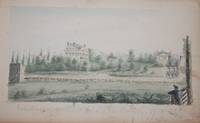
1828006534New York City 1828. Hardcover. Cloth spine. Marbled pastedown on boards. Leather centerpiece label on front board. Good. Original watercolors of rural Manhattan as it appeared in 1828. Among these and captioned are a farmhouse on Broadway and 8th Street; Kips Bay showing a boy sailing a small craft with a farmhouse in the background; a house in Bloomingdale the location of an early village now the Upper West Side along the river between 96th and 106th Streets; and a stately mansion surrounded by fields and less important buildings we would conjecture in or around Bloomingdale but captioned surely incorrectly the Battery. Most of the paintings are uncaptioned. Of these some are surely the Upper Hudson area or are scenes that we can't tell whether they are upstate or in the present day city. The artist also ventured away from the New York areas. Among the non-New York paintings are a depiction of the Cape Pogue Lighthouse on Martha's Vineyard which still stands; Fowey Harbour which is in Cornwall; and a few scenes which look very much like Scotland. Oblong 14 by 19.5 cm. 55 watercolors generally fully finished. Although the sketchbook has a label on its front board bearing the name of Walter Oddie who was a listed artist we believe a good amount of the artwork contained in this sketchbook is of his father-in-law Henry Meigs. Meigs had been a U.S. Congressman from New York and also held a number of other political positions in the city over the course of his career. More pertinently Meigs was known to be an amateur painter and as such an inspiration to Oddie. Given Oddies youth at the time -- he was 20 or 21 years old and from his diary for the years 1828 and 1829 now housed in the Winterthur Library we know he was just starting to paint we find it inconceivable that he would have had the skill yet to produce the sensitive and fine renderings of nature and buildings that typify this sketchbook. Further underlying our thinking about attribution is that some of captioning only makes sense if Meigs were the primary artist. We do consider it quite likely that Oddie may have done some of the sketchier work contained herein as well as contributing in bits and pieces to his father-in-laws work as well as perhaps copying some of it in this sketchbook. To us it isnt really so important who was responsible for particular paintings in the sketchbook. Rather the significance lies in the recording of New York City and its surroundings at the time we suspect that there may be no recording anywhere of some of the buildings and locations at this time. And of course not to be minimized is the beauty of the better paintings contained in the sketchbook.Whatever the degree of Oddies contribution the sketchbook does have something to say about his career and visa versa given that it contains the type of artwork for which he became known later. Oddie was born in Maryland Washington D.C. or possibly New Orleans but spent almost his entire life in New York and more specifically New York City Brooklyn or Long Island. In 1828 the year most of the watercolors in the catalogue were executed Oddie was spending much of his time in the city.Once Oddies interest in painting was sparked he was believed to have been largely self-taught but he did come to study art with Hudson River School painter Robert Walter Weir and Anthony Lewis De Rose a portrait and historical painter. From the diary we know that Oddie did work with De Rose in 1829; we believe that his tutelage with Weir came later. From the diary we know that Oddie was regularly going to art exhibits and critiquing what he saw. The diary also discloses or corroborates our prior sense that Oddie sometimes would work off of engraved prints. To what degree he was merely copying the prints as opposed to using the prints as a spur to his own imagination we can not determine with certitude. We tend to think the views of Scottish and Welsh castles contained in the Sketchbook were done by Meigs not Oddie and so they might well have been done from life.From the diary we know that Oddie had some day job that occupied him during the week and so he did most of his painting at that time on the weekends when he would often go for long hikes along the Hudson. Oddie also refers in the diary to having been in Hudson then and now the county seat of Columbia County and so it is very plausible that some of the upstate scenery is from around there. Again we think some of these paintings may have been done by Meigs.Oddie would become an associate member of the National Academy of Design where he frequently exhibited his artwork.One further note we spoke of questioning one caption referring to the Battery. In 1828 the urbanized part of the city didnt even reach 14th Street but the Battery as the oldest part of the city was thoroughly urbanized. Thus the painting could not be of the Battery. But the landscape is very consistent with the topography of Upper Manhattan. <br /> hardcover books
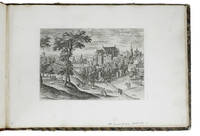
1575ABC_46067Antwerp: Hans van Luyck 1575. Modern red half cloth marbled sides. Oblong folio album 24.5 x 35.5 cm. Series of 24 engravings plate size ca. 20 x 14 cm with views of landscapes around Brussels by Hans I Collaert possibly after Hans Bol or Jacob Grimmer each with a caption in the plate plates 8 and 20 also with Van Luyck and Collaert's monograms "H.V.L.EXcudit" and "H.C.Fecit". Trimmed down to the plate edge and mounted on album leaves numbered in pencil on the album leaves next to the engravings. Album with the complete series of Collaert's views around Brussels here in its first unnumbered state published by Hans van Luyck in Antwerp. Hans I Collaert ca. 1525/30 - 1585 was a painter-draughtsman who founded the influential Collaert dynasty of engravers and print publishers. The views show villages castles and abbeys in the vicinity of Brussels engraved in a very naturalistic way. The series includes a view of the cloister of Zevenborren south of Sint-Genesius-Rode views of Schaarbeek Elsene Etterbeek Stal Eggevoort and Bosvoorde and views of the some castles including those of Brussels Coensborg south of Laken and Carloo. Some references attribute the drawing of the views to Hans Bol because of an inscription added to the first plate of the later Visscher edition but the "related drawings are not consistent with Bol's style" New Hollstein. Others name Jacob Grimmer as an alternative candidate for the artist who drew the views.With a 20th-century manuscript inscription on the first free endleaf mistakenly identifying the series as the second state published by Visscher which is however numbered in the plates in contrast to the present series in an unnumbered first state. Binding slightly worn around the edges some slight marginal foxing stains browning and soiling but overall a beautiful album complete and therefore rare with all the plates of Collaert's views around Brussels here in its first state.l Hollstein IV 149-172; New Hollstein The Collaert dynasty V 1229-1252; cf. New Hollstein The Collaert dynasty I pp. xlix-liii. Hans van Luyck, hardcover
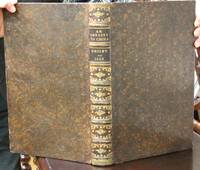
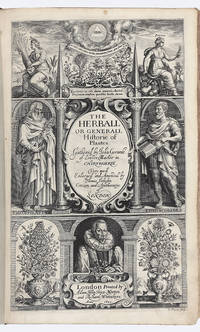
5564Finely engraved title woodcut head- & tailpieces & 2776 woodcuts in the text. 20 p.l. incl. initial blank & engraved title 1630 48 pp. one blank leaf. Thick folio 350 x 210 mm. cont. calf well-rebacked by Trevor Lloyd with the original spine laid-down a few gouges carefully filled-in corners bruised panelled in gilt & blind large gilt device in center of each cover with initials "W H" on either side. London: A. Islip for J. Norton & R. Whitakers 1633. First edition of Thomas Johnson's expanded and corrected version of Gerarde's Herball 1st ed.: 1597 the most famous of all English herbals. "Many errors made by Gerard in his text and in the identification of the illustrations were corrected by the apothecary and botanist Thomas Johnson d. 1644 of London who prepared an expanded edition of The Herball that first appeared in 1633.Johnson's painstaking revision of Gerard's herbal constituted in itself a valuable contribution to botany and to the art of the printed book. He added the descriptions of many new plants with illustrations some of them borrowed from the botanical texts published by Christophe Plantin in Antwerp in this way bringing the total number of engravings to 2776. Any new passages were carefully marked with special symbols so that the reader could distinguish them from the original text. "The title-page of The Herball is particularly attractive. It was executed by John Payne 1607-1647 one of the most talented engravers of the period.In the upper part of Payne's work we see a luxuriant garden with the goddesses Ceres and Pomona on either side. Below them are the fathers of botany Theophrastus and Dioscorides while in the lower section two imposing vases filled with flowers surround a portrait of Gerard who is shown facing in the opposite direction to that of the portrait by Rogers. The vase on the left is crowned with a bunch of bananas as a tribute to Johnson. "One of the most significant additions made by Johnson was his chapter on the 'Maracot' or 'Grandilla' as it was called at the time actually the passion-flower. He includes a full page illustration p. 1592 and refers the reader to Monardes for more information on this exotic species.In the long preface Johnson traces the history of the botanical sciences analyzing the contributions of celebrated figures from the mythical King Solomon to William Turner.He closes with some critical remarks on John Gerard and the origins of his herbal."-Tomasi & Willis An Oak Spring Herbaria p. 84. An uncommonly nice and crisp copy. Bookplates of John Charles Bigham Viscount Mersey Bignor Park and Oliver Howard. ❧ Garrison-Morton 1820-1st ed. of 1597-"The most important edition of his book is the second published by T. Johnson in 1633." Henrey I pp. 48-54-"Johnson produced an edition that was noteworthy for its many corrections improvements and additions" & no. 155. Hunt 223. unknown books
6775Eight columns per page 17 characters per column. Three sizes of type. 42; 41; 38; 40 folding leaves. Four vols. Large 8vo 280 x 195 mm. orig. dark wrappers dyed with persimmon juice shibubiki new stitching. Enryakuji Temple Mount Hiei: mid-Kan'ei ca. 1626-30. An unrecorded moveable type edition of the commentary and subcommentary of Zongmi 780-841 on the Sutra of Perfect Enlightenment. This is a rare example of an Eizan-ban a book printed with moveable type at the temples on Mount Hiei outside of Kyoto where Enryakuji Temple one of the most important monasteries of Japan and the headquarters of the Tendai sect of Japanese Buddhism is located. Printing began there in the 13th century. "There were few of these printed books in the medieval period perhaps due to the dominance of Kyoto itself as a printing centre.Eizan printing came into its own on a large scale only from the end of the sixteenth century with the introduction of movable-type printing. Typographic printing flourished at various temples on Hieizan from the Keicho to Kan'ei periods 1596-1644 and with the publication of Chinese works as well as Tendai scriptures publication and distribution at Hieizan began to develop into the beginnings of a commercial enterprise."-K.B. Gardner "Centres of Printing in Medieval Japan: Late Heian to Early Edo Period" reprinted in Brokaw & Kornicki eds. The History of the Book in East Asia 2013 p. 450. The writings of Dushun 557-640 Zhiyan 602-68 Fazang 643-712 and Zongmi are considered by many as the "crowning glory of Chinese thought. marking the maturation of a process by which the Chinese made Buddhism their own."-Bowring The Religious Traditions of Japan 500-1600 p. 104. Zongmi was a Tang dynasty Buddhist scholar monk; he was the fifth patriarch of the Huayan school as well as a patriarch of the Heze lineage of Southern Chan. The Sutra of Perfect Enlightenment was the scripture that led Zongmi to enlightenment in 808; he resolved to prepare a commentary and subcommentary on the text which he accomplished fifteen years later. As stated above this moveable type edition is unrecorded. Kawase in his bibliography of Japanese moveable type editions records another printing of this text dated 1626 but with ten columns per page and 20 characters per column Vol. I p. 304. Sorimachi in his amazing 40th anniversary catalogue of moveable type books issued in 1972 describes what appears to be yet another moveable type printing of this text with the same number of columns and characters as the Kawase example but using three different sizes of type they might be the same printing. It is described as four parts in two volumes in their original bindings printed in mid-Kan'ei ca. 1630 and with a slightly different title. The NIJL records no moveable type editions and only the woodblock-printed Seihan edition of 1644. On the printed title-labels of the second and fourth volume covers the title is given as Engaku ryakusho chu. The labels on Vols. I and III are no longer present. As mentioned above the wrappers have been dyed with persimmon juice which serves a dual purpose: to strengthen the paper and act as an insect repellent. Nevertheless the wrappers are somewhat wormed. Each volume has some worming but this set is in rather fresh and appealing condition. unknown books
6775Eight columns per page 17 characters per column. Three sizes of type. 42; 41; 38; 40 folding leaves. Four vols. Large 8vo 280 x 195 mm. orig. dark wrappers dyed with persimmon juice shibubiki new stitching. Enryakuji Temple Mount Hiei: mid-Kan’ei ca. 1626-30.<br/> <br/> An unrecorded moveable type edition of the commentary and subcommentary of Zongmi 780-841 on the Sutra of Perfect Enlightenment. This is a rare example of an Eizan-ban a book printed with moveable type at the temples on Mount Hiei outside of Kyoto where Enryakuji Temple one of the most important monasteries of Japan and the headquarters of the Tendai sect of Japanese Buddhism is located. Printing began there in the 13th century. “There were few of these printed books in the medieval period perhaps due to the dominance of Kyoto itself as a printing centre…Eizan printing came into its own on a large scale only from the end of the sixteenth century with the introduction of movable-type printing. Typographic printing flourished at various temples on Hieizan from the Keicho to Kan’ei periods 1596-1644 and with the publication of Chinese works as well as Tendai scriptures publication and distribution at Hieizan began to develop into the beginnings of a commercial enterprise.â€â€“K.B. Gardner “Centres of Printing in Medieval Japan: Late Heian to Early Edo Period†reprinted in Brokaw & Kornicki eds. The History of the Book in East Asia 2013 p. 450.<br/> <br/> The writings of Dushun 557-640 Zhiyan 602-68 Fazang 643-712 and Zongmi are considered by many as the “crowning glory of Chinese thought… marking the maturation of a process by which the Chinese made Buddhism their own.â€â€“Bowring The Religious Traditions of Japan 500-1600 p. 104.<br/> <br/> Zongmi was a Tang dynasty Buddhist scholar monk; he was the fifth patriarch of the Huayan school as well as a patriarch of the Heze lineage of Southern Chan. The Sutra of Perfect Enlightenment was the scripture that led Zongmi to enlightenment in 808; he resolved to prepare a commentary and subcommentary on the text which he accomplished fifteen years later.<br/> <br/> As stated above this moveable type edition is unrecorded. Kawase in his bibliography of Japanese moveable type editions records another printing of this text dated 1626 but with ten columns per page and 20 characters per column Vol. I p. 304. Sorimachi in his amazing 40th anniversary catalogue of moveable type books issued in 1972 describes what appears to be yet another moveable type printing of this text with the same number of columns and characters as the Kawase example but using three different sizes of type they might be the same printing. It is described as four parts in two volumes in their original bindings printed in mid-Kan’ei ca. 1630 and with a slightly different title. The NIJL records no moveable type editions and only the woodblock-printed Seihan edition of 1644.<br/> <br/> On the printed title-labels of the second and fourth volume covers the title is given as Engaku ryakusho chu. The labels on Vols. I and III are no longer present.<br/> <br/> As mentioned above the wrappers have been dyed with persimmon juice which serves a dual purpose: to strengthen the paper and act as an insect repellent. Nevertheless the wrappers are somewhat wormed.<br/> <br/> Each volume has some worming but this set is in rather fresh and appealing condition. unknown
157665511576. Numerous woodcut illus. in the text. Largely printed in black letter. 7 p.l. first leaf blank except for signature mark 63 1 pp. Small 4to early 20th cent. polished mottled calf by Riviere triple gilt fillet round sides spine richly gilt red morocco lettering pieces on spine dentelles gilt a.e.g. London: H. Denham 1576.<br/> <br/> Second edition “nowe newly corrected and augmented†of the first English book on hops. The first edition appeared two years earlier; both editions are very rare. This is “an eminently practical treatise illustrating the various methods of setting the roots making the hills and ramming the poles tying the bine and its pulling up and preservation with a number of curious cuts. It was the work of a practical man written for practical men and in this respect is far in advance of most of Scot’s contemporaries who were still much interested in the superstitions of the time and the traditional pseudo-science of the Middle Ages.â€â€“Fussell I p. 12.<br/> <br/> Clinch in his English Hops a History of Cultivation and Preparation for the Market from the Earliest Times 1919 states that in many respects “the information is as useful today as it was nearly three-and-a-half centuries ago when it was published.â€<br/> <br/> Scot d. 1599 is most famous for his The Discoverie of Witchcraft 1584 in which he attacked the general belief in witchcraft and other forms of credulity and superstition including astrology alchemy and Catholicism. For more on Scot and his fascinating life see ODNB.<br/> <br/> Fine copy. Signature of T. Barling on first leaf.<br/> <br/> ⧠Henrey I p. 64 & no. 338. McDonald Agricultural Writers from Sir Walter of Henley to Arthur Young 1200-1800 pp. 34-36. unknown
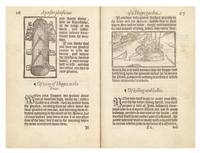
6551Numerous woodcut illus. in the text. Largely printed in black letter. 7 p.l. first leaf blank except for signature mark 63 1 pp. Small 4to early 20th cent. polished mottled calf by Riviere triple gilt fillet round sides spine richly gilt red morocco lettering pieces on spine dentelles gilt a.e.g. London: H. Denham 1576. Second edition "nowe newly corrected and augmented" of the first English book on hops. The first edition appeared two years earlier; both editions are very rare. This is "an eminently practical treatise illustrating the various methods of setting the roots making the hills and ramming the poles tying the bine and its pulling up and preservation with a number of curious cuts. It was the work of a practical man written for practical men and in this respect is far in advance of most of Scot's contemporaries who were still much interested in the superstitions of the time and the traditional pseudo-science of the Middle Ages."-Fussell I p. 12. Clinch in his English Hops a History of Cultivation and Preparation for the Market from the Earliest Times 1919 states that in many respects "the information is as useful today as it was nearly three-and-a-half centuries ago when it was published." Scot d. 1599 is most famous for his The Discoverie of Witchcraft 1584 in which he attacked the general belief in witchcraft and other forms of credulity and superstition including astrology alchemy and Catholicism. For more on Scot and his fascinating life see ODNB. Fine copy. Signature of T. Barling on first leaf. ❧ Henrey I p. 64 & no. 338. McDonald Agricultural Writers from Sir Walter of Henley to Arthur Young 1200-1800 pp. 34-36. unknown books
1486ABC_47548Strasbourg: Johann Prüss 1486. Contemporary blind-tooled pigskin over wooden beechwood boards by an Augsburg bindery Eindbanddatenbank workshop w002998 active ca. 1488-1497 sewn on 3 double supports each board in a panel design with 4 concentric multi-fillet rectangular frames the central field into 4 whole and 8 half-lozenges by 6 diagonal multi-fillets 3 in each direction each whole lozenge stamped with a double fleur-de-lis in a lozenge and each half lozenge with a crown stamp the immediately surrounding fields filled with 32 full and 4 half impressions of a rosette in a square and the next surrounding fields filled with a 10 mm and a 6 mm roll the outermost fields empty making in total 88 full and 8 partial impressions of 3 stamps plus the 2 rolls. Remnants of 2 strap fastenings catchplates and clasps lost 7 leather tabs or traces of lost leather tabs wrapped around the fore-edge margin 0.5 x 1 cm marking the opening of libri 2-8. Chancery folio 32.5 x 22 cm. Printed in 2 columns with 48 lines to the column. Set in 2 sizes of rotunda gothic types Prüss types 2 180G and 3 90G with spaces left some with and some without printed guide letters for manuscript initials 1 8-line 2 7-line 4 6-line 3 5-line and numerous 3- and 4-line. From the beginning to h3r these spaced have been filled in with manuscript lombardic initials in red and the text has been rubricated the first fifth of the book. Written around 1280 the Rationale divinorum officiorum is considered one of the principal sources for the western church liturgy. It focuses on the allegorical interpretation of the liturgy based on Amalario's work and Duanti is recognized as an excellent compiler. The book is divided into eight volumes and provides an elaborate account of the laws ceremonies customs and mystical interpretations of the Roman Rite. The first volume discusses religious art and architecture such as the church altar pictures bells churchyard and more. The second volume is dedicated to the ministers while the third volume focuses on vestments. The fourth volume discusses the Mass the fifth covers the canonical hours the sixth volume is about the Proprium Temporis the seventh is about the Proprium Sanctorum and the eighth covers the astronomical calendar the manner of finding Easter Epacts and more. The Rationale is considered the most comprehensive medieval treatise of its kind serving as a significant authority on medieval Latin liturgy. It had at least 44 editions during the incunabula age since its first printing in 1459 by Johann Fust and Peter Schöffer in Mainz. Even today it remains the standard authority for rituals clothing and symbolism from the thirteenth century.Guillaume Durand Bishop of Mende was an important liturgical author and canonist. Born in 1237 in Puimisson Provence a Canonist and prominent liturgical writer of the medieval period Durandus earned the nickname "Speculator" from his work Speculum Judiciale. After studying law under Bernard of Parma at Bologna he went on to teach law at Modena before being summoned by Clement IV to Rome. Lacking the final blank leaf L10. The leaves in the central part of the book h4-E2: about 160 leaves show only one or two small worm holes but in the leaves before and after about 60 leaves each the worm holes gradually multiply as one approaches the beginning and end. In general the bookworms were kind enough to tunnel straight through rather than turning to the side so that only a handful of leaves show trails and those are few and short in the worst leaves 2 trails of 1 and 1.5 cm. They did continue through the paste-downs boards and hinges leaving numerous very small holes in the pigskin though the spine remains almost untouched. The bookworms appear not to have grown fat from their feast because their holes measure only about 1.5 mm in diameter. Aside from the worm holes the book is internally in very good condition with only minor marginal stains in the last 5 leaves and an occasional small marginal tear or chip 4 of the 7 leather tabs have torn off sometimes also affecting the leaf before or after but none of these few minor blemishes comes close to the text. One can see where two catchplates were once attached to the fore-edge of the binding and remnants survive of the two leather straps that would have held the clasps. The boards are somewhat rubbed making it difficult to see details in some of the tooling but thanks to the numerous repetitions of the three stamps and one roll or possibly two rolls side by side the binding provides some clear impressions of most and all can be identified. An early edition of an important book on church liturgy in contemporary blind-tooled pigskin with an interesting provenance and nearly untrimmed several leaves preserving deckles at the foot quires b c and others fore-edge quires s y z and others and head quire K and others.l Collijn Uppsala 514; GW 9131; Goff G431; Hain-Copinger 6491; ISTC id00431000; Pellechet 4508; Polain 1379; USTC 744525; for Scheyern Abbey its bindery its library and Georg Waser see John Thomas McQuillen In manuscript and print: the fifteenth-century library of Scheyern Abbey PhD thesis University of Toronto 2012 mcquillen_john_t_2012nov_phd_thesis.pdf pp. 27-35 220-229 & 309. [Johann Prüss], hardcover
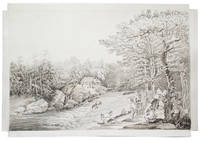
180052601Canada 1800. Graphite pen-and-ink and grey wash on wove paper watermarked "W. Elgar 1796". 13 5/8 x 20 inches. Corners clipped outside the image verso toned. Graphite pen-and-ink and grey wash on wove paper watermarked "W. Elgar 1796". 13 5/8 x 20 inches. Along the falls of a tree-lined river two First Nations men are pulling a canoe into the water directed by another in an elaborate feather headdress; a wigwam with mother and child is on the same shore to their left; across the river a longhouse and structure for smoking fish with another group of native people can be seen; at the far left a First Nations man is standing in his canoe fishing with a pole in the water just below the rapids.<br /> <br /> Although the 1796 watermark on the paper is consistent with drawings by Heriot the unfinished quality of this work make attribution difficult. However it is somewhat reminiscent of a smaller grisaille watercolor signed by Heriot titled FALLS OF THE POQUISQUE ON THE RIVER ST JOHN on verso sold at Waddington's March 15 2018 lot 137.<br /> <br /> Furthermore this scene is reminiscent of one described by Heriot in his Travels in the Canadas 1807 in which he describes Native American fishing on the cacasdes of St. Mary nine miles below the entrance to Lake Superior: "It is at the bottom of the rapids and even among their billows which foam with ceaseless impetuosity that innumerable quantities of excellent fish may be taken from the spring until the winter; the species which is found in the greatest abundance is denominated by the savages atticameg or white fish; the Michilimakinac trout and pickerell are likewise caught here. These aflford a principal means of subsistence to a number of native tribes. No small degree of address as well as strength is employed by the savages in catching these fish; they stand in an erect attitude in a birch canoe and even amid the billows they push with force to the bottom of the waters a long pole at the end of which is fixed a hoop with a net in the form of a bag into which the fish is constrained to enter. They watch it with the eye when it glides among the rocks quickly ensnare it and drag it into the canoe. In conducting this mode of fishing much practice is required as an inexperienced person may by the efforts which he is obliged to make overset the canoe and inevitably perish."<br /> <br /> Trained by Paul Sandby at the Royal Military Academy Woolwich London Heriot worked as a clerk for Board of Ordnance. "In 1792 Heriot was posted to Quebec and promoted clerk of the cheque in the Ordnance department. Heriot was to remain in Lower Canada until 1816 except apparently for two periods of absence in 1796-97 and in 1806. His first years at Quebec are not well documented. Sketches record visits in and about Quebec and Montreal perhaps on Ordnance business. In November 1792 he published a sketch of Jersey in the Quebec Magazine and the following year he prepared a view of Quebec perhaps also intended for publication. When he returned to Britain in 1796 he resided in London travelled to the south coast and made at least one sketching foray into Wales . A watercolour prepared from his sketches of Wales and two Canadian views were accepted by the Royal Academy of Arts for exhibition in the spring. Heriot probably sailed for Lower Canada soon afterwards taking notes and making sketches on the voyage. The impact of his visit to Britain was considerable. While there he had been stimulated by the art he had seen and by his success as an artist. He returned with a fresh enthusiasm for the Canadas; he began to read about their past and to make elaborate notes and numerous sketches of the places he visited and the peoples he encountered. His sojourn abroad had affected his artistic vision of the Canadas; his drawings and water-colours assumed a new confidence and his landscape forms developed a new strength and grandeur. In London he had probably studied the simply handled and remarkably strong water-colours of younger British artists such as Thomas Girtin Joseph Mallord William Turner and John Varley. Either in Britain or in Lower Canada he had also become familiar with Lieutenant George Bulteel Fisher's Six views of North America . London 1796. He was influenced by this work especially by Fisher's use of the Picturesque in depicting Canadian landscape" Dictionary of Canadian Biography. unknown
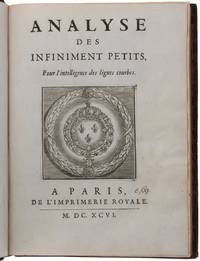
17002848Paris: L'imprimerie Royale; Jean Boudot 1700. First edition. First editions. L'Hôpital's treatise on differential calculus was based on lessons he received from Johann Bernoulli and it was under the influence of Malebranche that some years later appeared the first work on the integral calculus by Louis Carré. Hardcover. THE FIRST BOOKS ON DIFFERENTIAL AND INTEGRAL CALCULUS. <p>A fine sammelband comprising the first editions of the first books on the differential and integral calculus respectively. "In France it was through the Oratorian circle of Nicolas Malebranche that Johann Bernoulli introduced in 1691 the Leibnizian calculus. His lessons to the Marquis de l'Hôpital led to the draft of the first treatise of differential calculus 1696 and it was under the influence of Malebranche that some years later appeared the first works on the integral calculus by Louis Carré in 1700 and Charles René Reyneau in 1708. The spread and acceptance of the Leibnizian calculus was transferred in this way to the wide public" Landmark Writings p. 56. "The importance of L'Hospital's work lay in its dissemination throughout Europe of the concepts and early development of the calculus whose cause L'Hospital advanced as well through his many contacts; these included Christiaan Huygens who is reputed to have learned the calculus from L'Hospital" DSB. Bernoulli's lectures also covered integral calculus but L'Hospital dropped plans to write a continuation to his Analyse des infiniment petits dealing with this subject "in deference to Leibniz who had let him know that he had similar intentions" ibid. Leibniz never wrote such a text however and Bernoulli's lectures on integral calculus remained unpublished until they appeared in his Opera 1742. The task of completing L'Hospital's book was instead taken up by Carré a pupil of Malebranche and assistant to Pierre Varignon from whom he probably learnt calculus. "Following the classical custom his Analyse des infiniment petits starts with a set of definitions and axioms . The difference differential is defined as the infinitely small portion by which a variable quantity increases or decreases continuously. Of the two axioms the first postulates that quantities which differ only by infinitely small amounts may be substituted for one another while the second states that a curve may be thought of as a polygonal line with an infinite number of infinitely small sides such that the angle between adjacent lines determines the curvature of the curve. Following the axioms the basic rules of the differential calculus are given and exemplified. The second chapter applies these rules to the determination of the tangent to a curve in a given point . The third chapter deals with maximum-minimum problems and includes examples drawn from mechanics and geography. Next comes a treatment of points of inflection and cusps. This involves the introduction of higher-order differentials each supposed infinitely small compared to its predecessor. Later chapters deal with evolutes and with caustics. L'Hospital's rule is given in chapter 9" ibid. The tenth and final chapter of the Analyse discusses the methods of Descartes and Johann Hudde. The companion work by Carré is "the first treatise on the integral calculus in any language which is here applied to the determination of the area of superficies surfaces and solids and their centres of gravity problems of percussion oscillation etc." Sotheran. On this last topic the determination of the centres of oscillation of solids Carré made a significant error. This was known to Bernoulli but not publicized at the time and so was propagated into several later calculus texts such as Charles Hayes' Treatise on Fluxions 1704 and Edmund Stone's The Method of Fluxions both Direct and Inverse 1730. Both works are rare on the market: ABPC/RBH list four copies of L'Hospital's book since the Norman copy which realised $6325 in 1998; and only two copies of Carré's work in the last half century. </p> <br /> <p>"Differential and integral calculus are generally considered to have their origins in the works of Newton and Leibniz in the late 17th century although the roots of the subject reach far back into that century and arguably even into antiquity. Leibniz first described his new calculus in a cryptic article more than a decade before the publication of the Analyse. For all practical purposes Leibniz' early papers were not understood until Jakob Bernoulli and his younger brother Johann began studying them in about 1687 and making discoveries of their own using his techniques.</p> <br /> <p>"Bernard de Fontenelle became the secretary of the Académie des Sciences in Paris in 1697 and wrote the eulogy of l'Hôpital for the academy's journal. He said that in 1696 'the Geometry of the Infinitely small was still nothing but a kind of Mystery and so to speak a Cabalistic Science shared among five or six people. They often gave their Solutions in the Journals without revealing the Method that produced them and even when one could discover it it was only a few feeble rays of this Science that had escaped and the clouds immediately closed again.' Later on Montucla went one step further and listed the only people that he believed understood Leibniz' calculus before 1696: Leibniz himself Jakob and Johann Bernoulli Pierre Varignon and l'Hôpital. L'Hôpital's Analyse changed all of this and for much of the 18th century his book served aspiring French mathematicians as their first introduction to the new calculus.</p> <br /> <p>"For all that the Analyse was a popular and successful introduction to the differential calculus it's remarkable that there is no account of the integral calculus in the book. In his Preface l'Hôpital explained why: 'In all of this there is only the first part of Mr. Leibniz' calculus . The other part which we call integral calculus consists in going back from these infinitely small quantities to the magnitudes or the wholes of which they are the differences that is to say in finding their sums. I had also intended to present this. However Mr. Leibniz having written me that he is working on a Treatise titled De Scientiâ infiniti I took care not to deprive the public of such a beautiful Work' p. iii. Unfortunately Leibniz never completed this book On the Science of the Infinite.</p> <br /> <p>"The Analyse consists of ten chapters which l'Hôpital called 'sections.' We consider it to have three parts. The first part an introduction to the differential calculus consists of the first four chapters:</p> <br /> <br /> In which we give the Rules of this calculus. <br /> <br /> Use of the differential calculus for finding the Tangents of all kinds of curved <br /> lines. <br /> <br /> Use of the differential calculus for finding the greatest and the least ordinates to which are reduced questions De maximis & minimis. <br /> <br /> Use of the differential calculus for finding inflection points and cusps.<br /> <br /> <p>"Taken together these chapters provide a thorough introduction to the differential calculus in about 70 pages. The next five chapters are devoted to what can only be described as an advanced text on differential geometry motivated in part by what were then cutting-edge research problems in optics and other fields" Bradley et al. pp. v-vi.</p> <br /> <p>These subsequent chapters no longer mirror the structure of Bernoulli's lectures. Chapter 5 the longest in the Analyse deals with evolutes and involutes including the cycloid and various spirals. Chapters 6-8 are on envelopes of lines and curves i.e. curves that are tangent to every member of a family of lines or curves - this includes the study of caustics in geometrical optics. Chapter 9 contains "the solution of various problems that depend upon the previous Methods;" the first of these is the celebrated rule that we now call L'Hôpital's Rule which was first discovered by Bernoulli. In his final chapter of the Analyse l'Hôpital demonstrates how all of the methods of Descartes and Hudde may be easily derived and justified using Leibniz's differential calculus.</p> <br /> <p>Born into a noble family L'Hospital 1661-1704 abandoned a military career due to poor eyesight to pursue his interest in mathematics. "Some time around 1690 L'Hôpital joined Nicolas Malebranche's circle which was engaged among other things in the study of higher mathematics. It was there in November 1691 that he met the 24-year-old Johann Bernoulli who was visiting Paris and had been invited by Malebranche to present his construction of the catenary at the salon . Bernoulli told Pierre Rémond de Montmort that upon meeting the Marquis he soon found him to be a good enough mathematician with regard to ordinary mathematics but that he knew nothing of the differential calculus other than its name and had not even heard of the integral calculus. L'Hôpital had apparently mastered Fermat's method of finding maxima and minima and told Bernoulli that he had used it to invent a rule for determining the radius of curvature for arbitrary curves. The method was unwieldy and actually could only be used at local extrema of algebraic curves. Bernoulli showed him the formula for the radius of curvature that he had developed with his brother Jakob which employed second-order differentials. Apparently this so impressed the Marquis that he visited Bernoulli the very next day and engaged him as his tutor in the differential and integral calculus.</p> <br /> <p>"Bernoulli tutored the Marquis in his Paris apartment four times a week from late 1691 through the end of July 1692 . In the summer of 1692 Bernoulli accompanied the Marquis to his estate in Oucques near the French city of Blois where he continued giving him tutorials until some time in October . Bernoulli kept copies of his lessons to the Marquis throughout his long and productive career. The first part on the differential calculus was incorporated by l'Hôpital into the first four chapters of the Analyse. Bernoulli himself published the much larger second part concerning the integral calculus in his collected works. Titled Lectiones mathematicae de methodo integralium this treatise bears the subtitle 'written for the use of the Illustrious Marquis de l'Hôpital while the author spent time in Paris in the years 1691 & 1692' . Because Bernoulli chose not to publish this part it was impossible in the 18th century to say how closely l'Hôpital's textbook coincided with Bernoulli's lessons. A comparison finally became possible when Paul Schafheitlin discovered a manuscript copy of the full set of lessons on both the differential and integral calculus in the library of the University of Basel in 1921 . Because the latter part was a near-perfect match to what Bernoulli had published in 1741 he could be quite certain that the first part was essentially the same set of lessons l'Hôpital had used when composing the Analyse .</p> <br /> <p>"Since the appearance of the Lectiones various authors have characterized the Analyse as having essentially been written by Bernoulli. Indeed Bernoulli himself in an angry letter to Varignon of February 26 1707 said that 'to speak frankly Mr. de l'Hôpital had no other part in the production of this book than to have translated into French the material that I gave him for the most part in Latin.' The truth is much more nuanced. The superstructure of l'Hôpital's first four chapters is certainly due to Bernoulli and many of the details are essentially the same in both texts. However l'Hôpital added much in both quantity and quality. For one thing Bernoulli's Lectiones occupied 37 manuscript pages compared to 70 typeset pages for the first four chapters of the Analyse but the Marquis added much more than mere verbiage to Bernoulli's lesson. He was a very talented pedagogue. He organized his material very well extracting general propositions where Bernoulli gave examples and explained matters clearly and in some detail. Furthermore he frequently included many illustrative examples gradually increasing in difficulty generally providing an appropriate level of detail but always leaving some things for readers to work out for themselves" Bradley pp. vii-xi. The last six chapters were not taken directly from Bernoulli's lectures although l'Hôpital has drawn on material provided to him in Bernoulli's letters or in his lessons on the integral calculus.</p> <br /> <p>Louis Carré's 1663-1711 father a prosperous farmer wanted him to become a priest but after having spent three years studying theology in Paris he refused to take holy orders and his father cut off all financial support for his son. Carré managed to avoid poverty by becoming an amanuensis to Malebranche. The group Malebranche had assembled at the Oratory in Paris included Varignon and l'Hôpital among others. Carré spent seven years with Malebranche after which he became a private tutor in Paris specializing in the teaching of women then barred from a university education many of whom were nuns.At this stage Carré seems to have been interested mainly in philosophy and did not take much interest in current mathematical research. However on 4 February 1699 Varignon admitted him as one of his élèves in the Academy of Sciences. This stimulated Carré's interest in mathematics and he began working on his Methode pour Ia mesure des surfaces .</p> <br /> <p>The work is divided into four Sections:</p> <br /> <br /> On the measure i.e. area of surfaces.<br /> On the dimension i.e. volume of solids.3<br /> On centres of gravity.<br /> On centres of percussion and oscillation.<br /> <br /> <p>The centre of percussion is the point on a solid body attached to a pivot where a perpendicular impact will produce no reactive shock at the pivot. The same point is called the centre of oscillation for the body suspended from the pivot as a pendulum meaning that a simple pendulum with all its mass concentrated at that point will have the same period of oscillation. The formula for the centre of oscillation originally derived by Huygens in his Horologium oscillatorium 1673 requires certain integrations to be performed. Carré made an error in calculating the integral for the moment of inertia of a cone suspended from its vertex a mistake that led to an incorrect expression for the centre of oscillation of the cone. Lenore Feigenbaum explains that the story of Carré's mistake and the subsequent propagation of his error in eighteenth-century calculus textbooks "is instructive in several regards: first in showing how some of the methods of the calculus were interpreted and absorbed during the early 18th century; second in shedding light on the nature of the textbook industry of the time; and finally in providing us with a modicum of historical sympathy when we find our own students making the same kind of mistakes."</p> <br /> <p>Between 1701 and 1705 Carré published over a dozen papers on a variety of mathematical and physical subjects which led to him being admitted to the Academy of Sciences as an Associate Mechanician on 15 February 1702 and being promoted to Pensioner on 18 August 1706. This provided him with an income which allowed him to devote himself entirely to his academic studies during the final five years of his life. At age 46 he suffered an attack of dyspepsia from which he died in 1711. </p> <br /> <p>I. Babson Supplement p.30; Honeyman 2006 & 2007; Norman 1345; Sotheran First Supplement 1411; not in Macclesfield. II. Macclesfield 481; Poggendorff I 383-384; Sotheran I 704. Bradley Petrilli & Sandifer. L'Hôpital's Analyse des infiniments petits. An Annotated Translation with Source Material by Johann Bernoulli 2015. Grattan-Guinness ed. Landmark writings in Western mathematics 1640-1940 2005.</p> <br/> <br/> Two works bound in one volume 4to 251 x 186 mm pp. xviii 181 3 with 11 folding engraved plates; pp. xii 115 1 blank and 4 folding engraved plates. Old signature cut from first title and expertly repaired. Contemporary French calf spine gilt with red lettering-piece. Fine copies. / Hardcover. L'imprimerie Royale; Jean Boudot unknown
1579B6621A Lyon: Par Barthelemy Vincent M.D. LXXIX. 1579. . A near fine example reinforcement on margin of leaf B4. Plates are clean and crisp. Binding: Full embossed cotemporary pigskin with central medallion; spine expertly rebacked saving the original with six 6 raised bands gilt lettered title on Morocco label on two; all edges sprinkled red. Notes: Text in Middle French. <br>Second French edition after its first of 1578; first Lyon French edition with commentaries to illustrations by Beroald de Verville. <br>"In 1578 after the death of Besson c. 1572 the Theater of Mathematical and Mechanical Instruments was published in Geneva a work in which we note an evolution in turning techniques with the appearance of the first mandrels and first fixed glasses. Other Geneva editions will follow in French Latin Italian German and finally Spanish until 1602. in rue de la Harpe opposite Saint-Cosme presented twenty-one models of machines eleven of which were executed from the plates of Jacques Besson. … The work belongs to … a genre consisting of presenting series of engravings of instruments and machines often newly invented. These printed writings are used by the inventors in order to protect their invention and to guarantee their right in an irrefutable way. These printed ‘machine’ books appeared in France at the end of the 16th century when the formation of the intermediate class of technicians crystallized grouped together today under the name of engineers. These engineers first appeared in Italy in the 15th century then in Germany and finally in France. … Besson's book which is unanimously considered to be the first true "machine theatre" marks a break with its passage to print. There are sixty figures in all each occupying a full page. Each engraving is accompanied by a legend indicating the manner of construction and its function. … Besson presents four major series of machines: machines for raising water mills cranes and winches. He often suggests ways to multiply the force in order to be able to replace two or three workers with one." <br>“When King Charles IX of France made a royal visit to Orléans in 1569 Besson presented to the King a draft of his new treatise what was to become the Theatrum Instrumentorum. and returned with him to Paris as "master of the King's Engines". Charles gave Besson exclusive rights to his designs in that same year. While employed by the court Besson also created an ingenious screw-cutting lathe that was semi-automatic in that the operator only needed to pull and release a cord. … Besson's Theatrum Instrumentorum Theater of Machines was completed and published in 1571 or 1572. It was a unique work; previously works on engineering and technology such as Valturio's De re militari 1472 Biringuccio's Pirotechnia 1540 and Agricola's De re metallica 1556 had had only limited descriptions of new inventions or recounted inventions of the past without much detail. In contrast Besson's work was a collection of his own new inventions with detailed illustrations of each engraved by Jacques Androuet du Cerceau to his specifications. Some of his designs suggested important improvements to lathes and the waterwheel. The Latin captions to the highly detailed drawings were sparse however which would seem to indicate that the text was probably produced in a hurry. Even the title page does not give the name of the printer or the date of publication. The rush in publishing the book may have been due to the crackdown on French Protestants that culminated in the St. Bartholomew's Day Massacre of 1572. … Although Besson was favoured by King Charles IX he feared the increasing anti-Protestant sentiment in France and emigrated to England shortly after the St. Bartholomew's Day Massacre of 1572 where he died in 1573. … The Theatrum Instrumentorum had proved so popular that a second edition appeared in 1578 with more detailed descriptions of the instruments and machines by François Béroalde de Verville. The copper plates from the original edition were reused except for four which were replaced by new engravings produced by René Boyvin.â€<br><br> Size: Folio 342x238mm. Illustration: Illustrated allegorical wood engraved title; large ornamental and floral woodcut initials head- and tailpieces; moreover sixty 60 insert wood engraved plates depicting mathematical and mechanical instruments and inventions. Provenance: Upper pasted endpaper with a bookplate black ink manuscript ownership note dated 1588. Pages: Ll: bl. 20 60 ill bl.; collation: bl. illustrated title A2-E4 engraved plates numbered 1-60; bl. Category: Book Early Printed 1500; Book Plate Books General; Book Science & Technology; Par Barthelemy Vincent, M.D. LXXIX. hardcover
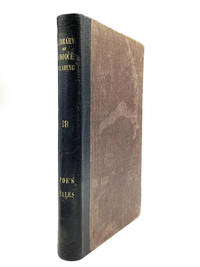
184578404New York: Wiley and Putnam 1845. First Edition. Hardcover. First edition third issue with the three-line copyright notice naming Wiley and Putnam and the Library of American Books half-title. Octavo: vi 228 4 ads pp. In the publisher's black gilt-stamped black morocco over plum cloth binding which has been expertly rebacked. The contents are clean and bright. Some general toning and minor staining to the cloth; otherwise very good. BAL 16146.<br /> <br /> ".the first important book of detective stories the first and greatest the cornerstone of cornerstones.the highest of all high spots.contains for the first time in book form all three Dupin stories" Queen's Quorum 1. While the tales herein were not selected by Poe and he expressed reservations about the editor "whose taste does not coincide with my own" they are in the end perhaps the single best representation of his broad range and lasting influence. The 1845 Tales contains not only the invention of modern detective fiction but also his supreme handling of psychological horror and contributions to both science fiction and the adventure story. Wiley and Putnam hardcover
16515427Antwerp: Jacob van Meurs 1651. First edition. <p>First edition very rare and a fine copy. "Tacquet's most important mathematical work Cylindricorum et annularium contained a number of original theorems on cylinders and rings. Its main importance however lay in its concern with questions of method. Tacquet rejected all notions originating with Cavalieri that solids are composed of planes planes of lines etc." DSB. "It was Tacquet's decisive influence followed by Pascal's large-scale implementation which allowed the passage from indivisibles to infinitesimals" Julien Seventeenth-Century Indivisibles Revisited.</p>. <p>'ALLOWED THE PASSAGE FROM INDIVISIBLES TO INFINITESIMALS'</p> . <p>First edition very rare and a fine copy. "Tacquet's most important mathematical work Cylindricorum et annularium contained a number of original theorems on cylinders and rings. Its main importance however lay in its concern with questions of method. Tacquet rejected all notions originating with Cavalieri that solids are composed of planes planes of lines and so on except as heuristic devices for finding solutions. The approach he adopted was that of Luca Valerio and Gregorius of Saint-Vincent an essentially Archimedean method" DSB. "Tacquet's criticisms must have been effective because indivisibles became homogeneous magnitudes as a result of innovations introduced during the course of the seventeenth century" Rossini p. 465. The historian of mathematics Henri Bosmans "states that it was Tacquet's decisive influence followed by Pascal's large-scale implementation which allowed what is sometimes referred to as the passage from indivisibles to infinitesimals" Julien p. 187. "In this work the ideas that the tangent and the area under a curve were inverse to each other appeared. It arises from the way that Tacquet thought of curves generated by moving points but not actually comprising of points. Of course this idea is an early form of what would become clear when the calculus was invented namely that the derivative and integral were inverse to each other. This book had a considerable effect on Pascal and was important in setting the scene for the invention of the calculus" MacTutor. Bosmans has pointed out the debt owed to Tacquet's Cylindricorum et annularium by Pascal in his preparation of the Lettres de Dettonville 1659. Indeed in the Lettre à Carcavy Pascal writes that Tacquet's book is full of "learned geometry" praises how Tacquet "handles the indivisibles with all desirable rigour" and refers specifically to Tacquet for a result on the approximation of a surface by inscribed and circumscribed polyhedra see Descotes. "The change in Pascal to a clear point of view with respect to infinitesimals may well have come from Pascal's reading of Tacquet's Cylindricorum et annularium in which the author denied the validity of concluding anything about the ratio of surfaces from the ratio of their indivisibles or lines" Boyer p. 151. This is a rare work particularly in commerce. ABPC/RBH list only the Turner copy from the University of Keele offered by a prominent London dealer in 2002 and subsequently sold at Reiss in 2005 quite a poor copy in modern binding with some paper repairs and a partially removed library stamp. Ours is a fine untouched copy in contemporary binding.</p> <br /> <p>Provenance: Contemporary ownership inscription on title of "Conde da Torre" possibly the Portuguese nobleman João de Mascarenhas 1633-1681 second Count of Torre and first Marquis of Fronteira. </p> <br /> <p>"The Jesuit mathematician André Tacquet 1612-60 was by the standards of his time a man of the world. Although he may never have left his native Flanders his network of correspondents spanned Europe's religious divide reaching to Italy and France but also to Protestant Holland and England. Only months before his death he entertained the Dutch polymath Christiaan Huygens who had travelled to Antwerp with the express purpose of meeting Tacquet by then regarded as one of the brightest mathematical stars ever to come out of the Society of Jesus . It was his mathematical excellence that transcended 17th-century prejudices. In England Henry Oldenburg secretary of the Royal Society of London and no friend of the Jesuits spent so much time describing Tacquet's Opera mathematica at the Society's meeting in January 1669 that he felt compelled to apologise to the fellows for abusing their patience. But it was he insisted 'one of the best books ever written on mathematics'" Alexander p. 118.</p> <br /> <p>"In 1651 André Tacquet the urbane Fleming whose work was celebrated by Catholics and Protestants alike published hisCylindricorum et annularium libri IV 'Four books on cylinders and rings' a work dedicated to the study of geometrical features of these figures and their applications. Befitting a Jesuit publication the frontispiece shows two angels bathed in divine light holding up a ring enclosing the book's title; on the ground below them a band of cherubs is busy putting the theory into practice. The implication is clear: divine mathematics universal and perfectly rational orders and arranges the physical world to the best possible effect. It is a fetching visual depiction of the Jesuit view of the role and nature of mathematics.</p> <br /> <p>"The Cylindricorum et annularium is Tacquet's most celebrated work the one that established his reputation as one of Europe's most original and creative mathematicians. As it turned out it may have been a bit too 'original and creative' for his superiors: when Tacquet sent a copy of the book the newly appointed superior general Goswin Nickel the general's response was surprisingly cool. After thanking the mathematician and congratulating him on the book Nickel added that it would be better if Tacquet applied his impressive gifts to producing textbooks of elementary geometry for use by students at the Society's colleges rather than original works aimed at a select audience of professional mathematicians . Tacquet a good soldier in the Army of Christ obeyed. From then on he published no more original work but concentrating instead on producing textbooks some of which are of such quality that they became standards in the field for over a century .</p> <br /> <p>"In his critique Tacquet is respectful even deferential toward his rivals. He refers to Cavalieri as 'a noble geometer' and insists that he 'does not wish to detract from the deserved glory' of Cavalieri's 'most beautiful invention' Geometria indivisibilibus 1635. Tacquet knew of what he spoke because he was himself deeply familiar with the work of Cavalieri and Torricelli and was no less capable than they of using their method to arrive at new results. But once he gets beyond his congenial style and mathematical mastery it becomes clear that Tacquet's opposition to the infinitely small is . unyielding . 'I cannot consider the method of proof by indivisibles as either legitimate or geometrical' he states flatly at the opening of his discussion of indivisibles. 'It proceeds from lines to surfaces from surfaces to solids and applies to the surface the quality or proportion obtained from the lines and transfers what was obtained from the surfaces to the solid.' 'By this method' he concludes 'nothing can be proven by anyone'" ibid. pp. 161-2.</p> <br /> <p>"André or Andreas Tacquet resembles his contemporary Torricelli in the generality of his adoption from his predecessors of varied infinitesimal methods. In his Cylindricorum et annularium libri IV he gave for example four demonstrations of the proposition that the volume of a sphere is equal to that of a cylindrical wedge whose base is half a great circle of the sphere and whose altitude is equal to the circumference of the sphere. This theorem had been given by a number of mathematicians since Kepler as well as by Archimedes in the Method probably not then extant. Tacquet however after proving the theorem in two ways by the use of inscribed and circumscribed figures gave two further demonstrations by indivisibles based on the equality of triangles and circular sections. Torricelli had himself been satisfied with the rigor of proofs by means of indivisibles although he supplied alternative demonstrations for the benefit of others. Tacquet on the other hand said that he did not consider that the method of Cavalieri was to be admitted as either legitimate or geometrical. He maintained that the cylindrical wedge could not in all strictness be considered as made up of triangles; nor could the sphere be regarded as composed of circles . A geometrical magnitude he asserted is made up only of homogenea that is parts of like dimension - a solid of small solids and area of small areas and a line of small lines - and not of heterogenea or parts of a lower dimension as Cavalieri had maintained. He therefore felt that a proposed magnitude is exhausted a word he undoubtedly acquired from Gregory of St. Vincent by inscribing homogenea within them 'as in the manner of the ancients'" Boyer pp. 139-140.</p> <br /> <p>Tacquet gave a famous example where Cavalieri's method led to incorrect results. On pp. 23-24 he considers a right-angled triangle with one horizontal and one vertical side. Rotating this triangle around the vertical side generates a cone. Each plane section of the cone parallel to the base determines a circle and the circumference of each of these circles bears the same ratio to its radius namely 2π to use our notation. Since the surface of the cone is made up of all these circular cross-sections and the triangle is made up of all the radii Cavalieri's method would imply that the same ratio is also that between the surface area of the cone and the area of the triangle. But this is not the case.</p> <br /> <p>Archimedes had used a double reductio ad absurdum style of proof to find areas and volumes and this argument continued to be used until the publication of Cavalieri's work. To show that the area of a given region is equal to A Archimedes showed that for any number B smaller than A an inscribed figure could be constructed whose area is greater than B the inscribed area was usually composed of rectangles or triangles so that its area could easily be determined. This shows that the area of the given region cannot be smaller than A. A similar argument with circumscribed figures shows that the area cannot be larger than A. This technique is usually referred to as the 'method of exhaustion.'</p> <br /> <p>In the Cylindricorum et annularium Tacquet gives two proofs of most of his results on rings and cylinders the first using a modified form of the exhaustion technique the second using indivisibles; the precision and rigour of the traditional method is repeatedly stressed. But Tacquet introduces a number of innovations in the use of the method of exhaustion.</p> <br /> <p>"Tacquet's book has two theorems dealing with exhaustion which are the foundation for nearly all other theorems in the book. The first proposition of the first book is reminiscent of Valerio's theorem De Centro Gravitatis Solidorum Libri Tres 1604:</p> <br /> <p>Let A and B be two magnitudes either areas or volumes and let the ratio of E to F be given. If one can consecutively inscribe into A and B a sequence of magnitudes that relate to one another as E to F and if these magnitudes exhaust A and B i.e. they differ from these by an arbitrarily small amount then the magnitude A will relate to the magnitude B as E to F.</p> <br /> <p>"Tacquet's general theorem has the advantage that he does not have to repeat a double reductio ad absurdum with each proof .</p> <br /> <p>"The first proposition of the second book introduces another exhaustion method:</p> <br /> <p>If a sequence of magnitudes Ain and Bin can be inscribed in magnitudes A and B and if likewise a sequence of magnitudes Acn and Bcn can be circumscribed about magnitudes A and B and if moreover Ain and Acn exhaust A and for the corresponding magnitudes we have Ain / Bin = E/F and Acn / Bcn = E/F then A/B = E/F.</p> <br /> <p>"The simplification lies in the fact that it is no longer necessary to exhaust the inscribed and circumscribed magnitudes for each of the magnitudes A and B as it suffices to calculate the ratio for one or the other .</p> <br /> <p>"An important new concept is found in Tacquet's definitions of surfaces and solids. He defines the cylinder for instance as a solid that is generated by the movement of a circle in such a way that one of the points of the circle segment moves along a straight line. The axis of this cylinder is the straight line joining the centre of two of the generated circles. Despite this definition he does not accept that the cylinder is composed of circles" ibid. pp. 214-5.</p> <br /> <p>An important example of Tacquet's 'kinetic' method of generating curves and surfaces is contained in the second part of the Cylindricorum et annularium entitled 'Dissertatio physico-mathematica de circulorum volutionibus' in which Tacquet studies the cycloid a curve traced out by a point on the circumference of a circle as it is rolled along a straight line. This curve was to be the focus of Blaise Pascal's work on indivisibles published in the Lettres de A. Dettonville 1659.</p> <br /> <p>"Although Pascal was undoubtedly attracted by the power of indivisible methods he was impressed by the careful geometrical approach of Grégoire de Saint-Vincent and swayed by the vigorous criticism of Cavalierian indivisibles launched by André Tacquet in his work Cylindricorum et annularium. Pascal was accordingly impelled to examine carefully the basis for the use of indivisibles in geometry" Baron pp. 199-200.</p> <br /> <p>"Blaise Pascal in a sense represents the highest development of the method of infinitesimals carried out under the tradition of classical geometry . Pascal was not a professional geometer and as a result his geometrical work was accomplished in two periods which were separated by an interval of mathematical inactivity from 1654 to 1658 during which he devoted his interests to theology. These two periods moreover are characterised by somewhat different views as to the nature of infinitesimals . In this connection he enunciated in the Potestatum numericarum summa of 1654 the theorem on the integral of xn . The essential point in Pascal's demonstration is the omission of terms of lower dimension . The geometrical intuition of indivisibles of lower dimension was carried over into arithmetic to justify the neglect of certain terms of lower degree .</p> <br /> <p>"In the later period of his mathematical activity his view appears to be modified. In connection with problems such as those in his Traité des sinus du quart de cercle of 1659 contained in the Lettres de Dettonville . he used the language of infinitesimals in speaking of the sum of all the ordinates; but he added that one need not fear to do this inasmuch as what is really meant is the sum of arbitrarily small rectangles" Boyer pp. 147-151.</p> <br /> <p>Bosmans sees Pascal's Potestatum numericarum summa as containing two mutually incompatible ideas about indivisibles. On the one hand Pascal sometimes regards indivisibles as rigorously null quantities as had Cavalieri. On the other hand he sometimes regards indivisibles as simply quantities that are negligible in comparison to other quantities. "Bosmans then strongly underlines the difference with the clarity of the Lettres de Dettonville where Pascal expresses himself with impeccable rigour substituting for the strict indivisibles of Cavalieri homogeneous quantities whosesums differ from that to be measured by less than any given quantity. He then finds the reason for this progress in the reading that Pascal would have made between 1654 and 1658 of the book published by Tacquet in 1651" Descotes pp. 1-2 our translation.</p> <br /> <p>In the last section of the Lettre à Carcavy Pascal refers specifically to Tacquet in his discussion of the problem of finding the area of a surface obtained by rotating a curve around a vertical axis. When an infinitesimal section of the curve is rotated one obtains a circular band; these bands together make up the whole surface. "This is properly what according to Dettonville Tacquet has demonstrated: 'The sum of these semi-circumferences of the surface of the semi-solid makes up this very surface as others have demonstrated among them Tacquet'. We find in fact in the Cylindricorum et annularium Book II 1st part a Proposition VI which corresponds to Pascal's words. Its object is to prove that if we consider in a great-circle BICQ on a sphere with diameter BC if we inscribe and circumscribe regular polygons on the semi-circle BIC and if we rotate these polygons around the diameter BC they inscribe and circumscribe in the sphere with solids whose surfaces differ from that of the sphere by a quantity which can be made as small as one wishes. We see how it accords with Pascal's thought: the inscribed and circumscribed segments generate bands during the rotation which at the limit can be said to compose the curved surface. In accordance with his principles Father Tacquet demonstrates it in the manner of the Ancients" ibid. p. 4.</p> <br /> <p>"Tacquet was the son of Pierre Tacquet a merchant and Agnes Wandelen of Nuremberg. His father apparently died while the boy was still young but left the family with some means. Tacquet received an excellent education in the Jesuit collège of his native town and a contemporary report describes him as a gifted if somewhat delicate child. In 1629 he entered the Jesuit order as a novice and spent the first two years in Malines and the next four in Louvain where he studied logic physics and mathematics. His mathematics teacher was William Boelmans a student of and secretary to Gregorius Saint Vincent. After his preliminary training Tacquet taught in various Jesuit collèges for five years notably Greek and poetry at Bruges from 1637 to 1639. From 1640 to 1644 he studied theology in Louvain and in 1644-45 he taught mathematics there. He took his vows on 1 November 1646 and subsequently taught mathematics in the collèges of Louvain 1649-55 and Antwerp 1645-49 1655-60" DSB.</p> <br /> <p>A second edition of the Cylindricorum et annularium was published in 1659 with the addition of a fifth book devoted to an unrelated subject the paradox of 'Aristotle's wheel'. The perceived unsuitability of the Cylindricorum at annularium for the Jesuit colleges may explain why it was not added to all copies of the Opera mathematica 1669 it was not present in the Macclesfield copy for example.</p> <br /> <p>De Backer-Sommervogel VII 1806 3; Poggendorff II 1064. Alexander Infinitesimal 2014. Baron The Origins of the Infinitesimal Calculus 1969. Boyer The History of the Calculus and its Conceptual Development 1949. Descotes 'Documents relatifs aux lettres de A. Dettonville I. Pascal et le Père Tacquet' Courrier du Centre international Blaise Pascal 14 1992 pp. 1-13. Julien ed. Seventeenth-Century Indivisibles Revisited 2015. Malet From indivisibles to infinitesimals 1996. Meskens Between Tradition and Innovation: Gregorio a San Vicente and the Flemish Jesuit Mathematics School 2021. Rossini 'Giordano Bruno and Bonaventura Cavalieri's theories of indivisibles: a case of shared knowledge' Intellectual History Review 28 2018 pp. 461-476.</p> <br/> <br/> Small 4to 217 x 162 mm pp. xx 284 4 with 18 folding engraved plates the first 9 bound preceding title the remainder at end as in the instructions to binder on p. 286 full-page engraving on title second work with special half-title occasional light browning and spotting. Contemporary yapped limp vellum with manuscript title on spine remains of ties a few stains and light rubbing. Jacob van Meurs unknown
15465968Venice: Cornelio Adelkind for Daniel Bomberg 1546. First edition. Very Good/First printed edition editio princeps of the 11th century commentary on portions of the pentateuch by the Bulgarian poet and Talmudist Tobiah ben Eliezer. Published by the house of the seminal printer of Hebrew books Daniel Bomberg under the supervision of his scholar-in-residence extraordinaire Cornelio Adelkind. Venetian law at this time limited Hebrew publishing to Gentile printers. Bomberg a protestant from Antwerp entered this lucrative market and with Adelkind's help became its prime exponent until his death in 1549. . Folio 32 cm; 93 leaves. Text in Hebrew. Title within architectural border reproduced in Amram "Makers of Hebrew Books in Italy" p. 215 also in the Jewish Museum's 1989 exhibition catalogue "Gardens and Ghettos: the Art of Jewish Life in Italy" page 50. Some section headings within ornamental borders. Bound in c19 or c20 dark red crushed morocco ruled in gilt and decorated with arabesques on both boards; spine with raised bands and compartments tooled and titled in gilt; green polished leather doublures with red crushed morocco dentelles bordered in pointillé accented with arabesques; green moiré free endleaves. Edges gilt. Binding not signed. Joints and crown adroitly reinforced with Japanese paper; corners somewhat worn down. Occasional contemporary notes in manuscript in text; brief stain on leaf mem-tet and lightly along the bottom edge of leaves nun-bet and nun-gimmel. Text otherwise pristine. Title page light possibly washed. Old library ink stamps from an institution in Warsaw on title page. Red morocco ex-libris of mining magnate and philanthropist Adolph Lewisohn 1849-1938. References: Adams T-766; BM Italian 674; Steinschneider 7304 #1; Amram 215 illustration and 222. Cornelio Adelkind for Daniel Bomberg hardcover books
1802B5905Roma: : Work I: Roma: Niccola de Antoni; Work II: Roma: n.p. Work I: c. 1802; Work II: c.1770. . A handsome fine example. Prints are clean and crisp. . Binding: Skillfully rebacked half calf preserving contemporary blue speckled - marbled boards. Spine raised with six 6 bands; compartments elegantly gilt ornamented at borders corners and centres and gilt lettered title on two. Notes: Work I: Raphael 1483-1520 painted the ceilings walls and columns of the Vatican Logge over the two-year period before he would pass away. Together with Michelangelo and Leonardo da Vinci he forms the traditional trinity of great masters of that period. These particular images are renowned for their clarity and accessibility. Much of the subject matter on the columns is traced to Roman iconography. Such items as coins vases sarcophagi and various other items are done with stunning clarity and accuracy. Carlo Lasinio 1759 – 1838 was an Italian engraver who worked chiefly in Florence. Lasinio started as a painter at the Accademia di Belle Arti Venice. He quickly placed more emphasis on printmaking especially after moving to Florence in 1778. He established his reputation with two large series of etchings in 1787 and 1789. Lasinio also taught engraving at the Accademia in Florence becoming a Professor in 1800. <br><br>Work II: A collection of plates from this work with no title page. The Raphael fresco decorations in the Vatican's three-storied balconies known as the 'Logge' quickly became famous and various suites of plates were issued from the 17th century onward. However this set was the first to attempt to show all the decoration of the pilasters and pillars. A set of the present engravings stimulated Catherine the Great to have a replica of the Logge built at the Hermitage in St. Petersburg.<br><br> Size: Folio 621x478mm. Illustration: Illustrated with plates after Raphael: Work I: 14 decorative copper engraved plates; engraved title page by Giovanni Balzar; remaining by Carlo Lasinio after Raphael’s depictions of the Vatican’s loggia and columns. Work II: collection of 31 full page etchings amounting to thirteen 13 pairs or sets of engravings after the Vatican frescoes by Raphael. Volume: Two works in one volume Provenance: Upper pasted endpaper ex libris bookplate marked “Dampierreâ€. All leaves of the first work of wove paper contain the watermark “Pietro Miliani Fabriano.†References: Berlin Kat. 1048 Pages: Work I: illustrated half-title plates numbered figure: II No. I &II III No. III & IV IV No. V& VI V No. VII & VIII VI No. IX&X I No. I&II II No. III&IV III No. V&VI IV No.VII&VIII V No. IX&X dated 1802 VI No.XI&XII VII No.XIII&XIV VIII No.XI&XII ; Work II: plate I-XIII Num I-XIII I-V Category: Book Art Architecture & Design; Book Europe Italy; Book Plate Books General; Work I: Roma: Niccola de Antoni; Work II: Roma: [n.p.] hardcover
160019698Louvain 1600. 8vo. Gerardus Rivius Contemporary limp vellum with the manuscript title on the spine remnants of ties. With a woodcut "IHS" vignette on the title-page. 8 197 9 3 14 299-250 6 pp. Extremely rare edition containing several works most notably an important account of the New World and its discovery by Christopher Columbus: De Ophira Regione written by the Portuguese geographer Gaspar Barreiros = Caspar Varrerius d. 1574 first published in his Chorographia Coimbra 1561.The first two works by the Italian philologist Angelo Canini 1521-1557 and the Spanish classical scholar Antonio de Nebrija 1444-1522 reflect on the names of places also of people and animals etc. of Hebrew origin in the New Testament. The collection also contains Barreiros's letters including one to the King of Portugal and other short works. The collection was simultaneously printed in Antwerp by the Heirs of J. Bellerus and in Louvain. The present Louvain printing is of the utmost rarity.Some slight browning in a few quires. Good copy of an extremely rare collection of works including an early Americanum.l Alden & Landis 600/28; Belg. Typ. 548; Index Aureliensis 131.043; Leclerc 414; USTC 414149 3 copies; cf. Adams C-507 Antwerp ed.; Machiels C-85 Antwerp ed.; Sabin 3596 Antwerp ed.; not in KVK; STCV; WorldCat. ABE CAT Bibles Sermons & Psalmbooks hardcover
1905247478New York: Dodd Mead and Co 1905. First edition one of 200 large paper sets on Van Gelder paper. Seven volumes bound in fourteen parts plus atlas volume atlas with 56 maps & plates on 62 sheets. 15 vols. Large 8vo. Original gilt green cloth. Bookplate on front pastedowns. Spines lightly worn several lightly faded. Internally fine much of the text unopened. A very good set. First edition one of 200 large paper sets on Van Gelder paper. Seven volumes bound in fourteen parts plus atlas volume atlas with 56 maps & plates on 62 sheets. 15 vols. Large 8vo. "The most elaborate work on this expedition" - Howes. <br /> <br /> A cornerstone of modern historical research printing for the first time many major primary documents which did not appear in the Biddle edition including the Floyd and Whitehouse journals and material from the Clark-Voorihis papers along with facsimile manuscripts maps portraits and other illustrative matter. Also valuable is Victor Paltsits' bibliography of the Lewis and Clark expedition in the first volume. "This edition is notable for its thorough Introduction covering the history of the expedition and earlier exploration and a detailed account of the original journals and their various editions.In its maps and numerous illustrations the Thwaites edition is an outstanding source of visual materials relating to the expedition" - LITERATURE OF THE LEWIS AND CLARK EXPEDITION. Graff 2485; Howes L320 "b"; Wagner-Camp 13:7 note to 1842 Harpers ed.; Tweney Washington 76; Literature of the Lewis and Clark Expedition 5d.1 Dodd, Mead and Co unknown
1905247478New York: Dodd Mead and Co 1905. First edition one of 200 large paper sets on Van Gelder paper. Seven volumes bound in fourteen parts plus atlas volume atlas with 56 maps & plates on 62 sheets. 15 vols. Large 8vo. Original gilt green cloth. Bookplate on front pastedowns. Spines lightly worn several lightly faded. Internally fine much of the text unopened. A very good set. First edition one of 200 large paper sets on Van Gelder paper. Seven volumes bound in fourteen parts plus atlas volume atlas with 56 maps & plates on 62 sheets. 15 vols. Large 8vo. One of 200 Sets on Large Paper. "The most elaborate work on this expedition" - Howes. <br/><br/>A cornerstone of modern historical research printing for the first time many major primary documents which did not appear in the Biddle edition including the Floyd and Whitehouse journals and material from the Clark-Voorihis papers along with facsimile manuscripts maps portraits and other illustrative matter. Also valuable is Victor Paltsits' bibliography of the Lewis and Clark expedition in the first volume. "This edition is notable for its thorough Introduction covering the history of the expedition and earlier exploration and a detailed account of the original journals and their various editions.In its maps and numerous illustrations the Thwaites edition is an outstanding source of visual materials relating to the expedition" - LITERATURE OF THE LEWIS AND CLARK EXPEDITION. Graff 2485; Howes L320 "b"; Wagner-Camp 13:7 note to 1842 Harpers ed.; Tweney Washington 76; Literature of the Lewis and Clark Expedition 5d.1 Dodd, Mead and Co unknown books