15 963 résultats
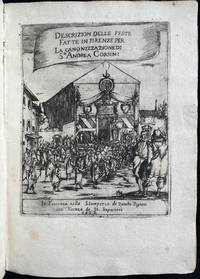
54765Florence: nella Stamperia di Zanobi Pignoni 1632. Quarto 20.8 × 15 cm. Contemporary limp vellum; 8 86 2 pp. including printed half-title etched pictorial title as well as the final leaf containing woodcut devite of Giorgio Marescotti errata and colophon; historiated initials on pp. 6 8 and 1. Illustrated throughout with twenty etchings by Stefano della Bella. Later manuscript title to spine in pencil; very minor wear to edges of boards; tiny closed tear to margin of title; p. 79/80 with small closed tear to margin; else a very good wide-margined copy. First edition of this rare work documenting the festivities for the canonization of St. Andrea Corsini which had already taken place in 1629. Pignoni's preface makes it clear that its appearance was delayed because of the outbreak of the bubonic plague in 1629 to 1631. The large-scale event included a festive procession into Santa Maria del Carmine as depicted on the title page. The church was richly adorned and decorated including a series of twenty paintings depicting scenes from Corsini's life and various miracles attributed to him explained by poems by Alessandro Adimari; the event also included musical accompaniment including by the famous organist and composer Girolamo Frescobaldi. The present work is illustrated with Stefano della Bella's etched interpretations of the original paintings. Measuring ca. 9.5 × 10.5 cm the etchings are printed within the text. Each scene features a decorative border as well as a combination of an engraved motto and allegorical motif inside a cartouche at the bottom. The accompanying text describes at length the various sonnets mottos and other words displayed during the festivities dwelling on various emblems symbols and anagrams that shed further light on the life and miracles of Saint Corsini. The author was the Florentine priest Benedetto Buommattei or Buonmattei 1581-1648 a member of the Accademia della Crusca as well as Professor of Tuscan first at Pisa and then at Florence where he also lectured on Dante and met John Milton in 1638. He also authored the important "Della lingua toscana" 1613.<br /> <br /> The striking etchings are unsigned and were long attributed to Jacques Callot who was active in Florence between 1612 and 1621. De Vesme later established them to have been the work of a still very young Stefano della Bella 1610-1664. They depict key episodes in the life of Andrea Corsini 1301-1374 the Bishop of Fiesole at his time of death whose reputation for saintliness was based in part on his heroic works of mercy during the 1347 outbreak of the plague in Florence. A procession with his relics still takes place each year in Florence on his feast day.<br /> <br /> Cicognara 1439. Gamba 2750. De Vesme/Massar Stefano Della Bella 884-904. Getty Festival Collection 94-B8960 online catalog. unknown
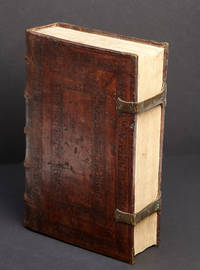
6759Numerous fine woodcut initials diagrams tables & maps in the text. Woodcut printer’s device at end. 14 p.l. 18 leaves 6 leaves 30 xxxi-cxxvi leaves 4 leaves. Folio cont. Flemish blindstamped calf binding over wooden boards rather well rebacked a few unimportant stains rolls of medallion heads & foliage forming a double panel orig. clasps and catches metal corner guards. Cologne: J. Prael for P. Quentel 1537.<br /> <br/> <br/> bound after:<br /> <br/> <br/> ANSELM ARCHBISHOP OF CANTERBURY. In Omnes Pauli Apostili Epistolas enarrationes. Title within fine woodcut border by Anton Woensam of Worms. Some fine large woodcut initials. 8 p.l. 531 pp. Folio. Cologne: E. Cervicornus for G. Hittorp 1533.<br/> <br/> A most attractive sammelband of two well-illustrated books in an attractive contemporary blind-stamped binding probably made at the Stavelot monastery in Belgium.<br/> <br/> I. First collected and illustrated edition of the scientific writings of the Venerable Bede including De Natura Rerum dealing with cosmology and natural history and De Temporum Ratione a work on chronology that still exercises a considerable influence over our daily life today. This edition was edited and commented upon by Joannes Noviomagus i.e. Jan van Bronchorst of Nijmegen 1494-1570 philosopher and mathematician then a professor of philosophy at the Collegium Montanum in Cologne. It would appear that he used the manuscript at the Dombibliothek no. 103 of Cologne to prepare this edition.<br/> <br/> The De Temporum Ratione is a significant book in several ways. Most notably “this book helped to establish the custom of counting years from the birth of Christ. When we say that Queen Elizabeth II was born in 1926 not ‘in the 16th year of the reign of George V’ or ‘in the year 2678 after the foundation of Rome’ or in the ‘2nd year of the 481st Olympiad’ we are indebted to the Venerable Bede.â€â€“Printing & the Mind of Man 16n.<br/> <br/> “Bede’s greatest practical effect was on the Western calendar. His decisions beginning the year calculation of Easter names of days and months calculations of eras and so forth in most instances finally determined usage that was only refined not changed by Gregorian reform.â€â€“D.S.B. I p. 565.<br/> <br/> “The De Ratione Temporum first published in 1505 is particularly important. It contains a remarkable theory of tides based upon Pliny but also upon personal observation; first mention of the establishment of a port i.e. the mean interval between the moon’s meridian passage and high water following; this interval is different in different ports.â€â€“Sarton I p. 511. Pierre Duhem described Bede’s establishment of a port as the only original formulation of nature to be made in the West for some eight centuries. <br/> <br/> Also contained here is the De Natura Rerum 1st printing: 1529 which contains such physical science as was then known. It collects the wisdom of the ancient world on these subjects and has the special merit of referring phenomena to natural causes. It contains a particularly important section — the “De Comptu vel Loquela digitorum†— which is “our main almost our only source for the study of mediaeval finger reckoning or symbolism.â€â€“Sarton I pp. 510-11. See also Smith History of Mathematics II p. 200.<br/> <br/> The rest of the book contains further treatises by Bede on arithmetic astronomy and the calendar and chronology.<br/> <br/> II. Very rare.<br/> <br/> PROVENANCE: Early inscription of “Antonius abbatis a Sancto Remaclo†on front flyleaf; Benedictine monastery of Stavelot Belgium inscription “Liber Monasterii Stabulensis†on title-page of Anselm; auction sale of the monastery library Catalogue d’une belle Collection de Livres et Manuscrits précieux sur vélin du VIIIe et du IXe siècle Ghent 26 April 1847 lot 42; Michel Chasles 1793-1880 the mathematician with bookplate his sale Paris 27 June-18 July 1881 lot 28; Robert B. Honeyman 1897-1987 his sale Sotheby’s 30 October 1978 lot 265.<br/> <br/> BINDING: Stavelot had its own bindery at this time and it is quite likely that this binding was executed there see Goldschmidt Gothic & Renaissance Bookbindings no. 90.<br/> <br/> Fine large copies preserved in a box.<br/> <br/> ⧠I. Adams B448–calling for two additional preliminary leaves but no other collation calls for them. Smith Rara Arithmetica p. 159n. Zinner 1657. II. Adams A1174. unknown
6759Numerous fine woodcut initials diagrams tables & maps in the text. Woodcut printer's device at end. 14 p.l. 18 leaves 6 leaves 30 xxxi-cxxvi leaves 4 leaves. Folio cont. Flemish blindstamped calf binding over wooden boards rather well rebacked a few unimportant stains rolls of medallion heads & foliage forming a double panel orig. clasps and catches metal corner guards. Cologne: J. Prael for P. Quentel 1537. bound after: ANSELM ARCHBISHOP OF CANTERBURY. In Omnes Pauli Apostili Epistolas enarrationes. Title within fine woodcut border by Anton Woensam of Worms. Some fine large woodcut initials. 8 p.l. 531 pp. Folio. Cologne: E. Cervicornus for G. Hittorp 1533. A most attractive sammelband of two well-illustrated books in an attractive contemporary blind-stamped binding probably made at the Stavelot monastery in Belgium. I. First collected and illustrated edition of the scientific writings of the Venerable Bede including De Natura Rerum dealing with cosmology and natural history and De Temporum Ratione a work on chronology that still exercises a considerable influence over our daily life today. This edition was edited and commented upon by Joannes Noviomagus i.e. Jan van Bronchorst of Nijmegen 1494-1570 philosopher and mathematician then a professor of philosophy at the Collegium Montanum in Cologne. It would appear that he used the manuscript at the Dombibliothek no. 103 of Cologne to prepare this edition. The De Temporum Ratione is a significant book in several ways. Most notably "this book helped to establish the custom of counting years from the birth of Christ. When we say that Queen Elizabeth II was born in 1926 not 'in the 16th year of the reign of George V' or 'in the year 2678 after the foundation of Rome' or in the '2nd year of the 481st Olympiad' we are indebted to the Venerable Bede."-Printing & the Mind of Man 16n. "Bede's greatest practical effect was on the Western calendar. His decisions beginning the year calculation of Easter names of days and months calculations of eras and so forth in most instances finally determined usage that was only refined not changed by Gregorian reform."-D.S.B. I p. 565. "The De Ratione Temporum first published in 1505 is particularly important. It contains a remarkable theory of tides based upon Pliny but also upon personal observation; first mention of the establishment of a port i.e. the mean interval between the moon's meridian passage and high water following; this interval is different in different ports."-Sarton I p. 511. Pierre Duhem described Bede's establishment of a port as the only original formulation of nature to be made in the West for some eight centuries. Also contained here is the De Natura Rerum 1st printing: 1529 which contains such physical science as was then known. It collects the wisdom of the ancient world on these subjects and has the special merit of referring phenomena to natural causes. It contains a particularly important section - the "De Comptu vel Loquela digitorum" - which is "our main almost our only source for the study of mediaeval finger reckoning or symbolism."-Sarton I pp. 510-11. See also Smith History of Mathematics II p. 200. The rest of the book contains further treatises by Bede on arithmetic astronomy and the calendar and chronology. II. Very rare. PROVENANCE: Early inscription of "Antonius abbatis a Sancto Remaclo" on front flyleaf; Benedictine monastery of Stavelot Belgium inscription "Liber Monasterii Stabulensis" on title-page of Anselm; auction sale of the monastery library Catalogue d'une belle Collection de Livres et Manuscrits précieux sur vélin du VIIIe et du IXe siècle Ghent 26 April 1847 lot 42; Michel Chasles 1793-1880 the mathematician with bookplate his sale Paris 27 June-18 July 1881 lot 28; Robert B. Honeyman 1897-1987 his sale Sotheby's 30 October 1978 lot 265. BINDING: Stavelot had its own bindery at this time and it is quite likely that this binding was executed there see Goldschmidt Gothic & Renaissance Bookbindings no. 90. Fine large copies preserved in a box. ❧ I. Adams B448-calling for two additional preliminary leaves but no other collation calls for them. Smith Rara Arithmetica p. 159n. Zinner 1657. II. Adams A1174. hardcover books
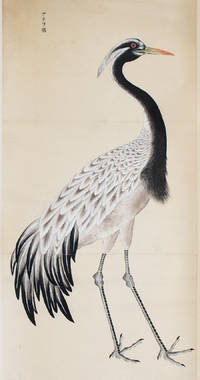
6952Scroll 420 x 12000 mm. with elaborate silk brocade endpaper at beginning. Japan: 1880-86. This beautifully rendered scroll of natural history paintings was executed with one exception by Akio or Keigu Yamamoto 1827-1903 Confucian scholar doctor botanist and highly gifted artist. He was born in Kyoto the son of the prominent doctor and botanist Boyo Yamamoto 1778-1859 the direct disciple of Ono Ranzan 1729-1810 the famous professor of botany who wrote a series of classic botanical books. Keigu "continued his father's work in his private school in Osaka and spent his time organizing meetings that were regularly attended by both honzogaku amateurs and Japanese biologists."-Federico Marcon The Knowledge of Nature and the Nature of Knowledge in Early Modern Japan p. 301. Keigu travelled widely throughout Japan drawing plants and animals. He gave botanical instruction to the Meiji emperor and other members of the royal family. Keigu also wrote several standard works on materia medica and left many sketch books and scrolls which entered the Kyoto rare book trade in 1932; some of these were published only in the 1980s. All of his sketch books and scrolls offered valuable and unique information regarding native plants and animals as well as those that had been introduced into Japan. Our scroll contains 14 very finely executed color paintings of plants birds and animals. The paintings are quite unique in their remarkable spaciousness. For instance the image of the octopus is 1410 mm. long. The images include a most unusual morning glory three joined sheets and 1190 mm. long; an edible yellow lily two joined sheets 800 mm.; an ungei flower two joined sheets 795 mm.; a magnificent red toki a now-endangered crane species three joined sheets 765 mm.; a large akowa tsuru another species of crane three joined sheets 815 mm.; a young white crane three joined sheets 935 mm.; a sea lion umiuso painted in many shades of delicate black two joined sheets 545 mm.; a carp two joined sheets 597 mm.; an octopus four joined sheets; a chameleon three joined sheets 844 mm. dated "1880"; a deer antler two sheets 545 mm.; a "Dutch" dog two sheets 545 mm.; a lion seen at exhibitions in Tokyo and Kyoto two sheets 640 mm. with a seal and note stating this was the work of "Ariyoshi" dated "1886"; and two camels two sheets 545 mm. long. Four of the paintings have the signature and seal of Yamamoto and another painting - the final - has the seal only. Three of the paintings have additional text by Yamamoto regarding where seen and painted alternative regional names date etc. Very fine condition preserved in a new wooden box. All but the penultimate painting are the work of Yamamoto. unknown books
6952Scroll 420 x 12000 mm. with elaborate silk brocade endpaper at beginning. Japan: 1880-86.<br/> <br/> This beautifully rendered scroll of natural history paintings was executed with one exception by Akio or Keigu Yamamoto 1827-1903 Confucian scholar doctor botanist and highly gifted artist. He was born in Kyoto the son of the prominent doctor and botanist Boyo Yamamoto 1778-1859 the direct disciple of Ono Ranzan 1729-1810 the famous professor of botany who wrote a series of classic botanical books. <br/> <br/> Keigu “continued his father’s work in his private school in Osaka and spent his time organizing meetings that were regularly attended by both honzogaku amateurs and Japanese biologists.â€â€“Federico Marcon The Knowledge of Nature and the Nature of Knowledge in Early Modern Japan p. 301. Keigu travelled widely throughout Japan drawing plants and animals. He gave botanical instruction to the Meiji emperor and other members of the royal family. Keigu also wrote several standard works on materia medica and left many sketch books and scrolls which entered the Kyoto rare book trade in 1932; some of these were published only in the 1980s. All of his sketch books and scrolls offered valuable and unique information regarding native plants and animals as well as those that had been introduced into Japan.<br/> <br/> Our scroll contains 14 very finely executed color paintings of plants birds and animals. The paintings are quite unique in their remarkable spaciousness. For instance the image of the octopus is 1410 mm. long. The images include a most unusual morning glory three joined sheets and 1190 mm. long; an edible yellow lily two joined sheets 800 mm.; an ungei flower two joined sheets 795 mm.; a magnificent red toki a now-endangered crane species three joined sheets 765 mm.; a large akowa tsuru another species of crane three joined sheets 815 mm.; a young white crane three joined sheets 935 mm.; a sea lion umiuso painted in many shades of delicate black two joined sheets 545 mm.; a carp two joined sheets 597 mm.; an octopus four joined sheets; a chameleon three joined sheets 844 mm. dated “1880â€; a deer antler two sheets 545 mm.; a “Dutch†dog two sheets 545 mm.; a lion seen at exhibitions in Tokyo and Kyoto two sheets 640 mm. with a seal and note stating this was the work of “Ariyoshi†dated “1886“; and two camels two sheets 545 mm. long.<br/> <br/> Four of the paintings have the signature and seal of Yamamoto and another painting — the final — has the seal only. Three of the paintings have additional text by Yamamoto regarding where seen and painted alternative regional names date etc. <br/> <br/> Very fine condition preserved in a new wooden box. All but the penultimate painting are the work of Yamamoto. unknown
17063719Te Leyden: By Pieter Vander Aa Boekerkoper 1706. First edition. Later half-cloth boards covered with marbled paper spine with title vignette. Small wormhole affecting the first five leaves and the folding map; otherwise in very good condition. First edition. Later half-cloth boards covered with marbled paper spine with title vignette. 6 86 4 p. and an engraved folding map and 9 engraved folding plates. <p><br /> Scarce Dutch illustrated edition of the first eyewitness account of Hernando de Soto's expedition complete with a folding map of Florida and nine double-page engraved plates.<br /> <p><p><br /> Dutch abridged edition of the earliest published eyewitness narrative of Hernando de Soto's expedition to Florida and the interior of North America. The text derives from the Relaçam verdadeira dos trabalhos Évora 1557 written by an anonymous Portuguese gentleman from Elvas who participated in the expedition. That work is the first printed account of de Soto's journey and remains a foundational source for the early Spanish exploration of the southeastern regions of what is now the United States.<br /> <p><p><br /> De Soto landed in Florida in May 1539 and led a large expedition through present-day Florida Georgia the Carolinas Tennessee Alabama Mississippi Arkansas and Louisiana reaching the Mississippi River before his death in 1542. The narrative records sustained contact with Indigenous societies and documents the challenges of an extended inland expedition through the southeastern regions of North America.<br /> <p><p><br /> This Leiden edition was issued by Pieter van der Aa as part of his Naaukeurige versameling der gedenkwaardigste zee- en landreysen presenting the narrative in Dutch translation in an abridged form. It is illustrated with an emblematic engraved title a folding engraved map of Florida attributed to de Soto's discoveries and nine double-page engraved plates depicting episodes from the Spanish conquest. Van der Aa's engravings played a significant role in shaping early eighteenth-century European visual conceptions of Spanish America and its exploration.<br /> <p><p><br /> A well-preserved copy complete with the folding map and plates. An important Dutch contribution to European-Americana transmitting one of the principal sixteenth-century sources for the exploration of the North American interior.<br /> <p><p><br /> Not in Sabin. Scarce on the market; RBH records only four copies offered in the past 100 years. <br /> <p>. By Pieter Vander Aa, Boekerkoper unknown
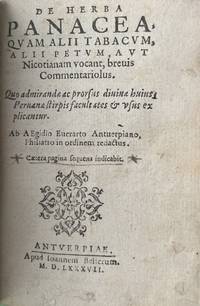
15873021Antverpiae Antwerp: Antverpiae Antwerp 1587. First edition a variant with 246 pages in the second part was published in the same year by the same publisher; no priority has been established. In 17th-century limp vellum. Title lettered in ink on spine. Occasional annotations and underlines by a 17th-century hand in ink. Binding restored new endpapers and thongs. Pages restored throughout heavily in the first third at some places affecting the text few leaves over trimmed. Overall in very good condition. First edition a variant with 246 pages in the second part was published in the same year by the same publisher; no priority has been established. In 17th-century limp vellum. Title lettered in ink on spine. Occasional annotations and underlines by a 17th-century hand in ink. 78 =98 4; 234 pp. The first book devoted entirely to tobacco.<br> <br /> <br /> “This little work produced by a physician who is said to have practiced with distinction in Antwerp appears to have been the first published entirely devoted to the subject of tobacco . a neat compendium of much of the information then available. It was consequently popular.†Arents <br /> De herba panacea concerns with the beneficial medicinal properties of tobacco and describes most of what was then known of this New World plant including its origin native methods of curing and cultivation and lore surrounding tobacco. Everard gives numerous recipes depending on tobacco for ailments to all kinds of illnesses. The book also contains texts by Castore Durante Gérard van Bergen Galen Jean de Jonghe and Andrés de Laguna.<br> <br /> <br /> The book was included in the John Carter Brown Library’s 1974-published Rare Americana list A Selection of One Hundred & One Books Maps & Prints not in The John Carter Brown Library.<br /> Ref.: Sabin 23218; Adams E1150; Alden 587/15; Arents 32; Books not in JCB 21. Antverpiae [Antwerp] unknown
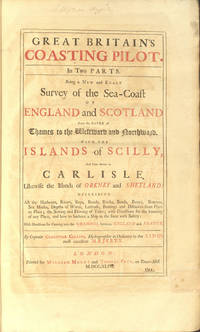
1744007689London: Tower-Hill: William Mount and Thomas Page 1744. Hardcover. Very Good. Elephant Folio - over 15 - 23" tall. COLLINS Greenvile Captain. A Landmark in the Charting of Great Britain. Folio 18th century mottled half calf over blue-green marbled paper boards decorative gilt spine red morocco lettering piece pp. iv 26. Fine allegorical copperplate title incorporating a small map of the British Isles letter press title printed in red & black 47 copperplate charts & profiles 5 folding 3 single page the remainder double page and one chart in the text at p18. A couple of the folding maps just torn at fold some browning and offsetting text spotted in places but still a handsome copy. First published in 1693 and reissued many times throughout the eighteenth century this formidable and costly project was the first systematic survey of British coastal waters Moreland & Bannister Antique Maps 3rd ed p163. 511322 mm. Phillips 5199. Moreland & Bannister. In 1667 the Dutch sailed up the Thames and destroyed a great part of the British Navy in the Medway and bombarded Chatham. an the Government was shaken. by the realisation that the Dutch new more about the coastline of England than the English themselves and their confidence was not increased when it was found that John Seller in producing the first volume of his marine atlas the English Pilot in 1671 was still using Dutch plates and often very old ones at that. As now government was tardy in action and it was not until 1681 that Samuel Pepys as Secretary of the Navy instructed Captain Greenville Collins to carry out a survey of British coasts and harbours. In due course after a seven year survey Captain Collins issued in 1693 the Great Britain's Coasting Pilot an outstanding work consisting of 48 charts the first complete Pilot Book in English of all the coasts of Great Britain and the surrounding islands with special attention of course to the ports Moreland & Bannister. In 1693 he finally published his results in a folio volume of two parts Great Britain's Coasting Pilot containing sailing directions tide tables coastal views and about forty-nine charts. The charts were not completely accurate but with all their shortcomings they were an enormous advance on anything before them and entitle Collins to rank not only with the earliest but with the best of English hydrographers. The work covered England and Scotland and though Collins proposed a further study to cover Ireland the plan came to nothing. Collins recorded that he had spent £40 on instruments and charged £80 for the 120 manuscript maps he delivered. With his claim for expenses set at £200 per annum and his wages of £394 10s. he claimed a total of £1914 10s. for his work which was eventually paid in arrears. The cost was more than three times the original estimate. His cousin Freeman Collins printed the Coasting Pilot which Richard Mount sold. Mount's subsequent firm then went on to publish twenty-one further editions of the pilot throughout the nineteenth century. <br/> <br/> William Mount and Thomas Page hardcover
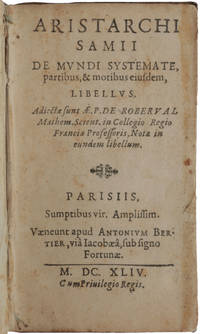
16445431Paris: Antoine Bertier 1644. First edition. <p>First edition exceptionally rare of Roberval's cosmology in which he expresses covertly his support for Copernicus and also formulates for the first time the law of universal attraction - that any two material bodies in the universe attract each other. This principle is normally ascribed to Robert Hooke who published it three decades later and to Newton in the Principia 1687.</p>. <p>THE LAW OF UNIVERSAL ATTRACTION</p> . <p>First edition exceptionally rare of Roberval's cosmology in which he expresses covertly his support for Copernicus and also formulates for the first time the law of universal attraction - that any two material bodies in the universe attract each other. This principle is normally ascribed to Robert Hooke who published it three decades later and to Newton in the Principia 1687. Roberval 1602-75 was one of the most brilliant members of Mersenne's circle. He developed indivisibles independently of Cavalieri invented an original method of drawing tangents and solved many of the problems on the cycloid that were formulated and solved by Pascal two decades later. However since almost nothing of his work was published in his lifetime he was for long eclipsed by Fermat Pascal and above all by Descartes his irreconcilable adversary. In fact Roberval himself published only two works the Traité de mécanique 1636 and the Aristarchi offered here; several of his other works appeared posthumously in the Divers ouvrages de mathématique et de physique 1693 but many remain unpublished even today. "Roberval's positivism appears in a particularly nuanced form in the book De mundi systemate of 1644 where he claimed to have translated an Arabic manuscript of Aristarchus to which he had added his own notes all of them favorable to the author. Yet he did not adhere to the system of Aristarchus to the exclusion of those of Ptolemy and Tycho Brahe. In the dedication of the work Roberval wrote: 'Perhaps all three of these systems are false and the true one unknown. Still that of Aristarchus seemed to me to be the simplest and the best adapted to the laws of nature.' It is with this reservation that Roberval expressed his opinion on the great system of the world the solar system the minor systems planetary the motions of the sun and the planets the declination of the moon the apogees and perigees the agitation of the oceans the precession of the equinoxes and the comets. Despite this reservation Roberval appeared convinced of the existence of universal attraction which-under the inspiration of Kepler-he put forth as the foundation of his entire astronomy: 'In all this worldly matter the fluid of which the world is composed according to our author and in each of its parts resides a certain property or accident by the force of which this matter contracts into a single continuous body'" DSB. Like Copernicus Aristarchus ca. 310-230 BCE maintained that the Earth rotates on its axis and revolves around the Sun. However Aristarchus's work has not survived and the Arabic manuscript which Roberval claimed to have translated almost certainly did not exist. Roberval uses it as a cover to express his support albeit nuanced for heliocentrism still a dangerous idea at the time. OCLC lists Cornell Huntington and Linda Hall in US. No other copies in auction records.</p> <br /> <p>"Gilles Personne was born in the village of Roberval near Senlis in 1602. Nothing is known about his early education; his father was a poor farmer or farmworker and the young mathematician who would later add 'de Roberval' his surname seems to have led the peripatetic life of an impoverished student passing through several universities and alternately studying and teaching. In 1628 he settled in Paris; there he got to know Mersenne who recognised his talents and encouraged him to work on the problem of the curve known as the 'trochoid' 'roulette' or 'cycloid.' In 1632 Roberval was given a teaching post at the Collège de Maître Gervais; two years later he obtained a more eminent position the Ramus chair of mathematics at the Collège Royal. He would remain in this professorship for forty-one years - a permanent fixture as it were of Parisian intellectual life - until his death in 1675. But the peculiar terms on which holders of this Ramus chair were appointed had a very negative influence on both his work and his later reputation. The chair was tenable for a period of three years; at the end of that time it was opened to a public competition in which anyone including the incumbent could apply for it. Candidates were required not only to lecture but also to demonstrate theorems and solve problems put to them by all comers. As a result the practice grew up of the incumbent trying to ensure his reappointment by proposing problems which only he could solve. Whatever were the most advanced discoveries Roberval was making at any time therefore he had an incentive to keep them secret so that he could use them to confound his competitors on these triennial occasions. One consequence was that most of his important work in his special field - geometry - remained unpublished in his lifetime. And another consequence was that Roberval would more than once become embroiled in disputes about precedence insisting that he had made key discoveries long before they were published by others; in 1646 for example he would make bitter accusations against Torricelli alleging that his analysis of the cycloid had been derived in an underhand way from Roberval's unpublished work. Even when he did allow some of his work to circulate he favoured a method of publication that was both limited and carefully monitored. As the English mathematician John Pell would later recall 'many yeares agoe some pieces of Mr Roberval were published after the old fashion. That is they were not given to a Printer; but any man that would pay for the transcribing might have had a coppy of them.'</p> <br /> <p>"Roberval was by all accounts a prickly character quick to take offence and with a high opinion of his own worth. As those were also the most prominent characteristics of René Descartes it is hardly surprisingly that a fierce enmity quickly sprang up between them. Roberval was almost ostentatiously unimpressed by Descartes' 'Géométrie' one of the essays published with his Discours de la méthode in 1637; his cool and critical comments transmitted to the author by their mutual friend Mersenne elicited an angry reaction. Relations between them were further soured by Descartes' quarrel with Fermat about the construction of tangents in 1638 in which Roberval became one of Fermat's leading defenders; not long afterwards Descartes accused Roberval of purloining his own ideas about the cycloid. Meanwhile Mersenne himself remained on the best of terms with both of these disputants. Indeed he seems to have had not only a deep admiration of Roberval's mathematical talents - he described him as scarcely inferior to Archimedes - but also a real personal fondness for him. Mersenne made a special effort to promote the writings of this far from prolific author: he added Roberval's brief treatise on mechanics at the end of book 3 of his own Harmonie universelle Paris 1636; he included material from the Latin version of that treatise in his compilation of 1644 Cogitata physico-mathematica; he encouraged and assisted the publication of Roberval's astronomical work Aristarchi Samii de mundi systemate libellus in 1644; he also reprinted that entire work in his own later compilation of 1647 Novarum observationum . tomus III. And throughout his own writings Mersenne referred to Roberval in terms both laudatory and affectionate calling him simply 'our geometer' - 'Geometra noster'" Malcolm pp. 157-8. </p> <br /> <p>"In 1644 Gilles Personne de Roberval published a small cosmological treatise entitled Aristarchi Samii de Mundi Systemate partibus & motibus eiusdem libellus. The book is attributed to the ancient Aristarchus of Samos and Roberval claims it to be an annotated translation of a recently recovered Arabic manuscript . Roberval tells the reader that the Arabic manuscript was translated under his and Mersenne's supervision at the expense of the royal counsellor. He does not explicitly defend the authenticity of the manuscript or even its origin as a true ancient source. Roberval does however imply the manuscript's authenticity at least by the style and disposition of the treatise. The epistle informs us that in addition to the translated text Roberval will also help the reader by inserting certain notes. These are given within the text are labelled as 'NOTA' and end with the abbreviation 'P.N.E.M.' 'pondere numero et mensura' the motto of the mathematicians of the Collège Royal. Usually the notes present new discoveries which were unknown by the author in order to corroborate or refute Aristarchus's opinions.</p> <br /> <p>"Not many took the book to be an authentic ancient treatise. Most philosophers mathematicians or scientists realized that the book was not authentic and that the name of Aristarchus was used just as a cover for a seventeenth century author. They were of course right. However as Heath observed more than a hundred years ago 'there was every excuse for Roberval. The times were dangerous.' Only ten years before he wrote the Aristarchi Galileo's Dialogue on the Two Chief Systems of the World was condemned. The French context was uncertain as geocentric systems were actively defended in the 1630s. In 1632 Libert Froidmond arguing against Philip and Jacob Lansbergen's heliocentric system published the Anti-Aristarchus sive Orbis-terrae immobilis. Two years later Froidmond followed up with another treatise the Vesta sive Ant-Aristarchi Vindex. Furthermore Roberval's Parisian colleague Jean Baptiste Morin had published the Famosi et antique problematis de telluris motu strongly arguing against Galileo and Copernicanism" Babeş pp. 95-97.</p> <br /> <p>In the Aristarchi Roberval not only discusses heliocentrism he gives a complete theory of the motion of the Earth Moon and planets. It is based on three principles.</p> <br /> <p>"The Sun as a cause of motion. From the very first chapter of the Aristarchi Roberval explains all motion of the system of the world by two principles. One of them is a principle of attraction stating that the fluid heavenly matter has in every one of its parts a certain property by which it tends to unite with all the other parts of matter. If the Sun would be absent from the world all heavenly matter would reunite in a perfect sphere. The second principle concerns the action of the Sun. By its heat the Sun continuously rarefies the surrounding matter. The rarefaction results in the elongation of matter which is pushed towards the extremity of the system. The sun also has an axial motion of its own by which the eviction of the rarefied matter takes place. This motion impresses upon the celestial bodies their periodical movement around the Sun. However throughout the Sun's axial rotations the ejections of rarefied matter do not have a constant flux and thus the motions of heavenly bodies around the sun are not uniform.</p> <br /> <p>"The movements of the Earth's system. As one of the planetary systems the Earth is moved around the Sun by the continuous pushing of the elongated matter coupled with the attractive property of the celestial matter. The system of the Earth retains its quasi-spherical shape due to an analogous attractive property of the elemental matter which accounts for the weight of terrestrial bodies. The terrestrial matter is however different from the heavenly matter. It is very mixed and it is unevenly disposed on the surface of the Earth. Therefore the Sun unevenly elongates the airy and fiery atmosphere surrounding the Earth and as a result the diurnal motion of the Earth is irregular. To this is added a third reason of the irregularity the influence of the Moon.</p> <br /> <p>"The periodical movement of the Moon. According to Roberval the Moon is a part of the system of the Earth. Its density is similar to that of the superior atmosphere such that it revolves together with the air and fire around the Earth. Roberval claims that the moon floats in the superior atmosphere in the same way as a submerged piece of wax floats in water. Its orbit however in not circular but oval-shaped. This shape is responsible for the ebb of the seas: at its perigee the Moon compresses the air below it which in turn exerts a pressure on the ocean. Likewise the Moon disturbs the flow of rarefied matter coming from the Sun which also affects the diurnal motion of the Earth" Babeş pp. 110-111.</p> <br /> <p>What is particularly noteworthy here is the "property of matter by which it tends to unite with all the other parts of matter" the first suggestion of the 'universal attraction' between material bodies.</p> <br /> <p>"In his System of the World Roberval asserts that each part of the fluid matter which fills the universe is endowed with a certain property that makes all parts draw together and attract each other reciprocally p. 39. At the same time he admits that in addition to this universal attraction there are other similar forces proper to each of the planets something that Copernicus and Kepler also admitted which hold them together and explain their spherical shapes .</p> <br /> <p>"Roberval's cosmology as it is presented in his System of the World . was heartily condemned by Descartes and Newton was deeply angered by Leibniz's identification of Newton's views with those of Roberval. Yet historically Roberval's work is interesting not only because it was the first attempt to develop a 'system of world' on the basis of universal attraction but also because it presented some characteristic features or patterns of explanation which or at least the analogues of which we shall find discussed later by Hooke and advocated by Newton and Leibniz.</p> <br /> <p>"Thus according to Roberval the fluid and diaphanous matter which fills or constitutes the 'great system of the world' forms a huge - but finite - sphere in the center of which is the sun. The sun a hot and rotating body exerts a double influence on this fluid matter: a It heats and thus rarefies it; it is this rarefaction and the ensuing expansion of the world-matter that counterbalances the force of the mutual attraction of its various parts and prevents them from falling upon the sun. This rarefaction also confers on the world-sphere a particular structure; the density of its matter increases with the distance from the sun. b The sun's rotating motion spreads through the whole world-sphere the matter of which turns around the sun with speeds diminishing with its distance from the sun. The planets are considered as small systems analogous to the great one which swim or place them selves at distances from the sun corresponding to their densities that is in regions the density of which is equal to their own; thus they are carried around the sun by the circular motion of the celestial matter as is the case with bodies swimming in a rotating vessel. Strangely enough Roberval - who never takes any account of centrifugal forces - believes that these bodies will describe circular trajectories!" Koyré pp. 59-60.</p> <br /> <p>The engraved plate which is repeated in this copy appears to be often lacking: it is not present in the BNF copy digitized on Gallica for example. In the reprint of the work in Mersenne's Novarum observationum . tomus III the two astronomical diagrams on the plate are printed within the text each of them several times.</p> <br /> <p>Babeş 'Roberval's scepticism in the Aristarchi Samii De Mundi Systemate' Studia Ubb. Philosophia 65 2020 pp. 95-114. Koyré Newtonian Studies 1965. Malcolm Aspects of Hobbes 2002.</p> <br/> <br/> 12mo 142 x 83mm pp. viii 148 with one engraved plate showing two astronomical diagrams bound before title and repeated at end two small paper flaws in aii affecting three letters but not the sense occasional light browning and foxing. Contemporary vellum darkened and stained. A genuine untouched copy of an extremely rare book. Antoine Bertier unknown
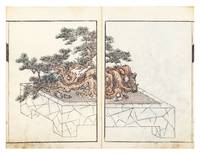
662824 color-printed woodcut illus. of which six are double-page & 18 are full-page. 20 folding leaves. Large 8vo orig. wrappers wrappers somewhat soiled orig. block-printed title label on upper cover new stitching. Osaka or Kyoto: very likely issued privately Preface dated 1808. First edition posthumously published of this extremely rare work by Buzen Sumie 1734-1806 edited by his son Aizan. WorldCat locates no copy of our edition; there was a later edition issued in 1826 with rather different images and color palette. The Union Catalogue of Early Japanese Books does not record a copy. Small tray or pot landscapes - known in the Edo period as senkeiban - have their origins in 10th century China. The "trays" in Chinese zhan jing pan or penjing were made out of copper or pottery. They were filled with soil rocks pebbles sand plants and miniature trees forming elaborately conceived miniature garden landscapes. The landscapes are clearly Chinese in style with mountains and pagodas surrounded by the sea or rivers represented by pebbles or sand. Many of the created landscapes include miniature houses temples gates stairways etc. The descriptive text for many of the images discusses the unity and philosophy involved in the creation and depiction of these miniature landscapes. The extensive explanatory text at the end describes in very great detail how to create the landscapes materials used aesthetic considerations how to care for the plants and trees etc. Aizan Sumie has provided a most interesting two-page "Afterword" in which he describes the genesis of this book. Buzen Sumie a bonkei and bonsai artist in the Chinese style created many senkeiban and the images in this work are a representative selection of his creations. The selection was made by the publisher Tadataka Katsu who also wrote a highly complimentary preface. Sumie's teacher was Settei Tsukioka. Very good copy. One image has some soiling. Minor thumbing and soiling. ❧ Brown Block Printing & Book Illustration in Japan p. 208-referring to the 2nd ed. of 1826 which she calls "delightful.". unknown books
755413 columns per page 18 characters per column. 43; 49; 55 folding leaves. Three vols. 8vo 279 x 195 mm. orig. wrappers stained dark brown with fermented persimmon juice to prevent worming nevertheless wrappers a little wormed with careful repairs cont. manuscript title labels with “Kongen†written on each cover new stitching. Japan: ca. 1630-40.<br/> <br/> A rare movable type edition unrecorded by Kawase or WorldCat. Sorimachi in his wonderful Catalogue 42 1972 of movable type books describes a copy item 419 and gives a date of “mid-Kan’ei†ca. 1630-40. In his description Sorimachi states that the full title of this work is Jippunimon Kongensho or Jufunimon Kongensho. He also suggests that it might well be an “Eizan-ban†printed at the Enryakuji monastery complex on Mount Hiei which specialized in Chinese works as well as Tendai scriptures.<br/> <br/> This work contains the text in Vols. II and III of The Essentials of the Ten Gates of Non-Duality Ch.: Shibu’er men by Jingxi Zhanran 711-82 the putative ninth patriarch of the Tiantai zong and one of the great revitalizers of the Tiantai tradition. Interspersed with Zhanran’s text is later commentary by other Tiantai monk-scholars.<br/> <br/> Vol. I contains further commentaries including those of Siming Zhili 960-1028 a Chinese monk of the Tiantai tradition. “In 991 Zhili became the abbot of Ganfusi and four years later he began his residence at the monastery Bao’enyuan on Mt. Siming whence his toponym…Zhili later found himself at the center of the Shanjia Shanwai or ‘Home-Mountain/Off-Mountain’ debate that racked the Song-dynasty Tiantai school.â€â€“Buswell & Lopez The Princeton Dictionary of Buddhism p. 825.<br/> <br/> Zhili’s commentary written in 1004 was important. “From the Song forward orthodox Tiantai doctrine has been based upon Zhili’s doctrinal elaborations on Tiantai teachings. Zhili was best known for his interpretation of the thought of Zhanran…who commanded great respect and imperial patronage in the Tang Dynasty…<br/> <br/> “Zhili’s doctorial elaboration on Zhanran’s teachings was generated during debates with other Tiantai monk-scholars over Zhanran’s works. The victorious faction led by Zhili was retrospectively known as the Home Mountain shanjia Teaching in contrast to their opponents labeled the Off Mountain shanwai Teaching. In the present work Zhili criticized his opponents’ interpolation of Huayan and Chan thought in Tiantai doctrine…<br/> <br/> “Zhili’s interpretation was canonized other interpretations were left in oblivion. Tiantai orthodoxy for the following centuries was defined during the Song Dynasty.â€â€“Shin-yi Chao “Chinese Religion in the Song and Alien Dynasties†in Nadeau ed. The Wiley-Blackwell Companion to Chinese Religions pp. 106-07.<br/> <br/> A very good set preserved in a chitsu. With some carefully repaired worming throughout touching characters. In Vol. III the final 18 leaves have worming that obscures several characters per leaf. unknown
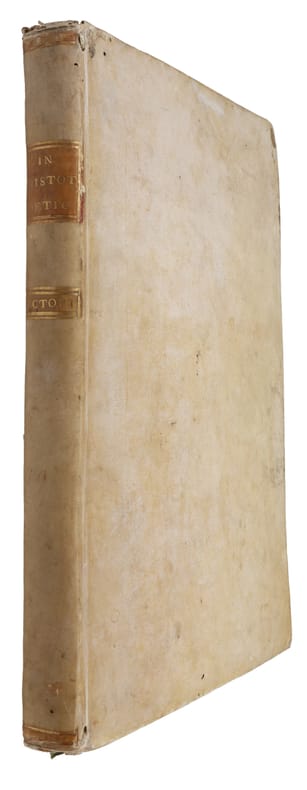
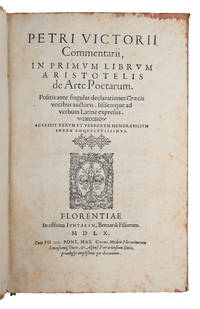
161062508Florence, In officina Iuntaru, Barnardi Filiorum, 1560. Small folio. 18th century full vellum with gilt labels to spine. Wear to capitals and small worm tracts towrad opper hinges. Corners a bit bumped. A very nice and sturdy binding. Marbled edges. Some browspotting throughout. Small wormholes to blank margin of final leaf, far from affecting imprint. Woodcut vignette to title-page and to verso of colophon-leaf. (10), 308, (12) ff.
161062508Florence In officina Iuntaru Barnardi Filiorum 1560. Small folio. 18th century full vellum with gilt labels to spine. Wear to capitals and small worm tracts towrad opper hinges. Corners a bit bumped. A very nice and sturdy binding. Marbled edges. Some browspotting throughout. Small wormholes to blank margin of final leaf far from affecting imprint. Woodcut vignette to title-page and to verso of colophon-leaf. 10 308 12 ff. <br/><br/><em>The rare first edition of Vittore's main work his great edition translation and commentary on Aristotle's Poetics which is arguably the most important and influential commentary on the work ever published profoundly shaping our understanding and interpretation of Aristotelian literary theory. Petrus Victorius or Piero/ Pietro Vittore/Vettore 1499-1584 is not only the “first great editor of the Poetics†McMahon he is also considered "the greatest Greek scholar of Italy" Whibley “the leading Italian scholar of his time†Encycl. Britt. “the last great figure from that period in the domain of Greek studies†Willamowitz and “the foremost representative of classical scholarship in Italy during the sixteenth century which for Italy at least may well be called the “saeculum Victorianumâ€.†Sandys. His magnum opus and without doubt most influential work is his edition with commentary of Aristotle’s Poetics which is of seminal importance in several respects. It is crucial to our understanding of Aristotle’s great work shaping the way that all later scholars have read it. The understanding of Aristotle’s work on poetry came to define the way that we have understood literature and fiction ever since the Renaissance and Victorius is the leading interpreter. ““From the sixteenth century to Romanticism European literary theory used the term marvel or wonder It. meraviglia ammirabile Fr. merveille Sp. maravilla to designate everything that was on the conceptual margins of the poetics of probability and imitation. The discovery and complete reception of Aristotle’s Poetics between the fifteenth and sixteenth centuries resulted in the dissemination of an idea of poetry as the imitation of the actions of men whose main part was the plot or the structuring of actions ordered according to the laws of necessity credibility and probability. This formed the basis of Neo-Aristotelian poetics which determined the ways of thinking about literature and fiction for more than four centuries.†Vega p. 280. Especially the idea of “wonder†in Aristotle’s Poetics came to be one of the founding ideas of modern literary theory. And especially here Victurius’ reading is groundbreaking playing a central part in the reception and understanding of the work over the centuries to come. “A single editorial decision in just one passage and what is more in a complex fragmentary unfinished text like the Poetics affects the entire work…†Vega p. 284. “The text of the Poetics that can be read in the editions and translations of the sixteenth century and a large part of the seventeenth with one exception as we shall see NB. This exception is Victorius does not include the term alogon in the passage that deals with wonder. It does not appear in the first Greek edition the famous Aldine princeps of 1508 or in the Latin translations of the end of the fifteenth century; it is not in the edition and translation by Alexander Paccius or Pazzi the one most widely read in the sixteenth century neither does it appear in the edition with commentary by Francesco Robortello nor in Vincenzo Maggi’s Enarrationes nor in the vernacular commentaries of Ludovico Castelvetro and Alessandro Piccolomini. What is more a detailed revision of the history of the text reveals that no manuscript of the Poetics and no direct or indirect testimonies not even in the Arabic branch of its transmission have ever included the term alogon.†Vega p. 282. It is Victorius who is solely responsible for the reading that is generally accepted today as well. “The moment when the idea of irrationality alogon appears for the first time in Aristotle’s text can be identified without hesitation as 1560 which is the date when the edition translation and commentary on the Poetics by the philologist and Hellenist Pier Vettori or Victorius was printed on the presses of Giunti in Florence. Vettori is the one who first edits alogon even though no testimony provides him with this reading and he does so fully aware of his choice and its implications†Vega pp. 287-89. “The success of Victorius’ reading while not immediate was extraordinary.†Vega p. 287 Antonio Viperano accepts the reading “alogon†with all it involves De poetica libri tres Ricciboni adapts it in his edition of Aristotle’s Poetics Tasso embraces it Discorsi dell’arte poetica Discorsi del poema eroico and it is implicit in Alonso López Pinciano’s Philosophia Antigua Poetica. Vossius in 17th century Germany makes abundant glosses on alogon in his books on poetics and the commentators and translators of the “Poetics†in France preferred Victorius’ reading in every case. “Victorius’ conjecture seems to have convinced all editors and commentators who reproduce it without question in every case.†Vega p. 289. The influence of Victorius’ interpretation of Aristotelian literary theory that he presented in his magnum opus i.e. the present work was not limited to the use of specific words that changed the reception history of Aristotle’s Poetics. His entire view of poetry through an interpretation of Aristotle was highly original and came to define the way we understand literature in general. Victorius was one of the first to put forth the belief that heroic poetry should present a Platonic idea of perfect virtue contributing to the centuries long doctrine of the perfect hero as perfect exemplar and he was one of the first to revive Aristotle’s idea of purgation from tragedy still widespread today and to also understand the existence of a purgation from poetry. “He viewed poetry as a moderator of minds “By reading poetry men “become moderate in temper and their turbid motions are extinguished.†Poems “purge our minds of blemish and spotâ€. Vettori realized that Aristotle’s reference to catharsis should be applied to tragedy alone but he added that similar purgations could be achieved by other kinds of poetry effective however on other passions than pity and fear and with the aid of other instruments.†Hathaway pp. 292-93. Apart from his overall interpretation of Aristotle’s literary theory and his groundbreaking reading of the most central passages of the Poetics Victorius was also the first to determine that the Aristotelian text that has come down to us is not complete. “Victorius was the first to see that the treatise now known as the Poetics is only the surviving portion of a larger work.†Bywater p. XX. “during his lifetime five medals were struck in his i.e. Victorius’ honour and his portrait was painted by Titian… His fame was not limited to his own land or his own time. His scrupulous care and unwearied industry are lauded by Turnebus who declines to be compared with him even for a moment; the epiteths doctissiums optimus and fidelissimus are applied to him by the younger and the greater of the two Scaligers while Muretus calls him eruditorum coryphaeus; and similar eulogies might be quoted from Justus Lipsius. Dacius … and Graevius. He is described as having climbed the “hill of virtue†and taken his place on its summit between Cicero and Aristotle. In his funeral oration Salviati says of him in the personification of Italia: “Now no more shall distant peoples cross the snows of the Alps to see Victorius or men of mark arrive from every land to hear him; or princes hold converse with him. Now no more shall the works of scholars in all parts of the world be sent here for his approval; or youth learn wisdom from his lips.†Sandys pp. 139-40. “No one said a contemporary of his in a funerary laudatio ‘left Aristotle in a cleaner state purgatior’.†Baldi. _____________________________________________ Adams: 1905; Brunet V: 1179; Graesse I: 213 â€Ã©dition excellente quant à la critique†and noting that some copies bear the dates 1563 and 1564. Sandys: A History of Classical Scholarship Vol. II 2003 pp. 135-140. Hathaway Baxter: The Age of Criticism: The Late Renaissance in Italy. Cornell University Press 1962. A.Philip McMahon: On the Second Book of Aristotle's Poetics and the Source of Theophrastus' Definition of Tragedy Authors. In: Harvard Studies in Classical Philology 1917 Vol. 28 1917 pp. 1-46. Christopher Rowe: Petrus Victorius and Aristotle’s Eudemian Ethics Cambridge University Press online 2025. Vega Maria José: Wonder and the Irrational. The Invention of Aristotle’s Poetics in the Sixteenth Century. In: Nous Polis Nomos. Berlin Academia Verlag 2016. Baldi: Il greco a Firenze e Pier Vettori 1499–1585 Alessandria 2014 117. </em> hardcover
163457767London. 1634. 1st. Ed. 1st. Iss. pp.xx 326 iv with woodcuts throughout the text last 4 leaves with woodcut illus. Royal 4to. Hardback. Title page professionally reinforced at gutter lightly chipped to fore-edge. Overall contents in nr. fine condition. Contemporary full-calf boards in thoroughly vg. condition more recent spine in fine condition. A very pleasing copy indeed. One of three variant imprints Lisney identifies this variant as the first issue given the appearance of 'apud Benjam Allen' on the title page. Lisney 3 British Bee Books 25. A very significant work indeed. A first edition first issue copy of the first book about insects published in Britain. Partly compiled from the writings of Edward Wotton Conrad Gesner and Gesner's assistant Thomas Penny Moffett's copiously illustrated treatise remained the 'standard work' on insects until the early 1700s. London. hardcover
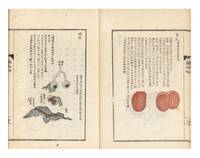
7009Numerous fine woodcut illus. 18 of which are finely hand-colored. 48 irregularly paginated; 33; 39; 26; 28 folding leaves 5 folding leaves of ads. Five vols. 8vo orig. blue wrappers wrappers a bit worn occasional minor worming touching text orig. block-printed title label on covers new stitching. Tokyo: Mankyudo Hanabusa Heikichi Preface dated 1810. First edition of one of the three most important early Japanese books on the history and technique of Chinese and Japanese acupuncture. This work is very different from all earlier Chinese and Japanese books on the subject. For the first time the illustrations are finely and realistically rendered and are anatomically accurate clearly influenced by European medical works that had circulated in Japan. Another important aspect of this book is the 18 woodcuts each depicting organs of the body that are finely hand-colored. Also the body is described in full from head to foot and not entirely dependent on the fourteen meridians. Kosaka was a court physician of the fiefdom of Kameyama and had studied under the famous physician Motonori Taki 1731-1801 who was a member of a distinguished family of doctors. The publisher of this work was the exclusive publisher for the government-sponsored medical school. Fine set. unknown books
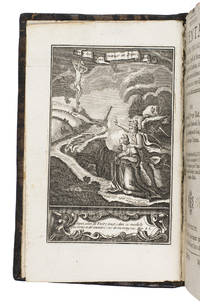
160922968Brussels: Rutger Velpius 1609. Contemporary brown calf sewn on 4 supports with corresponding raised bands on the spine gold-tooled spine with the title lettered in gold in the second compartment red sprinkled edges. 8vo. With a small woodcut vignette on both title-pages some woodcut head- and tail-pieces and woodcut decorated initials. Ad 1 with an engraved illustration depicting a Biblical scene mounted as a frontispiece on the verso of the second free flyleaf. 2 works in 1 volume the 2nd in 2 parts. With:2 GLEN Jean Baptise de and Aleixo de MENEZES. La messe des anciens Chrestiens dicts de S. Thomas en l' évesché d' Angamal és Indes Orientales . Brussels Rutger Velpius 1609. Ad 1: First French edition of António de Gouvea's account Jornada do Arcebispo de Goa Dom Frey Aleixo de Menezes first published in Portuguese in Coimbra 1606. It details the Jesuit-Portuguese success in aligning the St. Thomas Christians of Malabar with the Latin Church which was related to the trade struggles in the 16th and early 17th century between the Portuguese and their European and Indian rivals. The original Portuguese text was translated into French by Jean Baptiste de Glen 1552-1613 an Augustinian theologian. There are two issues of this edition with two different imprints: one published by J. Verdussen in Antwerp and one our copy published in Brussels by R. Velpius. The text was also translated into Spanish by Francois Munoz but remained in manuscript. Ad 2: Published under a separate title these two texts do in fact belong together. The Historie orientale and the two texts in La messe des anciens Chrestiens form a single book. Following the dedication to Abbot Gilles de Sprimont is the Remonstrance Catholique by Jean Baptise Glen. He expands on the Histoire Orientale and presents the edifying lessons the inhabitants of the Southern Netherlands can draw from it including interesting remarks on the Christian Syro-Malabar ritual and liturgy purified from the influence of Nestorianism a Christian heresy that held Jesus to be two distinct persons.The subsequent part is by Aleixo de Menezes on the Mass of the first Christians La messe des anciens Chrestiens on pp. 77-123 in which he deals with the content of the Mass and in which he gives the full Latin text. These two parts together published as one book are considered as a major contribution to the history of Christianity in India in general and the St. Thomas Christians on the Malabar Coast in particular.With a contemporary manuscript inscription on the recto of the second free flyleaf and a contemporary manuscript inscription on the title-page of ad 1. The binding shows some signs of wear second free flyleaf the title-page and the the first page of the dedication to ad 1 are restored in the upper outer corner the top margin is cut rather close to the text without affecting it. Otherwise in good condition.l Bibl. Belg. III G3; Cioranescu 33232 33233; Lach Asia in the Making of Europe III I pp. 320-1 395; USTC 6167300 7 copies; cf. STCV 6689348 1 copy other issue Rutger Velpius, hardcover
51-6118London: Printed by Tho. Johnson for the author and are to be had at his house in White Fryers M. DC. LXXI. 1671. Folio. 26 x 42cm. vi 724pp. Contemporary gilt paneled calf with later gilt calf spine and repaired innner hinges. .Sub-title: The Second and Third Embassy to the Empire of Taysing or China.Bookplate dated 1738 of Thomas Trevor 2nd Baron Trevor of Bromham 1692-1753.Printed in red and black throughout: With one engraved double-page map; six single page plates; 31 double page plates and 57 third page engravings. Very good without foxing.OCLC Number / Unique Identifier:35077336; Cox I 326; Cordier BS 2349;Kress 01964.2; Landwehr VOC 545. London: Printed by Tho. Johnson for the author, and are to be had at his house in White Fryers, M. DC. LXXI. [1671] unknown
162134518Lisbon and Hangzhou China: Manuscripts ca.1623 and 1621. Very Rare A Similar Manuscript Exists in Brussels. We know of no others. The Latin text of both letters is written in a neat uniform cursive hand in brown. Folio leaves 33 x 20.5 cm The transcripts bound in 18th Century stiff blue wrappers the blank paste-downs and endpapers are late 18th century most likely the third quarter between 1745/1753 and 1776 since they contain a clear "lion/vryheit/pro patria" watermark with a crowned GR countermark which resembles Heawood 3148 3149 and 3154. The paper used for the manuscript contains a faint double-headed eagle watermark and it has been reinforced in the gutters. A very pleasing survival very well preserved edges slightly mellowed the wrappers show some signs of wear. VERY RARE MANUSCRIPT TRANSCRIPTS. Chrysostomus Johann Gall 1586-1643 was a German Jesuit and scholar. He left Ingolstadt Germany to teach astronomy mathematics and navigation in Lisbon fro 1620to 1627 before leaving to work in the Jesuit missions in India. The Colégio de Santo Antŕo benefitted from the arrival of many foreign mathematicians and other scholars as Lisbon serves as a gateway for all missionaries departing for Asia. The original letter by Gall was written in Lisbon September 1623 and concerns a newspaper style description of various events including details of the perseution of Christians in Japan particularly the execution of large numbers of the Christian community in Nagasaki in 1622.<br> The second letter in the present work is especially interesting as the original was written by Johannes Terentius also known as Johannes Schreck an Deng Yuhan Hanpo 1576-1630. Terentius was a prominent Jesuit scholar specialized in natural science and mathematics. Before joining the Jesuits as a novice1611 he already enjoyed a grea reputation in Germany as a scholar. In 1621 Terentius left for China to join the Jesuit mission. The original letter by Terentius was written in Hangzhou China on 30 August 1621 to the rector of teh Jesuit College in Munich Jakob Keller 1568-1631. He discusses his journey to China which he started in 1618 his intentions to participate in the planned calendar reform in China and his impressions of the city of Hangzhou which he reached in 1621 Terentius wrote several works on european medicine mathematics and technology in Chinese and together with Johann Adam Schall von Bell and G. Roho introduced European tigonometry and European astronomical instruments to China. In 1629 he began to reform the calendar which J.A. Schall von Bell ocmpleted after Terentius' early death a year later.<br><br>Backer & Sommervogel VII col. 1929-F<br> Manuscripts unknown
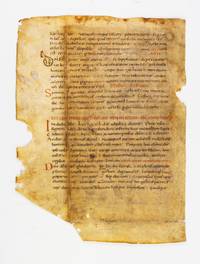
ST17235Probably France or Rhineland 10th century. Irregularly shaped but approximately 298 x 225 mm. 11 3/4 x 8 7/8". Single column 33 lines on recto and 29 on verso in a neat Caroline minuscule. <br/> Rubrics in red nine two-line initials in red and/or brown one with a light yellow wash and feathered extender one with feathered ascender. ◆Recovered from a binding with the verso consequently somewhat soiled and with a vertical crease obscuring a letter or two on each line a little loss of blank vellum margin but no text lost other light stains and imperfections as expected but still in remarkably good condition the text almost entirely legible and the recto still generally quite pleasing.<br/> <br/> Written in an attractive and highly legible Caroline minuscule this early leaf is desirable not only for its age and script but also for the many initials opening each separate prayer. Inked in brown and orange and sometimes tinged with yellow these initials are reminiscent of those found in the Gellone Sacramentary BNF Latin 12048 an eighth century manuscript with extraordinarily inventive designs incorporating animals knotwork and a multitude of patterns and favoring a color palette of green orange yellow and brown. Although the present examples are simpler in their execution we can see similar tendencies in terms of colors and shapes--especially in the winged designs on two of the initials here. The smaller "S" residing in the larger "D" initial on the recto signifying the word "Deus" is a feature that can also be seen in the Gellone Sacramentary for example on f. 7r. The text here probably comes from a Sacramentary a type of manuscript containing only the words said by a priest or bishop rather than the congregant during Mass and other liturgical services or possibly a Rituale containing the services not included in the Missal or Pontifical. The text on this particular leaf includes blessings for trees. Though recovered from a binding the damage on this leaf is far less severe than is often encountered with such specimens; the text on both sides is intact all but a few letters are entirely legible the margins are quite generous and the initials have been well preserved. unknown
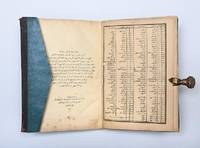
1872160588Istanbul: al-Matba'a al-Mahmudiyah 1289 H / 1872. Significant hajj texts by two distinguished scholars Rare first edition combining two important and complementary texts which outline the rites of hajj and umrah with descriptions of Mecca Medina and Jerusalem; an online institutional search locates five copies only: Library of Congress Stanford Ohio State Utah and University of Basel; included is the first printed edition of Majmu'at al-manasik by the eminent 16th century Hanafi scholar Rahmatullah al-Sindi. Rahmatullah al-Sindi d. 993 H/ 1585 CE was as his name implies born in Sind in modern day Pakistan. As a young man he fled with his father to Hejaz "frequently the destination for Sindhi scholars fleeing imperial unrest" Baig p. 63. Having completed his studies at Mecca under the Indian Sunni scholar al-Muttaqi he proceeded to Medina where he lectured in hadith literature. In 1574 he travelled to India accompanying Haji Begu empress consort of the Mughal emperor Humayun who had just completed the hajj. He visited Agra and read hadith with the distinguished historian and translator 'Abd al-Qadir Badayuni before teaching at Ahmadabad. Returning to Hejaz he "contributed to a new generation of Hanafi scholarship that was steeped in the hadith sciences and was intimately connected to political and intellectual developments in South Asia The vast oeuvre of Rahmatullah al-Sindi's work was on 'ilm al-manasik the discipline of the rites of pilgrimage. He wrote encyclopaedic tomes for scholars as well as abridgements as hajj guides for general pilgrims thus encompassing both scholarly and non-scholarly communities. Rahmatull h wrote his largest Jam' al-Manasik wa Naf' al-Nasik The Compilation of Rites and the Benefit of the Pilgrim in 950/1543 in Medina while still in his early twenties this is not to be confused with the work of the same name by Gümüshânevî. Though it initially attracted local opposition it became a landmark in the field that Hanafi scholars in South Asia and the Ottoman Empire consulted for centuries. Drawing upon more than 150 sources of Hanafi law Rahmatull h laid out in encyclopaedic detail the rulings of pilgrimage claiming to have produced an unprecedented compilation striving to synthesize the vast array of differences amongst Hanafi scholars" ibid. 65. Fittingly he died at Mecca. On the page Rahmatull h's text surrounds that of the Turkish mystic Ahmed Ziyauddin 1813-1893 known as Gümüshânevî or Kumushkhanawi. Gümüshânevî's text Jam' al-Manasik wa Naf' al-Nasik The Compilation of Rites and the Benefit of the Pilgrim was also published separately the same year. "Ziyauddin Gümüshânevî had been initiated into the Khalidiya a branch of Naqshbandiya Sufiism in 1847 by Shaykh Ahmad b. Sulaiman al-Arwadi After his initiation Gümüshânevî acquired a steadily expanding following which met under his guidance at the Fatma Sultan mosque in the Cagaloglu section of Istanbul. Numerous members of the Ottoman bureaucracy became his followers and the tekke religious lodge he established was visited several times by Sultan Abdulhamid II. In addition to activities conventionally associated with Sufi shaykhs Gümüshânevî was remarkable for enlisting with his murids Sufi novices to fight on the eastern front in the Russo-Ottoman War of 1877; for establishing a printing press to produce works written by himself and others; and for setting up public libraries in Trabzon Rize and Of" Gross p. 118. The present work may have been published by Gümüshânevî's own press in Istanbul. It is lithographed throughout in naskh script the first 16 leaves comprising a comprehensive index and the page preceding decorated with simple biomorphic motifs in the hatâyî style; the opening of the text is embellished with an intertwining foliate headpiece. Lithography was introduced to Ottoman Turkey in 1831 by Henri Cayol a Marseille printer who established a press at Istanbul under the patronage of the admiral and statesman Koca Hüsrev Mehmed Pasha. Lithography proved a very popular medium as it "reproduced the beauty of the handwritten Arabic script in a way which the type-face of the letterpress could not equal" Flemming p. 153. Octavo 240 x 176 mm. Contemporary envelope-flap binding of black quarter sheep green pebble-grain paper boards. A little wear to edges occasional foxing and browning yet this remains a very good copy. Sohaib Baig Indian Hanafis in an Ocean of Hadith: Islamic Legal Authority between South Asia and the Arabian Peninsula 16th to 20th Centuries UCLA doctoral dissertation 2020; Carl Brockelmann Handbook of Oriental Studies Section One: The Near and Middle East vol. 11 7/S2 2018; Barbara Flemming Essays on Turkish Literature and History 2018; Jo-Ann Gross Muslims in Central Asia: Expressions of Identity and Change 1992. hardcover
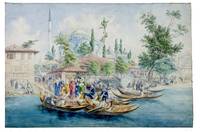
1840J37G5H5ISWE1Istanbul 1840. Mounted on a larger sheet of paper in a passe-partout. Watercolour drawing on wove paper 29.5 x 45 cm with highlights in shellac and a thin black border. A lively scene on the Tophane Quay in Istanbul with the background dominated by the dome and minaret of the 1580 Kilic Ali Pasha Mosque. The tip of a second minaret perhaps from a different mosque is visible in the distance. On the quay an opulently dressed black-bearded Ottoman a high official in the Emperor's court or a wealthy merchant stands in the centre of the scene with his entourage. He wears red robes trimmed with gold and with black decorations a white turban around a red fez and a gold waistband with the hilts of two guns sticking out and carries a walking stick in his left hand. His entourage includes a white-bearded Islamic holy man with a green turban around a red fez a Greek or Armenian man in a black hat a dark-skinned woman in green robes holding a bundle and several other men women and children. They appear to be preparing to depart in the boats that stand ready. Two more dark-skinned women in white robes with red and blue stripes follow the party deferentially. Several people appear in the boats in addition to their crews. Four more white-bearded Islamic holy men each again with a green turban around red fez sit in one with some women while two Ottoman infantrymen with bayonets stand in another one just stepping out. Other parts of the quay show various men busy with their trades or smoking long pipes. From the collection of Hooton Pagnell Hall in Yorkshire England. With a 1.5 cm tear in the water at the foot of the scene not approaching the boats and otherwise in very good condition. A lively and fascinating scene on a quay in Istanbul with the dome and minaret of Kilic Ali Pasha Mosque prominently shown.l For the King family: Debretts Peerage 1840 p. 423 & 1861 p. 338; Debretts Baronetage LXXV 1893 p. 127. unknown
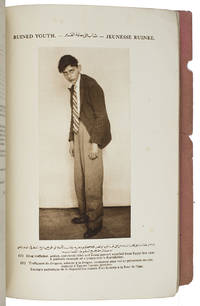
ABC_46768Cairo: Government Press 1933. Original publisher's pink paper wrappers printed letterpress. Although the book is in quires of 8 leaves unwatermarked wove paper they are not sewn but stapled through the side 3 staples. Imperial 8vo 27 x 18.5 cm. With 14 rotogravure plates printed in sepia 1 folding facsimile letter 2 folding graphs a plate with 6 pie charts and 1 illustration also in red showing schematically a smuggling box. Rare work on drug trafficking in Egypt in the 1930s and an important example of the authors "war on drugs": he was director of the Central Narcotics Intelligence Bureau. Thomas Wentworth Russell 1879-1954 sometimes better known as Russell Pasha was a police officer in service of Egypt who was appalled by the increasing drug trafficking in Egypt and the large number of drug addicts in the country. He founded the Central Narcotics Intelligence Bureau CNIB making it his mission to rid Egypt of drugs especially what he called "white drugs" cocaine morphine heroin but also of "black drugs" hashish opium. Russell was one of the most important anti-drug campaigners in Egypt in his time and after greatly raising awareness of the rising problem. Here he describes how drugs are smuggled in large quantities from abroad to Egypt. In many chapters he extensively describes the foreign sources of supply discussing not only important drug barons but also mentioning specific ships and other means of transport used to smuggle drugs notes cases where weapons were used by traffickers discusses people involved in the trade traffickers and their methods of smuggling in shoes camel saddles etc. addiction and its social effects and death rates and much more. Although 3000 copies were printed the printers code for the job is printed on the back of the title-page: 10506-1932-3000 ex. it is a scarce and outstanding example of Russell's anti-drug campaign extensively describing drug trafficking in Egypt in the 1930s being well-illustrated with photographs of drug barons users traffickers and methods of concealment. We have located only four other copies but due to ambiguity between the year covered 1932 and the year of publication 1933 three further locations are uncertain.Authors presentation copy for the English poet and dramatist John Drinkwater with an inscription by Russell on the front wrapper "John Drinkwater With compliments from the director Tho Russell 24/3/33" insciption in Arabic script" and his red stamp next to the inscription.Spine of wrapper damaged and front wrapper detached and with light water stain. A rare survival.l KVK 1 copy; WorldCat 1780146 3-6 copies. Government Press, unknown
1581ABC_47414Antwerp 1581. Large folio. Christoffel Plantin Later 17th-century blind tooled vellum with a single fillet frame and a large ornamental centre piece sewn on 5 supports corresponding with the 5 raised bands on the spine creating 6 compartments with a manuscript title in the first compartment at the head of the spine. With an engraved title-page the author's large "candore et spe" woodcut device on leaf 6r approximately 2185 botanical woodcuts in the text 8 woodcut decorated sometimes interlaced initials plus repeats 6 series and 1 typographic interlaced initial. Set in fraktur types with extensive roman and textura and incidental italic and civilité. 2 volumes bound as 1 the second in 3 parts. 10 994 2 blank "312"= 312 294 2 blank 2 blank 15 1 blank 67 1 blank pp. First Dutch edition with approximately 435 more woodcuts than Plantin's Latin edition of 1576 of one of the greatest herbals. Besides the expected herbs medical plants etc. it illustrates and discusses mushrooms a coconut corals petrified wood and what may be a fossil fern. Matthias de Lobel 1538-1616 a Flemish botanist and physician published his Stirpium adversaria nova in London in 1571 but greatly expanded it after his return to the Low Countries. Plantin bought 800 copies of the London edition and reissued it in 1576 cancelling a few leaves but printing extensive supplementary material to incorporate Lobel's further work. Lobel further expanded it for the present first edition in Dutch evidently his own translation giving the work its definitive form. The 1571 Latin edition had included about 275 woodcuts. Plantin acquired 120 of them but also added many more for his editions including many he had used for his editions of Dodoens and Clusius. The number of woodcuts therefore grew to about 1750 in the 1576 Latin edition and about 2185 in the present Dutch edition but Plantin appears to have had some new blocks cut as well. Many blocks were cut by Antoon van Leest and Gerard Janssen van Kampen after drawings by Pieter van der Borcht.With a clear purple owner's stamp "Jan Veth" and a clear 18th-century inscription "Cost 2800" on the front pastedown and some additional inscriptions on the rectos of the blank flyleaves engraved title-page and the back pastedown. With some occasional annotations in brown ink in the margins and some discrete additional manuscript shading to a few illustrations. The binding is somewhat soiled and the head and foot of the spine are slightly damaged all without affecting the structural integrity of the binding. The margins of the preliminary leaves including pastedown and flyleaves final blank flyleaves and back pastedown are somewhat water stained and have been restored. Somewhat browned throughout but the impressions of the woodcut illustrations remain clear. With some minor defects to several leaves only occasionally slightly affecting the text. Otherwise in good condition.l Arber Herbals p. 278; Belg. Typ. vol 1 1974; Bibl. Belgica L119; BM NH vol. 3 p. 1160; Carter & Vervliet 199; Nissen BBI 1219; Plesch mille et un livres botaniques p. 314; Stafleu & Cowan 4908; STCN 344385353 5 copies; STCV 12914575 9 copies incl. 4 incomplete; Voet the Plantin press 1579; Wellcome 3829; WorldCat 833674408 2 copies. hardcover
15465968Venice: Cornelio Adelkind for Daniel Bomberg 1546. First edition. Very Good. Folio 32 cm; 93 leaves. Text in Hebrew. Title within architectural border reproduced in Amram "Makers of Hebrew Books in Italy" p. 215 also in the Jewish Museum's 1989 exhibition catalogue "Gardens and Ghettos: the Art of Jewish Life in Italy" page 50. Some section headings within ornamental borders. Bound in c19 or c20 dark red crushed morocco ruled in gilt and decorated with arabesques on both boards; spine with raised bands and compartments tooled and titled in gilt; green polished leather doublures with red crushed morocco dentelles bordered in pointillé accented with arabesques; green moiré free endleaves. Edges gilt. Binding not signed. Joints and crown adroitly reinforced with Japanese paper; corners somewhat worn down. Occasional contemporary notes in manuscript in text; brief stain on leaf mem-tet and lightly along the bottom edge of leaves nun-bet and nun-gimmel. Text otherwise pristine. Title page light possibly washed. Old library ink stamps from an institution in Warsaw on title page. Red morocco ex-libris of mining magnate and philanthropist Adolph Lewisohn 1849-1938. References: Adams T-766; BM Italian 674; Steinschneider 7304 #1; Amram 215 illustration and 222. <br /><br />First printed edition editio princeps of the 11th century commentary on portions of the pentateuch by the Bulgarian poet and Talmudist Tobiah ben Eliezer. Published by the house of the seminal printer of Hebrew books Daniel Bomberg under the supervision of his scholar-in-residence extraordinaire Cornelio Adelkind. Venetian law at this time limited Hebrew publishing to Gentile printers. Bomberg a protestant from Antwerp entered this lucrative market and with Adelkind's help became its prime exponent until his death in 1549. Cornelio Adelkind for Daniel Bomberg hardcover
3396Large engraved vignette on title. Title in red & black. 8 p.l. 626 69 pp. Folio cont. blind-stamped pigskin over wooden boards arms on covers effaced. Lyon: J. & P. Prost 1636. First edition Schuh's issue B no stated priority with the dedication to Charles de Neufville. "Very scarce. Compendium of all the author ever discovered or read about the subject of mineralogy. It was published posthumously from notes he left by his Order at Lyon six years after his death. Printed in a double column format in a relatively small type-size the work is a vast storehouse of all things mineralogical including new ideas restatements of earlier authors observations and superstitious belief. The uncritical selection of material led Webster in his Metallographia London 1671 p. 29 to criticize the author as too digressive and as mixing tares with the wheat. Partington thinks the use of the term 'Mineralogia' in the title is the first modern usage of the word. "The work opens by listing the evils and benefits of mineralogy. Mining is considered dangerous because of the lurking underground spirits.the author notes that the study of mineralogy helps one to understand the bible. It provides medicines and money ornaments for religious purposes tools used in agriculture industry painting music and alchemy. Cesi then answers the question he posed earlier and declares mineralogy to be a true philosophy worthy of careful study. "The numerous citations to earlier authors provide evidence of Cesi's wide reading. Commonly many authors are referenced on single points. For example in describing the generation of minerals he closely follows Aristotle but also cites Theophrastus Avicenna Albertus Magnus Agricola Gregorius Reisch Pliny Boodt Francis Rueus Marbode the Bible and numerous church fathers. The author is uncritical of the views he presents and accepts the authority of the ancient and medieval authors as his own. He believes that the Sun Moon and stars influence the subterranean world of minerals and metals and that gems have miraculous curative powers. He includes a chapter on the magnet. "Cesi divides his work into five sections: the first treats mineralogy proper the second the economic and commercial aspects for example colors and pigments the third lapidifying juices of the earth that congeal into minerals the fourth gems and the fifth metals. At the conclusion is a long and thankfully comprehensive index. Much insight about ancient philosophy and its affect in the 17th century can be gained from studying Cesi's Mineralogia."-Schuh Mineralogy & Crystallography: A Biobibliography 1469 to 1920 pp. 358-59. Cesi 1581-1630 was a Jesuit professor at Modena and Parma. A nice copy of a book which is now scarce on the market. ❧ Hoover 214. Partington II p. 94. Schuh 1113. Sinkankas 1221-who inaccurately calls this issue a reprint. Sinkankas knew mineralogy very well but nothing about bibliography. Thorndike VII pp. 254-57. hardcover books