HUAN, Kuan (or Guan)Biblio.com
15 963 résultats
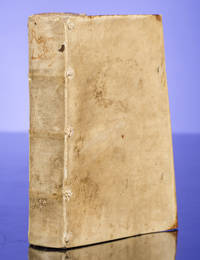
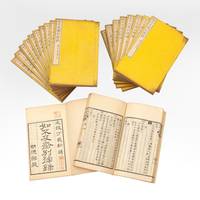
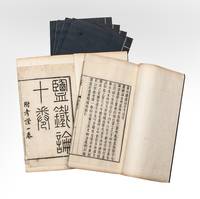
821136; 19; 20; 27; 37; 31 folding leaves neatly interleaved throughout. Ten juan in five vols. plus one vol. of commentary by Dunren Zhang. 8vo modern blue wrappers new stitching. China: 1807.<br/> <br/> A rare and important edition of this notable text; the sixth volume contains the valuable commentary and notes of Dunren Zhang 1754-1834 Qing scholar mathematician historian and book collector.<br/> <br/> After the death of Emperor Wu in 87 B.C. his successor summoned to the capital scholars from throughout the empire to discuss the most important problems of the day. Emperor Wu had “implemented a series of centralized economic measures to support his territorial expansion particularly to sustain wars with Xiongnu a confederation of nomadic tribes from Central Asia. For example the state monopolized salt iron and liquor industries; operated nationwide transportation facilities; and ran retail businesses. After the emperor died the new emperor gathered his officials and more than sixty Confucian literati to reassess these measures. The consultation turned into a lengthy debate not only on economic issues but also on topics such as agriculture border defense diplomacy legality and Confucianism…<br/> <br/> “The debate was later reconstructed under the title Yan tie fan by a Confucian bureaucrat-scholar Huan Kuan who consulted both living debaters and the historical record. The text delineates the debate in sixty episodes spanning over several days. In each episode the debaters focus on a specific issue that emerges during the debate.†You “Building Empire through Argumentation†369.<br/> <br/> As a result of the debates the monopolies on salt and iron were briefly abolished but were soon resumed only to be abolished again after the overthrow of Emperor Wang Mang in 23 A.D.<br/> <br/> “The text of this book the Yantielun has been brought in the shape of a dialogue between the opponents. Except the state monopolies the text also touches political questions of the time like the power of the nomad federation of the Xiongnu in the north or the general style of politics as a ‘rule of the law’ versus ‘rule by virtue.’ Huan Kuan’s book is an important document about the internal discussions about political affairs during the Former Han period" ChinaKnowledge.de online.<br/> <br/> Fine set preserved in a slightly worn hantao.<br/> <br/> <br /> <br> <br> References<br /> <br> <br> ChinaKnowledge.de<br /> <br> <br> Wagner Donald B. Ferrous Metallurgy. Science and Civilisation in China. Vol. 5. Part 11. Cambridge: Cambridge University Press 2008.<br /> <br> <br> You Xiaoye. “Building Empire through Argumentation: Debating Salt and Iron in Western Han China.†College English Vol. 72 No. 4 March 2010. unknown
03734Paris: Aegidius Gorbinus 1578. A Remarkable Survival of Three Books by Ramón Lull - 'Doctor Illuminatus'<br/>One of Athanasius Kircher's Greatest Influences<br/><br/>LULL Ramón. Opusculum Raymundinum de auditu Kabbalistico sive ad omnes Scientias introductorium. Incipit libellus de Kabbalistico auditu in via Raymundi Lullii. Paris: Apud Aegidium Gorbinum. 1578. <br/><br/>Twelvemo 4 3/8 x 3 1/8 inches; 111 x 80 mm. 82 i.e. 80 leaves A8-K8. Woodcut printer's device on title Renouard no. 376. Folding table and two woodcuts in the text and five plates with woodcut diagrams including one with a volvelle with two moving parts. Title-page with the German Jesuit library stamps of "Domus Bonnensis" and "Bibl.script".<br/><br/>A fine copy of a rare and important work which includes among its five plates a volvelle mounted with its two movable parts still present.<br/><br/>Third Edition the previous two appeared in 1518 and 1538 in Venice all of which are very rare. "How successful was the thesis of 'De auditu kabbalistico' in the 16th and 17th centuries could be shown by the impressive reception of this treatise which ranges from about Giordano Bruno Claude Duret Johann Heinrich Alsted and Athanasius Kircher up to Leibniz" G. Kurz ed Meditation und Erinnerung in der Frühen Neuzeit p 115; trans. <br/><br/>This text has found an important place in the body of Kabbalistic texts with its attribution to Ramón Lull 1232-1316. However there is evidence that this is the work of a Renaissance physician and Kabbalist scholar when one goes back to the original 1518 edition. Pietro Mainardi born about 1456 obtained his doctorate at the University of Ferrara in 1490 and went on to teach medicine there until 1527. He was definitely a great scholar of Lull and while composing this work he drew heavily from Lull's Ars Brevis and inserted kabbalistic references and added very effectively some of his own. However he did not sign the work. He apparently wished to remain anonymous as the author so his name appears only in the colophon of the 1518 edition as the editor and publisher. Thus in later editions with different publishers and colophons the work became Opusculum Raymundinum. The work definitely has very scholarly content and a form so similar as to be considered a work of Lull and would from then on be ascribed to him. Its great success is attested by several documents and printed texts in which quotations from the present work De auditu would mingle with the Kabbalistic text collections of Lull.<br/><br/>In addition this is the first book that deepens and broadens the ars combinatorial method invented by Lull through which by using diagrams figures or words you can connect in a sort of mechanical logic information in each field to get closer to universal knowledge as well as to be able to memorize it. Many later scientists and philosophers Bruno Agrippa Kircher Alsted Leibniz and his followers or writers Roussel Raymond Queneau Perec Calvino Eco were interested in the theories expressed here.<br/><br/>Palau 143.864; Duveen 370; Caillet 6846; E. Rogent & E. Durà n Bibl. de les impressions lul-lianes Barcelona 1927 no 120; C. Ottaviano Lull's L'ars compendiosa 1930 p. 97 no. 17 under "E Écrits apocryphes.". <br/><br/>together with<br/><br/>LULL Ramón. Ars Brevis Illuminati Doctoris Magistri Raymundi Lull. Quae est ad omnes scientias pauco & brevi tempore assequendas introductorium & brevis via una cum figuris illi materiae deservientibus necnon & illius scientiae approbatione. In cuius castigatione attendat lector quam castigatissimè Magister Bernardus de lavinhera artis illius fidissimus interpres insudatit. Paris: Apud Aegydium Gorbinum. 1578. <br/><br/>Twelvemo 4 3/8 x 3 1/8 inches; 111 x 80 mm. 48 leaves A8-F8. Woodcut printer's device on title Renouard no. 376. woodcut diagrams on A5 recto B1 recto folding woodcut diagram between A6 and A7 B2 verso with a volvelle with two moving parts folding table between B7 and B8.<br/><br/>A fine copy of a rare and important work with the plate with the volvelle mounted with its two movable parts still present.<br/><br/>Rare compendium edition of the Ars Magna - and therefore defined Brevis - of the Catalan philosopher and theologian Ramón Lull who lived in the thirteenth century and was the author of numerous works of scientific argument mystical-philosophical and even literary. The work of Lull ranks for many critics of the foundations of modern science and was studied and deepened by thinkers such as Nicola Cusano Giovanni Pico della Mirandola Giordano Bruno Kircher Cartesio Descartes and Leibniz. <br/><br/>"This work written at Pisa in 1308 was the most widely read and widely distributed version of the Art. It corresponded to a desire peculiar to the second of the Art's phases to simplify the principles of the Art. The Ars Brevis starts by stating that it was written so as to facilitate access to the ‘Great Art' specifically the Ars generalis ultima 1305-1308".<br/><br/>"The Ars brevis operates in accordance with a remodelled version of logic that Llull dealt with in the Logica nova 1303: the ‘compartments' containing two or three concepts correspond therefore to propositions and syllogisms. The Art shows one how to ‘find' all possible propositions and syllogisms from the terms given in the Alphabet and how to verify their truth or falsity. The Tree of Science 1295-1296 on the other hand reveals how the structure of principles and relations in the Ars brevis is linked with the whole of the intelligible world.<br/><br/>The Ars brevis contains thirteen highly dense parts. The first part presents the Alphabet; the second the Figures; the third the definitions of the Principles; the fourth the Rules; the fifth the Table; the sixth the Evacuation of the Third Figure; the seventh the Multiplication of the Fourth Figure; the eighth the ‘mixing' ‘mixtio' or combining of the Principles and the Rules; the ninth the nine Subjects; the tenth the application of the Art; the eleventh the questions; the twelfth familiarisation with the Art; the thirteenth ‘the way to teach this Art'". See Anthony Bonner. Selected Works of Ramón Llull volume 1 pp. 569-646.<br/><br/>".The next twist in the path came from perhaps the strangest character in the history of Lullism the German Jesuit Athanasius Kircher 1602-1680 scientist mathematician cryptographer and student of Egyptian hieroglyphics. With the idea of perfecting Llull's Art he published in Amsterdam in 1669 his vast Ars magna sciendi. This work begins in reforming the alphabet of the Art inventing little symbols a heart for Concordantia a donkey for Animalia etc and continues with what Martin Gardner calls a fascinating mixture of Science and nonsense." Anthony Bonner. Doctor Illuminatus. A Ramon Llull Reader p. 68.<br/><br/>Palau 14370-14384; Duveen p. 370.<br/><br/>together with<br/><br/>LULL Ramón. Articuli Fidei Sacrosanctae ac Salutiferae legis Christianae cum corundem perpulchra introductione. Quos caeteras leges omnes improbando Illuminatus doctor Raymundus Lullius rationibus necessariis demonstrativè probat. Paris: Apud Aegydium Gorbinum. 1578. <br/><br/>Twelvemo 4 3/8 x 3 1/8 inches; 111 x 80 mm. 66 i.e. 64 leaves A8-H8 I2. Woodcut printer's device on title Renouard no. 376. <br/><br/>Articles of Christian faith Holy law and healing affairs with a fine introduction. <br/><br/>"Deus in Virtue tua sperantes & de tua gratia confidentes intendimus probare articules fidei per necessarias rationes." <br/><br/>The three books bound together as a sammelband.<br/><br/>Twelvemo. Contemporary full yapp-edged vellum manuscript title on spine unidentified armorial bookplate on front paste-down. A remarkable survival in almost pristine condition. Housed in a fleece-lined full brown scored calf clamshell case.<br/><br/>"The German Jesuit Athanasius Kircher 1601-1680 scientist mathematician cryptographer and student of Egyptian hieroglyphics was also a confirmed Lullist. He published in Amsterdam in 1669 a huge tome of nearly 500 pages titled Ars magna sciendi sive combinatoria. It abounds with Lullian figures and circles bearing ingenious pictographic symbols" Gardner Martin. Logic Machines and Diagrams.<br/><br/>Ramón Lull Poet Philosopher Alchemist Catalan Mystic - also known as Doctor Illuminatus. "The definitive Ars Magna Lull's greatest contribution to science - his attempt to unify all knowledge into a single system. Lull invented an ‘art of finding truth' which inspired Leibniz's dream of a universal algebra four centuries later. The most distinctive characteristic of his Art is clearly its combinatory nature which led to both the use of complex semimechanical techniques that sometimes required figures with separately revolving concentric wheels - ‘volvelles' in bibliographical parlance - and to the symbolic notation of its alphabet. These features justify its classification among the forerunners of both modern symbolic logic and computer science with its systematically exhaustive consideration of all possible combinations of the material under examination reduced to a symbolic coding. The Art's function as a means of unifying all knowledge into a single system remained viable throughout the Renaissance and well into the seventeenth century" DSB. Paris: Aegidius Gorbinus, 1578 unknown books
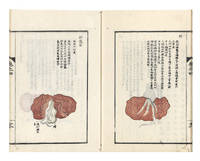
7010Many fine full-page woodcut illus. 46; 59 folding leaves. 8vo orig. yellow wrappers wrappers a little soiled orig. woodblock title-slips on upper covers labels a little soiled new stitching. Kyoto Osaka & Edo: 1808. First edition of one of the three most important Japanese works on orthopedic medicine. The book is based on Chinese medical science most notably the Sheng ji zong lu written in the 11th century and the Yi zong jin jian by Qian Wu active 1736-43 who also wrote the famous Yusuan Yizong Jinjian Imperially Commissioned Golden Mirror of Medical Learning published in 1742. Our work presents a system of surgical treatment to cure injuries to bones principally fractures and dislocations with instructions on how to stop bleeding and to bind or immobilize the injured part by bandaging. There is a substantial section on materia medica and the compounding of prescriptions considered essential to the treatment of bones in Japan. The numerous and fine woodcuts depict braces and corsets plasters manipulations bandaging techniques casts etc. Many of these techniques are clearly taken from Western medicine. Ninomiya 1754-1827 was a prominent medical doctor who laid down the foundations of orthopedic surgery in Japan. He studied in Nagasaki where he learned Western and Japanese techniques from Kogyu Yoshio 1724-1800 interpreter of Dutch and a famous physician and surgeon who had a "Western-style" room at his home in the city. After further study under a number of doctors throughout Japan including Gento Yoshiwara Ninomiya established himself in Edo where he had an extremely successful practice. After contracting syphilis as a baby from his wet nurse Ninomiya lost his nose and wore a artificial nose for the rest of his life. Nice set. Both volumes have some minor marginal dampstaining. ❧ Mestler A Galaxy of Old Japanese Medical Books III p. 152. unknown books
7010Many fine full-page woodcut illus. 46; 59 folding leaves. 8vo orig. yellow wrappers wrappers a little soiled orig. woodblock title-slips on upper covers labels a little soiled new stitching. Kyoto Osaka & Edo: 1808.<br/> <br/> First edition of one of the three most important Japanese works on orthopedic medicine. The book is based on Chinese medical science most notably the Sheng ji zong lu è–濟總錄 written in the 11th century and the Yi zong jin jian 醫宗金鑑 by Qian Wu active 1736-43 who also wrote the famous Yuzuan Yizong Jinjian 御纂醫宗金鑑 Imperially Commissioned Golden Mirror of Medical Learning published in 1742. Our work presents a system of surgical treatment to cure injuries to bones principally fractures and dislocations with instructions on how to stop bleeding and to bind or immobilize the injured part by bandaging. There is a substantial section on materia medica and the compounding of prescriptions considered essential to the treatment of bones in Japan.<br/> <br/> The numerous and fine woodcuts depict braces and corsets plasters manipulations bandaging techniques casts etc. Many of these techniques are clearly taken from Western medicine.<br/> <br/> Ninomiya 1754-1827 was a prominent medical doctor who laid down the foundations of orthopedic surgery in Japan. He studied in Nagasaki where he learned Western and Japanese techniques from Kogyu Yoshio 1724-1800 interpreter of Dutch and a famous physician and surgeon who had a “Western-style†room at his home in the city. After further study under a number of doctors throughout Japan including Gento Yoshiwara Ninomiya established himself in Edo where he had an extremely successful practice. After contracting syphilis as a baby from his wet nurse Ninomiya lost his nose and wore a artificial nose for the rest of his life.<br/> <br/> Nice set. Both volumes have some minor marginal dampstaining.<br/> <br/> ⧠Mestler A Galaxy of Old Japanese Medical Books III p. 152. unknown
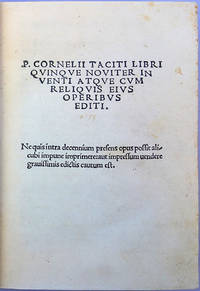
151742431Milan: Alessandro Minuziano 1517. <p>Tacitus Publius Cornelius ca. 56 - ca. 120 C.E. P. Cornelii Taciti libri quinque noviter in venti atque cum reliquis eius operibus editi. Small 4to. 20 233 3ff. Signatures H-K bound in reverse order in this copy. Milan: Ex officina Minutiana 1517. 192 x 127 mm. Full morocco tooled in gilt and blind in antique style. Occasional faint dampstaining but a fine copy. Engraved armorial bookplate of Count Dmitri Petrovich Boutourlin 1790-1849.</p> <p> First Minuziano Edition and the First Example of a Challenge to a Copyright. In 1508 Pope Leo X formerly Cardinal Giovanni de'Medici purchased the only surviving manuscript of the "lost" first six books of Tacitus's Annals which had earlier been stolen from the monastery of Corvey in Westphalia. Six year later Leo granted the Vatican librarian humanist Filippo Beroaldo the younger the exclusive right or privilegio to issue a printed edition the complete works of Tacitus including the previously unpublished "lost" books from the Corvey manuscript. Violators of the privilegio were threatened with excommunication. Beroaldo's Tacitus printed in Rome by Stephanus Guilleretus de Lotheringia was published in 1515.</p> <p> At the same time the Milanese printer Alessandro Minuziano undaunted by the fear of papal displeasure began preparing a word-for-word reprint of the Beroaldo Tacitus probably bribing one of Lotheringia's employees for sheets of the work as it was being printed. It is likely that Minuziano intended to issue his pirated edition around the same time as the legitimate one but the Pope got word of his scheme and the subsequent dispute over the privilegio forced Minuziano to suspend publication until the matter was resolved. The matter was serious especially as Leo X actively involved himself in issues of publication and censorship. The case was eventually resolved in Minuziano's favor and he added an appendix to the edition containing the key documents pertaining to the case. These included the papal privilege of November 14 1514 Minuziano's "supplication and prayers" to Leo X of March 30 1516 in which he defended himself remarkably by claiming ignorance of the Pope's privilegio and the papal letter of pardon dated September 7 1516 reiterating Minuziano's defense and granting Minuziano permission to publish his edition.</p> <p> This copy of the Minuziano Tacitus bears the bookplate of Dmitri Petrovich Boutourlin or Buturlin a Russian general statesman and military historian who became director of the Russian Imperial Public Library in 1843. A catalogue of Boutourlin's extensive private library was published in 1831.</p> . $12500 rebound by Sean Richards. Alessandro Minuziano unknown books
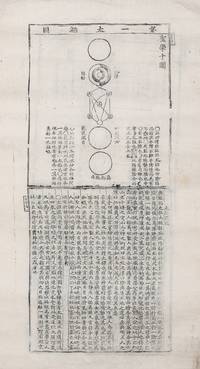
10716All sheets with woodblock diagrams. Ten woodblock-printed sheets each ca. 1045 x 580 mm. Korea: 18th or 19th century<br /> <BR> <BR> A very rare woodblock-printed broadside edition of the influential SÅnghak sipto by Yi Hwang 1501-71 “Korea’s greatest philosopher.â€â€“Pratt & Rutt Korea. A Historical and Cultural Dictionary Curzon: 1999 p. 517. Yi a child prodigy was a scholar and government official. He served four kings in a number of high positions but his integrity and stand against corruption caused him to be relieved of his posts and sent into exile a number of times.<br /> <BR> <BR> “Yi Hwang better known by his penname T’oegye is generally reputed as Korea’s foremost Neo-Confucian thinker. From the very beginning of the Yi dynasty 1392-1910 the Neo-Confucian doctrine of the Ch’eng-Chu school was the officially sanctioned ideology but with T’oegye it arrived at its full maturity on the peninsula for he was the first to present it with a fully sophisticated and integral grasp of its scope unity and implications. Consequently his teaching became a constant reference point for subsequent generations of Korean Neo-Confucians and his understanding of Chu Hsi’s Zhu Xi’s vision exercised a profound and lasting influence…<br /> <BR> <BR> “One of his last and most important works was the Ten Diagrams on Sage Learning SÅnghak sipdo which he composed for the instruction of young King SÅnjo reigned 1567-1608 in 1568 two years before his death. Considered the summation of T’oegye’s lifetime of learning the Ten Diagrams became one of the classics of the Korean Neo-Confucian tradition: during the course of the Yi dynasty it was reprinted at least twenty-four times and it now circulates in three modern Korean translations…<br /> <BR> <BR> “‘Sage learning’ is a phrase that appears frequently in Neo-Confucian works meant for the instruction of rulers reflecting the view that the essential duty of a ruler is to learn from and emulate ancient sage kings. In terms of its origin the Ten Diagrams is certainly such a work. But T’oegye’s title is ambiguous for ‘sage learning’ also means ‘learning how to become a sage’ that is a fully perfected human being. This is a kind of learning that has to do with not only kings but every human being. Thus the provenance of this work is universal and through the centuries it has served as a basic handbook for generations of serious Neo-Confucians in their endeavor to understand and cultivate the full perfection of their humanity…<br /> <BR> <BR> “This kind of ‘sage learning’ in its full scope is a distinctively Neo-Confucian development. With the Neo-tradition revival of the tradition in the Sung dynasty Confucians finally developed a metaphysical psychological and ascetical framework that could fully describe the status of sagehood and delineate it. Sagehood became a practical goal rather than a theoretical ideal. T’oegye’s object in the Ten Diagrams is to present that framework and path…<br /> <BR> <BR> “Doing this of course amounts to presenting a structured summation of the essence of Ch’eng-Chu theoretical and practical learning. One could devote a large book to this topic; T’oegye compressed it into ten chapters each brief enough to be mounted on a single panel of a ten-paneled screen. Each chapter begins with a diagram and is followed by a text. T’oegye’s own remarks are only a short portion of each chapter. As far as possible he tried to make this a compilation of diagrams and words from other authoritative sources so that the work would clearly represent the cumulative wisdom of the Confucian tradition not just his own private opinion…<br /> <BR> <BR> “The compressed format is not a concession to hasty readers or beginners needing a simple introduction. Quite the opposite; whether as a short book or a screen placed in one’s quarters T’oegye intended this as a work to be lived with and absorbed slowly through repeated reading and leisurely reflection. In that way its compressed contents would unfold gradually and become a part of oneself through the lengthy and personal effort of apprehending its full meaning. The diagrammatic format he chose is ideal for such use for the categories correspondences and relationships suggested by spatial arrangement offer food for reflective thought far beyond the content of the words themselves. T’oegye could expect that the Ten Diagrams would be approached in this way because the Neo-Confucian approach to texts emphasized this kind of repeated reading prolonged reflection and personal assimilation. The theory was that reading should be a process of self-transformation not mere information gathering. T’oegye designed his Ten Diagrams precisely as a tool to be used in such a process.â€â€“Michael C. Kalton “T’oegye’s ‘Ten Diagrams on Sage Learning’: A Korean View of the Essence of Chu Hsi’s Teaching†in The Journal of Korean Studies Vol. 7 1990 pp. 97-99–& see the rest of this wonderful article for the importance of this text which was influential in both Korea and Japan.<br /> <BR> <BR> The titles of the ten chapters are: The Diagram of the Supreme Ultimate The Western Inscription The Elementary Learning The Great Learning The Rules of the White Deer Grotto Academy The Mind Combines and Governs the Nature and Feelings Diagram of the Explanation of Humanity Diagram of the Learning of the Mind-and-Heart Diagram of the Admonition of Mindfulness Studio and Admonition on Rising Early and Retiring Late.<br /> <BR> <BR> As mentioned in Prof. Kalton’s essay these broadsides were intended to be made into a ten-panel standing screen.<br /> <BR> <BR> Fine condition and a remarkable survival. A few minor stains and a little dusty at extremities. We find no broadside edition in WorldCat. unknown
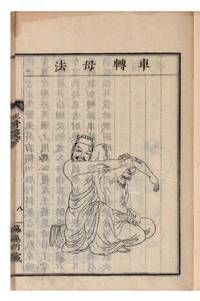
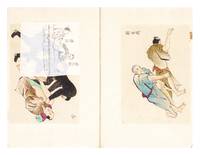
691531 finely hand-colored mounted drawings with eight fine black & white brush drawings on slips also pasted on. 36 folding leaves of which 20 are text. 8vo 253 x 180 mm. orig. patterned wrappers manuscript title label on upper cover new stitching. Japan: late Edo. Gento Yoshiwara d. 1800 was one of the three most important orthopedic specialists in Japan during the final years of the 18th century along with Bunken Kagami and Genka Ninomiya. Yoshiwara studied both Dutch medicine in Nagasaki and Chinese medicine being greatly influenced by the Chinese Dao yin treatment of massage and exercise. Unlike the works of Kagami and Ninomiya Yoshiwara's most important work - "Seikotsu yoketsu" - remained in manuscript as it was restricted to students of Yoshiwara's school Ninomiya was a student. Yoshiwara's trade name or mark was "Kyoinsai." Following the 20 leaves of manuscript text which describe 13 types of treatment in detail is a series of 31 finely drawn and hand-colored illustrations of treatments and manipulations including fixing dislocated shoulders fingers and jaws; spinal stretching dealing with hip problems etc. Many of these treatments have rather fanciful names: "Windmill" "Bear Hug" "Bird's Wing" "Control the Wind" "Crane Feather" "Playing with a Fish" "Worm" "Play with a Jewel" "Tail of the Bird" "The Snail Method" "Riding on the Dragon" "Swallow's Tail" etc. An additional eight smaller pasted-on black & white drawings show further treatments. A number of pharmaceutical ointments and plasters are described. In fine and fresh condition although the outer upper corner of all the leaves has been a little nibbled by a mouse. The scribe of this manuscript has used one incorrect character when spelling Yoshiwara's name on the first leaf giving his name as "Yoshio." ❧ Mestler A Galaxy of Old Japanese Medical Books III p. 152. unknown books
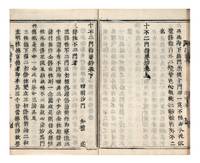
7555Ten columns per page 20 characters per column. 71 folding leaves. Two parts in one vol. 8vo 270 x 180 mm. orig. wrappers stained dark brown with fermented persimmon juice to prevent worming nevertheless wrappers a little wormed new stitching. Japan: ca. 1600-40.<br/> <br/> A rare movable type edition unrecorded by Kawase or Sorimachi and not in WorldCat. The copies at the National Diet Library and Bukkyo University Library are different movable type editions. We learn from the final paragraph on the last leaf that this edition is an exact copy of the Chinese printed edition<br/> <br/> Zhili 960-1028 was a Chinese monk of the Tiantai tradition. “In 991 he became the abbot of Ganfusi and four years later he began his residence at the monastery Bao’enyuan on Mt. Siming whence his toponym…Zhili later found himself at the center of the Shanjia Shanwai or ‘Home-Mountain/Off-Mountain’ debate that racked the Song-dynasty Tiantai school.â€â€“Buswell & Lopez The Princeton Dictionary of Buddhism p. 825.<br/> <br/> This is his commentary written in 1004 on The Essentials of the Ten Gates of Non-Duality by Jingxi Zhanran 711-82 the putative ninth patriarch of the Tiantai zong and one of the great revitalizers of the Tiantai tradition. “From the Song forward orthodox Tiantai doctrine has been based upon Zhili’s doctrinal elaborations on Tiantai teachings. Zhili was best known for his interpretation of the thought of Zhanran…who commanded great respect and imperial patronage in the Tang Dynasty…<br/> <br/> “Zhili’s doctorial elaboration on Zhanran’s teachings was generated during debates with other Tiantai monk-scholars over Zhanran’s works. The victorious faction led by Zhili was retrospectively known as the Home Mountain shanjia Teaching in contrast to their opponents labeled the Off Mountain shanwai Teaching. In the present work Zhili criticized his opponents’ interpolation of Huayan and Chan thought in Tiantai doctrine…<br/> <br/> “Zhili’s interpretation was canonized other interpretations were left in oblivion. Tiantai orthodoxy for the following centuries was defined during the Song Dynasty.â€â€“Shin-yi Chao “Chinese Religion in the Song and Alien Dynasties†in Nadeau ed. The Wiley-Blackwell Companion to Chinese Religions pp. 106-07.<br/> <br/> Zhili’s text is preceded by a Preface by his friend and fellow priest Zunshi 964-1032 who was the other pivotal figure in the Tiantai revival.<br/> <br/> A very good and crisp copy preserved in a most attractive chitsu. With some worming mostly confined to the gutter or lower margins occasionally touching a few characters. A few of the final leaves have some worming. unknown
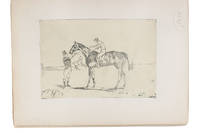
1835H1EFLHU1E5LWEngland and/or Sweden 1835. 4to 24.5 x 18 cm. Each drawing mounted on or occasionally drawn on a card loose in a Swedish blind-blocked textured red cloth portfolio ca. 1860 title in gold on front board decorated endpapers purple on white red cloth ties. 36 pencil drawings of English thoroughbred race horses 7.5 x 11.5 to 11 x 16 cm 1 finished in ink washes and a few touched up with white or light brown. 36 loose ll. A collection of 36 pencil drawings of famous English thoroughbred race horses by at least three artists including one signed "Harry Hall" and several others clearly based directly or indirectly on his paintings. Some horses appear in their stables or grounds sometimes with a stable boy groom or owner others are shown carrying a jockey during a race at a track. The earliest horses shown include a beautiful pencil and ink-wash drawing of Camel 1822-1844 who raced from 1825 to 1827 and won the 1826 Port Stakes at Newmarket. He is better known as the sire of Touchstone 1831-1861 also shown one of the most famous thoroughbreds of all time who raced from 1833 to 1837. In very good condition with only some minor wrinkles in one drawing and faint stains in another. Portfolio good. A charming collection of horse drawings mostly from the early 1850s. ABE CAT Art History hardcover
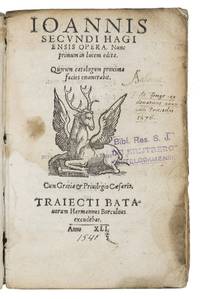
1541M23NGJ7IKRQ5Utrecht: Herman van Borculo 1541. Contemporary vellum wrapper straight-sewn on 3 tanned calf straps laced through the wrapper with the authors name in large textura lettering reading up the spine. Small 8vo 16 x 10.5 cm. With Van Borculos winged stag couchant regardant and book device on the title page and another salient regardant with 2 books on the verso of the otherwise blank last leaf; and 3 vine-leaf ornaments Vervilet 7 8 & 43. Set in an Aldine-style italic type with upright capitals; 92 mm/20 lines with roman capitals for occasional words phrases and 2-line initials. Rare first edition in the original Latin of the collected poetic works of the humanist and neo-Latin poet Janus or Joannes Secundus Jan Everaerts 1511-1536 who "ranks among the foremost poets of the world" as "the only famous 16th-century Dutch poet" Guépin p. 231: "one of the most significant and enduring poets of the Renaissance" and "the outstanding Latin love poet of the northern Renaissance" Price p. 1. Although not quite twenty-five when he died he published numerous poetic works from 1532 to 1536 but left most of his work unpublished at his premature death. Much of his poetry appeared for the first time in the present posthumous edition. Janus is most famous for his "Basia" kisses: 19 lyric love poems influenced by Catullus. Janus's three books of elegies especially the first book comprising 11 love poems to his possibly fictional first love Julia are also masterpieces of neo-Latin poetry.Although revered internationally in his own century and influential throughout the 17th and 18th centuries among his avid readers were Ronsard Fleming Huygens Milton and Goethe Janus's name has been eclipsed in the Netherlands by those of Cats and Vondel in part because they wrote in Dutch.Janus Secundus was born in The Hague. His father was a lawyer at the leading courts of the Low Countries and the family moved to Maastricht when Janus was sixteen. He studied law there and later studied at Bourges and at the University in Louvain. Though a native Dutch speaker and fluent in French Janus had learned Latin with his older brothers at an early age and corresponded with them in Latin.With 3 French verses in a near contemporary hand on the endleavesFurther with a near contemporary donation inscription on the title-page; a 19th-century bookplate on the inside front wrapper and blue ink stamp on the title-page. With the title-page somewhat worn and with stains in its margins plus a water stain in the first 10 leaves and a fainter marginal one some of the last few leaves but otherwise in good condition. The sewing supports have broken at the front hinge and the velum wrapper is somewhat soiled with a small corner of the back wrapper lost. Rare first edition of a seminal work of neo-Latin poetry by the first great Dutch poet Janus Secundus.l Adams S837 1 copy; BMC STC Dutch p. 185; G. Joos Uitgaven van Janus Secundus 10; Netherlandish books 27713 10 copies; USTC 421142 same 10 copies; Valkema Blouw Typ. Batava 2673 13 copies; not in Oberlé Poètes néo-Latins; for Secundus: J.P. Guépin "Tres fratres Belgae: brothers poets and civil servants in the sixteenth century" in: The Low Countries 8 2000 pp. 231-238; David Price Janus Secundus 1996. Herman van Borculo, hardcover
6006Numerous fine woodcut illus. 18 of which are finely handcolored. 48 irregularly paginated; 33; 39; 26; 28 3 folding leaves. Five vols. 8vo orig. wrappers some worming in upper margin of each vol. orig. block printed title label on each upper cover new stitching. Tokyo: Mankyudo Hanabusa Heikichi Preface dated 1810. First edition of one of the three most important early Japanese books on the history and technique of Chinese and Japanese acupuncture. This work is very different from all earlier Chinese and Japanese books on the subject. For the first time the illustrations are finely and realistically rendered and are anatomically accurate clearly influenced by European medical works which had circulated in Japan. Another important aspect of this book is that eighteen of the woodcuts each depicting organs of the body are finely handcolored. Also the body is described in full from head to foot and is not entirely dependent on the fourteen meridians. Kosaka was a court physician of the fiefdom of Kameyama who had studied under the famous physician Motonori Taki 1731-1801 who was himself a member of a distinguished family of doctors. The publisher of this work was the exclusive publisher for the government sponsored medical school. Very good set. unknown books
6006Numerous fine woodcut illus. 18 of which are finely handcolored. 48 irregularly paginated; 33; 39; 26; 28 3 folding leaves. Five vols. 8vo orig. wrappers some worming in upper margin of each vol. orig. block printed title label on each upper cover new stitching. Tokyo: Mankyudo Hanabusa Heikichi Preface dated 1810.<br/> <br/> First edition of one of the three most important early Japanese books on the history and technique of Chinese and Japanese acupuncture. This work is very different from all earlier Chinese and Japanese books on the subject. For the first time the illustrations are finely and realistically rendered and are anatomically accurate clearly influenced by European medical works which had circulated in Japan. Another important aspect of this book is that eighteen of the woodcuts each depicting organs of the body are finely handcolored. Also the body is described in full from head to foot and is not entirely dependent on the fourteen meridians.<br/> <br/> Kosaka was a court physician of the fiefdom of Kameyama who had studied under the famous physician Motonori Taki 1731-1801 who was himself a member of a distinguished family of doctors.<br/> <br/> The publisher of this work was the exclusive publisher for the government sponsored medical school.<br/> <br/> Very good set. unknown
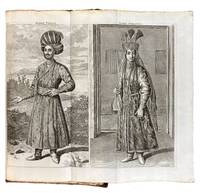
171842045Amsterdam: Chez les Freres Wetstein 1718. 2 volumes small folio. 13 3/4 x 8 1/2 inches. Half-title in volume I titles printed in red and black. Vol 1: engraved portrait of the author by G. Valck after G. Kneller engraved allegorical frontispiece by B. Picart dedication with engraved headpiece 3 engraved double-page maps 111 engraved plates numbered 1-110 plus 1 unnumbered on 52 sheets 29 double-page 7 folding 24 engraved illustrations within the text illustration on p. 164 pasted on slip as issued. Vol 2: 162 engraved plates numbered 111-262 plus 10 unnumbered on 56 sheets 33 double-page 9 folding 20 engraved illustrations within the text. Quarter calf and marbled paper boards spines with raised bands forming six compartments tooled and lettered gilt. Uncut<br/> <br/> Provenance: Princes of Liechtenstein bookplate "Ex Libris Liechtensteinianis" of Franz Joseph II 1906-1989 on front paste-downs<br/> <br/> A fine clean uncut copy of the First edition in French of Le Bruyn's important illustrated account of his voyage to Russia Persia India and Java. From the library of the Princes of Liechtenstein.<br/> <br/> In his first expedition of 1674 Dutch traveller and painter Cornelius Le Bruyn remained in the Levant for seven years travelling principally in Asia Minor Syria the Holy Land and Egypt. On his return he published his Voyages au Levant and encouraged by its success undertook a second more far-reaching expedition. "In 1701 Le Bruyn started on the second of his journeys taking a ship to the country of the Samoyeds . and then proceeding to Moscow. Travelling by way of Asia Minor he arrived in Persia where he remained for the years 1704-05. Leaving Persia he proceeded by ship to India stopping at Cochin Ceylon and the East Indies i.e. Batavia. He returned by much the same route residing in Persia between 1706 and 1707 and describing the ruins of Persepolis and Pasargades" Howgego. The numerous finely engraved illustrations include large folding panoramas of Moscow and Isfahan views of Astrakhan and the antiquities at Persepolis and many of the forts encountered on his journey as well as portraits of native peoples and depictions of the flora fish birds animals etc. Of particular note are Le Bruyn's description and images of the Samoyeds and their country among the earliest for the region. Le Bruyn also gives an account of an encounter with William Dampier in Batavia and describes the route taken by Everard Ysbrants Ides the Danish Russian ambassador to China.<br/> <br/> Brunet III:911 calls for 262 plates based on the numbering of the plate list which does not include the unnumbered plates; Chadenat II 5085; Chahine 2078; Cohen-de Ricci 610; Lipperheide Kaa 6 calls for 128 plates and 45 engraved illustrations; Howgego B177. Chez les Freres Wetstein unknown
835348 parts & one index in 20 vols. 8vo orig. yellow wrappers orig. block-printed title labels on upper covers new stitching. Kubota: Meitokukan Academy 1827.<br /> <BR> <BR> Second edition 1st ed.: 1825 and rare; this was printed in the Kubota domain in northwestern Japan. Following the death of his father in 1785 Yoshimasa Satake 1775-1815 became daimyo of the Kubota domain in Dewa Province modern-day Akita Prefecture. He instituted a number of reforms ordering the planting of extensive windbreaks to improve crop yields; encouraged the mining silk and lacquerware industries; instituted land reforms; dismissed incompetent and corrupt officials; and hired forestry management experts. He also established the domain academy the Meitokukan “House of Virtues†which developed an active publishing division.<br /> <BR> <BR> The present work is a rare example of an early publication from the school which specialized in Chinese learning and Confucian traditions. The Preface was written under the pseudonym “Rakuo†by Sadanobu Matsudaira 1758-1829 who instituted the “Kansei Reforms†of 1789-1801 which included a number of educational changes improving the quality of learning through Japan.<br /> <BR> <BR> The compiler of this work Ichimei Suzuki d. 1818 was a teacher at the Meitokukan and was encouraged by Satake referred to here by his pen name “Jofukyusai†to prepare this work. It is a list of pseudonyms of authors and other people of the Three Kingdoms era 220-80 AD in China with biographical sketches of each person. For each name Suzuki and his fellow compilers have given citations of the Chinese books in which they were able to determine the actual names.<br /> <BR> <BR> Fine and fresh set preserved in two old chitsu. With the “Kanda ke zo†seal of the Kyoto collector Kogan Kanda d. 1918 who formed a large and fine library which was inherited by his grandson Kiichiro Kanda. unknown
1972145005Burbank CA: Warner Brothers 1972. Original maquette demonstrating an early poster design for the 1973 film featuring a vintage silver gelatin photograph of the legendary streetlit scene of Father Merrin's first arrival to Georgetown in the film mounted to the poster.<br/><br/>A minimal design without the credits information seen in the completed original "purple style" poster variant and with a proposed but ultimately unrealized release date of Christmas Day shown at the bottom margin. This maquette compares both to the "purple style" poster in its use of said purple text but also to the original black and white "special poster" design both in size and compositional austerity. The "special poster" measured 25 x 19 inches as opposed to the standard 27 x 41 inches for the one sheet and stated nothing but the film's title and the stark photo of Father Merrin. <br/><br/>Based on the 1971 novel by William Peter Blatty and written for the screen by Blatty. One of the great genre films of the 1970s that accomplished the uncommon feat of being an over-the-top sensation upon its release and gaining subsequent status as a classic with a strangeness and depth supplied by Ellen Burstyn and Max von Sydow that only increases with repeated viewings. Another distinction was that it walked away with two Oscars including Best Screenplay for Blatty along with eight nominations including Best Picture a feat nearly unheard for a horror film. <br/><br/>Set in Washington DC and shot on location in Washington DC notably Georgetown University New York City and Mosul Iraq. <br/><br/>18 x 12.5 inches mounted on a 30 x 20 inch mat. Black with the vintage black and white photo of Father Merrin affixed at the center and a hand painted release date. Title letters are hand cut from purple paper and affixed in place. Good condition with water damage to the bottom three inches of the mat and with soil and loss of glue adhesion to the white mat. Archivally matted and framed in a museum-quality frame with UV glass.<br/><br/>National Film Registry. Clover "Men Women and Chainsaws. Warner Brothers unknown books
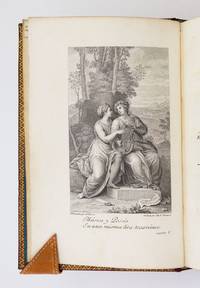
1779ST19371Madrid: Imprenta Real 1779. FIRST EDITION. 235 x 150 mm. 9 1/4 x 6". 10 p.l. 126 XL pp. 1 leaf errata. <br/> EXCELLENT CONTEMPORARY CRIMSON MOROCCO BY DEROME LE JEUNE his ticket with address of Rue St. Jacques on verso of front free endpaper covers framed with thick and thin gilt rules raised bands spine compartments with central floral sprig surrounded by a lozenge of small tools volute cornerpieces gilt titling gilt-rolled turn-ins gilt edges cobalt blue paste-paper endpapers. WITH SIX CHARMING ENGRAVED ALLEGORICAL PLATES after G. Ferre. Front pastedown with morocco bookplate of Mortimer L. Schiff and small book label with a gilt cipher on a red peach. A Large Paper Copy. Palau y Dulcet IV 107; RSIM B VI 429; MGG VI 1403 f.; Gregory-Bartlett I 129. Three minute dents to front board a hint of wear to bands and corners isolated faint foxing blank recto of frontispiece leaf and blank verso of final leaf with faint blue shadown from endpapers but all of these quite trivial and otherwise A BEAUTIFUL COPY--fresh clean and bright internally with very wide margins and strong impressions of the plates and in a lustrous binding showing with few signs of use.<br/> <br/> This is surely one of the handsomest poetical treatises on music ever produced and it is offered here in a binding done by one of the finest craftsmen working in Europe during the period of the book's publication. The work is written in the "silva" form of poetry used by persons of high rank illustrated with fine engravings and put into elegant morocco by the finest hands among the large Derome family of binders. According to Palau our first edition is "beautiful and printed on fine paper." He says further that although the strongly expressed opinions of the youthful author on contemporary composers caused the work to be "unfairly attacked" it was "appreciated by professors of music and collectors of literature in that genre" especially in Italy and America. A child of the Enlightenment Iriate 1750-91 gained entry to intellectual and artistic circles in Madrid through his uncle who was librarian to the king of Spain. He translated works by Horace and Virgil into Spanish by royal request and wrote criticism poetry and dramas. He is best known for his satirical fables on the contemporary literary scene "Fábulas literarias." There were no fewer than 18 members of the Derome family who made their livings as binders in Paris from the middle of the 17th century until the first quarter of the 19th but by far the most distinguished family member was Nicolas-Denis called "le jeune" 1731-88. Known for the gracefulness of his bindings and for being capable of "amazing delicacy" in Hobson's words Derome le jeune was simply the leading binder of the day and his work was much in demand. Because he refused to turn away customers Derome was forced to hire a number of assistants whose work he could not always supervise closely. However Thoinan says that the binder's best work is indicated by the presence of his ticket as here. The volume's provenance adds to its luster: it was in the distinguished library of American bibliophile Mortimer Schiff 1877-1931. In Dickinson's words Schiff a financier and philanthropist Schiff "brought together an unrivaled collection of decorative bindings." His library included works by great printers important illustrated books and works printed on vellum but chiefly fine and historic bindings. The "Reliures" database of the Bibliothèque Nationale de France commends Schiff for assembling "one of the most important inter-war libraries" noting that his collection was "renowned for its collection of French bindings.". Imprenta Real unknown
1938312786N.p.: Privately printed for the members of the Royal Guild of Wisconsin Fisherman 1938. First edition one of a very few copies known. Illustrations from photographs. vi 25 pp. 1 vols. 8vo. White printed wrappers stapled. Very good. Some minor wear. Green quarter morocco slipcase. First edition one of a very few copies known. Illustrations from photographs. vi 25 pp. 1 vols. 8vo. Salmon fishing during four days in the first part of July 1938 by a party of six who styled themselves the Royal Guild of Wisconsin Fishermen comprising: Evan A. Evans Louis M. Hanks Roy F. Tomlinson Theodore G. Montague William S. Kies and George I. Haight to whom authorship is attributed by the Wisconsin Historical Society. The last page of text records their catch by weights. Rare. Wetzel p. 171 tentatively ascribed to William Kies. "A rare work."; Bruns K-45 not seen; Bibliotheca Salmo Salar 105. OCLC 2 copies Princeton Wisconsin Historical Society Privately printed for the members of the Royal Guild of Wisconsin Fisherman] unknown
1938312786N.p.: Privately printed for the members of the Royal Guild of Wisconsin Fisherman 1938. First edition one of a very few copies known. Illustrations from photographs. vi 25 pp. 1 vols. 8vo. White printed wrappers stapled. Very good. Some minor wear. Green quarter morocco slipcase. First edition one of a very few copies known. Illustrations from photographs. vi 25 pp. 1 vols. 8vo. Rare. Salmon fishing during four days in the first part of July 1938 by a party of six who styled themselves the Royal Guild of Wisconsin Fishermen comprising: Evan A. Evans Louis M. Hanks Roy F. Tomlinson Theodore G. Montague William S. Kies and George I. Haight to whom authorship is attributed by the Wisconsin Historical Society. The last page of text records their catch by weights. Rare. Wetzel p. 171 tentatively ascribed to William Kies. "A rare work."; Bruns K-45 not seen; Bibliotheca Salmo Salar 105. OCLC 2 copies Princeton Wisconsin Historical Society Privately printed for the members of the Royal Guild of Wisconsin Fisherman] unknown books
16113462Latin manuscript on vellum with large 6 in diameter suspended black wax seal of James I of England and autograph of Anne of Denmark dated July 23 1610 granting title to Corrodownan Manor in County Cavan Ulster to one John Browne Gent. of Gorgiemill near Edinburgh and his descendants during the Plantation i.e. colonization of Ulster under James I beginning in 1609. The colonists were settled on land confiscated from the Irish inhabitants following the conquest of Ulster 1594-1603 under James's predecessor Elizabeth I. The Plantation was intended to consolidate royal control of Ulster and repress rebellion by importing a substantial Protestant population. Like John Browne and indeed James himself many of the new colonists were Scottish. Some of these families went on to form the backbone of the Protestant Ascendancy in the province. John Browne and his heirs however were not among them. Sir George Carew sent by the king in 1611 to report on the progress of the Plantation noted that "he Browne . sent an agent who took possession set the lands to the Irish returned to Scotland and . performed nothing." The land was sold in 1613 to another Scottish colonist Archibald Acheson. Acheson's descendants were raised to the peerage of Ireland in 1806 as Earls of Gosford and still owned the property in the late nineteenth century. The first nineteen lines of the document grant the Scottish Browne the rights and privileges of James's English and Irish citizens. Especially notable are the requirement that the grantee maintain an adequate supply of arms for defense against the king's enemies lines 77-80 the attempt to encourage the growth of towns 74-76 and the ban on sale of the property to "mere Irish" or to anyone who failed to acknowledge the sovereign as head of the church thus excluding all Catholics by swearing the Oath of Supremacy 114-121. See Rev. George Hill The Conquest of Ireland. An Historical Account of the Plantation of Ulster at the Commencement of the Seventeenth Century 1608-1620 Belfast 1877 308; idem Plantation Papers. Containing a Summary Sketch of the Great Ulster Plantation in the Year 1610 Belfast 1889 188-190; F.J. McCaughey Arvagh. Sources for a Local History Arvagh 1998 16.; Moiré chemise lined with exact recess for seal housed in handsome ruled red morocco clamshell case with gilt title to front cover and raised bands gilt particulars and decoration to spine; gilt rolled edges. Two leaves 65 x 81 cm; the first illuminated with a portrait of the king. Stain to upper left see image.; 65 x 81 cm; 1 pages; Signed by Notable Personage Related; All shipments through USPS insured Priority Mail. . hardcover books
1748ABC_46957London 1748. Large 4to. printed for the author by John and Paul Knapton Bound by Marcus Ward & Co. founded 1833 with their bookbinder's label on the front paste-down in 19th-century calf gold-tooled and blind-tooled frame on both boards gold-tooled spine with red morocco spine label with title in gold gold-tooled board edges blind-tooled turn-ins red edges blue ribbon marker. With 42 engraved plates maps and plans all but one folding. 1 1 blank 32 1 blank 417 1 blank 2 pp. First edition of this important and popular account of the unfortunate and famous expedition of George Anson being considered as the one most sought after Borba de Moraes. It is an account of Ansons expedition to the western coast of South America to harass the Spanish trading territories and cutting off the Spanish supplies of wealth in this way after the outbreak of the War of Jenkinss Ear between Britain and Spain in 1739. Anson was the commander of 7 ships in 1740 including the Centurion but soon his expedition threatened to turn into a fiasco. His squadron was battered by storms and bad weather causing damage and shipwrecks and many of his crew died from scurvy typhus and dysentery. The remaining crew was transferred to the Centurion the last remaining vessel and Anson limped across the Pacific to Macao. In June 1743 he sailed to the Philippines were he achieved a substantial victory near Manila by capturing the Nuestra Senora de Covadonga a Spanish galleon filled with gold. After sailing around the world Anson returned to England in June 1744 and in spite of his enormous losses he returned with large profits.Ansons voyage being one of the greatest voyages in the history of exploration and naval warfare laid the foundation for British voyages and exploration of the Pacific and more specific for English trade in this area. The present account being based upon Ansons own ship journal describing this troubled expedition soon became highly popular in the 18th century and is even considered as the masterpiece of descriptive travel and the most popular book of maritime adventure of the eighteenth century Hill. With occasionally a correction of the text in brown ink and the name of Mr. Sweeting added to the list of subscribers. Binding slightly worn around the edges and with a few minor scratches on the boards some marginal foxing and staining to both the text leaves and plates especially in the first part barely affecting the plates except the map of the Pacific Ocean which is a little more stained folding lines of some plates especially all three large folding maps reinforced but sometimes still with some very small tears on the folding lines some corners of the folding plates slightly frayed but overall a copy of the first edition of this important 18th-century travelogue with all the plates which is still in good condition.l Alden/Landis 748/225; Borba de Moraes I p. 38; Cox I p. 49; ESTC T89475; Hill 1817; Howgego A-100; Kroepelien 1086; Sabin 101175 cf. 1625. hardcover
Stable Money Association gift bookplate inside front board is signed by Irving Fisher, James Rand, Jr., and Frederic A. Delano. Delano [1863-1953] was uncle to FDR, President of the Stable Money Association and was appointed to serve on the first Board of the Federal Reserve by Woodrow Wilson. James Rand Jr. [1886-1968] was Chairman of the Committee For the Nation and a prominent American businessman. This copy inscribed to Ethan Bates Stanley who was President of the American Laundry Machinery Company. pp. [vi], vii-xxiii, 484. Selected bibliography. Index. Extensive footnotes. "The present book is intended to be not so much a history of [monetary] catastrophes, due to unstable money and endured by unsuspecting millions subject to the money illusion, but rather a history of the efforts of a few to remedy or prevent such catastrophies." - xxi. Pages 443-484 constitute a lengthy list of Stable Money Pioneers, individuals who supported the movement. Corporate affiliations are included for most of these names, thus the list reads like a corporate Who's Who of America. Dust jacket not included. Average wear to publisher's pebbled navy cloth. Binding sound. Bookseller ink stamp inside front board. 21 x 14.5cm. Rist p.379, Cohen p.186, Fisher M-2058, Book
1850List1929California 1850. With thirteen letters most multi-page written from Monterey in 1850 a 7 pp facsimile transcription of a 1834 Mexican land grant on cloth measuring 11 x 14 inches and and eleven page document on paper in Spanish relating to a Monterey land grant transcribing an 1841 document. Letters heavily worn with some loss at margins but mostly legible land grant in good to very good condition transcribed document in Spanish in fair condition with water damage to margins. Fair. An interesting archive of 1850s-era material relating to the life and career of the surveyor Edward Williams which recently surfaced in the central mother lode region. The group includes his personal letters from the California Gold Rush as well as well two interesting documents form his work for the Surveyor General J.W. Mandeville in 1858 where he transcribed two Mexican land grants. <br /> <br /> Lt. Edward Williams was a member of Company E New York Volunteers under Capt. Nelson Taylor. He came to California around 1847 and found employment as a deputy surveyor later working for the Office of the Surveyor General of the Unites States for California. In 1858 Surveyor General J.W. Mandeville commissioned a report on Mexican-era California Land Grants. Mandeville had Williams copy the original documents exactly - inclusive of an ink copy on linen that is an "exact tracing" of the original documents starting with 1834 up through about 1840. These "copies" were submitted to the Surveyor General in 1858 for use in the report. Williams continued the title work by copying other documents from about 1841 though this time not as a tracing but hand copied on the usual blue paper of the 1850s.<br /> <br /> The documents illustrate the length officials went to while they investigated Mexican Land Grant titles to California properties in the 1850s. The process was difficult and involved two distinctly separate cultures and legal systems that clearly conflicted. The Mexican Government granted rights for these large land parcels in California to various people but clearly stated they could not sell parts of the property. The wording was used many times in litigation of the period in both defense of the land grants and in opposition to how the land grants were handled. The issues were actually quite simple in that the Mexican legal standards for land grants was far different from those in the United States and the two differing forms of written land ownership and use clashed. <br /> <br /> These documents reflect a parcel of land granted to Francisco Mesa at "Corral de Tierra" a large parcel in Monterrey County California. Mesa had requested land for "his personal use and that of his family." In the Grant the title papers reflect "while the land is under Francisco's possession it cannot be divided mortgaged or a levy placed on it nor handed down." These original documents help illustrate the complex story of Mexican Land Grants in California. <br /> <br /> Also included are thirteen letters from Ed aka "Ned" to various family members primarily his mother and sister Alice and vice versa. About half are from Ed the other half are written to him. The dates of the letters are; 1850: February 10th April 15th April 16th April 28th June 10th July 30th October 11th and November 17th and 1851: September 9th. One undated letter with heavy loss is written from Panama. The letters are generally readable but the condition far from perfect with water stains throughout and chips abundant along edges and significant textual loss. The letters are generally at least two pages sometimes four or more inclusive of writing in the crossed line custom to save paper. Most are datelined at Monterrey where he discusses the people the customs setting and more. <br /> <br /> Despite the condition flaws there is much to be gleaned from his correspondence. In his April 15 1850 letter . he describes his trip to San Juan Bautista from Monterrey in detail while he was on his way to San Francisco. Williams writes of his great pleasure on tasting cooked beef by the Indians that he found was the best he ever tasted as they camped on the way to San Jose with the ultimate goal Mission Dolores in San Francisco: “this the beef they put on the embers of the fire and broiled it - I never tasted anything like it before so tender so juicy…†One of his first notes on San Francisco: "There are regular streets filled with all kinds of sorts of stores… The shipping covers the water as far as you can see. And those nearest the shore are converted into store houses the rigging being taken down and the and holes cut in the sides for doors.The best houses in town are occupied by gamblers . a large saloon filled with tables on which are played all kinds of games of chance - at some of the tables are displayed immense amounts of coin and gold in lumps worth from 1 to 5000 dollars which some poor infatuated fool of a miner has at some time lost to them."<br /> In his letter of April 16th he discusses both his difficulties with women in California and his lack of fitting in back east: “The Spanish Girls are very nice and all that sort of thing but the trouble is to find one that is educated. I can’t bear an uneducated wom an and I think I shall have to come to N.Y. and bring one out here… I know one or two in N.Y. but I don’t believe they would have such an uncouth specimen of an ‘hombre’ as me…†In his next letter he describes Carmel in detail. He states: “I haven’t been to the mines nor have I any inclination to go†though he intends to settle in California permanently. In his next letter he discusses the people he’s met and how he detests the anglophone community there: “How do I like the People Those of Spanish whom I call my friends I love with all my soul - there is not much society except among them… the Eng. and Am. population I detest from the bottom of my heart. This may sound strange but you will know the por que when you arrive.†He then praises the climate and scenery of Monterey. One letter written from Panama which has unfortunately sustained heavy losses at margins offers some details of the trip on the Chagres River. The replies to Williams from his family offer details on life in New York and are similarly compromised in condition but overall there is enough to glean from the group to provide a detailed example of family correspondence from the period. <br /> <br /> Overall a very interesting and unusual archive of a young professional who moved to California during the Gold Rush period and rejected the Anglophone mining community with particular interest to historians of Monterey and of the systems of land grants that shaped Mexican and American land policy in the nineteenth century. unknown
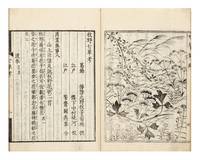
8333One full-page woodcut. .5 29 .5; 15.5 folding leaves. Two vols. 8vo orig. blue wrappers orig. block-printed title labels on upper cover later decorated wrappers later stitching. From the colophon at end of Vol. II: Edo Kyoto & Osaka: Hanabusaya Heikichi et al. 1812.<br /> <br /> <BR> <BR> with:<br /> <br /> <BR> <BR> —. Haru nanakusa ko Thoughts about Seven Herbs in Spring. Three full-page woodcuts & nine smaller woodcuts in the text. .5 36 folding leaves. 8vo orig. blue wrappers as above later decorated wrappers later stitching. From the colophon: Edo: Yamashiroya Sahei 1814.<br /> <BR> <BR> First editions a rare complete set of these two works which are concerned with two important seasonal celebrations. The first of the year is the Festival of Seven Herbs in Spring Nanakusa no sekku a traditional Japanese ritual of eating seven-herb rice porridge on the 7th of January; its consumption would bring longevity and health and ward off evil. The tradition derives from ancient China. The seven herbs are seri Japanese parsley nazuna shepherd’s purse gogyo cudweed hakobera chickweed tahirako nipplewort suzuna turnip and suzushiro daikon radish.<br /> <BR> <BR> The other is the Festival of Seven Autumn Herbs Akino nanakusa less well known then the spring celebration. These herbs are hagi bush clover obana/susuki Japanese pampas grass kuzu kudzu nadeshiko Japanese dianthus ominaeshi Patrinia scabiosifolia fujibakama Eupatorium fortunei and kikyo balloon flower. While many of them have medicinal qualities for this festival they are not for eating but for viewing and admiring.<br /> <BR> <BR> Kikuu Kitano 1762-1831 a native of Sendai came to Edo in the 1780s and opened an antiques gallery that enjoyed great success. In 1804 he purchased a large piece of land in the Mukojima section of Edo where he established a botanic garden today known as the Mukojima Hyakkaen Garden. It is Tokyo’s only surviving garden from the Edo period. There he planted a landscaped orchard of 360 plum trees and other plants including the seven herbs of both spring and autumn selected by Kitano and his literati friends both poets and painters. <br /> <BR> <BR> These works are very beautifully printed using a wide variety of character styles to express meanings and authorship. The first two volumes to be published — on the autumn festival — contain a fine full-page woodcut designed by the author showing all seven herbs. The text contains references to each herb in waka and kanshi Chinese poetry written by Japanese a guide to understanding the nuances of the poetry and the botanical literature.<br /> <BR> <BR> The spring festival volume published two years later describes each of the seven spring herbs and their uses in medicine and gastronomy with many references to the Japanese botanical literature. There is a long passage on how to prepare the springtime porridge. The woodcuts depicting each of the seven herbs are by prominent artists including Kita Busei 1776-1856 and an unidentified woman artist.<br /> <BR> <BR> PROVENANCE: With the seals of Mayori 1829-1906 and Mamichi 1866-1925 Kurokawa prominent father and son book collectors. Their collection was largely concerned with botanical and herbal books; most of the collection was destroyed in the great Kanto earthquake. Our set later entered the collection of Frank Hawley scholar and one of the most discerning collectors of Japanese books and manuscripts. His stamp appears on the first page of text. See R.H. van Gulik’s “In Memoriam. Frank Hawley 1906-1961†in Monumenta Nipponica Vol. 16 No. 3/4 Oct. 1960-Jan. 1961 pp. 434-47.<br /> <BR> <BR> Fine set preserved in a fine chitsu. With some mostly marginal worming much of which has been carefully repaired. unknown
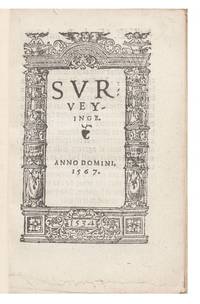
6566Title within architectural woodcut border incorporating the date "1534." Largely printed in black letter. 67 leaves 8 pp. Small 8vo antique calf by Sangorski & Sutcliffe spine gilt red leather lettering pieces on spine. London: Printed by H. Wykes 1567. An early edition of the first text on surveying printed in English. The first edition was printed by Richard Pynson in 1523; all early editions are rare as copies were used to death. Our copy is most unusual as it is fine and large with a number of lower edges uncut. Fitzherbert's book is concerned primarily with giving instruction to land stewards and overseers of the manor. The authorship of this work has long been disputed: was it Anthony Fitzherbert ca. 1470-1538 judge and legal writer or his older brother John d. 1531 The current scholarship supports John Fitzherbert as the more likely author. The book is "addressed to the landed interest and is an explanation of the laws relating to manors. Fitzherbert sets forth the relation between the landlord and the tenant with observations on their respective moral rights and mutual obligations to each other. The author is also concerned with the best means of developing and improving an estate to the advantage of both the lord and the tenant. "As defined by Fitzherbert the duties and functions of the surveyor were many and varied. In the preface he states that the surveyor should prepare his findings in a small book or put them on a large piece of parchment. This parchment or book should show the 'buttes' and 'bounds' of all the holdings as well as the leases grants and tenures. Along with this information he should state the number of buildings and their location and give a description of the lands specifying whether they are meadow grainland or woodland and by whom held. He should also record the value of all properties along with their rents and fines. The author then goes into considerable detail in giving the form for the preparation of this information. "The author states that the word 'surveyor' is from the French signifying an overseer and that the surveyor must appraise and make recommendations to the lord of the manor."-Richeson English Land Measuring to 1800: Instruments and Practices pp. 33-34. Fine copy. ❧ Fussell I p. 6-"contains a great deal of matter of service to farmers in particular as well as to the agricultural community in general." ODNB. hardcover books
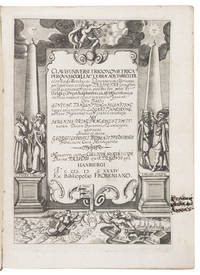
6761Finely engraved added title & numerous woodcut diagrams & printed tables in the text. Printed title in red & black. 9 p.l. incl. engraved title 323 184 pp. Two parts in one vol. Large 4to cont. vellum over boards covers nicely decorated with coats-of-arms in gilt & silver now oxidized on each cover a.e.g. ties gone. Hamburg: Frobenius 1634. First edition of this handsome and rare work on trigonometry by a student of Tycho Brahe. Frobenius 1566-1645 after studying in Tübingen and Wittenberg went in 1591 to the island of Hven where he intended to live and study with Tycho Brahe. Upon leaving he wrote a recently discovered memorandum see John Robert Christianson's On Tycho's Island. Tycho Brahe and His Assistants 1570-1601 which is full of "critical insight" on Tycho and his relationships with his students and assistants. Later Frobenius moved to Hamburg where he married well and became a leading printer publisher and bookseller of that city specializing in learned and scientific works. He wrote and self-published a number of works - like this one - a number of works on trigonometry astronomy and philology. The first part of the present book is devoted to spherical trigonometry as applied to astronomy and the text contains many references to Brahe and Longomontanus. The second part includes the famous trigonometric tables of Rheticus which first appeared in 1596. A very fine and large copy with the Nordkirchen bookplate. The attractive engraved title-page present here is usually missing ❧ Poggendorff I 809. Tomash & Williams F101. hardcover books