Gold, David MBiblio.com
7 654 résultats
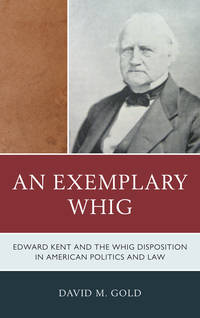
2012SONG0739172727Lexington Books 2012-07-06. 1. hardcover. Used: Good. 6.29x0.92x9.23. Buy with confidence. Excellent Customer Service & Return policy. Lexington Books hardcover
20011335978PN. New. 2001. Soft Cover. Date is original print. This is a reprint edition . PN paperback
1332323030.Gpaperback. Good. Access codes and supplements are not guaranteed with used items. May be an ex-library book. paperback
0267494122.Ghardcover. Good. Access codes and supplements are not guaranteed with used items. May be an ex-library book. hardcover
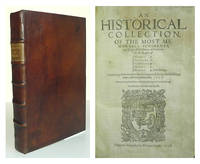
1598001041London: Thomas Creede 1598. First English language edition. . Hardcover. See Description. Small folio. Lacking preliminary blank leaf thus pp. 10 310 292 4. Page numbering is erratic. Leaf Ee3 is mis-signed as F3 but all leaves are present and in order. The title page contains a woodcut vignette/device. Each chapter begins with a woodcut decorative head piece and an initial. Bound in full dark brown modern calf with blind tooled borders and stamps after an early period style. The upper part of the title page is age-toned / tanned; a professionally sealed 7 cm. tear runs from the gutter part way across the upper portion of the title and is difficult to detect on first sight; a couple of tiny chips on the top edge are restored. Interior pages are generally attractive but with occasional mild age-toning and periodic faint marginal damp staining. A small repair patch is present on the inner margins of leaves A6 and V6. A tear on leaf V6 also carefully sealed extends vertically about 8.5 cm from the lower gutter and part way into the text but causing almost no obscuration. Printed by Thomas Creede who is best known for issuing dramatic works including some of Shakespeares plays. The book is divided into two parts. The first part is a translation of "Recueil des choses mémorables avenues en France sous le règne de Henri II François II Charles IX Henri III et Henri IV." This work is generally attributed to either Simon Goulart or Jean de Serres and was first printed in French no place or publisher in 1595 and again in 1598 expanded to include the reign of Henri IV up to the year 1597. See Brunet IV 1161-1162. The second part with new pagination provides translated selections from Pierre Matthieus 4 part "Histoire des derniers troubles de France" first published in Lyons 1594-95. A section at the end is titled "a brief recitall of the most memorable things which came to passé in Fraunce under the raigne of Henry the fourth until the middle of the Yeare 1598" which if written by Matthieu may possibly represent the first printing of some amendments which Matthieu later added to the second edition of his "Histoire" printed in 1600. This collection provides interesting testaments to the wars of religion in France during the 16th century. A separate 4 page tract at the end is titled: "A true discourse concerning the deliverie of Brittaine in the yeare 1598." ESTC S121331; USTC 513796; Lowndes p. 831; Hazlitt Biblio. Collections 2nd Series p. 231. <br/> <br/> Thomas Creede hardcover
197524542Cincinnati OH: B. B. & Co 1975. 1st. Hardcover. Fine. 10.3x7.3x0.7in. Inscribed by Authors. not issued with a dust jacket inscribed by author. <br>168pp 1.36lb 10.3x7.3x0.7in B. B. & Co hardcover
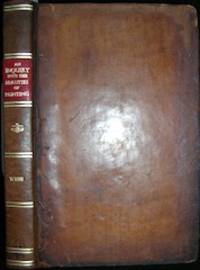
1769OB1016<p>London: Printed for J. Dodsley. MDCCLXIX 1769. Hard Cover. xvi 200 p.; 18 cm. Schlosser Magnino La Letteratura Artistica p. 656 points out that this was a defense of Sir Joshua Reynolds and introduced many English travelers to Italian painting. "Winckelmann realised that much of its text is derived from a similar book written a little earlier by the eminent painter Anton Mengs" but it was the text by Webb that influenced classicism in England. This copy is bound in full contemporary calf with a new spine. A gift note to Jane North is dated 1772. Very Good; spine misdated "1749." Stock#OB1016.</p> Printed for J. Dodsley..., hardcover
1760223920London : printed for R. and J. Dodsley in Pall-mall MDCCLX. 1760 1760. First Edition. Hardback. Manuscript notation to the front endpaper. Finely bound in full contemporary aniline calf. Raised bands gilt-cross bands. Bands and panel edges somewhat rubbed and toned as with age. Scans on request. ; 8vo 8"" - 9"" tall; 200 pages; Physical description; xvi 200 p. ; 8vo. Subjects; Painting - Appreciation - Early works to 1800. Art criticism - Early works to 1800. Aesthetics - Early works to 1800. Painting - Criticism and interpretation - Early works to 1800. Painting - History - Early works to 1800. Painting - Appreciation and connoisseurship. London : printed for R. and J. Dodsley, in Pall-mall MDCCLX. [1760] hardcover
193959792Gold Hill Jackson County OR: Murphy Murray Dredging Company ca. 1939-1941. Oblong 4to. 30 pp unpaginated. on thick black paper stock. With 43 silver gelatin photographs mounted w/ black corners sized from 2.75 x 3.75 in. up to 3.5 x 6 in. some date stamped on versos several w/ pencil annotations in cursive manuscript minor chipping to couple corners edgewear. Contemporary flexible ribbed black cloth post-binder nickel plated screwposts at gutter margins minor edgewear VG. This series of photographs captures the historic gold mining by the last gold dredge to operate on Foots Creek in Southern Oregon on the property of Edward Dole. Several dredges and placer mining operations mined Foots Creek from the 19th well into the 20th Century with one dredge owned by the Rogue River Gold Mining Co. known as the Ferry Dredge dredged both forks of Foots Creek until 1935 when it was moved to Graves Creek. Under the direction of “Wicks the Boss†this dredge was brought in unassembled by railroad in 1939 and “this was his 35th dredge.†The photos show the steel hull mass boom erecting the steel framework framing the steel gantries for the dredge installing the winches as well as the massive 67 bucket line ladder built by New York Engineering Co. Yonkers NY. The newly constructed dredge shown here proceeded to work it’s way up the creek digging 20 feet below the water line and moved 4000 yards daily through the screening and wash plant with conveyor belts stacking the tailings behind. In March 1941 just months before the attack on Pearl Harbor the dredge was dismantled and moved to another location by the Murray Dredging co. although mounds and walls of rock paralleling the creek still offer visible signs of its operation. See: Lillian Knoteck Nosik A Historical Review of Gold Dredging on Foots Creek Southern Oregon Sunrise July 1978 pp. 34-36; Gilbert Walter The Grave Creek Gold Dredge Daily Courier Dec. 12 1994 p. 4B. Murphy Murray Dredging Company, hardcover
197510721Coburg Oregon: John W. Ball - Self Published 1975. First Edition. Original wraps. Fine. 8vo. pp. 66 decorated wraps illustrated. -- Condition. Contents: The Foolers of Depth Perception - The Hidden Bottom - The Hitch Effect - Jackrabbit Bait - Up and Down Sags - Pendulum Drift - Ideal Drift - Avoiding the Shake - Lures - Snags - Animated Lures - Animated Lure Criteria Ole - Tackle Foolers - Feeding Line to the Drifts Spinning Gear - Reel Lubrication - Back Lash - Paradox of Rod Position - Feeding line to the Drift Casting Gear - Steelhead Fly Fishing - Handling Hooked Fish - Handling the Landing Net - Artificial Weather - Three Kinds of Fish and Rivers - How to Hold a River Post Mortem - Killers to Watch For - Post Script. John W. Ball - Self Published unknown
SKU0624117ILR Press 2014-03-04. paperback. New. 5x0x8. New Textbook Ships with Tracking ILR Press paperback
1641760508.Gpaperback. Good. Access codes and supplements are not guaranteed with used items. May be an ex-library book. paperback
1998DADAX0801484774Cornell University Press 1998-02-26. Revised Subsequent. paperback. New. 5.75x0.25x9.25. Buy with confidence. Excellent Customer Service & Return policy. Cornell University Press paperback
20032-0930773683Black Heron Pr 2003. Hardcover. New. illustrated edition. 100 pages. 8.25x7.50x0.75 inches. Black Heron Pr hardcover
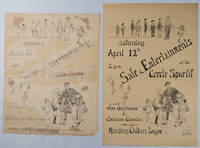
1924170069Hong Kong.: The South China Morning Post Ltd. circa1924. A fund raising poster in aid of World War I war orphans and children's charities organised by the Ministering Children's League at the Cercle Sportif Shanghai or Saigon Saturday April 12th at 3pm. 1924 76 x 50.5cm. <br>The original art work is in pencil and ink on tracing paper with some art work pasted down. It is fascinating to see the work in progress compared with the finished poster which is printed in black - on fragile paper but in very good condition. Original works from East Asia at this time are extremely scarce because of their ephemeral nature. Even though we have extensively researched this poster published by the South China Morning Post in Hong Kong there remains the possibility that this event could have taken place either in Cercle Sportif in Saigon or in Shanghai. <br> <br>Cercle Sportif Français- Shanghai. 1926 Rue Cardinal Mercier French Concession. <br>Known universally as the "French Club" this building was the home of Shanghai's most popular social and sporting clubs. Unlike the stuffier Shanghai Club and the American Club this was the most cosmopolitan club in town even extending its membership to women quelle horreur!; although to balance this madness female membership was limited to 40. The club featured a roof-top terrace for summer dances restaurants a ballroom restaurants bars billiards room and games room. For the more active there was a huge swimming pool and twenty tennis courts. <br>The clubhouse was designed by Shanghai's leading French architects Alexandre Leonard and Paul Veysseyre of Leonard Veysseyre et Kruze in the French Renaissance style. <br> <br>Cercle Sportif Saigon: The rebuilt Cercle Sportif Saïgonnais at 55 rue Chasseloup-Laubat was inaugurated on 5 December 1925 at “a brilliant reception attended by the Governor of Cochinchina and key notables of the colony.” <br> <br>According to a press release issued on 31 January 1926 by the Agence économique de l’Indochine the Cercle’s upgraded facilities included “10 tennis courts a football field with spectator stands which may rarely be found in France and comfortable buildings with rooms for fencing billiards games and reading a dance hall and vast changing rooms.” It concluded: “Saigon now has a club worthy of the colony which can easily be compared with those in Shanghai Hong Kong or Singapore.” <br> <br>The Ministering Children's League was founded by the Countess of Meath in her London house 83 Lancaster Gate February 10 1885. It owed its inception to the deep impression made upon Lady Meath about a child by M. L. Charles-worth's delightful story "Ministering Children." The idea of the book haunted her and she determined to form a society under that name. <br> <br>A small children's league thus started in a London parish would spread until it encircled the globe. It travelled quickly through the parishes of England was welcomed in Scotland and Ireland and crossed the Atlantic and rooted itself in the United States and in Canada. It had flourishing branches in Australia South Africa New Zealand and Tasmania and has penetrated to India China and Japan. As an international organisation it had no distinction of race colour or creed. . The South China Morning Post Ltd. unknown
192062329Portland OR Spokane WA San Francisco CA & Seaside OR: Lyle E. Lewis Dance Orchestra ca. 1920-1944. Eight vols. 1st - 4to. 48 pp unpaginated. on thick black paper w/ 100’s of pieces of ephemera mounted and laid-in including 7 silver gelatin photographs sized from 5 x 7 in. up to 8 x 10 in. many different TLS and ALS most on stationery letterhead for assorted hotels KGW Radio and others many newspaper clippings tickets promotional brochures advertising cards dance tickets along with a spoof printed “Wanted†notice for Ted Mullen alias Sourdough Sullen with $ 500 million reward offered and large double-page advertising broadside on yellow-gold tinged thick paper stock at rear for gig in Astoria OR under the auspices of the Co. L 186th Infantry Oregon National Guard. Contemporary pebbled black boards punch-sewn at gutter margin chipping edgewear still VG- exemplar; 2nd - 4to. 92 pp unpaginated w/ majority of leaves on ruled paper including 18 leaves of mylar sleeves featuring the majority of the 23 silver gelatin photographs most sized 8 x 10 in. photographer’s imprints on versos remainder w/ clippings promotional announcements tickets broadsides ALS & TLS documents throughout along with a long radio program script. Contemporary 2-ring blue cloth binder rounded corners some edgewear rubbing still VG; 3rd-7th - 16mo. Five daily diaries Approx. 700 pp unpaginated. w/ approx. 4000 words manuscript annotations in ink & pencil throughout featuring some laid-in miniature photos receipts business cards including 1 photographic souvenir business card for Cole McElroy’s Dance Band and Cole McElroy’s Spanish Ballroom 1 tiny postage stamp photo of Lewis at his bungalow in Seaside all bound in cloth some wear still VG grouping; 8th - 12mo. Approx. 150 pp unpaginated. of ruled paper mostly typescript ink & pencil manuscript some ruling throughout annotations & checkmarks last 4th or so blank. Flexible black cloth 6-ring binder business card for Lewis as Commercial Agent for ACME Fast Freight taped in on front pastedown 3 blank routing order forms in red & black some scuffing edgewear still VG all from the library of Genevieve Martha Lewis Levin 1911-1994. This unusually well-preserved archive of a Roaring 20’s Jazz Orchestra musician and Band Leader in the Pacific Northwest reveals the exuberance and business success of this largely forgotten artist through his successful years before foundering during the Great Depression. Both scrapbooks open with clippings thank you and recommendation letters as well as dance broadsides and photographs during 1926 at the height of Lyle Lewis’s orchestra appreciation. Testimonials include B.J. Saad who owned the Garden Dancing Palace and stated “I have taken the Garden which is second to no other ballroom west of Chicago. That is why I have secured Lyle Lewis recognized as one of the best orchestra leaders on the Coast.†C.W. Craig of Lipman Wolfe & Co. department store extolls that Jazz music dance held at the Multnomah Hotel March 16 1926 that “I don’t think we have ever enjoyed better or more up to date dance music than that furnished by your splendid aggregation.†Broadsides and notices advertise the Lewis Jazz Orchestra playing the Grand Ball Room at the Masonic Temple Congress Hotel leading McElroy’s Oregonians at the McElroy’s Spanish Ballroom the Dessert Hotel Oasis near Spokane parties for Studebaker and more. One of the mounted letters includes a rather sad severance letter signed by Cole McElroy explaining the circumstances of Lyle Lewis’s leaving stating “I realise that you were a victim of circumstances. On account of the fact that you had a fine band organized. . . certain music masters of the theatre jobs saw fit to take your men away from you thereby breaking up your fine band and forcing me to make a deal for another organization.†McElroy 1888-1947 was known as “Pop†McElroy was a popular band leader who during the years before World War I and after played the Palm Gardens often and had great success in his McElroy Spanish Ballroom which opened in 1926 and then opened another Seattle McElroy Ballroom in 1928. Several TLS on letterheads include those for KXL Radio station KGW Radio Station and the KOIN Studio Director for The Portland News which played three nights a week on air for over six months. The many photographs capture the Lyle Lewis band joking around with their instruments on the road fully arrayed on stage in the Radio Station posing at various venues stages and even one as late as 1939 conducting the Lyle E. Lewis Dance Orchestra. The band included Cluet Mansfield formerly with Henry Halsted band William Webber on drums Eddie Scroggins & Frank Champion as sax players G. Berardinelli on Bass and also played dances at the Irvington Club Multnomah Athletic Club and for a while with the historic Congress Hotel in Portland which had been the City’s first reinforced concrete building erected during the Progressive Era and by 1924 expanded to 119 rooms with vibrant Jazz ballroom. The daily diaries for 1929 and 1930 show that Lewis regularly played at the Cotillion Hall now the Crystal Ballroom initially at $ 7.00 per night in 1929 and then steadily dropping to less than half by 1933. He writes about traveling for a gig in San Francisco with Mansfield in 1929 leaving Tuesday and arriving Wednesday Sept. 18 1929 driving 40 mph and getting 19 miles to the gallon with a drive made in 19 hours and 15 minutes. He played extensively at the Bungalow Club in Seaside OR which had opened originally June 19 1920 and for more than 25 years was the destination for the biggest names in the Big Band Jazz era including Lyle E. Lewis Cole McElroy Duke Ellington Bob Crosby Glenn Miller and tragically became connected with the death of Jimmie Lunceford who died from a heart attack just before playing his last set at the Bungalow after playing McElroy’s Ballroom in Portland 2 nights before. Lewis 1890-1948 was a popular Portland Oregon based jazz band & orchestra leader who managed to lie about his age and enlist at 15 in the Oregon National Guard Co. G 3rd Battalion served for three years and in May 1910 married Genevieve Franklin while working as salesman and musician before World War I Following the War he quickly became a successful band leader including successful stints with the Cole McElroy Spanish Ballroom Congress Hotel Multnomah Hotel Bungalow Garden Ballroom as well as the Coronado Hotel in California. As indicated by the daily diaries he maintained a fairly close relationship with his daughter Genevieve “Martha†but became largely estranged from his wife Genevieve living in separate rooming houses or hotels. Still in her position as a sales manager she managed to convince Meier & Frank to hire him as their house band for store functions and the restaurant while during the Great Depression he mostly worked for the US Forest Service mapping division while his show business largely disappeared. By 1943 he became the commercial agent for ACME Fast Freight where he worked as commercial agent until his death. This cataloguer could find no surviving recorded discography record for Lyle E. Lewis and his assorted incarnations although there are a few recordings for the Cole McElroy Band from 1926-1928 which most likely would have included him as band leader and musician. Lyle E. Lewis, Dance Orchestra, hardcover
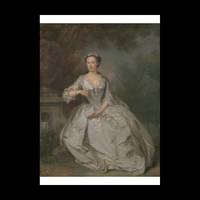
753982Contentum Ltd. Loose sheet. New. High-quality art print based on an original work from the Ycba. Created in the 18th century ca. 1735. Professionally printed on premium fine-art paper Photo Rag Bright White premium quality in size A2. The artwork is printed with a white border museum-style presentation. Contentum Ltd. unknown
753981Contentum Ltd. Loose sheet. New. High-quality art print based on an original work from the Ycba. Created in the 18th century ca. 1735. Professionally printed on premium fine-art paper Photo Rag 308 in size A2. The artwork is printed with a white border museum-style presentation. Contentum Ltd. unknown
753980Contentum Ltd. Loose sheet. New. High-quality art print based on an original work from the Ycba. Created in the 18th century ca. 1735. Professionally printed on premium fine-art paper Museum Etching museum quality in size A3. The artwork is printed with a white border museum-style presentation. Contentum Ltd. unknown
753983Contentum Ltd. Loose sheet. New. High-quality art print based on an original work from the Ycba. Created in the 18th century ca. 1735. Professionally printed on premium fine-art paper Museum Etching museum quality in size A2. The artwork is printed with a white border museum-style presentation. Contentum Ltd. unknown
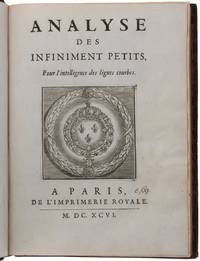
17002848Paris: L'imprimerie Royale; Jean Boudot 1700. First edition. First editions. L'Hôpital's treatise on differential calculus was based on lessons he received from Johann Bernoulli and it was under the influence of Malebranche that some years later appeared the first work on the integral calculus by Louis Carré. Hardcover. THE FIRST BOOKS ON DIFFERENTIAL AND INTEGRAL CALCULUS. <p>A fine sammelband comprising the first editions of the first books on the differential and integral calculus respectively. "In France it was through the Oratorian circle of Nicolas Malebranche that Johann Bernoulli introduced in 1691 the Leibnizian calculus. His lessons to the Marquis de l'Hôpital led to the draft of the first treatise of differential calculus 1696 and it was under the influence of Malebranche that some years later appeared the first works on the integral calculus by Louis Carré in 1700 and Charles René Reyneau in 1708. The spread and acceptance of the Leibnizian calculus was transferred in this way to the wide public" Landmark Writings p. 56. "The importance of L'Hospital's work lay in its dissemination throughout Europe of the concepts and early development of the calculus whose cause L'Hospital advanced as well through his many contacts; these included Christiaan Huygens who is reputed to have learned the calculus from L'Hospital" DSB. Bernoulli's lectures also covered integral calculus but L'Hospital dropped plans to write a continuation to his Analyse des infiniment petits dealing with this subject "in deference to Leibniz who had let him know that he had similar intentions" ibid. Leibniz never wrote such a text however and Bernoulli's lectures on integral calculus remained unpublished until they appeared in his Opera 1742. The task of completing L'Hospital's book was instead taken up by Carré a pupil of Malebranche and assistant to Pierre Varignon from whom he probably learnt calculus. "Following the classical custom his Analyse des infiniment petits starts with a set of definitions and axioms . The difference differential is defined as the infinitely small portion by which a variable quantity increases or decreases continuously. Of the two axioms the first postulates that quantities which differ only by infinitely small amounts may be substituted for one another while the second states that a curve may be thought of as a polygonal line with an infinite number of infinitely small sides such that the angle between adjacent lines determines the curvature of the curve. Following the axioms the basic rules of the differential calculus are given and exemplified. The second chapter applies these rules to the determination of the tangent to a curve in a given point . The third chapter deals with maximum-minimum problems and includes examples drawn from mechanics and geography. Next comes a treatment of points of inflection and cusps. This involves the introduction of higher-order differentials each supposed infinitely small compared to its predecessor. Later chapters deal with evolutes and with caustics. L'Hospital's rule is given in chapter 9" ibid. The tenth and final chapter of the Analyse discusses the methods of Descartes and Johann Hudde. The companion work by Carré is "the first treatise on the integral calculus in any language which is here applied to the determination of the area of superficies surfaces and solids and their centres of gravity problems of percussion oscillation etc." Sotheran. On this last topic the determination of the centres of oscillation of solids Carré made a significant error. This was known to Bernoulli but not publicized at the time and so was propagated into several later calculus texts such as Charles Hayes' Treatise on Fluxions 1704 and Edmund Stone's The Method of Fluxions both Direct and Inverse 1730. Both works are rare on the market: ABPC/RBH list four copies of L'Hospital's book since the Norman copy which realised $6325 in 1998; and only two copies of Carré's work in the last half century. </p> <br /> <p>"Differential and integral calculus are generally considered to have their origins in the works of Newton and Leibniz in the late 17th century although the roots of the subject reach far back into that century and arguably even into antiquity. Leibniz first described his new calculus in a cryptic article more than a decade before the publication of the Analyse. For all practical purposes Leibniz' early papers were not understood until Jakob Bernoulli and his younger brother Johann began studying them in about 1687 and making discoveries of their own using his techniques.</p> <br /> <p>"Bernard de Fontenelle became the secretary of the Académie des Sciences in Paris in 1697 and wrote the eulogy of l'Hôpital for the academy's journal. He said that in 1696 'the Geometry of the Infinitely small was still nothing but a kind of Mystery and so to speak a Cabalistic Science shared among five or six people. They often gave their Solutions in the Journals without revealing the Method that produced them and even when one could discover it it was only a few feeble rays of this Science that had escaped and the clouds immediately closed again.' Later on Montucla went one step further and listed the only people that he believed understood Leibniz' calculus before 1696: Leibniz himself Jakob and Johann Bernoulli Pierre Varignon and l'Hôpital. L'Hôpital's Analyse changed all of this and for much of the 18th century his book served aspiring French mathematicians as their first introduction to the new calculus.</p> <br /> <p>"For all that the Analyse was a popular and successful introduction to the differential calculus it's remarkable that there is no account of the integral calculus in the book. In his Preface l'Hôpital explained why: 'In all of this there is only the first part of Mr. Leibniz' calculus . The other part which we call integral calculus consists in going back from these infinitely small quantities to the magnitudes or the wholes of which they are the differences that is to say in finding their sums. I had also intended to present this. However Mr. Leibniz having written me that he is working on a Treatise titled De Scientiâ infiniti I took care not to deprive the public of such a beautiful Work' p. iii. Unfortunately Leibniz never completed this book On the Science of the Infinite.</p> <br /> <p>"The Analyse consists of ten chapters which l'Hôpital called 'sections.' We consider it to have three parts. The first part an introduction to the differential calculus consists of the first four chapters:</p> <br /> <br /> In which we give the Rules of this calculus. <br /> <br /> Use of the differential calculus for finding the Tangents of all kinds of curved <br /> lines. <br /> <br /> Use of the differential calculus for finding the greatest and the least ordinates to which are reduced questions De maximis & minimis. <br /> <br /> Use of the differential calculus for finding inflection points and cusps.<br /> <br /> <p>"Taken together these chapters provide a thorough introduction to the differential calculus in about 70 pages. The next five chapters are devoted to what can only be described as an advanced text on differential geometry motivated in part by what were then cutting-edge research problems in optics and other fields" Bradley et al. pp. v-vi.</p> <br /> <p>These subsequent chapters no longer mirror the structure of Bernoulli's lectures. Chapter 5 the longest in the Analyse deals with evolutes and involutes including the cycloid and various spirals. Chapters 6-8 are on envelopes of lines and curves i.e. curves that are tangent to every member of a family of lines or curves - this includes the study of caustics in geometrical optics. Chapter 9 contains "the solution of various problems that depend upon the previous Methods;" the first of these is the celebrated rule that we now call L'Hôpital's Rule which was first discovered by Bernoulli. In his final chapter of the Analyse l'Hôpital demonstrates how all of the methods of Descartes and Hudde may be easily derived and justified using Leibniz's differential calculus.</p> <br /> <p>Born into a noble family L'Hospital 1661-1704 abandoned a military career due to poor eyesight to pursue his interest in mathematics. "Some time around 1690 L'Hôpital joined Nicolas Malebranche's circle which was engaged among other things in the study of higher mathematics. It was there in November 1691 that he met the 24-year-old Johann Bernoulli who was visiting Paris and had been invited by Malebranche to present his construction of the catenary at the salon . Bernoulli told Pierre Rémond de Montmort that upon meeting the Marquis he soon found him to be a good enough mathematician with regard to ordinary mathematics but that he knew nothing of the differential calculus other than its name and had not even heard of the integral calculus. L'Hôpital had apparently mastered Fermat's method of finding maxima and minima and told Bernoulli that he had used it to invent a rule for determining the radius of curvature for arbitrary curves. The method was unwieldy and actually could only be used at local extrema of algebraic curves. Bernoulli showed him the formula for the radius of curvature that he had developed with his brother Jakob which employed second-order differentials. Apparently this so impressed the Marquis that he visited Bernoulli the very next day and engaged him as his tutor in the differential and integral calculus.</p> <br /> <p>"Bernoulli tutored the Marquis in his Paris apartment four times a week from late 1691 through the end of July 1692 . In the summer of 1692 Bernoulli accompanied the Marquis to his estate in Oucques near the French city of Blois where he continued giving him tutorials until some time in October . Bernoulli kept copies of his lessons to the Marquis throughout his long and productive career. The first part on the differential calculus was incorporated by l'Hôpital into the first four chapters of the Analyse. Bernoulli himself published the much larger second part concerning the integral calculus in his collected works. Titled Lectiones mathematicae de methodo integralium this treatise bears the subtitle 'written for the use of the Illustrious Marquis de l'Hôpital while the author spent time in Paris in the years 1691 & 1692' . Because Bernoulli chose not to publish this part it was impossible in the 18th century to say how closely l'Hôpital's textbook coincided with Bernoulli's lessons. A comparison finally became possible when Paul Schafheitlin discovered a manuscript copy of the full set of lessons on both the differential and integral calculus in the library of the University of Basel in 1921 . Because the latter part was a near-perfect match to what Bernoulli had published in 1741 he could be quite certain that the first part was essentially the same set of lessons l'Hôpital had used when composing the Analyse .</p> <br /> <p>"Since the appearance of the Lectiones various authors have characterized the Analyse as having essentially been written by Bernoulli. Indeed Bernoulli himself in an angry letter to Varignon of February 26 1707 said that 'to speak frankly Mr. de l'Hôpital had no other part in the production of this book than to have translated into French the material that I gave him for the most part in Latin.' The truth is much more nuanced. The superstructure of l'Hôpital's first four chapters is certainly due to Bernoulli and many of the details are essentially the same in both texts. However l'Hôpital added much in both quantity and quality. For one thing Bernoulli's Lectiones occupied 37 manuscript pages compared to 70 typeset pages for the first four chapters of the Analyse but the Marquis added much more than mere verbiage to Bernoulli's lesson. He was a very talented pedagogue. He organized his material very well extracting general propositions where Bernoulli gave examples and explained matters clearly and in some detail. Furthermore he frequently included many illustrative examples gradually increasing in difficulty generally providing an appropriate level of detail but always leaving some things for readers to work out for themselves" Bradley pp. vii-xi. The last six chapters were not taken directly from Bernoulli's lectures although l'Hôpital has drawn on material provided to him in Bernoulli's letters or in his lessons on the integral calculus.</p> <br /> <p>Louis Carré's 1663-1711 father a prosperous farmer wanted him to become a priest but after having spent three years studying theology in Paris he refused to take holy orders and his father cut off all financial support for his son. Carré managed to avoid poverty by becoming an amanuensis to Malebranche. The group Malebranche had assembled at the Oratory in Paris included Varignon and l'Hôpital among others. Carré spent seven years with Malebranche after which he became a private tutor in Paris specializing in the teaching of women then barred from a university education many of whom were nuns.At this stage Carré seems to have been interested mainly in philosophy and did not take much interest in current mathematical research. However on 4 February 1699 Varignon admitted him as one of his élèves in the Academy of Sciences. This stimulated Carré's interest in mathematics and he began working on his Methode pour Ia mesure des surfaces .</p> <br /> <p>The work is divided into four Sections:</p> <br /> <br /> On the measure i.e. area of surfaces.<br /> On the dimension i.e. volume of solids.3<br /> On centres of gravity.<br /> On centres of percussion and oscillation.<br /> <br /> <p>The centre of percussion is the point on a solid body attached to a pivot where a perpendicular impact will produce no reactive shock at the pivot. The same point is called the centre of oscillation for the body suspended from the pivot as a pendulum meaning that a simple pendulum with all its mass concentrated at that point will have the same period of oscillation. The formula for the centre of oscillation originally derived by Huygens in his Horologium oscillatorium 1673 requires certain integrations to be performed. Carré made an error in calculating the integral for the moment of inertia of a cone suspended from its vertex a mistake that led to an incorrect expression for the centre of oscillation of the cone. Lenore Feigenbaum explains that the story of Carré's mistake and the subsequent propagation of his error in eighteenth-century calculus textbooks "is instructive in several regards: first in showing how some of the methods of the calculus were interpreted and absorbed during the early 18th century; second in shedding light on the nature of the textbook industry of the time; and finally in providing us with a modicum of historical sympathy when we find our own students making the same kind of mistakes."</p> <br /> <p>Between 1701 and 1705 Carré published over a dozen papers on a variety of mathematical and physical subjects which led to him being admitted to the Academy of Sciences as an Associate Mechanician on 15 February 1702 and being promoted to Pensioner on 18 August 1706. This provided him with an income which allowed him to devote himself entirely to his academic studies during the final five years of his life. At age 46 he suffered an attack of dyspepsia from which he died in 1711. </p> <br /> <p>I. Babson Supplement p.30; Honeyman 2006 & 2007; Norman 1345; Sotheran First Supplement 1411; not in Macclesfield. II. Macclesfield 481; Poggendorff I 383-384; Sotheran I 704. Bradley Petrilli & Sandifer. L'Hôpital's Analyse des infiniments petits. An Annotated Translation with Source Material by Johann Bernoulli 2015. Grattan-Guinness ed. Landmark writings in Western mathematics 1640-1940 2005.</p> <br/> <br/> Two works bound in one volume 4to 251 x 186 mm pp. xviii 181 3 with 11 folding engraved plates; pp. xii 115 1 blank and 4 folding engraved plates. Old signature cut from first title and expertly repaired. Contemporary French calf spine gilt with red lettering-piece. Fine copies. / Hardcover. L'imprimerie Royale; Jean Boudot unknown
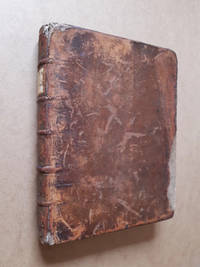
1708#BIBLIO-1153Analyse démontrée ou la méthode de resoudre les problêmes de mathématiques et d'apprendre facilement ces sciences; Expliquée & démontrée dans le premier Volume & appliquée dans le second à découvrir les proprietés des figures de la Geometrie simple & composée ; à resoudre les Problêmes de ces sciences & les Problêmes des sciences Physico-mathématiques en employant le calcul ordinaire de l'Algebre le calcul differentiel & le calcul integral ; Ces derniers calculs y sont aussi expliqués & démentrés. Dediée a Monseigneur le Du de Bourgogne Charles-René Reynaud or Reyneau. Tome I. Demonstrated analysis or the method of solving mathematical problems and of easily learning these sciences; Explained and demonstrated in the first Volume and applied in the second to discover the properties of the figures of simple and composite Geometry; to solve the Problems of these sciences and the Problems of the Physico-mathematical sciences by using the ordinary calculation of Algebra the differential calculus and the integral calculus; These last calculations are also explained and disproved. Dedicated to Monseigneur the Duke of Burgundy Charles-René Reynaud or Reyneau. Volume I Paris: Jacque Quillau 1708. Hardback full speckled calf raised bands with gilt-blocked title and decoration to spine. Quarto/4to measures around 7 7/8" x 10" x 1 5/8" xxiv 486 pp and two-page list of corrigenda. Extensive scuffing and wear to binding with some loss to leather at head and tail of spine a little to top of hinge corners of boards and more so to lower fore-edge of front board. Title label also missing although gilt title lettering itself can still partially be seen. Rubbing at edges and on hinges. Some cracking to outer hinges and extensively to inner hinges whereby daylight can be seen through them but boards are still attached. Otherwise reasonably firm. Bumped and torn corners. Speckled page edges which are browned scuffed and otherwise marked especially to upper and lower edges. A little puckering tearing and staining to pastedowns and endpapers with marking. Heavy marking to title page and previous owner inscription to top in ink with name of author written in pencil towards bottom. The odd dog-eared page corner. A little marking to page surfaces throughout but generally reasonably clean no underlining marginalia etc. A scarce first edition copy of one of the earliest calculus textbooks and a work of some significance in the field. See pictures for further information.<em>Charles-René Reynaud or Reyneau 1656 Brissac – 24 February 1728 Paris was a French mathematician. A priest of the Oratory of Saint Philip Neri father Reyneau was successively professor of philosophy at Toulon and Pézenas and then of mathematics at the college of Angers. He was a member of the Académie des sciences belles-lettres et arts d'Angers and free associate of the French Academy of Sciences. </em><em>Source: Wiki</em><em>Reyneau was a priest who served as a professor of philosophy at Toulon and Pezenas and then as professor of mathematics at the College of Angers. While he made no significant discoveries in the field of mathematics Reyneau had a talent for explicating new discoveries in mathematics. His most important work the Analyse demontree was a popular textbook in the early 18th century and was the book used by Jean le Rond d'Alembert to learn the fundamentals of the subject. In it Reyneau describes explains and demonstrates the main theories found in the works of Leibniz Newton Descartes Bernoulli and other pioneering mathematicians of the day. </em><em>Source: Jeff Weber Rare Books</em> Jacque Quillau hardcover
19971301190PN. New. 1997. Soft Cover. Date is original print. This is a reprint edition . PN paperback
1997299542PN. New. 1997. . Soft Cover. Date is original print. This is a reprint edition . PN paperback
1974748499PN. New. 1974. Soft Cover. Date is original print. This is a reprint edition. . PN paperback