10 613 résultats
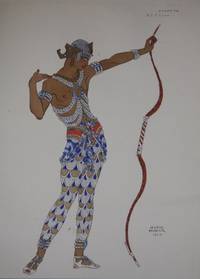
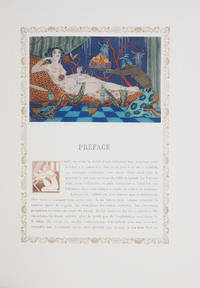
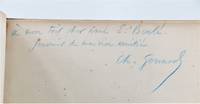
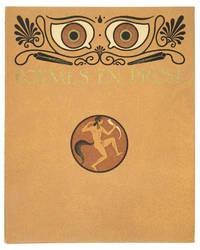
94761Paris A. Blaizot 1928. . First edition number 101 of 150 copies; 4to 26 x 21 cm; 27 text illustrations wood-engraved by Pierre Bouchet and printed in colour after designs by Barbier; presentation copy signed by Barbier on front blank; loose as issued in original pictorial wrappers after Barbier publisher's burgundy cloth chemise and slipcase.<br /> A French Romantic poet Maurice de Guérin 1810-39 achieved cult status in his lifetime as one of the first writers of 'prose poems.' The present work is illustrated by George Barbier who provides beautiful illustrations of the mythological Centaur and the Bacchante a follower of Bacchus Dionysus.<br /><br />The charming presentation inscription reads: 'À Mademoiselle Violette Gath / ces petites divinités d'autrefois déjà touchées par la mélancolie d'aujourd'hui / avec les respectueux compliments de l'artiste / George Barbier / juin 1928.' To Miss Violette Garth / These small deities of days past already touched by the melancholy of today / With respectful compliments of the artist George Barbier / June 1928.<br /> Carteret IV 195; Méhé II 309-310; Ritchie 25. Paris, A. Blaizot, 1928. hardcover
195448028Paris.: Les Bibliophiles de l'Amerique Latine. 1954. Original publisher's cream illustrated wrappers with printed titles in gold chemises with titles to spine and later red morocco-backed slipcases. 2 vols. 4to. 284 x 222 mm. Illustrated with 52 colour wood-engraved illustrations by Pierre Bouchet after George Barbier and Georges Lepape: full-page frontispiece to each vol. printed title to vol. I with vignette 6 vignette head-pieces vignette tail-piece 6 further full-page plates and 34 text vignettes as well as the two illustrations for the wrapper of each vol.; 33 decorative gilt initials numerous gilt text ornaments vignettes and head- and tail-pieces throughout; each vol. with two additional suites colour and black and white; additional portfolio consisting of 13 prints marked 'Décomposition de la gravure' for page 297; also included is a signed gouache by Barbier. An excellent example of Barbier's 'Aphrodite' with a signed gouache two pairs of suites and further unique material.From the edition limited to 150 copies with this one of 125 on Arches reserved for 'Membres de la Compagnie aux Archives et aux Collaborateurs'. The last book illustrated by George Barbier who died during its production. Barbier's contemporary Georges Lepape completed the project. The 52 colour wood engravings were cut and printed by Pierre Bouchet on his own press at Boulogne-sur-Seine. The seventh book published by 'Les Bibliophiles de l'Amerique Latine' 'Aphrodite' was produced during the presidency of the Comte de la Rochefoucauld-Montbel.The original gouache shows Aphrodite surrounded by birds. The image which uses a striking variety of purple / blue tones is reproduced on pg. 45 Chapter IV 'La Passante' Volume 1.This copy also contains a Menu from 'Les Bibliophiles de l'Amerique Latine - Assemblée Générale du 28 Mai 1952' with a gold cover design after Barbier printed in gold and numbered '5 / 60' with Bouchet's signature. Also included inserted loose is a typed press announcement for the publication with annotations dated '17 Juin 1954'. Les Bibliophiles de l'Amerique Latine. unknown
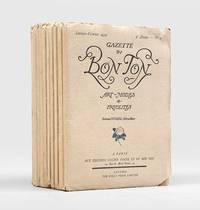
1920118958London: the Field Press Limited 1920. An attractive run of the hugely influential French fashion magazine. Founded by Lucien Vogel the first issue was released in November 1912. Publication was suspended in 1915 due to the First World War resuming in 1920 with the present volume and continuing until 1925. Extensive runs such as this especially in such bright condition are uncommon. "After the last issue of this excellent magazine in 1925 nothing else quite like it was ever produced. It has the prestige of having pioneered the idea of using the very best artists to illustrate the very best haute couture designs of having maintained a superb standard of printing on hand-made paper and for most of its life it was guided by one director Lucien Vogel" Robinson p. 28. Although short-lived Gazette du Bon Ton was a key publication and reported on the latest developments in fashion and lifestyle at the beginning of the twentieth century at a time when styles were changing dramatically in the space of a few years. The magazine was only available to subscribers at a price which equals $425 per year in today's money thereby creating a very exclusive image. Lucien Vogel the editor aimed to establish fashion as an art form and to create "good taste" for the Parisian elite. Contributing artists included all the greatest names of the day such as Dufy Bakst Barbier and Brunelleschi all of whom depicted the haute couture in a narrative and dramatic style using vivid colours and the pochoir technique on special handmade paper. Many of the designs were idealistic leisure scenes of the well-to-do illustrating the latest creations of Paris vintage fashion houses such as Worth Lanvin Doucet Poiret Callot Soeurs Paquin and Beers often without explanatory text. The literary content was also of the highest quality with essays by well-known art historians playwrights and novelists of the day. 10 vols quarto: 79 hand-coloured lithograph plates en pochoir 48 coloured croquis. Loose as issued in original printed paper wrappers. Housed in a custom orange cloth solander box. Trivial wear to edges corners very slightly defective to front wrapper of part I; a very good remarkably well-preserved set. Julian Robinson The Golden Age of Style 1976. hardcover
192887423Sous étui et chemise cartonnés. Couverture illustrée en rempliée.Belle édition publiée d'après une maquette typographique de François-Louis Schmied, illustrée de 33 compositions en couleurs de George BARBIER gravées sur bois par Pierre Bouchet.
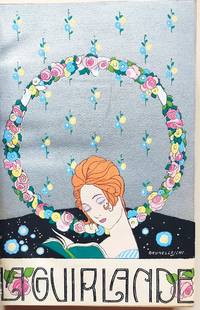
1917002990Paris: La Guirlande 1917. Book. Near Fine. Hardcover. 1st Edition. Complete set of this rare and highly decorative art deco periodical. Eleven issues all published bound in two volumes. 59 pochoir colored plates by renowned illustration artists Georges Barbier Umberto Brunelleschi Taquoy Vallee Bonotte Domergue Wegener Stab and others. Most pages with in-text color illustrations including head- and tail-pieces. All eleven original printed wrappers with colored and silver design by Brunelleschi are included. Brunelleschi was the artistic director of the short lived but significant La Guirlande. Jean Hermanovits was the literary director. Jean Saude one of the foremost artists to explore and promote pochoir techniques was responsible for the brilliant pochoir coloring. Texts by Lucie Delarue-Mardrus Rene Boylesve Jean Hermanovits Abel Hermant and others. Each issue numbered 79 of a total edition of 800 copies. Both Barbier and Brunelleschi at that time were at the top of their artistic prowess and their beautiful illustrations in La Guirlande reflect their talents. Includes duplicate of 'L'Heure du Bain' as stated in Colas. Each issue complete with mostly illustrated advertisements of 'Maisons de luxe'. Bound in two volumes half calf with raised bands and patterned boards matching patterned endpapers and gilt titles on spine. Top edges gilt. Besides the inevitable offsetting from the pochoirs this is a very fine complete set of all issues published. No marks or inscriptions no foxing. 28 x 20 cm. . La Guirlande Hardcover
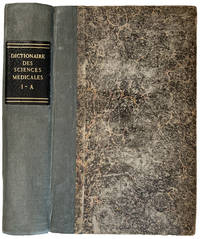
1812M12282Paris:: Crapart & C.L.F. Panckoucke 1812-22. 1812. Complete set of 60 volumes. 127 engraved plates list of subscribers in the index volume 10 folding charts; occasional foxing ink and water-stains. Modern quarter green spines over original marbled boards gilt-stamped black leather spine labels; re-backed. Ex-lib bookplates and ink stamps of the Norwich & Norfolk United Medical Book Society early ownership inscription of Hudson Gurney. Fine. FIRST EDITION. 19th Century French Medical Encyclopedia Possibly one of the most important encyclopedia/dictionaries of medicine ever assembled and certainly the earliest. As Diderot's encyclopedia became the model for assembling scientific knowledge this massive set brings together all that was known about medicine in the post-Napoleonic era. Included here are numerous engraved plates of surgical instruments of the period. Also illustrated are facial expressions and signs of mental abnormality many in the style of Esquirol's work. A smaller set Dictionnaire abrege des sciences medicales. . . was concurrently published however that set is only 15 volumes. In 1821-25 Panckoucke published Dictionnaire des sciences medicales Biographie medicale. . . which includes biographies of medical luminaries. Nicolas Philibert Adelon 1782-1862 and Francois Victor Merat 1780-1851 were two of the prominent contributors to this medical encyclopedia. <br /><br /> This compendious work was not included amongst the items exhibited by the Library of Congress in their Circle of Knowledge exhibition of the history of the encyclopedia. Panckoucke 1736-1798 was involved with issuing various encyclopedias beginning with Diderot's Encyclopedie which ". . . was an immediate success: a new edition was called for even before the first had been completed. C.J. Panckoucke proposed such a new edition in 1761 and bought the rights to the first seven volumes. He approached Diderot to edit a new revised edition and when Diderot refused began to reissue the original volumes. The government intervened in 1770 and seized the three which had appeared. After the death of the last of the original proprietors in 1775 Panckoucke published a five-volume supplement to the Encyclopedie and later in 1780 a two-volume index. The complete first edition comprises Diderot's twenty-eight volumes plus Panckoucke's seven; its publication spanned the years 1751-80." Circle of Knowledge 1979 p. 8. <br /><br /> Provenance: Hudson Gurney 1775-1864 was an antiquary and verse-writer of Norwich. He became an M.P. for Newtown in 1816 and sat in six successive parliaments. In 1835 he was high-sheriff of Norfolk and was elected fellow of the Society of Antiquaries 1819 was vice-president from 1822-46 a fellow of the Royal Society and a member of the British Archaeological Association. As such Gurney may have been the donor of this set to the Norwich & Norfolk Library. <br /><br /> DNB Vol. VIII pp. 803-4. Circle of Knowledge 1968 1979; Wellcome II p. 465. Crapart & C.L.F. Panckoucke, 1812-22. hardcover
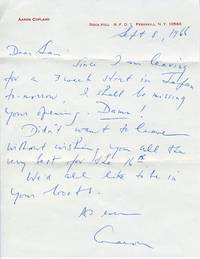
10127Used; Like New/Used; Like New. A fascinating and important collection of autograph letters and telegrams to the important American composer dating from the premieres of his two operas Vanessa 1958 and Antony and Cleopatra 1966. Included are autograph letters from Aaron Copland John Browning who premiered Barber's Piano Concerto Rosalind Elias the original Erika in Vanessa and Charmain in Antony and Cleopatra Ignace Strasvogel and other friends and admirers and telegrams from Leonard Bernstein Martha Graham Jerome Robbins W. H. Auden Noel Coward and many others.<br style="">While Vanessa with libretto by Menotti won Barber the 1958 Pulitzer Prize for music Antony and Cleopatra written for the opening of the new Metropolitan Opera at Lincoln Center was not well-received. Franco Zeffirelli chosen to write the libretto and stage the opera weighed down the production with over-the-top scenery animals and extras; technical difficulties marred the opening night. As Barber departed New York for Italy the very next morning his years of success had for the most part come to an end. The 1966 letters to Barber reflect his unhappy state with many of his friends consoling him over the bad reviews and assuring him that his music transcended the problems of staging.<br style="">Included are:<br style="">88 telegrams sending best wishes and congratulations on the première of Vanessa in 1958 sent by W. H. Auden Noel Coward Aaron Copland Leonard Bernstein Jerome Robbins John Browning Frank O'Hara Stephen Spender Martha Graham Erich Leinsdorf Antal Dorati Andre Kostelanetz Regina Reznik "Your old Baroness" Roberta Peters G. Schirmer Lillian Gish Max Rudolf Samuel Chotzinoff the heads of ASCAP and NBC and many other luminaries and friends.<br style="">3 letters about Vanessa two ALS and one TLS dated January 1958. One from Roberta Peters celebrated Met coloratura thanking Barber for sending her some music mentioning that she is looking forward to learning Barber's song "Nuvoletta" and wishing him good luck for Vanessa 2 pp.; one from Eleanor Belmont a member of the Metropolitan Opera board congratulating Barber on the premiere 1 p.; and one from a music student William Gordon expressing his love for the opera and asking where he can obtain the score 1 p. typed and undated.<br style="">19 letters mostly autograph with one TLS to Barber from before and after the 1966 premiere of Antony and Cleopatra. Dated September-November 1966. Letters are from: Ignace Strasfogel 1 p; John Browning 3 pp.; Rosalind Elias 2 pp.;  John Barrows 1 p.; Aaron Copland wishing Barber the best for the opening 1 p. with original envelope; David Johnson from Time-Life Records 2 pp.; C. W. Bailey 3 pp.; Dick 1 p.; Ellie Frankfurter 3 pp.; an unidentified correspondent in Russian 1 p.; Nina Fassler 1 p.; Lisette Lewis and another correspondent in one airmail letter from South Africa 3 pp.; Andrew Chiappe 2 pp.; Channing Way Jr a West Chester friend1 p.; Katy Katsoyanis mentioning Dimitri Mitropoulos 1 p.; "Chandler" 1 p.; Edith Jackson Barber's old school teacher from West Chester! 2 pp.; Horace P. Halsing from West Chester 1 p.; Mrs. Henry Holt 3 pp.  Also included is one letter about the premiere addressed to "Bill" from "Ed" on the letterhead of the St. Thomas Aquinas Rectory Chicago; and an envelope addressed to Barber letter missing from Sol Schoenbach postmarked October 31 1966.<br style="">Also included are 2 telegrams sent to Barber at the Metropolitan Opera House on the occasion of the premiere of Antony and Cleopatra. One is from an Ada Camillo congratulating Barber on behalf of all Cadegliano Menotti's hometown in Lombardy. The other reads "Love the story hated the music I think you are an American disgrace. Frank Terez 17" - a comic reaction to Barber's music but one that may have hit a nerve unknown books
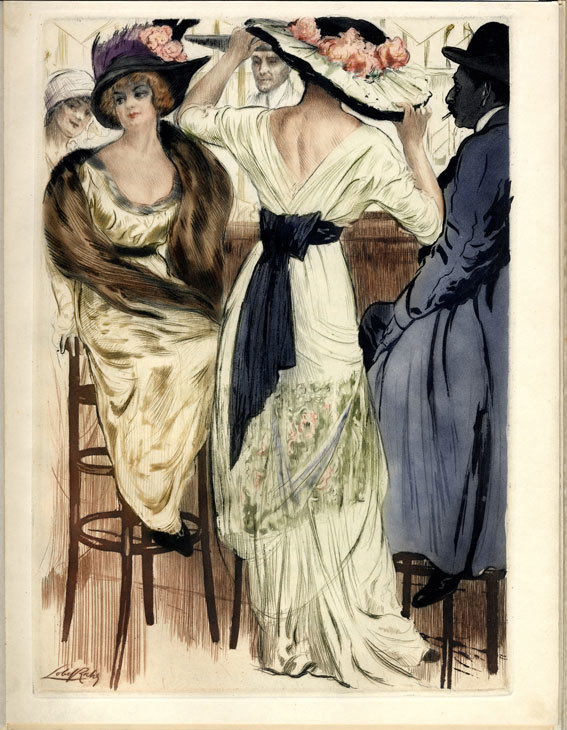
19141477Imprimé pour Charles Meunier, La Maison du Livre, Paris 1914. 1 volume in-folio (370 x 280 mm) entièrement monté sur onglets, couverture muette de papier marbré gaufré, portefeuille à rabats, dos et coins de percaline bleue, pièce de titre (de l'éditeur). 10 EAUX-FORTES ORIGINALES EN COULEURS HORS-TEXTE DE LOBEL-RICHE dont un frontispice, une vignette gravée sur le titre, 10 illustrations dans le texte et nombreux ornements. Édition de luxe tirée à 30 exemplaires seulement. EXEMPLAIRE SUR JAPON IMPÉRIAL contenant 5 ÉTATS DES EAUX-FORTES dont un état sur parchemin signé à la mine de plomb (1e, 2e, 3e épreuves en états d'eau-forte, 4e état terminé sur parchemin, signé pour chacune au crayon par l'artiste, 5e état en couleurs à la poupée sur vélin blanc), une suite sur Japon de 12 petites eaux-fortes reprenant les vignettes in-texte, la gravure de titre avant la lettre et 2 très jolis DESSINS ORIGINAUX signés au crayon en noir et bistre sur le faux-titre. English description: LES BARS. Size plate or paper : 37 x 28 cm, 10 original etchings in 5 states : 1rst state (eau-forte pure), second state in black, state in black signed and printed on parchemin, in black with aquatint, and final state in color (à la poupée). cumulatively 50 plates. Also 20 pages of text with small drawings printed in red. All these drawings are reinterpreted in original etching (pointe-sèche) : 12 (tltle + 11), and printed on Japan paper. 2 ORIGINAL DRAWINGS signed on the half-title page.
1934260057New York: The Derrydale Press 1934. First Edition ONE OF 55 LARGE-PAPER COPIES signed by Barber this being No. 22. 5 color plates one of them handcolored and 121 other illustrations. TOGETHER WITH BARBER'S ORIGINAL INK DRAWING FOR THE TITLE PAGE laid in. 1 vols. 4to. Original full red morocco gilt t.e.g. others uncut; very slight chipping to top of spine else a fine copy of a book seldom found approaching this condition. Half red morocco slipcase with Derrydale logo on spine and on upper cover leather label with chemise. First Edition ONE OF 55 LARGE-PAPER COPIES signed by Barber this being No. 22. 5 color plates one of them handcolored and 121 other illustrations. TOGETHER WITH BARBER'S ORIGINAL INK DRAWING FOR THE TITLE PAGE laid in. 1 vols. 4to. "One of the most important books published by Connett." -- Siegel This is the large paper edition of this work. The regular trade edition was published at the same time by Windward House a sporting press started by Connett in 1933. Both editions used Barber's vignette on the the title page. From this drawing it appears that Connett liked the artist's Windward design and used in it the Derrydale edition: in the margin of the drawing Connett has pencilled "reduce 1/4 inch" and the drawing was photographically reduced to the smaller dimension for the large paper copies. A simplified version of the design was used on the Derrydale edition spine. One of the rarest and most desirable productions of the Derrydale Press and by virtue of the drawing a unique copy. Siegel 85; Frazier B-5-a The Derrydale Press unknown
116864Paris Meynial 1917-1921. . First editions 5 vols 12mo 12.3 x 8.4 cm; 31 colour pochoir lithograph plates illustrations in the text; original pictorial satin over Bodoni boards with pictorial dust-wrappers original decorated slipcases some age-toning to dust wrappers and slipcases otherwise very attractive copies housed in a later Art Deco style box with tassle and gold tassle a fine set.<br /> A fine complete set of Barbier almanacs which although published in a small format due to wartime austerity are nevertheless extremely luxurious. The early volumes of these beautiful little annual almanacs often include images of men in military uniform. In addition to the pochoir illustrations Barbier contributed articles from 1918 to 1921 on such topics as the Ballets Russes epigrams opera and the pleasures of love. The fashions depicted show a radical post-war shift in style with the adoption of shorter and fuller skirts backless gowns and fabrics that incorporated more risqué elements of the tango.<br /> Paris, Meynial, 1917-1921. hardcover
95553Paris Lucien Vogel 1914. . First edition. 4to. 6 original parts comprising January to June 1914 the second year of this periodical 61 hand-coloured lithograph plates en pochoir by Barbier and others later cream cloth lightly soiled.<br /> It may have been short-lived but the Gazette du Bon Ton was hugely influential reflecting all the latest developments in fashion and lifestyle at the beginning of the twentieth century at a time when styles changed dramatically in the space of a few years. The magazine was only available to subscribers at a price which equals $425 per year in today's money thereby creating a very exclusive image. Lucien Vogel the editor aimed to establish fashion as an art form and also to create 'good taste' for the Parisian elite. Publication was suspended in 1915 due to World War I and resumed in 1920 continuing through 1925. <br /><br />Contributing artists included all the greatest names of the day such as Dufy Bakst Barbier and Brunelleschi etc and these artists would depict the haute couture in a narrative and dramatic style using vivid colours and the pochoir technique on special handmade paper. Many of the designs were idealistic leisure scenes of the well-to-do illustrating the latest creations of Paris vintage fashion houses such as Worth Lanvin Doucet Poiret Callot Soeurs Paquin and Beers often without explanatory text. The literary content was also of the highest quality with essays by well known art historians playwrights and novelists of the day.<br /> Ray Art deco Book in France pp.29-30. Paris, Lucien Vogel, 1914. hardcover
1912119004Paris: aux bureaux du Journal des dames 1912-13. First editions number 807 of 1250 copies. This journal which borrowed both the title and format of La Mésangère's periodical of a hundred years before was founded by Tom Antonginigini the secretary friend and biographer of the poet and collector Gabriele D'Annunzio 1863 - 1938 whom Antonginigini followed to Paris from Italy in 1910. It features colour pochoirs by Barbier Bakst Brunelleschi Dammy and Martin and was meant as a record of contemporary Parisian culture and fashion. Perhaps less deliberately it also documents the transition from the end of the Belle Époque to a radically different period in world history. The journal ceased publication in August 1914 due to the outbreak of the First World War. 2 vols octavo. With 1 facsimile plate 93 etched pochoir plates without advertisements. Contemporary red straight-grain boards smooth spines lettered and decorated in gilt. Original wrappers bound in. Spines slightly sunned and worn still excellent copies. hardcover
102348Paris A & G Mornay Éditeurs 1929. . Limited edition one of 67 copies on Japon this numbered 37; 8vo 21 x 17.5 cm; 325pp. 36 compositions in colour after Barbier including the printed wrappers title-page and vignette printed on wood by Gasperini with an additional suite of illustrations of the same composition but in a simplified outline design printed in red black grey or purple pages cut and in various sizes blue marbled endpapers minor age toning but otherwise very fresh; bound in contemporary quarter crushed dark blue morocco over marbled boards with the original wrappers bound in spine in six parts with raised bands and gilt title to second in fine condition.<br /> Théophile Gauthier's novel was undoubtedly inspired by the 'Orientalism' which dominated French culture in the middle of the XIX century. The text first appeared in parts in Le Moniteur universel between March and May 1857 and was published in book form in 1858. Set in the Valley of Kings a young English aristocrat and a German Egyptologist find a sarcophagus with a perfectly preserved mummy of a pharaoh named Tahoser inside. After this discovery the novel recounts the life of beautiful Tahoser and her lovers. <br /> Paris, A & G Mornay, Éditeurs, 1929. hardcover
191251747Reliure postérieure pleine basane racinée pour 3 tomes et 1 volume en plein bradel vélin à petit recouvrement. Chaque fascicule est illustré d'une, deux ou trois planches coloriées au pochoir, gravées sur papier fort. Les couvertures de livraison ont été reliées à la fin des volumes.L'ensemble est orné de 186 figures hors texte gravées sur cuivre et finement aquarellées à la main d'après George Barbier, Léon Bakst, Bernard Boutet de Monvel, Umberto Brunelleschi, Étienne Drian, Marie-Madeleine Franc-Nohain, Paul Iribe, Pierre Legrain, Charles Martin, Fernand Simeon, Armand Vallee et Gerda Wegener, entre autres.Les chroniques sont signées Robert de Montesquiou, Robert de Flers, Marcelle Tinayre, René Boylesve. On y trouve également des poèmes de Jean Cocteau, Anna de Noailles, Lucie Delarue-Mardrus.
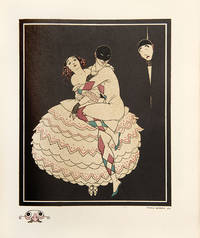
115833Paris Pierre Corrard 1914. . First edition limited edition one of 500 numbered copies on papier vélin d'arches folio 32.5 x 27.8 cm title page with pictorial vignette to head and verso 18pp. 12 full-page coloured illustrations by Barbier printed on rectos only very minor stains to margin of a couple of plates printer's leaf at end original pictorial wrappers wrappers a little browned a very good copy.<br /> Barbier's early masterpiece dedicated to Tamara Karsavina. <br /><br />'The cover design pays homage to Beardsley. and its 12 pochoir plates depict Karsavina in her principal parts. That their purpose is again to stir the emotion and delight the eye of the viewer not to document the performance is demonstrated by Le spectre de la rose glimpsed at the moment when the phantom lover of whom the young girl has dreamed after the ball is about to disappear as the rose drops from her hand.' Ray.<br /> Carteret IV 59. Paris, Pierre Corrard, 1914. unknown
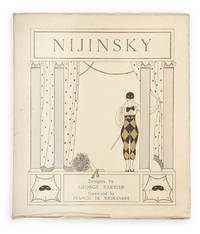
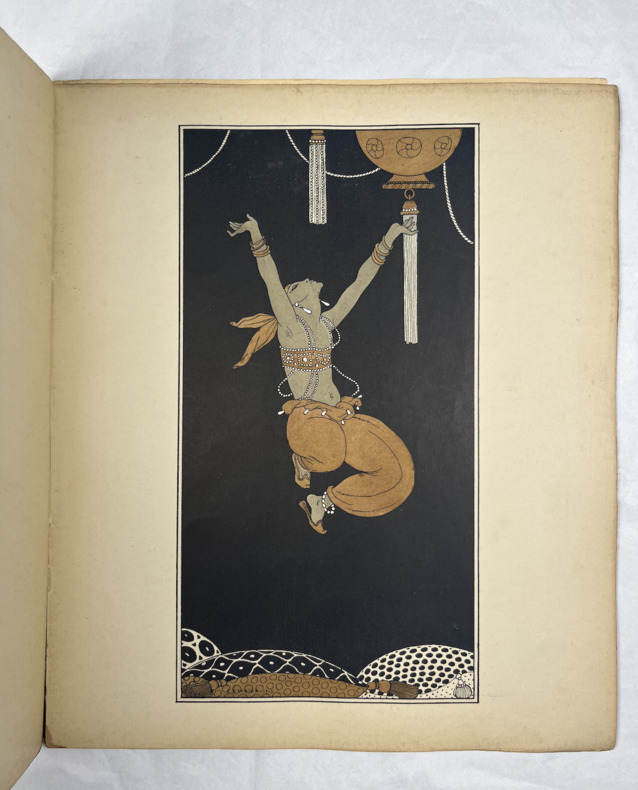
115832Paris La Belle Édition 1913. . First edition limited edition one of 340 copies on vélin from a total edition of 390 folio 33 x 28 cm; title 8pp. of text in French by Miomandre black and white vignette 12 full-page colour illustrations by Barbier printed on rectos only printed wrappers yapp edges slightly worn a very good copy.<br /> Barbier's wonderful illustrations for the Ballets Russes. Nijinsky is depicted here in Scheherazade Carnaval and L'Après-midi d'un Faune. <br /><br />'The designs although somewhat fantastic in treatment do convey the impression produced by Nijinsky in his famous characters' Beaumont.<br /><br />'In his brief time Nijinsky was the most famous male dancer in the world a pre-eminence due in part to his extraordinary virtuosity. But it was not his virtuosity alone that made him such a powerful stage presence. As contemporary reports make clear Nijinsky was a great and unusual actor. The ideal Fokine interpreter he was able to expand a simple choreographic design into a rich dramatic portrait using in keeping with Fokine's dicta the whole body as an expressive instrument. Nijinsky's influence as a dancer was immediate and huge. That ballet nearly extinguished artistically in western Europe was revived in this century is due to him and other great dancers of his generation such as Anna Pavlova and Karsavina as well as to Diaghilev. That male ballet utterly extinguished was also revived is due to him preeminently. Nijinsky was the first real ballet star of the male sex that Europe had seen since the retirement of Auguste Vestris nearly a century earlier. He initiated a renaissance.' Cohen: The International Encyclopedia of Dance Vol. 4 pp. 646-648.<br /> Paris, La Belle Édition, 1913. unknown
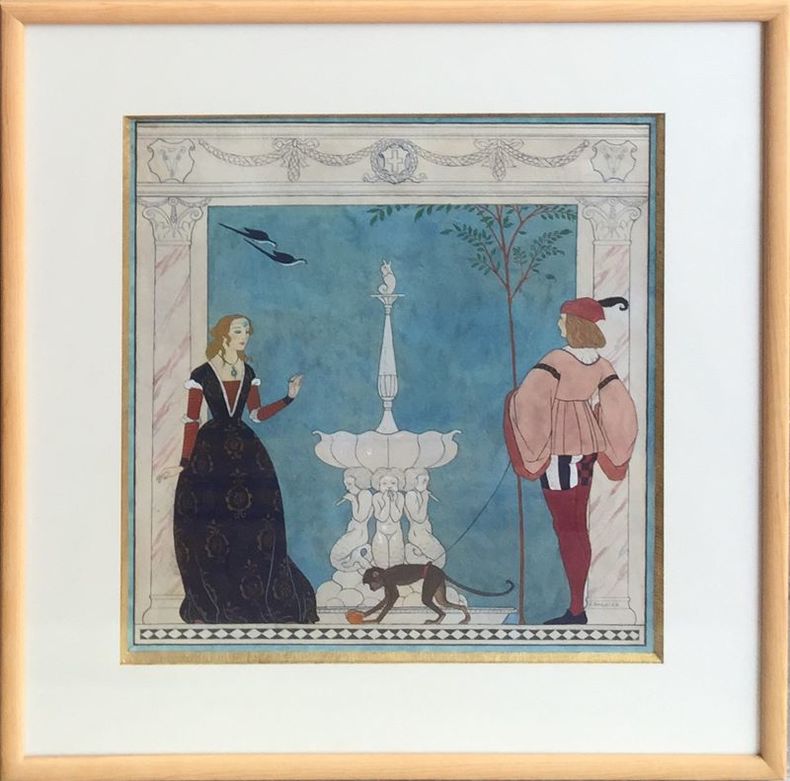
1912217381912 Aquarelle sur papier greige signée en bas à droite, (1912), 32 x 29.5 cm., encadrée.
1893160511893 PARIS, Alphonse Picard, CAEN,Henri Delesques, 1893, N° 1, 3, 5 & 6 - Broché - In-8 - Couverture imprimée avec médaille au nom d'Arcisse de CAUMONT - Importante iconographie : nombreuses planches PP Ht & illustrations en texte - 85 pages & Pagination 191 à 589 - Bon exemplaire, Intérieur très frais.
16511Valence, 1915.
EXE-766London, C. W. Beaumont & Cº, 1913. In-4° broché, couverture beige imprimée et illustrée. Illustré de 12 grandes compositions rehaussées au pochoir par George Barbier. Tirage à 400 exemplaires sur vélin, celui-ci le numéro 117.
1934239130New York: The Derrydale Press 1934. First Edition No. 14 of 55 large paper copies signed by the author. 5 color plates one of them hand-colored and 121 other illustrations. xix iii 156 pp. 1 vols. 4to. Original red morocco gilt t.e.g. Head of spine chipped and some minor loss at foot of spine. Custom red morocco backed folding box with cloth chemise. First Edition No. 14 of 55 large paper copies signed by the author. 5 color plates one of them hand-colored and 121 other illustrations. xix iii 156 pp. 1 vols. 4to. "One of the most important books published by Connett." - Siegel<br/><br/>Published in an edition of only 55 copies this in effect was the Derrydale "De luxe" edition of Barber's book: the trade edition was published by Windward House. Siegel 85; Frazier B-5-a; Biscotti p. 24 The Derrydale Press unknown books
1934375021New York: The Derrydale Press 1934. First Edition ONE OF 55 LARGE-PAPER COPIES signed by Barber this being No. 4. 5 color plates one of them handcolored and 121 other illustrations. xix iii 156 pp. 1 vols. 4to. Original full red morocco gilt t.e.g. others uncut; Almost fine minor rubbing at head and tale of spine IN ORIGINAL SLIPCASE laid into a beige linen drop box with red morocco label. Barber Joel. First Edition ONE OF 55 LARGE-PAPER COPIES signed by Barber this being No. 4. 5 color plates one of them handcolored and 121 other illustrations. xix iii 156 pp. 1 vols. 4to. "One of the most important books published by Connett." -- Siegel <br /> This is the large paper edition of this work. The regular trade edition was published at the same time by Windward House a sporting press started by Connett in 1933. Both editions used Barber's vignette of a floating decoy on the the title page. This spine of this binding is fragile; this copy in better condition than typically encountered<br /> With ALS to Mr. Dobberteen laid in about decoys. Siegel 85; Frazier B-5-a The Derrydale Press unknown
1927005263Paris: Bloch and Meynial 1927. Limited First Edition. Heavy Wrappers. . Very Good Plus/Good. No. 185 of 275 copies. 4to. 32 by 24 cm. 25 tipped-in pochoir costume plates by Barbier. Lettered tissue guards. Colas 218. The artwork is all dated to the early post-World War One period into the early 1920s. Captured here is the fantasy spun by the costuming so at odds with the parsimonious theatrical zeitgeist of the present when it seems so much of classic theater and opera is willfully updated to the unglamorous present day. Not that the costumes here are entirely unrelated to the then contemporary styles -- one can discern the cross-fertilization of costuming with fashion effortlessly though through Barbier's fluent presentation. Barbier focuses on the escapist element of theater and his renderings usher us on this excursion. The plays represented include works by Rostand and Hugo among others. Original pictorial wrappers. Closed tear of joints by extremities with the longer tear at the base about 6 cm in length. Glassine dust jacket mostly intact but with several tears and chips especially by the lower portion of the rear cover and then by the spine extremities and neighboring joints. Frontis portrait of Barbier has flattened cornered crease. Otherwise the plates most importantly are very clean and bright. <br/><br/> Bloch and Meynial unknown books
8745<p>First edition copy number 7 of 100 of this sumptuously illustrated version of the story of the Queen of Sheba combining illustrations by Barbier and the Abyssinian artist Michel Engueda-Work. French scholar traveller and diplomat Hughes Le Roux had transcribed parts of the Ethiopian chronicle Kebra Nagast in 1904 with the help of local scholars from a manuscript looted by the British at Maqdala and subsequently returned. The Kebra Nagast or 'The Glory of the Kings' is a fourteenth-century national epic of Ethiopia written in Geʽez by the nebure id Ishaq of Aksum. In its existing form the text is at least 700 years old and purports to trace the origins of the Solomonic dynasty a line of Ethiopian Orthodox Christian monarchs who ruled the country until 1974 to the biblical king Solomon and the Queen of Sheba. </p><p>The story of the text's survival is interesting. The Battle of Maqdala the last struggle in the British Expedition to Abyssinia led to significant looting by the victorious British forces who took Emperor Tewodros II's crown along with ceremonial crosses chalices weapons and the holy icon Kwer'ata Re'esu along with two fine manuscripts of the Kebra Nagast which found their way to the British Museum catalogued as Oriental MS 818 and 819 respectively. 819 was returned to Ethiopia in 1872 on the request of the Abyssinian king who identified it as a fundamental source of law. Hugues Le Roux a French envoy from the President of the French Republic to Menyelek II King of Ethiopia later went to Addis Alem in order to see this manuscript and to obtain his permission to translate it into French. He notes in his introduction here the inscription 'This volume was returned to the King of Ethiopia by order of the Trustees of the British Museum Dec. 14th 1872'. Of the artist Michel Engueda-Work who is referred to elsewhere as an 'Abyssinian artist' almost nothing else is known but his illustrations are of course far truer to the Ethiopian style than Barbier's highly exoticised and eroticised interpretations in which Sheba is portrayed following long tradition as a white woman.</p><p>Folio 328 × 250 mm 4 xiii 1 84 1 pages six plates one a frontispiece and one vignette illustration by Barbier all hand/pochoir coloured illustrations some colour six sepia plates uncoloured by Michel Engueda-Work numerous vignettes and ornaments by Louis Popineau decorative borders. All plates and illustrations with lighter paper guards with printed captions. Original pale blue wrappers preserved in early red morocco by Joly fils with onlaid interlace cornerpieces gilt borders and spine panels silk and marbled endpapers top edge gilt other uncut. Marbled slipcase. Upper joint very slightly tender at head spine just a little faded. A super copy.</p> Goupil & C[ompagn]ie, Manzi, Joyant & C[ompagn]ie.
186782010Paris: Choudens 1867. Fine. Choudens Paris S.d 1867 19 x 28 cm relié Roméo et Juliette - Opera score in 5 acts by J. Barbier et M. Carré Choudens Paris n.d 1867 19x28cm bound. First edition. Opera in five acts based on the play Romeo and Juliet by William Shakespeare music by Charles Gounod for voice and piano and libretto by Jules Barbier and Michel Carré. Contemporary red half shagreen color restored gilt spine glazed calico boards double ruled in gilt central gilt initials of Ernest Beulé on the first board moiré silk endpapers with some spotting and staining to the margins first original cover preserved all edges gilt strictly contemporary binding. Rare inscription signed by Charles Gounod to archaeologist Ernest Beulé. Choudens hardcover