[pseud: MOORE, Thomas] "One of The FancyBiblio.com
8 447 résultats
181982501London: Longman Hurst Rees Orme and Brown 1819. First Edition. Octvao. 16.5cm. Contemporary black half straight grain morocco or in fact something that is the leathery equivalent of thin gruel masquerading as morocco over marbled paper covered boards titled in gilt to spine. Some scuffing and wear and to the boards and extremities with a couple of places where the thin skin of the leather has chipped away a little strong and tight regardless of cheap production ethics it's a very good little copy. Internally clean and rather artfully printed.<br /> <br /> A rather scathing satire of political standpoints of the day presented through the lens of a 19th century boxing fanatic and through the words of Tom Crib sic All England Champion of the art of bare knuckle boxing between 1808 and 1822 who won 15 title fights and suffered no defeats becoming on of the most famous and influential pugilists in history and the darling of "The Fancy" those gentlemen and not quite so gentle men who were addicted to the pursuit and practice of bare knuckle boxing in the early 19th century. Cribb and his contemporary sportsmen frequently featured in political satire and argument of the time in the guise of "Everyman" figure like the "Man on The Clapham Omnibus" a vague figure who nonetheless personified the thoughts and opinions of the average man in the street. Longman, Hurst, Rees, Orme and Brown unknown
18852082702114601820Not Available 1885. Soft Cover. Fine. The book is in fine condition. Not Available paperback
18657722Kerry Powys: unpublished circa 1865. Farewell address expressing the heartfelt thanks of the people of Kerry near Newtown Montgomeryshire/Powys and surrounding villages to Rev. E. S. Tiddeman for his endeavours in their parish likely on the occasion of his removal circa 1865 to the parish of Childerditch in Essex. The Subscribers wish to record specially their gratitude to Tiddeman for pioneering adult education in the area teaching "gratuitously reading writing and arithmetic to the working men of the neighbourhood" and his faithful exercise of his ministry: "It has not been unnoticed by us that during your short sojourn among us you have in the lonely hours of night sat by the bedside watching over the pillow of the dying." The villagers further beg Tiddeman to accept their gift of a silver pocket communion service as a humble token of their esteem and respect. A single paper leaf 35x53 cm penned in a cursive hand all text visible; paper foxed and stained missing 2x5 cm top left corner and parts of top edge; tears to top right corner patched front and rear with sticky labels. Four 'stubs' at bottom possibly remains of attachments for seals. Several horizontal creases as though once presented as a scroll. Tiddeman 1831-1898 was sometime second-master at Llanrwst Grammar School. His wife Harriet Spooner's family were instrumental in the construction and operation of the Ffestiniog Railway; and one of their sons was draughtsman with the LNER. Tiddeman's obituary stated the family tradition he was a direct descendant of the poet Edmund Spenser. Please contact Christian White Rare Books Ltd for more information or images of this item 1865 unpublished unknown
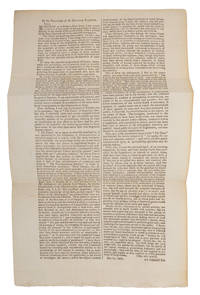
18025834s.l.: s.n. 1802. Broadside 250 x 330mm printed on 1 side in 2 columns. Sometime folded in 3 old creases from prior folds 5mm split to one crease blank verso a little soiled. An anonymous letter commending the probity and social standing of the organisers of the newly-formed Society for the Suppression of Vice. The writer defends the society against allegations in the Times of December 4th 1802 that the Society did ‘pay a profligate and needy wretch to suborn to crimes in order to prosecute’ and highlighting their success in prosecuting a man ‘grown grey in his infamous and detestable trade. and had for years exhibited his abominable trash against the wall of Privy Garden Whitehall’. The Society for the Suppression of Vice was formed in 1802 against ‘profanation of the Lord's Day and profane swearing; publication of blasphemous licentious and obscene books and prints; selling by false weights and measures; keeping of disorderly public houses brothels and gaming houses; procuring; illegal lotteries and cruelty to animals’ per their 1803 publication ‘Address to the Public’ and persisted long enough to harangue Richard Burton for his unexpurgated Arabian Nights in 1885 petering out soon after. We can find no trace of this broadside in any library catalogues. [s.n.] unknown
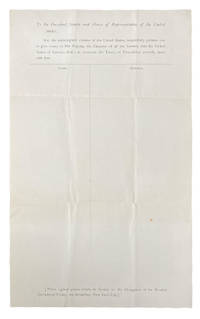
1893003137New York: By the authors 1893. Very good. Broadside n. d. 1893; 14 x 8 1/2; text and a table to recto printed in black; several fold lines else minor wear; in very good condition. In February of 1893 the US Senate would ratify a controversial agreement the first ever extradition treaty between the two countries which initially was proposed by Emperor of Russia Alexander III in 1886 and which would be quite-unfavorably received by many Americans who feared it would affect political exiles who had sought refuge in the United States. The treaty indeed included a political offense clause but it also stipulated an exception for individuals that took an attempt against the life of the head of either Government . . ." Nowadays the validity of the agreement has created two camps - on the one hand those arguing that the treaty specified "it shall remain in force for six months after notice of its termination shall have been given by either of the contracting parties" and since such notice has never been formally recorded - it is still valid; on the other hand others speculating that with the multiple changes in government the treaty became invalid after the October Revolution in 1917. The broadside published by the Society for the Abrogation of the Russian Extradition Treaty featured a very-large table with columns for names and addresses unused and stated: "To the President Senate and House of Representatives of the United States: We the undersigned citizens of the United States respectfully petition you to give notice to His Majesty the Emperor of all the Russias that the United States of America desire to terminate the Treaty of Extradition recently made with him.When signed please return to Society for the Abrogation of the Russian Extradition Treaty 100 Broadway New York City." Not in OCLC not in the trade as of January 2022. By the authors unknown
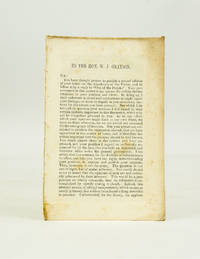
1850014925c. 1850. Pamphlet. Very Good. This pamphlet was broken out of a bound book of pamphlets. No writing or markings in the text. William J. Grayson served in both the SC State House of Representatives and SC State Senate. He was an outspoken Unionist who published a pamphlet entitled "Letter to Governor Seabrook" criticizing the secessionist movement. This pamphlet is a secessionist's reply published in response to Grayson's printing a second edition of his pamphlet. Full refund if not satisfied. unknown
187355762Hertford: Printed by Stephen Austin and Sons 1873. Hardcover. g to vg-. Quarto. 11 1/4 x 8 3/4". 7 1 12pp. Period full pebbled green morocco with elaborate gilt tooling and ruling on covers. 7 pages of text in English left to right followed by 12 pages in Persian right to left. Lavishly decorated binding with Islamic motifs produced by the publisher Stephen Austin and Sons. Each page contains elaborate decorative borders in gilt along with either red or purple framing the text. Title page includes a printed image of the Qajar Dynasty coat of arms with the Lion and Sun motif.<br /> <br /> This extremely scarce text printed in both English and Persian was presented by a delegation of the Anglo-Jewish Association to Nasar al-Din 1831-1896 the fourth Shah of Qajar Iran during an audience at Buckingham Palace on June 24th 1873. An exceedingly lavish copy of the bound text was gifted to the Shah which included the Qajar Dynasty coat of arms inlaid to the middle of the front cover and was signed by the members of the delegation in the area following the end of the Persian text. According to contemporary reporting in the Jewish Chronicle the English text was translated into Persian by a Syd Abdullah. Our book is one of a very limited but unknown number of additional copies of this bilingual text likely printed for the members of the delegation and/or other members of the Shah's entourage. It is possible than less than 10 of these additional copies were produced and we have currently only been able to confirm one other extant copy.<br /> <br /> The Shah's visit to the United Kingdom was part of his European tour of that year which was significant in that it marked the first time a modern Persian monarch had traveled to the continent. On numerous stops in various cities throughout Europe the Shah was presented with Jewish appeals from local representatives of their respective communities advocating for the improvement of the conditions of the Jews in Iran. Most notably in addition to the British Jewish delegations in June the Shah met with a member of the Rothschild family likely Baron Alphonse de Rothschild and Adolphe Crémieux head of the Alliance Israélite Universelle in Paris in July.<br /> <br /> On the 24th of June two delegations of prominent members of the British-Jewish community visited the Shah at Buckingham Palace for the same purpose. The first group consisted of members of the Board of Deputies of British Jews comprising Sir Moses Montifiore Joseph Meyer Montefiore Morris S. Oppenheim and Sir Joseph Sebag-Montefiore. The second delegation who presented this text was from the Anglo-Jewish Association and comprised Sir Julian Goldsmid Sir John Simon Baron George de Worms Frederick David Mocatta Reuben David Sassoon and Herbert G. Lousada. <br /> <br /> In the text here presented to the Shah the delegation of the Anglo-Jewish Association states that advocacy on behalf of our "brethern-in-faith" in promoting their "moral social and intellectual well-being" is the organization's aim. Presented is a list of eight grievances on behalf of the Jewish community of Iran relating to their systemic religious legal and economic persecution in the country often originating in the long held pervasive Islamic belief in the ritual impurity of Jews. Ideas for increased civil rights and economic opportunities for Jews are advanced in the text with specific remedies for some these issues proposed especially in regard to taxation and prejudice in the judicial system. The history of anti-Semitic persecution in Europe and the subsequent emancipation of Jews in the modern period is held up as an example for an enlightened ruler. Jewish contributions to broad social improvements and economic success in their respective countries is discussed as a positive result of such changes. The text extolls their "industry energy and integrity" as well as "their loyal devotion to their sovereign and their country. There is scarcely a trade profession or art in which they do not excel; and in the various spheres of intellectual distinction the countries of Europe derive a considerable portion of their renown from the activity and perseverance of their Jewish citizens." The tone of the text consistently appeals to the just enlightened and modern nature of the Shah and draws a clear lineage of rule between Cyrus the Great of the ancient Persian Empire liberator of the Jews and the then current monarchy of Iran.<br /> <br /> Bilingual text in English and Persian.<br /> <br /> Binding with some rubbing to extremities especially corners. Minor scratches and stains to the back cover. Interior with some smudging to the endpapers. Ex-libris ink stamps at the bottom of the interior covers. Starting after the eigth page in between the two sections. Binding in good interior in very good- condition overall. Ex-libris ink stamps of Dr. Eugen Meyer. A card with printed text 'Ex-libris Eugen Meyer' and some notes in ink below laid in. Meyer served as a district Rabbi in Zweibrücken Germany.<br /> <br /> Title text in Persian:<br /> Øيدا شاهنشاه خورشید کلاه Ùلك بارگاه جهان پناه که٠امن Ùˆ امان نوشیروان زمان وارث ملك سليمان مولى الملوك العرب والعجم سلطان البر Ùˆ البØر خد يوكشور ستان اعني اعلیٰ Øضرت قدر قدرت ØاÙظ شریعت غÙرا Ùˆ ناصر ملت بیضا السلطان ابن السلطان الخاقان ابن الخاقان ناصر الدین شاه قاجار<br /> <br /> Bibliographic sources:<br /> The Jewish Chronicle London No. 222 June 27th 1873;. Printed by Stephen Austin and Sons hardcover
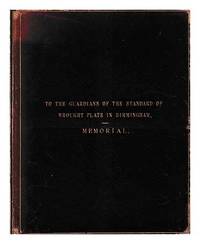
1890436702Guardians of the Standards of Wrought Plate Birmingham 1890. Edition Unstated. Softcover. Poor copy in the original gilt-blocked cloth. Spine bands worn; panel edges somewhat dust-toned and rubbed as with age. Text remains clear and without blemish. Further scans images and additional bibliographical material available on request. Signed by attendees. Date is suggested/cannot be verified. Subjects; Birmingham. Silversmithing. Wrought Plate. Guardians of the Standards of Wrought Plate, Birmingham paperback
1815500050741Anon 1815. Soft cover. Good. disbound Rare Not in British Library or any library by the look of it <br/> <br/> Anon paperback
1893041565Geneva: George & Cie Libraires -Editeurs 1893 Book. Illus. by Edited Jules Nicole. Good>Very Good. Original Wraps. First Thus. ` ` = Le livre du prefet ou l'edit de l'empereur Leon le Sage sur les corporations de Constantinople : texte grec du "Genevensis 23"To Eparchikon Biblion : Le Livre du Préfet ou l'Édit de l'empereur Léon le Sage sur les corporations de Constantinople. Texte grec du Genevensis 23 publié pour la première fois par J. Nicole. Avec une traduction latine des notices exégétiques et critiques et les variantes du Genevensis 23 au texte de Julien d'Ascalon.Parallel Greek and Latin texts with introduction and notes in French. 102p.index. Pages clean and unmarked but loose in original but damaged paper wraps. George & Cie, Libraires -Editeurs paperback
1896037767New York: Longmans Green and Co. 1896. 377 pages. Private library book plate on front paste down. Ink stamp of a masonic lodge is seen on the upper edge of the text block. Light wear on spine where a small library sticker was removed. Top hinge is cracked though holding. Other light wear. Volume remains tight and is generally clean. . First Edition. Cloth - Hard Cover. Good/No Dust Jacket. Longmans, Green, and Co.
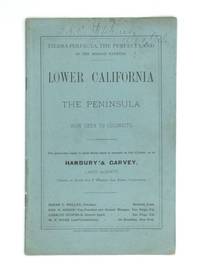
188676564San Diego California: The International Company of Mexico 1886. Wraps. Octavo: 22 2 p. with 6 black-and-white photographic illustrations and 3 maps: one of Colony Carlos Pacheco Ensenada a map of the United States showing the "Lands of The International Company of Mexico Lower California" and a detailed rendering of Baja California. Original printed blue paper wrappers bound with two staples. The contents are a little toned. The ink signature of B.A. Cecil Stephens a member of the Historical Society of Southern California in the 1890s as well as a principal in a syndicate interested in water flow in the lower Colorado River appears along the top edge of the front panel. Some minor toning and wear along the extremities of the wrappers with a stain to the rear panel; else very good. Barrett 1305 and 1306 although neither is this issue with the "Francis Valentine & Co. Printers San Francisco Cal." imprint at the bottom of the front panel.<br /> <br /> Extols the virtues of Baja California for agriculture mining and manufacturing. Includes statements from persons who have been on the company lands conditions prices and other information for colonists. The final leaf features a rendering fot the company office located at the corner of Sixth and F Streets in San Diego. The International Company of Mexico unknown
183447207Berlin G. Reimer 1834. 4to. No wrappers. Extracted from "Journal für die reine und angewandte Mathematik. Hrsg. von A.L. Crelle" Bd. XII. Pp. 258-262. <br/><br/><em>First apperance of Poisson's preamble to his famous work "Théorie mathématique de la Chaleur" published 1835. “Poisson scored a point in this work by demonstrating how the conductibility of heat in the interior of bodies far from being contained in the notion of flux as Fourier had held must be derived from an absorption coefficient that restores a neglected functional dimension. It was in this area that … Poisson’s mechanical model for conduction of heat was the most fruitful. That conception enabled Poisson to understand on the molecular scale the complete and correct equation for radiation of heat†DSB </em> unknown
181649626Paris Crochard 1816. Contemp. hcloth. Spine with gilt lettering. In: "Annales de Chimie et de Physique Par MM. Gay-Lussac et Arago." Sweries 2 tome 3. Entire volume offered. 448 pp. a. 3 engraved plates. A library stamp to some upper corners. Fourier's paper: pp. 350-375. A few scattered brownspots. <br/><br/><em>First appearance in print of any part of Fourier's landmark work "Théorie Analytique de la Chaleur" which was published in 1822. The 2 large memoirs of 1811 out of which - together with the offered memoir - grew his landmark work were only published in 1824 and 1826.The volume contains also original papers by LAPLACE GAY-LUSSAC MAGENDIE PRONY HUMBOLDT BIOT etc.etc."In 1816 Fourier published a paper the paper offered announcing the imminent appearance of a book on both the mathematical and the physical aspects of heat Fourie 1816; but six years were to pass before a book was published and it covered only the mathematical sides. In the 'preliminary discourse' he stated that its writing and printing had taken a long time p. xvii." Grattan-Guiness "Landmark Writings in Western Mathematics 1640-1940" p.356. </em> hardcover
188748946Paris Gauthier-Villars 1887. 4to. No wrappers. In: "Comptes Rendus Hebdomadaires des Séances de L'Academie des Sciences" Tome 105 No 7. Pp. 325-- 563. Entire issue offered. Maupas' paper: pp. 356-359. <br/><br/><em>First appearance of this classic paper in whic Maupas determined that fertilization in protozoa is essential to the indefinite continuation of a cell strain. His discovery proved an importent stimulus to subsequent investigation not only upon protozoa but also in the area of parthenogenesis."He found in Paramecium that after generations of division the stock becomes infeebled. Ultimately the individuals die unless they meet partners for conjugation. When two such enfeebled individuals meet their bodies are approximated and they interchange nuclear elements. Next division takes place. The stock has regained its vigour. No differentiation of sexes is evident in the conjugatory process though such differentiation can be traced in other prorozoa."Singer "The Story of Living Tings" p. 531 ff.Thomas Hall "A Source Book in Animal Biology" pp. 458-60. </em> unknown
1890249921Sabbath School of the Franklin Street Congregational Church 1890. First Edition. Hardcover. Good copy in the original gilt-blocked cloth. Panel edges somewhat dulled and dust-toned as with age. Corners sharp with an overall tight bright and clean impression. Physical description; 8 unnumbered pages. Subject; Historical record. Sabbath School of the Franklin Street Congregational Church hardcover
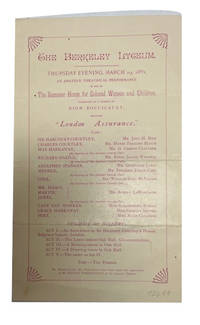
189192699New York: The Berkeley Lyceum 1891. Very Good. Modest-sized broadsheet flyer. 24 cm. Text printed in red on both sides. Two horizontal creases. List of 30 "patronesses" printed on other side. The first patroness listed is Mrs. Valentine G. Hall who was the grandmother of Eleanor Roosevelt whom little Eleanor went to live after her mother's death. We were unable find information about a "Summer Home for Colored Women and Children" other than an online reference identifying it as organized in 1890. The Berkeley Lyceum unknown
190075756Sapmi: N.p. ca. 1900. Three unattributed but very professional photographs of the Sami people and their dwellings. Likely they are from different groups as one family is seen living in an earthen hut and the other in tents. Each photograph measures 8 3/4 x 6 5/8 inches but for the one of the child with measures 4 1/4 x 5 1/2 inches it is also hand-colored. All on original plain mounts measuring 14 x 17 inches with simple manuscript captions in English. Some browning to mount edges but the images are bright crisp and fascinating.The Sami also spelled Sami or Saami are the traditionally Sami-speaking people inhabiting the region of Sapmi which today encompasses large northern parts of Norway Sweden Finland and of the Kola Peninsula in Russia. The region of Sapmi was formerly known as Lapland and the Sami have historically been known in English as Lapps or Laplanders as they are in these three photographs but these terms are regarded as offensive by the Sami who prefer the area's name in their own languages e.g. Northern Sami Sapmi. Their traditional languages are the Sami languages which are classified as a branch of the Uralic language family.Traditionally the Sami have pursued a variety of livelihoods including coastal fishing fur trapping and sheep herding. Their best-known means of livelihood is semi-nomadic reindeer herding. As of 2007 about 10% of the Sami were connected to reindeer herding which provides them with meat fur and transportation; around 2800 Sami people were actively involved in reindeer herding on a full-time basis in Norway. For traditional environmental cultural and political reasons reindeer herding is legally reserved for only Sami in some regions of the Nordic countries. Like many other native peoples they were persecuted and assimilation was forced upon them up until about 1940. Today they are recognized as a people of their own. Sweden recognized the existence of the "Sami nation" in 1989 but the ILO Indigenous and Tribal Peoples Convention C169 has not been adopted. The Sametingslag was established as the Swedish Sami Parliament on January 1st 1993. In 1998 Sweden formally apologized for the wrongs committed against the Sami.Sami is one of five national minority languages recognized by Swedish law. The Compulsory School Ordinance states that Sami pupils are entitled to be taught in their native language; however a municipality is only obliged to arrange mother-tongue teaching in Sami if a suitable teacher is available and the pupil has a basic knowledge of Sámi. One would imagine that to be a scarce commidity. In 2010 after 15 years of negotiation Laponiatjuottjudus an association with Sami majority control will govern the UNESCO World Heritage Site Laponia. N.p. unknown