10 351 résultats
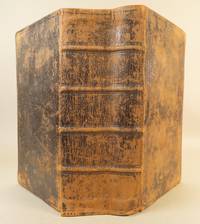
17435689Germantown: Gedruckt bey Christoph Saur 1743. 4to 26.3 cm 10.375". 2 ff. supplied in facsimile 995 1 blank 277 1 pp. 1 f. <br><br>1743 saw the first complete Bible in a European language printed in the New World in of all places Germantown Pa. and in of all languages German. The colonial powers had granted monopolies for Bible printing to "home" publishers and their products were priced sufficiently low to discourage illegal printing by colonial printers which left it to German-Americans a people here as independent settlers not "colonists" to first print a Bible of their own. Christopher Saur or Sower as he Englished it was something of a renaissance man university educated and a physician and he used his connections in Germany to obtain the gift of the fraktur type used in this Bible. It was printed in an edition of 1200 copies and cost 18 shillings. Another complete American Bible did not follow until Saur's son also Christopher published a further edition in 1763.<br>Â Â Â Â Arndt lists three states for this edition of which this appears to be C based on the absence of a two-leaf addendum giving a short history of Bible translation that a buyer could choose to have bound in or not. <br>Â Â Â Â <br>Â Â Â Â Evans 512728; Sabin 5191; Arndt The First Century of German Language Printing in the United States of America 47C; Hildeburn 804; Rumball-Petre Rare Bibles 159; Darlow & Moule 4240; O'Callaghan 22; Wright Early Bibles of America 2444. Contemporary calf over bevelled boards; binding scratched and abraded with tears to spine leather hinges inside open. First two leaves lacking i.e. main title-page and preface and title-page supplied in facsimile. A printed poem has been affixed to the front pastedown over a strip of cloth. Ownership inscriptions in German in gothic cursive and English on endpapers. Pp. 12 with loss of part of margins some text and part of headpiece repaired with paper. Lightly age-toned with darker brown-spotting some waterstaining occasional dog ears and some holing or chipping in the margins some of the latter repaired with paper. The New Testament title-page is present. Gedruckt bey Christoph Saur hardcover books
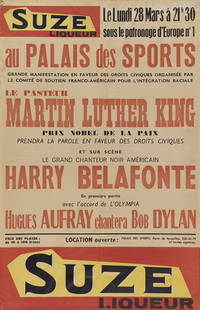
17914Used; Like New/Used; Like New. Poster for a March 28 1966 appearance by the Civil Rights leader together with singer Harry Belafonte at the Palais des Sports in Paris. Organized by the Comité de Soutien Franco-Américain pour l'Intégration Raciale the event featured a speech by King and music from Harry Belafonte and French singer Hugues Aufray sponsored by Suze Liqueur. Two-color poster with folding creases one tear to the right edge minimal wear and toning; overall very good. Sight size 14.5 x 22.5 inches 37 x 57 cm archivally matted and framed to an overall size of 20.5 x 26.5 inches.<br style="">In March 1966 King and Belafonte went to Europe for fundraising appearances on behalf of the Southern Christian Leadership Conference starting with the Palais des Sports in Paris on the 28th and closing in Sweden on the 31st. This poster for the French appearance is emblazoned with the logo of a sponsor Suze Liqueur and also cites the French-American Committee for Racial Integration as the organizing body. The opening act for the evening was the popular French folksinger Hugues Aufray doing a set of Bob Dylan covers followed by a set by Belafonte. Dr. King closed out the evening with a speech on civil rights touching on the war in Vietnam and American support for South African apartheid. The tour raised more than $100000 but drew the wrath of the American ambassador to France for airing American problems overseas. See Ross Hollywood Left and Right p. 220. We have traced no other copies of this poster at auction or elsewhere.<br style=""> unknown books
195822512NY: Harper. Fine in Near Fine dust jacket. 1958. First Edition; Later Printing. Hardcover. Inscribed on the fep by King. I purchased this more than twenty five years ago from the person to whom it is inscribed. ; 8vo 8" - 9" tall; 230 pages; Signed by Author . Harper hardcover
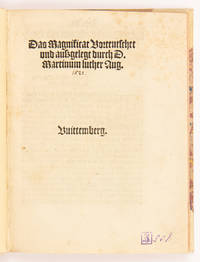
15213036<p>Wittenberg: Melchior Lotter 1521. </p><p>Price: $5600.00 </p><p>Quarto: 19 x 13 cm. 88 pp. a-l4</p><p>FIRST EDITION.</p><p>Modern marbled boards vellum spine and corners. A fine copy with contemporary marginalia in red and black. Provenance: Alain Moirandat Switzerland.</p><p>Luther wrote his "The Magnificat Translated into German and Explained" in two parts the first composed before his appearance at the Diet of Worms and the second part while he was in hiding in the Wartburg in May and June 1521. Given that Luther's vision of the church and of Mary's nature and place within Christianity were evolving and were to evolve much further over time and the fact that Luther left the Diet a changed man living in changed circumstances it is no wonder that Luther's exposition of the Magnificat has been the subject of numerous conflicting interpretations.<br /><br />In Albert Steinhaeuser's view the work "is a classical discussion of the place that the Virgin Mary occupies in the Protestant system. Although Luther regards her in one place as sinless and invokes her aid and intercession at the beginning and close of his work these are isolated instances; the whole tenor of the exposition is evangelical and as far removed from the Mariolatry of Rome as from an ultra-protestant depreciation of the Mother of our Lord. 'She does not want you to come to her but through her to God.' There is something very human and altogether unlike the radiant Queen of Heaven in the Mary who 'goes about her household tasks milking the cows cooking the meals washing pots and kettles sweeping out the rooms.' It is Luther's contribution to the German Madonna and the Weimar editors well compare this and similar passages of the Magnificat with Albrecht Durer's Marienleben a series of quaint woodcuts portraying the life of the Virgin 1503-10."<br /><br />But Hartmann Grisar one of the leading Catholic writers on Luther writes "Luther's 'Exposition of the Magnificat' has frequently been taken as a proof of Luther's great piety. It indeed contains many good thoughts even apart from those relating to Mary but in numerous passages the author uses his pen for a highly prejudiced vindication of his new teachings on the state of grace. It should also be borne in mind that the printers started on the book just before the Diet of Worms and that it was intended to attract and secure the support of the future rulers of the Saxon Electorate. Luther was also engaged at that time on his exceedingly violent screed against Catharinus in which he attempts to reveal the Pope in his true character as Antichrist. When after the Diet of Worms he continued his work on the Magnificat he was certainly in no mood to compose a book of piety on Mary. The result was that the book became to all intents and purposes a controversial tract which cannot be quoted as a proof of his piety or serenity of mind during those struggles. Luther's Magnificat is as little a serious work of edification and piety as his exposition of certain of the Psalms which appeared almost simultaneously and was also directed " against the Pope and the doctrine of men.".</p><p>VD16 L-5453; Benzing Luther 855; Kuczynski 1431</p> Melchior Lotter, books
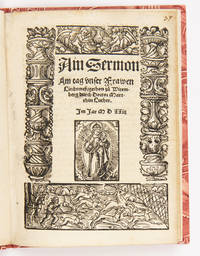
15233029<p>Augsburg: Melchior Ramminger 1523. </p><p>Price: $5500.00 </p><p>Quarto: 20 x 15 cm. 8 pp. Collation A4</p><p>One of five editions all printed in 1523.</p><p>Modern boards. A fine copy with a beautiful four-part title page border the lower register of which shows a stag hunt. There is also a small woodcut of the Virgin balancing on the crescent moon and holding the infant Christ.</p><p>A sermon for Lichtmeß Candlemas the feast of the presentation of the infant Jesus in the temple and the purification of Mary February 2. Jesus takes as his text Luke 2:22-39.<br /><br />For the complexities of Luther's evolving Mariology see Thomas O'Meara Mary in Protestant and Catholic Theology 1966. "Luther's attitude toward the theology of Mary and toward the devotion which a Christian should have to the Mother of God is a small-scale representation of his entire religious accomplishment. During any discussion of Luther and the Blessed Virgin we must keep uppermost in our minds that there was a development in his ideas a change more or less drastic in each aspect of Marian theology. This development has its beginning in Catholicism; it passes through contradictions struggles and uncertainties and terminates in a new Marian viewpoint one which Luther decided was Christocentric biblical unexaggerated and edifying."p. 123.</p><p>Benzing 1746; VD16 L-6084</p> Melchior Ramminger, books
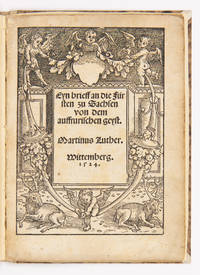
15243177Wittenberg:: Cranach and Döring 1524. FIRST EDITION. Quarto:. 21 x 15 cm. . 20 pp. A4 B2 C4 Bound in marbled boards. With an excellent woodcut title page by Lucas Cranach Luther 43c cut from a single block with putti cornucopiae architectural motifs and stags. A good copy light soiling a few stains. First edition of Luther’s response to the growing danger posed by the radical preacher Thomas Münzer who was ultimately executed the following year for leading the violent open revolt that came to be known as the Peasants’ War. In 1523 Thomas Münzer formerly the leader of the radical “Zwickau Prophets†began to radicalize the area of Allstedt where he was then pastor preaching that the ungodly were to be eliminated and the elect would establish a kingdom of Christ on earth and threatening the political rulers of the area with rebellion. In early 1524 as Münzer “grew bolder in his denunciation of the authorities and called for an elimination of the enemies of God†he divided the citizenry into military units in order to resist any outside interference in his activities. Münzer openly challenged and attacked Luther who was openly opposed to Münzer’ ministry of the elect as one of “our mad debauching pigs which are horrified by the windstorm the raging billows and by all the waters of wisdom.†In his “Letter to the Princes of Saxony Concerning the Rebellious Spirit†written in July 1524 in response to the recent violence and Münzer’s mystical theology Luther “appealed to the rulers to act before the incendiary suggestions of Münzer led to civil rebellion and open revoltâ€. Luther “distinguished two sides of Münzer’s behavior that of violence and that of precept. Only the subject of violence concerns the princes and to this subject he devotes almost his entire letter. Satan can here be seen at work in a new way and has shown us his hoofprint all too plainly –meaning Münzer says that one is not to leave it up to the Word but that it is time to resist the authorities with fists with the sacking of cloisters with the destruction of images. Luther demanded that the princes respond preventively by rigorous prohibitions. If the Allstedters wished to defend themselves and show their true colors let them do so in a public trial before whomever they choose. “Luther’s book is noteworthy not because he admonished them to suppress violence but much more because he drew boundaries for them to observe. They do not have to defend themselves against Münzer’s teaching: ‘Let them preach as confidently and as boldly as they are able and against whomever they wish…There must be sects and the Word of God must be under arms and fight…Let the spirits collide and fight it out. If meanwhile some are led astray let it be; such is war. Where there is battle and bloodshed some must fall and some are wounded. Whoever fights honorably will be crowned.’… “The princes became convinced that the disturbances might lead to rebellion and they summoned the leaders before them. The Allstedt council and Münzer were examined in Weimar at the beginning of August. To escape the impending verdict Münzer fled to Mühlhausen where later in the year he gained leadership over the city. He became a central figure in the Peasants’ Revolt and suffered death in May 1525 when the revolt was crushed.â€Bornkamm Luther in Mid-Career p. 152 ff. Benzing 1927; Kessler 553; Title border: Luther “Titeleinfassungen der Reformationszeit†43c Cranach and Döring, unknown books
1966223481966. Martin Luther King Jr. Chicago King Jr. Martin Luther. Western Union telegram sent May 19 1966 supporting the Independent Union of Public Aid Employees during the Chicago Freedom Movement. The message documents King's public alignment with labor activism and welfare reform campaigns during his Northern civil rights organizing in Chicago where he sought to address structural inequality in housing employment and public assistance systems.<br /> <br /> Original telegram from Dr. Martin Luther King Jr. to the Independent Union of Public Aid Employees. May 19 1966. Western Union telegram. Chicago Illinois. Measures 8" x 5.5" unframed 12.5" x 9.5" framed. An extraordinary piece of civil rights ephemera this original 1966 Western Union telegram was sent by Dr. Martin Luther King Jr. and "the staff" to the Independent Union of Public Aid Employees IUPAE during the height of the Chicago Freedom Movement. The telegram reflects King's growing commitment to labor justice economic equality and Northern civil rights struggles supporting public labor unions engaged in collective social welfare reform.<br /> <br /> The telegram reads as follows:<br /> <br /> "CD199.=PD CHICAGO ILL 29 154P CDT.<br /> =INDEPENDENT UNION OF PUBLIC AID EMPLOYEES.=<br /> ATTN ALLEN KAPLAN PRES 26 WEST HARRISON CHGO.=<br /> <br /> ALL OF US HAVE BEEN PAYING CLOSE ATTENTION TO THE DEVELOPMENT .=OF THE STRUGGLE IN WHICH YOU ARE NOW ENGAGED. WE RECOGNIZE .=THAT YOU TOO SHARE THE VISION OF A SOCIETY IN WHICH ALL MEN .=ARE TREATED WITH JUSTICE AND DIGNITY. WE OFFER OUR SUPPORT .=TO YOU IN YOUR STRUGGLE FOR COLLECTIVE BARGAINING RIGHTS AND .=A MORE HUMANE WELFARE SYSTEM. WE LOOK FORWARD TO WORKING MORE .=CLOSELY WITH YOU IN THE COMING MONTHS--FAITHFULLY.=<br /> <br /> DR MARTIN LUTHER KING JR AND THE STAFF.=="<br /> <br /> Sent on May 19 1966 this message directly coincides with King's relocation to Chicago in early 1966 to launch the Chicago Freedom Movement his most ambitious campaign to confront systemic racism in the urban North. Co-led by the Southern Christian Leadership Conference SCLC and the Coordinating Council of Community Organizations CCCO the campaign sought to challenge racial segregation in housing employment discrimination and inequities in municipal services. King recognized that structural injustice in Northern cities was just as debilitating as the overt segregation of the South. The IUPAE a union representing frontline welfare workers had staged actions demanding not only better workplace conditions but also systemic reforms to a punitive welfare system that disproportionately affected Black and poor communities. By expressing solidarity with public employees fighting for "collective bargaining rights and a more humane welfare system" King extended his vision of the "Beloved Community" beyond civil rights into economic justice and labor rights themes that would define his final years. That same year King endured resistance not only from segregationists but also from local city officials including Mayor Richard J. Daley and endured physical threats during open housing marches in white neighborhoods like Marquette Park. His support for labor organizations particularly in Chicago foreshadowed the Poor People's Campaign and his final act of solidarity-marching with striking sanitation workers in Memphis in 1968.<br /> <br /> Overall very good condition with light toning and minor creasing to telegram. Framed under glass in black wood frame. A rare and powerful primary document linking Dr. King's Northern campaign for racial and economic justice with the struggles of organized labor a direct and material expression of King's belief that "all labor has dignity."and his "VISION OF A SOCIETY IN WHICH ALL MEN .ARE TREATED WITH JUSTICE". An exceptionally historic piece. unknown
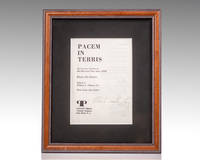
1963149593Glen Rock NJ: Paulist Press 1963. Original printed pamphlet of Pope John XXIII's 1963 Pacem in Terris. Boldly signed by Martin Luther King Jr. at the bottom of the title page. Martin Luther King Jr. was a Baptist minister and activist who became the most visible spokesperson and leader in the civil rights movement from 1954 through 1968. He is best known for his role in the advancement of civil rights using the tactics of nonviolence and civil disobedience based on his Christian beliefs and inspired by the nonviolent activism of Mahatma Gandhi. King led the 1955 Montgomery bus boycott and in 1957 became the first president of the Southern Christian Leadership Conference SCLC. With the SCLC he led an unsuccessful 1962 struggle against segregation in Albany Georgia. Pope John's Pacem in Terris was issued on April 11 1963. The day after on April 12 King would be arrested for his nonviolent protesting against racism and racial segregation in Birmingham Alabama writing his Letter from Birmingham Jail on the 16th. Matted and framed. In fine condition. The piece measures 11.25 inches by 9.25 inches. Rare and desirable. Pope John XXIII’s 1963 encyclical Pacem in Terris “Peace on Earth†stands as one of the most influential Catholic social teachings of the twentieth century articulating a global moral framework grounded in human dignity universal rights and the ethical responsibilities of both individuals and states. Issued amid Cold War tensions and only months before his death the document broke new ground by addressing itself not only to Catholics but to “all people of good will†reflecting John XXIII’s broader ecumenical and humanitarian vision. Pacem in Terris condemned nuclear proliferation affirmed the equality of all peoples and called for structures of international cooperation capable of safeguarding peace and justice. Paulist Press unknown
19632111002American Friends Service Committee 1963. softcover. near fine. Second printing June 1963. This letter was written on April 16 1963 and published for the first time May 1963. In near fine condition. American Friends Service Committee unknown
1522140948314Wittemberg Wittenberg: Nickell Schyrlenz Schirlentz 1522. First edition. Near Fine. First edition of Martin Luther's riposte to King Henry VIII's pamphlet "In Defense of the Seven Sacraments" preceding the Latin edition by one month. Unpaginated 47 pp blank A-F4. Laid paper text in German woodcut title illustration featuring cupids. Collated complete. Small quarto recently bound in brown speckled paper-covered boards. Near Fine with tape marks to rear board perceptible in raking light light toning and thumbing and occasional foxing to contents. Title page repaired with backing paper to margins soiling to first and last pages faint dampstain to upper right corner of first few leaves. Binding solid interior overall clean and bright.<br /> <br /> <p>A well-preserved copy of a treatise by one of the most famous men in history. In 1521 Henry VIII of England published an attack on Martin Luther and defense of the Catholic Church that earned him the title "Defender of the Faith" from Pope Leo X. Henry's Assertio Septem Sacramentorum was swiftly translated into German and sold well on the Continent. Luther perceived a threat and published this furious response the following year mocking Henry''s new title and his qualification for the role. Henry himself would soon defy the Catholic Church after his demand for the annulment of his first marriage was rejected but he and Luther continued their acrimonious correspondence and never reconciled. Nickell Schyrlenz [Schirlentz] unknown
15501503130064Gedruckt zu Wittemberg : Durch Hans Lufft 1550-01-01. Hardcover. Acceptable. Folio. 380 of 383p. Collation: A1-Z6 A1-Z6 Aa1-Aa2 lacking Aa3-Aa4 Aa5-Rr4 Lacking Rr5 Rr6 Ss1-Ss5 in 6's. Bound in contemporary pigskin. Bindings decorated in blind. 5 raised bands. Contemporary brass corners and latches. Woodcut title page and 62 woodcuts throughout most by Hans Brosamer and some by Georg Lemberger. Good binding. Shelfwear. Chipping and loss to head and tail of spine. Loss to board edges. Lacking clasps. Lacking first and final blank. Top of title page missing from signature removal. Cracking to hinges. Soiling to pages. Loss to tail of leaf 33 affecting last 2 sentences of text. Marginal loss to f209. Tear to halfway of leaf 216. Contemporary marginal notation to the Gospels. Contemporary underlining to select pages throughout. Repairs to leaf 229 and 277. Tanned pages with some staining. <br><br> The Prophets of the Old Testament with the New Testament and Apocrypha from Martin Luther's translation of the Bible. Gedruckt zu Wittemberg : Durch Hans Lufft hardcover
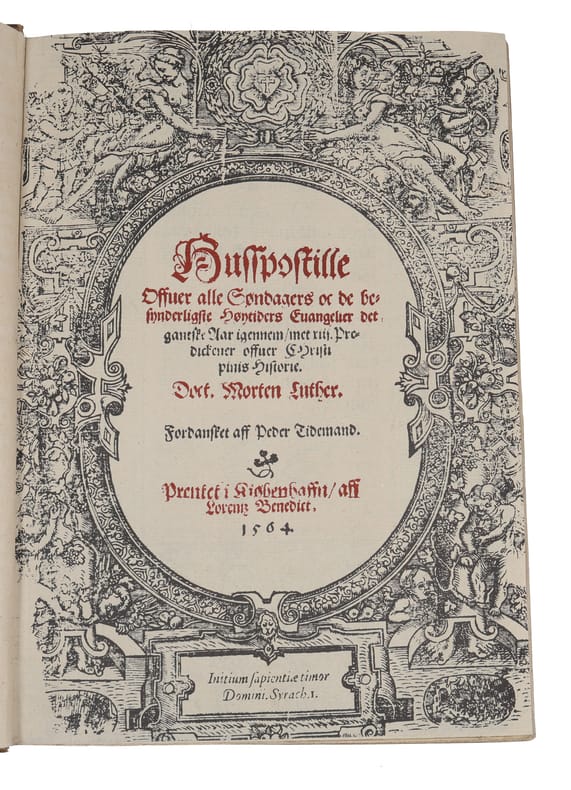
156415908Kiøbenhaffn, Lorentz Benedict, 1564. 4to. Senere helldrbd. 188,156,114 blade. Titelblad og fortale samt sidste blad i smuk lystryk faksimile ( 3 blade ialt). de sidste 10 blade kantrepareret. Lettere brugsspor. 3 træskårne titelblade, tæt beskåret foroven. Talrige større træsnitillustrationer i teksten.
156415908Kiøbenhaffn Lorentz Benedict 1564. 4to. Senere helldrbd. 188156114 blade. Titelblad og fortale samt sidste blad i smuk lystryk faksimile 3 blade ialt. de sidste 10 blade kantrepareret. Lettere brugsspor. 3 træskårne titelblade tæt beskåret foroven. Talrige større træsnitillustrationer i teksten. <br/><br/><em>Første danske udgave af Luthers Postil og af største sjældenhed i komplet stand. Kun ganske få bevarede på private hænder. De fleste eksemplarer i de offentlige biblioteker er ukomplette Lauritz Nielsen anfører kun 7 komplette eksemplarer. En af de mest betydningsfulde bøger fra Benedichts trykpresse og det største i omfang.Extremely scarce first Dansih edition of Luther's "Hauspostille" with only af few copies still on private hands.Thesaurus I 104. - Birkelund 24. - Lauritz Nielsen 1084. - Paulli 20. </em> unknown
In-4°, 48cc, frontespizio in cornice figurata, gotico corsivo, illustrazioni xilografiche, capilettera, legatura in piena pergamena, buone condizioni. Prima edizione. Si tratta del diffuso Catalogus scritto dal Domenicano Bernardo di Lussemburgo come continuazione di quello di Nicola Eymerich, e che tratta delle più diffuse eresie del tempo, includendo ovviamente quella luterana. In-4 °, 48cc, frontispiece in ornated frame, gothic text, woodcut illustrations, inital letters, full vellum binding, good condition. First edition. This is the widespread Catalogus written by the Dominican Bernard of Luxembourg as a continuation of that of Nicola Eymerich, and which deals with the most common heresies of the time, obviously including the Lutheran one.
192936266Munich: Bremer Presse 1929. Hardcover. Near Fine. Hardcover. 365 copies. This is a magnificent production from the famed Bremer Presse of Germany - probably their masterpiece. They published books from 1911 to 1939 interrupted only by World War I. It was founded by Willy Wiegand and like England's Doves Press rejected ornament except for splendid initials draw by Anna Simons and relied upon carefully chosen types and painstaking presswork to produce its limited edition hand printed books. The colophon states that this edition was printed to commemorate the 400 year anniversary of the publication of Martin Luther's German bible. The text was based on the editions published in 1545 and 1546. The Bible German: Lutherbibel was the first German language Bible translation from Latin sources. The New Testament was first published in September 1522 and the complete Bible containing the Old and New Testaments with Apocrypha in 1534. Luther continued to make improvements to the text until 1545. The five volumes are: Die Bucher Mose; Teil des Alten Testaments; Teil des Alten Testaments; Die Propheten; Das Neue Testament. Each volume has a different copy number. They are bound uniformly in blue paper boards with linen spines with the title written in calligraphy. The volumes are housed in gray paper board slipcases. In near fine condition in very good slipcases. Measures 10 x 14 inches. Unpaginated each volume about 250-300 pages PRI/011623. Bremer Presse hardcover
15872KING Martin Luther. "Freedom Day . . . Come March with Dr. King!" Printed flier. February 22 1965. 8 1/2" x 5 1/4" inches. This flier was issued to advertise the Freedom Day event planned for March 1st 1965 which protested the voter suppression tactics targeting African-American citizens of the US. In this demonstration prospective voters led by Martin Luther King Jr. and John Lewis signed an "appearance book" to indicate their attempt to register. It is illustrated with a shackled hand grasping for the key to freedom--"The Vote." This demonstration followed the first Freedom Day of January 18th 1965 in which King and Lewis led 500 prospective voters to the Selma courthouse for registration who were subsequently turned away. The Freedom Day voter registration efforts were among the events leading up to the famed March from Selma to Montgomery. "Bloody Sunday" transpired the very next week after the events of this flier in which peaceful participants in a Selma to Montgomery march for voting rights were met by Alabama state troopers who attacked them with nightsticks tear gas and whips after they refused to turn back. Some protesters were severely beaten and bloodied while others ran for their lives; The entire incident was captured on national television. As a direct result of the Freedom Day demonstrations and especially the horror of Bloody Sunday the Voting Rights Act was signed by President Lyndon B. Johnson on August 6 1965 with Martin Luther King Jr. and other civil rights leaders present at the ceremony. Toning minor foxing. unknown books
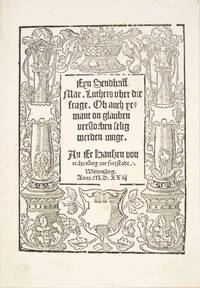
15233175Erfurt:: Stürmer 1523. FOURTH PRINTING. Quarto:. 20 x 14.5 cm. 8 pp. A4 Modern boards with a stamped Luther rose. With a narrow woodcut title border. A very fresh clean copy with an intricate title page border. All printings are rare. Luther wrote this letter in August 1522 to Hans von Rechenberg a strong supporter of the Reformation and a man who distinguished himself in battle against the Turks. There is no evidence that Luther knew von Rechenberg personally but the question that Luther addresses in the letter whether a person who dies without faith may be saved seems to have been one of personal concern to the addressee. Luther’s reply is quite direct and to the point: whether men like it or not Luther says God saves no one without faith for to do so would be contrary to his word. Furthermore faith does not seek to penetrate why God does not save without faith. Luther cites four passages of scripture: Mark 16:16 where Jesus says “Whoever does not believe will be condemnedâ€; Hebrews 11:6 which says “Without faith it is impossible to please Godâ€; John 3:6 “Whoever is not born anew of the Spirit and water cannot see the kingdom of Godâ€; and John 5:18 “Whoever does not believe is already judged.†Luther writes: “Now if God were to save someone without faith he would be acting contrary to his own words and make himself out to be a liar. Yes he would be denying himself and that is impossible. For St. Paul says in 2 Timothy 2:13 “God cannot deny himself.†As impossible as it is for divine truth to lie it is just as impossible for him to save someone without faith.†He continues: “It would be a completely different question to ask whether God could grant faith to a few at the moment of their death or after death and thereby save them through faith. Who would doubt that he could do this But no one can prove that he does do this. For we only read that he has already raised the dead and given them faith. No matter what he does whether he grants faith or not it is impossible for anyone to be saved without faith. Otherwise all preaching and the Gospel and faith itself would be futile false and deceptive since the entire Gospel makes faith necessary.†Benzing 1270 Stürmer], unknown books
751Wittenberg 1532. Quarto 8 1/4 X 6 1/2 inches . First edition A-Z4 a-z4 aa-nn4 oo2 pp4 241 Leaves Bound in full modern calf a very nice copy. Luther proceeds line by line some times giving one line from Matthew five pages of commentary! Here is a shortened example: from the greek. And His commentary. Benzing Luther 3011;VD 16; L 4754; Pegg Swis; 2988;. Here is a shortened example: from the greek. And His commentary.<br /> <br /> V. 3. Blessed are the poor in spirit for theirs is the kingdom of heaven.<br /> <br /> This is a delightful sweet and genial beginning of his sermon. For he does not come like Moses or a teacher of law with alarming and threatening demands; but in the most friendly manner with enticements and allurements and pleasant promises. And indeed if it had not been thus recorded and if the first uttered precious words of the Lord Christ had not been given to us all an over-curious spirit would tempt and impel everybody to run after them even to Jerusalem yes to the end of the world if one might hear but a word of it all. Then there would be plenty of money forthcoming to build a good road and every one would boastingly glory how he had heard or read the very words that the Lord Christ had spoken. O what a wonderfully happy man would he be held to be who should succeed in this! That is just the way it surely would be if we had none of our Savior's words written although much might have been written by others; and every one would say: Yes I hear indeed what St. Paul and his other apostles have taught but I would much rather hear what he himself said and preached. But now that it is so common that every one has it written in a book and can read it daily nobody regards it as something special and precious. Yes we grow tired of them and neglect them just as if not the high Majesty of heaven but some cobbler had uttered them. Therefore we are duly punished for our ingratitude and contemptuous treatment of these words by getting little enough from them and never feeling or tasting what a treasure force and power there is in the words of Christ. But he who has grace only to recognize them as the words of God and not of man will surely regard them as higher and more precious and never grow tired or weary of them.<br /> <br /> Kindly and sweet as this sermon is for Christians who are our Lord's disciples just so vexatious and intolerable is it for the Jews and their great saints. For he hits them a hard blow in the very beginning with these words rejects and condemns their doctrine and preaches the direct contrary; yes he denounces woe against their way of living and teaching as is shown in the sixth chapter of Luke. For the substance of their teaching was this: If it goes well with a man here upon earth he is happy and well off; that was all they aimed at that God should give them enough upon earth if they were pious and served him; as David says of them in Psalm 144: "Our garners are full affording all manner of store; our sheep bring forth thousands and ten thousands in our streets; our oxen are strong to labor; there is no breaking in or going out; there is no complaining in our streets.". Wittenberg ,1532 unknown
1531140949420Wittenberg Germany: Hans Lufft 1531. First edition. First edition. First printing with date misprinted as "1231" on the title page as per Benzing. 63 pp. Bound in recent brown paper over boards with red morocco spine label. Text in German. Small 4to A1-D4. Title page with Georg Lemberger woodcut border Luther Taf. 34 showing angels surrounding the entrance to the book. Near Fine annotations in a contemporary hand have been washed out with varying degrees of success much of them still visible; tidemark to fore tail corner otherwise a very clean and fresh copy. Uncommon in its first printing. <p>After the Diet of Augsburg Charles V gave Protestants six months to renounce the Evangelical reforms and return to the Catholic church or else face armed persecution. During this period a confederation of Protestant states dubbed The Schmalkaldic League was formed with the intention of defending themselves from the Empire's repression. Luther joined Philip Melanchthon and several other theologians at Torgau in signing a declaration in defense of the creation of an armed Protestant league something he had adamantly refused to do on multiple prior occasions. The Warnunge An Seine lieben Deudschen was composed as a theopolitical justification of this new declaration of the right to armed resistance at Torgau. In it Luther walks a fine dialectical line with one of the clearest practical applications of his Two Kingdoms doctrine: as a minister of the Gospel he must counsel peace and could not press for war; but neither would he reprove those who took up arms to defend themselves against tyranny. Benzing 2908; VD16 L7736. Hans Lufft unknown
17208417<p>201084 312 pages. Full ruled black calf. All edges gilt with modest gauffering to top & bottom. Four raised bands. Eisenach was Luther's childhood home & place of refuge during his best-selling translation of the Greek New Testament to German using the Vulgate only for comparison. Blank fly leaves as well as recto & verso of pastedowns contain Hoffmann family genealogical records see image. Scarce Eisenach imprint with but two copies found on WorldCat. 11 x 20 cm or 4.5 x 8 in.</p> Boëtio [Johann Adolph Boetius] hardcover
175353654Wittemberg, Vidua Scheffler, 1753. 4to. Contemporary full calf with five raised bands to richly gilt spine. Edges of boards blindtooled. Boards slightly warped and with lsigns of wear. Internally very nice and clean with only a few scattered brownspots. A nice, tight, clean, and completely unrestored copy. Title-page printed in red and black. (4), 18, (6), CCLII, (2) pp. + two folded engraved plates.
175353654Wittemberg Vidua Scheffler 1753. 4to. Contemporary full calf with five raised bands to richly gilt spine. Edges of boards blindtooled. Boards slightly warped and with lsigns of wear. Internally very nice and clean with only a few scattered brownspots. A nice tight clean and completely unrestored copy. Title-page printed in red and black. 4 18 6 CCLII 2 pp. two folded engraved plates. <br/><br/><em>The exceedingly rare first edition of the first published biography of Aldus Manutius including "the first real attempt at an Aldine bibliography" Grolier Aldus. This legendary publication constitutes not only the earliest but also one of the most important sources on Aldus and his publications. Written by Christian Gottlieb Unger 1671-1719 presumably in the early 1700'ies it circulated in manuscript-form for decades until 1753 when Samuel Luther Geret German theologian lawyer and politician took upon himself to edit the manuscript and have it published. Renouard mentions a 1729-edition but this is a ghost See "Grolier Aldus Manutius: No. 135".Grolier Aldus Manutius: No. 135.Renouard pp. iv-v. </em> hardcover
19261211270031Bremer Presse 1/1/1926. Hardcover. Very Good. The masterpiece of the Bremer Presse printed in 14-point German type and accompanied by Anna Simons' calligraphic initials 5 volume set. No. 244 of 365. Folio. Bound in vellum. Gilt spine. TEG. Vellum slightly soiled faint white paint smear to spine of Vol. I rear cover of Vol IV scuffed and with few tiny gouges. Interiors in fine condition. Limited edition 244 of 365 sets. Anna Simons' gorgeous typography. Published on the 400th anniversary of the first Lutheran bible. The text however is based on later editions of 1545 and 1546. Contents: t.1. Die Bucher Mose. t.2. Das 2. Teil des Alten Textaments. t.3. Das 3. Teil des Alten Testaments. t.4. Die Propheten. t.5. Das Neue Testament.Tysk. This is an oversized or heavy book that requires additional postage for international delivery outside the US. Bremer Presse hardcover
1926CNJL743Munich: Bremer Presse 1926-1928 1926. Limited Edition. Hardcover. Fine. Simons Anna. One of 365 copies folio size 5 volumes complete in German. An extraordinary publication by the Bremer Press of the "Martin Luther Bible". Translated by Luther directly from the Greek during his enforced sequestration in Wartburg Castle 1521-22 it was first published in 1545 and he continued to edit and refine his translation up to his death the following year. Translating directly from the Greek was a marked departure for the academics of the day who relied on the Latin Vulgate translation and used Latin for their studies with Greek seldom used or even taught. <br/><br/>Luther chose to translate from the Greek into the vernacular German language of the day making the scriptures accessible to everyday people and at the same time providing a vehicle for a more unified German language. The Bremer Press known for its interrelation of scholarship type design and book design has provided a version of the Luther Bible edited by Professor Carl von Kraus 1868-1952 Professor of German Philology at the Ludwig Maximilian University of Munich. n. b. above info from Wiki and Ransom.<br/><br/>___DESCRIPTION: Set of five volumes complete; Volume I: Die Bucher Mose; Volume II: Das Ander Teil des Alten Testaments; Volume III: Das Dritte Teil des Alten Testaments; Volume IV: Die Propheten; and Volume V: Das Neue Testament. The text is continuous with no chapter or verse indications save in the bottom margin of each page; each book of text is delineated with its own sectional title page each opens with a four- or five-line initial capital letter designed by Anna Simons. This set is bound in ivory tinted boards with the single word "Biblia" in gilt on the front black leather spines double raised bands single gilt rule at the head and tail "Biblia" and the volume number in gilt; top edges gilt fore- and bottom edges rough-cut; endpapers of light tan laid paper; in the style of the Bremer Press as with the Doves Press the interior is free of illustration or ornamentation the focus is on the integrity of design of the type and the overall work. Folio size almost 14" tall with the volumes unpaginated printed on Zanders hand-made paper special black-letter cut for this edition. Limited edition of 365 copies per Ransom with each volume in this set numbered differently Vol. I unnumbered Vol. II - no. 56 Vol. III - no. 142 Vol. IV - no. 300 and Vol. V - no. 289. All text in German.<br/><br/>___CONDITION: Fine as new the set appears never to have been used. Each volume has a strong square text block solid hinges perfectly straight corners with no rubbing the interiors are clean and bright and all volumes are entirely free of prior owner markings. The slipcases are very good with overall minor soiling and edgewear one of the five has a single split seam approximately 3 inches long.<br/><br/>___CITATION: Ransom Bremer Press no. 36.<br/><br/>___POSTAGE: Please note that due to the size and weight of this set additional postage will apply; we are happy to ship at cost to both domestic and international addresses please contact us for details.<br/><br/>___Swan's Fine Books is pleased to be a member of the ABAA ILAB and IOBA and we stand behind every book we sell. Please contact us with any questions you may have we are here to help. Bremer Presse [1926-1928] hardcover books
1963149928Boston: The Beacon Press 1963. First edition of this collection of interviews done by Kenneth B. Clark. Octavo original half cloth. Boldly signed by James Baldwin on the title page. Fine in a near fine dust jacket with a small closed tear to the front panel. With a talk with Kenneth B. Clark and with a note about the interviews by Henry Morgenthau III. Interviews recorded for National Educational Television in May-June 1963. Conversations with James Baldwin Malcolm X and Martin Luther King with Kenneth B. Clark as the moderator. The Beacon Press hardcover