114 507 résultats
200216408Leiden / London. Brill. Luzac & Co. 1960 - 2002. 4°. XIX, 1359 / XXI, 1146 / XVI, 1270 / XVI, 1188 / XVIII, 1263 / XVI, 1044 / XVI, 1058 / XVII, 1056 / XVII, 920 / XVIII, 968 / XVI, 575 SS. mit vielen (ausfaltbaren, farb.) Karten, Textabb., Zeichnungen, Stammbäumen, Tafeln. gebundene Ausgabe, Leinen, Olwd. mit Deckelvignette und Rückentitel, Exemplare in gutem Erhaltungszustand
152680145AB(Luzern, Thomas Murner, 1526). 19,5x14 cm. (8) S. Neuerer Pappband mit hs. Deckelschild.
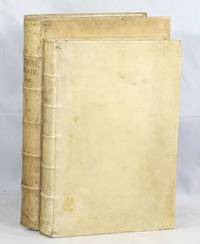
1586000013413Venetiis; Romae: Haeredem Hieronymi Scoti; Iulium Accoltum 1586. Later editions. Hardcover. Very Good. 2 vol. Folio. 12 1-149 foliated leaves; 12 1-269 foliated leaves pp. Later full parchment with manuscript hand on the spines; all edges decoratively stained blue. Later endpapers though volume two retains an original rear endpaper. This is a married set with volume two likely from a larger set of the complete works of St. Thomas Aquinas. Text in Latin. A few woodcut publisher's devices and woodcut initials illustrate this set. Adams 1454. Aertsen "Aquinas' Philosophy in its Historical Setting" Cambridge Companion to Aquinas 16. Encyclopedia Britannica "Peter Lombard: French bishop". Graesse 139. Stanford Encyclopedia of Philosophy "Thomas Aquinas". We could not locate the 1570 volume in Adams or Graesse. It is highly difficult to find all four books of this early work of St. Thomas Aquinas. Composed from 1252 until 1256 these commentaries are dense and systematic. They were written while Aquinas held the position of bachelor of theology and continued into his first term as master of theology. This work constitutes what we would think of today as Aquinas' Ph.D.: thus it is his first major text. The organizational scheme of Aquinas' commentaries on Lombard differs from what Lombard set down in his own work: Aertsen argues that Aquinas' circular notion of reality and existential beings has its origins in Neoplatonism a contrast to St. Augustine's influence on Lombard. Several theologians wrote commentaries on the writings of Peter Lombard but Aquinas' is special because it helped to elevate his reputation in the church and in the academic sphere. Aquinas' perspective on Lombard's theology comes from 100 years later though both men wrote these works in France and it demonstrates his own early theological ideas and notions. Lombard's work discusses topics like God the Trinity divine guidance evil predestination angels demons the Fall of man grace sin the Incarnation of Jesus Christ the redemption of sins virtues the Ten Commandments the sacraments and many other weighty questions of Christian doctrine. The reception of Lombard's work on the sacraments was especially warm. Taken together these commentaries represent the work of two scholars one in conversation with the other. These books are the product of two medieval writers who grappled with ponderous questions and debates that raged in the most powerful institution of medieval Europe. The two title pages in volume one each have repairs to them a previous owner from long ago may have excised library stamps and then mended the leaves. Eight or so other leaves of the set have repairs to a margin or a corner different from the title page mends. Volume two's front hinge gently cracked but holding its title page and next few leaves have minor worming. The set with a few unobtrusive historical ink marks from private owners. Overall the parchment bindings are beautiful and these volumes represent a lovely example of early printing in Europe. Haeredem Hieronymi Scoti; Iulium Accoltum hardcover
1796102Princeton 1796. Very good. 25419pp. Modern calf gilt leather label. Some chipping and wear to a few leaves light scattered foxing. Manuscript volume of eighty-three 18th-century university theology lectures written in Taylor shorthand. Picking up at the start of the semester in January 1796 the book contains lecture notes through late February with lectures numbered 75 to 158. The volume begins with an extensive table of contents written mostly in English followed by over 400 pages of manuscript notes written out primarily in Taylor shorthand. Taylor shorthand was developed in 1786 by Samuel Taylor in Britain and is comprised of nineteen simplified geometric characters. Though principally written out in shorthand the text is interspersed with words in English Latin and Greek. Lecture 94 dated January 22 mentions Dr. Smith and Jersey College potentially linking this volume to Princeton University. Samuel Stanhope Smith was a Presbyterian minister and president of Jersey College later Princeton from 1795 to 1812. Smith taught at Princeton from 1779 onward first as a professor of moral philosophy and later as a professor of theology; he also served on the board of trustees. He was married to Ann Witherspoon daughter of the previous president of the college John Witherspoon and was elected to the presidency upon Witherspoon's death. An unusual and fascinating artifact of 18th-century higher education. unknown books
In-4, ff.128 (mancano il primo e l'ultimo bianchi). Legatura settecentesca in piena pergamena, titolo in oro su tassello granata. Tagli spruzzati. Circa un terzo del volume è interessato da una gora d'acqua nel margine interno, l'ultimo quaderno anche all'esterno e gli ultimi 5 fogli hanno un'integrazione cartacea all'angolo superiore senza perdita di testo. Per il resto, esemplare su carta forte, bella e nitida impressione, ampi margini. Voluta e curata dal vigevanese Giovanni Andrea Bussi, si tratta della prima edizione dei sermoni di Papa Leone Magno. Johannes Andrea fu accolito del papa Niccolò V, vescovo della Diocesi di Accia e di Aleria in Corsica, bibliotecario della Biblioteca Vaticana e segretario pontificio. Raccolse ed emendò numerosi codici e, dal 1468, curò le editiones principes di molti autori latini per i tipografi romani. Con lui la prefazione si ampliò da semplice lettera personale al patrono, diventando una lezione pubblica o anche un'omelia. Al contropiatto ex-libris della famiglia Dionisi, tra le più antiche della nobiltà di Verona: il marchese Gabriele (1719-1808) fu l'artefice della ristrutturazione della villa a Ca' del lago di Cerea nonché del riordino e aggiornamento della biblioteca. I Dionisi avevano destinato al piano nobile la funzione di libreria e sala di lettura, precoce esempio di centro culturale dove si riunivano artisti e letterati. Dopo la dispersione delle migliaia di volumi del fondo antico, conserva ora i libri sul mobile d'arte contemporaneo della Fondazione Aldo Morelato.. Goff L134; HC 10012*; Pell Ms 7127 (7070); CIBN L-115; Aquilon 442; Neveu 390; Maignien(Grenoble) 361; Polain(B) 4518; IGI 5725; IBE 3475; IBP 3394; Sajó-Soltész 2047; IBPort 1076; SI 2397; Sallander 2294; Martín Abad L-26; Walsh 1796; Oates 1800;Sheppard 3653; Pr 4496; BMC V 281.
167893607BBFrankfurt/Main:, Christian Kirchner, 1678. Gr.-8°. Gr.-8°. 64 Bll. 1211 S. 1 gestochenes Bildnis-Frontispiz. zahlreiche Holzstich--Miniaturen im Text. Je 1 Titelblatt-Stempel. Schmuckbänder-und Vignetten-Stempel. Pergament auf 5 Bünden. Rückentitel in alter Handschrift. Kleiner Nummernkleber oberhalb Kapital unten. Titelblatt rot/schwarzer Druck. Umlaufender Farbschnitt. (altersmässig gebräunt; teils stockfleckig; Titelblatt kleine Ecke unten rechts sauber abgeschnitten; einige von altersher saubere Unterstreichungen im Text; S. 29-38 alte Wasserflecken; Scharnier hinten innen minim gelöst; Rückenkleber mit Fehlstelle; Ei
[Incunabolo-raro -diritto] (cm.14,6) Solida mz. pergamena fine XIX sec. Doppio tassello al dorso, titolo in oro. -cc.201 (di 202) manca l'ultima bianca. Caratteri gotici, 33 linee, spazi per lettere capitali con letterina guida. le prime 185 cc. a numerazione romana. Edizione rarissima della quale si registrano 3 copie in America e secondo I.G.I. 6 copie in Italia. Sander "prices" 1930, una sola vendita. Manca ad Harvard e Oates "in Cambridge"; nonchè al Baudrier "Bibliographie Lyonnaise". Non abbiamo traovato nessuna vendita in molti celebri cataloghi di Maggs, Quaritch, Baer, Rosenthal, Olschky, e Harper. Opera celebre apparsa intorno al 1480 che ebbe varie ristampe fino alla edizione Aldina del 1586; l'autore Domenicano, morì nel 1334. Ottima vecchia integrazione all'angolo bianco di una decina di carte, esemplare molto bello, nitido, fresco e con buoni margini. Assolutamente completo, privo solo dell'ultima carta bianca, e raro come tutti gli incunaboli di piccole dimensioni. * Hain 1796; * I.G.I 858; * Gw 2504;* Goff A 1058; *BMC VIII 330 * Proctor 8677; * Pellechet 1272; * Polain 313.[f47] Libro
20155126DBohne Ortsangabe, Oris Mediaevalis, Editoria Internacional de Facsimiles. 2015. 8° (130 x 95 mm). 150 Blatt. Alles Seiten mit Miniaturen von Jean Colombe. Roter Lederband mit reicher Goldverzierung in Acryl-Box.
3575CB[Augsburg, Klauber/ Göz, o.J.]. 163 Bll. Ld. der Zeit auf vier Bünden., Beispielabbildung
1712045850Johann Jacob und Heinrich Bodmer, 1712. 1711-1712, 2°, blindgeprägter Schweinsledereinbd. d. Zeit auf abgefasten Holzdeckeln m. Messingschließen (eine fehlt) u. Messingbeschlägen, 28 Bl., 566, 218, 187, 248 S. m. Kupfertitel u. Zwischentiteln. - Rücken bestoßen, der vordere Einbanddeckel mit kleinerem Lederverlust, Vorsatzblatt mit Einträgen, Titelblatt etwas braunfleckig u. gelockert, sonst innen sauber u. gut erhaltenes Exemplar
155530476DBBasel, Henripetri, 1555. Folio. 48 n.n. Bl., 1499 (recte 1503) S., 1 S. Druckermarke. Schweinslederband der Zeit über Holzdeckeln mit handschriftlichem Rückentitel und Rollstempelverzierung. + Wichtig: Für unsere Kunden in der EU erfolgt der Versand alle 14 Tage verzollt ab Deutschland / Postbank-Konto in Deutschland vorhanden +, 30476D
164419391ABVenice, Ivntas, 1644. 42 : 28 cm. 451 láminas con viñeta grabada en el titulo, notas de musica y muchas letras initiales en rojo. Piel de cerdo, dorado en frio sobre tapas de madera sobre 5 nervios, 2 cierres, cantos en rojo.
164418435ABVenice, Ivntas, 1644. 42 : 28 cm. 451 paginas con titulo grabado y viñeta y notas de musica y muchas initiales en rojo. Plancha de madera con piel de cerdo impresso, 2 cierres, cantos en rojo.
164417864ABVenice, Ivntas, 1644. 42 : 28 cm. 451 pages with engraved title-vignette and music-notes and many iniitials in red. Blindtooled pig-skin over wooden bords on 5 raised bands, 2 clips, edges in red.
16981943-14Lvov (Lemberg), Oct. 1698. gr.-4°. ill. Tit., 844 nn. S. Mit 2 ganszeit. Holzschn. u. 14 Textholzschn. Ldr. d. Zt. m. Blindpräg. auf beiden Deckeln. Rü. restaur. Titelbl. in Faksim. Die letzten 3 Bll. eckverstärkt. [4 Warenabbildungen]
49416[Kutná Hora (Kuttenberg), Martin of Tischniowa, 14 Nov. 1489?]. Small folio (268 x 191 mm). 2 pp. Double column, 50 lines. With a hand-coloured woodcut showing Saul and his son Jonathan losing their lives in battle with the Philistines at Mount Gilboa, and King David receiving note of this. One red Lombardic initial, a larger illuminated initial in blue, green, and shades of pink, and initials in the text picked out in yellow.
Royal folio (315 x 450 mm). (4), 176 pp. With engraved title-page, engraved title vignette, 18 engraved vignettes in the text, 3 engraved borders, 15 full-page text engravings, and numerous engraved initials. Contemporary auburn morocco with green label to richly gilt spine; covers elaborately gilt with bishop's giltstamped armorial supralibros. All edges gilt; leading edges gilt. Coloured endpapers. Splendid missal bound for the personal use of an unidentified bishop. His arms in the supralibros have been superimposed with a different crest by a later owner (removed from back cover). - Text and notes printedin red and black throughout; the engraved plates depict scenes from the life of Christ, mostly signed by Carlo Grandi (cf. Thieme/B. XIV, 506). - Appealing binding, slightly rubbed and chafed; some browning and fingerstaining to interior. Not in Weale/Bohatta.
178410317Rom, A. P. Salvioni, 1784. (4), 176 SS. Mit gest., illustriertem Titel, gest. Titelvignette, 18 gest. Vignetten im Text, 3 gest. Bordüren, 15 ganzseitigen Textkupfern und zahlreichen gest. Initialen. Zeitgenöss. rotbrauner Maroquinband mit grünem Rückenschildchen und reicher Vergoldung. Decken mit breitem Rahmen von zwei unterschiedlichen floralen Rankenwerksrollen, durch Fileten bzw. Wellenbänder voneinander getrennt. Die innere Rahmung in den Ecken und mittig durch Einzelstempel (Maske) verbunden. Goldgeprägtes Supralibros mit viergeteiltem Wappenschild auf Doppeladler unter geistlichem Hut mit je 10 Quasten. Rücken in sechs Felder geteilt, diese alternierend mit Rauten- und Stäbchenvergoldung gefüllt. Dreiseitiger Goldschnitt, Stehkantenvergoldung, Buntpapiervorsätze und Blattweiser sowie vier verschiedenfärbige, seidene Lesebänder an Brokatquaste mit eingesticktem Monogramm "IHS". Imp.-Folio (315:450 mm).
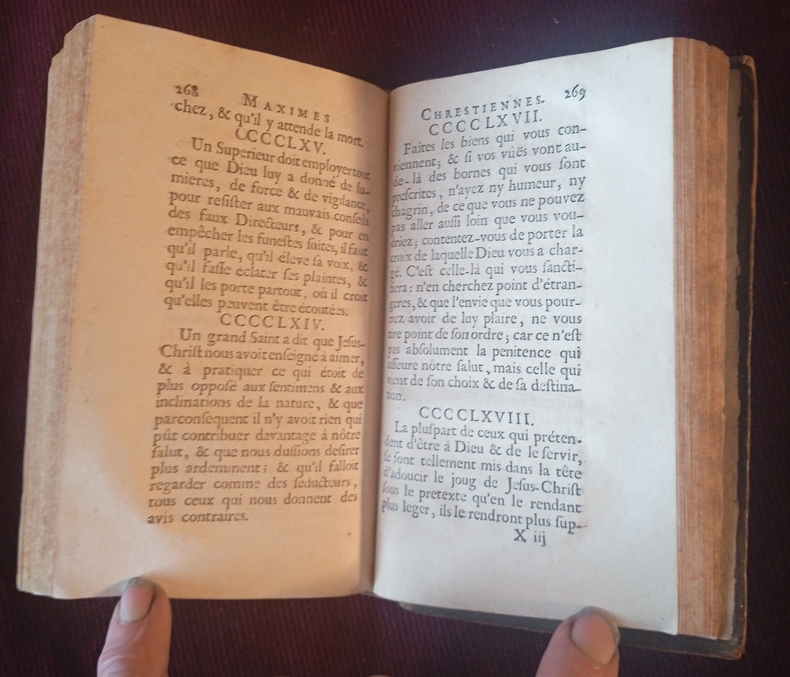
1698LR19-HN7Rare exemplaire de l'édition originale, 2 volumes, in 12, veau fauve d'époque, 5 nerfs, dos orné, approbation et privilège, 384 p. et 375 p. + table, beaux exemplaires, coiffe de tête du premier volume coupée, celle de pied du second frottée, manques de cuir sur 3 coins. Bien que réalisées à l'époque, les reliures sont légèrement différentes par leurs ornements, celle du tome 1 à une armoirie d'alliance sous couronnes ducales à ce qu'il me semble, celle de gauche portant une fleur de lys, celle de droite illisible). Je reprend le descriptif collé à l'intérieur du premier plat du T. 1 provenant du catalogue d'un vendeur de la fin du dix-neuvième siècle ou du début du vingtième : Première édition de ce recueil de plus de treize cent maximes de l'illustre Armand-Jean du Rancé le réformateur de la Trappe. On y trouve l'"Approbation de Monseigneur Jacques Bénigne, évêque de Meaux, conseiller d'Etat ordinaire et devant précepteur de Monseigneur le Dauphin", donnée à Meaux, en son palais épiscopal le 28 septembre 1697. Ouvrage très rare, qui n'est pas mentionné par les biographes malgré la célébrité de son auteur. (N'auraient-ils pas reconnu dans le "R.P. Dom Armand-Jean" l'illustre Rancé ?). Il semble que Chateaubriand, lui aussi, ait ignoré cet ouvrage, car il ne le mentionne pas dans sa Vie de Rancé.
168029568Leiden, Joannes Lindanus, 1680. (12), 223, (5) SS. Mit Holzschnittdruckermarke am Titel. Lederband der Zeit mit goldgepr. Rückenschildchen und hübscher, etwas beriebener Rückenvergoldung. Stehkantenvergoldung, Marmorvorsätze. 8vo.
In-8, broché, couverture imprimée, (4), 647 p., et 36 de catalogue éditeur (Alcan), carte pliée hors texte. Édition originale de cet ouvrage fondateur, illustré d'une carte pliée hors texte. "A partir d'une analyse du totémisme australien, défini comme une forme élémentaire de la vie religieuse, Durkheim entreprend une étude pionnière de la religion et met à jour les aspects symboliques de l'intégration sociale par la religion" (J.-P. Willaime). Précieux exemplaire comportant un envoi autographe signé d'Emile Durkheim à François Simiand: "A F. Simiand, Affectueux souvenirs". Sociologue, historien et économiste, François Simiand (1873-1935) est considéré, avec Durkheim, comme l'un des fondateurs de l'école sociologique française. Simiand s'engagea très tôt auprès d’Émile Durkheim et participa à ses combats pour la promotion de la sociologie comme discipline autonome et en faveur de son intégration dans l’université. "Maître d'oeuvre de la sociologie économique dans l'école durkheimienne", François Simiand appliqua à l’étude des phénomènes économiques les principes d’analyse des faits sociaux énoncés par Durkheim. La descendance dans les sciences humaines en fut immense. Papier légèrement bruni. Bon exemplaire.
22353o.J. Gest. Frontisp., Titel in Rot-Schwarz-Druck, 4 n.n. Bll., 456 SS., 16 n.n. Bll. Register; 4 n.n. Bll, 416 SS., 18 n.n. Bll., Reg.; 4 n.n. Bll., 635 SS., 25 Bll. Reg. 4°. - 22:16,5 cm. Schlichter brauner Halblederband des 19. Jhdts. Einband etwas berieben und bestoßen.
176853691Leipzig, (Loeper for) Hilscher, 1768. 8vo. XVI, 64 pp. Later plain paper wrappers with handwritten cover-title.
8vo. XVI, 64 pp. Later plain paper wrappers with handwritten cover-title. First edition. - Early Western edition of a part of the Quran, comprising the first and 79 verses of the second surah (Al-Fatihah and Al-Baqarah) in Latin and Arabic, edited and translated by the German theologian and orientalist Froriep (1745-1800). A planned sequel to this work, promised by Froriep "provided this specimen is met with approval" (cf. Ernesti), was never realized. - The Arabic text is taken from the well-received Maracci edition. The text is followed by historical and philological observations on the same, drawing on Ludovico Maracci, George Sale, Adriaan Reland and others, as well as explanations of several passages of the Old Testament. - Light edge wear to wrappers; interior somewhat browned and brownstained. Contemporary ownership stamp to verso of title-page, another stamp reading "Card Catalogued" to title-page. A good copy of this rare work never seen at auction. Schnurrer 383. Ernesti, Neue theologische Bibliothek IX, 471ff. Binark/Eren. World bib., 1047. BM Arabic I, col. 902. OCLC 165614847.