114 507 résultats
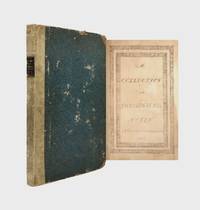
XXII, (2), 119, (1) SS. Interimsbroschur der Zeit. 8vo. Seltene erste Ausgabe des an Schellings Naturphilosophie anknüpfenden Werks; nur vier Exemplare weitweit über OCLC nachweisbar (BSB München; Schweizerische Nationalbibliothek Bern; Zentralbibliothek Luzern; Univ. of Southern California). Am inneren Broschurdeckel eigenh. Widmung des Autors: "Seinem geschätzten Freunde / Hrn. Prof. v. Haska / der Verfasser". Beim Widmungsempfänger dürfte es sich um Lorenz Leopold Haschka (auch: Haska, 1749-1827) handeln: Der ehemalige Jesuit war Kustos der Universitätsbibliothek, Professor der Ästhetik am Theresianum und Dichter der österreichischen Kaiserhymne "Gott! erhalte Franz, den Kaiser". - "[A] document belonging to the idealist programme of a philosophy of nature, another discourse emphatically committed to the unity and systematicity of nature. Here, too, we may locate the scientific programme of Romanticism" (The Oxford Handbook of European Romanticism, ed. by P. Hamilton, p. 687). Der Philosoph, Mediziner, Pädagoge und freisinnige Politiker Troxler (er gilt als Begründer des Zweikammernsystems in der Schweizer Bundesverfassung) praktizierte als Arzt zeitweise in Wien, wo er Haschka kennengelernt haben dürfte. Als Philosoph "folgte er zunächst Schelling, ab 1834 dann Jacobi. Allmählich schlug er eine mystische Richtung ein [...] Troxler sah die Philosophie als 'objektivierte Anthropologie' - er bezeichnete dies in Anlehnung an seinen Begriff 'Biosophie' auch als 'Anthroposophie', welche er als Erkenntnis der menschlichen Natur betrachtete" (Wikipedia). - Durchgehend gebräunt bzw. wasserrandig; die Ränder etwas lappig. Unbeschnittenes Exemplar. Seit 1950 kein Exemplar im Handel nachweisbar. ADB XXXVIII, 667. OCLC 80138005. Vgl. Goedeke VI, 270, 20, 3 ("Leipzig 1808").
1561181853Wittenberg, Hans Krafft für Conrad Rühel, 1561. Erste niederdeutsche Ausgabe der ersten evangelischen Dogmatik. Mit Holzschnitt-Druckermarke (C.Rühel) am Schluß. Zeitgenössischer Schweinslederband über Holzdeckeln mit reicher Blind- und Rollenprägung (Kreuzigung, Taufe, Verkündung, Auferstehung).
172658639BBBerleburg, (s.n.)., 1726-1742. 4°. Gestochenes Frontispiz, 6 n.n. Bl., 804S., 4 n.n. Bl., 880 S.; 4 n.n. Bl., 784 S., 3 n.n. Bl., 858 S.; 4 n.n. Bl., 820 S., 4 n.n. Bl., 792 S.; 4n.n. Bl.,600 S., 2 n.n. Bl., 556 S., 44 n.n. S. Register. Blind- und goldgeprägte Lederbände um 1880 mit roten goldgeprägten Rückenschildern und schwarzgeprägter Rückenfiletierung. Deckel mit goldgeprägtem Kreuzmedaillon. 8 Teile in 4 Bänden. [6 Warenabbildungen]
1950202006Basel, Steinkopf, 1857-1950. Bis Jg. 50 m. zahlr. Abb. Meist OLwdbde. m. Rtit., einige Hlwdbde., wenige Hefte. Meist Rücken verblichen. Selten Bibliotheksex. m. Rsign. u. St. od. Sign. a. Tit. od. and. S. Teilw. Papier leicht gebräunt od. gelbfleckig, einige wenige m. Anstreich. od. leicht angeschmutzt, meist aber Buchbl. tadellos. Es fehlt: Jg. 77 H. 8.
15503197-11Gedruckt zu Wittemberg, Durch Hans Lufft 1550. 2°. 360 (v. 382) Bll. Mit ill. Titeleinfassung in Holzsch., Initialen u. 62 gr. Textholzschn. Springende Pagina. HLdr. d. Zt. Restauriert. Rückensch. u. Bezugspapier erneuert. Bll. 271-293 fehlen. Mehre kl. Randläsuren restaur. Letzte Bll., tlw. mit größerem Textverl. angerandet bzw. sauber ergänzt. [5 Warenabbildungen]
1673373863N.p. England 1673. Manuscript on paper with more than four dozen floral and ornamental head- and tailpieces. Text in an elegant hand within ruled borders 28 lines per page. 2 172 6 pp. Small folio. Eighteenth century vellum backed boards. Bookplate of the Duke of Sussex. Front inner hinge starting some dampstaining at top of leaves throughout the text. Manuscript on paper with more than four dozen floral and ornamental head- and tailpieces. Text in an elegant hand within ruled borders 28 lines per page. 2 172 6 pp. Small folio. From the Library of Augustus Frederick Duke of Sussex 1773-1843 younger son of George III. His brothers were George IV and WIlliam IV<br /> <br /> An unsigned manuscript compendium of devotional prompts and theological texts in a legible and well formed hand including discourses expositions of Bible verses and a more substantial rebuttal of Thomas Tillam's book The Seventh-day Sabbath sought out and celebrated 1657.<br /> <br /> The manuscript is adorned with finely executed drawings of stylized flowers and architectural classical or heraldic ornaments. The headpiece of the rebuttal of the Seventh-day Sabbath is a nest of snakes.<br /> <br /> AN ATTRACTIVE MANUSCRIPT WITH DISTINGUISHED PROVENANCE. Provenance: from the Library of Augustus Frederick Duke of Sussex 1773-1843 bookplate; General Theological Seminary unknown
49240aafColoniae Agrippinae (= Köln), sumptibus Viduae Wilh. Metternich & filii, 1731, gr. in-folio, 6 Bl. + 757 S. / 2 Bl. + 751 S. / 2 Bl. + 266 S., mit je 1 wh. Titelblattvignette, Titelblatt von Bd. 1 in rot und schwarz, am Schluss des ersten Bandes etwas tintenfleckig am Rande, Stempel und Besitzvermerk a.T. und V., Prgt., stellenweise leicht fleckig, Bd. 1 zu Beginn oben mit kleinen Wurmspuren ohne Textverlust. - Im Ganzen gut erhaltenes Exemplar.
198016570ABLuzern, Faksimile-Verlag, 1980. Fol. o. Pag. [341 + 4 Bll.]. OLd. mit zwei Lederbändern und Metallapplikationen., Abbildung
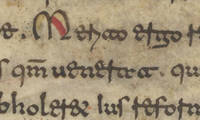
235221075. <p><strong>This document survives in part because it was later used as a binding from another book; a handful of other segments of this manuscript appear in book bindings now at the National Library of Naples</strong></p><p><strong>""Rightly then is the soul restored thither since He has come who will undo the treacherous knot and reestablish righteousness.""</strong></p><p>The 1000s AD was a period of great tumult and transformation in Europe. In England the Norman Invasion took place resulting in the crowning of William the Conqueror. Around this time the Papal States led by the Pope created an alliance with the Normans and acquired from the Byzantines the Duchy of Beneveto around and south of Rome. This all took place in the late 11th century.</p><p><a href=""https://cdn.raabcollection.com/wp-content/uploads/20231204153804/Beneventan-1B-wide.jpg""><img class=""alignnone size-post-window wp-image-23523"" src=""https://cdn.raabcollection.com/wp-content/uploads/20231204153804/Beneventan-1B-wide-1600x433.jpg"" alt="""" width=""1600"" height=""433"" /></a></p><p>In Benevento in the 8th century great monks and scholars were doing fascinating work. A particular kind of handwriting had emerged which we now refer to as Beneventan script. It was the result of work by monks in a handful of monasteries in the region most notably that of Monte Casino. It is beautiful sometimes inscrutable and unique in form.</p><p>Ambrose of Milan later Saint Ambrose was Bishop of Milan in the 4th century. He was a fierce promoter of the church and left a substantial collection of writings and sermons with his views on Christianity set against a backdrop that included paganism.</p><p>Leo the Great was a Roman aristocrat and was the first pope to have been called ""the Great"". He is perhaps best known for having met Attila the Hun in 452 and persuaded him to turn back from his invasion of Italy.</p><p><strong>Two 11th century Southern Italian medieval manuscripts</strong> Beneventan scrit likely from near Naples consisting of explanations of the gospels homilies originally written by Ambrose of Milan and Pope Leo the Great.</p><p> </p><p>These documents were handled by the Quaritch firm in 1990 and Sothebys in 1994. Other fragments of the same parent manuscript can be found in the bindings of Naples Biblioteca Nazionale.</p><p><strong>More details</strong></p><p>From a Homiliary with parts of Ambrose of Milan Expositio Evangelii Secundum Lucam and Leo the Great Tractatus 76 in Beneventan minuscule decorated manuscript in Latin on parchment Italy perhaps Naples late eleventh century. Two cuttings from a single parent manuscript with some Bari-type features capitals touched in red and iridescent yellow wash the second cutting with remnants of a large initial 'P' in red with leaf flourishing. Size: 100 by 170mm. and 85 by 130mm.</p> unknown
198031478ABLuzern, Faksimile Vlg., 1980. (Kommentar 1983). Folio. Graduale: 2° (50 x 35 cm), 314 farb. Bl. m. 71 tlw. m. Blattgold geschmückten Miniaturen, 13 ornamentale Initialen; - Kommentarband: 4°, IX, 347 S., 85 Textabb. Graduale: OLdr. auf 3 echten Bünden m. 2 Leder- Schliessen, Eisenbeschlägen u Mittelrosette; Kommentarbd in OHLdr. - In der Original-Holzkiste. Schönes Exemplar.
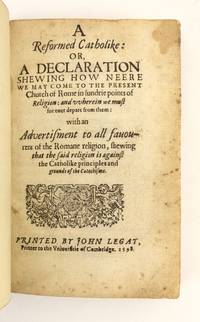
1598ST16441Cambridge: John Legat 1598. Second Printing. 153 x 98 mm. 6 x 3 7/8". 4 p.l. 375 1 pp. <br/> Modern sprinkled calf blind-ruled covers raised bands flanked by double gilt rules brown morocco label remnants of paper library shelf label at tail of spine. Printer's device on title page. Front pastedown with bookplate of the Fox Pointe Collection; rear pastedown with deaccession stamp of Bradford City Libraries. STC 19736; ESTC 19736. ◆Spine just faintly sunned leaves lightly browned due to paper quality and trimmed a bit close at head grazing headline on a couple of leaves isolated marginal stains or tiny rust spots but an excellent copy fresh and clean in a sympathetic binding with few signs of wear.<br/> <br/> This was an important work in establishing distinctions in liturgy and doctrine between the Catholic Church and the Church of England written by a moderate puritan whom DNB considers "perhaps the most significant English theologian of his age." Perkins 1558-1602 was one of the most popular voices of his time speaking from a Calvinist puritan point of view; while he could be virulently anti-Catholic he did not believe in repudiating the English church only in reforming it. According to DNB "The genius of Perkins's work did not lie in its originality—his theology represents a conventional recital of Calvinist scholasticism in virtually every respect. His gift lay rather in bringing to a broad audience a variety of theological and moral issues popularizing essentially technical discussions and therefore as Fuller observed humbling 'the towering speculations of philosophers into practice and morality.'" The present work spread his polemical influence beyond England to the Continent; even the Catholic bishop William Bishop admitted he had "not seene any book of like quality published by a Protestant to contain either more matter or delivered in better method." Both the 1597 first edition and our 1598 second printing are rare: no other copies of either edition are recorded at auction by RBH or ABPC in the past 50 years. John Legat unknown
15424110DBGetruckt zuo Zürych, bey Christoffel Froschouer, im Jar 1542. 2°. (33) Bl., DLXVIII, (1) Bl. (unbedruckt). Geprägter Lederband über Holzdeckeln mit 5 Bünden.
155556525Naples, (Tomasso Riccione), 1555. Folio (210 x 305 mm). XII ff. With several woodcut initials. Later red half calf over marbled boards with giltstamped spine-title.
Folio (210 x 305 mm). XII ff. With several woodcut initials. Later red half calf over marbled boards with giltstamped spine-title. First and only edition of this exceedingly rare commentary on Aristotle and Averroes, prepared by the Neapolitan philosopher Giovanni Gomezio Pagano (ca. 1500-69), a leading Franciscan theologian active in the San Lorenzo convent in Naples. His work constitutes a remarkable philosophical treatise defending Aristotelianism against the Neoplatonist tendencies of early Greek and Muslim thinkers including Al-Farabi, Ibn Sina (Avicenna), and Themistius, as well as Christian philosophers such as Alexander of Aphrodisias. - Covers somewhat warped; very slightly rubbed. Title-page lightly brownstained. A fine copy of this notable work rarely offered in the trade. OCLC lists a single record (in the Italian National Library). Edit 16, CNCE 38268. OCLC 954806038. Manzi, La tipografia napoletana nel '500. Not in BM-STC Italian or Adams. For Pagano cf. Istoria degli scrittori nati nel Regno di Napoli V, 50-51.
170448975Vienna, Johann Jacob Kürner, 1704. 12mo. (20), 240 pp. With engraved frontispiece and 7 engraved plates. Contemporary blindstamped calf with ties; IHS and MARIA monograms to covers.
12mo. (20), 240 pp. With engraved frontispiece and 7 engraved plates. Contemporary blindstamped calf with ties; IHS and MARIA monograms to covers. Second edition of this extremely rare and curious emblem book, with the text couched in the form of seven dialogues between a "vir politicus" and "theologicus", generally attributed to the Hungarian Jesuit János Rajcsanyi. The dialogues concern (1) the existence of God; (2) divine providence; (3) fate; (4) predestination and divine prescience; (5) the immortality of the soul; (6) on Gehenna; and (7) the resurrection of the dead. Along with a frontispiece, each dialogue is preceded by an emblematic engraving by the Viennese artist (Franz) Ambros Dietel (d. 1737?) which constitute extraordinary, and frequently visionary, pictorial representations of the substance of each of the dialogues. The frontispiece is signed "A. Dietel sc. Vi.", others "Dietell" or "D. sc.". The plates depart from the usual format of the emblem book in that there is no motto, but the symbolic content of the images, each with an accompanying Biblical verse, places it squarely in the tradition. - Although Sommervogel cites no other edition and gives Raicsani's dates as 1670-1733, his text was first published in Vienna in 1676 with six very similar plates which clearly were the model on which Dietel based his engravings. An undated edition which may precede the present one was printed in Passau by Maria Margarete Höller, and reprints appear as late as 1757. All editions are rare: no copy of any edition in U.S. libraries, and only two copies anywhere (Bavaria State Library and Austrian National Library) of this 1704 edition. - Paper lightly browned; a few tiny wormholes to spine. 19th century bookplate of Anton Kurz on pastedown; handwritten and stamped 1979 ownership of the Viennese collector Werner Habel (1939-2015) to the flyleaf. De Backer/Sommervogel VI, 1402f., 1. Cf. VD 17, 12:110764V (1676 ed.).
149958484Tübingen, [Johann Otmar für Friedrich Meynberger, 1499]. 8°. Titel in Rotdruck. Mit 2 (wiederh.) Holzschn.-Initialen. 78 nn. Bll. (Got. Typ., 37 Zeilen), Mod. Ppbd. m. goldgepr. Rückenschild.
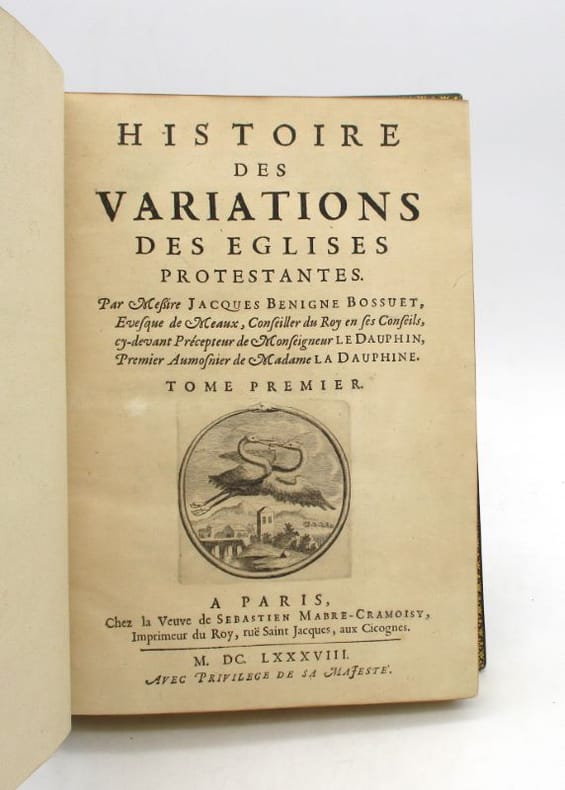
22064Paris, Veuve de Sébastien Mabre-Cramoisy, 1688. 2 vol. in-4, [40]-506-[33] pp. + [8]-680-[42] pp., maroquin janséniste brun d'Allô, dos à nerfs, importante bordure intérieure ornée de dentelle dorée, tranches dorées (dos légèrement éclaircis, quelques minuscules épidermures).
1512952693Paris: Henricus Stephanus [Estienne]. 13. August 1512. Oktav, 19,8 cm. (Einband etwas berieben, durchgehende Wurmspur im unteren weißen Rand ohne Textverlust, hinten stärker, erstes Blatt und Bindung gelockert, kleine Fehlstellen ohne Textverlust im Bug der ersten beiden Blätter, Feuchtigkeitsspuren und Überreste von Schimmel) [7 Warenabbildungen] 30 Blatt; Lagenzählung: A 8, B 4, C 8, D 4, E 6. Neuere schmucklose Broschur,
In 4, pp. (2) + 252 + (2). Indicazioni di stampa al colophon. Fresco esemplare in bel carattere tondo. Piccola mancanza restaurata a p. 3 con perdita do poche lettere al verso. Piena pergamena settecentesca. Rarissima edizione originale di questo particolare catechismo redatto in gran parte dal Marini su ordine del cardinale Gonzaga di cui era stato nominato suffraganeo per la diocesi di Mantova. La disposizione degli argomenti dell'opera (Decalogo, Simbolo, Padre Nostro) richiama assai da vicino la celebre triade (gerbot - glauben - gebet) seguita da Martin Lutero nei due catechismi di Wittemberg del 1529 che il M. conosceva. Tale struttura e la mancanza di una parte specificatamente dedicata ai sacramenti, differenzia il Catecismo da altre opere coeve simili. Sebbene possa ascriversi al M. la stesura di gran parte del testo(il decalogo, il simbolo e il discorso sopra l'orazione) non gli fu possibile redigere la parte dedicata al Padre Nostro. Nuovi incarichi obbligarono il M. a partire dalla diocesi e a lasciare il Catecismo che, completato da Bartolomeo Ghisellino, fu pubblicato nel 1555 a mantova dal Ruffinelli. M. era stato nominato Nunzio apostolico a madrid da Giulio III... (Marco Maiorino in Diz. Biogr. degli Italiani, vol. 70). Marini era nto sull'isola di Chio, nell'Egeo da famiglia genovese, Domenica, fu abile predicatore e diplomatico, ebbe, infatti, la nunziatura apostolica a madrid. Rezzagi, Il 'catecismo' di Leonardo Marini nel contsto della riforma pastorale del Card. Ercole Gonzaga. Solo 2 ess. in ICCU.
Paris, Bertholdus Rembolt, 1517 y 1518. [al fin:] Parrhisiis impressi per Magistrum Bertholdum Rembolt, anno domini millesimo quingentesimo xvii, [y] per Magistrum Bertholdum Rembolt Anno domini millesimo quingentesimo xviii. Seis tomos en un volúmen en 4to.; 4 hs., LIIII folios ( mal numerados: en realidad, XCIV). + CXXXIIII folios, 2 hojas, incluída portada orlada, impresa a dos tintas, con la marca del impresor + LXXVI folios, 2 hojas, incluída portada orlada, impresa a dos tintas, con la marca del impresor, + LII folios, 10 hojas, incluída portada orlada, impresa a dos tintas, con la marca del impresor, + XCVI folios, 4 hojas, incluida portada orlada, impresa a dos tintas, con marca del impresor, con un grabado en el reverso que muestra la Crucifixión y otro de San Francisco de Asís recibiendo los estigmas en el vuelto de la cuarta hoja + LVII folios numerados y siete más sin numerar, 4 hojas, incluída portada orlada, impresa a dos tintas, con marca de impresor y con un grabado de San Francisco de Asís recibiendo los estigmas en el reverso. Impresión gótica. Bellísima encuadernación de época, en piel sobre tabla, con gofrados en seco en ambos planos. Los tres tomos restantes contienen: Oratio Octaviani in vitam Beati Bonaventure. Libellus de reductione Artium ad Theologiam. Tractatus de paupertate Christi. Tractatulus de quinque festivitatibus Pueri Iesu. Tractatulus de regimine anime. Epistola ad magistrum innominatum eliminans errorem contra regulam Beati Francisci. Epistola de eo quæ Christus et Apostoli et discipuli eius incesserunt Discalciati. Epistola ad ministros provinciales et custodes de reformandis fratribus sui Ordinis. Viginti passus de informatione spiritualis vite et profectu religiosorum. Sermones de decem preceptis Domini. Apologia Pauperum. Expositio orationes dominice. Laudisimus de cruce Domini. Tractatus de dieta salutis. Contemplatio devota de nativitate Domini. Tractatus de resurrectione hominis a peccato ad gratiam. Liber salutaris Beati Bonaventure Pharettra vocatus.
1856R67192Parisiis, apud Ludovicum Vivès 1856-1878 complete in 28 volumes: 26 volumes + 2 volumes of indices, text in latin, original 1856-1878-edition, Editio nova (second edition, the first of which was printed in 1740-1751 in Venice), 27cm., text printed in 2 columns, all vols. are uniformely bound in hardcover (marbled plates, spine in cloth, with marginal spots), few library stamps, good set [cfr. De Backer & Sommervogel, VII col.1680 no.24, Suarez Franciscus S.J., Grenada 1548 - Lisbon 1617], R67192
complete in 28 volumes: 26 volumes + 2 volumes of indices, text in latin, original 1856-1878-edition, Editio nova (second edition, the first of which was printed in 1740-1751 in Venice), 27cm., text printed in 2 columns, all vols. are uniformely bound in hardcover (marbled plates, spine in cloth, with marginal spots), few library stamps, good set [cfr. De Backer & Sommervogel, VII col.1680 no.24, Suarez Franciscus S.J., Grenada 1548 - Lisbon 1617], R67192
in-folio, ff. (6), CCCXIV, (10). Leg. 700esca mezza pergamena, tass. in pelle con tit. oro al dorso. Titolo racchiuso in magnifica bordura silogr. nello stile di Holbein raffig. vari episodi della vita di S. Atanasio; numerose iniz. silogr. su fondo nero, testo in car. tondo con note marginali in corsivo. Nei ff. preliminari leggesi la lunga "esortazione al pio lettore" di Erasmo da Rotterdam, il quale è autore anche dell'ampia Vita di S. Atanasio che abbraccia gli ultimi 20 ff. Edizione importantissima, una tra le prime, delle opere di Sant'Atanasio, vescovo di Alessandria, Padre e Dottore della Chiesa, vissuto tra il 295 ed il 373 d.C. Tra le principali opere, apologetiche e dogmatiche, citiamo il Trattato contro i Greci, il Trattato sulla Incarnazione del Verbo, l'Apologia contro gli Ariani. Da segnalare l'importanza dei due scritti di Erasmo già citati e la presenza di Angelo Poliziano tra traduttori. Bell'esempl., puro e genuino, con note di mano coeva nel margine dei primi ff., ex-libris manoscritto della "Fundationis Baldauficae" sulla sguardia e suo antico timbro sul titolo (fori di tarlo all'inizio e più sensibili in fine).. STC, German Books, 49. Bibliotheca Erasmiana, II série, p. 11..
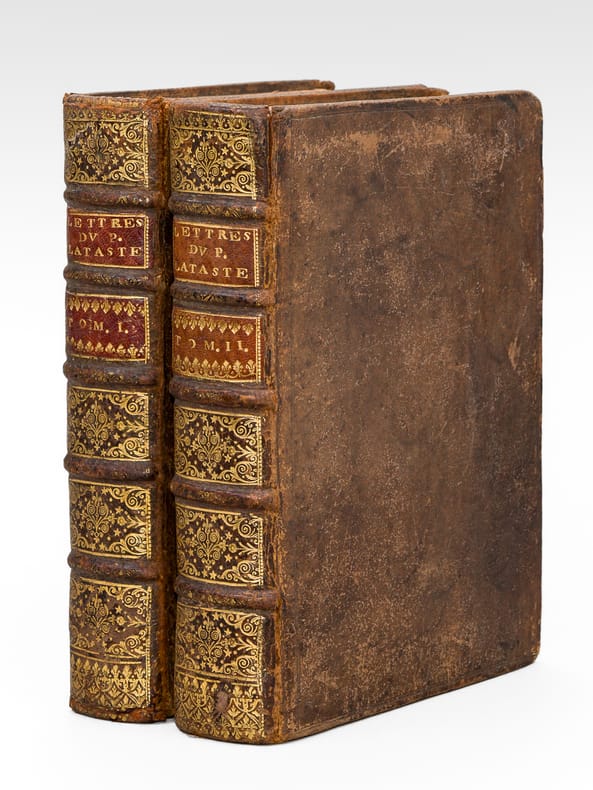
173968147Par le Reverend Pere Dom Louis Lataste, Religieux Benedictin de la Congregation de Saint Maur, Assistant du Très Reverend Pere Superieur General de ladite Congregation,. A present Evêque de Bethleem & Abbé de Moirmont Diocèse de Châlon sur Marne, 2 vol. in-4 reliure de l'époque pleine basane brune, dos à 5 nerfs orné, De l'Imprimerie de Marc Chave, Marchand Libraire, à Avignon, 1739, 1 f., 15-878 pp. ; 1 f., pp. 903-1298 et 1305-1644, 4 ff., 101-18-lxiiij pp.