BERNOULLI Jacob:Livre Rare Book
53 307 résultats
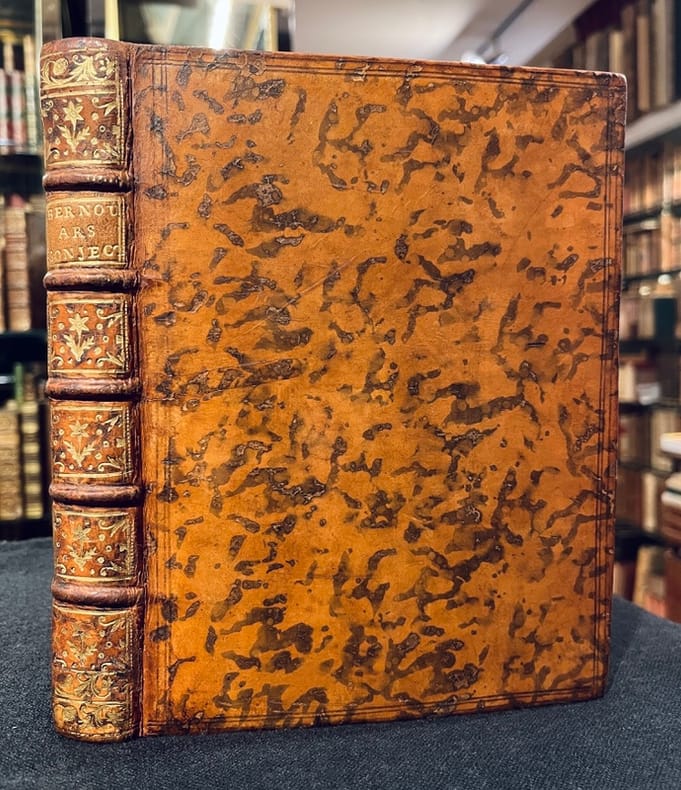
171321804Basilea, Impensis Thurnisiorum Fratum, 1713. Petit in-4 de [4]-306-35-[1] pages, plein veau moucheté brun, dos à nerfs, pièce de titre en maroquin beige, filet doré sur les coupes, tranches rouges.
1812283558Berlin: In der Realschulbuchhandlung 1812. First. hardcover. good. 2 384 lx pages. Short thick 12mo bound in 20th century gray boards with paper spine label. The text block has extensive expert repairs at margins and Japanese tissue overlays to re-enforce the numerous torn and chipped pages; approximately 12 leaves have actual loss of text although some pages are missing lacking the entire 23 page prologue and last 4 pages of text which contain half of tale 84 and all of tales 85-86 and the errata leaf. Some occasional staining and light penciling. Berlin: In der Realschulbuchhandlung 1812. First edition.<br/> <br/> The first volume only others followed in 1815 & 1822 of the first edition of Grimm's Fairy Tales. A flawed copy but extraordinarily scarce nonetheless and containing classics such as Hansel & Gretel Rapunzel Little Red Riding Hood and Snow White.<br/> <br/> In der Realschulbuchhandlung unknown
1812283558Berlin: In der Realschulbuchhandlung 1812. First. hardcover. good. 2 384 lx pages. Short thick 12mo bound in 20th century gray boards with paper spine label. The text block has extensive expert repairs at margins and Japanese tissue overlays to re-enforce the numerous torn and chipped pages; approximately 12 leaves have actual loss of text although some pages are missing lacking the entire 23 page prologue and last 4 pages of text which contain half of tale 84 and all of tales 85-86 and the errata leaf. Some occasional staining and light penciling. Berlin: In der Realschulbuchhandlung 1812. First edition.<br/><br/> The first volume only others followed in 1815 & 1822 of the first edition of Grimm's Fairy Tales. A flawed copy but extraordinarily scarce nonetheless and containing classics such as Hansel & Gretel Rapunzel Little Red Riding Hood and Snow White.<br/><br/> In der Realschulbuchhandlung unknown books
1590ABC_49312Frankfurt 1590. 8vo. Andreas Wechel heirs of Claude de Marne and Johann Aubry Near contemporary overlapping vellum with the manuscript title on the spine remnants of ties red edges. With a woodcut vignette on the title page and the final leaf a woodcut decorated initial and a woodcut head- and tailpiece. 1 1 blank 12 2 blank 565 1 1 blank 1 pp. Rare first edition of the Latin translation of a very influential astronomical work which was in large part responsible for spreading Ptolemaic astronomy in medieval and early modern Europe. Written in the 9th century it was a summary of Ptolemy's Amalgest but circulated in Europe long before the Amalgest itself was first translated into Latin 1496. The work was referenced by numerous medieval authors and it is known that Dante Alighieri also used it for two of his works Vita Nuovo and Convivio. Despite its importance however the present edition is quite scarce as we have only been able to trace one other copy in sales records of the past 100 years.Ahmad ibn Mohammad ibn Kathi¯r al-Farghani also known as Alfraganus in the West ca. 800-ca. 861 was one of the astronomer-astrologers employed by the Abbasid caliph Al-Ma'mun r. 813-833 in Baghdad. He composed several works on astronomy and astronomical equipment that were widely distributed in Arabic and Latin for multiple centuries. The present work however is his best-known and most influential one. It was known in Arabic under various titles including Kita¯b jawa¯mi' 'ilm al-nuju¯m wa usu¯l al-haraka¯t al-sama¯wi¯ya which translates to "Book of generalities of astronomy and bases of celestial motions". It was written between 833 and 857 and is a summary of Ptolemy's Amalgest but with corrected calculations that were based on the most up-to-date information of the time. Like the Amalgest Al-Farghani's work describes the movements of the sun moon and planets their distance to earth solar and lunar eclipses a calculation of the dimensions of the earth descriptions of the different climates on earth and zodiac signs. Al-Farghani also added a chapter with comparisons between different calendar systems. According to the Dictionary of Scientific Biography the work "gives a comprehensive account of Ptolemaic astronomy that is entirely descriptive and nonmathematical. These features together with the admirably clear and well-organized manner of presentation must have been responsible for the popularity this book enjoyed." The work was translated into Latin multiple times including by Johannes Hispalensis John of Seville fl. mid-12th century Gherardo da Cremona ca. 1114-87 and Jacob Golius 1596-1667. It was also translated into Hebrew by Jacob Anatoli 1194-1256. The present Latin translation is by German orientalist and humanist Jacob Christmann 1554-1613 and was based on Anatoli's Hebrew translation. A second edition appeared in 1618. In the appendix Chistmann mentions his difficulties in editing it while lacking suitable Arabic versions. His lament about the difficulty of printing a scientific work that predates his era by more than 700 years is a telling detail that highlights the influence that scientific texts produced in the Islamic world had on early modern Europe.With a crossed out ownership annotation on the recto of the first flyleaf an annotation "f=10=" on the verso of the first flyleaf a calculation in an 18th-century hand on page 25 and another annotation in a different 18th-century hand on pp. 531 and 565 "de el Conde de Storrepalma". The edges and corners of the boards are slightly scuffed and the vellum is slightly stained with an imprint of a label on the spine a green ink scribble and partially rubbed off writing in blue ink on the front board. The work is somewhat browned throughout with a water stain in the outer margin of the first 30 pages slightly affecting the text the head margin has been cut slightly short without affecting the text. Otherwise in good condition.l De la Lande Bibliographie astronomique p. 121; DSB 4 p. 541-545; Houzeau & Lancaster 1115; USTC 676537; VD16 A 1203; Zinner 3368. ABE CAT Astronomy & Cosmography hardcover
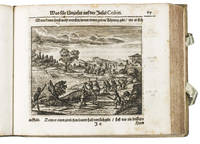
1662ABC_49406Nuremberg: printed by Wolfgang Eberhard Felssecker and sold by Johann Tauber 1662. Contemporary vellum with the manuscript title and author on the spine modern mint green closing ties red sprinkled edges. Oblong 8vo. With an engraved title page of a ship engaged in a sea battle an engraved portrait of the author and 15 engraved plates. Further with woodcut tailpieces woodcut decorated initials 2 gothic and 1 roman series and headpieces built up from typographic ornaments. Set in fraktur type with incidental schwabacher roman and italic. First edition of Johann Saar's extensive account of his travels from 1644 to 1659 in the Dutch East Indies the Moluccas and Ceylon present-day Sri Lanka. This account with beautiful plates depicting various aspects of the East Indies Ceylon and their cultures including rare eye-witness depictions of native elephant hunting is a great source of information for the 17th-century exploration of the East Indies and especially Ceylon. The first edition is quite rare as we have only been able to trace two other copies in sales records of the past hundred years.Johann Jacob Saar 1625-1664 was a German seaman. After working in the service of the Dutch East Indian army in Bantam Batavia and the Moluccas Saar moved to Ceylon in 1647 which he describes most extensively though he also covers Java Batavia the Banda islands etc. He describes Ceylons trees and fruits wild animals including the hunting of crocodiles depicted in 1 plate. He also gives more cultural-anthropological and historical information such as how the natives treat their sick and dead people how the king of Ceylon wanted peace with the Dutch and he comprehensively describes the local practice of elephant hunting which is beautifully illustrated in three plates. These illustrations like the others underline the diversity of the narrative. He and his crew then sailed from Ceylon to the coast of Goa. He describes how the Portuguese tried to capture a silver-fleet from the Japanese but he also describes a sea battle off the coast of Goa between the Dutch and the Portuguese. On their way home Saar visited and described Cape Town too including Table Mountain depicted in one of the plates. The vellum is somewhat soiled with brown stains on the front and back the ties and flyleaves have recently been replaced. The work is somewhat foxed throughout with annotations in some of the margins. Otherwise in good condition.l Cat. NHSM p. 174; Landwehr VOC 308; Tiele 952; USTC 2567770 9 copies; VD 17 23:253491D. printed by Wolfgang Eberhard Felssecker and sold by Johann Tauber, hardcover
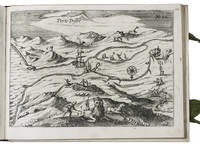
1621B86DJ001U79OAmsterdam 1621. Oblong 4to 17.5 x 23 cm. Johannes Janssonius printed by Izaak Elzevier Modern vellum sewn on 4 vellum tapes with gold double fillets on the boards gold lettering on the spine gilt edges green cloth ties. With 24 of 25 engraved plates with maps plans views and battle-scenes including 5 double-page and 10 larger folding the large map of the Malayan archipelago with an inset-map of the Strait of Boeton 32 x 45.5 cm. 4 172 pp. First and only edition of the French translation of one of the bestsellers of illustrated 17th-century travel literature describing one of the most famous early voyages around the world by Joris van Spilbergen 1568-1620 a veteran Dutch East Indies naval officer-turned-pirate undertaken from 1614 to 1618. A short survey of another of the most important early voyages around the world by Schouten and Le Maire in the years 1615 to 1617 is added at the end pp. 117-172 with drop-title "Navigationes Australes". It reports Le Maire's proof that Tierra del Fuego is an island and his discovery of what is still called the Strait of Le Maire an alternative route to the Pacific. Rich in ethnographic detail the numerous illustrations in the Miroir include oversized penguins llamas and an Andean condor with a nine-foot wing span. Naval battles beleaguered Spanish settlements and newly discovered islands are also depicted in detail making the work a valuable compendium of adventure on the high seas during the Age of Discovery.With several owner's inscriptions. With a few manuscript annotations in the margin. Lacking the world map. Washed with a brush leaving light brown steaks on most leaves and further with an occasional leaf foxed or smudged and an occasional minor tear. Otherwise a good copy of an extraordinary journal.l Borba de Moraes p. 826 "This French edition is much sought after"; Landwehr & V.d. Krogt VOC 362; Sabin 89451; Tiele Bibl. 1030. hardcover
162231298Amsterdam: Chez Michel Colin 1622. Folio. 11 x 7 1/4 inches. 6 103 6 107-254pp. Engraved additional title 17 engraved maps 16 double-sheet 1 folding 5 engraved illustrations in the text of the Le Maire narrative. Without the portrait of Le Maire as usual found in only a small number of copies. Early eighteenth century sheep covers ruled in blind spine with raised bands in seven compartments morocco lettering piece in the second the others with a repeat decoration in gilt marbled pastedowns<br/> <br/>One of the classic descriptions of the Spanish conquests in the New World including the first publication of Jacques Le Maire's journal of one of the greatest early Pacific voyages and circumnavigations: a work of great rarity and importance.<br/> <br/>This edition of Herrera includes the first publication of Jacques Le Maire's journal of one of the greatest early Pacific voyages and circumnavigations that of Le Maire and Schouten in 1615 and 1616. Le Maire's journal which occupies pp. 107-174 of this book describes the voyage of trade and discovery launched by one of the most aggressive of Netherlands traders in this era of Dutch expansion. The expedition sailed around Cape Horn explored the Pacific coast of South America and pursued the search for Terra Australis. Inspired in part by Quiros and motivated by Dutch trading zeal this was the essential precursor to Tasman's voyage; indeed Tasman made great use of Le Maire's mapping of the ocean. The Le Maire voyage the last of the seventeenth century expeditions to search for the unknown continent from the east was responsible for extensive discoveries in the Pacific recorded in excellent detail on the numerous maps published here. These include maps of Le Maire's Pacific route and of New Guinea the latter definitely establishing it to be an island. There are also five engraved views showing the expedition in Patagonia a Polynesian sailing canoe the anchorage at Cocos Island natives at Cocos and the isle of Hoorn. The first section of this work is the first French and second edition overall of a portion of Antonio de Herrera's Historia General first published in Madrid in 1601. This is one of the classic descriptions of the Spanish conquests in the New World with important maps of the West Indies the Americas the coasts of Central and South America the interior of Mexico Terra Firme and the west coast of South America including some of the most important maps relating to the Pacific made to the time. The third section of this volume consists of brief accounts of other voyages into the Pacific and the account of Pedro de Cevallos of the Spanish possessions in the New World. Two issues of this French translation were printed in Amsterdam in 1622. This copy has the first imprint recorded by Wagner. There were also Latin and Dutch editions in the same year differing slightly in their makeup; Wagner assigns priority to this French edition. A work of great rarity and importance.<br/> <br/>Borba de Moraes p.400; European Americana 622/68; JCB 3II:166; Sabin 31543; Tiele pp. 56-57 314-316; Tiele-Muller 296; Wagner Spanish Southwest 12a. Chez Michel Colin unknown books
1669B6290London: Printed by John Macock for the Author Ogilby. c.1669. A fine attractive and handsome copy with text and plates clean and crisp. Edition: First or 1669 Edition in English. Binding: Contemporary mottled full calf rebacked expertly saving the original spine spine with seven raised gilt bands; compartments densely gilt ornamentated; with gilt lettered title on brown morocco label on two and three. Blind dentelle pattern tooled on edges of covers; pasted and free endpapers marbled. <br><br><br> Notes: John or Johann Nieuhof 1618 – 1672 is best known for the account of his journey from "Guangzhou"Canton to Peking in 1655-1657 which enabled him to become an authoritative Western writer on China. The book was first published in Dutch in 1665 by Johan's brother Hendrik and the Amsterdam based publisher and printer Jacob van Meurs. The publication was successful several edited editions followed geared towards commercial interests also translated into French German Latin and eventually into English. The English version was not published by Van Meurs but by John Ogilby instead. The book consists of the notes and illustrations that Nieuhof made in his position as a steward on Peter de Goyer and Jacob de Keizer's embassy to the emperor of China. The work itself is split into two parts. The first part contains the written account of the embassy led by Peter de Goyer and Jacob de Keizer to the emperor of China. It details the entire journey from "Guangzhou"Canton to Peking and back again. This part also contains descriptions and depictions of all that the embassy came to pass on its trip. The second part consists of an overview of China describing bridges mountains temples customs and costumes supported by illustrations. Prior to this period the image of the Chinese in Europe was dominated by fantasy illustrations. Many subsequent artists and architects based their work on Nieuhof's pictures. The present copy John Ogilby’s translation and the first Edition in English. Apart from 'An embassy from the East-India Company…’ Nieuhoff’s account of his journey it also includes ‘A Narrative of the Success of an Embassage sent by John Maatzuyker's de Badem General of Batavia…’ and Kircher’s ‘An Appendix or Special Remarks taken at large out of Athanasius Kircher/ His / Antiquities of China.’<br><br> Size: Folio 418 x 270mm. Illustration: engraved frontispiece portrait of John Ogilby by Lilly and engraved by Lombart; engraved illustrated title signed and dated by ‘W.enceslas Hollar 1668.’; printed title in red and black ink; map of China signed by Hollar double page dedication leaf to King Charles; with 17 full-page and 2 double-page plates. 121 in-text illustrations throughout as well as head-piece vignettes and rubricated historiated initials at openings of dedication and sections; one endpiece.<br>Wide margined large paper copy; main text jumps from 184 to 205 without loss of content. References: Cordier Sinica II 2347; Lust 536; Wing N1153 Transation: John Ogilby’s Englis Pages: PP. illustrated title blank printed title blank map; dedication leaf to King Charles; 327 bl.; 1-18; appendix 1-106 19 ill. Category: Book Voyages General; Book Asia Far East Printed by John Macock for the Author [Ogilby],. unknown
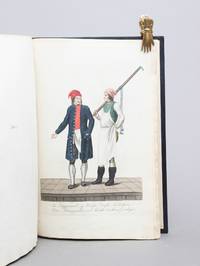
125047København ca. 1805-08. Folio 297 x 200 mm. 72 håndkolorerte kobberstukne plansjer. Komplett. Bundet i et senere elegant håndbundet helskinnbind. Innlagt i foret kassett. Utgitt opprinnelig i 12 hefter hefteomslagene er ikke medbundet her. 9 av plansjene fagmessig restaurert hvorav på 4 berører reparasjonen trykkflaten. Noen få plansjer i ulik bladstørrelse. En plansje forekommer i dublett. Verket er inndelt i to deler hvorav den første viser draktplansjer fra København med Amager og Sjælland. Den andre delen gjengir sønderjydske drakter med Holstein og de nordfrisiske øyer. . . <br/><br/><em>Meget sjelden i komplett stand. </em> unknown
17616853Copenhagen: Johan Jacob Bruun 1761. Contemporary Danish mottled sheepskin richly gold-tooled spine with red morocco title-label marbled pastedowns red sprinkled edges. Oblong folio 26.5 x 40 cm preliminaries upright folio bound with foot folded in. With 60 engraved views including one folding plate with a view of the Royal Castle near Copenhagen engraved by Jonas Haas and Hans Quist after designs by Johan Jacob Bruun. Enlarged issue of a very rare series of engraved views of Danish castles mansions houses gardens and city views by the Danish landscape painter Johan Jacob Bruun 1715-1789. It was first published in 1761 containing 50 views of buildings on the Danish island Zealand as the first volume of a planned series covering whole Denmark. The other volumes never appeared but 10 additional views were already engraved dated 1760-1762 and included in the present issue with all plates on the same French paperstocks.With plate numbers in manuscript on the back of the plates and some occasional faint thumbing in the margins. Binding rubbed. Very good copy of a very rare series of views of Denmark.l WorldCat 4 copies of all issues; cf. Thieme & Becker V p. 152; Weilbach Dansk Kustnerlex. I 1896; not in BAL; Fowler. Johan Jacob Bruun, unknown
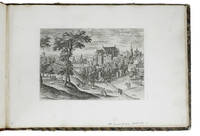
1575ABC_46067Antwerp: Hans van Luyck 1575. Modern red half cloth marbled sides. Oblong folio album 24.5 x 35.5 cm. Series of 24 engravings plate size ca. 20 x 14 cm with views of landscapes around Brussels by Hans I Collaert possibly after Hans Bol or Jacob Grimmer each with a caption in the plate plates 8 and 20 also with Van Luyck and Collaert's monograms "H.V.L.EXcudit" and "H.C.Fecit". Trimmed down to the plate edge and mounted on album leaves numbered in pencil on the album leaves next to the engravings. Album with the complete series of Collaert's views around Brussels here in its first unnumbered state published by Hans van Luyck in Antwerp. Hans I Collaert ca. 1525/30 - 1585 was a painter-draughtsman who founded the influential Collaert dynasty of engravers and print publishers. The views show villages castles and abbeys in the vicinity of Brussels engraved in a very naturalistic way. The series includes a view of the cloister of Zevenborren south of Sint-Genesius-Rode views of Schaarbeek Elsene Etterbeek Stal Eggevoort and Bosvoorde and views of the some castles including those of Brussels Coensborg south of Laken and Carloo. Some references attribute the drawing of the views to Hans Bol because of an inscription added to the first plate of the later Visscher edition but the "related drawings are not consistent with Bol's style" New Hollstein. Others name Jacob Grimmer as an alternative candidate for the artist who drew the views.With a 20th-century manuscript inscription on the first free endleaf mistakenly identifying the series as the second state published by Visscher which is however numbered in the plates in contrast to the present series in an unnumbered first state. Binding slightly worn around the edges some slight marginal foxing stains browning and soiling but overall a beautiful album complete and therefore rare with all the plates of Collaert's views around Brussels here in its first state.l Hollstein IV 149-172; New Hollstein The Collaert dynasty V 1229-1252; cf. New Hollstein The Collaert dynasty I pp. xlix-liii. Hans van Luyck, hardcover
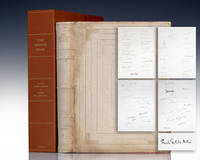
1929149534London: Privately printed by The Curwen Press for H.R.H. The Prince of Wales 1929. First and limited deluxe edition of the monumental Legion Book; one of only one hundred numbered copies printed for private distribution by the Prince of Wales and signed by a remarkable array of British writers and artists as well as four prime ministers. Quarto original publisher's full deluxe pigskin over boards elaborately decorated in blind and gilt top edge gilt tissue-guarded color frontispiece engraved title-page vignette illustrated with 16 captioned tissued-guarded plates in various techniques some signed by the artist and 32 collotypes. One of one hundred numbered copies printed for private distribution by the Prince of Wales and with five pages signed by each of the 89 contributing writers and illustrators as well as four prime ministers three British Prime Ministers: David Lloyd George Stanley Baldwin and Ramsay MacDonald and French Prime Minister Georges Clemenceau including: Winston Churchill who was not yet a Prime Minister Rudyard Kipling P.G. Wodehouse Eric Gill Stanley Spencer Charles Ricketts W. Heath Robinson Laura Knight William Nicholson Paul Nash David Low Rebecca West John Lavery Max Beerbohm Vita Sackville-West Hilaire Belloc Mark Gertler Edith Sitwell Jacob Epstein W.H. Davies and Aldous Huxley among others. This is number 84. The Legion Book was created at the request of H.R.H. The Prince of Wales—who would later become King Edward VIII and following his abdication the Duke of Windsor—as a fundraising initiative for the British Legion. All profits from its sales were intended to support the organization. The book features contributions from 85 distinguished British writers and artists including Winston Churchill Rudyard Kipling P.G. Wodehouse Aldous Huxley Vita Sackville-West G.K. Chesterton Hilaire Belloc Augustus John Eric Kennington and John Nash. It was compiled and edited by James Humphrey Cotton Minchin 1894–1966 a veteran who served with the Cameronians and the Royal Flying Corps during the First World War. While the trade version saw several reprints a special edition of 600 numbered copies was also produced. Of these 500 bore the editor’s signature but “the first 100 were reserved for H.R.H. the Prince of Wales sponsor of the volume in his gift.†According to the note at the conclusion of the Table of Contents “Five pages of contributors’ signatures appear after the Dedication with additional signed pages opposite Collotype No. 3 and Collotype No. 20.†Every contributor signed the book with the sole exception of John Singer Sargent who died in 1925 before the project was completed. In near fine condition with toning to the extremities of the front panel and front hinge. Housed in the original publisher's custom folding cloth clamshell box. An exceptional example of this rare signed limited edition. Formed in the aftermath of a war that had shattered a generation the Royal British Legion emerged in May 1921 as a unified voice for the countless veterans left wounded—physically mentally and economically—by the First World War. The staggering cost of the conflict with nearly 3.2 million British Empire casualties exposed the inadequacy of postwar support. A fully disabled veteran received just 30 shillings a week and any claim had to be made within seven years of discharge. In response to such injustice several ex-servicemen’s groups came together to create the Legion not merely as a charity but as an advocate for those who had borne the brunt of industrialized warfare. From its inception the Legion fought for fair pensions better employment opportunities and meaningful support for both former service members and their families—laying the groundwork for a broader movement of remembrance welfare and national responsibility that continues to this day. Privately printed by The Curwen Press for H.R.H. The Prince of Wales hardcover
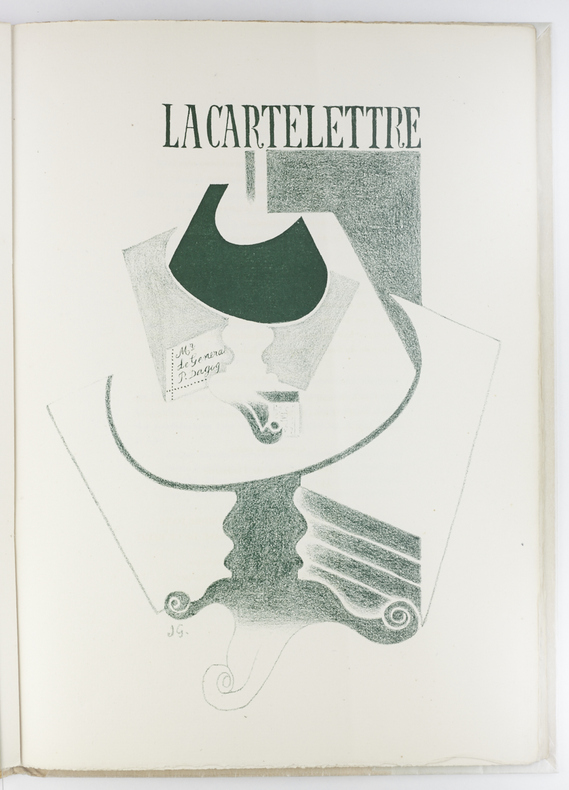
EXE-543Paris, Éditions de la Galerie Simon, 1921. Grand in-4° broché, couverture imprimée. ÉDITION ORIGINALE. Illustré de 4 lithographies hors-texte de Juan Gris. Tirage à 107 exemplaires, un des 90 exemplaires sur Hollande van Gelder, signé par l’auteur et l’illustrateur. Achevé d’imprimer le 2 février 1921 par Paul Birault; lithographies: Charlot frères. PREMIER LIVRE ILLUSTRE DE GRAVURES ORIGINALES DE JUAN GRIS. C’est également l’apparition de la couleur dans la production éditoriale de Kahnweiler : le bleu, le vert, le bistre et l’ocre ! 1921 sera une année faste, car ce n’est pas moins de six volumes que l’éditeur va publier. De retour à Paris depuis peu, Kahnweiler, pour cette nouvelle publication, se tourne vers son fidèle ami Max Jacob; le poète a longuement correspondu avec le marchand durant son long séjour en Suisse, l’informant de la vie artistique et littéraire parisienne. Max Jacob est désormais un poète reconnu, il a alors déjà publié une dizaine d’ouvrages. Ne coupez pas Mademoiselle « conte philosophique » burlesque et ironique, est illustré de quatre lithographies cubistes de Juan Gris, autre grand ami de Kahnweiler. Durant l’exil helvète, Juan Gris ne s’était engagé auprès de Léonce Rosenberg qu’avec l’accord de « son » marchand. Il fut le second peintre, après Vlaminck à retourner auprès de Kahnweiler. L’ouvrage sera souscrit notamment par Paul Guillaume, Jacques Doucet et Paul Poiret. Encore un détail éditorial, c’est la première fois que les illustrations portent clairement un titre: aucun des livres précédents n’avait de légende ou de titre pour les hors-texte. Et ici, Kahnweiler privilégie le papier de Hollande à l’exclusion du papier Japon. Skira 142 | Kahnweiler p. 294 | Rauch 97 | Hugues 6 | Castleman p. 173 | Pompidou p. 180 | Chapon p. 283 | Galland p. 863
1904014375New York: The Outlook Company 1904. First Edition. Hardcover. Hinges cracked and neatly repaired. Still Near Fine. Second Printing in publisher's original decorated cloth. Illustrated with plates. This copy virtually unique as it is INSCRIBED and SIGNED by both the author and the subject as President. Riis's inscription is dated 5 August 1908. Roosevelt writes: "with the best wishes of/Theodore Roosevelt/The White House/Jan. 18th 1909." The addition of "The White House" by Roosevelt is notable as prior to his administration the residence was known as the "President's Palace" the "President's House" and the "Executive Mansion." It was Roosevelt who officially named it "The White House" in 1901. Of the many books signed by Roosevelt we have both handled and seen we have never before encountered one in which he has noted his official residence along with his signature. <br/><br/>Jacob Riis among the most dedicated advocates for America's oppressed and downtrodden arrived in New York from his native Denmark at the age of 21 in 1870. A pioneer in photojournalism Riis photographed and wrote about the slums and tenements of a New York in the dawn of a new century. Riis came to Roosevelt's attention through his 1890 book HOW THE OTHER HALF LIVES. As Commissioner of the New York City Police Department Roosevelt accompanied Riis on his evening travels through the slums and witnessed firsthand the inhumane conditions endured by many of New York's inhabitants. In his 1901 book MAKING OF AN AMERICAN Riis wrote of Roosevelt: "It could not have been long after I wrote HOW THE OTHER HALF LIVES that he came to the Evening Sun office one day looking for me. I was out and he left his card merely writing on the back of it that he had read my book and had 'come to help.' That was all and it tells the whole story of the man. I loved him from the day I first saw him; nor ever in all the years that have passed has he failed of the promise made then. No one ever helped as he did. For two years we were brothers on Mulberry Street." Roosevelt in turn wrote of Riis after his death: "It is difficult for me to write of Jacob Riis only from the public standpoint. He was one of my truest and closest friends. I have ever prized the fact that once in speaking of me he said 'since I met him he has been my brother.' I have not only admired and respected him beyond measure but I have loved him dearly . and I mourn him as if he were one of my own family." The Outlook Company hardcover
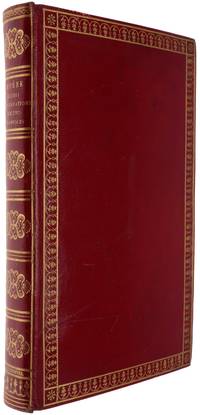
18234768Paris: Crochard 1823. <p>A beautiful copy bound in contemporary red morocco of the definitive version of this continually evolving collection of important memoirs on electrodynamics by Ampère 1775-1836 and others over the period 1820-1823 beginning with his 'Premier Mémoire' the "first great memoir on electrodynamics" DSB.</p>. DOCUMENTING THE BIRTH OF ELECTRODYNAMICS. <p>A beautiful copy bound in contemporary red morocco of the definitive version of this continually evolving collection of important memoirs on electrodynamics by Ampère 1775-1836 and others over the period 1820-1823 beginning with his 'Premier Mémoire' the "first great memoir on electrodynamics" DSB. "Ampère had originally intended the collection to contain all the articles published on his theory of electrodynamics since 1820 but as he prepared copy new articles on the subject continued to appear so that the fascicles which apparently began publication in 1821 were in a constant state of revision with at least five versions of the collection appearing between 1821 and 1823 under different titles" Norman. Some of the 25 pieces in the collection are published here for the first time others appeared earlier in journals such as Arago's Annales de Chimie et de Physique and the Journal de Physique. But even the articles that had appeared earlier are modified for the Receuil or have additional notes by Ampère to reflect his progress and changes in viewpoint in the intervening period. Many of the articles that are new to the present work concern Ampère's reaction to Faraday's first paper on electromagnetism 'On some new electro-magnetical motions and on the theory of magnetism' originally published in the 21 October 1821 issue of the Quarterly Journal of Science which records the first conversion of electrical into mechanical energy and contains the first enunciation of the notion of a line of force. Faraday's work on electromagnetic rotations would lead him to become the principal opponent of Ampère's mathematically formulated explanation of electromagnetism as a manifestation of currents of electrical fluids surrounding 'electrodynamic' molecules. The Receuil contains the first French translation of Faraday's paper followed by extended notes by Ampère and his brilliant student Félix Savary 1797-1841. Ampère's reaction to Faraday's criticisms are the subject of several of the articles in the second half of the Receuil. The collection also includes Ampère's important response to a letter from the Dutch physicist Albert van Beek 1787-1856 in which "Ampère argued eloquently for his model insisting that it could be used to explain not only magnetism but also chemical combination and elective affinity. In short it was to be considered the foundation of a new theory of matter. This was one of the reasons why Ampère's theory of electrodynamics was not immediately and universally accepted. To accept it meant to accept as well a theory of the ultimate structure of matter itself" DSB. The volume concludes with a résumé of a paper read by Savary to the Académie des Sciences on 3 February 1823 and a letter from Ampère to Faraday dated 18 April 1823 which does not appear in the Table of Contents showing that this definitive version of the Receuil was in fact published in 1823. Only three other copies of this work listed by ABPC/RBH. </p> <br /> <p>Provenance: Marcel Gompel 1883-1944 ex-libris on front paste-down - Répertoire général des ex-libris français: G1896. A Jewish professor at the Collège de France Gompel worked in the Laboratoire d'Histoire naturelle des corps organisés from 1922 to 1940 under the direction of André Mayer. In World War II he became a hero of the French resistance and was finally tortured and executed on orders from Klaus Barbie the chief of the Gestapo in Lyon. When Barbie came to trial the prosecutors used Gompel's case as a particularly clear and egregious example of his guilt of crimes against humanity. His superb library was stolen by the Nazis. </p> <br /> <p>The collection opens with the 'Premier Mémoire' 1 numbering as in the list of contents below first published in Arago's Annales at the end of 1820. This was Ampère's "first great memoir on electrodynamics" DSB representing his first response to the demonstration on 21 April 1820 by the Danish physicist Hans Christian Oersted 1777-1851 that electric currents create magnetic fields; this had been reported by François Arago 1786-1853 to an astonished Académie des Sciences on 4 September. In this memoir Ampère "demonstrated for the first time that two parallel conductors carrying currents traveling in the same direction attract each other; conversely if the currents are traveling in opposite directions they repel each other" Sparrow Milestones p. 33. </p> <br /> <p>The first quantitative expression for the force between current carrying conductors appeared in Ampère's less well-known 'Note sur les expériences électro-magnétiques' 2 which originally appeared in the Annales des Mines. Ampère stated without proof that if two infinitely small portions of electric current A and B with intensities g and h separated by a distance r set at angles α and β to AB and in directions which created with AB two planes at an angle γ with each other the action they exert on each other is </p> <br /> <p>gh sin α sin β sin γ k cos α cos β/r2</p> <br /> <p>where k is an unknown constant which he stated could 'conveniently' be taken to be zero. This last assumption was an error which significantly retarded his progress in the next two years before he stated correctly that k = − 1/2 in his article 13 published for the first time in the Receuil. This article comprised 'notes' on a lecture 12 delivered to the Institut in April 1822 in which he surveyed experimental work carried out by himself and others since 1821 he also published for the first time there the words 'electro-static' and 'electro-dynamic'. The full theoretical and experimental proof of the correct value of k appeared in two articles in Arago's Annales in 1822 19 and 20 in an article by Savary 22 and in experiments with de la Rive 17 see below. </p> <br /> <p>On 20 January 1821 Ampère performed an experiment together with César-Mansuète Despretz 1798-1863 intended to support his own theory of the interaction of electric currents against a rival theory of Jean-Baptiste Biot 1774-1862 and Félix Savart 1791-1841 presented to the Académie on 30 October 1820. This was reported in article 21 the first "experimentally based semi-axiomatic presentation of electrodynamics" Hofmann p. 316. A small cylindrical magnet was placed at the same distance from two perpendicular current carrying wires. The Biot-Savart theory predicted that the magnet would experience no net force; Ampère's theory predicted that the magnet would experience a non-zero torque from the nearby currents. But when Ampère and Despretz performed the experiment the magnet did not move p. 343. This defeat together with illness and fatigue caused Ampère to suspend his electrodynamical researches for several months. What little energy he could muster for electrodynamics was mainly devoted to correspondence.</p> <br /> <p>According to Ampère magnetic forces were the result of the motion of two electric fluids; permanent magnets contained these currents running in circles concentric to the axis of the magnet and in a plane perpendicular to this axis. By implication the earth also contained currents which gave rise to its magnetism. It was not long however before Auguste Fresnel 1788-1827 pointed out to his friend Ampère that his theory had several difficulties notably the fact that the supposed currents in magnets should have a heating effect which was not observed. Fresnel suggested that the electric currents circulated around each molecule rather than around the axis of the magnet. In January 1821 Ampère publicly accepted Fresnel's idea. </p> <br /> <p>Not everyone was convinced of the identity of electricity and magnetism however. Humphry Davy 1778-1829 expressed doubts in a letter to Ampère of 20 February 1821 7. Ampère's idea of magnetism created by circulating electric currents was also in direct opposition to a theory put forward by Johann Joseph von Prechtl 1778-1854 and supported by the great Swedish chemist Jöns Jacob Berzelius 1779-1848 according to which electromagnetism was 'transverse magnetism' - whereas Ampère eliminated magnetism and showed how all the phenomena could be accounted for by the action of two electric fluids Prechtl and Berzelius reduced electromagnetism to magnetic action. Berzelius expressed this view in his letter 3; Ampère responded in a letter to Arago 4. </p> <br /> <p>In April 1821 Ampère wrote to Paul Erman 1764-1851 professor of physics at the University of Berlin and perpetual secretary of Berlin's Royal Academy in response to Erman's Umrisse zu den physischen verhältnissen des von Herrn Professor Oersted entdeckten elektro-chemischen Magnetismus Berlin 1821. Ampère declared that his electric theory of magnetism was established "as solidly as a physical theory can be since in only admitting it at first as a hypothesis it serves to predict and make known in advance all the magnetic phenomena formerly known those which M. Oersted has discovered and the new properties whose existence in voltaic conductors I have made known. When one finds such an agreement between the facts and the hypothesis from which one started can one recognize it merely as a simple hypothesis Is it not on the contrary a truth founded on incontestable proofs" In the same letter Ampère calmly harvested Erman's experimental discoveries as further confirmatory evidence. "The observations described in the memoir which you have been so good as to send me are all the more new proofs of it. For if I am not mistaken they could all be predicted according to the theory in which magnets are considered to be assemblages of what I call electric currents" Hofmann pp. 277-8. Erman's experiments influenced Ampère's investigations of induction in July 1821 in which he very nearly anticipated Faraday's landmark discovery of electromagnetic induction a decade later see below.</p> <br /> <p>Ampère again stressed the 'identity' of electricity and magnetism in a lecture to the Académie on 2 April 1821 5. He also expressed his views on the nature of magnetism in a letter to Gaspard de la Rive 1770-1834 8. "Perhaps in an attempt to accommodate the positivistic inclinations of some of his Parisian colleagues or to avoid the adoption of hypotheses Ampère normally wrote on electricity and magnetism in a phenomenological vein eschewing noumenal questions. But there were exceptions: an example occurred in a letter of 15 May 1821 to the Swiss physicist Gaspard de la Rive which was published in the recipient's journal Bibliotheque universelle. Adopting the two-fluid theory of electricity then prevalent in France he spoke rather in passing of "the series of decompositions and of recompositions of the fluid formed by the reunion of the two electricities of which one regards electrical currents as composed" p. 122. Thus at this time Ampère's aetherian framework was based on electric current regarded as de- and recomposition of fluids and magnetism construed in terms of these currents rotating around each magnetic molecule" Grattan-Guinness p. 927.</p> <br /> <p>As far as Ampère was concerned "The physical theory of electrodynamics was now complete. Given the concepts of the ether and the electromotive force of matter as Ampère had formulated them all the observed effects could be explained; not only explained but subjected to mathematical analysis. The combination was a potent one and the accuracy of Ampère's calculations and the depths of his insight led many to embrace his theory. Ampère however was not satisfied with merely creating a model of electrodynamic action. By 1821 he was intoxicated by his vision and convinced that his electrodynamic molecules really existed. They must then also explain other areas of physics and chemistry.</p> <br /> <p>"In his 'Answer to the Letter of M. van Beck' i.e. van Beek 11 published in October 1821 Ampère turned his attention once again to the problem of chemical combination . What determined whether a reaction would take place and if so with what violence was the electrical condition of the participating molecules. To explain the mechanism of chemical combination Ampère had recourse to another analogy; molecules were not only like voltaic piles but also like Leyden jars. The facts of electrochemistry proved "that the particles of substances are essentially in two opposed electrical states." In order to preserve its electrical neutrality each molecule therefore decomposed the ambient ether to attract the electricity of the opposite sign. Ampère did not say if this was why each molecule was surrounded by electric currents but his use of the Leyden jar analogy would appear to rule out this possibility. The molecule presumably had both an inherent electrical charge and electric currents associated with it. It was the inherent static charge that caused chemical combination; the resultant combination of the two electricities gave rise to heat and light and both the material and energy relations of reactions could be understood in terms of the same mechanism . There can be no doubt that he took his own theory seriously as a general theory of matter. Nor was he alone in this. During the 1820's Becquerel in Paris and Auguste de la Rive 1801-73 in Geneva used the electrodynamic model in their researches in electrochemistry" Williams pp. 150-1.</p> <br /> <p>Late in 1821 however Ampère's satisfaction with his theory of magnetism was seriously challenged by Faraday's discovery of electromagnetic rotation a development which thrust Faraday immediately into the first rank of European scientists. "In the autumn he had to face a powerful criticism from Faraday whose paper 'On some new electro-magnetical motions' came out in a French translation 9 in Arago's Annales soon after its appearance in a London journal. A seminal paper in Faraday's contributions to the topic it announced that continuous rotation could occur if a pivoted cylindrical magnet moved around a fixed wire and also if a pivoted wire moved round a fixed magnet. In October he sent to Ampère and Jean-Nicolas-Pierre Hachette 1769-1834 one of his pieces of apparatus and Ampère demonstrated its working to the Académie in November.</p> <br /> <p>"From the theoretical point of view the chief challenge to Ampère's view was Faraday's conviction that such motions could not be explained by theories based on inter-molecular forces. Faraday's alternative drawn from this and other experiments was to give preference to curved 'lines of force'; but Ampère was anxious to preserve his own approach. Accordingly when the translation was prepared he had a set of appendicial notes 10 made by a new helper Félix Savary polytechnicien of the promotion of 1815 and thus one of Ampère's old students and in 1821 principally a geographer by profession. Ampère added his name to these notes to indicate his agreement with them. In his second note Savary rejected Faraday's implicit claim in the paper that the rotatory motion could be taken as a 'primitive fact' in electromagnetic phenomena and in the next note he showed how that motion could be explained in Ampère's terms" Grattan-Guinness p. 928.</p> <br /> <p>"In his original article describing the discovery of a continuous rotation of one extremity of a current-carrying wire around a magnet as well as the rotation of one extremity of a magnet around a current-carrying wire Faraday stated the following: "Having succeeded thus far I endeavoured to make a wire and a magnet revolve on their own axis by preventing the rotation in a circle round them but have not been able to get the slightest indications that such can be the case; nor does it on consideration appear probable." Ampère on the other hand considered that this new kind of motion might be produced in the laboratory. He was also the first to obtain it experimentally. He communicated his discovery to the Academy of Sciences of Paris in 7 January 1822 14. In order to obtain continuous rotation of a magnet around its axis Ampère initially floated it in mercury by the help of a counterweight in its lower extremity. By closing the circuit a constant current flowed vertically downwards through the upper extremity of the magnet leaving laterally along its lower portion and going through the mercury. When this constant current was flowing through the magnet it rotated around its axis relative to the ground" Assis & Chaib p. 123. Ampère wrote to Faraday in April 1823 describing these electromagnetic rotation experiments 24.</p> <br /> <p>In the letter to van Beek 11 described earlier Ampère described an experiment suggested by Fresnel to decide whether in a ring of copper macroscopic currents would be induced by a nearby coil or magnet. A first trial in July 1821 produced a negative result which fitted well into Ampère's theory of molecular currents. When he repeated the experiment with a more powerful magnet in August 1822 however he indeed obtained an effect and realized that this was the induction of currents by magnets. But as a consequence of his struggle with Faraday's rotations he concentrated on his magnetic theory. Although the positive result of the induction experiment again opened the way for both interpretations of magnetization it did not provide any positive hint concerning which of them should be preferred. Thus Ampère declared only that the result did not refer to his theory and decided not to pursue it further. A decade later when Faraday again discovered electromagnetic induction and gained great publicity Ampère bitterly complained about his former disregard of the result.</p> <br /> <p>Between 1821 and 1822 Gaspard de la Rive van Beek and Faraday performed some experiments showing that the poles of a cylindrical magnet are not located exactly at the extremities of the magnet as was predicted by Ampère's theory. These experiments forced Ampère to modify his conception of microscopic currents. In a letter addressed to Gaspard de la Rive dated 12 June 1822 15 Ampère included a figure which presents the equilibrium configuration of the microscopic currents around the particles of the magnet due to the interaction of all microscopic currents. That is due to the collective interactions between the small current-carrying loops the planes of these molecular currents should no longer remain orthogonal to its magnetic axis . This final conception of molecular currents presented by Ampère with their planes inclined relative to the axis of an uniformly magnetized bar is accepted in its essence up to the present time" Assis & Chaib p. 105.</p> <br /> <p>As described earlier Ampère had concluded in his article 13 that the constant k in his law for the force between current carting wires should be equal to −1/2. This implied however that two collinear and parallel current elements should repel one another when both currents flowed in the same direction towards the same point in space. Sceptical about this prediction he performed with Auguste de la Rive in September 1822 in Geneva an experiment to test it reported in 17 pp. 284-5 . This experiment has received several names in the literature: "Ampère's floating wire experiment" "Ampère's hairpin experiment" and "Ampère's bridge experiment." Ampère himself gave a very clear description: "Two very interesting electro-magnetic experiments have lately been made by M. Ampère in the laboratory of M. de la Rive at Geneva. M. Ampère had been induced from his mathematical investigations to expect a repulsion between two portions of an electrical current passing in the same direction and in the same right line or that every part of an electrical current would repel the other parts a result which may be comprehended by conceiving an endeavour in the current to elongate itself. The experiment which M. Ampère has contrived to illustrate this action of the current consisted of dividing a dish into two parts by a division across the middle and filling each division with mercury a piece of wire was then bent into the form of the letter U but the curved part was bent to one side so that the two limbs of the wire might lie on the mercury one on each cell and the bent part pass over the division without touching it. The wire was covered with silk except a small portion at each extremity by which the communication was established with the mercury" Assis & Chaib p. 145. "Ampere and Auguste de La Rive reported that as soon as a current was sent through the circuit and regardless of the direction of this current the originally stationary floating wire was propelled across the mercury pool away from the terminals connected to the power source. Ampere immediately attributed this phenomenon to repulsive forces between collinear pairs of current elements that is pairs in which one member is an element of the current in the mercury flowing between the bare end of the wire and the adjacent terminal and the other is an element of one of the linear segments of the wire. Interpreted in these terms the experiment represented a striking confirmation of the prediction Ampère had made to the Académie three months earlier. The importance Ampère ascribed to this demonstration was promptly reflected in the way he publicized it. For example in sharp contrast to his ambiguous and incomplete descriptions of induction the text he composed for his verbal report to the Académie includes a thorough and accurate account of the floating-wire demonstration" Hofmann pp. 317-8.</p> <br /> <p>In his article 22 Savary provided further support for Ampère's conclusion that k = −1/2 by analyzing an experiment carried out in 1820 by the chemists Joseph Louis Gay-Lussac 1778-1850 and Jean-Joseph Welter 1763-1852. "Initially they utilized an unmagnetized steel ring which did not interact with a compass needle. If this ring was broken into pieces its pieces also had no influence upon the magnetized needle. They then coiled a toroidal helix around this ring and a constant current flowed through it. The current was then turned off and the helix was removed out of the ring. The ring did not interact with a compass needle placed nearby. However when the ring was broken into pieces each piece did now interact with the magnetized needle. Each piece behaved now as a small magnet. That is each small piece of the ring was magnetically polarized with a North and a South pole so that it became magnetized" Assis & Chaib p. 149. Savary showed that the results of this experiment were possible only if k = 1 or −1/2 and as previous experiments by Ampère had shown that k could not be positive he could conclude that k = −1/2. "Savary's contribution was well publicized by Ampère. He wrote several complimentary reviews for influential journals and wrote to la Rive that Savary's presentation of his work to the Académie marked "a kind of epoch in the history of dynamic electricity" Hofmann p. 321.</p> <br /> <p>List of Contents author is Ampère unless otherwise stated:</p> <br /> <br /> Premier Mémoire. De 1'Action exercée sur un courant électrique par un autre courant le globe terrestre ou un aimant pp. 3-68<br /> AMPÈRE & Gillet de LAUMONT Additions au mémoire précédent - note sur les expériences électro-magnétiques de MM. Oersted Ampère Arago et Biot pp. 69-92<br /> BERZELIUS Lettre à M. Berthollet sur l'État magnétique des corps qui transmettent un courant d'électricite pp. 93-99<br /> <br /> <br /> Lettre de M. Ampère à M. Arago pp. 99-108<br /> Notice sur les Experiences électro-magnétiques de MM. Ampère et Arago lue à la séance publique de l'Académie royale des Sciences de Paris le 2 avril 1821 pp. 109-112<br /> Lettre de M. Ampère à M. Erman secrétaire de 1'Académie Royale de Berlin pp. 113-120<br /> DAVY Extrait d'une Lettre de Sir H. Davy à Mr. Ampère pp. 120-121<br /> Extrait d'une Lettre de Mr. Ampère au Prof. De La Rive pp. 121-124<br /> FARADAY Mémoire sur les mouvemens électro-magnétiques et la théorie du magnétisme pp. 125-158<br /> AMPÈRE & SAVARY Notes relatives au Mémoire de M. Faraday pp. 158-167<br /> Réponse de M. Ampère à la Lettre de M. Van Beck sic sur une nouvelle Expérience électro-magnétique pp. 169-198<br /> Exposé sommaire des nouvelles Expériences électro-magnétiques faites par différens Physiciens depuis le mois de mars 1821 lu dans la séance publique de l'Académie royale des Sciences le 8 avril 1822 pp. 199-206<br /> Notes sur cet exposé des nouvelles Expériences relatives aux Phénomènes produits par 1'action électrodynamique faites depuis le mois de mars 1821 pp. 207-236<br /> Expériences relatives aux nouveaux phénomènes électro-dynamiques que j'ai obtenus au mois de decembre 1821 pp. 237-250<br /> Extrait d'une Lettre de M. Ampère au Prof. De La Rive sur des expériences électro-magnétiques 22 June 1822 pp. 252-258<br /> De l'Action qu'exerce la Terre sur les conducteurs voltaïques pp. 259-261<br /> De la RIVE Mémoire sur l'Action qu'exerce le globe terrestre sur une portion mobile du circuit voltaïque pp. 262-286<br /> Remarks on the preceding memoir pp. 286-292<br /> Second Mémoire. Sur la Détermination de la formule que représente 1'action mutuelle de deux portions infiniment petites de conducteurs voltaïques pp. 293-318<br /> Additions au Mémoire précédent. Extrait d'un Mémoire présenté à l'Académie royale des Sciences dans la séance du 16 septembre 1822 pp. 319-324<br /> Exposé méthodique des phénomènes électrodynamiques et des lois de ces phénomènes pp. 325-344<br /> SAVARY Extrait fait par M. Savary du Mémoire qu'il a lu à l'Académie royale des Sciences le 3 fevrier 1823 pp. 345-354<br /> Observations additionelle pp. 354-364<br /> Extrait d'une Lettre de M. Ampère à M. Faraday Paris 18 avril 1823 pp. 365-378<br /> <br /> <p>Table pp. '357-360' errata on p. '360'</p> <br /> <p>Errata p. 383.</p> <br /> <p>The bibliographical complexity of this work is a direct result of Ampère's modus operandi: "His work was marked by flashes of insight and it often happened that he would publish a paper in a journal one week only to find the next week that he had thought of several new ideas that he felt ought to be incorporated into the paper. Since he could not change the original he would add the revisions to the separately published reprints of the paper and even modify the revised versions later if he felt it necessary" Norman. Our version of the Receuil is more extensive than the most complete copy owned by Norman and is probably that alluded to in the note to item 45 in the Norman catalogue: "Another probably later version has been noted with additional pages 361-378 plus an additional page of errata p. 383 and ten instead of nine plates." This copy additionally has pp. 223-236 which are missing from the Norman copy and to which the additional plate refers.</p> <br /> <p>Ekelof 819; Norman 44-45 less complete issues; Ronalds 10; Wheeler Gift 784 copy with 344 pages only - "The author's classical investigations in electro-dynamics together with experimental illustrations. Also a paper by De la Rive on the action of the earth on a movable circuit carrying a current". Assis & Chaib Ampère's Electrodynamics 2015. Grattan-Guinness Convolutions in French Mathematics 1800-1840 1990. Hofmann André-Marie Ampère 1995. Williams Michael Faraday 1965.</p> <br/> <br/> 8vo 204 x 126 mm pp. ii 1-3 4-167 1 blank 169-250 252-258 1 blank 259-378 1 358-360 383 with 10 folding engraved plates plates 1-5 signed by Adam after Girard one small text woodcut. Contemporary red morocco gilt by Lefebvre flat spine richly decorated and lettered in gilt borders of covers gilt-tooled within double rules inner gilt dentelles all edges gilt. A very fine copy. Crochard unknown
1826118064London: C. Baldwyn 1823; James Robins 1826. First edition first issue in English of both volumes of Grimms' famous fairy tales including Snow White Cinderella Rumpelstiltskin Hansel and Gretel and Sleeping Beauty. With the first state of the engraved title page of Volume I without the umlaut in the word Marchen "later issues of the first edition of Volume I had the umlauts inserted"-- Quayle 38. Vol. II with the half-title and advertisements. Small octavo bound in full scarlet crushed morocco by Riviere & Sons with gilt titles and tooling to the spine in six compartments within raised gilt bands triple gilt ruling to the front and rear panels gilt turn-ins and inner dentelles all edges gilt illustrated with with two engraved title pages and 20 full-page etchings by George Cruikshank. German Popular Stories was Cruikshank's first illustrated book. Following the success of this work he illustrated the works of his friend Charles Dickens. Translated by Edgar Taylor. From the library of banker and rare book collector Frederick Stanhope Peck with his bookplate to the pastedown. Laid in is an original bill of sale from Parke-Bernet Galleries dated April 21-22nd 1947. In fine condition. An exceptional example with noted provenance as these have been in a private collection since the 1940s. As early as 1805 Jacob and Wilhelm Grimm began collecting German popular tales. They published the first and second volumes of Kinder-und Hausmarchen in 1812 and 1814. Its publication brought immediate and worldwide fame to the brothers Grimm and provided the foundation for their influential and groundbreaking studies in German philology and grammar PMM 281. The 1823 edition in English of German Popular Stories was the "first anywhere to be fully illustrated" as well as the first to truly target children Darton 216. Moreover the English translation by Edgar Taylor and his relatives "revolutionized the conventional English attitude to fairy tales and rehabilitated fantasy as generally acceptable reading-matter for the young. The Cruikshank illustrations which the Grimms themselves admired remain inextricably associated with the tales" and are considered among his best works Carpenter & Prichard 230. They have been called "the first real kindly agreeable and infinitely amusing and charming illustrations for a child's book in England" Charles Welsh. Among other famous Grimm tales these volumes contain "Rumpel-Stilts-Kin" "Snow-Drop" Snow White "Rose-Bud" Sleeping Beauty "Tom Thumb" "Hansel and Gretel" "The Golden Goose" "The Frog-Prince" and "Ashputtel" Cinderella. C. Baldwyn, 1823; James Robins unknown books
196444629Vietnam Thailand and elsewhere in Asia as well as the United States Europe and the Middle East ca. 1964-1974: Compiled by Jacob Harris an American who served as a Senior Police Advisor in Vietnam and Thailand during the Vietnam War 1964 - 1974. 1964 - 1974. First edition. A large and remarkable archive of images from Vietnam and Thailand covering the decade from the Gulf of Tonkin incident and the beginning of the buildup of American forces in Vietnam to a year before the evacuation of the American embassy. Most notable are the many images showing the training of local security forces by American civil and military advisors. The collection was compiled by Jacob Harris an employee of the United States Agency for International Development USAID Office of Public Safety OPS whose task was to train Vietnamese and Thai police and counterinsurgency forces. Most of the images in the form of photographs and photographic slides were created by Harris his wife or his associates and illustrate all aspects of life in those countries at the time. Harris traveled widely throughout the region and the collection includes images from not only Vietnam and Thailand but also from Laos Singapore Hong Kong Macao Malaysia India and elsewhere. The images also document Harris' lengthy career as a New Jersey State Trooper and his travels in other parts of the world. Jacob Joseph Harris ca. 1910-2005 also known as "Jack" and "Jake" served for thirty-six years 1928-64 with the New Jersey State Police eventually attaining the rank of major. Included herein is a printed card dated Dec. 31 1960 marking thirty years of Harris' service to the state of New Jersey. In 1964 he began what he called his "second career" taking a position with the U.S. Agency for International Development and was stationed first in Vietnam and then in Thailand. As his postings permitted he was joined by his wife of many years Virginia and she appears in a great number of the photographs. Harris was associated mostly with USAID's Office of Public Safety which was established in 1957 to train the police forces of America's overseas allies. The OPS was often used by the Central Intelligence Agency as a cover for its agents abroad and operated in Europe the Middle East Africa and Asia until it was shut down by Congress in 1974. At other times Harris was a part of the State Department's Office of Missions. Whether or not Harris was directly employed by the CIA has not been ascertained and it seems that his actual role in Vietnam and Thailand was in fact the training of local police and paramilitary forces. However Harris' proximity to high ranking officials in the governments of South Vietnam and Thailand as well as the nature of many of the photographs in this collection show that he played an active and important role in training local forces to fight the Vietcong and Thai insurgents. And it is certainly true that the various departments and agencies of the U.S. government in southeast Asia at that time those operating overtly or covertly worked together toward their common goal. Jacob Harris ended his career at the State Department in Washington and retired to Florida in 1975. A slide included as part of the collection explains the "Objective of U.S. Assistance to Civil Police Programs & Paramilitary Forces Overseas." Among these are "encourage humane responsible police administration; enforce the law & maintain public order with minimum use of force; counter subversion & terrorism; improve the character and image of civil police & paramilitary forces binding them more closely to the community." A large percentage of the photographs and slides in this collection show Jacob Harris with the Vietnamese and Thai officials and officers with whom he worked trained and advised during his decade of service. Included are images of military and political leaders members of the Thai royal family and members of military and police forces. A number of the photographs show police operations against members of the Vietcong or other subversive organizations several of them showing dead bodies. One album is devoted to photographs showing a Thai operation against revolutionaries with pictures of soldiers dead and mangled bodies of the enemy and members of the Thai forces recuperating and being commended at their hospital beds. This same album contains a number of typescripts in Thai that appear to describe the actions depicted. A few other photographs have manuscript ink notes apparently in Jacob Harris' hand identifying the scene. One showing a dead body is captioned "Vietcong" while another dated April 2 1969 shows a Thai military force with some members identified with a caption explaining that they were "assigned to eliminate Durae Gang." Some photographs are quite chilling in their juxtaposition as in one album where pictures of the Harrises and their friends at the beach are displayed beside photographs of dead Vietcong soldiers. The photographs and slides show Harris and his American colleagues and often their wives interacting with Vietnamese and Thai officials the local citizenry and each other. One group of images shows a party thrown for Harris and his wife when they were reassigned from Vietnam to Thailand in 1968 in the wake of the Battle of Hue. Several images show Harris visiting villages and interacting with locals and the difficulty of lives of Thai and Vietnamese villagers is clearly evident. Many of these images show villages populated mostly by the elderly women and small children. The absence of most men speaks volumes; they may have left to fight for the Army of the Republic of Vietnam or the Vietcong or they may have lost their lives. It is clear from the images in this collection that despite the hardships encountered by American troops in Vietnam USAID officials lived comfortable lives. Many of the photographs show them at parties vacationing at beach resorts lounging by swimming pools etc. As mentioned though stationed in Vietnam and then Thailand Harris traveled widely throughout Asia including to Hong Kong Singapore Macao Malaysia and Laos. He also traveled throughout the countries he was stationed in and there are images in this archive of Saigon the Vietnamese provincial capital of Dalat Danang Bangkok Ayutthaya Angkor Wat and much more. Many of the images of Vietnam show a country that still bears a heavy French influence before the Communist takeover of the 1970s. Other images show trips taken by the Harrises to Europe and the Middle East as well as photographs documenting Harris' life in New Jersey and his earlier career with the state police. The more than 1700 photographs are a mixture of black and white and color ranging in size from 2 3/4 by 3 1/2 inches to 3 1/2 by 5 1/2 inches though a handful are larger. Included are more than fifty boxes of slides some 2000 original slides in all. The images in the slides appear to have been taken by Harris or his wife and are in color. As with the photographic prints the slides are a mixture of military and nonmilitary scenes: parades assemblies featuring police and military officials pictures of village life aerial views of the Vietnamese and Thai countryside etc. There are many images of American military airplanes and equipment training exercises aerial views of the countryside several images of the demilitarized zone and much more. One group of slides shows an anti-American parade in Vietnam featuring signs reading "Kick out Taylor" protesting the 1964 appointment of General Maxwell Taylor as ambassador to South Vietnam. As a military advisor to President Kennedy Taylor had enthusiastically supported sending more American combat troops to Vietnam. Other slides show Jacob Harris accompanying a Vietnamese delegation on a visit to the United States during which they went to Washington and to New Jersey where they met with his old colleagues in the New Jersey State Police. Yet another box of slides is labeled "Hong Kong" and "Red Chinese border" containing a number of views of Hong Kong in the late 1960s as well as views of mainland China. Other images document visits by American dignitaries to Thailand and Vietnam and there is a series of slides featuring Harris with Army of the Republic of Vietnam general Nguyen Chanh Thi and others showing Harris and police officers at the strategically important Hai Van Pass near Danang. One group of thirty-five slides housed in a box labeled "DMZ bombing" shows the aftermath of an air raid presumably by U.S. forces with bombed-out buildings and ruined villages and countryside. Other images show bombed out buildings in a more urban setting. In all a massive archive of images documenting American activities at the local and police levels in Vietnam and Thailand over the course of a crucial decade. The Harris archive is a wealth of views of all aspects of life in the region during this period which help deepen our understanding of the effects of the American presence in southeast Asia during the era of the Vietnam War. More than 1700 original photographic prints and 2000 original photographic slides plus fourteen audio recordings and miscellaneous documents. Most of the slides preserved in their original Kodak processing boxes. Some photographs loose but most bound into albums. On the whole in near fine condition. Compiled by Jacob Harris, an American who served as a Senior Police Advisor in Vietnam and Thailand during the Vietnam War, 1964 unknown
1968387331968. <p>Jacob Francois 1920- ; Monod Jacques 1910-75; Lwoff Andre 1902-94; & Brenner Sydney 1927- . Group of 22 offprints mimeographs etc. on molecular biology and bacterial genetics together with 2 related papers by other authors. Various sizes. 1947-1968. Together in one volume cloth "Institut Pasteur" in gilt on the spine. Overall good to very good; see detailed condition descriptions below. From the library of G. G. and Elinor Meynell authors of Theory and Practice in Experimental Biology 1970 with their address label on the front endpaper and ownership signatures on several of the offprints.</p> <p>First / First Separate Editions. Jacob Monod and Lwoff all colleagues at the Institut Pasteur received the 1965 Nobel Prize in physiology / medicine for their discoveries concerning genetic control of enzyme and virus synthesis-discoveries that "opened up a new field of research that deserved to be called 'molecular biology'" Magill The Nobel Prize Winners: Physiology or Medicine II p. 921. Their work answered the fundamental question of how the hereditary information contained in DNA can be translated into the chemical processes that synthesize cellular proteins this question had been posed most succinctly and explicitly in Francis Crick's theoretical paper "On protein synthesis" 1957 which laid the groundwork for over a decade's worth of research in this area. Brenner another key figure in this field worked with Jacob and Matthew Meselson on providing experimental evidence for messenger RNA; he was awarded a share of the 2002 Nobel Prize for his discoveries concerning genetic regulation of organ development and programmed cell death.</p> <p>The collection we are offering here focuses largely on the Nobel Prize-winning work done by the Institut Pasteur group-Lwoff Jacob and Monod-in the 1950s and 1960s. The work can be divided into four sections: </p> <p>1 lysogeny and bacterial conjugation</p> <p> 2 expression of the genetic material via messenger RNA</p> <p> 3 the regulation of the genetic activity of bacterial cells by operons</p> <p>4 the organization of bacterial genetic material.</p> <p> In the following paragraphs we will attempt to highlight the more important papers in this remarkable collection; however all the papers here touch upon these central questions of molecular biology.</p> <p>Lysogeny defined as the hereditary ability to produce the bacteriophage virus is a peculiar type of infection in which the phage becomes part of the genetic material of a bacterial cell; in this non-infective form prophage it can then be inherited by succeeding generations of cells becoming virulent only when some environmental stimulus causes the bacterium to produce and release phage.</p> <p> "Lysogeny brought a model for the interrelation between a virus and a cell. And also a model for the possible mode of action of carcinogenic agents which could disturb something in this balance" Judson p. 368. Lwoff studied this phenomenon intensively in the late 1940s and early 1950s successfully demonstrating the genetic nature of lysogeny which was disputed by several scientists including Delbruck and discovering how it is induced. In 1953 he published an important review of the subject "Lysogeny" Bacteriological Review 17; see no. 2 below. Lysogeny was also studied by Jacob and Elie Wollman whose paper "Induction of phage development in lysogenic bacteria" CSH Symposia on Quant. Biol. 18 1953; see no. 5 below summarizes what had been learned about lysogeny as of that date.</p> <p>Lwoff's work on lysogeny inspired Jacob and Wollman to investigate the phenomenon of bacterial conjugation the transfer of genetic information from a male donor bacterium to a female recipient resulting in genetic recombination to see if they could discover where in the bacterium's genetic material the prophage was located. In 1955 working with a highly recombinant strain of E. coli K12 discovered by William Hayes Jacob and Wollman performed what came to be known as their "coitus interruptus" experiment in which they used a Waring blender to interrupt the mating bacteria at various stages of their conjugation. They found that the donor cell's genetic characteristics were not transferred all at once but rather sequentially over time-a discovery of great importance. </p> <p>"Wollman and Jacob had stumbled upon a way to measure off the genes on the bacterial chromosome as directly and physically as a child squeezes toothpaste onto a brush or a carpenter unrolls a coiled steel tape measure. As they saw instantly and reported in a note in mid-June 1955 in the weekly Comptes rendus of the Academie des Sciences "Sur le mecanisme du transfert de materiel genetique au cours de la recombinaison chez E. coli K12"; see no. 6 below they had the means to make a genetic map of biochemical characteristics expressed in units of time" Judson p. 385.</p> <p> In 1956 Wollman and Jacob published the first albeit rudimentary timed map of the K12 strain of E. coli in a paper published in France. This map was printed again in their English-language paper "Conjugation and genetic recombination in E. coli K-12" CSH Symposia on Quant. Biol. 21 1956; see no. 8 below which also contained the first publication of Thomas Anderson's famous electron micrograph of two conjugated bacteria.</p> <p>In 1958 Jacob delivered his paper "Transfer and expression of genetic information in E. coli K12" see no. 9 below at a symposium in Brussels; this paper together with one given by Jacob's sometime colleague Arthur Pardee "ranged over the whole matter of transfer of genes between bacteria and the regulation of their expression" Judson p. 400. Jacob and Wollman had originally represented the hereditary material in linear form while stating that the genetic map could be formally represented as a circle. In 1963 at a Cold Spring Harbor conference the researcher J. Cairns provided physical evidence that the E. coli chromosome was circular; at this same conference Jacob Brenner and co-author Francois Cuzin presented their paper "On the regulation of DNA replication in bacteria" CSH Symposia on Quant. Biol. 28; see no. 16 below containing their "replicon model of chromosome replication in bacteria a model that almost required circularity of chromosomal and F factor DNA" Brock p. 103.</p> <p>Experimental proof of the existence of messenger RNA the substance responsible for coding protein synthesis was announced in Brenner Jacob and Meselson's landmark paper "An unstable intermediate carrying information from genes to ribosomes for protein synthesis" Nature 190 1961; see no. 1 below. The theoretical groundwork for messenger RNA had been laid in Crick's "On protein synthesis" 1957; demonstration of the substance's existence had been foreshadowed by Volkin and Astrachan's discovery of a high-turnover unstable RNA distinct from the ribosomal and transfer varieties 1956 and by the famous "PaJaMo" experiment demonstrating the negative control mechanism of enzyme induction 1958. However it was not until the spring of 1960 that these previous findings were combined by Brenner Jacob and Francis Crick into a biological model setting forth the exact means of communication between gene and cytoplasm while eliminating the various problems associated with earlier ribosome-based theories of gene expression. As Brock puts it the ribosome was now seen as "simply a nonspecific translation machine something like a computer whose behavior depended on what software it contained" Brock p. 306.</p> <p> Working with Matthew Meselson who had developed experimental techniques for tagging and separating ribosomes Brenner and Jacob performed the critical experiment described in their paper which provided direct evidence for the existence of an unstable rapidly turning over messenger RNA.</p> <p>The concept of the operon-a group of adjacent genes functioning as a unit under the control of another gene the operator gene-developed between 1958 and 1960 on the basis of work done by Monod and Jacob who were investigating the repressor model of gene regulation. Jacob developed the idea that gene regulation was based on a repression system that operated like an on-off switch and that "genetic units of a higher order existed . . . that contained several genes subject to unitary expression. . . . On the basis of these ideas and observations Jacob and Monod developed the concept of two kinds of genes structural which coded for the synthesis of proteins and regulatory which did not" Brock p. 300. In October 1959 Jacob and Monod published the theoretical basis for the operon in "Genes de structure et genes de regulation dans la biosynthese des proteines" C. r. Acad. Sci. 249; see no. 11 below. Their paper "established the sharp distinction between the familiar genes that determined protein structures and the new class of genes that regulated. It even looked to them then as though the product of the regulatory gene were not a protein by RNA. But the fact to be underlined they said was that in every known case when several structural genes had their expression controlled by the same regulatory gene-'that is to say in all probability by a unique repressor'-the structural genes were grouped tightly together. . . . The best fit to the evidence was that the group of genes had among them a single element: the operator target of the repressor" Judson p. 410. </p> <p>The Jacob/Monod operon model of gene expression was further explored in their 1961 paper "On the regulation of gene activity CSH Symposia on Quant. Biol. 26; see no. 14 below which presented a more detailed examination of the mechanics of protein synthesis. For further information see Judson The Eighth Day of Creation 2nd ed. and Brock The Emergence of Bacterial Genetics; specific references are given below.</p> <p>1. Brenner Sydney; Jacob Francois; & Meselson Matthew. An unstable intermediate carrying information from genes to ribosomes for protein synthesis. Offprint from Nature 190 May 13 1961. 576-581pp. Diagrams. Without wrappers as issued. Light toning. Ownership signature of E. W. Meynell on the first page. Garrson-Morton 256.10. Brock ch. 10.12. Judson pp. 414-27.</p> <p>2. Lwoff Andre. Lysogeny. Offprint from Bacteriological Review 17 1953. 269-337pp. Without wrappers. Small stamp on first page. Brock ch. 7.4.</p> <p>3. Monod Jacques. Inhibition de l'adaptation enzymatique chez une bacterie E. coli infectee par un bacteriophage. Offprint from C. r. Acad. Sci. 224 1947. 2 2 blankpp. Without wrappers. Light browning creased horizontally with small tear along crease. Ownership stamp and ms. annotations of A. A. Miles.</p> <p>4. Lwoff & Siminovitch Louis. Induction de la lyse d'une bacterie lysogene sans production de bactÈrophage. Offprint from C. r. Acad. Sci. 233 1951. 3pp. Fore-edge frayed marginal tear affecting a few words. A. A. Miles's signature.</p> <p>5. Jacob Francois & Wollman Elie. Induction of phage development in lysogenic bacteria. Offprint from CSH Symposia on Quant. Biol. 18 1953. 101-121pp. Without wrappers. Light soiling a few annotations. Owner's name on first page. Judson p. 382.</p> <p>6. Wollman & Jacob. Sur le mecanisme du transfert de materiel genetique au cours de la recombinaison chez E. coli K12. Offprint from C. r. Acad. Sci. 240 1955. 3pp. Without wrappers. Creased horizontally light toning. Ownership signature of Elinor Meynell. Brock ch. 5.7.</p> <p>7. Jacob; Alfoldi Lajos; & Wollman Elie. Zygose letale dans des croisements entre souches colicinogenes et non colicinogËnes d'E. coli. Offprint from C. r. Acad. Sci. 244 1957. 3pp. Without wrappers. Small marginal tears. Elinor Meynell signature.</p> <p>8. Wollman; Jacob & Hayes W. Conjugation and genetic recombination in E. coli K-12. Offprint from CSH Symposia on Quant. Biol. 21 1956. 141-162pp. Without wrappers. Brock ch. 5.11.</p> <p>9. Jacob. Transfer and expression of genetic information in E. coli K12. Manuscript for the Symposium of the Society for Cell Biology Brussels 1958. 29 3pp. Dittoed table. Mimeographed. Without wrappers. Edges a bit frayed. E. Meynell signature. Judson p. 400.</p> <p>10. Jacob & Fuerst Clarence R. The mechanism of lysis by phage studied with defective lysogenic bacteria. Offprint from J. Gen. Microbiol. 18 1958. 518-526pp. Without wrappers. E. Meynell signature.</p> <p>11. Jacob & Monod. Genes de structure et genes de regulation dans la biosynthese des proteines. Offprint from C. r. Acad. Sci. 249 1959. 3pp. Without wrappers. Creased horizontally. E. Meynell signature. Brock ch. 10.10. Judson p. 410.</p> <p>12. Changeux Jean-Pierre. Sur l'expression biochimique de determinants genetiques d'E. coli introduits chez Salmonella typhimurium. Offprint from C. r. Acad. Sci. 250 1960. 3pp. Creased horizontally. Meynell signature.</p> <p>13. Jacob. Comments. Offprint from Cancer Research 20 1960. 695-697pp. Without wrappers.</p> <p>14. Jacob & Monod. On the regulation of gene activity. Offprint from CSH Symposia on Quant. Biol. 26 1961. 193-211pp. Without wrappers. Meynell signature. Brock ch. 10.13.</p> <p>15. Jacob & Monod. Elements of regulatory circuits in bacteria. Unesco Symposium on Biological Organization. Paris 1962. Mimeographed. 27pp. plus tables and figures. Without wrappers. Light browning.</p> <p>16. Jacob; Brenner Sydney; & Cuzin Francois. On the regulation of DNA replication in bacteria. Offprint from CSH Symposia on Quant. Biol. 28 1963. 329-348pp. Without wrappers. Meynell signature. Brock ch. 5.11.</p> <p>17. Jacob & Ryter Antoinette. Etude au microscope Èlectronique des relations entre mÈsosomes et noyaux chez Bacillus subtilis. Offprint from C. r. Acad. Sci. 257 1963. 4pp. Plate. Without wrappers. Meynell signature.</p> <p>18. Lennox Edwin S. ; Novick Aaron; & Jacob. Relation between repression level and rate of enzyme synthesis. Offprint from Colloques Internationaux du Centre Nat. de la Recherche Scientifique. No. 124. Mecanismes de regulation des activites cellulaires chez les microorganisms 1965. 209-219pp. Orig. wrappers. Meynell signature.</p> <p>19. Sebald Madeleine & Schaeffer Pierre. Toxinogenese et sporulation chez Clostridium histolyticum. Offprint from C. r. Acad. Sci. 260 1965. 3pp. Without wrappers.</p> <p>20. Jacob & Ryter. Segregation des noyaux chez Bacillus subtilis au cours de la germination des spores. Offprint from C. r. Acad. Sci. 263 1966. 4pp. Plate. Without wrappers. Meynell signature.</p> <p>21. Jacob & Ryter. Segregation des noyaux pendant la croissance et la germination de B. subtilis. Offprint from C. r. Acad. Sci. 264 1967. 3pp. Plate. Without wrappers.</p> <p>22. Jacob. Genetics of the bacterial cell. Offprint from Science 152 1966. 9pp. Orig. printed self-wrappers. Nobel address. Meynell signature.</p> <p>23. Jacob; Pereira da Silva Luiz; & Eisen Harvey. Sur la rÈplication du bacteriophage l. Offprint from C. r. Acad. Sci. 266 1968. 3pp. Without wrappers.</p> <p>24. Ryter A.; Hirota Y.; & Jacob. DNA-Membrane complex and nuclear segregation in bacteria. Offprint from CSH Symposia on Quant. Biol. 33 1968. 669-676pp.</p> . unknown books
1609791AD6R1MSG6Frankfurt 1609. 4to. Wilhelm Hoffmann Contemporary vellum sewn on 3 vellum tapes rebacked. With the letterpress title within engraved border including the imprint and 3 series of 42 43 and 32 full-page numbered woodcuts showing exercises with the arquebus musket and pike. 3 parts in 1 volume. 3 1 blank 43 1 blank 44 36 ll. Rare first edition published in Germany with woodcuts instead of engravings of a military manual known in English as The exercise of arms it was written and illustrated by Jacques de Gheyn and quickly became a famous pictorial army manual for use of officers to teach the young recruits how to handle their weapons: the arquebus part 1 musket part 2 and pike part 3. The text here in German and French gives a short explanation of the illustrations. It gives an excellent picture of the successful army of the Dutch Republic after its reform by Prince Maurits who reintroduced exercises and discipline. It also immortalizes Prince Maurits as a military thinker and commander of the most disciplined army of his age.Some faint browning throughout slightly more visible on a few leaves and some foxing on title-page. Binding rebacked and a few stains on the sides. Good copy.l VD 17 39:124359A 3 copies; WorldCat 6 copies incl. 2 the same; cf. Cockle 79 other ed.; Jähns pp. 1005-1007 other ed.; Lipperheide 2057-2060 other eds. ABE CAT Costumes & Uniforms hardcover
19262112Paris : Éditions « Cahiers d’Art », 1926 In-4 (283 x 228 mm), broché, non rogné, sous couverture rempliée de papier Japon. Encartée dans l’exemplaire: 1 EAU-FORTE ORIGINALE DE PABLO PICASSO TIRÉE SUR HOLLANDE, SIGNÉE AU CRAYON PAR L' ARTISTE ET JUSTIFIÉE 13/50. Note historique: Un des premiers livres sur Picasso, publié par la galerie "Cahiers d'Art" fondée cette même année. L'ouvrage est illustré de 4 reproductions de dessins dans le texte et de 42 planches, dont 2 en couleurs, reproduisant des œuvres de Picasso des années 1920-1926. La gravure accompagnant ce tirage de luxe, "Femme au fauteuil", fait partie d'une série réalisée en 1922-1923 dans laquelle les lignes superposées donnent à voir les figures à la fois de face et de profil. Le zinc est perdu. Un des 50 exemplaires sur Hollande van Gelder, les seuls avec les 6 sur Japon à comprendre la gravure originale, celui-ci le n°13 (quelques piqûres à la gravure et à la couverture). Chemise et étui d l'époque. ENGLISH DESCRIPTION: PABLO PICASSO (1881-1973) et CHRISTIAN ZERVOS (1889-1970) Picasso. Œuvres 1920-1926. Paris : Éditions « Cahiers d’Art », 1926 Deluxe copy, with the signed original etching. 4to (283 x 228 mm). Untrimmed, Japan wrappers. 1 etching on zinc by Pablo Picasso, on van Gelder Holland wove, signed in pencil by the artist and numbered 13/50. Several black and white reproductions of works by Picasso, 2 plates in color. One of 50 copies on van Gelder Holland wove, the only copies with the first 6 on imperial Japan to contain the etching, this copy numbered 13 (some spotting on the etching and the wrappers). Jacket and slipcase of the time. Référence: Goeppert-Cramer, Picasso, n°15 - Bloch, 56 - Baer-Geiser, 99/II.
1644123825Two books in one 8vo. Paris: Rolet le Duc 1644. Two books in one: 8vo 4 leaves 164 pp; 1 leaf Extraict du Privilege du Roy; 10 leaves 717 71 Appendix Table pp. Contemporary limp vellum with hand lettered label on backstrip. Very early illegible ownership inscription on the rear pastedown. Unfortunate bookplate of A.R.A. Hobson on verso of first title page. § Second edition of Naudé's celebrated treatise on library management "reveuë corrigée & augmentée" by Naudé himself a work of the greatest importance in the history of book collecting and libraries complete with the ‘Extraict du Privilege du Roi’ an unsigned leaf following L2 p. 164 which is missing from most copies. Together with Jacob's treatise the first comprehensive account of libraries ancient and modern and including some on which notices can be found nowhere else. The account of British libraries occupies 65 pages. Since the Hobson sale only one copy has sold at auction the Bergé copy of the Naudé only for 12000 euros. Of the Jacob Hill notes: As is usual when the two parts are bound together the title-page to the second part has been excised. Hobson also notes: "Lacks the inserted title to part II as often." Peignot 33: "la seconde edition est la meilleure". See Breslauer and Folter 53. Tumarkin 1191: "See Balsamo. where Naudé's humanist message is shown to bear the stamp of. Montaigne Charron Descartes and even Giordarno Bruno's Eroicifurori. Rolet le Duc hardcover books
16441238251644. Paris: Rolet le Duc 1644. <br /> <br /> Two books in one: 8vo 4 leaves 164 pp; 1 leaf Extraict du Privilege du Roy; 10 leaves 717 71 Appendix Table pp. Contemporary limp vellum with hand lettered label on backstrip. Very early illegible ownership inscription on the rear pastedown. Bookplate of A.R.A. Hobson on verso of first title page. <br /> <br /> § Second edition of Naudé's celebrated treatise on library management "reveuë corrigée & augmentée" by Naudé himself a work of the greatest importance in the history of book collecting and libraries complete with the 'Extraict du Privilege du Roi' an unsigned leaf following L2 p. 164 which is said to be missing from most copies. Together with Jacob's treatise the first comprehensive account of libraries ancient and modern and including some on which notices can be found nowhere else. The account of British libraries occupies 65 pages. Since the Hobson sale only one copy has sold at auction the Bergé copy of the Naudé only for 12000 euros. Of the Jacob Hill notes: As is usual when the two parts are bound together the title-page to the second part has been excised. Hobson also notes: "Lacks the inserted title to part II as often." Peignot 33: "la seconde edition est la meilleure". See Breslauer and Folter 53. Tumarkin 1191: "See Balsamo. where Naudé's humanist message is shown to bear the stamp of. Montaigne Charron Descartes and even Giordarno Bruno's Eroicifurori. unknown
1734170795London: for T. Cox; and sold by J. Wilford 1734. The first scientific study of the question of distribution First edition of "the first scientific study of the question of distribution" Foxwell anticipating the Physiocratic positions on single tax land rents and free trade. "Stewart compared Vanderlint also with David Hume. McCulloch used Stewart's opinions on several occasions and may have provided the basis for Marx's charge that 'Hume follows step by step and often even in his personal idiosyncracies' Vanderlint's work" New Palgrave. "Like Barbon and North Vanderlint had a global vision of international trade and pleaded for free trade. He recognized the mutual benefits that flowed from free trading referring to 'an invincible argument for free and unrestrained trade'" Murphy. Octavo 196 x 121 mm pp. iv ii 170. Contemporary sprinkled calf rebacked spine ruled in gilt in compartments red morocco label. Engraved armorial bookplate of Maurice Fitzgerlad Knight of Kerry Corners. Spine and board edges lightly rubbed light surface wear to sides. Pale dampmark to fore-edge upper outer corner of title page chipped; a very good copy. Goldsmiths' 7227; Kress 4201; McCulloch p. 162; Sraffa 6080. Antoin Murphy Monetary Theory 1601-1758 1996 pp. 46-7. unknown
180560296(København, ca. 1805-08). 4to. Near contemporary (ca. 1850) full brown calf with richly gilt spine and blindstamped border to boards. Spine worn and capitals lacking a bit of leather. Front hinge cracked, strengthened from verso. Internally very nice and fresh with only occasional brownspotting. With the book-plate of John Arden to inside of front board. Bound with the original wrappers for the fourth and ninth series. The front wrapper for the ninth has the title written in English in contemporary hand to the top right (slightly cropped), in ink that seems identical to the ""9"" denoting the series number. 57 (out of in all 72 published) engraved an excellently hand-coloured plates of costumes, one present in two copies (plate nr. 67). All plates with Danish and German text in the plate. Apart from two leaves that are slightly smaller, the leaves measure 25,5x19 cm. The print surface on all measures 20,5 x 14 cm.
180560296København ca. 1805-08. 4to. Near contemporary ca. 1850 full brown calf with richly gilt spine and blindstamped border to boards. Spine worn and capitals lacking a bit of leather. Front hinge cracked strengthened from verso. Internally very nice and fresh with only occasional brownspotting. With the book-plate of John Arden to inside of front board. Bound with the original wrappers for the fourth and ninth series. The front wrapper for the ninth has the title written in English in contemporary hand to the top right slightly cropped in ink that seems identical to the "9" denoting the series number. 57 out of in all 72 published engraved an excellently hand-coloured plates of costumes one present in two copies plate nr. 67. All plates with Danish and German text in the plate. Apart from two leaves that are slightly smaller the leaves measure 255x19 cm. The print surface on all measures 205 x 14 cm. <br/><br/><em>An unusually large collection of 57 of the rare plates that constitute the first Danish work on national costumes. The work is of the utmost scarcity with only one known complete copy in public institutions Danish University Library - the copy in the Royal Library is also incomplete. The title is known solely from the wrappers that each series of six plates was issued with. These wrappers are also exceedingly scarce and almost never present. Our copy contains two of them. As always the issue number has been added in hand. Rieter and Senn were both born and educated in Switzerland and both arrived in Copenhagen in 1804. They studied costumes on Sealand the West Sea Islands and Holsten. The series of costumes is divided into two sections the first depicting those of Copenhagen along with Amager and Sealand the other that of Southern Jutland including Holsten and the North Friesian Islands. Rieter left Copenhagen already in 1805 and Senn was left to complete the publication. It is assumed that Senn did most of the drawings. Only very few complete copies of the work are known to exist only one in public collections. Colas states that “I do not know the exact number of plates to have been published in this collection which is very rare. The copy of Lipperheide contains 56 plates and that of the University of Copenhagen has 72.†Own translation from French. Lipperheide 1045 56 plates; Bibl. Danica II: 1080 incomplete; Colas: 2557; Krohn: 873-944. </em> hardcover