Schrenck von Notzing, Jacob (d1612) d 1Biblio.com
262 résultats
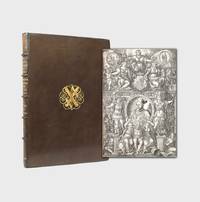
1603376588Innsbruck: Daniel Baur 1603. First edition in German after the Latin edition published in 1601. With frontispiece engraved portrait of Archduke Ferdinand II privilege on verso title page two preliminary leaves and 121 of 125 elaborate engraved portraits each with facing biographical notice printed within woodcut border. Lacking 4 leaves portraits 3 24 64 71. Two preliminary leaves printed for William Sterling Maxwell his extensive bibliographical note and index of portraits; a facsimile folding view of Innsbruck inserted after title. Full dark brown morocco spine titled in gilt upper board with Sterling Maxwell arms in gilt a.e.g. by XXXX. Sterling Maxwell's largest bookplate on front pastedown. A few portraits possibly in old facsimile or restrike. 11 leaves loose or slightly sprung a few marginal paper flaws one portrait poorly inked. First edition in German after the Latin edition published in 1601. With frontispiece engraved portrait of Archduke Ferdinand II privilege on verso title page two preliminary leaves and 121 of 125 elaborate engraved portraits each with facing biographical notice printed within woodcut border. Lacking 4 leaves portraits 3 24 64 71. Two preliminary leaves printed for William Sterling Maxwell his extensive bibliographical note and index of portraits; a facsimile folding view of Innsbruck inserted after title. The celebrated portrait gallery of the Archduke Ferdinand II of Austria with portraits of emperors kings nobles and war heroes in historic suits of armor in the Archduke's collection at Schloß Ambras. Compiled by the Archduke's secretary Schrenck von Notzing and translated into German by J.E. Noyse van Campenhouten. With an interesting full page printed bibliographical notice by Sterling Maxwell dated 1870 printed within facimile borders matching the text pages of the portraits. Colas 2691; Brunet V 224; Vinet 2046; Grässe VI 317; Lipperheide 499 Daniel Baur unknown
1603100584Innsbruck: Daniel Baur 1603. First edition in German after the Latin edition published in 1601. With frontispiece engraved portrait of Archduke Ferdinand II privilege on verso title page two preliminary leaves and 121 of 125 elaborate engraved portraits each with facing biographical notice printed within woodcut border. Lacking 4 leaves portraits 3 24 64 71. Two preliminary leaves printed for William Sterling Maxwell his extensive bibliographical note and index of portraits; a facsimile folding view of Innsbruck inserted after title. Full dark brown morocco spine titled in gilt upper board with Sterling Maxwell arms in gilt a.e.g. by XXXX. Sterling Maxwell's largest bookplate on front pastedown. A few portraits possibly in old facsimile or restrike. 11 leaves loose or slightly sprung a few marginal paper flaws one portrait poorly inked. First edition in German after the Latin edition published in 1601. With frontispiece engraved portrait of Archduke Ferdinand II privilege on verso title page two preliminary leaves and 121 of 125 elaborate engraved portraits each with facing biographical notice printed within woodcut border. Lacking 4 leaves portraits 3 24 64 71. Two preliminary leaves printed for William Sterling Maxwell his extensive bibliographical note and index of portraits; a facsimile folding view of Innsbruck inserted after title. The celebrated portrait gallery of the Archduke Ferdinand II of Austria with portraits of emperors kings nobles and war heroes in historic suits of armor in the Archduke's collection at Schloß Ambras. Compiled by the Archduke's secretary Schrenck von Notzing and translated into German by J.E. Noyse van Campenhouten. With an interesting full page printed bibliographical notice by Sterling Maxwell dated 1870 printed within facimile borders matching the text pages of the portraits. Colas 2691; Brunet V 224; Vinet 2046; Grässe VI 317; Lipperheide 499 Daniel Baur unknown books
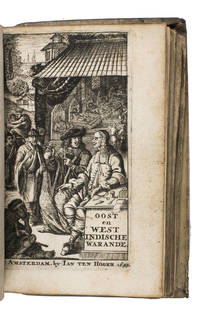
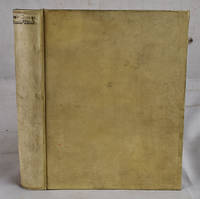
1694ABC_50174Amsterdam 1694. 8vo 14.4 x 9.1 cm. Jan ten Hoorn Contemporary blind-tooled vellum sewn on 3 supports laced through the joints with the title in brown ink on the head of the spine and sprinkled edges. Ad 1 with an engraved title page erroneously mentioning the year 1693 a small fleur-de-lis woodcut vignette on the title page a woodcut decorated initial and a woodcut tail-piece. Ad 2 with a large woodcut vignette on the title page and three woodcut decorated initials. 2 works in 1 volume. 8 304 7 1 blank 96 pp. Very rare work on medicine in the East and West Indies compiled for the use of naval and tropical surgeons including ships doctors on VOC and WIC ships. Dutch physicians Jacobus Bontius or Jacob de Bondt 1592-1631 and Willem Piso or Gulielmus Piso 1611-1678 are both considered to be the founders of the field of tropical medicine. Bontius worked in the East Indies. His chapters contain the first modern descriptions of cholera beriberi tropical dysentery and yaws. Piso worked in Brazil during the Dutch period 1630-1654. He is known for his research on local medicinal plants including the jaborandi and discovered that Brazilian lemons were particularly effective for treating scurvy. The work is very rare. According to WorldCat it is only present in a few libraries worldwide. We have also not been able to trace any other copies in sales records of the past 100 years.The present work is a Dutch translation of De medica Indorum 1642 by Bontius the first Dutch work on tropical medicine and Historia naturalis Brasiliae 1648 by Piso and Georg Markgraf also known as Georg Marcgrave or Marggraf 1610-1644 which is also considered to be a pioneering work in the field. As the present work was meant as a practical guide for surgeons only the most relevant chapters of the Latin editions have been included.This is the first Dutch edition of Piso's work but the second of Bontius'. Although most reference works do not mention this the Dutch translation of Bontius' work had already been published in 1673 as Oost-Indische warande. As a result the present work is the second edition but it is the first to combine these two pioneering works.The last work in this binding written by VOC physician Johannes Verbrugge 17th century is a catalogue of drugs that physicians should carry on their travels to the East and West Indies and includes a list of diseases that are common on those voyages and their cures. It is a logical addition to the other two works and is rarely found separately.With an ownership inscription on the first flyleaf 4 d Verwilghen Van den bussche and another on the second flyleaf Ch. Verwilghen 1829 probably referring to the Verwilghen family a notable and noble Belgian family originating from the Waasland region. Further with a small wormhole in the upper margin not affecting the text very slight browning and foxing throughout and the upper support is slightly loosened for the quires in the second half of the work. Otherwise in good condition.l Krivatsy 1500; Landwehr VOC 829; Sabin 6341; STCN 102642796 3 copies incl. 1 incomplete; USTC 1838762 4 copies; WorldCat 1154809136 9 copies; cf. Borba de Moraes II p. 676 different ed.; Garrison & Morrison 2263 and 2263.1 different eds. hardcover
16162602240004Bey Paul Jacobi in Verlegung des Auctoris Franckfurt 1616. First Edition. Hardcover. Good. First edition of one of the earliest military manuals printed in Europe. Handsomely bound in later vellum. Short 4to; 21 cm. Fine binding and cover. 8 195 32 pages 19 fold out page. Illustrated title-page with engraved border. 19 double-page engravings depicting soldier formations and munitions. Generally clean. Minor spotting. Light dampstain at bottom margin effecting some of the early pages. Marginal loss to p. 80; loss to bottom corner p. 102 partially affecting text. Cockle 622. Klara Andresova 2019 "Military Camps in Military Manuals" in Alexander Samuel Wilkinson; Graeme Kemp eds. Negotiating Conflict and Controversy in the Early Modern Book World Brill pp. 163–177. <br> Johann Jacob served in the army of Maurice Price of Orange and fought in the Eighty Years' War in the Netherlands. He later served as an offer in Danzig and in Hungary and Russia. In 1616 he was appointed by Count John VII of Nassau-Siegen to head up the newly established Kriegsschule the first military academy in the world. The outbreak of the 30 Years War in Germany prematurely caused the school to close. Jacob was one of the most important German military writers before the 30 years war. Bey Paul Jacobi, in Verlegung des Auctoris, Franckfurt hardcover
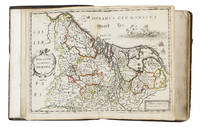
16525476Antwerp 1652. 4to 18 x 14.5 cm. Jan Huyssens Later 17th-century mottled calf sewn on 4 double cords gold-tooled spine and board edges. With a double-page letterpress title-page with a frame built up from typographic ornaments and 39 unnumbered double-page engraved maps of the northern and southern Low Countries by Jacob Aertsz. Colom each map coloured in outline. Interleaved with 38 blank leaves and with a manuscript table of contents 3 3 blank pp. at the end. Double-page title-page and 39 double-page maps. Second known copy of a pocket-atlas published at Antwerp but containing a selection of the maps of the Low Countries originally published by Jacob Aertsz. Colom at Amsterdam in 1635 with the title De Vyerighe Colom the title Colom had first used for his famous pilot guide in 1632 and the name he had given to his Amsterdam printing office where he worked from 1622 to his death in 1673 as a bookseller printer and mapmaker. The only other copy known is at the Royal Library in Brussels. The Vyerighe Colom with 47 maps and 3 plates and with extensive text in Dutch and French went through several editions in the 17th century but it was once thought that all editions before his death in 1673 had been published at Amsterdam by Colom himself. The Royal Library copy like the present one contains 39 maps but each contains one map not in the other so there are forty in total: the present copy includes Drentiae not in the Royal Library copy which includes Le terres entre la Meuse Vahal et Rhin not present here. The maps are also bound in a different order.The present edition is of great interest and gives cause to review Colom's activities. It is printed from Coloms plates so Colom may have licenced the Antwerp publisher to produce a variant edition of his Vyerighe Colom to broaden his market possibly reacting to the signing of the Peace of Münster in 1648 which finally ended the Eighty Years War and opened trade and communication between the northern and southern Low Countries. Jan Huyssens made an entirely new and practical atlas out of Colom's Vyerighe Colom. He omitted all text and the three plates that do not show maps and selected only maps of general interest leaving out the map of the ancient Low Countries and such typical Dutch maps as the separate maps of the polders De Zype Beemster Wormer Purmer Byllemermeer and Waterland also - at least in the present copy - completely rearranging the maps more in order of their geographical sequence. The title suggests that Huyssens originally planned to include a text so the present extremely rare edition may be the only surviving result of an abandoned project.l Koeman & Van der Krogt 365.23 IIIB pp. 644-645 2 copies: the present & Royal Library Brussels; UniCat 99095764 Royal Library Brussels only; cf. Koeman II Col 1 1635 Amsterdam ed.; not in KVK; STCV; WorldCat. unknown
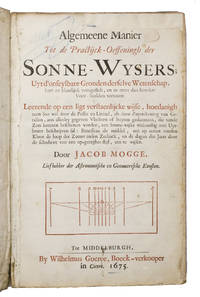
167599PCHI08WBVRMiddelburg 1675. Small folio 28.5 x 18.5 cm. Willem Goeree Early sheepskin parchment over paperboards. With both title-pages printed in red and black about 150 woodcut diagrams in the text including a wide variety of sundials a woodcut headpiece with the Zeeland coat of arms plus 2 repeats and woodcut decorated initials. 2 works in 1 volume. 1 1 blank 2 108 3 1 blank; 1 1 blank 54 2 pp. Re-issues by Willem Goeree in Middelburg of the first editions of Jacob Mogge's extensively illustrated general introduction to the making and use of sundials and of his extensively illustrated translation of Lansberge's further account of various sorts of sundials on flat surfaces. Mogge's own work was first published by Zacharias Roman in Middelburg as Inleydinge der Sonne-Wijsers in 1666. Roman had published the first edition of Lansberge's posthumous Latin work on planar sundials Horologiographia plana in 1663 and Mogge translated it into Dutch and expanded it for publication together with his own work in matching format and style in 1666. Roman apparently died in or soon after 1667 however and Goeree must have acquired the remaining stock of these two books having cancel title-pages printed to re-issue them in 1675. They therefore still include the colophons of the 1666 editions at the end. Mogge opens his work with a general introduction to geometry and astronomy followed by a description of sundials on a flat surfaces and on the surface of the earth. Jacob Mogge ca. 1613-1669 was a surveyor and map draughtsman active in Zeeland from ca. 1649 to ca. 1666 describing himself as surveyor to the water district Vrije van Sluis. Lansberge 1561-1632 worked as physician and pastor in Middelburg Zeeland but devoted his last years to writing and publishing several important works on astronomy.With a faded manuscript inscription on the title-page in blue pencil. The binding is soiled and shows clear signs of wear the bottom half of the spine has been restored. A previous owner's inscription has been torn from the head of the title-page which has been restored but slightly affecting the "M" in the title. The edges of the leaves are somewhat browned slight browning throughout with some occasional light water stains some occasional minor marginal tears. Otherwise in good condition.l Ad 1: Bierens de Haan 3286; Crone Library 283; Houzeau-Lancaster 11524; STCN 822714299 8 copies; Ad 2: Bierens de Haan 2676; Crone Library 281; Houzeau-Lancaster 11499; STCN 822714434 8 copies; cf. for Mogge: Donkersloot-De Vrij p. 205; for Lansberge: NNBW II cols. 775-782. ABE CAT Astronomy & Cosmography hardcover
1699210071699. Ed. secunda. - Genf Chouet & Ritter 1699 Folio 28 124 1072 pp. 2 1233 pp. mit vielen Holzschnitten u. 124 davon 9 doppelseitig u. gefalt ganzseitigen Kupfertafeln Pergamenteinband d.Zt.; etwas gebräunt wie üblich. Second Edition! This edition contains significant additions and revisions to this "extraordinary storehouse of seventeenth century anatomical works" Russell 524 which was first published in 1685. The impressive collection with its striking engraved title and 124 plates based on original sources gathers in a single work the most important discoveries of the seventeenth century the period which laid the foundation for modern anatomy and physiology. ALL THE BST IN SEVENTEENTH CENTURY OF MEDICINE - "Here are Harvey's important embryological work 'De generatione animalium' 1551 as well as his treatise on the circulation of the blood with the four figures and also Malpighi's discovery 1651 of the capillary anastomosis in the lungs which supplied the missing link in Harvey's demonstration; . Olof Rudbeck's work on the lymphatics illustrated with nineteen figures on three folio plates; and the works of Pecquet and Bartholin. Here is given s short list of some of the more important works: Asseli discovery of the lacteal vessels 1617 Thomas Wharton's description of the duct of the submaxillary salivary gland Wharton's duct Zambeccari's proof that the spleen is not essential to life; Borelli's 'De moti animallium' 1680 on the application of mechanics to the motion of the limbs of animals Niels Stensen's papers on the muscular mechanics and his account of the excretory duct of the parotid gland Stensen's duct John Mayow's classic on the physiology of respiration 1674 DuVerney's account of the structure function and diseases of the ear and Schelhammer's account of the physiology of hearing Thomas Willi's on the circle of Willis; Richard lower treatise on the heart 1669 and the first blood transfulsion Francis Glisson's first accurate description of the capsulae of the liver Glisson's capsule Regnier de Graaf's detailed description of the male and female reproductive system including the first account of 'Grafiaan follicle' and his work on pancreatic secretion Malpighi's and Swammerdam's many excellent discoveries whit microscope to name but a few. Jean Jacques Manget 1652-1742 practised in Geneva with great success. In 1699 the Elector of Brandenburg made him his first physician. His literary work in which he was assisted by Daniel Le Clerc 1652-1728 chiefly consisted of collecting and reprinting in large volumes important treatises on medicine anatomy and chemistry. Le Clerc is sometimes called the "Father of the History of Medicine" because he wrote the first large history of medicine. That valuable and still consulted work was first published in 1696. Waller 5663; Haller Bibl. Anatomica I 803-04; Keynes Harvey no.45; Neu 2263; Hahn & Dumaitre 218; Osler 3192; Hahn & Dumaitre 218 describing the Baroque engraved title and reproducing it 226; Parkinson-Lumb 1422 lists complete content unknown
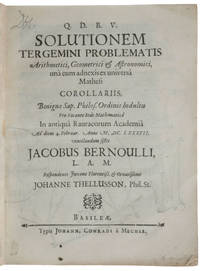
16875601Basel: Mechel 1687. First edition. First edition exceptionally rare of this dissertation which Bernoulli 1655-1705 submitted in order to secure the chair of mathematics at the University of Basel. This was the beginning of a remarkable career in mathematics in which he "greatly advanced algebra the infinitesimal calculus the calculus of variations mechanics the theory of series and the theory of probability and was one of the most significant promoters of the formal methods of higher analysis" DSB. EXCEPTIONALLY RARE DISSERTATION BY JACOB BERNOULLI. <p>First edition exceptionally rare of this dissertation which Bernoulli 1655-1705 submitted in order to secure the chair of mathematics at the University of Basel. This was the beginning of a remarkable career in mathematics in which he "greatly advanced algebra the infinitesimal calculus the calculus of variations mechanics the theory of series and the theory of probability and was one of the most significant promoters of the formal methods of higher analysis" DSB. The dissertation 'The solution of a triplet of problems arithmetical geometrical and astronomical together with corollaries from general mathematics' treats three elementary problems in number theory one arising from arithmetic one from geometry and one from astronomy/navigation. "Jacob Bernoulli's research on elementary mathematics taken as a whole constitutes a work of no mean importance very diverse in content lacking organic unity to be sure but also of exceptional historic interest. Indeed only from very few of the mathematicians who have left a lasting mark do we have the documentation which allows us to examine carefully the process of their scientific education . However in contrast from Jacob Bernoulli we actually possess some 'exercises' that he wrote beginning during the early years of his education. This is how we might characterize some of his Meditationes which he worked on with great diligence and singular ability. The interest of these exercises lies not only in their relationship to the general state of mathematics of the time but also and perhaps more in the way in which they represent an almost complete psychological picture of the formation of a great mathematician - which he certainly was - toward the end of the XVIIth century" Werke 2 p. 15. These Meditationes remained unpublished until the twentieth century except for the three published with much additional detail in the present pamphlet. On the last page of the dissertation is a list of 'Corollaries' one of which concerns the values of expectations in a lottery and is of particular interest in view of Bernoulli's posthumously-published Ars conjectandi 1713 the founding work of mathematical probability. "The academic dissertation Solutionem tergemini problematis arithmetici geometrici et astronomici which was presented at the University of Basel 4.2.1687 secured him the desired teaching post. Therefore this paper has particular biographical interest" ibid. p. 18. OCLC lists only 5 copies worldwide Yale only in US; not on COPAC.</p> <br /> <p>"Let us recall briefly what we know of Jacob Bernoulli's education before he obtained at the age of34 the chair in mathematics in his hometown Basel. Jacob was born in this city on December27th 1654 according to the old calendar in a protestant family of spice traders who had fled theSpanish low lands after the fall of the Duke of Alba. Complying with the wish of his father NicolasBernoulli a state adviser and magistrate Jacob studied philosophy and then theology until 1676. Aswas common at the time he chose a motto. His came from Phaeton who drew the solar carriageInvito patre sidera verso which may be translated by 'Despite my father I am among thestars'. Rather than exaggerated modesty this motto was a proud affirmation of superiority.</p> <br /> <p>"The young Jacob fully benefited from what Daniel Roche calls 'culture de la mobilité' promoted in the second half of the XVII century by new institutions which facilitated the movement of individuals and the spread of knowledge. Starting in August 1676 he traveled by horse to Geneva where he remained for twenty months preaching instructing a blind young girl Elisabeth von Waldkirch and serving as an opponent during the theological disputations. He relates his experience teaching mathematics to the blind in an article published in the Journal des Savants in 1685. This article is probably a reaction to an account by Spon published in the same journal in 1680 in which the author attributes to the father of the blind girl the writing system that was in fact developed by Jacob. It is here that Jacob meets Nicolas Fatio de Duillier a life long friend who recalled in a letter dating from July 22nd 1700 that he had seen Jacob play court tennis in Geneva a game on which Jacob later wrote a famous letter . </p> <br /> <p>"In June 1678 Jacob continues his extensive traveling in France residing in the Limousin in Nède with the marquis de Lostanges where he constructs two sundials in the castle courtyard then in Bordeaux and a few weeks in Paris. During this journey he begins in 1677 to write his mathematical journal Meditationes annotationes animadversiones theologicae et philosophicae which contains 236 articles . The journal is a precious testimony from this early phase of Jacob's scientific training which only really began when he encountered the Cartesian environment initially in France later mainly in the Netherlands Amsterdam and Leiden and in England during a second journey April 1681- October 1682. In August 1682 Jacob attended a meeting of the Royal Society in London. Jacob started out by acquainting himself with the Cartesian philosophy of nature after which he turned to geometry .</p> <br /> <p>"After his return to Basel in 1682 Jacob gave up the idea of a career in the clergy and decided to devote himself to mathematics. At the University of Basel he gave courses in experimental physics as can be gathered by a pamphlet printed in Basel in 1686. From 1682 on he also submitted short articles to the Journal des Savants - reactions to the works of others that he presented or criticized - initially in the area of natural philosophy machines for breathing under water to elevate water to weigh air oscillation center then from 1685 in mathematics .</p> <br /> <p>"Jacob slowly acquired a knowledge of mathematics at first through his readings of the second Latin edition of Descartes' Géométrie 1659-61 later that of Arnauld and his Logique Malebranche and Prestet . Jacob is confronted with precise problems often stemming from the area of applied mathematics. Solving these leads him to discover general methods. He begins by a thorough study of previous works which will serve him as a springboard to make further headway and produce new results. On several occasions Jacob voices the opinion that it is necessary to base one's own progress on the knowledge of what has been done in the past. Accordingly in the memoir entitled Solutionem tergemini problematis arithmetici geometrici et astronomici offered here presented on February 4th 1687 in order to obtain the mathematics chair in Basel he describes his own way of proceeding in the following way: 'In reality he who embraces a career as a mathematician is not the one who copies the inventions of others remembers them and recites them on occasion but the one who is truly innovative and is able to invent by using the divine algebra and thus to revolutionize what has been studied by others'" Peiffer.</p> <br /> <p>"Like other graduates of the University of Basel in the seventeenth century Bernoulli had a broad if not deep knowledge of all the disciplines of the liberal arts - an education he would draw on in writing Ars conjectandi 1713. The university at this time had a small faculty of philosophy including only nine chairs in logic rhetoric eloquence Greek mathematics physics history ethics and Hebrew. So although he had only an elementary education in mathematics as an undergraduate Bernoulli had a knowledge of Greek logic rhetoric and other subjects and was able to write polished Latin.</p> <br /> <p>"It was not uncommon at this time for a man to take a university post in a less desirable discipline if the chair he would have preferred was not available. He would then move if the opportunity arose to the preferred discipline without having to do everything required of a new applicant for a university position such as paying to print lists of theses to be defended in a disputation . The lists of theses that Jacob Bernoulli proposed to defend publicly in the years after his return to Basel in October 1682 reflect this list of open positions. Thus in January 1684 of the 100 theses that Bernoulli proposed to defend 34 were logical and 18 oratorical . Again in September 1685 and in February 1686 Bernoulli's theses were heavily logical. Finally after the death of the professor of mathematics in 1686 Bernoulli applied for disputed and won the chair" Sylla pp. 6-7.</p> <br /> <p>The first of the three problems treated by Bernoulli in his Solutionem tergemini problematis is: 'to find without the aid of algebra with the help of numerical arithmetic alone a number such that if we divide it into the numbers 12 and 36 and then add 8 to each of these numbers the resulting sums are in the ratio of 3 to 5.' The problem is generalized to arbitrary sets of given numbers.</p> <br /> <p>The second problem is more challenging. It "calls for the construction of a quadrilateral inscribed in a semi-circle with sides and diagonals of rational lengths in other words commensurable to the radius" Werke 2 p. 18.</p> <br /> <p>The third problem is one which could arise in navigation: 'It is observed somewhere at the sixth hour of the sun that it has an altitude of 12 degrees above the horizon and that one hour and 12 minutes after the moment of this observation the sun sets. The question is at what latitude and at what time of the year was the observation made'</p> <br /> <p>On the last page of text under 'Corollaria' Bernoulli lists some of his other Meditationes - problems dealing with logic physics meteorology geometry referring to Propositions 55-57 of Euclid Book X stereometry mechanics perpetual motion machines dioptrics perspective referring to Bosse and Desargues gnomonics referring to Münster and Sturm ballistics 'ars conjecturandi' probability and figurate numbers giving the very large example 1580972.</p> <br /> <p>The problem on probability "concerned the slowness with which the values of expectations in a lottery increase as more and more blank slips are drawn out of the urn. In an urn containing 16000 slips if it initially cost 7½ to participate 1000 blank slips in a row would have to be drawn out before the person could sell his expectation to someone else for 8" Sylla p. 27.</p> <br /> <p>Peiffer 'Jacob Bernoulli teacher and rival of his brother Johann' Electronic Journal for History of Probability and Statistics 2 2006. Sylla tr. Jacob Bernoulli. The Art of Conjecturing 2006.</p> <br/> <br/> Small 4to 198 x 156 mm pp. 16 including a full page of geometrical diagrams printed on title verso. Contemporary marbled wrappers. Mechel unknown
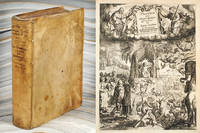
16271048964to. Rotterdam: Bij Pieter van Waesberge 1627. 4to 7 parts in one -- 5 parts as called for in Landwehr plus two additional titles bound in at rear as follows: 8 1-35 1 blank 1-315 1; 1-91 1; 1-46 2; 1-2 3-28; 1-2 3-48 6 2 engraved frontis 49-55 1; 36 1-119 1; 16 1-49 29 pp. 109 engravings through the 7 parts as follows: the wonderful engraved title page and 52 emblems in Sinne ende Minne Belden; 43 circular copperplate engraved emblems in Emblemata Moralia; full-page engraving of Phyllis in the Argumentum; a portrait and 4 engravings in Galathee. Full 17th-century vellum expectably soiled yapped fore edges some wear at top of front cover. Manuscript title on backstrip. Parts bound out of order according to Landwehr but complete. A few notable but hardly bothersome defects: A2 with short marginal tear; I3r-I4v small hole; M1 small hole; P1 hole; 2a1-2a4 minor worming; ii marginal tear; Nn4 burn hole in image; marginal dampstaining through a handful of gatherings; a lone stamp from the Los Angeles University of International Relations seen at the top of the final leaf of text. Occasional offsetting; some leaves darkened. Very good. § The only edition of Proteus published in 4to format and containing Cats’ love-emblems with the addition of their English translation done by Josuah Sylvester. Also included is a separate portfolio of 80 additional emblems and allegorical symbols most likely extracted from the 1618 Middelburg first edition of Jacob Cats’ Silenus Alcibiadis sive Proteus Vitae Humanae ideam Emblemate. These are perfect for display or study apart from the text and are in very good condition. Bij Pieter van Waesberge hardcover books
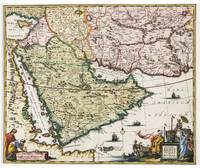
1680G1ADMF4MUJWBAmsterdam 1680. Engraved map 30 x 35 cm contemporarily hand-coloured. Matted. A copy of the De Witt map of Arabia with fine cartouches.l Al Ankary 79; Tibbetts 137. unknown
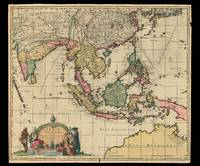
169617550Amsterdam c1696. 550 by 635mm. 21.75 by 25 inches. Maps""Indiae Orientalis One of only three examples known Engraved map with contemporary hand-colour in full. Rare printing by Jacob de la Feuille 1668-1719 son of Daniel de la Feuille of Nicolas Visscher's 1670 map of Southeast Asia. The map extends to include India Ceylon the Maldives part of China the East Indies the Philippines southern Persia and the northern coast of Australia depicted as """"Hollandia Nova"""". Jacob de Feuille acquired a number of engraved cartographical plates through his marriage in 1696 to Maria de Ram the widow of Johannes de Ram 1648-93 and this map is clearly printed from the same plate as de Ram's map of the same title c1683 with Feuille's name substituted for de Ram's. It is also almost identical to De Wit's 1688 map of the same title. In his imprint de Wit describes the map as """"Editia"""" edited by him whereas both de Ram and Feuille in their imprints attest that the map is """"Auctore"""" authored by them implying that the de Ram / Feuille map precedes de Wit's. De Wit's 'Tabula Indiae Orientalis emendata' of the same area was published in 1662. However Jacob de la Feuille's honour cannot be depended upon. The year following his marriage """"he was already in trouble for he was brought to court accused of having raped his housemaid. A notary act of 1711 registers the complaint of his wife that he left her five years earlier in a poor state and that his present whereabouts were unknown"""" Burden 577. Exceptionally rare: only known in two other examples: bound in a Frederick De Wit composite atlas at the Newberry Library; and in the National Library of Australia. Tooley I 566 Feuille II 35 de Wit unknown
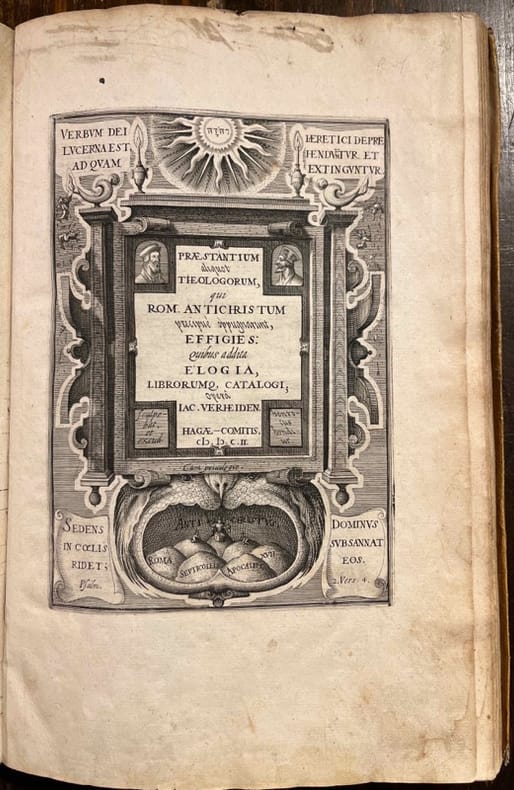
1602177786The Hague: ex officina Bucoldi Cornelii Nieulandii 1602. A portrait gallery of the Reformation First edition a compendium of 50 attractively engraved portraits of famous Protestant theologians each paired with a detailed biography and a list of their works. The illustrator was Henrick Hondius I 1573-1650 one of the most prominent engravers and cartographers in The Hague. This work is uncommon complete with all 50 portraits copies in commerce often lacking gathering "" comprising 2 leaves with the portrait of Berengarius. Hondius's portrait series sometimes referred to in English as "Celebrated Reformers and Men of the Religion" was first published without text in 1599. The artist then collaborated with Verheiden and the printer Nieulandt to include the portraits in this book. The series features all the major Protestant reformers such as Erasmus Luther Melanchthon Zwingli Calvin Theodore Beza John Knox Peter Martyr and Geronimo Savonarola. "The stylistic variation among the portraits may be due to the range of pictorial sources that Hondius seems to have relied upon for depicting each reformer. The portrait of Melanchton for example derives from the well-known portrait engraving by Durer of 1526. thus the entire series seems to have been engraved by Hondius himself during a period in which his style was in the process of transformation" Orenstein p. 64. Other sources of inspiration were the painter Hans Hasper and the engraver Jacques the Gheyn II. Provenance: Henry Yelverton Viscount of Longueville 1664-1704 with his monogram on the covers. Yelverton matriculated at Christ Church Oxford in 1680 but did not graduate and later supported William of Orange during his invasion in 1688. "Yelverton amassed a substantial library whose extent is not known but many volumes are traceable today in libraries around the world in English Latin Italian and Spanish with imprints from the early 16th century to the late 17th. Yelverton's stamp was often applied to books irrespective of their binding when acquired" Book Owners online. A manuscript index of contents was compiled on the final blank leaf of this copy by a late 17th-century hand perhaps by the viscount himself. Folio 302 x 198 mm: 852 A-2C4 2D6 2E4; 122 leaves pp. xvi 226 2. Elaborate engraved architectural frontispiece 50 engraved portraits similar allegorical plate. Contemporary vellum over thin boards flat spine lettered in early manuscript black monogram stamp "HL" surmounted by a viscount's coronet of Henry Yelverton 1664-1704 on both covers yapp fore-edges edges sprinkled red remnants of blue silk ties. Couple of minor near-contemporary marginalia. Head of front joint split but firm a little loss at foot of spine covers slightly bowed tiny rust burn on leaf V2 slightly affecting portrait and a couple of letters small faint damp stain in margin of 3 final leaves. A clean and well-margined copy. Pelc Illustrium Imagines 166; STCN 851224962. Nadine Orenstein Hendrick Hondius and the Business of Prints in Seventeenth-Century Holland 1996. hardcover
1679291101Paris: Chez Estienne Michallet 1679. Hardcover. Near Fine. First edition. Small octavo. 288pp. Folding map. Rebound in lovely 19th Century green morocco gilt with elaborately decorated dentelles. One ink letter on a preliminary leaf and ink correction in errata else very near fine. Guillet's response to Spon's criticism of his brother-in-law's book on Greece. OCLC locates three copies only one in the U.S. and none in France. Chez Estienne Michallet hardcover
169141859Leipzig, Grosse & Gleditsch, 1691. 4to. Contemp. full vellum. Faint handwritten title on spine. a small stamp on titlepage. In: ""Acta Eruditorum Anno MDCLXXXXI"". (8),590,(6) pp. and 13 (of 15) folded engraved plates. The 2 first plates lacks, but they do not belong to the papers listed.Leibniz' papers: pp.277-281 a. 1 plate, pp. 435-439. Johann Bernoulli: pp. 274-276 a. 1 plate. Huygens: pp. 281-282. - Jacob Bernoulli: pp. 282-290 a. 1 plate.
169141859Leipzig Grosse & Gleditsch 1691. 4to. Contemp. full vellum. Faint handwritten title on spine. a small stamp on titlepage. In: "Acta Eruditorum Anno MDCLXXXXI". 85906 pp. and 13 of 15 folded engraved plates. The 2 first plates lacks but they do not belong to the papers listed.Leibniz' papers: pp.277-281 a. 1 plate pp. 435-439. Johann Bernoulli: pp. 274-276 a. 1 plate. Huygens: pp. 281-282. - Jacob Bernoulli: pp. 282-290 a. 1 plate. <br/><br/><em>All papers first apperance. All 5 of extreme importence in the development of the Calculus. Leibniz' 2 papers on the catenary curve paper 1-2 offered here was written at the instigation of Jacques Bernoulli. Following the example of Blaise Pascal who had initiated in 1658 a contest for the construction of the cycloid Leibniz also provoked the geometers of his time by challenging them to submit at the fixed date of mid-1691 their geometric method for the construction of the catenary curve. Leibniz later provided the answer followed by Johann Bernoulli and Huygens.'These two papers are a historical account of the origin of the study of this transcendental curve and at the same time the first physical-geometric construction showing the species-relationship between the catenary and the logarithmic curves as two companion curves; one arithmetic the other geometric. All of the differentials of the catenary curve are arithmetic means of corresponding differentials of the logarithmic curve; and all of the differentials of the logarithmic curve are geometric means of the catenary.'"The Catenary is the form of a hanging fully flexible rope or chain the name comes from "catena" which means 'chain' suspended on two points. The interest in this curve originated with Galileo who thought that is was a parabola. Young Christiaan Huygens proved in 1646 that this cannot be the case. What the actual form was remained an open question till 1691 when Leibniz Johann Bernoulli and the then much older Huygens sent solutions to the problem to the "Acta" Jakob Bernoulli 1690 Johann Bernoulli 1691 Huygens 1691 and Leibniz 1691 - these 4 1691-papers offered here - in which the previous year Jakob Bernoulli had challenged mathematicians to solve it. As published the solutions did not reveal the methods but through later publications of manuscripts these methods have been known. Huygens applied with great paper 4 virtuosity the by then classical methods of 17th century infinitesimal mathematics and he needed all his ingenuity to reach a satisfactory solution. Leibniz the papers 1-2 and Bernoulli paper 3 applying the new Calculus found the solutions in a much direct way. In fact the catenary was a test-case between the old and the new style in the study of curves and only because the champion of the old style was a giant like Huygens the test-case can formally be considered as ending in a draw." Grattan-Guiness in "From the Calculus to Set Theory 1630-1910.".The paper by JACOB BERNOULLI no. 5 offered here is a milestone papers as it marks the invention of the "SYSTEM OF POLAR COORDINATES" with points located by reference to a fixed point and a line through that point. Although newton had earlier also devised such a coordinate system in 1671 his work was not known so that the credit for the discovery generally goes to Bernoulli. Parkinson Breakthroughs 1691.Further papers contained in this volume of Acta Eruditorum:DENYS PAPIN: Mecanicorum de Viribus Motricibus sententia asserta a D. Papino adversius C.G.G. L. Leibniz objectiones. pp. 6-13. The plate lacks. - and Dion. Papini Observationes quaedam circa materias ad Hydraulicam spectantes. Pp. 208-213 a. 1 plate. This importent paper is part of the LEIBNIZ-PAPIN-CONTROVERSY.JACOB BERNOULLI: Specimen Calculi Differentialis in dimensione Parabolæ helicoidis ubi de flexuris curvarum in genere carundem evolutionibus. Pp. 13-22. The plate lacks. - and J.B. Demonstratio Centri Oscillationis ex Natura Vectis reperta occassione eorum quæ super hac materia in Historia Literaria Roterodamensi recensentur articulo.Pp.317-321.LEIBNIZ: O.V.E. Additio ad Schediasma de Medii Resistentia publicatum in Actis mensis Febr. 1889. Pp. 177-178. and O.V.E. Quadratura Arithmetica Communis Sectionum Conicarum quæ centrum babent.Pp. 178-182 a. 1 plate.TSCHIRNHAUS: Singularia Effecta Vitri Caustici bipedalis quod omnia magno sumtu hactenus constructa specula ustoria virtute superat per D.T. Pp. 517-520 </em> hardcover
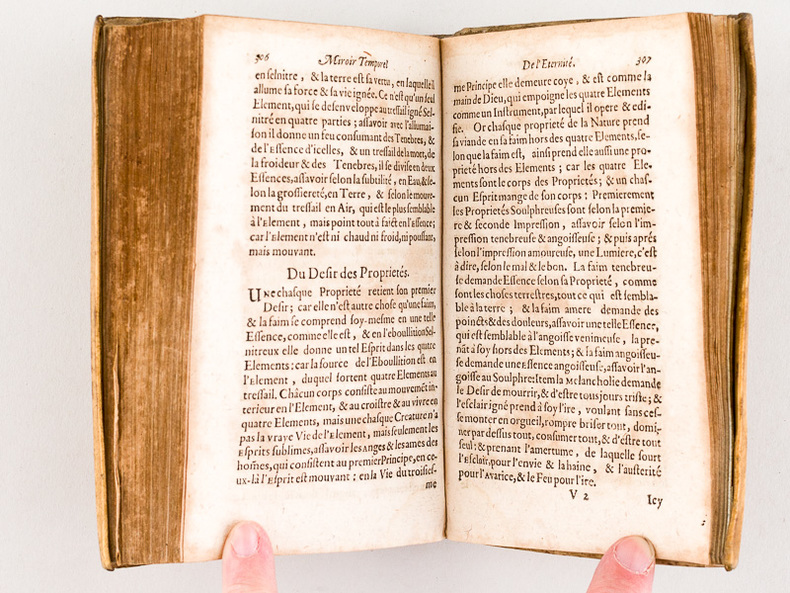
166458245Escrit par Iacob Boehm, nomae Philosophiis Teutonicus, et traduit de l'Allemand en François par le Sr: Jean Maclé, Docteur & Medecin tres-celebre, 1 vol. petit in-8 reliure de l'époque plein velin à recouvrement partiel, mis en lumière par C: le Blon à Ffort au Main [ Francfort ], 1664, 1 f. (titre gravé), 359 pp., 2 ff. blancs. Rappel du titre complet : De Signaturarerum c'est à dire De la Signature de Toutes Choses, comment l'intérieur est marqué par l'Extérieur. Vray Miroir Temporel de l'Eternité [ De Signatura Rerum ] Miroir Temporel de L'Eternité : Auquel est représenté Comment toutes choses sont marquées exterieurement selon leur forme interieure : Comment ce Monde visible, qui comprend kes Astres, les Animaux, Vegetaux & Mineraux, nous conduit en celuy qui est invisible : Comment le sublime procés Philosophal nous descouvre notre Regeneration
160216378Hagae Comitis [La Haye], Ex officina Bucoldi Cornelii Nieulandii, 1602. In-folio de [12]-226 pages [*6; A-Z4;Aa-Cc4; Dd6-Ee3], plein vélin à rabats, étiquette de titre manuscrite (en vélin), traces d'attaches. Ex-libris JFC, inscription ancienne au verso du titre.
165140032London: John Macock for Giles Calvert 1651. 4to. 7 1/8 x 5 3/8 inches. 8 224 pp. Bound to style in half calf marble paper boards spine with raised bands in six compartments with ruled lines and center tool red lettering piece in second compartment.<br/> <br/> Rare first English edition of Jacob Böhme's a groundbreaking work of Christian mysticism translated by J. Ellistone which reveals the hidden connections between the material and spiritual worlds through its exploration of the signatures imprinted on all of creation.<br/> <br/> At once leatherworker mystic and founder of modern theosophy Böhme published little in his lifetime and what was published brought him endless trouble with the Church. Despite this Böhme had a profound influence on later philosophical movements such as German Idealism and German Romanticism with Hegel describing him as "the first German philosopher". Böhme was born in Alt Seidenberg now in present-day Poland. Deemed too weak for husbandry Böhme was sent to Seidenberg as an apprentice to become a shoemaker. While he lived with a family who was not Christian Böhme regularly prayed and read the Bible and consumed the works of visionaries such as Paracelsus Weigel and Schwenckfeld. After leaving his apprenticeship Böhme travelled as far as Görlitz before returning as a master craftsman to set up his own workshop and started a family. Böhme later joined the "Conventicle of God's Real Servants" - a parochial study group organized by poet and mystic Martin Moller. Since his youth Böhme often had spiritual experiences including one that occurred while he was travelling for business where as he later recalled was "surrounded with a divine light and stood in the highest contemplation and kingdom of joys." This title The Signature of All Things written in High Dutch in 1622 following a series of Böhme's mystic experiences appears here in the first English edition. In it Böhme explains systematically the cosmology that lies at the heart of his whole mystical approach and experience revealing his mystical pantheism and his dialectical conception of God in which good and evil are rooted in one and the same being. The book is a highly symbolic work that deals with the nature of God creation and the relationship between the spiritual and physical worlds. In brief Böhme's thesis can be summarised thus: everything in the material world bears the imprint or "signature" of its spiritual counterpart and that by understanding these signatures one can gain insight into the divine. The present work is the title for which Böhme is most famous and it is invoked by James Joyce in the Proteus episode in Ulysses "Ineluctable modality of the visible." Bohme's ideas had a significant influence on later mystics philosophers and theologians including Goethe Nietzsche and Jung. Signatura Rerum remains a classic work of Christian mysticism and esoteric philosophy and is still studied and debated by scholars and practitioners today.<br/> <br/> Wing B3419; Bach "Jacob Boehme" in Protestants and Mysticism in Reformation Europe; Hartman The Life and the Doctrines of Jacob Boehme the God-Taught Philosopher. John Macock for Giles Calvert unknown
167219314Nuremburg: Johann Daniel Tauber 1672. Enlarged edition. Hardcover. Later quarter vellum and boards. Very good. 30.5 x 21 cm. 312 22 a-d6 B-P6Q4. Full page engraving of ship at sea by Boner frontispiece portrait of Saar title page in black and red one leaf with two engravings 12 engravings in the text floriated chapter head designs. First published 1662 this an enlarged edition. Saar was employed as a mercenary for the East India Company spending 15 years in South East Asia including Indonesia and Ceylon. He died at age 38 in the battle of Mogersdorf. Most of Saar's descriptions relate to Ceylon. The publisher also added other contemporary accounts to help authenticate Saar's accounts. Scattered text toning ex-library stamp effaced from head of title page title page slightly chipped fore-edge and foot dampstain lower corners M-M4. Johann Daniel Tauber hardcover books
167219314Nuremburg: Johann Daniel Tauber 1672. Enlarged edition. Hardcover. Later quarter vellum and boards. Very good. 30.5 x 21 cm. 312 22 a-d6 B-P6Q4. Full page engraving of ship at sea by Boner frontispiece portrait of Saar title page in black and red one leaf with two engravings 12 engravings in the text floriated chapter head designs. First published 1662 this an enlarged edition. Saar was employed as a mercenary for the East India Company spending 15 years in South East Asia including Indonesia and Ceylon. He died at age 38 in the battle of Mogersdorf. Most of Saar's descriptions relate to Ceylon. The publisher also added other contemporary accounts to help authenticate Saar's accounts. Scattered text toning ex-library stamp effaced from head of title page title page slightly chipped fore-edge and foot dampstain lower corners M-M4. Johann Daniel Tauber hardcover
16606191660. With 47 full-page engraved maps and 3 full-page plates with portraits. 2 Blank pages / 4 Pages / 14 NNP / 223 Pages / 2 NNP / 3 Blank pages / 47 Maps / 3 Engraved Plates This book can only be viewed by appointment. Binding: Contemporary Full Leather Octavo 8vo Height cm: 22 CM Width cm: 29 CM Thickness cm: 4 CM hardcover
1695621831695. Halae : Typis Christophori Salfeldi 1695 Kl.4° 16 6 pp. marmor. Broschur; feines Expl. Sehr Selten - Erste Ausgabe! Die hier vorliegenden "Disputatio de passionibus animi" "Über den mannigfaltigen Einfluß von Gemütsbewegungen auf den menschlichen Körper" zeigt daß es Stahl schon zum Beginn seines Wirkens in Halle seit 1694 also um das Problem der psychophysischen Wechselwirkung gegangen ist. Er hat seine Bedeutung seine Auswirkung in der Praxis beobachtet. Man findet hier die Grundlagen der medizinischen Psychologie. Es werden Beispiele für den Einfluß seelischer Erregungen auf den menschlichen Organismus angeführt. In der Einleitung wird hervor gehoben: "So leiten sich von den Leidenschaften des Gemütes in ihrer vielfältigen Bestimmung Leitung oder Änderungen der Bewegungen des menschlichen Körpers auch viele Krankheitsanzeichen her." Die Mehrschichtigkeit seelischer Alterationsstufen das Unverlierbare besonders tiefe Eindrücke wird in der Vorahnung späterer Erkenntnisse Freudausgesprochen: Zugegeben sei "daß der im Erbgang geprägte Prototyp der Leidenschaften und Neigungen des Gemüthes in gewohnheitsmäßiger Festigung nicht ganz umgekehrt werden kann" so vermag doch "die domminierendende Leidenschaft durch eine ihr entgegengesetzte Gewohnheit an die zweite oder gar dritte Stelle verdrängt werden wo sie zwar noch innerhalb der Ordnungen steht gleichwohl ihre Rangstufe wechselt." Es liegt dem in nuce die Idee von der Verdrängung zugrunde. Es wird schließlich empfohlen die psychologischen Beobachtungen bei der Behandlung der Patienten nützlich anzuwenden und zu verwerten indem man den Kranken "viele Ausbrüche des Erschreckens der Furcht des Zornes anhebender Ängstlichkeit durch guten Zuspruch und durch vertrauenserweckende Sicherheit" benimmt. So zieht die Arbeit die Folgerung: "Seelenleiden die von Verletzungen des Körpers herrühren sind oft mit schwerwiegenden und dauernden Folgen verbunden. Doch sie sind zu vertreiben mit der Heilung der Körperschäden." Die Lehre von den symptomatischen Psychosen wird im Ansatz vorweggenommen wenn auch die Terminologie auf einen noch neuen Begriffsterain vortastet. Es sind Gehversuche auf einem noch dunklem Gebiet in der ärztlichen Praxis. Man kann die "Disputatio" als eine frühe Arbeit bezeichnen die sich aus der Sicht des Arztes mit dem Problem psychisch verursachter Störungen von Krankheitsabläufen beschäftigt. Es handelt sich hierbei nicht um Geisteskrankheiten. Es geht vor allem um die körperlichen Einflüsse transitorischer Seelenzustände die man heute in der Lehre von den Neurosen und ihren verschiedenen Erscheinungsformen zusammenfassen würde. Die seit der Antike beknatte Verbindung zwischen Knostitution und Charakter wird auch nach der therapeutischen Seite hin erwogen und berücksichtigt. Es ist der Geist einer naturwissenschaftlichen Betrachtungsweise der sich durch diese Arbeit hindurchzieht. Es zeigt wie vorbeitreffend die Annahme war den STAHL'schen Animismus nur religiös zu interpretieren." "In dem an zweiter Stelle stehenden "Propempticon inaugurale" - es ist eine dem Doktoranden JOHANN JACOB REICH gewidmete Abschiedsrede STAHLS mit angeschlossener Vita REICHS - nimmt STAHL zu dem Thema "De synergeia naturae in medendo" Stellung. Man findet hier alle Merkmale des STAHLschen Systems und erkennt wie sehr der aus der Erfahrung schöpfende Psychologe den Vorrang gehabt hat. So wird eine tiefe Kenntnis des Eigenrhythmus biologischer Abläufe in dem Gedanken ausgesprochen: "Die Natur hat ihr eigenes Zeitmaß und verwendet dieses bei den rhythmischen Vorgängen des Lebens von längerer Zeitdauer so bei der Embryonalentwicklung bei der Geburt Zahnung Pubertät". Die Synergie der Organe unter der Direktion der Lebenskraft enthält im Krankheitsfalle das ärztliche Problem die nützlichen Bewegungen der Naturheilkraft von den eigentlichen Krankheitsbewegungen zu unterscheiden. Der Arzt muß vor allem die Bewegungen erkennen die auf einen nützlichen Zweck abzielen. Theoretische Fragen werden aus dieser Sicht kurzerhand beiseite geschoben und in der für STAHL typischen Art das Leib-Seele-Problem zu einem biologischen Postulat'gemacht : "Es handelt sich nicht um eine Annahme sondern wir beweisen a priori mit der Vernunft daß im Menschen von einer einzigen Seele alle diese Akte und Bewegungen vollzogen werden können. Erfahrung und Vernunft zeigen a posteriori daß diese Zusammenhänge zwischen Leib und Seele in der Tat vorliegen." In diesem Problem sieht STAHL den Inhalt seiner Lebensarbeit: "Darauf werfe ich mich mit ganzer Seele. Dem gilt meine ganze Arbeit. Weder Mühe noch Neid können mich dabei verdrießlich machen. Ich hoffe vielmehr mit dem Problem in würdiger Weise fertig zu werden. Möge die Medizin dann wieder auf ihr rechtes Fundament gestellt sein"!" Diese beiden Texte "vermitteln so ein interessantes Bild der ärztlichen Persönlichkeit STAHLS ihres Temperamentes und ihrer Suche nach den biologischen und psychologischen Gesetzen einer wirksamen Therapie. Er gibt sich mit der Vorstellung einer nur mechanistischen Arzneiwirkung nicht zufrieden. Er nennt die besondere "Chronometrie" biologischer Abläufe das Gesetz der Ganzheit den Begriff des allen Einzelerscheinungen übergeordneten Organismus den Einfluß seelischer Erregungen auf die Vitalbewegungen desselben. Die psychophysische Wechselwirkung wird dem Arzt als praktisch wichtiges Problem gestellt. Jedenfalls hat STAHL bereits im Jahre 1695 alle wesentlichen Gedanken seines medizinischen Systems dargelegt. Die Ansicht er habe erst durch CHRISTIAN WOLF gewichtige Anregungen erhalten ist nicht mehr haltbar. Bereits 12 Jahre vor dem Erscheinen seiner "Theoria medica vera" hat die Forschungsrichtung STAHLS ihr wesentliches Ziel gehabt. Wenn man die Geschichte der medizinischen Psychologie überdenkt so wird man GEORG ERNST STAHL auf Grund der Einsichten in die ärztliche Bedeutung des Psychischen wie schon KORNFELD mit Recht ausgeführt hat an den Anfang einer Erschließung dieses Fachgebietes stellen dürfen. Die Leitsätze am Schluß der "Disputatio" enthalten das historische Fundament dieser neuen erst in unserer Zeit zur Anerkennung gekommenen Wissenschaft." B.J. Gottlieb G.E.Stahl Sudhoffs Klassiker der Medizin pp.18-21 23-47 unknown
167763401677 Zurich, Johann Wilhelm, Simler, 1677-1678. In-16: 10 x 15.5 cm, 1f. de titre illustré, 1f. faux-titre, 1f. avertissement, 1f. frontispice grav. 2 ff. préface, 4 ff. de tables, 174 pp. de texte, 1 carte grav. de Jérusalem, 2 pl. grav. en taille douce. Première édition collective de ces textes et édition originale de trois d'entre eux, seul le récit de Hans Jacod Amman avait déjà été publié en 1618 et 1630. Ouvrage rare et recherché contenant quatre récits de voyages réalisés par des Zurichois: 1. en Terre-Sainte; 2. en Jamaïque; 3. aux Caraïbes et en Nouvelle Angleterre; 4. sur la Côte de l'or de l'Afrique de l'ouest. Reliure postérieure (fin 18e - début 19e) en demi-basane à petits coins. Dos lisse à filets dorés avec pièce de titre de maroquin rouge. Plats marbrés. Quelques légères rousseurs, sans défaut. Reliure en parfait état.
166555379Leiden: J. van Meurs 1665. First edition. Hardcover. Very good condition. Folio. 6 10 290 1 134 1pp. 35 plates including engraved half-title and frontispiece. Bound in three-quarter brown leather over brown textured paper-covered boards. Half-title engraving. Frontispiece engraving. Missing China folding map. The title page printed in red and black with framed engraved vignette. Historiated and decorative initials head- and endpieces. All but one folding plate engraving Ceremonies du Marriage are double-paged and bound in butterfly style. In addition the volume is profusely illustrated with 110 in-text engravings 4 1/4 x 6 1/8" placed at the top of pages. Part II is an illustrated general description of the Chinese Empire. <br /> <br /> Account of the first Dutch embassy from 1655-1657 by Messrs. Pierre de Goyer and Jacob de Keyser. It is illustrated with a highly accurate description of China and enriched with outstanding copperplate engravings. Compiled by Jean Nieuhoff steward of the embassy translated into French embellished and supplemented with a wealth of fascinating details by Jean le Carpentier historiographer. The goal was to establish a trade agreement on behalf of the Dutch East India Company providing a very accurate description of the cities towns villages seaports and other notable places in China.<br /> <br /> Text in French. Binding with some wear along edges more pronounced at tail of spine and along half of bottom edge of front cover. Very lightly starting at half-title engraving. Few minor notations in margins. Plate bound in between pp 98/99 with 4 1/4 x 1 3/4 chip at lower foredge not affecting image. Block very lightly age-toned. Binding in fair condition. J. van Meurs hardcover
1700BB1034T'Amsterdam / T'Utrecht: Daniel van den Dalen. François Halma. De wed. van A. van Someren / J. en Wilhelm vande Water. Boekverkopers 1700. Early Reprint. Vellum. Fine. Profusely illustrated edition of Cats's complete collected works first published in 1655. Two folio volumes bound in one each separately paged and signed and each with additional engraved title page bearing a portrait of the author as well as sectional title pages with engraved vignettes. 28666 i.e. 662: 183-184 repeated and 343-348 omitted10; 183906393-608611 pp with full-page portraits of the author and of Anna Maria Schurman three double-page plates and more than 400 superb copper-engraved half- and quarter-page plates most from the original designs of Adrian van de Venne numerous tailpieces of bouquets and historiated initials. Recent period-style full vellum binding by Fitterer mustard lettering piece decorated and lettered in gilt end papers renewed. An exemplary example in a magnificent vellum binding occasional spotting and minor marginal browning else fresh and bright with rich impressions of type and plates. Cats was a Dutch statesman and writer of emblem books a type of popular seventeenth-century literature consisting of woodcuts or engravings accompanied by didactic verses pointing a moral or presenting an ethical concern often related to love and marriage. Dutch artists of the Golden Age including Vermeer used such books as inspiration for motifs in their paintings and prints. The sources upon which Cats draws for this combination of emblem literature and love poetry are chiefly the Bible and the classics and occasionally Boccaccio and Cervantes. His first book Sinne-en minnebeelden "Portraits of Morality and Love" contained 96 emblematic engravings with text in Dutch Latin and French each emblem with a threefold interpretation expressing what were for Cats the three elements of human life: love society and religion. Perhaps his most famous emblem book written in a more homely style than his earlier works is Spiegel van den ouden en nieuwen tyt "Mirror of Old and New Times" with 128 emblematical engravings accompanied by quotations many of which have become household sayings. Two other works—Houwelyk 'Marriage' and Trou-ringh 'Wedding Ring' with 59 plates—are rhymed dissertations on marriage and conjugal fidelity. Finally in one of his last books Ouderdom buyten-leven en hof-gedachten "Old Age Country Life and Garden Thoughts" with 27 plates Cats writes movingly about his declining years. Adapted from the Encyclopedia Britannica N. B. With few exceptions always identified we only stock books in exceptional condition. All orders are packaged with care and posted promptly. Satisfaction guaranteed. Fine Editions Ltd is a member of the Independent Online Booksellers Association and we subscribe to its codes of ethics. Daniel van den Dalen. François Halma. De wed. van A. van Someren / J. en Wilhelm vande Water. Boekverkopers unknown