53 307 résultats
182516744Dresden Arnoldischen Buchhandlung 1825-31. Uncut in 8 orig. blue boards. Printed on good paper. A wormtrack on cover of volume IV:2 only effecting cover and halftitle. With all 13 folded engraved plates showing chemical apparatus. Titles with rubber-stamps. <br/><br/><em>This German translation of Berzelius main work contains many additions by the author not found in the swedish original. "Berzelius's work on the science of Chemistry in general is universally known. He mastered the whole of Chemistry as no one else has ever done since his time and he created something new in all the spheres in which he worked." </em> hardcover
180761857Heidelberg Muhr und Zimmer 1807. 8vo. Uniformly bound in three recent card-board bindings with gilt lettering to spine. Spines with sunning. Ex-libris Philosopher Carl Henrik Koch pasted on to pasted down front front end-paper. Verso and recto of front and back free end-paper in vol. 1 closely annotated in contemporary hand. With light occassional brownspotting throughout a nice set.2 L 347 pp.; 327 pp.; 392 pp. <br/><br/><em>The very rare first edition of Fries seminal work on psychology. “In his earliest writings Fries generally referred to the science of psychology as “empirical psychologyâ€. However by 1807 in Neue Kritik der Vernunft he preferred to call his own psychology “philosophical anthropology†and in 1820 under the influence of G. E. Schulze he changed the title of his psychology to “psychic anthropologyâ€. In the second edition of Neue Kritik der Vernunft 1828-31 in which he again used the title of “psychic anthropology†Fries explained why he had avoided the use of the term “psychologyâ€: “Although this science is usually called psychology we will deviate from this terminology for several reasons. The word «psyche» or soul has been used in philosophy to designat the metaphysical persisting simple and immortal essence of the spirit and its use therefore''implies certain assumptions which we cannot now entertain. We are only concerned with developing a doctrine of the nature of the human soul based upon "inner experienceâ€. Thus we will deal only with inner anthropology. In thus narrowing our scope to the human spirit we arrive at the topic of empirical psychology or psychic anthropology. But our present task differs from empirical psychology which is an experimental physics of inner life eine innere Experimentalphysik which remains forever fragmentary. We will not be satisfied with such a science. We want to achieve a unified theory of inner life a doctrine of inner nature which will provide for the study of our inner psychic nature what 'the philosophy of nature now provides for physics. This part of psychic anthropology we want to call philosophical anthropology From the introduction to Vol. 1 p. 36. “Thus Fries called his psychology “psychic anthropology†both to avoid the metaphysical assumptions of the old rational psychology and to indicate his dissatisfaction with the current « fragmentary » and mechanical empirical psychology. On the first account in rejecting the old metaphysics of the soul Fries accepted Kant's critique of rational psychology; on the second in rejecting the merely empirical status of psychology he disagreed with Kant's evaluation of the limited epistemological possibilities of psychology. Instead he maintained that psychology need not be “merely empirical†that it can attain the true status of a science and in other words that its phenomena can be rationally organized according to metaphysical criteria. Kant 1786; trans. 1970 had denied this possibility claiming that the metaphysical principles of natural science were not applicable to psychology. Fries agreed that the principles which Kant referred to as “the metaphysical principles of natural science†could not be used in psychology but he pointed out that these principles were really « metaphysical principles of outer nature » not natural science per se and that another set of metaphysical criteria was possible.†Leary T he Psychology of Jakob Friedrich Fries 1773-1843: Its Context Nature and Historical Significance p. 231 </em> unknown
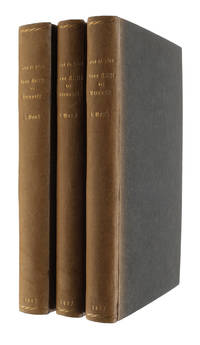
180761857Heidelberg, Muhr und Zimmer, 1807. 8vo. Uniformly bound in three recent card-board bindings with gilt lettering to spine. Spines with sunning. Ex-libris (Philosopher Carl Henrik Koch) pasted on to pasted down front front end-paper. Verso and recto of front and back free end-paper in vol. 1 closely annotated in contemporary hand. With light occassional brownspotting throughout, a nice set.(2), L, 347 pp. 327 pp." 392 pp.
1774334261774-1776. Wien Rudolph Graeffer 1774-1776 8° 243 pp. 178 pp. mit zwei Titelvignetten Pappband. Extrem rare first Edtion! The short Latin translations of this text book was the fist systematical textbook on surgery translated in to Japanese. Sehr seltene erste Ausgabe! "Eine Übersetzung des 'Compendium insitutionum chirurgicarum' von Joseph Jacob Plenck in Wien wurde im 3.Jahre der Tempô-Ära 1832 unter dem Titel Yôka Shinsen von Kinchô Sugita publiziert und war eigentlich das erste systematische Lehrbuch der europäischen Chirurgie in Japan". Fujikawa J. Geschichte der Nedizin in Japan p.75 Extrem rare - only first part in: Nat. Lib. Medicine Bound with Thomas Sydenhams "Anweisung zur Cur dermehresten Krankheiten nebst einem Anhang vom Podagra und der Wassersucht" "Zweite und über die Hälfte vermehrte Auflage" Nürnberg Wolfgang Schwarzkopf 1777 8° 244 pp. 3 ff. unknown
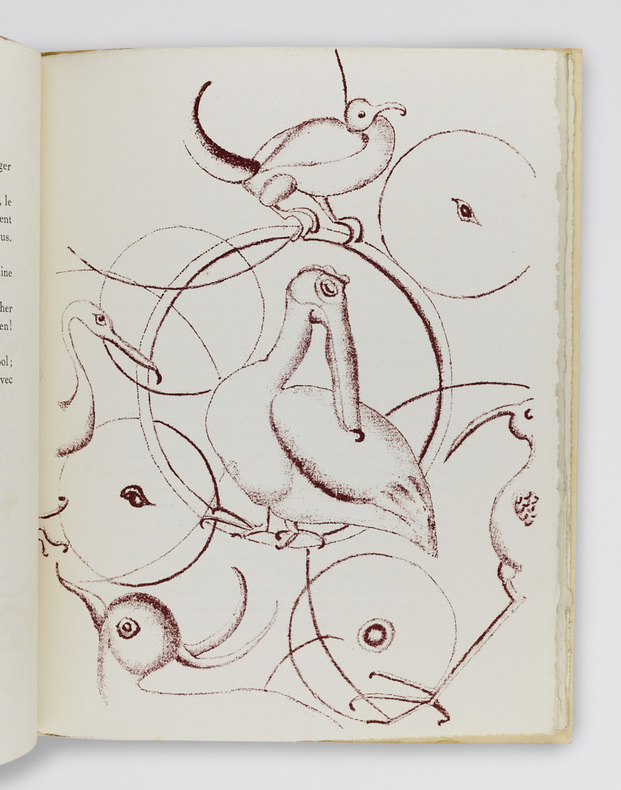
EXE-536Paris, Éditions de la Galerie Simon, 1923. In-8° broché, couverture imprimée. ÉDITION ORIGINALE. Illustré de 3 lithographies en couleurs de Suzanne Roger. Tirage à 112 exemplaires, un des 100 exemplaires sur vergé d’Arches, signé par l’auteur et l’illustratrice. Suzanne Roger est une nouvelle venue dans l'écurie Kahnweiler. Elle est l'épouse du peintre André Beaudin, ami de Juan Gris. Tous deux sont invités aux dimanches de Boulogne. Lorsque Daniel-Henry Kahnweiler lui confie l'illustration du texte de Max Jacob, elle a vingt-quatre ans, n'a jamais illustré de livre et n'a pas beaucoup d'expérience de la gravure. Elle choisit la lithographie dont elle apprécie la spontanéité d'expression et transpose dans son propre univers poétique, l'atmosphère fantastique du texte du poète. Skira 312 | Hugues 15 | Pompidou p. 184 | Chapon p. 284 | Galland p. 902
142151New York: St. Hubert Guild 1906 a numbered set from a limited edition of 1000. Hardcover set Fine. An exquisite set from the "Edition Immortal" bound in various colors of leather. This set is No.3 with an elaborate certificate signed by W.E. Wise. Each volume stamped in gilt and color after original designs of famous fine bindings most with a descriptive page tipped in. Faux moire endpapers top edges gilt ribbon page markers illustrated with photogravures on Japan Vellum including hand-painted reproductions of famous historical paintings and rare engravings. Each volume has a tastefully designed bookplate on the front inner board and the only flaw on the set being that the spines of 11 volumes are lightly faded some to a pale green some to a light tan. Because the volumes are bound in different colors this is not an offensive fault. Photos available on request. Sets History Sets. St. Hubert Guild Hardcover
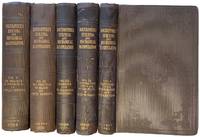
1843S13870London:: Published for the author by Holtzapffel & Co. . . . 1843 1846 1850 1878 1884. 1843. Complete Five volumes. 8vo. vol. I xiv 2 462; II xx 457-1025 3 8; III viii 8 1026-1477 2 16; IV xix 1 592 12; V xxi 1 652 6 pp. Profusely illustrated 2575 figures in all incl. 78 'plates' figs. plates indexes ads. Original full blind- and gilt-stamped dark brown cloth; vols. 1-2-3-5 each neatly restored preserving the original covers spines laid down. Bookbinder's tickets of J. & J. Thomson Manchester Westleys & Co. and Westleys & Clark London. Handsome set. Very good. GEORGE ELLERY HALE'S COPY WITH HIS SIGNATURE 1910. First edition of the greatest work in English on the lathe and its accessories. The set was published for the author. It is rare today and when found often either incomplete mixed issues or rather worn. The series was proposed to be issued in 6 volumes but only 5 volumes were ever published. / SUB-TITLES: Vol. I. Materials their differences choice and preparation; various modes of working them generally without cutting tools. Vol. II. The principles of construction action and application of cutting tools used by hand; and also of machines derived from the hand tools. Vol. III. Abrasive and miscellaneous processes which cannot be accomplished with cutting tools. Vol. IV. The principles and practice of hand or simple turning. Vol. V. The principles and practice of ornamental or complex turning. / Holtzapffel Charles 1805–1847 mechanical engineer and technical writer was born on 28 December 1805 in London where he was baptized at St Martin's in the Fields on 13 May 1806 the son of John Jacob Holtzapffel and his wife Ann. His father who was from Strasbourg settled in London in 1792 as a tool and lathe maker and was naturalized as a British subject. In addition to a thorough training in workshop practice Holtzapffel received a good general education and by assiduous study and practice became a skilled mechanical engineer. He married on 9 September 1830 Amelia Vaux Dutton 1803–1889 of Islington with whom he had three daughters and three sons. In 1838 he published his New system of scales of equal parts applicable to various purposes of engineering architecture and general science followed by List of Scales of Equal Parts suitable for his system. His principal work Turning and mechanical manipulation intended as a work of general reference and practical instruction on the lathe was designed to fill six volumes but only five were published. The first three volumes appeared in 1843 1846 and 1850 posthumously published by Holtzapffel's widow. The final two volumes were completed by his son John Jacob Holtzapffel. The family business was Holtzapffel & Co. 64 Charing Cross Road London. They made lathes and other machines and published a number of works in connection with woodworking. They also marketed an amateur printing press about which they published a number of booklets. / In his writing Holtzapffel throughout displayed a masterly knowledge of technical art and of the scientific principles underlying it. He was a member of the Institution of Civil Engineers and a member of its council. He was for a time chairman of the mechanics' committee of the Society of Arts. He died on 11 April 1847 at 127 Long Acre Covent Garden London of chronic abscesses of the liver and was buried at St Marylebone. – DNB. / His son John Jacob II was eleven years old when his father died. Twenty years later in 1867 he became head of the firm which he ran until 1896. He completed Vol. 4 "The Principles and Practice of Hand or Simple Turning" which was published in 1879. He also made the 750 woodcut illustrations that it contains. Vol. 5 "The Principles and Practice of Ornamental or Complex Turning" was published in 1884. PROVENANCE: Signature and armorial bookplate of John Hick 1815-1894 "Omne Bonum" Desupee Bolton – vol V Charles possibly S. or E. Fletcher Aug. 1844sic and again 1884 on half-title – signature of George Ellery Hale 1868-1938 astronomer Jan 1910. Hick's bookplate is mounted on the half-title. NOTE: John Hick JP DL 1815-1894 of Bolton was a wealthy English industrialist art collector and Conservative Party politician who sat in the House of Commons from 1868 to 1880 he is associated with the improvement of steam-engines for cotton mills and the work of his firm Hick Hargreaves and Co. universal in countries where fibre was spun or fabrics woven. "His final years at Mytton Hall were devotedto compiling an elaborately illustrated catalogue of the collection; some of these works were auctioned by Christie's during June and July 1909 following Rebecca Hick's death in 1908. The Hick library at Mytton Hall was dispersed at Capes Dunne & Co. Manchester in November 1909." Wikip. See: Sinkankas 3008–3010. Published for the author, by Holtzapffel & Co., . . . 1843, 1846, 1850, 1878, 1884. hardcover
18591405300056Wellsburg Va. Jacob & Smith 1859-01-01. First Edition. Hardcover. Very Good. 12mo. viii 9-280 p. front. port. ill. 3 pl. 19 cm. Bound in publisher's dark brown cloth. Gilt lettering on spine. Good binding and cover.Fading to gilt on spine. Chipping and loss to head and tail of spine. Fraying to middle of spine of front cover. Wear to extremities. Contemporary owner's name on FEP of Luther Haymond 1880. Clean unmarked pages with minimal tanning. New endpages added though original endpages are present. Pg 107 is loose. Graff 2183; Howes J31; Streeter 3067; Wagner-Camp 6:10; Usiana J31. <br><br>The first biography of any member of the Lewis and Clark expedition containing an abridgement of his journal kept while crossing the continent. Patrick Gass is perhaps the fourth most famous member of the expedition after Lewis Clark and Sacajawea; his Journal published in 1807 was the first detailed account of the Lewis and Clark expedition to appear in print and his long life he died in 1870 at age 99 added further to his fame. citing PBA Galleries June 30 2005 Wellsburg, Va., Jacob & Smith hardcover
19600033615Springfield: Charles C. Thomas 1960. First Edition. Hardcover Hardcover. Good Condition. 23.5cm x 16cm. xlii 1080 pages black and white illustrations. Green cloth no jacket. The leading 20th century monograph on human injury as a result motor vehicle accidents written by an orthopaedic surgeon for a medical audience. Crash Injuries was a source of inspiration for J. G. Ballard's 1973 novel Crash. Ex-Raymon H. Mulford Library Medical College of Ohio University of Toledo spine label stamps and plates. Minor general wear. Category: Automobiles & Vehicles; Medicine & Health. Inventory No: 0033615. BZDB407 Automobiles & Vehicles; Medicine & Health. Unbranded Jacob Kulowski Crash Injuries: The Integrated Medical Aspects of Automobile Injuries and Death Charles C. Thomas hardcover
49733verfasst von I. J. Schmidt. St. Petersburg : Gräff ; Leipzig Voss 1839. Quarto 280 x 210 mm contemporary red calf richly gilt spine with gilt lettering and decoration gilt dentelles; all edges gilt; blue endpapers; pp. xv 1 blank 318 2 Errata; text in German roman and Tibetan script; scattered light foxing a fine example in a beautiful binding of the period. First edition of Schmidt's Tibetan grammar which was not only the first grammar of the language in German but one of the first Tibetan grammars in any European language. Isaac Schmidt 1779-1847 was an Amsterdam-born Moravian missionary and Orientalist specialising in Tibetan and Mongolian. As a member of the Russian Academy of Sciences - the present work is dedicated to its president Uwarow - he spent much of his career in St. Petersburg devoting his later years to Bible translations in Kalmyk and Mongolian. Cordier BS 2932; Lust 254 unknown
002490Johannesburg South Africa: The Brenthurst Press 1988 The standard edition one of 850 unnumbered copies. Brenthurst Second Series #4 & 5. In our opinion the most significant publication in this important series. The set of two volumes have never been removed from their packaging. Brand new. Ribbon bookmarks. ---------- Orders over $100.00 are shipped using tracked courier delivery services. Size: Each Book Approx 9"Wide By 12"Tall The Brenthurst Press hardcover
1728RW1451London:: John Senex 1728. 1728. 8vo. iv 187 1 pp. 4 folding plates decorative headpieces. Original gilt-stamped calf modern red leather gilt-stamped spine label raised bands; rubbed joints cracked upper spine mended. Ownership stamp of "P.G." Very good. RARE. First edition in English; first printed in Leiden in 1727 as Matheseos universalis elementa. "This work translated into Dutch 1728 and English 1752 sic is of didactic rather than original merit but it was significant for its invitation to mathematicians to elucidate systematically Newton's Universal Arithmetick which 'sGravesande exemplified by his own explanation of two passages from Newton's book. 'sGravesande found the lighthearted treatment of infinitesimals and the infinite in Bernard de Fontenelle's Elemens de la geometrie de l'infini Paris 1727 unacceptable and he maintained his objections in the Journal litteraire against Fontenelle's rejoinder 1730." – DSB V p. 510. REFERENCES: ESTC no.: T187811; not in Babson. John Senex, 1728. hardcover
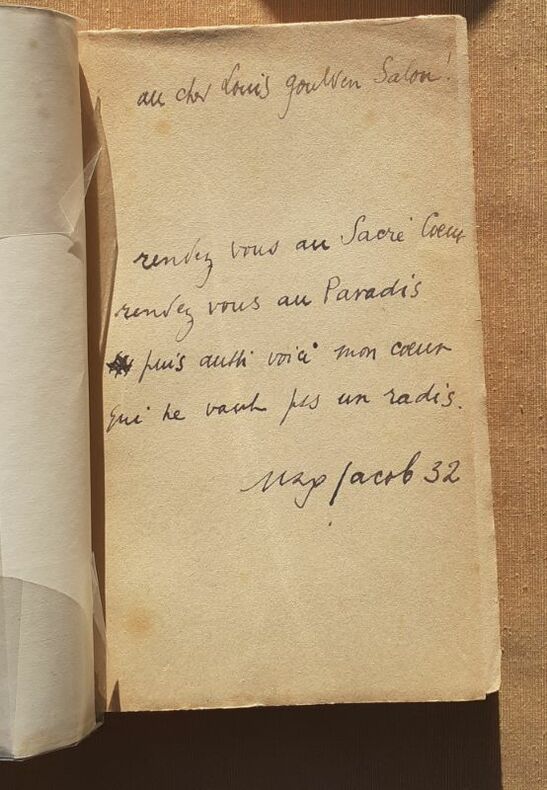
193292321932 1 P., Librairie Gallimard, 1932, in-12 broché, exemplaire légèrement fatigué.
18119912London: John Nichols and Son for J. Johnson 1811. First Edition Primera edición. Hardcover Tapa dura. 266x217mm. 10½x8½". London John Nichols and Son for J. Johnson 1811. En folio menor 266 x 217mm. xiii-407 36 10 pp. 13 mapas y láminas 3 de ellas plegadas. Encuadernación de época en holandesa con puntas restos de etiqueta adherida a la lomera. Primera edición de este viaje por Adalucía a través de las 57 cartas escritas por Jacob entre 1809 y 1810. Incluye un mapa plegado de Cádiz un grabado de la Inquisición y 11 aguatintas. William Jacob político y comerciante llegó a Andalucía durante la Guerra de la Independencia; escribe a su familia largas misivas en las que relata los pormenores de lo que ve siente y piensa sobre los españoles. Aparecen aquí las 57 cartas remitidas a su familia acompañadas de un prólogo absolutamente comprometido y solidario con los españoles y sus intereses en el conflicto armado. Es importante anotar que Jacob aún cuando habla de la guerra y recoge las preocupaciones políticas de su época dedica si cabe más lugar en sus cartas a las gentes de Andalucía: "los labriegos muleros soldados españoles y británicos oficiales de ambos cuerpos mujeres y niños de todos los rincones de Andalucía aparecen retratados en primer plano" Plaza Orellana Las poblaciones que visitó en los seis meses que duró su viaje son: Sanlúcar de Barrameda Cádiz Puerto de Santa María Jerez Lebrija Sevilla Chiclana Gibraltar San Roque Estepona Marbella Mijas Fuengirola torremolinos Málaga Vélez Viñuela Alhama Granada Santa Fe Loja Antequera Alora Casarabonela el Burgo Zahara y Gaucín. Ligero óxido generalmente marginal como es habitual. Referencias: Palau 122598; Foulché-Delbosc 244; Farinelli III pp. 50; García-Romeral 887 John Nichols and Son for J. Johnson hardcover
19832510BASTEI-LÜBBE 1983-85. 1. softcover. Macht der Mantas Die 240462406722080 BASTEI-LÜBBE paperback
19721753BASTEI-LÜBBE 1972-80. 1. softcover. Titanen 72001420018 BASTEI-LÜBBE paperback
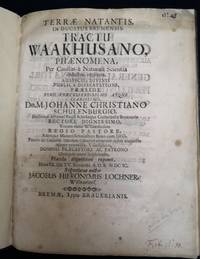
554830Bremen: Brauer Bremae: Typis Brauerianis o.J. 1699. Der alte feste Broschur Buchblock unbeschnitten in neuen Pappdeckeln montiert komplett mit den gefalteten Tafeln. Dort die erste Erwähnung Worpswedes. - Mit gestochenen Titelvignetten. - Mit den zwei einfach gefalteten Tafeln zu den Kapiteln "Terrae Natantis In Ducatus Bremensis Tractu Waakhusano Phaenomena" und "Caput I. Præviam eamque brevem Insularum Natantium Historiam complectitur." "Caput II. Waakhusanæ Terræ Phænomena" "Caput III. Variis Observationibus ad Phænomenorum caussas rite indagandas viam sternit" "Caput IV. Caussas enarratorum". - In lateinischer Sprache. - Montiertes Korrekturblatt auf Seite 46. - Buchbloch etwas fleckig. Tafeln gering randfleckig. Sonst gutes und wohlerhaltenes Exemplar. 0 1 0 Bremen: Brauer (Bremae: Typis Brauerianis) o.J. [1699]. unknown
186036183Basel, 1860. 8vo. A little later green half cloth with a recent printed paper title-label to spine. Brownspotting to some leaves. Some underlinings and maginal annotations, all in pencil. Near contemporary annotations/description pasted on to verso of dedication-leaf. (4), 576 pp.
169745644Leipzig, Grosse & Gleditsch, 1697. 4to. No wrappers. In: ""Acta Eruditorum Anno MDCXCVII"", No V, May-issue. Pp. 193-240 (entire issue offered). With titlepage to the volume 1697. Leibniz: pp. 201-205. Johann Bernoulli: pp. 206-211. Jacob Bernoulli: pp. 211-214. Newton: pp. 223-224. As usual, some leaves with browning.
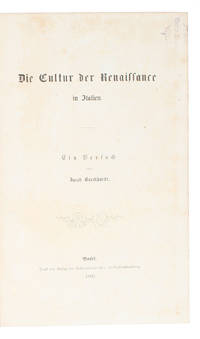
186036183Basel 1860. 8vo. A little later green half cloth with a recent printed paper title-label to spine. Brownspotting to some leaves. Some underlinings and maginal annotations all in pencil. Near contemporary annotations/description pasted on to verso of dedication-leaf. 4 576 pp. <br/><br/><em>The scarce first edition of Burckhardt's main work the groundbreaking work on the culture of the Renaissance which helped found the historical study of this previously much overlooked era. " "The most penetrating and subtle treatise on the history of civilization" in Lord Acton's words "a mere essay" as Burckhardt himself called it "The Civilization of the Renaissance in Ittaly" has for more than a century determined the general conception of thirteenth- to fifteenth-century Italy." PMM p. 210This classic of Renaissance historiography is of the greatest importance to the development of the history of the Renaissance and of history of art and culture in general. More specifically Burckhardt here establishes the fact that the Renaissance came first in developing the human individuality to the highest degree. He places the earliest signs of "the modern European Spirit" in Florence which was a great contributing factor to the comprehension of this city as representing one of the highlights of European culture.The Swiss historian of art and culture Jacob Chrisoph Burckhardt 1818-1897 contributed seminally to the historiography of these two fields. He is considered the discoverer of the Renaissance and with his main work he founded the study of thirteenth- to fifteenth-century Italy and thereby the historical study of the Renaissance the society of which he dealt with all aspects of. In general Burckhardt's works all constitute an original historical approach to the study of art culture social institutions etc. As a highly respected scholar of Greek civilization Burckhardt with his original historiographical approach was highly admired by Nietzsche who also attended his lectures. The two kept in contact and corresponded frequently. Like Nietzsche Burckhardt was a great admirer of Schopenhauer and he greatly opposed the Hegelian interpretations of history.". as in the case of other great historians such as Gibbon Ranke Macaulay no criticism of details can detract from the powerful spell which Burckhardt's book has exercised upon such widely different writers as Ruskin Nietzsche and Gobineau as well as upon innumerable lovers of the most magnificent period of European history." PMM.Printing and the Mind of Man 347. </em> hardcover
169745644Leipzig Grosse & Gleditsch 1697. 4to. No wrappers. In: "Acta Eruditorum Anno MDCXCVII" No V May-issue. Pp. 193-240 entire issue offered. With titlepage to the volume 1697. Leibniz: pp. 201-205. Johann Bernoulli: pp. 206-211. Jacob Bernoulli: pp. 211-214. Newton: pp. 223-224. As usual some leaves with browning. <br/><br/><em>First appearance of the famous issue of Acta Eruditorum in which the 4 solutions by the 4 most eminent mathematicians at the time were printed together. There were in all 5 solutions to the posed problem and Newton's solution was first printed in the Philosophical Transactions January 1697 and reprinted here. The solution proposed by L'Hopital not printed here was not published until 1988.The brachistochrone problem was posed by Johann Bernoulli in Acta Eruditorum in June 1696. He introduced the problem as follows: "I Johann Bernoulli address the most brilliant mathematicians in the world. Nothing is more attractive to intelligent people than an honest challenging problem whose possible solution will bestow fame and remain as a lasting monument. Following the example set by Pascal Fermat etc. I hope to gain the gratitude of the whole scientific community by placing before the finest mathematicians of our time a problem which will test their methods and the strength of their intellect. If someone communicates to me the solution of the proposed problem I shall publicly declare him worthy of praise." Johann Bernoulli and Leibniz deliberately tempted Newton with this problem. It is not surprising given the dispute over the calculus that Johann Bernoulli had included these words in his challenge:- ."there are fewer who are likely to solve our excellent problems aye fewer even among the very mathematicians who boast that they. have wonderfully extended its bounds by means of the golden theorems which they thought were known to no one but which in fact had long previously been published by others."According to Newton's biographer Conduitt he solved the problem in an evening after returning home from the Royal Mint. Newton: . "in the midst of the hurry of the great recoinage did not come home till four in the afternoon from the Tower very much tired but did not sleep till he had solved it which was by four in the morning."Newton send his solution to his friend Charles Montague and Montague published anonymously in the Transactions. Newton's solution presented here in the Acta is also anonymous. The episode did not please Newton as he later wrote: "I do not love to be dunned pestered and teased by foreigners about mathematical things ." After the competition Johann Bernoulli said ". my elder brother made up the fourth of these after Leibniz himself and Newton that the three great nations Germany England and France each one of their own to unite with myself in such a beautiful search all finding the same truth."Struik Edt. "A Source Book in Mathematics 1200-1800 pp. 391 ff. </em> unknown
1138675733New. Brand new and still unused unknown
1140251120New. Brand new and still unused unknown
0517886839New. Brand new and still unused unknown
0195301404New. Brand new and still unused unknown