Piranesi FrancescoMareMagnum

29 735 résultats
Incisione in rame all'acquaforte, bulino e puntasecca inserita nell'opera "TROFEI DI OTTAVIANO AVGVSTO INNALZATI PER LA VITTORIA AD ACTIVM E CONQ" edita da Firmin Didot Frères nel 1753
Incisione in rame all'acquaforte, bulino e puntasecca inserita nell'opera "TROFEI DI OTTAVIANO AVGVSTO INNALZATI PER LA VITTORIA AD ACTIVM E CONQ" edita da Firmin Didot Frères nel 1753
Acquaforte, bulino e puntasecca, circa 1762, firmata in lastra in basso. Magnifica prova, impressa su carta vergata coeva con margini, in eccellente stato di conservazione. Tavola tratta da Il Campo Marzio dell’Antica Roma opera di G.B. Piranesi socio della Real Società degli Antiquari di Londra. Sebbene pubblicata solo nel 1762 questa fondamentale opera, che appare come una delle più complesse del Piranesi, veniva già annunciata dall’artista nelle Antichità Romane (1756) delle quali, secondo Focillon, può essere considerata come il quinto tomo. La vicenda del Campo Marzio si intrecciano con l’amicizia con lo scozzese Robert Adam, al quale l’opera è dedicata. Adam era giunto a Roma nel 1755 e ben presto aveva conosciuto Piranesi, forse per mezzo del comune amico Charles-Louis Clerisseau, trovando nella comune passione archeologica la base di una reciproca stima, che continuò anche dopo il ritorno dell’architetto Londra. Fu proprio Adam che, durante le ricognizioni dei resti dei monumenti del Campo Marzio, suggerì al Piranesi l’idea di realizzare una mappa dell’intera area, che inizialmente doveva essere inclusa nelle Antichità, e poi finì per costituire la base di un progetto ben più ambizioso, dando alla luce questa importante opera. Negli scritti iniziali l’autore annuncia lo scopo di questo lavoro, affermando la volontà di voler tracciare la storia di questa vasta area compresa tra il Tevere ed i colli, cercando di ricostruirne la conformazione ed il volto. Egli sottolinea la difficoltà di tale lavoro di ricostruzione, poiché l’antico Campo Marzio ha coinciso con l’area più intensamente popolata e riedificata della città dal medioevo all’epoca attuale, non nascondendo il margine di ipotetica insito nell’opera. Il risultato è che l’attendibilità dei risultati rimane quanto mai problematica, sia per la pionieristica ricerca archeologica del tempo, sia per la carica visionaria che porta l’artista e l’architetto a superare di slancio i limiti della realtà storica progettando il passato in funzione del presente, portando il genio artistico a prevalere di gran lunga sull’archeologo, conferendo senso e vigore a tutta l’opera. Bibliografia Focillon 437, Wilton Ely 568. Etching, engraving and drypoint, circa 1762, signed in plate at the bottom. Magnificent proof, printed on contemporary laid paper, in excellent condition. Plate taken from Il Campo Marzio dell’Antica Roma opera di G.B. Piranesi socio della Real Società degli Antiquari di Londra. Although published only in 1762, this fundamental work, which appears to be one of Piranesi's most complex, had already been announced by the artist in the Antichità Romane (1756) of which, according to Focillon, it can be considered as the fifth volume. The story of the Campus Martius is intertwined with the friendship with the Scotsman Robert Adam, to whom the work is dedicated. Adam had arrived in Rome in 1755 and soon got to know Piranesi, perhaps through their mutual friend Charles-Louis Clerisseau, finding in their common archaeological passion the basis of a mutual esteem, which continued even after the architect's return to London. It was Adam himself who, during the reconnaissance of the remains of the monuments of the Campus Martius, suggested to Piranesi the idea of creating a map of the entire area, which initially was to be included in the Antiquities, and then ended up forming the basis of a much more ambitious project, giving birth to this important work. In the initial writings the author announces the purpose of this work, stating the will to trace the history of this vast area between the Tiber and the hills, trying to reconstruct the conformation and the face. He underlines the difficulty of this reconstruction work, since the ancient Campus Martius coincided with the most intensely populated and rebuilt area of the city from the Middle Ages to the present time, not hiding the margin of hypothetic inherent in the work. The result is that the reliability of the results remains very problematic, both for the pioneering archaeological research of the time, and for the visionary charge that leads the artist and the architect to overcome the limits of historical reality designing the past in function of the present, bringing the artistic genius to prevail by far on the archaeologist, giving sense and vigor to the whole work. Literature Focillon 437, Wilton Ely 568.
17840313-B1784. Radierung, 1748, auf Bütten mit Wasserzeichen: Lilie im Doppelkreis (Hind 3). 24:35,7 cm. Titelblatt, der ?Antichità romane de?tempi della Republica??. Abdruck der römischen Ausgabe, o.J., 1748. Literatur: Focillon 41; Hind 1; Taschen 81; Wilton-Ely 103. - Sehr kräftiger Abdruck mit vollem Rand, die Ränder leicht gebräunt.
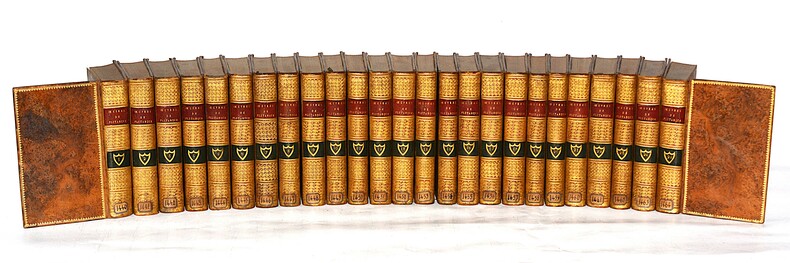
18010055351801 Paris, Cussac, 1801-05. Vingt-cinq volumes in-8 (203 X 130 mm) basane fauve marbrée, encadrement de roulette dorée sur les plats, dos lisse cloisonné, compartiments entièrement ornés de croisillons et petits fleurons dorés, pièces de titre et de tomaison maroquin grenat et noir, coupes et coiffes ornées de roulettes dorées, tranches mouchetées en rouge (Reliure de l'époque). Manques à sept coiffes supérieures. Étiquette papier en pied de chaque volume.
IN FOLIO, PP. 6+ UNA RACCOLTA DI 60 TAVOLE F.T. INCISI IN RAME DISPOSTE SU 52 FOGLI+15 TAVOLE F.T. PER DOCUMENTAREL'ILLUSTRAZIONE DEGLI ARABESCHI DEI BAGNI DI LIVIA E DELLA VILLA ADRIANA.LEGATURA CARTONATA CON MANCANZA DI DORSO. PREGEVOLE RACCOLTA DI ARABESCHI ROMANI.
194169194Firenze: Vallecchi 1941. Brossura wrappers. Molto buono Very Good. Dedica e firma autografe dell'Autore al Premio Nobel Salvatore Quasimodo datata maggio 1941 Inscribed and signed by the Author to the Nobel Prize Salvatore Quasimodo Maj 1941. . 16mo. pp. 82. Dedica e firma autografe dell'Autore al Premio Nobel Salvatore Quasimodo datata maggio 1941 Inscribed and signed by the Author to the Nobel Prize Salvatore Quasimodo Maj 1941. Molto buono Very Good. Copertina leggermente sporca e sciupata Lightly soiled cover. Prima edizione First Edition. Letteratura italiana del Novecento Gambetti 1997 Gambetti Lucio Vezzosi Franco La letteratura italiana del Novecento. Repertorio delle prime edizioni. Genova Graphos 1997. Opera prima dell'Autore stampata in sole 700 copie Gambetti Vallecchi, unknown
In-4°; pp. (16), 229, (3), marca tipografica al frontespizio e capilettera figurati. Legatura coeva in piena pergamena. Poche carte brunite, una leggera gora alle ultime carte. Storia delle genti patrizie, di Strein, barone austriaco con il titolo di Von Schwartzenau, studioso di giurisprudenza prima e di antiquaria romana. L’opera è anche ricca di molte iscrizioni riportate.
197151268Roma: L'Arco Edizioni d'Arte 1971. Perfetto Mint. Cartella contenente 4 acquaforti originali numerate firmate e datate a matita dall'Artista cm 175x125 - foglio 50x35. . Perfetto Mint. Edizione originale di 20 es. numerati. <em>ROCCAMONTE Giorgio Amelio Buenos Aires 1927 - Roma 1980. Scultore ha firmato con Lucio Fontana il Manifesto Blanco nel 1946</em> L'Arco Edizioni d'Arte, unknown
39367Paris.Morel.1881.2 volumes in-folio en plein chagrin estampé à froid.Couvertures conservées. Dos à 5 double-nerfs avec caractères dorés.304 et 391 pages avec tables des matières.Iconographie importante. Bel état avec quelques rousseurs.Têtes mouchetées.
1931823-1824 À Paris, chez Firmin Didot, 1823-1824.
16507991650 Rome, Lodovico Grignani, 1650. In-8, (8) ff. [dont un f. blanc, un f. de titre, un f. gravé représentant Hercule et le Génie, (3) ff. de dédicace à Giovanni Battista Borghèse, (2) ff. de dédicace à Innocent X], bradel vélin à léger recouvrement, dos à nerfs, titre manuscrit au dos (Rel. pastiche).Rare édition originale de la première monographie sur la villa Borghèse, illustrée d'une jolie vue architecturale dépliante, signée D.B. (Dominique Barrière).L'auteur, qui était le gardien de ce fameux palais romain, conduit ses lecteurs à travers les trois enceintes, décrivant les architectures, avec leurs décorations et dimensions, les jardins, les appartements et les peintures, sculptures et objets d'art réunis par le cardinal Borghèse.La Villa fut construite près de Rome, au delà de La Porta Pinciana, au début du XVII siècle par Flaminio Ponzio puis Giovanni Vansanzio, pour le cardinal Scipione Borghese (1576-1633). Elle fut conçue comme un écrin de présentation pour ses statues antiques, l'une des collections privées les plus importantes de la Rome baroque... — jusqu'à ce que le prince Camillo Borghese en vende une partie à son beau-frère Napoléon en 1807. Parmi les trésors de la Villa, on trouve des œuvres du Caravage, du Titien et de Véronèse.Pâles mouillures, petites restaurations aux premiers feuillets.
0706-Bo.J. Radierung, 1819, auf Velin. 45,8:36,4 cm. Im breiten Rand etwas knitterfaltig und fleckig, im oberen Rand Spuren alter Bindung. Aus der 100-Blatt-Folge ?Antichita? Romane?, 1823. - Tiefschwarzer und klar zeichnender Abdruck auf Velin.
0707-Bo.J. Radierung, 1820, auf Velin. 36,8:46,5 cm. Im breiten Rand etwas knitterfaltig und fleckig, im linkenen Rand Spuren alter Bindung. Aus der 100-Blatt-Folge ?Antichita? Romane?, 1823. - Tiefschwarzer und klar zeichnender Abdruck auf Velin.
0705-Bo.J. Radierung, 1821, auf Velin. 40,7:48,7 cm. Im brei-ten Rand etwas knitterfaltig und fleckig, im linken Rand Spuren alter Bindung. Aus der 100-Blatt-Folge ?Antichita? Romane?, 1823. - Tiefschwarzer und klar zeichnender Abdruck auf Velin.
0709-Bo.J. Radierung, 1819, auf Velin. 46,7:36,7 cm. Im breiten Rand etwas knitterfaltig und fleckig. Aus der 100-Blatt-Folge ?Antichita? Romane?, 1823. - Tiefschwarzer und klar zeichnender Abdruck auf Velin.
0701-Bo.J. Radierung, 1819, auf Velin. 46,7:36,7 cm. Im breiten Rand etwas knitterfaltig und fleckig. Aus der 100-Blatt-Folge ?Antichita? Romane?, 1823. - Tiefschwarzer und klar zeichnender Abdruck auf Velin.
0704-Bo.J. Radierung, 1819, auf Velin. 45,8:36,4 cm. Im breiten Rand etwas knitterfaltig und fleckig, im oberen Rand mit Spuren al-ter Bindung. Aus der 100-Blatt-Folge ?Antichita? Romane?, 1823. - Tiefschwarzer und klar zeichnender Abdruck auf Velin.
0697-Bo.J. Radierung, 1823, auf Velin. 39,3:54,3 cm. Im breiten Rand etwas knitterfaltig und fleckig, im linken Rand Spuren alter Bindung. Aus der 100-Blatt-Folge ?Antichita? Romane?, 1823. - Tiefschwarzer und klar zeichnender Abdruck auf Velin.
0703-Bo.J. Radierung, 1820, auf Velin. 47,3:37,3 cm. Im breiten Rand etwas knitterfaltig, kleinen Einrissen und fleckig, im oberen Rand mit Spuren al-ter Bindung. Aus der 100-Blatt-Folge ?Antichita? Romane?, 1823. - Tiefschwarzer und klar zeichnender Abdruck auf Velin.
0700-Bo.J. Radierung, 1822, auf Velin. 35,3:48 cm. Im breiten Rand etwas knitterfaltig und fleckig, im linken Rand Spuren alter Bindung. Aus der 100-Blatt-Folge ?Antichita? Romane?, 1823. - Tiefschwarzer und klar zeichnender Abdruck auf Velin.
0702-Bo.J. Radierung, 1819, auf Velin. 46,7:36,4 cm. Im breiten Rand etwas knitterfaltig und fleckig, im oberen Rand mit Spuren alter Bindung. Aus der 100-Blatt-Folge ?Antichita? Romane?, 1823. - Tiefschwarzer und klar zeichnender Abdruck auf Velin.
0710-Bo.J. Radierung, 1820, auf Velin. 45,8:36,4 cm. Im breiten Rand etwas knitterfaltig und fleckig, im oberen Rand mit Spuren alter Bindung. Aus der 100-Blatt-Folge ?Antichita? Romane?, 1823. - Tiefschwarzer und klar zeichnender Abdruck auf Velin.
0712-Bo.J. Radierung, 1819, auf Velin. 36:46,2 cm. Im breiten Rand etwas knitterfaltig und fleckig, im linken Rand Spuren alter Bindung. Aus der 100-Blatt-Folge ?Antichita? Romane?, 1823. - Tiefschwarzer und klar zeichnender Abdruck auf Velin.
0711-Bo.J. Radierung, 1821, auf Velin. 37,3:53,5 cm. Tiefschwarzer Abdruck, breitrandig. - Zwei Quetschfalten im linken Rand außerhalb der Darstellung, gering fleckig. Aus der 100-Blatt-Folge ?Antichita? Romane?, 1823. - Tiefschwarzer und klar zeichnender Abdruck auf Velin, breitrandig.