29 735 résultats
Acquaforte e bulino, firmata in lastra in basso a destra. Da un disegno del Canaletto.Magnifica prova, impressa su carta vergata coeva con filigrana “tre mezze lune”, con ampi margini, in perfetto stato di conservazione. Il Museo Correr possiede una raccolta di quindici fogli raffiguranti vedute di Roma incise da Brustolon su disegno del Canaletto; il frontespizio, manoscritto, reca l’iscrizione Vari Prospetti di Roma Antica e Moderna. Il catalogo della tipografia Remondini del 1817 elenca sempre 15 soggetti “romani”. Tuttavia secondo il Moschini le vedute di Roma del Brustolon sarebbero addirittura venticinque. Rarissima. Etching and engraving, signed on lower right. After a drawing of Canaletto.Magnificent proof, printed on contemporary laid paper with "three crescents" watermark, wide margins, in perfect conditions.The Correr Museum owns a collection of fifteen sheets depicting views of Rome engraved by Brustolon after drawings of Canaletto; the front page, handwritten, bears the inscription Vari Prospetti di Roma Antica e Moderna. The 1817 catalogue of the typography of Remondini lists 15 “Roman” subjects; nonetheless, according to Meschini, Brustolon’s views of Rome are not less than twenty five. Very rare. Succi pagina 82.
Acquaforte e bulino, firmata in lastra in basso a destra. Da un disegno del Canaletto.Magnifica prova, impressa su carta vergata coeva con filigrana “tre mezze lune”, con ampi margini, in perfetto stato di conservazione. Il Museo Correr possiede una raccolta di quindici fogli raffiguranti vedute di Roma incise da Brustolon su disegno del Canaletto; il frontespizio, manoscritto, reca l’iscrizione Vari Prospetti di Roma Antica e Moderna. Il catalogo della tipografia Remondini del 1817 elenca sempre 15 soggetti “romani”. Tuttavia secondo il Moschini le vedute di Roma del Brustolon sarebbero addirittura venticinque. Rarissima. Etching and engraving, signed on lower right plate. After a drawing of Canaletto.Magnificent proof, printed on contemporary laid paper with "three crescents" watermark, wide margins, in perfect conditions.The Correr Museum owns a collection of fifteen sheets depicting views of Rome engraved by Brustolon after drawings of Canaletto; the front page, handwritten, bears the inscription Vari Prospetti di Roma Antica e Moderna. The 1817 catalogue of the typography of Remondini lists 15 “Roman” subjects; nonetheless, according to Meschini, Brustolon’s views of Rome are not less than twenty five. Very rare. Succi pagina 82.
Acquaforte e bulino, firmata in lastra in basso a destra.Da un disegno del Canaletto.Magnifica prova, impressa su carta vergata coeva con filigrana “tre mezze lune”, con ampi margini, in perfetto stato di conservazione.Il Museo Correr possiede una raccolta di quindici fogli raffiguranti vedute di Roma incise da Brustolon su disegno del Canaletto; il frontespizio, manoscritto, reca l’iscrizione Vari Prospetti di Roma Antica e Moderna.Il catalogo della tipografia Remondini del 1817 elenca sempre 15 soggetti “romani”. Tuttavia secondo il Moschini le vedute di Roma del Brustolon sarebbero addirittura venticinque.Rarissima. Etching and engraving, signed on lower right. After a drawing of Canaletto.Magnificent proof, printed on contemporary laid paper with "three crescents" watermark, wide margins, in perfect conditions.The Correr Museum owns a collection of fifteen sheets depicting views of Rome engraved by Brustolon after drawings of Canaletto; the front page, handwritten, bears the inscription Vari Prospetti di Roma Antica e Moderna. The 1817 catalogue of the typography of Remondini lists 15 “Roman” subjects; nonetheless, according to Meschini, Brustolon’s views of Rome are not less than twenty five. Very rare.Etching and engraving, signed on lower right. After a drawing of Canaletto.Magnificent proof, printed on contemporary laid paper with "three crescents" watermark, wide margins, in perfect conditions.The Correr Museum owns a collection of fifteen sheets depicting views of Rome engraved by Brustolon after drawings of Canaletto; the front page, handwritten, bears the inscription Vari Prospetti di Roma Antica e Moderna. The 1817 catalogue of the typography of Remondini lists 15 “Roman” subjects; nonetheless, according to Meschini, Brustolon’s views of Rome are not less than twenty five. Very rare.Etching and engraving, signed on lower right. After a drawing of Canaletto.Magnificent proof, printed on contemporary laid paper with "three crescents" watermark, wide margins, in perfect conditions.The Correr Museum owns a collection of fifteen sheets depicting views of Rome engraved by Brustolon after drawings of Canaletto; the front page, handwritten, bears the inscription Vari Prospetti di Roma Antica e Moderna. The 1817 catalogue of the typography of Remondini lists 15 “Roman” subjects; nonetheless, according to Meschini, Brustolon’s views of Rome are not less than twenty five. Very rare.Etching and engraving, signed on lower right. After a drawing of Canaletto.Magnificent proof, printed on contemporary laid paper with "three crescents" watermark, wide margins, in perfect conditions.The Correr Museum owns a collection of fifteen sheets depicting views of Rome engraved by Brustolon after drawings of Canaletto; the front page, handwritten, bears the inscription Vari Prospetti di Roma Antica e Moderna. The 1817 catalogue of the typography of Remondini lists 15 “Roman” subjects; nonetheless, according to Meschini, Brustolon’s views of Rome are not less than twenty five. Very rare.Etching and engraving, signed on lower right. After a drawing of Canaletto.Magnificent proof, printed on contemporary laid paper with "three crescents" watermark, wide margins, in perfect conditions.The Correr Museum owns a collection of fifteen sheets depicting views of Rome engraved by Brustolon after drawings of Canaletto; the front page, handwritten, bears the inscription Vari Prospetti di Roma Antica e Moderna. The 1817 catalogue of the typography of Remondini lists 15 “Roman” subjects; nonetheless, according to Meschini, Brustolon’s views of Rome are not less than twenty five. Very rare.Etching and engraving, signed on lower right. After a drawing of Canaletto.Magnificent proof, printed on contemporary laid paper with "three crescents" watermark, wide margins, in perfect conditions.The Correr Museum owns a collection of fifteen sheets depicting views of Rome engraved by Brustolon after drawings of Canaletto; the front page, handwritten, bears the inscription Vari Prospetti di Roma Antica e Moderna. The 1817 catalogue of the typography of Remondini lists 15 “Roman” subjects; nonetheless, according to Meschini, Brustolon’s views of Rome are not less than twenty five. Very rare.Etching and engraving, signed on lower right. After a drawing of Canaletto.Magnificent proof, printed on contemporary laid paper with "three crescents" watermark, wide margins, in perfect conditions.The Correr Museum owns a collection of fifteen sheets depicting views of Rome engraved by Brustolon after drawings of Canaletto; the front page, handwritten, be...
Acquaforte e bulino, firmata in lastra in basso a destra.Da un disegno del Canaletto.Magnifica prova, impressa su carta vergata coeva con filigrana “tre mezze lune”, con ampi margini, in perfetto stato di conservazione.Il Museo Correr possiede una raccolta di quindici fogli raffiguranti vedute di Roma incise da Brustolon su disegno del Canaletto; il frontespizio, manoscritto, reca l’iscrizione Vari Prospetti di Roma Antica e Moderna.Il catalogo della tipografia Remondini del 1817 elenca sempre 15 soggetti “romani”. Tuttavia secondo il Moschini le vedute di Roma del Brustolon sarebbero addirittura venticinque.Rarissima. Etching and engraving, signed on lower right. After a drawing of Canaletto.Magnificent proof, printed on contemporary laid paper with "three crescents" watermark, wide margins, in perfect conditions.The Correr Museum owns a collection of fifteen sheets depicting views of Rome engraved by Brustolon after drawings of Canaletto; the front page, handwritten, bears the inscription Vari Prospetti di Roma Antica e Moderna. The 1817 catalogue of the typography of Remondini lists 15 “Roman” subjects; nonetheless, according to Meschini, Brustolon’s views of Rome are not less than twenty five. Very rare.Etching and engraving, signed on lower right. After a drawing of Canaletto.Magnificent proof, printed on contemporary laid paper with "three crescents" watermark, wide margins, in perfect conditions.The Correr Museum owns a collection of fifteen sheets depicting views of Rome engraved by Brustolon after drawings of Canaletto; the front page, handwritten, bears the inscription Vari Prospetti di Roma Antica e Moderna. The 1817 catalogue of the typography of Remondini lists 15 “Roman” subjects; nonetheless, according to Meschini, Brustolon’s views of Rome are not less than twenty five. Very rare.Etching and engraving, signed on lower right. After a drawing of Canaletto.Magnificent proof, printed on contemporary laid paper with "three crescents" watermark, wide margins, in perfect conditions.The Correr Museum owns a collection of fifteen sheets depicting views of Rome engraved by Brustolon after drawings of Canaletto; the front page, handwritten, bears the inscription Vari Prospetti di Roma Antica e Moderna. The 1817 catalogue of the typography of Remondini lists 15 “Roman” subjects; nonetheless, according to Meschini, Brustolon’s views of Rome are not less than twenty five. Very rare.Etching and engraving, signed on lower right. After a drawing of Canaletto.Magnificent proof, printed on contemporary laid paper with "three crescents" watermark, wide margins, in perfect conditions.The Correr Museum owns a collection of fifteen sheets depicting views of Rome engraved by Brustolon after drawings of Canaletto; the front page, handwritten, bears the inscription Vari Prospetti di Roma Antica e Moderna. The 1817 catalogue of the typography of Remondini lists 15 “Roman” subjects; nonetheless, according to Meschini, Brustolon’s views of Rome are not less than twenty five. Very rare.Etching and engraving, signed on lower right. After a drawing of Canaletto.Magnificent proof, printed on contemporary laid paper with "three crescents" watermark, wide margins, in perfect conditions.The Correr Museum owns a collection of fifteen sheets depicting views of Rome engraved by Brustolon after drawings of Canaletto; the front page, handwritten, bears the inscription Vari Prospetti di Roma Antica e Moderna. The 1817 catalogue of the typography of Remondini lists 15 “Roman” subjects; nonetheless, according to Meschini, Brustolon’s views of Rome are not less than twenty five. Very rare.Etching and engraving, signed on lower right. After a drawing of Canaletto.Magnificent proof, printed on contemporary laid paper with "three crescents" watermark, wide margins, in perfect conditions.The Correr Museum owns a collection of fifteen sheets depicting views of Rome engraved by Brustolon after drawings of Canaletto; the front page, handwritten, bears the inscription Vari Prospetti di Roma Antica e Moderna. The 1817 catalogue of the typography of Remondini lists 15 “Roman” subjects; nonetheless, according to Meschini, Brustolon’s views of Rome are not less than twenty five. Very rare.Etching and engraving, signed on lower right. After a drawing of Canaletto.Magnificent proof, printed on contemporary laid paper with "three crescents" watermark, wide margins, in perfect conditions.The Correr Museum owns a collection of fifteen sheets depicting views of Rome engraved by Brustolon after drawings of Canaletto; the front page, handwritten, be...
184546404486Paris, Lecoffre ; Strasbourg, Drach, impr. Sirou, 1845 ; 2 vol. grand in-8, demi-chagrin rouge, coins, nerfs et caissons à froid, non rogné. (Ottmann-Duplanil) 2 ff., II pp., 516 pp. - 2 ff., 282 pp., 3 grandes planches dépliantes.ÉDITION ORIGINALE. Origine, histoire et description de Saint-Jean de Latran, Saint-Pierre, Saint-Paul, Sainte-Marie Majeure, Saint-Laurent, Sainte-Croix en Jérusalem et Saint-Sébastien. L’ouvrage est dédié à Eugène Boré le “voyageur missionnaire” qui avait accompagné l’auteur lors de ses visites aux églises de Rome. Théodore de Bussierre est une célébrité alsacienne. Né à Strasbourg en 1802 et mort au château de Reichshoffen en 1865, ce diplomate, voyageur et historien s’est fait un nom comme hagiographe et controversiste catholique. Peintre amateur, il avait pris à Rome les leçons de Vernet. À 19 ans, il fut attaché à l’ambassade de France de Bavière et fut accueilli par le roi Maximilien, un ami des ancêtres du jeune Alsacien. Sa carrière diplomatique se poursuivit à Vienne où il se lia avec le prince Metternich, puis à Constantinople. La révolution de 1830 mit fin à sa carrière. Il visita alors la Sicile, Naples et séjourna plusieurs fois à Rome. Né protestant, il abjura en 1837 et resta tout le reste de sa vie un fervent zélateur du catholicisme. En 1841 il retourna à Rome où il habita la villa Taverna à Frascati. Cet ouvrage fut rédigé pendant ce séjour. Après plusieurs années il retourna en Alsace pour se retirer au château de Reichshoffen qu’il avait hérité. Il a laissé de nombreux autres ouvrages dont Stizmann. Biogr. des hommes célèbres d’Alsace I, pp. 268-69 donne la liste. - Lorenz I, p. 404-405.Bel exemplaire bien relié à l’époque par Charles Ottmann, célèbre relieur parisien qui exerçait au 19 rue du Cherche-Midi.
921CGo.J. Oel auf Holz. Bildausschnitt: 20 x 30 cm. + Wichtig: Für unsere Kunden in der EU erfolgt der Versand alle 14 Tage verzollt ab Deutschland / Postbank-Konto in Deutschland vorhanden +, A
In4°; pp. 100. Si tratta della causa di attribuzione dei beni e dei titoli della famiglia Cesarini alla metà del seicento, con gli inventari dei loro beni. Legatura in cartonato
Veduta tratta dalla raccolta Ruinarum varii prospectus, ruriumque aliquot delineationes pubblicato da Philip Galle con incisioni tratte da disegni di Hendrick van Cleve o Cliven III. Figlio e allievo di William van Cleve, si trasferisce in Italia nella metà del XVI secolo; oltre ad un dipinto raffigurante una veduta di Roma, datato 1550, realizza un cospicuo numero di disegni che serviranno come modelli per l’opera incisa, realizzata al ritorno ad Anversa e pubblicata nel 1587. Le vedute, che raffigurano principalmente Roma ma anche altre città europee, recano in basso l’iscrizione “Henri. Cliven. inven." o "Henri Cliven pingebat" che ne attestano la derivazione ma non l'autografia. È certo che Hendrick viaggiò in Italia. Gli studiosi non sono d'accordo sui tempi del suo soggiorno, che alcuni collocano prima del 1551, anno in cui divenne maestro della Gilda, mentre altri lo collocano tra il 1551 e il 1555, data in cui si sposò. In Italia fece molti disegni di vedute di montagne, edifici e paesaggi urbani, che poi utilizzò nelle sue opere. Sulla base dei suoi disegni noti di città italiane, probabilmente trascorse del tempo a Roma, Firenze e Napoli. Hendrick van Cleve era un artista di paesaggio, creando sia vedute topografiche che paesaggi immaginari. I suoi paesaggi sono in stile italianizzante e tipicamente raffigurano ampie vedute con rovine che possono essere o meno interamente immaginarie. Le rovine sono di solito una compilazione di elementi caratteristici dell'architettura classica. Alcune sono basate su rovine esistenti che possono essere identificate, mentre altre sono costruzioni completamente di fantasia dell’artista. I disegni di Hendrik van Cleve furono quindi usati dai tipografi contemporanei di Anversa. Due serie di stampe secondo i disegni di van Cleve furono pubblicate dal famoso incisore ed editore Philips Galle. La prima serie, Regionem, rurium, fundormumq[ue], varii atove amoeni prospectus fu pubblicata nel 1587. Consiste di 10 tavole che raffigurano principalmente paesaggi pastorali immaginari con rovine. Hendrik van Cleve è menzionato come disegnatore su ogni stampa e Philip Galle come incisore. La seconda serie intitolata Ruinarum varii prospectus, ruriumq[ue] aliquot delineationes non è datata ma fu probabilmente pubblicata intorno allo stesso periodo della prima. Le 38 stampe mostrano vedute mediterranee. Non è chiaro chi abbia inciso questa serie. La firma con il monogramma di H. van Cleve appare su tutte le 38 incisioni, ad eccezione dell'incisione n. 22 della serie. Anche la firma di Philip Galle appare su tutte le incisioni mentre quella di suo figlio Theodoor appare solo su una. Anche Hendrick van Cleve stesso potrebbe essere stato l'incisore della serie. Incisione al bulino, bella impressione su carta vergata coeva, in ottimo stato di conservazione. A nice view taken from the rare Ruinarum vari prospectus ruriumq. Aliquot delinationes. Hendrick van Cleve or Cliven III, son and pupil of William van Cleve, moved to Italy in the second half of the XVI century; besides a painting depicting a view of Rome (1550), he realized a considerable amount of drawing which he afterwards used as preparatory for the engravings he realized in Antwerp and published by Philip Galle in 1587. The views, whose main subject is Rome but there are also other European cities, bear the inscription “Henri. Cliven. inven" or "Henri Cliven pingebat" on lower part, which testify their origin, but not necessarily the fact that he realized them. It is certain that Hendrick travelled to Italy. Scholars disagree about the timing of his stay in Italy. Some place it before 1551, the year in which he became a master of the Guild, while others place it between 1551 and 1555, the date on which he got married. In Italy he made many drawings of mountain views, buildings and cityscapes, which he later used in his works. Based on his known drawings of Italian cities, he likely spent time in Rome, Florence and Naples. Hendrick van Cleve was a landscape artist. He created topographical views as well as imaginary landscapes. His landscapes are in the Italianising style and typically depict wide views with ruins that may or may not be entirely imaginary. The ruins are usually a compilation of characteristic elements from classical architecture. Some are based on existing ruins which can be identified. Others are completely fabricated constructions Hendrik van Cleve's drawings were used by contemporary printmakers in Antwerp as designs. Two series of prints after van Cleve's designs were published by the renowned engraver and publisher, Philips Galle. The first series, Regionem, rurium, fundormumq[ue], varii atove amoeni prospectus was published in 1587. It consists of 10 plates that mainly depict imaginary pastoral landscapes with ruins. Hendrik van Cleve is mentioned as the designer on each print and Philip Galle as the engraver. The second series entitled Ruinarum varii prospectus, ruriumq[ue] aliquot delineationes is undated but was likely published around the same time as the first one. The 38 prints show Mediterranean views. It is not clear who engraved this series. H. van Cleve's signature and monogram appear on all 38 engravings with the exception of engraving n.22 of the set which lacks the monogram. Philip Galle's signature also appears on all the engravings while that of his son Theodoor appears on engraving only. Hendrick van Cleve III may also have been the engraver as his monogram is present on the print. Engraving, good impression on contemporary laid paper, very good conditions. Hollstein, F. W. H. Dutch and Flemish Etchings, Engravings, and Woodcuts, v.4, pl.170, n.1-38 and v.7, p.80, n.423-460.
Veduta tratta dalla raccolta Ruinarum varii prospectus, ruriumque aliquot delineationes pubblicato da Philip Galle con incisioni tratte da disegni di Hendrick van Cleve o Cliven III. Figlio e allievo di William van Cleve, si trasferisce in Italia nella metà del XVI secolo; oltre ad un dipinto raffigurante una veduta di Roma, datato 1550, realizza un cospicuo numero di disegni che serviranno come modelli per l’opera incisa, realizzata al ritorno ad Anversa e pubblicata nel 1587. Le vedute, che raffigurano principalmente Roma ma anche altre città europee, recano in basso l’iscrizione “Henri. Cliven. inven." o "Henri Cliven pingebat" che ne attestano la derivazione ma non l'autografia. È certo che Hendrick viaggiò in Italia. Gli studiosi non sono d'accordo sui tempi del suo soggiorno, che alcuni collocano prima del 1551, anno in cui divenne maestro della Gilda, mentre altri lo collocano tra il 1551 e il 1555, data in cui si sposò. In Italia fece molti disegni di vedute di montagne, edifici e paesaggi urbani, che poi utilizzò nelle sue opere. Sulla base dei suoi disegni noti di città italiane, probabilmente trascorse del tempo a Roma, Firenze e Napoli. Hendrick van Cleve era un artista di paesaggio, creando sia vedute topografiche che paesaggi immaginari. I suoi paesaggi sono in stile italianizzante e tipicamente raffigurano ampie vedute con rovine che possono essere o meno interamente immaginarie. Le rovine sono di solito una compilazione di elementi caratteristici dell'architettura classica. Alcune sono basate su rovine esistenti che possono essere identificate, mentre altre sono costruzioni completamente di fantasia dell’artista. I disegni di Hendrik van Cleve furono quindi usati dai tipografi contemporanei di Anversa. Due serie di stampe secondo i disegni di van Cleve furono pubblicate dal famoso incisore ed editore Philips Galle. La prima serie, Regionem, rurium, fundormumq[ue], varii atove amoeni prospectus fu pubblicata nel 1587. Consiste di 10 tavole che raffigurano principalmente paesaggi pastorali immaginari con rovine. Hendrik van Cleve è menzionato come disegnatore su ogni stampa e Philip Galle come incisore. La seconda serie intitolata Ruinarum varii prospectus, ruriumq[ue] aliquot delineationes non è datata ma fu probabilmente pubblicata intorno allo stesso periodo della prima. Le 38 stampe mostrano vedute mediterranee. Non è chiaro chi abbia inciso questa serie. La firma con il monogramma di H. van Cleve appare su tutte le 38 incisioni, ad eccezione dell'incisione n. 22 della serie. Anche la firma di Philip Galle appare su tutte le incisioni mentre quella di suo figlio Theodoor appare solo su una. Anche Hendrick van Cleve stesso potrebbe essere stato l'incisore della serie. Incisione al bulino, finemente colorata a mano, alcune pieghe di carta perfettamente restaurate, per il resto in buono stato di conservazione. A nice view taken from the rare Ruinarum vari prospectus ruriumq. Aliquot delinationes. Hendrick van Cleve or Cliven III, son and pupil of William van Cleve, moved to Italy in the second half of the XVI century; besides a painting depicting a view of Rome (1550), he realized a considerable amount of drawing which he afterwards used as preparatory for the engravings he realized in Antwerp and published by Philip Galle in 1587. The views, whose main subject is Rome but there are also other European cities, bear the inscription “Henri. Cliven. inven" or "Henri Cliven pingebat" on lower part, which testify their origin, but not necessarily the fact that he realized them. It is certain that Hendrick travelled to Italy. Scholars disagree about the timing of his stay in Italy. Some place it before 1551, the year in which he became a master of the Guild, while others place it between 1551 and 1555, the date on which he got married. In Italy he made many drawings of mountain views, buildings and cityscapes, which he later used in his works. Based on his known drawings of Italian cities, he likely spent time in Rome, Florence and Naples. Hendrick van Cleve was a landscape artist. He created topographical views as well as imaginary landscapes. His landscapes are in the Italianising style and typically depict wide views with ruins that may or may not be entirely imaginary. The ruins are usually a compilation of characteristic elements from classical architecture. Some are based on existing ruins which can be identified. Others are completely fabricated constructions Hendrik van Cleve's drawings were used by contemporary printmakers in Antwerp as designs. Two series of prints after van Cleve's designs were published by the renowned engraver and publisher, Philips Galle. The first series, Regionem, rurium, fundormumq[ue], varii atove amoeni prospectus was published in 1587. It consists of 10 plates that mainly depict imaginary pastoral landscapes with ruins. Hendrik van Cleve is mentioned as the designer on each print and Philip Galle as the engraver. The second series entitled Ruinarum varii prospectus, ruriumq[ue] aliquot delineationes is undated but was likely published around the same time as the first one. The 38 prints show Mediterranean views. It is not clear who engraved this series. H. van Cleve's signature and monogram appear on all 38 engravings with the exception of engraving n.22 of the set which lacks the monogram. Philip Galle's signature also appears on all the engravings while that of his son Theodoor appears on engraving only. Hendrick van Cleve III may also have been the engraver as his monogram is present on the print. Engraving, with fine later hand colour, some paper fold perfectly restored, otherwise good conditions. Hollstein, F. W. H. Dutch and Flemish Etchings, Engravings, and Woodcuts, v.4, pl.170, n.1-38 and v.7, p.80, n.423-460.
Veduta tratta dalla raccolta Ruinarum varii prospectus, ruriumque aliquot delineationes pubblicata da Philip Galle con incisioni tratte da disegni di Hendrick van Cleve o Cliven III. Figlio e allievo di William van Cleve, si trasferisce in Italia nella metà del XVI secolo. Oltre ad un dipinto raffigurante una veduta di Roma, datato 1550, realizza un cospicuo numero di disegni che serviranno come modelli per l’opera incisa, realizzata al ritorno ad Anversa e pubblicata nel 1587. Le vedute, che raffigurano principalmente Roma ma anche altre città europee, recano in basso le iscrizioni “Henri. Cliven. inven.” o “Henri Cliven pingebat”, che ne attestano la derivazione, ma non l'autografia. È certo che Hendrick viaggiò in Italia. Gli studiosi non sono d'accordo sui tempi del suo soggiorno: alcuni lo collocano prima del 1551, anno in cui divenne maestro della Gilda, altri tra il 1551 e il 1555, data in cui si sposò. In Italia fece molti disegni di vedute di montagne, edifici e paesaggi urbani, che poi utilizzò nelle sue opere. Sulla base dei suoi disegni noti di città italiane, probabilmente trascorse del tempo a Roma, Firenze e Napoli. Hendrick van Cleve era un artista di paesaggio, creava sia vedute topografiche sia paesaggi immaginari. Questi sono in stile italianizzante, raffigurano ampie vedute con rovine che possono essere o meno interamente immaginarie. Le rovine sono di solito una compilazione di elementi caratteristici dell'architettura classica; alcune sono basate su rovine esistenti che possono essere identificate, altre sono costruzioni completamente di fantasia dell’artista. I disegni di Hendrik van Cleve furono, quindi, usati dai tipografi contemporanei di Anversa. Due serie di stampe, secondo i disegni di van Cleve, furono pubblicate dal famoso incisore ed editore Philips Galle. La prima serie, Regionem, rurium, fundormumq[ue], varii atove amoeni prospectus, pubblicata nel 1587, comprende 10 tavole che raffigurano principalmente paesaggi pastorali immaginari con rovine. Hendrik van Cleve è menzionato come disegnatore su ogni stampa e Philip Galle come incisore. La seconda serie intitolata Ruinarum varii prospectus, ruriumq[ue] aliquot delineationes non è datata, ma fu, probabilmente, pubblicata nello stesso periodo della prima. Le 38 stampe mostrano vedute mediterranee, non è chiaro chi abbia inciso questa serie. La firma con il monogramma di H. van Cleve appare su tutte le 38 incisioni, ad eccezione della n° 22. La firma di Philip Galle appare su tutte le incisioni mentre quella di suo figlio Theodoor si vede solo su una. Anche Hendrick van Cleve stesso potrebbe essere stato l'incisore della serie. Incisione al bulino, bella impressione su carta vergata coeva, in ottimo stato di conservazione. A nice view taken from the rare Ruinarum vari prospectus ruriumq. Aliquot delinationes. Hendrick van Cleve or Cliven III, son and pupil of William van Cleve, moved to Italy in the second half of the XVI century; besides a painting depicting a view of Rome (1550), he realized a considerable amount of drawing which he afterwards used as preparatory for the engravings he realized in Antwerp and published by Philip Galle in 1587. The views, whose main subject is Rome but there are also other European cities, bear the inscription “Henri. Cliven. Inven” or “Henri Cliven pingebat” on lower part, which testify their origin, but not necessarily the fact that he realized them. It is certain that Hendrick travelled to Italy. Scholars disagree about the timing of his stay in Italy. Some place it before 1551, the year in which he became a master of the Guild, while others place it between 1551 and 1555, the date on which he got married. In Italy he made many drawings of mountain views, buildings and cityscapes, which he later used in his works. Based on his known drawings of Italian cities, he likely spent time in Rome, Florence and Naples. Hendrick van Cleve was a landscape artist. He created topographical views as well as imaginary landscapes. His landscapes are in the Italianising style and typically depict wide views with ruins that may or may not be entirely imaginary. The ruins are usually a compilation of characteristic elements from classical architecture. Some are based on existing ruins which can be identified. Others are completely fabricated constructions Hendrik van Cleve’s drawings were used by contemporary printmakers in Antwerp as designs. Two series of prints after van Cleve's designs were published by the renowned engraver and publisher, Philips Galle. The first series, Regionem, rurium, fundormumq[ue], varii atove amoeni prospectus was published in 1587. It consists of 10 plates that mainly depict imaginary pastoral landscapes with ruins. Hendrik van Cleve is mentioned as the designer on each print and Philip Galle as the engraver. The second series entitled Ruinarum varii prospectus, ruriumq[ue] aliquot delineationes is undated but was likely published around the same time as the first one. The 38 prints show Mediterranean views. It is not clear who engraved this series. H. van Cleve’s signature and monogram appear on all 38 engravings with the exception of engraving n.22 of the set which lacks the monogram. Philip Galle’s signature also appears on all the engravings while that of his son Theodoor appears on engraving only. Hendrick van Cleve III may also have been the engraver as his monogram is present on the print. Engraving, good impression on contemporary laid paper, in very good conditions. Hollstein, F. W. H. Dutch and Flemish Etchings, Engravings, and Woodcuts, v.4, pl.170, n.1-38 and v.7, p.80, n.423-460.
Veduta tratta dalla raccolta Ruinarum varii prospectus, ruriumque aliquot delineationes pubblicata da Philip Galle con incisioni tratte da disegni di Hendrick van Cleve o Cliven III. Figlio e allievo di William van Cleve, si trasferisce in Italia nella metà del XVI secolo. Oltre ad un dipinto raffigurante una veduta di Roma, datato 1550, realizza un cospicuo numero di disegni che serviranno come modelli per l’opera incisa, realizzata al ritorno ad Anversa e pubblicata nel 1587. Le vedute, che raffigurano principalmente Roma ma anche altre città europee, recano in basso le iscrizioni “Henri. Cliven. inven.” o “Henri Cliven pingebat”, che ne attestano la derivazione, ma non l'autografia. È certo che Hendrick viaggiò in Italia. Gli studiosi non sono d'accordo sui tempi del suo soggiorno: alcuni lo collocano prima del 1551, anno in cui divenne maestro della Gilda, altri tra il 1551 e il 1555, data in cui si sposò. In Italia fece molti disegni di vedute di montagne, edifici e paesaggi urbani, che poi utilizzò nelle sue opere. Sulla base dei suoi disegni noti di città italiane, probabilmente trascorse del tempo a Roma, Firenze e Napoli. Hendrick van Cleve era un artista di paesaggio, creava sia vedute topografiche sia paesaggi immaginari. Questi sono in stile italianizzante, raffigurano ampie vedute con rovine che possono essere o meno interamente immaginarie. Le rovine sono di solito una compilazione di elementi caratteristici dell'architettura classica; alcune sono basate su rovine esistenti che possono essere identificate, altre sono costruzioni completamente di fantasia dell’artista. I disegni di Hendrik van Cleve furono, quindi, usati dai tipografi contemporanei di Anversa. Due serie di stampe, secondo i disegni di van Cleve, furono pubblicate dal famoso incisore ed editore Philips Galle. La prima serie, Regionem, rurium, fundormumq[ue], varii atove amoeni prospectus, pubblicata nel 1587, comprende 10 tavole che raffigurano principalmente paesaggi pastorali immaginari con rovine. Hendrik van Cleve è menzionato come disegnatore su ogni stampa e Philip Galle come incisore. La seconda serie intitolata Ruinarum varii prospectus, ruriumq[ue] aliquot delineationes non è datata, ma fu, probabilmente, pubblicata nello stesso periodo della prima. Le 38 stampe mostrano vedute mediterranee, non è chiaro chi abbia inciso questa serie. La firma con il monogramma di H. van Cleve appare su tutte le 38 incisioni, ad eccezione della n° 22. La firma di Philip Galle appare su tutte le incisioni mentre quella di suo figlio Theodoor si vede solo su una. Anche Hendrick van Cleve stesso potrebbe essere stato l'incisore della serie. Incisione al bulino, bella impressione su carta vergata coeva, in ottimo stato di conservazione. A nice view taken from the rare Ruinarum vari prospectus ruriumq. Aliquot delinationes. Hendrick van Cleve or Cliven III, son and pupil of William van Cleve, moved to Italy in the second half of the XVI century; besides a painting depicting a view of Rome (1550), he realized a considerable amount of drawing which he afterwards used as preparatory for the engravings he realized in Antwerp and published by Philip Galle in 1587. The views, whose main subject is Rome but there are also other European cities, bear the inscription “Henri. Cliven. Inven” or “Henri Cliven pingebat” on lower part, which testify their origin, but not necessarily the fact that he realized them. It is certain that Hendrick travelled to Italy. Scholars disagree about the timing of his stay in Italy. Some place it before 1551, the year in which he became a master of the Guild, while others place it between 1551 and 1555, the date on which he got married. In Italy he made many drawings of mountain views, buildings and cityscapes, which he later used in his works. Based on his known drawings of Italian cities, he likely spent time in Rome, Florence and Naples. Hendrick van Cleve was a landscape artist. He created topographical views as well as imaginary landscapes. His landscapes are in the Italianising style and typically depict wide views with ruins that may or may not be entirely imaginary. The ruins are usually a compilation of characteristic elements from classical architecture. Some are based on existing ruins which can be identified. Others are completely fabricated constructions Hendrik van Cleve’s drawings were used by contemporary printmakers in Antwerp as designs. Two series of prints after van Cleve's designs were published by the renowned engraver and publisher, Philips Galle. The first series, Regionem, rurium, fundormumq[ue], varii atove amoeni prospectus was published in 1587. It consists of 10 plates that mainly depict imaginary pastoral landscapes with ruins. Hendrik van Cleve is mentioned as the designer on each print and Philip Galle as the engraver. The second series entitled Ruinarum varii prospectus, ruriumq[ue] aliquot delineationes is undated but was likely published around the same time as the first one. The 38 prints show Mediterranean views. It is not clear who engraved this series. H. van Cleve’s signature and monogram appear on all 38 engravings with the exception of engraving n.22 of the set which lacks the monogram. Philip Galle’s signature also appears on all the engravings while that of his son Theodoor appears on engraving only. Hendrick van Cleve III may also have been the engraver as his monogram is present on the print. Engraving, good impression on contemporary laid paper, in very good conditions. Hollstein, F. W. H. Dutch and Flemish Etchings, Engravings, and Woodcuts, v.4, pl.170, n.1-38 and v.7, p.80, n.423-460.
(4) cc., in-4, legatura in carta marmorizzata, stemma xil. di Gregorio XIII e fregio sul front, iniziale xil.
Disegno della Prospettiva de Portici che nuovamente si fanno d’ordine della S.ta Di N. S Papa Alessandro VII nella Piazza di S.Pietro di Roma in Vaticano. Bulino, 1665 circa, in basso a sinistra: ‘Si stampano in Roma da Gio . lacomo Rossi alla Pace con Licenza de ' Sup . L'opera figura tra le incisioni prima attribuite a Giovan Battista Falda, poi scartate da Bellini. La pianta mostra il progetto originario di Bernini per la sistemazione di piazza S. Pietro, con il famoso “terzo braccio” che non venne mai realizzato. Nel 1666, dopo il completamento dei colonnati nord e sud, questa struttura doveva ancora essere costruita. Nel febbraio del 1667 venne discussa la demolizione del gruppo di edifici che allora riempiva l'apertura tra il colonnato. In quell'occasione Bernini presentò la sua proposta di aggiungere una torre dell'orologio al terzo braccio, trasformandolo in un propileo formale (Kitao 1974, pp. 49-56). Rarissima. Bibliografia McDonald, The Print Collection of Cassiano dal Pozzo, series C, part II – 1, n. 2061, p. 237. Disegno della Prospettiva de Portici che nuovamente si fanno d’ordine della S.ta Di N. S Papa Alessandro VII nella Piazza di S.Pietro di Roma in Vaticano Engraving, 1665 circa, lettered along bottom: Disegno della Prospettiva de Portici che nuovamente si fanno d’ordine della S.ta Di N. S Papa Alessandro VII nella Piazza di S.Pietro di Roma in Vaticano / Si stampano in Roma da Gio . lacomo Rossi alla Pace con Licenza de ' Sup . The print shows Bernini’s original plan for the square including the terzo braccio. In 1666, after the north and south colonnades had been completed, this structure was still to be built. In February 1667, the demolition of the group of buildings which then filled the opening between the colonnade, the Palazzo del Priorato di Malta, came up for discussion. At that time Bernini presented his proposal for adding a clocktower to the terzo braccio, making it into a formal propylaeum, but this was not carried out. The work was ascribed to Giovan Battista Falda but Bellini reject this attribution. A very rare item. Literature McDonald, The Print Collection of Cassiano dal Pozzo, series C, part II – 1, n. 2061, p. 237.
Pianta di Roma antica a proiezione verticale con alzato. Tra i pochi monumenti riprodotti alcuni sono recenti, come il torrione di Niccolò V in Vaticano, la basilica di S. Paolo, la villa di Giulio III (costruita fra 1551-1553). Orientata con il Nord a sinistra.Questa pianta originariamente è inserita, ripiegata, da Bernardo Gamucci nei suoi “Libri quattro dell’antichità della città di Roma raccolte sotto brevità da diversi antichi et moderni scrittori”, prima edizione apparsa a Venezia, appresso Varisco & Compagni, nel 1565.La stessa pianta, con vari errori nei toponimi, con l’aggiunta della cornice decorativa e del testo in latino, si trova inserita anche nell’aggiornamento dell’opera di Johannes Rosinus (Johann Rossfeld) “Antiquitatum Romanorum corpus absolutissimum…” (I edizione 1585) edita da Thomas Dempster, stampata a Ginevra nel 1612 a spese di Samuel Chouët, che conobbe varie edizioni (1613, 1620, 1632, 1645, 1662, 1701, 1743). La pianta edita dal Dempster viene realizzata mediante un nuovo intaglio in legno, arricchito da una bordura ornamentale di stile nordico.Silografia, tracce delle pieghe editoriali, in ottimo stato di conservazione. Rara. Map of ancient Rome; vertical projection with elevation. Among the few monuments reproduced some are recent, such as the tower of Niccolò V in the Vatican, the basilica of S. Paolo, the villa of Giulio III (built between 1551-1553). Oriented with North to the left. This map is originally inserted, folded, by Bernardo Gamucci in his "Libri quattro dell’antichità della città di Roma raccolte sotto brevità da diversi antichi et moderni scrittori”, first edition published in Venice, Varisco & Compagni, in 1565. The same map, with various errors in the toponyms, with the addition of the decorative frame and the Latin text, is also included in the update of the work by Johannes Rosinus (Johann Rossfeld) "Antiquitatum Romanorum corpus absolutissimum ..." (1st edition 1585) published by Thomas Dempster, printed in Geneva in 1612 by Samuel Chouët, who went through various editions (1613, 1620, 1632, 1645, 1662, 1701, 1743). The map printed by Dempster is created by a new wood block, enriched by an ornamental border of Nordic style. Woodcut, traces of editorial folds, in excellent condition. Rare. cfr. Frutaz XVIII, Tav. 35; Scaccia Scarafoni, p. 26, n. 16.
Roma ex officina Philippi Rubej, 1648. Pp. (10), 404, (14). Piacevole legatura ‘800esca in piena pelle con filetto doratoi ai piatti e fregi a secco al dorso. Con 3 tavole f.t. e altre nel testo. Manca l’antiporta incisa. Bibl: S. Rossetti, Rome a bibliography from the invention of printing through 1899, I The guide books, Roma 2000, n. G742 - Choix 16839: «Ouvrage qui à coté de celui de Nardini "Roma antica" s'élève au dessus de toute la littérature topographique du siècle XVIIe ... il est encore utile de nos - Borroni II, 8013-2 - Schudt 738 - Bibliografia Gabburriana, Fonti citate nelle Vite di pittori di Francesco Maria Niccolò Gabburri, pag. 8.
Acquaforte, 1555 circa, priva di indicazioni editoriali. Opera appartenente alla rarissima serie Praecipua aliquot Romanae antiquitatis ruinarum monimenta vivis prospectibus ad veri imitationem affabre designate, attribuita alla mano di Jacques Androuet Du Cerceau. Si tratta di una serie di incisioni basate sull’omonima opera di Hieronimus Cock, stampata ad Anversa nel 1551 (frontespizio e 24 tavole). Tutte le rovine sono sinonimo di persistenza e decadenza. Eppure la specificità delle rovine romane, per l'editore di Anversa Hieronymus Cock (c. 1510-1570), risiede meno in una sublimità carica che in un persistente potere di modellare, di fornire modelli nel suo qui-e-ora olandese. La sorprendente serie di incisioni di Cock, i Praecipua Aliquot Romanae Monimenta fu pubblicata nel 1551. Uno dei primi prodotti della rivoluzionaria ditta Aux Quatre Vents di Cock, la Praecipua si è a lungo dimostrata problematica per gli storici dell'arte, poiché non sembra tanto documentare l'antica Roma quanto presentare la città come un paesaggio, una distesa di strutture disastrate. Scrivendo nel 1907, l'archeologo Hülsen si lamentava che le vedute di Cock "non ci insegnano quasi nulla" dell'antichità, e "descrivono solo quanto grave sia diventato lo sttao id conservazione dei monumenti". Eppure il fascino cinquecentesco delle stampe di Cock risiedeva proprio in questa rappresentazione della decadenza. Per il suo pubblico Cock frammentava le vedute del Colosseo, confondeva le distanze tra edifici come il Settizonio e le Terme di Diocleziano e corredava le rovine con piccoli animali e figure umane. In definitiva, le incisioni non erano importanti come documenti antiquari, ma come stampe di modelli, che vennero riutilizzati ed estrapolati da intarsisti tedeschi, fabbri olandesi e pittori italiani. Era il mezzo di stampa che permetteva a tali copie di ricostruire una Roma che non c'era più, non tanto mostrandola quanto rimettendola in scena attraverso una sorta di virtualità antiquaria. (cfr. Christopher P. Heuer, Hieronymus Cock's Aesthetic of Collapse, pp. 387, 389-408, Oxford 2009). La serie del Du Cerceau è una fedele riduzione delle incisioni di Cock. Si dovrebbe comporre di 24 tavole, ma la sua estrema rarità - non ci risultano esemplari completi della raccolta, ma solo pochissime piccole collezioni delle tavole (13 tavole, incluso il frontespizio, sono conservati a Roma, BIASA [Rari I 93]) – non permette di stabilirlo con certezza. Bellissima prova, impressa su carta vergata coeva, rifilata al rame, foro di tarlo nella parte inferior, per il resto in perfetto stato di conservazione. Rarissima Bibliografia Per Du Cerceau: Inventaire du fonds français 1932, v. I, p. 53; Les Du Cerceau, leur vie et leur oeuvre, d'après de nouvelles recherches par le baron Henry de Geymüller (1887); Jean Guillaume, Peter Fuhring Jacques Androuet du Cerceau: un des plus grands architectes qui se soient jamais trouvés en France, Parigi, 2010. Per Hieronymus Cock: H. Coch, The Reinassance in Print, pp. 90-103; Christopher P. Heuer, Hieronymus Cock's Aesthetic of Collapse, pp. 387, 389-408. Etching, circa 1555, lacking editorial indications. Work belonging to the exceedingly rare series Praecipua aliquot Romanae antiquitatis ruinarum monimenta vivis prospectibus ad veri imitationem affabre designate, attributed to the hand of Jacques Androuet Du Cerceau. This is a series of engravings based on the work of the same name by Hieronimus Cock, printed in Antwerp in 1551 (frontispiece and 24 plates). “All ruins bespeak both persistence and decay. Yet the specificity of Roman ruins, for the Antwerp publisher Hieronymus Cock (c. 1510—1570), lay less in a charged sublimnity than in a lingering power to model, to furnish templates in his Netherlandish here-and-now. Cock's astonishing series of etchings, the Praecipua Aliquot Romanae Monimenta was published in 1551. One of the earliest products of Cock's revolutionary Aux Quatre Vents firm, the Praecipua has long proven problematic to art historians, since it seems less to document ancient Rome than to present the city as landscape, a sprawl of disabled structures. Writing in 1907, for example, the archaeologist Hülsen complained that Cock's views 'teach us nearly nothing' of antiquity, and 'depict only how grave the monuments' "en-rubblement" (Verschüttung) has become'. Yet the sixteenth-century appeal of Cock's prints lay precisely with this enactment of decay. For his audiences Cock fragmented views of the Colosseum, blurred distances between buildings like the Septizodium and the Baths of Diocletian and dotted the ruins with tiny animals and human figures. Ultimately, the etchings mattered not as antiquarian documents but as pattern prints, templates re-used and excerpted by German intarsists, Dutch metalsmiths, and Italian painters. It was the print medium that enabled such copia to reconstruct a Rome that was no longer there, less by showing it than re-staging via a kind of antiquarian virtuality, its aesthetic of bricolage” (cf. Christopher P. Heuer, Hieronymus Cock's Aesthetic of Collapse, pp. 387, 389-408, Oxford 2009). The Du Cerceau series is a faithful reduction of Cock's engravings. It should consist of 24 plates, but its extreme rarity - there are no complete set of the collection, but only very few small collections of the plates (13 plates, including the frontispiece, are preserved in Rome, BIASA [Rari I 93]) - does not allow us to establish this with certainty. Beautiful proof, printed on contemporary laid paper, trimmed to the platemark, woodworm hole in lower part, otherwise in perfect condition. Exceedingly rare. Literature Inventaire du fonds français 1932, v. I, p. 53; Les Du Cerceau, leur vie et leur oeuvre, d'après de nouvelles recherches par le baron Henry de Geymüller (1887); Jean Guillaume, Peter Fuhring Jacques Androuet du Cerceau: un des plus grands architectes qui se soient jamais trouvés en France, Parigi, 2010; H. Coch, The Reinassance in Print, pp. 90-103; Christopher P. Heuer, Hieronymus Cock's Aesthetic of Collapse, pp. 387, 389-408.
Acquaforte, 1555 circa, priva di indicazioni editoriali. Opera appartenente alla rarissima serie Praecipua aliquot Romanae antiquitatis ruinarum monimenta vivis prospectibus ad veri imitationem affabre designate, attribuita alla mano di Jacques Androuet Du Cerceau. Si tratta di una serie di incisioni basate sull’omonima opera di Hieronimus Cock, stampata ad Anversa nel 1551 (frontespizio e 24 tavole). Tutte le rovine sono sinonimo di persistenza e decadenza. Eppure la specificità delle rovine romane, per l'editore di Anversa Hieronymus Cock (c. 1510-1570), risiede meno in una sublimità carica che in un persistente potere di modellare, di fornire modelli nel suo qui-e-ora olandese. La sorprendente serie di incisioni di Cock, i Praecipua Aliquot Romanae Monimenta fu pubblicata nel 1551. Uno dei primi prodotti della rivoluzionaria ditta Aux Quatre Vents di Cock, la Praecipua si è a lungo dimostrata problematica per gli storici dell'arte, poiché non sembra tanto documentare l'antica Roma quanto presentare la città come un paesaggio, una distesa di strutture disastrate. Scrivendo nel 1907, l'archeologo Hülsen si lamentava che le vedute di Cock "non ci insegnano quasi nulla" dell'antichità, e "descrivono solo quanto grave sia diventato lo sttao id conservazione dei monumenti". Eppure il fascino cinquecentesco delle stampe di Cock risiedeva proprio in questa rappresentazione della decadenza. Per il suo pubblico Cock frammentava le vedute del Colosseo, confondeva le distanze tra edifici come il Settizonio e le Terme di Diocleziano e corredava le rovine con piccoli animali e figure umane. In definitiva, le incisioni non erano importanti come documenti antiquari, ma come stampe di modelli, che vennero riutilizzati ed estrapolati da intarsisti tedeschi, fabbri olandesi e pittori italiani. Era il mezzo di stampa che permetteva a tali copie di ricostruire una Roma che non c'era più, non tanto mostrandola quanto rimettendola in scena attraverso una sorta di virtualità antiquaria. (cfr. Christopher P. Heuer, Hieronymus Cock's Aesthetic of Collapse, pp. 387, 389-408, Oxford 2009). La serie del Du Cerceau è una fedele riduzione delle incisioni di Cock. Si dovrebbe comporre di 24 tavole, ma la sua estrema rarità - non ci risultano esemplari completi della raccolta, ma solo pochissime piccole collezioni delle tavole (13 tavole, incluso il frontespizio, sono conservati a Roma, BIASA [Rari I 93]) – non permette di stabilirlo con certezza. Bellissima prova, impressa su carta vergata coeva, rifilata al rame, foro di tarlo nella parte inferior, per il resto in perfetto stato di conservazione. Rarissima Bibliografia Per Du Cerceau: Inventaire du fonds français 1932, v. I, p. 53; Les Du Cerceau, leur vie et leur oeuvre, d'après de nouvelles recherches par le baron Henry de Geymüller (1887); Jean Guillaume, Peter Fuhring Jacques Androuet du Cerceau: un des plus grands architectes qui se soient jamais trouvés en France, Parigi, 2010. Per Hieronymus Cock: H. Coch, The Reinassance in Print, pp. 90-103; Christopher P. Heuer, Hieronymus Cock's Aesthetic of Collapse, pp. 387, 389-408. Etching, circa 1555, lacking editorial indications. Work belonging to the exceedingly rare series Praecipua aliquot Romanae antiquitatis ruinarum monimenta vivis prospectibus ad veri imitationem affabre designate, attributed to the hand of Jacques Androuet Du Cerceau. This is a series of engravings based on the work of the same name by Hieronimus Cock, printed in Antwerp in 1551 (frontispiece and 24 plates). “All ruins bespeak both persistence and decay. Yet the specificity of Roman ruins, for the Antwerp publisher Hieronymus Cock (c. 1510—1570), lay less in a charged sublimnity than in a lingering power to model, to furnish templates in his Netherlandish here-and-now. Cock's astonishing series of etchings, the Praecipua Aliquot Romanae Monimenta was published in 1551. One of the earliest products of Cock's revolutionary Aux Quatre Vents firm, the Praecipua has long proven problematic to art historians, since it seems less to document ancient Rome than to present the city as landscape, a sprawl of disabled structures. Writing in 1907, for example, the archaeologist Hülsen complained that Cock's views 'teach us nearly nothing' of antiquity, and 'depict only how grave the monuments' "en-rubblement" (Verschüttung) has become'. Yet the sixteenth-century appeal of Cock's prints lay precisely with this enactment of decay. For his audiences Cock fragmented views of the Colosseum, blurred distances between buildings like the Septizodium and the Baths of Diocletian and dotted the ruins with tiny animals and human figures. Ultimately, the etchings mattered not as antiquarian documents but as pattern prints, templates re-used and excerpted by German intarsists, Dutch metalsmiths, and Italian painters. It was the print medium that enabled such copia to reconstruct a Rome that was no longer there, less by showing it than re-staging via a kind of antiquarian virtuality, its aesthetic of bricolage” (cf. Christopher P. Heuer, Hieronymus Cock's Aesthetic of Collapse, pp. 387, 389-408, Oxford 2009). The Du Cerceau series is a faithful reduction of Cock's engravings. It should consist of 24 plates, but its extreme rarity - there are no complete set of the collection, but only very few small collections of the plates (13 plates, including the frontispiece, are preserved in Rome, BIASA [Rari I 93]) - does not allow us to establish this with certainty. Beautiful proof, printed on contemporary laid paper, trimmed to the platemark, woodworm hole in lower part, otherwise in perfect condition. Exceedingly rare. Literature Inventaire du fonds français 1932, v. I, p. 53; Les Du Cerceau, leur vie et leur oeuvre, d'après de nouvelles recherches par le baron Henry de Geymüller (1887); Jean Guillaume, Peter Fuhring Jacques Androuet du Cerceau: un des plus grands architectes qui se soient jamais trouvés en France, Parigi, 2010; H. Coch, The Reinassance in Print, pp. 90-103; Christopher P. Heuer, Hieronymus Cock's Aesthetic of Collapse, pp. 387, 389-408.
Acquaforte, 1555 circa, priva di indicazioni editoriali. Opera appartenente alla rarissima serie Praecipua aliquot Romanae antiquitatis ruinarum monimenta vivis prospectibus ad veri imitationem affabre designate, attribuita alla mano di Jacques Androuet Du Cerceau. Si tratta di una serie di incisioni basate sull’omonima opera di Hieronimus Cock, stampata ad Anversa nel 1551 (frontespizio e 24 tavole). Tutte le rovine sono sinonimo di persistenza e decadenza. Eppure la specificità delle rovine romane, per l'editore di Anversa Hieronymus Cock (c. 1510-1570), risiede meno in una sublimità carica che in un persistente potere di modellare, di fornire modelli nel suo qui-e-ora olandese. La sorprendente serie di incisioni di Cock, i Praecipua Aliquot Romanae Monimenta fu pubblicata nel 1551. Uno dei primi prodotti della rivoluzionaria ditta Aux Quatre Vents di Cock, la Praecipua si è a lungo dimostrata problematica per gli storici dell'arte, poiché non sembra tanto documentare l'antica Roma quanto presentare la città come un paesaggio, una distesa di strutture disastrate. Scrivendo nel 1907, l'archeologo Hülsen si lamentava che le vedute di Cock "non ci insegnano quasi nulla" dell'antichità, e "descrivono solo quanto grave sia diventato lo sttao id conservazione dei monumenti". Eppure il fascino cinquecentesco delle stampe di Cock risiedeva proprio in questa rappresentazione della decadenza. Per il suo pubblico Cock frammentava le vedute del Colosseo, confondeva le distanze tra edifici come il Settizonio e le Terme di Diocleziano e corredava le rovine con piccoli animali e figure umane. In definitiva, le incisioni non erano importanti come documenti antiquari, ma come stampe di modelli, che vennero riutilizzati ed estrapolati da intarsisti tedeschi, fabbri olandesi e pittori italiani. Era il mezzo di stampa che permetteva a tali copie di ricostruire una Roma che non c'era più, non tanto mostrandola quanto rimettendola in scena attraverso una sorta di virtualità antiquaria. (cfr. Christopher P. Heuer, Hieronymus Cock's Aesthetic of Collapse, pp. 387, 389-408, Oxford 2009). La serie del Du Cerceau è una fedele riduzione delle incisioni di Cock. Si dovrebbe comporre di 24 tavole, ma la sua estrema rarità - non ci risultano esemplari completi della raccolta, ma solo pochissime piccole collezioni delle tavole (13 tavole, incluso il frontespizio, sono conservati a Roma, BIASA [Rari I 93]) – non permette di stabilirlo con certezza. Bellissima prova, impressa su carta vergata coeva, rifilata al rame, foro di tarlo nella parte inferior, per il resto in perfetto stato di conservazione. Rarissima Bibliografia Per Du Cerceau: Inventaire du fonds français 1932, v. I, p. 53; Les Du Cerceau, leur vie et leur oeuvre, d'après de nouvelles recherches par le baron Henry de Geymüller (1887); Jean Guillaume, Peter Fuhring Jacques Androuet du Cerceau: un des plus grands architectes qui se soient jamais trouvés en France, Parigi, 2010. Per Hieronymus Cock: H. Coch, The Reinassance in Print, pp. 90-103; Christopher P. Heuer, Hieronymus Cock's Aesthetic of Collapse, pp. 387, 389-408. Etching, circa 1555, lacking editorial indications. Work belonging to the exceedingly rare series Praecipua aliquot Romanae antiquitatis ruinarum monimenta vivis prospectibus ad veri imitationem affabre designate, attributed to the hand of Jacques Androuet Du Cerceau. This is a series of engravings based on the work of the same name by Hieronimus Cock, printed in Antwerp in 1551 (frontispiece and 24 plates). “All ruins bespeak both persistence and decay. Yet the specificity of Roman ruins, for the Antwerp publisher Hieronymus Cock (c. 1510—1570), lay less in a charged sublimnity than in a lingering power to model, to furnish templates in his Netherlandish here-and-now. Cock's astonishing series of etchings, the Praecipua Aliquot Romanae Monimenta was published in 1551. One of the earliest products of Cock's revolutionary Aux Quatre Vents firm, the Praecipua has long proven problematic to art historians, since it seems less to document ancient Rome than to present the city as landscape, a sprawl of disabled structures. Writing in 1907, for example, the archaeologist Hülsen complained that Cock's views 'teach us nearly nothing' of antiquity, and 'depict only how grave the monuments' "en-rubblement" (Verschüttung) has become'. Yet the sixteenth-century appeal of Cock's prints lay precisely with this enactment of decay. For his audiences Cock fragmented views of the Colosseum, blurred distances between buildings like the Septizodium and the Baths of Diocletian and dotted the ruins with tiny animals and human figures. Ultimately, the etchings mattered not as antiquarian documents but as pattern prints, templates re-used and excerpted by German intarsists, Dutch metalsmiths, and Italian painters. It was the print medium that enabled such copia to reconstruct a Rome that was no longer there, less by showing it than re-staging via a kind of antiquarian virtuality, its aesthetic of bricolage” (cf. Christopher P. Heuer, Hieronymus Cock's Aesthetic of Collapse, pp. 387, 389-408, Oxford 2009). The Du Cerceau series is a faithful reduction of Cock's engravings. It should consist of 24 plates, but its extreme rarity - there are no complete set of the collection, but only very few small collections of the plates (13 plates, including the frontispiece, are preserved in Rome, BIASA [Rari I 93]) - does not allow us to establish this with certainty. Beautiful proof, printed on contemporary laid paper, trimmed to the platemark, woodworm hole in lower part, otherwise in perfect condition. Exceedingly rare. Literature Inventaire du fonds français 1932, v. I, p. 53; Les Du Cerceau, leur vie et leur oeuvre, d'après de nouvelles recherches par le baron Henry de Geymüller (1887); Jean Guillaume, Peter Fuhring Jacques Androuet du Cerceau: un des plus grands architectes qui se soient jamais trouvés en France, Parigi, 2010; H. Coch, The Reinassance in Print, pp. 90-103; Christopher P. Heuer, Hieronymus Cock's Aesthetic of Collapse, pp. 387, 389-408.
Acquaforte, 1555 circa, priva di indicazioni editoriali. Opera appartenente alla rarissima serie Praecipua aliquot Romanae antiquitatis ruinarum monimenta vivis prospectibus ad veri imitationem affabre designate, attribuita alla mano di Jacques Androuet Du Cerceau. Si tratta di una serie di incisioni basate sull’omonima opera di Hieronimus Cock, stampata ad Anversa nel 1551 (frontespizio e 24 tavole). Tutte le rovine sono sinonimo di persistenza e decadenza. Eppure la specificità delle rovine romane, per l'editore di Anversa Hieronymus Cock (c. 1510-1570), risiede meno in una sublimità carica che in un persistente potere di modellare, di fornire modelli nel suo qui-e-ora olandese. La sorprendente serie di incisioni di Cock, i Praecipua Aliquot Romanae Monimenta fu pubblicata nel 1551. Uno dei primi prodotti della rivoluzionaria ditta Aux Quatre Vents di Cock, la Praecipua si è a lungo dimostrata problematica per gli storici dell'arte, poiché non sembra tanto documentare l'antica Roma quanto presentare la città come un paesaggio, una distesa di strutture disastrate. Scrivendo nel 1907, l'archeologo Hülsen si lamentava che le vedute di Cock "non ci insegnano quasi nulla" dell'antichità, e "descrivono solo quanto grave sia diventato lo sttao id conservazione dei monumenti". Eppure il fascino cinquecentesco delle stampe di Cock risiedeva proprio in questa rappresentazione della decadenza. Per il suo pubblico Cock frammentava le vedute del Colosseo, confondeva le distanze tra edifici come il Settizonio e le Terme di Diocleziano e corredava le rovine con piccoli animali e figure umane. In definitiva, le incisioni non erano importanti come documenti antiquari, ma come stampe di modelli, che vennero riutilizzati ed estrapolati da intarsisti tedeschi, fabbri olandesi e pittori italiani. Era il mezzo di stampa che permetteva a tali copie di ricostruire una Roma che non c'era più, non tanto mostrandola quanto rimettendola in scena attraverso una sorta di virtualità antiquaria. (cfr. Christopher P. Heuer, Hieronymus Cock's Aesthetic of Collapse, pp. 387, 389-408, Oxford 2009). La serie del Du Cerceau è una fedele riduzione delle incisioni di Cock. Si dovrebbe comporre di 24 tavole, ma la sua estrema rarità - non ci risultano esemplari completi della raccolta, ma solo pochissime piccole collezioni delle tavole (13 tavole, incluso il frontespizio, sono conservati a Roma, BIASA [Rari I 93]) – non permette di stabilirlo con certezza. Bellissima prova, impressa su carta vergata coeva, rifilata al rame, foro di tarlo nella parte inferior, per il resto in perfetto stato di conservazione. Rarissima Bibliografia Per Du Cerceau: Inventaire du fonds français 1932, v. I, p. 53; Les Du Cerceau, leur vie et leur oeuvre, d'après de nouvelles recherches par le baron Henry de Geymüller (1887); Jean Guillaume, Peter Fuhring Jacques Androuet du Cerceau: un des plus grands architectes qui se soient jamais trouvés en France, Parigi, 2010. Per Hieronymus Cock: H. Coch, The Reinassance in Print, pp. 90-103; Christopher P. Heuer, Hieronymus Cock's Aesthetic of Collapse, pp. 387, 389-408. Etching, circa 1555, lacking editorial indications. Work belonging to the exceedingly rare series Praecipua aliquot Romanae antiquitatis ruinarum monimenta vivis prospectibus ad veri imitationem affabre designate, attributed to the hand of Jacques Androuet Du Cerceau. This is a series of engravings based on the work of the same name by Hieronimus Cock, printed in Antwerp in 1551 (frontispiece and 24 plates). “All ruins bespeak both persistence and decay. Yet the specificity of Roman ruins, for the Antwerp publisher Hieronymus Cock (c. 1510—1570), lay less in a charged sublimnity than in a lingering power to model, to furnish templates in his Netherlandish here-and-now. Cock's astonishing series of etchings, the Praecipua Aliquot Romanae Monimenta was published in 1551. One of the earliest products of Cock's revolutionary Aux Quatre Vents firm, the Praecipua has long proven problematic to art historians, since it seems less to document ancient Rome than to present the city as landscape, a sprawl of disabled structures. Writing in 1907, for example, the archaeologist Hülsen complained that Cock's views 'teach us nearly nothing' of antiquity, and 'depict only how grave the monuments' "en-rubblement" (Verschüttung) has become'. Yet the sixteenth-century appeal of Cock's prints lay precisely with this enactment of decay. For his audiences Cock fragmented views of the Colosseum, blurred distances between buildings like the Septizodium and the Baths of Diocletian and dotted the ruins with tiny animals and human figures. Ultimately, the etchings mattered not as antiquarian documents but as pattern prints, templates re-used and excerpted by German intarsists, Dutch metalsmiths, and Italian painters. It was the print medium that enabled such copia to reconstruct a Rome that was no longer there, less by showing it than re-staging via a kind of antiquarian virtuality, its aesthetic of bricolage” (cf. Christopher P. Heuer, Hieronymus Cock's Aesthetic of Collapse, pp. 387, 389-408, Oxford 2009). The Du Cerceau series is a faithful reduction of Cock's engravings. It should consist of 24 plates, but its extreme rarity - there are no complete set of the collection, but only very few small collections of the plates (13 plates, including the frontispiece, are preserved in Rome, BIASA [Rari I 93]) - does not allow us to establish this with certainty. Beautiful proof, printed on contemporary laid paper, trimmed to the platemark, woodworm hole in lower part, otherwise in perfect condition. Exceedingly rare. Literature Inventaire du fonds français 1932, v. I, p. 53; Les Du Cerceau, leur vie et leur oeuvre, d'après de nouvelles recherches par le baron Henry de Geymüller (1887); Jean Guillaume, Peter Fuhring Jacques Androuet du Cerceau: un des plus grands architectes qui se soient jamais trouvés en France, Parigi, 2010; H. Coch, The Reinassance in Print, pp. 90-103; Christopher P. Heuer, Hieronymus Cock's Aesthetic of Collapse, pp. 387, 389-408.
Deuxième édition revue et augmentèe de lettres inedites. Due volumi (14x22 cm) di XXVII-507 e (4)-529 pagine. In lingua francese. Fioriture sparse. BELLA LEGATURA in piena pelle, dorso a nervi ornato e dorato, cornice floreale ai piatti con STEMMA nobiliare della famiglia Van de Werve d’Immerseel (Fiandra), labbra ornate, risguardie in raso di seta bianche; tagli dorati. Esemplare da grande collezione.
192413276Madrid: Junta Para la Ampliación de Estudios.1912-1924.- 5 Fascículos 127; 128; 198; 124; 129 pp. en un solo volumen ; 4º mayor 279 x 205 cm.; Media Piel Chagrén Puntas conservando las cubiertas originales de cada fascículo.- CONTIENE: J. PIJOAN: Miniaturas españolas en manuscritos de la Biblioteca Vaticana; JUAN M. PEREA: Frescos descubiertos en la sacristía de la iglesi a nacional de España en Roma; RAMON DE ALOS: El Cardenal de AragónFr. Nicolas Rosell; P.A. MARTIN ROBLES: Del Epistolario de Molinos; F. MARTORELL: Fragmentos inéditos de la "Ordinatio Eclesiae Valentinae"; J. SERRANO: Causas de la guerra entre el Papa Paulo IV y Felipe II; E. PACHECO Y DE LEYVA: Relaciones vaticanas de Hacienda española del siglo XVI; L. SERRANO: Alfonso XI y el Papa Clemente VI durante el cerco de Algeciras; E. PACHECO Y DE LEYVA: La intervención de Floridablanca en la redacción del Breve para la supresión de los jesuítas 1772-1773; I SERRANO: Primera negociaciones de Carlos V con la Santa Sede; L. SERRANO: El Papa Pío IV y dos embajadores de Felipe II; A. ANDRES: Proyecto de una diplomática española en el siglo XVIII. COLECCION COMPLETA MAGNIFICAMENTE ENCUADERNADA Y EN IMPECABLE ESTADO. HISTORIA DEL SIGLO DE ORO ESPAÑOL Libro en español Junta Para la Ampliación de Estudios... hardcover
Veduta a volo d'uccello da nord con sullo sfondo le case di Borgo. E' una derivazione dell'incisione di Giulio De Musi, la prima incisione a mostrare dall’alto la nuova cinta esterna pentagonale di fortificazione voluta da Pio IV, munita di fossato e di baluardi ad “asso di picche”. Per questo progetto Pio IV, nel 1561, si affidò all’architetto militare Francesco Laparelli (1521-1570), la cui fama è legata soprattutto al progetto di fondazione e fortificazione della città La Valletta, a Malta. Oltre alla costruzione di nuove mura di fortificazione della Mole Adriana, il progetto di Laparelli prevedeva anche la pianificazione di un nuovo borgo, che dal pontefice prenderà il nome di Borgo Pio, e l’apertura di Porta Angelica.Questa lastra è per la prima volta pubblicata nella rarissima raccolta di Paolo Forlani "Il primo libro delle citta, et fortezze principali del mondo" edito nel 1567 a Venezia. Il presente esemplare proviene dalla successiva (di 2 anni) raccolta del Ballino, denominata "De’ disegni delle più illustri città e fortezze del mondo". Giulio Ballino era un avvocato veneziano che frequentava la casa dei Manunzio già verso il 1530, dedicandosi in gioventù allo studio dei classici. Il libro De’ disegni delle più illustri città, et fortezze del mondo.. stampato a Venezia da Bolognino Zaltieri nel 1569 è costituito da cinquanta vedute ed una carta geografica. L’opera rappresenta il primo tentativo, nell’ambito dell’editoria italiana, della realizzazione di un testo/atlante delle principali fortezze e città del mondo. A differenza dei suoi predecessori, dei quali utilizza spesso i rami e le iconografie, egli concepisce un’opera unitaria corredata di testi e di indice, della quale, per la prima volta, si è ha conoscenza dell’esatto numero di tavole che la compongono. Sicuramente ispirata all’opera del Du Pinet Plantz, Pourtraitz et descriptions de plusieurs ville set forteresses.., la raccolta del Ballino è molto probabilmente solo una parte del progetto iniziale, molto più ampio. Egli probabilmente intendeva pubblicare un’edizione in latino, sperando di lanciare la sua opera a livello europeo, ma si arrese davanti alla pubblicazione del primo libro del Civitates Orbis Terrarum di Georg Braun & Fransz Hogenberg, che in qualche modo bruciò parecchie delle iniziative editoriali sull’iconografia urbana.Le carte della raccolta sono datate tra il 1566 ed il 1568; secondo un recente studio di Albert Ganado (1993), trentadue di queste risultano essere ristampe dei rami di Paolo Forlani e di Domenico Zenoi, per la prima volta apparsi ne Il primo libro delle città, et fortezze principali del mondo del Forlani (1567); questo cospicuo gruppo di tavole è inserito nella raccolta con alcuni ritocchi nelle lastre, che vengono modificate. Altre furono per la prima volta pubblicate da Ferrando Bertelli nel Disegni di alcune più illustri città di fortezze del mondo con aggiunte di alcune isole principali, datato 1568. Il resto delle tavole sono di anonimi incisori di cui l’autore si servì per la sua opera, probabilmente anche per ritoccare le lastre di cui era già in possesso.Acquaforte e bulino, in ottimo stato di conservazione. Bird's eye-view of the S. Angelo castle, inspired by the work of Giulio de Musi, the very first document of the show from the new outer wall of pentagonal fortification built by Pius IV, equipped with a moat and bastions in the "ace of spades ". For this project, Pope Pio IV, in 1561 was entrusted to the military architect Francesco Laparelli ( 1521-1570), whose fame is mainly linked to the project of founding of the city and fortifications of Valletta, Malta. In addition to the construction of new fortification walls of Hadrian, the draft Laparelli also provided for the planning of a new town, which the pope will take the name of Borgo Pio, and the opening of Porta Angelica .First published in the Paolo Forlani "Il primo libro delle citta, et fortezze principali del mondo", this example is taken from De’ disegni delle più illustri città et fortezze del mondo, printed by Bolognino Zaltieri in 1569. Ballino's work is a reissue of the plates of Forlani and Domenico Zenoi; nevertheless it is also the first attempt to realize a complete work completed with text and index. Copper engraving, wide margins, very in good conditions.
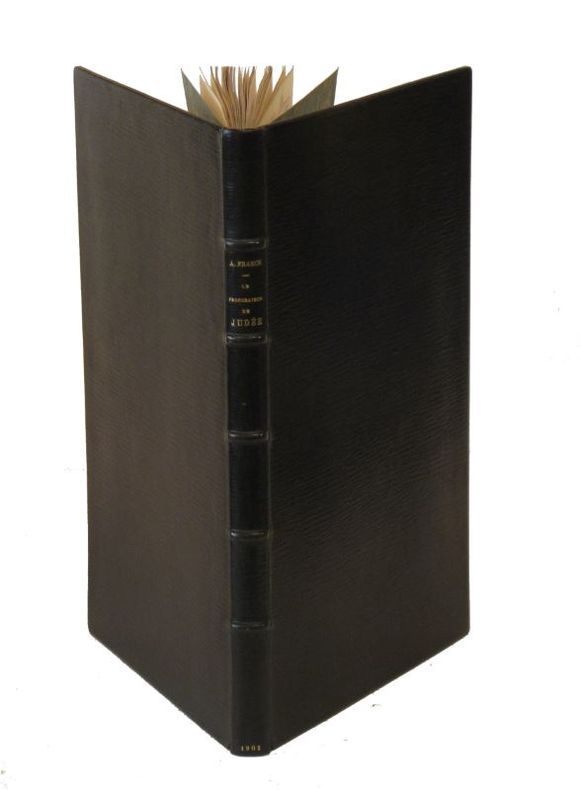
190215491Paris EDOUARD PELLETAN 1902 1 Quatorze compositions d'Eugène GRASSET gravées par Ernest Florian. Paris, Edouard Pelletan, 1902, in-8, maroquin vert, double filet doré sur les coupes, cinq filets dorés sur les gardes, dos à 5 nerfs, tranches dorées, 40 pages, table des compositions gravées, achevées d'imprimer, vient de paraître daté de 1902 avec page spécimen et justification du tirage. (Affoltep Relieur).
Panorama della città ripreso dalla via Flaminia, all'all'altezza di Ponte Milvio. L'opera deriva da un dipinto di Karl Ludwig Frommel, che lo stesso autore incide e fa pubblicare dal Bibliographisches Institut di Hildburghausen (ma aveva sede anche ad Amsterdam e a New York) verso il 1840. Acquaforte, finemente colorata a mano, in ottimo stato di conservazione. Panorama of the city taken from Via Flaminia, outside of Ponte Milvio. The work is based on a painting by Karl Ludwig Frommel, which the same author engraved and had published by the Bibliographisches Institut of Hildburghausen (but he was also based in Amsterdam and New York) around 1840. Etching, finely hand-colored, in excellent condition.
In 8° (18,4×12,5 cm); (4), 336, (2 b.) pp. Legatura editoriale in pieno cartoncino molle con titolo chiosato a mano al dorso. Qualche macchia e traccia di sporco. Un leggerissimo alone al margine interno delle prime 5 carte e al margine esterno delle ultime 5, praticamente invisibile e ininfluente. Esemplare in barbe e quindi ad ampi margini ed in più che buone condizioni di conservazione. Rarissima edizione, della variante della prima edizione di questo scritto del grande medico, anatomista e patologo forlivese, Giovanni Battista Morgagni o Giovan Battista Morgagni o anche Giambattista Morgagni (Forlì, 25 febbraio 1682 – Padova, 5 dicembre 1771). Questa variante, che venne stampata da Comino prima delle altre copie, non presenta la dedicatoria ad Heister, aggiunta solo in seguito ed un frontespizio con qualche piccola differenza di stampa delle lettere oltre ad un errore marchiano poi corretto nelle copie seguenti. Trattasi probabilmente di una copia di prova dello stesso Comino. In questo esemplare infatti invece della corretta forma di “nunc primum” è stampato l’errore “nunc primnm”. Antica firma di appartenenza privata al recto del piatto anteriore “Ippoliti”. L’opera che apparve per la prima volta in forma notevolmente rimaneggiata nel 1721 vide la sua forma definitiva, considerata in tutto e per tutto come la prima edizione (presenta più di 200 pagine rispetto all’edizione precedente), edita da Comino a Padova nel 1750. Fra i suoi interessi anche quelli legati allo studio dei classici della medicina con studi filologici approfonditi. Qui presenta i suoi studi dedicati alla dottrina e figura del grande medico romano Auro Cornelio Celso descritta nel suo “De Medicina” che unico superstite pervenutoci di un trattato più ampio dedicato a tutte le scienze antiche, rappresenta una delle più vaste fonti di informazioni sulle pratiche mediche dell’epoca.. “L’impegno filologico di Morgagni si realizzò soprattutto nelle quattro lettere In scriptores rei rusticae, composte tra il 1721 e il 1723 per conto di Johann Matthias Gesner (Lipsia 1735), e nelle dieci lettere In Aur. Corn. Celsum et Q. Ser. Samonicum pubblicate in due momenti successivi (Padova 1721 e 1750) su richiesta del collega e amico Giovanni Battista Volpi. Morgagni lasciò inoltre numerosi scritti a carattere storico-medico, storico ed erudito, raccolti insieme con altri negli Opuscula miscellanea (1763), tra i quali le Epistolae Aemilianae in cui illustrò la propria terra natale da tutti i punti di vista (geologico, geofisico, archeologico, storico, etc.)”. E’ considerato il fondatore dell’anatomia patologica nella sua forma contemporanea. Rudolf Virchow lo definisce il Padre della patologia moderna. In Europa si era soliti riferirsi a lui come “Sua Maestà anatomica”. “Il 18 novembre 1698, all’età di sedici anni, si iscrisse all’Università di Bologna per studiarvi medicina, specie anatomia, considerata da Morgagni “pietra angolare di tutto l’edificio medico”. Ebbe come maestro di anatomia Ippolito Albertini, ma soprattutto ebbe la possibilità di seguire le lezioni di Antonio Maria Valsalva, eminente sperimentalista di fisiologia, nonché figlio scientifico di Marcello Malpighi, tra i primi ad opporsi al fenomeno seicentesco della separazione tra speculazione scientifica e pratica. In effetti Morgagni non è da considerarsi lo scopritore unico del metodo -detto poi morgagnano-, bensì l’esponente principale, che raccolse e sviluppò le fatiche dei suoi maestri diretti e indiretti, Valsalva e Malpighi, per creare quell’edificio monumentale anatomo-patologico che sta alla base della medicina moderna … Nel 1711 il desiderio di Morgagni venne esaudito: venne chiamato alla seconda Cattedra di medicina teorica dell’Università degli Studi di Padova lasciata libera da Antonio Vallisneri, dopo che quest’ultimo ebbe ottenuto la prima Cattedra dopo la morte di Domenico Guglielmini. …. Nel 1761 Morgagni pubblicò il suo massimo contributo alla medicina, De sedibus et causis morborum per anatomen indagatis: la grande opera del forlivese stabilì una volta per sempre la correlazione tra osservazione anatomica e pratica clinica, spostando l’accento dallo studio della natura della malattia a quello della sede della malattia”. Rarissima edizione della variante della prima edizione in più che buone condizioni di conservazione ed in legatura coeva. Curiosità bibliografica. Copia probabilmente unica. Bibl: Federici, pag. 201, n. (7) che descrive la prima edizione nella sua forma classica.