25 870 résultats
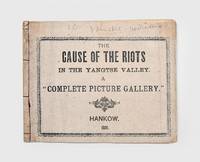
1891175500Hankow: no stated publisher 1891. Anything more horribly beastly and disgusting than these painted representations it would be impossible to imagine Sole edition of this collection of 32 images used by anti-Christian agitators in central China to whip up anti-foreign sentiment. They "appeal directly to the folk and elite traditions of China's classical past. In vivid colours they depict graphic violence. and show graphically the growing conflict between western missionary views of China and Chinese views of the Western presence" Perdue. The treaties signed at the end of the Opium War authorized western missionaries to proselytise in the Chinese hinterland. During the late 19th century when Chinese agriculture and rural life faced steep decline missionaries became popular scapegoats. "The original causes might be a dispute over land or water rights or an inappropriate marriage or an illicit love affair but the conflict could easily metastasize into large scale violence" Perdue. During the 1891 riots hundreds of Chinese Christians and two western missionaries were killed. The editor the missionary John Griffith based this publication on a pamphlet attributed to the Hunanese official Zhou Han 1842-1911 who used a publishing outfit in Changsha to disseminate a large quantity of anti-foreign literature. Zhou's images employ colour allegory and popular folk custom to "attack religious heterodoxy and sexual deviance with violent rhetoric. They portray the Christians as animals who know nothing of the moral codes that define humanity. The pictures portray the Western missionaries as goats and their Chinese followers as pigs. The play on words linking 'Jesus' as 'master' zhu with 'hog' zhu or 'Westerner' yang with 'goat' yang reduced the Christian believers to a bestial level. The use of the color green indicating 'cuckold' in the characters referring to Christians signified the undermining of the family by the alien believers. In a number of these images the animalistic Christians are brought before a god or magistrate who sits in judgement and offers them as sacrifices by having their throats slit" Purdue. Landscape quarto. With 32 full-page colour woodblocks colour Chinese title page. Original printed wrappers recent purple thread xianzhuang stitching front cover lettered in black rear cover with decoration and Chinese text in red black and green. Housed in custom burgundy quarter morocco box. Contemporary manuscript notation on front cover. Wrappers and edges of leaves creased and bumped rear cover rather worn recent adhesive tape repair to Chinese title page verso of final folded leaf sometime laid down onto rear wrapper illustrations bright stab-holes from original binding visible in gutter: a very good copy of a fragile work. Peter Perdue "The Cause of the Riots in the Yantgse Valley 1891 - Introduction" available online. unknown
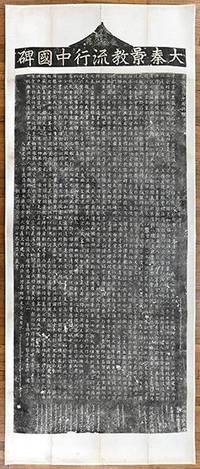
1900174874Xi'an China: c.1900. China's "Christian Rosetta Stone" A rubbing of the most famous document of Chinese Christianity. When rediscovered the Nestorian Stele transformed understanding of the cross-cultural history of Tang dynasty China. "The discovery of this monument is what made Westerners aware of the presence of Christianity in China prior to the mission of the Franciscans in the thirteenth and fourteenth centuries and those of the Jesuits" Nicolini-Zani p. 117. The Nestorian stele was carved in 781 and stands at almost three metres tall. The Chinese inscription in the calligraphy of a local official Lu Xiuyan describes how Christians arrived at the Tang capital of Xi'an in 635 and with official permission founded churches. The stele also introduces in Chinese and Syriac some of the community's senior clergy and the present state of the Nestorian church. "Erecting a stone monument to describe commend and propagate its teachings was no small undertaking for the Tang Christian community. Putting up stone monuments was an expensive exercise because of the price of the stone and the fee of the expert artisan who engraved the text. The monument itself makes an important statement about the place of Christianity within Tang society" Nicolini-Zani pp. 120-1. In 845 Christianity was banned by Emperor Wuzong and the stele was buried. Rediscovered by Chinese antiquarians around 1625 it brought to light a lost dimension to China's history and translations soon appeared in Jesuit sinological writings including Kircher's China Monumentis 1667 which includes the first printed reproduction of the text. The stone now stands at the Beilin Museum in Xi'an and is listed among the small number of protected antiquities that will never be exhibited abroad. Rubbings from the original are no longer permitted. Provenance: the theologian and sociologist Y. Y. Tsu 1886-1986 also known as Chu Yu-Yu. Born in Shanghai Tsu studied at St John's College Shanghai and at Columbia where he was one of the first Chinese students of sociology to study abroad. In 1912 he became Professor of Sociology at St John's and later served as religious director of the Peking Union Medical College. "In 1940 he was consecrated an Episcopal bishop in Shanghai and was named Assistant Bishop of Hong Kong and Bishop of Kunming where he began his Burma Road work. Bishop Tsu was known. as the 'Bishop of the Burma Road' because of his efforts to befriend Allied troops traveling the international highway that ran through his district" obituary in New York Times. In 1931 Tsu held a visiting lectureship at the Pacific School of Religion in Berkeley California. This rubbing was gifted to the institution by Tsu and displayed there during the 1930s. It is regularly mentioned as a point of interest in contemporary tourist guides to the state. Rubbing from stone on multiple paper sheets arranged soon after execution to form 120 x 320 mm curved headpiece 100 x 588 mm title and 1825 x 870 text body mounted on four long pieces of paper joined to form area of 2338 x 958 mm edges of mount reinforced with old decorative white paper. Rubbing generally sharp and legible a few surface blemishes sectional joins expertly reinforced in places on verso: a very good example of an imposing piece. Matteo Nicolini-Zani The Luminous Way to the East: Texts and History of the First Encounter of Christianity with China 2022. unknown
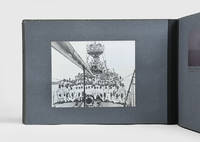
1898178920China Japan and at sea: 1898-99; 1911-13. The "scramble for China" An important visual record of Germany's empire-building in China and naval life in East Asia before the First World War including early views of Qingdao. It was assembled by Hermann Mörsberger a future rear-admiral who served at Kiautschou Bay during the 1897-8 crisis and commanded the East Asia Squadron's SMS Nürnberg between 1911 and 1913. The murder of two missionaries in Shandong in 1897 offered Germany an excuse to deploy troops to Kiautschou Bay and press its case for a concessionary area - and strategically positioned port - on Chinese soil. Attached to the Matrosenartillerie-Detachement Kiautschou as a leutnant zur see Mörsberger 1872-1940 shipped out to China in late 1897 on the screw steamer Darmstadt. The ship's arrival off Qingdao in January 1898 and the rapid deployment of its marines confirmed Germany's de facto control of the territory and left the Qing government with little option but to grant a concession. The first album opens with a photograph of Darmstadt and superb photographs of the cruiser SMS Kaiserin Augusta - ordered to China to brandish its dozen guns - and other powerhouses of the squadron including Cormoran Irene and Prinzess Wilhelm. Images show the parade on 27 January 1898 to welcome the future governor Rear-Admiral Ernst Otto von Diederichs 1843-1918 and Qingdao's artillery dump and yamen. Missionaries were hot on the navy's heels the album containing a group portrait of Joseph Freinademetz and other visiting Catholic missionaries in February 1898 as well as several pieces of red paper with their Chinese and Western signatures. After the legal takeover of the concession Mörsberger transferred to Kaiserin Augusta visiting Shanghai Hong Kong and Tokyo. More standard tourist views of Shanghai including a nicely composed image of a junk moored in the river are arranged alongside photographs of the unveiling of the city's ltis Monument on 21 November 1898. In a more relaxed moment Mörsberger poses playfully with other junior officers. German power did not take long to bed in. Within a decade and a half Mörsberger - now a fregattenkapitän - returned to Qingdao with Nürnberg a Königsberg-class light cruiser and the squadron's newest member. A panorama shows the armoured cruiser SMS Scharnhorst the flagship of squadron commander Count Maximilian von Spee docked in newly built facilities the recently christened Prince Heinrich Hill in the background. Nürnberg moves between ports as part of its Yangtze patrol duties Mörsberger obtaining panoramas taken from the river of Shanghai Zhenjiang Jiujiang Nanjing and Hankou as well as shots of other squadron vessels. Alongside official events including the welcoming of official dignitaries and the parade to celebrate the 25th anniversary of the Kaiser's coronation there is time for tourism parties and an international rowing contest. Four unusual photographs capture the illuminated buildings of Shanghai at night. A small proportion of material concerns Japan Thailand Honolulu and Mexico. Many of the professionally executed photographs concerning China were clearly circulated only within the German military and in small numbers. 2 albums landscape folio. With 195 mounted albumen platinum and gelatin silver photographs including 31 large portraits and views c. 145 x 205 to 205 x 280 mm 26 panoramas c. 90 x 290 to 110 x 340 mm and 138 small photographs c. 55 x 80 to 145 x 210 mm. Together with other laid-down material: 17 items of printed ephemera documents menus etc. 14 ms. items some in Chinese ms. map watercolour 110 x 140 mm. With 4 ms. maps printed map photographic panorama and printed passport loosely inserted. Neat German captions. First album: original black half sheep green cloth sides decorative linings card leaves hinged with black cloth. Second album: original green cloth lettered "S.M.S. Nürnberg" in gilt on front cover decorative linings black cloth rear pocket card leaves hinged with black cloth. Material well preserved occasional offsetting fading and yellowing to some photographs but detail still readily discernible one photograph splitting along old horizontal fold binding of first album worn second sunned and with a few abrasions: very good. hardcover
1944172481United States: Department of the Interior Bureau of Reclamation 1944. The genesis of the Three Gorges Dam Number 4 of a small number of copies of this report by the engineering mind behind the Hoover Dam on harnessing the mighty Yangtze River for hydroelectric power generation - a vision finally realized over half a century later. We have traced only four other surviving examples all found in institutions. The author John Lucian Savage 1879-1967 was an American civil engineer who became the Chief Designing Engineer at the Bureau of Reclamation in 1924. "In this capacity he designed dams canals and other irrigation-related structures throughout eleven western states the most impressive projects being Hoover - the supreme engineering feat of its day - Grand Coulee Parker and Shasta dams. Because the first three were respectively the highest widest and deepest dams in the world at the time of their construction Savage and his design team developed trial-load analysis for determining actual versus theoretical stresses in arched dams as well as models for determining concrete deterioration land subsidence and increased seismicity caused by the weight of a mammoth dam" ANB. Since the 1930s Savage had been fascinated with both the idea of damming the Yangtze and the prospect of co-operation between the Bureau of Reclamation and the Chinese government. Chiang Kai-Shek's administration was equally keen. Amidst Chinese efforts to repel a Japanese invasion in 1943 the National Resources Commission of Chiang's government invited Savage to China to devise concrete plans - an opportunity Savage described to the State Department as a "signal honor" and "an opportunity to be of service to the valiant people of China" quoted in Rowley & Gahan p. 584. Even as Chinese-Japanese armed engagements raged nearby Savage spent the period from May to November 1944 researching feasibility and necessary administrative and financial arrangements. This resulting report outlines several different plans for constructing a dam reservoir and power plant to generate up to 11 million kilowatts of power 74 million acre feet of water for irrigation and 22 million acre feet of flood storage. Savage projects a final cost of around 1 billion US dollars and annual revenues exceeding 50 million US dollars. The main 98-page technical report is accompanied by his 238-page discussion of four hydro-projects located on important tributaries discussing costings and technical details. The two reports are supported by dozens of technical maps plans and diagrams. Savage's time in China only reinforced his belief in the possibilities of a project unprecedented in its scope and ambition: "The Yangtze Gorge Project is a 'CLASSIC'. It will be of utmost importance to China. It will bring great industrial developments in Central and Western China. It will bring widespread employment. It will bring high standards of living. It will change China from a weak to a strong nation. The Yangtze Gorge Project should be constructed for the benefit of China and the World at large" p. 6. An accompanying typescript letter dated 2 April 1946 from Walker R. Young Chief Engineer in the Bureau of Reclamation confirms that as many as 50 Chinese engineers will soon be available to orchestrate the Yangtze project but also hints at the impact of the Chinese Civil War on the National Resources Commission - the war proved the ultimate undoing of efforts to act on Savage's vision. The letter states that numbered copies of the report are being distributed in preparation for a formal planning conference involving American and Chinese engineers. The number of recipients - nine western engineers - gives a good indication of the report's small circulation. Savage's copy is housed with some of his papers at the National Museum of American History. Copies are also found at the US National Archives the Colorado School of Mines and Purdue University where Savage served as a faculty member. The National Library of China has a version with a Chinese title page - the precise nature of this copy awaits further research. Folio. With 73 large folding maps plans and diagrams. Original black cloth spine lettered in gilt hinges reinforced with brown linen as issued buff endpapers text printed in photostat typescript. Cloth lightly soiled and rubbed internally clean. A fine copy. William D. Rowley & Andrew H. Gahan The Bureau of Reclamation: From Developing to Managing Water 1945-2000 2006. hardcover
25041601China 1904-1906. Half red leather over marbled boards recent binding gold-stamped very good 35 x 27.5 cm. all edge gilt most gone 18 stiff leaves 166 b.w. photos one pencil drawing one post card one photo cut outvery clean. . . . AMERICAN "DOUGH BOYS" IN CHINA 1927 . . . DURING THE FIRST REVOLUTIONARY WAR . . THE FOUNDING OF THE COMMUNIST PARTY This excellent primary record was begun July 1904 and ended with the last photo caption dated June-August 1906. The work is an exceptionally clean example with meticulous captions clear and bright images of varying sizes. The smallest is 6 x 4.5 cm. ca 10 each up to 23.5 x 17 cm. for the largest. With a large number of intermediary sizes in between. . The captions are in both English & Italian and a mix of both languages carefully identifying the place & person photographed. From the kind of photographs and people in these its is easy to deduce that this album was likely made by an Italian officer assigned as part of the protective foreign force for the Italian Embassy and diplomatic corps as guards. Assigned to China to continue to protect after the Boxer uprising they protected both the foreign diplomatic community and their families. A good number of these are of Peking and of their excursions around China. . Visits to Shan-Fan-Shan temple photos of a friend who was in Seoul Korea riding a rickshaw photos of some American military officers: ie "Lieut. Clark & Capt. Brewster Commandant of the Peking U.S. Delegation guard Lieutenant. Clark" et al. Polo on the Peking Polo grounds Pei-Tai-ho beach one lovely one of "Casa di mia Isabella; next obviously a photo of the album's maker and Italian who freely associated freely with his American counterparts in the military & diplomatic corps. . A lovely pencil sketch of Francesco Rospidliosi perhaps the creator of this album dated August 1903. Peking race track grandstand "Variag" Chemulko Korea: view of a belly-up ship in Korea another dated April 1904 shows various diplomats: "Ministro d'Augustine.Mr. Uchida.do of Peking." dragon boat in Shanghai three great photos of horse-mounted officers with caption and date "Warriors. 1904 Peking & Huang Ts'un" and their horses. . January 1905 the album continues with photos of the soldiers in Peking their pet dog horses wagons Chinese grooms &c. Then a lovely and grand size group photo some in military uniform others in civilian clothes diplomats most with long boots dated "March 1905" most with Italian names except for one penciled at the far right: "Swanton" and two women. Names appear above and below the photo which is 23.5 x 17 cm. Next 2 page show horse racing honor guards in formation "April 1905" going to church photos of Peking race horses and their foreign mounts "May 1905." Next pair of pages show a "September 1905 Trip to the Great Wall with Mrs. Brewster & Miss Brewster at Sha-ho Chinese hotel Nan-ko Pass Mrs. David at Peitai-ho" and along the way to the Great wall with stunning photos of the impressive and grand size "First Gate." Their horse-drawn stage coach-like "wagon" straight out of the old American West ! Photos of three foreign children "Peking 1905." On the next page more of the Great Wall excursion: Capt. & Mrs. Brewster along side the Great Wall & of course photos from on top of the Great wall all nicely dated ! Next set show more on the Great Wall and "Coming back without Toda and a superb photo of the album compiler mounted on horseback with "doggie" standing at attention ! . The next pair shows Shanghai naval officer and horse wagon another of two foreign children in a large Jinriksha in Peking 1905 with another of the children in great fur coats. Postcard of the Wuta-su Temple of Seven Pagodas Peking. More horse-mounted photos Peking race course. . The next page shows some important and spectacular photos. "Miss Roosevelt Eleanor wife of President Franklin D. Roosevelt who held that office from 1933 to 1945 Capt. Diconard Military Attaché USA Mr. Rockhill U.S. Minister please inquire with us to see if we have some of his important books on Tibet in stock Mr. Cooledge First American Legation Miss Roosevelt Chinaman.Peking Sept. 1905. These great people are greeted by a group of Chinese Imperial Mandarins wearing special hats and long white gowns. Another of "Miss Roosevelt M. Mrs. di Almeida Capt. Pringle Peking 1905." . Then a larger and quite stunning photo of Italian Naval officers.and Americans: "Mrs. Brewster Commandant Cipriani Miss Brewster Guardia della Degarione d'Italia.Capitano BrewsterAmerican." all seated before a great Fu Dog for a camera pose. . The album continues then a rather sad photo of the "Portion of the remains of the French Catholic Mission residence of La Varche & Ma-murdered Nan Chang March 1906" & "Kinghams chapel in background.burnt house is right around March 1906." Adjacent to this is "Ring leader of attack on Kingham's house Han Chang March 1906." . Next 2 pages show more ruined church with "corner of house in which Mr. & Mrs. Kingham and the little daughter Gracie .they were beaten to death in this corner-blood stains March 1906." Next shows "Four men who conducted murder torture having taken part in the murder of the Kinghams and burning of their mission March 1906" shows four Chinese handcuffed to a steel ring around their necks. We now learn the true level of danger for foreigners in China and the reason for the foreign troops to give protection to the innocents murdered by Chinese. . The next page shows an inspection of the palace by Capt. Lynne Doct. Dawe H.M. Tripe at Han Chang March 1906. Arrival of the Chinese delegation for the "Han Chang murder of foreign missionaries affair. Next two show a visit to Hankow the race course grand stand Miss Byron A.W. Cross another shows 1st Lieut. F.E.K. Strong playing banjo April 1906. Shipboard travel on the H.M.S. Cadmus. Continue ship travel to Hankow on board the "Calabria" and a nice photo of A.W. Cross Commissioner Hankow another of S.S. Marco Polo at Hankow. Apparently the military group was now moved to Hankow where memorial photos were taken aboard ship with the officers all named around the photo. Next shows "Consulato d'Italia Hankow August 1906." Other pages show H.M.S. Clarity the Han river ."with daddy & Miss Hart June 1906" and other ship and harbor views. Next shows a great French cruiser "Descartes" at Kiukiang Kiukiang Bund Commissioner's garden Festa del Dragones dragon boats country walks with Mrs. Lay et al. The album ends with June-August 1906 dated photos rest at "Bungalow" in Kiu Kiang. Where they visited with British administrators and missionaries. . Rare insight to the diplomatic world of foreigners stationed in China at the turn-of-the century. Fascinating primary resource. There are very few albums that cover this rare aspect of life in China from the higher social structure of foreign diplomats and military people. Keen insights to the life and customs of the privileged people. . . unknown
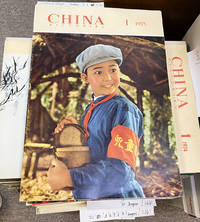
19591007<p><b><i>China Pictorial 219 issues</i></b></p><p>Beijing: China Pictorial distributed by Guozi Shudian; printed in the People's Republic of China comprising 219 issues covering the years 1959–1984 each measuring approx. 10-3/16 x 14-1/2 inches 26 × 37 cm overall condition is very good plus to near-fine. Because of the weight shipping will be by FedEx Ground</p><p>China Pictorial is a monthly magazine bi-weekly thru 1960 illustrated with photographs and essays about current events <b>highlighting the development and progress in modern PRC</b> the People's Republic of China. It doubled as a <i>propaganda tool of the Chinese government</i> and was issued in 19 languages including Korean Russian German French Spanish and Italian. Several issues include various supplements calendars and flyers laid inside. Except for the one duplicate issue covering the funeral of Chairman Mao 1976.11 which is in Chinese all remaining 218 issues are the English-Language version. Quite rare thus.</p><p>1959: No. 2-22; 1960: No. 2-14 16-24; 1961: No. 1-12; 1962: No. 1 3 4 5 6 7 8 10 11; 1963: No. 1-12; 1964 No. 1-5 7-12; 1965: No. 1-4; 1966: No. 1-10; 1968: No. 1-9 11-12; 1969: No. 1-8 10-12; 1971: No. 1-9 11-12 1972: No. 1-12; 1973: No. 1-12; 1974: No. 1-6 8-11; 1975: No. 1-6 8 10; 1976: No. 1-9 11; 1978: No. 1 7; 1979: No. 1-9 12 1980: No.1 3 4 5 7 11 12; 1981: No.1 3 4 7 8 9 10; 1982: No. 2 4 9 11; 1983: No. 12; 1984: No. 12; </p><p><i>Important events detailed: Modern woodcuts in China; Hard-Stone Carving-A Special Craft of Peking; Stamp collection; the Propaganda Poster—A Fighting Art; Works of Art by PLA Men; Peking Peasants Hold Sports Meeting; Wrought Iron Pictures; The Museum of the Chinese Revolution; In Commemoration of the 50th Anniversary of the 1911 Revolution; Tea Drink in China; Mei Lan-fang and His School of Art; The people of Tibet for the first time in history in the midst of electing their local representatives; A Great People's Fighter—Lei Feng & Lei Feng's Dairy; The First GANEFO; Guo Lan-ying A Well-Known Singer; Box-Wood Carving; Painting Illustrating Chairman Mao's Poem; New Stamps</i><i>ï¼›</i><i>China Successfully Explodes Her First Atom Bomb; A Splendid Revolutionary Oil Painting "Chairman Mao Goes To Anyuan"; Piano Music "The Red Lantern" with Peking Opera Singing; Ping Pang Ball Spreads Friendship: Chuang Tse-tung of China with Glenn Cowan of the US.; Ancient Chinese Silk and the Silk Road; President Nixon Visits China: Chairman Mao Meets President Nixon in Peking; Photographs Taken by Edgar Snow in China in 1936; Choukoutien-Home of Peking Ape-Man; Peking Duck; Jade in China; Yellow River Valley-Cradle of Ancient Chinese Civilization; Evergreen Friendship Between the Chinese and Japanese People; Criticize the Fallacies of Lin Piao and Confucius in Peiking and Tsinghua University; A Madman's Diary by Lu Hsun; Chin Shih Huang's Progressive Role in History; the Shang Yang Reform; Lu Shun a Pictorial Series in Gouache; the Chen Sheng-Wu Kuang Uprising; More Ancient Treasures Excavated at Mawangtui: Books Copied on Silk; Wang Chung Against Confucius; Tsao Tsao; Vice Premier Deng Visits The United States; The Silk Road; Painting of Wu Guanzhong; The Chinese Muslim; How an Ancient Chinese Painting Was Reproduced; Fan Zeng's Figure Painting; The Museum of Qin Dynasty Terracotta Warriors and Horses; The Ma Haide I Know; Colored Paintings on Ancient Architecture; Lu Xun: His Life and Works</i>; <i>Confucius Temple; Traditional Chinese Painting Watercolor; Oil Painting—Li Huaji Style; Wushu; Modern Porcelain</i><i>Special Issue About Cultural Revolution: Decision of the Central Committee of The Chinese Communist Party Concerning the Great Proletarian Cultural Revolution; Revolutionary Ballet: White-Haired Girl; Chairman Mao Joins a Million People in Celebrating the Great Cultural Revolution; Comrade Lin Piao and Chou En-lai's Speech; Supplement: In Memory of Lu Hsun—Comments from Chairman Mao; Comrade Chu Teh's Life Was One of Fighting for Cause of Communism; Bamboo Slips from the Chin Dynasty Unearthed; Chairman Mao Meets Former U.S. President Nixon in February; People Throughout China March to Against Teng Hsiao-ping's Crimes of Reverting Capitalism; Children's Paintings; Death of Comrade Chou En-lai; Chairman Mao's Funeral: Eternal Glory to the Great Leader and Great Teacher Chairman Mao Tsetung; Message to the Whole Party the Whole Army and the People of All Nationalities Throughout the Country; Memorial Speech by Comrade Hua Kuo-feng with original photo of Hua Kuo-feng's delivering memorial speech &c</i>.</p><p>《人民画报》æ‚志,本组涵盖1959年到1984年(具体期刊è§åˆ—表),ä¸åŽäººæ°‘共和国出版,国å书店å‘行。本组包括219期,å“相éžå¸¸å¥½ã€‚</p><p>《人民画报》是月刊,通过照片ã€æ–‡å—ç‰æ–¹å¼æ¥å±•ç¤ºä¸å›½çš„å‘展和进æ¥ï¼Œå®ƒåŒæ—¶è¿˜å‘行了包括韩è¯ï¼Œä¿„è¯ï¼Œå¾·è¯ï¼Œæ³•è¯ï¼Œè¥¿ç牙è¯ï¼Œæ„大利è¯ç‰å¤šç§è¯è¨€æ¥ä½œä¸ºä¸å›½æ”¿åºœå‘ä¸–ç•Œå®£ä¼ ä¸å›½çš„é‡è¦å·¥å…·ã€‚内部还包括多个增刊ã€æ—¥åŽ†å’Œå®£ä¼ å•ã€‚</p><p>出版社:外国è¯è¨€å‡ºç‰ˆç¤¾ ä¸å›½Â·åŒ—京</p><p><br /></p> distributed by Guozi Shudian; printed in the People's Republic of China, paperback
193471Some wears as shown many photo plates color maps of Concession. Concession Francaise de Changhai (Shanghai) paperback
698117 of 36 folding black & white woodcut plates each with fine contemporary hand-coloring. Printed in red & black zhu mo tao yin ben. 51; 50 folding leaves. Two vols. 8vo 265 x 166 mm. modern brown wrappers new stitching. Beijing: Wu ying dian the Imperial Printing House Preface dated 1711 Afterword dated 1712 completed 1713. First edition Chinese issue of this famous and beautifully illustrated book ordered by and overseen by Kangxi 1654-1722 Emperor of China. It was printed in 400 copies on superior paper 200 in Manchu and 200 in Chinese. The Chinese edition is quite remarkable for having been printed in both black and red ink zhu mo tao yin ben an invention from the Yuan Dynasty requiring two runs through the press. The book is a collection of poems written about 36 remarkable sites which include gardens landscapes and buildings at the emperor's summer palace a mountain estate in Rehe now Chengde Hebei; it is today a UNESCO World Heritage Site. For each poem a magnificent folding woodcut plate is provided depicting the associated site. While our copy has 17 of the 36 folding plates they have been beautifully hand-colored at what appears to be an early date and have large margins at the bottom. The difference between the black & white plates and those hand-colored is remarkable and dramatic. In each case the plates - which are extremely fragile - have been expertly backed with new paper margins strengthened and reinserted into the volumes on stubs. The plates clearly come from another copy. On several of the plates there is some small loss of image. Our copy has plates 2 3 7 8 9 11 14 15 16 19 21 24 25 27 29 32 and 35 as established by Whiteman see below. The result is a perfect match of poetry and landscape painting with strong literary and artistic characteristics. Kangxi's own Preface dated 1711 is followed by the impressions in red of his two seals: Ti yuan zhu ren his style name used on his seals and Wan ji yu xia "Brief leisure". This work "offers a virtual tour framed by images and the emperor's own poetry the garden placed in the palms of one's hands. Created in parallel painted which no longer survives woodblock printed our first edition and copperplate engraved versions the album's multiple iterations resonated with each other and with the park itself."-Stephen H. Whiteman Where Dragon Veins Meet. The Kangxi Emperor and His Estate at Rehe 2020 p. 6-& see the entirety of this wonderful and beautiful book especially pp. 151-88. The scenes of the imperial gardens and landscapes offered in this book allowed unprecedented access to the private life of the emperor. In 1702 Kangxi ordered the construction of the palace and landscaping of the considerable parklands at Rehe in order to support his annual tours north amongst the court's Inner Mongolian allies. The palace served as a second capital at which Kangxi resided from late spring to early autumn. When in residence the emperor oversaw garden tours banquets and entertainments all of which celebrated his rule. In 1711 Emperor Kangxi conceived of a project to celebrate his 60th birthday and 50th year of his reign. He selected 36 major scenic sites within the extensive property and gardens surrounding the summer palace. One poem for each site was written with the emperor's involvement and one painting of each site was created by the court artist Shen Yu b. 1649. The writings and accompanying illustrations were meant to demonstrate the harmony between heaven and humankind through natural landscapes and related architecture. They also served as propaganda: this represents the first time imperial spaces were depicted during the Kangxi court. The collection of poems was annotated by Kui Xu Li Tingyi and others upon the imperial order and prefaced by Emperor Kangxi himself in 1711. Two of the court's most talented woodblock artists Zhu Gui ca. 1644-1717 and Mei Yufeng active ca. 1696-1713 were engaged to prepare the woodblocks from Shen Yu's designs. "Whether derived from or simply correlated to the unique album now lost the woodblock-printed book functions as a surrogate for the paintings. It imitates the album's arrangement and mode of engagement with the landscape pairing image and text in an intimately scaled format. The style of the images evokes Wang Yuanqi but also and more significant the emperor's most important artist thereby marking the book as a work of the court's highest echelon of cultural production and an object clearly commissioned and owned by the emperor. "Kangxi was intimately involved in the minutiae of the book's production from the selection of a specific type of high-quality paper to reviewing and editing the printing proofs to inspecting samples of the finished work. He was kept closely informed about the progress of the project including difficulties in curing the datewood blocks Zhu Gui and Mei Yufeng used as well as the need for more artisans given the scale and intricacy of the work. The order for four hundred copies two hundred in Chinese and another two hundred in Manchu came directly from the throne. In comparison to other contemporary projects with print runs of one thousand or more this number suggests that the emperor had a clear sense of the exclusive audience he intended to reach. "There is no record of the deadline against which the block-cutters printers and binders all labored. Given the timing of the project and the flurry of reports around printing and binding that appear from the intercalary fifth through the seventh months of 1713 however it seems most likely that the volumes were meant as gifts for the emperor's sixtieth birthday celebrations that year. The scale and lavishness of production accords with this hypothesis as four hundred copies indicated intended distribution among a relatively small circle of imperial clansmen steppe elites senior officials and others close to the throne."-ibid. pp. 182-83. Shortly thereafter in the years 1712-14 another edition was produced with engravings instead of woodcuts. It was overseen by the Jesuit Matteo Ripa and two Qing artists. In fine and fresh condition. Minor worming to text leaves but not the plates. Preserved in a chitsu. unknown books
187464884Berlin, R. Wagner, (1871-1874). Imp.-Fol. (62 x 53 cm). Mit 34 chromolithogr. Farbtafeln v. R. Steinbock (27) u. W. Loeillot (7) nach Eduard Hildebrandt, vom Verlag auf Untersatzkartons montiert. Zus. m. dem letzten Orig.-Lieferungsumschlag lose in schwarz- u. goldgepr. illustr. OLwd.-Mappe.
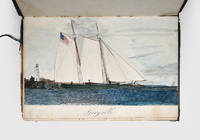
1842170558At sea & China: 1842-48. This ground is under English control though their authority is might makes right An American second mate's illustrated eyewitness account of China in the immediate aftermath of the First Opium War. Sailing east on a Jardine Matheson specie and opium runner he becomes an old China hand and a sharp observer of early colonial Hong Kong and Shanghai coastal trade and maritime life. The opening section consists of diary entries kept during the outward voyage from the United States describing a life of adventure entered almost by accident. "On the 1st of Sept. 1842 being in Boston and out of employ I shipped in the Schr Gazell" p. 1. The Gazelle - an Aberdeen-built schooner illustrated in watercolour at the front of the manuscript - sailed on 19 September 1842 with guns muskets and nine boxes of specie. Some 30 pages trace the passage with detailed daily entries including latitudes and longitudes weather hazards marine life shipboard routines and the rituals of crossing the Equator. After rounding the Cape the vessel encounters American traders off China and reaches Macao on 22 February 1843. The remainder of the manuscript comprises reflective recollections written later in the 1840s. Macao is judged healthy and pleasant but eclipsed after the war by Hong Kong now the hub of British trade. The Gazelle is reassigned to opium running along the coast bringing higher pay and extended travel. The author recalls Hong Kong in 1844: the nightly curfew gunshot the opium fleet at Whampoa and the crowded Pearl River illustrated with pencil sketches of local craft. His view of the Chinese population is unsympathetic though he offers a vivid portrait of "Boston Jack" a wealthy comprador and indispensable intermediary to American ships. Further chapters describe Canton the forts of the Bogue Amoy and its junks and Chusan praised for its industry and abundance. Shanghai emerges as a newly important centre of opium exchange its foreign settlement firmly under British control. The author sketches the harbour notes the thousands of junks and contrasts the city's "civil and obliging" inhabitants with those of Canton. The manuscript breaks off mid-sentence on page 50 leaving the writer's later life unknown but preserving a detailed first-hand record of a China on the threshold of colonial modernity. Octavo notebook 252 x 165 mm. Opening full-page watercolour 12 illustrations and plan in pencil. Original blue linen pink patterned endpapers edges sprinkled blue 49 pages neatly written in black ink 38 unused blanks. Notebook worn and shaken with sewing loose a few closed tears internally touching a few letters only. A very good example. unknown
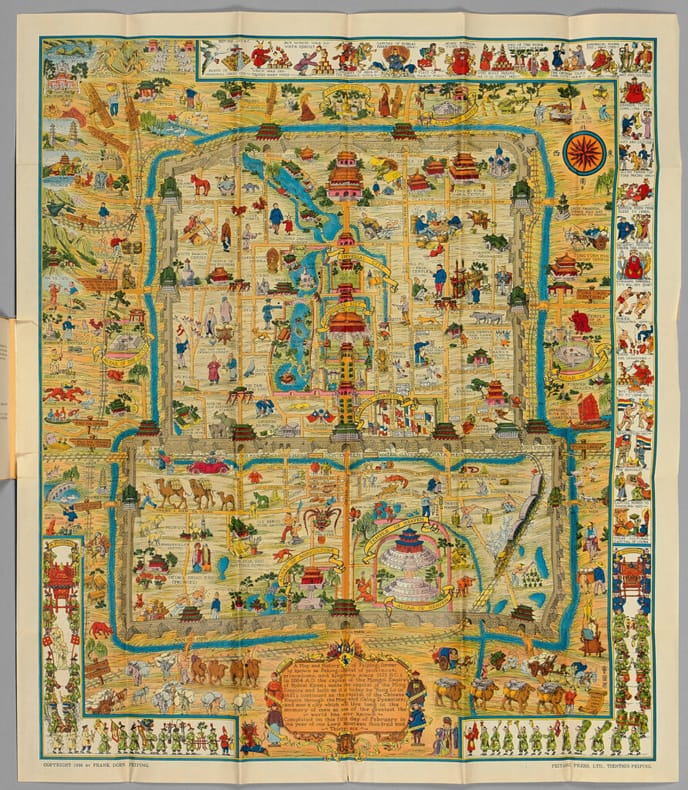
LCS-18269“One of the great maps of the golden era of pictorial mapmaking”. Lithographed & Published by The Peiyang Press, Ltd., Tientsin-Peiping, 1936. In-8 de (1) f. de titre, 22 pp. de texte explicatif et carte repliée en couleurs de 86 x 74 cm. Deux petites déchirures dans la marge blanche de la carte. Conservé dans la brochure et dans l’étui d’origine. Dimensions du livret : 181 x 132 mm. Dimensions de la carte : 860 x 740 mm.
CBF24<p>Lithographed & Published by The Peiyang Press Ltd. Tientsin-Peiping 1936.</p><p>8vo 181 x 132 mm of 1 title-page 22 pp. of explanatory text and a folded map in colors measuring 86 x 74 cm. Two small tears in the white margin of the map. Preserved in the original publisher's wrappers and slipcase.</p><p><b>Very rare first edition complete with the folded map and the booklet preserved in the publisher's illustrated folder.</b></p><p><b>Finely executed pictorial map of Beijing published by Frank Dorn and the Peiyang Press. Ltd. of Tientsin and Peiping in 1936.</b></p><p><b>Dorn's map is perhaps the best known and most iconic pictorial map of Beijing published in the 20th Century offering a host of interesting ethnographic and iconographic information about Beijing and its environs while retaining the whimsical qualities of the great pictorial maps of the first half the 20th Century.</b></p><p><b>Dorn's map is considered one of the great maps of the golden era of pictorial mapmaking. </b></p><p>The map is ringed with a series of cartoon vignettes illustrating the history of the city from ancient times to 1936. Dorn was a friend and admirer of the pictorial mapmaker Jo Mora 1876-1847 and was clearly influenced by Mora's style of combining accurate pictorial details bright colors and a bit of whimsy along with vignettes providing an illustrated history of the place.</p><p>The cartouche is decorated with names and dates of historical events and this legend in the center.</p><p>Frank Dorn was an artist writer and military officer. Growing up in San Francisco he attended the San Francisco Art Institute and became an accomplished cartoonist. After graduation from West Point he was assigned a post in the Philippines and as a side project wrote a book about a clan of tribal people he got to know there. An acquaintance of California artist Jo Mora Dorn began making his own maps; an early one depicted Camp Strassenbourg in the Philippines.</p><p>While living in China Dorn made his popular pictorial map of "Peiping". He later served in the field as advisor to a Chinese army. A fluent speaker of Chinese Dorn's most important military role was in the China-Burma-India theater during World War II. There he served with Deputy Chief of Staff of the U.S. Army forces General "Uncle Joe" Stilwell during the Burma campaign from 1942 to 1944 and served as a commanding officer in 1944-45. A 1942 Life Magazine article about the Burma mission stated that "Dorn an artist drew Stilwell's campaign maps." </p><p>Dorn eventually attained the rank of Brigadier-General and retired in 1953. He settled in Carmel California living what his friend John Thompson describes as "a semi-bohemian life writing and painting. In the Sixties he did some amazing psychedelic paintings wondered if he was the incarnation of a Buddhist painter and held progressive civil rights and antiwar views." In the 1970s Dorn authored two highly-regarded scholarly books on the Chinese and Burmese theaters of World War II. </p><p><b>A fascinating pictorial map of Beijing drawn by an American officer who was a military attaché in China during the 1930s. </b></p><p><b>It features vignettes of Chinese history from 1100 BC to 1927 as well as modern tourist attractions</b> including golf and race courses. </p><p>Hints to the political situation include the 'Kuomintang Headquarters'; and the German swastika and the Japanese 'Rising Sun' flags flying in the 'Legation Quarter' the year before the official start of the Second Sino-Japanese War in 1937. </p><p>Frank Dorn 1901-81 was a graduate of West Point where he picked up the life-long nickname of 'Pinky' before being posted to Beijing in 1934 to help gather intelligence on Japanese aggression. He immersed himself in the language and culture of the city researching the Forbidden City and collecting antiquities. When war with Japan broke out Dorn became chief-of-staff to L.t General Joseph Stilwell with a rank of Colonel. At one point relations between the Americans and the leader of the Chinese Kuomintang Chiang Kai-shek were so bad that Dorn was ordered to prepare a plan to assassinate him. Although Dorn suggested giving Chiang a faulty parachute and sabotaging his plane authorization was never given. </p><p>The plan is packed full of wonderful illustrations from the border that covers the city's history from its inception in 1100B.C. its numerous dynasties - including the 'decadant period under the Ch'Ings' - through to the revolution of 1911 and the movement of the capital to Nanking in 1927. Also to the borders are illustrations of a wedding and a funeral. </p><p>The plan itself not only shows all the historic landmarks including the Forbidden City and the Temple and Altar of Heaven but also the racecourse zoo old execution ground and cocks fighting. </p><p>The color printed map is accompanied by a 22 page booklet which gives a potted history of the city together with a list of points of interest that are shown on the map.</p><p><br /></p><p><u>Français</u></p><p>Lithographed & Published by The Peiyang Press Ltd. Tientsin-Peiping 1936.</p><p>In-8 de 1 f. de titre 22 pp. de texte explicatif et carte repliée en couleurs de 86 x 74 cm. Deux petites déchirures dans la marge blanche de la carte. Conservé dans la brochure et dans l'étui d'origine.</p><p>Dimensions du livret : 181 x 132 mm.</p><p>Dimensions de la carte : 860 x 740 mm.</p><p><b>Très rare édition originale complète de la très belle carte repliée de Pékin et du fascicule de présentation accompagnant la carte le tout sous chemise illustrée d'éditeur.</b></p><p><b>La carte de Frank Dorn est sans doute la plus célèbre et la plus emblématique carte picturale de Pékin publiée au XXe siècle. </b></p><p><b>Elle offre une foule d'informations ethnographiques et iconographiques du plus haut intérêt sur Pékin et ses environs</b> tout en conservant les qualités fantaisistes des grandes cartes picturales de la première moitié du XXe siècle.</p><p>Elle présente une suite de vignettes illustrant l'histoire de la ville de Pékin aux temps anciens. La bordure de la carte regorge d'illustrations formidables qui retracent l'histoire de la ville depuis sa création en 1100 av. J.C. à travers ses nombreuses dynasties jusqu'à la révolution de 1911 et le déplacement de la capitale à Nankin en 1927. Un mariage et un enterrement sont également représentés dans cette bordure. Le cartouche comporte d'ailleurs des noms et des dates d'événements historiques majeurs. </p><p>La carte ne montre pas seulement les lieux historiques comme la Cité interdite ou le Temple du Ciel mais aussi des attractions touristiques plus récentes comme l'hippodrome le zoo les combats de coq… Elle révèle également les occupations des habitants.</p><p><b>La carte de Dorn est considérée comme une des grandes cartes de l'âge d'or de la cartographie illustrée.</b> </p><p>Frank Dorn 1901-81 était un ami et un admirateur du cartographe Jo Mora 1876-1947. Il a été clairement influencé par le style de Mora qui combinait l'illustration précise par des couleurs brillantes et un peu d'humour avec des vignettes fournissant une histoire illustrée du lieu étudié. Frank Dorn est un artiste auteur et officier militaire. En grandissant à San Francisco il a étudié à la San Francisco Art Institute et est devenu un dessinateur accompli. Après l'obtention de son diplôme d'officier à West Point il a été assigné à un poste aux Philippines. A côté de son travail militaire il a écrit un livre sur les tribus autochtones qu'il a appris à connaître là-bas. Proche de Jo Mora Dorn a commencé à faire ses propres cartes. </p><p>Plus tard vivant en Chine Dorn a réalisé sa carte illustrée de "Peiping" après s'être immergé dans la culture locale faisant des recherches sur la cité interdite et accumulant des antiquités. Il a servi dans ce pays comme conseiller militaire de l'armée chinoise. </p><p>Pendant la Deuxième Guerre mondiale il a été attaché au Chef d'Etat-Major Adjoint des Forces de l'Armée de Terre des États-Unis le Général Stilwell pendant la Campagne de Birmanie de 1942 à 1944. Un article de Life Magazine daté de 1942 a par ailleurs déclaré que "Dorn un artiste a dessiné les cartes de campagne de Stilwell." Dorn a finalement atteint le grade de Général de Brigade et est parti en retraite en 1953. Il s'est installé à Carmel en Californie vivant une semi-vie de bohème écrivant et peignant. Dans les années 1960 il a réalisé quelques peintures psychédéliques étonnantes. Dans les années 1970 Dorn a écrit deux livres savants sur les théâtres chinois et birmans pendant la Deuxième Guerre mondiale.</p><p>La carte accompagne un fascicule de 22 pages qui retrace l'histoire de la ville et présente une liste des lieux et monuments représentés sur la carte.</p><p><b>Fascinante carte picturale de Pékin dessinée par un officier Américain envoyé en Chine dans les années 1930.</b></p>
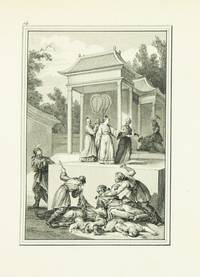
1788ST20889Paris: Chez l'Auteur 1788 1788. FIRST EDITION. 565 x 400 mm. 22 1/4 x 15 3/4". 50 leaves. Two separately published works bound in one. <br/> Modern retrospective calf-backed tan paste paper boards smooth spine profusely gilt with a repeating pattern of grape vines red morocco label lettered in gilt vellum tips. ENGRAVED THROUGHOUT WITH A TOTAL OF 48 FULL-PAGE ILLUSTRATED PLATES each accompanied by either one or two plates of engraved text. SHEETS UNCUT AND UNFOLDED the first work printed only on the recto; the second with three sheets printed on both sides. Reed and Dematté China on Paper 20 21; Cohen-de Ricci 479. Edges and lower corners slightly worn but the binding with only just minor signs of use; free endpaper in front and back with vertical crease one sheet with an early marginal repair isolated inconsequential faint spotting but still AN EXTREMELY FINE COPY the wide-margined sheets exceptionally fresh and bright and with strong impressions of the engravings.<br/> <br/> This pair of lavishly illustrated fully engraved works produced by a talented French engraver after earlier Chinese artworks are here presented in an enormous volume made up of uncut and unfolded sheets. According to Benzit Parisian engraver and print seller Isidore Stanislas Henri Helman 1743 - ca. 1809 "stands out among the engravers of the end of the 18th century" and his skill is evident in the two works bound together here. The first is a pictorial history of the Chinese emperors from the earliest mythical rulers to the Northern Song dynasty 960-1126. It is based on the Dijian Tushuo composed in 1573 to educate the Ming-dynasty Wanli Emperor 1563-1620 who had ascended to the throne at the age of nine. In accordance with its didactic aims it presents the very best and worst of imperial behavior and the original handwritten album was published as a block-printed book to great popularity. Two centuries later the Qing-dynasty Qianlong Emperor 1711-99 commissioned a Western-style edition of the famous work which was executed by two French artists the Jesuit painter Jean-Denis Attiret and the engraver Charles-Nicolas Cochin II. The enterprising Helman was able to see the Attiret-Cochin book in the collection of French statesman Henri Léonard Jean Baptiste Bertin 1720-92 and having had great success with a previous reproduction of a Chinese work Conquêtes de l'Empereur de la Chine ca. 1783 he created the present reproduction. The second work the life of Confucius was also reproduced from plates in Bertin's collection. The source material in this case was the biography of Confucius assembled by the Jesuit Joseph-Marie Amiot 1718-93 as part of his informational series on China meant to educate missionaries. Amiot was a correspondent of Bertin and had sent him the biography and accompanying album of drawings which were based on the Shenji tu Illustrated Traces of the Sage a popular Confucian work throughout the Ming and Qing dynasties. Helman selected 24 scenes from each creating books that balance serene scenes of mountainous landscapes and temples with dramatic fight scenes and dragons. The quality of the engravings is excellent with delicate linework creating faint wisps of smoke and subtle shadows. These two works apparently both published in 1788 were released in several formats. The format here with the engravings laid out on the recto of large uncut sheets appears at auction very infrequently: we have been able to trace only two copies of both works in this format since 2004 and neither in such fine condition as the present example. Chez l'Auteur unknown
11290Paris, J. Caboche, Demerville et Cie, Editeurs, 1848 (deuxième Edition, mise en un meilleur ordre). 2 volumes in-folio, (30 pp.), reliure ancienne demi-maroquin, dos ornés de fleurons, enrichi de 181 planches dessinées et coloriées, rousseurs habituelles sinon très bon état.
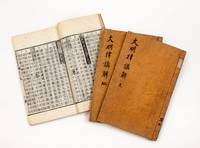
913569; 84; 102 folding leaves. 30 parts in three vols. Large 8vo 306 x 202 mm. orig. patterned yellow-brown wrappers new stitching. Korea: final volume with date 1903.<br /> <BR> <BR> A rare metal movable type edition printed at the Ministry of Justice in Seoul in 1903 using a font cut in 1816. The text was originally compiled in ChosÅn Korea on royal command in ca. 1440. The earliest edition that can be confidently dated was printed by woodblocks in KyÅngju in 1536.<br /> <BR> <BR> The text explains the descriptions of crimes and punishments contained in the Great Ming Code which was the penal code of the Chinese Ming empire 1368-1644. This book in the form in which we now have it is the result of a series of revisions in the late 14th century. It represents an important moment in Chinese legal history as a kind of legal Renaissance in that it was deliberately modeled on the centuries-old Tang code whereas the preceding Mongol Yuan empire had not had an official Chinese legal code. <br /> <BR> <BR> The Ming legal code was very influential in East Asia. In Korea the Ming code’s influence can be discerned already in the second half of the 15th century when we see references in the penal section in the official collection of statutes specifying that certain matters should be handled according to the Ming code. Even in the last Korean code issued before the advent of Japanese rule dated 1905 the influence of the Ming code is still discernable.<br /> <BR> <BR> Our edition of the book belongs to the uncertain period in the late 19th and early 20th centuries when the Korean leadership tried to navigate between the surrounding empires and establish the country as an independent state. The laws of Ming China which had collapsed more than two and a half centuries earlier were still being studied by prospective officials in the Korean judiciary on the eve of the Russo-Japanese War which made Korea a Japanese protectorate.<br /> <BR> <BR> Our edition was printed with metal movable type using the chÅnsaja å…¨å²å— set. This copper font of approximately 20000 characters was cast privately in 1816 by Pak ChonggyÅng 朴宗慶.<br /> <BR> <BR> Fine and handsome set. A seal states that this set belonged to the collection of the Institute for the Training of Officials for the Judiciary PÅpkwan YangsÅngso 法官養æˆæ‰€ in Seoul founded in 1895 as part of an attempt to modernize the civil service. It was intended as a textbook for the institute’s students.<br /> <BR> <BR> "At the end of the book is a double leaf of errata a novelty among Korean government publications" Fang The Asami Library 18.45 <br /> <br> <br> <br /> References<br /> <br> <br> <br /> Fang Chaoying. The Asami Library: A Descriptive Catalog. Edited by Elizabeth Huff. Berkeley: University of California Press 1969.<br /> <br> <br> Jiang Yonglin trans. The Great Ming Code. Seattle: University of Washington Press 2014.<br /> <br> <br> Tanaka Toshimitsu ç”°ä¸ä¿Šå…‰. “ChÅsen kan Daiminritsu kÅkai†æœé®®åˆŠã€Žå¤§æ˜Žå¾‹è¬›è§£ã€ã«ã¤ã„㦠TÅyÅ hÅseishi kenkyÅ«kai tsÅ«shin æ±æ´‹æ³•åˆ¶å²ç ”究会通信 no. 28 2015. unknown
biblio21<p>Size:24.520.5cm. Good a little creased as shown. With Consular Service Shanghai stamps as shown.</p>
20002091502135401362Not Available 2000. Soft Cover. Fine. Volume: 163 Not Available paperback
9037Pékin, Nachbaur, Imprimerie Na Che Pao, 1926 (première édition). 1 volume in-folio, sous reliure demi-percaline noire à bandes, plats de soie orangée d'éditeur, dos lisse muet avec déchirures, [92] feuillets y compris les feuillets explicatifs et de support et les feuillets blancs (quelques images pliées en marge, quelques rares déchirures, bon état général. Edition originale contenant 39 beaux bois en couleurs tirés sur papier de Chine et montés sur feuillet de support dont 2 grandes planches dépliantes, 19 feuillets d'idéogrammes imprimés en noir sur fond rouge de formats variables, volants, et +/- 38 tirages en noir sur papier de Chine sur feuillets de formats variables, volants. Tirage à 220 ex. dont 20 h.c. (N. 106). Bel ouvrage imprimé et décoré à Pékin dans les ateliers de Na Che Pao, contenant principalement des images de nouvel an, mais aussi des images de la 5e et de la 8e lune. Etabli à Pékin en 1916 Albert Nachbaur (1879-1933) y publia de nombreux ouvrages relatifs à la culture chinoise. Please inquire before ordering.
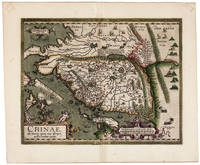
1606602014 3/8 x 18 3/8 inches. Fine original hand color; slight split at centerfold fine condition. <br /><br /><p>A brilliant example in rich original hand color of the rare and only English language edition of the earliest printed folio-size western map specifically of China and "the first to show the Great Wall"Nebenzahl. "This map remained the standard type for the interior of China for over sixty years" Tooley. Although 2 pocket-sized English language editions of an abbreviated version of Ortelius' <i>Theatrum</i> entitled <i>Epitome</i> were published previously in 1601 and 1603 with brief texts in English the English text in the present edition runs to 2 large folio pages printed on the back of the map giving an extensive description of China drawn from recent publications of observations by European travelers to the area particularly Jesuits. With its three lushly designed cartouches and many illustrations of indigenous shelters modes of transportation i.e. the famous wind wagons and animals this is one of Ortelius's richest engravings and among his rarest. </p><p>Nebenzahl <i>Mapping the Silk Road and Beyond </i>4.6; van der Krogt 8410:31:051; Tooley <i>Maps and Mapmakers</i> p. 106 pl. 78 p. 108; Walter <i>Japan: A Cartographic Vision</i> 11F p. 186.</p>
1606602014 3/8 x 18 3/8 inches. Fine original hand color; slight split at centerfold fine condition. <br /><br /><p>A brilliant example in rich original hand color of the rare and only English language edition of the earliest printed folio-size western map specifically of China and "the first to show the Great Wall"Nebenzahl. "This map remained the standard type for the interior of China for over sixty years" Tooley. Although 2 pocket-sized English language editions of an abbreviated version of Ortelius' <i>Theatrum</i> entitled <i>Epitome</i> were published previously in 1601 and 1603 with brief texts in English the English text in the present edition runs to 2 large folio pages printed on the back of the map giving an extensive description of China drawn from recent publications of observations by European travelers to the area particularly Jesuits. With its three lushly designed cartouches and many illustrations of indigenous shelters modes of transportation i.e. the famous wind wagons and animals this is one of Ortelius's richest engravings and among his rarest. </p><p>Nebenzahl <i>Mapping the Silk Road and Beyond </i>4.6; van der Krogt 8410:31:051; Tooley <i>Maps and Mapmakers</i> p. 106 pl. 78 p. 108; Walter <i>Japan: A Cartographic Vision</i> 11F p. 186.</p> books
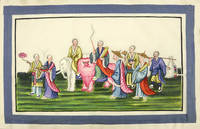
91713Canton 2nd half of 19th century. . A set of 10 watercolour and gouache studies on pith paper; one with a long horizontal closed tear. Contemporary red patterned silk binding; upper hinge broken and upper cover detached.<br /> <br />Pith seems not to have been adopted for painting until about 1820. Some European museums claim that their paintings on pith often erroneously called "rice paper" or "mulberry pith" come from the end of the eighteenth century but there do not seem to be any dateable examples that are so early. There is a record of the Kaiser Franz of Austria buying some albums from an English Consul-General Watts in 1826. We know of an Italian Count who visited Canton in 1828 and had over 350 paintings on pith in his baggage when he died in Ambon two years later. In the British Library there is a scrap-book containing six pith paintings and a journal entry by a serving British officer who sent them home from India in 1829. These examples and contemporary accounts by visitors to Canton suggest that there was a flourishing trade in pith paintings by the early 1830s.<br /><br />Pith presumably came into use for painting to satisfy the increasing demand for small inexpensive and easily transported souvenirs following the massive growth in the China Trade in the first quarter of the nineteenth century. Paintings in oils on board and canvas were costly and difficult to carry home. Earlier and more prestigious export water-colours had often been on a larger scale and painted on fine Chinese paper or on paper imported from Europe. The albums of pith paintings and later the little glass-fronted boxes were inexpensive light easy to pack and gave the pictures some protection on the long voyage home. Because many were sold in albums and hence protected from the light they retain their bright colours to this day.<br /><br />Pith comes from the central column of spongy cellular tissue in the stem of a small tree called Tetrapanax Papyrifera native to south-west China. It has had a variety of uses some going back many centuries. At the imperial court both men and women wore coloured flowers made from pith in their hair. For use in painting it is cut by hand with a knife into thin sheets from short lengths of the spongy tissue. Cutting is highly skilled and the constraints of the process mean that the finished sheets for painting seldom if ever measure more than about 30cms by 20cms. The sheets are dried trimmed and used for painting without any further processing.<br /><br />Because of the nature of pith and its cellular structure the gouache used by the Chinese sat on the surface and produced a bright and even sparkling effect. Very fine detail could be achieved but pith did not lend itself to the flat wash of colour favoured for European watercolours. <br /><br />Carl Crossman in his book The Decorative Arts of the China Trade originally published under the title The China Trade gives an excellent list of export painters with a note of those known to have painted on pith. These include Tingqua Sunqua and Youqua. From 1757 until 1842 Canton was the only Chinese port open to trade with the west and it is no surprise that of the eight studios identified by Crossman as producing works on pith six were in Canton. <br /><br />It seems that the 1830s and 1840s may have been the heyday of pith painting. The international trading bases the waterfront 'factories' on the 'Hongs' in Canton where they were produced were partially burnt during the First Opium War 1839-41 and totally destroyed in a fire of 1856. The foreign trading companies then moved to Honan and subsequently put up splendid new offices on reclaimed land at Shamian Island a little up river. As the result of the Treaty of Nanking in 1842 additional Chinese ports were opened up for foreign trade and Hong Kong was established as a major trading centre. <br /><br />By 1860 references to China in the Illustrated London News plentiful three years earlier were few and far between. That is not to say that painting on pith ceased. Nicholas the second was given paintings on pith when he visited Canton in 1891 and the last Emperor is said to have sent him a gift which included pith paintings in 1907 though these could have been examples of much earlier work. <br /><br />Painters on pith did not in general sign their work the sole exception is Sunqua whose name can be found on the face of three paintings on pith. <br /><br />There are collections of paintings on pith in the Ashmolean the British Museum the Fitzwilliam the Hermitage the Peabody/Essex Museum in Massachusetts and the Hong Kong Museum of Art. However because paintings on pith are not in general regarded as fine art they are usually to be found in ethnographic or specialised collections.<br /> Canton, 2nd half of 19th century]. unknown
20162081502111906025Chinese book office 2016. Soft Cover. Fine. The book is in fine condition. Chinese book office paperback
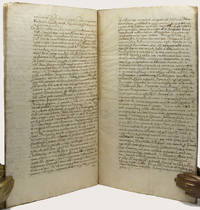
162134518Lisbon and Hangzhou China: Manuscripts ca.1623 and 1621. Very Rare A Similar Manuscript Exists in Brussels. We know of no others. The Latin text of both letters is written in a neat uniform cursive hand in brown. Folio leaves 33 x 20.5 cm The transcripts bound in 18th Century stiff blue wrappers the blank paste-downs and endpapers are late 18th century most likely the third quarter between 1745/1753 and 1776 since they contain a clear "lion/vryheit/pro patria" watermark with a crowned GR countermark which resembles Heawood 3148 3149 and 3154. The paper used for the manuscript contains a faint double-headed eagle watermark and it has been reinforced in the gutters. A very pleasing survival very well preserved edges slightly mellowed the wrappers show some signs of wear. VERY RARE MANUSCRIPT TRANSCRIPTS. Chrysostomus Johann Gall 1586-1643 was a German Jesuit and scholar. He left Ingolstadt Germany to teach astronomy mathematics and navigation in Lisbon fro 1620to 1627 before leaving to work in the Jesuit missions in India. The Colégio de Santo Antŕo benefitted from the arrival of many foreign mathematicians and other scholars as Lisbon serves as a gateway for all missionaries departing for Asia. The original letter by Gall was written in Lisbon September 1623 and concerns a newspaper style description of various events including details of the perseution of Christians in Japan particularly the execution of large numbers of the Christian community in Nagasaki in 1622.<br> The second letter in the present work is especially interesting as the original was written by Johannes Terentius also known as Johannes Schreck an Deng Yuhan Hanpo 1576-1630. Terentius was a prominent Jesuit scholar specialized in natural science and mathematics. Before joining the Jesuits as a novice1611 he already enjoyed a grea reputation in Germany as a scholar. In 1621 Terentius left for China to join the Jesuit mission. The original letter by Terentius was written in Hangzhou China on 30 August 1621 to the rector of teh Jesuit College in Munich Jakob Keller 1568-1631. He discusses his journey to China which he started in 1618 his intentions to participate in the planned calendar reform in China and his impressions of the city of Hangzhou which he reached in 1621 Terentius wrote several works on european medicine mathematics and technology in Chinese and together with Johann Adam Schall von Bell and G. Roho introduced European tigonometry and European astronomical instruments to China. In 1629 he began to reform the calendar which J.A. Schall von Bell ocmpleted after Terentius' early death a year later.<br><br>Backer & Sommervogel VII col. 1929-F<br> Manuscripts unknown
2081502111907398Koryo Shosha N.A. Soft Cover. Fine. Size: Hardcover Koryo Shosha paperback
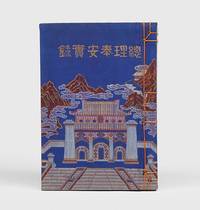
1929172181Nanjing: Zongli fengan huakan bianzuan weiyuanhui 1929. Bidding China's "National Father" farewell First and only edition and printing of the official commemorative publication for Sun Yat-Sen's state burial distributed as a gift by the Chinese Ministry of Foreign Affairs. Over one hundred photographic illustrations record the elaborate multi-day ceremony and the appearance of Sun's mausoleum; these are accompanied by several folding architectural plans. Loosely inserted is the ministry's printed presentation card. Following Sun's death on 12 March 1925 the Kuomintang formed a 12-man committee tasked with overseeing the construction of a massive mausoleum on Mount Zijin in Nanjing. The stakes were high: amidst the breakdown of the Kuomintang's relations with the Chinese Communist Party and Chiang Kai-Shek's tightening grip on the party-state exerting control over Sun's legacy and image was paramount. The design of the site was opened to public tender the committee requiring the winning design to combine traditional Chinese styles with modern concepts of adaptive architecture. The winning architect Lu Yanzhi 1894-1929 died before construction finished and his vision was seen through to completion by his colleague Poy Gum Lee 1900-1968. Lu and Poy's American training is reflected in such design elements as the layout of the site which draws on the Mall in Washington and the Liberty Bell and the design of a statue of Sun seated in Lincoln-esque fashion. In spring 1929 the internment ceremony began with the transfer of Sun's body from Beiping to Nanjing on a special train named the "Soul Train" in Chinese. "The transfer was designed as a long drawn-out mobile media event that was to spiritually mobilize modernize and unify the population around the spirit and body of Sun Yat-sen". The internment ceremony held on 1 June 1929 after the body had lain in state for three days was a lavish and highly regulated spectacle. The body was escorted by a 3-mile-long procession to the echoes of a 101-gun salute from a gunboat moored on the Yangtze River. At midday as Song Qingling and Sun Ke Sun's wife and son closed the metal door on the tomb the ceremony closed with a national three-minutes silence. This is the most important printed record of one of 20th-century China's defining political events. The majority of copies are now housed in institutional collections and we have traced no others in commerce. Accompanying this copy are two contemporary typescript translations into English of the book's captions. Large octavo. With 73 plates 4 collotype and 35 half-tone plates 7 maps and plans 6 folding ornate title page after calligraphy by Han Minjing. Original lavish silk brocade lettered in gold orange thread xianzhuang stitching spine and covers lined with tan silk. With original blue cloth folding case xylographic label on front panel reproducing calligraphy by Chiang Kai-Shek lined with decorative blue paper bone toggles. Brocade bright some losses to silk on spine rear cover silk lining worn and feathering where sometime damp text and illustrations very well preserved one folding plan with small hole not affecting printed area: a very good copy the binding having lost none of its lustre in very good case with rubbing a little soiling and cockling to lining. Rudolph G. Wagner "1925-1928: Enshrining the Father of the Republic" China Heritage Annual available online. hardcover