25 870 résultats
20212081502111904391commercial stamp office 2021. Soft Cover. Fine. The book is in fine condition. commercial stamp office paperback
18134205A Paris, de l'Imprimerie impériale, 1813. 1813 1 vol. fort in-folio (490 x 310 mm.) de : [3] ff. (faux-titre, titre, "Traduction en langue européenne des caractères chinois") ; LVI (introduction, Tableau de l'orthographe et de la prononciation, Préface, Méthode pour trouver les caractères au moyen de la table des deux cent quatorze clefs, Table des deux cent quatorze clefs) ; 1112 pp. ; [1] f. (errata). Ex-libris manuscrit au dos du premier plat Benj Stillwell. (quelques tâches aux marges). Demi-vélin à coins ancien, dos lisse, pièce de titre de maroquin rouge, plats recouverts de papier marbré, exemplaire non rogné à très larges marges. (Défauts d'usage, couture fragile).
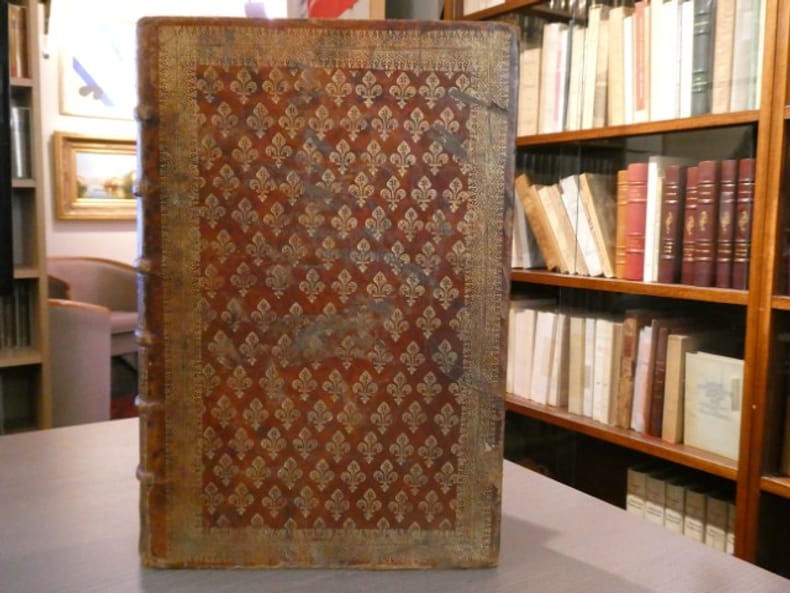
673480Johannem Janssonium á Waesberge & Elizium Weyerstraet Amsterdolami 1667 In-folio ( 380 X 250 mm ) de ( 14 ), 237, ( 10 ) pages, pleine basane caramel, dos à nerfs orné de caissons richement ornés de fleurs de lys dorées, belle dentelle sur les plats encadrant un semis de fleurs de lys dorées, tranches dorées ( reliure de l'époque ). L'illustration se compose d'une belle page de titre ornée d'un frontispice allégorique gravé, page de titre illustrée d'une vignette, portrait gravé de l'auteur, 2 cartes dépliantes sur double page "Imperium Sinicum Quindecupartitum" et "Tabula Geodoborica Itinerum a varijs in Cataium", 23 planches hors-texte dont 2 dépliantes, 61 vignettes gravées. ( Exemplaire complet de tous les hors-texte conformément à la table des illustrations. EDITION ORIGINALE de ce bel ouvrage magnifiquement illustré. Plats frottés, usures aux coupes et aux coins, un ancien ex-libris gratté au contre plat, gardes absentes, rousseurs passim. Malgré les défauts annoncés, l'exemplaire est complet, solide et tout à fait désirable.
19432092902144201915Daiichishobo 1943. Soft Cover. Fine. The book is in fine condition. Daiichishobo paperback
1873312749Shanghai: Printed at The "North China Herald" Office 1873. First edition. Presentation copy inscribed from the author to Douglas Jones on first blank. Title-page printed preface and text with holograph manuscript by Jones on the Index and Game Register. Pp. vii 116 Diary & Game Register accomplished in ink 4 pages unused; 1-50. 1 vols. 4to 10-1/8 x 8 inches; 257 x 203 mm. Contemporary full brown roan upper cover titled in gilt. Spine neatly rebacked notes on front endsheets. Quarter black morocco slipcase and cloth chemises. First edition. Presentation copy inscribed from the author to Douglas Jones on first blank. Title-page printed preface and text with holograph manuscript by Jones on the Index and Game Register. Pp. vii 116 Diary & Game Register accomplished in ink 4 pages unused; 1-50. 1 vols. 4to 10-1/8 x 8 inches; 257 x 203 mm. "The immense tracts of country available for purposes of sport and well stocked with game the entire absence of game laws and the friendly disposition of the natives combine to render Keang-soo and the adjoining provinces a very Paradise for sportsmen ." Groom from the Preface. <br /> <br /> Early work on hunting in China with a partly printed dairy and "Register of Game Bagged" here accomplished with an extensive and detailed manuscript of expeditions from 1878 to 1892 recounting trips on the Merlin and other boats after deer waterfowl and other game listing participants names of dogs and game bags. The manuscript is followed by the printed text with notes on boats guns and kit "The Medicine Chest" cookery and chapters on various types of game pheasant snipe wild pig and a printed Vocabulary with Chinese/English translations and phonetic transcriptions.<br /> <br /> Among the hunting companions of Jones in the 1885 season was Bell-Irving author of Diary of the Ewo Party 1890. Both Jones and Bell-Irving are quoted frequently in Wade's With Boat and Gun in the Yangtze Valley 2nd ed. 1910.<br /> <br /> Some interesting ephemera has been preserved including printed Chinese broadside shooting permits for Jones for the years 1884 and 1885 a shooting permit for Hong Kong and the New Territories 1894; fivee sketch maps of Kiang Su Le Yang and Kashing; four small photographs of Hong Kong mounted on the verso of a Victorian photographic portrait of Douglas Jones; a manuscript translations of Chinese verse by one of Jones' companions and four autograph letters on sporting topics or introductions and requests to assist Jones in his up country trips; and a stray sheet of printed letterhead of the Union Insurance Society of Canton Shanghai where Jones was Secretary.<br /> <br /> A UNIQUE AND SUBSTANTIAL RECORD OF SPORT IN CHINA. Czech Asia p. 93. Not in OCLC Printed at The "North China Herald" Office unknown
1873312749Shanghai: Printed at The "North China Herald" Office 1873. First edition. Presentation copy inscribed from the author to Douglas Jones on first blank. Title-page printed preface and text with holograph manuscript by Jones on the Index and Game Register. Pp. vii 116 Diary & Game Register accomplished in ink 4 pages unused; 1-50. 1 vols. 4to 10-1/8 x 8 inches; 257 x 203 mm. Contemporary full brown roan upper cover titled in gilt. Spine neatly rebacked notes on front endsheets. Quarter black morocco slipcase and cloth chemises. First edition. Presentation copy inscribed from the author to Douglas Jones on first blank. Title-page printed preface and text with holograph manuscript by Jones on the Index and Game Register. Pp. vii 116 Diary & Game Register accomplished in ink 4 pages unused; 1-50. 1 vols. 4to 10-1/8 x 8 inches; 257 x 203 mm. "The immense tracts of country available for purposes of sport and well stocked with game the entire absence of game laws and the friendly disposition of the natives combine to render Keang-soo and the adjoining provinces a very Paradise for sportsmen ." Groom from the Preface. <br/><br/>Early work on hunting in China with a partly printed dairy and "Register of Game Bagged" here accomplished with an extensive and detailed manuscript of expeditions from 1878 to 1892 recounting trips on the Merlin and other boats after deer waterfowl and other game listing participants names of dogs and game bags. The manuscript is followed by the printed text with notes on boats guns and kit "The Medicine Chest" cookery and chapters on various types of game pheasant snipe wild pig and a printed Vocabulary with Chinese/English translations and phonetic transcriptions.<br/><br/>Among the hunting companions of Jones in the 1885 season was Bell-Irving author of Diary of the Ewo Party 1890. Both Jones and Bell-Irving are quoted frequently in Wade's With Boat and Gun in the Yangtze Valley 2nd ed. 1910.<br/><br/>Some interesting ephemera has been preserved including printed Chinese broadside shooting permits for Jones for the years 1884 and 1885 a shooting permit for Hong Kong and the New Territories 1894; fivee sketch maps of Kiang Su Le Yang and Kashing; four small photographs of Hong Kong mounted on the verso of a Victorian photographic portrait of Douglas Jones; a manuscript translations of Chinese verse by one of Jones' companions and four autograph letters on sporting topics or introductions and requests to assist Jones in his up country trips; and a stray sheet of printed letterhead of the Union Insurance Society of Canton Shanghai where Jones was Secretary.<br/><br/>A UNIQUE AND SUBSTANTIAL RECORD OF SPORT IN CHINA. Czech Asia p. 93. Not in OCLC Printed at The "North China Herald" Office unknown books
17473878FBRostock, Verlag Christian Koppe, 1747-1749. 4°. 26,5 x 21,5 cm. [1] Blatt, 58, 472 Seiten; [1] Blatt, 56, 748; 28 Seiten, [2] Blatt, 548; 56, 264, 552 Seiten, [16] Blatt. Ganzlederbände der Zeit auf 4 Zierbünden mit Streicheisenlinien auf den Deckeln und rotem Sprengschnitt. [12 Warenabbildungen]
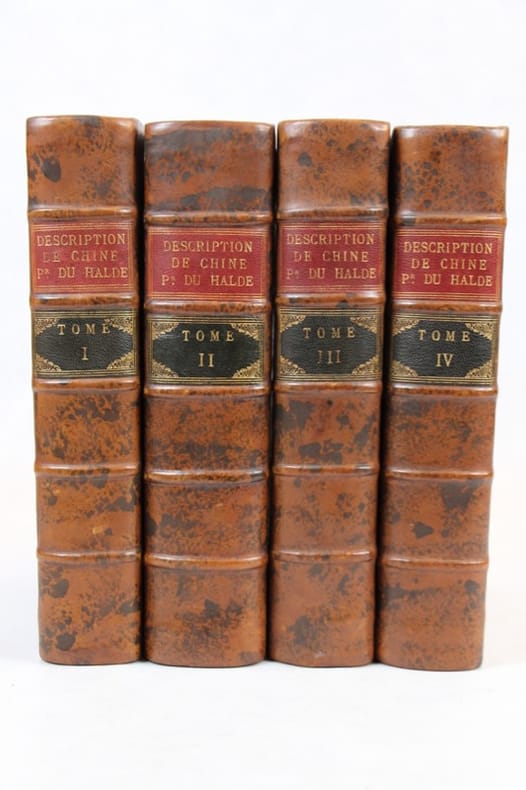
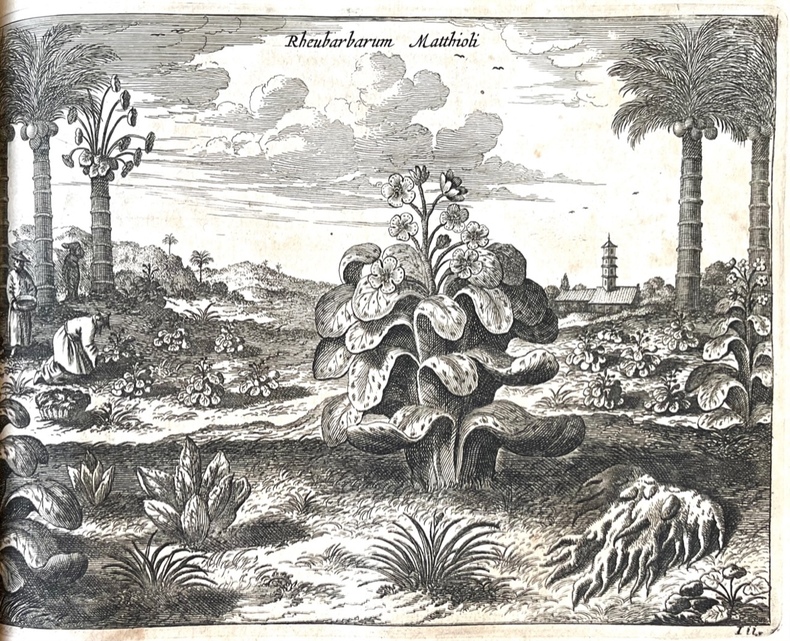
1736137520La Haye, Henri Scheurleer 1736 4 volumes in-4, plein veau brun, dos à nerfs , pièces de titre et de tomaison reliure de l’époque très soigneusement restaurée, LXXX- 488- [35] pp., 2 portraits et 21 planches 2 repliées ; [4]- 834 pp., 3 illustrations dans le texte, 25 planches 11 repliées ; [6]- 652 pp., 7 planches, 6 repliées, 5 illustrations dans le texte ; [4]- 606- [127] pp., une illustration dans le texte. Titres noir et rouge. Lettrines et culs-de-lampe. La plupart des gravures non signées, certaines : J. C. Philips d’après A. Humblot, Humblot d’après J. van de Spyk, une de Philippe van Gunst. Soigneuse restauration angulaire de la page de titre du seconf volume Très bon exemplaire frais.
177630329Paris, Nyon, 1776-1791. Gr. 8°. Zusammen ca. 7700 Seiten. Mit 168 Kupfertafeln, darunter 3 Frontispizes und 4 gefaltete. Bd. 1. 1776. (2), XVI, 485 p. Frontispiz, 9 Tfl (Schriftmuster); Bd, 2. 1777. VIII, 650 p. 3 gefaltete und 7 Tfl (Landschaften); (die Tafelnummerierung 1-37 zählt auch 27 im Text gedruckten Tabellen 2-4, 11-26, 30-37 mit) Bd, 3. 1778. IV, 5-504 p. 6 Tfl. (Porträts); Bd. 4. 1779. (2), 518 p. 7 Tfl. (Kampfsport: Coung-Fou, Pflanzen); Bd, 5. 1780. IV, 510 p. 3 Tfl. (Porträts, Hausrat); Bd. 6. 1780. (2), 380 p, 37 Tfl. (Musikinstrumente); Bd. 7. 1781. XII, (III)-X, (3)-396 p. 33 Tfl. (Militärische Kleidung, Waffen, Schlachtenaufstellungen); Bd. 8. 1782. VIII, 375 p. 30 Tfl. (Militärisches); Bd. 9. 1783. XXIV, 470 p. 1 gefaltete und 11 Tfl. (Landschaften); Bd. 10. 1784. XI, 510 S. Enthält Gesamtregister für die Bände 1-10. Bd. 11. 1786. XXIV, 609 p. 1 Tfl. (Observatorium); Bd. 12. 1786. (2), VII, 532 p. Frontispiz (Porträt), 17 Tfl. (Leben des Konfuzius); Bd. 13. 1788. (2), XVI, 543 p.; Bd. 14. 1789. XVI, 561 p.; Bd. 15. 1791. (2), 515 p. Frontispiz (Porträt); Hellbraune Ziegenleder-Halblederbände der Zeit auf 5 echten Bünden, Rückentitel, Bandnummerierung und ornamentale Goldprägung; Hellbraunes Bezugspapier in Spritztechnik, Ecken in Marmorpapier, zweifarbig marmorierter Schnitt. - 1814 erschienen zwei weitere Bände XVI. und XVII.- Umfassende Sammlung von Berichten von Missionaren aus China, die in Europa erstmals ein umfassendes Bild des Landes ermöglichten. Mit zahlreichen Erstübersetzungen Chinesischer Werke in eine europäische Sprache. Einige Rücken mit restaurierten Fehlstellen an den Kapitalen, Deckel am Bezugspapier, Ecken und Kanten etwas berieben. Die Buchblöcke fest im Bund, teilweise etwas gewellt, vereinzelt stockfleckig, und einige wenige Blätter wasserrandig, vereinzelt Wurmsp
In -4°, pp. 1 cb., (14), 646 (ma 648, la numerazione di 111-112 è ripetuta), (10), 2 ccb. Pergamena coeva con titolo manoscritto al dorso. Include il frontespizio inciso da Wolfgang Kilian, con i ritratti in piedi dei due autori ai lati di una riproduzione della mappa della Cina, e la pianta, ripiegata, del palazzo pechinese convertito a chiesa, con la tomba di Ricci. Presente anche l’ultima carta bianca, qui con appunti e un piccolo indice analitico, manoscritti. Prima edizione di uno dei primi resoconti di un occidentale sulla Cina, il libro di Ricci ebbe un impatto culturale enorme sul mondo europeo del XVII secolo, e fu abbondantemente ristampato e tradotto fin dall’anno successivo. Matteo Ricci, missionario in Cina fino all’anno della sua morte, nel 1610, lasciò un importante manoscritto che sarebbe stato redatto e pubblicato da Trigault, anche lui membro della spedizione. Frontespizio restaurato nella parte bassa. The first edition of the earliest modern description of China, made by an Occidental traveller: Ricci’s book had a big impact all over the Century and it was republished and translated many times since a year later his publication. Matteo Ricci, a jesuit missionary to China until his death, in 1610, left an important manuscript edited and published by Trigault, another member of the expedition. Title restored in his lower part.
10323Batavia, Mars 1866. 1 volume in-8, reliure demi-toile, plats cartonnés, 2 cahiers constitué de x pages et de x pages, écriture claire et lisible, très bon état.
16705727Amsterdam, J. Janssonius 1670. 1670 1 vol in-folio (400 x 255 mm) de : 1 titre frontispice gravé ; [7] ff. (dont titre, préface, table) ; portrait de Kircher manquant (pas toujours présent pour cette édition) ; 367 pp. ; [12] pp. (table) ; 24 planches hors texte dont 2 cartes (certaines sur double-page ou dépliantes) ; très nombreuses vignettes gravées sur cuivre dans le texte. Mention manuscrite sur la page de titre : DArminy. Plein veau dépoque, dos à nerfs orné et titré avec pièce de maroquin rouge, roulette sur les coupes.
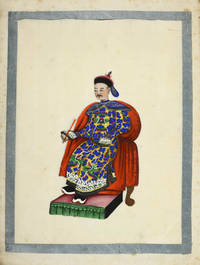
90282Canton ca. 1860. . Album 29.5 x 21.5 cm with 12 watercolour and gouache on pith paper each laid on paper with a light blue ribbon; one a bit stained in brown. Contemporary binding of patterned brown paper; very rubbed.<br /> A lovely variety of Chinese official costumes in fine condition and bright colours.<br /><br />Pith seems not to have been adopted for painting until about 1820. Some European museums claim that their paintings on pith often erroneously called "rice paper" or "mulberry pith" come from the end of the eighteenth century but there do not seem to be any dateable examples that are so early. There is a record of the Kaiser Franz of Austria buying some albums from an English Consul-General Watts in 1826. We know of an Italian Count who visited Canton in 1828 and had over 350 paintings on pith in his baggage when he died in Ambon two years later. In the British Library there is a scrap-book containing six pith paintings and a journal entry by a serving British officer who sent them home from India in 1829. These examples and contemporary accounts by visitors to Canton suggest that there was a flourishing trade in pith paintings by the early 1830s.<br /><br />Pith presumably came into use for painting to satisfy the increasing demand for small inexpensive and easily transported souvenirs following the massive growth in the China Trade in the first quarter of the nineteenth century. Paintings in oils on board and canvas were costly and difficult to carry home. Earlier and more prestigious export water-colours had often been on a larger scale and painted on fine Chinese paper or on paper imported from Europe. The albums of pith paintings and later the little glass-fronted boxes were inexpensive light easy to pack and gave the pictures some protection on the long voyage home. Because many were sold in albums and hence protected from the light they retain their bright colours to this day.<br /><br />Pith comes from the central column of spongy cellular tissue in the stem of a small tree called Tetrapanax Papyrifera native to south-west China. It has had a variety of uses some going back many centuries. At the imperial court both men and women wore coloured flowers made from pith in their hair. For use in painting it is cut by hand with a knife into thin sheets from short lengths of the spongy tissue. Cutting is highly skilled and the constraints of the process mean that the finished sheets for painting seldom if ever measure more than about 30cms by 20cms. The sheets are dried trimmed and used for painting without any further processing.<br /><br />Because of the nature of pith and its cellular structure the gouache used by the Chinese sat on the surface and produced a bright and even sparkling effect. Very fine detail could be achieved but pith did not lend itself to the flat wash of colour favoured for European watercolours. <br /><br />Carl Crossman in his book The Decorative Arts of the China Trade originally published under the title The China Trade gives an excellent list of export painters with a note of those known to have painted on pith. These include Tingqua Sunqua and Youqua. From 1757 until 1842 Canton was the only Chinese port open to trade with the west and it is no surprise that of the eight studios identified by Crossman as producing works on pith six were in Canton. <br /><br />It seems that the 1830s and 1840s may have been the heyday of pith painting. The international trading bases the waterfront 'factories' on the 'Hongs' in Canton where they were produced were partially burnt during the First Opium War 1839-41 and totally destroyed in a fire of 1856. The foreign trading companies then moved to Honan and subsequently put up splendid new offices on reclaimed land at Shamian Island a little up river. As the result of the Treaty of Nanking in 1842 additional Chinese ports were opened up for foreign trade and Hong Kong was established as a major trading centre. <br /><br />By 1860 references to China in the Illustrated London News plentiful three years earlier were few and far between. That is not to say that painting on pith ceased. Nicholas the second was given paintings on pith when he visited Canton in 1891 and the last Emperor is said to have sent him a gift which included pith paintings in 1907 though these could have been examples of much earlier work. <br /><br />Painters on pith did not in general sign their work the sole exception is Sunqua whose name can be found on the face of three paintings on pith. <br /><br />There are collections of paintings on pith in the Ashmolean the British Museum the Fitzwilliam the Hermitage the Peabody/Essex Museum in Massachusetts and the Hong Kong Museum of Art. However because paintings on pith are not in general regarded as fine art they are usually to be found in ethnographic or specialised collections.<br /> Canton, ca. 1860]. unknown
In-folio, pp. [8], xxvi, [4], 152, con numerosi caratteri cinesi xilografati nel testo, e una grande tavola pieghevole; con l’aggiunta di una seconda carta T1 (pagg. 71-72) con una coppia di caratteri cinesi corretti al recto, rilegata dopo l'errata a p. 140; due vecchi timbri al titolo; leggermente imbrunito, leggermente più imbrunito alle ultime carte; ottimo esemplare in vitello screziato francese coevo, dorso dorato; lievi abrasioni ai piatti; parte inferiore del dorso un po' usurata. RARA PRIMA EDIZIONE DI UNA DELLE PRINCIPALI OPERE SULLA LINGUA CINESE DEL PIONIERE STUDIOSO ORIENTALE FRANCESE E SECONDA GRAMMATICA SULLA LINGUA DA PUBBLICARE IN EUROPA. 'Fourmont è stato uno dei primi studiosi occidentali a tentare di comprendere il più accuratamente possibile il sistema dei dizionari cinesi e il pensiero che una volta che uno studioso avesse compreso i vari sistemi, sarebbe stato in grado di lavorare da solo. In effetti, a quel tempo gli europei non avevano altro modo per imparare il cinese se non consultare i dizionari e lavorare dal noto all'ignoto. Sfortunatamente, i dizionari di Fourmont non furono mai stampati, e non si trovano nemmeno in forma manoscritta, ad eccezione di un dizionario storico e geografico... 'Le Meditationes possono essere considerate un manuale da usare insieme ai dizionari che Fourmont intendeva pubblicare, ed è solo nella prospettiva di questo progetto più ampio che si può giudicare la sua parola. L'assenza dei dizionari spiega perché è difficile usare il libro di testo. Abel Rémusat, nel diciannovesimo secolo, avrebbe qualificato questo lavoro come accademico ma oscuro, e i suoi avversari sostenevano che Fourmont avesse scritto qualcosa di non veramente utile.' Fourmont attribuiva così tanta importanza alla lettura dei dizionari da criticare la grammatica cinese di Prémare, la Notitia Linguae Sinicae, ricevuta alla Bibliothèque du Roi il 12 maggio 1730, perché non insegnava al lettore come identificare i caratteri o come usare i dizionari cinesi. Era sbalordito dal fatto che un'autorità in cinese come Prémare non prestasse attenzione alle radici cinesi nella sua grammatica e non poté perdonare l'omissione. D'altra parte, secondo Lundbaek, la Notitia Linguae Sinicae di padre de Prémare era troppo avanzata per essere compresa da uno studioso relativamente inesperto. In effetti, padre de Prémare aveva una conoscenza della pedagogia della lingua cinese migliore di Fourmont. La sua opera è composta da frasi scelte dai Classici, che lo studente doveva imparare per familiarizzare con i personaggi e il loro uso. Inoltre, Prémare, per quanto riguarda l'ideologia, era molto più attratto dal metodo di classificazione radicale esposto da Mei Yingzuo. Ogni studioso proiettava la propria preoccupazione nella lingua straniera, e ognuno aveva la sua mistica. “Tuttavia, la familiarità con le radici aiuta a comprendere il significato dei caratteri, e un metodo di classificazione per l'enorme numero di caratteri è considerato di grande utilità. In tal senso Fourmont promuoveva un mezzo pratico di accesso al cinese per il lettore europeo» (Cécile Leung, Etienne Fourmont. (1683-1745), Oriental and Chinese Languages in Eighteenth Century France, pp. 203-204). Fourmont divenne professore di arabo al Collège de France nel 1715. Nel 1713 fu eletto membro dell'Accademia delle iscrizioni, nel 1738 membro della Royal Society di Londra e nel 1742 membro di quella di Berlino. Morì a Parigi l'8 dicembre 1745. In-folio, pp. [8], xxvi, [4], 152, with numerous Chinese characters in woodcut in the text, and one large folding table; an additional cancel of leaf T1 (pages 71-72) with a couple of Chinese characters corrected on recto, bound in after the errata on p. 140; two old stamps to title; a little light browning, slightly heavier to the last leaves; a very good copy in contemporary French mottled calf, spine gilt; minor abrasions to covers; tail of spine a little worn. SCARCE FIRST EDITION OF ONE OF THE MAJOR WORKS ON THE CHINESE LANGUAGE BY THE PIONEERING FRENCH ORIENTAL SCHOLAR, AND THE SECOND GRAMMAR ON THE LANGUAGE TO BE PUBLISHED IN EUROPE. ‘Fourmont was one of the first Western scholars to attempt to understand as accurately as possible the system of Chinese dictionaries, and the thought that once a scholar understood the various systems, he would be able to work by himself. In fact, there was no other way for Europeans to learn Chinese at this time besides consulting the dictionaries and working from the known to the unknown. Unfortunately, Fourmont’s dictionaries were never printed, and are not even to be found in manuscript form, except of a historical and geographical dictionary … ‘The Meditationes can be considered a handbook to be used in conjunction with the dictionaries that Fourmont intended to publish, and it is only in the perspective of this larger project that his word can be judged. The absence of the dictionaries explains why it is difficult to use the text-book. Abel Rémusat would, in the nineteenth century, qualify this work as scholarly but obscure, and his adversaries contended that Fourmont wrote something not really useful. ‘ Fourmont placed so much importance on reading dictionaries that he criticized Prémare’s Chinese grammar, the Notitia Linguae Sinicae, which was received at the Bibliothèque du Roi on May 12, 1730, on the ground that it did not teach the reader how to identify characters or how to use Chinese dictionaries. He was shocked that such an authority on Chinese as Prémare did not pay attention to Chinese radicals in his grammar, and could not forgive the omission. On the other hand, according to Lundbaek, Father de Prémare’s Notitia Linguae Sinicae was far too advanced for the relatively young scholar to understand. As a matter of fact, Father de Prémare had a better grasp of Chinese language pedagogy than Fourmont. His work is made up of sentences chosen from the Classics, which the student was supposed to learn in order to familiarize himself with the characters and their usage. Moreover, Prémare, as far as ideology was concerned, was much more attracted to the method of radical classification as set out by Mei Yingzuo. Each scholar was projecting his own preoccupation into the foreign language, and each had his own mystique. ‘Nevertheless, familiarity with the radicals helps to understand the meaning of the characters, and a method of classification for the enormous number of characters is considered to be of greatest utility. To that extent Fourmont was promoting a practical means of access to Chinese for the European reader’ (Cécile Leung, Etienne Fourmont. (1683-1745), Oriental and Chinese Languages in Eighteenth Century France, pp. 203-204). Fourmont became professor of Arabic in the Collège de France in 1715. In 1713 he was elected a member of the Academy of Inscriptions, in 1738 a member of the Royal Society of London, and in 1742 a member of that of Berlin. He died at Paris on 8 December 1745.
166565637Wien, Matthäus Cosmerovius, 1665. 8°. Mit gest. Titelportrait. 6 Bll., 267 (1) S., 1 Bl., Ldr. d. Zt. m. goldgepr. gekröntem Wappensupralibros a. beiden Deckeln (monogrammiert ?R M F?), reicher Rückenverg., goldgepr. Rückentitel u. gespränkeltem Farbschnitt.
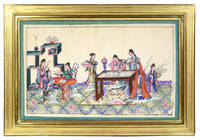
94512Canton 2nd half of 19th century. . Six watercolour and gouache studies on pith paper edged in turquoise silk ribbon and laid on paper; framed glazed and overall size: 27 x 39.4 x 2 cm.<br /> An exquisite group of interior scenes exclusively of noblewomen and ladies in waiting engaging in various genteel activities such as flower arranging painting poetry reading and writing surrounded by elegant Qing dynasty furniture and ornaments including unusual asymmetrical display cabinets exotic bird swings and porcelain vases all standing or sitting on elaborately patterned silk carpets.<br /><br />Pith seems not to have been adopted for painting until about 1820. Some European museums claim that their paintings on pith often erroneously called 'rice paper' or 'mulberry pith' come from the end of the eighteenth century but there do not seem to be any dateable examples that are so early. There is a record of the Kaiser Franz of Austria buying some albums from an English Consul-General Watts in 1826. We know of an Italian Count who visited Canton in 1828 and had over 350 paintings on pith in his baggage when he died in Ambon two years later. In the British Library there is a scrap-book containing six pith paintings and a journal entry by a serving British officer who sent them home from India in 1829. These examples and contemporary accounts by visitors to Canton suggest that there was a flourishing trade in pith paintings by the early 1830s.<br /><br />Pith presumably came into use for painting to satisfy the increasing demand for small inexpensive and easily transported souvenirs following the massive growth in the China Trade in the first quarter of the nineteenth century. Paintings in oils on board and canvas were costly and difficult to carry home. Earlier and more prestigious export water-colours had often been on a larger scale and painted on fine Chinese paper or on paper imported from Europe. The albums of pith paintings and later the little glass-fronted boxes were inexpensive light easy to pack and gave the pictures some protection on the long voyage home. Because many were sold in albums and hence protected from the light they retain their bright colours to this day.<br /><br />Pith comes from the central column of spongy cellular tissue in the stem of a small tree called Tetrapanax Papyrifera native to south-west China. It has had a variety of uses some going back many centuries. At the imperial court both men and women wore coloured flowers made from pith in their hair. For use in painting it is cut by hand with a knife into thin sheets from short lengths of the spongy tissue. Cutting is highly skilled and the constraints of the process mean that the finished sheets for painting seldom if ever measure more than about 30 by 20 cm. The sheets are dried trimmed and used for painting without any further processing.<br /><br />Because of the nature of pith and its cellular structure the gouache used by the Chinese sat on the surface and produced a bright and even sparkling effect. Very fine detail could be achieved but pith did not lend itself to the flat wash of colour favoured for European watercolours. <br /><br />Carl Crossman in his book The Decorative Arts of the China Trade originally published under the title The China Trade gives an excellent list of export painters with a note of those known to have painted on pith. These include Tingqua Sunqua and Youqua. From 1757 until 1842 Canton was the only Chinese port open to trade with the west and it is no surprise that of the eight studios identified by Crossman as producing works on pith six were in Canton. <br /><br />It seems that the 1830s and 1840s may have been the heyday of pith painting. The international trading bases the waterfront 'factories' on the 'Hongs' in Canton where they were produced were partially burnt during the First Opium War 1839-41 and totally destroyed in a fire of 1856. The foreign trading companies then moved to Honan and subsequently put up splendid new offices on reclaimed land at Shamian Island a little up river. As the result of the Treaty of Nanking in 1842 additional Chinese ports were opened up for foreign trade and Hong Kong was established as a major trading centre. <br /><br />By 1860 references to China in the Illustrated London News plentiful three years earlier were few and far between. That is not to say that painting on pith ceased. Nicholas the second was given paintings on pith when he visited Canton in 1891 and the last Emperor is said to have sent him a gift which included pith paintings in 1907 though these could have been examples of much earlier work. <br /><br />Painters on pith did not in general sign their work the sole exception is Sunqua whose name can be found on the face of three paintings on pith. <br /><br />There are collections of paintings on pith in the Ashmolean the British Museum the Fitzwilliam the Hermitage the Peabody/Essex Museum in Massachusetts and the Hong Kong Museum of Art. However because paintings on pith are not in general regarded as fine art they are usually to be found in ethnographic or specialised collections.<br /> [Canton, 2nd half of 19th century]. unknown
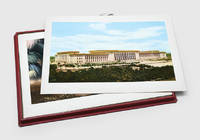
1959168629Beijing: Renmin meishu chubanshe c.1959. Monumentality and the weight of state power First edition first printing of this grand portfolio. Occupying 170000 square metres on the western flank of Tiananmen Square the Great Hall of the People was one of ten architectural projects completed in 1959 to celebrate the tenth anniversary of the founding of the People's Republic of China. The design combines classical and neoclassical styles with Chinese aesthetics. For example the total number of columns in the main gate colonnade equals the number found inside the most important hall in the Forbidden City and these columns are spaced at receding widths away from the central point - a long-held Chinese architectural practice. The decision to build the hall was enacted by the Politburo in 1958 and a force of 30000 builders and technicians finished the project in just ten months. For the last six decades the Great Hall's main ceremonial space capable of holding 10000 people has served as the venue for Chinese Communist Party meetings and lavish state events. Its corridors and many smaller rooms have also played host to political intrigues contentious meetings and important diplomatic dialogues. In 2003 Riverdance became the first Western show to perform on the hall's main stage selling out 11 performances. Copies were also issued in a dark red vinyl box with no priority established. Landscape folio. Title leaf printed in red and black. 20 colour photographic plates c. 292 x 465 mm printed on glossy paper each tipped onto loose 372 x 525 stiff card sheet together with loose single title leaf printed both sides all housed in original red cloth box lid with calligraphic title in gilt and blind-stamped decoration. Plates bright a little soiling and foxing to card sheets; bright box lightly rubbed and soiled abrasions to base sides of tray a little tender: a fine set in well-preserved box. Parr & WassinkLundgren The Chinese Photobook: From the 1900s to the Present pp. 183-5. Chang-tai Hung Mao's New World: Political Culture in the Early People's Republic 2011. hardcover
1640CHI3155Herbipoli (Würzburg), Henricus Pigrin, 1640. 7 S. Vorrede, 4 S. Inhaltsverz., 712 Seiten Text, 21 S. Index, H 18 x 11 x 4,5 cm, ornament. gepr. Ganzleder, Vollgoldschnitt. - Einband mit Gebrauchsspuren, berieben, beschabt. Altes Ex Libris, Name (geschwärzt) auf Vorsatz, Name auf Titel. Fraßspuren? auf letzten Seiten. Buchblock fest, ungelesen. fest gebunden/ hardcover
19802091202133212040Nigensha 1980. Soft Cover. Fine. Volume: 1 Nigensha paperback
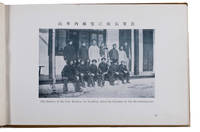
1912ABC_47646Shanghai: Commercial Press Limited 1912. Original publisher's orange-brown pictorial cloth marbled endpapers. Oblong 8vo 15 x 22.5 cm. 160 black-and-white photographic illustrations all protected by tissue paper guards. First and only edition of a very rare work with photographic illustrations of the Chinese Revolution of 1911 with captions in Chinese and English. It was published specifically for circulation in the West and consists of 14 parts. The present work contains the first 4. However any volume in this series is exceptionally rare as we have not been able to find another copy in sales records of the past 100 years.The Chinese Revolution of 1911 is an important event in Chinese history as it resulted in the establishment of the Republic of China. The Revolution was preceded by decade of revolts since Chinese citizens had already been dissatisfied with the rule of the Qing dynasty 1636-1912 for some time. The Revolution started in October 1911 with the Wuchang Uprising after which similar revolts broke out across the country. The Qing court then initiated negotiations with the revolutionaries. Both parties came to the agreement that the emperor who was just 6-years old had to abdicate in February 1912. Revolutionary statesman Sun Yat-Sen 1866-1925 became the first provisional president.The present work offers an authentic pictorial record of the first revolts. The work contains numerous portraits of important leaders of the Revolution and members of the Qing court grim photographic illustrations of the battlefields in Wuchang now the Wuchang District of Wuhan and Hankow or Hankou and images of the attack on Nanking now Nanjing including the preparations and the aftermath.The binding shows very slight signs of wear the gutters of the front and back endpapers are weakened causing the binding to be wobbly but the boards are still attached. The tissue paper between the photographic illustrations has browned throughout. Otherwise in very good condition.l WorldCat 891342401 2 copies. Commercial Press, Limited, hardcover
1890312761London: Printed at the Army-Navy Cooperative Society Limited 1890. 3 mounted albumen photographs of the shooting party with their trophies head- and tailpieces. xii 170 pp. 1 vols. 8vo 7-3/4 x 5 -3/8 inches; 196 x 137 mm. Contemporary full black morocco over stiff card covers ruled in silver upper cover with text in blindstamp edges silvered decorative endpapers. Finely rebacked to style; edges rubbed. Black morocco backed slipcase and chemise. 3 mounted albumen photographs of the shooting party with their trophies head- and tailpieces. xii 170 pp. 1 vols. 8vo 7-3/4 x 5 -3/8 inches; 196 x 137 mm. A signed presentation copy from the author John Bell-Irving to Douglas Jones. <br /> Bell-Irving was a Scottish businessman and partner in the Hong Kong trading firm Jardine Matheson and a director of the Hong Kong Electric Company. Jones was Secretary of the Union Insurance Society of Canton of Shanghai. <br /> "The greatest pleasure in up-country shooting trips" Bell-Irving claims "is the idea of perfect freedom far removed from business cares and beyond the reach of letters and telegrams." Succinct account of many hunting trips after pheasant waterfowl deer and other game with observations on weather and conditions and game bag. Bell-Irving and Jones are quoted frequently in Wade's With Boat and Gun in the Yangtze Valley 2nd ed. 1910.<br /> <br /> A SUSTANTIAL ACCOUNT OF SPORT ALONG THE YANGTZE OVER THREE DECADES.<br /> <br /> EXCEEDINGLY RARE. OCLC 42241800 Princeton Printed at the Army-Navy Cooperative Society Limited unknown
1890312761London: Printed at the Army-Navy Cooperative Society Limited 1890. 3Â mounted albumen photographs of the shooting party with their trophies head- and tailpieces. xii 170 pp. 1 vols. 8vo 7-3/4 x 5 -3/8 inches; 196 x 137 mm. Contemporary full black morocco over stiff card covers ruled in silver upper cover with text in blindstamp edges silvered decorative endpapers. Finely rebacked to style; edges rubbed. Black morocco backed slipcase and chemise. 3Â mounted albumen photographs of the shooting party with their trophies head- and tailpieces. xii 170 pp. 1 vols. 8vo 7-3/4 x 5 -3/8 inches; 196 x 137 mm. Presentation Copy. A signed presentation copy from the author John Bell-Irving to Douglas Jones. <br/>Bell-Irving was a Scottish businessman and partner in the Hong Kong trading firm Jardine Matheson and a director of the Hong Kong Electric Company. Jones was Secretary of the Union Insurance Society of Canton of Shanghai. <br/>"The greatest pleasure in up-country shooting trips"Â Bell-Irving claims "is the idea of perfect freedom far removed from business cares and beyond the reach of letters and telegrams." Succinct account of many hunting trips after pheasant waterfowl deer and other game with observations on weather and conditions and game bag. Bell-Irving and Jones are quoted frequently in Wade's With Boat and Gun in the Yangtze Valley 2nd ed. 1910.<br/><br/>A SUSTANTIAL ACCOUNT OF SPORT ALONG THE YANGTZE OVER THREE DECADES.<br/><br/>EXCEEDINGLY RARE. OCLC 42241800 Princeton Printed at the Army-Navy Cooperative Society Limited unknown books
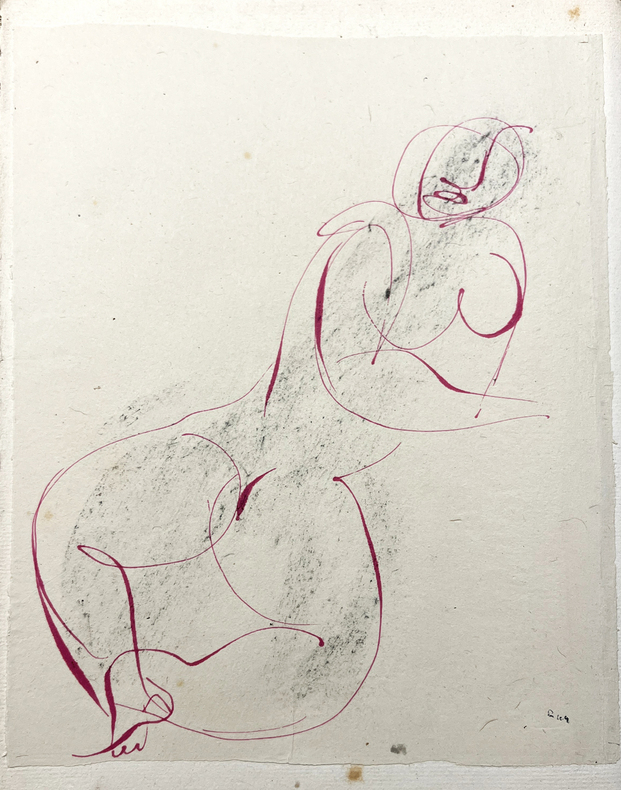
19473746S.l. (Paris), Librairie Auguste Blaizot, 1947 Un volume petit in-4 (29,1 x 22 cm), en feuilles, sur Vergé d'Auvergne au filigrane "L'Alleluiah ", sous couverture de vergé d'Auvergne rempliée, imprimée du titre en noir et illustré d'une lithographie en violet sur le front. - 3 DESSINS ORIGINAUX À L'ENCRE ROSE/ROUGE (1 en frontispice) ET À L'ENCRE GRISE (2). à la plume et au pinceau avec frottages, sur Chine, chacun étant monogrammé et daté " 44 ". Dimensions: 26,2 x 20,5 cm environ l'un. - 18 LITHOGRAPHIES ORIGINALES IN TEXTE imprimées en violet (couverture, têtes de chapitres et culs de lampe). - 100 lettrines lithographiées en violet. - Édition totale à 92 exemplaires, celui-ci l'un des 50 sur Auvergne contenant 3 dessins originaux. - Condition: rousseurs sur la couverture comme toujours et quelques rousseurs éparses dans l'ouvrage mais pas sur les dessins originaux. L'exemplaire est des plus agréables et les dessins sont particulièrement beaux. Bibliographie : Mason 170 à 187.
1952015764Paris Pierre Seghers 1952 In-4 Broché à la japonaise Signé par l'auteur
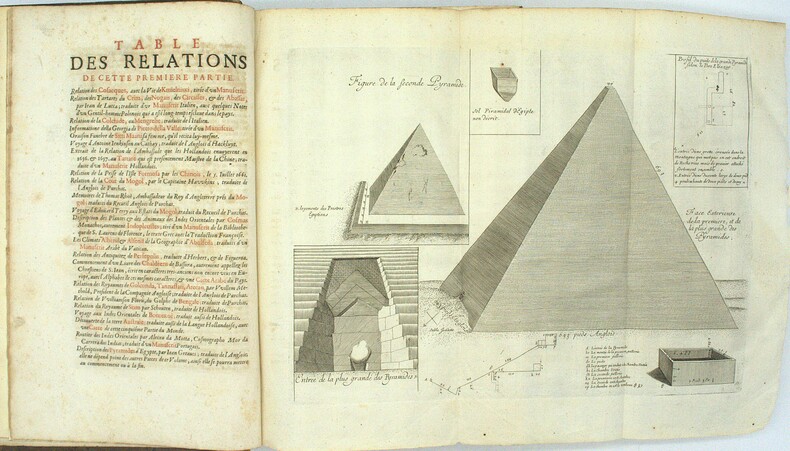
1696PHO-1981Paris, Thomas Moette, 1696 ; 5 parties en 2 vol. in-folio (37x23,5cm), veau marbré, dos à nerfs richement orné de motifs dorés avec tomaison et pièce de titre grenat, quelques frottements, charnières fendillées, manque au dos, coins usés, coiffes absentes, 8 feuillets détachés, rousseurs, qlqs feuillets brunis. L’illustration comporte de nombreuses gravures et illustrations dans et hors texte, 6 cartes dont la carte de l’Indostan, de la Colchide, du Japon (qui regarde l’Amérique), carte de la route du voyage de Canton à Péking, carte de l’Éthiopie, carte de l'Éthiopie ["Entrée de quelques ports…"]. Il manque la Carte de Bassorah, les 2 planches de caractères Chaldéens, la carte de l’Australie, la carte des côtes d’Arabie et d’Asie, la carte des Costes de Sierlionne, la carte des Philippines et Chine, la carte de Chine