25 870 résultats
199524401995 Lucerne, Editions Facsimilé, 1995. 30,5x44 cm. Fac-similé reproduisant à l'identique la première partie du manuscrit enluminé conservé sous la cote ms. fr. 2810 à la Bibliothèque Nationale de France à Paris. Format des feuillets légèrement variable comme sur l'original médiéval. Texte en français médiéval. Superbe reliure en plein veau marron. Plats ornés des armoiries royales françaises. Dos à 8 nerfs, orné de caissons dorés portant le monogramme L (Louis, roi de France). Pièce de titre en maroquin rouge. Roulettes dorées à l'intérieur des plats. Coffret recouvert de soie bleu-roi et orné des armoiries royales sur le plat supérieur. Minimes et très discrètes traces de frottement sur la reliure, sinon ouvrage en excellent état et d'une qualité exceptionnelle.
1940008960Tientsin China: Reprinted in China 1940. Book. Good. Cloth. Reprint. Small 8vo - over 7¾" - 9¾" Tall. Four volumes bound in blue/grey cloth Good the cloth worn and soiled one hinge each in Vols. I and II and both in Vol. IV broken the bindings still holding well. Faint damping bottom edges Vol. III. Interiors clean and unmarked. Prior owner name stamp of Richard W. Powell noted University of Hawaii anthropologist. From the collection of noted East Asian scholar Ruth Meserve her business card for The Mongolian Society which she served as Secretary laid in. The 1940 Chinese reprint of the original 1834 first edition SCARCE in either edition. The first serious study of Genghis Khan. Three folding genealogical charts one in Vol.I and two in Vol. IV; large 1824 folding map of Asia in the13thcentury in pocket at rear of Vol. IV. The charts and the map are Fine. A sturdy and usable set of this important history. Reprinted in China Hardcover
191356870Munich: Verlag von F. Bruckmann A.G. 1913. Oblong Atlas folio. 20.75 x 19.5 in. 4 12 pp. w/ 51 tipped-in collotype plates 1 partially coloured all retaining their original tissue guards. Loose portfolio held in folding covers minor bumping to corners of textblock some very light toning 1st couple leaves w/ very slight closed tear at upper left corner w/ open-backed slipcase w/ printed labels on covers wear toning some scuffing minor dampstaining soiling still a VG/G- exemplar. First edition thus of this remarkable group of collotypes reproducing drawings made from the famed frescoes of the renowned Tang Dynasty artist Wu Tao-Tze -- Godoshi in Japanese 680-760. Believed to have painted hundreds of frescoes on Temples representing the Buddhist purgatory or inferno they were of such dramatic power many on viewing them repented of their sins and nearly all were destroyed through the Cultural Revolution and development. All his artworks have either been preserved by being incised on stone as woodcuts or as Chinese brush drawings. These drawings taken from Dr. Martin’s Collection were rendered originally by Li Lung Mien 1070-1106 a Sung master painter and superb draftsman who has been often considered the Leonardo da Vinci of China. He was renowned for his paintings of horses and also adept at painting landscapes as well as works with Buddhist and Taoist themes. Each collotype reproduction within this portfolio has been printed on a tinted background to simulate the originals and then mounted on thick laid paper along with a critique by Anders Zorn and notes were by Dr. Haenisch. See: Reviews & Notices The International Studio Vol. LII 1914 pp. 255-256; Recent Publications of Chinese Subjects Journal of the Royal Asiatic Society Vol. LIV Issue 1 1922 p. 99. Verlag von F. Bruckmann A.G., unknown
193123260Shanghai: Kelly and Walsh 1931. Hardcover. Very good condition. A presentation copy of a scarce volume celebrating the 25th anniversary of a Danish engineering company that brought western technology to the industrial development of 1900s China and secured the exclusive right to represent General Electric in China. <br /> <br /> Andersen Meyer first worked on a joint basis with an American import export firm based in Shanghai named Fearon Daniel & Company to set up an engineering firm in China. In 1907 it won the right to represent G. E. in China and in 1908 secured its first large contract with the Mukden Electric Light Works. <br /> <br /> The firm quickly diversified from the construction and engineering fields to partner with American makers of textile machinery and equipment selling the first cotton mill entirely equipped with American machinery. It also expanded into power plant machinery electrical machinery including Xray equipment plumbing and heating equipment agricultural machinery and drugs and chemicals. Offices were located in Tientsin Peiping Harbin Mukden Hankow Tsingtao Tsinan Hong Kong and Canton. Meyer Andersen represented the major American manufacturers of the day from G. E. American Radiator International Harvester Masonite Parke Davis once America's oldest and largest drug maker Sherwin Williams and more.<br /> <br /> This is a signed presentation copy to a long term business associate who was the principal of a company acquired by Pittsburgh Coal Co. from the founder Vilhelm Meyer and signed below Meyer's frontispiece portrait: "F. L. Robbins with thanks for your long and loyal cooperation. From your old friend Vilhelm Meyer. March 1931".<br /> <br /> The first section is written in English; the second section in Chinese translated and prepared by Kuang Chao Lee with a special title page and separate pagination with Chinese numerals. The volume is impressive for its wide array of b&w photographic illustrations in all the areas in which the company operated including staff portraits showrooms of the various departments interior views of factories including cotton & silk mills power plants lighting of Shanghai buildings railway and locomotive equipment and workshops and bridge construction. There is an unusual double spread photograph of the Bund in Shanghai with 29 numbered buildings and a chart below listing all the heating supplies provided by Andersen Meyer to the prominent landmark buildings all along the waterfront! pp92-93. The many images in a broad range of fields provide a vivid sense of the tremendous impact of western technology on China's industrial growth.<br /> <br /> In 1934 Vilhelm Meyer died and the ownership of the company passed to its main American partner General Electric. In 1949 following the founding of the People's Republic of China many international firms in Shanghai were nationalized including Andersen Meyer. By 1950 it was completely Chinese controlled.<br /> <br /> Large 4to 247pp; 134pp frontispiece b&w photographic illustrations including portraits of staff maps. With the book plate of F. L. Robbins at the front paste down. Dark blue stamped buckram covers title in English at front cover in Chinese at rear cover original titles in yellow somewhat dulled.<br /> <br /> We located four copies at the National Library of Singapore National Library of Australia the University of Hong Kong and Stanford. OCLC: 123199443. Libraries Australia ID 5041194. Kelly and Walsh hardcover
1940006910Helsinki Finland: Suomalais-Ugrilainen Seura 1940. Two volumes in original dustjackets. Both volumes are Fine Vol.I dustjacket Very Good 1 1/2" triangular chip bottom edge at spine tears at spine folds and 2 tears horizontally at spine Vol. II jacket Near Fine small chips bottom edge of spine. List of donors laid in. One folding plate map index 15 folding maps at rear Vol. II. Numerous black and white photographs in text. A classic scholarly text ''In the spring of 1906 I received orders from the Russian General Staff to undertake a journey from Russian Turkestan through Chinese Turkestan and Western China and the provinces of Kan Su Shensi and Shansi to Peiping as the final goal. The object of this expedition was to study the conditions in the interior of Northern China collect statistical materials and perform various tasks of a military nature'' Preface. Mannerheim also collected archaeological and ethnographic materials and manuscripts and studied little-known peoples and tribes in Norther China. Mannerheim later became the 6th President of Finland after serving as Commander-in-Chief of the Finnish armed forces during WWII. . First Edition. Cloth. Fine/Very Good. Folio - over 12" - 15" tall. Suomalais-Ugrilainen Seura Hardcover books
8676Peking, Imprimerie des Lazaristes au Pé-T'Ang, 1897 (Première Edition). Exemplaire de luxe avec gravures en couleurs. 1 volume in-4, 562 pp., enrichi de 660 gravures, anciennes et nouvelles, reproduites ou exécutées par des artistes chinois d'après les plus précieux documents (dont 10 en brillantes couleurs), reliure moderne plein cuir, couvertures conservées, très bon état. Exemplaire de luxe numéroté 110, sur un tirage d'environ 1000 volumes.
1986250012London, Philip Wilson, 1986. 3 vols. 1381 pp. with numerous illustrations, partly coloured. 2°, Folio, original cloth binding, top edges gilt, dust jackets, slipcases
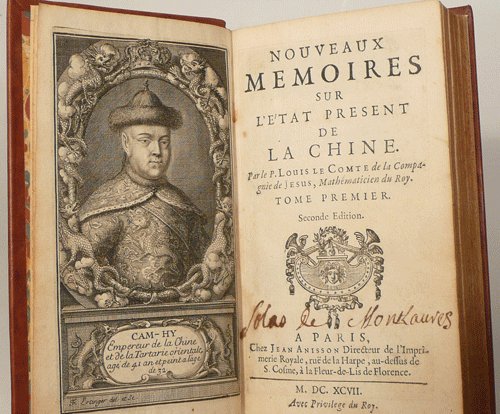
16970031141697 Paris, Jean Anisson, 1697. Deux volumes in-12 (101 X 171 mm) veau marbré, dos cinq nerfs ornés, caissons dorés, titre et tomaison dorés, tranches mouchetées en rouge (reliure moderne). Tome I : portrait-frontispice, (1) f. de titre, (15) ff., 410 pages, 18 planches et un tableau ; Tome II : (2) ff. de titre et de table, 435 pages, (9) pages de table et privilège, 2 planches. Six feuillets du premier tome comportent des taches claires sans gravité ne gênant pas la lisibilité du texte.
190015638BB(Tokyo, Nachdruck auf Chinesisch, um 1900). Als Blockbücher gebunden, in Seidenmappe. 4 Bände.
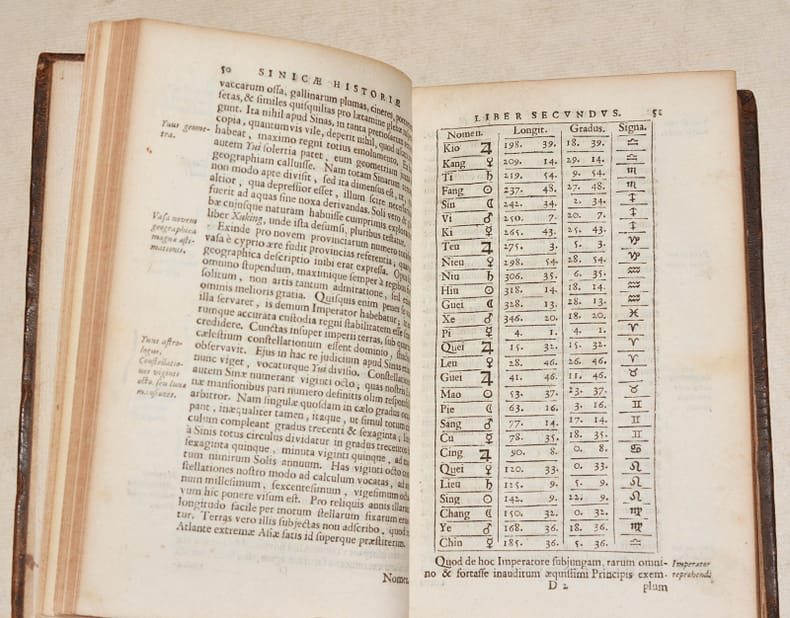
16590032931659 Amsteldami [Amsterdam], Joannem Blaeu, 1659. In-12 (102 X 158 mm) veau brun, dos cinq nerfs ornés, caissons dorés, pièce de titre maroquin grenat, coupes ornées, tranches mouchetées rouge (Reliure de l'époque) ; 413 pages (dont titre), (1) page et (8) ff. d'index. Coiffe supérieure restaurée, fine déchirure sans manque habilement restaurée aux feuillets A4 et A5 (pp.7/8 et 9/10 de l'avis au lecteur), petite mouillure claire dans l'angle supérieur droit des pages 99 à 303.
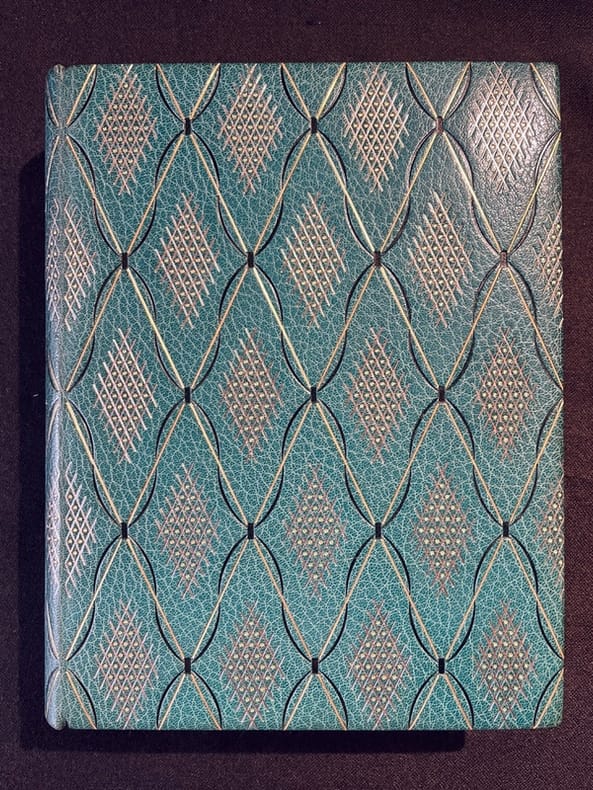
191121846Paris, Édouard Pelletan, 1911. Fort in-4, maroquin bleu turquoise, dos lisse et plats entièrement recouverts d’un décor géométrique de losanges dorés et à froid avec points dorés, doublures et gardes de box mastic ornées d’un semé de rectangles dorés, tranches dorées sur témoins, couvertures et dos conservés, chemise, étui. Reliure signée G. Cretté succ. de Marius Michel.
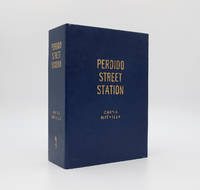
26671Burton MI: Subterranean Press. 2011. Limited edition. Limited edition. One of 26 lettered copies. Signed by the author. Publisher's original blue leather with titles in gilt to the upper board and spine in the original blue leather solander case. With a frontispiece and seven further full page colour illustrations by four full page colour plates by Edward Miller. A fine copy the binding square and tight the contents clean throughout. Housed in the structurally sound slightly rubbed and scuffed tray case. Issued in a limited edition of 26 lettered copies of which this example is lettered 'G' and signed by China Miéville on the limitation page. There was also an edition of 350 copies. First published in 2000 Perdido was Miéville's second novel after King Rat and the first to be set in the fictional universe of Bas-Lag. It won the Arthur C. Clarke Award and British Fantasy Society Award for best novel. Further details and images for any of the items listed are available on request. Lucius Books welcomes direct contact with our customers. Burton, MI: Subterranean Press. 2011 hardcover
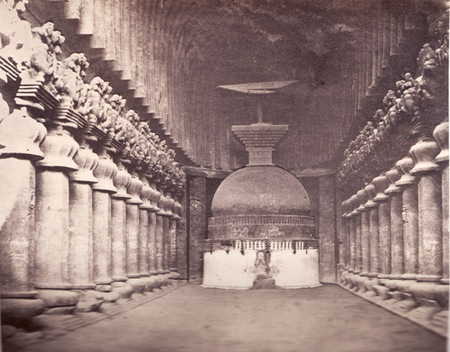
18671101867 Firmin Didot frères, fils et Cie, Paris, 1867. 2 tomes reliés en un volume. 18 x 24,5 cm (R), in-8°, XXXII pp. + 407 pp. & (4 pp.) + 472 pp. ; avec 4 planches hors texte : 1 planche lithographiée et coloriée (le Taj-Mahal à Agra du côté de la Jumna), 1 planche lithographiée en noir (Un éléphant porteur de reliques, et chefs kandiens à Ceylan), toutes deux placées en frontispice et deux photographies originales contrecollées (Tombe d'Akmud Oud Doula, Agra et Vue de l'intérieur de la Chaïtya, grottes de Karli), reliure demi basane fauve, dos à 5 nerfs orné de fers dorés avec pièces de titre olive et grenat, tranches mouchetées.
10285Londres, Paris, Fisher, Fils, et Cie, [1843-1845] 1845. 2 volumes in-4, 68+26 pp., 76 pp., 74 pp.; 73,(3) pp., demi-chagrin à coins, plats cartonnés marbrés, comportant 4 titres illustrés et 124 gravures sur acier, très bel état. Exemplaires sans rousseurs, copies without any foxing. Ces 2 volumes couvrent les 4 tomes de LEmpire Chinois Illustré, traduit de l'anglais et inspiré de "China Illustrated, its Scenery, Architecture, Social, Habits, Etc."
4234A Paris, Chez le Sieur Le Rouge, Ingénieur-Géographe du Roi, Rue des Grands Augustins, M.DCC.LXXVI (1776). 1 volume in-4, reliure demi-toile (dos restauré), plats cartonnés, 30 pp., enrichi de 20 planches gravées, with 20 engraved plates, quelques rousseurs, some foxing.
1756PHO-10591756/1758 ,à Paris chez Desaint et Saillant , 4 tomes en 5 volumes in-4 (275x220mm) , relié couverture d’attente, dos lisse , grandes marges sur beau papier, non rognés, (manque aux dos , charnières faibles mais corps solides , 2 plats détachés , bord brunis)
Octavo. Pp. vi, (ii), 420. Plus wood-engraved frontispiece with facing tissue-guard; 2 full page wood-engraved plates; one full-page plan, and 6 wood-engraved vignette illustrations. Plus 3 folding engraved maps, bound at end. Hardcover, beautifully bound in recent three-quarter smooth black calf extra, attractive marbled paper over boards, sides decorated with blind rolls, spine in compartments between gilt-ruled raised bands, large gilt fleuron in five of six compartments, red morocco lettering-piece gilt in remainder, all edges polished smooth and dyed red. In exceptionally fine condition. An immaculate copy. ~ First edition. Authorship attributed by some to Arthur A'Court Fisher; by others to George Battye Fisher. For that matter, see British Union Catalog and OCLC 9004104.
12410Paris, Imprimé par autorisation du Roi à l'Imprimerie Royale, 1842. 1 volume in-8, XIV-303pp., reliure d'époque en plein chagrin rouge, dos à nerfs orné, plats ornés d'un décor d'encadrements, entrelacs et filets dorés, tranches dorées, petite épidermure au plat inférieur, bel exemplaire très frais.
20142081502111904566China/Salt Industry History Research and Editing Department 2014. Soft Cover. Fine. Number of books: 10 joint editions China/Salt Industry History Research and Editing Department paperback
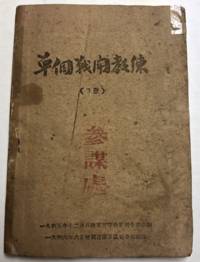
1946AG-10067<p>CHINA - Defense Fighting Jin-Ji-Lu-Yu Military Region: Published by the Commander of Eighth Route Left-Behind Corps in December 1945 reprinted by Commander of Jin-Ji-Lu-Yu Military Region June 1946 volume 2 of 2 with red Chinese characters on front cover: <i>General Staff</i>. This book illustrated techniques of defense and fighting back one on one in many different combat situations and warfare chiefly directed for military use. 12mo ii 69 pp. started from 37 to 105 8 large folded picture maps many images on each folded sheet <i>minor wear occasionally strengthened at folds cello-tape repair to spine and right top of front cover good.</i><br /></p><p><b>å•个战斗教练</b></p><p>晋冀é²è±«å†›åŒºï¼š1945å¹´12月八路军留守军团å¸ä»¤éƒ¨å‡ºç‰ˆï¼Œ1946年晋冀é²è±«å†›åŒºå¸ä»¤éƒ¨ç¿»å°ã€‚下册,书å°çš®çº¢è‰²å—体为"å‚谋处"å—æ ·ã€‚书内部带有8处粘贴的注释折å 图。共68页(从37页到105页), 书脊处和å°çš®å³ä¸Šè§’有胶带粘贴修补。其他å“相很好。</p> Commander of Eighth Route Left-Behind Corps paperback
1955AG-1012<p><b><i>CHINA RECONSTRUCTS 62 issues. </i></b>Beijing: China periodical 1955-1971 edited in Wai Wen Building distributed by GUOZI SHUDIAN printed in the People's Republic of China. Small folio 23×30 cm each issue approx. 52 pages; original pictorial colored wrappers. All issues are English language texts.</p><p><b><i>China Reconstructs</i></b> is a monthly magazine published in English French Spanish Arabic and Russian by the China Welfare Institute Soong Ching Ling Chairman to present a positive image of China to the outside world. These interesting magazines are filled with articles on a huge range of subjects: <i>Eternal Glory to the Great Leader and Teacher Chairman Mao Tsetung; Four Young Woodcut Artists; Is Selling Vegetables Revolutionary Work; Socialist Drama; A Model for Revolutionary Peking Opera; The Red lantern; Workers Armed with Mao Tsetung's Thought Are Most Resourceful; During the Great Leap Forward period articles about great progress in Agriculture; Industrial Education was published in No. 4 1959. Some Chinese Folk Toys; Festival Lanterns; Color Pictorial: Chairman Mao's Hometown-Shaoshan; Painted Pottery of Neolithic China; a study in Chinese Literature-Lu Xun; Tsou Tao-fen Patriotic Intellectual; Selected Works of Mao Tsetung; On the Long March with Chairman Mao; Communist Heroine Liu Hu-lan; Health Work Develops in Tibet; Commemorating the Centenary of the Birth of the Great Lenin; a Soldier-Sculptor; People of the World Unite and Defeat the U.S. Aggressors and All Their Running Dogs; Heroic Images of Our Great Era; 1500 Red Hearts United in Battle; The Bright Sunshine of Mao Tse-tung's Thought Lights up the Land; Vice Chairman Lin Piao's Speech At the Rally Celebrating the 20th Anniversary of the Founding of the PRC.; China's First Underground Nuclear Test; The Power of the Good Old Three; The revolution in Education in Progress; Art that Serves Proletarian Politics; When Chairman Mao Gives the Signal We Advance; Hundreds of Millions of Chairman Mao's Books Published in 1967; World's People Eagerly Seek Chairman Mao Badges; Chinese Scientists Survey World's Highest Peak; New Look in Traditional Arts and Crafts; Peoples of Europe and North America We Support You!; Painting Pictures of Chairman Mao is Our Greatest Happiness; Chairman Mao's Important Inscription for Japanese Worker Friends; All China is Red; Working and Living with Chinese Peasants; The Great January Revolution in Shanghai; In Memory of Norman Bethune; The First Hydrogen Bomb; </i><i>One Million People in Peking at Solemn Mass Memorial Funeral for Chairman Mao Tsetung &c.</i></p><p>《ä¸å›½å»ºè®¾ã€‹æ‚志,外文大厦编辑,国å书店å‘行,本组有1955年—1976年的部分期刊,《ä¸å›½å»ºè®¾ã€‹æ˜¯ä¸€æœ¬æœˆåˆŠï¼Œæœ‰è‹±æ–‡ï¼Œæ³•è¯ï¼Œè¥¿ç牙è¯ï¼Œé˜¿æ‹‰ä¼¯è¯ã€ä¿„è¯ç‰è¯è¨€ï¼Œç”±å®‹åº†é¾„ç¦åˆ©åŸºé‡‘会出版,旨在å‘世界展示ä¸å›½å»ºè®¾çš„好的方é¢ï¼ŒåŒ…å«äº†å¤šä¸ªä¸å›½ç›¸å…³ä¸»é¢˜çš„æ–‡ç« 。</p><p> Contents of collection: 1955 No. 12; 1956 No. 1 5; 1959 No. 4 11; 1960 No. 12; 1961 No. 3; 1962 No. 7; 1963 No. 7; 1964 No. 3; 1965 No. 347 89 11 12; 1966 No. 1-6 10; 1967 No. 1-7 9-12; 1968 No. 1-5 7-12; 1969 No. 1 2 3 4 12; 1970 No. 1 4extra 6 8; 1971 No. 3 4 8 10 12; 1972 No. 3; 1976 No. 11/12</p><p><br /></p> edited in Wai Wen Building, distributed by GUOZI SHUDIAN, printed in the People’s Republic of China. paperback
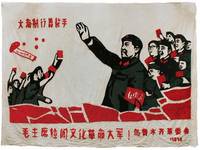
196716838Urumqi XinJiang Uyghur Autonomous Region: Cultural Revolution Committee of Urumqi / Xinjiang Army Divisioni 1967/8. Two extraordinary hand-crafted parade banners ca. 110" x 84" 9 feet x 7 feet one slightly smaller. Each entirely composed of hook-work with colored yarns on white muslin backing. Slight age-toning and soil; a few threads loose but no significant losses; Near Fine condition overall. Folded and stored in original velvet draw-string carrying bags as found.<br /> <br /> Both banners bear the inscription "Chairman Mao Reviewing the Great Army of the Cultural Revolution" and depict the August 1966 mass rally at Tiananmen Gate where more than 10 million Red Guards from all over China converged to express their solidarity with Mao and his second-in-command Lin Biao. Additional text on the lower banner reads "Long Live Chairman Mao for ten thousand years" and "Sailing in the ocean requires a helmsman" -- both quotes from Lin Biao. The agencies responsible for the banners are identified in lower right of each: "Cultural Revolution Committee of Xinjiang Army Division 1968" upper banner and "Cultural Revolution Committee of Urumqi 1967" lower. <br /> <br /> The presence of Biao the figure to the right of Mao holding the Little Red Book in the top banner is of particular interest. Biao compiler of The Quotations of Chairman Mao popularly known as the "Little Red Book" and coiner of the phrase "Maoism" was probably more responsible than any other figure for creating the cult of personality around Mao particularly at the time of the Cultural Revolution. He quickly ascended Party ranks and was widely seen as Mao's obvious successor. But in 1971 Biao was exposed in the process of an apparent coup attempt the details of the event have never been made public. He died in an airplane crash attempting to leave China and from this point forward was officially condemned as a traitor by the Communist Party; any record of his achievements on behalf of the Revolution was expunged from the official record and any positive image of Biao would have been confiscated and destroyed as a matter of course - suggesting either that these banners left China prior to 1971 or that they remained out of sight until some later date. The second possibility is plausible given whence the banners issued - both were created by Red Guard branches in the Xinjiang Uyghur Autonomous Region an extremely remote province in China's northwest corner and for many years the center of a militant independence movement for Uyghur and other Turkic minorities. Cultural Revolution Committee of Urumqi / Xinjiang Army Divisioni unknown
19561700121956. CHINA. First five-year plan for Development of the National Economy of the People's Republic of China in 1953-1957. Unpaginated approximately 70 pp. profusely illustrated. Publisher's cloth and dust jacket. Peking: Foreign Languages Press 1956. An astonishing example of modernist book design from communist China. The avant-garde layout combined with the use of photography and isotypes is strongly reminiscent of such works as Lissitzky's An Album Illustrating the State Organization and National Economy of the U.S.S.R. published in 1929. Dust jacket restored. Otherwise a fine copy of a most unusual book. hardcover
19184224Shanghai: Presbyterian Mission Press 1918. First edition. Near Fine. Quarter cloth over pictorial drab boards. Early ownership signature to upper front board and some faint soiling mostly to spine and edges. Textblock firm and square measuring 210 x 130mm. Internally a surprisingly fresh copy collating complete with adverts to front and rear: 12 138 16. Introducing a range of "native products" to Americans living in the region the cookery reflects a growing need for nutritious recipes and supply chain substitutions in wartime. The sole copy on the market OCLC reports only 7 copies.<br/><br/>The only Chinese-published cookbook "to deal only with native products and recipes that could be made from them." In their preface to this new cookery the committee for the Women's Auxiliary explains in clear terms what sets their cookery apart. "This book was definitely war product. It was prepared with two ideas in view: that of utilizing local products as substitutes for the home imported foodstuffs and secondly that of reducing the cost of living. It was different from all other cook books that had been published in China for foreigners' use in that it dealt only with native products and recipes that could be made from them." While some recipes are titles in English only the compilers included Cantonese translations wherever possible in addition to including a glossary at the rear called Hints for the Housekeeper as well as a List of Terms Necessary in Food Preparation which both provide translations and pronunciations for Cantonese words related to food and household cleaning products. During and after WWI Shanghai had become a space of rich and problematic interactions between cultures. In addition to rising Western military forces its reputation as the "Paris of the East" drove in American and British tourists while later large residential areas were being built in the north due to war concessions. Opium smuggling prostitution and a spreading wealth gap caused friction. The Women's Auxiliary composed of intelligent and educated members with a cultural appreciation for these fluctuations as well as for the culture into which they had migrated sought to use the kitchen as a positive space for the exchange of food language and ideas. Near Fine. Presbyterian Mission Press unknown books
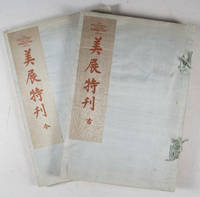
192941261上海市 Shanghai: æ£è—社 Zheng yi she 1929. Second edition. Softcover. poor to vg-. Folios. Approx. 15x10". Unpaginated. "Modern" volume with 3 preliminary pages of index and 8 pages of prologue. "Ancient" volume with 2 pages of prologue and 1 page of index at the front. Grey patterned cloth portfolio with black lettering over a white label on the front cover. Light blue-grey silk wrappers with light blue string-tied bindings. Red lettering in English and Chinese over a tan silk label on the front covers. This is the "November 1929" printing.<br /> <br /> The work is an exhibition catalog from The National Fine Arts Exhibition held in Shanghai in April of 1929 which was organized by the Ministry of Education of the Republic of China headed at the time by Cai Yuanpei. It is considered the first Chinese fine arts exhibition in modern history. The exhibition was a monumental retrospective with more than 2000 pieces of art from throughout Chinese history starting from the Five Dynasties period the 10th century up through the contemporary period. The event brought together the work of countless Chinese artists photographers and architects and also included the work of six Japanese artists. <br /> <br /> The catalog includes some 400 pieces of the artwork featured in the exhibition divided into a "modern" volume and an "ancient" volume. The artwork is printed in b/w offset photographic reproductions and collotypes. Also included in the "ancient" volume are seven works in color with both Chinese and English language titles on protective tissue guards a few of which are beautifully printed color lithographs. The "modern" volume contains a printed calligraphic prologue written in by Cai Yuanpei. The "ancient" volume includes works from some artists as The Four Wangs Wu and Yun from Qing Dynasty Four Monks of the Early Qing Dynasty Bada Shanren Shitao Hong Ren and Kun Can Lan Ying and Gong Xian. The "modern" volume contains works from Zhang Daqian Qi Baishi Wu Hufan Liu Haisu and Lin Fengmian among many others. Both volumes contains extensive indexes of the artwork. Text in Chinese.<br /> <br /> Portfolio with boards broken but present. Wrappers with some light smudges and scratches and a few minor creases. Some sunning along the top and bottom edges of the covers. Interiors with sunning to the edges and a few sporadic minor smudges. Images mostly unaffected. Portfolio in poor wrappers in good interiors in very good- condition overall. æ£è—社 (Zheng yi she) unknown