[JAPAN] COELHO, GASPARBiblio.com
24 761 résultats
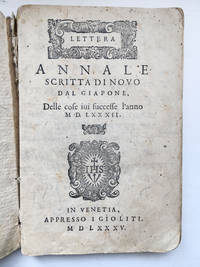
1585125<p>Coelho Gaspar. <em>Lettera annale scritta di novo dal Giapone delle cose ivi successe l'anno MDLXXXII. </em>Venice: Gioliti 1585<em>.</em></p><p>8vo 154x99 mm contemporary <em>cartonato alla rustica</em> original sewing to spine preserved pp. 103. Woodcut printer's device woodcut initials.</p><p>The scarcest issue of Jesuits' report of their missions and activity for the year 1582: one of the earliest printed Western testimony of the ancient Japan.</p><p>Gaspar Coelho composed this report in February 1582 describing the ongoing missionary activity across the country: in Hirado Amasuka Bungo and especially Funai Oita City the home of a thriving Jesuit college.</p><p>Streit describes another edition printed by the same publisher in the same year and according to Boscaro there were four editions of Coehho's letter published in Italy in 1585 around the time the embassy arrived in Venice on June 25: two issue printed in Venice by Gioliti one printed in Rome by Zanetti and one printed in Milano by Pontio. A French edition translated by Michel Coyssard was published in Paris in 1586 and one German translation in Dilingen in 1586.</p><p>According to Edit 16 our variant issue is the scarcest one located only in 2 Italian institutional library Biblioteca Universitaria of Bologna and Biblioteca nazionale Marciana of Venice:</p><p>CNCE 14783: <em>Lettera annale scritta di novo dal Giapone delle cose ivi successe l'anno MDLXXXII. </em>Venice: Gioliti 1585<em>. </em><u>Our variant</u> 2 copies.</p><p>CNCE 12736: <em>Lettera annale portata di nuouo dal Giapone da i signori ambasciatori delle cose iui successe l'anno MDLXXXII</em>. Venice: Gioliti 1585 12 copies.</p> Gioliti
198516488Paris, Arnaud de Vesgre, 1985 ; grand in-plano (coffret 67 x 48 cm), en feuilles sous couverture blanche à rabats et coffret de tissu orange, titre doré au dos et sur le plat (coffret d’éditeur).
1969104301BBTokyo, Gendai Shicho Sha, (1969). Folio (38 x 31 cm.). [3] Bl., 34 Tafeln, [2] Bl., alle ausfaltbar u. 1 Orig.-Photographie (Silbergelatine, 24,5 x 16 cm.) auf dem Trägerkarton und verso signiert und mit Stempel des Fotografen, dat. 1971. Illustr. OLn. mit Blau bedrucktem Klarsichtschutzumschlag in Orig.-Pappschuber u. Orig.-Versandkarton mit Deckelschild.
1912123064ére Meiji 1912 In-4 30 x 487 cm. 12 estampes montées en 1 rouleau. Chaque estampe aquarellée 30 x 48 cm. Ensemble en bon état.
1728019215London: for the Publisher and Thomas Woodward and Charles Davis 1728. First Edition. Hardcover. Light dampstaining in second volume. Generally clean and bright Near Fine. Two folio 8-1/2" x 13-3/4 volumes in contemporary calf leather neatly rebacked preserving the original gilt spine labels. First edition in English second issue with the additional appendix in volume 2 translated from the German by J. G. Scheuchzer. Titles printed in red and black with additional engraved titles and 45 mostly double-page or folding plates and maps. Kaempfer's HISTORY OF JAPAN "was for more than a century the chief source of Western knowledge of the country. It contains the first biography of Kaempfer; an account of his journey; a history and description of Japan and its fauna; a description of Nagasaki and Deshima; a report on two embassies to Edo with a description of the cities which were visited on the way; and six appendices on tea Japanese paper acupuncture moxa ambergris and Japan's seclusion policy" DICTIONARY OF SCIENTIFIC BIOGRAPHY. Kaempfer was a physician for the Dutch East India Company's trading settlement at Nagasaki in the late 17th century. Sir Hans Sloane acquired the manuscript after Kaempfer's death and arranged for it to be translated into English for this edition. Of significance is the fine folding map of Japan "Imperium Japonicum in Sexaginta et Octo Provincias Divisum." <br/><br/>Cordier JAPONICA pages 414-15; Cox I: 332; Garrison-Morton 6374.11; See Nissen BBI 1019 note; Wellcome III: 376. for the Publisher, and Thomas Woodward and Charles Davis hardcover
19682110502151002316Senmon-do shoten 1968. Soft Cover. Fine. Number of books: 29 combined books Senmon-do shoten paperback
LCS-13899Paris, Michel Sonnius, en la rue sainct Jacques, 1571. Avec privilège. In-8 de 131 pp., (1) p. d’avis au lecteur, ancien travail de vers dans la marge blanche inférieure des pp. 20 à 60 sans atteinte au texte. Vélin souple de l’époque, traces de liens, dos lisse avec titre manuscrit, étiquette en pied. Petit manque au plat supérieur. Reliure de l’époque. 163 x 100 mm.
19622092902137704351Keiso Shobo Gyosei 1962. Soft Cover. Fine. The book is in fine condition. Keiso Shobo Gyosei paperback
172816JAPAN. Higashi Nihon Kaigan shosaizu. Coloured manscript map in the form of a scroll. ca. 29.5 x 488 cm with two foldouts extending ca. 17.5 x 29.5 cm housed in a wooden box. N.p.: n.d. A detailed map of the east coast of Japan depicting the coastline from the Mura Peninsula to the Boso Peninsula and from the Sanriku Coast to Hachinohe in Aomori. unknown
15852438<p>Venice: Appreso I Gioliti 1585. </p><p>Price: $8500.00 </p><p>Octavo: 16 x 10.5 cm. 188 11 pp. Collation: A-M8 N4</p><p>One of several 1585 editions first ed. 1584</p><p>Bound in modern cartoncino. A very good copy with some minor repairs lightly washed. With a fine woodcut headpiece and Jesuit emblem on the title page and numerous decorative head- and tailpieces and initials including one of a dragon throughout.</p><p>This collection contains the following letters from the Jesuit missions in Japan and Goa: Francesco Carreón writing from Kuchinotsu 1 Dec. 1579; Gregorio de Céspedes 1579; Lorenço Mexia at Bungo 20 Oct. 1580; three letters by LuÃs Fróis Miyako 14 April 1581; 19 May 1581; and 29 May 1581; Francesco Cabral 15 Sept. 1581; and Alessandro Valignano Goa 28 Dec. 1583.<br /><br />The Salsette Martyrs:<br /><br />This collection concludes with Valignano's important letter from Goa –one of only five Jesuit letters from India published between 1570 and 1585- detailing the deaths of the Jesuit Martyrs of Cuncolim who were killed on Monday 25 July 1583 in the village of Cuncolim in the district of Salsette territory of Goa India. The "martyrs" were the Italian Rudolph Acquaviva the Spaniard Alphonso Pacheco the Swiss Peter Berno the Portuguese Anthony Francis and Brother Francis Aranha also a Portuguese. In addition the Portuguese layman Gonçalo Rodrigues and some Indian youths Dominic Alphonso Francis Rodrigues Paul da Costa and ten others were also killed.<br /><br />While prosecuting their mission of Conversion in Cuncolim the Jesuits and their companions desecrated a Hindu temple by urinating in it a relatively mild if repugnant form of desecration; on an earlier excursion Father Berno had set fire to another temple and destroyed a sacred anthill. In addition they killed a cow that was also an object of worship and hurled its entrails into a sacred well thereby defiling it. The understandably outraged citizenry set upon the Jesuits and their companions killing them with scimitars lances and arrows. They then threw their bodies into a well. The five Jesuits quickly achieved great fame as martyrs and at last in the 19th century were elevated to sainthood while the lay Indians who were slaughtered with them were ignored. <br /><br />It should be remembered that three of the five Jesuit martyrs were in Cuncolim as chaplains to a force of Portuguese soldiers sent to exact harsh reprisals for indigenous resistance to Portuguese rule and the Jesuit campaign of forced conversion. In this context the killing of the Jesuits is remembered by the people of modern day Cuncolim as one of the first acts of revolutionary resistance to European rule in India.<br /><br />Of course the letter written in December of 1583 by the Jesuit Provincial of India Alessandro Valignano glorifies the "martyrs" and in true martyrological style vividly describes the deaths of Acquaviva and his companions.<br /><br />"The Pagans then fell upon them; Father Rudolph received five cuts from a scimitar and a spear and died praying God to forgive them and pronouncing the Holy Name. Father Berno was next horribly mutilated and Father Pacheco wounded with a spear fell on his knees extending his<br />arms in the form of a cross and praying God to forgive his murderers and send other missionaries to them.</p><p>Streit Bibliotheca Missionum IV. 1639; Sommervogel II col 492; Cordier Sinica 75; Laures 170</p> Appreso I Gioliti, books
0904-Co.J. Farbradierung, Roulette und Aquatinta, 1901, auf cremefarbenem Japan, mit Bleistift signiert. 19,5:13,3 cm. ? Mit ca. 1,5/2 cm breitem Rand um die Plattenkante, dieser etwas unregelmäßig geschnitten. Literatur: Kat. Galerie Glöckner. Köln 2007/2008, Nr. 82.- Vorzüglicher Abdruck, mit leichtem Wischton! ? Die in mehreren Farben gedruckten Exemplare dieser Radierung sind selten!
20022080202104501889Hon'notomosha 2002. Soft Cover. Fine. Number of pages: 11 books Number of books: 11 books Hon'notomosha paperback
20022080402107100080Hon'notomosha 2002. Soft Cover. Fine. Size: 22cm Number of books: 9 books in total Hon'notomosha paperback
197519436ABTokyo, 1975. 44 : 35,5 cm. 12 handcoloured original woodcuts by Keisuke Zerizawa under passepartout, each lead into a paper- sheet with pasted on Japanese title, housed in brown special Japanes paper portfolio with title in Japanes,. Together in original cloth portfolio with title on front board. 3 issues with 4 inlead woodcuts each (all Published).
1892019217@1892. Hardcover. Photographs are Fine and bright with tissue guards. Both boxes in nice shape. The front cover of the album with a horizontal crack about 3 inches from the bottom and extending across most of the cover doing little to detract from the lovely decorative scene. Overall a beautiful example uncommon in such nice condition. Oblong Folio 14" x 10-1/2" with a black morocco leather spine with gilt designs and exquisite black enamel painted and onlaid covers. Containing 50 hand-colored 10-1/4" x 7-3/4" albumen photographs laid down onto heavy cardboard pages titled in the negative in English and with small color drawings of figures in the margins of each page. Images include cityscapes landmarks and scenes of daily life and rituals in mid-to-late Meiji period Japan. Places shown include Tokyo Kyoto Yokohama Nagoya Enoshima the shrines of Nikko and two views of Mt. Fuji. Occupational scenes include women spinning cotton men striking wheat a rice plantation men transporting rice bales on horseback a samurai a Shinto priest Shinto pilgrims a "blind shampooer" a pottery shop a shoe shop a grocery a cloth store "reading at home" "gathering the cocoons" "playing at ball" and more. Albums such as this were sold to overseas visitors to Japan ca 1880s- early 1900s who would choose their favorite scenes from the photography studio's stock and whether to pay extra for hand-coloring fine binding and artistic covers. We have offered a handful of examples over the years and this is easily the finest in content with more occupational and daily life scenes as opposed to the standard landmarks as well as special touches such as the small hand-painted characters in the margins of each page and also in the finest condition. Housed in a clamshell box with decorative cloth covers and likely the original tin container used for shipment to America. <br/><br/> hardcover
738736 folding leaves of which four are blank. 8vo 240 x 170 mm. orig. blue semi-stiff wrappers wrappers somewhat worn orig. label heightened in gold with manuscript title new stitching. Japan: n.d.<br /> During the Edo period there were 12 Korean delegations to Japan whose purposes were mostly to congratulate a new Tokugawa shogun. The missions which normally included 300-500 Koreans accompanied by roughly 1500 Japanese escorts symbolized the amicable relationship between the two nations and in the early years served to legitimize the Tokugawa shogunate.<br /> These delegations which usually took nine or ten months round-trip were enormously expensive undertakings for both countries. The Koreans brought many luxurious presents both public and private gifts and the Japanese in turn furnished equally lavish gifts including large quantities of silver. Also the receiving Japanese were obligated to fund a number of elaborate and costly banquets during the delegation's travels on the mainland and in the capital city as well as provide accommodations throughout.<br /> Our manuscript is concerned with one of the three final missions which took place in 1748 1764 and 1811 this last mission was held on the island of Tsushima located roughly halfway between Kyushu and the Korean mainland. All three of these missions experienced considerable cost-cutting. We suspect our manuscript is a record of the banquets for the final 1811 mission as there is a reference to a Russian translator at this time there was considerable tension between Japan and Russia because of the Russian desire to open trade with the island nation.<br /> Our manuscript describes a series of banquets served during one of these three final missions. In spite of the newly instituted austerity it is clear that the participants ate very well. For each of the 13 banquets we are given the number of guests and their official positions the number of dishes per tray what foods were served etc. Some of the banquets were limited to just a dozen or so guests and others included more than 300 people. <br /> The cuisine is very much in the tradition of the ritualistic preparation and serving of the food on a series of trays known as honzen ryori "main tray cuisine" which was the dominant banqueting style for the elite from the Muromachi period through the Edo period. Various seafoods including luxury items like lobster smoked fish roe octopus and preserved fish are listed along with preparations of chickens eggs many kinds of vegetables burdock daikon radish ginger eggplant wild wasabi and many vegetables that are today quite obscure cooked in various ways pickles mushrooms fruits persimmons pears yuzu nuts rice and other grains and elaborate confections including sweets of Portuguese origin like pound cake or kasutera.<br /> Fine copy preserved in a chitsu. unknown books
1919875901919. PHOTOGRAPHY- JAPAN. HOSHITA Eishô photographer. SCENES ON THE TRANS-SIBERIAN RAILWAYS ZEN SHIBERI TESTUDÔ SHASHIN-CHÔ. Urajio Vladivostok Taishô 8 1919 Contemporary oblong folio rebacked. Album of 250 photo illustrations of the Japanese Imperial Army in the Allied Siberian Expedition 1918-1922 ranging in size from 3 5/8" x 5 1/8" to 8 3/4 x 11 1/2". Includes a panoramic bird's eye view of Vladovostok measuring 7 3/8' x 41 7/8/" and a fold out map of the route of the expedition measuring 14" x 29 3/4". Three-quarter leather stamped in gilt rebacked. The cloth and leather corner pieces are worn and rubbed. Captions in Japanese English and Russian with text in Japanese. title is taken from cover. Includes a number of pictures of partisan sabotage of railway between Chita and Krasnoyarsk. Hoshita Eishô produced at least two such albums of the warfare in the Russian Far East. Very unusual and important record of a "lost war unknown books
6217Tokyo, 1890-1891. 34 x 24,5 cm, six volumes brochés à la japonaise, couverture illustrée. Nous avons six numéros dont trois numéros aux planches colorées, exemplaires de luxe de ce journal. - 1ère série n°1. Le déjeuner maigre de Fujisawa. Août 1890. 25 planches légendées en noir et blanc. Couverture au titre coloré. Couverture légèrement tachée sinon bon exemplaire. - 1ère série n°3. 1891. 21 planches légendées colorées. Couverture au titre coloré. Mouillures en haut des pages de couverture et sur les pages de garde sinon bon exemplaire. - 1ère série n°4. Le départ du colon. 1891. 20 planches légendée en noir et blanc. Couverture abîmée, déchirures et deuxième plat détachée. Intérieur en bon état. - 1ère série n°7. Sans date. 20 planches légendées colorées. Couverture tachée avec de petites déchirures. Intérieur en bon état. - 1ère série, sans numéro, sans date. 20 planches légendées colorées. Couverture tachée avec de petites déchirures, intérieur en bon état. - 1ère série, sans numéro, sans date. 20 planches légendées en noir et blanc. Couverture légèrement usée, intérieur en bon état. Rarissime ensemble. Premier numéro paru en 1890 les Potins de Yoko ont eu onze numéros dont le dernier sortira en 1891.
6217Tokyo, 1890-1891. 34 x 24,5 cm, six volumes brochés à la japonaise, couverture illustrée. Nous avons six numéros dont trois numéros aux planches colorées, exemplaires de luxe de ce journal. - 1ère série n°1. Le déjeuner maigre de Fujisawa. Août 1890. 25 planches légendées en noir et blanc. Couverture au titre coloré. Couverture légèrement tachée sinon bon exemplaire. - 1ère série n°3. 1891. 21 planches légendées colorées. Couverture au titre coloré. Mouillures en haut des pages de couverture et sur les pages de garde sinon bon exemplaire. - 1ère série n°4. Le départ du colon. 1891. 20 planches légendée en noir et blanc. Couverture abîmée, déchirures et deuxième plat détachée. Intérieur en bon état. - 1ère série n°7. Sans date. 20 planches légendées colorées. Couverture tachée avec de petites déchirures. Intérieur en bon état. - 1ère série, sans numéro, sans date. 20 planches légendées colorées. Couverture tachée avec de petites déchirures, intérieur en bon état. - 1ère série, sans numéro, sans date. 20 planches légendées en noir et blanc. Couverture légèrement usée, intérieur en bon état. Rarissime ensemble. Premier numéro paru en 1890 les Potins de Yoko ont eu onze numéros dont le dernier sortira en 1891.
39363In-8 (203 x 125 mm), demi-veau fauve de lépoque, dos lisse orné de compartiments garnis dun fleuron répété au centre et cloisonnés dune roulette dorée en place des nerfs, pièce de titre de maroquin vert, tranches mouchetées de rouge, xxxv, (1), 137 et (2) pages derrata (faux-titre et titre compris). Paris, Brunot-Labbe, 1817.
In -8°, pp. 109, (b), cartonato, tagli rossi. Prima edizione. Francesco Pasio (1551-1612) fu il primo provinciale gesuita in Giappone, residente a Nagasaki; il libro comprende anche una lettera del vice-provinciale Pedro Gomez (1533-1600), autore del “Compendium”, ovvero un trattato di cosmologia e teologia che sarebbe diventata la prima opera a introdurre la cultura occidentale in Giappone; segue un testo di Nicolò Longobardi (1559-1654), gesuita siciliano che in Cina fu il successore di Matteo Ricci (nominato varie volte in questo testo); la quarta e ultima lettera è un resoconto di una missione presso i territori islamici del Mogol (India, Pakistan, Afghanistan). Marca dei gesuiti al frontespizio e capilettera figurati. First edition. Pasio (1551-1612) was the first Jesuit Provincial in Japan: he resided in Nagasaki; the book includes also a letter of his deputy Pedro Gomez (1533-1600), author of the “Compendium”, a cosmology and theology treaty that had to become the first work to introduce western knowledge in Japan; then a text by Nicolò Longoboardi (1559-1654), a sicilian jesuit who replace, in China, Matteo Ricci (mentioned many times in this text); the fourth and last letter is the chronicle of a mission in Islamic areas of Mughal (India, Pakistan, Afghanistan). A Jesuit mark on title page and figurative initials. Pasio (1551-1612) was the first Jesuit Provincial in Japan: he resided in Nagasaki; the book includes also a letter of his deputy Pedro Gomez (1533-1600), author of the “Compendium”, a cosmology and theology treaty that had to become the first work to introduce western knowledge in Japan; then a text by Nicolò Longoboardi (1559-1654), a sicilian jesuit who replace, in China, Matteo Ricci (mentioned many times in this text); the fourth and last letter is the chronicle of a mission in Islamic areas of Mughal (India, Pakistan, Afghanistan). A Jesuit mark on title page and figurative initials.
1696PHO-1981Paris, Thomas Moette, 1696 ; 5 parties en 2 vol. in-folio (37x23,5cm), veau marbré, dos à nerfs richement orné de motifs dorés avec tomaison et pièce de titre grenat, quelques frottements, charnières fendillées, manque au dos, coins usés, coiffes absentes, 8 feuillets détachés, rousseurs, qlqs feuillets brunis. L’illustration comporte de nombreuses gravures et illustrations dans et hors texte, 6 cartes dont la carte de l’Indostan, de la Colchide, du Japon (qui regarde l’Amérique), carte de la route du voyage de Canton à Péking, carte de l’Éthiopie, carte de l'Éthiopie ["Entrée de quelques ports…"]. Il manque la Carte de Bassorah, les 2 planches de caractères Chaldéens, la carte de l’Australie, la carte des côtes d’Arabie et d’Asie, la carte des Costes de Sierlionne, la carte des Philippines et Chine, la carte de Chine
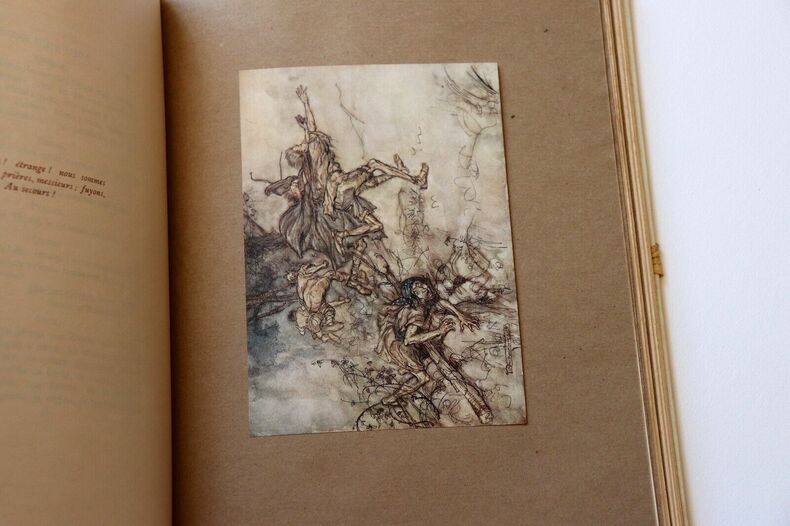
1909AMO-4513Paris, Hachette et Cie, 1909 (imprimé par Ballantine and Co, Londres pour le texte. Les illustrations en couleurs ont été reproduites par MM. Carl Hentschel) 1 volume grand in-4 (30 x 23,5 cm) de (6)-134-(2) avec 40 planches en couleurs montées sur papier marron épais et protégées par un calque avec légende imprimée et 30 dessins au trait imprimés en noir dans le texte. Cartonnage éditeur plein vélin blanc, premier plat décoré doré du titre et de l'auteur et illustré d'une illustration d'Arthur Rackham dorée au centre, dos avec titre doré, tête dorée, doublures et gardes de papier brun fort (identique au papier qui sert de support aux illustrations hors-texte). Collationné complet. Reliure très fraîche. Le lacet du plat supérieur a été arraché (le morceau déchiré est bien présent dans le volume). Intérieur parfait.
1592026339Frankfurt am Main 1591 1592. Original Antique Map . Single Sheet. Near Fine. Laid Paper. Size: Image And Border Approximately 17 7/8 Inches X 1M.5 Inches 45.2 Cm X 36.75 Cm. Debry Printed His Voyage To Virginia In 1590 As Part I Of His Works But Burden Mapping Of North America Provides No Record That A 1592 Printing Exists. This Map Has No Center Fold But Contemporary Engravings Exist Of The Offices Of The Great 17Th Century Cartographic Publishers With Row Upon Row Of Flat Drawers For Storage Of Single Maps; It Would Be Unreasonable To Believe That None Of These Unbound Maps Survived. This Appears To Be One Of Them Although The Consensus Of Modern Dealers Is That No Unfolded Large Map First Published In A Book Can Exist. Although We Have Been Unable To Locate A 1592 German Edition Of Debry We Believe This Is A Map As Issued In The 1592 German Edition Of De Bry Which Was First Published In 1591 And Subsequently Reprinted In 1592 And 1594 And In The Seventeenth Century. Small Cartouche At Lower Left Monogram With Text "Caesavece Matis. Privilegio Mdxcii" In The Plate Added After Original 1591 Printing. This Is An Unfolded Sheet Which Was Never Bound In A Book; A Strong Impression Without Damage And With Old Light Partial Coloring. Once Quite Aged Then Professionally Cleaned De-Acidified And Mounted Loosely With Archival Materials By A Museum-Experienced Conservator In About 2000. Scarce. And Now 430 Years Later It's Depicting A Hangout For Orangutans. <br/> <br/> unknown
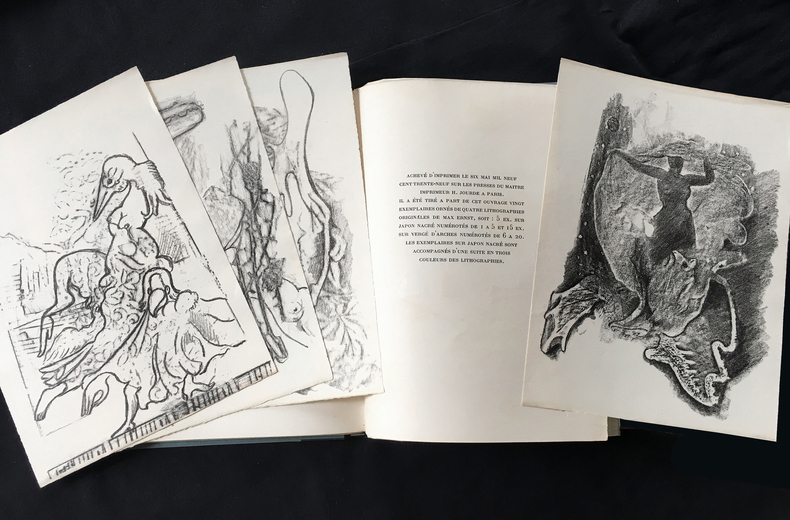
19391435-2Paris, NRF, Gallimard, 1939. in-4 broché, 70 pages, couverture imprimée. ÉDITION ORIGINALE de ce recueil contenant : "Trois chevaux aigus. Nous sommes. Nulle rupture. À l'ombre de ma porte. Poème perpétuel. L'or et l'eau froide. Trois poèmes inachevés. Les vainqueurs d'hier périront". Tirage : 5 Japon nacré et 15 vergé d'Arches numérotés et signés + les exemplaires non numérotés sur vélin du Marais (tirage probable à 500 ex.). Le notre, sur vélin du Marais est accompagné DES 4 SUPERBES LITHOGRAPHIES ORIGINALES DE MAX ERNST TIRÉES EN NOIR À PLEINE PAGE SUR VERGÉ DE HOLLANDE (seuls les 20 premiers exemplaires en grand papier contiennent ces lithographies). - Note bibliographique et historique : Max Ernst avait prévu une série de douze lithographies, mais seules quatre d’entre elles furent publiées dans l’édition de luxe à petit nombre. Un an plus tôt, en 1938, désapprouvant ses positions trotskystes, Éluard avait rompu avec Breton : À sa suite Max Ernst quitte le groupe surréaliste outré d’avoir à subir l’exigence de « saboter la poésie de Paul Éluard par tous les moyens » (in Centre Georges Pompidou, Paul Éluard et ses amis peintres, 1982, p.109).