JAPANABAA

24 761 résultats
1860347451860. Two small broadsides each 9 x 11 3/4 inches. Previously folded. Moderate toning and dust soiling faint foxing at outer margins. Good plus. Japanese news sheet on foreigners.<br/> <br/>Two interesting Japanese Kawaraban woodblock news sheets documenting some of the foreigners who visited Japan's shores in the 1850s as the country opened up to the west. The first sheet is in four sections and titled "Western Products and Strange Things." It contains images of an English Captain a black sailor a microscope of Dutch style and a mummified body wrapped in sheets. The second shows a Captain's wife and her wolfhound dog an American Flag and a depiction of four Russian coins obverse and reverse and two other coins dated 1843 and 1854. unknown books
19741055121974 Tokyo, à compte d’auteur, 1974.Premier volume : 288x428mm, 126p., 62 photographies, ouverture à gauche, couverture toilée noire avec disque en métal poli, pages de garde argent.Deuxième volume :181x256mm, 128p., 54 photographies, ouverture à droite, couverture souple noire avec étiquette collée ; il se trouve dans un logement ménagé dans le coffret et comme, au dire du photographe, « enterré » sous l’ouvrage principal.
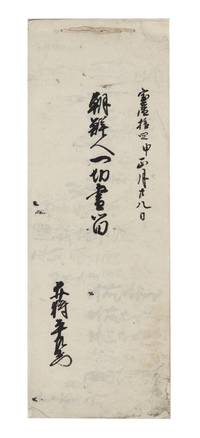
1113722 folding leaves. Narrow tall 8vo 343 x 123 mm. orig. self-wrappers orig. stitching. Japan: on upper wrapper in trans.: “28 January 1764.â€<br /> <BR> <BR> During the Edo period 12 Korean delegations were sent to Japan mostly to congratulate a new Tokugawa shogun. The missions which normally included 300-500 Koreans accompanied by roughly 1500 Japanese escorts symbolized the amicable relationship between the two nations and in the early years served to legitimize the Tokugawa shogunate.<br /> <BR> <BR> These delegations which usually took nine or ten months round-trip were enormously expensive undertakings for both countries. The Koreans brought many luxurious presents both public and private offerings and the Japanese in turn furnished equally lavish gifts including large quantities of silver. During the Korean mission’s stays the Japanese government was responsible for all expenses and provisions for their guests.<br /> <BR> <BR> The present manuscript is an account of the diplomatic mission sent by the Koreans in 1763-64. The mission totaled 497 people and took 382 days. The members of the embassy included chief and auxiliary envoys a document official three translating officials with assistants ten translators two copyists a poet a painter three doctors army officers musicians horsemen clerks captains pilots servants commissariat officials gift guardians trumpeters six for each of the three principal envoys soldiers and sailors. The mission sailed from Pusan to Osaka stopping at Tsushima on the way and then travelled by land to Edo via Kyoto.<br /> <BR> <BR> Our manuscript provides menus of the elaborate banquets the Japanese offered to their guests accounts of the special ceramics created at the kilns of Shigaraki used at banquets itemized lists of the provisions and their quantities including rice seasonings condiments and miso routes and stops along the way from Osaka to Edo housing arrangements official proceedings distribution of horses to the delegation itemized balance sheets detailing expenses of the mission etc.<br /> <BR> <BR> The cost of this mission was so enormous for both countries that the next and final mission of the Edo period was a toned-down meeting in 1811 on Tsushima island conveniently located in between both countries.<br /> <BR> <BR> On the upper wrapper we find the name Imochi Heizaemon 井æŒå¹³å·¦è¡›é–€ and on the penultimate leaf we find the place-name Hachiman 江州八幡町 which is in today’s Shiga Prefecture.<br /> <BR> <BR> Nice fresh condition. Some worming carefully repaired.<br /> <BR> <BR> ⧠George M. McCune “The Exchange of Envoys Between Korea and Japan During the Tokugawa Period†in The Far Eastern Quarterly Vol. 5 No. 3 May 1946 pp. 308-25. unknown
20112110502151003577Risosha/Waseda University Publishing Department/The Philosophy of Science Society of Japan 2011. Soft Cover. Fine. Number of books: 58 Risosha/Waseda University Publishing Department/The Philosophy of Science Society of Japan paperback
193331933Jacques de Brunhoff, chez Jules Meynial 1933 Grand in-4 demi-chagrin cerise rel. mod., couverture conservée, 95 pp. 32 planches couleurs en héliogravure et 48 illustrations dans le texte en noir. Couvertures brunies. Infimes rousseurs.
189714037ABBoston, Millet, 1897. 41 : 32 cm. With ten colour collotype frontispieces, 30 mounted handcoloured albumen photographs, and appproximately 260 halftone reproductions. Original printed silk over boards, bound with silk cord, each volume with different Japanese style floral pattern. 10 volumes.
In-4°, 236cc, (2), legatura in pergamena molle, buone condizioni. Antichi timbri di possesso. Si tratta della traduzione in latino effettuata dal Maffei del lavoro di Acosta Historia das missoes da Oriente. Manuel da Costa (1541 - 25 febbraio 1604) era un gesuita portoghese e bibliografo di Lisbona. Dopo aver insegnato discipline umanistiche e teologia in diverse scuole, come Coimbra, dove la maggior parte delle letture dei gesuiti erano disponibili in forma non censurata, fu scelto come rettore di Braga, poi missionario nelle Azzorre; si distinse per il suo zelo. Scrisse A História das Missões dos Jesuítas no Oriente, Até ao Ano de 1568 (Storia dei missionari gesuiti in Oriente, fino al 1568). Il manoscritto fu inviato a Roma, tradotto in latino, e fu poi consegnato al giovane novizio Giovanni Pietro Maffei (1533-1603) per prepararlo alla pubblicazione. Maffei aggiunse una notevole quantità di testo all'opera di Acosta, intitolata De Japonicis rebus epistolarum. Questa parte contiene traduzioni latine abbreviate di lettere inviate dai Gesuiti che lavorano in Giappone fino all'anno 1564. Nella sua introduzione Maffei si congratula con Da Costa per il suo sforzo nel riassumere il contenuto delle lettere insieme in un breve commento. In-4°, 236cc, (2), vellum binding, good condition. Some possession marks. This is the latin traduction of Acosta’s Historia das missoes da Oriente. Manuel da Costa (1541 – 25 February 1604) was a portuguese Jesuit and bibliographer from Lisbon. After teaching humanities and theology at several schools, like Coimbra where most of the Jesuit letters were available in uncensored form, he was chosen rector of Braga, then missionary to the Azores; he was distinguished by his zeal. He wrote A História das Missões dos Jesuítas no Oriente, Até ao Ano de 1568 (History of the Jesuit Missionaries to the East, until 1568). The manuscript was sent to Rome, translated into Latin, and was then given to the young novice Giovanni Pietro Maffei (1533-1603) to prepare it for publication. Maffei added a considerable amount of text to Acosta's work, entitled De Japonicis rebus epistolarum. This part contains abridged Latin translations of letters sent from the Jesuits working in Japan until the year 1564. In his introduction Maffei congratulates Da Costa on his effort in summarizing the contents of the letters together in a short commentary.
In-4°; pp. (10), 318, (2),; (8), 161, (3), con un bel ritratto di Francesco Saverio finemente inciso su rame da Theodor Galle; vari esemplari, tra cui quello alla Biblioteca Casanatense di Roma e quella dell’Università di Granada, come il nostro sono prive della carta *6; le Epistole hanno un proprio frontespizio, entrambi con monogramma della Società di Gesù inciso su legno. Nota di possesso manoscritta all’ultima sguardia. Legatura in piena pergamena coeva. Bellissimo esemplare. The third edition of De Vita Francisci Xaverii (the first in Rome 1594, another issues in Antwerp in the same 1596 containing only De vita) and the first of the Epistolae. This 1596 edition of the saint’s biography is better then the one of 1594 because revised by the author and complete. St Francis Xavier (1506-52), a companion of Ignatius of Loyola and co-founder od the Jesuit order, was a leader of the first Jesuit missions to India, southeast Asia and Japan. Orazio Torsellino was an italian Jesuit; he achieved great popularity with this work, which had numerous editions and translations, and with his first and principal early printed collection of Xavier’s letter, including many from Japan, available at the end of the 16th century. This first edition remained standard for many years and also for 17th cent. editions. This is the first collection of writings by St. Francisco Xavier. In 1540, he set off as a missionary to Asia. From there in the midst of ten years of incessant labor, 1542 - 1554, he produced 137 letters and instructions. The translator and editor of this volume, Orazio Torsellini in this place presented 52 letters. This collection of Xavier letters is very important in the story of China and Japan. Streit Iv, p. 290; Cordier col. 128; Sommervogel VIII, col. 140.
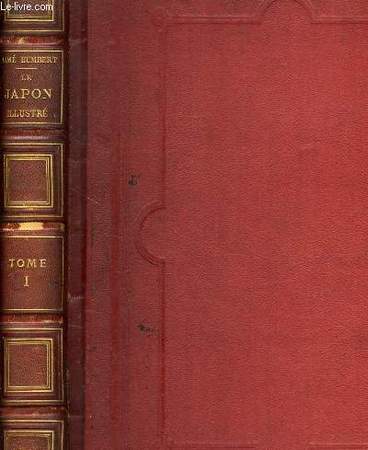
1870RO40086928Librairie de L. Hachette et Cie. 1870. In-4. Relié demi-cuir. Bon état, Coins frottés, Dos à nerfs, Quelques rousseurs. 424 pages pour le tome I, et 432 pages pour le tome II. Illustrés de nombreuses gravures en noir et blanc dans le texte, et de gravures en noir et blanc sur planches hors texte. Auteur, titre, tomaison et caissons dorés sur le dos. Tranche dorée. Ouvrage de bibliothèque avec code collé sur le dos et petits tampons en page de titre. Mors du tome I fendu sur 5 cm. Dos frottés.. . . . Classification Dewey : 952-Japon et ses îles
Librairie de L. Hachette et Cie. 1870. In-4 Carré. Relié demi-cuir. Bon état. Coins frottés. Dos à nerfs. Quelques rousseurs. 424 pages pour le tome I, et 432 pages pour le tome II. Illustrés de nombreuses gravures en noir et blanc dans le texte, et de gravures en noir et blanc sur planches hors texte. Auteur, titre, tomaison et caissons dorés sur le dos. Tranche dorée. Ouvrage de bibliothèque avec code collé sur le dos et petits tampons en page de titre. Mors du tome I fendu sur 5 cm. Dos frottés. Ouvrage contenant 476 vues, scènes types, monuments et paysages, dessinés par E. Bayard, H. Catenaci, Eug. Cicéri, L. Crépon, H. Clerget, A. de Neuville, M. Rapine, E. Thérond, etc. Une carte et 5 plans. Tome I: Benten, Kioto, Kamakoura, Yédo. Tome II: Yédo, Yokohama.
19392091502135500283Not Available 1939. Soft Cover. Fine. Number of pages: A5 size super thick book 442 pages of overview of Northern China 838 pages of business and industry directory 267 pages of announcements of famous shops Not Available paperback
19422090502113707228Not Available 1942. Soft Cover. Fine. The book is in fine condition. Not Available paperback
19982080502106907631Not Available 1998. Soft Cover. Fine. The book is in fine condition. Not Available paperback
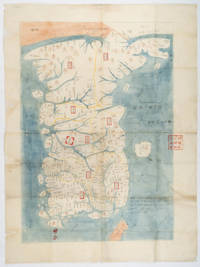
218441Tokyo. No date. Late Edo. Folding manuscript map ink and watercolour 82 x 61 cm red chop at one edge. Evidence of worming mainly affecting the edges and central fold professionally strengthened with archival washi tide-mark to the verso of the map and the wrappers but an appealing example of this delicately executed and sought-after map of the Korean peninsula. A late Edo period hand-painted colour copy of one five maps produced by Japanese scholar Hayashi Shihei to accompany his famous 1785 banned work "Sangoku Tsuran Zusetsu" "An Illustrated Description of the Three Countries" - the three countries in question being Japan's neighbours Korea the Ryukyu Kingdom now Okinawa Prefecture and Ezo now Hokkaido Sakhalin and the Kuril Islands. <br> <br>This detailed map of "The Eight Provinces of Korea" was probably based on Korean maps but Hayashi added details including the existence of the residence in Busan maintained by envoys from the Japanese Domain of Tsushima which had a relationship with Korea throughout most of the Edo period. He also adds text showing the distance between this residence and the Korean capital in both Japanese and Korean measurements and includes latitude lines though these are somewhat inaccurate - placing the 38th parallel south of the Korean capital. His map interestingly gives the Korean words for the four cardinal directions written in Korean script. Unlike Hayashi's "Illustrated Description of the Three Countries" this map does not show the contentious Takeshima/Dokdo/Liancourt Rocks which are too far out from the coast to fall within the frame of the map although it does include the island of Ulleungdo closer to the east coast of Korea. <br> <br>This copy is undated but inscribed with the words "Map by Hayashi Shihei of Sendai". A red chop in the lower middle shows that the map was owned by the Iijima Family in Matsushiro Domain Nagano Prefecture. The family were known as historians of the domain. . unknown
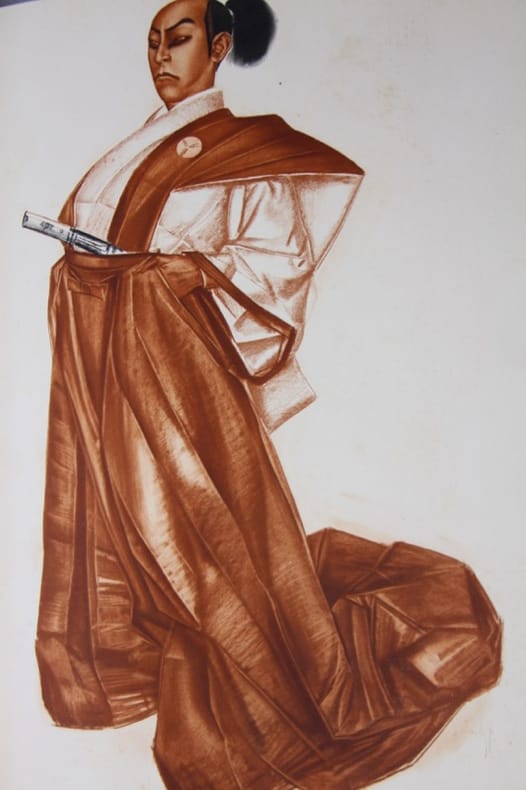
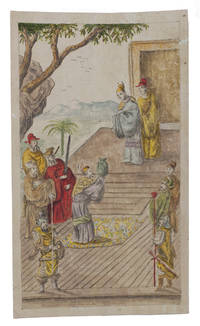
1670E9PF9I9C81WOChina 1670. A series of 8 Chinese drawings ca. 24 x 14.5 cm: 5 coloured 1 also highlighted in gold showing scenes from a Chinese novel many military or diplomatic plus a Chinese watercolour drawing and a Japanese woodblock print. A series of 8 pen and ink drawings 5 coloured 1 also highlighted in gold drawn from Chinese books possibly the 14th-century Sanguo yanyi or Romance of the Three Kingdoms. All mounted on European paper 6 on 3 different patterns of decorated paper. The paper of the drawings ranges from 23.5 x 14 cm to 24 x 15 cm. They show the following outdoor and indoor scenes:1 2 warriors on horseback one of whom has just beheaded the other and carries his head away the beheaded warrior has not yet fallen from his horse while his superior watches on horseback with 2 attendants.2 a man standing with a spear in the prow of a boat while 2 men and a woman sit at a tea table in the boat which flies a flag and pennant.3 5 people on 2 boats one flying a flag and pennant.4 4 soldiers bringing a woman to a dignitary at his house.5 a delegation visiting a dignitary.6 2 men playing go with 4 attendants and a guard.7 a dignitary at a writing table with attendants and visitors.8 a seated dignitary with 6 standing figures 1 with a document at a table.In the backing paper of number 7 one can make out an Amsterdam coat of arms watermark. It is difficult to see clearly but seems to follow the general style of Laurentius 71-95 1662-1675. The 3 patterns of decorated backing paper show: a flower pattern printed in gold on green; 2 patterns with more abstract decorations in a diamond pattern printed in gold on white.With this series we include a watercolour drawing and a woodblock print:9 watercolour drawing of irises along a stream with hills in the background 17 x 22.5 cm.10 rectangular woodblock print of a Samurai at a tea ceremony 14 x 10 cm possibly derived from a Japanese book.Some edges of the drawings a little frayed but otherwise in very good condition. unknown
1926015082Paris Grasset 1926 In-12 Broché Edition originale
19982080502106907323Not Available 1998. Soft Cover. Fine. The book is in fine condition. Not Available paperback
1858WRCAM52130AJapan 1858. Five volumes. 58; 58; 54; 58; 58pp. Original stiff textured tan wrappers stitched as issued each with printed paper title label. Some minor shelf wear and dust soiling. Very good. An attractive set of the "Ansei Five-Power Treaties" the formal diplomatic engagements between Japan and the United States United Kingdom France Russia and the Netherlands ending Japan's 250 years of seclusion and opening its ports to worldwide commercial trade so named for their signing in the fifth year of the Ansei era. The first treaty also known as the Harris Treaty was signed by the U.S. on the deck of the USS "Powhatan" in Edo now Tokyo Bay on July 29 1858. It opened the ports of of Shimoda Hakodate Kanagawa and Nagasaki to foreign trade effective July 4 1859 and then Niigata and Hyogo on January 1 1860 and January 1 1863 respectively. In addition to extensive trade and consular provisions the treaty also established the rights of U.S. citizens to reside permanently lease property purchase real estate and construct residences and warehouses; established a system of extraterritoriality whereby U.S. residents were subject only to the laws of their own consular courts and not the Japanese legal system; and established freedom of religious expression and the right to construct churches to serve the needs of U.S. residents within the confines of designated foreign settlements. The treaty followed the Convention of Kanagawa signed under threat of force in 1854 after Commodore Matthew Perry's aggressive visits to the Shogunate in 1853 and 1854. The Convention had granted coaling rights for U.S. ships and allowed for an American consul in Shimoda but Perry left the more important trading negotiations to Townsend Harris New York businessman and eventually the first U.S. Consul General to Japan. <br> <br> Each of the five volumes details the negotiations between Japan and a specific foreign power. These other accords are similar and duly inspired by the U.S. treaty; each nation forced Japan to grant the same "favored nation" provisions they had granted to the U.S. The Dutch already had several treaties with Japan; they were the only Western power to retain trade relations with Japan after the final expulsion of Europeans in 1638 and had been advising and supplying the Japanese navy since 1853. However once the U.S. had sealed its "Treaty of Amity" the Dutch quickly revised theirs to match on August 18 1858; Russia followed on August 19; Lord Elgin signed for Britain on August 26; and Jean-Baptiste Louis Gros commander of the French expedition in China signed for France on October 9 1858. Subsequent Japanese and Chinese scholars refer to these treaties and subsequent agreements as the "unequal treaties" as none of the provisions were ever reciprocated. <br> <br> This set is uncommon. We found only one record for another incomplete set at auction. This is the first time we have handled this title. unknown books
1853WRCAM55689Japan 1853. 14pp. including three double-page woodblock illustrations. Gathered signatures stitched as issued. Mild wear. Near fine. Rare kawaraban newsbook announcing the arrival of Commodore Perry and the Black Ships to Japan in 1853. The work includes three double-page illustrations: a dominating portrait of Perry's flagship; Perry and a contingent of marines marching in procession to a meeting with local dignitaries at Kurihama with two cabin boys carrying boxes presumably official gifts or President Fillmore's letter requesting harmonious commerce; and a map of Edo Bay where the Black Ships entered. Listings of the Samurai and Daimyo Feudal Lords entrusted with the protection of Japan from foreign invasion are found on the final leaves. Such kawaraban - news sheets broadsides or small periodicals - provided the most immediate contemporary news of events in Japan including Commodore Perry's momentous first visit. unknown books
192919791Paris, Société Nouvelles des Editions d’Art Devambez, 1929 ; in folio, veau bleu nuit décoré d’une gondole dorée sur les deux plats et le dos, un gondolier en action et une paline décorée, sous un ciel étoilé, titre à la japonaise en lettres fantaisie, contreplats de même, avec quatre coins carrés fauve mosaïqués et reliés par deux filets dorés gras et maigre, entourant une pièce de soie bleu-roi, garde identique, tête dorée sur témoins, couverture et dos conservés, non rogné, étui bordé (Bayard. Lyon).
In -8°, pp. 77, (B); cartonato, tagli rossi. Prima edizione. Pasio (1551-1612) fu il primo provinciale gesuita in Giappone, residente a Nagasaki. La lettera compendia le attività dei Gesuiti in Giappone a cavallo dei due secoli, descrive le condizioni di vita in diverse città e si impegna nel racconto delle condizioni culturali del Giappone a quel tempo. First edition. Pasio (1551-1612) was the first Jesuit Provincial in Japan: he resided in Nagasaki. This letter outlines the Jesuits’ activities in Japan, between XVI and XVII century, also giving descriptions of the various life conditions in many cities, and more widely of the Japan culture at that time.
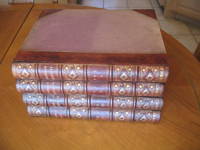
1880023430London circa 1880: J. S. Virtue and Co 1880. First Edition . Hardcover. Very Good . 13" Tall. Engravings on Steel and Wood. Vol 1: X;Vi; 240; Vol 2: Vi 240; Vol 3 Vi 240; Vol 4 Vi 236. Half Morocco Spine And Tips Over Purple Pebbled Cloth; Spines With 5 Bands Six Compartments Gilt Title And Volume Number Ornate Gilt Decorations In Other Four Compartments; Original Yellow Endpapers; All Edges Of Page Block Gilt. The Books Are 13" Tall 10 1/2" Deep And The Four Volumes Are 6 3/4" Wide On The Shelf. Undated But Circa 1880. Front Hinge To Vol Ii Cracked Binding Solid. Original Leather Recently Professionally Conditioned And Refreshed Professional Repairs To A Few Splits At Top/Bottom Of Spine Edges; Gilt Bright; No Names No Marks No Bookplates. Also With An Additional 41 Loose Plates Of Same Size As Those In The BooksPossibly From Another Copy Of This Set Or Perhaps Never Bound. Shipping Weight About 30 Pounds Insurance Required Shipping Requires Additional Charges Depending On Destination. Palestine Refers To The Area Immediately North Of Egypt Along The Mediterranean Coast Inhabited By Countless Peoples And Conquered More Or Less Mercilessly Countless Times By Various Empires From England To Central Asia. The Volumes May Or May Not Include References To This Unrivaled Mix Of Ethnicities Most Of Whom Were Then Living At Pece With Each Other. <br/> <br/> J. S. Virtue and Co hardcover
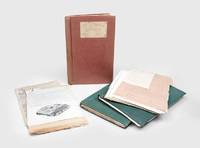
1942176989South-east Asia: 1942-45. The 9-inch gun is believed to have been mounted. in the Japanese Golf Course grounds A far-reaching archive assembled by an artillery officer attached to GHQ India including confidential intelligence and technical summaries and documents as well as material reproduced from War Information Circular issued by Military Intelligence GHQ India and other friendly and enemy sources. Organized into sections the information in these binders is very detailed and concerns the structure of artillery groups tactics and deployment and particular campaigns. For example a section on the attack on Hong Kong notes "The Japs were adept at dragging guns to the tops of hills and siting them in positions very difficult to locate. Ammunition was plentiful and was maintained by forced local Chinese labour. Any coolie failing to work up to Japanese expectations was shot out of hand. The 9-inch gun is believed to have been mounted on a previously and secretly prepared concrete mounting in the Japanese Golf Course grounds or even in the Club House on the mainland" Vol. 1 f. 9. Other material offers technical data and specifications for different guns and shells and included are pages from Periodical Technical Summary a restricted briefing issued by military intelligence in India. Supporting the text are photographs taken from other sources skilled technical drawings of weaponry and diagrams and sketch maps. The collection offers a forensic perspective on the conduct of Japanese artillery offensives in south-east Asia and the channels through which Allied personnel aggregated important strategic and technical information. The compiler may be either Captain J. E. Lee RA GHQ India Counter Battery Pool or Captain David Rogers RA GHQ Counter Battery Team 1 the recipient and addressee of a letter in this collection. Together 3 quarto springback binders and loose material. Original green or brown cloth laid-down title label housing several hundred sheets of bound-in and loose material including notes and documents in typescript letterpress and manuscript sketch maps and diagrams and illustrations. Material actively used and therefore creased marked and annotated a few items split and soiled: a very good working collection. hardcover
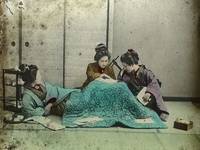
189032522AB1890. Japan Kyoto / Nikko and other locations c. 1890-1900. Each slide 8.3 cm x 8.3 cm. One Plate in Black-and-White all other 44 Plates in colour. Very good condition with only minor signs of wear. All Plates with their original uncleaned Patina. Only one slide with a slightly broken off corner held by a strip of paper. unknown
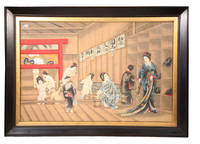
1900D55FLLW1EWHEJapan 1900. 70 x 98.5 cm. Watercolour on silk highlighted with white gold and perhaps mica. Large Japanese watercolour with a charming scene in a Japanese bath house. The interior of the bath house shows seven women and four children washing themselves and dressing. One of the women is already fully dressed in a blue and green kimono. In good condition. unknown