Vigny, Alfred de :Livre Rare Book

24 761 résultats
18852223Paris, Pour les Amis du livre, A. Lahure, 1885 ; in-8, demie-percaline rouge à coins à la bradel, pièce de titre verte, fleuron décoratif doré, couverture conservée (reliure de l'époque, signée Champs) ; (2) ff. (faux-titre, titre), 294 pp., (6) ff; (justification, légende des gravures, 3 ff. Société des Amis du livre, 1 bl.).
19732110502150906056Yoshioka shoten 1973. Soft Cover. Fine. Number of books: 10 Yoshioka shoten paperback
19702110502150908420Not Available 1970. Soft Cover. Fine. Number of books: 5 Not Available paperback
19502090502113700361Not Available 1950. Soft Cover. Fine. The book is in fine condition. Not Available paperback
20012111902160200754Seishodoshoten 2001. Soft Cover. Fine. Volume: 1 Seishodoshoten paperback
19632090502126802785Sanho 1963. Soft Cover. Fine. Number of books: 7 Sanho paperback
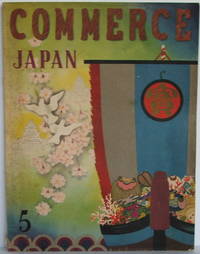
1938008936Tokyo: Japan Foreign Trade Federation. First edition. Original and only issue of the journal. Published Tokyo: Japan Foreign Trade Federation 1938. Text chiefly in English with many articles in French or Spanish or both full page ads in English. Folio 10 1/2" x 13 3/4" 94pp. plus 4pp. printed covers illustrated throughout with b/w photos and full color reproductions 31" x 13 3/4" color fold-out die cut page 2 printed clear mylar overlays exquisite full color front cover. Articles include: American-Japanese Trade; Upcoming New York World's Fair and Golden Gate International Exposition; Affairs in East Asia Moving from Military Campaign to Reconstruction; Nagoya; Locomotives and Rolling Stock; Japanese Toys; Menthol; Tea; Hats; Working Girls; Stone Lanterns; Aviation in Japan; Japan's Merchant Marine; The Oil and Fat Industry in Japan; Silk Carpets and Tapestries; Japanese Timepieces of Old; Japanese Fauna; Japanese Water Pets; Natural Camphor; Brushes. Top half of page 71 flap foldout missing with tape repairs to page fray and loss at the lower spine end otherwise very good. Pages clean and bright binding tight. Rare. . Good. Soft cover. 1st. 1938. Japan Foreign Trade Federation paperback
Exhibition catalog in white oversize wraps with as-issued protective jacket. Text on cover in English and Japanese, red & black print. Covers have sharp corners, no edge wear, are nearly pristine. Page block and binding are solid and straight. Text/interior is clean and free of marking of any kind. 136 pages in dual language with many b&w and color photos, large section of plates with many full and half page illustrations. Contents include: The spriti of experimentation -- an anthology by Shuzo Takiguchi: Art and experimentation, The spirit of Experimentation, People creating new art -- experimental workshop, On joie de vivre, Musical performance and the plastic arts, Ballet and the plastic arts, Words for some friends, Closed and open classics; Experimental workshop and the deterritorialization of art by Katsuhiro Yamaguchi; Innovation and expansion of music in experimental workshop by Kuniharu Akiyama; Plates by Kiyoji Otsuji, Shozo Kitadai, Tetsuro Komai, Hideko Fukushima, Katsuhiro Yamaguchi, Keijiro Sato, Hiroyoshi Suzuki, Toru Takemitsu, Kazuo Fukushima, Joji Yuasa, Kuniharu Akiyama; Comments and biographies; Experimental workshop: chronological history (1948 -- 1958, year by year) & Postcript by Kazuhiko satani
19742111902154602396Horupushuppan 1974. Soft Cover. Fine. The book is in fine condition. Horupushuppan paperback
1785306984AB(um 1785). 21,3 x 28,5 cm. (guter Zustand, linke untere Ecke etw. abgegriffen).
584Paris, Benoît Dandré-Garnery-Obré Libraires-Editeurs, An IV (1796). 4 volumes in-8, LXIV-417 - (X pages missing)-430 - VIII-445 - XII-462-VIII pp., illustrés d'un portrait de l'auteur en frontispice et de 27 planches in fine (il manque 1 planche / one print is missing). Les 4 volumes ont été reliés en plein cuir brun foncé. Très bel état.
19862092902137800161Tokyo daigaku 1986. Soft Cover. Fine. Number of books: 4 Tokyo daigaku paperback
26473Including six postcards 'Copyright Ono-Banzaikan Ginza Tokyo Japan.' and one 'TRADE MARK K.P.C. YOKOHAMA JAPAN'. None of the others with European attribution. None dated all early twentieth century. A contemporary oriental album 19 x 27cm. with oat cloth boards green ribbon and embroidered spine containing a beautiful collection of vintage 9 x 14cm. postcards in near-mint condition. None of the postcards has any manuscript marks or sign of postage. In addition to oriental characters all have printed on the reverse the designation 'CARTE POSTALE' some with 'Union Postale Universelle' with one exception: a lightly-tinted photographic card of a geisha girl with a fan with a woman playing a stringed instrument to her right is gilt-edged and has evidence on the back of being removed from an album. Among the 52 photographic images tinted in vibrant pinks yellows greens blues purples reds and browns are images of geishas ferrymen women with parasols a tea ceremony peasants cutting wood peasants in straw coats children playing a woman weaving outdoors old men and women with babies on the road; scenes with carts fans temples flags kites bundles sail boat; in parks fields waterways woods. The other 48 postcards include twelve black and white photographic reproductions of original drawings fourteen simple coloured engravings six coloured engravings of geishas twelve coloured engravings of street scenes two modern engravings printed with a metallic hue and another two modern engravings printed matt. Including six postcards 'Copyright, Ono-Banzaikan, Ginza, Tokyo, Japan.' and one 'TRADE MARK K.P.C. YOKOHAMA JAPAN'. None of the hardcover
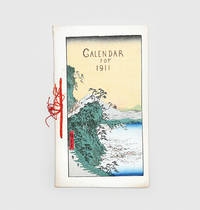
1910191232Tokyo: Shimbi Shoin c.1910. First edition of this vivid calendar illustrated after Hiroshige's landscape prints mostly focusing on boats near the shoreline. One illustration is of Mt Fuji. Shimbi Shoin produced at least 17 calendars for 1911 of which 9 were in book format. Tall duodecimo pp. 6. Colour woodblock illustrations throughout. Original illustrated chirimen crepe paper wrappers original red thread binding front wrapper lettered in brown and decorated with landscape. A fine copy. Ein Illustrierter Katalog über Einzelblätter Gemäde Postkarten Tischkarten und Kalender BC 6. unknown
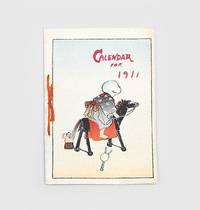
1910191231Tokyo: Shimbi Shoin c.1910. First edition of this brightly illustrated calendar depicting mostly children with their parents or playing. Shimbi Shoin produced at least 17 calendars for 1911 of which 9 were in book format. Duodecimo pp. 8. Colour woodblock illustrations throughout. Original illustrated chirimen crepe paper wrappers original orange thread binding front wrapper lettered in orange and decorated with three women and a child. A fine copy. Ein Illustrierter Katalog über Einzelblätter Gemäde Postkarten Tischkarten und Kalender BC 2. unknown
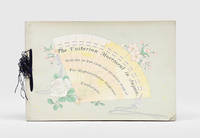
1900178748Tokyo: Japan Unitarian Mission 1900. First edition first printing. This window onto Japan's Westernization in the wake of the Meiji Restoration surveys the mission's history and work as well as its ambitious book distribution program which disseminated 100000 pamphlets in 1899. Landscape octavo. Tissue-guarded half-tone frontispiece illustrations in text. Original illustrated green card wrappers purple thread musubi toji binding front cover lettered in black. Covers a little marked small tear at lower tip of front cover contents clean: very good. unknown
1975102687Kyuryudo Art Publishing 1975 In-4 30,5 x 29 cm. Reliure éditeur pleine toile écrue sous jaquette rempliée, 312 pp., nombreuses illustrations en noir & blanc et en couleurs, sommaire, notes sur l’oeuvre, autobiographie de l’artiste, bibliographie. édition originale. Exemplaire à l’état neuf, N 1199/1500 enrichi d’un envoi autographe et d’un dessin de l’artiste.
20152081502111902118Chinese book office 2015. Soft Cover. Fine. Number of pages: 2018 Size: Hardcover Chinese book office paperback
2018x-9811355363Springer Verlag 2018. Paperback. New. reprint edition. 650 pages. 9.25x6.10x1.38 inches. Springer Verlag paperback
193463317Tokyo Japan: Koku Jidaisha Zidaisha Saiwai-Buil Uchisaiwai-cho Kojimachi Jan. 1934- Oct. 1938 Dec. 1940- Sept. 1941. Thirteen issues. 8vo. 132; 132; 120; 120; 132; 120; 108; 120; 104; 104; 104; 104; 124 pp. plus approx. 150 pp. publisher’s ads. With 100’s of photo illustrations text illustrations diagrams some printed in tinted colour or on colour-tinted glossy sized paper. Colour-illustrated softcovers title in Japanese & English dustsoiling light uniform interior toning some minor chipping to head & foot of spines minor creasing to a few still a VG- set from the library of Otto C. Winzen 1917-1979 pioneering German-American aeronautical engineer was interned during World War II and later significantly advanced material and construction of high-altitude balloons after World War II. First editions of these exceedingly scarce pre-World War II Japanese aviation magazines including articles on uniforms and equipment for aviators both German and U.S. dirigible and Zeppelin aircraft transoceanic Japanese flights in heavier and lighter-than-air aircraft and development of Imperial Japanese fighter planes. Frequent articles are included on aviation in Southern California gliders the development of Boeing passenger and airmail aircraft as well as aerial bombers. The last three issues include articles on Luftwaffe dive bomber and strafing tactics Nazi German and United States aircraft as well as long range Japanese military fighters reconnaissance aircraft and bombers just 3 months before the attack on Pearl Harbor. Worldcat locates 1 set National Diet Library Koku Jidaisha [Zidaisha], Saiwai-Buil, Uchisaiwai-cho, Kojimachi, paperback
19842080502106505879Gakuseisha 1984. Soft Cover. Fine. Number of books: 22 Gakuseisha paperback
19942090502125401137Not Available 1994. Soft Cover. Fine. Volume: 1 Not Available paperback
19250379901925. Original photograph album. Very Good. Oblong string-tied album of black cardstock leaves 11" x 13" photographs mounted on 35pp blanks at the rear. Bound in black flexible boards with an embossed sailing ship and gilt lettering Photo-Album on the cover. Pasted in are 116 albumen and silver gelatin prints ranging from small candids to 8 ½" x 10 ½" group portraits a few fading overall sharp and clean. Laid into the album are a Japanese news article a small head-shot of an older gentleman and a watercolor portrait 10" x 8 ¼" of a man's face. Most of the photographs in this album. circa 1895-1925 were taken in Mie-Ken or "Mie prefecture" part of the Kansai region on the main island of Honshu. The group and individual portraits reflect new social and economic developments and cultural norms that emerged during this period. Subjects are shown in either traditional Japanese garments or in Western dress. Group shots often depict people wearing both styles within the same picture. There are many group shots of schoolchildren of both sexes young people in uniforms posed before buildings with Japanese signs on them as well as many formal group shots of families some "nuclear"-husband wife children- others extended by relatives. Individual shots of young children show them almost invariably in western dress one posed with his tricycle young boys in uniform a young girl in kimono showing a dance move while holding a fan infants in traditional robes and young men in business suits. Several birdseye views feature very large groups of rural people in traditional dress posed outdoors. Among the most striking photographs are: one 8 ½" x 10 ½" showing 11 doctors/ medical students posed around two corpses one smiling happily being dissected on two tables; four women and one man posed around a table doing handwork weaving tatting; men in western dress "strap-holding" inside a streetcar; and 5 actors 2 male 3 female on stage in costume. ~~ The Meiji period 1868-1912 saw the restoration of the Emperor this time with a centralized bureaucracy behind him after years of shogun rule. Japan was under heavy influence from Western political economic and educational models and the country became more capitalist industrial and progressively democratic offering free education to youngsters of both genders. Transportation and communications systems were modernized the feudal lords and samurai lost their power and a powerful national army and navy were created. By the early 1870s the government declared all classes of people to be equal. The Taishu period 1912-26 saw the continued influence of Western culture and values such as efficiency and individualism continued to replace more traditional ones. Japanese participation on the world stage continued to grow as the nation co-founded the League of Nations and emerged on the winning side in WWI. By 1925 there was universal male suffrage in Japan. Corruption in government increased however and the West began to form negative views of this newly-powerful non-white nation exacerbated by Japan's poor treatment of China. <br/><br/> hardcover books
19250379901925. Original photograph album. Very Good. Oblong string-tied album of black cardstock leaves 11†x 13†photographs mounted on 35pp blanks at the rear. Bound in black flexible boards with an embossed sailing ship and gilt lettering Photo-Album on the cover. Pasted in are 116 albumen and silver gelatin prints ranging from small candids to 8 ½†x 10 ½†group portraits a few fading overall sharp and clean. Laid into the album are a Japanese news article a small head-shot of an older gentleman and a watercolor portrait 10" x 8 ¼†of a man’s face. Most of the photographs in this album. circa 1895-1925 were taken in Mie-Ken or “Mie prefecture†part of the Kansai region on the main island of Honshu. The group and individual portraits reflect new social and economic developments and cultural norms that emerged during this period. Subjects are shown in either traditional Japanese garments or in Western dress. Group shots often depict people wearing both styles within the same picture. There are many group shots of schoolchildren of both sexes young people in uniforms posed before buildings with Japanese signs on them as well as many formal group shots of families some “nuclearâ€â€”husband wife children— others extended by relatives. Individual shots of young children show them almost invariably in western dress one posed with his tricycle young boys in uniform a young girl in kimono showing a dance move while holding a fan infants in traditional robes and young men in business suits. Several birdseye views feature very large groups of rural people in traditional dress posed outdoors. Among the most striking photographs are: one 8 ½†x 10 ½†showing 11 doctors/ medical students posed around two corpses one smiling happily being dissected on two tables; four women and one man posed around a table doing handwork weaving tatting; men in western dress “strap-holding†inside a streetcar; and 5 actors 2 male 3 female on stage in costume. ~~ The Meiji period 1868-1912 saw the restoration of the Emperor this time with a centralized bureaucracy behind him after years of shogun rule. Japan was under heavy influence from Western political economic and educational models and the country became more capitalist industrial and progressively democratic offering free education to youngsters of both genders. Transportation and communications systems were modernized the feudal lords and samurai lost their power and a powerful national army and navy were created. By the early 1870s the government declared all classes of people to be equal. The Taishu period 1912-26 saw the continued influence of Western culture and values such as efficiency and individualism continued to replace more traditional ones. Japanese participation on the world stage continued to grow as the nation co-founded the League of Nations and emerged on the winning side in WWI. By 1925 there was universal male suffrage in Japan. Corruption in government increased however and the West began to form negative views of this newly-powerful non-white nation exacerbated by Japan’s poor treatment of China. unknown
1850137006[Suzuki Chuzo, graveur Egawa Sentaro. Kaei (1848-1854)] 1850 23 x 16 cm. Reliure japonaise verte d’origine avec étiquette de titre imprimée en rouge, 30 ff., 58 pages d'illustrations gravées sur bois en noir. Fine impression.