Maurice BLANCHOTBiblio.com

71 309 résultats
194244674Paris: Gallimard 1942. Fine. Gallimard Paris 1942 14 x 20.50 cm relié First edition an advance service de presse copy. Elegant half dark red morocco over marbled paper boards by P. Goy & C. Vilaine spine in six compartments gilt date to foot marbled endpapers and pastedowns covers and spine sunned preserved top edge gilt. Fine and handsome autograph inscription signed from Maurice Blanchot to his brother René and his wife Inge : Un bonze demanda un jour au bonze Sozan Daishi : Qu'est-ce quiest le plus précieux au monde / N'importe quoi une charogne latête d'un chat mort répondit Sosan Daishi. / Pourquoi Parcequ'on ne peut l'évaluer. Zenso Mondo. / Pour René et Inge en toute affection. Maurice. A bonze asked bonze Sozan Daishi one day: What is the most precious thing in the world/ Whatever a rotting carcass the head of a dead cat replied Sosan Daishi./ Why Because it's priceless. Zenso Mondo./ For René and Inge with all love. Maurice. A very good copy perfectly bound with a moving provenance. Gallimard hardcover
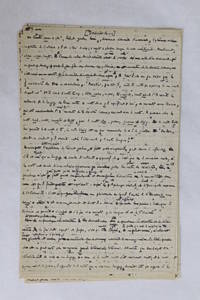
194947141s. l.: S. n. 1949. Fine. S. n. s. l. 1949 13.50 x 21.50 cm Autograph manuscript by the author of 16 pages in-8 published in number 9 June 1946 of Les Temps modernes and reprinted slightly revised in La Part du Feu 1949. Complete recto-verso manuscript very densely written with numerous deletions corrections and additions. Accompanied by the complete typescript with autograph corrections in black ink. ""Le Paradoxe d'Aytré"" ""Aytré's Paradox"" is the first text by Maurice Blanchot that Jean-Paul Sartre published in the pages of Les Temps modernes the spearhead of committed literature. Three others would follow until 1952 ""Le roman uvre de mauvaise foi"" ""The Novel a Work of Bad Faith"" ""A la rencontre de Sade"" ""Meeting Sade"" and ""L'art la littérature et l'expérience originelle"" ""Art Literature and Original Experience"" all of great importance. Continuing his reflection begun several years earlier on the writer's struggle with language and his relationship to silence notably in his article ""Le Mythe d'Oreste"" ""The Myth of Orestes"" Blanchot bases his demonstration here on Aytré qui perd l'habitude ""Aytré Who Loses the Habit"" by Jean Paulhan - a major influence - who notably provides him with the title of his article: ""De ce petit récit il ne résulte pas que la littérature ne doive logiquement commencer qu'avec le crime ou à défaut avec le vol. Mais qu'elle suppose un écroulement une sorte de catastrophe initiale et le vide même que mesurent l'anxiété et le souci c'est ce qu'on peut être tenté de voir. Or remarquons-le cette catastrophe ne s'exerce pas seulement sur le monde les objets qu'on manie . ; elle s'étend aussi et en même temps au langage à la possibilité des mots. C'est là le paradoxe d'Aytré."" ""From this little story it does not follow that literature should logically begin only with crime or failing that with theft. But that it presupposes a collapse a sort of initial catastrophe and the very void that anxiety and worry measure this is what one might be tempted to see. Now let us note this catastrophe is not exercised only on the world the objects we handle .; it extends also and at the same time to language to the possibility of words. This is Aytré's paradox."" And he adds: ""L'écrivain ne débute pas toujours avec le sang d'un fait divers ou l'horreur d'un crime qui lui ferait sentir l'instabilité et le vide du monde mais il ne peut guère songer à commencer autrement que par une certaine incapacité de parler et d'écrire par une perte de mots par l'absence même des moyens dont il surabonde. Ainsi lui est-il indispensable de sentir d'abord qu'il n'a rien à dire."" ""The writer does not always begin with the blood of a news item or the horror of a crime that would make him feel the instability and emptiness of the world but he can hardly think of beginning otherwise than with a certain inability to speak and write with a loss of words with the very absence of the means of which he has abundance. Thus it is essential for him to feel first that he has nothing to say."" Jean Paulhan therefore but also Franz Kafka Herman Melville or Stéphane Mallarmé so many writers admired by Blanchot confronted Aytré's paradox silence the collapse of language. And the critic concludes: "". le silence du langage créateur ce silence qui nous fait parler n'est pas seulement une absence de parle mais une absence tout court cette distance que nous mettons entre les choses et nous et en nous-mêmes et dans les mots et qui fait que le langage le plus plein est aussi le plus poreux le plus transparent le plus nul car il laisse infiniment fuir le creux même qu'il enferme sorte de petit alcarazas du vide."" "". the silence of creative language this silence that makes us speak is not only an absence of speech but an absence pure and simple this distance that we put between things and ourselves and within ourselves and in words and which makes the fullest language also the most S. n. unknown
195144768Paris: Les Editions de Minuit 1951. Fine. Les Editions de Minuit Paris 1951 11.50 x 18.50 cm relié First edition one of 990 copies on Ghaldwill the only deluxe copies after 10 on pur fil. Half blue morocco binding smooth spine gilt date at foot covers with marbled paper blue paper endpapers and pastedowns original wrappers and spine preserved spine slightly sunned with small filled losses top edge gilt binding signed by Goy & Vilaine. Exceptional and moving signed autograph inscription from Maurice Blanchot to his mother and sister: ""Pour vous mes très chères ces pages hélas bien anciennes en toute affection. Maurice. / Mais avant le commencement il y a le recommencement qui fait de la lumière une fascination de toute chose une image et de nous le coeur vide du ressassement éternel"" ""For you my very dear ones these pages alas quite old with all my affection. Maurice. / But before the beginning there is the re-beginning which makes light a fascination everything an image and us the empty heart of eternal rehearsal"". Half-title page bearing the inscription very slightly and marginally shaded. Marguerite Blanchot renowned organist at Chalon cathedral remained all her life in the family home with her mother and aunt. ""She gradually became for the family like the memory of origins."" Very close to Maurice she corresponded regularly with the writer who showed her great gratitude for her devotion to their disabled mother. While Blanchot's intense affection for his mother and sister shows through in his dedications we know almost nothing of their relationships. In the only biographical essay on Blanchot Christophe Bident reveals however: ""Marguerite Blanchot venerated her brother Maurice. Very proud of him . she attached great importance to his political ideas . She read extensively . They telephoned each other corresponded. From a distance they shared the same natural authority the same concern for discretion."" Blanchot indeed sent her numerous works from his library maintaining with her a continuous intellectual bond. As for Blanchot's passion for his mother it is in the course of his work that we discover the most beautiful testimonies: ""Perhaps the power of the maternal figure borrows its brilliance from the very power of fascination and one could say that if the Mother exercises this fascinating attraction it is because appearing when the child lives entirely under the gaze of fascination she concentrates in herself all the powers of enchantment"". Cultivating absolute discretion Blanchot pushed the art of effacement even into his manuscript dedications generally succinct and written almost systematically on cards attached to the rare works he offered to his close friends. In contrast in these precious inscriptions to his mother and sister Blanchot offers himself in all his fragility and reveals a hitherto unknown intimacy. Fine copy perfectly established. Les Editions de Minuit unknown
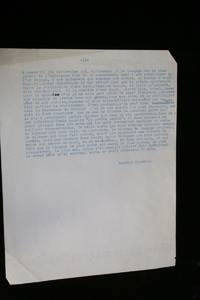
1946483461946. Fine. 1946 13.50 x 21 cm en feuilles HEMINGWAY BLANCHOT Maurice. Autograph manuscript on Hemingway 1946 16 pages 1/2 in-8 135 x 21 cm loose leaves Author's autograph manuscript 16 and a half 8vo pages published in number 17 of L'Arche July 1946 and reprinted with slight modifications in La Part du Feu 1949. Complete manuscript written recto-verso very densely spaced with numerous deletions corrections and additions. In order to examine the problems related to the translation of a literary text into another language Maurice Blanchot looks at the contemporary American novel and its perception in Europe. Many good critics complain about American literature: they find it less than original and of middling interest for a culture that moved over fifty years ago beyond naturalism. They make fun of young writers who think they're being modern by imitating Faulkner Dos Passos or Steinbeck while for Americans themselves these writers are more of yesterday than tomorrow. Thus the critic for whom the oddities of language particular to any literary work survive translation takes the example of a novel by Ernest Hemingway. In For Whom the Bell Tolls Robert Jordan discovering the importance of the moment he is living repeats the word now' in several languages. Maintenant ahora now heute. But he is somewhat disappointed by the mediocrity of this vocabulary and looks for other words. . He tries to find in language links between these words and what they mean for him his meeting with Maria who is also his meeting with his final hour his meeting with death. The word Todt seems to him the most dead of all the word Krieg the one that resembles war most closely. Or is it just that he knew German less well than the other languages This reflection fascinates Blanchot: This impression of Robert Jordan's can give us food for thought. If it's true that a language seems more expressive and more real to us when we know it less if words need a certain ignorance to keep their virtue from being revealed this paradox should hardly surprise us since translators come across it all the time and it represents both one of the principal challenges and one of the foremost riches of all translation. An inspired look at the work of Ernest Hemingway and the problem of translation. unknown
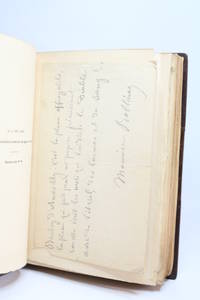
188372680Paris: G. Charpentier 1883. Fine. G. Charpentier Paris 1883 19 x 14 cm relié First edition one of 50 numbered copies on Holland paper the only deluxe copies after ten on Japan and a few on China. With frontispiece portrait of the author engraved by F. Desmoulin. Half brown morocco with corners smooth spine with mosaic heart-shaped havana morocco title and author labels covering a long floral spray in mosaic gilt with inlaid colored morocco petals and leaves head and foot enhanced with five small circles gilt and inlaid with havana morocco gilt fillet on covers marbled paper endpapers and pastedowns original wrappers preserved top edge gilt retaining deckled edges. Binding signed by Canape. Our copy is enhanced with an autograph quatrain mounted on a stub: ""Barbey d'Aurevilly: c'est la plume effroyable la plume qui fait peur au papier frémissant. Car elle écrit les mots que lui dicte le Diable avec du Vitriol des larmes et du sang!"" ""Barbey d'Aurevilly: it is the dreadful pen the pen that frightens the trembling paper. For it writes the words dictated by the Devil with Vitriol tears and blood!"". The note mirrors a remark by Barbey d'Aurevilly his friend who also called him a devil but a ""Devil of steel"". G. Charpentier unknown
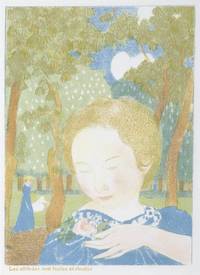
18952731<p>1895. Original lithograph printed in colors from the set AMOUR . P. Cailler 109. 15 1/4 x 11 margins 21 x 16. Deckled edge. In fine condition with full margins. signed in the plate. Prov:Candillier</p> Amboise Vollard
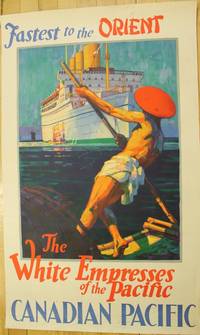
1819P4781Montreal: Canadian Pacific c.1918-1930. Very Good. Notes: The White Empress fleet were the Empress of Britain Empress of Asia Empress of Russia Empress of Canada Empress of Australia or the Empress of Japan.<br>Maurice Logan was a prominent commercial artist working out of Northern California. He was also a fine artist and in 1917 joined five other California painters to form the "Society of Six" a group of artists whose work was categorised first and foremost by bold colours. Logan designed one other poster for the Canadian Pacific but was primarily employed by the American Railway companies. Image Size : Platemark Size : Paper Size : 940x565 mm 37.01x22.24 Inches Coloring: Printed in Color Medium: Lithograph Categories: Posters; Transportation Ships; Canadian Pacific unknown
182972No place: No Publisher No date. Hardcover. VG_ one tie missing. Greem portfolio with cloth ties white paper label affixed to front c0over with lettering typical of 1930s. 29 illustrations printed on fine rag paper. A conundrum this book is. No text no writing of any sort. 29 unnumbered sheets of original prints. Based on the plate impression one of the 29 images appears to be an etching rather than a lithograph. Quite rare no sales or data found. No Publisher hardcover books
1926140498Beverly Hills CA: Metro-Goldwyn-Mayer MGM 1926. Draft script for the 1927 Silent film. <br/><br/>Based on the 1913 yellow peril play by Henry Maurice Vernon and Harold Owen and previously adapted for the screen in 1919 directed by Maurice Elvey and starring Matheson Lang. Lon Chaney in full yellowface murders his daughter after discovering she loves the son of a British diplomat then seeks revenge on son and his the entire family. <br/><br/>Anna May Wong who has a small role in the film was originally considered for the role of the daughter but censorship of mixed race relationships on the screen caused the role going to a white actress a sadly all-too-familiar story in her career. Wong would leave Hollywood for Europe the following year after once again being denied the lead role in a film because of her race this time in "The Crimson City."<br/><br/>Tan titled wrappers rubber-stamped copy No. 543 and production No. 1589 dated Nov. 13 1926 with credits for story writer Louise Jordan Miln and screenwriter Lorna Moon. Title page integral with the first page of the text dated October 20 1926 with credits for screenwriter Moon and story writer Miln. 102 leaves with last page of text numbered 96. Ditto style mimeograph duplication. Pages Near Fine wrapper Very Good bound with two gold brads. Metro-Goldwyn-Mayer [MGM] unknown books
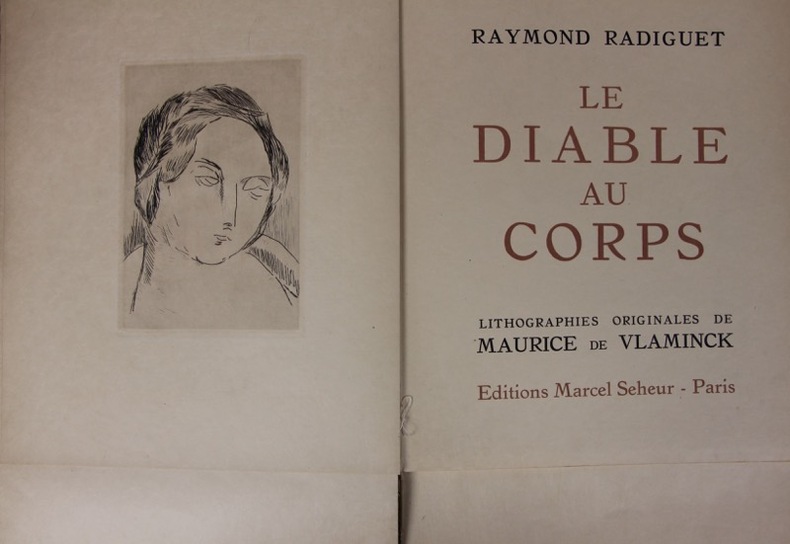
1926RADIGUET005033Marcel Seheur Paris. 1926. First edition thus: illustrated by Maurice de Vlaminck with a frontispiece etching and ten black and white lithographs of which three are full-page and seven in the text. Folio. Original wrappers. Publisher's prospectus laid in.Out of a total edition of 345 copies this is one of twenty hors commerce and ad personam copies the recipient's printed name being Lucien Boucher printed on japon with a suite of the ten illustrations on chine bound in at the end and with a separate portfolio containing them printed on japon. Also included is yet another suite with seven of the lithographs on chine and three on japon. Lucien Boucher was an engraver and poster artist who illustrated at least four books for Marcel Seheur in the twenties.Fine in custom-made leatherette chemise and slipcase. Marcel Seheur, Paris. hardcover
166716335A La Haye; A Brusselles, Chez Jean Rammazeyn; chez l'auteur & aussi chez François Foppens, 1667. In-folio de [34]-484 (chiffrée 496)-[12] pages, plein en veau marron du temps, dos orné de filets et fleurons dorés, supra-libros "G. Gomer van Berckmans 1667" au premier plat, et au second la devise "Desir · Romp · Repos".
2000C102367Somogy. As New. 2000. Hardcover. 2850564311 . FREE UPGRADE to Courier/Priority Shipping Upon Request - IN STOCK AND IMMEDIATELY AVAILABLE FOR SHIPMENT - Flawless copy brand new pristine never opened -- Text in French. 240 pages; illustrated in color. -- with a bonus offer-- - May be EITHER: out of print OOP and extremely rare in this pristine condition; signed by author or contributor; or a first or special edition; inquire for details . Somogy hardcover
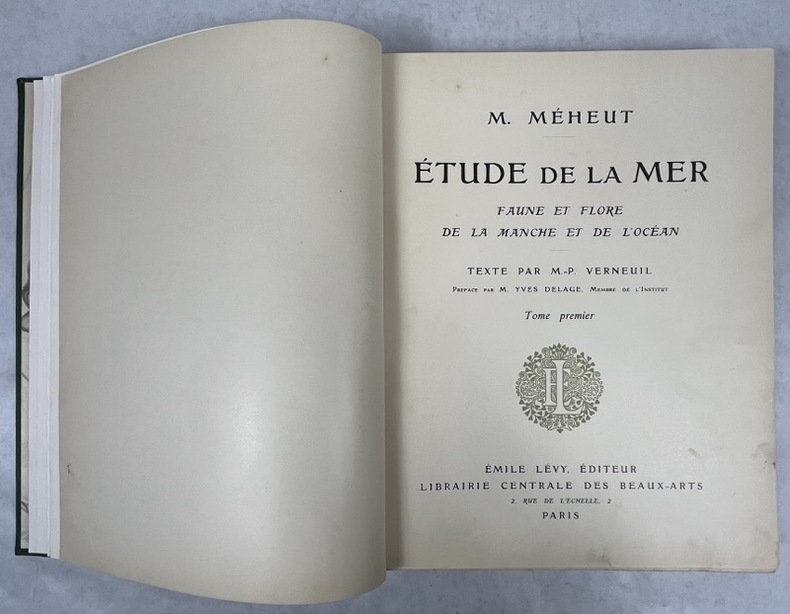
1924136578émile Lévy, impr. G. Kadar, imprimeur, Paris 1924 2 volumes. In-folio 36 x 27,5 cm. 207- pp., 22-29 planches en couleurs montées sur onglets, 240-314 dessins dans et hors-texte, table des matières. Intérieur frais, bien complet des planches.
200891222Institute. New. 2008. Hardcover. FREE UPGRADE to Courier/Priority Shipping Upon Request - IN STOCK AND IMMEDIATELY AVAILABLE FOR SHIPMENT - Flawless copy brand new pristine never opened -- Text in French and English. 600 pages with approximately 500 illustrations most in color. Catalogue Raisonné Catalogue Raisonne Catalog Raisonnee Complete Works -- with a bonus offer . Institute hardcover
1926133873Marcel Seheur 1926 In-folio broché sous jaquette rempliée. Non rogné. Une eau-forte et 10 lithographies originales en noir dont 3 à pleine page et 7 dans le texte, ainsi qu'une lettrine et un fleuron imprimés en rose. Petit manque au dos.
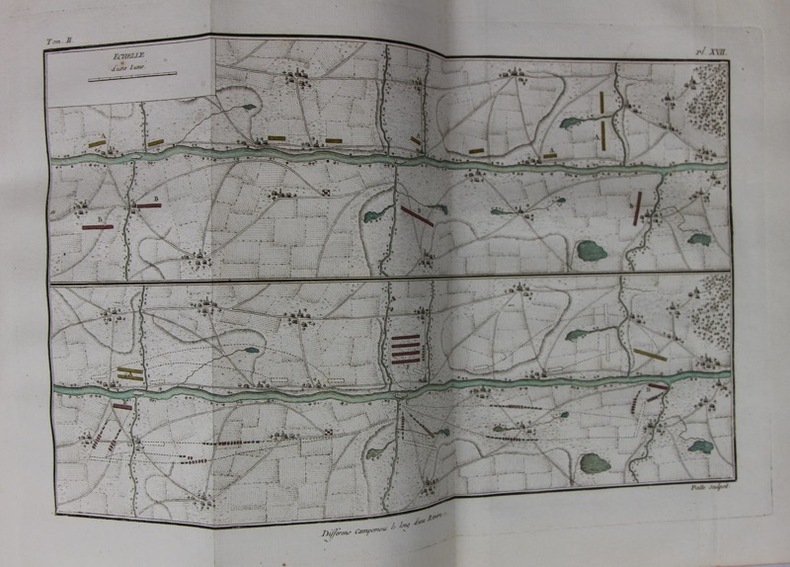
1757104163Amsterdam et Leipzig, Arkstée & Merkus 1757 2 volumes in-4 reliés en plein veau fauve de l'époque, aux plats ornés d'un triple filet d'encadrement doré, dos à nerfs ornés de motifs floraux, pièces de titre et de tomaison, double filet doré sur les coupes, tranches rouge - coiffes arasées, début de fente en queue du premier plat du T I, mors épidermurés, frottements aux plats, coins percés - T. 1 : [5 ff.], CXXXIV pp., 159 pp.; T. 2 : [2 ff.], 259 pp. Ouvrage illustré de 84 planches hors-texte 61 dépliantes, dessinées par Pierre Patte d'après l'auteur et gravées sur cuivre par Moitte, Tardieu et Patte lui-même, finement mises en couleurs sauf 4, représentant des costumes militaires et des plans de bataille.
1928119485P., chez l'Artiste, 1928, in-4°, 48 eaux-fortes originales de P.-A. Bouroux, dont une vignette de titre, 12 hors texte et 35 dans le texte, reliure plein maroquin bleu-nuit, dos à 5 nerfs soulignés à froid, titres dorés, date dorée en queue, tranches dorées, décors d'encradements de maroquin mosaïqué sur les contreplats, gardes de soie bleu-nuit et doubles gardes de papier fantaisie, coupes filetées, couv. et dos conservés, sous emboîtage (lég. frotté) de papier fantaisie ourlé de maroquin bleu-nuit (reliure de l'époque signée Vermorel), bel exemplaire. Exemplaire nominatif : un des 175 ex. sur vélin de Rives enrichi du prospectus de souscription de l'ouvrage, de trois lettres manuscrites de P.-A. Bouroux, de 4 planches d'état et d'une planche originale sur Japon signée
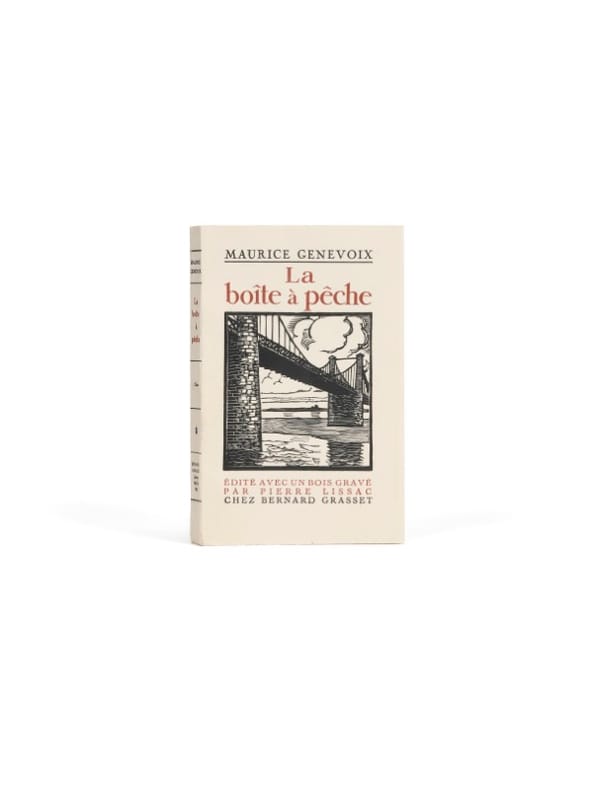
192630977Exemplaire sur chine : celui de l'auteur Paris, Grasset, (18 octobre) 1926. 1 vol. (125 x 185 mm) de 272 p. et [2] f. Broché, sous emboîtage (Devauchelle). Édition originale. Couverture illustrée d'un bois gravé de Pierre Lissac. Un des 11 premiers exemplaires sur chine. Exemplaire de passe, non numéroté, pour Maurice Genevoix.
30977Paris Grasset 18 octobre 1926. 1 vol. 125 x 185 mm de 272 p. et 2 f. Broché sous emboîtage Devauchelle. . Édition originale. Couverture illustrée d'un bois gravé de Pierre Lissac. Un des 11 premiers exemplaires sur chine. Exemplaire de passe non numéroté pour Maurice Genevoix. . Un an après Raboliot Goncourt 1925 c'est vers la Loire à la suite de la Sologne que se tourne Genevoix. Il est revenu vivre après 1919 à Châteauneuf-sur-Loire près des lieux pour lesquels il avait déjà donné quatre plus tôt un merveilleux Rémi des Rauches qui mettait déjà en scène avec bonheur le fleuve-roi par la grâce d'un tonnelier offrant au lecteur de magnifiques descriptions qui sont autant d'invitations au voyage. La Loire était même le dédicataire de son roman c'est dire. La Boîte à pêche est de prime abord une évocation quasi ethnographique des diverses formes de pêche et du plaisir qu'elles procurent : un roman « du terroir » que le milieu intellectuel parisien a taxé de « régionaliste » avec ses oeillères habituelles ; pour sa part Genevoix le justifie par la nécessité de conjurer le souvenir de la barbarie de la première guerre toujours vive ainsi qu'il l'exprime dans son avant-propos en hommage au maître à pêcher Najard et aux camarades de collège et de pêche Bailleul et Jeanneret. C'est à la faveur du succès de Raboliot Rémi des Rauches et La Boîte à pêche - trois textes imprégnés d'un vocabulaire d'une exceptionnelle richesse sensorielle que Genevoix pourra en 1927 acquérir la maison des Vernelles à Saint-Denis-de-l'Hôtel. Il y aménagera un bureau face à la Loire et y écrira une grande partie de son oeuvre à venir. Précieux exemplaire de tête qui provient de la bibliothèque de l'auteur aux « Vernelles » avec ex-libris. Paris, Grasset, (18 octobre) 1926. 1 vol. (125 x 185 mm) de 272 p. et [2] f. Broché, sous emboîtage (Devauchelle). unknown
188922838London, Sampson Low, Marston, Searle and Rivington, 1889 ; Edinburgh and London Ballantyne Press ; "This Imperial 8° Edition de luxe, with Mounted Plates and Text Illustrations on India Paper", tirage limité à 100 exemplaires numérotés et signés de la main de Frédéric Alford. Plein maroquin vert sapin, dos rond à cinq nerfs, 2 pièces de titre et auteur renouvelés, filet doré d'encadrement des plats, double filet doré sur les coupes, dentelle dorée d'intérieur, tête dorée sur témoins, non rogné (reliure de l'époque). 26 planches hors-texte par Kemp et Moul lithographiées par Leighton Brothers, dont le frontispice, sont collées sur des feuilles de bristol montées sur onglets, parmi lesquelles 5 sont en couleurs : 3 aquarellées à la main et 2 en chromolithographie, toutes protégées par des serpentes en papier de soie ; 13 figures imprimées sur papier collé de chine dans le texte.
195041171Sous étui et chemise cartonnés. Sous couverture rempliée illustrée. Avec 11 sur 12 gouaches hors texte de Maurice UTRILLOsuperbement reproduites par Daniel Jacomet,1 planche de Max Jacob, 1 planche d'E. Heuzé, 1 planche de Chas Laborde, 1 de Pascin, 3 portraits et 3 fac-similés de lettres, dessins de Lucie Valore dans le texte. Il manque la planche Youki, nu par Pascin. Trace de colle sur les contours de certaines planches.
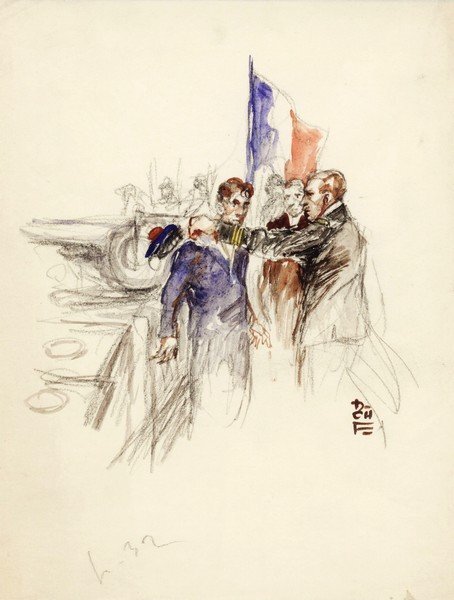
1180Paris : René Kieffer, 1928. AQUARELLES ORIGINALES RÉALISÉES « AVEC LES SEULS MOYENS DU BORD », EXEMPLAIRE DE LA BIBLIOTHÈQUE PERSONNELLE DE RENÉ KIEFFER
190878556Sous étui bordé. Reliure plein maroquin havane. Plats entièrement ornés d'une riche composition mosaïquée en maroquin noir de spirales, volutes, placettes, listels et grecque dans le goût de l'antique. Dos à nerfs orné de même. Doublures de maroquin olive décorées d'un encadrement de spirales dorées, gardes de soie tissée brique, doubles gardes de papier marbré. toutes tranches dorées. Couverture et dos conservés. Reliure signée CANAPE. Illustré de cadres et ornements typographiques et de 30 superbes eaux-fortes d'après Maurice RAY gravées par Louis Muller. Dos très légèrement éclairci.
192518931925 Edition "Le Livre", Paris, 1925-1927. 2 volumes brochés, couvertures illustrées rempliées.212 pages, 14 aquarelles dont couverture et frontispice pour le premier volume. Le second volume comprend une préface de Gérard d'Houville (Marie de Hérédia) de 10 pages, 61 planches de 7 décors dépliants, et 54 de costumes. Les illustrations sont reproduites au pochoir, par Jacques Saudé, "maître enlumineur"
18890035411889 Paris, Vanier, 1889. In-8 (151 X 199 mm) maroquin havane, dos cinq nerfs, auteur et titre dorés, date en queue, coiffes et coupes filetées, bordure intérieure ornée de roulettes et filets dorés, plats et dos de la couverture conservés, tranches dorées sur témoins, étui (Huser); (1) f. blanc, frontispice, 97 pages, (1) f. d’achevé d’imprimer, (1) f. blanc. Infimes traces de frottements sur les plats.