DELVAUX NADEAU Maurice.Livre Rare Book

71 307 résultats
7121 En feuillets, sous chemise et étui en toile fuchsia de l'éditeur. 39,5 x 30 cm, 112-[8] p. Paris, Denoël, 1967. Edition originale
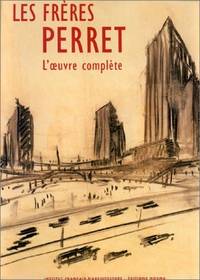
200086687Institut Francais D' Architecture - Ediitons Norma. New. 2000. Hardcover. 290928333X . FREE UPGRADE to Courier/Priority Shipping Upon Request - IN STOCK AND IMMEDIATELY AVAILABLE FOR SHIPMENT - Flawless copy brand new pristine never opened -- 512 pages with many illustrations in color and in black and white. Catalogue Raisonné Catalogue Raisonne Catalog Raisonnee Complete Works uvre Oeuvre Institut Francais D' Architecture - Ediitons Norma hardcover
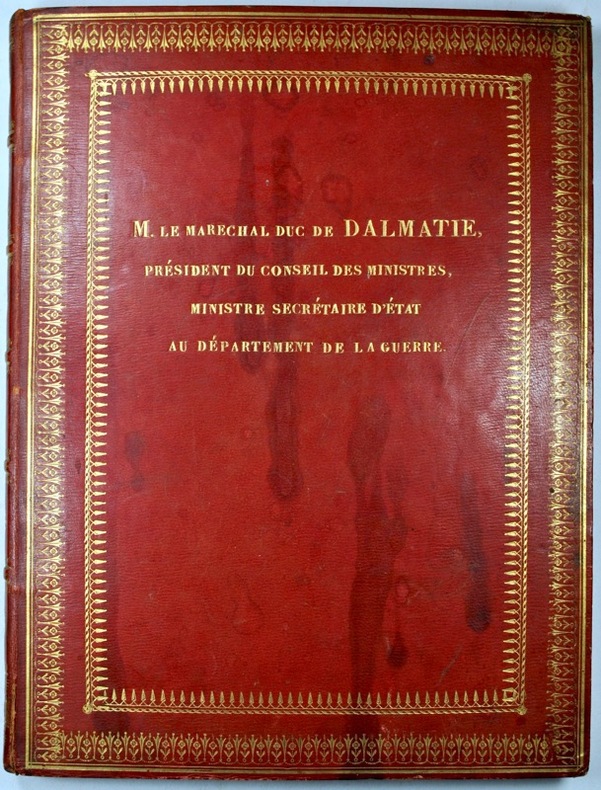
183241019Paris, Imprimerie royale, 1832. 2 parties en 1 vol. in-4 de (2)-III-87-(84) pp., maroquin rouge à grains longs, dos orné à nerfs, frises, filets et roulettes dorées en encadrement sur les plats, inscription dorée sur le plat supérieur, tranches dorées, gardes de tabis bleu (reliure de l'époque).
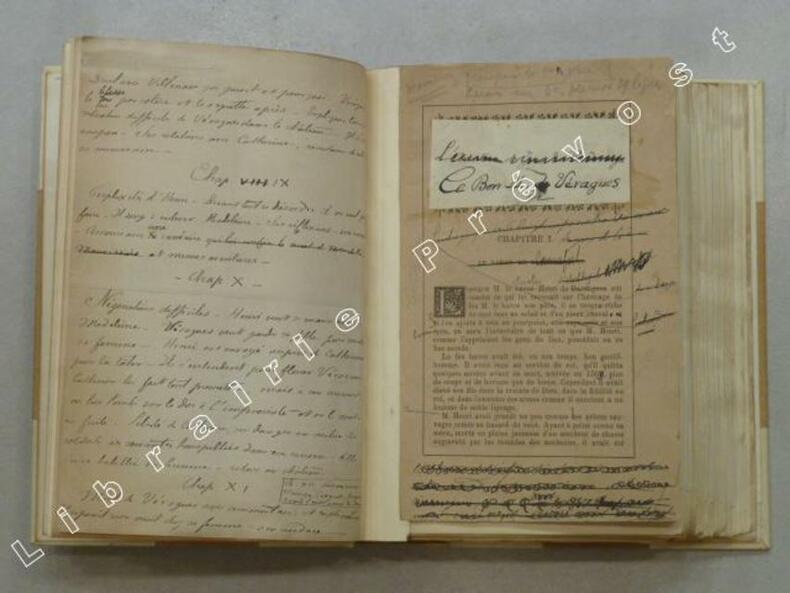
191172051911 1911 (1911). 1 volume in-8, demi-vélin à coins à la Bradel, chemise fatiguée et étui. Reliure signée Stroobants. [4] ff. ; 163 ff. imprimé au recto. ; [1] f.
194244674Gallimard | Paris 1942 | 14 x 20.50 cm | relié
194947141S. n. | s. l. 1949 | 13.50 x 21.50 cm
195144768Les Editions de Minuit | Paris 1951 | 11.50 x 18.50 cm | relié
1946483461946 | 13.50 x 21 cm | en feuilles
188372680G. Charpentier | Paris 1883 | 19 x 14 cm | relié
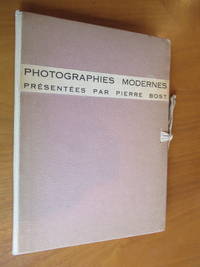
1927036748Paris: Librairie Des Arts Decoratifs 1927. First Edition . Hardcover. Very Good . 235 x 175 Mm. 12 24. Plates are 225 x 165 mm. Introductory text in French folded sheets with 24 loose plates in a paper-covered salmon chemise with off-white paper label white cloth spine and cloth ties spine and ties a little aged. Light wear at corners tiny area of bumping to upper tips interior paper of spine is split but exterior is sound; plates are immaculate and undamaged. No names or marks. Scarce. <br/> <br/> Librairie Des Arts Decoratifs hardcover
19537421New York: Ace Books Inc 1953. First Edition. Burroughs's first book a semi-autobiographical field report from the seedy underbelly of post-war America chronicling his experiences using and selling drugs and vacillating between addiction and recovery. A cornerstone work of the Beat Generation and a high-point of drug literature always plentiful in the marketplace but less so in anything approaching collector's condition. Maynard & Miles A1a. First Printing a paperback original novel bound together with Maurice Helbrant's Narcotic Agent. Octavo 16.25cm; original pictorial card wrappers; dark yellow edge-staining; 45-1492; 169pp. Subtle tanning to text edges light wear to extremities with a few faint stress creases to wrappers; a bright Near Fine copy. Ace Books, Inc unknown
First edition, 3 vols., comprising 2 volumes of text, 8vo (202 x 125 mm) xv, 423, [3]; 348, [2], with final errata leaf to each volume, wanting the half-titles, plus 4to atlas volume (305 x 220 mm), title, 1 leaf description of the plates and maps, 18 mostly large folding engraved maps and plates, all very clean and bright, text volumes in contemporary speckled calf, double gilt fillet to covers, spine gilt, Marchioness of Downshire monogram with crown above in top compartment of each volume, minor rubbing, otherwise attractively bound text volumes in near fine condition, the atlas in the original blue paper covered boards with original printed title label on upper cover, also in fine clean condition. Rare account of a voyage to the East Indies and a description of French possessions in the Indian Ocean (Mauritius and Reunion) and of Java including Batavia, now Jakarta, which was then ruled by France. The atlas volume contains 7 maps all engraved by Tardieu and it includes a fine large map of Java (380 x 630 mm). The 11 other plates show costumes, native inhabitants etc. and include 3 fine folding views of Batavia and a view of the Dutch settlement of Keppen on the island of Timor. Volume 2 includes a substantial vocabulary of the Malay language. Provenance: Mary Hill (n?e Sandys, 1764-1836), Marchioness of Downshire and Baroness Sandys; the library of the Second Baron Hesketh of Ombersley Court, Worcestershire.
19871210241987. Signed. STOCKTON Frank SENDAK Maurice. Original drawing inscribed. No place 1987. One sheet originally a half title from a book measuring 8 by 7-1/2 inches; handsomely framed with the title page from the book entire piece measures 11 by 19-1/2 inches. $3200.Wonderful original drawing by Maurice Sendak of the Bee-Man of Orn inscribed ""For Eric and Kim from Maurice with all his loveMay 87.""Frank Stockton's story was first published in 1887; the edition with Sendak's illustrations was first published in 1964. This original drawing is on the half title of a copy of the book; it is framed together with the title page from the same book. The drawing depicts a smiling Bee-Man with hands on hips six bees at his head. Fine condition. unknown
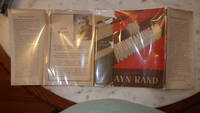
19437376Bobbs-Merrill 1943. HBDJ stated 1st edition 2nd printing with picture of Ayn Rand on back DJ with 3 book Reviews 1943 VG / GOOD- AS-IS Green Cloth On the front pastedown are written in ink the words "Bryant Memorial Library. Gift Of . donated" There is a faint mark on the rear pastedown possibly caused by removal of tape. The HBDJ stated 1st edition1943surface of the pastedown is intact but has a sheen to it. Corners and spine bumped. Dust jacket chipped and torn & has several pieces missing mainly in Spine Area tho it doesnt affect Title or author Name AT TOP DJ Spine. Has Rare non-clipped Dust Jacket with the original $3.00 price This is the true First Edition 2nd in the correct larger latter jacket with 1/2 inch of space below the authors name on the front panel of DJSpine DJ slightly sunned Book tight and sound. Internally clean 754 pgs Back DJ light fox Wear Edge TEars & small Chips Small Mended Tear Across part Front DJ Top Edge Area. First Edition. Hard Cover. Bobbs-Merrill hardcover
195291976Pierre Cailler. As New. 1952. Paperback. FREE UPGRADE to Courier/Priority Shipping Upon Request - IN STOCK AND IMMEDIATELY AVAILABLE FOR SHIPMENT - AS NEW THE TEXT BLOCK IS PRISTINE CLEAN UNMARKED AND IN EXCELLENT CONDITION - - - Text in French. 338 pages. Catalogue Raisonne Catalog Raisonné Complete Works La Vie et L'uvre Oeuvre Raisonnee Pierre Cailler paperback
198691556Clarkson Potter. New. 1986. Hardcover. 051756341X . FREE UPGRADE to Courier/Priority Shipping Upon Request - IN STOCK AND IMMEDIATELY AVAILABLE FOR SHIPMENT - Flawless copy brand new pristine never opened -- 682 pages. Catalogue Raisonne Catalog Raisonné Complete Works Life and Work Raisonnee -- with a bonus offer . Clarkson Potter hardcover
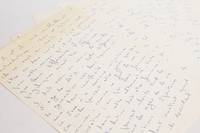
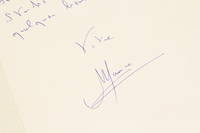
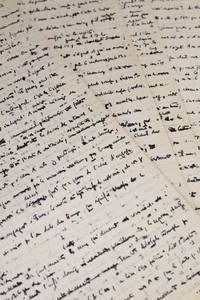
1991654561991. Fine. s. d. ca 1991 21 x 29.70 cm 10 feuillets Handwritten manuscript signed by the choreographer Maurice Béjart. 10 leaves written in blue pen. Handwritten pagination. Maurice Béjart's handwritten proofs for his book Béjart-theâtre: A-6-Roc éditions Plume 1992 about his play A-6-Roc first performed in the same year at the Vidy theatre in Lausanne. After the foundation of Béjart Ballet Lausanne and his definitive departure from Belgium in 1987 Béjart continues to stage operas produce films and publish several books novel memories personal diary. In addition he wrote and directed his third play A-6-Roc performed in Lausanne in 1992 which he published with commentaries in a book entitled Béjart-theâtre: A-6-Roc. The play features seven characters in search of a lost paradise and calls for a deep reflection on the choreographer's memory and childhood. Béjart takes the leading role and gives the lines to Gil Roman his favourite dancer during the period in Lausanne who will succeed him as the head of his company in 2007. A-6-Roc was probably Béjart's favourite play and it will be the only one that he will agree to publish. Largely inspired by Jean Anouilh's theatre and even more so by that of Eugène Ionesco the play makes use of his childhood in the South of France. This manuscript which provides valuable information on the staging and scenery was published with the original play in 1992. The present the past and the future come together in this play through three characters a patriarchal figure played by Béjart himself another embodying youth played by Gil Roman 6 must be at least twice the age of Mr A. This generational difference creates their tension and also their bond. and a clown called Roc played by the actor Phillipe Olza. The influence of the theatre of the absurd is easily detected here as much in the scenery choices as in the psychology of the characters: the play's first scene that can last from 3 to 6 or 7 minutes is nothing but mechanical movement of the body . conjuring up the useless and empty activity of the world of concentration camps. The playwright Béjart nevertheless remains faithful to the spectacle total idea for which he was well known as a choreographer. The play is inundated with dance and movement particularly in the theatre choir four characters I should say since nothing pleases me less than the uniformity of the Greek pseudo-choirs and other aestheticizing corps de ballet and Béjart devotes the last four leaves to the music it plays right through the play like dolphins following a boat ranging from Nino Rota to the syrupy music of Jackie Gleason. Beyond the theatre Béjart wanted with A-6-ROC to create a complete work of art including all performance genres and in this manuscript he demonstrates his talent as a playwright and a producer. Invaluable manuscript on the last play that Béjart wrote produced and performed. It features amongst the choreographer's very rare privately owned documents his archives being shared between his house in Brussels the Béjart foundation in Lausanne and the Théâtre Royal de la Monnaie. Provenance: Maurice Béjart's personal archives. unknown
1991653911991. Fine. Let us never forget the glory of human nature. We are the greatest Gods Christs and Buddhas are but waves on the boundless ocean that I am s. d. ca 1991 21 x 29.70 cm 9 feuillets Handwritten manuscript signed by the choreographer Maurice Béjart sent to his publisher with a handwritten letter on two leaves. 9 leaves 145 lines written in blue pen. Hand-pagination of the manuscript 1-7 and the letter to his publisher a-b. Maurice Béjart's handwritten reflections entitled Mémoire Memoirs make up the last chapter of his work Béjart-theâtre: A-6-ROC Editions Plume 1992 regarding his eponymous play that was created the same year in Lausanne. After the foundation of Béjart Ballet Lausanne and his definitive departure from Belgium in 1987 Béjart continues to stage operas produce films and publish several books novel memories personal diary. In addition he writes and stages three plays: La Reine Verte Casta Diva and finally A-6-ROC to which dedicates a book. The play features seven characters in search of a lost paradise and calls for a deep reflection on memory . The last chapter of his book on A-6-ROC the manuscript of which we have here is a mixture of philosophical thought and commentaries on the play: The first idea for the scenery for A-6-Roc was an enormous library . where the two characters in a drama called life no-longer know if the words they say are theirs or those of the generations who preceded them in this prison of knowledge. Implicitly the author-choreographer maintains that the memory although salutary for Man harms the creative faculties. A series of questions on Me where one can detect Montaigne's influence follows: I am a series of moments of looks of emotions of expectations. I am the fruit that I eat the air that I breath the cat that I stroke the book that I read the look that I remember. Provenance: Maurice Béjarts personal archives. unknown
1946483451946. Fine. 1946 20.90 x 13.70 cm en feuilles Autograph manuscript by the author of sixteen and a half pages in-8vo published in issue 20 October 1946 of L'Arche and reprinted slightly revised in La Part du Feu 1949. Complete recto-verso manuscript in very dense handwriting with numerous deletions corrections and additions. Benjamin Constant's Adolphe who was one of the prestigious contributors to the Journal des débats during its golden age interests Maurice Blanchot at the very moment when he begins a passionate relationship with Denise Rollin former mistress of Georges Bataille. Moreover ""Adolphe ou le malheur des sentiments vrais"" is one of Blanchot's rare texts thus devoted to amorous desire: ""On trouve presque à chaque page dans Adolphe la description des sentiments dont la cause a beau se renverser tout les renvoie à eux-mêmes tout en confirme la fatalité. C'est que le point est atteint où la diversité des évènements et tout l'infini du monde répètent inlassablement le mouvement en cercle dans lequel s'est enfermé le cur avide de vérité."" ""One finds on almost every page in Adolphe the description of feelings whose cause may well be reversed everything sends them back to themselves everything confirms their fatality. This is because the point is reached where the diversity of events and all the infinity of the world tirelessly repeat the circular movement in which the heart avid for truth has enclosed itself."" To support his analysis Blanchot chooses to compare Constant's approach to that of other writers particularly to that of Proust in the Recherche: "". Proust ne désire pas cette absence comme le mouvement de toute communication ainsi que le fait Constant : il ne la désire même pas mais c'est elle qui lui rend un être désirable en le faisant souffrir de ne pouvoir l'atteindre. . Proust aime parce qu'il souffre et il souffre de sentir tout ce qu'il y a d'absence dans une présence toujours fuyante ; mais c'est aussi à cause de cette absence que cette présence fonde des rapports véritables. Constant commence à aimer lorsqu'un être particulier éclaire aimante tout le vide qui le sépare des autres et que la possession est loin de restituer sous la forme de l'inconnu. Dès que par un engagement trop exigeant la possibilité de ses relations avec tous qu'il a voulu vivre avec une personne unique est épuisée il étouffe il succombe. Il a besoin d'être libre mais il est toujours lié."" ""Proust does not desire this absence as the movement of all communication as Constant does: he does not even desire it but it is this absence that makes a being desirable to him by making him suffer from not being able to reach it. . Proust loves because he suffers and he suffers from feeling all the absence there is in a presence that is always fleeting; but it is also because of this absence that this presence establishes true relationships. Constant begins to love when a particular being illuminates magnetizes all the void that separates him from others and which possession is far from restoring in the form of the unknown. As soon as through too demanding an engagement the possibility of his relationships with all that he wanted to live with a single person is exhausted he suffocates he succumbs. He needs to be free but he is always bound."" Blanchot's biographer will see in this conception of Adolphe the reflection of his own feelings toward Denise Rollin BIDENT Christophe Maurice Blanchot : partenaire invisible p. 275. Handsome study on passion and desire through the work of Benjamin Constant. unknown
1943483281943. Fine. 1943 21 x 13 cm en feuilles Autograph manuscript by the author four and a half pages in octavo published in the issue of Journal des Débats dated 12 May 1943. Complete recto-verso manuscript in a dense hand featuring numerous deletions corrections and additions. A literary column written on the occasion of the publication of Ramon Fernandezs book À la gloire de Proust. It was to Maurice Blanchot that his friend Emmanuel Levinas owed his discovery of the work of Marcel Proust which he deeply admired despite Charles Maurrass condemnationa judgment that at first failed to turn him away from it. What Blanchot valued most in Proust was his at times fluid rhythm and his remarkable sense of the scene. Placing him within his literary pantheon alongside the Marquis de Sade and Franz Kafka Blanchot was drawn in the early 1940s to the very nature of the experience Proust conveyed in his novels: « L'uvre de Proust est sortie d'états mystérieux qui semblent ne lui avoir été proposés que pour que cette uvre fût écrite. Ils ont servi de stimulant à une extraordinaire avidité de connaître et eux qui étaient d'abord une rupture de connaissance ont fourni un aliment inépuisable à la connaissance littéraire. Cependant ce n'est pas l'aspect le moins surprenant du Temps perdu que dans le flot d'images d'événements de théories de figures dont ils ont été par abus la source ces états aient gardé la valeur d'un secret en continuant selon le pouvoir qui leur était propre à paraître toujours plus mystérieux que l'uvre elle-même pourtant toute chargée de mystères. C'est en cela que Proust n'a pas trahi la révélation qu'il a rencontrée et dont il a offert l'image à la plus étendue et la plus admirable comme pour montrer qu'elle ne l'épuisait pas. » The text later revised would become part of the opening section of Faux Pas 1943 devoted to what Blanchot regarded as the fundamental question of inner experience. A very clean manuscript reflecting Blanchots clarity of thought on Proust. unknown
194648355s. l.: S. n. 1946. Fine. S. n. s. l. S.d 1946 - en feuilles Complete autograph manuscript of 12 pages on 6 octavo leaves with a title difficult to decipher perhaps: ""Sade or the Kingdoms of the Unique"" and which would appear under the title ""Some Remarks on Sade"" in Critique no. 3-4 of August-September 1946. Manuscript with very dense writing containing numerous deletions corrections and additions. ""It is Sade's thought that pushes Blanchot's to its fulfillment and it is also Blanchot's that fulfills that of Sade."" Georges Bataille Bataille's writing and friendship are undoubtedly not unrelated to the importance that Blanchot would attach throughout his life to this tutelary figure of his philosophical reflection. These Some Remarks on Sade are nonetheless the first study that Blanchot devoted to this writer whom he had until then almost never mentioned. In this first impartial and sometimes severe analysis Blanchot emphasizes the weaknesses of Sade's literary posture and his relative immorality within a post-revolutionary society shaped by ideological contradictions. However beneath the artifice of extreme expression Blanchot reveals a philosophy far more disconcerting and subversive than these ""great extravagances"". With singular acuity he draws the portrait of a unique mind embracing all the great ideals of his time but inflicting upon them the filter of his nihilistic singularity: ""Freedom in his eyes is nothing but the prohibition made to any person from being anything other than what he wants that is to say nothing."" Under Blanchot's pen Sadism is then no longer the enjoyment of violence inflicted on others but the expression of ""the infinite solitude of the individual"" in a world ""where the relationships between beings the general forms of life and even language everything is already consumed in universal destruction""; ""and henceforth all particular cruelties are no longer destined . except to bring to the Unique the pleasant proofs of his existence in the midst of nothing."" If as Bataille emphasizes more than a fresh perspective Blanchot's reading of Sade reveals a community of thought it is undoubtedly through the conclusion of this first major study that Blanchot the solitary most clearly testifies to his attachment to Sade the Unique: ""And then one comes to think: if circumstances made Sade a man forever reduced to the misery of an eternal prison he himself knew how to make his prison the image of the solitude of the universe over which reigns his sole glory forever all-powerful. This prison does not hinder him it is his work it is commensurate with the world over which he has more rights than God himself for not only does he reign there as master but he has banished and excluded all creatures from it. Such is the advantage of the Destroyer over the Creator. This atheist is more God than God. Thus he is called divine."" S. n. unknown
194144721Paris: Gallimard 1941. Fine. Gallimard Paris 1941 14 x 20.50 cm broché First edition an advance service de presse copy. Handsome fine autograph inscription from Maurice Blanchot to Gaston Gallimard on ffep: ""On ne s'arrête plus aux tables des heureux puisqu'on est mort. Charles Cros / A Gaston Gallimard ce livre destiné à écarter tout lecteur One doesn’t stop any more at the table of the joyous for one is dead. Charles Cros / To Gaston Gallimard this book destined to drive away every reader."" Two repaired tears to head of spine slightly sunned one tiny scratch to head of upper cover paper yellowed at edges of some pages as usual ffep repaired with small lack at foot. Gallimard unknown
717L23New York: Harper & Row 1971. Disbound. Fine. 15" by 24". Maurice Sendak. A very bright and crisp scarce giclee print from Maurice Sendak's classic children's tale 'Where the Wild Things Are'. This print is titled 'Let the Wild Rumpus Start I'. Sendak is best known for 'Where the Wild Things Are' which this image is from. Sendak is best known as being one of the first children's authors to deal frankly with the fears and anxieties of childhood. He has been referred to as 'the Picasso of Children's Books' and his pictures are represented in major collections worldwide.This coloured print was issued by Harper & Row in 1971 A very bright and crisp giclee print. A very bright and crisp print with no marks. Fine Harper & Row unknown
20862Montpellier, Fata Morgana, 1975, in-4, en feuilles, couv. rempliée, chemise et étui. Édition originale de cet hommage collectif rendu à Bram van Velde. 1/100 ex. de tête num. sur Arches comprenant une suite de 5 très belles lithographies en couleurs, toutes justifiées et signées par l'artiste.
157830New YorK: Harper & Row 1971. Edition of 200. Signed in pen by Sendak lower right. This image from Where the Wild Things Are was created in 1971 as part of a project with 19 different images from eight different books comprising Maurice Sendak's favourite images that he felt could exist on their own without text for framing or hanging on the wall. Sheet size: 26.5 x 58.0 cm. Framed size: 42 x 69 cm. Original process lithograph on white wove paper. Excellent condition. Framed in a limed ash frame with conservation acrylic glazing. unknown