[DENIS (Maurice) ill.]Livre Rare Book

71 431 résultats
36851Paris, Ambroise Vollard, 1903. In-4°, XIII-456p. Reliure demi-chagrin rouge à coins, dos à nerfs, tête dorée, gardes marbrées, couverture et dos conservés.
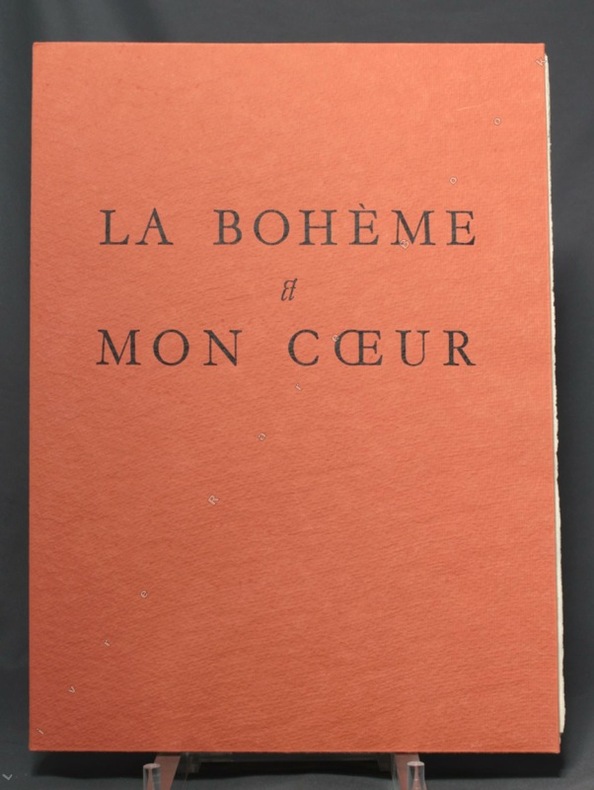
194310196Genève, Editions du Milieu du Monde, 1943. In-folio en feuilles de 187-[5] pages, sous couverture brique rempliée, chemise, étui, pièce de titre en maroquin rouge.
196921834Sierre, 1969. In-folio de [72] pages, couverture imprimée, chemise et étui de l'éditeur.
193411802Genève, Maurice Barraud & André Kundig, 1934. In-8 de [4]-135-[7] pages, couverture illustrée rempliée.
193420065Genève, Maurice Barraud & André Kundig, 1934. In-8 de [4]-135-[7] pages, couverture illustrée rempliée.
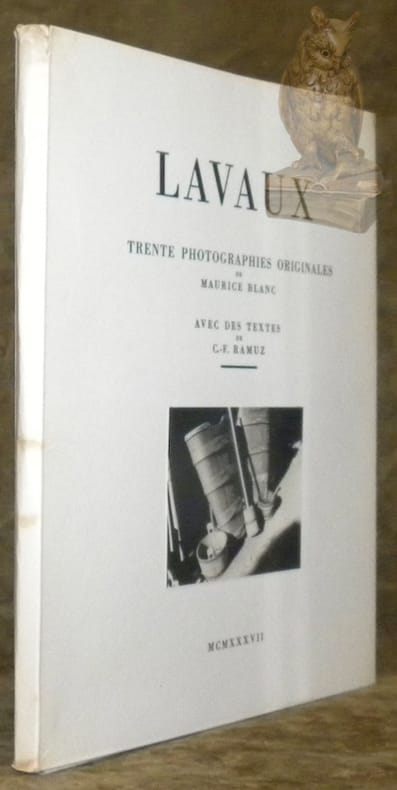
118490Lausanne, Librairie Centrale et Universitaire V. Porchet & Cie. 1937, 310x250mm, 33pages, en feuilles, sous chemise rempliée, imprimée en noir, ornée d'une photographie n/b contrecollée. Un des 185 exemplaires sur papier vélin, numéroté n.° 78 / 170, imprimé par Tell Geneux, maître imprimeur, à Lausanne. Petites déchirures sur le haut du dos de la chemise, autrement très bel exemplaire de cette belle édition originale - rare et précieuse, difficile à trouvé. Bringolf, 30, in fine.
1890001538Paris: Didier Perrin 1890. 7 viii-ix 4 14-58pp 2. Slightly later full morocco by Charles Meunier. Raised bands spine in six panels author and title lettered directly to second panel upper cover with inlaid flowers in tan brown and green morocco and tooled in gilt gilt roll to edges and inner edges blue silk moire doublures and fly leaves and gold veined marbled fly leaves a.e.g. original wrappers bound in signed to foot of upper turn in 'Ch. Meunier 97'. Slightly rubbed to extremities especially to upper joint but generally quite bright and clean. Signed and inscribed by the author to the Comtesse de Lagnes to the half title. For Charles Meunier 1866-1948 bookbinder see Flety pages 128-129. Signed by Author. Second Edition. Hardback. Good. 16mo. Didier Perrin Hardcover
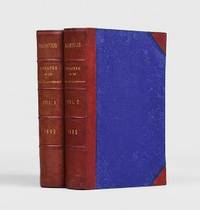
1893184400Port Louis: no stated publisher 1893. The most devastating cyclone in Mauritian history First edition from the library of the governor of Mauritius Sir Hubert Edward Henry Jerningham with his signature on the front free endpapers and the royal coat of arms blind-stamped in Volume 2. They record the 39 meetings of the 1892 government session the year of the devastating cyclone. Sir Hubert Edward Henry Jerningham was educated at the University of Paris and entered the diplomatic service in 1866. In March 1892 he was sent to Mauritius first in an acting role then as the lieutenant-governor later governor from 20 September. This period saw "the most devastating cyclone in Mauritian history" Walshe p. 5 on 29 April killing over 1200 people. He remained in the colony until 1897 when he was appointed as the governor of Trinidad and Tobago. The volumes include reports of the extent of the damage the relief efforts and the aid sent to the country from around the world. They mention Mauritius's telegraph early warning system the first in the world. These wires were intended to warn Port Louis of impending catastrophes and were suspended above ground. However this made them vulnerable to high wind. In addition they record strategies to prevent a cholera epidemic questions over the printing of currency the appointment of Jerningham to his substantive position and immigration and quarantine laws. 2 vols quarto 248 x 165 mm pp. xiv 1469. Tables in text. 20th-century red half sheep spine gilt-lettered direct raised bands blue pebble-grain cloth boards. Occasional pencil notes internally. Spine marked boards bowed and lightly silverfished remnants of adhesive at corners contents clean: a very good copy. Rory Walshe "'Who could have expected such a disaster' How responses to the 1892 cyclone determined institutional trajectories of vulnerability in Mauritius" Journal of Historical Geography vol. 75 January 2022. hardcover
102704Paris Louis Desessart 1840. . First edition 2 volumes 8vo 399; 402 pp. folding engraved map contemporary green polished calf-backed marbled boards gilt spines faded occasional light spotting a very good set.<br /> In 1833-34 Maurice Tamisier served as a secretary to the chief medical officer in the armies sent by Muhammad Ali to suppress further uprisings in the Hejaz. 'Accompanied by a group of other Europeans including an amateur conjurer whose tricks astonished the Bedouins. he made his way into the mountainous area of Asir in the south of the Hejaz and took part in a battle in which Egyptian troops were rewarded with 10 shillings for every pair of enemy ears that they brought in. Tamisier obviously enjoyed chatting to the local people and recorded some of their tales' Bidwell Travellers in Arabia 1995 pp.122-123.<br /> Gay 3608. Paris, Louis Desessart, 1840. hardcover
1948012763Paris N.R.F., Editions Gallimard 1948 In-12 Broché Ed. originale
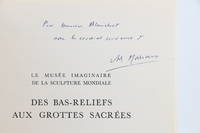
1951012905Paris Galerie Louise Leiris 1951 en feuilles, couverture rempliée illustrée, chemise et étui éditeur
190112114Paris Charpentier 1901 in-octavo plein maroquin un volume, plein maroquin (full morocco tobacco) havane in-octavo (183 X 116 mm.) , dos à nerfs (spine with raised bands) décoré or (gilt decoration) filets or (gilt line) et filets à froid (blind-stamping line decoration) entre nerf orné d'un fer doré spécial "Abeille" (between the raised bands special "Bee" blocking stamps) - titre et auteur frappés or (gilt title) - pièces de titre et auteur sur fond marron plus foncé (label of title) avec filet or (label of title with gilt line) , plats décorés à froid (cover blind-stamping) d'un encadrement à motif floral coloré en marron foncé (floweret with hollowed out blocking stamp) avec une abeille centrale en marquetterie de cuir incrustée en marron plus foncé (reliure signée par G. Cornez relieur d'Art- signed binding), dentelle intérieure or avec double gardes de soie "Saumon", tête lisse (top edge smooth) dorée (top edge gilt), gouttière non rognée (fore-edge no smooth), long papier (fore-edge - great papier), dos et couverture conservée (spine and cover preserved - library edition), sans illustration (no illustration), [vi] +311 pages + 1feuillet + table (contents leaf), 1901 Paris Charpentier Editeur + lettre Autographe Manuscrite (4 pages format in-octavo) de Maurice MAETERLINCK à l'Ecrivain, femme de lettres française. : Marguerite Eymery (alias RACHILDE),
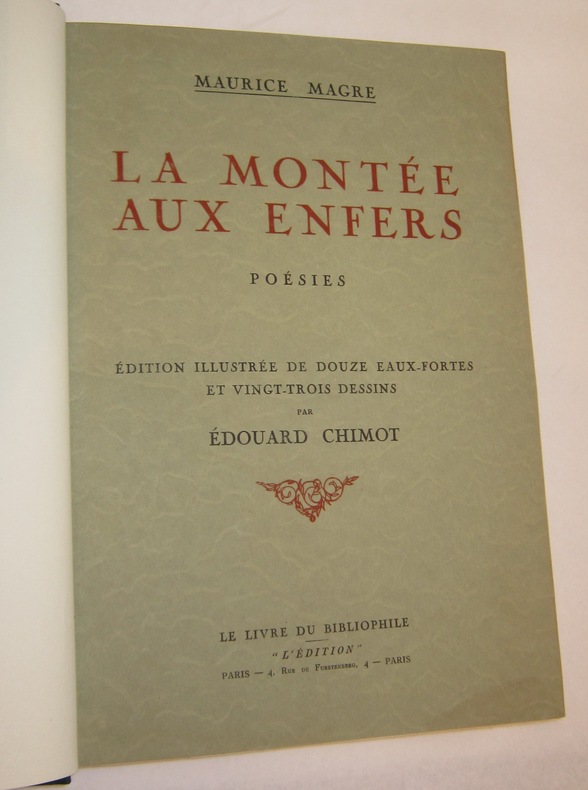
1920001284Paris Le Livre Du Bibliophile 1920
190778637Couverture illustrée en couleurs d'Henri Goussé. Le volume a pour frontispice un portrait photographique de l'auteur. Rousseurs sur les premières pages. Usures du dos et des coiffes. Tassement sur le haut du second plat.
194684255Relié. Demi-chagrin maroquiné bleu nuit à coins. Dos à quatre nerfs. Tête dorée. Couvertures et dos conservés. Infime égrenure à la coiffe de tête.
1857E30331Trenton: printed at the Office of The True American 1857. First edition. Hardcover. Very Good. Octavo in dark blue-green cloth with spine lettered in gilt. 205 pp. plus index at rear. 11 plates including frontis and one large folding map tipped in at rear. A tight very good example some spotting to the spine strip and minor wear at the spine extremities. Occasional light foxing to the text as is usual. One of the scarcest and most sought after New Jersey historical volume. Part I describes the physical and geological description of Cape May County its geological age and formation. Part II is "Economical Geology" analyses of soils marsh mud forests agriculture fish and fish by-products building material substances particularly brick salt. The second major portion of the work consists of "Catalogues of Zoological And Botanical Productions of the County of Cape May" that includes lists of the larger wild animals of the county opossums bears raccoons skunk fox squirrels rabbits deer etc.; birds native to the county including bald eagles geese various hawks owls swallows fly-catchers and smaller birds.; fishes black fish mackerel dories catfish mudfish pike flounder herring turbot sole eels shark; plants marine algae. There is an engraving of a Venus Mercenaria with descriptive paragraphs of that fossil and the Buccinum Obsoletum. The final section is "Sketch of the Early History of the County Of Cape May printed at the Office of The True American hardcover
19661235911966. First Edition. Signed. SENDAK Maurice SINGER Isaac Bashevis. Zlateh the Goat and Other Stories. New York: Harper & Row 1966. Octavo original gilt-stamped white cloth original dust jacket. $1650.First trade edition presentation copy of this collection of Jewish folklore inscribed on the half title to a close friend and neighbor: ""For ElizabethFor whom I am signing books today! So there! Maurice Sendak May '79.""Zlateh the Goat Singer's first book for children contains seven tales of Jewish folklore and is illustrated with 17 black-and-white plates by Maurice Sendak. Published the same year as the signed limited edition. Hanrahan A66. The former owner of this inscribed book was Maurice Sendak's neighbor Andrew from Ridgefield Connecticut. Sendak bought a home and studio in Ridgefield in 1972 with his longtime partner Eugene Glynn and lived there until his death. Andrew first encountered Sendak in 1975 during one of his daily dog walks. Sendak owned many dogs throughout his life and they often starred in his books. Andrew was immediately taken with Sendak who reminded him of his recently deceased father. One day Andrew called Sendak at home and asked if he could join him on his walks. Andrew and Sendak thus embarked on a 37-year friendship that also included the Andrew's mother Betty as well as Andrew's brother. Sendak went on long walks and hikes with Andrew and his family regularly discussing general life events opera and books. He also invited them into his studio to show off works in progress. Andrew's mother Betty was an avid reader and collector and she and Sendak would talk late into the night about books. Sendak offered Betty advice about how to find and authenticate rare children's books which she used to build her collection. Additionally he frequently bartered for autographs i.e. a cake for an inscribed drawing. Sendak often referred to Betty as ""Elizabeth"" in inscriptions as he felt that ""Betty"" was too common a name. The many inscribed drawings along with first editions signed books and other valuable items grew into one of the country's premier Sendak collections. Calling card of Robert M. White laid in.Book with interior generally fine and light foxing to cloth corner-clipped dust jacket with only slight rubbing and toning to extremities. A near-fine inscribed copy with interesting provenance. hardcover
197715085ENew York: Putnam 1977. First Edition. Signed and inscribed by the great motion picture director Billy Wilder: “This is a pretty dull book - but then again so is the subject. Best wishes Billy Wilder ‘85.†Illustrated. Near fine copy in a near fine dust jacket with a few tiny tears. A candid and revealing portrait of the life and work of Billy Wilder and the most important biographical book published on Wilder in his lifetime. Wilder was one of Hollywood’s most accomplished directors whose films include such classics as Double Indemnity The Lost Weekend Sunset Boulevard Stalag 17 Sabrina The Apartment etc. Putnam unknown books
193452957Elbeuf: S. n. 1934. Fine. S. n. Elbeuf S.d 1900 5.50 x 8 cm une feuille Original photograph of Maurice Blanchot standing against a wall. Vintage silver gelatin print. « Blanchot long defied photographers and caricaturists of the literary press. Minimalist and extremely rare over so many years are the illustrative sketches: in 1962 in L'Express a hand brandishing a book against a page background; in 1979 in Libération a blank square in the middle of the page bearing only the name Maurice Blanchot as caption and a quotation from L'Entretien infini ""un vide d'univers: rien qui fut visible rien qui fut invisible"" ""a void of universe: nothing that was visible nothing that was invisible"" » C. Bident Maurice Blanchot. In 1986 on the occasion of an exhibition of writers' portraits he requested that his photo be replaced by a text manifesting his desire to « apparaître le moins possible non pas pour exalter ses livres mais pour éviter la présence d'un auteur qui prétendrait à une existence propre » ""appear as little as possible not to exalt his books but to avoid the presence of an author who would claim a proper existence"". A photo taken without his knowledge by a paparazzo in a supermarket parking lot would long serve as the writer's portrait before his friend Emmanuel Levinas revealed a few rare portraits from their youth. That Maurice Blanchot did not oppose this disclosure that it was the work of his closest friend could be explained by what Bident calls « l'espacement de l'inquiétude » ""the spacing of unease"" the outdatedness of the disclosed portraits echoing the delayed publications of L'Idylle Le Dernier Mot L'Arrêt de mort. Only a few photographs gathered in the central pages of the issue of Cahiers de l'Herne devoted to Maurice Blanchot complete these unique shots of the most secret writer of the 20th century. In his chapter « L'indisposition du secret » ""The Indisposition of the Secret"" Christophe Bident devotes several pages to the almost total absence of images of this partenaire invisible invisible partner questioning the intellectual and psychological motivations of the writer who was nevertheless conscious of the inevitable revelation to come « Tout doit devenir public. Le secret doit être brisé. L'obscur doit entrer dans le jour et se faire jour. Ce qui ne peut se dire doit pourtant s' entendre. Quidquid latet apparebit tout ce qui est caché c'est cela qui doit apparaître . » ""Everything must become public. The secret must be broken. The obscure must enter the day and make itself day. What cannot be said must nevertheless be heard. Quidquid latet apparebit everything that is hidden that is what must appear ."" Maurice Blanchot L'Espace littéraire S. n. unknown
195480045Paris: Gallimard 1954. Fine. Gallimard Paris 1954 18 x 23.50 cm reliure de l'éditeur The first edition of which there were no deluxe copies. Publisher's full cream cloth binding complete with its illustrated dust jacket. Spine of dust jacket sunned and with two small stains on the back panel Precious signed autograph inscription from André Malraux to Maurice Blanchot. While they knew each other at the NRF it was primarily through several major articles by Blanchot devoted to Malraux that the two men ""encountered"" each other. After the war Blanchot published in Bataille's ephemeral review 'Actualité' an article on l'Espoir that allowed him ""to visibly inscribe his political reversal"". In 1950-51 in his double article on ""Le Musée imaginaire"" he formalized his own theory of the image that would permeate his future work. Confronting these two visions of art Henri Godard writes: ""Through the constancy and radicalism of its reference to death to absence to nothingness Blanchot's thought is one pole of our reflection on art of which Malraux could well incarnate the other"" In ""L'Expérience existentielle de l'art"". A polarity that could only bind Blanchot to Malraux whose tutelary figure would be invoked one final time at the end of his last narrative ""l'Instant de ma mort"": ""Later having returned to Paris he met Malraux. The latter told him that he had been taken prisoner without being recognized that he had managed to escape while losing a manuscript. What does it matter! Only the feeling of lightness remains which is death itself or to put it more precisely the instant of my death henceforth always pending."" Rich iconography. Spine of dust jacket slightly sunned as is often the case and with two marginal stains at the head of the back panel. Gallimard hardcover
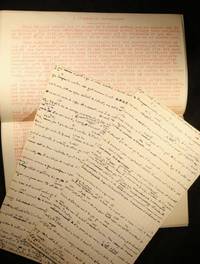
194544927s. l. Paris: S. n. Paysage dimanche 1945. Fine. S. n. Paysage dimanche s. l. Paris s. d. 1945 11.50 x 22 cm 3 pages 1/2 in-4 Autograph manuscript by the author of 3 and a half pages in-4 published in number 23 of November 18 1945 of Paysage Dimanche. Complete manuscript in very dense handwriting with numerous deletions corrections and additions. Literary chronicle of André Dhôtel's work. The complete typescript is included. When the apostle of silence in literature speaks of the novelist of the invisible this produces a strange apology for a work « destinée à sauver . l'essence du romanesque sa vie pure et secrète » « passionnante jusque dans sa monotonie selon le rythme des plus belles histoires romanesques où il ne se passe rien mais où l'imprévu est toujours imminent. » ""destined to save . the essence of the novelistic its pure and secret life"" ""fascinating even in its monotony according to the rhythm of the most beautiful novelistic stories where nothing happens but where the unexpected is always imminent."" Between April 1941 and August 1944 Maurice Blanchot published in the ""Chronicle of intellectual life"" of Journal des Débats 173 articles on recently published books. In half a page of newspaper approximately seven in-8 pages the young author of ""Thomas l'obscur"" takes his first steps in the field of literary criticism and thus inaugurates a theoretical work that he would later develop in his numerous essays from ""La Part du feu"" to ""L'Entretien infini"" and ""L'Écriture du désastre"". From the first articles Blanchot demonstrates an analytical acuity far exceeding the literary current events that motivate their writing. Oscillating between classics and moderns first-rate writers and minor novelists he establishes in his chronicles the foundations of a critical thought that would mark the second half of the 20th century. Transformed by writing and by war Blanchot breaks through a thought exercised ""in the name of the other"" with the violent Maurrassian certainties of his youth. Not without paradox he then transforms literary criticism into a philosophical act of intellectual resistance to barbarism at the very heart of an ""openly Maréchaliste"" newspaper: ""To burn a book to write one are the two acts between which culture inscribes its contrary oscillations"" Le Livre In Journal des Débats January 20 1943. In 2007 the Cahiers de la NRF brought together under the direction of Christophe Bident all the literary chronicles not yet published in volumes with this pertinent analysis of Blanchot's critical work: ""novels poems essays give rise to a singular reflection always more certain of its own rhetoric more given over to the echo of the impossible or to the sirens of disappearance. . Not without contradictions or sidesteps and in the feverish certainty of a work that begins . these articles reveal the genealogy of a critic who transformed the occasion of the chronicle into the necessity of thought."" C. Bident. Autograph manuscripts by Maurice Blanchot are extremely rare. S. n.[ Paysage dimanche] unknown
194444947s. l. Paris: S. n. Journal des débats 1944. Fine. S. n. Journal des débats s. l. Paris s. d. 1944 13.50 x 21.50 cm 2 1/2 pages in-8 Autograph manuscript by the author of 2½ pages in-8 published in the February 10 1944 issue of Journal des Débats. Complete manuscript with very dense handwriting containing numerous deletions corrections and additions. Literary chronicle published on the occasion of the publication of Jean Dumay's ""Journal de guerre"". The complete typescript is included. Between April 1941 and August 1944 Maurice Blanchot published 173 articles on recently published books in the ""Chronique de la vie intellectuelle"" of Journal des Débats. In half a newspaper page approximately seven pages in-8 the young author of ""Thomas l'obscur"" takes his first steps in the field of literary criticism and thus inaugurates a theoretical work that he would later develop in his numerous essays from ""La Part du feu"" to ""L'Entretien infini"" and ""L'Écriture du désastre"". From the first articles Blanchot demonstrates an analytical acuity far exceeding the literary news that motivates their writing. Oscillating between classics and moderns first-rate writers and minor novelists he establishes in his chronicles the foundations of critical thought that would mark the second half of the 20th century. Transformed by writing and by war Blanchot breaks through a thought exercised ""in the name of the other"" with the violent Maurrassian certainties of his youth. Not without paradox he then transforms literary criticism into a philosophical act of intellectual resistance to barbarism at the very heart of an ""openly Maréchaliste"" newspaper: ""Brûler un livre en écrire sont les deux actes entre lesquels la culture inscrit ses oscillations contraires"" ""To burn a book to write one are the two acts between which culture inscribes its contrary oscillations"" Le Livre In Journal des Débats January 20 1943. In 2007 the Cahiers de la NRF brought together under the direction of Christophe Bident all the literary chronicles not yet published in volumes with this pertinent analysis of Blanchot's critical work: ""romans poèmes essais donnent lieu à une réflexion singulière toujours plus sûre de sa propre rhétorique livrée davantage à l'écho de l'impossible ou aux sirènes de la disparition. . Non sans contradictions ni pas de côté et dans la certitude fiévreuse d'une uvre qui commence . ces articles révèlent la généalogie d'un critique qui a transformé l'occasion de la chronique en nécessité de la pensée."" ""novels poems essays give rise to a singular reflection ever more sure of its own rhetoric delivered more to the echo of the impossible or to the sirens of disappearance. . Not without contradictions or sidesteps and in the feverish certainty of a work that begins . these articles reveal the genealogy of a critic who transformed the occasion of the chronicle into necessity of thought."" C. Bident. Autograph manuscripts by Maurice Blanchot are extremely rare. S. n.[ Journal des débats] unknown
194344967s. l. Paris: S. n. Journal des débats 1943. Fine. S. n. Journal des débats s. l. Paris s. d. 1943 13.50 x 21.50 cm 4 1/2 pages in-8 Autograph manuscript by the author of 4½ pages in quarto published in the November 27-28 1943 issue of Journal des Débats. Complete manuscript with very dense handwriting containing numerous deletions corrections and additions. Literary chronicle published on the occasion of the publication of Paul Thiry d'Holbach et la philosophie scientifique au XVIIIe siècle by Pierre Naville. The complete typescript is included. Far more than a critique of Pierre Naville's work on Baron d'Holbach this long article by Blanchot is a veritable philosophical pamphlet against the materialist thought of the Encyclopedists whom he accuses of wanting to « know the world in order to seize it. This is a notable expression of the bourgeois spirit. . Man can only dominate the world if the world is a collection of objects. » But through this virulent critique of 18th-century thought Blanchot identifies a more modern evil: « To make man a thing that can be studied . is to ensure that he can be used as a thing and exploited as a thing. All the social contradictions of liberalism are already in this assertion. And its starting point is the Encyclopedia. » Between April 1941 and August 1944 Maurice Blanchot published 173 articles on recently published books in the ""Chronicle of Intellectual Life"" of Journal des Débats. In half a page of the newspaper approximately seven octavo pages the young author of ""Thomas l'obscur"" took his first steps in the field of literary criticism and thus inaugurated a theoretical work that he would later develop in his numerous essays from ""La Part du feu"" to ""L'Entretien infini"" and ""L'Écriture du désastre"". From the very first articles Blanchot demonstrated an analytical acuity that far exceeded the literary current events that motivated their writing. Oscillating between classics and moderns first-rate writers and minor novelists he laid in his chronicles the foundations of a critical thought that would mark the second half of the 20th century. Transformed by writing and by war Blanchot broke through a thought exercised ""in the name of the other"" with the violent Maurrassian certainties of his youth. Not without paradox he then transformed literary criticism into a philosophical act of intellectual resistance to barbarity at the very heart of an ""openly Maréchal-supporting"" newspaper: ""To burn a book to write one are the two acts between which culture inscribes its contrary oscillations"" Le Livre In Journal des Débats January 20 1943. In 2007 the Cahiers de la NRF brought together under the direction of Christophe Bident all the literary chronicles not yet published in volumes with this pertinent analysis of Blanchot's critical work: ""novels poems essays give rise to a singular reflection increasingly confident in its own rhetoric more given over to the echo of the impossible or to the sirens of disappearance. . Not without contradictions or sidesteps and in the feverish certainty of a work that begins . these articles reveal the genealogy of a critic who transformed the occasion of the chronicle into the necessity of thought."" C. Bident. Autograph manuscripts by Maurice Blanchot are extremely rare. S. n.[ Journal des débats] unknown
194444955s. l. Paris: S. n. Journal des débats 1944. Fine. S. n. Journal des débats s. l. Paris s. d. 1944 13.50 x 21.50 cm 2 1/2 pages in-8 Autograph manuscript by the author 2½ pages octavo published in the January 13 1944 issue of the Journal des Débats. Complete recto-verso manuscript in very dense handwriting with numerous deletions corrections and additions. Accompanied by the complete typescript with one autograph correction in black ink. Chronicle published on the occasion of the publication of Le pèlerinage aux sources by Joseph Lanza del Vasto. This chronicle by Maurice Blanchot forms an astonishing echo to one of his very first published texts 1931 devoted to Gandhi's Memoirs which already contained the essence of his thought from the 1930s. Published in the pages of Cahiers mensuels a Catholic review close to the thinking of Jacques Maritain Blanchot defended the idea of a necessarily spiritual revolution but also of a struggle against the impurity of foreign influences. In ""Le pèlerinage aux sources"" Blanchot returns to Gandhi through a recently published work by Joseph Lanza del Vasto in which the Italian philosopher analyzes ""the hope of renewal that many Westerners seek often lightly in the profound secrets of Hinduism"". But for Blanchot Gandhi's action could hardly constitute a true example to follow: ""Naturally we all understand that Gandhi's politics tends not only toward a political victory but toward a spiritual victory: he wants to deliver the people from their ills from their ignorance to make them live the truth; all this is quite clear; what is also clear is that among these ills there is first the presence of the foreigner and that the regime recommended by the Mahatma and with a view to which he brings into play spiritual forces is a regime of political economic and social liberation. It is impossible not to see . in this rehabilitation of external action the distortion of the spiritual ideal. Man is no longer asked to strip himself of himself for nothing without any formidable end being able to justify him in this total annihilation but he receives the order to arrange the world to conquer himself with a view to making reality better. It is an inglorious return to the most vulgar morality of salvation."" An interesting critique of Mahatma Gandhi's political action. Between April 1941 and August 1944 Maurice Blanchot published 173 articles on recently published books in the ""Chronicle of Intellectual Life"" of the Journal des Débats. In half a page of newspaper approximately seven octavo pages the young author of ""Thomas l'obscur"" takes his first steps in the field of literary criticism and thus inaugurates a theoretical work that he would later develop in his numerous essays from ""La Part du feu"" to ""L'Entretien infini"" and ""L'Écriture du désastre."" From the first articles Blanchot demonstrates an analytical acuity far exceeding the literary current events that motivate their writing. Oscillating between classics and moderns first-rate writers and minor novelists he establishes in his chronicles the foundations of a critical thought that would mark the second half of the 20th century. Transformed by writing and by war Blanchot breaks through a thought exercised ""in the name of the other"" with the violent Maurrassian certainties of his youth. Not without paradox he then transforms literary criticism into a philosophical act of intellectual resistance to barbarism at the very heart of an ""openly Maréchaliste"" newspaper: ""To burn a book to write one are the two acts between which culture inscribes its contrary oscillations"" Le Livre In Journal des Débats January 20 1943. In 2007 the Cahiers de la NRF gathered under the direction of Christophe Bident all the literary chronicles not yet published in volumes with this pertinent analysis of Blanchot's critical work: ""novels poems essays give rise to a singular reflection always more sure of its own rhetoric delivered more to the echo S. n.[ Journal des débats] unknown
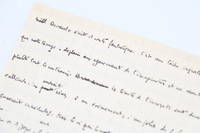
194589879n. l. Paris: s. n. Paysage dimanche 1945. Fine. s. n. Paysage dimanche n. l. Paris s. d. 1945 11.50 x 22 cm 3 pages in-4 Autograph manuscript by the author 3 pages in-8 published in issue 21 4 November 1945 of Paysage Dimanche. Complete manuscript written on both sides in a very dense hand with numerous deletions corrections and additions. Together with the complete typescript bearing 3 autograph corrections in black ink. This text by Maurice Blanchot « Les malheurs de ""Peau d'âne"" » contains two paradoxes. Contrary to what its title suggests it does not deal with the work of Charles Perrault; furthermore this column is devoted to the tales of an author whom the critic had already cited in his article on the fantastic novel published the previous year in the Journal des Débats and whose work he appeared to have little taste for: Noël Devaulx. Yet with nuance Blanchot here reveals to the reader the qualities of these tales and beyond that their terrible relevance in the year 1945: « Il y a dans ces récits d'au-delà du monde un certain charme provincial qui est assez singulier ; ils n'ont assurément rien à voir avec quelque folklore mais se déroulant comme tout vrai conte ""aux environs de l'absence"" ils finissent par nous imposer cette impression que nulle part est une province morte que c'est un lieu aussi suranné précieux et ridicule que peut l'être la province la plus archaïque. Or cette impression ne laisse pas de nous inquiéter. Car ce monde qu'on nous découvre et qui a la fragilité l'air endormi et sournois des objets dans les vieilles maisons c'est le nôtre mais c'est surtout celui de nos inquiétudes les plus brûlantes celui de la surnature et du surréel. . Après la lecture de L'Auberge on rêve à l'autre monde comme à un modeste salon de campagne du dehors encore très respectable de bonne compagnie et même solide mais qu'on y entre et tout vole en poussière. » A subtly political reading of Noël Devaulxs tales. s. n. [Paysage dimanche] unknown