Maurice BLANCHOTBiblio.com

71 408 résultats
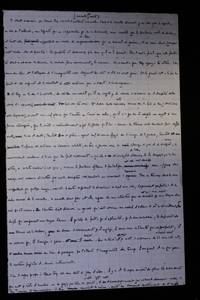
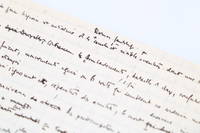
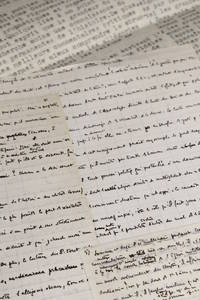
194344964s. l. Paris: S. n. Journal des débats 1943. Fine. S. n. Journal des débats s. l. Paris s. d. 1943 13.50 x 21.50 cm 4 1/2 pages in-8 Autograph manuscript by the author of 2½ pages in-4 published in the May 26 1943 issue of Journal des Débats. Complete manuscript with very dense handwriting containing numerous deletions corrections and additions. The complete typescript is included. Each chapter of Roland Cailleux's novel Saint-Genès ou la vie brève presents a different narrative form. This gives Blanchot the opportunity to return to the interest of this literary audacity initiated a few years earlier by Joyce: ""The novel showed itself there with all its possibilities it metamorphosed into everything it could be."" Between April 1941 and August 1944 Maurice Blanchot published 173 articles on recently published books in the ""Chronique de la vie intellectuelle"" of Journal des Débats. In half a newspaper page about seven octavo pages the young author of ""Thomas l'obscur"" takes his first steps in the field of literary criticism and thus inaugurates a theoretical work that he would later develop in his numerous essays from ""La Part du feu"" to ""L'Entretien infini"" and ""L'Écriture du désastre"". From his first articles Blanchot demonstrates an analytical acuity far exceeding the literary current events that motivated their writing. Oscillating between classics and moderns first-rate writers and minor novelists he establishes in his chronicles the foundations of a critical thought that would mark the second half of the 20th century. Transformed by writing and by the war Blanchot breaks through a thought exercised ""in the name of the other"" with the violent Maurrassian certainties of his youth. Not without paradox he then transforms literary criticism into a philosophical act of intellectual resistance to barbarism at the very heart of an ""openly Maréchaliste"" newspaper: ""To burn a book to write one are the two acts between which culture inscribes its contrary oscillations"" Le Livre In Journal des Débats January 20 1943. In 2007 the Cahiers de la NRF brought together under the direction of Christophe Bident all the literary chronicles not yet published in volumes with this pertinent analysis of Blanchot's critical work: ""novels poems essays give rise to a singular reflection ever more sure of its own rhetoric delivered more to the echo of the impossible or to the sirens of disappearance. . Not without contradictions or sidesteps and in the feverish certainty of a work that begins . these articles reveal the genealogy of a critic who transformed the occasion of the chronicle into necessity of thought."" C. Bident. Autograph manuscripts by Maurice Blanchot are extremely rare. S. n.[ Journal des débats] unknown
194444934s. l. Paris: S. n. Journal des débats 1944. Fine. S. n. Journal des débats s. l. Paris s. d. 1944 13.50 x 21.50 cm 2 1/2 pages in-8 Autograph manuscript by the author of 2 and a half octavo pages published in the April 20 1944 issue of Journal des Débats. Complete manuscript with very dense writing containing numerous strikethroughs corrections and additions. Literary chronicle on the work of Claude Roy. The complete typescript is included. This critique of La Mer à boire by Claude Roy is at once a detailed analysis of each short story and a poetic hymn to the poet's writing: ""Le style de Claude Roy répond à merveille à ce jeu de nuances : il est lui aussi plein d'échos qui s'évanouissent de mots qui se répercutent: il est libre discipliné tout en inventions et fidèle à la réalité qu'il décrit."" ""Claude Roy's style responds marvelously to this play of nuances: it too is full of echoes that fade away of words that reverberate: it is free disciplined full of inventions and faithful to the reality it describes."" Between April 1941 and August 1944 Maurice Blanchot published 173 articles on recently published books in the ""Chronique de la vie intellectuelle"" of Journal des Débats. In half a page of newspaper about seven octavo pages the young author of ""Thomas l'obscur"" takes his first steps in the field of literary criticism and thus inaugurates a theoretical work that he would later develop in his numerous essays from ""La Part du feu"" to ""L'Entretien infini"" and ""L'Écriture du désastre."" From the first articles Blanchot demonstrates an analytical acuity far exceeding the literary current events that motivate their writing. Oscillating between classics and moderns first-rate writers and minor novelists he establishes in his chronicles the foundations of a critical thought that would mark the second half of the twentieth century. Transformed by writing and by war Blanchot breaks through a thought exercised ""in the name of the other"" with the violent Maurrassian certainties of his youth. Not without paradox he then transforms literary criticism into a philosophical act of intellectual resistance to barbarism at the very heart of an ""openly Maréchaliste"" newspaper: ""To burn a book to write one these are the two acts between which culture inscribes its contrary oscillations"" Le Livre In Journal des Débats January 20 1943. In 2007 the Cahiers de la NRF brought together under the direction of Christophe Bident all the literary chronicles not yet published in volumes with this pertinent analysis of Blanchot's critical work: ""novels poems essays give rise to a singular reflection always more confident in its own rhetoric delivered more to the echo of the impossible or to the sirens of disappearance. . Not without contradictions or sidesteps and in the feverish certainty of a work that begins . these articles reveal the genealogy of a critic who transformed the occasion of the chronicle into the necessity of thought."" C. Bident. The autograph manuscripts of Maurice Blanchot are extremely rare. S. n.[ Journal des débats] unknown
194489878s. l. Paris: Journal des débats 1944. Fine. Journal des débats s. l. Paris s. d. 1944 13.50 x 21.50 cm 2 1/2 pages in-8 Autograph manuscript by the author two and a half pages octavo published in the issue of May 4 1944 of the Journal des Débats. Complete recto-verso manuscript densely written with numerous deletions corrections and additions. Together with the complete typescript. A column published on the occasion of the release of Robert Poulets Prélude à l'apocalypse. In this column devoted to the contemporary state of the fantastic novel Maurice Blanchot focuses in particular on Robert Poulets Prélude à l'apocalypse which had just been published: « Le lecteur passe volontiers du réel au fantastique mais qu'y gagne-t-il Les péripéties anormales sont faibles au regard des faits véritables que l'imagination suppose ou que la mémoire rappelle. . Prélude d'apocalypse paraît infidèle lorsqu'il n'est qu'un documentaire et insuffisant lorsqu'il prête des péripéties de fin du monde à une simple aventure historique. » Yet the « merveilleux scientifique » gave rise to major works by Edgar Allan Poe Louis Stevenson and H.G. Wells. But it is a treacherous genre and even Auguste de Villiers de L'Isle-Adam somewhat lost his way in L'Eve future: « Ce dernier livre qui a pour sujet la création d'une machine humaine par le savant Edison montre assez bien les difficultés du genre. Villiers qui se piquait de culture scientifique a décrit avec minutie le mécanisme de l'automate. . Mais ce ""bizarre cours d'anatomie"" aujourd'hui nous lasse et la virtuosité des explications nous paraît futile. Au contraire ce qui nous attire c'est l'effort pour égarer la conscience l'éternelle tentation de rendre illusoire l'existence par l'imitation qu'on en fait le jeu troublant du reflet qui donne tort à l'image de l'ombre qui abolit le modèle. » A highly critical text by Blanchot on fantastic entertainment. [Journal des débats] unknown
194544925s. l. Paris: S. n. Journal des débats 1945. Fine. S. n. Journal des débats s. l. Paris s. d. 1945 13.50 x 21 cm 4 1/2 pages in-8 Autograph manuscript by the author of 4 and a half pages in-8 published in the issue of November 3 1943 of Journal des Débats. Complete recto-verso manuscript in very dense handwriting with numerous deletions corrections and additions. The complete typescript is included. Chronicle published on the occasion of the publication of L'Apocalypse de St Jean vision chrétienne de l'histoire by Father H.M. Féret. From the outset Maurice Blanchot doing his job as a critic praises the seriousness of the study conducted by Father Féret. But what interests him more than this careful orthodoxy are the powerful echoes of L'Apocalypse in the terrible hours the world was then going through: « Dans les périodes troublées les esprits qui ne supportent pas l'incertitude de l'avenir ont besoin de prophètes. Mais ces prophètes ils les demandent au passé et plus l'oracle est ancien - et redoutable - plus ils y voient des correspondances avec l'histoire qu'ils voudraient connaître. L'Apocalypse de St Jean doit en partie à la sublimité du langage à l'autorité de l'écrivain à l'étendue de la révélation une curiosité que des siècles d'étude n'ont pas réussi à épuiser. Mais elle doit aussi son prestige auprès d'esprits qui ne sont pas toujours pieux à l'antiquité de la réponse et à son caractère terrifiant. Qui n'est pas prêt à croire que la fin des temps est proche et que le pire va être vécu Chacun a le désir secret d'associer sa propre fin qu'il entrevoie à celle du monde dont il est moins sûr. » ""In troubled periods minds that cannot bear the uncertainty of the future need prophets. But these prophets they seek them in the past and the more ancient - and fearsome - the oracle the more they see correspondences with the history they would like to know. The Apocalypse of St. John owes partly to the sublimity of language to the authority of the writer to the extent of the revelation a curiosity that centuries of study have not managed to exhaust. But it also owes its prestige among minds that are not always pious to the antiquity of the answer and to its terrifying character. Who is not ready to believe that the end of times is near and that the worst will be lived Each has the secret desire to associate his own end that he glimpses with that of the world of which he is less certain."" The biblical text thus awakens his interest for its literary and mythological qualities but also in an almost political approach for its sense of History. Furthermore if religion does not of course pose itself in terms of belief for Blanchot it nevertheless reveals his attention to the question of God particularly sensitive through Judaism notably and joins that decisive in his eyes of the writer's interior experience. Finally the analysis of L'Apocalypse that Blanchot delivers here constitutes a first in-depth reflection on the question of Evil: « . ce qui est propre au message inspiré c'est le rôle qu'il fait jouer au démon dans la vie collective et le mouvement de l'histoire. Saint Jean ne dévoile pas l'action du mal dans les âmes ; il se borne à montrer quelle maîtrise les puissances démoniaques peuvent exercer sur les réalités collectives par quelles voies elles agissent . et quelle défaite mettra un terme à leur empire. » "". what is proper to the inspired message is the role it makes the demon play in collective life and the movement of history. Saint John does not unveil the action of evil in souls; he confines himself to showing what mastery demonic powers can exercise over collective realities by what paths they act . and what defeat will put an end to their empire."" These links between the Apocalypse History and Evil would be questioned again by Blanchot in ""L'Apocalypse déçoit"" 1964 and ""Penser l'Apocalypse"" 1988. First foundational text by Blanchot on Evil and History. Between April 1941 and Augus S. n.[ Journal des débats] unknown
194344963s. l. Paris: S. n. Journal des débats 1943. Fine. S. n. Journal des débats s. l. Paris s. d. 1943 13.50 x 21.50 cm 4 1/2 pages in-8 Autograph manuscript by the author of 4½ pages in-8 published in the September 8 1943 issue of Journal des Débats. Complete manuscript with very dense handwriting containing numerous deletions corrections and additions. The complete typescript is included. Literary chronicle published on the occasion of the publication of Les Voyages de Montesquieu prefaced by Marcel Arland. This artificial collection of Montesquieu's travel notebooks gives Blanchot the opportunity to praise a form of ""natural"" writing ""pure of all concern for readership"". These intimate notes indeed testify to an art of ""concision which delivers facts to us naked pressed by the meaning that illuminates them"" and which from ""considerable material drew only a small book discreetly reduced to the essential."" Between April 1941 and August 1944 Maurice Blanchot published 173 articles on recently published books in the ""Chronique de la vie intellectuelle"" of Journal des Débats. In half a newspaper page about seven octavo pages the young author of ""Thomas l'obscur"" takes his first steps in the field of literary criticism and thus inaugurates a theoretical work that he would later develop in his numerous essays from ""La Part du feu"" to ""L'Entretien infini"" and ""L'Écriture du désastre"". From his first articles Blanchot demonstrates an analytical acuity far exceeding the literary current events that motivated their writing. Oscillating between classics and moderns first-rate writers and minor novelists he establishes in his chronicles the foundations of a critical thought that would mark the second half of the 20th century. Transformed by writing and by the war Blanchot breaks through a thought exercised ""in the name of the other"" with the violent Maurrassian certainties of his youth. Not without paradox he then transforms literary criticism into a philosophical act of intellectual resistance to barbarism at the very heart of an ""openly Maréchaliste"" newspaper: ""To burn a book to write one are the two acts between which culture inscribes its contrary oscillations"" Le Livre In Journal des Débats January 20 1943. In 2007 the Cahiers de la NRF brought together under the direction of Christophe Bident all the literary chronicles not yet published in volumes with this pertinent analysis of Blanchot's critical work: ""novels poems essays give rise to a singular reflection ever more sure of its own rhetoric delivered more to the echo of the impossible or to the sirens of disappearance. . Not without contradictions or sidesteps and in the feverish certainty of a work that begins . these articles reveal the genealogy of a critic who transformed the occasion of the chronicle into necessity of thought."" C. Bident. Autograph manuscripts by Maurice Blanchot are extremely rare. S. n.[ Journal des débats] unknown
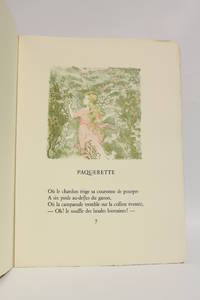
193969612Paris: Ambroise Vollard 1939. Fine. Ambroise Vollard Paris 1939 28.50 x 38.50 cm en feuilles sous chemise et étui New edition of the French translation illustrated with 70 original color lithographs by Maurice Denis one of 204 copies on Holland paper ours unnumbered the only issue after 35 Japan and 20 other Holland hors commerce copies. Handsome copy despite very occasional worming. The work has the peculiarity of being dated 1939 on the front cover dated 1936 on the title page and dated 1942 on the colophon page. The 70 lithographs break down as follows: 13 full-page in color 2 in color in the text and the others in black in blue or in 2 tones. Our copy is complete at the end with the double-page table of lithographs hors-texte. Ambroise Vollard unknown
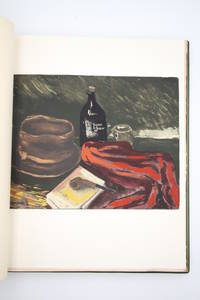
195177127Paris: Chez l'auteur 1951. Fine. Chez l'auteur Paris 1951 32.50 x 40.50 cm relié sous étui First edition illustrated with 15 original copperplate engravings including 10 in color by Maurice de Vlaminck one of 250 numbered copies on Arches laid paper. The work is also illustrated with 2 portraits by Amedeo Modigliani depicting Maurice de Vlaminck and his wife. Full Empire green morocco binding spine with two prominent raised bands extending as triangles in blind on the covers spine decorated with three gilt lozenges with gilt title and separated by a transverse gilt bar marbled paper endpapers and pastedowns triple gilt fillets framing the pastedowns covers and spine preserved top edge gilt Empire green morocco-edged slipcase marbled paper boards contemporary binding signed by the workshops of C. Muller Nancy bookbinder. Manuscript signature by Maurice de Vlaminck in pencil below his frontispiece portrait. Spine slightly darkened otherwise a handsome copy. Chez l'auteur hardcover
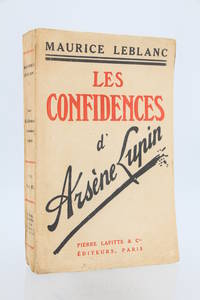
191388169Paris: Pierre Laffitte & Cie 1913. Fine. Pierre Laffitte & Cie Paris 1913 12 x 19 cm broché First edition with no mention of copies on deluxe paper. Spine slightly creased at the foot a minor stain at the lower margin of the final leaves not affecting the text. A pleasing and rare copy given the fragility of this work. Pierre Laffitte & Cie unknown
195745555Paris: FlammarionGrasset 1957. Fine. Flammarion Grasset Paris 1957-1978 16.50 x 21.50 cm 3 volumes brochés First edition one of 30 numbered copies on chiffon de Lana paper for the first two volumes and one of 64 numbered copies on vergé de Voiron for the last the tirage de tête for the first two volumes and the only large paper copies for the last. Trace of a transverse fold to upper cover of second volume upper cover of third volume slightly sunned at foot with transparent traces of adhesive paper to endpapers of same volume. A very good and rare set that one rarely finds complete with the third volume which appeared later. FlammarionGrasset unknown
181721199461817. London: Henry Colburn. 1817. Two volumes in one as issued 4to. Modern half-calf over cloth boards spine with raised bands lettered in gilt; pp. xv 346; ii 274 engraved portrait-frontispiece foxed 33 plates in sepia aquatint after the author; light offsetting from plates these occasionally a little spotted otherwise a good copy of a scarce work.First issued the year before under the title Travels in Europe and Africa comprising a Journey through France Spain and Portugal to Morocco this is the re-issue of the first printing sheets under a slightly altered title. 'The portions relating to Morocco - Mogador to Merakish and up the coast to Tangier the regular route of the embassies one of which Mr. Payne's Col. Keatinge accompanied - are in vol. i. pp. 175-346 and in vol. ii. Pp. 1-54. The journey was made years previously in 1785 but though the book is diffuse it is valuable for the account it gives of Mowlai Abdalla of whom a most repulsive portrait serves as frontispiece. At the time of Keatinge's visit to Merakish there seemed to have been what is not the case now quite a little European colony there - including a Venetian who was the Sultan's mercantile agent a Prussian and two Spanish monks who had a 'hospicio' there and were engaged in the redemption of Christian captives. There was also a tiny 'Danish garden'. There were several renegades including a Frenchman and his French wife and numbers of people of consequence the descendants of old renegades who were always addressed as 'Uncles'. Among them was an Englishman Thomas Myers who bore the title of El-Kaid Boazzer. He professed to be one of the crew of the Inspector privateer wrecked in Tangier Bay in January 1745 - a statement which is confirmed by one 'Thomas Mears' appearing in the list of the twenty members of the crew who turn'd Moors' Judaisme Marocain. Maurice Bagenal St. Leger Keatinge c. 1761-1835 was a Kildare landowner soldier and politician who undertook this journey in 1784/5 whilst on half-pay and published it all those years later. hardcover
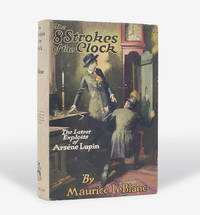
192221212901922. New York: The Macaulay Company. 1922. 8vo. Original orange-stamped black cloth orange lettering to spine and front board with the original very rare pictorial dust jacket by G.W. Gage issue with ad for ""Smoke of the .45"" at top of rear panel; pp. 12 313 1 blank with frontispiece by Gage; extremities very lightly rubbed some very minor wear to extremities of jacket else fine condition.First US edition of this collection of eight short stories featuring Arsene Lupin rare in the G.W. Gage's dust jacket especially in such excellent condition.In The Eight Stroke of the Clock a reformed Arsene Lupin adopts the identity of the millionaire ""Prince Renine"" and turns his criminal expertise toward solving mysteries rather than committing them. He is joined by Hortense Daniel a young woman determined to transform her life. Together they form a dynamic detective duo.Translated from the original French by Alexander Teixeira de Mattos this collection is widely regarded as the finest portrayal of Lupin in his role as a detective. hardcover
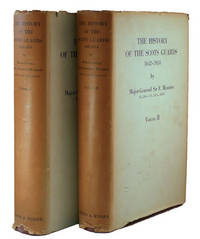
1934r4187London: Chatto & Windus. VG : in very good condition with dust jacket. Wrapper darkened and edge chipped. Covers sligtly discoloured and spines faded. Pencil annotations to verso of fep and to illustration list. Light foxing to title page. Fore edge untrimmed. Teg. 1934. Limited Edition 41/60. Blue/gilt hardback cloth cover with bevelled edges. 260mm x 160mm 10" x 6". xxii 410pp; xi 394pp. Plates and maps some coloured including hand coloured plates by Lawson. Limited edition. Signed in volume I by Prince Albert as Colonel of the Regiment before he became King George VI. Heavy item - shipping supplement may apply for overseas. . Chatto & Windus hardcover
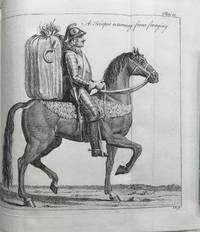
175757281CELEBRATED GENERAL ON THE ART OF WAR<br />first edition in English 4to. 2 title iii-x 2 dedication 195 1 advts.pp. 40 numbered engraved images on 34 folding plates attractive and sympathetic modern contemporary-style tan half calf by Brockman spine panelled by raised bands highlighted by double gilt fillets large blind tool at panel centres black morocco title label brown marbled sides hand-made paper endpapers title leaf a little dusty and with minor and almost invisible archival tissue reinforcement on verso at fore edge a few slight fox spots on fore-edge of plates else a nice fresh copy. A handsome copy.<br /><br />ESTC t97717 <br />Maurice Comte de Saxe 1696-1750 one of the most notable and successful military commanders of the eighteenth century was an illegitimate son of Augustus II King of Poland and Elector of Saxony. He was engaged in and immersed in military engagements and soldiering from his early youth and served successively in the armies of the Holy Roman Empire the Austrian army and France with the title of Marshal General of French being specially revived for him in the last of these. Characteristic of his military methods were the use of surprise and of mobile warfare by harassing a superior force without head-on conflict until he was in a position to engage it in a decisive battle. The most celebrated of his victories the brilliant and decisive defeat of the English at the Battle of Fontenoy in 1745 was an exemplar of his methods. His book on the art of war <i>Mes Rêverie</i>s was first postumously published in 1757.In the book Saxe subjected military affairs to reasoned criticism with a view to creating military doctrines based on universal principles. "Written following Prussian expansion during the War of the Austrian Succession Saxe in the book rejected their rigid discipline; arguing the French character was fundamentally different and their tactics should reflect that he advocated the use of a deep order or ordre profond rather than relying on firearms. However <i>Mes Rêveries</i> also challenged French military orthodoxy in arguing for a greater focus on mobile warfare rather than fortifications; this was partly a legacy of the French military engineer Vauban 1633-1707 who had revolutionised this field but adherence to his principles meant French engineers became ultra-conservative. As early as 1701 John Churchill 1st Duke of Marlborough argued winning one battle was more beneficial than taking 12 fortresses; Saxe followed this line but his argument was later given increased weight by French losses in the 1756-1763 Seven Years' War" wikipedia.<br />The Battle of Fontenoy on 11 May 1745 during the War of the Austrian Succession pitted the Pragmatic Allies - principally the Dutch British and Hanoverians - against the French which pitched two armies of about 50000 men against each other was notable for several reasons: both the British and French kings were present on the field of battle; it enabled further French victories; and in so doing it greatly reinforced the position of the French Ancien Régime. The battle was for a time closely fought but was swayed in French favour by the deployment of the Irish Brigades in the French army which in a celebrated counter attack swept a flank of English infantry from the field with great loss of life on both sides. They captured the English colours and 15 cannon and reputedly charged with the war-cry in Irish "Cuimhnigidh ar Luimnech agus feall na Sassonach!" that is "Remember Limerick and Saxon Perfidy". The casualty figures were appalling with at least 7000 killed or wounded on the French side including 500 Irish and between 10000 and 12000 on the allied side. Printed by J. Nourse hardcover
187756018n128Paris: Garnier Freres 1877. Book. Very Good. Hardcover. 8vo - over 7¾ - 9¾" tall. Published 1877-79. 16 volumes in matching contemporary quarter morocco over marbles boards. Edges speckled; marbled endpapers. Some moderate wear and scuffing to covers and edges. Otherwise clean tight and unmarked. Very neat -- a very sound and handsome intact and completely workable set. Garnier Freres Hardcover
51-6666Paris. Ambroise Vollard 1903. 4to. 25.5 x 30.2cm. iv 453 5pp. Sheets loose as issued in original wrappers and matching linen slipcase.One of 400 signed and numbed copies. Approxiimately 75 wood-engravers members of the Syndicat des Graveurs sur Bois contributed to the work.Images in the symbolist style.References: Luc Monod no. 6262; Chapon Le Peintre et le Livre. L’Âge d’or du livre illustré en France 1870-1970 pp. 68-69.- Skira Anthologie du livre illustré 1946 n° 62.- Ray The Art of the French Illustrated Book 1700 to 1914 n° 376 ; Carteret IV p. 214.First printing of 216 wood engravings designed by Maurice Denis engraved under his direction with the collaboration of Tony Beltrand.Limited edition of 400 numbered copies.One of 152 on Marais vellum in the form n° 303 of the edition with the watermark “L’Imitation de J.-C.â€.Signed by Denis in pencil.Magnificent book illustrated with woodcuts based on the compositions of Maurice Denis: 216 woodcuts including 116 square compositions mid-page at the head of each chapter approximately 11 x 11 cm the others being headbands and ends.This remarkable symbolist illustration is in the painter's first manner; although published in 1903 the compositions of Maurice Denis were executed from 1893 to 1899. The reproduction of the drawings was a real challenge entrusted by Ambroise Vollard to the care of the Imprimerie Nationale and to the skill of the eighty craftsmen who shared the work under the direction of Tony Beltrand.The work appeared without a publication slipcase: the copies are generally bound and such a copy in sheets and in very good condition has become rare. In-4 en ff. couverture illustrée rempliéesous étui.216 bois dessinés par Maurice DENIS.Tirage limité à 400 ex. ; n°152 des 280 sur vélin à la formefabriqué spécialement pour cette édition signé par l'artiste aujustificatif. Paris. Ambroise Vollard, 1903 hardcover
19554696Oxford: Routledge and Kegan Paul 1955. First edition. Octavo original cloth. Nobel Prize-winning economist Amartya Sen's copy with his name "A.K. Sen Trinity College Cambridge" on the half title page. Inscribed on the front free endpaper to Sen "For Amartiya With the confidence that he will plan the dynamic economy of a socialist and peaceful India. With best wishes Arif Cambridge 8 May 1955." In very good condition. In 1953 Sen entered Trinity College Cambridge where he earned a second B.A. in Economics in 1955 with a first class topping the list. He was elected President of the Cambridge Majlis. While Sen was officially a Ph.D. student at Cambridge though he had finished his research in 1955-6 he was offered the position of Professor and Head of the Economics Department of the newly created Jadavpur University in Calcutta and he became the youngest chairman to head the Department of Economics. He served in that position starting the new Economics Department during 1956 to 1958. Meanwhile Sen was elected to a Prize Fellowship at Trinity College which gave him four years of freedom to do anything he liked; he made the radical decision to study philosophy. Sen explained: "The broadening of my studies into philosophy was important for me not just because some of my main areas of interest in economics relate quite closely to philosophical disciplines for example social choice theory makes intense use of mathematical logic and also draws on moral philosophy and so does the study of inequality and deprivation but also because I found philosophical studies very rewarding on their own". His interest in philosophy however dates back to his college days at Presidency where he read books on philosophy and debated philosophical themes. In Cambridge there were major debates between supporters of Keynesian economics on the one hand and the "neo-classical" economists skeptical of Keynes on the other. However because of a lack of enthusiasm for social choice theory in both Trinity and Cambridge Sen had to choose a different subject for his Ph.D. thesis which was on "The Choice of Techniques" in 1959 though the work had been completed much earlier except for some valuable advice from his adjunct supervisor in India Professor A.K. Dasgupta given to Sen while teaching and revising his work at Jadavpur under the supervision of the "brilliant but vigorously intolerant" post-Keynesian Joan Robinson. Sen has went on to become one of the leading international voices on issues of famine welfare economics and human development theory as well as the social issues and inequalities that underlie those problems. Routledge and Kegan Paul hardcover books
19611236081961. Signed. SENDAK Maurice UDRY Janice May. The Moon Jumpers. New York: Harper & Row 1959 i.e. circa 1965. Slim quarto original half maroon cloth original dust jacket. $1600.Later edition of a childs exhilaration and enchantment with the loveliness of summer nights inscribed by Sendak to a close friend and neighbor: ""For Elizabethwith pleasure. Maurice Sendak June '76"" and with an original drawing of one of the moon jumpers.""'The warm night-wind tosses our hair. The wind chimes stir. And we all dance barefooted. Over and over the grass. We climb the tree just to be in a tree at night.' Here is a child's exhilaration and enchantment with the loveliness of summer nights with the magic of moonlight."" ""No one has ever touched the moon"" Udry tells us and silently encourages us to give it a try. ""For the Moon Jumpers Maurice Sendak has painted some of his most glorious pictures catching the moon's illumination of the grass the house and the dancing children."" The first edition of The Moon Jumpers appeared in 1959 under the Harper & Brothers imprint. In 1960 Harper & Brothers merged with Row-Peterson. Not long afterward Harper & Row reissued a number of Sendak books including this one. See Hanrahan A36. The former owner of this inscribed book was Maurice Sendak's neighbor Andrew from Ridgefield Connecticut. Sendak bought a home and studio in Ridgefield in 1972 with his longtime partner Eugene Glynn and lived there until his death. Andrew first encountered Sendak in 1975 during one of his daily dog walks. Sendak owned many dogs throughout his life and they often starred in his books. Andrew was immediately taken with Sendak who reminded him of his recently deceased father. One day Andrew called Sendak at home and asked if he could join him on his walks. Andrew and Sendak thus embarked on a 37-year friendship that also included the Andrew's mother Betty as well as Andrew's brother. Sendak went on long walks and hikes with Andrew and his family regularly discussing general life events opera and books. He also invited them into his studio to show off works in progress. Andrew's mother Betty was an avid reader and collector and she and Sendak would talk late into the night about books. Sendak offered Betty advice about how to find and authenticate rare children's books which she used to build her collection. Additionally he frequently bartered for autographs i.e. a cake for an inscribed drawing. In inscriptions Betty is often referred to as ""Elizabeth""; Sendak felt that her name was ""common"" and didn't suit her. The many inscribed drawings along with first editions signed books limited edition books and other valuable items grew into one of the country's premier Sendak collections.Book near-fine with a few spots of foxing to endpapers. Price-clipped dust jacket extremely good with slight stain to rear flap stray mark to rear panel and light wear mainly to spine ends. hardcover
19811235421981. Signed. SENDAK Maurice. Poster inscribed ""The Cunning Little Vixen"". New York 1981. Color poster measuring 14 by 24 inches; professionally lined and framed entire piece measures 15 by 25 inches. $1600.Limited edition number 174 of 500 copies of this poster for the New York City Opera's 1981 production of The Cunning Little Vixen inscribed to a close friend and neighbor: ""For MichaelGreetings! Maurice. May '81.""Beginning in the 70s Sendak designed sets and costumes for a number of operas. This one is for the New York City Opera's 1981 production of Janácek's The Cunning Little Vixen with Gianna Rolandi in the role of the vixen. Hanrahan C10b. The former owner of this inscribed poster was Maurice Sendak's neighbor Andrew from Ridgefield Connecticut the brother of the inscribee Michael. Sendak bought a home and studio in Ridgefield in 1972 with his longtime partner Eugene Glynn and lived there until his death. Andrew first encountered Sendak in 1975 during one of his daily dog walks. Sendak owned many dogs throughout his life and they often starred in his books. Andrew was immediately taken with Sendak who reminded him of his recently deceased father. One day Andrew called Sendak at home and asked if he could join him on his walks. Andrew and Sendak thus embarked on a 37-year friendship that also included the Andrew's mother Betty as well as Andrew's brother. Sendak went on long walks and hikes with Andrew and his family regularly discussing general life events opera and books. He frequently bartered for autographs as well i.e. a cake for an inscribed drawing. The many inscribed drawings along with first editions signed books and other valuable items grew into one of the country's premier Sendak collections compiled by various members of a single family and ultimately owned by Andrew.Minor soiling to extremities. A lovely piece. unknown
elala3440The Hague: Pierre Gosse Junior 1756. First Edition of this classic and influential treatise on the art of war by the Comte de Saxe one of the most famous generals of the eighteenth century Marshal of France and son of King Frederick Augustus I of Poland. Edited by Captaine de Bonneville Saxe’s Rêveries provides a detailed discussion of the rules and principles of war including chapters on strategy manoeuvres cavalry artillery discipline &c. The Réflexions Sur La Propagation De L’Espèce Humaine forms the last chapter of the work. cfBrunet V 174. cfSpaulding & Karpinski 268. cfGraesse VI 286. cfRosenwald 1730. cfCohen-De Ricci 942-43. folio. pp. xii 228 4incl. errata. title in red & black. 40 engraved plates many folding. engraved title vignette & 43 engraved head & tail pieces. woodcut initials. contemporary calf worn & damaged but solid upper outer portion of title lacking with loss of few letters of title marginal defect to one other leaf. gilt stamp on upper cover of the École Royale d’Artillerie de Marine The Hague: Pierre Gosse Junior, 1756 unknown
1959mon00001832351959-01-01. Hardcover. Good. in x in x in. Ex-library book usual markings. Hardback/Hardcover. Original dust cover laminated onto front cover. Clean copy in good condition. hardcover
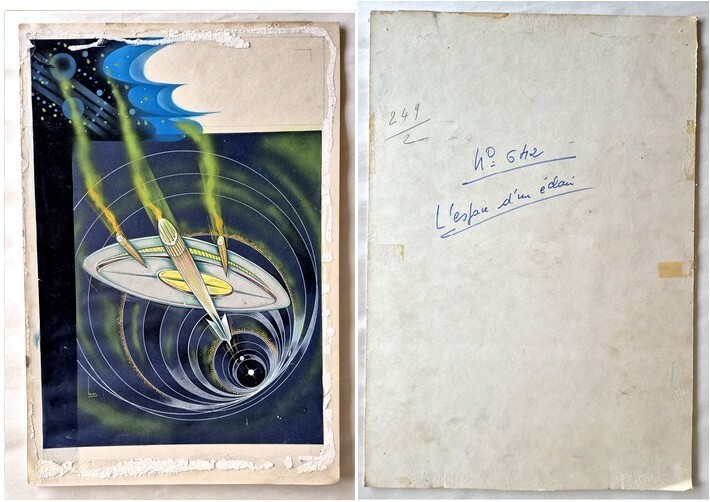
201332077Magnifique gouache en couleurs, sur carton fort, au format 43 x 29,5 cm, réalisée pour le livre de Maurice Limat " L'Espace d'un éclair ", paru aux éditions Fleuve Noir en 1974 dans la collection Anticipation sous le n° 642. Dessin signé des initiales " Br ". Titre et numéro écrits au dos par René Brantonne. L'original avait été collé sous un passe-partout et celui-ci ayant disparu, il y a quelques traces de papier et frottis dans les marges. De toute rareté. Le troisième scan est une reproduction du livre publié. Ce dernier n'est pas fourni.
1940ZB445484Paris: Masson et Cie. Edieurs 1940-1943. Eleventh Series: volumes 1 to 18 an uninterrupted run of complete volumes ex library good PRICE IS FOR THE LOT:. - If you are reading this this item is actually physically in our stock and ready for shipment once ordered. We are not bookjackers. Buyer is responsible for any additional duties taxes or fees required by recipient's country. Photos available upon request. Paris: Masson et Cie., Edieurs unknown
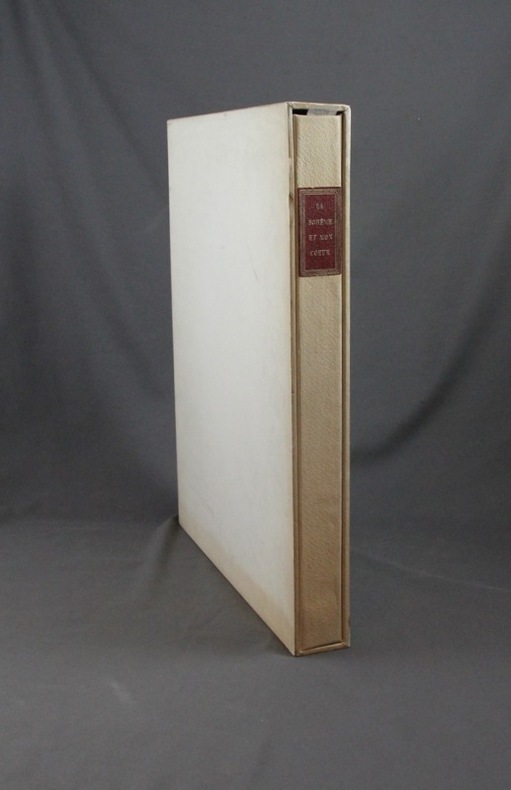
19433994Sans lieu, Ed. du Milieu du monde, 1943. 1 vol. en feuilles in-foilo de 187 p., [2 ff.]. Couverture écrue à rabats, sous chemise et étui de carton blanc, pièce de titre rouge au dos de la chemise. Belle condition.
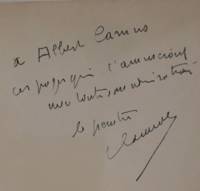
2669Monte Carlo: André Sauret. First editon. In origianal paper. In fine condition without the folder nor the case of the edition/Inscribed to Camus. 12 original full-page lithographs in black by the author. 12 original full-page lithographs in black by the author. First editon. In origianal paper. 176 p. First edition printed at 350 copies on large Arches vellum plus a few copies reserved for the author illustrated with 12 original full-page lithographs in black by the author.<br /> <br /> Example of Albert Camus being part of the few copies out of trade not signed but with this beautiful sending of the author:<br /> <br /> " to Albert Camus // these pages which will amuse him // with all his admiration // the painter // Vlaminck André Sauret unknown
19842508DARGAUD 1984. 1. F. Lucky Luke schwerstverletzt! Linker Arm fehlt und linkes Bein angerissen! Jolly Jumper geschockt erstarrt! DARGAUD unknown