48 390 résultats
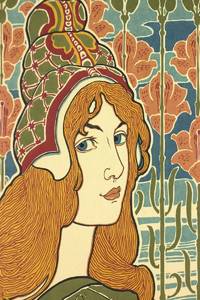
189874290Paris: Imprimerie Champenoispour CH. MassonH. Piazza 1898. Fine. Imprimerie Champenois pour CH. Masson H. Piazza Paris Février 1898 33.50 x 23 cm une feuille et une serpente Rare original lithograph printed in colour by Louis John Rhead for L'Estampe Moderne Deuxième prime gratuite réservée aux abonnés d'un an de L'Estampe Moderne Second free gift reserved for the annual subscribers to L'Estampe Moderne. One of the 50 grand luxe proofs printed on Japon paper with wide margins artist's signature and date in the plate publisher's embossed stamp showing a child's profile on the lower margin a numbered stamp of the tirage de luxe on the back; engraving preceded by a protective tissue guard with the name of the artist the title and a poem; as well as a blank protective tissue guard. Lithograph inspired by a poem extract from Leconte de Lisle's Chansons écossaises printed as a caption on the print's protective tissue guard. A magnificent monthly French publication published between May 1897 and April 1899 ""L'Estampe moderne"" included unpublished chromolithographs which unlike other magazine such as ""Les Maîtres de l'Affiche"" and as is stipulated on the protective tissue guard were specially made for the magazine by each artist. There are thus 100 prints that appeared in total covering the major artistic movements of the late 19th century: Symbolism Art Nouveau the Pre-Raphaelites Orientalism and the Belle Epoque. Each delivery of four prints had 2000 copies and sold for 3.50F with 100 copies on Japon offered for 10F. Henri Piazza also planned a high-luxury confidential print: 50 copies with wide margins on Japon and 50 in black and white at the considerable price of 30F. This beautifully-sized print is superbly printed on the most prestigious of papers: Japon. Thick silky satin and pearly the paper helps to make each page an artwork in its own right. Its ink absorption quality and its affinity with colours also make it the ideal medium for these beautiful lithographs. French collectors' interest in artistic posters grew from the beginning of the 1890s. Octave Uzanne invented the term affichomanie poster-mania for this growing interest. The poster originally common-place and plastered across the streets of the capital then became an object of art and its ephemeral medium then became precious and dedicated to conservation. Piazza decided to remove the poster from its advertising role and elevate it to the rank of a work of art in its own right in the same way as the luxury illustrated book. He assembled and printed a prestigious collection of entirely original works by the most well-known European artists of the time: Georges de Feure Eugène Grasset Henri Detouche Emile Berchmans Louis Rhead Gaston de Latenay Lucien Lévy-Dhurmer Gustave-Max Stevens Charles Doudelet Hans Christiansen Henri Fantin-Latour Steinlen Ibels Engels Willette Henri Meunier Evenepoël Bellery-Desfontaines Charles Léandre etc. A beautiful copy in an Art Nouveau style. Imprimerie Champenoispour CH. MassonH. Piazza unknown
196678778s. l. 1966. Fine. s. l. s. d. Février 1966 21 x 27 cm une feuille Autograph letter signed by Jacques Chardonne with his initials 14 lines in blue ink. Fold inherent to mailing. A date has been added at the top of the letter February 66 probably the date this missive was received by the addressee. A small ink stain at the foot of the letter. Jacques Chardonne congratulates his correspondent on his departure for a trip to Megève even though he recommends that he disdain as a ""young king of Paris"" this kind of place just good enough to impress: ""rich provincials who feel in exile in Tourcoing or Abbeville sic and who come to Megève to see high society at any cost"" and to prefer to this resort other places more beautiful and less expensive : "". if it's about mountains for health you have others just as beautiful elsewhere for a quarter of the price"". unknown
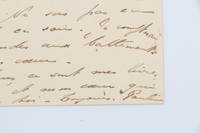
190078897s. l. Paris 1900. Fine. s. l. Paris s. d. ca 1900 9.50 x 5.60 cm une carte rédigée des deux côtés Autograph manuscript card signed ""Pauline"" and addressed to Natalie Clifford Barney written in black ink on both sides. Two small pinholes at the top of this card which accompanied a bouquet: ""Méchante d'être partie si vite ! - voici des orchidées blanches - elles te défendront contre les doutes et les pensées tristes. Elles te protègeront et t'assureront de ma profonde et éternelle tendresse. Ne sois pas en retard ce soir. Je compterai les secondes aux battements de mon coeur. Ces fleurs ce sont mes lèvres mon âme et mon coeur qui vont vers toi - Toujours."" ""Naughty to have left so quickly! - here are white orchids - they will defend you against doubts and sad thoughts. They will protect you and assure you of my deep and eternal tenderness. Don't be late tonight. I will count the seconds to the beating of my heart. These flowers are my lips my soul and my heart going towards you - Always."" It was at the end of 1899 and through the intermediary of Violette Shillito that Renée Vivien - then Pauline Tarn - made the acquaintance of Natalie Clifford Barney ""cette Américaine plus souple qu'une écharpe dont l'étincelant visage brille de cheveux d'or de prunelles bleu de mer de dents implacables"" ""this American more supple than a scarf whose sparkling face shines with golden hair sea-blue eyes and implacable teeth"" Colette Claudine à Paris. Natalie who had just experienced a summer idyll with the scandalous Liane de Pougy who had initiated her into sapphism paid only discreet attention to this new acquaintance. Renée however was completely captivated by the young American and would relate this love at first sight in her autobiographical novel Une Femme m'apparut: ""J'évoquai l'heure déjà lointaine où je la vis pour la première fois et le frisson qui me parcourut lorsque mes yeux rencontrèrent ses yeux d'acier mortel ses yeux aigus et bleus comme une lame. J'eus l'obscur prescience que cette femme m'intimait l'ordre du destin que son visage était le visage redouté de mon avenir. Je sentis près d'elle les vertiges lumineux qui montent de l'abîme et l'appel de l'eau très profonde. Le charme du péril émanait d'elle et m'attirait inexorablement. Je n'essayai point de la fuir car j'aurais échappé plus aisément à la mort."" ""I evoked the already distant hour when I saw her for the first time and the shiver that ran through me when my eyes met her eyes of mortal steel her eyes sharp and blue like a blade. I had the obscure presentiment that this woman was giving me destiny's order that her face was the dreaded face of my future. I felt near her the luminous vertigo that rises from the abyss and the call of very deep water. The charm of peril emanated from her and attracted me inexorably. I did not try to flee her for I would have escaped death more easily."" ""Hiver 1899-1900. Débuts de l'idylle. Un soir Vivien est invitée par sa nouvelle amie dans l'atelier de Mme Barney mère de Natalie 153 avenue Victor-Hugo à l'angle de la rue de Longchamp. Natalie s'enhardit à lire des vers de sa composition. Comme Vivien lui dit aimer ces vers elle lui répond qu'il vaut mieux aimer le poète. Réponse bien digne de l'Amazone."" ""Winter 1899-1900. Beginning of the idyll. One evening Vivien is invited by her new friend to Mme Barney's studio Natalie's mother 153 avenue Victor-Hugo at the corner of rue de Longchamp. Natalie ventures to read verses of her composition. When Vivien tells her she loves these verses she replies that it is better to love the poet. A response quite worthy of the Amazon."" J.-P. Goujon Tes blessures sont plus douces que leurs caresses Two years of unequal happiness followed punctuated by Natalie's recurring infidelities and Renée's pathological jealousy whose letters oscillated between impassioned declarations and painful mea culpas. ""Renée Vivien c'est la fille de Sappho et de Baudelaire c'est la f unknown
184771901Paris 1847. Fine. Paris 21 mars 1847 13.50 x 21 cm une feuille rempliée Autograph letter signed by the painter Louis Cabat French landscape painter and engraver of the Barbizon School. One folded sheet The painter solicits the help of a benefactress for an artists' lottery for the ""father of a very distinguished artist who died a few years ago"". unknown
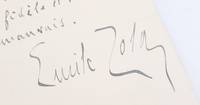
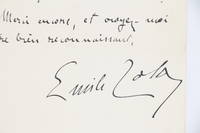
189886837Weybridge 1898. Fine. In the midst of universal cowardice you wouldn't believe how moved I am to feel a few faithful people around me Weybridge 19 août 1898 13.50 x 20.50 cm quatre pages sur un bifeuillet Autograph letter signed by Emile Zola to Octave Mirbeau dated August 19 1898. Four pages in black ink on a bifolium written to Octave Mirbeau. Usual trace of horizontal fold. Published in Zola's uvres complètes t. XLIX ed. F. Bernouard 1927 p. 808. Exceptional testament of friendship and self-sacrifice from Emile Zola in exile after being sentenced to the maximum penalty for writing ""J'accuse!"" the most famous article proclaming Captain Dreyfus's innocence. After his historic article in L'Aurore Zola was sentenced a first time by a jury on February 23 1898 to one year's imprisonment and a fine of three thousand francs. The verdict was overturned and the case was referred back to the Versailles court of justice which upheld only three of the eight hundred lines in ""J'accuse!"" as a charge. Unwilling to accept such a stifling of the proceedings Zola's defense decided to default and the conviction was upheld. After his eventful exit from the courthouse Clémenceau and his lawyer Labori advised him to leave the country before the judgment could become enforceable. Zola left on the last train that evening with only a shirt hastily rolled up in newspaper as luggage. A month after his departure the writer writes this superb reply to a letter from his loyal supporter Octave Mirbeau who had written to him a few days earlier: ""We think only of you; there isn't a minute of our existence that you don't fill entirely"" August 14 1898. Settled in the London suburb of Weybridge he angrily receives the ""echoes of Paris"" and is enraged to see Esterhazy the true culprit of the Dreyfus Affair once again cleared - this time by civil courts. ""My dear friend Thank you for your kind letter . In the midst of universal cowardice you wouldn't believe how moved I am to feel a few faithful people around me. My existence here has become possible since I've been able to get back to work. Work has always comforted me saved me. But my poor hands are still trembling with a shiver that cannot end. You wouldn't believe the outrage I feel at the echoes from France that reach me. In the evening when daylight falls I think it's the end of the world. You think I should go back and make myself a prisoner without returning to Versailles. That would be too good to have the peace of prison and I don't think it's possible. I didn't set out to go back like that; our attitude would be neither logical nor beautiful. Rather I think I'm in indefinite exile unless I run the abominable risk of a new trial. Besides we won't be able to make up our minds until October. And by then who knows Although I'm counting on a miracle in which I have little faith. So let us be brave my friend and let our work be done! If I can keep working things won't be too bad yet. . I shake your hand my good friend the faithful and rare friend of bad days"". Poignant manuscript confession from Zola forced into exile. Death would strike him in the midst of his glory days without him ever knowing the outcome of the affair he had devoted so many years of struggle. unknown
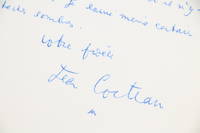
195287645Saint-Jean-Cap-Ferrat 1952. Fine. Saint-Jean-Cap-Ferrat 8 Novembre 1952 21 x 27 cm une page Autograph letter dated and signed by Jean Cocteau 15 lines in blue ink addressed to a friend from Saint-Jean-Cap-Ferrat about a painting he is about to complete. Fold marks inherent to postal delivery. Jean Cocteau questions his correspondent about the shipping arrangements for his work which he plans to finish the day after writing this letter: ""Should I bring it back to Paris or send it elsewhere if that suits you The best would be to remove the canvas from its frame and roll it. Please be so kind as to reply quickly so that I can prepare the packaging."" ; he briefly describes the work: "". will be 92 cm in height and 1 m 26 wide. It appears as if it were in flat tints and there is not a single flat surface. I even leave some sunken areas that form dark patches."" unknown
191183331s. l.: S. n. 1911. Fine. S. n. s. l. Janvier 1911 21 x 27 cm 2 feuilles Autograph letter signed by the dandy count 31 lines written in black ink addressed probably to his friend and bibliographer the critic Henri Lapauze notably mentioning a work by Ingres in his possession also thanking his correspondent for his always lucid and benevolent critiques toward him. ""Cher ami je crois posséder une miniature d'Ingres père ; c'est laid mais assez curieux un tétard de Georges Rivière junior mais un tétard sur ivoire ! Merci pour votre mot révélateur mais toujours compréhensif et sympathique en ce qui vous concerne tous les deux c'est l'important. Il n'y a qu'un terme que je n'accepte pas dans votre protestation c'est le monosyllabe tous. ""Envers et contre plusieurs"" suffit et d'ailleurs est plus exact. Tous le monde n'est pas si bête que de ne pas voir et entendre ce que je mets dans mes livres bien notamment dans celui-là et ce que ça vaut. Il y a même beaucoup de gens qui s'en aperçoivent m'en félicitant et m'en remerciant de cent façons. Et comme ce sont les meilleurs je suis content. Vous êtes de ceux-là tous deux. Je le savais ; mais une fois d eplus je m'en félicite non sans vous en complimenter un peu. Votre Montesquiou Janvier 911."" ""Dear friend I believe I possess a miniature by Ingres the elder; it is ugly but quite curious a tadpole by Georges Rivière junior but a tadpole on ivory! Thank you for your revealing word but always understanding and sympathetic as far as you are concerned both of you that's what's important. There is only one term I do not accept in your protest it is the monosyllable 'all'. 'Against and despite several' suffices and moreover is more exact. Everyone is not so stupid as not to see and hear what I put in my books particularly in that one and what it's worth. There are even many people who notice it congratulating and thanking me in a hundred ways. And as they are the best I am content. You are among those both of you. I knew it; but once more I congratulate myself for it not without complimenting you a little. Your Montesquiou January 911."" On a separate sheet Robert de Montesquiou added as a postscript: ""P.S. Votre ""L'homme propose et Dieu dispose"" m'a bien fait rire. Cette fois c'est le Dieu d'Israël ; et celui-là n'est jamais tout à fait converti."" ""P.S. Your 'Man proposes and God disposes' made me laugh heartily. This time it's the God of Israel; and that one is never quite converted."" Traces of folds inherent to postal handling. S. n. unknown
199679439Paris: S. n. 1996. Fine. S. n. Paris 2 Juillet 1996 21 x 29.50 cm une feuille une enveloppe Manuscript dated and signed letter of 37 lines by Alphonse Boudard to his great friend and companion of well-watered lunches the Brussels journalist André Tillieu who was like Alphonse Boudard a great friend of Georges Brassens but also of Louis Nucéra. Two fold marks inherent to the letter's insertion in the envelope envelope included. ""Vieux Je deviens de en niçois sous la protection bien sûr du cher Louis Louis Nucéra qui arrive tout de même à pédaler dans les collines malgré les ennuis de santé de Suzanne. Un mal difficile à cerner mais qui la fait souffrir beaucoup. Merci de ta chaleureuse lettre. Là j'ai voulu faire du pur divertissement. Une petite suite pour sexualité ecclésiastique. Bien sûr je soigne toujours le paysage historique ; c'est ce qui donne de l'épaisseur une dimension de vérité à l'aventure de Mme Blandine. Tes références à Sartre sont plaisantes. je n'y avais pas pensé. Je me suis surtout efforcé de faire un roman genre XVIIIe. Restif Crébillon ou même ""les infortunes de la vertu"" de Sade. un Sade gentillet après tout. En septembre ou octobre je vais me propulser en Belgique pour la promotion du livre. Je te ferai signe à l'avance pour qu'on puisse casser la graine de l'amitié. Mon ami le metteur en scène Jacques Rosny a tiré un spectacle avec des extraits de la Cerise les Combattants etc. Il fera une escale de quelques jours dans un théâtre à Liège. Si tu veux y faire un tour tu pourras me dire si tu peux y faire un tour tu pourras me dire ce que tu en penses. J'espère que les choses vont bien pour toi et les tiens. Donc à bientôt. avec mon amitié. ABoudard."" ""Old friend I'm becoming more and more from Nice under the protection of course of dear Louis Louis Nucéra who still manages to pedal in the hills despite Suzanne's health problems. An illness difficult to pinpoint but which makes her suffer greatly. Thank you for your warm letter. Here I wanted to create pure entertainment. A little sequel for ecclesiastical sexuality. Of course I always take care with the historical landscape; that's what gives depth a dimension of truth to Madame Blandine's adventure. Your references to Sartre are pleasant. I hadn't thought of that. I mainly tried to write an 18th-century genre novel. Restif Crébillon or even Sade's ""les infortunes de la vertu"". A gentle Sade after all. In September or October I'm going to propel myself to Belgium for the book's promotion. I'll let you know in advance so we can break bread in friendship. My friend the director Jacques Rosny has created a show with excerpts from la Cerise les Combattants etc. He'll make a stop of a few days at a theater in Liège. If you want to take a look you can tell me what you think of it. I hope things are going well for you and yours. So see you soon. with my friendship. ABoudard."" André Tillieu from Brussels very close friend and biographer of Georges Brassens maintained an epistolary correspondence with Alphonse Boudard for almost thirty years from 1972 until the latter's death in 2000. The witty Parisian writer quickly demonstrated his friendship to him considering him as one of the rare critics to understand him perfectly to the point of clearly explaining in his reviews what he himself expressed only incompletely and sometimes confusedly in his books. André Tillieu therefore became part of the small circle of Alphonse Boudard's true friends on the same level as le Gros Georges Georges Brassens le Niçois Louis Nucéra and René Fallet with whom he liked to share hearty well-watered meals and cycling excursions. As death gradually took away his best friends one by one André Tillieu remained one of Alphonse's very last pals. S. n. unknown
188279108Médan 1882. Fine. Médan 23 juin 1882 13.40 x 21.60 cm 1 page 1/2 sur un double feuillet - enveloppe jointe Autograph letter signed by Emile Zola - apparently unpublished - addressed to Léon Carbonnaux written in black ink on a double sheet. Folds inherent to mailing. Envelope included. Important testimony to the colossal documentation work and the capital role of Emile Zola's informants in depicting his immense natural and social fresco. This letter was sent to Léon Carbonnaux department head at Bon Marché who transmitted precious information to Emile Zola for the creation of the eleventh volume of the Rougon-Macquart series: Au Bonheur des Dames. Only two letters from Léon Carbonnaux to Emile Zola are known: they can be consulted in the digitization of the preparatory file for Bonheur des Dames made available online by the Bibliothèque nationale de France. However we know thanks to this same file which contains a long section entitled ""Notes Carbonnaux"" that this department head at Bon Marché provided a significant amount of information to Zola particularly about employee customs and their remuneration. The two men undoubtedly met when Emile Zola eager for information about the functioning of department stores conducted field research in February and March 1882. This response would therefore be the very first that the writer addressed to the department head in reply to his letter of June 19 1882. Far from imagining the keen success that this new novel would achieve Zola even seems to take it lightly: ""Je désire simplement toucher au sujet dans mon livre pour le besoin du petit drame commercial qui me sert de fable. Vos notes sont excellentes. . Enfin me voilà au travail. Le sujet est à la fois bien vaste - et bien ingrat pour un roman. On devra me tolérer un peu de fiction car il faut bien que je passionne la matière. Mais je tâche de m'en tenir le plus strictement possible à mes notes."" ""I simply wish to touch on the subject in my book for the needs of the little commercial drama that serves as my fable. Your notes are excellent. . Finally here I am at work. The subject is both very vast - and very thankless for a novel. One will have to tolerate a bit of fiction from me for I must make the material passionate. But I try to stick as strictly as possible to my notes."" It must be said that Carbonnaux takes his role as informant very much to heart and having no doubt about the book's success he writes: ""Dans le bâtiment chez nous d'ailleurs partout on attend votre livre. Les lecteurs ne vous manqueront pas. Soyez-en sûr. Vous n'en êtes plus à compter les succès celui-là s'annonce comme devant dépasser les autres."" letter of June 19 1882 For another work on the same subject has just appeared: ""J'ai lu le volume de Pierre Giffard. Il me paraît comme vous injuste et même faux dans plusieurs parties. C'est bâclé. Il aurait fallu pour un pareil ouvrage de documents purs une entière exactitude. Moi qui écris une uvre d'imagination je ne me permettrai pas de tels écarts."" ""I have read Pierre Giffard's volume. It seems to me like you unjust and even false in several parts. It is hastily done. For such a work of pure documents complete accuracy would have been necessary. I who write a work of imagination would not allow myself such deviations.""It was Carbonnaux who had pointed out the work to Zola: ""Pierre Giffard du Figaro vient de faire paraître chez Havard un vol de 300 pages intitulé « Les Grands bazars de Paris ». . On sait que le Figaro est inféodé au Louvre magasin concurrent au Bon Marché & on peut assurer que ce livre a été commandé et bâclé dès que votre intention de traiter le même sujet a été connue. . Il fallait déguiser un peu la réclame pour le Louvre."" letter of June 19 1882 We can clearly see here how much department stores fascinate and we understand the immense success that this novel by Zola describing their advent and supremacy would achieve. unknown
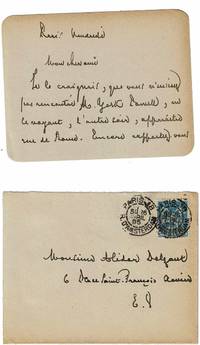
189576349Paris 1895. Fine. Paris 26 avril 1895 11.40 x 8.80 cm une carte recto-verso et une enveloppe Autograph letter signed by Stéphane Mallarmé addressed to Alidor Delzant written on both sides in black ink. Envelope included. Alidor Delzant was a lawyer collector and bibliophile. A friend of the Goncourts he devoted a work to them and was Edmond's secretary and testamentary legatee. ""Je le craignais que vous n'eussiez pas rencontré M. York Powell en le voyant l'autre soir apparaître rue de Rome. Encore rapportez-vous du merveilleux Oxford un souvenir."" ""I feared as much that you had not met M. York Powell seeing him the other evening appear on rue de Rome. Still you bring back from wonderful Oxford a memory."" Mallarmé had recommended his friend Frederick York Powell professor of history to Delzant who was to travel to Oxford in March 1895. It appears from this letter that the two men had not met previously. unknown
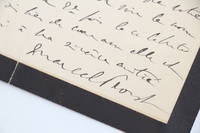
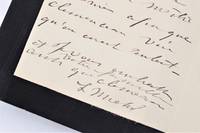
190484876s. l. 1904. Fine. Because I also want success I am extremely material in my wishes for those I love and I wish them every pleasure from the highest to the crudest. s. l. mardi 25 octobre 1904 12.60 x 20.40 cm 12 pages sur 3 bifeuillets Autograph letter signed by Marcel Proust addressed to René Peter. Twelve pages written in black ink on three bifolia framed in black. Tears at the ends along the folds of the bifolia not affecting the text. Published in Kolb IV n°168. A very long letter from Proust full of innuendo to the playwright René Peter. Praising Peter's success Proust confesses to his own vanity as a writer and his literary ambitions. He subtly lets his jealousy for Peter's mistress shine through and declares his absolute devotion to Reynaldo Hahn. This is one of the first letters he sends to his childhood friend after recently reconnecting with him. Proust eternally plagued by ailments remains a recluse and apologizes for missing the rehearsal of Peter's new play Le Chiffon. Peter's three-act comedy with music by Reynaldo Hahn premiered at the Athénée the following month and was a huge success with around sixty performances before the end of the year. The young Proust relies on the glowing opinion of Hahn who had attended the rehearsals and the missive becomes a love letter for the composer and his impeccable judgement: ""Reynaldo told me that your play was delightful and ravishing which is not quite the same thing that he laughed and cried in it as he never laughs or cries in the theater and that the language was exquisite. Of that I was certain. But knowing nothing about you I couldn't know if you had dramatic genius. I am certain of it now because even if I do not know a judge as severe as ridiculously severe as Reynaldo I also do not know one who has more taste giving his enthusiasm very great value in my eyes. In a characteristic tangle of confession and denial Proust barely hides his ambitions and his quest for recognition. He hopes and prays for the same laurels he places on Peter's head: your poor and charming mother who like all those who love and who have lived life bruising all our tenderness has suffered so much is witnessing this great happiness these first rays of glory on your charming forehead which Vauvenargues says softer as the rising sun. I only speak of them in quotations having never known them myself! He will even end up instilling his own literary vocation into the fictional life of the narrator of In Search of Lost Time although the narrator's journey as a man of letters is more marked by disappointments than rays of glory so long awaited by Proust himself. However it culminates in Time Regained with an epiphany: the narrator now knows what to write and above all how to write it. The letter marks the beginnings of the Proust-Peter-Hahn trio whose complicity was such that they formed a special vocabulary of which only they had the secret. The river of words in this letter perfectly illustrates the undeniable link between desire and intellectual admiration: Because I also want success I am extremely material in my wishes for those I love and I wish them every pleasure from the highest to the crudest. Despite these displays of generosity the writer cannot however mask a certain jealousy towards Robert Danceny the fictional co-author of Le Chiffon who was none other than Peter's mistress Mme Dansaërt. Proust elegantly but explicitly refers to her: It makes me happy to think that the charming woman who I am assured is hiding under the male name of your collaborator shares half of your work. I am not talking about your success because whether she worked with you or not she would always have shared your success with her heart having I believe a deep friendship for you. Typical of a Proust transposing his desires through fiction the writer will form various dramatic and morbid scenarios between Peter and this young woman in the following years: I unknown
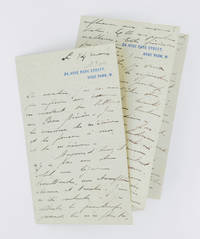
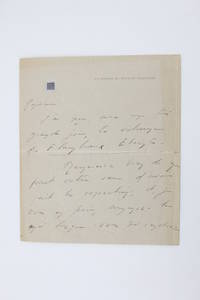
190079025s. l. Londres London 1900. Fine. s. l. Londres London Le 14 mars 1900 9.90 x 15.20 cm 8 pages sur 2 doubles feuillets Autograph letter signed ""Pauline"" by Renée Vivien written in black ink on two double sheets of letterhead paper from 24 Hyde Park Street. Transverse folds inherent to posting. A very beautiful and poetic letter written from London where the young Renée savors a sweet melancholy: ""Today there was no sun a light fog a dark and sad atmosphere. I was pleased by it I hate spring when you are no longer here and the sun and soft air hurt me. I love the sadness of the sky and the moon which goes well with my thoughts."" Despite a very busy schedule ""I am very tired this evening I return from the Alhambra where mama took me to see the military ballet and hear the patriotic songs. . I went skating in the afternoon in the morning I went to see one of my friends here who is very kind although having too much religion for my taste."" the young woman is bored in this city that she profoundly detests ""How can you be jealous you whom I adore of London which I hate I have been unhappy since I entered this city. It is dark it has a bad influence on my destiny. It brings me misfortune. It will end up killing me if I stay. I am afraid of it I want to leave to join you my darling my spring you who are the being of light and beauty my love my happiness and my consolation."" and finds comfort in the memory of her beloved of whom she thinks every moment: ""You are right to feel my thoughts around you I desperately throw my soul across space so that it finds you Your memory is in all my actions all my words it is you that I see through the things that surround me."" Natalie is everywhere even in her reading: ""I will read 'Séraphita' to find you a little in those pages of Balzac. Everything that reminds me of you everything that has some connection with you even distant is dear to me."" As Jean Chalon shows in his biography of Natalie Clifford Barney Portrait d'une séductrice Séraphita is a founding novel of the Amazon's thought and one of the first books she bought upon her arrival in Europe: ""Natalie had vainly sought this philosophical novel by Balzac in the bookstores of Washington. She would find this book in Europe and push refinement to the point of reading the angelic avatars of Séraphitus-Séraphita in that Norway which forms its setting."" From this underlined passage in her copy one notices that she retains more of its feminism than the concept of intersexuality: ""Would this not be using your rights as a man We must always please you relax you always be cheerful and have only the whims that amuse you. What must I do my friend Do you want me to sing to dance when fatigue takes away the use of my voice and legs Gentlemen even if we were dying we must still smile at you! You call this I believe reigning. Poor women! I pity them."" As evidenced by a letter addressed to her previous lover Liane de Pougy she had already introduced her to this Balzacian heroine: ""You will come to me I will go to you and we will marry our lives. That day you will read me Séraphîta. She will awaken our slumbering souls and you will lend to the sleeping words the beauty of your voice. It will be our litany of love."" It was at the end of 1899 and through Violette Shillito that Renée Vivien - then Pauline Tarn - made the acquaintance of Natalie Clifford Barney ""this American more supple than a scarf whose sparkling face shines with golden hair sea-blue pupils and implacable teeth"" Colette Claudine à Paris. Natalie who had just lived a summer idyll with the sulfurous Liane de Pougy who had initiated her into sapphism paid only discreet attention to this new acquaintance. Renée on the other hand was totally captivated by the young American and would relate this love at first sight in her autobiographical novel Une Femme m'apparut : ""I evoked the already distant hour when I saw her for the first time and t unknown
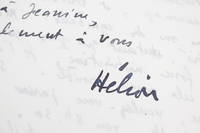
194986755Paris 1949. Fine. Paris 8 Novembre 1949 13.50 x 20 cm quatre pages sur deux feuillets Autograph letter dated and signed by Jean Hélion addressed to Raymond Queneau 41 lines four pages on two leaves written in black ink. Jean Hélion cannot respond favorably to an invitation extended by his friend Raymond Queneau partly due to his homebody nature: ""J'ai pris l'habitude de rester chez nous le samedi après-midi : à l'atelier jusqu'à 5 heures et là-haut jusqu'à l'heure du dîner pour y recevoit toutes sortes de jeunes gens que je n'ai pas le temps de voir un par un. Mais j'aimerais davantage vous montrer à vous seul un peu tranquille et à n'importe quelle heure. Ne passez-vous jamais de ce côté "" ""I have gotten into the habit of staying at home on Saturday afternoons: at the studio until 5 o'clock and upstairs until dinner time to receive all sorts of young people whom I don't have time to see one by one. But I would prefer to show you alone a bit quietly and at any time. Don't you ever come by this way"" He worries about the political path of one of their mutual friends the pacifist militant Garry Davis who created in 1948 the World Citizens movement and in 1954 the World Service Authority organization: ""Je m'occupe encore de ce bon Garry Davis qui s'engage maintenant dans la non-violence mais d'une façon qui pourrait être violente. Breton a tapé dessus comme sur des cymbales. Mais moi par amitié autant que pour une confiance dans sa force instinctive je l'aiderai tant que possible. Il veut encore consulter ses amis et il en a grand besoin. Camus Mounier Altman l'abbé Pierre et quelques autres lui sont demeurés dévoués."" ""I'm still taking care of that good Garry Davis who is now engaging in non-violence but in a way that could be violent. Breton struck out at him like cymbals. But I out of friendship as much as for confidence in his instinctive strength will help him as much as possible. He still wants to consult his friends and he has great need of it. Camus Mounier Altman Abbé Pierre and some others have remained devoted to him."" unknown
191586629Cagnes Cagnes-sur-Mer 1915. Fine. Cagnes Cagnes-sur-Mer 6 avril 1915 10.90 x 16.40 cm 1 page sur un feuillet Autograph letter signed by Auguste Renoir dated in his hand April 6 1915. One page in black ink on a sheet with letterhead ""Les Collettes Cagnes A.-M."". Transverse fold marks inherent to posting. Renoir composed this missive in his house at Les Collettes in Cagnes which witnessed the birth of works of great sensuality and where he also tried his hand at sculpture: « Cher ami J'ai vu ta lettre avec plaisir je me porte à merveille et ce matin reçu lettre de Jean Renoir qui se repose quelques jours. Je t'écrirai plus longuement bientôt tâche surtout malgré tous les ennuis de bien te porter. A toi » Dear friend I was pleased to see your letter I am in excellent health and this morning received a letter from Jean Renoir who is resting for a few days. I will write to you at greater length soon try above all despite all the troubles to take good care of yourself. Yours We find this same enthusiasm from Renoir a few weeks later in the memoirs of his son Jean who was hit by a German bullet shortly after this letter: « Mon père m'attendait dans son fauteuil roulant. Il y avait déjà plusieurs années qu'il ne marchait plus. Je le trouvais beaucoup plus recroquevillé qu'à mon départ pour le front. Par contre son expression était d'une vivacité extrême. Il m'avait entendu sur le palier et rayonnait de sa malice heureuse. Ses yeux semblaient dire : 'cette fois ils t'ont bien raté !' » My father was waiting for me in his wheelchair. It had been several years since he could walk. I found him much more hunched over than when I left for the front. However his expression was extremely lively. He had heard me on the landing and was beaming with his happy mischief. His eyes seemed to say: 'this time they really missed you!'. Touching and radiant note from the great painter a very visual document. Provenance: pasted stamp on verso of the sheet from the collection of the scholar and collector Ray Rawlins. unknown
188879098Paris 1888. Fine. Paris 11 février 1888 13.20 x 20.50 cm 2 pages sur un double feuillet Autograph letter signed by Emile Zola addressed to Henry Fouquier written in black ink on a bifolium. Usual folds from mailing. This letter was transcribed in the complete correspondence of Emile Zola published by the CNRS and the Presses de l'Université de Montréal. A fine letter evoking La Terre and Tolstoy's The Power of Darkness. Henry Fouquier 1838-1900 was a literary critic and columnist for numerous newspapers. A close friend of Guy de Maupassant he supported Emile Zolas candidacy for the Académie française. This letter was written to him the day after the performance of Tolstoy's The Power of Darkness at the Théâtre-Libre. We have not found evidence of an article in which the journalist explicitly drew a parallel between the Russian drama and Zolas La Terre but Zola here addresses his thanks: « Merci mon cher Fouquier de ce que vous voulez bien dire de « la Terre » si attaquée. J'en suis touché vivement et croyez à toute ma gratitude. » It must be said that the fifteenth volume of the Rougon-Macquart cycle was harshly received unleashing passions from the moment of its serial publication in Gil Blas. On 18 August 1887 even before the conclusion of the novel was revealed to the public Le Figaro published the Manifeste des Cinq written by Paul Bonnetain J.-H. Rosny Lucien Descaves Paul Margueritte and Gustave Guiches. These young authors issued a severe verdict: « La Terre a paru. La déception a été profonde et douloureuse. Non seulement l'observation est superficielle les trucs démodés la narration commune et dépourvue de caractéristiques mais la note ordurière est exacerbée encore descendue à des saletés si basses que par instants on se croirait devant un recueil de scatologie : le Maître est descendu au fond de l'immondice. . Nous répudions ces bonshommes de rhétorique zoliste ces silhouettes énormes surhumaines et biscornues dénuées de complication jetées brutalement en masses lourdes dans des milieux aperçus au hasard des portières d'express. De cette dernière uvre du grand cerveau qui lança L'Assommoir sur le monde de cette Terre bâtarde nous nous éloignons résolument mais non sans tristesse. Il nous poigne de repousser l'homme que nous avons trop fervemment aimé. » Zola who had been developing the idea of a peasant novel for a decade was deeply affected. Though he never responded publicly to these accusations his correspondence is strewn with clarifications about the work whose sheer brutality alone seemed to occupy readers minds: « Mais vous ajoutez que notre thèse à Tolstoï et à moi est la même et peut se résumer en ceci : le travail de la terre est corrupteur. Tolstoï il me semble protesterait bien haut et quant à moi je vous affirme que je n'ai jamais voulu prouver une telle chose radicalement fausse à mon avis. Ce que je pense c'est que la petite propriété telle qu'elle existe chez nous c'est que la suite de faits sociaux qui ont abouti à notre forme sociale nous ont donné notre paysan d'aujourd'hui avec ses qualités et ses vices. Notre paysan est le prisonnier de sa terre et non l'homme libre qu'il devrait être. Comment voulez-vous qu'il n'y étouffe pas dans son ignorance et sa passion unique Labourer est très sain mais à la condition qu'on sera le maître de son champ au lieu d'en être le forçat. Je me suis exténué à faire sortir cette vérité de mon livre si l'on ne m'a pas compris la faute en est sans doute à moi. » A remarkable letter from the master of Naturalism shedding new light on one of the most brutal volumes of the Rougon-Macquart series. unknown
182784601Paris 1827. Fine. Christian Genius and Human Error Paris 22 juin 1827 15.30 x 19.60 cm un feuillet Autograph letter signed by François René de Chateaubriand addressed to M. Beaudesson notary in Paris dated by the author June 22 1827. Two pages in black ink on one leaf. Manuscript signature of the letter's recipient in the lower part of the second page. Discreet transverse creases. Letter partially published in the Revue d'histoire littéraire de la France Volume 31 1924 p. 347. Chateaubriand responds to a scrupulous reader who had pointed out errors in the quotations of texts that compose his Génie du Christianisme. ""Je me suis fait Monsieur une loi de ne rien changer au texte de mes anciens ouvrages afin que ceux qui les ont achetés autrefois ne soient pas obligés de les racheter aujourd'hui. De là il est arrivé que j'ai laissé aux différentes personnes chargées de revoir les différents textes le soin de corriger les fautes d'impression. Et mes devoirs à remplir à la chambre des pairs m'ont encore empêché ces derniers temps de surveiller les épreuves. Je vous remercie Monsieur de votre intérêt : j'avertirai M. Ladvocat et s'il le faut des cartons seront faits et envoyés aux souscripteurs. J'ai l'honneur d'être Monsieur avec toute la reconnaissance possible et la considération la plus distinguée Votre très humble et très obéissant serviteur Chateaubriand"" ""I have made it a rule Sir to change nothing in the text of my old works so that those who bought them in the past are not obliged to buy them again today. Hence it has happened that I have left to the various persons charged with reviewing the different texts the task of correcting printing errors. And my duties to fulfill in the House of Peers have further prevented me lately from supervising the proofs. I thank you Sir for your interest: I will notify M. Ladvocat and if necessary corrections will be made and sent to subscribers. I have the honor to be Sir with all possible gratitude and the most distinguished consideration Your very humble and very obedient servant Chateaubriand"" unknown
192686814Viviers 1926. Fine. Viviers 18 août 1926 14 x 9.50 cm quatre pages sur un bifeuillet Autograph letter signed by Paul Signac 4 pages written in blue ink on letterhead from his property ""Les Maraniousques Viviers Ardèche"" Paper lacks not affecting text at central fold of bifolium and lower margin of first leaf. Signac addresses his correspondent from his small house situated on the right bank of the Rhône south of Montélimar where he had just settled: ""This country is very beautiful and our little house is beginning to get organized. You will see this when ""coming back down"". He would reside there until the end of his life. After devoting himself to illustrating Stendhal's Memoirs of a Tourist he confides: ""I have started painting. I was hungry for it"". The painter continues his missive with a comment probably concerning a house in the Breton country of his addressee where Signac passionate about port life regularly resided and had created many of his canvases: ""It was not very nice of them to increase us by half the price paid. precisely. . It is good that they realize their house is not so easy to rent absence of beach casino sea. it doesn't suit people who want to tell their concierge ""we went to the seaside!"" And the rising railway fares prevent many families from going to Brittany. Perhaps next year they would be happy to take us. at the old price"" Charming letter from the painter who embellished the second page with a small sun in ink. unknown
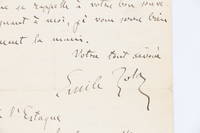
187779046L'Estaque - Marseille Marseille 1877. Fine. L'Estaque - Marseille Marseille 22 septembre 1877 13.30 x 20.80 cm 3 pages 1/2 sur un double feuillet Autograph letter signed by Emile Zola addressed to Louis-Edmond Duranty written in black ink on a double leaf. Some deletions and corrections; folds inherent to postal transmission. This letter has been transcribed in the complete correspondence of Emile Zola published by the CNRS and the Presses of the University of Montreal. Long letter evoking the heat wave at L'Estaque Une page d'amour and Edouard Manet. ""Il y a quatre mois que nous sommes ici et je vous avais promis de vous écrire. Mais j'ai tant travaillé et j'ai eu si chaud que vous m'excuserez de mon apparente paresse. Imaginez-vous que jusqu'au 15 août la température a été très agréable ; il faisait beaucoup moins chaud qu'à Paris et nous respirions chaque soir une brise de mer délicieuse. Puis voilà que brusquement lorsque je nous croyais hors de toutes mauvaises plaisanteries de la chaleur le thermomètre est monté à 40 degrés et s'y est maintenu nuit et jour. Nous avons ainsi passé deux semaines intolérables. Aujourd'hui la fraîcheur est revenue et nous allons rester jusqu'aux premiers jours de novembre pour jouir des charmes d'un bel automne."" ""We have been here for four months and I had promised to write to you. But I have worked so much and have been so hot that you will excuse my apparent laziness. Imagine that until August 15th the temperature was very pleasant; it was much less hot than in Paris and we breathed each evening a delicious sea breeze. Then suddenly when I thought we were safe from all the nasty tricks of the heat the thermometer rose to 40 degrees and stayed there night and day. We thus spent two unbearable weeks. Today the coolness has returned and we will stay until the first days of November to enjoy the charms of a beautiful autumn."" In this summer of 1877 Zola left the tumultuous capital for a five-month stay at L'Estaque ""banlieue de Marseille"" ""suburb of Marseille"" in the company of his wife Alexandrine and his mother Emilie Aubert. This long southern interlude reminded him of his youth in Aix: ""Je suis d'ailleurs enchanté de mon été. Les pays est splendide et me rappelle toute ma jeunesse."" ""I am moreover delighted with my summer. The country is splendid and reminds me of all my youth."" ""Pour finir avec moi j'ajouterai que j'ai travaillé vigoureusement à mon roman sans pourtant l'avancer autant que je l'aurais voulu. Ce roman doit paraître dans le Bien Public à partir du 14 novembre. J'en serai quitte pour donner encore un vigoureux coup de collier à Paris."" ""To finish with myself I will add that I have worked vigorously on my novel without however advancing it as much as I would have liked. This novel must appear in the Bien Public starting November 14th. I will have to give another vigorous push in Paris."" The new novel in question here is Une page d'amour whose plot and style contrast completely with the previous volume of the Rougon-Macquart: ""Je ne sais vraiment pas ce que vaut mon travail. J'ai voulu donner une note absolument opposée à celle de L'Assommoir ce qui me déroute parfois et me fait trouver mon roman bien gris. Mais je vais tout de même bravement mon chemin. Il faudra voir."" ""I really don't know what my work is worth. I wanted to give a note absolutely opposite to that of L'Assommoir which sometimes disconcerts me and makes me find my novel quite gray. But I am nonetheless bravely going my way. We will have to see."" But this ""page of love"" conceals another and during this stay in the Marseilles furnace Emile Zola was already thinking about the following volume: ""What is simmering in his southern pot is nothing less than a new bomb. Not Une page d'amour: 'it is a work too gentle to excite the public.' But Nana is already announced: 'I dream here of an extraordinary Nana. You will see that.' letter to Marguerite Charpentier of August 21 1877"" Henri Mitterrand Zola Even t unknown
188583956s. l. Paris 1885. Fine. s. l. Paris 20 avril 1885 11 x 17.70 cm 2 pages sur un bifeuillet et un feuillet encollé sur la 3e page Autograph letter signed by Louise Michel addressed to Lucien Barrois; two pages written in black ink on a white paper bifolium with black border. One sheet in the hand of a naval adjutant from Brest pasted on the third page. Transverse folds inherent to postal delivery. Louise Michel asks the recipient of this letter for advice regarding her young cousin: ""Ignorant si Clémenceau aurait le temps d'écrire un mot de recommandation pour quelques leçons à mon petit cousin Dacheux je vous le dis d'abord afin que vous preniez un moment où ce sera possible pour le dire à Clemenceau. Je vous avoue que je n'ai pas trop compris la lettre du petit parce qu'il en est resté une bonne partie dans l'encrier il écrit si mal."" ""Not knowing if Clémenceau would have time to write a word of recommendation for some lessons for my young cousin Dacheux I tell you first so that you may find a moment when it would be possible to mention it to Clémenceau. I confess that I did not quite understand the boy's letter because a good part of it remained in the inkwellhe writes so poorly."" Moving letter testimony to the unwavering devotion of the former Communard. unknown
190879911s. l. Paris 1908. Fine. s. l. Paris 1908 13 x 15 cm 3 pages 1/2 sur un double feuillet Autograph letter signed by Renée Vivien addressed to her publisher Edward Sansot written in black ink on a double sheet of headed paper bearing the poet's monogram and her address at 23 avenue du Bois de Boulogne. Transverse folds inherent to mailing two tiny marginal tears without loss at the fold. Fascinating letter written by the Muse of the violets in the last months of her life: ""J'ai reçu avec une très grande joie les volumes des Flambeaux éteints. Remerciez bien de ma part votre soeur d'avoir fait les corrections et je vous en prie amenez-la moi lorsque vous reviendrez Avenue du Bois. Pour les six exemplaires de Sillages décollés donnez-les - je n'ai pas beaucoup d'amis et me soucie peu de distribuer des volumes au hasard. Maintenant s'il est trop tard lorsque ma lettre vous parviendra et que les exemplaires me parvinssent quand même ne soyez pas désolé - cela m'est indifférent je vous les ferai envoyer. Mes meilleurs sentiments d'amitié littéraire. Renée Vivien. Je vous envoie en même temps sept volumes à distribuer au hasard parmi vos amis littéraires."" ""I received the volumes of Flambeaux éteints with very great joy. Please thank your sister on my behalf for having made the corrections and I beg you bring her to me when you return to Avenue du Bois. For the six unbound copies of Sillages give them away - I do not have many friends and care little about distributing volumes at random. Now if it is too late when my letter reaches you and the copies reach me nonetheless do not be sorry - it is indifferent to me I will have them sent to you. My best feelings of literary friendship. Renée Vivien. I am sending you at the same time seven volumes to distribute at random among your literary friends."" The publication of Flambeaux éteints marks the first collaboration between the poet and her new publisher Edward Sansot. In these last painful years of life Sansot and his friend Charles-Brun are her only two links with the literary world whose critics - once highly laudatory - have finally turned their backs on her. It must be said that Renée Vivien has decided to withdraw all her books from commerce and is gradually sinking into solitude and depression. Handsome letter bearing witness to the last literary years of Sappho 1900. unknown
1970667171970. Fine. 22 juillet 1970 14.60 x 10.10 cm une feuille After many years spent in Greece Egypt and Rhodes travel writer Lawrence Durrell was forced to flee Cyprus following popular uprisings that led the island to independence. With only a shirt and a typewriter but with the success of his Bitter Lemons novels he arrived in France in 1956 and settled in the Languedoc village of Sommières. In the ""house Tartès"" his large house surrounded by trees he wrote the second part of his work his monumental Quintet of Avignon gave himself to painting and received his illustrious friends whose couple Henry Miller and Anaïs Nin the violinist Yehudi Menuhin the London publisher Alan G. Thomas and his two daughters Penelope and Sappho. Among the olive trees and under the Mediterranean sun he meets there in the middle of the 1960s the young and sparkling ""Jany"" Janine Brun Montpellier of thirty years with the ravaging beauty who worked in the department of the Antiquities of the Sorbonne in Paris. She was named ""Buttons"" in memory of their first meeting where the girl wore a dress covered with buttons. Henry Miller also fell under the spell of ""Buttons"" praising his beauty and his eternal youth in exceptional letters unpublished. The three friends spent memorable Parisian evenings of which we keep precious autograph traces on a restaurant menu and through their epistolary exchanges. Recommended by Durrell she made many trips including to England where she received a wide correspondence from the writer and original works of art signed by his pseudonym artist Oscar Epfs. Unpublished autographed postcard signed Lawrence Durrell from Corfu to his young French lover Janine Brun named ""Buttons"". 15 lines with multicolored markers signed LD The card carries a photograph on the back of his beloved island of Corfu which accueilla Durrell during his youth from 1935 to 1941 and inspired his famous novel The Black Book The Black Book 1938.""Buttons darling with your little hole in business card you will arrive at the end of the world I'm sure - You'll win the jackpot woman intact without tacte Much love LD. ""The card was sent to a young lover of the author who in Sommières as in Paris enlivened his solitary days at the end of the sixties and seventies. Janine Brun also nicknamed ""Buttons"" in the writer's letters and postcards was described by Durrell biographer Ian McNiven: "" She was almost thirty-two-year-old with a girl's small-breasted figure as dark-haired as Claude Kiefer was blond and not languorous but tremendously energetic """" She was almost thirty but looked much younger with a girl silhouette with small breasts as dark as Claude Kiefer another her lovers wife of a Swiss surgeon was blonde not so languorous as extremely energetic "" Lawrence Durrell: A Biography page 591. Durrell addresses this charming and facetious map from Corfu which he rediscovers in the summer of 1969 after many years of absence. In the company of his brother and his wife who share the same hotel he is about to shoot the film adaptation of his brother's book The Garden of the Gods on the famous stay of the Durrell family in Corfu over the years. 1930. He starts and finishes the missive with funny traits: "" Oh Buttons you're funny!"" I have your picture on a shelf next to another gentleman ""I am moved for him and for myself "". The young woman claimed indeed her independence and her freedom as Durrell remarks a little bitterly a few lines further: "" I miss you a little but now I received my lesson - so be it "". Having not been able to make her a lasting and loving companion he will be satisfied with the carnal pleasures that he shares with her in the heat of the South or in the Parisian hotel rooms: "" Buttons darling with your little hole in map You will arrive at the end of the world I'm sure - You'll win the jackpot untouched woman "". Their relationship lasted until the late 1970s with Jani / Buttons appearing occasio unknown
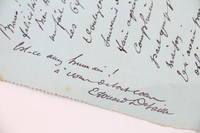
1889879161889. Fine. 1er Novembre 1889 10 x 15.90 cm une feuille Autograph letter dated and signed by the painter and illustrator of military scenes Edouard Detaille to his friend Philippe Gille 21 lines in black ink in telegram form. The painter congratulates Philippe Gille recent recipient of the Légion d'Honneur: ""Bravo ! Nom de nom ! et mille bonnes félicitations. Bien heureux de votre rosette qui me fait un vrai et sincère plaisir."" Bravo! Good Lord! And a thousand congratulations. So happy about your rosette which gives me true and sincere pleasure. for whom his friendship remains unwavering: ""Je n'avais pas besoin que vous soyez officier pour avoir pour vous ma vieille et amicale sympathie. Est-ce assez humain "" I didn't need you to be an officer to have my old and friendly sympathy for you. Isn't that human enough unknown
195481941Marnes-la-Coquette: S. n. 1954. Fine. S. n. Marnes-la-Coquette 12 Décembre 1954 21 x 13.50 cm une feuille une enveloppe Autograph letter dated and signed by Maurice Chevalier addressed from his property ""La Louque"" in Marnes-la-Coquette to Alice Rim 20 lines in blue ink envelope included. Fold mark inherent to envelope insertion. The letter is addressed to Caro Canaille pen name of Alice Rim Carlo's wife: ""12 - 12- 54 Chère Caro Pour ne pas qu'il y ait d'obscurités dans ce que vous me proposez si affectueusement de faire savoir au public - vous pouvez absolument dire que ""entre ce que j'ai gagné par mes concours aux galas que j'organisais - entre ce que j'ai obtenu d'amis généreux - entre ce que j'ai souvent versé de ma propre poche pour - la maison de retraite de Ris Orangis - le dispensaire du spectacle - et le comité du coeur de la Sacem - nous en sommes - et facilement - à cent millions d'aujourd'hui en 1954. Je ne compte pas ce que j'ai fait et continue de faire pour de vieux copains dans le malheur. Votre radin et ami Maurice"". Carlo Rim was a Provençal writer author of ""Ma belle Marseille"" a caricaturist a filmmaker and was notably the friend of Fernandel Raimu and Marcel Pagnol but also of Max Jacob and André Salmon whom he met in Sanary. S. n. unknown
194488349Paris: s. n. 1944. Fine. s. n. Paris s.d.1944 21 x 27 cm une feuille une enveloppe Autograph letter signed and dated one page from Maurice Blanchot addressed to the theater actress Marcelle Tassencourt wife of Thierry Maulnier 18 lines in black ink. Central folds inherent to postal handling envelope included. Maurice Blanchot praises the acting performance of Marcelle Tassencourt who created in 1944 the role of Antigone in Robert Garnier's play directed by her husband Thierry Maulnier: "". cette Antigone m'a beaucoup touché. Je ne croyais pas que la beauté des vers y fût capable d'une actrice aussi vivante. Que la vie et le style peuvent être à ce point associés que l'harmonie engendrât l'horreur et la beauté le déchirement c'est que je n'imaginais pas pouvoir ressentir aussi complètement et que la plupart des spectateurs me semblent avoir ressenti autour de moi et chez moi."" . this Antigone moved me greatly. I did not believe that the beauty of the verses could be capable of such a lively actress. That life and style can be so closely associated that harmony could engender horror and beauty create heartbreak is something I never imagined I could feel so completely and that most of the spectators around me and within me seemed to have felt. Maurice Blanchot particularly emphasizes the actress's perfect mastery of facial expressions: "". je penserais qu'il y a en vous le pouvoir de confiner à quelques-uns de vos traits - et en particulier à votre regard - les sentiments que les acteurs en général répartissent et éparpillent mollement dans l'ensemble du visage. Mais ce pouvoir ne s'appelle-t-il pas concentration naturelmement je n'ai rien dit."" . I would think that you have the power to confine to some of your features - and particularly to your gaze - the feelings that actors in general distribute and scatter weakly across the entire face. But is this power not called concentration naturally I have said nothing. s. n. unknown
198086753s. l.: S. n. 1980. Fine. S. n. s. l. s. d. ca 1980 14.50 x 21 cm 1 page Manuscript note by Philippe Soupault 22 lines in mauve ink on a sheet headed with this inscription: ""Les séances"" devoted to the famous ""sleep"" sessions conducted in André Breton's studio consisting of oneiric writings or texts dictated by a dreamer. The manuscript notes contain three deletions and corrections. Philippe Soupault considers his attempts questionable and even labels them as imposture distancing himself from any active participation in these practices: ""Neither Aragon nor I participated actively in the experiments called sleep sessions while Breton accepted with great interest Crevel's suggestion to engage in experiments he had discovered among friends. One had to fall asleep and recount what 'one saw'."" He recalls the results that were not always convincing: ""Crevel Desnos and Péret 'fell asleep' and despite his efforts Breton could not manage to fall asleep. Listening to the accounts of these sessions I could not help thinking that the 'sleepers' did not hesitate to simulate in order to make themselves interesting."" to such an extent that the intransigent leader of surrealism interrupted them: ""Breton realized the danger of one-upmanship and especially of Desnos's exaltation. He ceased attempting new sleep experiments."" Interesting recollections from the last living historical surrealist often harsh toward his former or new companions. S. n. unknown