Julien GRACQBiblio.com
48 390 résultats
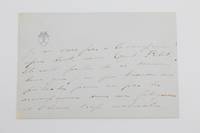
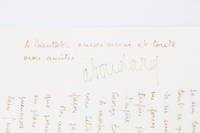
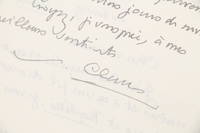
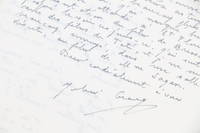
197884596Paris 1978. Fine. Paris s. d. 1978 14.50 x 20.50 cm une feuille Important autograph letter signed by Julien Gracq 53 lines in black ink addressed to his close friend and monographer Ariel Denis establishing him as his biographer. Julien Gracq expresses his regret that his friend Ariel Denis was not selected despite his intervention by the Berlin Academy to teach: ""Je vous avais recommandé de mon mieux mais je doute que cela ait été en Allemagne d'une grande efficacité. Je sais d'ailleurs que comme vous le pressentiez les concurents étaient en nombre."" ""I recommended you as best I could but I doubt that was very effective in Germany. I know moreover that as you suspected there were many competitors."" To help his friend the author of Rivage des Syrtes suggested to publisher Seghers who wanted to publish a work about him in his famous ""Poètes d'aujourd'hui"" collection the name of Ariel Denis having had no news from the first biographer considered for this publication: ""Ils me demandent de leur suggérer un nom. J'ai indiqué celui de Lautrat. Et j'ai indiqué le vôtre ne sachant bien sûr aucunement si un travail de ce genre pourrait vous plaire. Il va de soi que si Seghers s'adressait à vous vous devez être absolument libre d'accepter ou de refuser."" ""They ask me to suggest a name. I indicated Lautrat's. And I indicated yours not knowing of course at all whether work of this kind might please you. It goes without saying that if Seghers approached you you must be absolutely free to accept or refuse."" He also hopes to see his friend again soon before the summer holidays: "". si je ne vous revois pas avant juillet je vous souhiate des vacances à la fois paisibles et laborieuses en comptant vous revoir d'ici l'automne."" "".if I don't see you again before July I wish you holidays that are both peaceful and productive counting on seeing you again by autumn."" He concludes his letter with his judgments as an informed cinephile: ""J'ai surtout revu des films de Tati et je me suis beaucoup ennuyé dans une salle déserte au film de Mme Sagan."" ""I mainly rewatched Tati films and I was very bored in a deserted theater by Mme Sagan's film."" At Julien Gracq's instigation Ariel Denis would indeed accept Seghers' proposal to publish a volume in his ""Poètes d'aujourd'hui"" collection about the author of Au château d'Argol thereby becoming one of his best and most remarkable biographers. unknown
193177544Paris 1931. Fine. Paris 6 avril 1931 14.60 x 19.30 cm une page sur une carte lettre Signed autograph note by Reynaldo Hahn addressed to Madame Serge André and written on a white paper letter-card in blue ink. Central fold inherent to the mailing. Dominique André is a poetess novelist and playwright. She notably published under the pseudonym Claude Isambert. ""J'ai trop tardé chère Madame à vous remercier de votre livre et du plaisir qu'il m'a procuré. Plaisir amer et trouble - mais rare. Ce qui est particulièrement remarquable en ces pages c'est leur extrême distinction."" ""I have delayed too long dear Madame in thanking you for your book and the pleasure it has given me. Bitter and troubled pleasure - but rare. What is particularly remarkable in these pages is their extreme distinction."" unknown
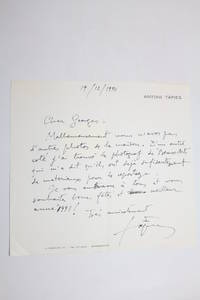
199073713Barcelone Barcelona 1990. Fine. Barcelone Barcelona 19 décembre 1990 22 x 20 cm une feuille Autograph letter signed by Antoni Tàpies to Georges Raillard his close friend and foremost French specialist of his work. One sheet written in black ink on headed paper bearing the author's name and at the foot his Barcelona address: ""C. Zaragoza 57 - Tel. 217 33 98 - Barcelona-6."" Fold marks from mailing. The Catalan artist writes to his friend regarding the forthcoming article ""Tàpies dans ses murs"" published in issue 88 of Beaux Arts magazine in March 1991: ""Malheureusement nous n'avons pas d'autres photos de la maison. D'un autre côté j'ai trouvé le photographe de 'Beaux Arts' qui m'a dit qu'ils ont déjà suffisamment de matériaux pour le reportage"". unknown
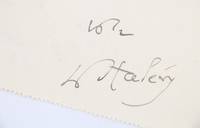
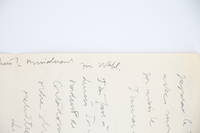
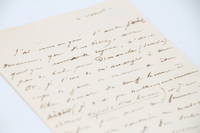
193588359Paris: s. n. 1935. Fine. s. n. Paris 12 mai 1935 11.50 x 16 cm une page Autograph letter dated and signed addressed to Thierry Maulnier 12 lines in black ink on one leaf. Central fold marks inherent to mailing. Daniel Halévy thanks Thierry Maulnier and congratulates him on the prize recently awarded to him: "". je me réjouis du prix qui vous est si bien donné."" .I rejoice in the prize that is so well given to you. s. n. unknown
190885189Toulon 1908. Fine. Toulon 30 Mars 1908 13.50 x 21.50 cm 8 pages sur deux doubles feuillets une enveloppe Long autograph letter signed by Claude Farrère approximately 160 lines in blue ink 8 pages on two double leaves to his friend Pierre Louÿs thanking him notably for his thoughtfulness. Traces of folds inherent to being placed in an envelope envelope included. Claude Farrère praises his friend's thoughtfulness towards him: ""Thank you for your letter. not only because it is exquisite - six times more than you can believe - but much more because I know very well that you told it to me so as 'not to worry me.' as you say."" and is amazed by the problems raised by these recent articles: ""Said in parentheses I am quite stunned by the one relating to controversial articles. Not only have I not written any."" He is more concerned about the suspicions he arouses regarding his alleged opium consumption: ""I was informed by my own commander that the ministry based on my first book supposed that opium was not foreign to me. The same commander protested arguing that for so many months that I had served under his orders he had absolute certainty that I had not committed the slightest sin! But I doubt that his word is very appreciated in Paris."" and about the hatred that an officer bears him. Despite these problems Claude Farrère wants to reassure his friend: ""I want my dear friend for you to be absolutely at peace about me. I absolutely don't care myself."" while lamenting that the latter is abandoning the south of France this year: ""Tamaris without you how do you expect the celestial mechanism to continue turning And me You would systematically push me to suicide. Don't forget that I'm writing a quite bloody book and that I live in the iniquitous society of people who for a half-yes or a quarter-no disembowel themselves!"" He concludes his letter with new rumors concerning him: ""Of course Madame de X has gratuitously supposed horrible things: I am not the lover of the other lady from the milliner's. Come now! how could a young man such as myself decent and too well brought up cf. Madame P.L.'s opinion etc."" unknown
190079011s. l. Paris 1900. Fine. s. l. Paris s. d. ca 1900 12.50 x 8.40 cm une carte rédigée des deux côtés Autograph letter signed ""Paul"" and addressed to Natalie Clifford Barney written in black ink on both sides. Silver monogram of the poetess in the upper left corner of the recto. ""Je ne vais pas à la campagne après tout mon Tout-Petit. Ils sont partis de si bonne heure que j'ai pu trouver un prétexte pour ne pas les accompagner dans ma fatigue et l'heure trop matinale. Quand veux-tu que je vienne te chercher et où irons-nous Je serai prête à l'heure où tu voudras. J'aime tes jolies fleurs elles sont charmantes - j'ai porté une de tes roses hier au soir. A tout à l'heure mignon Tout-Petit - Paul"" ""I'm not going to the countryside after all my Little One. They left so early that I was able to find an excuse not to accompany them in my fatigue and the too early hour. When do you want me to come get you and where shall we go I'll be ready whenever you want. I love your pretty flowers they are charming - I wore one of your roses last evening. See you soon sweet Little One - Paul"" It was at the end of 1899 and through Violette Shillito that Renée Vivien - then Pauline Tarn - made the acquaintance of Natalie Clifford Barney ""this American more supple than a scarf whose sparkling face shines with golden hair sea-blue eyes implacable teeth"" Colette Claudine à Paris. Natalie who had just experienced a summer idyll with the sulfurous Liane de Pougy who had initiated her into sapphism paid only discreet attention to this new acquaintance. Renée however was completely captivated by the young American and would recount this coup de foudre in her autobiographical novel Une Femme m'apparut: ""J'évoquai l'heure déjà lointaine où je la vis pour la première fois et le frisson qui me parcourut lorsque mes yeux rencontrèrent ses yeux d'acier mortel ses yeux aigus et bleus comme une lame. J'eus l'obscur prescience que cette femme m'intimait l'ordre du destin que son visage était le visage redouté de mon avenir. Je sentis près d'elle les vertiges lumineux qui montent de l'abîme et l'appel de l'eau très profonde. Le charme du péril émanait d'elle et m'attirait inexorablement. Je n'essayai point de la fuir car j'aurais échappé plus aisément à la mort."" ""I recalled the already distant hour when I saw her for the first time and the shiver that ran through me when my eyes met her deadly steel eyes her sharp and blue eyes like a blade. I had the dark prescience that this woman was commanding me to destiny that her face was the dreaded face of my future. I felt near her the luminous vertigo that rises from the abyss and the call of very deep water. The charm of peril emanated from her and attracted me inexorably. I did not try to flee from her for I would have escaped death more easily."" ""Winter 1899-1900. Beginning of the idyll. One evening Vivien is invited by her new friend to the studio of Mrs. Barney Natalie's mother 153 avenue Victor-Hugo at the corner of rue de Longchamp. Natalie ventures to read verses of her composition. When Vivien tells her she loves these verses she replies that it is better to love the poet. An answer quite worthy of the Amazon."" J.-P. Goujon Tes blessures sont plus douces que leurs caresses There followed two years of unequal happiness punctuated by Natalie's recurring infidelities and Renée's morbid jealousy whose letters oscillated between impassioned declarations and painful mea culpas. ""Renée Vivien is the daughter of Sappho and Baudelaire she is the flower of evil 1900 with fevers broken flights sad voluptuousness."" Jean Chalon Portrait d'une séductrice In 1901 came an important break that would last almost two years; Renée despite Natalie's solicitations and the intermediaries she sent to win her back resisted. ""The two friends met again and it was in August 1905 the pilgrimage to Lesbos which constituted a disappointment for Natalie Barney and remained without sequel. . unknown
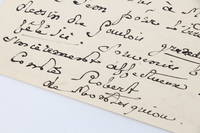
190783363New York: S. n. 1907. Fine. S. n. New York 4 février 1903 13.50 x 17.50 cm deux feuillets recto-verso Autograph letter signed by the dandy count 54 lines written in black ink on two leaves recto-verso addressed to his friend and bibliographer the critic Henri Lapauze: ""4 février Westminster hôtel New-York Cher monsieur et ami j'ai le plaisir de vous adresser ci-joint une copie manuscrite du salut d'ouverture qui servira de prélude de bienvenue à la première de mes conférences dont la date est fixée à demain. J'espère que vous ferez bon accueil à cet envoi de l'absent et le publierez en bonne place. Les documents ci-joints vous aideront à faire rédiger les lignes explicatives dont je vous demande d'accompagner l'article. Merci à vous à Mr Galdemar et à Sem pour son irrésistible dessin du Gaulois grandement fêté ici. Souvenir bien sincèrement affectueux. Comte Robert de Montesquiou. Je tiens à ajouter que je suis heureux de vous donner la primeur de ce document en témoignage et souvenir de nos bons rapports. J'ajoute que tout semble se disposer pour le succès de mon entreprise. Et vous connaissez assez les lois humaines mondaines et polémiques pour savoir que le tapage de presse accueillant ici les étrangers un peu notables ajoute à la curiosité de l'auditoire. J'espère ne pas trop la décevoir et ceci est le secret de demain. J'ai énuméré dans les pages que je vous adresse les raisons qui m'ont dicté le choix du sujet de ma première conférence. Je n'y reviens pas."" ""February 4th Westminster hotel New-York Dear Sir and friend I have the pleasure of sending you herewith a manuscript copy of the opening greeting which will serve as a welcome prelude to the first of my lectures the date of which is set for tomorrow. I hope you will give a good reception to this missive from the absent one and publish it in a prominent place. The enclosed documents will help you have written the explanatory lines I ask you to accompany the article with. Thank you to Mr Galdemar and to Sem for his irresistible drawing of the Gaulois greatly celebrated here. Most sincerely affectionate regards. Count Robert de Montesquiou. I want to add that I am happy to give you the exclusive rights to this document as testimony and remembrance of our good relations. I add that everything seems to be arranged for the success of my enterprise. And you know well enough the human worldly and polemical laws to know that the press commotion welcoming rather notable foreigners here adds to the audience's curiosity. I hope not to disappoint it too much and this is tomorrow's secret. I have enumerated in the pages I am sending you the reasons that dictated my choice of subject for my first lecture. I will not return to this."" Small pin holes that held the two leaves together. S. n. unknown
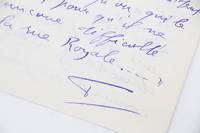
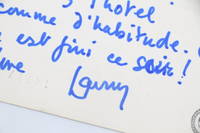
197986609Rhodes 1979. Fine. Rhodes Octobre 1979 21 x 10 cm une carte postale Evocative autograph postcard signed by Lawrence Durrell addressed to Jani Brun written in blue felt-tip pen on the verso of a reproduction of a sculpture depicting a seahorse fountain in Rhodes. Minor angular fold marks on the postcard. ""Rhodes ! J'arrive à Paris Dimanche 19 pour deux nuits. Sera tu la sic Disponible Je decend chez l'hotel Royale comme d'habitude. Le tournage est fini ce soir ! Ouf ! Love. Larry."" ""Rhodes! I'm arriving in Paris Sunday the 19th for two nights. Will you be there Available I'm staying at the Hotel Royale as usual. Filming is finished tonight! Phew! Love. Larry."" After many years spent in Greece Egypt and Rhodes the travelling writer Lawrence Durrell was forced to flee Cyprus following popular uprisings that led the island to independence from the British crown. Rich only with a shirt and a typewriter but crowned with the success of his novel Bitter Lemons of Cyprus he arrived in France in 1956 and settled in the Languedoc village of Sommières. In the ""Tartès house"" his large residence surrounded by trees he wrote the second part of his work his monumental Avignon Quintet devoted himself to painting and received his illustrious friends including the couple Henry Miller and Anaïs Nin the violinist Yehudi Menuhin the London publisher Alan G. Thomas and his two daughters Penelope and Sappho. Among the olive trees and under the Mediterranean sun he met in the mid-1960s the young and vivacious ""Jany"" Janine Brun a woman from Montpellier in her thirties of devastating beauty who worked in the Antiquities department at the Sorbonne in Paris. She was nicknamed ""Buttons"" in memory of their first meeting where the young woman wore a dress covered with buttons. Henry Miller also fell under the charm of ""Buttons"" praising her beauty and eternal youth in exceptional unpublished letters. The three companions spent memorable Parisian evenings of which we retain precious autograph traces through their epistolary exchanges. Recommended by Durrell she made numerous trips particularly to England from where she received extensive correspondence from the writer as well as original works of art signed with his artist pseudonym Oscar Epfs. unknown
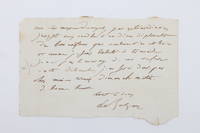
1839803451839. Fine. s. d. ca 1839 13 x 8 cm une feuille Signed handwritten letter to Louis Desnoyers ca 1839 13 x 8 cm one leaf Handwritten letter signed by Honoré de Balzac addressed to Louis Desnoyers written on a white piece of paper in black ink. My dear Mr Desnoyers extraordinarily today I attend a diplomatic dinner of good-natured folk who want to laugh and drink and as I am in a stupor at work I have not had the courage to refuse this debauchery; I will therefore not be at home. Come early Sunday morning. / Yours / de Balzac. Louis Desnoyers plays an important role in the foundation of the Société des gens de lettres which aims to protect literary and artistic property and to create a solidarity fund. Balzac supported the creation of this Society of which Desnoyers was vice-president. Amusing letter testimony of Balzac's love of good food. unknown
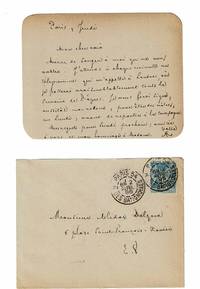
189676347Paris 1896. Fine. Paris 2 avril 1896 11.40 x 8.80 cm une carte et une enveloppe Signed autograph card from Stéphane Mallarmé addressed to Alidor Delzant written on the recto in black ink. Envelope included. Alidor Delzant was a lawyer collector and bibliophile. Friend of the Goncourts he devoted a work to them and was Edmond's secretary and testamentary legatee. ""Merci de songer à moi qui ne vous oublie. J'attends à chaque minute un télégramme qui m'appelle à Londres où je passerai vraisemblablement toute la semaine de Pâques."" ""Thank you for thinking of me who does not forget you. I am expecting at any moment a telegram calling me to London where I will most likely spend the entire Easter week."" unknown
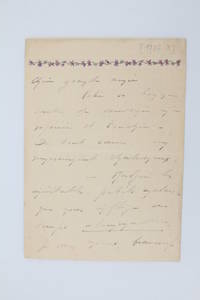
190779804s. l. Paris 1907. Fine. s. l. Paris s. d. ca. 1907-1908 11.50 x 16 cm 2 pages 1/2 sur un double feuillet Autograph letter signed by Renée Vivien addressed to Marcelle Tinayre written in black ink on a double sheet of headed paper decorated with a border of violets. Transverse creases inherent to mailing. Also a writer Marcelle Tinayre was close to Renée Vivien who entrusted her first verses to her to read. Upon Vivien's death Tinayre paid tribute to her through several texts notably a very beautiful tribute article published in the review Schéhérazade in 1910 entitled ""Trois images de Renée Vivien"". ""Chère grande amie Votre si bonne carte de souvenir m'a réjouie et touchée. De tout coeur un remerciement chaleureux. Malgré les inévitables petits malaises que nous inflige ce temps abominable je vais mieux beaucoup mieux. Aussi serais-je très heureuse si vous et Monsieur Tinayre étiez libres le 12 et pouviez venir dîner chez moi. J'aurai le plaisir de vous présenter ma soeur et mon beau-frère qui seront à Paris. Vous devinez quelle joie me causera leur présence ! Croyez à toute mon admiration à toute ma sympthie. Renée Vivien."" ""Dear great friend Your so kind remembrance card delighted and touched me. A warm thank you from the heart. Despite the inevitable small ailments this abominable weather inflicts upon us I am better much better. So I would be very happy if you and Monsieur Tinayre were free on the 12th and could come dine at my home. I will have the pleasure of introducing my sister and brother-in-law who will be in Paris. You can imagine what joy their presence will bring me! Believe in all my admiration all my sympathy. Renée Vivien."" The Muse of violets was indeed very close to Toinette her younger sister who lived in London with her husband Francis. Renée Vivien was moreover the godmother of their son Paul a very rare name then in England in honor of his aunt and in 1911 Toinette would give birth to a daughter whom she would name Renée in tribute to her deceased sister. Very beautiful testimony to the friendship that Renée Vivien bore toward Marcelle Tinayre a writer friend who contributed to perpetuating the memory of Sappho 1900. unknown
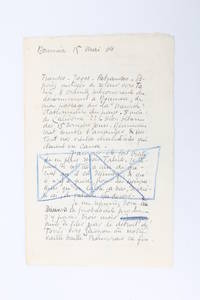
190479615Nouméa 1904. Fine. Nouméa 15 mai 1904 11.50 x 17.80 cm 4 pages sur un double feuillet Autograph letter signed by Victor Segalen addressed to Emile Mignard. Four pages written in black ink and blue colored pencil on a double sheet. Cross fold inherent to the sending. Emile Mignard 1878-1966 also a doctor from Brest was one of Segalen's closest childhood friends whom he met at the Jesuit college of Notre-Dame-de-Bon-Secours in Brest. The writer maintained an abundant and regular correspondence with this friend in which he described with humor and intimacy his daily life in the four corners of the globe. It was at Mignard's wedding on February 15 1905 that Segalen met his wife Yvonne Hébert. Segalen has been in Nouméa a city he abhors since early April 1904. He attended the health council that annually brings together doctors from ships of the French Pacific division to decide on convalescences leaves and transfers. For more than two weeks a mechanical problem has prevented the Durance from leaving Nouméa. It had even been considered as Segalen relates in a letter written to Mignard on May 10 1904 to decommission the aging ship in Saigon without stops in Tahiti. However he has just learned that he will be able to return to his island for a few months before his return to France: ""Anxiety. Joy. Re-anxiety. Mixed hopes of returning to Tahiti and subconscious fear of decommissioning in Nouméa of my transfer to the Meurthe stationed in the country. Eight months in Caledonia!!! My assessment of the last 15 days. Nevertheless everything seems to be working out especially our old boilers which were at issue. I would have been very sad not to see Tahiti again."" For a reason that remains unknown a very beautiful passage concerning Tahiti was crossed out in blue colored pencil: ""I would have been very sad not to see Tahiti again. The departure from this island has this special quality that it is final and that there is hardly for the sympathies one leaves behind there a valid farewell."" This Nouméan exile allows Segalen to continue writing his Immémoriaux which would finally appear in 1907 at Mercure de France under the pseudonym Max-Anély Max in homage to Max Prat and Anély one of his wife's first names Segalen not being authorized in his capacity as a military doctor to sign a fictional work with his own name: ""The crossed-out pages accumulate; I hope to return with 2/3 'composed' . I would like to have submitted the proofs before my next campaign; so as to close at the same time a large piece of intense life to be prepared for new spectacles re-sensitized for new races and new suns."" unknown
190673701Cormeilles-en-Vexin 1906. Fine. Cormeilles-en-Vexin 22 août 1906 ou 1908 12.60 x 17 cm une feuille Friendly autograph letter signed by Octave Mirbeau addressed to the playwright and founder of the Revue Blanche Alfred Natanson. 12 lines in black ink on a folded sheet letterhead paper ""Cormeilles-en-VexinS.&O."" envelope included. ""Cher ami J'avais bien pensé que cette vieille bonne femme qui tape si fort sur les matelas avait du écorcher mon nom. Mais dans l'incertitude car je pouvais penser aussi que vous étiez pris avec quelqu'un de très sérieux . Ceci mon cher Fred pour vous dire que je suis parti de chez vous triste de ne pas vous avoir vu voilà tout et sans le moindre sentiment mauvais. Vous savez que j'ai pour vous une affection solide et je vous connais assez gentil pour moi pour me permettre de supposer des sottises. ."" ""Dear friend I had indeed thought that this old good woman who beats the mattresses so hard must have mangled my name. But in uncertainty for I could also think that you were busy with someone very serious . This my dear Fred to tell you that I left your house sad not to have seen you that's all and without the slightest bad feeling. You know that I have a solid affection for you and I know you well enough to be kind to me to allow myself to suppose foolish things. ."" With an amusing postscript: ""Ne prêtez pas attention à ce gribouillage. L'auto a je ne sais pas quoi j'y travaille. et n'y fait rien de bon. d'ailleurs. Et mon mécanicien se prend la tête à deux mains noires d'huile grasse ."". ""Don't pay attention to this scribbling. The car has something wrong I don't know what I'm working on it. and it's not doing any good. anyway. And my mechanic is holding his head in his two hands black with greasy oil ."". Mirbeau was particularly close to the Revue Blanche group since its launch in Paris in 1891. But it was from the Dreyfus affair that his intimate and lasting friendship with the Natanson brothers Thadée Alexandre and Alfred was strengthened. After aesthetic disagreements about Art Nouveau and the Nabis Mirbeau finally reunited with Thadée around 1900 in a now common inclination for the young Nabis painters of the Revue Blanche Bonnard Vallotton and Vuillard. The Revue Blanche played an essential role in France as confirmed by historian Paul-Henri Bourrelier: ""Most of the most prominent writers painters musicians politicians intellectuals of the late 19th and early 20th centuries collaborated with it or were associated with it. Created financed and directed by the three Natanson brothers young Polish Jews with the enthusiastic complicity of their classmates from the Condorcet lycée La Revue blanche quickly became a place of debate on all subjects that stirred France. It led political battles under the impulse of anarchists like Fénéon Mirbeau; socialists such as Blum G. Moch Péguy; Dreyfusards and founders of the League of Human Rights like Reinach and Pressensé."" unknown
193877525Cannes 1938. Fine. Cannes 16 octobre 1938 13.40 x 21.20 cm 2 pages sur un feuillet enveloppe jointe double Autograph letter signed by Jean Wahl addressed to Marc Barbezat one and a half pages written in black ink on one sheet. Envelope included. Transverse fold inherent to the mailing. Jean Wahl was Marc Barbezat's examiner for the philosophy baccalaureate examination and it was then that the two men became friends. In 1940 shortly after this letter was written Barbezat would found the review L'Arbalète to which the philosopher would contribute by entrusting his very first poems to his young protégé. This review would later become a publishing house that would notably publish Jean Genet's first and scandalous texts. Interesting letter full of bitterness written on the eve of World War II: ""J'avais l'impression qu'il n'y aurait pas de guerre. J'aurais voulu que ce fût par une reculade d'Hitler qu'elle n'eût pas lieu. Le destin ou la faiblesse des hommes en a décidé autrement. Nous avons manqué - et l'Angleterre aussi - d'hommes qui fussent à la hauteur des circonstances. C'est bien triste."" ""I had the impression that there would be no war. I would have wished that it were through Hitler's retreat that it would not take place. Fate or the weakness of men decided otherwise. We lacked - and England too - men who were equal to the circumstances. It is very sad."" Wahl relates his meeting with the poet Lucien Jacques also translator of Moby Dick: ""Sans le roman traduit de Melville les Cahiers du Contadour me paraissent de second ordre. . Lucien Jacques est très sympathique."" ""Without Melville's translated novel the Cahiers du Contadour seem second-rate to me. . Lucien Jacques is very likeable."" He ends his letter: ""J'admire beaucoup le talent du conteur Panaït Istrati. Conteur qui fait surgir les émotions comme celles que fait naître la musique."" ""I greatly admire the talent of the storyteller Panaït Istrati. A storyteller who brings forth emotions like those that music creates."" unknown
183087775Paris 1830. Fine. Paris s. d. ca 1830 12 x 18.50 cm 1 page Autograph letter signed by Victor Hugo to his friend H. de Cambier 20 lines written in black ink on a bifolium autograph address on the verso of the final leaf. Splendid and likely unpublished letter from Victor Hugo inviting his correspondent to the famed Romantic 'Cénacle' gatherings at the Bibliothèque de l'Arsenal a veritable literary institution in the 1830's. ""This Saturday the 6th I noticed the other evening Sir that you expressed with some regret not having a ball to attend on Sunday tomorrow. Now I have managed to arrange my guard duty so as to be free tomorrow from nine o'clock to midnight alas I could not obtain more than six hours and I am taking advantage of it to take my wife to a small masquerade party at Nodier's. If you would like to come with us we would be delighted and Nodier too. To do so you would need to be at my home at nine o'clock the hour I myself will return. Answer me this morning and believe in all my friendship. Vr Hugo."" ""In the drawing room of the Arsenal library where he had been head librarian since 1824 Charles Nodier hosted every Sunday evening the entire Romantic literary and artistic elite during the final years of the Restoration and the early years of the July Monarchy. In addition to Hugo one of the most regular attendees and later Musset Dumas and Balzac the salon gathered ""representatives of all the book professions from conception to illustration publication and criticism . in a friendly and convivial atmosphere"" Marta Sukiennicka. Hugo invites his correspondent to a masked ball held on one of those celebrated Sundays. Far from being a mere social occasion the 'Cénacle of the Arsenal' salon was one of the most vibrant centers of the Romantic movement. Having succeeded in excusing himself from his National Guard duties he was a sub-lieutenant in 1830 Hugo had likely arranged for a replacement to take his watch that evening; even the most illustrious of writers were not exempt from such military service. A few years later Balzac dodged his National Guard shifts and was imprisoned twice in 1836 and 1839. unknown
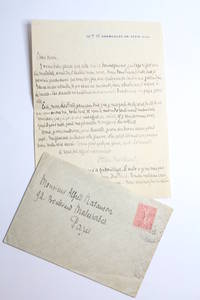
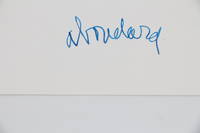
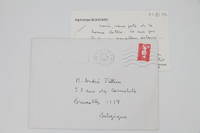
199279440Paris: S. n. 1992. Fine. S. n. Paris 28 Septembre 1992 14.50 x 10.50 cm une feuille une enveloppe Manuscript signed letter of 14 lines by Alphonse Boudard on a visiting card to his great friend and companion of well-watered lunches the Brussels journalist André Tillieu who was like Alphonse Boudard a great friend of Georges Brassens but also of Louis Nucéra. A date inscribed in blue ballpoint pen at the head of the card. Envelope included. ""Mon cher André bien reçu Le Rail. et comme toujours ton papier amical et percutant. Quel dommage que tu ne sois pas critique au Nouvel Obs ou à l'Express ! J'espère ou espère Louis aussi que tu viendras un de ces quatre te propulser sur les derniers trottoirs fréquentables de Pantruche. Porte-toi le mieux possible et à bientôt. encore merci. ABoudard."" ""My dear André received Le Rail. and as always your friendly and hard-hitting piece. What a pity you're not a critic at Nouvel Obs or L'Express! I hope or Louis hopes too that you'll come one of these days to propel yourself onto the last frequentable sidewalks of Pantruche. Take care of yourself as best you can and see you soon. thanks again. ABoudard."" André Tillieu from Brussels very close friend and biographer of Georges Brassens maintained an epistolary correspondence with Alphonse Boudard for almost thirty years from 1972 until the latter's death in 2000. The witty Parisian writer quickly demonstrated his friendship to him considering him as one of the rare critics to understand him perfectly to the point of clearly explaining in his reviews what he himself expressed only incompletely and sometimes confusedly in his books. André Tillieu therefore became part of the small circle of Alphonse Boudard's true friends on the same level as le Gros Georges Georges Brassens le Niçois Louis Nucéra and René Fallet with whom he liked to share hearty well-watered meals and cycling excursions. As death gradually took away his best friends one by one André Tillieu remained one of Alphonse's very last pals. S. n. unknown
199779431Paris: S. n. 1997. Fine. S. n. Paris 21 Novembre 1997 12.50 x 8 cm une feuille une enveloppe Signed manuscript letter on Bristol card of 8 lines by Alphonse Boudard on letterhead from his Parisian address in Nouvelle Athènes in the 9th arrondissement to his great friend and companion of well-watered lunches the Brussels journalist André Tillieu who was like Alphonse Boudard a great friend of Georges Brassens but also of Jean Giono. Envelope included. ""Merci vieux pote de ta bonne lettre. Je sais que tru es un amateur éclairé. alors tout ce que tu me dis me touche dans le mille. J'espère bien aller te saluer un de ces quatre en Bruxellie. Mon amitié. Ab."" ""Thank you old friend for your good letter. I know that you are an enlightened amateur. so everything you tell me hits the bull's eye. I really hope to go and greet you one of these days in Brussels. My friendship. Ab."" André Tillieu from Brussels very close friend and biographer of Georges Brassens maintained an epistolary correspondence with Alphonse Boudard for almost thirty years from 1972 until the latter's death in 2000. The cheeky Parisian writer quickly showed him his friendship considering him one of the rare critics to understand him perfectly to the point of clearly explaining in his chronicles what he himself expressed only incompletely and sometimes confusedly in his books. André Tillieu thus became part of the small circle of Alphonse Boudard's true friends on the same level as le Gros Georges Georges Brassens le Niçois Louis Nucéra and René Fallet with whom he liked to share hearty well-watered meals and cycling expeditions. As death gradually took away his best friends one by one André Tillieu would remain one of Alphonse's very last buddies. S. n. unknown
197979532Paris: S. n. 1979. Fine. S. n. Paris 3 Avril 1979 14.50 x 21 cm une feuille une enveloppe Handwritten letter dated and signed with 21 lines from Alphonse Boudard to his great friend and companion of convivial lunches the Brussels journalist André Tillieu who was like Alphonse Boudard a great friend of Georges Brassens but also of Jean Giono. A fold mark inherent to the folding of the letter for mailing envelope included. ""ami bien reçu ""Relax"". Mille mercis. Je suis toujours un peu confus par tout ce que tu écris sur mes livres. Je ne suis peut-être pas si haut Tu me forces à me poser des questions. Enfin je fais de mon mieux. J'espère te voir bientôt à Paris avec Georges Brassens et Louis. A moins que j'aille faire un tour vers Lille puis Bruxelles. De toute façon je te ferai signe. Mes amitiés à ta femme. J'espère que pour ta fille les choses sont en place. J'ai vu des tas de cas de pneumos spontanés ça s'arrange très bien j'ai eu un double pneumo pendant cinq ans mais c'était en vue de me guérir. A bientôt. encore merci et toute mon amitié. ABoudard."" ""friend well received 'Relax'. A thousand thanks. I am always somewhat confused by all that you write about my books. Perhaps I am not so great You force me to ask myself questions. Anyway I do my best. I hope to see you soon in Paris with Georges Brassens and Louis. Unless I take a trip towards Lille then Brussels. In any case I will let you know. My regards to your wife. I hope that for your daughter things are falling into place. I have seen lots of cases of spontaneous pneumothorax it works out very well I had a double pneumo for five years but it was to cure me. See you soon. thanks again and all my friendship. ABoudard."" André Tillieu from Brussels very close friend and biographer of Georges Brassens maintained an epistolary correspondence with Alphonse Boudard for almost thirty years from 1972 until the latter's death in 2000. The witty Parisian writer very quickly showed him his friendship considering him as one of the rare critics to understand him perfectly to the point of clearly explaining in his reviews what he himself expressed only incompletely and sometimes confusedly in his books. André Tillieu thus became part of the small circle of Alphonse Boudard's true friends on equal footing with le Gros Georges Georges Brassens le Niçois Louis Nucéra and René Fallet with whom he liked to share hearty well-watered meals and cycling trips. As death gradually took away his best friends one by one André Tillieu remained one of Alphonse's very last pals. S. n. unknown
194186528Paris: Morestel Isère 1941. Fine. Morestel Isère Paris 19 Octobre 1941 13.50 x 21 cm une page et demie Autograph letter dated and signed by Paul Claudel 23 lines in black ink on letterhead of Château de Brangues in Isère addressed to his publisher Egloff. Fold marks inherent to mailing. Paul Claudel acknowledges good receipt of the copies of Présence et prophétie that his publisher had sent him: ""J'ai bien reçu les 50 ex. ordinaires et 3 ex. sur fil."" and hopes that despite the difficulties related to the Occupation the booksellers have been well supplied. The poet finally rejoices in the good news that his publisher had conveyed to him: ""Je prends bonne note de ce que vous me dites du supplément de droits que vous pourrez me faire parvenir dans les premiers jours de novembre."" Morestel (Isère) unknown
186286137Paris: S. n. 1862. Fine. S. n. Paris 6 Décembre 1862 13.50 x 21 cm une page Autograph letter dated and signed by Théodore de Banville 12 lines in black ink explaining his manner of writing verse. Fold marks inherent to mailing. The letter has been mounted on a tab then inserted into a book before being extracted. Minor corner lacks of no consequence to the leaf. Théodore de Banville wishes to revive through his verse his illustrious predecessor Pierre de Ronsard but remains lucid about the reception the Parisian public will give him: ""Certainly this is poor news for the Parisian world and yet do not refuse me a small word about it in your correspondence would that not be true charity"" S. n. unknown
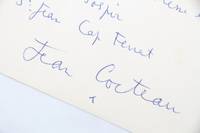
195687010Saint-Jean-Cap-Ferrat 1956. Fine. Saint-Jean-Cap-Ferrat 31 Décembre 1956 21 x 27 cm une page une enveloppe Autograph letter dated and signed by Jean Cocteau 12 lines in blue ink to his friend Georges Bachelard. Fold marks inherent to mailing envelope included. Jean Cocteau is fully absorbed in decorating the Saint-Pierre chapel of Villefranche sur mer which he adorns out of friendship for the village fishermen to whom it belongs. He nevertheless wishes to make himself available for his friend ""Viendrez-vous sur notre côte Mon adresse est villa Santo Sospir St Jean Cap Ferrat."" ""Will you come to our coast My address is villa Santo Sospir St Jean Cap Ferrat."" unknown
188471900Londres London 1884. Fine. Londres London 20 mai 1884 11.20 x 17.60 cm une feuille rempliée Autograph visiting card signed by the painter Edouard Dubufe official portraitist under the Second Empire. During a stay in London the painter informs his correspondent about the future universal exhibition to be held in 1889 in Paris. He plans a visit to the Crystal Palace Joseph Paxton's masterpiece which housed the first Universal Exhibition. Dubufe arranges a meeting with his correspondent regarding the Exhibition Jury which will select the paintings presented at the exhibition. unknown
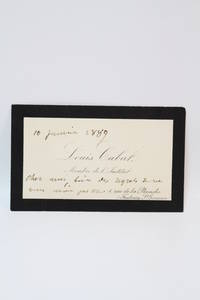
1889718451889. Fine. 10 janvier 1889 10.30 x 6.30 cm une carte de visite Autograph signed visiting card from landscape painter Louis Cabat member of the Barbizon School and the Institut. ""Cher ami bien des regrets de ne pas vous avoir vu hier veuillez agréer mes voeux les plus affectueux à l'occasion de la nouvelle année j'irai vous voir dès que le temps sera plus doux . L.C"" ""Dear friend much regret at not having seen you yesterday please accept my most affectionate wishes for the new year I will come to see you as soon as the weather is milder . L.C"" unknown
1890716621890. Fine. 30 novembre 1890 11.40 x 17.80 cm une feuille Autograph letter from the painter Pascal Dagnan-Bouveret regarding one of his most famous paintings depicting future soldiers of the Great War entitled ""Les Conscrits"" now held in the collections of the Assemblée nationale in Paris. 2 pages on a folded sheet. Trained in the studios of Alexandre Cabanel and Jean-Léon Gérôme Dagnan-Bouveret received the second prize of Rome. Of naturalist inspiration he devoted himself to religious painting and had a prolific career as a portraitist at the end of his life. He received prestigious commissions from the Countess of Béarn and the New York Frick family. Known for his Breton subjects in realistic style Dagnan-Bouveret painted during 1890 young conscripts drawn by lot to perform their military service. The youngest is depicted draped in the tricolor flag which he brandishes. ""If the painter Dagnan-Bouveret created realistic portraits of these conscripts it is almost certain that these men experienced fire during the First World War"" cf. expositions.bnf "". J'ose à peine vous inviter à venir voir mon nouveau tableau ""les Conscrits"" et pourtant vous avez toujours pris tant d'intérêt à mes efforts que je me ferais des reproches de ne pas vous avoir prévenu. ."" "". I hardly dare invite you to come see my new painting 'the Conscripts' and yet you have always taken such interest in my efforts that I would reproach myself for not having warned you. ."" unknown
194486166Salies-du-Salat Haute-Garonne Salies-du-Salat 1944. Fine. Salies-du-Salat Haute-Garonne Salies-du-Salat s. d. 1944 21 x 27 cm une page recto verso Amusing autograph letter signed by Roland Dorgelès addressed to a fellow writer concerning René Le Hénaff's film entitled Coup de tête released in 1944 for which the author of Les Croix de Bois served as screenwriter and dialogue writer 41 lines in blue ink written from his retreat in Salies-du-Salat in Haute-Garonne. Fold marks inherent to postal handling. Roland Dorgelès shows little indulgence for cinema actors and actresses: ""J'ai vu votre photo dans un illustré : vous faisiez un cours de littérature aux futures vedettes de cinéma. Elles en ont foutrement besoin !"" ""I saw your photo in an illustrated magazine: you were giving a literature course to future cinema stars. They damn well need it!"" Displeased with the final editing of the film Coup de tête to which he had devoted much of himself in adapting it then serving as screenwriter and dialogue writer the former Poilu Roland Dorgelès denounces René Le Hénaff's attitude who did not even take the precaution of consulting him before making some final changes to their collaboration: ""J'étais content de mon scénario. Mais en mon absence le metteur en scène un certain Le Hénaff que Sacha Guitry a surnommé Le Gniaf a tripatouillé mon texte ajoutant un dialogue et des gags de son goût si bien que je me demande ce que vaut le film ainsi remanié."" ""I was pleased with my screenplay. But in my absence the director a certain Le Hénaff whom Sacha Guitry nicknamed Le Gniaf tampered with my text adding dialogue and gags to his taste so much so that I wonder what the film is worth thus reworked."" He distances himself in advance from the result obtained: ""J'ai d'ailleurs demandé que l'oeuvre fut présentée comme tirée d'un roman de moi et non comme scénario portant ma signature."" ""I have moreover requested that the work be presented as drawn from a novel of mine and not as a screenplay bearing my signature."" and asks as a favor of his correspondent to go see this film: ""Vous avez compris ce que j'attends de votre amitié Allez vite voir Coup de tête pour me dire franchement ce que ça vaut."" ""You have understood what I expect from your friendship Go quickly see Coup de tête to tell me frankly what it's worth."" unknown