Dominique DE ROUXBiblio.com
48 390 résultats
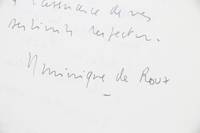
196788340Paris: L'Herne 1967. Fine. L'Herne Paris 27 Février 1967 21 x 27 cm une feuille Autograph letter signed one page by Dominique De Roux addressed to Thierry Maulnier who is not named explicitly 21 lines in black ink on a recto verso leaf with Les Cahiers de l'Herne letterhead. Central folds inherent to postal mailing. Dominique De Roux discusses his reading and research: ""I have long been searching for your anthology to read in particular Catherine Pozzi and the Möller Ven der Brucke which I believe you prefaced. Can you tell me if I could obtain them someday. You answer me there is the Nationale but that place creates in me a phenomenon of illegibility."" L'Herne unknown
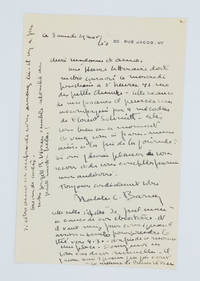
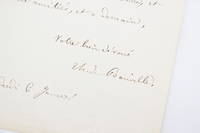
195278894Paris 1952. Fine. Paris samedi 29 novembre 1952 13.50 x 20.80 cm une page sur un feuillet Handwritten signed letter addressed to a friend: There will also be three poems that I wrote in memory of Renée Vivien Paris Saturday 29 November 1952 135 x 208 cm one page on a leaf Handwritten letter signed by Natalie Clifford Barney addressed to a friend and written in black ink on a stationery from 20 rue Jacob Paris VIe. Central fold from having been sent. Interesting letter mentioning a future reading of Natalie Clifford Barney: A literary hour must be devoted to me this Wednesday at 5pm 41 rue des Petits champs. This session of my poems and thoughts will be accompanied by 4 melodies by Florent Schmidt. The so-called literary hour will also be a tribute to one of Natalie's greatest loves who died several decades earlier: There will also be 3 poems that I wrote in memory of Renée Vivien. The two women experienced an intense and tumultuous relationship in their youth. After the tragic and early death of her lover Natalie Clifford Barney continued to honor her memory notably by becoming a patron of the Prix Renée-Vivien created by the baroness Hélène de Zuylen another of Renée's lovers. It is at the end of 1899 and through Violette Shillito that Renée Vivien then Pauline Tarn met Natalie Clifford Barney ""this American woman softer than a scarf whose sparkling face shines with golden hair sea blue eyes never-ending teeth"" Colette Claudine à Paris. Natalie who had just experienced a summer romance with the scandalous Liane de Pougy who introduced her to sapphism paid little attention to this new acquaintance. Renée on the other hand was totally captivated by the young American woman and describes this love at first sight in her autobiographical novel Une femme m'apparut: ""I lived again the hour already well past when I saw her for the first time felt the shiver that ran through me when my eyes met the mortal steel of her look those eyes blue and piercing as a blade. I had a dim premonition that this woman would determine the pattern of my fate and that her face was the predestined face of my Future. Near her I felt the luminous dizziness which comes at the edge of an abyss or the attraction of a very deep water. She radiated the charm of danger which drew me to her inexorably."" ""Winter 1899-1900. Beginnings of the idyll. One evening Vivien is invited by her new friend to Mme Barney's studio Natalie's mother 153 avenue Victor-Hugo on the corner of the rue de Longchamp. Natalie finds the courage to read the verses of her composition. As Vivien tells her to love these verses she tells her that it is better to love the poet. A response worthy of the Amazon."" J.-P. Goujon Tes blessures sont plus douces que leurs caresses Two years of unequal happiness will follow punctuated by Natalie's recurring infidelities and Renée's sickly jealousy the letters of which oscillate between inflamed declarations and painful admissions of guilt. ""Renée Vivien is the daughter of Sappho and Baudelaire she is the 1900 flower of evil with fevers broken-up fights sad delights."" Jean Chalon Portrait d'une séductrice In 1901 a major break-up occurred which lasted almost two years; Renée despite requests from Natalie and the others she sent to win her back resisted. ""The two friends saw each other again and in August 1905 went on a pilgrimage to Lesbos which was a disappointment for Natalie Barney and was short-lived. . The spring was broken once and for all. The two former friends stopped seeing each other in 1907 and Vivien died without them seeing each other again."" J.-P. Goujon ibid. unknown
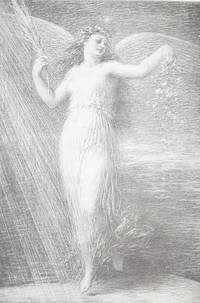
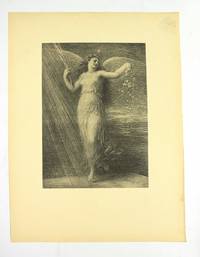
189874400Paris: Imprimerie Champenoispour CH. MassonH. Piazza 1898. Fine. Imprimerie Champenois pour CH. Masson H. Piazza Paris Mai 1898 24.50 x 34.50 cm une feuille Rare original lithograph executed by Henri Fantin-Latour for L'Estampe Moderne series number 13 published in May 1898. One of 50 deluxe proofs printed on China paper with wide margins artist's signature in the plate publisher's dry stamp representing a child's profile in the lower margin mounted on a sheet of laid paper with the numbered stamp of the deluxe issue on the verso pale marginal foxing. Lithograph inspired by an extract from William Shakespeare's Sonnets. Magnificent French monthly publication issued between May 1897 and April 1899 L'Estampe moderne consisted of original chromolithographs which unlike other periodicals such as Les Maîtres de l'Affiche and as stipulated on the tissue guards were created specially by each artist for the magazine. Thus 100 prints appeared in total covering the major artistic movements of the late nineteenth century: Symbolism Art Nouveau Pre-Raphaelites Orientalists and Belle Epoque. Each issue of four prints was issued in 2000 copies sold at 3.50F and 100 on Japan paper offered at 10F. Henri Piazza also planned a confidential deluxe printing: 50 copies on Japan paper with wide margins and 50 in black on China paper at the considerable price of 30F. This print in a handsome format is superbly printed on one of the most prestigious papers: China paper. ""Despite all its qualities China paper too inconsistent owes its reputation not to its own beauty but rather to its particular affinities with printing ink. Its texture smooth and soft together is more apt than any other to receive a fine printing. This property makes China paper sought after for printing engravings."" Anatole France. The interest of French collectors in artistic posters grew at the beginning of the 1890s. Octave Uzanne to describe this fever invented the term ""affichomanie."" The poster originally popular and plastered on the streets of the capital then became an art object and its ephemeral medium became precious and devoted to preservation. Piazza decided to remove the poster from its advertising vocation and elevate it to the rank of a work of art in its own right on the same level as the deluxe illustrated book. He thus composed a prestigious collection of entirely original works by the most prominent European artists of the moment: Georges de Feure Eugène Grasset Henri Detouche Emile Berchmans Louis Rhead Gaston de Latenay Lucien Lévy-Dhurmer Gustave-Max Stevens Charles Doudelet Hans Christiansen Henri Fantin-Latour Steinlen Ibels Engels Willette Henri Meunier Evenepoël Bellery-Desfontaines Charles Léandre etc. Handsome copy. Imprimerie Champenoispour CH. MassonH. Piazza unknown
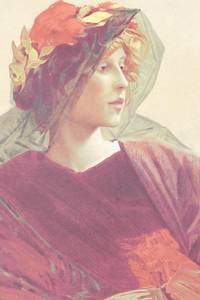
189874399Paris: Imprimerie Champenoispour CH. MassonH. Piazza 1898. Fine. Imprimerie Champenois pour CH. Masson H. Piazza Paris Mai 1898 24.50 x 34.50 cm une feuille et une serpente ""Immortalité"" - Original lithograph on Japan paper L'Estampe Moderne L'Estampe Moderne Imprimerie Champenois for C. H. Masson & H. Piazza Paris May 1897 subject: 245 x 345cm plate: 40.8 x 55 cm one leaf and a captioned silk tissue Rare Henri Fantin-Latour color lithograph heightened with gold published by L'Estampe Moderne series number 13 May 1897. One of 50 grand luxe' proofs printed on papier japon with wide margins signed by the artist in the plate publisher's stamp to the lower margin de luxe printing numbered stamp to verso small trace of stamp from the previous plate; the plate itself preceded by a silk tissue with the name of the artist title a poem and a caption. L'Estampe moderne was a magnificent monthly French publication published between May 1897 and April 1899. It included unpublished chromolithographs specially made by each artist for the magazine as mentioned on the protective silk tissue over each plate unlike other publications such as Les Maîtres de l'Affiche. 100 prints were published in total covering major artistic movements of the late 19th-century: Symbolism Art Nouveau Pre-Raphaelites Orientalists and Belle époque'. 2000 copies were printed of each fascicule containing four prints and sold for 3.50F. 100 copies were printed on papier japon for 10F. Henri Piazza also planned a very luxurious secret printing of 50 copies on papier japon with wide margins and 50 in black and white on papier chine at the considerable price of 30F. This well-sized print is superbly printed in colors on the most prestigious of papers: japon. Thick creamy satin and with a nice sheen it contributes to making each page a work of art in itself. Its qualities of absorption and its affinity for colors make it the ideal support for these lovely lithographs. The interest of French collectors for artistic posters grew from the beginning of the 1890s. Octave Uzanne invented a term for this new form of collection: affichomanie' or poster mania. The initially common poster displayed in the streets of Paris became a work of art and its ephemeral material became precious and made to last. Piazza decided to separate the poster from its advertising role and to elevate it to a form of art similarly to luxury illustrated artists' books. He put together a prestigious collection of entirely original artworks by the most fashionable European artists: Georges de Feure Eugène Grasset Henri Detouche Emile Berchmans Louis Rhead Gaston de Latenay Lucien Lévy-Dhurmer Gustave-Max Stevens Charles Doudelet Hans Christiansen Henri Fantin-Latour Steinlen Ibels Engels Willette Henri Meunier Evenepoël Bellery-Desfontaines Charles Léandre etc. A very fine plate. Imprimerie Champenoispour CH. MassonH. Piazza unknown
189974847Paris: Imprimerie Champenoispour CH. MassonH. Piazza 1899. Fine. Imprimerie Champenois pour CH. Masson H. Piazza Paris Avril 1899 25 x 34 cm une feuille et une serpente Rare original color lithograph executed by Alfred Pierre Agache for L'Estampe Moderne series number 24 published in April 1899. One of 50 deluxe proofs printed on Japan paper with wide margins publisher's dry stamp depicting a child's profile in lower margin numbered stamp of the deluxe issue on verso. A magnificent French monthly publication edited between May 1897 and April 1899 L'Estampe moderne consists of original chromolithographs which unlike other magazines such as Les Maîtres de l'Affiche and as stipulated on the tissue guards were created specifically by each artist for the magazine. Thus 100 prints appeared in total covering the major artistic movements of the late 19th century: Symbolism Art Nouveau Pre-Raphaelites Orientalists and Belle Époque. Each issue of four prints was printed in 2000 copies sold at 3.50F and 100 on Japan paper offered at 10F. Henri Piazza also planned a confidential very deluxe printing: 50 copies on Japan paper with wide margins and 50 in black on China paper at the considerable price of 30F. This print of handsome format is superbly printed on the most prestigious of papers: Japan. Thick silky satin and pearlescent it contributes to making each page a work in its own right. Its quality of ink absorption and its affinity with colors also make it the ideal support for these very beautiful lithographs. The interest of French collectors in artistic posters intensified at the beginning of the 1890s. Octave Uzanne to describe this fever invented the term ""affichomanie"". The poster originally popular and posted in the streets of the capital then became an art object and its ephemeral support became precious and destined for preservation. Piazza decided to remove the poster from its advertising vocation and elevate it to the rank of a complete work of art in the same way as the deluxe illustrated book. He thus composed a prestigious collection of entirely original works by the most prominent European artists of the moment: Georges de Feure Eugène Grasset Henri Detouche Emile Berchmans Louis Rhead Gaston de Latenay Lucien Lévy-Dhurmer Gustave-Max Stevens Charles Doudelet Hans Christiansen Henri Fantin-Latour Steinlen Ibels Engels Willette Henri Meunier Evenepoël Bellery-Desfontaines Charles Léandre etc. Handsome copy. Imprimerie Champenoispour CH. MassonH. Piazza unknown
189773930Paris: Imprimerie Champenoispour CH. MassonH. Piazza 1897. Fine. Imprimerie Champenois pour CH. Masson H. Piazza Paris Juillet 1897 33 x 24.50 cm une feuille et une serpente Rare original lithograph in colors executed by Marcel Lenoir for L'Estampe Moderne series number 3 published in July 1897. One of 50 deluxe proofs printed on Japan paper with large margins artist's signature in the plate publisher's dry stamp representing a child's profile in the lower margin numbered stamp of the deluxe edition on verso; print preceded by a tissue guard inscribed with the artist's name title and presentation of the artist; and another blank tissue guard. Magnificent French monthly publication edited between May 1897 and April 1899 L'Estampe moderne consists of original chromolithographs which unlike other magazines such as Les Maîtres de l'Affiche and as stipulated on the tissue guards were specially created by each artist for the magazine. Thus 100 prints appeared in total covering the major artistic movements of the late 19th century: Symbolism Art Nouveau Pre-Raphaelites Orientalists and Belle Epoque. Each delivery of four prints was issued in 2000 copies sold for 3.50F and 100 on Japan paper offered at 10F. Henri Piazza also planned a very limited deluxe printing: 50 copies on Japan paper with large margins and 50 in black on China paper at the considerable price of 30F. This print in a handsome format is superbly printed in colors on the most prestigious of papers: Japan paper. Thick silky satined and pearlescent it contributes to making each page a work in its own right. Its ink absorption quality and affinity with colors also make it the ideal support for these very beautiful lithographs. French collectors' interest in artistic posters intensified in the early 1890s. Octave Uzanne to describe this fever invented the term ""affichomanie."" The poster originally popular and posted in the streets of the capital then became an art object and its ephemeral support became precious and destined for preservation. Piazza decided to remove the poster from its advertising vocation and elevate it to the rank of a complete work of art on the same level as the deluxe illustrated book. He thus composed a prestigious collection of entirely original works by the most prominent European artists of the moment: Georges de Feure Eugène Grasset Henri Detouche Emile Berchmans Louis Rhead Gaston de Latenay Lucien Lévy-Dhurmer Gustave-Max Stevens Charles Doudelet Hans Christiansen Henri Fantin-Latour Steinlen Ibels Engels Willette Henri Meunier Evenepoël Bellery-Desfontaines Charles Léandre etc. Handsome copy in the artist's Art Nouveau style. Imprimerie Champenoispour CH. MassonH. Piazza unknown
189773931Paris: Imprimerie Champenoispour CH. MassonH. Piazza 1897. Fine. Imprimerie Champenois pour CH. Masson H. Piazza Paris Juillet 1897 33 x 24.50 cm une feuille Rare original lithograph executed by Marcel Lenoir for L'Estampe Moderne series number 3 published in July 1897. One of 50 deluxe proofs printed on China paper with wide margins artist's signature and date in the plate publisher's dry stamp showing a child's profile in the lower margin mounted on a sheet of laid paper with the numbered stamp of the deluxe edition on verso rare marginal foxing blank tissue guard. Magnificent French monthly publication issued between May 1897 and April 1899 L'Estampe moderne consists of original chromolithographs which unlike other magazines such as Les Maîtres de l'Affiche and as stipulated on the tissue guards were created especially by each artist for the magazine. Thus 100 prints appeared in total covering the major artistic movements of the late 19th century: Symbolism Art Nouveau Pre-Raphaelites Orientalists and Belle Époque. Each delivery of four prints was issued in 2000 copies sold for 3.50F and 100 on Japan paper offered at 10F. Henri Piazza also planned a confidential very deluxe printing: 50 copies on Japan paper with wide margins and 50 in black on China paper at the considerable price of 30F. This print in a handsome format is superbly printed on one of the most prestigious papers: China. ""Despite all its qualities China paper too insubstantial owes its reputation not to its own beauty but indeed to its particular affinities with printing ink. Its texture smooth and soft together is more apt than any other to receive a beautiful impression. This property makes China paper sought after for printing engravings."" ""Malgré toutes ses qualités le papier de Chine trop inconsistant doit sa réputation non pas à sa propre beauté mais bien à ses affinités particulières avec l'encre d'impression. Son tissu lisse et mou tout ensemble est plus apte qu'aucun autre à recevoir un beau tirage. Cette propriété fait rechercher le papier de Chine pour le tirage des gravures."" Anatole France. The interest of French collectors in artistic posters grew in the early 1890s. Octave Uzanne to describe this fever invented the term ""affichomanie"". The poster originally popular and pasted on the streets of the capital then became an art object and its ephemeral support became precious and destined for preservation. Piazza decided to remove the poster from its advertising purpose and elevate it to the rank of a complete work of art on the same level as the deluxe illustrated book. He thus composed a prestigious collection of entirely original works by the most prominent European artists of the moment: Georges de Feure Eugène Grasset Henri Detouche Emile Berchmans Louis Rhead Gaston de Latenay Lucien Lévy-Dhurmer Gustave-Max Stevens Charles Doudelet Hans Christiansen Henri Fantin-Latour Steinlen Ibels Engels Willette Henri Meunier Evenepoël Bellery-Desfontaines Charles Léandre etc. Fine copy in the artist's Art Nouveau style. Imprimerie Champenoispour CH. MassonH. Piazza unknown
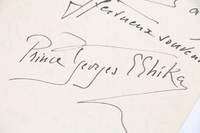
194487922Paris 1944. Fine. Paris s.d. ca 1944 13.50 x 18 cm deux pages et demi sur un bifeuillet Autograph letter signed by Prince Georges Ghilka 31 lines in black ink on a double sheet with letterhead from the Majestic Hotel in Paris probably addressed to René-Louis Doyon who devoted in 1944 a biography to Isabelle Eberhardt entitled ""Au pays des sables Isabelle Eberhardt"". Fold mark inherent to the mailing. Prince Georges from the House of Ghika a princely family of Romania of Albanian origin married in Paris in 1910 the most famous Amazon of All Paris Liane de Pougy. René-Louis Doyon sent his work to his friend the prince who thanks him for it: ""Nous avons lu votre livre et c'était délicieux comme une causerie avec vous une causerie qui emporte dans ces pays aimés du soleil et d'Isbelle Eberhardt que vous vous plûtes à citer. Merci encore pour ce grand plaisir que vous nous avez donné."" We read your book and it was delightful like a conversation with you a conversation that carries one away to those beloved lands of sun and of Isabelle Eberhardt whom you took pleasure in quoting. Thank you again for this great pleasure you have given us. unknown
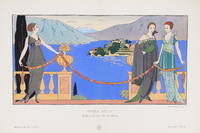
191484745Paris: Lucien Vogel éditeur 1914. Fine. Lucien Vogel éditeur Paris Juin 1914 36.50 x 24 cm une feuille Original double color print heightened with gold and palladium printed on laid paper signed lower left on the plate. Original engraving created for the illustration of La Gazette du bon ton one of the most beautiful and influential fashion magazines of the 20th century celebrating the talent of French creators and artists in the full bloom of Art Deco. Famous fashion magazine founded in 1912 by Lucien Vogel La Gazette du bon ton was published until 1925 with an interruption during the War from 1915 to 1920 due to the mobilization of its editor-in-chief. It consists of 69 issues printed in only 2000 copies and is illustrated notably with 573 color plates and 148 sketches representing models by great couturiers. From their publication these luxurious publications ""address bibliophiles and worldly aesthetes"" Françoise Tétart-Vittu ""La Gazette du bon ton"" in Dictionnaire de la mode 2016. Printed on fine laid paper they use a typeface specially created for the magazine by Georges Peignot the Cochin character adopted in 1946 by Christian Dior. The prints are created using the metal stencil technique heightened in colors and some highlighted with gold or palladium. The adventure begins in 1912 when Lucien Vogel man of the world and fashion - he had already participated in the magazine Femina - decides to found with his wife Cosette de Brunhoff sister of Jean father of Babar the Gazette du bon ton whose subtitle was then ""Art modes et frivolités"". Georges Charensol reports the words of the editor-in-chief: ""In 1910 he observes there existed no fashion journal truly artistic and representative of the spirit of its time. I was therefore thinking of making a luxury magazine with truly modern artists . I was certain of success because for fashion no country can rival France."" ""Un grand éditeur d'art. Lucien Vogel"" in Les Nouvelles littéraires n°133 May 1925. The magazine's success is immediate not only in France but also in the United States and South America. Originally Vogel therefore brings together a group of seven artists: André-Édouard Marty and Pierre Brissaud followed by Georges Lepape and Dammicourt; and finally his friends from the École des beaux-arts who are George Barbier Bernard Boutet de Monvel or Charles Martin. Other talents quickly join the team: Guy Arnoux Léon Bakst Benito Boutet de Monvel Umberto Brunelleschi Chas Laborde Jean-Gabriel Domergue Raoul Dufy Édouard Halouze Alexandre Iacovleff Jean Émile Laboureur Charles Loupot Charles Martin Maggie Salcedo. These artists unknown for the most part when Lucien Vogel calls upon them will subsequently become emblematic and sought-after artistic figures. These same illustrators create the drawings for the Gazette's advertisements. The plates highlight and sublimate the dresses of seven creators of the era: Lanvin Doeuillet Paquin Poiret Worth Vionnet and Doucet. The couturiers provide exclusive models for each issue. Nevertheless some of the illustrations feature no real model but only the idea that the illustrator has of the day's fashion. La Gazette du bon ton is a decisive step in fashion history. Combining aesthetic demand and plastic unity it brings together for the first time the great talents of the worlds of arts letters and fashion and imposes through this alchemy a completely new image of woman slender independent and bold also carried by the new generation of couturiers Coco Chanel Jean Patou Marcel Rochas. Taken over in 1920 by Condé Montrose Nast the Gazette du bon ton would largely inspire the new composition and aesthetic choices of the ""little dying journal"" that Nast had bought a few years earlier: Vogue magazine. Lucien Vogel éditeur unknown
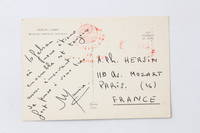
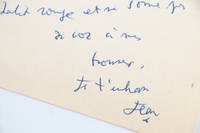
197470633Ispahan Isfahan 1974. Fine. Ispahan Isfahan 22 novembre 1974 14.90 x 10.20 cm une carte postale Autograph postcard signed by Maurice Béjart addressed to André-Philippe Hersin on the verso of a photographic reproduction showing the trembling minarets of Isfahan. The choreographer sent this postcard from Iran where he created in 1971 under the patronage of Empress Farah Pahlavi his ballet Golestan The Rose Garden and in 1974 at the Shiraz festival his ballet Mallarmé III to music by Pierre Boulez. It would also be during this period that Béjart is said to have converted to Islam after meeting Dariouche Safvate eminent Kurdish Sufi musician. unknown
195388024Saint-Jean-Cap-Ferrat 1953. Fine. Saint-Jean-Cap-Ferrat 29 Août 1953 21 x 27 cm une page Autograph letter dated and signed by Jean Cocteau 26 lines in blue ink to Olivier Quéant editor of the magazine Plaisir de France sent from villa Santo-Sospir. Fold marks inherent to postal handling. Quéant journalist and notably editor of the magazine Plaisir de France maintained a fine friendly and literary correspondence with the writer. He notably delivered a glowing review of Antigone at its premiere in 1944: ""depuis Racine l'on avait rien écrit d'aussi beau d'aussi grand et d'aussi profondément humain"" since Racine nothing so beautiful so great and so profoundly human had been written L'Illustration. Jean Cocteau at the twilight of his life rebels and complains about his diminished and merely symbolic role in French theater of the 1950s. The second sentence of this letter will be taken up almost word for word in the famous verses of his longest poem Requiem 1962: ""Il est juste qu'on m'envisage / Après m'avoir dévisagé"" It is right that I should be considered / After having been stared at which will also serve as his epitaph. Despite official recognition Cocteau felt until his death ""méconnu inconnu invisible"" misunderstood unknown invisible Jean Cocteau sur le fil du siècle 2003 - a malaise masterfully expressed through these lines. ""Voilà plusieurs années que j'accepte d'être en secret mis à ma place et publiquement remis à ma place. Bref de n'être pas envisagé mais dévisagé. Il est beau de recevoir des lettres ""retournées"" où Anouilh me dit ""Sans vos pièces je n'aurais pas écrit une ligne des miennes"" et Giraudoux ""Rilke avait raison. Nos figures blanches à côté du hâle de tes séjours dans l'antiquité."" Il est beau d'être comme le Pisanelle - enterré sous les roses ."" For several years I have accepted being secretly put in my place and publicly put back in my place. In short not being considered but stared at. It is beautiful to receive ""returned"" letters where Anouilh tells me ""Without your plays I would not have written a line of mine"" and Giraudoux ""Rilke was right. Our pale faces beside the tan of your sojourns in antiquity."" It is beautiful to be like Pisanello - buried under roses . Interesting and touching missive from Cocteau with disordered and furious handwriting twisting and stretching in the manner of a calligram. unknown
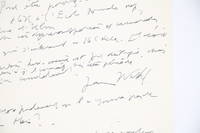
193877514Paris 1938. Fine. Paris 10 février 1938 14 x 18.20 cm 2 pages sur un feuillet enveloppe jointe Autograph letter signed by Jean Wahl addressed to Marc Barbezat two pages written in blue ink on a sheet. Envelope included. Transverse fold inherent to the mailing. Jean Wahl was Marc Barbezat's examiner for the philosophy examination at the baccalauréat; it was then that the two men became friends. In 1940 shortly after writing this letter Barbezat would found the journal L'Arbalète to which the philosopher would contribute by entrusting his very first poems to his young protégé. This journal would later become a publishing house that would notably publish Jean Genet's first and scandalous texts. Beautiful letter imbued with poetry: ""J'ai aimé ce que vous dites sur vos journées passées avec la nature - avec Dame Nature Femme nature."" ""I loved what you said about your days spent with nature - with Lady Nature Woman nature."" Wahl comments: ""J'ai reçu un volume de vers de René Tavernier dont vous m'avez parlé et qu'un de mes étudiants connaît. C'est difficile mais non sans intérêt."" ""I received a volume of verse by René Tavernier whom you told me about and whom one of my students knows. It is difficult but not without interest."" unknown
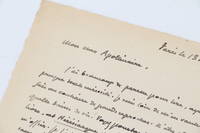
191083024Paris 1910. Fine. Paris 13 novembre 1910 14.50 x 19 cm une feuille Autograph letter from Paul Léautaud addressed to Guillaume Apollinaire. One page written in black ink with some crossed-out words. unknown
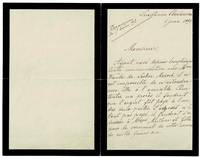
1893763781893. Fine. 1er juin 1893 11.30 x 17.70 cm un feuillet Probably unpublished autograph letter written by a secretary dated 1st June 1893 and signed by Leopold von Sacher-Masoch to an unknown recipient probably a lawyer. Handwritten note by Sacher-Masoch in the upper left margin of the letter: « Répondu le 1 mai 93 ». Two pages written in black ink on a bifolium. The writer is preparing for a possible lawsuit brought by his first wife Wanda the inspiration for his famous novel La Vénus à la fourrure who sought to reclaim what was owed to her and free herself from the fantasy she had embodied through her husbands works. Wanda whose real name was Angelika Aürora Rümelin had signed with him the notorious contract stipulating that she should cover herself in furs and whip him thus attireda veritable gospel of what would become masochism. Despite this sacred and formalised union by the late 1870s Leopold had grown weary of life with her Wanda being unable to fulfil his desires: « Courtisane malgré elle » and « infirmière » according to Jean-Paul Corsetti she was Gilles Deleuze tells us « sa compagne à la fois docile exigeante et dépassée ». Overwhelmed by financial difficulties he sold the famous furs and his wifes dresses and their divorce was pronounced in 1886. Haunted by her alter ego of La Vénus à la fourrure which had made of her an imperious and venal Delilah Wanda appears to have intended to sue her former husband: « Ayant cessé depuis longtemps toute communication avec Madame Wanda de Sacher-Masoch il m'est impossible de m'entendre avec elle à l'amiable . En cas échéant ce sera contre moi que Mme de Sacher-Masoch pourra tenter un procès». The lawsuit is without doubt connected with the premiere of Kassya an opera by Léo Delibes on a libretto by Sacher-Masoch adapted by Henri Meilhac and Philippe Gilles staged at the Opéra-Comique that same year. It is possible that Wanda who had translated Masochs works during their marriage did not receive the translation rights due to her for Kassya based on a tale published in her husbands Contes galiciens. In the same spirit as his years of absolute submission to Wanda he was determined to bear alone the burden of his wifes accusations in return for a sum of money paid by the other authors of the opera Henri Meilhac and Philippe Gilles: « Je déclarerai dans un acte notariel sic que en touchant la somme dite je me charge de toute responsabilité vis-à-vis de Mme de Sacher-Masoch». A strange and picturesque episode in the history of the founder of masochism still unknown to his biographers. unknown
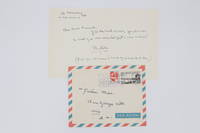
196678869Paris 1966. Fine. Paris 17 novembre 1966 20.70 x 13.50 cm une page sur un feuillet enveloppe jointe Handwritten signed letter addressed to Docteur Francis Mars: ""j'ai du mal à vous pardonner le mal que vous vous êtes fait à vous-même ! I find it difficult to forgive you for the harm you have done to yourself! Paris 17 November 1966 20.7 x 13.5 cm one page on a leaf envelope attached Handwritten letter signed by Natalie Clifford Barney addressed to Doctor Francis Mars a few lines written in black in on a leaf of headed paper from 20 rue Jacob Paris VIe envelope attached. Central fold from having been sent. ""Cher ami Francis j'ai du mal à vous pardonner le mal que vous vous êtes fait à vous-même ! Natalie PS: Je ne serai à Nice que vers le 5 déc. My dear friend Francis I find it difficult to forgive you for the harm you have done to yourself! Natalie PS: I will not be in Nice until around 5 Dec. Francis Mars from Nice was a mutual friend of Natalie Clifford Barney and her companion the artist-painter Romaine Brooks. The two women who had been in a relationship for almost fifty years did not live together: Natalie lived in Paris and only joined Romaine in Nice for the winter. unknown
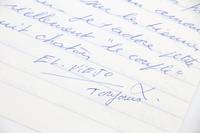
197684900Fleury-Mérogis 1976. Fine. ""Le pire que l'on puisse faire à un juge c'est lui enlever toute autorité devant les autres et crois moi il l'a bien compris"" ""The worst thing you can do to a judge is to remove all his authority in front of others and believe me he understood it well"" Fleury-Mérogis 2 Décembre1976 21 x 29.50 cm une page recto verso Autograph letter dated and signed by Jacques Mesrine dated Thursday December 2 1976 65 lines in blue ink on one recto-verso page addressed to his love at the time Jeanne Schneider thanks to whom the manuscript of Instinct de mort was discreetly smuggled out of prison. Jacques Mesrine then incarcerated at Fleury-Mérogis prison feels unwell and helpless far from his companion and from all human warmth: ""Ce soir je suis très mal foutu. il est 19 heures et je me couche juste après la fin de ta lettre. de rien de grave. juste une grande fatigue à rien faire"" ""Tonight I feel really awful. it's 7 PM and I'm going to bed just after finishing your letter. nothing serious. just very tired from doing nothing"" As a good father Jacques Mesrine rejoices in his daughter's happiness: ""Je suis heureux que sa veste lui plaise. de plus c'est la mode. son Loïc chéri ne va plus la reconnaître."" ""I'm happy that she likes her jacket. plus it's fashionable. her dear Loïc won't recognize her anymore."" and shows himself neither surprised nor more than amused that his daughter wants to embrace the Jewish religion: ""Comme cela la puce veut prendre la religion juive. encore une idée à elle. oui je sais elle a fait croire à ses copains qu'elle était juive. car eux l'étaient.si cela l'amuse je la laisse libre. mais ça démontre aussi un dédoublement de personnalité."" ""So the little one wants to take up the Jewish religion. another one of her ideas. yes I know she made her friends believe she was Jewish. because they were. if it amuses her I leave her free. but it also shows a split personality."" Public enemy No. 1 evokes with a certain pride his latest confrontation with his judge a fierce revenge of the insubordinate against the penitentiary universe that crushes men: ""Aujourd'hui j'ai eu la visite du juge Madre. Tu aurais rigolé car il a eu droit à tout mon vocabulaire. il en perdait la parole j'ai pris mon pied sic A un moment il me dit ""mais c'est quand même moi qui commande. Réponse de ton bibi : ""Ici pédé"" c'est moi ton patron"". Il était vert et les flics se marraient comme des perdus."" ""Today I had a visit from Judge Madre. You would have laughed because he got my full vocabulary. he was speechless I had a ball At one point he tells me 'but I'm still the one in charge. Your boy's response: 'Here faggot I'm your boss.' He was green and the cops were laughing like crazy."" and against all submission to any form of power or violence: ""Le pire que l'on puisse faire à un juge c'est lui enlever toute autorité devant les autres et crois moi il l'a bien compris. Il était venu avec 5 anti-commandos. L'un avait la bombe de gaz à la main. au cas où Loin d'être impressionné. cela me rend con."" ""The worst thing you can do to a judge is to remove all his authority in front of others and believe me he understood it well. He had come with 5 anti-commandos. One had the gas canister in his hand. just in case Far from being impressed. it makes me crazy."" The eternal rebel ends his letter with a beautiful testimony of tenderness for his beloved: ""Là ma puce je vais prendre mon lit en marche.Ton vieux voyou pose ses lèvres sur le tiennes en une douce caresse d'amour. je t'adore petite fille. car nous sommes réellement le ""couple"" et plus encore. Bonne nuit chaton."" ""There my little one I'm going to take to my bed. Your old rogue places his lips on yours in a sweet caress of love. I adore you little girl. because we are truly the 'couple' and even more. Good night kitten."" Rare and very fine letter by Jacques Mesrin unknown
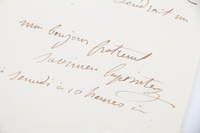
187586517Paris 1875. Fine. Paris s. d. ca 1875 13 x 21 cm une page Autograph letter signed by Savinien Lapointe 16 lines in black ink on one page discussing his financial difficulties due to his disinterested political commitment. Fold mark inherent to postal mailing. In the upper left margin the recipient of the letter has written: Répondre avec argent envoyé Reply with money sent The poet songwriter and cabaret performer Savinien Lapointe laments his material situation having always prioritized his political struggle over his own person: "". il en résulte que je n'ai pas le sol et que je dois quelques chose à mon propriétaire. Je suis menacé de congé si je ne lui donne pas d'argent aujourd'hui ou demain."" . it results that I don't have a penny and I owe something to my landlord. I am threatened with eviction if I don't give him money today or tomorrow. This is why he solicits his dear friend Etienne: ""Cela me rendrait un bien grand service."" That would render me a great service. Rare autograph letter signed by the poet-worker. unknown
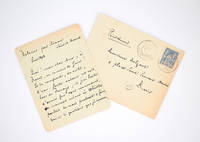
189875918Valvins 1898. Fine. Valvins 23 juin 1898 8.90 x 11.50 cm une carte recto verso - enveloppe jointe Autograph letter-card signed by Stéphane Mallarmé addressed to Alidor Delzant written in black ink on both sides. With the original envelope. Enclosed with this letter is a quatrain in Mallarmés hand: ""Tout en les éternisant / Bracquemond ici fait vivre / Les traits d'Alidor Delzant / A nous ouvert comme un livre."" Alidor Delzant was a lawyer collector and bibliophile. A friend of the Goncourt brothers he devoted a book to them and served as Edmonds secretary and testamentary executor. A delightful card in which the poëte ordinaire refers to the making of his portrait by his friend the painter Whistler: ""j'ai honte d'avoir fui dans ma verdure au moment même où Whistler parlait de mon portrait à faire"". ""On June 1st as he had promised Whistler who in his last letter with an affection verging on tenderness addressed him as mon Mallarmé he went to the painters studio on the rue Notre-Dame-des-Champs. You will see someone from the woods somewhere between the wild boar and the nightingale he had warned playfully in announcing his visit. Painter and poet ended the day dining on the rue du Bac where the all-too-ephemeral Trixie was now absent. In the half-light after dinner Whistler near a lamp seemed to resurrect in appearance the extraordinary Poe. Doubtless he then repeated to Mallarmé his intention of painting him. The next day without waiting for the Monet exhibition soon to be held at Georges Petit the Mallarmés went on to Valvins. Jean-Luc Steinmetz Stéphane Mallarmé This was most likely the execution of another portrait of Mallarmé of which no trace remains Whistler having already produced one that served as the frontispiece to Vers et Prose in 1893. He also alludes to Bracquemonds etched portrait of Delzant: ""Je comprends du reste l'eau-forte valant cet exil de Paraÿs . Redites mon affectueuse admiration toujours à Monsieur Bracquemond."" unknown
193977526Paris 1939. Fine. Paris 21 avril 1939 13.60 x 21.10 cm 3 pages et 1/4 sur deux feuillet enveloppe jointe double Autograph letter signed by Jean Wahl addressed to Marc Barbezat two and a quarter pages written in black ink on two sheets. Envelope included. Transverse fold inherent to the mailing. Jean Wahl was Marc Barbezat's examiner for the philosophy baccalaureate examination and it was then that the two men became friends. In 1940 shortly after this letter was written Barbezat would found the review L'Arbalète to which the philosopher would contribute by entrusting his very first poems to his young protégé. This review would later become a publishing house that would notably publish Jean Genet's first and scandalous texts. Long letter notably discussing the sculptor Agustín Cárdenas: ""J'ai lu avec plaisir ce que vous disiez du témoignage de Cardenas. Croyez-vous cependant que les animaliers d'aujourd'hui soient si méprisables "" ""I read with pleasure what you said about Cardenas's testimony. Do you really think that today's animal sculptors are so contemptible"" He then lists some ""auteurs lyonnais"" ""authors from Lyon"" of his acquaintance: ""Albert Marie Schmidt . qui vient de faire paraîtreune thèse sur la poésie scientifique au 16ème siècle. Il y parle de Maurice Scève. . 2° Un jeune russe Balacheff . 3° Boas professeur à l'université de Glasgow Scotland . 4° Marcel Raymond l'auteur de Baudelaire au Surréalisme . 5° Joseph Rouault spécialiste de Du Bellay . Peut-être pourriez-vous écrire à Georges Blin ."" ""Albert Marie Schmidt . who has just published a thesis on scientific poetry in the 16th century. He speaks of Maurice Scève there. . 2° A young Russian Balacheff . 3° Boas professor at the University of Glasgow Scotland . 4° Marcel Raymond the author of Baudelaire to Surrealism . 5° Joseph Rouault specialist in Du Bellay . Perhaps you could write to Georges Blin ."" unknown
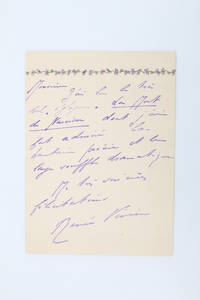
190479913s. l. Paris 1904. Fine. s. l. Paris s. d. ca 1904 11.50 x 16 cm une page sur un double feuillet Handwritten signed letter addressed to the poet Jean-Marc Bernard: I read the very beautiful eclogue La Mort de Narcisse whose haughty poetry and dramatic breath I admired very much. Paris ca 1904 11.5 x 16 cm one page on a double leafHandwritten signed letter from Renée Vivien addressed to Jean-Marc Bernard written in violet ink on a double leaf of paper decorated at the head with a border of violets. Transverse folds from having been sent. Monsieur J'ai lu le très bel ""églogue"" La Mort de Narcisse dont j'ai fort admiré la hautaine poésie et le large souffle dramatique. Mes très sincères félicitations. Renée Vivien. Monsieur I read the very beautiful eclogue La Mort de Narcisse whose haughty poetry and dramatic breath I admired very much. My very sincere congratulations. Renée Vivien. Jean-Marc Bernard was one of the founders of the poetic satirical and monarchist magazine Les Guêpes which welcomed contributions from Paul-Jean Toulet and Francis Carco among others. Together with the latter two he was part of the École fantaisiste a collective of young poets eager to break with the Parnassians and symbolists and whose ambitions were soon to be swept away by the arrival of the Great War. Jean-Marc Bernard lost his life on the front line destroyed by a shell at the age of thirty-three. unknown
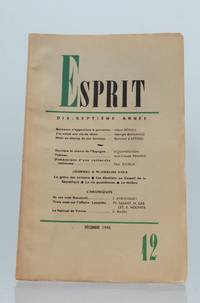
194875504Paris: Esprit 1948. Fine. Esprit Paris Décembre 1948 14.50 x 22.50 cm broché First edition of this issue of the important humanist review founded by Emmanuel Mounier one of 50 numbered copies on alma du Marais paper the only deluxe copies. This issue is partly devoted to Georges Bernanos who had died five months earlier with Albert Béguin ""Bernanos n'appartient à personne"" Georges Bernanos ""J'ai mené une vie de chien"" Bertanrd d'Astorg ""Mort au champ de son honneur"". Other contributions by Paul Ricoeur ""Dimension d'une recherche commune"" Marius Gandilhon ""Derrière le silence de l'Espagne"" Jacques Ayencourt ""Ils ont voté Roosevelt"". Occasional foxing mainly marginal. Esprit unknown
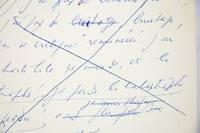
195484027Meudon 1954. Fine. Meudon 1954 20.70 x 26.80 cm une page sur un feuillet Autograph manuscript signed by Louis-Ferdinand Céline written in blue and pink ballpoint pens on a white paper sheet numbered 507 in the left corner. One transverse fold. Some pin holes in the upper margin stigmata of the organization of Céline manuscripts in ""bundles"". « j'ai pas de cinéma personnel j'ai pas de bruitage j'ai pas de critiques ""rémunérés"" j'ai que l'hostilité du monde et la catastrophe ! je perds la catastrophe je suis perdu ! . chienlit ! charlatan ! barbeau mou ! Comme ça vous m'intitulez si vous me trouvez pas dans la loge en plein enragement d'éléments ! je veux pas que vous. » The passage in our sheet presents some variations from the published version. Published in 1954 Normance is a direct sequel to Féérie pour une autre fois published two years earlier. Both parts were written during Céline's years of exile and imprisonment in Denmark. Upon his return to France in 1951 Céline undertook a work of ""polishing"" and published independently these two titanic texts originally envisioned as one. ""Céline while working on it thought of this novel as a second Voyage au bout de la nuit capable twenty years later of astonishing the public as much as the 1932 novel."" Henri Godard unknown
189086740Paris: S. n. 1890. Fine. S. n. Paris s. d. ca 1890 13 x 20 cm une page Dated and signed autograph letter from Théodore de Banville 9 lines in black ink requesting a favor for friends from a theater director. Fold mark inherent to envelope insertion. A black ink notation in the upper left corner of the letter: ""Fait"". ""Mon cher ami j'ai promis à des gens respectables une loge pour aller à la comédie ; c'est je crois le vrai jour de vous la demander. Merci et mille amitiés et à demain votre bien dévoué Th. de Banville. Vendredi 6 Janvier."" My dear friend I promised respectable people a box to go to the comedy; I believe this is the right day to ask you for it. Thank you and a thousand friendships and until tomorrow your very devoted Th. de Banville. Friday 6 January. S. n. unknown
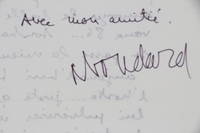
198679437Paris: S. n. 1986. Fine. S. n. Paris 23 Janvier 1986 21 x 29.50 cm une feuille une enveloppe Dated and signed manuscript letter of 28 lines from Alphonse Boudard to his great friend and companion of boozy lunches the Brussels journalist André Tillieu who was like Alphonse Boudard a great friend of Georges Brassens but also of Louis Nucéra. Two fold marks inherent to the envelope folding of the letter envelope included. ""Vieux merci de ta petite carte. il n'est pas encore trop tard pour te renvoyer la balle des meilleurs voeux pour 86. souhaitons que toute se passe le mieux possible. aujourd'hui Louis Nucéra est entré à l'hosto. juste q.qs jours. on va lui pulvériser un calcul au laser. Le dernier cri de la médecine en ce domaine. Si le pauvre Georges Brassens avait pu connaître ça ! Je pensais avoir un Guignol's band que je n'avais pas. d'où un malentendu. etc. Ma pièce est en rade le théâtre qui devait me la monter est en faillite. donc je repars à zéro. et je ne désespère pas d'avoir Galabru à l'affiche. J'ai remis ""La fermeture"" mon livre sur les claques à Laffont. Il sort en avril après les turbulences électorales. Mais d'ici peut-être aurons-nous l'occase de partager une croûte ensemble. Avec mon amitié. ABoudard."" ""Old friend thanks for your little card. it's not too late yet to return the ball with best wishes for 86. let's hope everything goes as well as possible. Today Louis Nucéra went into the hospital. just a few days. they're going to pulverize a stone with laser. The latest in medicine in this field. If poor Georges Brassens could have known that! I thought I had a Guignol's band that I didn't have. hence a misunderstanding. etc. My play is stranded the theater that was supposed to stage it is bankrupt. so I'm starting from zero again. And I don't despair of having Galabru in the cast. I delivered 'La fermeture' my book about brothels to Laffont. It comes out in April after the electoral turbulence. But perhaps by then we'll have the chance to share a crust together. With my friendship. ABoudard."" André Tillieu the Brusselian very close friend and biographer of Georges Brassens maintained an epistolary correspondence with Alphonse Boudard for nearly thirty years from 1972 until the latter's death in 2000. The cheeky Parisian writer very quickly showed him his friendship considering him one of the rare critics to understand him perfectly to the point of explaining clearly in his chronicles what he himself expressed only incompletely and sometimes confusedly in his books. André Tillieu thus became part of the small circle of Alphonse Boudard's true friends alongside Big Georges Georges Brassens the man from Nice Louis Nucéra and René Fallet with whom he loved to share copious well-watered meals and cycling expeditions. As death gradually took away his best friends one by one André Tillieu would remain one of Alphonse's very last buddies. S. n. unknown
197684675Paris 1976. Fine. Paris 11 Octobre 1976 21 x 29.50 cm une page recto verso Autograph letter dated and signed by Jacques Mesrine dated Monday October 11 1976 70 lines in blue ink on one recto-verso page addressed to his love of the time Jeanne Schneider thanks to whom the manuscript of Instinct de mort was discreetly smuggled out of prison. Jacques Mesrine then incarcerated at La Santé showers with gifts the people he loves because he wants their happiness: ""Comme cela j'ai payé une mobylette à mes trois gamines. Toi ce sera une quatre roues sic."" ""Like this I paid for a moped for my three girls. For you it will be four wheels sic."" He shows all his affection for a young girl named Betty whom he seems to cherish more than his own daughter Sabrina: ""Peut-être que je recherche en Betty ce que je ne trouve pas en Sabrina et que Mury m'a refusé ! Tu sais mon ange ; à 15 ans j'aurais tellement aimé avoir un copain de 40 ans à qui je puisse tout dire qui sache m'aider ou m'offrir mon rêve. Peut-être que ce cadeau je me le fais à moi-même."" ""Maybe I'm looking for in Betty what I don't find in Sabrina and what Mury refused me! You know my angel; at 15 I would have loved so much to have a 40-year-old friend to whom I could tell everything who would know how to help me or offer me my dream. Maybe this gift I'm giving it to myself."" for whom he has no more confidence feeling betrayed: ""Mais on ne devient jamais l'ami de quelqu'un qui vous juge. Pas plus que pour Sabrina ! qui elle m'a trompé dans ma confiance donc dans mon amour. Quand on use les sentiments ils ne redeviennent jamais les mêmes."" ""But one never becomes the friend of someone who judges you. No more than with Sabrina! who deceived my trust and therefore my love. When feelings are worn out they never become the same again."" Public enemy No. 1 takes great pride in his relationship with Jeanne Schneider based on honesty: ""C'est peut-être pour cela que je me suis toujours refusé à te mentir - quitte à te faire souffir. Je n'ai aucun passé.mais un seul présent ""Toi"". C'est peut-être cela qui fait que notre amour dure depuis 10 ans "" ""Maybe that's why I've always refused to lie to you - even if it means making you suffer. I have no past.but only one present 'You'. Maybe that's what makes our love last for 10 years "" Jacques Mesrine then turns to material considerations so important for a prisoner: ""J'ai reçu ton linge. Je ne risque pas d'avoir froid cet hiver. Le polo est très bien."" ""I received your clothes. I won't risk being cold this winter. The polo shirt is very good."" before castigating the inhumanity of the prison system and its indifference to suffering: ""Mais nous n'avons rien à attendre des juges et si ma lettre au président a été ferme c'est le genre de lettre qu'il comprendra mieux que le style ventre à terre."" ""But we have nothing to expect from judges and if my letter to the president was firm it's the kind of letter he will understand better than the groveling style."" As an eternally untamed man Jacques Mesrine never ceases to advocate fighting against the prison administration: ""On ne se défend pas en mettant sa tête dans le sable comme l'autruche ! Dès l'instant où l'on prend une arme dans la main. il faut s'attendre à payer ! que Michou le comprenne ce n'est pas le moment d'être ""bébé"" mais celui d'être femme."" ""You don't defend yourself by putting your head in the sand like an ostrich! From the moment you take a weapon in your hand. you must expect to pay! let Michou understand this is not the time to be a 'baby' but to be a woman."" Jacques Mesrine ends this beautiful letter with a moving declaration of love full of optimistic humor: ""Ton vieux tigre pose de doux bécots sur tout ce qui est toi. Bonne nuit chaton et un moral d'acier est de rigueur ok. Je t'adore chanceuse & Ton mystère Jacques !! ""Te adoro A toi seule."" ""Your old tiger puts gentle kisses on everything that is you. Good night kitten and a steel hardcover