Octave MIRBEAUBiblio.com
48 390 résultats
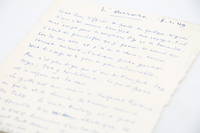
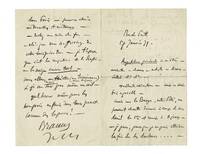
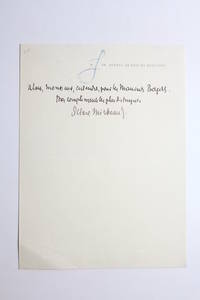
189773703s. l. Paris 1897. Fine. s. l. Paris 1897 13.50 x 18.30 cm une feuille Autograph letter signed by Octave Mirbeau. 2 lines in black ink on a folded sheet letterhead paper ""68 avenue du bois de Boulogne"". ""Alors Monsieur entendu pour les Mauvais Bergers"". The Mauvais bergers corresponds to Octave Mirbeau's tragedy a social drama performed at the Renaissance Theatre on December 15 1897 with Sarah Bernhardt and Lucien Guitry in the leading roles. unknown
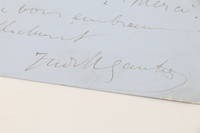
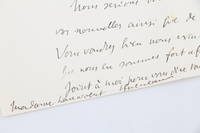
191080835Alger Algiers 1910. Fine. Alger Algiers s. d. ca 1910 13.70 x 18 cm 4 pages sur un double feuillet Autograph letter signed by Judith Gautier addressed to Céleste Chrétien her housekeeper. Four pages written in black ink on a double sheet. Transverse folds inherent to mailing. Judith Gautier here discusses the visit of her friend the musician Chalmers Clifton - whom she liked to nickname Charmeur - to Dinard: ""Voici les dernières instructions : le voyageur arrivera dimanche soir à 7 heures 20. Il faudra le prendre à la gare vous ou Francis et le conduire tout droit à la maison qu'il ne connait pas. Il apporte des draps au cas où il n'y en aurait pas. Il les donnera pour qu'on fasse le lit et on le conduira tout de suite à Michelet pour dîner il faudra prévenir pour qu'on garde un dîner. . Mr Clifton est un très jeune américain tout à fait charmant et qui a l'air d'une demoiselle. Soignez-le bien."" ""Here are the final instructions: the traveler will arrive Sunday evening at 7:20. You or Francis will need to meet him at the station and take him straight to the house which he doesn't know. He is bringing sheets in case there aren't any. He will give them so the bed can be made and he will be taken immediately to Michelet for dinner you must warn them to save a dinner. . Mr. Clifton is a very young American who is quite charming and looks like a young lady. Take good care of him."" unknown
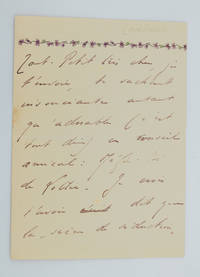
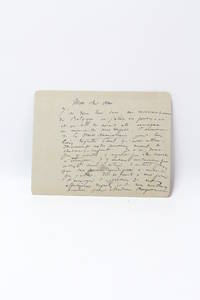
190679012s. l. Paris 1906. Fine. s. l. Paris s. d. ca 1906 11.50 x 15.90 cm 4 pages sur un double feuillet Autograph letter by Renée Vivien addressed to Natalie Clifford Barney and written in violet ink on a double sheet bordered with violets. Transverse folds inherent to mailing. Interesting letter of warning against the opportunist ""Lottie"": ""Tout-Petit très cher je t'envoie te sachant insouciante autant qu'adorable c'est tout dire ce conseil amical : Méfie-toi de Lottie. Je crois t'avoir dit que la « scène de séduction » chez moi était très savamment préparée et combinée. Lottie a besoin d'argent. Elle en cherche avec âpreté. Elle me demande maintenant une « lettre d'introduction » pour Lugné-Poë. et moi qui ne le connais pas ! Elle « t'embêtera » . c'est le mot cru le seul qui convient Elle est exaspérée contre moi parce que je n'ai pas succombé et surtout parce que je ne lui donnerai pas d'argent. Si elle m'en avait demandé loyalement franchement au nom des jours d'autrefois j'aurais cédé mais cette comédie amoureuse me répugne Je te le répète : Méfie-toi Ne la vois point si cela t'est possible."" ""Very dear Little One I send you knowing you to be as carefree as you are adorable which says everything this friendly advice: Beware of Lottie. I believe I told you that the 'seduction scene' at my place was very cleverly prepared and planned. Lottie needs money. She seeks it eagerly. She now asks me for a 'letter of introduction' to Lugné-Poë. and I who don't know him! She will 'bother you'. that's the crude word the only one that fits She is exasperated with me because I did not succumb and especially because I will not give her money. If she had asked me loyally frankly in the name of days gone by I would have given in but this amorous comedy disgusts me I repeat: Beware Do not see her if it is possible for you."" Charlotte ""Lottie"" Stern Countess Venturini was an actress also known by the name of Yorska and a close friend of Sarah Bernhardt. Alice Pike Barney Natalie's mother painted a very beautiful profile of her in pastel entitled ""Vamp of 1900"" and today preserved at the Smithsonian American Art Museum in Washington. The Jacques Doucet library holds eighteen autograph letters that she addressed to Natalie Clifford Barney. It was at the end of 1899 and through the intermediary of Violette Shillito that Renée Vivien - then Pauline Tarn - made the acquaintance of Natalie Clifford Barney ""cette Américaine plus souple qu'une écharpe dont l'étincelant visage brille de cheveux d'or de prunelles bleu de mer de dents implacables"" Colette Claudine à Paris. Natalie who had just lived through a summer idyll with the scandalous Liane de Pougy who had initiated her into sapphism paid only discreet attention to this new acquaintance. Renée on the other hand was completely captivated by the young American and would relate this love at first sight in her autobiographical novel Une Femme m'apparut: ""J'évoquai l'heure déjà lointaine où je la vis pour la première fois et le frisson qui me parcourut lorsque mes yeux rencontrèrent ses yeux d'acier mortel ses yeux aigus et bleus comme une lame. J'eus l'obscur prescience que cette femme m'intimait l'ordre du destin que son visage était le visage redouté de mon avenir. Je sentis près d'elle les vertiges lumineux qui montent de l'abîme et l'appel de l'eau très profonde. Le charme du péril émanait d'elle et m'attirait inexorablement. Je n'essayai point de la fuir car j'aurais échappé plus aisément à la mort."" ""Winter 1899-1900. Beginning of the idyll. One evening Vivien is invited by her new friend to Mme Barney's studio Natalie's mother 153 avenue Victor-Hugo at the corner of rue de Longchamp. Natalie ventures to read verses of her composition. When Vivien tells her she loves these verses she replies that it is better to love the poet. A response quite worthy of the Amazon."" J.-P. Goujon Tes blessures sont plus douces que leurs caresses Two year unknown
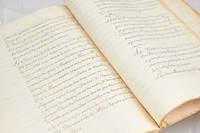
1672750391672. Fine. s. d. 1672-1674 24 x 34 cm relié Complete autograph manuscript of 106 pages entitled: Mémoire de la construction et agrèz d'une galère ordinaire avec l'explication des termes l'usage des manuvres et de toutes les parties qui composent le corps de la galère et son armement. Penned in a neat unrubricated hand with occasional marginal notes in another hand. Contemporary full vellum binding lightly soiled with minor wear smooth spine without lettering. A major and invaluable manuscript chronicling the revival of the French galley fleet written by the most influential galley shipwright of his time: Jean-Baptiste Chabert. We have identified only two other manuscripts bearing this same title: one belonged to Commander Noël Fourquin a master mariner and specialist in nautical lexicography; the other was owned by Louis-Philippe himself. The latter is listed under no. 445 in the catalogue of the sale of his Palais-Royal and Neuilly libraries held in December 1852 and bears a binding identical to ours. This significant manuscript can be attributed to Jean-Baptiste Chabert a Marseille-based galley shipbuilder. Jan Fennis in his work Trésor du langage des galères 1995 relays this attribution made by Jacques Humbert La Galère du XVIIIe siècle who passed the manuscript on to Commander Fourquin: Il nous paraît que cette uvre est celle d'un constructeur de galères travaillant à Marseille car il est question de l'arsenal de cette ville dans le texte. Il nous semble qu'on pourrait assez raisonnablement l'attribuer à Jean-Baptiste Chabert. Jean-Baptiste Chabert was part of a Marseille dynasty of galley builders whose activity dated back to the mid-17th century. He was involved in the construction of the remarkable flotilla on the Grand Canal of Versailles built in Marseille from 1681 onward. In 1682 he was appointed professor at the shipbuilding school in Marseille where officers lieutenants and sub-lieutenants of the galley corps were trained and in 1690 he was awarded the brevet of premier maître constructeur des galères royales. In a letter addressed to the presidents of the parlements dated 11 April 1662 Colbert writes: Le Roi m'a commandé de vous écrire ces lignes de sa part pour vous dire que Sa Majesté désirant rétablir le corps des galères et en fortifier la chiourme par toutes sortes de moyens est que vous teniez la main à ce que votre compagnie y condamne le plus grand nombre de coupables qu'il se pourra et que l'on convertisse même la peine de mort en celle des galères. This letter makes it possible to date the manuscript to around 16721674 confirmed by the author's mention in the opening pages of the nationalisation of the galley fleet: Il faut savoir que le roi a l'économie de ses galères depuis dix à douze ans les capitaines étant auparavant propriétaires du corps et agrès des galères. This dating is also supported by a note in the margin of Commander Fourquins copy reading 1672-74. The text then immediately refers to Monsieur Nicolas Arnoul intendant des galères de France: Du depuis Monsieur Arnoul . a fait construire à Marseille un arsenal très magnifique dans lequel il y a toute sorte de manufactures pour fournir les choses nécessaires pour armer les galères. The construction of the Marseille arsenal took place in three phases between 1665 and 1690 though Arnoul died in 1674. Chabert begins his treatise by listing the various types of galleys: ordinaire Patronne Capitane and Realle. While distinguished by size the author does not dwell on their dimensions reflecting the culture of secrecy surrounding naval construction at the time. He then briefly discusses the state of the galley fleet Louis XIVs renewed interest in these vessels and how the king managed to increase their numberand fill them with convictsover the past ten years. When Louis XIV visited Marseille in 1660 no war fleet remained in the port: the galleys lay rotting in Toulon and on hardcover
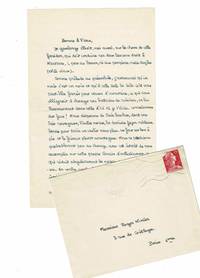
195676357Laval 1956. Fine. Laval 23 octobre 1956 13.50 x 21 cm 2 feuillets une enveloppe Long and exceptional autograph letter signed by Antoine Blondin addressed to fellow Hussar Roger Nimier at his home on rue de Coëtlogon. Blondin plans a gargantuan feast detailing at length the wines to be served for each guest while indulging in witty reflections on mans alcoholic ontology: ""Si tu avais simplement lu 'Tiens voilà du Bouddha !' d'Hubert Robert tu saurais : . que cet homme dualiste sans unité intérieure a besoin de Bourgogne et de Bordeaux."" 56 lines on two folded leaves. Envelope enclosed. Published in À mes prochains: lettres 1943-1984 ed. Alain Cresciucci 2009 p. 84. A fine expression of the anarchic spirit that so often guided Antoine Blondins inebriated steps and of the boisterous friendship that bound him to Roger Nimier. In this remarkable letter to his dear ""Pomme à leau"" Nimier the writer prepares a memorable soirée. The inveterate drinkerwho often alarmed his guests with his bibulous anticsonce declared: ""Je ne suis pas un écrivain qui boit je suis un buveur qui écrit."" In this letter he pairs an astonishing array of wines with the dishes of the meal and ever considerate of his guests adds: ""Question des vins il faut compter avec les personnalités ne pas travailler dans l'absolu chercher des rimes. Je crains que Popaul n'ait le chanfrein un peu porté sur le bouquet cosmopolite dans le genre cocktail extra-chlorydrique à se faire éclater l'ampoule de Vater."" Ever attentive to his future guests he adjusts his oenological marathon: ""Considérons donc que le champagne de dessert . qui sent un peu la première communion sauf s'il est administré en injections risquerait d'indisposer le premier et d'achever le second. Proscrivons jusqu'aux cigares puisqu'aussi bien nos lascars ne sont pas assez adultes pour se déglacer avec les bières."" He waxes lyrical on Swiss Sylvaner and Sauternes and concludes his letter with a brilliant remark on the great Médocs: ""N'oublie pas pourtant qu'à côté de Margaux il y a Lafite et que Latour n'est jamais loin. Tu as peut-être carencé rapidement sur les Côtes de Nuits Et pourquoi pas les deux "" Speaking of the profound friendship that united Blondin and Nimier and of the myth of the Hussars Blondin told Emmanuel Legeard: « Ce sont les 'hussards' qui sont une invention. Une invention 'sartrienne'. En réalité l'histoire c'est mon ami Frémanger qui s'était lancé dans l'édition qui avait un seul auteur c'était Jacques Laurent et un seul employé c'était moi. Laurent écrivait et moi je ficelais les paquets de livres. Donc on se connaissait on était amis et d'autre part. d'autre part Roger Nimier était mon meilleur ami. Nimier je le voyais tous les jours. Je l'ai vu tous les jours pendant treize ans. Mais Laurent et Nimier ne se fréquentaient pas du tout. Ils avaient des conceptions très différentes. On n'a été réunis qu'une seule fois. On s'est retrouvés rue Marbeuf au Quirinal pour déjeuner. On a discuté de vins italiens et de la cuisson des nouilles. Pendant deux heures."" A splendid letter from Blondin the prince of the bottle turning himself into a whimsical sommelier. unknown
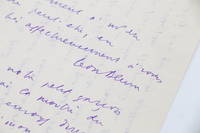
189784542Paris 1897. Fine. Paris s. d. circa 1897 11 x 18 cm deux pages et demie Autograph signed letter addressed to a fellow journalist 45 lines written in purple ink. Central fold inherent to the mailing. Léon Blum warns his fellow journalist about his article which differs from the editorial line of his own probably La Revue Blanche to which Alexandre Varenne contributes who is cited at the beginning of the letter: "". I confess to you in all frankness - that the very substance of the article was troublesome for our readership. First in your enumeration a term was missing: the priests. Don't forget that we are sectarians. Furthermore a sentence about financiers could seem in our publication rather singular."" and which could also offend the political sensibilities of his readership: ""Finally above all don't forget that our readers might have found it strange to be told: 'Don't hate. There are trees paintings verses music.' You know they don't have the time."" After careful reflection Léon Blum advises and invites his correspondent to write another article better suited to satisfy the journal's management and readers: "". I am convinced that it is better quite simply to send us another one which would then appear Saturday morning."" his frank recommendations being dictated only by the friendship he shows his friend. unknown
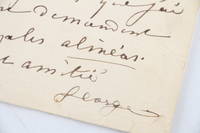
1838866321838. Fine. Sand publishes her response to Lerminier s. d. 23 février 1838 11 x 20.40 cm 1 page sur feuillet Autograph letter signed by George Sand addressed to François Buloz. One page in black ink on a single sheet. Fold marks sheet reinforced with paper on verso. Published in her correspondence ed. Georges Lubin vol. IV pp. 331-332. Exasperated by the attitude of the Revue des deux mondes of her friend Buloz George Sand decides to defend the progressive thinker Félicité Lammenais targeted by a scathing critique published in the review. She takes up her pen here and orders Buloz to publish her response article without changing a single line. Mon cher Buloz voici la lettre à M. Lerminier n'y changez rien. Relisez-en vous même et vous seul l'épreuve. Corrigez les fautes de typographie. Veuillez à la ponctuation et aux guillemets. Il va sans dire que les blancs de mon manuscrits sont le résultat de coupures et de transcriptions que j'ai faites et ne demandent que de simples alinéas. Bonjour et amitié George ""My dear Buloz here is the letter to M. Lerminier change nothing. Proofread it yourself and yourself alone. Correct the typographical errors. Mind the punctuation and quotation marks. It goes without saying that the blanks in my manuscript are the result of cuts and transcriptions I have made and require only simple paragraphs. Good day and friendship George"" This letter perfectly illustrates the stormy yet fruitful collaboration that united François Buloz and George Sand. The latter gave Sand for many years a platform and a means to live by her pen. She published in the Review a great number of masterpieces including Lettres d'un voyageur 1834-1836 Mauprat 1837 Spiridion 1839 Gabriel 1839 Mademoiselle La Quintinie 1863 Césanne Dietrich 1870. Through his mediation she also actively participated in the political debates of her time. In 1838 Buloz was the great orchestrator of an ideological duel when Sand ""decided to take on the critic Lerminier who had just made a very critical analysis of the Livre du peuple in the review. Buloz out of desire for publicity allowed his two collaborators to publicly exchange blows in the review. Through Lerminier and his superior tone the review then revealed its rather misogynistic vision of literature and philosophy: 'the time has come for you to give your philosophical opinions more consistency and scope because you are entering a new phase of life and talent. Inspiration and fantasy have raised you to a height where they would not suffice to maintain you. Draw now madam new strength from reflection and science'"" Marie-Eve Thérenty George Sand François Buloz et la Revue des Deux Mondes. Sand reacted immediately and sent her response article accompanied by this peremptory missive ordering Buloz to publish her text as it stood. Lamennais was very touched by her gesture: ""I shall always count among the happy circumstances of my life where I don't count many to have been defended by you. In publishing my last book I knew well that it would shock almost everyone legitimists juste-milieu Catholics even republicans those at least who want neither God nor liberty and their number is great and they have a terrible faith in themselves. I have hoped only in the people who do not make systems and who under the influence of primitive and imperishable human instincts judge by the heart and judge alone infallibly. Without them I don't know what would become of liberty on earth. M. Lerminier and many others imagine that I speak at random according to whatever idea of the moment occurs to me. They are mistaken"" Yves Chastagnaret George Sand Lerminier et le Livre du Peuple de Félicité Lamennais. Flying to the rescue of a defender of the people Sand writes this scathing missive at a key moment in her tumultuous relationship with Buloz. unknown
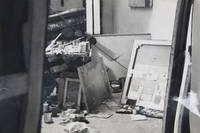
195482360Paris 1954. Fine. Paris s. d. circa 1954 24.20 x 31.10 cm une feuille Original view of Nicolas de Staël's atelier Paris n.d. circa 1954 242x311cm one leaf. Original silver print photograph of Nicolas de Staël's atelier by Denise Colomb. Traces of folds small pieces of paper missing in the lower left corner. Splendid ""still life"" in large format of the painter's Parisian atelier rue Gauguet taken one year before his death. His masterpieces are jumbled together with firewood and numerous pots of paint. The photograph was taken by Denise Colomb great portraitist of the 20th century known for her portraits of Antonin Artaud Giacometti Picasso Soulages and Miro in their studio. It is said that his workshop was the cave of a palaeontological potter. With sediment layers of paleo. A crucible a large material well riddled with pigments paintbrushes pots of plastered trowels buckets rags. In a strong smell of turpentine. A workshop covered soiled stained with dirt with masonry clay. Its wingspan its strength its topsail height springs into this crater of Vesuvius. Slightly disoriented he leans he pours. To paint for him is to be prey to vertigo to unpredictable accidental chance junctions. Patrick Grainville Les Yeux de Milos. unknown
1860640961860. Fine. s. d. circa 1860 20.60 x 27.60 cm un feuillet remplié DUMAS Alexandre Naïs et Chloé. Unpublished handwritten sapphic poem signed by Alexandre Dumas N. d. c. 1860 206 x 276 cm one folded leaf Autograph manuscript poem signed by Alexandre Dumas bearing the title Naïs et Chloé 84 verses in black ink on a blue folded leaf of paper. A few tiny tears without damage to the text invariably produced when a leaf of paper is folded. A very rare manuscript of a long unpublished poem depicting the love of Naïs and Chloé the writing of which is motivated by the admiration and tribute paid by Alexandre Dumas to one of the greatest figures of ancient poetry Sappho. A prolific novelist Dumas rarely tried his hand at poetry; Naïs et Chloé by its length constitutes a hapax in the literary production of this writer. The text remains unpublished to this day and is here enhanced by the elegant calligraphy of its author. The poem is made up of 21 quatrains among which stands a remarkable insertion of the most famous verse by Sappho to the beloved woman the title of which is preserved in the very body of the text. This embedding is part of the verve with which Dumas defends the poetic and evocative force of the writing of Sappho whom he elevates to the rank of the star of the world of Poetry: Il est au sein des mers s'appuyant à l'Asie Entre l'heureuse Smyrne et la sombre Lemnos Une île aux bois fleuris chers à la Poésie A qui Venus donna le doux nom de Lesbos. Quand du chantre divin la voix fut étouffée Que du nom d'Euridice elle eut frappé l'écho Le flot roula tête et la lyre d'Orphée Sur la rive où plus tard devait naître Sapho Sapho naquit la lyre en ses mains fut remise Les sons qu'elle en tira jusqu'à nous sont venus. Translated with conscientious care by the author the poem borrowed from Sappho in which that most famous verse emerges this one I say is equal to the gods is found in several places in Dumas' work particularly in the chapter entitled les vers saphiques of San Felice and in a collection of articles dedicated to the great female figures where she sits alongside Joan of Arc and Margaret of Anjou. For Dumas it is a matter of remaining faithful to the written verses and rendering their sensuality often blurred by previous translators: The translations of these two poets often appear to lack not only ancient color but are inadequate in their lesbian ardor Les étoiles du monde Galerie historique des femmes les plus célèbres de tous les temps et de tous les pays. Above and beyond this translation Dumas is imbued with the lyricism of Sappho without losing his own romantic vein and he paints the sapphic love of Naïs and Chloé in an erotic light: Oh seule palpitante échevelée et nue Une main sur ma gorge et l'autre. Oh ma Naïs Serre moi dans tes bras et sois la bien venue Car à force d'amour. tiens. tiens je te trahis Et l'on n'entendit plus alors dans la nuit sombre Que le bruit des baisers répétés par l'écho Car Nais et Cloé se taisaient et dans l'ombre Clinias s'enfuyait en maudissant Sapho. The poem testifies to the continuous interest that the authors of the late 19th century showed toward sapphism and to the personage of the reader-voyeur here embodied by Cleinias whose most famous occurrence remains Zola's Nana. Exceptional and long autograph sapphic poem by Alexandre Dumas. $ 10 000 unknown
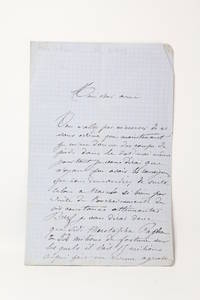
1867713581867. Fine. s. d. vers 1867 13.30 x 21.20 cm une feuille Long autograph letter signed by sculptor Charles Cordier to a painter friend regarding the sculptures of the Vaudeville Theatre built at the corner of Boulevard des Capucines and Rue de la Chaussée d'Antin from January 1867 to April 1 1869 commissioned by the City of Paris. The majority of the sculptures and bas-reliefs had been entrusted to Emile Hébert whose Italian cherubs were not to the taste of Charles Cordier a great defender of French style: ""Vaudeville should be represented by an adolescent receiving from artistic tradition the attributes of comedy and what instead Tiresome sculpture instead of creating French sculpture for a theatre that is so French in spirit."" Cordier created two caryatids for the Vaudeville for the balcony of one of the principal boxes. In a very interesting passage Cordier speaks of his sculptor pupils and his sculptural style: ""I always encourage the children not to abandon naivety in drawing which leads to intimate feeling in portraiture. A rare thing!"" ""Mon cher ami . Je crains fort de ne pouvoir partir le Vaudeville presse. J'ai le bas relief de milieu et illisible et classique. Le vaudeville doit être présenté par un adolescent recevant de la tradition artistique les attributs de la comédie et à quoi de la sculpture assommante au lieu de faire de la sculpture française pour un théâtre qui est si français par son esprit. Notre élève va bien. J'ai vu un portrait ébauché . J'engage toujours les enfants à ne pas se départir de la naïveté dans le dessin ce qui amène au sentiment intime dans le portrait. Chose rare !. Et vous cher maître faits dans dans les esquisses de la chapelle j'irai vous voir un soir si je ne vous dérange pas vous m'ouvrirez vers les 4h. Mes excuses encore une fois . Charles Cordier"" ""My dear friend . I very much fear I may not be able to leave the Vaudeville is pressing. I have the central bas-relief and illegible and classical. Vaudeville should be represented by an adolescent receiving from artistic tradition the attributes of comedy and what instead Tiresome sculpture instead of creating French sculpture for a theatre that is so French in spirit. Our pupil is doing well. I saw a sketched portrait . I always encourage the children not to abandon naivety in drawing which leads to intimate feeling in portraiture. A rare thing!. And you dear master working on the chapel sketches I will come to see you one evening if I don't disturb you you will receive me around 4 o'clock. My apologies once again . Charles Cordier"" unknown
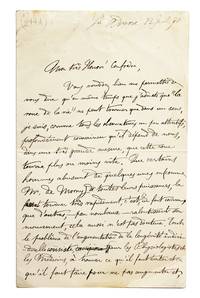
1890713501890. Fine. 12 juillet 1890 11.20 x 17.90 cm une feuille Signed autograph letter about human aging12 July 1890 11.2 x 17.9 cm one leafAutograph letter signed by the physiologist and neurologist Charles Edouard Brown-Séquard dated 12 July 1890 one folded sheet. He outlines a scientific method of prolonging human life while at the same time developing a series of philosophical and epistemological reflections on mortality. Successor to Claude Bernard in the Collège de France Brown-Séquard here tries to push back the limits of ageing and prolong the nervous responses of the brain: Not to grow old before time and to grow old as late as possible that is what should preoccupy those who love life or those who without loving it need to ensure it lasts. Brown-Séquard had just published a study on this subject and had succeeded in administering a harmless nervous stimulation with an injection of liquids extracted from animal testicles. Giving the example of the flamboyant Duc de Morny son of Hortense de Beauharnais who died at the age of 53 the professor lays out a theory that is broader than the simple neurological remedy: It depends on the person whether the wheel of life' spins more or less quickly. That certain men like M. de Morny abuse all their faculties and make the wheel turn very quickly is indubitable The problem in increasing the lifespan of the individual lies therefore for physiologists and doctors in finding what should be avoided and what should be done in order not to increase and indeed to decrease the progress towards natural death. Insisting on the beneficial effects of animal testicle extracts Brown-Séquard compares them with a more nefarious stimulant strychnine discovered a few decades before: I believe I have succeeded in increasing the various force of action of the nerve centers without stimulating exciting or putting them in play which is to say diminishing them by making them expend themselves in action. Testicular liquid acts like strychnine which does not determine the action but which only increases the strength of the reflex in the spinal chord. But the difference is that strychnine leads to a morbidly exaggerated excitability so that the slightest excitement leads to discharges of nervous force. unknown
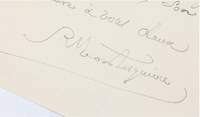
190783361s. l.: S. n. 1907. Fine. S. n. s. l. 21 mai 1907 25.50 x 20 cm une feuille Autograph letter signed by the dandy count 22 lines written in pencil addressed to his friend and bibliographer the critic Henri Lapauze: ""Neuilly Cher ami voici ce que je vous envoie d'accord avec Monsieur Schmoll qui m'en a téléphoné ce matin. Ne soyez pas effrayé par l'importance physique de ce document elle ne vient que de la grosseur des caractères. L'étendue n'en demeure pas moins normale. J'ajoute que les pièces ont été choisies parmi les transformées et remaniées comme elles le sont d'ailleurs à peu près toutes. Il serait désirable que cette publication eut lieu demain pour ne pas retarder l'apparition du volume. Dans ce cas j'enverrais ce soir pour la correction. La place sera celle que vous voudrez pourvu que ce soit en première page ou ""cheval"" - Votre femme m'a écrit une lettre délicieuse son éloge coule de source. Bien à vous deux. R. Montesquiou 21 mai 07."" Avec la mine de son crayon Robert de Montesquiou a trop appuyé en traçant un trait en dessous de son patronyme ce qui a occasionné un petit trou. ""Neuilly Dear friend here is what I am sending you in agreement with Monsieur Schmoll who telephoned me about it this morning. Do not be frightened by the physical importance of this document it only comes from the size of the characters. The extent nonetheless remains normal. I add that the pieces have been chosen among the transformed and reworked as they are moreover almost all of them. It would be desirable that this publication take place tomorrow so as not to delay the appearance of the volume. In this case I would send this evening for correction. The placement will be whatever you wish provided it is on the front page or ""cheval"" - Your wife wrote me a delightful letter her praise flows naturally. Best to you both. R. Montesquiou May 21st 07."" With the lead of his pencil Robert de Montesquiou pressed too hard while drawing a line under his surname which caused a small hole. Fold marks inherent to being placed in an envelope. S. n. unknown
192028100s. l.: S. n. 1920. Fine. S. n. s. l. s. d. circa 1920 55 x 37 cm autre Lithograph on thick vélin paper printed in 300 numbered copies and signed in pencil by the artist. S. n. unknown
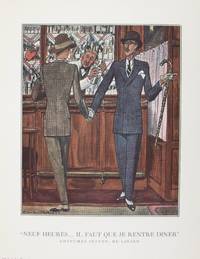
192284786Paris: Lucien Vogel éditeur 1922. Fine. Lucien Vogel éditeur Paris 1922 18 x 24 cm une feuille Original colour print printed on laid paper signed bottom left on the plate. La Gazette du bon ton one of the most beautiful and influential fashion magazines of the 20th century celebrating the talent of French creators and artists in the full bloom of art deco. Famous fashion magazine founded in 1912 by Lucien Vogel La Gazette du bon ton was published until 1925 with an interruption during the War from 1915 to 1920 due to the mobilization of its editor-in-chief. It consisted of 69 issues printed in only 2000 copies and was illustrated notably with 573 colour plates and 148 sketches representing models by great couturiers. Upon their publication these luxurious publications ""addressed bibliophiles and worldly aesthetes"" Françoise Tétart-Vittu ""La Gazette du bon ton"" in Dictionnaire de la mode 2016. Printed on fine laid paper they used a typeface specially created for the magazine by Georges Peignot the Cochin character adopted in 1946 by Christian Dior. The prints were created using the metal stencil technique heightened in colours and some underlined with gold or palladium. The adventure began in 1912 when Lucien Vogel a man of society and fashion - he had already participated in the magazine Femina - decided to found with his wife Cosette de Brunhoff sister of Jean the father of Babar the Gazette du bon ton whose subtitle was then ""Art modes et frivolités"". Georges Charensol reports the words of the editor-in-chief: ""In 1910 he observed there existed no fashion journal truly artistic and representative of the spirit of its time. I was therefore thinking of making a luxury magazine with truly modern artists . I was certain of success because for fashion no country can rival France."" ""Un grand éditeur d'art. Lucien Vogel"" in Les Nouvelles littéraires no.133 May 1925. The success of the magazine was immediate not only in France but also in the United States and South America. Originally Vogel thus assembled a group of seven artists: André-Édouard Marty and Pierre Brissaud followed by Georges Lepape and Dammicourt; and finally his friends from the École des beaux-arts who were George Barbier Bernard Boutet de Monvel or Charles Martin. Other talents quickly came to join the team: Guy Arnoux Léon Bakst Benito Boutet de Monvel Umberto Brunelleschi Chas Laborde Jean-Gabriel Domergue Raoul Dufy Édouard Halouze Alexandre Iacovleff Jean Émile Laboureur Charles Loupot Charles Martin Maggie Salcedo. These artists mostly unknown when Lucien Vogel called upon them would subsequently become emblematic and sought-after artistic figures. These same illustrators created the drawings for the Gazette's advertisements. The plates highlighted and sublimated the dresses of seven creators of the time: Lanvin Doeuillet Paquin Poiret Worth Vionnet and Doucet. The couturiers provided exclusive models for each issue. Nevertheless some of the illustrations featured no real model but only the idea that the illustrator had of the fashion of the day. La Gazette du bon ton was a decisive step in fashion history. Combining aesthetic requirements and plastic unity it brought together for the first time the great talents from the worlds of arts letters and fashion and imposed through this alchemy a completely new image of woman slender independent and audacious also carried by the new generation of couturiers Coco Chanel Jean Patou Marcel Rochas. Taken over in 1920 by Condé Montrose Nast the Gazette du bon ton would largely inspire the new composition and aesthetic choices of the ""little dying journal"" that Nast had bought a few years earlier: Vogue magazine. Lucien Vogel éditeur unknown
1949866621949. Fine. Cocteau fascinated by New York the ""city that sleeps standing"" 17 janvier 1949 14.90 x 19.50 cm un feuillet Initialed autograph manuscript by Jean Cocteau entitled ""L'Aurore"" dated by the author 17 January 1919. One page on one leaf written in blue pen. Published in L'Aurore 19 January 1949 no. 1353. Jean Cocteau wrote this dazzling portrait of the city that never sleeps for the newspaper L'Aurore after a twenty-day stay in New York. The writer would later extend this account with his 'Lettre aux Américains' Grasset 1949 taking up some of the words and expressions written on the spot in this charming manuscript. According to legend Cocteau began writing his 'Lettre aux Américains' on the flight home. One can imagine the writer eyes still shining with the lights of the city jotting down his first impressions on this page: ""It's very difficult to speak in a few lines about a city like New York. Did my trip last twenty days or twenty years I wonder . Nothing is lighter than the air of New York. Too light. Everything swirls. What rests and settles is very rare. The skyscrapers themselves sway slightly at the top and the light shines through them like tulle. At night Broadway is plagued by frightful electrical tics. And luminous Christmas trees six stories high adorn Park Avenue."" Cocteau had flown to New York in the last days of December 1948 for the premiere of The Eagle with Two Heads starring Edwige Feuillère as the Queen and his great love Jean Marais as the young anarchist poet. He hoped to convince the great actress Greta Garbo to play a role in one of his next films: ""It was the first time I'd spent New Year's Eve away from my city and I'm lucky when the clock struck midnight to be kissing Greta Garbo whose face is more and more admirable."" The writer ends the manuscript with a masterful ode to the New York way of life: ""There are sitting cities. There are cities that lie down. New York likes neither to sit nor to lie down. It's a city that sleeps standing."" In New York Cocteau found the perfect match for his own creative energy. During this short stay he posed for Philippe Halsman who had been commissioned by LIFE magazine to ""capture on camera what goes on inside a poet's mind"". Halsman's emblematic portraits - a janiform double profile or as a monster-magician with three pairs of hands smoking drawing and reading - caught the likeness of the surprisingly varied artist with incomparable accuracy. Precious impressions of a dandy and protean Cocteau irresistibly drawn to New York's bustling energy. unknown
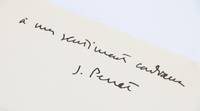
195584467s. l. 1955. Fine. s. l. s. d. circa 1955 13 x 21 cm une page Autograph letter signed by Jacques Perret 17 lines in black ink addressed to Roger Nimier. Fold marks inherent to mailing envelope included. Jacques Perret has nothing to provide for now to publishers notably to Gallimard's Roger Nimier: ""Pas de bonne nouvelle sentimentale non plus mais il reste entendu qu'un texte de ce genre n'était pas ailleurs que chez vous."" ""No good sentimental news either but it remains understood that a text of this kind belongs nowhere else but with you."" to whom he claims his arrears for his latest work: ""Soyez gentil de rappeler à la caisse qu'il reste un petit fric à toucher sur ce trapèze."" ""Be kind enough to remind the cashier that there's still a little money to collect on this trapeze."" unknown
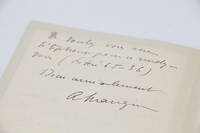
192486169s. l. 1924. Fine. s. l. 22 Novembre 1924 13.50 x 18 cm 1 page et quart sur un double feuillet Autograph letter dated and signed by General Charles Mangin addressed to a friend and arranging a meeting in order to deliver personally the work devoted to the Marchand mission glorification of the French colonial epic in Black Africa. Fold marks inherent to the mailing. 18 lines on a page and a quarter written in black ink. General Mangin would like to meet his correspondent : ""Je pense qu'il vaudrait mieux que nous nous rencontrions à la maison Flammarion. Quand pourrions-nous vous y trouver."" ""I think it would be better if we met at Flammarion house. When could we find you there"" unknown
187975877Budapest 1879. Fine. Budapest 17 janvier 1879 11 x 17.50 cm 4 pages sur un feuillet remplié Autograph letter signed by Jules Massenet two pages written in black ink on a double sheet. Fold inherent to mailing. A small split at the junction of the two sheets without gravity. Fine letter written by the composer during his first stay in the Hungarian capital for Le Roi de Lahore whose premiere took place eight days later: ""Répétition générale ce matin . excellente exécution"" ""General rehearsal this morning . excellent execution"". Massenet mentions the setbacks that occurred which forced the postponement of the opera's programming: ""La Benza Ida notre Sitia ne pouvant chanter demain à cause de son deuil la première est remise à huit jours."" ""La Benza Ida our Sitia unable to sing tomorrow because of her mourning the premiere is postponed by eight days."". This letter also evokes the friendship between Massenet and Franz Liszt more than thirty years his senior who took the young composer under his wing at the Villa Medici in 1863: ""Je viens de chez Liszt il est arrivé cette nuit à Peth et sera à la première."" ""I come from Liszt's he arrived last night in Pest and will be at the premiere."". Surprised by the hostile climate of this region he is visiting for the first time Massenet comments: ""Le froid est affreux la neige exaspère nous allons au théâtre en traîneau . Restez au coin du feu ah ! que vous souffririez de cette température je t'assure que c'est la sensation de la Russie la neige couvre tout. . je ne sors pas même un oeil quel hiver même pour les Hongrois enfouis dans leurs peaux comme des Lapons !"" ""The cold is dreadful the snow is exasperating we go to the theater by sleigh . Stay by the fire ah! how you would suffer from this temperature I assure you it's the sensation of Russia snow covers everything. . I don't even stick my nose out what a winter even for the Hungarians buried in their furs like Laplanders!"". unknown
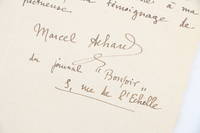
192086138Paris: S. n. 1920. Fine. S. n. Paris s. d. ca 1920 20 x 26 cm une page Deferential autograph letter signed by young Marcel Achard 14 lines in black ink concerning a tribute he wishes to pay to Sarah Bernhardt. Folding traces inherent to postal dispatch. A manuscript notation in pencil at the head of the letter: ""A Sacha Guitry -1923"" ""Mon cher maître je n'ai pas l'outrecuidance de croire que vous vous souviendrez de moi. Cependant comme nous allons dans le Théâtre et Comedia illustré consacrer un numéro à madame Sarah je vous serais infiniment obligé si vous vouliez bien consentir à parler un peu à nos lecteurs de la grande disparue. J'espère en un mot de vous me fin à ce sujet et je vous prie de croire à ma reconnaissance anticipée ainsi qu'au témoignage de ma vive admiration respectueuse. Marcel achard du journal ""Bonsoir"" rue de l'Echelle."" ""My dear master I do not have the presumption to believe that you will remember me. However as we are going to dedicate an issue of Théâtre et Comedia illustré to Madame Sarah I would be infinitely grateful if you would consent to speak a little to our readers about the great departed. I hope for a word from you on this subject and I beg you to believe in my anticipated gratitude as well as in the testimony of my keen respectful admiration. Marcel Achard from the newspaper ""Bonsoir"" rue de l'Echelle."" S. n. unknown
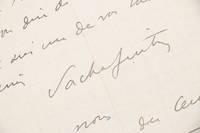
190586355Paris: S. n. 1905. Fine. S. n. Paris 15 Octobre 1905 9 x 14 cm 3 pages sur un double feuillet une enveloppe Autograph letter dated and signed by Sacha Guitry addressed to his friend Alfred Athis 40 lines penned in black ink from Biarritz. Single fold from mailing envelope enclosed. In this humorous handwritten letter the playwright recounts his stay in Biarritz: ""Nous sommes à Biarritz et nous n'en sommes pas plus fier pour ça ! Que le temps est affreux !"" while lamenting the social expectations of the resort: ""Ce qu'il y a de plus terrible ici c'est qu'il faudrait être en habit tous les soirs ce qui est non pas au dessus de mes forces mais au dessus de la bonne volonté de mon tailleur."" He describes feeling out of place amidst the ostentatious display of wealth and elegance that defines the seaside town: ""Nous jouons aux roues à 10 centimes dans la salle de baccara et tandis que les marquis espagnols et les barons russes murmurent 25 louis ! nous hurlons 020 cent !!! Avant hier on nous a d'ailleurs prié de nous taire! Gallipaux est des nôtres et sous prétexte de clous il ne porte pas de faux-col ce qui diminue encore son élégance naturelle."" S. n. unknown
188671531Wissant 1886. Fine. Wissant s. d. 11.60 x 9 cm une feuille Autograph signed postcard from painter Jules Breton to painter William Bouguereau regarding the loss of his son and his visit to the Salon des artistes indépendants: "". Quoique vieux jeunes tous les deux j'ai remarqué samedi matin lors d'une première visite au Salon que nous ne faisions pas mauvaise figure dans notre salle. Et il ya 50 ans que nous y luttons. Ceux qui vivront dans 50 ans verront beaucoup de nos triomphateurs à bon marché. ."" ""Though we are both old yet young I noticed on Saturday morning during a first visit to the Salon that we did not cut a poor figure in our room. And we have been struggling there for 50 years. Those who live in 50 years' time will see many of our cheap triumphers."". One postcard. Academically trained a realist then naturalist painter Jules Breton was one of the first artists of rural life and a poet member of the Parnasse admired notably by Van Gogh. unknown
197284434Paris 1972. Fine. Paris 26 Avril 1972 21 x 27 cm une page Autograph letter dated and signed by Raymond Queneau 17 lines in black ink addressed to Monsieur Lauwaert. Raymond Queneau and his wife Janine are sorry they cannot spend a few days with their friends: "" Ma femme doit entrer en clinique ces jours-ci pour un traitement de radiothérapie souffrant d'une sciatique aiguë"" ""My wife must enter the clinic these days for radiotherapy treatment suffering from acute sciatica"" hoping this is only a postponement: "". nous espérons bien venir en septembre et pouvoir récupérer longuement une meilleure santé car la meilleure non plus n'a pas été brillante cet hiver."" "". we very much hope to come in September and be able to recover better health for a long time as mine hasn't been brilliant this winter either."" A touching letter from Raymond Queneau about his wife's fragile health she being destined to pass away a few months later on July 18 1972. unknown
193777496Paris 1937. Fine. Paris 22 novembre 1937 14.10 x 18.10 cm 2 pages sur un feuillet enveloppe jointe Autograph letter signed by Jean Wahl addressed to Marc Barbezat two pages written in blue ink on one leaf. Envelope included. Transverse fold inherent to mailing. Jean Wahl was Marc Barbezat's examiner for the philosophy baccalaureate examination and it was then that the two men became friends. In 1940 shortly after writing this letter Barbezat would found the review L'Arbalète to which the philosopher would contribute by entrusting his very first poems to his young protégé. This review would later become a publishing house that would notably publish the first and scandalous texts of Jean Genet. Beautiful and very poetic letter: ""Merci de tout coeur de cette lettre où le coeur se meurt - et la mer - et la solitude l'étrangeté ; l'au-delà de ce paysage que vous me décrivez."" ""Thank you with all my heart for this letter where the heart dies - and the sea - and solitude strangeness; the beyond of this landscape that you describe to me."" Wahl laments: ""C'est dommage que lorsque je suis en face de vous vous notre intimité que je sens dans vos lettres et dans les miennes s'évanouisse. . Nous sommes tous bien emprisonnés en nous-mêmes."" ""It's a shame that when I am face to face with you our intimacy that I feel in your letters and in mine vanishes. . We are all quite imprisoned within ourselves."" unknown
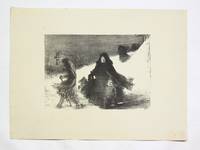
189773950Paris: Imprimerie Champenoispour CH. MassonH. Piazza 1897. Fine. Imprimerie Champenois pour CH. Masson H. Piazza Paris Août 1897 32 x 23 cm une feuille Rare original lithograph executed by Charles Léandre for L'Estampe Moderne series number 4 published in August 1897. One of 50 deluxe proofs printed on China paper with wide margins artist's signature and date in the plate publisher's dry stamp depicting a child's profile in the lower margin laid down on a sheet of laid paper with the numbered luxury edition stamp on verso occasional marginal foxing. Magnificent French monthly publication issued between May 1897 and April 1899 L'Estampe moderne consists of original chromolithographs which unlike other magazines such as Les Maîtres de l'Affiche and as stipulated on the tissue guards were created specially by each artist for the magazine. Thus 100 prints appeared in total covering the major artistic movements of the late 19th century: Symbolism Art Nouveau Pre-Raphaelites Orientalists and Belle Époque. Each issue of four prints was produced in 2000 copies sold for 3.50F and 100 on Japan paper offered at 10F. Henri Piazza also planned a confidential deluxe printing: 50 copies on Japan paper with wide margins and 50 in black on China paper at the considerable price of 30F. This print in handsome format is superbly printed on one of the most prestigious papers: China paper. ""Despite all its qualities China paper too insubstantial owes its reputation not to its own beauty but indeed to its particular affinities with printing ink. Its texture smooth and soft at once is more apt than any other to receive a beautiful impression. This property makes China paper sought after for printing engravings."" Anatole France. French collectors' interest in artistic posters intensified in the early 1890s. Octave Uzanne to describe this fever invented the term ""affichomanie."" The poster originally popular and pasted on the streets of the capital then became an art object and its ephemeral medium became precious and destined for preservation. Piazza decided to remove the poster from its advertising purpose and elevate it to the rank of a complete work of art on the same level as the luxury illustrated book. He thus composed a prestigious collection of entirely original works by the most prominent European artists of the moment: Georges de Feure Eugène Grasset Henri Detouche Emile Berchmans Louis Rhead Gaston de Latenay Lucien Lévy-Dhurmer Gustave-Max Stevens Charles Doudelet Hans Christiansen Henri Fantin-Latour Steinlen Ibels Engels Willette Henri Meunier Evenepoël Bellery-Desfontaines Charles Léandre etc. Handsome copy in the style of Les Maîtres de l'Affiche. Imprimerie Champenoispour CH. MassonH. Piazza unknown
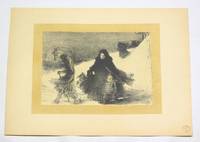
189773949Paris: Imprimerie Champenoispour CH. MassonH. Piazza 1897. Fine. Imprimerie Champenois pour CH. Masson H. Piazza Paris Août 1897 32 x 23 cm une feuille et une serpente Rare original color lithograph executed by Charles Léandre for L'Estampe Moderne series number 4 published in August 1897. One of the 50 deluxe proofs printed on Japan paper with wide margins artist's signature and date in the plate publisher's dry stamp representing a child's profile in the lower margin numbered stamp from the deluxe edition on verso; print preceded by a tissue guard bearing the artist's name title and introductory text; and another blank tissue guard. Magnificent French monthly publication issued between May 1897 and April 1899 L'Estampe moderne consists of original chromolithographs which unlike other journals such as Les Maîtres de l'Affiche and as stipulated on the tissue guards were created specially by each artist for the journal. Thus 100 prints appeared in total covering the major artistic movements of the late 19th century: Symbolism Art Nouveau Pre-Raphaelites Orientalists and Belle Époque. Each issue of four prints was produced in 2000 copies sold for 3.50F and 100 on Japan paper offered at 10F. Henri Piazza also planned a confidential deluxe printing: 50 copies on Japan paper with wide margins and 50 in black on China paper at the considerable price of 30F. This print of handsome format is superbly printed in colors on the most prestigious of papers: Japan. Thick silky satiny and pearlescent it helps make each page a work in its own right. Its ink-absorbing quality and affinity with colors also make it the ideal support for these very beautiful lithographs. French collectors' interest in artistic posters increased in the early 1890s. Octave Uzanne to describe this fever invented the term ""affichomanie."" The poster originally popular and displayed on the streets of the capital then became an art object and its ephemeral medium became precious and destined for preservation. Piazza decided to remove the poster from its advertising purpose and elevate it to the rank of a complete work of art on the same level as the deluxe illustrated book. He thus composed a prestigious collection of entirely original works by the most prominent European artists of the moment: Georges de Feure Eugène Grasset Henri Detouche Emile Berchmans Louis Rhead Gaston de Latenay Lucien Lévy-Dhurmer Gustave-Max Stevens Charles Doudelet Hans Christiansen Henri Fantin-Latour Steinlen Ibels Engels Willette Henri Meunier Evenepoël Bellery-Desfontaines Charles Léandre etc. Handsome copy in the style of Les Maîtres de l'Affiche. Imprimerie Champenoispour CH. MassonH. Piazza unknown