Henri GUINIER - (Anatole LE BRAZ)Biblio.com
48 390 résultats
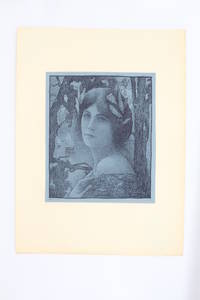
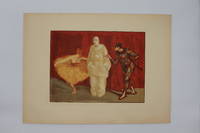
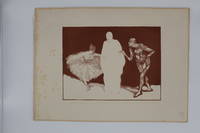
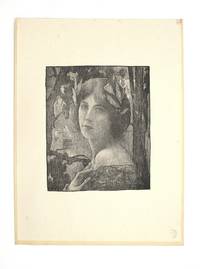
189974620Paris: Imprimerie Champenoispour CH. MassonH. Piazza 1899. Fine. Imprimerie Champenois pour CH. Masson H. Piazza Paris Janvier 1899 24.50 x 30 cm une feuille Rare original lithograph executed by Henri Guinier for L'Estampe Moderne series number 21 published in January 1899. One of 50 deluxe proofs printed on China paper with wide margins artist's signature in the plate publisher's dry stamp representing a child's profile in the lower margin mounted on a sheet of laid paper with the numbered stamp of the deluxe edition on the verso some foxing. Lithograph inspired by a song from Chansons de Bretagne by Anatole Le Braz. Magnificent French monthly publication edited between May 1897 and April 1899 L'Estampe moderne consists of original chromolithographs which unlike other magazines such as Les Maîtres de l'Affiche and as stipulated on the tissue guards were created especially by each artist for the magazine. Thus 100 prints appeared in total covering the major artistic movements of the end of the 19th century: Symbolism Art Nouveau Pre-Raphaelites Orientalists and Belle Époque. Each delivery of four prints was issued in 2000 copies sold for 3.50F and 100 on Japan paper offered at 10F. Henri Piazza also planned a confidential deluxe edition: 50 copies on Japan paper with wide margins and 50 in black on China paper at the considerable price of 30F. This print in a handsome format is superbly printed on one of the most prestigious papers: China paper. ""Despite all its qualities China paper too inconsistent owes its reputation not to its own beauty but indeed to its particular affinities with printing ink. Its texture smooth and soft together is more apt than any other to receive a beautiful printing. This property makes China paper sought after for printing engravings."" Anatole France. French collectors' interest in artistic posters intensified in the early 1890s. Octave Uzanne to describe this fever invented the term ""affichomanie"". The poster originally popular and displayed in the streets of the capital then became an art object and its ephemeral medium became precious and destined for preservation. Piazza decided to remove the poster from its advertising vocation and elevate it to the rank of a complete work of art on the same level as the deluxe illustrated book. He thus composed a prestigious collection of entirely original works by the most prominent European artists of the moment: Georges de Feure Eugène Grasset Henri Detouche Emile Berchmans Louis Rhead Gaston de Latenay Lucien Lévy-Dhurmer Gustave-Max Stevens Charles Doudelet Hans Christiansen Henri Fantin-Latour Steinlen Ibels Engels Willette Henri Meunier Evenepoël Bellery-Desfontaines Charles Léandre etc. Handsome copy. Imprimerie Champenoispour CH. MassonH. Piazza unknown
189974619Paris: Imprimerie Champenoispour CH. MassonH. Piazza 1899. Fine. Imprimerie Champenois pour CH. Masson H. Piazza Paris Janvier 1899 26.50 x 31.50 cm une feuille et une serpente Rare original lithograph executed by Henri Guinier for L'Estampe Moderne series number 21 published in January 1899. One of 50 deluxe proofs printed on Japan paper with wide margins blue laid paper mounted on Japan paper artist's signature in the plate publisher's dry stamp representing a child's profile in the lower margin numbered stamp of the deluxe edition on the verso; print preceded by a tissue guard captioned with the artist's name title and an extract from a work. Lithograph inspired by a song from Chansons de Bretagne by Anatole Le Braz reproduced on the tissue guard of the print. Magnificent French monthly publication edited between May 1897 and April 1899 L'Estampe moderne consists of original chromolithographs which unlike other magazines such as Les Maîtres de l'Affiche and as stipulated on the tissue guards were created especially by each artist for the magazine. Thus 100 prints appeared in total covering the major artistic movements of the end of the 19th century: Symbolism Art Nouveau Pre-Raphaelites Orientalists and Belle Époque. Each delivery of four prints was issued in 2000 copies sold for 3.50F and 100 on Japan paper offered at 10F. Henri Piazza also planned a confidential deluxe edition: 50 copies on Japan paper with wide margins and 50 in black on China paper at the considerable price of 30F. This print in a handsome format is superbly printed on the most prestigious of papers: Japan paper. Thick silky satined and pearlescent it contributes to making each page a complete work in itself. Its quality of ink absorption and its affinity with colors also make it the ideal support for these very beautiful lithographs. French collectors' interest in artistic posters intensified in the early 1890s. Octave Uzanne to describe this fever invented the term ""affichomanie"". The poster originally popular and displayed in the streets of the capital then became an art object and its ephemeral medium became precious and destined for preservation. Piazza decided to remove the poster from its advertising vocation and elevate it to the rank of a complete work of art on the same level as the deluxe illustrated book. He thus composed a prestigious collection of entirely original works by the most prominent European artists of the moment: Georges de Feure Eugène Grasset Henri Detouche Emile Berchmans Louis Rhead Gaston de Latenay Lucien Lévy-Dhurmer Gustave-Max Stevens Charles Doudelet Hans Christiansen Henri Fantin-Latour Steinlen Ibels Engels Willette Henri Meunier Evenepoël Bellery-Desfontaines Charles Léandre etc. Handsome copy. Imprimerie Champenoispour CH. MassonH. Piazza unknown
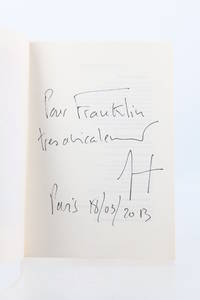
201283629Paris: Gallimard 2012. Fine. Gallimard Paris 2012 14 x 20.50 cm broché Edition from the same year as the first. A tiny stain to the upper right corner of the first cover. Handsome copy complete with its wraparound band ""Prix interallié 2012"". Autograph inscription dated and signed by Philippe Djian to a man named Franklin. Gallimard unknown
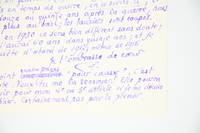
191677523Paris 1916. Fine. Paris Lundi 11 septembre 1916 13 x 20.50 cm 3 pages sur 2 feuillets Autograph letter signed with initial by Pierre Louÿs addressed to Georges Louis. Two pages written in purple ink on two sheets. Central folds inherent to posting. Fine letter addressed to his brother Georges Louis with whom Pierre Louÿs maintained a very intimate relationship and whom he considered as his own father. The question of Pierre Louÿs' real paternal identity still fascinates biographers today: ""His father Pierre Philippe Louis . had married in 1842 Jeanne Constance Blanchin who died ten years later after giving him two children Lucie and Georges. In 1855 he remarried Claire Céline Maldan and from this union was born in 1857 a son Paul; then in 1870 our writer who received the Christian names Pierre Félix. This late birth the differences in character between father and son the former's disaffection towards the latter the profound intimacy that always reigned between Louÿs and his brother Georges all this has led certain biographers and critics to suspect that the latter was in reality the writer's father. The exceptionally intimate and constant relationship that Pierre and Georges maintained between themselves throughout their lives could be an argument in this direction. Of course no irrefutable proof has been discovered and probably never will be. Nevertheless certain letters . are quite troubling. In 1895 for example Louÿs writes gravely to his brother that he knows the answer to 'the most poignant question' he could ask him a question he has had 'on his lips for ten years'. The following year at the height of Aphrodite's triumph he thanks Georges effusively and ends his letter with this sentence: 'Not one of my friends has a FATHER who is to him what you are to me.' Arguing from the close intimacy between Georges and Claire Céline during the year 1870 and from the jealousy that the father never ceased to show towards his younger son Claude Farrère did not hesitate to conclude in favor of Georges Louis. And what should we think of this dedication by Louÿs to his brother on a Japan paper copy of the first edition of Pausole: To Georges his eldest son / Pierre."" Jean-Paul Goujon Pierre Louÿs In this interesting letter Louÿs discusses at length the difficulty writers face in living by their pen. Titling his missive ""Continuation of our conversation about war and literature"" he first makes a very pessimistic observation: ""In the 16th century It was even worse! In the 16th the independent man of letters did not exist at all - to write one needed an office a benefice - or land and income rare fortune among writers. . It is only in the 19th century that we find a very small number of conscientious writers living by their pen. And even then. Do you want to count them Hugo almost alone succeeds. Lamartine fails and is obliged to beg pitifully at the end of his life. Gautier who had magnificent gifts only subsists by writing in newspapers . you see what I mean: Theatre and Journal."" He continues: ""That works well in peacetime. - In 1890 l'Echo de Paris inserted prose poems in the first column. - In ""date illegible because crossed out ""le Figaro had a literary supplement. . But in wartime in this century and ten twelve or fifteen years after the war we shall go to the woods no more; the laurels are cut down. Oh! In 1930 it will doubtless be very different; but I shall be 60 in fifteen years; and I worry first about 1917; even about 1916."" This very pessimistic letter was written at a period when Louÿs was at his worst ""The man who wrote these pages was a solitary man reclusive sick drugged surrounded by dubious creatures and having as confidant only this adored brother who would die less than a year later."" Ibid. unknown
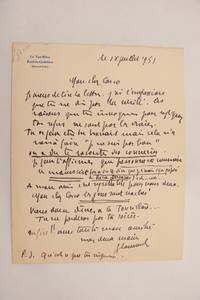
194186962Rueil-la-Godelière Eure-et-Loir Rueil-la-Godelière 1941. Fine. Rueil-la-Godelière Eure-et-Loir Rueil-la-Godelière 16 Juillet 1941 15.50 x 19.50 cm deux pages sur un double feuillet Autograph letter dated and signed by Maurice de Vlaminck addressed from his house ""la Tourillière"" in Rueil-la-Godelière in Eure-et-Loir to his friend Francis Carco 31 lines in black ink on a double sheet. A central fold inherent to postal delivery light dampstains at head of the double sheet without any damage to the text of the letter. The painter shows himself deeply affected and saddened by his friend's refusal of a project involving them both: ""J'ai l'impression que tu ne dis pas la vérité. Ces raisons que tu invoques pour expliquer ton refus ne sont pas les vraies. Tu as peut être du travail mais cela n'a rien à faire ""je ne suis pas bon"""" ""I have the impression that you are not telling the truth. These reasons you invoke to explain your refusal are not the real ones. You may have work but that has nothing to do with 'I am not good'"" He attempts to reassure Francis Carco convinced that his friend has been misinformed or influenced: ""Je peux t'affirmer que personne ne connait le manuscrit. A mon avis c'est regrettable pour nous deux. Mon cher Carco les gens sont vaches !"" ""I can assure you that no one knows the manuscript. In my opinion it is regrettable for both of us. My dear Carco people are awful!"" Without great resentment he invites him to his house in Eure-et-Loir at ""la Tourillière"": ""Viens donc dîner à la Tourillière. Tu ne perdras pas ta soirée. Enfin avec toute mon amitié mes deux mains. Vlaminck. P.S. Qu'est-ce que tu risques "" ""Do come and dine at la Tourillière. You won't waste your evening. Finally with all my friendship my two hands. Vlaminck. P.S. What do you risk"" but remains deeply troubled by his friend's rejection: ""Cette histoire m'agace. Quant à la pièce je m'en fous ! Mais je voudrais savoir ce qu'il y a derrière ton refus. Ce qu'on a t'a dit !"" ""This whole affair annoys me. As for the play I don't care! But I would like to know what lies behind your refusal. What they told you!"" unknown
1890715521890. Fine. 3 février 1890 11.20 x 17.40 cm une feuille rempliée Autograph letter from painter Pascal Dagnan-Bouveret to painter Lucien Monod. The painter offers his apologies following the refusal to nominate two friends of painter Monod as associates of the newly created Société nationale des beaux-arts. One folded sheet. Trained in the studios of Alexandre Cabanel and Jean-Léon Gérôme Dagnan-Bouveret received the second Prix de Rome. Of naturalist inspiration he devoted himself to religious painting and had a prolific career as a portraitist at the end of his life. He received prestigious commissions from the Countess of Béarn and the New York Frick family. « . Neither Mr Burgers nor Jules Girardet could pass as Associates. They were both named associate members. We wanted to limit ourselves to one hundred associates for the moment. . » unknown
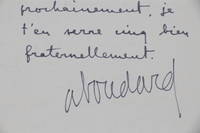
197979444Paris: S. n. 1979. Fine. S. n. Paris 13 Octobre 1979 14.50 x 21 cm une feuille une enveloppe Handwritten letter dated and signed 26 lines from Alphonse Boudard to his great friend and companion of boozy lunches the Brussels journalist André Tillieu who was like Alphonse Boudard a great friend of Georges Brassens but also of Jean Giono. A fold mark inherent to the folding of the letter for mailing envelope included. ""old friend magnificent your piece on Louis's book! Louis Nucéra It is written with friendship and competence. and then the one on Arland. bravo! We would need people like you in the Parisian literary press. Alas it is in the hands of pedants! I'm out of the woods. I'm getting back on my feet. a few more bandages and it will be completely fine. I've already taken up the felt-tip and blank sheet again but for TV. my series which should be shot in March if all goes well. looking forward to seeing you soon I give you five fraternal handshakes. ABoudard."" André Tillieu from Brussels very close friend and biographer of Georges Brassens maintained an epistolary correspondence with Alphonse Boudard for almost thirty years from 1972 until the latter's death in 2000. The irreverent Parisian writer very quickly showed his friendship considering him as one of the rare critics to understand him perfectly to the point of explaining clearly in his chronicles what he himself expressed only incompletely and sometimes confusedly in his books. André Tillieu therefore became part of the small circle of Alphonse Boudard's true friends on the same level as le Gros Georges Georges Brassens le Niçois Louis Nucéra and René Fallet with whom he loved to share hearty well-watered meals and cycling trips. As death gradually took away his best friends one by one André Tillieu would remain one of Alphonse's very last pals. S. n. unknown
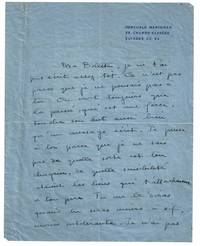
193674160Paris 1936. Fine. Paris s. d. 12 mars 1936 17.80 x 22.60 cm 2 pages sur un feuillet Fine autograph letter signed by Colette addressed to her friend Bolette Natanson. Two pages written in ink on blue headed paper from the Marignan building the writer's residence between 1936 and 1938. Transverse folds inherent to the folding of the letter for mailing. Moving letter addressed by Colette to her close friend following the death of her father Alexandre Natanson: "". ce dimanche va être un dimanche bien pénible. Je t'écris à l'heure juste où tu conduis ton père."" ""this Sunday is going to be a very painful Sunday. I am writing to you at the very moment when you are laying your father to rest."" Conscious of the suffering and ""chagrin"" ""grief"" of her ""chère Bolette"" ""dear Bolette"" she affectionately offers her support ""On croit toujours que la pensée qui est une force touche son but aussi bien qu'un message écrit."" ""We always believe that thought which is a force reaches its target as well as a written message."" ending her letter with a very beautiful declaration: ""Beaucoup de visages humains se penchent vers le tien et tu ne les aimes pas tous. Le mien que tu ne verras pas te suit de loin et s'inquiète de toi."" ""Many human faces lean toward yours and you do not love them all. Mine which you will not see follows you from afar and worries about you."" Bolette would commit suicide a few months later. Having evolved since her earliest childhood in artistic circles - she was the daughter of Alexandre and the niece of Thadée Natanson the creators of the famous Revue Blanche - Bolette Natanson 1892-1936 became friends with Jean Cocteau Raymond Radiguet Georges Auric Jean Hugo and also Colette. Passionate about couture she left Paris for the United States with Misia Sert a great friend of Coco Chanel and was hired at Goodman. With her husband Jean-Charles Moreux they created in 1929 the gallery Les Cadres on boulevard Saint-Honoré and frequented numerous artists and intellectuals. Their success was immediate and they multiplied their projects: the creation of the fireplace for Winnaretta de Polignac the decoration of the château de Maulny the arrangement of Baron de Rothschild's private mansion the creation of frames for industrialist Bernard Reichenbach and finally the creation of the storefront for Colette's beauty institute in 1932. Bolette Natanson also framed the works of her prestigious painter friends: Bonnard Braque Picasso Vuillard Man Ray André Dunoyer de Segonzac etc. Despite this meteoric rise she would end her life in December 1936 a few months after her father's death. unknown
198086752s. l.: S. n. 1980. Fine. S. n. s. l. s. d. ca 1980 14.50 x 21 cm 1 page Manuscript note by Philippe Soupault 24 lines in mauve ink on a sheet headed with this inscription: ""Note p.57"" concerning André Breton and the numerous letters he received. The co-author with André Breton of the surrealist manifesto ""Les champs magnétiques"" shows little kindness toward those who seized upon and hastened to publish part of his deceased friend's correspondence: ""At the end of his life Breton agreed to let M. Sanouillet who published a university thesis 'Dada à Paris' a questionable thesis illustrated with numerous errors publish the letters he had addressed to Tzara and Picabia enthusiastic letters which may surprise admirers of the correspondents."" even betraying the wishes of the pope of surrealism: ""Breton demanded that his correspondence very voluminous should only be consulted and published fifty years after his death."" Philippe Soupault faithful to the author of Nadja will not be confronted with this situation: ""As for myself I think this requirement will have no consequences since all the letters the author of Mont de Piété had addressed to me were stolen and destroyed."" Interesting recollections from the last living historical surrealist often harsh toward his former or new companions. S. n. unknown
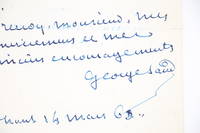
186376837Nohant Nohant-Vic 1863. Fine. Nohant Nohant-Vic 14 mars 1863 13.40 x 20.60 cm 3 pages sur un double feuillet Autograph letter signed by George Sand addressed to René Biémont. Three pages written in blue ink on a double sheet bearing at the head of the first page the blind stamp of Sand's initials. Envelope included. Folds inherent to mailing. This letter was published in the complete correspondence of George Sand established by Georges Lubin. Fine letter of congratulations addressed to René Biémont after sending his work Le Petit Fils d'Obermann: ""Your little book is very original and you show qualities of talent that will develop if you look ahead."" As an attentive reader much solicited by her young peers Sand develops her literary criticism: ""Obermann and his grandson the monk belong to the past. They are true and the timid Jean is well drawn. There is grandeur and truth in this exceptional type. But Constant d'Heurs is too passive to events. He should react against this powerless man and cure him or pity him more ."" Sententiously she thus concludes her letter: ""Do not complain of thankless work and accept it as a good thing three-quarters of life sacrificed to some duty makes the last quarter very strong and very alive. It is very good to be attached to poetry and thwarted in the possession of a beautiful dream. As soon as one can savor it without respite it fades or becomes troubled. I speak to you from experience. One is never happier and more inspired than when one believes one does not have time to be so."" Very fine testimony to the leading role that George Sand played on the literary scene of the Second Empire. unknown
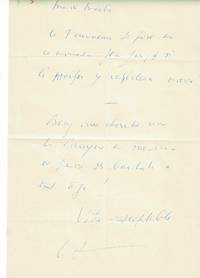
195076185s. l. Klarskovgaard 1950. Fine. s. l. Klarskovgaard 28 octobre 1950 21 x 34 cm 1 pages sur un feuillet Partly unpublished autograph letter signed by ""your touchy LF"" Louis-Ferdinand Céline addressed to his lawyer Maître Thorvald Mikkelsen. One page written in blue ink on a large sheet of white paper; number ""563"" in Céline's hand in the upper left corner in red pencil. Transverse folds inherent to the mailing. This letter was very partially transcribed in the Année Céline 2005. Céline after days of suffering from the cold is delighted to announce to his friend that he has received heating: ""Le fourneau se pose en ce moment. Je ne sais pas si la maison y résistera l'on verra !"" ""The stove is being installed right now. I don't know if the house will withstand it we shall see!"" This letter also mentions his Swedish friend Ernst Bendz like him a doctor and writer: ""Benz sic vous cherche un La Bruyère en suédois - on passe des bachots à tout âge !"" ""Bendz is looking for a La Bruyère in Swedish for you - one takes exams at any age!"" In 1947 Céline pursued by French justice for his collaborationist involvement was confined in Denmark. It was in May 1948 accompanied by Lucette and Bébert that he arrived at his lawyer Maître Thorvald Mikkelsen's home in Klarskovgaard. The latter owned a large property by the Baltic Sea and invited the exile to stay there. On February 21 1950 as part of the purge the writer was definitively condemned in absentia by the civic chamber of the Paris Court of Justice for collaboration to one year of imprisonment which he had already served in Denmark. The Swedish Consul General in Paris Raoul Nordling intervened on his behalf with Gustav Rasmussen the Danish Foreign Minister and managed to delay his extradition. On April 20 1951 Jean-Louis Tixier-Vignancour his lawyer since 1948 obtained Céline's amnesty as a ""severely disabled veteran of the Great War"" by presenting his file under the name of Louis-Ferdinand Destouches without any magistrate making the connection. Céline would leave Denmark the following summer after three years spent at his lawyer's home. unknown
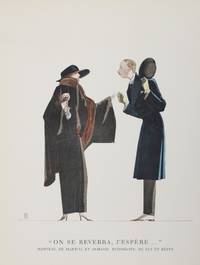
192284737Paris: Lucien Vogel éditeur 1922. Fine. Lucien Vogel éditeur Paris 1922 18 x 24 cm une feuille Original color print printed on laid paper signed in the lower left of the plate. La Gazette du bon ton one of the most beautiful and influential fashion magazines of the 20th century celebrating the talent of French creators and artists in the full flowering of Art Deco. Famous fashion magazine founded in 1912 by Lucien Vogel La Gazette du bon ton appeared until 1925 with an interruption during the War from 1915 to 1920 due to the mobilization of its editor-in-chief. It consists of 69 issues printed in only 2000 copies and is illustrated notably with 573 color plates and 148 sketches representing models by great couturiers. From their publication these luxurious publications ""addressed bibliophiles and worldly aesthetes"" Françoise Tétart-Vittu ""La Gazette du bon ton"" in Dictionnaire de la mode 2016. Printed on beautiful laid paper they use a typeface specially created for the magazine by Georges Peignot the Cochin character adopted in 1946 by Christian Dior. The prints are made using the metallic stencil technique enhanced in colors and some highlighted in gold or palladium. The adventure begins in 1912 when Lucien Vogel man of the world and fashion - he had already participated in the magazine Femina - decides to found with his wife Cosette de Brunhoff sister of Jean the father of Babar La Gazette du bon ton whose subtitle was then ""Art modes et frivolités"". Georges Charensol reports the words of the editor-in-chief: ""In 1910 he observes there existed no fashion journal that was truly artistic and representative of the spirit of its time. I was therefore thinking of making a luxury magazine with truly modern artists . I was certain of success because for fashion no country can rival France."" ""Un grand éditeur d'art. Lucien Vogel"" in Les Nouvelles littéraires no. 133 May 1925. The magazine's success is immediate not only in France but also in the United States and South America. Originally Vogel therefore brings together a group of seven artists: André-Édouard Marty and Pierre Brissaud followed by Georges Lepape and Dammicourt; and finally his friends from the École des beaux-arts who are George Barbier Bernard Boutet de Monvel or Charles Martin. Other talents quickly come to join the team: Guy Arnoux Léon Bakst Benito Boutet de Monvel Umberto Brunelleschi Chas Laborde Jean-Gabriel Domergue Raoul Dufy Édouard Halouze Alexandre Iacovleff Jean Émile Laboureur Charles Loupot Charles Martin Maggie Salcedo. These artists mostly unknown when Lucien Vogel calls upon them will subsequently become emblematic and sought-after artistic figures. These same illustrators create the drawings for the Gazette's advertisements. The plates highlight and sublimate the dresses of seven creators of the time: Lanvin Doeuillet Paquin Poiret Worth Vionnet and Doucet. The couturiers provide exclusive models for each issue. Nevertheless some of the illustrations feature no real model but only the illustrator's idea of the fashion of the day. La Gazette du bon ton is a decisive step in the history of fashion. Combining aesthetic demands and artistic unity it brings together for the first time the great talents from the worlds of arts letters and fashion and imposes through this alchemy a completely new image of woman slender independent and audacious also carried by the new generation of couturiers Coco Chanel Jean Patou Marcel Rochas. Acquired in 1920 by Condé Montrose Nast La Gazette du bon ton would largely inspire the new composition and aesthetic choices of the ""little dying journal"" that Nast had bought a few years earlier: Vogue magazine. Lucien Vogel éditeur unknown
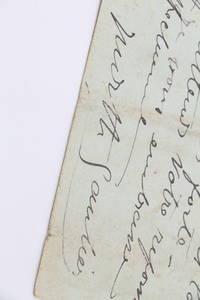
191280804Alger Algiers 1912. Fine. Alger Algiers 14 mars 1912 11.30 x 15.20 cm 4 pages sur un feuillet double Autograph letter signed by Judith Gautier addressed to Céleste Chrétien her maid; four pages written in black ink on a double sheet. This letter mentions the visit of Francis a carpenter by profession and Céleste Chrétien's husband to Paris: ""Does Francis still want to come and spend a few days in Paris Can he do so without harming his work They are going to perform Tristane with marionettes. I would like to have him to help me and I think it would amuse him. I would send him a first-class railway pass he would sleep and eat at my place so as not to incur any expenses. The performance takes place Saturday the 23rd at 4 o'clock; and there will be a dress rehearsal the day before or two days before."" It was in 1910 that Judith Gautier published in La Revue de Paris a triptych in verse entitled Tristane which she had performed in her Little marionette theatre inaugurated in May 1897 at 4 rue Charras in Paris. This theatre which contained about a hundred seats was quickly allocated a subsidy by the Ministry of Fine Arts. unknown
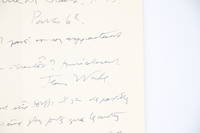
193977530Paris 1939. Fine. Paris 5 novembre 1939 13.50 x 20.80 cm 2 pages sur un feuillet enveloppe jointe double Autograph letter signed by Jean Wahl addressed to Marc Barbezat two pages written in blue ink on a single bifolium. Original envelope enclosed. Horizontal folds from mailing. Jean Wahl had been Marc Barbezats examiner in philosophy for the baccalauréat at which point the two men struck up a friendship. In 1940 shortly after writing this letter Barbezat would found the review L'Arbalète to which the philosopher contributed by entrusting his young protégé with his earliest poems. This review would later become a publishing house that issued among others the first and scandalous texts of Jean Genet. ""Il y a beaucoup de points sur lesquels je suis d'accord avec vous ; d'autres non. Montherlant . serait sans doute encore plus près de vous que je ne le suis. Et a d'ailleurs résolu de très peu écrire ces temps-ci se distinguant par là heureusement d'autres hommes de lettres Giraudoux Duhamel Romains et tutti quanti. Oui aimez Stendhal voilà une admiration que je comprends complètement."" He closes his letter with remarks on paintings by Velázquez and El Greco seen in Geneva. unknown
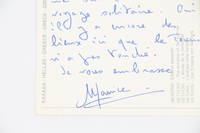
199279133Methoni Grèce Methoni 1992. Fine. Methoni Grèce Methoni 15 juillet 1992 14.80 x 10.20 cm une carte postale Autograph postcard signed by Maurice Béjart addressed to André-Philippe Hersin written in blue ballpoint pen on the verso of a color photographic reproduction of the citadel of Methoni Greece. ""Ma nouvelle compagnie me suit dans mon voyage solitaire. Oui il y a encore des lieux ici que le tourisme n'a pas touché. Je vous embrasse - Maurice"" ""My new company follows me in my solitary journey. Yes there are still places here that tourism has not touched. I embrace you - Maurice"" Journalist dance critic and editor-in-chief of Les Saisons de la danse Hersin was a great defender of Béjart's choreographic style and devoted laudatory articles to him in his magazine as well as monographic fascicles of his work. unknown
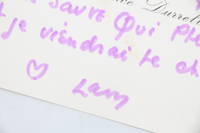
198086623Rhodes 1980. Fine. Rhodes s. d. ca 1980 13 x 8 cm une carte postale une enveloppe Suggestive autograph carte de visite signed by Lawrence Durrell addressed to Jani Brun written in brown and mauve felt-tip pens with accompanying envelope. ""dear Buttons. Oui telephonez moi quand tu es à Sauve-qui-pleut et je viendrai te chercher un coeur dessiné. Larry."" After many years spent in Greece Egypt and Rhodes the travel writer Lawrence Durrell was forced to flee Cyprus following popular uprisings that led the island to its independence from the British crown. Rich only in a shirt and a typewriter but crowned with the success of his novel Bitter Lemons of Cyprus Les citrons acides he arrived in France in 1956 and settled in the Languedoc village of Sommières. In the ""Tartès house"" his large dwelling surrounded by trees he wrote the second part of his work his monumental Avignon Quintet devoted himself to painting and received his illustrious friends including the couple Henry Miller and Anaïs Nin violinist Yehudi Menuhin London publisher Alan G. Thomas and his two daughters Penelope and Sappho. Among the olive trees and under the Mediterranean sun he met in the mid-1960s the young and vivacious ""Jany"" Janine Brun a thirty-year-old woman from Montpellier of devastating beauty who worked at the Antiquities department of the Sorbonne in Paris. She was nicknamed ""Buttons"" in memory of their first meeting where the young woman wore a dress covered with buttons. Henry Miller also fell under the charm of ""Buttons"" praising her beauty and eternal youth in exceptional unpublished letters. The three companions spent memorable Parisian evenings of which we retain precious autograph traces through their epistolary exchanges. Recommended by Durrell she made numerous trips notably to England from where she received vast correspondence from the writer as well as original works of art signed with his artist pseudonym Oscar Epfs. unknown
189419319NY: J. W. Scott Co. Ltd. Very Good. 1894. First Edition. Hardcover. Covers lightly soiled back cover mottled. ; 7"; 592ads pages . J. W. Scott Co. , Ltd. hardcover
189874570Paris: Imprimerie Champenoispour CH. MassonH. Piazza 1898. Fine. Imprimerie Champenois pour CH. Masson H. Piazza Paris Août 1898 35 x 26.50 cm une feuille et une serpente Rare original lithograph in colors executed by André Ibels for L'Estampe Moderne series number 16 published in August 1898. One of 50 deluxe proofs printed on Japan paper with wide margins artist's signature in the plate publisher's dry stamp representing a child's profile in the lower margin numbered luxury edition stamp on verso; engraving preceded by a tissue guard inscribed with the artist's name title and a poem. Lithograph inspired by an extract from Vitraux by Laurent Tailhade reproduced on the print's tissue guard. Magnificent French monthly publication edited between May 1897 and April 1899 L'Estampe moderne consists of original chromolithographs which unlike other magazines such as Les Maîtres de l'Affiche and as stipulated on the tissue guards were created specially by each artist for the magazine. Thus 100 prints were published in total covering the major artistic movements of the late 19th century: Symbolism Art Nouveau Pre-Raphaelites Orientalists and Belle Époque. Each issue of four prints was printed in 2000 copies sold at 3.50F and 100 on Japan paper offered at 10F. Henri Piazza also planned a confidential deluxe printing: 50 copies on Japan paper with wide margins and 50 in black on China paper at the considerable price of 30F. This print of handsome format is superbly printed on the most prestigious of papers: Japan. Thick silky satiny and pearlescent it contributes to making each page a work in its own right. Its quality of ink absorption and its affinity with colors also make it the ideal support for these very beautiful lithographs. French collectors' interest in artistic posters intensified in the early 1890s. Octave Uzanne to describe this fever invented the term ""affichomanie."" The poster originally popular and plastered in the streets of the capital then became an art object and its ephemeral medium became precious and devoted to preservation. Piazza decided to remove the poster from its advertising vocation and elevate it to the rank of a complete work of art on the same level as the luxury illustrated book. He thus composed a prestigious collection of entirely original works by the most prominent European artists of the moment: Georges de Feure Eugène Grasset Henri Detouche Emile Berchmans Louis Rhead Gaston de Latenay Lucien Lévy-Dhurmer Gustave-Max Stevens Charles Doudelet Hans Christiansen Henri Fantin-Latour Steinlen Ibels Engels Willette Henri Meunier Evenepoël Bellery-Desfontaines Charles Léandre etc. Handsome copy in Post-Impressionist style. Imprimerie Champenoispour CH. MassonH. Piazza unknown
189874571Paris: Imprimerie Champenoispour CH. MassonH. Piazza 1898. Fine. Imprimerie Champenois pour CH. Masson H. Piazza Paris Août 1898 35 x 26.50 cm une feuille Rare original lithograph in red chalk manner executed by André Ibels for L'Estampe Moderne series number 16 published in August 1898. One of 50 deluxe proofs printed on China paper with wide margins publisher's blind stamp depicting a child's profile in lower margin mounted on a sheet of laid paper with numbered stamp from the luxury printing on verso pale marginal foxing. Lithograph inspired by a poem by Paul Verlaine from the collection Fêtes galantes. Magnificent French monthly publication edited between May 1897 and April 1899 L'Estampe moderne consists of unpublished chromolithographs which unlike other magazines such as Les Maîtres de l'Affiche and as stipulated on the tissue guards were created specially by each artist for the magazine. Thus 100 prints appeared in total covering the major artistic movements of the late 19th century: Symbolism Art Nouveau Pre-Raphaelites Orientalists and Belle Époque. Each delivery of four prints was issued in 2000 copies sold at 3.50F and 100 on Japan paper offered at 10F. Henri Piazza also planned a confidential very deluxe printing: 50 copies on Japan paper with wide margins and 50 in black on China paper at the considerable price of 30F. This print of handsome format is superbly printed on one of the most prestigious papers: China. ""Despite all its qualities China paper too insubstantial owes its reputation not to its own beauty but indeed to its particular affinities with printing ink. Its tissue smooth and soft together is more apt than any other to receive a beautiful impression. This property makes China paper sought after for printing engravings."" Anatole France. The interest of French collectors in artistic posters intensified at the beginning of the 1890s. Octave Uzanne to qualify this fever invented the term ""affichomanie."" The poster originally popular and plastered in the streets of the capital then became an art object and its ephemeral support became precious and destined for preservation. Piazza decided to remove the poster from its advertising vocation and elevate it to the rank of a work of art in its own right on the same level as the luxury illustrated book. He thus composed a prestigious collection of entirely original works by the most prominent European artists of the moment: Georges de Feure Eugène Grasset Henri Detouche Emile Berchmans Louis Rhead Gaston de Latenay Lucien Lévy-Dhurmer Gustave-Max Stevens Charles Doudelet Hans Christiansen Henri Fantin-Latour Steinlen Ibels Engels Willette Henri Meunier Evenepoël Bellery-Desfontaines Charles Léandre etc. Handsome copy in Post-Impressionist style. Imprimerie Champenoispour CH. MassonH. Piazza unknown
1980009213Universal City MO: The Cerberus Press 1980. Book. Near Fine. French Wrappers. First Printing. 6 1/4" x 6 1/2". SCARCE the third publication of Timothy Hawler's Cerberus Press one of 90 copies. Near Fine faint crease top corner front wrapper In Near Fine jacket with corresponding crease. Set by hand in Deepdene with display in Engravers Shaded. The text paper is Warren's Olde Style sewn into covers of Fabriano Ingres Heavyweight with wrappers of Canson Mi Tientes. It was printed on a Chandler and Price New Series 8 x 12 platen press. SCARCE OCLC locates 10 institutional holdings not found in current commerce. The Cerberus Press Paperback
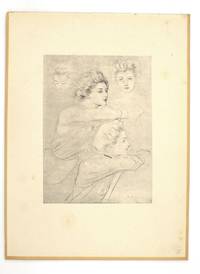
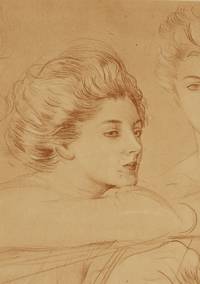
189874613Paris: Imprimerie Champenoispour CH. MassonH. Piazza 1898. Fine. Imprimerie Champenois pour CH. Masson H. Piazza Paris Décembre 1898 23.50 x 32 cm une feuille Rare original lithograph executed by Paul-César Helleu for L'Estampe Moderne series number 20 published in December 1898. One of 50 deluxe proofs printed on China paper with wide margins artist's signature in the plate publisher's dry stamp representing a child's profile in the lower margin laid down on a sheet of laid paper with the numbered luxury edition stamp on the verso some foxing; engraving preceded by a tissue guard inscribed with the artist's name title and an extract from a work. Lithograph inspired by an extract from Nos parisiennes by Alfred Labarre. Magnificent French monthly publication edited between May 1897 and April 1899 L'Estampe moderne consists of unpublished chromolithographs which unlike other magazines such as Les Maîtres de l'Affiche and as stipulated on the tissue guards were created specially by each artist for the magazine. Thus 100 prints appeared in total covering the major artistic movements of the end of the 19th century: Symbolism Art Nouveau Pre-Raphaelites Orientalists and Belle Époque. Each delivery of four prints was issued in 2000 copies sold for 3.50F and 100 on Japan paper offered at 10F. Henri Piazza also planned a confidential printing of very grand luxury: 50 copies on Japan paper with wide margins and 50 in black on China paper at the considerable price of 30F. This print of handsome format is superbly printed on one of the most prestigious papers: China paper. ""Despite all its qualities China paper too insubstantial owes its reputation not to its own beauty but rather to its particular affinities with printing ink. Its texture smooth and soft together is more apt than any other to receive a beautiful impression. This property makes China paper sought after for printing engravings."" Anatole France. French collectors' interest in artistic posters grew at the beginning of the 1890s. Octave Uzanne to qualify this fever invented the term ""affichomania."" The poster originally popular and plastered in the streets of the capital then became an art object and its ephemeral medium became precious and devoted to preservation. Piazza decided to remove the poster from its advertising vocation and elevate it to the rank of a work of art in its own right on the same level as the luxury illustrated book. He thus composed a prestigious collection of entirely original works by the most prominent European artists of the moment: Georges de Feure Eugène Grasset Henri Detouche Emile Berchmans Louis Rhead Gaston de Latenay Lucien Lévy-Dhurmer Gustave-Max Stevens Charles Doudelet Hans Christiansen Henri Fantin-Latour Steinlen Ibels Engels Willette Henri Meunier Evenepoël Bellery-Desfontaines Charles Léandre etc. Handsome copy. Imprimerie Champenoispour CH. MassonH. Piazza unknown
189874612Paris: Imprimerie Champenoispour CH. MassonH. Piazza 1898. Fine. Imprimerie Champenois pour CH. Masson H. Piazza Paris Décembre 1898 23.50 x 32 cm une feuille et une serpente Rare original lithograph in the manner of red chalk executed by Paul-César Helleu for L'Estampe Moderne series number 20 published in December 1898. One of 50 deluxe proofs printed on Japan paper with wide margins laid paper laid down on Japan paper artist's signature in the plate publisher's dry stamp representing a child's profile in the lower margin numbered luxury edition stamp on the verso; engraving preceded by a tissue guard inscribed with the artist's name title and an extract from a work. Lithograph inspired by an extract from Nos parisiennes by Alfred Labarre reproduced on the print's tissue guard. Magnificent French monthly publication edited between May 1897 and April 1899 L'Estampe moderne consists of unpublished chromolithographs which unlike other magazines such as Les Maîtres de l'Affiche and as stipulated on the tissue guards were created specially by each artist for the magazine. Thus 100 prints appeared in total covering the major artistic movements of the end of the 19th century: Symbolism Art Nouveau Pre-Raphaelites Orientalists and Belle Époque. Each delivery of four prints was issued in 2000 copies sold for 3.50F and 100 on Japan paper offered at 10F. Henri Piazza also planned a confidential printing of very grand luxury: 50 copies on Japan paper with wide margins and 50 in black on China paper at the considerable price of 30F. This print of handsome format is superbly printed on the most prestigious of papers: Japan paper. Thick silky satiny and pearlescent it contributes to making each page a work in its own right. Its quality of ink absorption and its affinity with colors also make it the ideal support for these very beautiful lithographs. French collectors' interest in artistic posters grew at the beginning of the 1890s. Octave Uzanne to qualify this fever invented the term ""affichomania."" The poster originally popular and plastered in the streets of the capital then became an art object and its ephemeral medium became precious and devoted to preservation. Piazza decided to remove the poster from its advertising vocation and elevate it to the rank of a work of art in its own right on the same level as the luxury illustrated book. He thus composed a prestigious collection of entirely original works by the most prominent European artists of the moment: Georges de Feure Eugène Grasset Henri Detouche Emile Berchmans Louis Rhead Gaston de Latenay Lucien Lévy-Dhurmer Gustave-Max Stevens Charles Doudelet Hans Christiansen Henri Fantin-Latour Steinlen Ibels Engels Willette Henri Meunier Evenepoël Bellery-Desfontaines Charles Léandre etc. Handsome copy. Imprimerie Champenoispour CH. MassonH. Piazza unknown
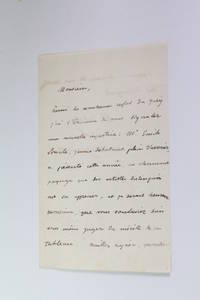
184771902Paris 1847. Fine. Paris s. d. 11.90 x 18.50 cm une feuille rempliée Signed autograph letter from painter Louis Cabat French landscape painter and engraver of the Barbizon School. One folded sheet The painter solicits a member of the Salon jury on behalf of a young artist Emile Loncle a ""jeune débutant plein d'avenir a présenté cette année un charmant paysage que des artistes distingués ont su apprécier et je serais heureux monsieur que vous voulussiez bien vous-même juger de la valeur du tableau"" ""promising young beginner who has presented this year a charming landscape that distinguished artists have been able to appreciate and I would be happy sir if you would kindly judge the value of the painting yourself"". unknown
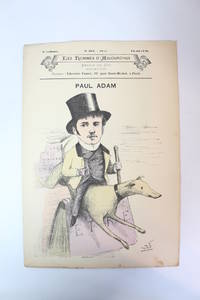
188773940Paris: Léon Vanier 1887. Fine. Léon Vanier Paris s. d. circa 1887 20 x 29.50 cm en feuilles First edition of this magazine issue consisting of two folded sheets. Minor marginal tears to the sheets without significance. On the first a color woodcut representing Paul Adam by Zed. On the following text by Gustave Kahn in first edition entitled ""Paul Adam"". Léon Vanier unknown
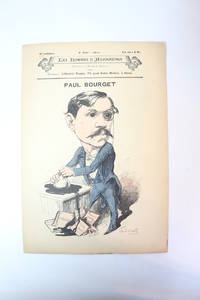
188773939Paris: Léon Vanier 1887. Fine. Léon Vanier Paris s. d. circa 1887 20 x 29.50 cm en feuilles First edition of this magazine issue consisting of two folded sheets. Minor marginal tears to the sheets without significance. On the first a color woodcut representing Paul Bourget by Emile Cohl. On the following text by Jules Laforgue in first edition entitled ""Paul Bourget"". Léon Vanier unknown