Maxime WEYGANDBiblio.com
48 402 résultats
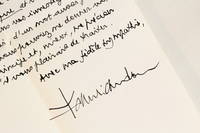
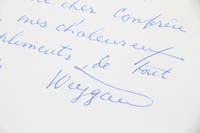
196488346Paris: s. n. 1964. Fine. s. n. Paris 13 Février 1964 13.50 x 21 cm une feuille Autograph letter dated and signed one page from General and Academician Maxime Weygand addressed to Thierry Maulnier 19 lines in blue ink on one sheet written on the very evening of the latter's official nomination to the Académie française. Central folds inherent to postal folding printed stamp ""Fonds archives privées Maulnier"" in lower left corner of the missive. The Immortal Maxime Weygand congratulates his now fellow member Thierry Maulnier elected to replace the vacant seat of Henry Bordeaux on February 13 1964: ""Mon cher confrère une ligne pour vous dire mon immense satisfaction de vous nommer ainsi."" My dear colleague a line to tell you my immense satisfaction in naming you thus. after a first ""blank"" election held in November 1963 during which Thierry Maulnier had obtained 14 votes against 11 for André Roussin: ""Cela fait oublier le passé qui fut un moment fort déplaisant. Donc cher confrère et ami mes chaleureux compliments de tout coeur."" This makes one forget the past which was at times quite unpleasant. So dear colleague and friend my warm compliments from the heart. s. n. unknown
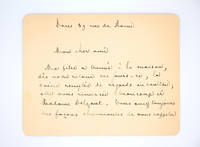
189375921Paris 1893. Fine. Paris 13 octobre 1893 11.40 x 8.90 cm une carte recto verso - enveloppe jointe Signed autograph card from Stéphane Mallarmé addressed to Alidor Delzant written in black ink on both sides. With envelope. Alidor Delzant was a lawyer collector and bibliophile. A friend of the Goncourts he devoted a work to them and was Edmond's secretary and testamentary legatee. A friendly card in which Mallarmé thanks Alidor Delzant for a surprise sent: ""Ma fille a trouvé à la maison dès notre retour ces jours-ci la caisse remplie de regards en coulisse ; elle vous remercie beaucoup et Madame Delzant. Vous avez toujours des façons charmantes de vous rappeler à vos amis même quand ils se souviennent."" ""My daughter found at home upon our return these past days the crate filled with sidelong glances; she thanks you very much and Madame Delzant. You always have charming ways of reminding your friends of yourself even when they remember."" The ""regards en coulisse"" are likely apricots or prunes. unknown
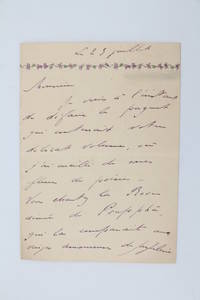
190779815s. l. Paris 1907. Fine. s. l. Paris Le 23 juillet ca. 1907-1908 11.50 x 16 cm 2 pages sur un double feuillet Handwritten signed letter addressed to a poet: You sing the rose loved by Psapphâ who compared it to the loving virgins of Mitilini Paris 23 July ca1907-1908 11.5 x 16 cm 2 pages on a double leafHandwritten signed letter from Renée Vivien addressed to a poet written in violet ink on a double leaf of paper decorated at the head with a border of violets. Transverse folds from having been sent. Monsieur Je viens à l'instant de défaire le paquet qui contenait votre délicat volume où j'ai cueilli de rares fleurs de poésie. Vous chantez la rose aimée de Psapphâ qui la comparait aux vierges amoureuses de Mytilène. Parmi vos poèmes je préfère : ''Sa Voix"" ""Sa Grâce"" et ""Les Mains et l'Apothéose"" . Renée Vivien Monsieur I have just this minute undone the package that contained your delicate volume where I picked rare flowers of poetry. You sing the rose loved by Psapphâ who compared it to the loving virgins of Mitilini. Among your poems I prefer: Sa Voix"" ""Sa Grâce"" and ""Les Mains et l'Apothéose"" . Renée Vivien Despite the precision of the titles mentioned it has not been possible for us to identify the poet to whom Vivien sent this letter of thanks. These titles are reminiscent of the poems of the Muse aux violettes herself. unknown
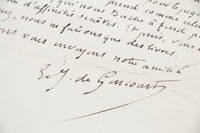
186588031Paris: s. n. 1865. Fine. s. n. Paris s.d. 1865 13.50 x 21 cm deux pages sur un double feuillet Laudatory autograph letter signed by Jules de Goncourt signed E&J de Goncourt addressed to Jules Vallès who had just published his polemical work ""Les réfractaires"" in which he notably exalts the proletariat 51 lines in black ink two pages on a double sheet. Fold marks inherent to postal handling. Jules de Goncourt does not hide his enthusiasm and admiration for the work of the sulfurous and terrible Jules Vallès: ""We have often had recently the urge to put our sympathies for you at the tip of our pen to write to you how much pleasure we had in catching an article a page twenty lines signed with your name your artist's mark; a foolish modesty the embarrassment of throwing our handshake in your face has held us back. you will not doubt the profound and keen interest we have taken in this poignant severe and warm study merciless and vibrant."" which has marvelously depicted the turmoil of the common people: ""There passes through all your pages this generous and melancholic bitterness that the spectacle of social miseries gives to tender and noble souls. You show corners of martyrs in the grotesques of Bohemia. You have the breath and fever of this time."" The Goncourt brothers would very much like to write something on this subject: "". unfortunately many things are lacking to us at this moment to write about Les Réfractaires an article worthy of them of you. time first then the journal then again the habit of reading a book to judge it. a book especially which takes us like this one by the entrails which touches us deeply through all sorts of secret affinities."" and Jules extends an invitation to Jules Vallès for the premiere of their play Henriette which would be created on December 5 1865: ""We will be happy to have you at the premiere of Henriette. you will kindly be free that evening."" Manuscript letters by Jules de Goncourt who died at 40 are rare. s. n. unknown
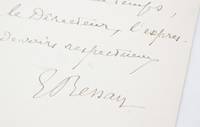
188486688Bellevue Meudon 1884. Fine. Bellevue Meudon 17 Octobre 1884 13 x 20.50 cm une page sur un double feuillet Autograph letter dated and signed by Ernest Renan to Louis Liard then director of higher education at the Ministry of Public Instruction 14 lines in black ink and on letterhead of the Collège de France of which he has been administrator since the previous year. Postal fold mark inherent to mailing a small tear at the head of the letter at the date level. Ernest Renan requests a meeting in order to discuss with his correspondent the future of the Collège de France: ""Oserai-je vous prier de me fixer l'heure et le jour où je pourrai sans vous déranger vous entretenir de quelques affaires très importantes pour le Collège de France et qui sont assez pressées ."" ""Dare I ask you to set the time and day when I could without disturbing you discuss with you some very important matters for the Collège de France which are rather urgent."" Louis Liard noted in pencil in the upper left corner of the letter: La 1ere lettre que j'ai reçu de Renan. The first letter I received from Renan. unknown
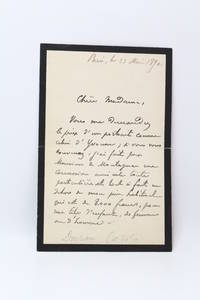
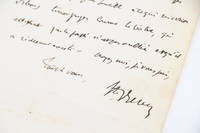
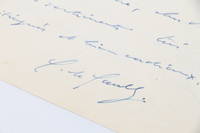
1890715021890. Fine. 23 mai 1890 11.60 x 17.80 cm une feuille rempliée Autograph letter signed by Charles Auguste Émile Durant known as Carolus-Duran famous portraitist of high society during the Third Republic to a female recipient. One folded sheet with envelope. The artist discusses a future portrait with his correspondent: ""Chère Madame Vous me demandez le prix d'un portrait comme celui d'Yvonne si vous vous souvenez j'ai fait pour Monsieur de Montague une concession amicale toute particulière et tout à fait en dehors de mon prix habituel qui est de 8000 francs pour une tête d'enfant de femme ou d'homme. Voilà ce que je vous prie d'indiquer ."" ""Dear Madam You ask me the price of a portrait like that of Yvonne if you remember I made for Monsieur de Montague a very particular friendly concession completely outside my usual price which is 8000 francs for a head of child woman or man. This is what I ask you to indicate ."". unknown
186084915s. l. 1860. Fine. s. l. 15 juillet1860 13.50 x 21 cm une page et demi sur un double feuillet Autograph letter signed by Sainte-Beuve 1 and a half pages on a double sheet. 25 lines in black ink. ""J'ai été très sensible cher monsieur à votre bon français et à l'envoi du très sage et instructif volume qui en est la cause. Vous me rappelez en effet des temps déjà bien anciens mais que ce qui a fini n'a pu effacer de ma mémoire : car à vous parler vrai quoi qu'il y ait bien de l'espace et bien de l'intervalle d'aujourd'hui à ce temps-ci il me paraît souvent qu'il y a du vide : et le tourbillon de la vie littéraire dont vous me parlez je ne le ressens guère. Ce qui me frappe c'est plutôt le contraire du tourbillon c'est à dire l'isolement la disparition ou le peu de mouvement de groupe. On se survit et l'on traîne un peu : je parle du moins pour moi aussi n'en suis-je que plus sensible. . de bons témoignages comme le vôtre qui attestent que le passé n'est pas oublié et qu'il a réellement existé. Croyez-moi je vous prie tout à vous. Sainte-Beuve."" ""I have been very touched dear sir by your good French and by the sending of the very wise and instructive volume which is the cause of it. You remind me indeed of times already quite ancient but which what has ended could not erase from my memory: for to speak truly to you although there is much space and much interval from today to that time it often seems to me that there is emptiness: and the whirlwind of literary life of which you speak to me I hardly feel it. What strikes me is rather the contrary of the whirlwind that is to say isolation the disappearance or the little group movement. One survives oneself and drags on a little: I speak at least for myself so I am all the more sensitive. . to good testimonies like yours which attest that the past is not forgotten and that it really existed. Believe me I beg you entirely yours. Sainte-Beuve."" unknown
196184441Paris 1961. Fine. ""Machiavelli and Rivarol facing the constitutional problem"" Paris 11 Mars 1961 13.50 x 21 cm une page une enveloppe Autograph letter dated and signed by Charles De Gaulle 25 lines in blue ink congratulating his correspondent on his latest works devoted to Rivarol and Choderlos de Laclos. Fold mark inherent to mailing envelope included. General de Gaulle praises Ivan Loiseau for the accuracy of his analyses: ""Laissez-moi vous dire que votre chapitre sur Machiavel et Rivarol devant le problème constitutionnel m'a particulièrement frappé."" ""Allow me to tell you that your chapter on Machiavelli and Rivarol facing the constitutional problem particularly struck me."" as well as his portraits: ""Quant à Laclos vous le montrez comme il faut et pas comme le plus souvent on se le représente. Or il n'y a qu'à y gagner."" ""As for Laclos you show him as he should be and not as he is most often represented. And there is only gain in that."" unknown
194276137Paris 1942. Fine. Paris 29 décembre 1942 13.60 x 17.90 cm 6 pages sur un double feuillet et un feuillet simple Autograph letter signed by Lucien Daudet addressed to Lucien Descaves; six pages written in black ink on a double sheet and a single sheet. Creases inherent to the mailing. Fine and long unpublished letter addressed to Lucien Descaves to whom Daudet had not given news for two years. He outlines broadly the tragic events that occurred since: ""Since that time I remained in Paris I witnessed the days of June 40 . I undertook to forget my life to write a life of my father . Then in August I understood that I was very ill . I was operated on reoperated on in November I was dying I knew nothing anymore then a phlebitis. . A month later I learned of my brother's death."" All these sad misadventures do not prevent him from thinking about the Goncourt Academy which he evokes at length in this missive. Indeed his brother Léon Daudet having died a few months earlier the academicians are seeking a successor and Lucien's name figures among the favorites: ""As soon as the newspapers mentioned my name for the Goncourt Academy I was very embarrassed."" He nevertheless states the reasons why he does not wish to join the ten: ""Because I could not appear my brother being dead to say 'my turn' . And finally it is difficult to write when one is the son of Alphonse Daudet but when in addition one is the brother of Léon Daudet . the game was lost in advance for me."" It is finally La Varende who will be elected on the recommendation of René Benjamin and Sacha Guitry and despite his certainties ""I would present myself one day or another to the Academy"" Lucien Daudet will never join the prestigious jury. Lucien has attached to his first letter another sheet in which he comments on Germaine Beaumont's latest novel: ""One must not have the slightest idea of what a novel is a true novel to not have understood that for years no one had written a novel of such density."" This literary consideration is the occasion for Daudet to address the Céline case who - still in France at this time - has just published his third pamphlet Les Beaux Draps: ""You I a few others loved Céline when he had great talent. And then all the imbeciles discovered him when he imitated himself and it was no longer anything but the waffle iron."" unknown
1973659151973. Fine. 21 juin 1973 21 x 27 cm une feuille avec enveloppe Autograph letter signed by Jean Ricardou Georges Raillard literary critic and specialist novel New. 12 lines in black felt envelope attached. Ricardou maintains his address for a future symposium on Claude Simon at Cerisy Castle. : "" Would you like to come and give a lecture Claude Simon really liked your work on Triptique and you know the esteem in which I hold your investigations."" unknown
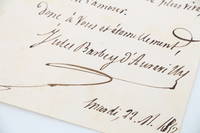
185284884s. l. 1852. Fine. s. l. 22 Mars 1852 13.50 x 20.50 cm une feuille Fine autograph letter dated and signed by Jules Barbey d'Aurevilly addressed to historian Jean-Marie Dargaud 13 lines in black ink. Creases inherent to folding for posting. Jules Barbey d'Aurevilly shows great tact towards his friend also expressing all his affection: ""Je veux vous épargner en allant sous peu de jours vous voir chez vous une course longue et peut-être inutile. On ne me voit que le matin et encore les trois premiers jours de la semaine. J'irai donc vous voir."" ""I want to spare you by going to see you at your home in a few days a long and perhaps unnecessary journey. I can only be seen in the morning and only on the first three days of the week. I will therefore come to see you."" unknown
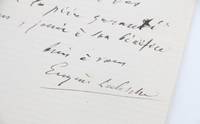
187486613s. l.: S. n. 1874. Fine. S. n. s. l. 25 Février 1874 10 x 13.50 cm une page sur un double feuillet une enveloppe Autograph letter dated and signed by Eugène Labiche 9 lines in black ink addressed to journalist and librettist Philippe Gille regarding the theatrical adaptation of Emile Zola's L'Assommoir. Fold marks inherent to postal dispatch envelope included. Eugène Labiche's monogram blind-stamped at the head of the letter. Eugène Labiche wishes to introduce Mr Dupuis to his correspondent so that he may handle the purchase of exploitation rights from Philippe Gille. S. n. unknown
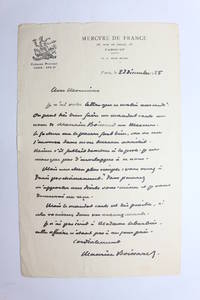
192573730Paris 1925. Fine. Paris 23 décembre 1925 13.80 x 21.70 cm une feuille Autograph letter by Paul Léautaud signed with his pen name Maurice Boissard his pseudonym at the Mercure de France 15 lines in black ink written on a double sheet with letterhead and vignette of the Mercure de France where he worked for more than thirty years. Léautaud writes to Marcel Lebarbier his publisher at Editions de la Belle Page who had published earlier that year his volume of chronicles entitled Villégiature. He asks for his author's royalties: « Je n'ai votre lettre que ce matin mercredi. On peut très bien faire un mandat carte au nom de Maurice Boissard au Mercure. Le facteur me l'apportera fort bien car on me l'enverra dans mon bureau aussitôt. Même s'il fallait toucher à la poste qui ne manque pas d'enveloppes à mon nom. Mais une chose plus simple : vous venez à Paris prochainement Vous pourrez m'apporter mes droits vous-même et je vous donnerai un reçu. Mais le mandat carte est très possible si cela va mieux dans vos arrangements. Je n'ai pas écrit à Madame Lebarbier cette affaire n'étant pas à un jour près.» ""I only received your letter this morning Wednesday. One can very well make a money order card in the name of Maurice Boissard at the Mercure. The postman will bring it to me quite well as they will send it to my office immediately. Even if one had to collect it at the post office which does not lack envelopes in my name. But something simpler: are you coming to Paris soon You could bring me my royalties yourself and I will give you a receipt. But the money order card is very possible if that works better with your arrangements. I did not write to Madame Lebarbier this matter not being urgent."" unknown
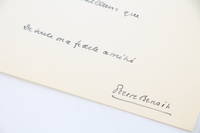
196085012Ciboure 1960. Fine. Ciboure 14 Février ca 1960 21 x 27 cm une page Autograph letter signed by Pierre Benoit from his property in Ciboure 15 lines in black ink. Central fold marks perforations due to filing in a binder having caused no loss. Pierre Benoit will soon be in Paris and will have the pleasure of meeting his friend: ""j'aurais une vraie joie à faire en tête avec vous dans un déjeuner discret un petit tour d'horizon."" I would have true joy in having a private conversation with you over a discreet lunch a brief survey of things. when the latter has determined according to his schedule a date for their meeting: ""Consultez votre emploi du temps et donnez-moi un coup de téléphone de préférence le matin vers 10 heures moment qui convient aux travailleurs que nous sommes."" Check your schedule and give me a telephone call preferably in the morning around 10 o'clock a time that suits workers like us. unknown
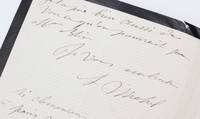
188583961s. l. Paris 1885. Fine. s. l. Paris 15 août 1885 13.40 x 21.10 cm 1 page 1/2 sur un bifeuillet Autograph letter signed by Louise Michel addressed to Lucien Barrois; one and a half pages written in black ink on a bifolium of white paper with black border. Transverse folds inherent to mailing. Tears to lower margin without loss at the fold. Louise Michel requests help for one of her friends: ""Vous savez que le père Blin ne peut plus travailler depuis deux mois passés voici maintenant la mère Blin qui vient de tomber très malade. Voyez ce qu'on pourrait faire vous savez tous les services qu'ils ont rendus en 70-71. Mon petit cousin . aidera le père Blin à tenir son kioske sic mais cela ne donne pas de secours à la maladie de Mme Blin. Mme Barrois devait revenir demain samedi ici qu'elle ne l'oublie pas mais je la prie bien aussi de voir ce qu'on pourrait pour Mme Blin."" ""You know that father Blin has been unable to work for the past two months and now mother Blin has just fallen very ill. See what could be done you know all the services they rendered in 70-71. My little cousin . will help father Blin run his kiosk but that doesn't provide relief for Mme Blin's illness. Mme Barrois was supposed to return here tomorrow Saturday may she not forget it but I also earnestly ask her to see what could be done for Mme Blin."" Mme Blin actively participated in the Paris Commune alongside Louise Michel; with other Parisian women they created the Women's Vigilance Committee and asked Louise Michel to take charge of it. Moving letter testimony to the unfailing devotion of the former Communard. unknown
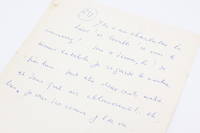
195483967Meudon 1954. Fine. Meudon 1954 21.20 x 26.10 cm une page sur un feuillet Autograph manuscript signed by Louis-Ferdinand Céline written in blue ballpoint pen on a sheet of white paper numbered 237 in the left corner. Some stains as well as a central fold of no consequence. Some pinholes in the upper margin evidence of the organization of Céline's manuscripts in ""bundles"". ""Y'en a un charlatant là-haut ! et terrible ! et vous le connaissez !. donc de dessous là ! de dessous la table je regarde le moulin. pas loin. peut-être deux cents mètres. et dans quel air éblouissant !. eh bien je vous dis comme je l'ai vu."" ""There's a charlatan up there! and terrible! and you know him!. so from underneath there! from under the table I look at the windmill. not far. maybe two hundred meters. and in what dazzling air!. well I tell you as I saw it."" The passage from our sheet conforms to the published version. Published in 1954 Normance is a direct sequel to Féérie pour une autre fois published two years earlier. The two parts were written during Céline's years of exile and imprisonment in Denmark. Upon his return to France in 1951 Céline undertook a work of ""polishing"" and published these two titanic texts independently originally conceived as one. ""Céline while working on it thought of this novel as a second Voyage au bout de la nuit capable twenty years later of astonishing the public as much as the 1932 novel."" Henri Godard unknown
198170551Grèce Greece 1981. Fine. Grèce Greece 28 mai 1981 14.60 x 10.20 cm une carte postale Autograph postcard signed by Lawrence Durrell addressed to Jani Brun his young French lover written in blue felt-tip pen on the verso of a humorous illustration featuring Poseidon. The writer had stayed at Club Méditerranée and sings its praises with a verse from the neo-medieval poem The Bard by Thomas Gray and one from Baudelaire: ""youth at the prow and beauty at the helm"" Jeunesse à la proue et beauté à la barre luxe et voupté - dans le Club Méditerranée everything is done for you tout est fait pour vous J'ai envie de rester encore vingt ans ici. That would make me 110 years old j'aurais 110 ans."" After many years spent in Greece Egypt and Rhodes the travelling writer Lawrence Durrell was forced to flee Cyprus following popular uprisings that led the island to independence from the British crown. Rich only with a shirt and a typewriter but crowned with the success of his novel Bitter Lemons of Cyprus Les citrons acides he arrived in France in 1956 and settled in the Languedoc village of Sommières. In the ""maison Tartès"" his large house surrounded by trees he wrote the second part of his work his monumental Avignon Quintet devoted himself to painting and received his illustrious friends including the couple Henry Miller and Anaïs Nin violinist Yehudi Menuhin London publisher Alan G. Thomas and his two daughters Penelope and Sappho. Among the olive trees and under the Mediterranean sun he met in the mid-1960s the young and vivacious ""Jany"" Janine Brun a woman from Montpellier in her thirties of devastating beauty who worked at the Department of Antiquities at the Sorbonne in Paris. She was nicknamed ""Buttons"" in memory of their first meeting where the young woman wore a dress covered with buttons. Henry Miller also fell under the charm of ""Buttons"" praising her beauty and eternal youth in exceptional unpublished letters. The three companions spent memorable Parisian evenings of which we keep precious autograph traces through their epistolary exchanges. Recommended by Durrell she made numerous trips notably to England from where she received extensive correspondence from the writer as well as original works of art signed with his artist pseudonym Oscar Epfs. unknown
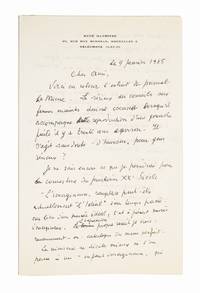
196565211Bruxelles Brussels 1965. Fine. Bruxelles Brussels 9 janvier 1965 13.50 x 20.50 cm deux pages sur un feuillet Significant letter written by René Magritte to André Bosmans dated 9 January 1965 and signed with his initials. 35 lines in black ink on one leaf with the heading René Magritte 97 rue des Mimosas Bruxelles 3 Téléphone 15.07.30. Several words crossed out and passages underlined. Published in the Lettres à André Bosmans 1958-1967 Seghers I. Brachot 1990 pp. 407-408 A letter that is both comical and of great philosophical depth in which the Surrealist painter René Magritte tackles the question of the imagination and inspiration. In it there is a very pertinent analysis of the issues of aesthetics and of modern thinking while the painter is seeking inspiration to produce the cover of the next XXe siècle an avant-garde artistic and literary journal issue XXV June 1965. Magritte addresses this letter to his great friend André Bosmans a school teacher poet and editor-in-chief of Rhétorique a literary journal to which Magritte actively contributed. The painter then in full mastery of his art enjoyed international recognition since the beginning of the 1960s. His work has already been the object of numerous retrospectives in France and in Belgium and will be celebrated on the other side of the Atlantic several months later at the Museum of Modern Art in New York. His letter is divided between humour and psychological reflection. Magritte's usual taste for irony is present: Here is the extract from the newspaper La Meuse. The serious advice to pregnant women becomes comical when it accompanies this reproduction of a gouache made about thirty years ago. This is probably humour' for serious people A daily paper in Liège had indeed taken a Surrealist gouache painting by Magritte entitled Maternité where the mother was represented with a baby's face and the baby with the face of a woman for one of its articles. After this aside Magritte provides Bosmans with a draft painting earmarked for a journal reproduced below: I don't know yet what I will paint for the cover of the next XXe siècle. The art journal Le XXe siècle was founded in 1938 by an Italian journalist reporting in Paris Gualtieri di San Lazzaro and appeared in the form of an annual notebook on modern art trends embellished with lithographs and original works. Magritte featured alongside Giorgio de Chirico his idol and also Kandinsky Jean Arp and Joan Miro as well as numerous other pioneering artists or heirs to Surrealism. Each issue was dedicated to a different current subject with contributions from critics artists and writers. Magritte dissects the title of the next issue for Bosmans Aux sources de l'imaginaire To the sources of the imaginary which according to him symbolises an entire era that has become the subconscious slave since the Surrealist revolution:The imaginary' perhaps now replaces the ideal' of a previous era. Instead of an ideal museum it is now an imaginary museum. I believe the proper expression would be: inventory or catalogue of the perfect museum. Taking André Malraux's well-known paradigm the musée imaginaire imaginary museum Magritte emphases the transition from romanticism to Surrealism: this replacement of the pursuit of an ideal through the opening up on to dreams and the accidental. He also criticizes the XXe siècle's pompous expression: It is the mediocre imaginary that is responsible the source speaking figuratively like the XXe siècle for that which only has an imaginary value. Because for Magritte there is a fundamental distinction between the imaginary and imagination between dreams and creation. For this artist who is profoundly sensitive to the paradoxes of reality and the role of mystery in life and in art the imagination is nothing without being creative. His paintings based on hallucinated realism demonstrate this belief such as the famous Homme au chapeau melon private collection 1 unknown
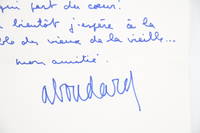
198076811Paris: S. n. 1980. Fine. S. n. Paris 8 Décembre 1980 21 x 29.50 cm une feuille une enveloppe Manuscript letter dated and signed 12 lines by Alphonse Boudard to his great friend and companion of boozy lunches the Brussels journalist André Tillieu who was like Alphonse Boudard a great friend of Georges Brassens but also of Louis Nucéra. Envelope included a fold mark inherent to the letter being placed in the envelope. ""Vieux merci grand merci. avec un peu de retard excuse-moi. pour ton article. Comme toujours c'est le meilleur le complet. celui qui va au fond des choses. et qui part du coeur ! à bientôt j'espère à la table des vieux de la vieille. Mon amitié. Aboudard."" André Tillieu from Brussels very close friend and biographer of Georges Brassens maintained an epistolary correspondence with Alphonse Boudard for almost thirty years from 1972 until the latter's death in 2000. The cheeky Parisian writer very quickly showed him his friendship considering him as one of the rare critics to understand him perfectly to the point of clearly explaining in his chronicles what he himself expressed only incompletely and sometimes confusedly in his books. André Tillieu thus became part of the small circle of Alphonse Boudard's true friends on the same level as le Gros Georges Georges Brassens le Niçois Louis Nucéra and René Fallet with whom he liked to share hearty well-watered meals and cycling trips. As death gradually took away his best friends one by one André Tillieu would remain one of Alphonse's very last pals. S. n. unknown
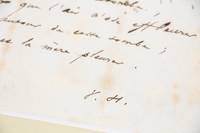
1840878291840. Fine. ""Spare still the mother vainly weepingO'er baby lost not long a-sleeping."" s.d. 21 janvier 1840 21.20 x 26.70 cm un feuillet sous cadre Autograph poem by Victor Hugo signed V. H. four stanzas written black ink on a leaf. Blind stamp of the city of Bath in the lower left-hand corner. Some folds small traces of foxing along the folds a few pale stains to the lower right margin not affecting the text. A few very small dark spots in the lower right margin one affecting a single letter of the word retombe. Original manuscript and earlier version of Victor Hugo's poem published as Écrit sur le tombeau d'un petit enfant au bord de la mer Baby's seaside grave in Les Rayons et les Ombres XXXVIII Paris Delloye 1840. Hugo wrote this magnificent eulogy in memory of his great friend Auguste Vacquerie's young nephew who died at the age of four years and ten months. The poet had promised a poetic epitaph and personally addressed this manuscript to Vacquerie: Take these verses if you still want them for the tomb of this dear little one Letter to Vacquerie January 21 1840. As Joseph Petrus Christiaan de Boer pointed out There is no sorrow Hugo understood and expressed more delicately than the immense grief that fills the hearts of parents upon the death of a child Victor Hugo et l'enfant 1933 p. 48-49. This poem is the first of a sublime macabre series composed on the occasion of the numerous tragedies suffered by the families of both Victor Hugo and his friend Auguste Vacquerie. The most famous will be Demain dès l'aube. written after the untimely death of Hugo's beloved daughter Léopoldine who drowned alongside Auguste Vacquerie's brother Charles on September 4 1843 shortly after their marriage. Hugo wrote these verses for Charles-Emile Lefèvre the young child of Vacquerie's sister who had succumbed to sudden illness on November 6 1839. On January 21 1840 Hugo sent this manuscript to Vacquerie which includes a variation from the final version published by Delloye on May 16 of the same year: « Vieux lierre frais gazon herbe roseaux corolles ; Église où l'esprit voit le Dieu qu'il rêve ailleurs ; mouches qui murmurez d'ineffables paroles A l'oreille du pâtre assoupi dans les fleurs ; Vents flots hymne orageux chur sans fin voix sans nombre ; Bois qui faites songer le passant sérieux ; fruits qui tombez de l'arbre impénétrable et sombre ; Étoiles qui tombez du ciel mystérieux ; oiseaux aux cris joyeux vague aux rumeurs ' plaintes' in the published version profondes ; froid lézard des vieux murs dans les pierres tapi ; plaines qui répandez vos souffles sur les ondes ; Mer où la perle éclot terre où germe l'épi ; Nature d'où tout sort nature où tout retombe feuilles nids doux rameaux que l'air n'ose effleurer Ne faites pas de bruit autour de cette tombe ; Laissez l'enfant dormir et la mère pleurer. » ' Brown ivy old green herbage new; Soft seaweed stealing up the shingle; An ancient chapel where a crew Ere sailing in the prayer commingle. A far-off forest's darkling frown Which makes the prudent start and tremble Whilst rotten nuts are rattling down And clouds in demon hordes assemble. Land birds which twit the mews that scream Round walls where lolls the languid lizard; Brine-bubbling brooks where fishes stream Past caves fit for an ocean wizard. Alow aloft no lullall life But far aside its whirls are keeping As wishfully to let its strife Spare still the mother vainly weeping O'er baby lost not long a-sleeping.' tr. Nelson Rich Tyerman Hugo sent the manuscript with a touching letter: Here at last my poet is what I have kept you waiting for so stupidly long. . Take these verses if you still want them for the tomb of this dear little one . For my part I do not feel that I have repaid my debt to this angel with so little. I have begun something longer for him that I will one day lay at the feet of his poor mo unknown
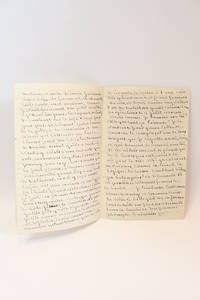
186771232Nohant Nohant-Vic 1867. Fine. Nohant Nohant-Vic 21 décembre 1867 13.40 x 20.70 cm deux feuillets sous chemise et étui Autograph letter from George Sand to Gustave Flaubert dated December 21 1867 8 pages on two lined leaves. Published in Sand's Correspondance XX pp. 642-645. From one of the finest literary correspondences of the century this letter written on Christmas Eve 1867 is a sublime testament to the frank friendship between George Sand the old troubadour and Gustave Flaubert christened cul de plomb leaden ass after declining his invitation to Nohant to complete L'Éducation sentimentale. Despite their seventeen year-age gap opposing temperaments and divergent outlooks on life the reader is gripped by the tenderness and astonishing verve of George Sand's long confession to Flaubert. At the height of her literary fame and enjoying her theater in Nohant Sand talks at length about politics their separation their conception of the writer's work and life itself. In this stream-of-consciousness letter Sand naturally and freely sets down on paper eight pages of conversations with Flaubert who made only too rare and brief appearances in Nohant: But how I chat with you! Do you find all this amusing I'd like a letter to replace one of our suppers which I too miss and which would be so good here with you if you weren't a cul de plomb leaden ass who won't let yourself be dragged along to life for life's sake whereas Flaubert's motto then busy writing L'Éducation sentimentale was rather art for art's sake. In the end of 1867 Sand grieved the death of an almost brother François Rollinat which Sand appeased with letters to Flaubert and lively evenings at Nohant: This is how I've been living for the last 15 days since I stopped working . Ah'! . Ah! when you're on vacation work logic and reason seem like strange swings. Sand was quick to criticize him for working tirelessly in his robe the enemy of freedom while she was running up and down mountains and valleys from Cannes to Normandy even to Flaubert's own home which she had visited in September. On this occasion Sand had happily reread Salammbô where she picked up a few lines for her latest novel Mademoiselle Merquem. Their literary and virile friendship similar to Rollinat's defied the old guard of literati who declared the existence of a sincere affair between man and woman utterly impossible. Sand who has been described in turn as a lesbian a nymphomaniac and made famous for her resounding and varied love affairs began a long and intense correspondence with Flaubert for whom she was a mother and an old friend. She called herself in their letters old troubadour or old horse and no longer even considered herself a woman but a quasi-man recalling her youthful cross-dressing and formidable contempt for gender norms. To Flaubert had compared the female writers as Amazons denying their femininity: To better shoot with the bow they crushed their nipples Sand replied in this letter: I don't share your idea that you have to do away with the breast to shoot with the bow. I have a completely opposite belief for my own use which I think is good for many others probably for the majority. A warrior yes but a peaceful warrior Sand willingly adopted the customs of a world of misogynistic intellectuals while remaining true to herself: I believe that the artist should live in one's nature as much as possible. To the man who loves struggle war; to the man who loves women love; to the old man who like me loves nature travel and flowers rocks great landscapes children too family everything that moves everything that fights moral anemia she then adds. A fine evocation of her green period this passage marks the time of Sand's country novels when mellowed by the years she gave herself over entirely to contemplation to write François le Champi La Mare au diable and La Petite Fadette. But her love of nature didn't stop unknown
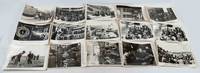
1976217811Hunan.: 湖南省新闻图片画报社. Hunan News Photos Pictorial House. 1976. A set of 15 one in duplicate and photograph 9 is missing captioned black and white photographs on the theme of Mao's July 21 directive to revolutionize science and engineering universities and courses. Edges slightly browned and a little worn else in very good condition. Approximately 15.5 x 20.6cm. <br> <br>Photographs presented in original brown paper envelope chipped and worn at edges handwritten text indicates photos published in August 1976. Also included is a 38.5 x 27cm red white black and purple poster with the slogan 七 . 二一 工人大学越办越好. Closed tear at lower edge repaired with washi else in very good condition. Text on photographs and poster in simplified Chinese characters. These captioned educational propaganda photographs show many aspects of what life should be like for workers and students in this case at the Shanghai Machine Tool Factory July 21st Workers' University. In one photograph students are marching past a large billboard promoting the idea of workers being trained to become technicians. It is clear from background posters that they are engaged in the "attack rightists" and "Criticise Deng Xiaoping" campaigns and many are carrying "large character posters" to be pasted up in photograph 3. <br> <br>Many of the photographs show students learning in real life situations from experienced workers and technicians - outside the classroom in factory workshops a gallery or agricultural settings. According to the captions teaching takes place in factories or on farms so theory and practice are combined in both design and manufacture or production and graduates can combine intellectual and manual labour to achieve technical innovations. . 湖南省新闻图片画报社. [Hunan News Photos Pictorial House]. unknown
18946Ann Arbor: Motte & Bailey Booksellers. This allows you to purchase a gift certificate for Motte & Bailey Booksellers which can be used in our shop or online at our website. After you purchase the gift certificate we will mail you a hardcopy or if you prefer we will keep a record on file here at our shop and notify the receiver of the certificate by email that we have a gift certificate for them on file at the shop please include their email if you choose this option. Each gift certificate will be assigned a unique number. You may order multiple certificates if you wish. NOTE: 1. Available for purchase only though our own website in store or by phone. 2. Shipping will not be charged on gift certificate orders. 3. Gift certificates DO NOT EXPIRE. <br/><br/> Motte & Bailey Booksellers unknown
18945Ann Arbor: Motte & Bailey Booksellers. This allows you to purchase a gift certificate for Motte & Bailey Booksellers which can be used in our shop or online at our website. After you purchase the gift certificate we will mail you a hardcopy or if you prefer we will keep a record on file here at our shop and notify the receiver of the certificate by email that we have a gift certificate for them on file at the shop please include their email if you choose this option. Each gift certificate will be assigned a unique number. You may order multiple certificates if you wish. NOTE: 1. Available for purchase only though our own website in store or by phone. 2. Shipping will not be charged on gift certificate orders. 3. Gift certificates DO NOT EXPIRE. <br/><br/> Motte & Bailey Booksellers unknown
0876374658.Gpaperback. Good. Access codes and supplements are not guaranteed with used items. May be an ex-library book. paperback