Victor SEGALENBiblio.com
48 402 résultats
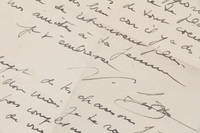
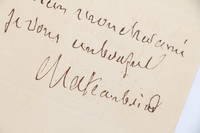
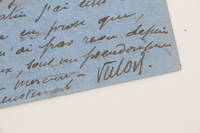
190280848San Francisco 1902. Fine. San Francisco dimanche 22 novembre 1902 13.70 x 18 cm 4 pages sur un feuillet double Autograph letter signed by Victor Segalen addressed to Emile Mignard four pages written in black ink on a double sheet of blue letter paper. Transverse creases inherent to the sending. Trace of white paper hinge. Emile Mignard 1878-1966 also a doctor and from Brest was one of Segalen's closest childhood friends whom he met at the Jesuit college Notre-Dame-de-Bon-Secours in Brest. The writer maintained with this schoolmate an abundant and very sustained correspondence in which he described with humor and intimacy his daily life in the four corners of the globe. It was at Mignard's wedding on February 15 1905 that Segalen met his wife Yvonne Hébert. Segalen who left Le Havre on October 11 1902 bound for Tahiti saw his voyage interrupted by contracting typhoid fever which would ultimately immobilize him for two months in San Francisco: ""Pleine convalescence mon cher Emile. . Aucune complication. Ma fièvre aura été de type « ambulant » car j'ai promené tout mon premier septénaire en sleeping. . J'ai renoncé à prendre le paquebot du 6 Décembre. Une rechute à bord et je ferais immanquablement connaissance avec les bas-fonds du Pacifique. Je partirai seulement le 11 Janvier. L'hiver est très doux à San Francisco. Dans 10 à 12 jours je m'installerai en ville. . New-York m'eût été infâme pour un séjour d'un mois. San Francisco m'agrée."" ""Full convalescence my dear Emile. . No complications. My fever was of the 'ambulatory' type as I spent my entire first week in the sleeping car. . I've given up taking the steamer of December 6th. A relapse on board and I would inevitably make acquaintance with the depths of the Pacific. I will only leave on January 11th. The winter is very mild in San Francisco. In 10 to 12 days I will settle in town. . New York would have been dreadful for a month's stay. San Francisco suits me."" After sharing with his correspondent his feelings when approaching a possible death "". je cherche à définir mon état d'esprit quand lucide j'ai appris que j'avais 41° et plus la réaction de Vidal et des taches rosées lenticulaires. J'ai envisagé froidement l'éventualité d'une issue fatale. Au point de vue religieux siccité absolue. Tout s'est reporté sur mes parents mes amis."" "". I seek to define my state of mind when lucid I learned that I had 41° and more Vidal's reaction and lenticular rose spots. I coldly considered the eventuality of a fatal outcome. From a religious point of view absolute dryness. Everything was transferred to my parents my friends."" Segalen - always very interested in womankind - gives his doctor friend details about the hospital nurses: ""Etonnement de trouver un Hôpital Français en ce répertoire cosmopolite du Grand Océan. Etonnement d'y voir comme personnel une quarantaine de « nurses » 20 à 25 ans jolies parfois toutes munies de brevets littéraires « graduées » comme on dit ici dont une attachée à ma personne me baignant me lotionnant me frictionnant de mains adroites couchant en long peignoir bleu et les cheveux défaits dans ma chambre me parlant de Rudyard Kipling Tennyson écrivant entre deux bains froids à ses « amis »."" ""Astonishment at finding a French Hospital in this cosmopolitan directory of the Great Ocean. Astonishment at seeing as staff about forty 'nurses' 20 to 25 years old sometimes pretty all equipped with literary certificates 'graduates' as they say here one of whom was assigned to my person bathing me lotioning me rubbing me with skillful hands sleeping in a long blue robe with her hair undone in my room speaking to me of Rudyard Kipling Tennyson writing between two cold baths to her 'friends'."" This convalescence which would last until early January 1903 would be an opportunity for Segalen to discover China Town. Autograph letters by Victor Segalen are of great rarity. unknown
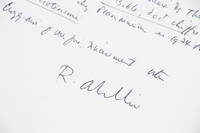
197787660Paris 1977. Fine. Paris 28 Octobre 1977 21.50 x 29.50 cm une feuille une enveloppe Autograph letter dated and signed by Raymond Abellio addressed to Robert Huet from his Parisian home on rue des Bauches 21 lines in black ink. Envelope included. Traces of folding inherent to mailing. Raymond Abellio responds to his correspondent and informs him about the unavailability of his work La Bible document chiffré and the difficulty of obtaining it: "". j'ai demandé à l'éditeur de ne pas le rééditer dans sa forme initiale que j'estime par endroits insuffisamment élaborée. Je ne dispose malheureusement que d'un seul exemplaire sur lequel je travaille en ce moment car une édition refondue et augmentée doit paraître d'ici 18 mois à 2 ans dans le nouveau titre Théorie des nombres bibliques."" . I asked the publisher not to reissue it in its initial form which I consider in places insufficiently developed. Unfortunately I only have one copy on which I am currently working as a revised and expanded edition is to appear within 18 months to 2 years under the new title Biblical Number Theory. In order to keep Robert Huet patient Raymond Abellio offers him this advice: ""Toutefois vous trouverez un résumé des thèmes et des principaux de la Bible doucment chiffré dans mon récent ouvrage paru chez Flammarion en 1974 dans le titre ""La fin de l'ésotérisme"" However you will find a summary of the themes and main points of the Bible document encoded in my recent work published by Flammarion in 1974 under the title ""La fin de l'ésotérisme"" unknown
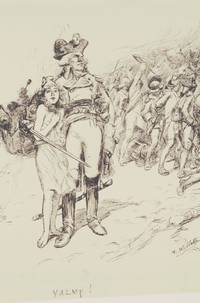
189974842Paris: Imprimerie Champenoispour CH. MassonH. Piazza 1899. Fine. Imprimerie Champenois pour CH. Masson H. Piazza Paris Avril 1899 23.50 x 30 cm une feuille et une serpente Rare original lithograph executed by Adolphe Willette for L'Estampe Moderne after the drawing exhibited at the Luxembourg Museum series number 24 published in April 1899. One of 50 deluxe proofs printed on Japan paper with wide margins laid paper mounted on Japan paper artist's signature in the plate publisher's dry stamp representing a child's profile in the lower margin numbered stamp of the deluxe printing on verso; engraving preceded by a tissue guard captioned with the artist's name title and text. Lithograph inspired by a poem extracted from the collection Chatîments by Victor Hugo reproduced on the print's tissue guard. Magnificent French monthly publication edited between May 1897 and April 1899 L'Estampe moderne consists of original chromolithographs which unlike other magazines such as Les Maîtres de l'Affiche and as stipulated on the tissue guards were created specially by each artist for the magazine. A total of 100 prints were thus published covering the major artistic movements of the late 19th century: Symbolism Art Nouveau Pre-Raphaelites Orientalists and Belle Époque. Each issue of four prints was printed in 2000 copies sold for 3.50F and 100 on Japan paper offered at 10F. Henri Piazza also planned a confidential deluxe printing: 50 copies on Japan paper with wide margins and 50 in black on China paper at the considerable price of 30F. This beautifully formatted print is superbly printed on the most prestigious of papers: Japan paper. Thick silky satiny and pearlescent it contributes to making each page a work in its own right. Its ink absorption quality and its affinity with colours also make it the ideal support for these very beautiful lithographs. French collectors' interest in artistic posters intensified in the early 1890s. Octave Uzanne to describe this fever invented the term ""affichomanie"". The poster originally popular and pasted on the streets of the capital then became an art object and its ephemeral medium became precious and destined for preservation. Piazza decided to remove the poster from its advertising purpose and elevate it to the rank of a work of art in its own right on the same level as the illustrated luxury book. He thus composed a prestigious collection of entirely original works by the most prominent European artists of the moment: Georges de Feure Eugène Grasset Henri Detouche Emile Berchmans Louis Rhead Gaston de Latenay Lucien Lévy-Dhurmer Gustave-Max Stevens Charles Doudelet Hans Christiansen Henri Fantin-Latour Steinlen Ibels Engels Willette Henri Meunier Evenepoël Bellery-Desfontaines Charles Léandre etc. Handsome copy. Imprimerie Champenoispour CH. MassonH. Piazza unknown
1969666281969. Fine. 1969 30.40 x 39.50 cm une feuille I knew that whenever I want to be perfectly alone With the memory of you of that whole day It's to Vaumort that I'll be turning. Exceptional handwritten poem dated 1969 signed and illustrated with original drawings in graphite markers and colour pencils by Lawrence Durrell. The poem-art work is sent to Janine Brun his French lover and has the inscription For Buttons the affectionate nickname given to her by the writer on top of a heart pierced by an arrow. Pin holes marginal tears. Published for the first time in Collected Poems: 1931-1974 1980. In this poem-drawing the writer looks back on a day of love spent in the company of his lover Janine Brun in the cemetery of the small village of Yonne. At the same time Durrell is painfully recovering from the premature death of this third wife two years earlier and publishes his series of dystopian novels Nunc 1968 and Nunquam 1970. He also takes refuge in poetry the last exercise of literary and philosophical asceticism of a writer who gradually chooses to withdraw from the world. It is during a journey from the capital towards the Midi in the south that the lovers stopped for a day in Vaumort: Below us far away the road to Paris. You pour some wine upon a tomb. The bees drink with us the dead approve. Durrell's poetry has suffered from the resounding success of his novels however here it achieves great lyrical beauty its free verse nevertheless very musical picking up the cemetery's well-known motif: One careless cemetery buzzes on and on As if her tombstones were all hives Overturned by the impatient dead We imagined they had stored up he honey their of their immortality In the soft commotion the black bees make. Here the writer attempts to capture in the poem a moment of happiness and carnal pleasure with his lover and frames the verse he has written in long graphite lines and many brightly coloured drawings. Here we have a rare example of a double work of art both poetic and pictorial. Produced in marker and colour pencil similar to the drawings of Joan Miró it is a magnificent illustration marked with naivety which beautifully complements the poem. Durrell continued this activity until the end of his life which he spent in Sommières: Incidentally we can also see a real pictorial reference to the burnt and dusty Languedoc verse 12 where he spent the rest of his life. Rare testimony of Durrell's Provençal adventure with the young French lady who inspired him to write a delightful poem imbued with warmth and Mediterranean colours. unknown
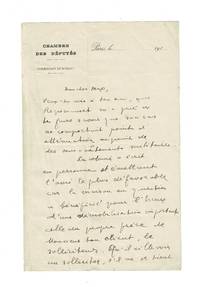
191875931Paris 1918. Fine. Paris s. d. ca 1918 13.30 x 21 cm 2 pages sur un feuillet Unpublished autograph letter signed by Guillaume Apollinaire addressed to Max Jacob. Two pages written in black ink on a sheet with the letterhead of the Chamber of Deputies. Folds inherent to mailing. Unpublished letter concerning the deputy Charles Régismanset then Director at the Ministry of Colonies: ""Veux-tu dire à ton ami que Régismanset m'a prié de te faire savoir que son cas ne comportait point d'atténuation au point de vue des sous-vêtements militaires."" ""La colonie a écrit en personne et émettant l'avis le plus défavorable car la maison en question a bénéficié pour l'heure d'une démobilisation importante."" ""These 'colonies' are hardly distant. He is seconded to Rue Oudinot to the office of Minister Henri Simon who was pleased to be able to assist a poet he had long admired. His duties are rather vague. Assigned to the Press Service he oversees the Bulletin d'Informations coloniales et étrangères occasionally contributing discreetly a task that leaves him sufficient freedom for his own work. His direct superior Charles Régismanset himself a writer calls upon him whenever a 'bushman' passing through might provide information on Bambara customs or Guinean witch doctors."" Pierre-Marcel Adéma Guillaume Apollinaire ""Viens tout de même me voir dirait le père Janvier qui doit pour le moins parler aussi bien que le père de Victor Hugo surtout viens avant janvier et toujours plus haut Excelsior viens j'ai quelque chose d'éditorial à te dire."" unknown
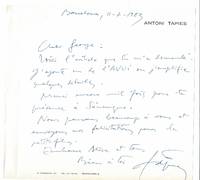
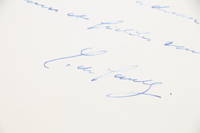
199073715Barcelone Barcelona 1990. Fine. Barcelone Barcelona 19 décembre 1990 22 x 20 cm une feuille Autograph letter signed by Antoni Tàpies addressed to Georges Raillard his close friend and greatest French specialist of his work. Sheet written in blue ballpoint pen on letterhead paper bearing the author's name with his Barcelona address at the bottom ""C. Zaragoza 57 - Tel. 217 33 98 - Barcelona-6"". Traces of folds inherent to the letter's envelope insertion. The Catalan artist writes to his friend about newspaper articles including one published in the Catalan daily l'Avui: ""Voici l'article que tu m'as demandé. J'ajoute un de l'AVUI où j'amplifie quelques détails. Merci encore pour ta présence à Sénanque. Nous pensons beaucoup à vous et envoyons nos félicitations pour le petit-fils."" ""Here is the article you asked me for. I'm adding one from l'AVUI where I expand on some details. Thank you again for your presence at Sénanque. We think of you often and send our congratulations for the grandson."" An exhibition by Antoni Tàpies had been organized at Sénanque Abbey from July 9 to August 29 1983. unknown
194183377Paris: S. n. 1941. Fine. S. n. Paris 16 septembre 1941 14.50 x 10.50 cm une feuille recto-verso Autograph letter signed by composer Vincent Scotto addressed from his Parisian home to his great friend the Provençal writer caricaturist and filmmaker Carlo Rim who was notably the friend of Fernandel Raimu and Marcel Pagnol but also of André Salmon and Max Jacob 44 lines in black ink Vincent Scotto insists with his friend and collaborator Carlo Rim whom he considers too hesitant and indecisive that he find the motivation to contact theater man Albert Willemetz so that the latter will stage the play that the two Marseillais created together for fear that their project might fall through: ""July 2nd My dear Carlo in response to your letter I must tell you that I am leaving for Paris Sunday 6th final deadline and that I would have liked to bring Willemetz the authorization and conditions for our play to be performed because I sense that with all these hesitations we are going to miss out again and that it's another play that will be performed instead of ours. I would have wanted you to write me a letter in this sense: ""My dear Willemetz. It is understood that we authorize you to perform our play at the Bouffes Parisiens and to touch it up according to the needs of your theater. You are also authorized to write the lyrics for the songs according to the performers. I will cede to you for this assuming that the play is declared at 12%. 1% on my rights and Mr. Vinc. Scotto 2% on his which will make 3% Willemetz 4% Scotto 5% Carlo Rim but it remains well understood that if the play is not performed by January 1st 42 in one of your theaters we will consider this contract as null and void and we each regain our freedom."" Here my dear Carlo is more or less what I would have wanted to bring to Willemetz. Of course if this no longer pleases you I am always wholeheartedly with you but think it over carefully because there are opportunities that don't come again. Our regards to your wife. I embrace you. V. Scotto. Regarding the song I'm waiting for Jo Bouillon but I remind you that they are not completely finished from the lyrics standpoint. Vincent. Telephone me and write me: Lycée 18-68 18-69."" S. n. unknown
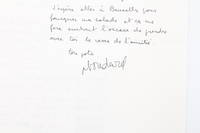
199579700Nice: S. n. 1995. Fine. S. n. Nice 20 Août 1995 21 x 29.50 cm une feuille Handwritten letter dated and signed 37 lines from Alphonse Boudard to his great friend and companion of well-watered lunches the Brussels journalist André Tillieu who was like Alphonse Boudard a great friend of Georges Brassens but also of Louis Nucéra. This missive is moreover written from the home of Louis Nucéra where Alphonse Boudard spends a few days of summer vacation each year. A fold mark inherent to the folding of the letter for mailing. ""ami merci de ta lettre. tu m'encourages toujours et là c'est encore plus important. Je suis d'ailleurs en piste pour le prix Giono mais j'y ai de redoutables concurrents soutenus par leurs éditeurs Mazis basta ! vivra verra. photo : j'ai quelques clichés à Paris et je t'en enverrai un en rentrant. De toute façon le livre parait en début septembre. Si tu es pressé demande à Claudine Lemaire ed. Laffont 24 av. Marceau 75008. fautes : Mea culpa pour Yvonne de Galais. Impardonnable. Les autres sont apparues après les corrections sur les deuxièmes épreuves. On n'en sort pas. Et il y a aussi le docteur Goebbels avec un seul B Tant pis pour sa gueule ! Louis a quelques ennuis acec sa femme toujours malade. Il l'accompagne demain en cure à Chatel Guyon. Voila je viens de finir encore un livre. Celui-là de divertissement pure et anticlérical. ""Madame de Saint Sulpice"". Le roman d'une taulière qui tient un bordel de curés entre les deux guerres. J'espère aller à Bruxelles pour fourguer ma salade et ça me fera surtout l'occase de prendre avec toi le verre de l'amitié. ton pote. ABoudard."" ""friend thank you for your letter. you always encourage me and here it's even more important. I'm actually in the running for the Giono prize but I have formidable competitors supported by their publishers Mazis basta! we'll see. photo: I have some shots in Paris and I'll send you one when I get back. In any case the book comes out in early September. If you're in a hurry ask Claudine Lemaire ed. Laffont 24 av. Marceau 75008. mistakes: Mea culpa for Yvonne de Galais. Unforgivable. The others appeared after corrections on the second proofs. We can't get out of it. And there's also doctor Goebbels with only one B Too bad for his face! Louis has some troubles with his wife who's always sick. He's accompanying her tomorrow to take the waters at Chatel Guyon. There I've just finished another book. This one pure entertainment and anticlerical. ""Madame de Saint Sulpice"". The novel of a madam who runs a brothel for priests between the wars. I hope to go to Brussels to peddle my wares and it will especially give me the chance to have a drink of friendship with you. your buddy. ABoudard."" André Tillieu the Brusselian very close friend and biographer of Georges Brassens maintained an epistolary correspondence with Alphonse Boudard for almost thirty years from 1972 until the latter's death in 2000. The mocking Parisian writer very quickly showed him his friendship considering him one of the rare critics to understand him perfectly to the point of clearly explaining in his reviews what he himself expressed only incompletely and sometimes confusedly in his books. André Tillieu thus became part of the small circle of Alphonse Boudard's true friends alongside le Gros Georges Georges Brassens le Niçois Louis Nucéra and René Fallet with whom he loved to share hearty well-watered meals and cycling trips. As the grim reaper gradually took away his best friends one by one André Tillieu would remain one of Alphonse's very last buddies. S. n. unknown
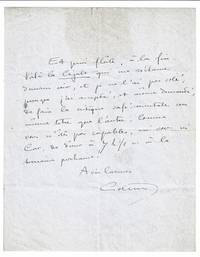
192075260Marseille 1920. Fine. Marseille s. d. circa 1920 19.80 x 25.20 cm une page sur un feuillet Autograph letter signed by Colette addressed to her friend the man of letters and lawyer Adrien Peytel nine lines written in black ink. Some folding marks inherent to the mailing of the letter. ""And then damn it enough already. Here La Cigale is calling me for tomorrow evening and I haven't stolen it since I accepted and even asked to do the café-concert criticism on the same level as the other."" unknown
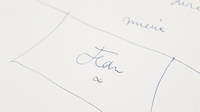
1953867921953. Fine. 3 septembre 1953 21 x 27 cm une page sur un feuillet Original ink drawing signed by Jean Cocteau dated in his hand September 3 1953. One horizontal crease. Between a few pen strokes that strangely resemble a tombstone the writer-artist has slipped in an amusing epitaph: ""Voilà ma fille je ne peux pas dire mieux / Jean"" There you are my daughter I cannot say better / Jean. unknown
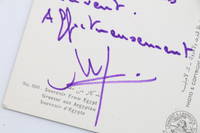
197083032Le Caire Cairo 1970. Fine. Le Caire Cairo s. d. ca 1970 15 x 10 cm une carte postale Autograph postcard signed by Maurice Béjart addressed to André-Philippe Hersin written in violet felt-tip pen on the verso of a photomontage showing a belly dancer in front of a mosque which appears to be the Al-Azhar mosque. ""Voilà ma nouvelle étoile. Je pense à vous souvent. Affectueusement. Maurice"" ""Here is my new star. I think of you often. Affectionately. Maurice"" Journalist dance critic and editor-in-chief of Les Saisons de la danse Hersin was a great champion of Béjart's choreographic style and devoted laudatory articles to him in his magazine as well as monographic fascicles of his work. unknown
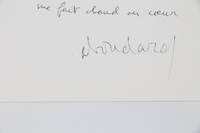
199979430Paris: S. n. 1999. Fine. S. n. Paris 4 Février 1999 14.50 x 10.50 cm une feuille une enveloppe Signed manuscript letter on Bristol card of 15 lines by Alphonse Boudard on letterhead from his Parisian address in Nouvelle Athènes in the 9th arrondissement to his great friend and companion of well-watered lunches the Brussels journalist André Tillieu who was like Alphonse Boudard a great friend of Georges Brassens but also of Jean Giono. A date 4.2.99 written in blue ballpoint pen at the top of the envelope. Envelope included. ""Merci mon cher André de ta magnifique lettre. J'ai parfois des doutes sur l'intérêt de ma production eh bien tu me rassures. Je sais que j'ai en Belgique un lecteur attentif et qui pige mes moindres intentions qui apprécie mes petits trucs de style. Je n'ai pas le temps de t'écrire plus longuement. J'espère te voir à Bruxelles en Avril ou Mai lorsque je ferai la promotion de Chère visiteuse le livre que je viens de finir et qui paraîtra dans deux mois. Voilà vieux frère ton amitié me fait chaud au coeur. ABoudard."" ""Thank you my dear André for your magnificent letter. I sometimes have doubts about the interest of my production well you reassure me. I know that I have in Belgium an attentive reader who understands my slightest intentions who appreciates my little stylistic tricks. I don't have time to write to you at greater length. I hope to see you in Brussels in April or May when I promote Chère visiteuse the book I have just finished and which will be published in two months. There you have it old brother your friendship warms my heart. ABoudard."" André Tillieu from Brussels very close friend and biographer of Georges Brassens maintained an epistolary correspondence with Alphonse Boudard for almost thirty years from 1972 until the latter's death in 2000. The cheeky Parisian writer quickly showed him his friendship considering him one of the rare critics to understand him perfectly to the point of clearly explaining in his chronicles what he himself expressed only incompletely and sometimes confusedly in his books. André Tillieu thus became part of the small circle of Alphonse Boudard's true friends on the same level as le Gros Georges Georges Brassens le Niçois Louis Nucéra and René Fallet with whom he liked to share hearty well-watered meals and cycling expeditions. As death gradually took away his best friends one by one André Tillieu would remain one of Alphonse's very last buddies. S. n. unknown
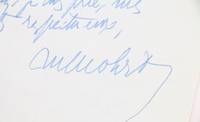
198588379S.n. Imprimerie universelle 1985. Fine. S.n. Imprimerie universelle 28 Mars 1985 21 x 29.50 cm 4 pages Autograph letter dated and signed by Michel Mohrt four pages addressed to Thierry Maulnier. 69 lines written in blue ink notably discussing his candidacy for the Académie française to succeed Marcel Brion's vacant seat. Folds from original mailing. A paperclip holds the two sheets of the letter together. After a first unsuccessful attempt in 1983 Michel Mohrt tried again in 1985 to become an Immortal: ""Je vous y rappelais qu'il y a deux ans lors d'une première candidature vous aviez bien voulu me recevoir à Versailles. Je n'ai pas osé une visite cette fois-ci sachant que vous me connaissiez."" Michel Mohrt regarded Thierry Maulnier as one of his intellectual mentors: ""Non seulement ces écrits politiques mais un ouvrage comme 'l'Introduction à la poésie française' ont été pour moi des révélations. A côté du maître intéressant vous étiez pour beaucoup de jeunes hommes de ma génération un maître dont les idées nouvelles 'au delà du nationalisme' représentaient l'avenir."" Although aware that it might cost him the election to the Académie Michel Mohrt showed some reluctance to engage in lobbying among the members of the Institut: ""Quelle que soit l'issue du vote académique qui à mon déplaisir a pris l'allure d'un affrontement avec un confrère du journal que je juge absurde je tenais à vous dire l'admiration que j'ai pour votre oeuvre."" S.n. [Imprimerie universelle] unknown
196986489Paris 1969. Fine. Paris 27 Novembre 1969 13.50 x 21 cm une feuille Dated and signed autograph letter from Charles de Gaulle addressed to his cook Augustine Bastide who served him from 1940 to 1958. 9 lines in blue ink on his headed paper. Trace of folding inherent to envelope insertion. ""Vos voeux d'anniversaire m'ont vivement touché. Je vous en remercie de tout coeur."" Your birthday wishes moved me deeply. I thank you with all my heart. The de Gaulles had taken in the recipient of this letter Augustine Bastide upon their arrival in London. Of Provençal origin she served the family from 1940 to 1958 first in Great Britain then in France. At the de Gaulle couple's table in an England severely affected by rationing one could then find rabbits periwinkles and other frogs. The ""outspoken Southerner"" would remain in the general's service for nearly twenty years sometimes arousing the hilarity of the stoic head of state: In 1946 when he had just voluntarily left power he said to her: ""Vous voyez Augustine la politique c'est plus décevant que le travail aux fourneaux"" You see Augustine politics is more disappointing than kitchen work. Then hands on hips she retorted: ""Mais général pourquoi ne vous décidez-vous donc pas à rendre définitvement votre tablier "" But general why don't you decide to hang up your apron for good My father could not help but laugh Philippe de Gaulle De Gaulle mon père unknown
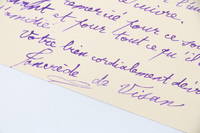
194086675Lyon 1940. Fine. Lyon 26 Septembre 1940 13.50 x 10.50 cm un bristol recto verso Autograph card dated and signed by Tancrède de Visan 22 lines in violet ink on recto and verso. Touched by the floral attention shown by his correspondent Tancrède de Visan expresses profuse gratitude: ""Comment ne pas être touché par si beau bouquet où les couleurs se marient et s'assemblent comme des strophes harmonieuses ! "" How can one not be moved by such a beautiful bouquet where the colors marry and come together like harmonious stanzas! inspiring in him a lyrical flight: ""Ces dahlias frais coupés et tout humides encore de rosée m'évoquent les nuances les plus glorieuses des jours déjà touchés par l'automne et ses trompettes de cuivre."" These dahlias freshly cut and still moist with dew evoke for me the most glorious shades of days already touched by autumn and its copper trumpets. unknown
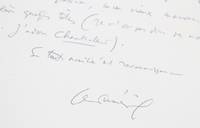
198288347Paris: s. n. 1982. Fine. s. n. Paris 27 Juin 1982 13.50 x 21 cm une feuille Autograph letter dated and signed one page by Georges Dumézil addressed to Thierry Maulnier 13 lines in black ink on a sheet with Collège de France letterhead. Central folds inherent to the mailing printed stamp ""Fonds archives privées Maulnier"" in lower left corner of the missive. The Immortal Georges Dumézil thanks his fellow academician Thierry Maulnier for sending his Introduction à la poésie française of which he makes a mixed critique: ""Votre Introduction à la poésie française que je ne connaissais que de renom m'a donné les jouissances et irritations attendues."" Your Introduction to French Poetry which I knew only by reputation has given me the expected pleasures and irritations."" specifying his thought: "". il suffit de s'entendre sur les mots et d'abord sur ""poésie"". . Mais quand votre tondeuse est passée mon vieux mauvais goût relève quelques têtes je n'ose pas dire de nom. Si j'adore Chantecler."" . it suffices to agree on the words and first on ""poetry"". . But when your lawnmower has passed my old bad taste raises a few heads I dare not mention names. If I adore Chantecler."" s. n. unknown
189574263s. l.: S. n. 1895. Fine. S. n. s. l. s. d. circa 1895 12.50 x 17 cm une page et demie sur une feuille Autograph letter signed by the dandy count of a page and a half 13 lines written in black ink to his friend the journalist from Le Gaulois Henry Lapauze so that he might use his decisive influence in the publication of a text: ""Il doit s'imaginer que ce texte est subversif. Détrompez-le."" ""He must imagine that this text is subversive. Disabuse him of this notion."" initially validated by Arthur Meyer but which Robert de Montesquiou wants to ensure through his friend will indeed be printed: ""J'ai vu votre directeur qui accepte en principe. Cependant comme votre intervention pour faire est déterminante j'insiste auprès de vous."" ""I have seen your director who accepts in principle. However as your intervention to make it happen is decisive I insist upon you."" Henry Lapauze 1867-1925 was a journalist art critic then in 1905 curator of the Petit Palais converted four years earlier into a museum and whose collections he considerably enriched by acquiring notably the Courbet Henner Falguière collections with in the twilight of his life a marked predilection for the Decorative Arts of which he was one of the ardent promoters. S. n. unknown
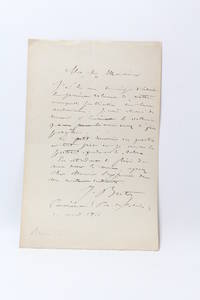
1866714851866. Fine. 15 avril 1866 13.30 x 21 cm une feuille Signed autograph letter from painter Jules Breton congratulating a historian on his latest work and requesting the sending of the second volume. One folded sheet. Academically trained a realist then naturalist painter Jules Breton was one of the first artists to depict the rural world. unknown
190984583Hoggar 1909. Fine. Hoggar 17 matin 1909 10.20 x 15.80 cm un feuillet remplié Foucauld and the temptation of the desert Foucauld's Sahara Epistle Precious handwritten letter signed by Saint Charles de Foucauld 4 pages in purple ink on a folded sheet. At the top of the first page is a handwritten version of his famous motto ""Jésus Caritas"" accompanied by a drawing of the Sacred Heart of Jesus surmounted by a cross which he wore on his habit. He repeats this sketch accompanied by the word Jesus at the head of each subsequent page of the letter. Published in Georges Gorrée Les amitiés sahariennes du Père de Foucauld 1946 vol. 2 p. 183. This long and admirable letter written in Algeria probably from the Assekrem plateau in the Hoggar mountains where his hermitage was located dates from 1909 according to Georges Gorrée. This was the year in which Foucauld presented the statutes of his fraternity which would be emulated by so many others around the world. In the letter Foucauld is probably helping a French officer preparing a camel trek across the Sahara and informs him of the number and condition of the camels he had personally ordered for him. Foucauld acts as an intermediary with two Tuareg tribal leaders: a member of the Dag Rali tribe Abahag ag Ourar and Aflan ag Douwa representative of the amenokal tribe chief Moussa Ag Amastan to whom he was very close : During the night I was brought back the letter sent yesterday evening the bearer having learned on the way that Aflan is not at home and that Abahag having learned of Aflan's absence had not stopped at his tents. He had chosen to ignore them. I'm sending someone to Aflan's house to tell him to come and see me as soon as he gets back. But when will it be I am told it's quite far away at the home of the Agouhs in Tehlé. Throughout the letter we sense the life of deprivation that Foucauld shared with the Tuareg a region regularly hit by famines and conflicts : There are 53 camels ordered the 1st arrivals are from Dag Rali Agouh in Tehlé close to Tamanrasset Klan in Taourit ; they are I fear in poor condition for here there is nothing to eat as in the Kouira but there is reason to hope that you will find camels in good condition among those of the Kel Tazoulet and Aït Loaien who due to the distance should arrive a little later than the others. In the letter he also pays tribute to several members of the military convoy he met in the Sahara including Marshal des Logis Lafont who a few years later would treat a Tuareg and thus earn the gratitude of the holy man: please thank Lafont for repairing my scrapers. The missive ends with these words: Yours very respectfully and affectionately devoted in the heart of Jesus. A superb letter from a humble servant of God who was canonized in 2022 featuring on every page his immortal symbol of the love with which Christ loved humanity - embroidered on his tunic it also preceded each of his meditations letters and writings. These lines full of kindness are an exceptional testimony to his dedication and his deep knowledge of the Sahara and its inhabitants. unknown
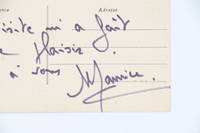
197079136s. l. 1970. Fine. s. l. s. d. ca 1970 8.90 x 13.60 cm une carte postale Autograph postcard signed by Maurice Béjart addressed to André-Philippe Hersin written in black felt-tip pen on the verso of the photographic reproduction of a black and white photograph by H. Manuel. ""Votre visite m'a fait tant de plaisir. Je pense à vous - Maurice"" ""Your visit gave me such pleasure. I think of you - Maurice"" Journalist dance critic and editor-in-chief of Les Saisons de la danse Hersin was a great defender of Béjart's choreographic style and devoted laudatory articles to him in his magazine as well as monographic fascicles of his work. unknown
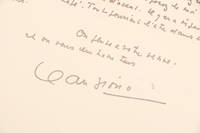
195284966s. l. 1952. Fine. s. l. ca 1952 21 x 27 cm une feuille Autograph letter signed by Jean Giono 14 lines in black ink addressed to Roland Laudenbach who jointly ran the magazine Opéra with his friend Roger Nimier. Fold marks inherent to the mailing. ""Cher Roland j'y pense : Voulez-vous quelque chose pour Opéra de qualité d'assez sensationnel et qui fuisse faire sept à huit numéros peut-être plus à votre gré Le Journal. Le Journal de 1936 à 1949. Si cela vous plait parlez en avec Nimier pensez à un chiffre proposez le moi ça ira sûrement et c'est d'accord. Il y en a déjà pas mal de tapé ! Tout le journal l'être dans un mois. On pense à votre venue et on vous embrasse tous. Jean Giono."" Dear Roland I'm thinking: Would you like something for Opéra Something quality rather sensational that could run for seven to eight issues perhaps more as you wish The Journal. The Journal from 1936 to 1949. If this appeals to you discuss it with Nimier think of a figure propose it to me it will surely work out and we're in agreement. Quite a bit of it is already typed! The entire journal will be ready in a month. We're thinking of your visit and we all embrace you. Jean Giono. A very visual letter bearing Jean Giono's handsome signature. unknown
182071476Paris 1820. Fine. Paris s. d. 13 x 19.90 cm une feuille Signed autograph letter from the painter Jean-Baptiste Isabey to the collector Alphonse Mennechet de Barival regarding the transport of two paintings. One folded sheet multiple tears. unknown
184184613s. l. 1841. Fine. s. l. 9 Mai 1841 11.10 x 18.10 cm deux pages et demi sur un bifeuillet Autograph letter signed by François René de Chateaubriand 2½ pages on a bifolium 29 lines in black ink. Folds inherent to posting. ""I called on you this morning my dear friend to say goodbye to you. You should have reminded me of my debt sooner when I was prosperous. I had completely forgotten it. Today I can only acknowledge it to establish its existence. In addition . that something might remain after me beyond the four planks of the worst clumsiness in the world. . I am not there this autumn I shall return to Paris or if I shall go to Italy. who can provide a project and decide a future"" Charming and aesthetic signed letter from the lord of Vallée aux Loups. unknown
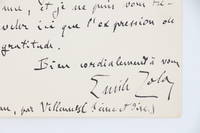
188279109Médan 1882. Fine. Médan 16 novembre 1882 13.60 x 21.40 cm 2 pages sur un double feuillet - enveloppe jointe Autograph letter signed by Emile Zola - apparently unpublished - addressed to Léon Carbonnaux written in black ink on a double sheet. Folds inherent to mailing. Envelope included. Important testimony to the colossal documentation work and the capital role of Emile Zola's informants in depicting his immense natural and social fresco. This letter was sent to Léon Carbonnaux department head at Bon Marché who transmitted precious information to Emile Zola for the creation of the eleventh volume of the Rougon-Macquart series: Au Bonheur des Dames. Only two letters from Léon Carbonnaux to Emile Zola are known: they can be consulted in the digitization of the preparatory file for Bonheur des Dames made available online by the Bibliothèque nationale de France. However we know thanks to this same file which contains a long section entitled ""Notes Carbonnaux"" that this department head at Bon Marché provided a significant amount of information to Zola particularly about employee customs and their remuneration. The two men undoubtedly met when Emile Zola eager for information about the functioning of department stores conducted field research in February and March 1882. ""J'ai pris l'inventaire comme cadre à un de mes chapitres. D'ailleurs je n'ai spécialement besoin que du travail dans le rayon des confections et dans le rayon des soieries. Il est inutile de me renseigner sur les autres rayons."" ""I have taken the inventory as the framework for one of my chapters. Moreover I specifically only need the work in the ready-to-wear department and in the silk department. It is unnecessary to inform me about the other departments."" Thanks to this important letter we understand that it was Léon Carbonnaux who provided the essential information to Emile Zola for writing his very beautiful eleventh chapter devoted to the inventory: ""Vous avez eu l'obligeance de me donner certains détails sur l'inventaire. Vous m'avez dit qu'on choisissait le premier dimanche d'août qu'on fermait les portes et que tous les employés s'y mettaient. On vide toutes les cases n'est-ce pas on jette les marchandises sur les comptoirs ou à terre et l'inventaire n'est terminé que lorsqu'il n'y a plus absolument rien en place."" ""You were kind enough to give me certain details about the inventory. You told me that the first Sunday in August was chosen that the doors were closed and all the employees set to work. All the compartments are emptied aren't they The merchandise is thrown onto the counters or on the ground and the inventory is only finished when there is absolutely nothing left in place.""The final version of Bonheur des Dames contains all the precious information provided by the department head of Bon Marché: ""Le premier dimanche d'août on faisait l'inventaire qui devait être terminé le soir même. Dès le matin comme un jour de semaine tous les employés étaient à leur poste et la besogne avait commencé les portes closes dans les magasins vides de clientes. . Neuf heures sonnaient. . Dans le magasin inondé de soleil par les grandes baies ouvertes le personnel enfermé venait de commencer l'inventaire. On avait retiré les boutons des portes des gens s'arrêtaient sur le trottoir regardant par les glaces étonnés de cette fermeture lorsqu'on distinguait à l'intérieur une activité extraordinaire. C'était d'un bout à l'autre des galeries du haut en bas des étages un piétinement d'employés des bras en l'air des paquets volant par-dessus les têtes ; et cela au milieu d'une tempête de cris de chiffres lancés dont la confusion montait et se brisait en un tapage assourdissant. Chacun des trente-neuf rayons faisait sa besogne à part sans s'inquiéter des rayons voisins. D'ailleurs on attaquait à peine les casiers il n'y avait encore par terre que quelques pièces d'étoffe. La machine devait s'échauffer si l'on voulait finir le soir même. unknown
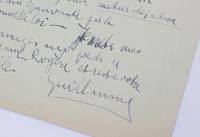
191383938s. l. Paris 1913. Fine. ""I will come to see you to speak to you about naturalization I am appalled by the new law"" s. l. Paris s. d. ca. juin 1913 15.70 x 24.50 cm une page sur un feuillet Unpublished autograph letter signed by Guillaume Apollinaire addressed to Jean Royère one page written in black ink on a sheet. Transverse folds inherent to posting. Very fine letter of thanks from poet to poet. ""I thank you for the admirable article you devoted to me. You have felt my soul like no one else."" Jean Royère had indeed written a laudatory article upon the publication of Alcools in the June 20 1913 issue of La Phalange: ""Here gathered in an 18mo of barely two hundred pages is almost the entire poetic work of Apollinaire. Fifteen years of poetry rest in this small volume. I therefore do not open it without almost a preconceived admiration. In poetry abundance means sterility and one only writes three volumes in a year through inability to devote one's life to a book. Apollinaire evidently will leave only one book of verse like Baudelaire and Mallarmé like Rimbaud: this is a considerable chance of immortality for the true poet is one who has this too rare gift of condensation."" "". I will come to see you in the coming days to thank you first and also to speak to you about naturalization I am appalled by the new law."" The poet here alludes to the Three Year Law dubbed the Barthou Law increasing the duration of military service from two to three years in view of preparing the French army for a possible war with Germany. If Apollinaire's biography prefers to focus on the publication of his works in this year 1913 the letters his mother addresses to her son show that the latter moves heaven and earth to avoid military service and be naturalized as quickly as possible: ""For your papers an Italian colonel attached to the ministry of war who was witness for your act of recognition had written to me once to give me the steps to follow so that you would be exempted from military service in Italy and for your French naturalization. I am going to write to him moreover to ask him to see to the Town Hall."" letter from Angelika Kostrowicka of July 12 1913. War would come soon and on August 3 1914 the day after mobilization the stateless poet would file a request for voluntary enlistment accompanied by a naturalization request. The latter would only be granted to him in 1916. An interesting letter written at the dawn of the Great War bearing witness to Guillaume Apollinaire's two passions: poetry and France. unknown