98 727 résultats
698630 black & white brush & ink drawings of diseased horses. Scroll 130 x 27630 mm. 94 joined sheets with several extension flaps which fold down with additional text recently & expertly backed. Omi Province today's Shiga Province: the most modern date we find in the scroll is 1809. A remarkably long scroll 90 feet; this is the most comprehensive old Japanese encyclopedia of horse diseases and their treatments we have encountered. The text includes recipes for medicines and acupuncture techniques as well as numerous case histories. There are references in this scroll to texts being copied in 1611. Each of the 94 sheets is numbered. It is obvious this was once a codex in at least two volumes that has been converted into an enormously long scroll. The accompanying title label was clearly the upper wrapper of the codex. At the beginning of this scroll are 30 brush & ink drawings of diseased horses representations of case histories adapted from the Inner Classic of the Yellow Emperor written about 2700 B.C. The case histories discuss rare diseases digestive problems drinking too much cold water kidney diseases heart problems lung problems wounds to the head diseases of the spleen parasitical worms breathing problems including asthma constipation cramping intestinal blocking food poisoning lack of appetite nervous horses brain diseases "black sweat" chills etc. Each case history concludes with pharmaceutical recipes. Sheets 51 to 94 contain sections on specific topics and include eye diseases tongue diagnosis diagnosis based on the condition of the tail setting of broken bones medicines to treat blood clots the six meridians the 18 meridians acupuncture treatments for tumors with a long list of pressure points and explanations of their relationships to tumors and other diseases etc. At the very end of this scroll we find the date "1809" with the name "Akatsu." In fine condition preserved in a box. unknown books
180463178London, 1804. 8vo. Bound uncut in a very nice recent pastiche binding with gilt lettering and ornamentation to spine. Previous owner's name in contemporary hand to upper margin of title-page. First four leaves with closed hole in upper margin, not affecting text. With only light occasional brownspotting and barely visible dampstain to upper margin of first 7 leaves - over over very nice copy. Printed on good paper. IX, (3), 203, (1) pp.
in-2°, 312x220 mm, leg. coeva in pergamena, con titolo manoscritto al dorso; pp. [36], 340 [i.e. 339], [1]. Frontespizio calcografico entro cornice riccamente illustrata, contenente la marca tipografica giuntina con il giglio di Firenze, nonché una vista panoramica di Venezia, zona piazza san Marco. Ritratto calcografico dell' Autore, firmato N.B. a carta c? v. Iniziali e fregi xilografici ornati. Testo in Latino. Nell'opera sono presenti 45 tavole calcografiche a piena pagina (numerate nel testo); in particolare l'illustrazione della tav. II del libro I è stata a suo tempo incollata al suo giusto posto, sovrapponendola ad una copia della illustrazione della tav. I che era stata erroneamente stampata originariamente al posto della illustrazione della tav. II; così facendo l'opera è completa. Edizione originale poco diffusa di questo trattato di anatomia del medico spagnolo Juan de Valverde, arricchito con 45 tavole su rame. Rif.: IT\ICCU\RMLE\006695. CNCE 26284. OCLC, 632682681. P. Camerini, Annali dei Giunti, Venezia, 943. Cond.: Segni d'uso alla legatura (alcune macchie ai piatti e leggere abrasioni). Carte prevalentemente spesse e croccanti, in generale abbastanza pulite. Rari fori di tarlo ai margini del frontespizio. Presenza di alcune macchie d'umido al frontespizio ed alle prime dieci carte e altri occasionali aloni ai margini e agli angoli di alcune carte. Piccolo strappo all'ultima carta, ma senza perdite (facilmente riparabile). Esemplare in condizioni generali decisamente buone. -- Scarce original edition of this treatise on anatomy by the Spanish physician Juan de Valverde, enriched with 45 copper plates. Good copy.
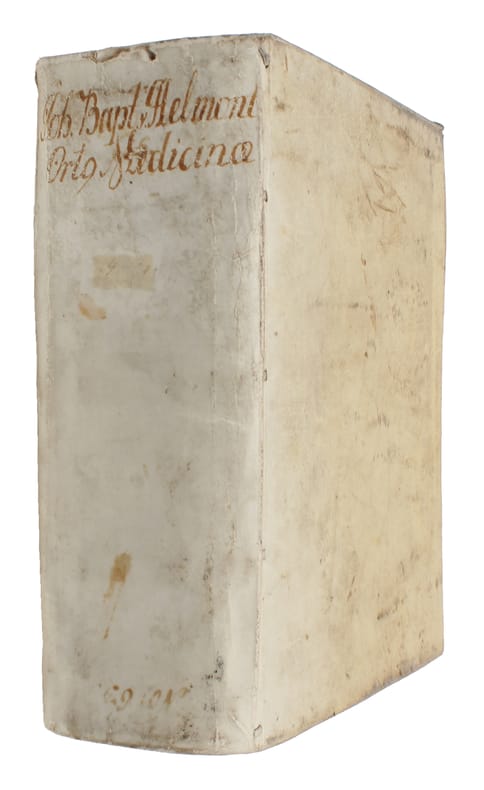
164860796Amsterdam, Elzevir, 1648. 4to. In contemporary full vellum over wooden boards with title in contemporary hand to spine. Extremities with wear and soiling, boards spotted and corners bumped. Vellum loosened from edges of boards. Internally with a few occassional marginal annotations in contemporary hand and last blank leaf annotated, but generally internally very fine and clean. [Ortus medicinae:] (32), 88, 87-158, 161-176, 175-382, 373-452, 457-800 pp. + portrait." [Opuscula medica inaudita:] (8), 110, (2) pp. [Febrium Doctrina Inaudita:] 115, (1) pp." [Tumulus Pestis:] 88 pp.
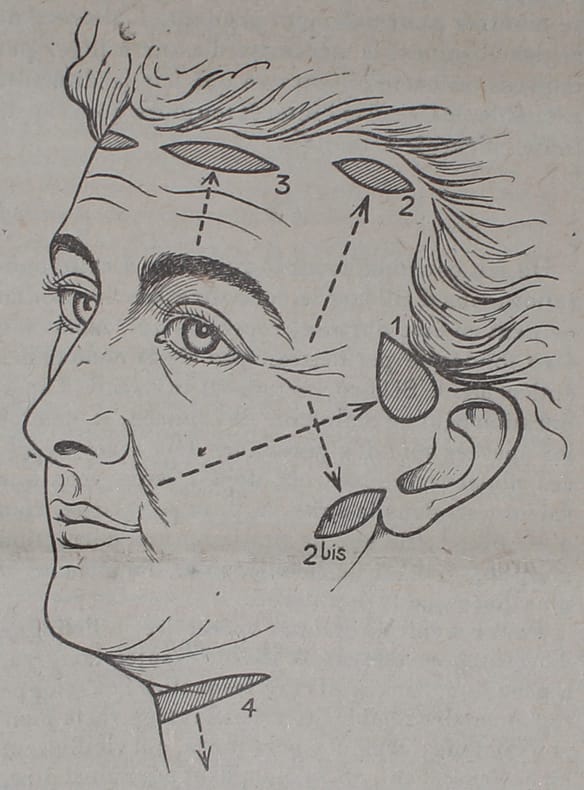
191960126(Paris), 1919. Folio. With a nice, later paper backstrip. Entire issue 27, 1919 of La Presse Médicale present (pp. 353- 360). Passot's article: 7 columns on pp. 258-261. With one illustration, depicting the ways to reduce wrinkles on a face. Well preserved.
(Paris), 1919. Folio. With a nice, later paper backstrip. Entire issue 27, 1919 of La Presse Médicale present (pp. 353- 360). Passot's article: 7 columns on pp. 258-261. With one illustration, depicting the ways to reduce wrinkles on a face. Well preserved.
First edition. Original beautifully illustrated broadside showing the hospital and with important names of hospital directors and committees. Mounted and framed in a wooden frame. Picture 11x16.5 cm, frame 22x28. Broadside page appears to be from an event related to the official re-naming of the Jews Hospital in New York to Mount Sinai Hospital. Jews' Hospital (later famously renamed as Mount Sinai Hospital) was founded in 1852 by Sampson Simson (1780-1857) to address the needs of New York's rapidly growing Jewish community. At the time, New York City hospitals often discriminated against Jews - refusing them treatment as patients as well as blocking the hiring of Jewish medical staff. The Jews' Hospital in the City of New York, as it was initially called, inaugurated its first building in 1855, in what was then a rural neighborhood on West 28th Street between Seventh and Eighth Avenues on land donated by Simson. Just a short few years later the 45-bed hospital would be unexpectedly filled to capacity with soldiers wounded in the U. S. Civil War. In 1866 it was renamed Mount Sinai HospitalThe medical staff was primarily Jewish, because until relatively recently, it was difficult for Jewish doctors to obtain postgraduate training or specialist posts at major New York hospitals. (See T. Levitan, Islands of Compassion: A History of the Jewish Hospitals of New York. 1964) . A comparable item but without the important listings of names sold for over USD 6, 000.00 at auction in 2015 SUBJECT(S) : Mount Sinai Hospital. Very minimal markings and wear. Slight toning. Very good + condition. Attractive. (AMR-53-8)
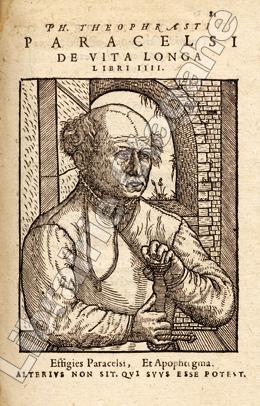
156713778Paris, aedibus Rovillii, (1567) ; in-8 ; plein veau havane marbré, dos décoré et doré, roulette sur les coupes, tranches mouchetées de rouge (reliure du XVIIIe) ; 376, (21) pp. (Index rerum et verborum et Index Autorum), (1) p. blanche, (1) f. blanc. ; portrait gravé sur bois (p.81).
8vo. IV, 500 pp. With 6 numbered engraved folding plates. Contemporary giltstamped full calf with gilt title-label to spine. 2 gilt labels with the arms of the Russian Empire and the monogram "CT" or "CP" to spine. Leading edges gilt, gilt inner dentelle. Marbled pastedowns. All edges marbled. Seminal work, written by "the first woman in the Western world who can accurately be called a mathematician" (DSB), from the library of Catherine the Great, Empress of Russia, with the Romanovs' arms to the spine. - Agnesi's work, which treats differential and integral calculus, is considered "the best introduction extant to the works of Euler" (A'Becket). The French Academy of Sciences regarded this manual the clearest, most methodological and most comprehensive work of its kind, and commissioned this French translation after the publication of the Italian original ("Instituzioni analitiche") in 1748, when the author - a child prodigy - was only 30 years old. - Binding very slightly rubbed, spine-ends chipped. Later library stamp to lower flyleaf, along with some ballpoint and pencil annotations. A fine copy of this outstanding work. DSB I, 75. Riccardi I, 1, 8, 3. A'Becket, "Maria Gaetana Agnesi", Catholic Encyclopedia (1913). OCLC 963682985.
8vo. X, 462 pp. With woodcut illustrations in text. Contemporary full calf with spine gilt in six compartments, giltstamped green spine label, gilt inner dentelle, leading edges gilt. Marbled endpapers; all edges marbled. First edition. - Presentation copy from the library of the British architect William Cecil Marshall (1849-1921), inscribed to him on the half-title ("From the Author") by a clerk at the publisher's, and with Marshall's autograph ownership above that. Darwin and Marshall had corresponded over insectivorous plants the previous year (cf. Darwin Correspondence Project no. 9627F, letter dated 7 Sept. [1874]). In 1876 Darwin would engage the architect's services to build an extension to Down House on the north side (a billiard room with dressing room and bedroom above). - Extremeties worn; front marbled flyleaf weakened. Still an appealing copy.
"Edizione: Post ultimam Gallicam impressionem denuo a uiro bene docto exactissima diligentia recogniti, cunctisque mendis & erroribus expurgati, reintegrato iterum amplissimo indice, qui omnia quaeque cognitu digna, alphabetice demonstrat. . Pagine: fogli 2+490+4 reali ( ufficiale 560) . Illustrazioni: Iniziali dei volumi xilografate. . Formato: Fino a cm 15: 24° . Rilegatura: Pergamena originale . Stato: Buono . Caratteristiche: Rarissimo. Si tratta probabilmente di una prova dello stampatore: in tutte le pagine sono presenti le squadrature con righe in rosso per delimitare i bordi, i margini e l'impostazione di tutta la pagina. Il numero delle pagine parte dalla 49 ma si tratta dell'inizio del primo libro. All'interno la numerazione delle pagine a volte è errata ma non vi sono pagine mancanti (presenti tutti i XIIII Libri ). Non è presente nessun frontespizio né indice. Vi sono ai margini molte note in greco antico probabilmente coeve. Firme di appartenenza e timbro antico. La presente edizione fu impostata seguendo quella parigina del 1519 ( prima traduzione in latino da parte di Thomas Linacre), che ebbe per titolo "Galeni Methodus medendi". Timbro antico Alberto de Foresta.Foto disponibili. . Note epoca: MDXXXVIII"
189888840E. Plon, Nourrit & Cie | Paris 1898 | 13.7 x 22.2 cm | relié
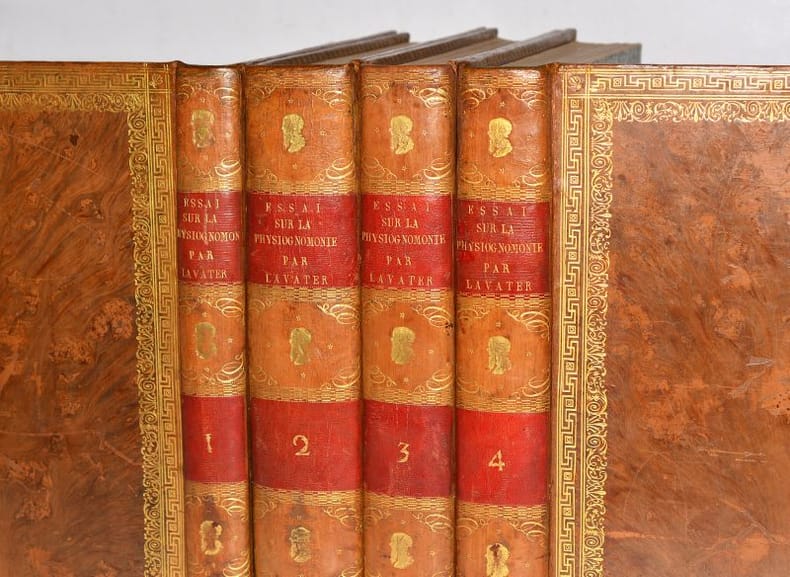
005632La Haye, [Jaques van Karnebeeck, 1781]-1783-1786 et La Haye, Isaac van Cleef, 1803. Quatre volumes petit in-folio (353 X 302 mm) carré veau fauve marbré, plats ornés d'un large encadrement de filets, guirlande, grecque et fers d'angles dorés, dos lisse cloisonné et orné de fers spéciaux (« à tête de Socrate »), pièces de titre et de tomaison maroquin rouge, bordure intérieure ornée d'une torsade dorée, tranches dorées (Mention dorée en queue du dos du tome I : « Relié par Bozérian »). Tome I : (1) f. de titre, X pages, 294 pages, 14 planches h.-t., (2) ff. d'errata et avis au relieur - Tome II : VII-404 pages, (1) f. d'avis au relieur - Tome II : VII-404 pages, 78 planches, (1) f. d'avis au relieur - Tome III : VIII-360 pages, 53 planches, (1) f. d'avis au public - Tome IV : VIII-328 pages, 48 planches.Quelques discrètes et habiles restaurations à la reliure, quelques traces de frottements au dos et petites pertes d'or au plat supérieur du tome I, tache claire en marge de la planche 1 du tome II sans atteinte à la gravure et en marge du feuillet de texte précédent sans atteinte au texte (pages 21/22), rousseurs claires à quelques rares gravures.
Pagine: X+15+5+82+54(Tavole)+2+36+4+72+39(Tav)+4+44+12(tav)+7(tav)+4+20+4(tav)+4+144+2(tav) . Illustrazioni: All'antiporta frande incisione Anatome Plantarum di R. White. All'interno del volume vi sono 122 Tavole di cui 115 a Pagina intera e 7 ridotte. . Formato: 4° . Rilegatura: Cartontato on pelle marrone con dorso anch'esso in pelle, cinque nervature, fregi in oro e tassello in pelle rossa con scritte in oro. Parte alta e bassa del dorso leggermente danneggiate, piatti con qualche graffio. . Stato: Buono . Caratteristiche: Dimensioni precise cm. 35,50 per 24. Bellissima opera che racchiude molti studi del Malpighi in botanica, embriologia, ematologia, respirazione, anatomia umana e animale.Restauro antico al margine destro del frontespizio. Mancanza di carta per le prime 5 pagine nel margine in basso a destra, senza ledere il testo.L'autore fu medico, anatomista e fisiologo. Fu grande osservatore attraverso il microscopio e a lui si deve la scoperta del collegamento fra vene ed arterie e quindi sia della circolazione sanguigna, sia del vero funzionamento dei polmoni (DE POLYPO CORDIS e DE PULMONIBUS). Interessante anche il trattato DE OVO INCUBATO. In catalogo abbiamo anche le altre opere del Malpighi, postume,in medesima rilegatura, datate 1743. . Note epoca: 1686
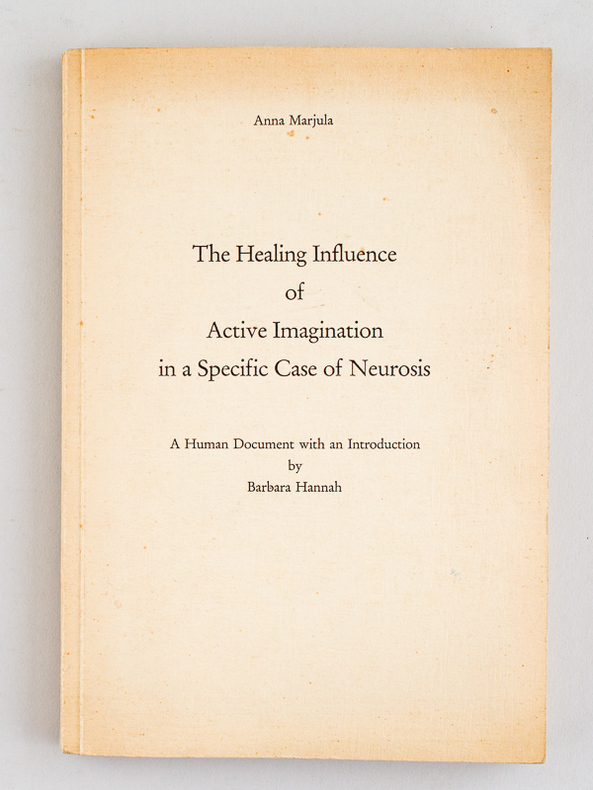
196757805A human document, with an Introduction by Barbara Hannah, 8vo paperback, Schippert & Co, Zurich, s.d. [ 1967 ], XII-128 pp. with 12 original colored drawings under an envelope pasted on guard, and autograph text in flemish on 14 leaves (letters, poems) in another one. Full Tite : The healing influence of Active Imagination in a Specific Case of Neurosis [ Unique and exceptional copy with autograph manuscripts and 12 original drawings: Anna Marjula mystery solved ! ]
A human document, with an Introduction by Barbara Hannah, 8vo paperback, Schippert & Co, Zurich, s.d. [ 1967 ], XII-128 pp. with 12 original colored drawings under an envelope pasted on guard, and autograph text in flemish on 14 leaves (letters, poems) in another one. Full Tite : The healing influence of Active Imagination in a Specific Case of Neurosis [ Unique and exceptional copy with autograph manuscripts and 12 original drawings: Anna Marjula mystery solved ! ] Unique copy with 12 original colored symbolical drawings sometimes (3 of them with comments in english) and 14 leaves with manuscript text (3 letters and poems) in flemish. Most of this extra-material is not signed except three letters (two dated 13-5-73 and 28-10-74) signed "Tante Han" or “Hanna”, clearly original work by "Anna Marjula", pseudonym used to protect the identity of the author (The letter "E". On an envelop is written : "These drawings illustrate the fifth conversation with the Great Mother pages 26-27". Many early jungian analysts worked with Anna Marjula (Toni Wolff, Emma Jung or Barbara Hannah), but her real name remained unknown, until now (but we knew it was a pianist). Indeed, our research allowed us to identify the recipient, Ms. Parvati Chavoix-Jodjana ("Vati") but especially the author, who hides behind the pseudonym of Anna Marjula : the famous dutch pianist and composer Hanna Beekhuis (1889-1980) ! A newspaper clipping is joined on a postcard, (that we join), titled : "Gouden medaille voor Hanna Beekhuis" and here's the translation : "Gold medal for Hanna Beekhuis: Arnhem, 3 Oct. - The Dutch composer of chamber music works and songs, Hanna Beekhuis from Ellecom, who currently resides in Zurich, has won a gold medal and an honorary diploma with "Reflet du Japon", a composition for viola and viola at an international competition held in Buenos Aires". It is known she won this medal in 1961. Hanna Beekhuis resided in Zurich, and was previously in relationship with Carl Jung (28 letters or copy of letters between Jung and Hanna Beekhuis, from 1942 until 1960, would be kept in the ETH-Bibliothek). Barbara Hannah explains in her preface that “Professor Jung had, however, once spoken to Anna of including it in a volume of case histories, and, as he died before he had collected the other cases, she was naturally disappointed”. We identify well the identical writing of "Aunt Hanna" with that present on the handwritten drawings, and with the only autograph word reproduced in the work - "Eve". Our incredible copy comes from Parvati Chavoix-Jodjana, daughter of a famous javanese dancer in France, Raden Mas Jodjana (1893-1972) and his wife Raden Ayou. Hanna Beekhuis accompanied the dancer in the 1920s. Another interesting relation with Jungian Psychanalysis is that the Jodjana were friends with Kurt Binswanger and his wife Erica since 1935. Here's some translated extract on a signed letter : “You said me that your Father has become your Guru. What is a guru ? [… ] Your father told me that he was a free thinker. I am that too but Christianity [ … ] is still in blood”. In another one : "The Jodjanas" have meant a lot to me in the course of my life, especially your father, [ … ] your mother too”. Anglais
in folio, pp. (20), 1-72, 81-317, (1; completo. Il salto di numerazione è dovuto al fatto che il fascicolo K venne omesso in tutti gli esemplari). Legatura coeva in p. perg. floscia, titolo al dorso ms. in bella grafia dell'epoca. Titolo in rosso e nero con la armi di Pietro Aldobrandini, cui l'opera è dedicata; con 1 grande silografia a p. 169, raffigurante le proporzioni tra il volto e la lunghezza delle sopracciglia affinchè queste non ostacolino l'angolo visuale. Edizione originale di questo curioso trattato, unico nel suo genere: diviso in tre libri affronta dal punto di vista medico e fisiologico il problema della natura della barba e dei peli, attingendo anche a fonti quali Crisippo, Diogene, Agostino, Lattanzio... Scarse sono le notizie relative all'autore: originario di Padova, dovette trasferirsi a Bologna ove G. B. Bellagamba editò la maggior parte delle sue opere. Autore già nel 1599 di un volume sulla barba (Opinio...de fine medico barbae humanae, Modena Gadaldini, 1599), nel 1601 pubblicò un trattato sull'utero (Uterus muliebris, Bologna Bellagamba, 1601). Ottimo esemplare di non comune opera (censita in sole 4 biblioteche italiane). Ex-Libris di ''Hon.ble Arthur Dillon'' con stemma araldico e motto ''Dum Spiro Spero'' della famiglia Dillon.. STC XVII sec., II, 926. Krivatsy 8425..
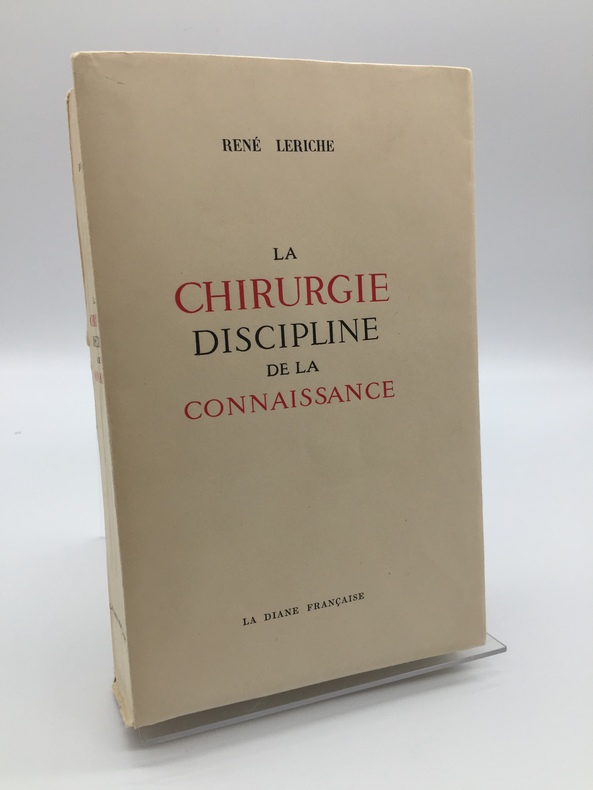
19492884Première édition, La Diane française 1949 23x14,5 cm
1944637591Berlin, Hirschwald, 1848-1944. M. zahlr. Taf. u. Portr. Hlwd. u. Ppbde.. m. Rsign. St. u. Sign. a. Tit. u. mehr. S. Einbde. teils etwas beschäd.. Wenige Rücken fehlen. Rest in einzelnen OBr. Wenige Hefte unaufgeschn., Kanten bestoßen u. am Rand teilw. stockfl. Fehlt: v. Bd. 20 d. 3. Suppl.-Heft. Meist mit Literaturheft/Bericht, teils eingebunden, teils separat. Später erschien dieses separat zusammen für 2 oder 3 Bde.
In-8 p. (mm. 228x168), p. pergamena antica, 8 cc.nn., 184 pp., con 10 belle tavole raffiguranti l’anatomia dell’orecchio, con una o più figure, inc. in rame e tutte descritte. "Prima edizione" di questa fondamentale opera sull’orecchio, considerato testo classico per più di un secolo. Questo trattato, il più completo apparso fino allora, contiene una minuziosa descrizione anatomica e alcune scoperte come quella della membrana nel vestibolo e altre che presero il suo nome. Valsalva (1666-1725), allievo di Malpighi e maestro del Morgagni, fu medico e chirurgo insigne, ed è considerato il fondatore dell’anatomia scientifica dell’orecchio. Cfr. Garrison-Morton,1546: “Valsalva is best remembered for his work upon the ear, in which he described and depicted its most minute muscles and nerves. He divided the ear into ‘external’, ‘middle’, and ‘internal’; his method of inflating the middle ear (Valsalva’s manoeuvre) is still practised. this book includes a description of ‘Valsalva’s dysphagia’” - Blake, p. 468 - Castiglioni, pp. 529-531. Con numerosi timbri di apparten.; 1 carta con picc. restauro per ang. infer. mancante; 3 cc. con lieve alone, altrimenti fresco esemplare ben conservato.
in-4, pp.(52), 473, (3), caratt. romano e corsivo, arma del cardinale Lauro silografata al titolo, gran numero d'iniziali istoriate. Importante legatura coeva in piena pelle, larga bordura floreale a secco sui piatti racchiudente entro fregi oro a fiori agli angoli e due leoni con corona, il simbolo IHS con la croce. Dorso a nervi con impresso in oro nei quattro scomparti il medesimo ferro del leone (restauri alle cerniere, alle cuffie e angoli, tassello recente con titolo). Seconda edizione, assai estesa rispetto alla prima di Venezia 1570 di soli 74 ff., di importante trattato di medicina, particolarmente importante sul salasso. L'Augenio (Monte Santo 1527-Padova 1603) ebbe cattedre mediche a Roma, a Torino dal 1578 al 1592, ed a Padova. Esemplare con alone d'umido nella metà inf. dei primi 50 ff. ; note di possesso e timbro di biblioteca privata al titolo. Rarissima cinquecentina torinese. (BERSANO, I, n.51 descrive il solo esemplare dell'Agnesiana di Vercelli).. Bersano, I, n.51. Carbonelli, n.28. Leclerc, Biographie Médicale, I, 271.272. Diz. Biogr. It., IV, 577. Non i BMC né in Adams. Wellcome Cat., conosce solo l'ediz. 1570..
- s.d. (1672-1674), in-4 (24x34cm), relié. - Manuscrit autographe complet de 106 pages intitulé «?Mémoire de la construction et agréz d'une galère ordinaire, avec l'explication des termes, l'usage des manuvres, et de toutes les parties qui composent le corps de la galère et son armement?». Il est rédigé d'une écriture soignée et sans ratures. Une autre main a apposé quelques annotations marginales au texte. Reliure de l'époque en plein parchemin comportant de petites taches et infimes manques, dos lisse muet. Manuscrit capital et précieux témoignage de la résurrection des galères françaises, rédigé par le maître constructeur le plus influent de son temps?: Jean-Baptiste Chabert. Nous avons pu identifier deux autres manuscrits présentant le même titre que le nôtre?: l'un a appartenu au Commandant Noël Fourquin, capitaine au long cours et spécialiste de la lexicologie nautique, et l'autre à Louis-Philippe en personne. On retrouve ce dernier dans le catalogue de la vente de ses bibliothèques du Palais-Royal et de Neuilly en décembre 1852 sous le numéro 445?; il présente une reliure identique à notre exemplaire. Cet important manuscrit est attribuable à Jean-Baptiste Chabert constructeur de galères à Marseille. Jan Fennis, dans son ouvrage intitulé Trésor du langage des galères (1995) rend compte de cette attribution par Jacques Humbert (La Galère du XVIIIè siècle) qui transmit le manuscrit au Commandant Fourquin?: «?Il nous paraît que cette uvre est celle d'un constructeur de galères travaillant à Marseille car il est question de l'arsenal de cette ville dans le texte. Il nous semble qu'on pourrait assez raisonnablement l'attribuer à Jean-Baptiste Chabert.?» Jean-Baptiste Chabert appartenait à une dynastie de constructeurs de galères marseillais dont le père construisait déjà des navires depuis le milieu du XVIIè siècle. Il fut notamment engagé dans la réalisation des galères présente dans l'hallucinante flottille du Grand Canal de Versailles qui furent réalisées à Marseille à partir de 1681. En 1682 il fut nommé professeur à l'école de construction de Marseille où étaient formés les officiers, lieutenants et sous-lieutenants des galères, avant d'obtenir en 1690 son brevet de premier maître constructeur des galères royales. Dans une lettre aux présidents de parlements datée du 11 avril 1662, Colbert annonce?: «?Le Roi m'a commandé de vous écrire ces lignes de sa part pour vous dire que, Sa Majesté désirant rétablir le corps des galères et en fortifier la chiourme par toutes sortes de moyens, est que vous teniez la main à ce que votre compagnie y condamne le plus grand nombre de coupables qu'il se pourra et que l'on convertisse même la peine de mort en celle des galères.?» Cette lettre permet de dater précisément autour de 1672-1674 notre manuscrit dans lequel l'auteur s'exprime dès les premières pages sur la «?nationalisation?» des galères?: «?Il faut savoir que le roi a l'économie de ses galères depuis dix à douze ans, les capitaines étant auparavant propriétaires du corps et agrès des galères.?» Cette datation peut également être confortée par le manuscrit du Commandant Noël Fourquin?: en marge de ce même passage concernant Louis XIV est indiquée la mention «?1672-74?». Il est ensuite immédiatement question de «?Monsieur [Nicolas] Arnoul intendant des galères de France?»?: «?Du depuis, Monsieur Arnoul [...] a fait construire à Marseille un arsenal très magnifique, dans lequel il y a toute sorte de manufactures pour fournir les choses nécessaires pour armer les galères.?» Le chantier de l'arsenal de Marseille s'étendit, en trois phases, de 1665 à 1690, mais Arnoul décéda en 1674. Chabert démarre son manuscrit en énonçant les différents types de galères?: ordinaire, Patronne, Capitane et Realle. Ces vaisseaux sont caractérisés par leurs tailles ,mais l'architecte ne s'attarde pas outre mesure sur ce sujet, témoignant de la culture du secret attachée au monde des constructeurs à cette époque. Chabert fait ensuite un
- Gauthier-Villars, Paris 1879, 14x22,5cm, broché. - First edition Rare, handsome autograph inscription by Louis Pasteur to the poet and Academician Auguste Barbier A small marginal lack to head of page with inscription, not touching inscription, two or three slight tears to spine (but not serious) Complete with the 2 plates hors texte. [FRENCH VERSION FOLLOWS] Edition originale. Rare et précieux envoi autographe signé de Louis Pasteur au poète et académicien Auguste Barbier. Un léger manque marginal en tête de la page où figure la dédicace sans l'affecter, deux très légers accrocs sans gravité sur le dos. Notre exemplaire est bien complet de ses 2 planches hors-texte.
68165aafBasileae (Basel), typis & sumtibus Joh. Rudolphi Im-Hof, (and vol. 9:) Joannis Schweighauser, 1751-87, lg. in-8vo, in all around 2300 p., all titles in red and black and illustrated with 82 engraved plates mostly folded, some browning or foxing in one or two vols., generally a very crisp copy, S.A.C. (Swiss Alpine Club of Basel) stamps and labels on endpaper & titlepages & ‘Naturwiss. Museum in Basel’, half leather bindings on raised bands and with corners, some gilt decoration on spines as well as partly hw. paper library labels, marbled paper on covers, a fine set.
In-16 gr. (mm. 184x120), p. pelle settecentesca, dorso a cordoni (restaur. per manc.) con decoraz. e tit. oro su tassello, 12 cc.nn., 448,38 pp.num.; al frontesp. cornice architettonica con lo stemma della città di Burgos; ornato da pregevoli grandi capilett. figur. a vignetta; con 1 ritratto di Christopher Acosta e con interessantissime e inedite illustrazioni xilografate nel t. Sono ben 46 tavv. di cui: 41 (a p. pag.) raffigurano piante, 2 portano l’immagine di due elefanti (a p. pag.) e 3 (più piccole) con figure di foglie, tutte disegnate da Acosta. L’opera chiude con un “Tractado del Elephante”, il primo studio monografico su questo animale. "Edizione originale" di questa rara e preziosa opera che ebbe notevole influenza in Europa perchè fece conoscere le piante asiatiche più importanti, sia dal punto di vista medicinale che del loro utilizzo come spezie; fra queste segnaliamo: ginger, cannella, pepe, noce moscata, oppio e cardamomo. In realtà questo trattato è una versione rivista ed accresciuta dei “Coloquios dos simples e drogas he cousas medicinais da India” di Garcia da Orta, pubblicato a Goa nel 1563. Medico e botanico portoghese il da Orta aveva a lungo studiato la flora locale di Goa, concentrandosi specialmente su quelle piante che potevano essere impiegate in campo medico. Acosta, medico gesuita, fece la conoscenza di da Orta nel corso dei suoi viaggi in India e la sua versione dei “Coloquios” risulta pertanto molto interessante per le sistematiche e dirette osservazioni sul campo. Cfr. Palau,I, p. 10 (con le varie traduz. in latino, italiano, francese e inglese) - Pritzel,13 - Wellcome,20 per l’ediz. di Venezia, 1585 - Morton,1819 - Cat. of British Museum,I, p. 9. Biographie Universelle,I, p. 160: “Christophe Acoste, chirurgien portugais, naquit en Afrique, dans les établissements qu’y possédait sa nation au 16 siècle. Il eut de bonne heure le gout des voyages, et étant allé en Asie pour y rechercher les drogues que l’on en tire pour l’usage de la médecine, il fut pris par des pirates qui l’emmenèrent en esclavage. Il trouva enfin le moyen de sortir de sa captivité, et continua ses voyages. Ce ne fut qu’après en avoir fait plusieurs, surtout aux Indes Orientales, qu’il revint en Europe, où il exerça la médecine et la chirurgie. Ayant eu connaissance de l’ouvrage de Garcia "ab horto", sur les drogues, il en entreprit un sur le meme sujet, qui parut à Burgos en 1578.” Mancano 2 carte: 1 con figura (pp. 419/420) e l’ultima con il nome dello stampatore e data di ediz., qui riprodotte su carta antica. Leggerm. corto del marg. super., con aloni e lievi uniformi arross. interc. nel t., ma complessivam. un buon esemplare.