98 839 résultats
4to. (8), 89, (13), 52, (8), 46, (10), 63, (13), 109, (17) pp., 1 blank f., 70, (10) pp. With engraved title page and 3 engraved plates (2 folding). - (Bound with) II: Welsch, Georg Hieronymus. Consiliorum medicinalium centuriae quatuor. Augsburg, Lorenz Kroniger / heirs of Gottlieb Göbel, 1698. (6), 496, (56) pp. Title printed in red and black. With engraved portrait frontispiece and 19 engraved plates (1 folding). - (Bound with) III: Welsch, Georg Hieronymus. Exotericarum curationum et observationum medicinalium chiliades duae. Ulm, [Christian Balthasar Kühn], 1676. (4), 484, (60) pp. - (Bound first) IV: Schroeck, Lucas. Memoria Welschiana, sive Historia vitae viri celeberrimi, Dn. Georgii Hieronymi Welschii, Augustani. Augsburg, Koppmayer for Theophil Göbel, 1678. 90 pp. With engraved portrait frontispiece. Contemporary full vellum. The principal medical writings of the German physician and oriental scholar Georg Hieronymus Welsch (1624-77), including his biography, published a year after his death. "The author [was] a learned German doctor and one of the earliest members of the 'Societas Naturae Curiosum'" (Duveen, p. 617). Welsch, the son of an Augsburg pharmacist, studied classical and oriental languages, philosophy and medicine in Tübingen, Strasbourg and Padua, during which time he visited Central Italy and Rome. He returned to Augsburg to practice medicine, but due to an illness (possibly a form of depression) he was unable to maintain a regular practice and instead shifted his efforts into the field of writing. A correspondent of Leibniz's, he is also remembered as a translator of Avicenna. - The "Sylloge", which had first appeared in the previous year, is an extensive collection of medical works by earlier writers, several here making their first appearance in print: treatises by Marcel Cumanus, Hieronymus Martius, Achilles Gasser (the supporter of Copernicus and Rheticus), Ulrich Rumler, and Hieronymus Reusner, as well as a another by Welsch himself. This is the second issue; although it ends with "Finis", it wants a final part (19, [8] pp.). - Bound with this is Welsch's massive two-part work "Consiliorum medicinalium" (a posthumous 1698 re-issue) and (with its own 1676 title-page and issued separately) "Exotericarum curationum". The first part contains four centuries of medical case studies, compiled and edited from manuscripts in the author's private library (including sources by Gasser, Rumler, Marquard Slegler, and many others). Welsch's knowledge of oriental medical science is evident from his copious learned footnotes, frequently quoting (in Arabic) the works of "Ebnsina" (Ibn Sina, Avicenna). It is also remarkable for its numerous engraved diagrams, still largely in an alchemical and astrological vein. The second part contains two thousand items of medical observations and cures, drawn from the same sources and similarly annotated by Welsch. - Prefixed to these is the Life of Welsch, written a year after his death by the respected Augsburg physician Lukas Schröck (1646-1730). - Some browning and brownstaining throughout as common due to paper, but well preserved. I: VD 17, 1:062768Y. Krivatsy 12934. Waller 9857. Jöcher IV, 1883. - II: VD 17, 547:693998F. Jöcher IV, 1883. Cf. Krivatsy 12923 (1676, counted as "Part 1" of a joint issue with the following). - III: VD, 17 12:188321G. Krivatsy 12923 (counted as "Part 2" of a joint issue with the previous). - IV: VD 17, 23:241931E. Krivatsy 10663. Waller 17972. Jöcher IV, 1883.
Oeuvres Françoises de M. Vieussens dediées à Nosseigneurs des Etats de la Province de Languedoc (3 Titres en 2 Volumes - Complet), en 2 vol. in-4 reliure de l'époque pleine basane marron, dos à 5 nerfs orné, avec DANS LE PREMIER VOLUME : Traité Nouveau de la Structure et des Causes du Mouvement Naturel du Coeur. Première édition et Traité Nouveau de la Structure de l'Oreille. Première édition, Chez Jean Guillemette, Toulouse, 1715 (Coeur) et 1714 (Oreille), portrait de Vieussens par Poussin en frontispice, titre général (avec belle vignette aux armes du Languedoc), titre du Traité du Coeur (avec belle vignette allégorique), 4 ff. (Epistre avec beau bandeau et letre historiée), 8 ff. (préface et privilège), 1 f. (Tables), 141 pp., 5 ff. n. ch. (faux-titre du Traité de l'Oreille et tables), 1 f. (Titre), 5 ff. (Préface, Epistloa et Table des Chapitres), 102 pp. et 3 ff. n. ch. (Tables), avec les 14 planches dépliantes du Traité du Coeur (2 planches numérotées 11), et les 6 planches du Traité de l'Oreille - Et DANS LE SECOND VOLUME : Traité Nouveau des Liqueurs du Corps Humain. Première édition. Chez Jean Guillemette, Toulouse, 1715 , 2 ff. (titre général et titre du Traité des Liqueurs), 4 ff. (Préface et tables), 388 pp., 8 ff. n. ch. (tables) et 1 f.blanc, avec insertion de 2 ff. paginés de 255* à 258 * entre les pages 386 et 387, et avec 1 planche "dessinée par M. Lafon et gravée par Simonneau" Très rare exemplaire complet de l'édition originale complète des "Oeuvres Françaises" de Raymond Vieussens. Le "Traité Nouveau des Liqueurs du Corps Humain", qui manque souvent à cet ensemble, est ici bien présent. Les reliures, bien solides, sont abîmées avec d'importants manques de cuir en plats et coupes, petites mouillures marginales au 2 dernières planches du traité de l'oreille, des mouillures marginales en fin du tome 2, agréable état intérieur par ailleurs. A rare and important work. The author's contributions to cardiology were of great importance. "By injecting mercury into various vessels and internal organs, of living animals and fresh human cadavers, Vieussens was able to trace the exact course of the blood's flow in differents parts of the body. He confirmed the hypothesis that there is a continuous vascular pathway between the arterial and venous vessels. In cardiac pathology, he was the first to describe mitral stenosis and aortic insufficiency on the basis of both clinical and anatomicopathological observation. Vieussens had already noted that disease of the aorta manifests itself by a characteristic pulse, which was rediscovered a century later by D. J. Corrigan, whose name it now bears" (DSB, XIV, 26) Français
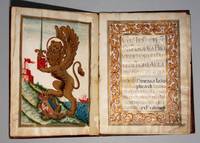
17175670<p>4to manuscript on vellum 23.5 x 17.1 cm 7 ff. 4 ff. vellum blanks including a full-page frontispiece illumination of Venetian Lion of St. Mark each text page with foliate borders in gold ink headings and initials in gold ink. Bound in contemporary Venetian morocco elaborately gold tooled gold block-printed foliate pastedowns. Edge wear and minor rubbing to spine and boards manuscript loose in binding oxidizing to edges of pastedowns. Marginal flaws to frontispiece illumination just touching border in places a few small wormholes elsewhere minor handsoiling.<br /></p><p>Finely illuminated early 18th-century Venetian manuscript issued by the city's Magistrato alla Sanità Health Department as a license to certify the physician Antonio Damugliano d. 1747 to practice medicine in the Venetian Republic using his propriety formula for topical salves <i>balsami</i> to treat "wounds and ulcers" f. 3v-3r. The manuscript ornately written out and decorated in gold and colored ink opens with a full-page image of the winged Lion of San Marco in the Venetian landscape which serves as an official seal of the document's authenticity and is inscribed by five <i>Provveditori</i> of the Magistrato and one notary who witnessed the certification.</p><p>This pharmaceutical license represents a rare material survival of how Venice's Magistrato alla Sanità regulated the practice of medicine in its territories even down to the level of controlling how individual practitioners could work with specific drugs. Damugliano presumably was required to keep the document on his person while plying his trade and to present it to the relevant authorities or even to his patients should his practice be called into question. The text of the document is written out twice – first in Italian and then in Latin – to suit the linguistic preferences of both the common Venetian citizen and the professional medical class.</p><p>Damugliano also known as Antimo Damulianos is noted in the document dated April 1717 as being a native of the Ionian island of Zante or Zakynthos at the time a Venetian colony and having recently returned from Moscow "where with good success and for a long time he practiced medicine with full official permission of many noteworthy people" f. 2v. Damugliano is said to have studied medicine in Europe likely in Italy specializing in contagious diseases and eventually practicing in Asia Minor Persia India China Egypt Constantinople and Trieste and to have been ordered by Emperor Charles VI 1685-1740 to treat the sick of a plague outbreak in Corinth see L. Zoes passim. Damugliano's name is also associated with a 1725 treatise entitled 'Medicina' which circulated in manuscript form in Venice and dealt with the use of salves pills and stones to treat hydrophobia see L. Zoes; we have been unable to locate a copy of this treatise. Damugliano is also recorded as having worked in Vienna where an April 1746 news magazine comments that the "very famous" Damugliano having traveled through numerous kingdoms has arrived to demonstrate the curative powers of "the wondrous Chinese stone called Bezoar" which is effective against fevers snake bites fatigue colic etc. <i>Nachtrag</i> p. 64. The bezoar stone an indigestible mass formed in the digestive tract of ruminants was lauded from the middle ages as a universal antidote to poison.</p><p> R. Palmer "Pharmacy in the Republic of Venice in the Sixteenth Century" in A. Wear et al. eds. <i>The Medical Renaissance of the Sixteenth Century</i> pp. 100-17; <i>Epeteris: Hetaireia Byzantinon Spoudon</i> vol. 43-44 1977 p. 417; H. Schmuck <i>Grieschischer Biographischer Index</i> vol. 1 p. 247; L. Zoes <i>Lexikon historikon kai laographikon Zakynthou</i> vol. 1; S. Carbone <i>Provveditori e sopraprovveditori alla Santità della Repubblica di Venezia</i>; P. Selmi "Il Magistrato all Sanità" in <i>Difesa della Sanità a Venezia Secoli XIII-XIX</i> pp. 28-50; <i>Nachtrag zu denen wöchentlich-kurtzgefaßter historischer Nachrichten Der neuern Europäischen Begebenheiten auf das Jahr 1746</i> p. 64.</p>
187460344Tuskaloosa AL: Alabama Insane Hospital 1874. Newspaper. 11 3/4 x 9 ¼ inches. 7 Issues: vol. 1 nos. 1-3 vol. 2 nos. 5 and 8 and vol. 3 nos. 9 and 10 each issue containing four pages apparently 21 issues in five volumes were published through 1876. This was the third magazine produced by patients in an American asylum the first in the south. The other two were the Asylum Journal Vermont Asylum for the Insane 1842-46 and the Opal New York Asylum 1850-1860. The content much of it dealing with the inner workings of the asylum and its needs includes articles from Darwinism to Spiritualism and engages arguments with the definitions of insanity and the treatments then in practice. Some of the articles are tinged with humor toward the hospital's employees from poetry on the perils of working as a nurse in a hospital for the insane to running an ad for a wife for an official of the hospital. Owen p. 993 No. 21 only his copy. OCLC locates two runs National Library of Medicine: Vol.1 no. 3 and Vol. 2 no. 5; Alabama Department of Archives and History: Vol. 1 nos. 1 &2 ; Vol. 2 nos. 7 & 8; Vol. 3 nos. 9 & 10; Vol. 4 no. 16; Vol. 5 nos. 17 & 18; Vol. 8 no. 21. The Alabama Insane Hospital was conceived under the influence of Dorothea Dix instrumental in the selection of Dr. Peter Bryce as its first superintendent in 1860 and Thomas Story Kirkbride its architect. Bryce 1834-1892 who had studied progressive ideas of treating the insane in Europe would head the institution until his death. The perennially underfunded hospital would prove self sufficient employing the patients to provide food heat and this newspaper both the editorial work and the printing process among other services reflecting the progressive belief of the time that activity settled the mind. Bryce and the hospital became known for innovative treatment of the mentally ill using a "therapeutic approach to treatment so called for its supposed ability to lead patients to an understanding and acceptance of 'right behavior'." The hospital accepted African-American patients including one who had been owned by Dr. Bryce but despite its progressive reputation in treatment the hospital showed the prejudices of the time by separating the patients by race. <br/><br/> Alabama Insane Hospital unknown books
- A. Eymery, Paris 1825 -1828, In-8 (13,5x21cm), 26 volumes reliés. - Edition complète en 25 tomes illustrée de 245 planches, dont le portrait de l'auteur par Deveria en frontispice, 216 planches en couleurs coloriées à la main (certaines avec des rehauts d'or) dont 91 pour les mammifères, 126 pour les oiseeaux, 13 en noir et 4 cartes géographiques repliées. Rare exemplaire complet du volumes supplémentaire paru en 1828 avec 12 planches en couleurs. Reliure en plein veau glacé. Dos comportant des traces de décoloration, petits manques ou minuscules manques de fragments à 8 coiffes de tête (9, 11, 23, 1, 5, 24...) avec au tome 26, une déchirure au mors en coiffe supérieure, idem en queue. Papier relativement frais avec quelques rousseurs éparses. La plupart des planches sont en parfait état de fraîcheur, certaines brunies avec quelques rousseurs. Au tome 3, 4, 5 et 10, quelques feuillets brunis et brunissures. Une déchirure au t.11 p. 63, et des feuillets brunis. Dos avec des traces de décoloration. Quelques rousseurs éparses. Ex-libris Comte Chevreau d'Enraigues. La plupart des planches en couleurs sont l'oeuvre de Gabriel Prêtre, le peintre du museum d'histoire naturelle et de la ménagerie de l'impératrice Joséphine. Ces oeuvres complètes sont enrichies d'une vue générale des progrès de plusieurs branches des sciences naturelles mises en ordre par le Comte de Lacépède, augmentées d'un volume contenant le précis des merveilles de la nature découvertes depuis Buffon jusqu'à nos jours. [ENGLISH DESCRIPTION ON DEMAND]
1969414594Leipzig u. Berlin, Vogel u. Springer, 1866-1969. M. zahlr. (teils farb.) Taf. u. Abb., sowie Tab. u. graph. Darst. Versch. geb., 2 Bde. in Heften. Die meisten Bde. m. Rsign. u. mehr. St. Einige Rücken beschäd. bzw. fehlen. Vereinzelt stockfl. u. m. Anstreich. Bde. m. Kunstdruckpapier teilw. etwas verklebt. Fehlen: Bd. 180-183, 192 u. in Bd. 210 S. 309-316.
1909221253Jena, Fischer, 1909-81. M. Abb. Verschieden geb., einige wenige Bde. in Heften. Teils St. a. Tit. Fehlen: Bd. 27 H. 6 u. TI; 37 H. 1-2; 1914 TI; 82 H. 4; 103 H. 6 u. TI; 105 H. 6 u. TI; 149 H. 1.
Grande raccolta di 124 opere edite in Italia, Francia e Germania fra il 1832 e gli anni '70 del Novecento. Si tratta della biblioteca di uno studioso di materia omeopatica che ha raccolto il presente materiale nella seconda metà del secolo scorso. Interessante insieme in cui sono presenti 26 opere stampate nell'800. Ottimo stato di conservazione complessivo. Tutti i volumi sono stati collazionati. Elenco dettagliato a richiesta.
168332267Lugd. Batav. (Leiden), 1683 & Lugd. Batav. (Leiden), 1683. 12mo. Bound in one cont. full vellum. Title in old hand on back. De Musculis: (4), 111 pp. and 1 folded engraved plate with 4 figs. - Observationes Anatomicæ: (12), 108 pp. and 3 folded engraved plates. Light scattered brownspots, but good copies.
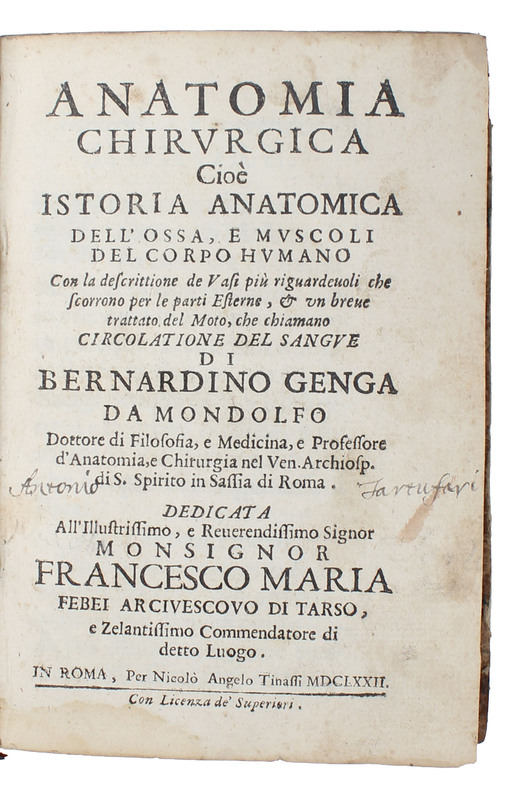
167254017Rome, Nicoloò Angelo Tinassi, 1672. Small8vo. In 18th century half calf with red leather title-label to spine and gilt lettering and ornamentation. Lower capital with a bit of wear and corners slightly bumped. Frontispiece mounted and with a closed tear (no loss). Title-page with light soiling and previous owner's name in contemporary hand. Dampstain affecting lower part of outer margin of Pp. 397-432 and Pp. 449-455. Some occasional browning and brownspotting, but overall fine a nice copy. (26), 455, (1) pp. Engraved frontispiece.
Lugd. Batav. (Leiden), 1683 & Lugd. Batav. (Leiden), 1683. 12mo. Bound in one cont. full vellum. Title in old hand on back. De Musculis: (4), 111 pp. and 1 folded engraved plate with 4 figs. - Observationes Anatomicæ: (12), 108 pp. and 3 folded engraved plates. Light scattered brownspots, but good copies.
Rome, Nicoloò Angelo Tinassi, 1672. Small8vo. In 18th century half calf with red leather title-label to spine and gilt lettering and ornamentation. Lower capital with a bit of wear and corners slightly bumped. Frontispiece mounted and with a closed tear (no loss). Title-page with light soiling and previous owner's name in contemporary hand. Dampstain affecting lower part of outer margin of Pp. 397-432 and Pp. 449-455. Some occasional browning and brownspotting, but overall fine a nice copy. (26), 455, (1) pp. Engraved frontispiece.
1872131806Divers éditeurs 1872 22 volumes in-8, demi-chagin vert, dos à nerfs, caissons à froid, ch. près de 600 pp. ch. 4 à 9 thèses. Planches hors texte, certaines en couleurs. Nombreux envoi d’auteur. Les titres figurent manuscrits en page de garde à l’exception de 3 volumes. Menus frottements, quelques coins émoussés. Quelques rousseurs éparses. Bon ensemble. Notamment :
159265469Venedig, Francesco de Franceschi, 1592. 4°. Mit 2 Holzschn.-Druckermarken u. 50 (39 ganzs.) Textholzschnitten. 4 nn., 80 (recte 84) num., 8 nn. Bll. - Angeb. - Ders. De medicina Aegyptiorum. Libri quatuor in quibus multa cum de vario mittendi sanguinis usu per venas, arterias, cucurbitulas, ac scarificationes nostris inusitatas [...], & alijs chyrurgicis operationibus, tum de quamplurimis medicamentis apud Aegyptios frequentioribus, elucescunt. Ebda., 1591. Mit Holzschn.-Druckermarke u. 7 (2 ganzs.) Textholzschnitten. 11 (statt 12; fehlt das Erratablatt c1) nn., 150 num., 25 nn. Bll., Etw. späterer Pgmt.-Bd. m. durchzogenen Bünden, goldgepr. gekrönten verschlungenen Initialen als Supralibros, handschriftl. Rückentitel u. erneuerten Schließbändern.
76407aafParis, Masson & Asselin, 1864-1889, gr. in-8vo, lég. bruni, ça et la qqs rousseurs, qqs illustrations gravées sur bois, reliure en d.-maroquin brun. Complet et en bel état.
180330335DB2 Teile in 1 Band. Leipzig, Heinrich Gräff, 1803. Gr.-folio. (7) Bl., 216 S., (24) Bl. Mit gestochener Titelvignette, 2 Anfangsvignetten, 46 gestochenen Kupfertafeln und 21 Vignetten im Text. Halblederband um 1840 mit rotem, goldgeprägtem Rückenschild und wenig Rückenvergoldung.
190348299Paris, 1903. 8vo. Nice contemporary half calf with raised bands and gilt lettering to spine. Inner hinge a bit weak, but still tight. 3 leaves with a tear, no loss. Otherwise a nice and clean copy. Inscribed by the author to half-title, to the preeminent Russian Byzantinist F.I. Uspenky. (6), II, 399 pp.
Paris, 1903. 8vo. Nice contemporary half calf with raised bands and gilt lettering to spine. Inner hinge a bit weak, but still tight. 3 leaves with a tear, no loss. Otherwise a nice and clean copy. Inscribed by the author author to half-title, to the preeminent Russian Byzantinist F.I. Uspenky. (6), II, 399 pp.
LCS-17876Rare édition originale de ce traité d’astronomie écrit par Maupertuis à l'occasion du passage de la comète de 1742. S.l. [Paris], 1742. In-12 de (1) f.bl., (5) ff. (y compris le frontispice), 111 pp., (1) f.bl. Relié en plein veau marbré de l’époque, dos à nerfs orné, filet or sur les coupes, tranches mouchetées rouges. Reliure de l’époque. 156 x 87 mm.
A full-spectrum presentation of medical science as it was in the early 1900s. Edited by Sir William Osler, often considered the father of modern medicine. Each volume contains approximately 900 pages and an index. Volumes I through III printed in 1907, volumes IV and V in 1908, volume VI in 1909 and volume VII in 1910. Numerous colour and black and white plates. Black and white diagrams. Full leather bindings. Two maroon labels with gilt lettering upon each backstrip. Each volume approximately 10" high by 7" wide by 2.75" thick. Of particular note are eight graphic full-page time-lapse photos illustrating the progressive ravages of smallpox upon a middle-aged man, and his appearance after recovery. All bindings stout and strong. Hairline opening along front hinge of volume I. Underlining on relatively few pages in light ink and pencil. Two volumes unmarked. Minimal marginalia on only a handful of pages. Minor evidence of moisture exposure to part of fore-edge of approximately fifty pages in volume VII. A quality example of this magnificent set. Very heavy. Special shipping considerations may apply. Book
in 12° (cm. 16x9,5), pp. 2 b, 4 nn., xxiij, 114; 2 nn., 132; 4 nn., 144, 2 b.; leg. francese coeva p/pelle spugnata, doppio tass. con tit. in oro e fregi pure in oro al ds., tagli rossi, sguardie marmor.; testatine e finalini. Il 'Méthode nouvelle et facile d'administrer le vif-argent' è un trattato di medicina del famoso medico e botanico austriaco, tradotto da Dominique Laflize. 'La culture du café' è un trattato molto raro, suddiviso in 3 parti; la 1^, Des Semis, tratta la storia del caffè, i semi, le varietà, l'influenza del clima e del suolo; la 2^, Entretien des Cafés, riguarda la coltivazione e il mantenimento della piantagione; la 3^, Récolte, tratta la raccolta, fermentazione, e i macchinari per il trattamento dei semi, con osservazioni sulle piantagioni in Africa, Medio Oriente, Antille, Indonesia e Cina. Le 'Observations sur le cacao et le chocolat' (molto raro) è una delle opere minori ma non meno interessanti di Navier (1712-1779), medico brillante a cui si devono, tra le altre, opere sull'inumazione precipitosa, sul modo di soccorrere persone avvelenate col veleno corrosivo, scritti sugli antidoti contro l'arsenico, il piombo ed altri veleni (cfr. Weiss, vol. 4°, pag. 355); in questo testo, suddiviso in 2 parti, esamina i vantaggi e gli inconvenienti derivanti dall'uso del frutto del cacao: Description du Cacaotier et de son amande; Analyse du Cacao faite par differents Savants; Nouvelle analyse du Cacao; Analyse des pellicules du Cacao; Comparaison de l'analyse du Cacao avec celle du café; Examen de l'action et des effets du Cacao et du Chocolat sur les solides et les fluides; Usage du Chocolat dans les maladies chroniques; Usage du Chocolat nuisible dans quelques circonstances; Du Chocolat consideré comme vehicule doux et agreable des purgatifs amers et irritans; Conclusion de l'Ouvrage. Curioso insieme di saggi di medicina ed agricoltura molto rari e ricchi di notizie interessanti. Ottimo e fresco esemplare. 600/23
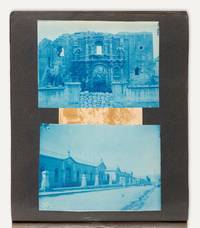
1918List2982Peru and Panama 1918. Approximately 364 photos; album and unmounted photos silver prints cyanotypes and printing-out-paper prints. Photos measure 3 x 4 to 8 x 10 inches with about half measuring 3 x 5 ½ inches. Some with photographer’s hand-stamp or credit in pencil; others with manuscript notations verso or recto; some captions to album pages. Offered in partnership with Daniel / Oliver.<br /> <br /> Rich and extensive photographic archive of Walton T. Burres of Stockton California showing his time in Peru c. 1904 as an amateur explorer and doctor for the Inca Mining and Rubber Company and his later work in Panama c. 1918 with the Rockefeller Foundation’s International Health Division.The collection consists of a large number of loose photos acquired by the gallery in 2021 and a recently discovered photo album showing some of the same subjects and containing a few duplicate images some printed in different sizes or formats as well as hundreds of previously unseen prints. Together this material makes up the largest extant archive of Burres’s photographic work. Though his work was published at the time both in Peruvian and American publications much of it was lost when he dropped it in a river that he was attempting to ford.<br /> <br /> Burres was educated at California’s Cooper Medical College the first school of medicine on the West Coast and was a prominent member of the Stockton community before sojourning to Peru around 1900 to help the Inca Mining and Rubber Company address the deadly diseases endemic to the region such as malaria and yellow fever. To encourage economic infrastructure in remote areas the Peruvian government began granting land concessions to any company that would build roads bridges or river ports. As a result the Inca Mining Company an American outfit based in Tirapata purchased the rights to mine gold along the upper Inambari River in 1896 and soon became the richest gold producer in Peru.<br /> <br /> A large portion of Burres’s Peruvian images document his 1903–1904 excursion from Arequipa 150 miles into “rubber country.†The journeys were well-recounted in U.S. papers and a number of the anecdotes described in print are seen in the present images.<br /> <br /> There are many dynamic views of Burres and his party trekking through the dense jungle and summiting the high mountains as well as shots of flora fauna and native Peruvians. Burres’s travel companions for this trip included the famed adventurer Harriet Chalmers Adams later dubbed “America’s greatest woman explorer†by the New York Times. Adams and her husband Frank both fellow Stocktonians joined up with Burres during their own multi-year expedition through South America. There are a number of portraits of a woman who bears a striking resemblance to Adams though it is possibly another person.<br /> <br /> Other Peruvian material includes numerous views of Cusco Arequipa and the surrounding environs including a beautiful interior of a chapel a Martin Chambi-esque detail shot of a stone wall and portraits of local townspeople some identified as Quechua people. There are a number of lush large-format cyanotypes rich printing-out-paper views and many handsome small-format panoramas. These were printed on Inca Mining Company surplus stationary which speaks to the makeshift nature of photo-development under the circumstances. One particularly striking image shows the top of Misti volcano barely visible above the clouds. This image was reproduced in Burres's account of his travels published in 1909 in Outing magazine.<br /> <br /> The photographs from Burres’s time in Panama document his more serious work as a virologist and health administrator in the area. One interesting photo shows a pair of recently-shot iguanas with a caption noting that “blood of these reptiles was found infected with Haemogregarina.†Another image is that of a new style of privy built from concrete and wire-mesh designed to better keep out rain water. There are also keenly-shot views of main streets and local culture in Los Santos Chiriquà and elsewhere including a number of humanistic group portraits taken at a girl’s school. unknown
1916055955Istanbul: Istanbul Darülfünunu Tip Fakültesi Yayinevi Matbaa-i Âmire. AH 1332 1916 CE - 1928. 1916. Hardcover. Very Good. 8vo - over 7¾ - 9¾" tall. Contemporary black clothes and separate fascicles. Roy. 16x24 cm. In Ottoman script Old Turkish with Arabic letters. Richly illustrated. A good collection. Vol. 1: March 1332 / 1916 - August 1334 / 1918 = Complete set of issues 1-7 no 4 is not inserted into the volume; it is present separately as a fascicle. Vol. 2: August 1335 / 1919 - June 1336 / 1920 = Complete set of nos 1-6. Vol. 3: Between August 1336 / 1920 and April 1337 / 1921 five issues were published; of this volume the first number August 1336 / 1920 and the no 5 April 1337 / 1921 are missing. Nos. 2 3 and 4 are present in fascicle form. Vol. 4: August 1337 / 1921 - December 1338 / 1922 = Complete set of nos 1-9. Vol. 5: January-February 1339 / 1923 - December 1339 / 1923 = Complete set of nos 1-12. Vol. 6: January 1340 / 1924 - December 1340 / 1924. Vol. 7: January-February 1341 / 1925 - May-December 1341 / 1925. Vol. 8: Of this volume only the first number dated January 1926 is present; the remaining 11 issues are missing. Vol. 9: January 1927 - December 1927 = Complete set of nos 1-12. Vol. 10: Between January and February 1928 and November 1928 12 issues were published; nos 1-7 and 11-12 are present while issues 8-10 are missing. Extremely rare collection including 83 issues of 99 of this journal of the Istanbul University Faculty of Medicine. This is one of the seven important periodicals published starting in 1916 by the Istanbul Darülfünun which was the first Turkish academic institution in the modern sense. Due to World War 1 this journal was published at irregular intervals and after the Alphabet Reform 1928 it switched to the new script starting from the January-June 1929 issue. Therefore this collection consists entirely of early issues printed in Ottoman Turkish using the Arabic script. The journal published by the professors of the Faculty of Medicine included many prominent figures in its editorial board: Ziya Nuri Dean of the Faculty of Medicine and Professor of Laryngeal and Otic Diseases Ismail Dervis General Secretary of the Faculty of Medicine and Professor of Obstetrics and Midwifery Tevfik Recep Professor of Histology and Embryology and Sevki Professor of Philosophy. In the same issue Sadettin Vedat Assistant Professor of Surgery is also recorded as the Secretary. Over time these names underwent some changes. For example in Year XV No. 1-2 1933 under the heading of Editorial Board Nasir Heyeti the names Akif Sakir Akil Muhtar Hamdi Suat Ihsan Hilmi Kenan Tevfik M. Hayrullah Necmettin Rifat Neset Ömer Server Kamil Süreyya Ali Tevfik Recep Ziya Nuri Fazil Serafettin and Tevfik Remzi appear. In this issue Behçet Sabit and Muzaffer Esat Bey are also listed under the title of Editors-in-Chief Tahrir Müdürleri. Again on the inner title page of this issue there is a list of the Editorial Board Tahrir Heyeti composed of 36 members. Some examples of articles in the collection that can be considered scientific contributions to the literature: The first article published in the first issue How Digitalis Takes Effect by Akil Muhtar 1877-1949 immediately draws attention. In this important study known as the "Usskof Experiment" and recorded in Turkish medical literature Akil Muhtar Özden proved for the first time in the world that digitalis when taken orally begins to take effect after one and a half hours and reaches its maximum effect after three and a half hours. A summary translation by Mustafa Hakki of Celal Muhtar Özden's 1865-1947 famous article titled On the Trichophytosis of the Hands and Soles Rahatü'l-yed ve ahmasü'l-kadem trikofisisi originally published in Annales de Dermatologie et de Syphiligraphie No. 8 August 1892 was printed in AH 1340 Issue 78. In this renowned article Celal Muhtar identified the Trichophyton fungus as the cause of a skin lesion observed on the hands and feet and presented the cases of trichophytosis he had followed. Ad <br/> <br/> Istanbul Darülfünunu Tip Fakültesi Yayinevi, Matbaa-i Âmire., AH 1332 [1916 CE] - 1928. hardcover
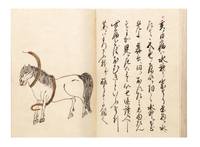
7052Seven vols. 8vo 218 x 160 mm. orig. wrappers each with an individual title label on upper cover new stitching. Japan: all late Edo.<br/> <br/> A fascinating collection of texts on equine medicine all bound in a similar fashion:<br/> <br/> Vol. 1: Manuscript label on upper cover entitled “Basho hijutsu den†“Horse Book Secret Methods Passed Onâ€. Nine brush & ink illus. in the text. 31 folding leaves. This text is concerned with exercising horses in each season and includes “32 Rules of Exercise.†At the end we find a date of 1825 the name of the person who provided this information Seizaimon Sekiguchi and the name of the copier Hanemon Hasegawa.<br/> <br/> Vol. 2: Manuscript label on upper cover entitled “Basho yakuho den†“Horse Book Medicine Passed Onâ€. 12 most unusual brush ink & wash drawings. 23 folding leaves. Each illustration depicts an unwell horse and 12 symbols of ill health demons snake ogre monkey female deity Buddhist practitioner archer bird etc. relating to the horse’s disease with recipes for medicines. These illustrations are all finely colored. The rest of the text is devoted to how to maintain a horse’s health in each of the four seasons. At the end there is the date 1596 and the information was given by Ichiraku Obata who lives in Kyoto.<br/> <br/> Vol. 3: Manuscript label on upper cover entitled “Basho hiden shu†“Collection of Horse Medicine Secrets Passed Onâ€. Seven brush & ink illus. in various colors. 15 folding leaves. This manuscript is concerned with methods of keeping a horse healthy while travelling. Herbal medicine recipes are given. At the end we find the following names: Ogasawara Taizen Taifu Ofusa Yawata Takeyori Ason and Kunai Taifu.<br/> <br/> Vols. 4 & 5: Manuscript label on each upper cover entitled “Basho ryoji den†“Horse Book Diagnoses & Treatments Passed Onâ€. 18; 13 folding leaves. Vol. 4 ends with the date 1858 and the statement that “Sokyu passed on this information to Ittai Sekiguchi.†Vol. 5 ends with the same date and a note that “Aikyu who lives in Ecchu in today’s Toyama Prefecture gave this information to Sekiguchi.â€<br/> <br/> Vol. 6: Manuscript label on each upper cover entitled “Basho juniyaku†“Horse Book. 12 Medicines. A Partâ€. Ten folding leaves. The text describes symptoms of various illnesses and provides 12 herbal medicine recipes. We believe the next part is contained in Vol. 7.<br/> <br/> Vol. 7: The label is no longer present but the beginning of the text states that there are 12 ingredients for medicines described. 17 folding leaves. The text is concerned with diseases common in each of the four seasons and the theory of the five organs and six intestines.<br/> <br/> In fine condition. Vol. 4 and 5 each have some marginal worming. unknown
7052Seven vols. 8vo 218 x 160 mm. orig. wrappers each with an individual title label on upper cover new stitching. Japan: all late Edo. A fascinating collection of texts on equine medicine all bound in a similar fashion: Vol. 1: Manuscript label on upper cover entitled "Basho hijutsu den" "Horse Book Secret Methods Passed On". Nine brush & ink illus. in the text. 31 folding leaves. This text is concerned with exercising horses in each season and includes "32 Rules of Exercise." At the end we find a date of 1825 the name of the person who provided this information Seizaimon Sekiguchi and the name of the copier Hanemon Hasegawa. Vol. 2: Manuscript label on upper cover entitled "Basho yakuho den" "Horse Book Medicine Passed On". 12 most unusual brush ink & wash drawings. 23 folding leaves. Each illustration depicts an unwell horse and 12 symbols of ill health demons snake ogre monkey female deity Buddhist practitioner archer bird etc. relating to the horse's disease with recipes for medicines. These illustrations are all finely colored. The rest of the text is devoted to how to maintain a horse's health in each of the four seasons. At the end there is the date 1596 and the information was given by Ichiraku Obata who lives in Kyoto. Vol. 3: Manuscript label on upper cover entitled "Basho hiden shu" "Collection of Horse Medicine Secrets Passed On". Seven brush & ink illus. in various colors. 15 folding leaves. This manuscript is concerned with methods of keeping a horse healthy while travelling. Herbal medicine recipes are given. At the end we find the following names: Ogasawara Taizen Taifu Ofusa Yawata Takeyori Ason and Kunai Taifu. Vols. 4 & 5: Manuscript label on each upper cover entitled "Basho ryoji den" "Horse Book Diagnoses & Treatments Passed On". 18; 13 folding leaves. Vol. 4 ends with the date 1858 and the statement that "Sokyu passed on this information to Ittai Sekiguchi." Vol. 5 ends with the same date and a note that "Aikyu who lives in Ecchu in today's Toyama Prefecture gave this information to Sekiguchi." Vol. 6: Manuscript label on each upper cover entitled "Basho juniyaku" "Horse Book. 12 Medicines. A Part". Ten folding leaves. The text describes symptoms of various illnesses and provides 12 herbal medicine recipes. We believe the next part is contained in Vol. 7. Vol. 7: The label is no longer present but the beginning of the text states that there are 12 ingredients for medicines described. 17 folding leaves. The text is concerned with diseases common in each of the four seasons and the theory of the five organs and six intestines. In fine condition. Vol. 4 and 5 each have some marginal worming. unknown books