ALBERTI AntonioMareMagnum

98 839 résultats
In-8 p., 7 volumi, mz. pelle coeva (abrasioni ai piatti), dorso a cordoni con fregi e tit. oro, pp. 244; (2),239; 244; 245; (2),239; (2),240; (2),128. Magnifica raccolta completa di 393 tavole (la 330 è bis) per lo più incise in rame da Dell'Acqua e con squisita coloritura di Lazzaretti, tutte dettagliatamente descritte: sono 392 tipi di piante medicinali, poste in ordine alfabetico, dalla "A" di "Abete" alla "N" di "Nigella". Come precisa l'A.: "abbiamo.. unite colla descrizione delle piante officinali, le notizie dell'uso che se ne fa in medicina, le dosi, e la maniera di prescriverle secondo i Maestri antichi e moderni..". In Appendice al 7° vol.: "Repertorio delle piante medicinali" descritte nella Flora Medica del Dottor Fisico Antonio Alberti. Italia, s.d. Dedicato a S.A.R. il Principe Eugenio, Duca di Leuchteuberg e Principe di Eichstett, ecc., pp. (2),127, con bellissima antiporta disegnata ed inc. in rame da F. Pistrucci e colorata da Lazaretti, che raffigura Esculapio Dio della medicina con Flora, divinità delle erbe, e Apollo, fecondatore della natura, su un cocchio d'oro trainato da cavalli. Nel “Repertorio” sono suddivise, secondo la materia medica, le piante descritte nella "Flora": Piante acri - Astringenti - Alessifarmache - Alteranti - Piante amare - Analetiche - Antacide - Antelmintiche - Antiscorbutiche - Antisettiche - Antispasmodiche - Antisifilitiche - Afrodisiache - Aromatiche - Balsamiche - Cardiache - Carminative - Catartiche - Corrosive - Deostruenti - Diuretiche - Emetiche - Errine - Espettoranti - Galatofore - Menagoghe - Mucillaginose - Narcotiche - Nervine - Oleose - Rinfrescative - Stimolanti - Resinose - Stomachiche - Sudorifiche. Sono quindi elencati i 4 ordini dei veleni e le piante medicinali secondo il sistema di Linneo, suddivise per classi e ordini. Al fine, l'Indice generale. Rara "edizione originale", soprattutto se completa (La II ediz. è del 1836). Cfr. Nissen,10 e Pritzel,82 che citano quest'opera in soli 6 volumi, con 360 tavole - CLIO,I,63 la cita invece in 7 volumi, con 391 tavv. L'Indice generale elenca ben 599 piante contenute nei 10 volumi della "Flora". Evidentemente queste erano le intenzioni dell'autore ma la pubblicazione si arrestò col 7° vol. Alone su 4 pp. di Indice e qualche lieve fiorit. nel t., altrimenti bell'esemplare per la qualità delle tavole (solo 8 presentano sbavature di colore).
In-8°, V-XX, 283pp, (1c), XXXVI carte di tavola incise, occhietto, ritratto inciso dell’Autore sull’antiporta (Diomira Franchi dis. e M. Carboni inc.). Testo entro cornice xilografica, esemplare marginoso, legatura in piena pergamena rigida coeva, titolo in oro al dorso su tassello, tagli spruzzati in rosso. Si tratta della rara prima edizione del primo testo di odontoiatria in lingua italiana. Nel libro Campani descrive innanzitutto le qualità necessarie per il successo di un dentista: “giovane di spirito e pieno di coraggio… che abbia un cuore pietoso e una mano crudele”. Ha anche sottolineato che un dentista deve sapere a memoria tutto ciò che riguarda l'odontoiatria, per poter rispondere a qualsiasi domanda come un professore intelligente, invece che come un ciarlatano ignorante. Successivamente, descrive le conoscenze più accettate sullo sviluppo dei denti, la causa della carie e il suo trattamento. Descrive la placca come fluidi che circolano costantemente nelle radici dei denti, che sotto l'influenza del caldo e del freddo, condensano e coagulano per decomporre e ammorbidire lo smalto in modo graduale. I principali trattamenti per la carie discussi sono la limatura del dente e anche l'otturazione della cavità con lamina di piombo. Una parte significativa del testo è stata dedicata alle estrazioni e Campani ha descritto meticolosamente quali denti possono essere rimossi facilmente e quali denti è meglio lasciar stare. Il volume si conclude con alcuni capitoli sull'odontoiatria protesica. Alla fine del 1700, i denti artificiali venivano realizzati con avorio e legati insieme con catgut o seta. Campani descrisse anche l'uso di molle per agganciare ponti o dentiere ai denti vicini. In fine sono riprodotti gli attestati dei casi di maggior successo del dentista. Il libro di oltre 300 pagine e corredato di 36 illustrazioni incise, fu un successo nella Firenze di fine Settecento. Poletti, p.39 Wellcome II, p.292 In-8°, V-XX, 283pp, (1c), XXXVI copper engraved plates, half-title, copper engraved portrait of the Author at the frontispiece (Diomira Franchi dis. e M. Carboni inc). Wooden framed text with large margins, contemporary full hard vellum binding, gilt title at the spine on label, marbled edges. This is a rare first edition of the first text on dentistry in Italian language. In the book, Campani first describes the qualities necessary for the success of a dentist: "young in spirit and full of courage ... who has a compassionate heart and a cruel hand". He also stressed that a dentist must know everything about dentistry by heart, in order to be able to answer any question like an intelligent professor, instead of an ignorant charlatan. Next, he describes the most accepted knowledge about tooth development, the cause of tooth decay and its treatment. He describes plaque as constantly circulating fluids in the roots of the teeth, which under the influence of heat and cold, condense and coagulate to decompose and soften the enamel in a gradual manner. The main decay treatments discussed are filing the tooth and also filling the cavity with lead. A significant portion of the text was devoted to extractions, and Campani meticulously described which teeth can be easily removed and which teeth are best left alone. The volume ends with some chapters on prosthetic dentistry. In the late 1700s, artificial teeth were made with ivory and bond together with catgut or silk. Campani also describes the use of springs to hook bridges or dentures to neighboring teeth. Finally, the certificates of the dentist's most successful cases are reproduced. The book of over 300 pages is accompanied with 36 copper engraved illustrations and was a success in Florence at the end of the eighteenth century. Poletti, p.39 Wellcome II, p.292
4to. (20) pp. (final blank). With woodcut title border. 18th century marbled wrappers. Extremely rare first and only edition: a defence of astrology written against the criticisms of Martin Luther, quoting Avicenna and other Arabic scholars. "In 1520 Luther had published a comment to the decalogue, including among the violators of the first commandment also magicians, necromancers, and astrologers. Luther's hostility toward astrology was great; moreover, this anti-astronomical polemic on a religious basis was widespread enough as was the traditional, contrary attempt to show [...] the religious legitimacy of astrology. But, coming from a heretic such as Luther, this new attack on astrology could very easily be turned around. Laurent Fries, a physician and astrologer of Colmar, intervened in defense of the science of the stars with a short work (Ein kurtze Schirmred der Kunst Astrologie ... [A Brief Defense of the Art of Astrology], J. Grüninger, Strasbourg, 1520) written in the form of a dialogue between Fries himself and Luther. In this work Fries tried to show that astrology was, from a Christian point of view, perfectly orthodox and not therefore, as Luther had maintained, a pagan science" (cf. C. Ginzburg, Il nicodemismo [Turin, 1970], p. 30). Among the witnesses called by Fries in defense of astrology are not only the gospels and the great thinkers of antiquity, but also several of the great Muslim philosophers and physicians, including Ibn Sina (Avicenna), Muhammad ibn Zakariya al-Razi (Rhazes) and 'Ali ibn al-'Abbas al-Majusi (Haly Abbas). - Occasional insignificant browning; some smudging of printer's ink on second and third folio; contemporary correction and marginal note in ink on fol. A2v. Apparently removed from an old sammelband, numbered "37" at the head of the title by an early hand. Not a single copy is known in the trade; only one is listed via VD16 (in the Bavarian State Library in Munich; a variant imprint of the title is in Göttingen). VD 16, F 2861. USTC 644398. Not in Pegg, Hohenemser, Knaacke, Kuczynski etc.
Small folio (210 x 342 mm). 38, (2) pp. With engr. title vignette and 12 engr. plates by J. C. Berndt. Contemp. marbled boards. Only edition of this profusely illustrated collection of human malformations. "Achondroplasia is first described on page 30 and pictured on plate 11" (Garrison/M.). An English translation appeared in 1932 in R. H. Major's "Classic Descriptions of Disease". The versatile German anatomist S. T. von Soemmerring (1755-1830), one of the first members of the Senckenbergian Society, is hailed as the discoverer of the eye's Macula lutea, one of the earliest scholars to describe the Pterodactyl, and inventor of a telescope as well as of an electrical telegraph. He also was an early champion of smallpox vaccination. - Binding bumped at extremeties. Ms. inscription (c. 1820) on flyleaf: "Zum Beweise der reinsten Achtung | Aug. v. Tournier" [?]. Corners of flyleaf clipped; slight worming throughout (insignificant loss to text; more pronounced near beginning and end), otherwise fine. Extremely rare; last recorded on a German auction in 1964. Garrison/Morton 4306. VD 18, 14590689-001. E. Goldschmid, Entwicklung und Bibliographie der path.-anatom. Abbildung 78. OCLC 67960624.
in-4, pp. XX, 119 (invertite in fase di rilegatura le pp. 69-72), (1), legatura coeva in pergamena, tassello al dorso. Vignetta al titolo, testatine, finalini ed iniziali vegetali; completo di una tavola con l'originaria disposizione del Museo all'interno del Monastero di San Vitale e di LXXII tav. f.t., ripiegate in modo da favorirne la consultazione, raffiguranti il più ricco repertorio iconografico italiano di ferri chirurgici e apparecchiature meccaniche terapeutiche dl XVIII secolo (ferri, letti, tavole operatorie, poltrone, mobili, sistemi per il trasporto dei pazienti, fasciature...), la maggior parte sono firmate da Giovanni Lindemain. Prima ed unica edizione di quella che è l'unica testimonianza sopravvissuta di questa grandiosa istituzione museale medico-chirurgica che nacque nel 1746 a Ravenna sotto l'influsso delle nuove idee Settecentesche. La trasformazione della raccolta in Museo, con vere e proprie finalità collezionistiche e acquisto anche di materiale didattico illustrativo fu dovuta al dotto padre Ippolito Rondinelli; nella realizzazione di questa impresa si associò con il chirurgo locale Gaetano Bianchi. L'importanza che ebbe fin dall'inizio la collezione è testimoniata anche dalla collocazione dei materiali all'interno del complesso benedettino. Sebbene fosse uno dei maggior vanti della comunità, a partire dal 1797, a seguito delle soppressioni napoleoniche, la raccolta seguì un triste destino di dispersione. Nel 1862 si ha ancora traccia di qualche strumento, del quale venne effettuato il restauro. Il venire meno della funzione pratica del materiale ne segnò la fine. Buon esemplare di edizione estremamente rara e curiosa (antico timbro di possesso sull'occhietto).. Waller 8159. NUC ricorda solo l'esemplare di Yale Medical..
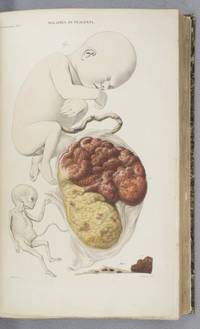
1829CJW1310Paris: J. B. Baillière 1829-42. FIRST EDITION IN BOOK FORM bound from the original parts. 486 x 337 mm. 19 1/8 x 13 1/4". Two volumes. <br/> Contemporary marbled boards backed with recent calf raised bands flanked by gilt fillets black morocco labels. WITH 231 LITHOGRAPHED PLATES two folding OF WHICH 167 ARE IN COLOR many heightened with gum arabic later tissue guards. Garrison & Morton 2286; "Heirs of Hippocrates" 863; Norman 538. ◆Corners and edges somewhat rubbed with some loss of paper as expected with large picture books text with variable foxing persistent but usually light never severe and principally confined to margins a handful of black & white plates with moderate spotting additional small defects internally otherwise quite a commendable copy of a book always found foxed browned and worse our volumes solidly restored now the spines unworn and the text and remarkable plates with no fatal condition problems.<br/> <br/> Garrison & Morton declares that "the fine illustrations of gross anatomy seen here make this one of the greatest works of its kind." The inaugural professor of pathological anatomy in Paris anatomist and pathologist Jean Cruveilhier 1791-1874 provided in the present work the first description of multiple sclerosis and an early identification of Cruveilhier's palsy. Hypertrophic pyloric stenosis and ulceration of the stomach due to hyperacidity were also detailed for the first time here. In "Doctrine of the Nerves" John A. Spillane called Cruveilhier "the prince of physician-pathologists" and this work a "treasure chest of neurology." "Heirs of Hippocrates" notes that "this atlas contains some of the finest illustrations of gross pathology ever made." The plates were done by anatomical illustrator Antoine Chazal 1793-1854 a French painter engraver art teacher at Muséum National d'Histoire Naturelle and great-uncle of Paul Gauguin. This work was originally issued in 40 parts at nine francs each over a period of 13 years. The parts were ultimately bound together into two volumes as here in a print run that based upon the subscriber's list was likely just more than 400 copies. While no stranger to auction rooms the book--a practical reference book heavily used by professionals--is all too often found with missing plates and/or parts and in condition that leaves much to be desired. J. B. Baillière unknown
Moskva, 1927. 8vo. Contemporary black half calf with gilt lines and gilt Russian lettering to spine. Inscribed by Pavlov to front end-paper. Annotated in pencil and crayon throughout (by Podkopaev?). A fine and clean copy. 371 pp.
195650079Lund, 1956. 4to. Minor signs of wear. A fine copy, With signature of ""Joh. Holtfreter"" to top of p. (1). 6 pp. + 1 plate.
Lund, 1956. 4to. Minor signs of wear. A fine copy, With signature of ""Joh. Holtfreter"" to top of p. (1). 6 pp. + 1 plate.
1914164313Erlangen, Enke, 1850-1914. Einheitl. Hldrbde. m. goldgepr. Rtit. Bibliotheksex. m. St. a. Vorsatz u. Tit. Rücken teilw. m. Fehlst. u. berieben. Seiten einiger Bde. gebräunt od. braunfl. Es fehlen Rücken d. Jgge. 8, 30, 31, 36, 42 u. 52/53. Jg. 28 Tit. lose. Registerbd. S. teilw. lose.
108981 p.l. 38 folding leaves. 8vo 280 x 174 mm. orig. wrappers with cover wrappers old stitching. Thần Xá: An Thái French colonial period.<br /> <BR> <BR> An extremely rare woodcut book printed by nuns in a rural monastery in northern Vietnam. “An eponymous MahÄyÄna sutra that recounts the qualities vows and pure land of the buddha Bhaiá¹£ajyaguru — the Master of Healing also known as the Medicine Buddha or the TathÄgata of Lapis-Lazuli Light. The scripture was most likely written in northern India during the early centuries of the Common Era. In this sutra Bhaiá¹£ajyaguru vowed that his name if merely uttered would cure diseases free prisoners secure food and clothing for the impoverished and produce other similar benefits. He also vowed that his body would be as resplendent as lapis lazuli itself so that it might illuminate the world†Donald Lopez & Robert Buswell The Princeton Dictionary of Buddhism “Bhaiá¹£ajyagurusÅ«traâ€.<br /> <BR> <BR> The Scripture of the Medicine Buddha T. 450 translated from Sanskrit into Chinese by Xuanzang 602–664 in the year 650 C.E. has been a popular text in East Asian and Tibetan Buddhist traditions. In our copy the sutra itself is bookended by a liturgical opening including the “Incense Praise†praises for the Buddha and a “sutra-opening gÄthĆand a final homage to the Medicine Buddha. According to the colophon bound at the beginning of the volume the scripture was printed for a specific occasion by three bhikkhuni or ordained Buddhist nuns affiliated with the An Thái temple 安泰寺 in the Thần Xá village 神èˆæ‘ of the An Lại commune 安賴社 in the Thanh Khê canton 清溪 Äại An district 大安縣 Nam Äịnh province å—å®šçœ of northern Vietnam. <br /> <BR> <BR> Only the names of two of them are fully legible: they are Quảng Thuáºn å»£é † and Quảng Thà nh 廣æˆ. They printed and disseminated this Scripture of the Medicine Buddha with a sincere mind when the statues of three of their masters were completed and placed into stupas. In their colophon they traced the lineage of themselves and their masters to the bhikkhuni An DÆ°Æ¡ng Tháp 安陽塔 dharma name Nguồn Hạnh æºå¹¸ and pseudonym Minh Lâm 明ç³. <br /> <BR> <BR> Despite the country’s long history of Buddhist and Confucian learning woodblock-printed books published within Vietnam itself are far fewer in number than their Chinese or Japanese counterparts. This scarcity is owed to the high cost of domestic production: according to the estimate of Kathlene Baldanza as late as the 19th century “the labor cost of printing in Vietnam was five to ten times higher than in China. Even ink and brushes were more expensive to produce in Vietnam.†Extensive international trade between northern Vietnam and southern China — where plentiful books were printed at very low costs — meant that “it was generally cheaper to purchase books from China than to buy them locally†“Publishing Book Culture and Reading Practices in Vietnam†Journal of Vietnamese Studies 13.3 2018 pp. 10–11. <br /> <BR> <BR> Beyond the limited cases of official and temple-based publishing Vietnamese publishers were pushed toward niche genres such as Sino-Vietnamese dictionaries ritual manuals or morality books. Regardless of genre woodblock-printed books from Vietnam are very difficult to find today outside a few major collections such as the Institute of Sino-Nôm Studies in Hanoi and l’École française d’Extrême-Orient in Paris. We will not focus on the humid climate of the country or the massive destruction of the nation’s cultural heritage during its long war of independence in the post World War II period.<br /> <BR> <BR> The catalogue of materials kept at the Institute of Sino-Nôm Studies mentions two copies VHv.1071 AC.116 of the Scripture of the Medicine Buddha printed in 1911 and it is unclear if those were printed with the same woodblocks as ours. We know for certain however that no material at the Institute of Sino-Nôm Studies gives the An Thái temple as the place of publication despite the large numbers of temples and monasteries listed. This copy being an example of Vietnamese women’s printing in a rural monastery is extremely rare.<br /> <BR> <BR> Fine copy. First leaf a little frayed and the outer wrappers are quite frayed.<br /> <BR> <BR> ⧠Li Guimin æŽè²´æ°‘ “Zaizhi yu bianyi: Yuenan hanchuan fojiao dianji de zhuanhua å†è£½èˆ‡è®Šç•°â€”—越å—漢傳佛教典ç±çš„轉化†Foguang xuebao 佛光å¸å ± 7 No. 1 2021: pp. 111–37. Yuenan Hannan wenxian ziliaoku 越å—漢喃文ç»è³‡æ–™åº« Academia Sinica. unknown
136590aafLondini, impensis Henrici Clements, ad insigne Lunae Falcatae in Coemeterio D. Pauli, 1708, petit in-4to, (24 x 18 cm), VI + 58 S.; II + 72 S.; II + 22 S., illustriert mit insgesamt 45 teils gefalteten Kupfertafeln einschliesslich des Porträts des Verfassers als Frontispiz, und 3 Titeltafeln (gestochen von Jos. Nutting nach Mechior Füssli und Anna Waser, auf Tafel 17 vom 2. Teil ist eine Figur im Zentrum handkoloriert, rezenter Kalbsledereinband, dem frühen 18. Jhd nachempfunden, beide Buchdeckel mit Blindpressung, Rücken reich vergoldet, Vorsätze erneuert, ein sehr schönes Exemplar.
188554947London, 1885. 8vo. Bound in a recent grey paper binding with printed paper label to front board. Old library stamp on the title-page (Royal Medical Society Edinburgh). A faint vertical crease down the middle of the block. A nice and sound copy. (2), 33 pp. Illustrated.
185260920Stockholm, 1849-52. Bound with the original blue back wrapper (for the second part?) in a very nice recent greenish moiré-like half cloth with marbled paper over boads. Gilt lettering to spine. First and last leaf of the first part evenly browned. A vague, marginal damp stain to the second part. Overall very nice and clean. Possibly washed when bound. (6), VIII, (2), 194 pp. + (4), II, (IV), 215, (1), (, -errata) pp.
163960630Rostock, Johann Hallervord, 1639. 4to. In contemporary full vellum. Title in contentemporary hand to spine. Gilt ornamentation to spine and gilt frames to boards. All edges gilt. Extremities with light soiling and a few dots and marks. Two previous owner's names in near contemporary hand to title-page. Three small worm-tracts affecting first few leaves, otherwise internally very nice and clean. (16), 80, 184, 19, (17), (32), (16) pp.
London, 1885. 8vo. Bound in a recent grey paper binding with printed paper label to front board. Old library stamp on the title-page (Royal Medical Society Edinburgh). A faint vertical crease down the middle of the block. A nice and sound copy. (2), 33 pp. Illustrated.
1742ST16000London: Printed for the author 1742. FIRST EDITION. 205 x 130 mm. 8 x 5". xxiv 285 1 pp. 3 leaves index. <br/> Contemporary sprinkled calf covers with double gilt-ruled borders raised bands flanked by gilt rules neatly rebacked preserving original backstrip one corner restored. Front flyleaf with ink inscription of Wm. Barber dated 1790. Weinberger "Introduction to the History of Dentistry" p. 330; Garrison-Morton 3672; Wellcome II 320; ESTC T63467. ◆Joints lightly rubbed corners a little bumped and worn but the binding solid and perfectly satisfactory; a handful of creased corners and a couple of trivial blemishes but the contents in very fine condition the paper clean and bright and obviously read very little.<br/> <br/> This is a fresh appealing copy of the first modern book on teething and the second book on dentistry in English. Weinberger says that "as far as English dental literature is concerned it began with Joseph Hurlock in 1742. Hurlock was a strong advocate of lancing the gums of infants to permit teeth to erupt more readily and thus prevent convulsions. His treatise was a plea for parents and nurses to allow him to carry out this procedure." The book documents symptoms of dentition difficulties and reports on cases in which our author lanced the gums of children whose health problems he attributed to teething trouble--not always with happy outcomes. The book does contain advice that was more beneficial. Weinberger notes "Hurlock apparently was a keen observer of dental conditions then found in children noticing that the havoc wrought by caries in the deciduous teeth was undoubtedly due to diet and recommended that such youngsters be sent to the country where fresh air and better food could be obtained." Little is known of the author who has no other works recorded in libraries or bibliographies. It has been suggested that he was related to the Joseph Hurlock 1715-93 who was a director of the East India Company. We are fortunate that Mr. Hurlock did not stint when it came to the quality of paper on which his treatise was printed; the text here has come down to us crisp and bright as a result. Printed for the author unknown
4to. (12), 1060, (34), (2 blank) pp. With engraved frontispiece, engraved dedication and 6 numbered engraved plates. Contemporary calf, richly gold-tooled spine. First edition of a pharmacopoeia compiled by the French apothecary Moyse Charas (1618-1698). The pharmacopoeia begins with an extensive introduction to ancient (Galenic) and modern (chemical) pharmacy. Charas was among the protagonists in favour of the chemical pharmacy, however, he did not thoroughly reject the Galenic pharmacy. "The remainder of the volume was divided almost evenly between traditional and chemical preparations. … In a long section on the elements he openly took the side of the chemists stating that the four elements were insufficient to explain observations. … The chemical section included plates illustrating chemical equipment as well as chemical characters and symbols" (Debus). While Charas wrote several works, the present pharmacopoeia is his best-known and was soon translated into English (The royal pharmacopeia …, 1678), German and even Chinese, and as such the first European medical book translated into Chinese. - With the engraved bookplate of the Espich family ("Insign Espichiorum famil") and small label of the pharmacist Koenig. A few occasional spots, some stains to the title-page and page 9, a negligible waterstain at the head of some leaves, head of the spine chipped, but otherwise in good condition. Krivatsy 2371. Osler 2280 note. Wellcome II, p. 327. Cf. A.G. Debus, The French Paracelsians: the chemical challenge to medical and scientific tradition in early modern France (1991), pp. 130-131.
12mo. 84 pp. 19th-century aubergine morocco, gold-tooled spine and board edges, gilt edges. Extremely rare treatise on a panacea by Denis de Maubec, de Copponay de Grimaldy (1623?-1717). This curious author was alchemist, personal physician to the king of Sardinia and founder of the Académie chimique ducale-royale de Savoie. He is known from a few short treatises from the end of the 17th century and his posthumous work published by Jourdan de Pellerin in 1745. While his name seems to have been well known in the past - at least until the 19th century, when he is described as the "fameux charlatan Grimaldi de Copponay" - actual information on the author and his work appears to be scarce. - With the bookplate of the 19th-century French bibliophile Henri Joliet from Dijon, with his monogram CBMHI (Claude Bernard Marguerite Henri Joliet) and the motto "Plus penser que dire", and a manuscript note that he acquired the volume in Lyon in 1843. A faint dampstain at the head throughout and at the foot of the title-page, but otherwise in very good condition. Brunet III, 1539. WorldCat (4 copies). Cf. Brüning 4477 (collected works). Goldsmith, BM-STC French C 1465 (other work). Krivatsy 7581 (other work). Wellcome II, p. 390 (3 other works). The author not in NBG.
155212757A Paris, Par Matthieu David, et au Palais en la boutique d'Arnoul L'angelier, 1552. In-8 de (16)-272-(32) pp., peau retournée, dos à 4 nerfs, vestiges de lacets (reliure de l'époque).
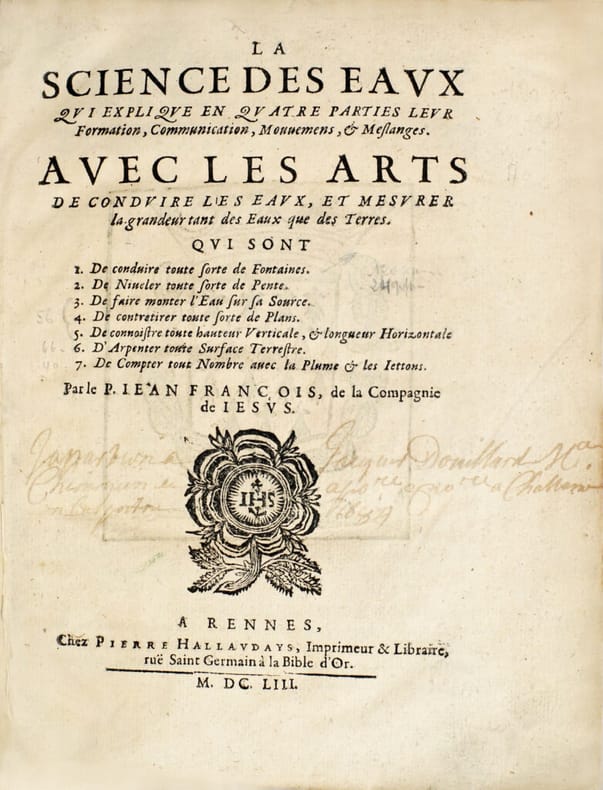
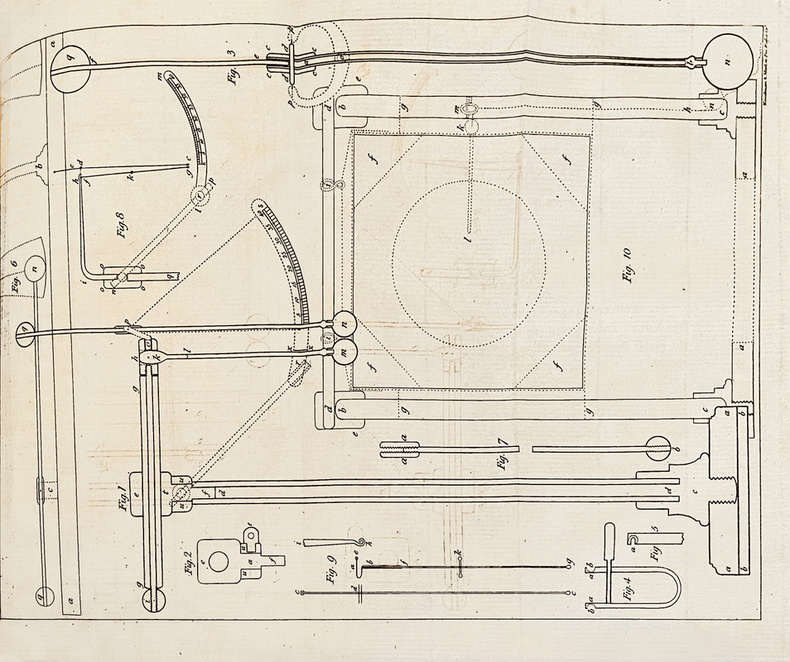
LCS-17901Précieux exemplaire conservé dans son authentique reliure en vélin souple de l’époque. Rennes, Pierre Hallaudays, 1653. 6 parties en 1 volume in-4 de (8) ff., 120 pp., 40 pp., 24 pp., 56 pp., 70 pp., 40 pp., 1 planche gravée dépliante, nombreuses gravures sur bois dans le texte, ex libris manuscrit sur le titre. Vélin souple de l’époque, dos lisse. Reliure de l’époque. 206 x 155 mm.
LCS-17904Edition originale peu courante de ce traité de météorologie dû au physicien et géologue suisse Jean-André de Luc. Londres, Imprimerie de T. Spilbury, 1786-1787. 3 parties reliées en 2 volumes in-8 de : I/ (2) ff. bl., (2) ff. de table, 320 pp., (1) f., pp. 319 à 543, pp. 485 à 516 (appendice), 2 planches dépliantes hors texte, (2) ff. bl. ; II/ (1) f., (2) ff. de table, 478 pp., (1) f. d’errata. Maroquin rouge à grain long, filets et grecques dorés encadrant les plats, dos lisses à compartiments ornés de grecques et petits fers floraux dorés, filet or sur les coupes, grecque intérieure, tranches dorées. Reliure du début du XIXème siècle dans le style de Bozérian. 211 x 131 mm.
Small 4to (200 x 150 mm). (25) ff. With the woodcut arms of Philip III of Spain on title-page. Loosely inserted in contemporary limp sheepskin parchment. Very rare first and only edition of a "memorial" addressed to the king, Philip III of Spain. Cosme Novella was initially denied permission to practice the profession of pharmacist in the apothecary of his father-in-law who had recently passed away. During the inspections by the "Colegio de Boticarios" (College of apothecaries) they had found deficiencies in the operation of the apothecary, but Novella was finally admitted after intervention of a municipal jury. In 1601 he was appointed as inspector to the pharmacy of the Hospital Real y General, where he found serious deficiencies in their preparations of medicines. This angered the management of the hospital, who held a high position in the College of apothecaries. The College restarted their inspections of Novella's business and closed his store. The dispute then grew to a bigger scale, involving the royal chapter of pharmacists and physicians. In the present "memorial" Novella presents his case to the King. Ultimately, the royal decree would be in favour of Novella, and his pharmacy would be permitted to re-open. - With manuscript note on title-page. Some faint waterstains, two tiny tears in the fore-edge margins and the paste-downs detached from the boards, separating the bookblock from its binding. A good copy. Bibliographia medica Hispanica 537. Iberian books 41802. Palau 194700. Vicente Martínez Tejero, "Cosme Novella" in: Diccionario biográfico español (online). WorldCat (3 copies). Not in Krivatsy; Osler; Wellcome.
4to. Two vols. in one. (24), 419, (9) pp. Title page printed in black and red. Text in double columns. With 86 numbered engr. plates (often with multiple images per plate). Old panelled calf, neatly rebacked to style with original gilt label laid down, leading edges gilt. Second edition in English, the first having appeared in two volumes in 1712. William Bowyer printed both this second edition (500 copies) and the 1737 third edition. The original French edition was published in 1694, and drew upon Pomet's own travels, as well as his expertise and business as a practicing pharmacist. Contains many notices of oriental medicinal plants and herbs, including the famous "Balsam of Mecca": "The Turks, who go a pilgrimage every year to Mecha, bring from thence a certain dry white balsam, in figure resembling white copperas calcin'd, especially when it is stale. The person who made me a present of about half an ounce, assur'd me, that he brought the same from Mecha liquid, and that the smell is the same as observ'd before. The same person likewise did testify to me that it was as good as Balm of Gilead" (p. 205). - Pomet (1658-99) was appointed druggist to Louis XIV, and in the introductory notes to the online exhibition at the University of Wales, "The Weird World of Pierre Pomet," the curator observes: "Parisian Pierre Pomet's pharmacopoeia [...] was intended not only as a handbook for the medical trade but also as a rough guide to the exotic for armchair travellers. Much of its appeal, then as now, comes from the illustrations which pepper the book: pictures of weird animals and weird people doing weird things in weird countries." - Early bookplate ("IKJ") and ownership signature ("H. Jones"), occasional dusting or minor offsetting. A very good, crisp copy. ESTC T111989. Wellcome IV,142. Garrison-Morton 1827.1 (French ed.). Hunt II, 428 (1712 ed.).
173243507, , 1732. In-12 de (1)-215 pp., veau marbré, pièce de titre en maroquin rouge, dos lisse orné à la grotesque, tranches rouges (reliure de l'époque).