98 839 résultats
32 geheftete Lieferungen in den originalen Lieferungsumschlägen. 5 Teile mit zus. 124 chromolithogr. Tafeln. XXVI, 162 SS. 112 SS. 36 SS. 32 SS. 8, 8 SS. (2) SS. Gr.-4to (250 x 325 mm). Vollständiges Exemplar des prachtvollen pomologischen Kompendiums von Äpfeln (60 Tafeln, 162 SS.), Birnen (36 Tafeln, 112 SS.), Kirschen (8 Tafeln, 36 SS.), Pflaumen (12 Tafeln, 32 SS.), sowie Aprikosen und Pfirsichen (8 Tafeln, 8+8 SS.). Durchwegs in deutscher und französischer Sprache. Auf den 124 aufwändig gestalteten chromolithographischen Tafeln sind je zwei Ansichten und ein Querschnitt, bei Steinobst auch Kerne und Laub von zwei bis vier Obstsorten abgebildet. Das Titelblatt, die Widmung an den niederländischen König WiIlhelm III., eine Vorrede des Botanikers Karl Heinrich Koch (1809-79) und ein Vorwort des textverantwortlichen Boskooper Vereins zur Bestimmung und Veredelung der Obstsorten zu den ersten vier Teilen des Kompendiums sind der 2. Lieferung eingebunden (I-XXIV); ein zusätzliches Vorwort zu Aprikosen und Pfirsichen (XXV-XXVI) ist in der 23. Lieferung enthalten. Die 32. Lieferung enthält einen Index der Pflaumen, Aprikosen und Pfirsiche (2 SS.). - Der verantwortliche Lithograph Guillaume Severeyn (1830-1909) war Mitglied der Königlichen Akademie in Brüssel und ausgewiesener Spezialist für botanische Illustration. Sybolt Berghuis (1820-96) wirkte in Groningen als Maler, Zeichner und Aquarellist. - Provenienz: Bibliothek der evangelischen reformierten Hochschule in Budapest; als Doublette verkauft mit durchgestrichenem Bibliotheksstempel und Ausscheidungsstempel auf der 1. Tafel der 1. Lieferung (recto). - Die 1. Lieferung mit altem Wasserschaden auf dem Umschlag und allen Blättern. Die Bindungen meist lose, teils leicht braunfleckig und angeschmutzt, mit kleineren Randläsuren bzw. geknickten Seiten. Beiliegend eine Verlagsankündigung (in der 4. Lieferung) sowie ein Verlagsprogramm und drei Rechnungen von 1865 und 1868 des bedeutenden Pester Buchhändlers und Verlegers Károly Grill (in der 32. Lieferung). Vgl. Nissen, BBI 2221 (niederländ. Ausgabe).
LCS-17900Précieux exemplaire conservé dans son authentique reliure en vélin à recouvrement de l’époque. Amsterdam, chez Jean & Corneille Blaeu, 1642. In-4 de (9) ff., 277 pp., nombreux bois gravés dans le texte. Vélin à recouvrement, dos lisse avec le titre manuscrit, restes de lanières. Reliure de l’époque. 192 x 154 mm.
Gest. Frontispiz, (10), 398, (2) SS. Mit 116 teils mehrf. gefalteten Kupfertafeln. Halblederband der Zeit mit gepr. Pergamentrückenschildchen und reicher, teils oxydierter Goldprägung in den Rückenfeldern. Qu.-4to. Das seltene, reich illustrierte Werk zur Festungsbaukunst handelt davon, "wie man die Royal-Vestungen und Cittadelle, Auxiliar-Wercke und Contra-Approschen, Retrenchementer und Feld-Schantzen, auff alten und neuen Plätzen, regular und irregular, in Eyl und mit Weile, mit kleinen als auch ansehnlichen Unkosten, aus siben wichtigen approbirten Militarischen Haubt-Maximen, dergestalten disponiren, erbauen und verthaidigen möge, daß ein darfür attaquirender Feind ehender ermüden müsse weder obsigen könne." - Borgsdorff "war kaiserl. Oberingenieur und trat in der Folge auf Befehl Kaiser Leopolds in den Dienst Peters des Großen. Hier leitete er 1696 die 2-jähr. Belagerung v. Asow, wie Glaser sagt, 'auf eine außerordentliche Weise', indem er eine besondere, sonst außergewöhnliche Art, zu approchiren angebe, weil denen solcher Arbeit noch unerfahrnen Russen die gewöhnliche Art in kurtzer Zeit nicht begreiflich zu machen war: die Erd-Waltzen genannt. Nach Eroberung dieses wichtigen Platzes baute er 1698 einige gantz neue Fortressen in selbiger Gegend" (Jähns). Eine lateinische Ausgabe hatte er bereits 1694 veröffentlicht. - Die 1693 gegründete Offizin des aus dem Kanton Schwyz zugewanderten Schlegel ist die jüngste der sieben alten Universitätsbuchdruckereien Wiens. - Ausgabe in einem Band; Pohler zitiert die nach S. 240 geteilte Ausgabe. - Stellenweise gering braunfleckig. Die Lagen Ccc und Bbb gegeneinander verbunden, jedoch komplett. Einbanddecken fachmännisch restauriert, Vorsätze erneuert, sonst gutes, kaum gebräuntes Exemplar. Jähns II, 1711 und 1380f. Pohler III, 699 (s. v. “Burgsdorf”; in 2 Bdn.). Michigan Military Books 223 (m. Abb.). Kat. KA I, 795. Mayer, Wr. Buchdr.gesch. II, 11.
4to (176 x 217 mm). (2), 20, 322, (2), 16, (4) pp. Title-page printed in red and black. With 4 folding plates. Contemporary Austrian full calf binding, covers ruled in blind, spine richly gilt, with two red leather labels. Marbled endpapers. All edges red. One of the fundamental books in the history of scientific thought, in which Boscovich developed his theory of "points" which are the first elements of all matter. Second edition, published a year after the first. - Concerning himself with the elementary constitution of matter, the nature and behaviour of physical forces, light, and atoms, Boscovich anticipated many of the features of the atomic and nuclear physics of our own times, and was the true creator of atomic physics as we understand it today. He predicted the penetrability of matter by high-speed particles and the possibility of states of matter of exceptionally high density. "The Theory of Natural Philosophy is now recognized as having exerted a fundamental influence on modern mathematical physics. As the title of his book implies, [Boscovich] considered that a single law was the basis of all natural phenomena and of the properties of matter; that the multiplicity of physical forces was only apparent and due to inadequate mathematical knowledge" (PMM). - Born at Dubrovnik in 1711, Boscovich became a Jesuit and spent most of his career in Italy as professor of mathematics at Rome and Pavia and as director of the observatory at Milan; he also taught in Vienna and Paris. Although then regarded as highly speculative, his "Theoria" enjoyed an immediate success in scientific circles across Europe, and its influence was felt and acknowledged for generations to come by such giants as Joseph Priestley, Michael Faraday, James Clerk Maxwell, Lord Kelvin, J. J. Thomson, and Niels Bohr. - This edition was released in 1759, to compete with the re-issue produced that same year by Kaliwoda, the Viennese printer of the first edition, and all three early Vienna editions are extremely rare. The earliest edition usually encountered is that printed in Venice in 1763, which is the one that J. M. Child reprinted and translated into English in 1922. - Includes the "Adnotanda et corrigenda" as well as the "Monitum" leaves, both frequently lacking. The 16-page "Epistola ad Carolum Scherffer" is bound after the "Finis". Occasional light brownstaining. Traces of a removed bookplate on the front pastedown. In all a very appealing copy. VD 18, 14408716-008. Cf. PMM 203. Poggendorff I, 246. Norman 277. Riccardi I, 1870, 53. De Backer/Sommervogel I, 1840. DSB II, 326.
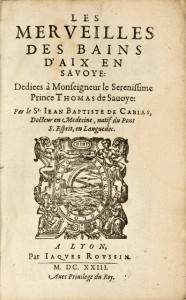
LCS-15321Rare édition originale du premier ouvrage consacré aux eaux d’Aix-les-Bains conservée dans sa toute première reliure en vélin souple de l’époque. Lyon, Jacques Roussin, 1623.In-8 de 208 pp., (8). Petite tache dans l’angle supérieur d’un f., mouillure pâle au titre. Vélin souple de l’époque, titre manuscrit au dos et sur la tranche supérieure. Reliure de l’époque. 170 x 103 mm.
4 vols. bound in 2 and plate volume. (2), XL, 318 pp. (4), 296, (4) pp. (2), XX, 368 pp. (4), VIII, 333, (3) pp. Plate vol.: 24, 12 pp. With 17 (12 coloured) plates. Contemp. cloth with giltstamped red spine labels. 8vo and 4to. Second edition of Goethe's principal scientific work, the "Farbenlehre" (Sämmtliche Schriften, vols. XX-XXIII, with half titles), including the quarto-sized "Erklärung der zur Goethe’s Farbenlehre gehörigen Tafeln" and the "Anzeige und Übersicht", which is also usually found missing. "Goethe's first publication on optics culminated in his 'Zur Farbenlehre', his longest and, in his own view, best work, today known principally as a fierce and unsuccessful attack on Newton's demonstration that white light is composite" (DSB V, 445). In 1810-17, Geistinger published a pirated edition of Goethe's works; the "Farbenlehre" was issued both separately with its own title page and as part of the collected works. The scarcity of Geistinger's edition (the only one published during the author's lifetime to include the "Farbenlehre") is dicussed by K. Dorn in his article "Habent sua fata libelli", in: Aus dem Antiquariat 1988, p. 379f. Goethe counted this edition of his works among the good ones, but himself owned only an incomplete copy. - Much rarer than the edition published in 1810: not in ABPC auction records since 1975; OCLC lists only two copies (Johns Hopkins Univ., San Diego Univ.). - Slightly browned and brownstained; plate volume foxed; plates trimmed and mounted on backing paper. A very nice copy with old ownership stamp from a school in Tulln/Donau on flyleaf of plate volume. Hagen 348, 348 b-c. Kippenberg 387 & 388. Goedeke IV/3, 583, 46 a 1. Schmid 68-71 & 77-79.
32Chez l'Auteur, 4 volumes, demi-maroquin rouge à grains longs et à coins, dos lisses ornés de roulettes et palettes dorées, filets et fleurons dorés.
8vo. VI, 160 pp. - (Bound with) II: Johnson, James. The Influence of Civic Life, Sedentary Habits, and Intellectual Refinement, on Human Health, and Human Happiness, Including an Estimate of the Balance of Enjoyment and Suffering in the Different Gradations of Society. London, (W. Thorne for) T. & G. Underwood et al., 1818. VIII, 93, (1) pp. Contemporary full green straight morocco (bound by Charles Hering, Jr., of London) with gilt spine title and the gilt arms of the Earls of Harrington on both covers. Leading edges gilt; gilt inner dentelle. Matching green endpapers. Green silk ribbon. All edges gilt. First edition of this rare and early vegetarian work. J. F. Newton (1767-1837) sought to popularise the vegetable and distilled water diet of the physician and veganism pioneer William Lambe, whose patient he was. In his book, Newton promoted his own "regimen of distilled water and vegetable diet" (p. 66), believing vegetables to be the natural food of man and animal flesh unhealthy and unnatural. It was Newton who converted Percy B. Shelley to a vegetarian lifestyle, and his book influenced the poet's 1813 pamphlet on vegetarianism and animal rights, "A Vindication of Natural Diet". - Bound with this is a rare hygienic work by the surgeon J. Johnson (1777-1845), physician to the Duke of Clarence (afterward King William IV). - Interior very slightly browned, but a fine specimen, beautifully bound by Charles Hering for the library of Charles Stanhope, Viscount Petersham and afterwards the 4th Earl of Harrington (1780-1851). Known as "Beau" Petersham, the eccentric but much-imitated gentleman was a close friend of the Prince Regent George, who emulated his mannerisms in clothing, tea mixes, and consumption of snuff. Lord Petersham designed many of his own clothes and his fashions were quickly copied; he made famous the "Harrington" hat and the "Petersham" overcoat. The final pages of the present volume contain contemporary handwritten annotations about the poisonous effects of a fruitarian diet of (quoted from Jacques de Sade's "Mémoires pour la vie de Pétrarque") and about the high regard in which Galen and Hippocrates held water and abstinence, very likely in Petersham's own hand.
13 pp. Disbound. First edition of Thomas Paine's final work: his essay on the cause of yellow fever, written during the summer of 1805 while Paine was at New Rochelle. "As he explained, 'the fever breaking out in the city prevented my sending it for publication'. Although he had intended to let his house in New Rochelle 'to some New Yorker for the summer', the outbreak of fever in New York led to his spending most of the latter half of 1805 and the first half of 1806 at home" (Speck, A Political Biography of Thomas Paine, p. 190f.). Paine held that the illness (now known to be transmitted by the yellow fever mosquito) was generated by "the impure air or [pernicious] vapour [issuing] from the [...] new made earth, raised on the muddy and filthy part of the river". - One of the Founding Fathers of the United States, Paine in 1776 authored the electrifying pamphlet "Common Sense", inspiring Americans to declare independence from Britain. The present treatise, first published in newspapers in 1806, bears witness to the strong scientific interests that Paine maintained beyond his many political activities. He died in 1809, his health having been failing for some time. - Very rare: WorldCat records only eight copies worldwide (seven in the U.S. and one in the National Library of Australia); no copy in British Library or COPAC. This copy removed from the Norwich & Norfolk United Medical Book Society (their stamp on title page), inscribed in a contemporary hand above the title: "Presented by the Hospital Medical Board". Sabin 58232. Not in Wellcome, Waller or Osler.
Folio. (12), 708, (28) pp. With the title-page in a border built up from cast fleurons and 5 engraved plates. Contemporary sheepskin parchment; recased, with later endpapers. Rare third edition of a work on pharmaceutical chemistry written by the Spanish apothecary Félix Palacios (1677-1737). When the Palestra pharmaceutica appeared in 1706, it was the first work on the subject written in the Spanish language. Even though the book became widely accepted and used in Spain, Palacios met strong resistance from his colleagues because he rejected the galenic, or plant based, medicines in favour of chemical medicines. With this he rejected the ideas of Galen, Mesue and Dioscorides, which were still the standard in most parts of Europe and the Middle East. The work starts with a preliminary text, followed by a chapter on the general principles of pharmacy and chemistry in the form of questions and answers. The other four chapters deal with the ingredients and making of the medicines. It discusses distillation and calcination methods with the engraved plates showing various tools and instruments: pots, furnaces, alambics etc. - First few leaves slightly damaged along the extremities, waterstains throughout and binding soiled, worn and recased; a fair copy. Blake, p. 336. Palau 209403. Wellcome IV, p. 286 (incomplete). WorldCat (6 copies).
Folio (224 x 335 mm). 5 parts in one volume. Each with a title-page in red and black, 2 [part III: 3] letterpress pp. and 18 numbered engraved plates. In total 90 engraved plates. Contemporary full calf with giltstamped red and green labels to prettily gilt spine. All edges red. First edition. - This "masterpiece" (cf. Cobres) by the German engraver and publisher is considered the "most extensive and widely useful collection, owing its existence solely to him [Ridinger]" (cf. Thienemann). It includes a sequence of zoologically themed plates which "are highly sought after and often copied" (cf. Thienemann), showing animals in their characteristic actions and surroundings. Part one presents sporting dogs, while part two treats wild animals, such as lions, tigers and aurochs. Parts three and four cover "principal animals of the chase" (Schwerdt), namely aurochs, bears, stags, boars, deer, ibexes, chamois, lynxes and wolves. "Lesser animals of the chase" (Schwerdt), like foxes, rabbits, badgers, otters, beavers and squirrels are included in the fifth part. Two additional parts, showing horses, mules and donkeys, would be issued until 1755. - Contemporary bookplate of Count Ladislaus Kemeny to the patterned pastedown. A few notes in ink, mostly stating animals' Latin names. Binding and pastedowns slightly wormed. Top spine end missing, lower one scuffed. A few pages brownstained, plate 86 waterstained, a small tear in plate 81 (not touching image). From the library of the Viennese collector Werner Habel, with his signed and stamped ownership, dated 1979, to the flyleaf. VD 18, 90195426. Thieme/Becker 28, 309. Thienemann 391-480. Nissen 3406. Schwerdt III, 141. Cobres 307, 4.
2 Bde. XVI, 512 SS. (8), 456, (38) SS. Mit 2 gefalt. Kupfertafeln. Zeitgenöss. Interimspappbände mit hs. Rückentitel. 8vo. Erste deutsche Ausgabe des erstmals 1782 in Stockholm erschienenen Werks, eines der maßgeblichen metallurgischen Kompendien des vorindustriellen Zeitalters. Der Bergbauexperte, Mineraloge und Chemiker Rinman (1720-92) gilt als "Vater der schwedischen Eisenindustrie" und war lange Jahre als Direktor mehrerer Bergwerke und Eisenhütten tätig; er hatte großen Einfluss auf die Entwicklung der schwedischen Stahlproduktion. Die Übersetzung stammt von dem vor allem durch seine Berichte über seine Reisen in Russland bekannten Apotheker und Chemiker Johann Gottlieb Georgi (1729-1802). - Die Tafeln zeigen die Verfertigung eines Stahlmagneten sowie das Gerben des Roh- und Messerstahls. Einbände berieben und bestoßen; innen etwas gebräunt bzw. stockfleckig. Aus der Bibliothek des Schlosses Pfannberg in der Steiermark mit Stempel des österreichischen Industriellen Franz Freiherr Mayr v. Melnhof (1810-89, Eigentümer des Eisenwerks in Donawitz und Errichter der Gussstahlfabrik in Kapfenberg) am Spiegel und Titelblatt. Poggendorff II, 646. Ronalds 431. Engelmann (Bibl. mech.-techn.) 306. ADB VIII, 713. NDB VI, 242f.
1772(LCPCMED-0001)(Deux rarissimes ouvrages sur l'électrothérapie au XVIIIe siècle, en édition originale, dans une superbe reliure en maroquin armorié du temps) SANS (abbé). "GUERISON DE LA PARALYSIE, PAR L'ELECRICITE, OU CETTE EXPERIENCE PHYSIQUE EMPLOYEE AVEC SUCCES DANS LE TRAITEMENT DE CETTE MALADIE REGARDEE JUSQUES A PRESENT COMME INCURABLE". 1772, Paris, Cailleau. (relié avec:) "GUERISON DE LA PARALYSIE, PAR L'ELECTRICITE; OUVRAGE... DANS LEQUEL ON EXPOSE LA METHODE QU'IL FAUT SUIVRE POUR GUERIR LA PARALYSIE PAR L'ELECTRICITE...". 1778, Paris, Cailleau. 2 ouvrages en 1 volume in-8° (166x101 mm) (dimensions pages 159x94 mm) I: (1) frontispice gravé, (8) ff. (faux-titre, dédicace, préface et table), 150 pp., 2 figures sur 1 planche dépliante. (a8, A-F12, G2) II: (1) frontispice gravé, (1) faux-titre, (1) titre, XXVII pp. (lettre), (1) p. (table), 234 pp., (1) f. (approbation), 4 planches dépliantes. (a12, b2, A-I12, K10) Reliure armoriée de l'époque en maroquin rouge. Encadrement avec triple filet doré sur les plats, petites fleurs aux angles et armoiries au centre. Dos lisse divisé en compartiments avec fleurons et décorations dorés et pièce de titre en maroquin olive. Filet doré sur les coupes et roulette intérieure dorée. Tranches dorées. Gardes de papier bleuté. Editions Originales, rares. Très rare le second ouvrage. Infime usure à un coin. Un petit trou de ver au pied du dos. Très petit manque de cuir à la charnière du premier plat. Très bel exemplaire dans une reliure en maroquin armorié du temps. Provenance: Exemplaire aux armes dorées de Mgr. Joseph-Dominique de Cheylus (Avignon, 1717 - Jersey, 1797), évêque de Bayeux et premier Aumônier de la Comtesse d'Artois. L'abbé de Cheylus, fut évêque de Cahors (1766) et de Bayeux (1777) avec, pour celle-ci, une rente annuelle de 90.000 livres. Premier Aumônier de la Comtesse d'Artois, en 1790 il devient maire de Bayeux; mais il refuse de prêter serment à la constitution civile du clergé. Il émigre à Jersey. Sa riche bibliothèque fut séquestrée et confisquée au profit de la Nation et M. Simien Despréaux, en 1793, fut chargé d'en rédiger l'inventaire (seul l' "Inventaire des livres trouvés dans la bibliothèque de l'émigré Cheylus, Théâtre et Poésies et Romans" subsiste, avec 145 ouvrages en 495 volumes). "L'importance de la bibliothèque de l'évêque est considérable et son inventaire mériterait d'en être dressé. Lorsque ces livres seront réclamés en mai 1803 par ses héritiers, les commissaires feront valoir que les 4082 volumes étiquetés Aa (c'est à dire provenant de la bibliothèque de Mgr. de Cheylus) par M. Simien Despréaux dans le dépôt A constituent une collection d'ouvrages précieux de toutes les parties de l'histoire, de la littérature et des sciences". ("Des chanoines et des livres. Actes du colloque sur la bibliothèque du Chapitre de la cathédrale de Bayeux Basse-Normandie Drac", 2014) (LCPCMED-0001) (4.500,00 €)
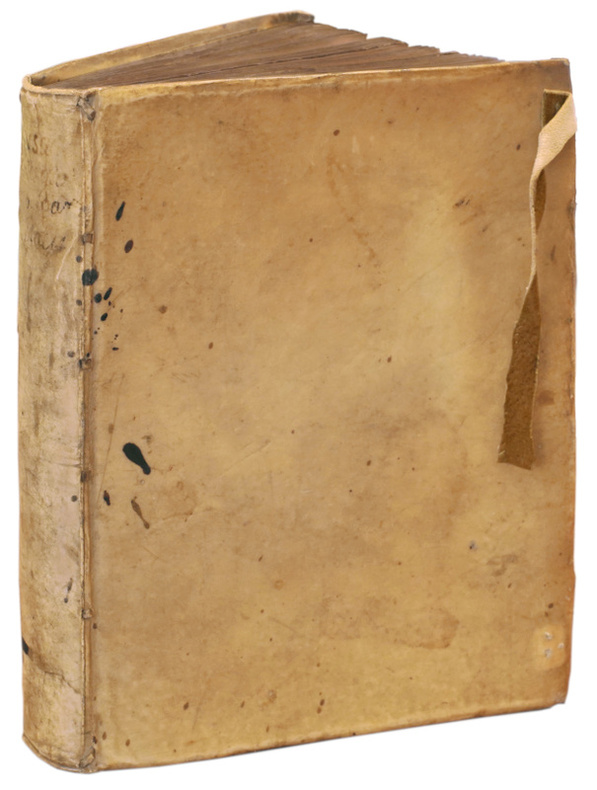
1664105238BBBasel, Jacob Werenfels, 1664. Folio (38 x 24 cm.). [8] Bl., 663 S.; [2] Bl., S. 665-1316; S. 1317-1529, [66] Bl. mit Holzschnitt-Titelbordüre und ca. 3000, teils kolorierten Textholzschnitten. Blindgeprägtes Schweinsledereinband der Zeit über Holzdeckeln. 3 Teile in 1 Band.
4to. (16), 170, (20) pp., final blank. With engraved vignette to title, printed in red an black. (With:) Ettmüller, Michael. De virtute opii diaphoretica dissertatio. Leipzig & Jena, Krebs for Bielcke, [1682]. 48 pp. Contemporary marbled half vellum. Second edition of this early monograph on the pharmacological and therapeutic aspects of opium. "The main text is a reissue of the 1674 edition" (Krivatsy). Wedel not only evaluates the medical literature but also all available travel reports. The chapter entitled "An aphrodisiacum sit opium & mulierem excitet?" provides an overview of the various opinions, including Saar's account from his East Indian journeys noting the use of opium in Batavian brothels, as well as Garcia's contradictory information that opium leads to infertility and impotence (p. 128f.). The title vignette depicts a Turkish opium picker: scratching the poppy seed capsule with his knife, he collects the sap. The appendix contains the first printing of a dissertation on the qualities of opium, written by Michael Ettmüller (d. 1683), who dedicated his work to his colleage Wedel. - G. W. Wedel (1645-1721) was one of the principal physicians of his age. He authored 49 books and was the teacher of several progressively minded medical men. He is credited with the timeless aphorism that "medicine is nothing but the incessant renewal of ignorance." His "Opiologia" won him admission to the Academy of Naturalists, the still-extant "Leopoldina" in Halle. "Wedel stood midway between medieval and modern world views, defending astrology and alchemy and championing iatrochemistry" (DSB XIV, 212). "Wedel appears to have been one of the first to employ the word physiology in its present restricted sense" (Thorndike VIII, s. v.). - Evenly browned throughout; binding slightly rubbed. A fine copy. VD 17, 12:166680Q. Krivatsy 12664. Pritzel 10054. Ferchl 570. Hirsch/H. V, 875.
154040365BBBasel, Isengrin, 1540. Folio. 11 n.n. Bl., 1 w. Bl., 603 (recte 601) S., 1 n.n. Bl. Druckermarke, 1 w. Bl. Flexibler Pergamentband der Zeit mit handschriftlichem Rückentitel.
120391aafParis, Chez D'Houry, père, M. DCC. XLVIII. - Chez la Veuve D’Houry, M. CC LXX., 1748 - 1770, in-4to, véritable encyclopédie medicale. Orné d’env. 200 planches gravées , manque le tome VI (6), reliure plein veau raciné, dos à cinq nerfs, ornés de fleurons dorés, pièce de titre maroquin brun, pièce de tomaison maroquin noir, toutes les tranches rouges,
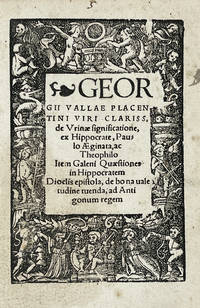
103<p>Rare 16th century work on uroscopy</p><p>the analysis of urine and its relation to health and disease</p><p>by the Italian Humanist Giorgio valla</p><p>from the most important medical treatise from the past</p><p>First Edition untrimmed</p><p>Valla Giorgio<em> Georgii Vallae . De Vrinae significatione ex Hippocrate Paulo Aeginata ac Theophilo. : Item Galeni Quaestiones in Hippocratem. </em><em>Dioclis Epistola de bona valetudine tuenda ad Antigonum Regem. </em>Argentine Strasbourg: Per Henricum Sybold 1528.</p><p>8vo 15 x 10 cm untrimmed copy printer paper binding pp. 46 signature A-C7 title with decorative woodcut border of putti woodcut initials imprint; date supplied from British Museum. <em>Short-title catalogue of books printed in the German-speaking countries . from 1455 to 1600</em>. London 1962 p. 883.</p><p>Rare and important collection of medical text about the analysy of urine and its relation to human health translated by the renowned Italian Humanist Giorgio Valla from text by Galen Hippocrates Paulo Aegineta Theophilus Medicus.</p><p>At the end of the book we find the <em>Epistola de bona valetudine tuenda the Letter on the Preservation of Health </em>written by Diocles of Carystus the well-regarded Greek physician said to be "<em>second only to Hippoctates</em>" to Antigonus the king of Asia concerning " <em>the prognosis of the diseases and extemporaneous remedies for the same throught garden herbs</em>".</p><p>Giorgio Valla 1430 - 1499 was an Italian physician and mathematician who practised in Milan Venice Padua; he belonged to the cultural circle of Ermolao Barbaro and held a professorship of grammar and rhetoric at the Scuola di San Marco Venice from 1485 until his death.</p><p>The studies conducted on an impressive amount of Greek and Latin codes and a solid training both in the humanities and in the sciences are the basis of the project pursued by Valla to bring together in a single volume the entire system of the arts: in 1501 it was printed posthumously a monumental encyclopedic work in forty-nine books in Latin entitled <em>De expetendis et fugiendis rebus</em> intended to exhaust all branches of knowledge from mathematics to astronomy from medicine to economics from philosophy to rhetoric up to music based on the works of large number of authors mostly Greek on whom the author had exercised his assiduous activity as a translator and exegete. Valla is the author of numerous other works on philosophy rhetoric and medicine and among them the present treatise.</p><p>Henricum Seybold a professor of medicine as well as a printer printed several medical texts all of which are rare.</p><p>Conditions: light staining to title and first few leave final blank missings; lower edge uncut.</p><p>Provenance: old ink underlining to first few lines and tracing of initial to verso of</p><p>dedication</p><p>References: Adams V150; Durling 4488; Not in Wellcome Osler or Graesse.</p> Henricum Sybold
Edizione: Prima edizione (Première édition) . Pagine: XII+1060+34+6 tavole . Illustrazioni: All'antiporta grande incisione a piena pagina raffigurante omaggi medicali alla regina. Altra incisione con dedica. Al fondo del testo vi sono 6 pagine di tavole incise su rame (en taille-douce) precedute da una pagina di spiegazione delle Formato: 8° . Ex libris: Firma del primo proprietario Nicolai de Malezieux . Rilegatura: Cartonato coevo in pelle marrone con cinque nervature, cerniere piatti e dorsi molto graffiati, perdita di pelle nella parte alta del dorso (1 cm per 6) e nella parte bassa (2cm.) . Stato: Buono . Caratteristiche: Farmacia in generale, preparazioni galeniche, chimiche e rimedi particolari. Opera dedicata a Monsignor Colbert. Prima edizione di quest'opera che divenne presto importantissima e tradotta in numerose lingue, fra le quali anche il cinese. A disposizione forniemo molte notizie sulla vita e le opere dell'autore, personaggio di primo piano della scienza medica europea del diciassettesimo secolo. Scrisse anche alcune opere alchemiche. Grossa brunitura nell'ultima e penultima pagina bianca.Foto disponibili . Autografo: AUTOGRAFO DI NICOLAS DE MALEZIEUX 1676 (AUTOGRAPHE) (1650-1727) letterato, ellenista e matematico francese. .
in-4 antico, cc 50, ccnn 1, bella leg. ottocentesca perg. Tagli color. Bel front. xilogr. con tit. in cornice architettonica con figure allegoriche e animali fantastici. Rara ediz. di opera medica del veneziano Niccolò Massa (1489-1569), anatomista e chirurgo. Principalmente studiò le malattie infettive e contagiose, e a lui si deve l'individuazione della prostata e la prima descrizione del liquido cerebrospinale. In questa opera si occupa del morbo gallico o mal francese, suddiviso in sei trattati, uno dei quali dedicato al Guaiacum o lignum indicum, una pianta originaria dell'America centrale da lui indicata per combattere la sifilide, innovativa rispetto ai tradizioni trattamenti per salasso finora perseguiti. Olschki, Choix, 9058. Hirsch IV, 160-161. Sander 4424. Hirsch IV, pp.160-161. Rappaport, Ars Medica per saecula, 1930, 1052: "Le livre cont. un interess. passage se referant a l'Amerique [...] Cet ancien livre sur la syphilis du fameux medicin etait tres estimè de son temps et est devenu excessivement rare". Splendido esempl. in ottimo stato di conservazione. [449]
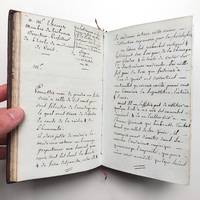
180319744<p><strong>A very interesting collection of around 80 copies of letters from the correspondence of Rouen physician Jean-Baptiste Vigné 1771-1842 a pioneer in the practice of vaccination in Rouen.</strong> He was head of the city's General Hospice and one of the first full members of the Académie de Rouen when it was re-established in 1803. He was also active in Paris as a corresponding member of the Académie de Médecine and the Société de Médecine Clinique.</p><p>This correspondence brings together the most important letters he sent between 24 Nivose An XI January 14 1803 and July 8 1806.<br />His correspondents were mainly doctors and members of learned societies in Paris and Rouen including leading medical figures of the period such as "shis ami" Jean-Etienne Esquirol 1772-1840 8 letters Michel-Augustin Thouret 1749-1810 6 letters François Chaussier 1746-1828 4 letters Philippe Pinel 1745-1826 2 letters J. J. le Roux b. 1749 1 letter and Henri-Marie Husson 1772-1853.</p><p><strong>Among the most interesting items are three letters relating the early beginnings of vaccinia in Rouen.</strong><br />One is addressed in his capacity as Corresponding Member of the Paris Academy of Medicine to Henri-Marie Husson 1772-1853 secretary of the central vaccinia committee in Paris dated 26 Pluviose an XI 1 page: "<em>Do not doubt Sir the pleasure I would have in communicating to you some observations favorable to vaccinia inoculation which I believe against the feeling of its detractors to be powerfully anti-smallpox</em>".<br />Two are addressed to Monsieur G. Robert pharmacist at the Hôtel Dieu in Rouen and secretary of the correspondence office of the central vaccinia committee of that city dated 8 brumaire an XIII 1 page and 3 pluviose an XIII 8 pp.<br />They concern the shipment of vaccine fluid taken from a 12-year-old child and give detailed observations on the vaccinations he carried out in Rouen reporting a few special cases such as the vaccination of a 9-month-old baby surrounded by sick people.<br />"<em>I have vaccinated only 26 people since Messidor Year XI three of whom were unsuccessfully. In twenty-two others I have seen all the symptoms of true vaccinia develop successively with a reddish superficial aureole forming around the injections as soon as they have been given and disappearing in a few moments.</em> "</p><p>Other letters concern the distribution of his own works or articles such as his analysis of Philippe Pinel's treatise on insanity his <em>Essai sur la petite vérole </em>his <em>Essai sur l'utilité de l'anatomie </em>1803 or <em>De la Médecine légale</em> 1805.</p><p>The volume also contains interesting observation letters and reports on a variety of subjects: care of wounds obstetrical observations peritonitis digestive tumors the case of a person with live salamanders coming out of his anus convulsions etc. There are 23 sheets of observations reported to the Paris Society of Clinical Medicine on Mr. Loger's illness.<br />Some letters are addressed directly to patients with instructions for their care and medical certificates and attestations.</p><p><strong>An important source on the activities of a particularly active corresponding member of several medical societies and a pioneer in the practice of vaccination.</strong></p>
in-folio, ff. (10), 319, legatura moderna ad imitazione antica in p. pelle, bordura ai piatti, fregi e titolo al dorso, il tutto in oro. Dedica dell'editore a Giacomo Vedova. Impresa tipogr. al tit., gran numero di silografie n.t. di crani, ferite, strumenti chirurgici, forbici, pinze, bisturi, cuciture; due silogr. a piena pag. raffig. l'estrazione di una freccia e la cauterizzazione di una ferita d'arma da fuoco. Tre belle silogr. raffig. operazioni di trapanazione del cranio realizzate in interno con chirurghi, infermieri e parenti in abiti cinquecenteschi. (Da notarsi la spiritosa presenza nelle stanze elegantemente arredate di cani, gatti e topi in evidente attesa di ''bocconi''). Rispetto alle ediz. precedenti sono più numerose le figure di strumenti e sono aggiunte, nel libro quinto, alcune silogr. anatomiche. Il libro quarto è aumentato della traduzione dell'opera di Jean Tagault, mentre il libro sesto lo è del Trattato di Jacques Houllier. Terza edizione italiana (la prima è del 1574) di una delle più belle e più importanti tra le opere di chirurgia del Cinquecento. Giovanni Andrea Della Croce (Venezia, 1514-1575), figlio di un barbiere, fin dal 1532 fu accolto come membro dal Collegio chirurgico di Venezia, tra le più rinomate corporazioni mediche del tempo, che aveva il monopolio della cura dei feriti; fu quindi a Feltre sino al 1546; tornato a Venezia, ebbe l'incarico di medico della flotta veneziana, e approfondì gli studi sulle ferite d'arma da fuoco. La sua Chirurgia ebbe fama europea e fu tradotta in varie lingue; è divisa in 7 libri, che trattano di ascessi e tumori; ferite; ulcere; fratture ossee; cauterizzazioni, flebotomia e litotrizia; il sesto è un antidotario e il settimo reca una serie di figure relative allo strumentario per le operazioni trattate. La diffusione dell'opera fu dovuta anche all'introduzione di sinonimi nelle varie lingue per designare le affezioni morbose, nonchè la ricchezza di esempi pratici. (Esemplare accuratamente rinfrescato, con abili restauri agli angoli inferiori dei margini di vari fogli).. Wellcome 1670. Blake 1082. Rutkov p. 156-7. Cushing C477. Krivatsy 2908..
194087015Pour les amis de Charles Pathé | Paris 1940 | 16 x 25 cm | relié