Fabricius von Hilden, WilhelmAntiquariat.de

98 831 résultats
168240512DBFrankfurt, Balthasar Christoph Wust, 1682. Folio. (18) Bl., 1044 S., (10) Bl. Index; (8) Bl., 272 S. (6) Bl. Index. Mit 2 gestochenen Titeln und ca. 220 Holzschnitten im Text. Restaurierter Lederband aus der Zeit mit goldgeprägtem Rückentitel und Rückenvergoldung. + Wichtig: Für unsere Kunden in der EU erfolgt der Versand alle 14 Tage verzollt ab Deutschland / Postbank-Konto in Deutschland vorhanden +, A|B [2 Warenabbildungen]
In 4° (285x225); pagg. VII, 100 con 13 pregiate tavole incise in rame (una eseguita alla maniera nera) e 7 tavole esplicative di testo; le tavole sono f.t. e raffigurano con dettaglio l'anatomia buccale, le dentizioni decidue e permanenti nelle età evolutive dell'uomo e rispettive malocclusioni e patologie. Legatura in piena pelle ottocentesca, filetto in oro ai piatti, dorso a nervi, titolo su tassello in oro.<BR>Edizione originale (FIRST EDITION) della principale opera di Fox, la prima opera sull'ortodonzia, che include chiare spiegazioni su come correggere le irregolarità dei denti. Fox basò la sua opera su quella del suo maestro Hunter, autore nel 1771 di una simile opera. Fox influenzò l'odontoiatria e ortodonzia del XIX secolo e le sue opere furono spesso ristampate.<BR>Bell'esemplare marginoso con qualche fioritura, una cerniera restaurata, lievi abrasioni agli spigoli.<BR>Garrison Morton, 3679; Norman, 825: Fox discusses the major causes of malocclusion in the permanent teeth and described his method of correcting these by means of a fixed metal band and silk ligatures. Fox's orthodontics marked a great improvement over the method of Fauchard and Bourdet, and his system of treatment found favour for nearly half a century."; Poletti, 77: "Le opere di Fox sono troppo conosciute e fondamentali nel nostro campo per cui riteniamo superfluo ogni commento". Wellcome III, 50.<BR>
Edizione: Seconda edizione (prima è del 1509) . Pagine: 1+207 . Illustrazioni: Una xilografia a tutta pagina all'antiporta raffigurante i Santi Cosma e Damiano; Una piccola xilografia a pg. 92 raffigurante un clistere. . Formato: 16° . Ex libris: All'ultima pagina la Croce di Lorena/ Croix de Lorraine/Croix d'Anjou (a doppia traversa, o Croce d'Angiò) con ai lati una L e una O e al piede un cerchio . Rilegatura: Cartonato pergamena fine Ottocento con scritte in oro al dorso (Satinarie anziché Gatinarie). CM. 16,50 PER 12 . Stato: Buono . Caratteristiche: Presenza di numerosissime note di mano antica in Latino contratto e abbreviato, ad una prima lettura molte incomprensibili proprio per il tipo di abbreviazione, sarebbe necessario uno studio molto approfondito. L'editore fu Pocatela Giacomo, attivo dal 1502 al 1538 e in particolare a Pavia dal 1504 al 1526. Tutti gli autori (Gattinara, Astari, Landolfi e Sebastiano) hanno operato e insegnato a Pavia. Gattinara fu allievo del celebre Giovanni Matteo Ferrari da Grado La sua Practica uberrima è un trattato terapeutico nella forma di commento al nono libro del Liber medicinalis ad Almansorem di RhazesDa notare che il trattato DE MORBO GALLICUM è in seconda edizione, fu pubblicato per la prima volta nel 1509 e fu molto importante per la lotta alla sifilide. Volume in ottimo stato conservativo, ad eccezione della rilegatura, risalente a fine Ottocento. . Note epoca: 27 Novembre (Novebris)
16127568CBWittenberg, Kempf, 1612). 7 (von 8) Bl., 510 S. (7) Bl. (Index). Mit 29 ganzseitigen Kupfertafeln im Text. Pergamentband der Zeit mit ausgerissenen Schliessbändern. + Wichtig: Für unsere Kunden in der EU erfolgt der Versand alle 14 Tage verzollt ab Deutschland / Postbank-Konto in Deutschland vorhanden +, 7568CB|7568CB_2|7568CB_3|7568CB_4 [4 Warenabbildungen]
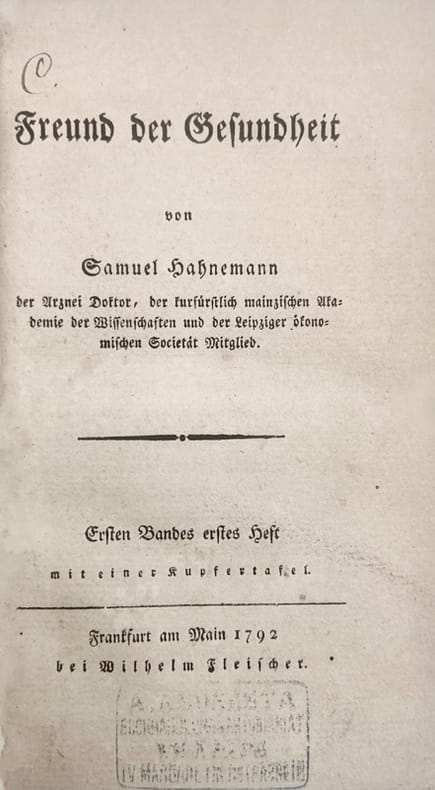
179244601Frankfurt, Wilhem Fleischer, 1792. In-12 de 1 frontispice gravé, (2)-100- (1) pp., chagrin noir, dos à nerfs, titre sur le premier plat, tête dorée.
4to. (16), 392 pp. (12), 188 pp. With one engraved frontispiece, 40 engraved folding plates, and several illustrations in the text. Later marbled wrappers. The first two volumes of the "Miscellanea Berolinensia", the scientific periodical of the Berlin Academy of Sciences (vol. 1, first issued in 1710, is present in the 1749 reprint). Bound in a single volume, they contain remarkable contributions by Gottfried Wilhelm Leibniz, among which is his "Brevis descriptio machinae arithmeticae", the description of Leibniz's famous calculating machine: the first stepped-drum calculator, being the first machine that could perform multiplication and division - an invention of major importance in the history of computing. Further, this issue includes a notable treatise on the game Go, also by Leibniz, illustrated by a folding plate showing two Japanese men playing this game. - Among the other contributors are the mathematicians Jakob Hermann and Philipp Naudé the younger, as well as the astronomers Johann Wilhelm Wagner, Christoph Langhansen and Gottfried Teuber. - The plates show Leibniz's calculating machine as well as fossils, celestial bodies and eclipses, a threshing machine, medals, and calculations with geometrical sketches. - Somewhat browned throughout. Old bookseller's ticket of Sifton, Praed & Co., London, to verso of first title-page. A fine copy of two publications reflecting the active academic scene of Berlin.
8vo. (10), 143, (9) pp. With fine woodcut frontispiece showing saw and pruning knife, 1 engraved folding plate, and 30 woodcut text illustrations. Contemporary half calf and speckled boards, spine richly gilt with gilt lettered label. The first western book on the cultivation of dwarf trees, or "bonsai". Georg Liegelsteiner was court gardener to the Archbishop of Salzburg in Austria, Count Franz Anton Harrach. His book on dwarf trees, although now largely forgotten and overlooked in botanical and horticultural literature, proved extraordinarily successful in its day, achieving six editions including the original edition of 1705. Liegelsteiner "writes about dwarfing trees so that they look like a very beautiful big tree, but only much smaller. He understands tree physiology like only a small minority of bonsai enthusiasts today. He explains in detail how to shorten roots and transplant trees often, how to shorten branches, how to correct a one-sided tree. He explains how to cut back a tree to a stump, let the new shoots grow, cut them back at strategic points, let the new shoots grown again and cut them back. It is exactly the 'Chinese' clip-and-grow technique. He makes drawings which explain the development of a dwarf tree in a way that could not be improved" (Walter Pall, Dwarf Trees of George Liegelsteiner, in: Bonsai Magazine 3 [2000]). The edition offered here is the final one, published after the death of its author, with a very interesting new preface which attempts to sketch a history of dwarf trees in Europe. It suggests that the art of growing Bonsai trees came to Versailles in the late 17th century. One of the Versailles gardeners, Grottendorf, settled in Berlin and experimented more on it. Eventually he was appointed head gardener to the wealthy merchant and Councillor Georg Bose's garden, the "Kleinbosischer Garten", in Leipzig. Liegelsteiner received advice from Grottendorf about the art of growing dwarf trees. - OCLC locates the 2 copies in US: Berkeley and National Agriculture Library; also: Berkeley (1703 ed.); Delaware, Agricult. Library, and Berkeley (1716); Berkeley and Cincinnati Museum Centre (1725)]; COPAC locates only British Library (1702 ed.) and Kew Gardens (1702 ed., their 1716 ed. 'is lost at binders' ). A very good copy. Not in Dochnahl, Hunt, Lindley Lib., Nissen, Plesch, Pritzel, Oak Sprink Sylva.
187986697Gauthier-Villars | Paris 1879 | 14 x 22.50 cm | broché
In-8 p. (mm. 226x167), importante legatura coeva in p. pelle rossa con una splendida decorazione dorata - entro cornice - impressa ai piatti (risg. rifatti), fregi al dorso a cordoni, tagli dorati, 10 cc.nn. (frontesp., dedica, prefaz. e Indice), 120 cc.num. di testo con diagrammi astrologici e numerose incisioni schematiche astrologiche; ornato da grandi capilettera figurati, inc. su legno. Dedica al Serenissimo Francesco Gonzaga, Principe di Mantova e Monferrato. Al fine vi è la nota “Apud Bartholomeum Rodellam, Haeredem Damiani Zenarij, ad Salamandrae Signum” (la marca tipografica xilografata al frontespizio). Al volume è stata aggiunta una tavola con uno stemma reale a colori e oro entro delicata cornice decorata. L’opera: “duobus libris distinctum, quorum primus complectitur commentarium in Claudij Galeni librum tertium de diebus decretoriis. Alter agit de legitimo Astrologiae in Medicina usu. His additur De annui temporis mensura in Directionibus: & de Directionibus ipsis ex Valentini Naibodae scriptis”. "Edizione originale". Cfr. Riccardi,I, p. 68: “L’applicazione dell’astrologia alla medicina era purtroppo uno degli studj che sciupava l’ingegno dei dotti di quella epoca..” - Krivatsy,7244 - Wellcome,3951. “Dotto delle matematiche, per le quali aveva un gusto particolare, Giovanni Antonio Magini (1555-1617) coltivò l’astronomia anche con maggior profitto; anzi per dedicarsi più esattamente a tale studio, trascurò anche l’esercizio della medicina, ch’egli avea appresa in Padova sua patria. Fu per oltre trenta anni professore di matematiche e di astronomia nell’Università di Bologna, ove morì all’età di 62 annni, da tutti compianto, perchè da tutti stimato. Le sue opere di astronomia e di geografia sono ancora applaudite ai giorni nostri, e rimarranno monumento della sua dottrina. Quella cui diè titolo "Novae Coelestium orbium theoricae" meritò gli elogi di Keplero; e pregevoli sono da tutti stimate le sue osservazioni e specialmente le sue tavole... Il Magini volle più direttamente applicare l’astrologia alla medicina con l’opera "De astrologica ratione.." . Così De Renzi “Storia della medicina in Italia”,III, pp. 43-44 e 65. Con solo qualche lieve uniforme arross. altrimenti esemplare ben conservato.
8vo. 16 pp. Original printed wrappers, bound within modern boards. With the author's three-line-autograph inscription to his friend Friedrich Schwandner, with whom he had studied at Tübingen and formed an illicit students' union, the "Corps Guestphalia", for which reason the two had been arrested in 1837. Both works, "Über die Torricellische Leere" and "Über Auslösung", were separately published in 1875 and 1876 within the "Beilage des Staatsanzeigers für Württemberg". Eisert 29.
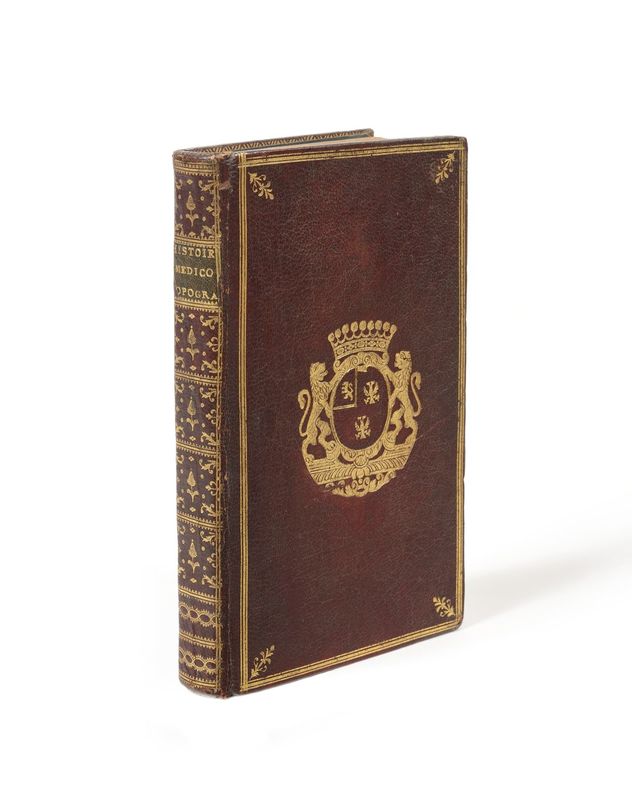
178629Paris, Hôtel Serpente, (Panckoucke), 1786 ; in-12 de [4]-xii-293-(5) pp. (privilège compris), reliure de l'époque maroquin rouge, trois filets dorés sur les plats, fleuron aux angles, armes au centre, dos lisse orné, pièce verte, roulette intérieure, tranches dorées.
in-4, pp. (8), 387, (41), leg. coeva p. perg. rigida con unghia. Dedica dello stampatore al nobile Pietro à Sprekelsen. La più completa edizione della prima opera illustrata sulla ginnastica, l'esercizio fisico e la lotta (pubblicata per la prima volta nel 1569, con una sola illustrazione). E' corredata di un frontespizio allegorico magistralmente inc. in rame da Romain de Hoogue, 6 tavole in rame f.t. (di cui 5 più volte ripieg. ed 1 su doppia pag.), 29 splendide figure nel testo, per lo più a piena pag. (di cui 2 in rame e 27 in silografia), tratte da precedenti edizioni o di nuova invenzione di Crist. Coriolano, le quali raffigurano palestre, bagni, giochi ed esercizi ginnici, competizioni ed attrezzi vari. L'autore (1530-1606), medico di Forlì, fu tra i primi che nel XVI sec. cercò di ristabilire l'educazione fisica della gioventù. Ottimo esempl. (con ex-libris Henrici de Brosia e Bibl. Roland Bonaparte).. Parkinson-Lumb, Cat. Manchester Univ., 1619. Osler 3388..
Large 4to. 2 parts in one volume. (8), XXXIX, (1), 307, (1) pp. (4), 309-633, (3) pp. With woodcut vignette to both title pages, several woodcut illustrations in the text, and printer's device on last leaf. Fine contemporary French éventail leather binding. Wants ties. Second, posthumous edition. Previously, Montebruni (1597-1644) had published his "Ephemerides" for the years 1640-45 and 1645-60. "D'apres les tables de Lansberg, pour le méridien de Bologne. Dans la part I de la publication, il y a un catalogue d'étoiles, réduites à 1630" (Houzeau/L.). - Edges, corners and spine-ends professionally restored. Sumptuous giltstamped éventail-style binding: double borders of a narrow zig-zagging design and a wider rosette-and-flower-design within floral braces and double fillets enclose a large central compartment, the corners of which are occupied by round-headed pointillé fans emanating from tendril corner stamps. The same éventail stamps form an elaborate central rosette with tendril stamps at top and bottom ends. The empty space in between in filled in by intricate tendril and dentelle blindstamping. The various elements of the design are starkly set off by empty quarter-inch fillet borders enclosing the corner éventails with quadrants and the central rosette with a lozenge; the tendril infilling is structured by the same blank borders forming a cross, thus dividing the cover into four richly tooled, mirroring quarters. The spine is framed by the same zigzag and floral borders as the covers, enclosing a narrow blank border and a finely tooled dentelle and semi-rosette design echoing the cover infilling. - Title page bears 1772 ms. note of ownership by the Capuchin monk Giovanni da Cento, who introduced the volume to his monastery's library in Cento (Emilia-Romagna). Later in the library of the Swedish collector Thore Virgin (1886-1957) with his repeated signature (dated Stockholm, 16 May 1914) and his bookplate (dated 1911) and collection stamp ("Bibliotheca Qvarnforsiana"). Additional bookplate of Rolf Wistrand. Riccardi II, 180, 2. Houzeau/Lancaster 15161. OCLC 68956764. Lalande 211 ("1640").
162642497Paris, Jean Libert, 1626. In-12 de (28)-476-(56) pp., maroquin vert, dos lisse orné, frise et roulette dorées d'encadrement sur les plats (reliure du XVIIIe siècle).
In 8° ant., leg. mod. con p. perg. antica muta, pp. 334 (i.e. 336), (64); buon es. di rara ed. latina di Paracelso, con il commento di Leone Suavio, la vita In 8° ant., leg. mod. con p. perg. antica muta, pp. 334 (i.e. 336), (64); buon es. di rara ed. latina di Paracelso, con il commento di Leone Suavio, la vita (CAT 8)
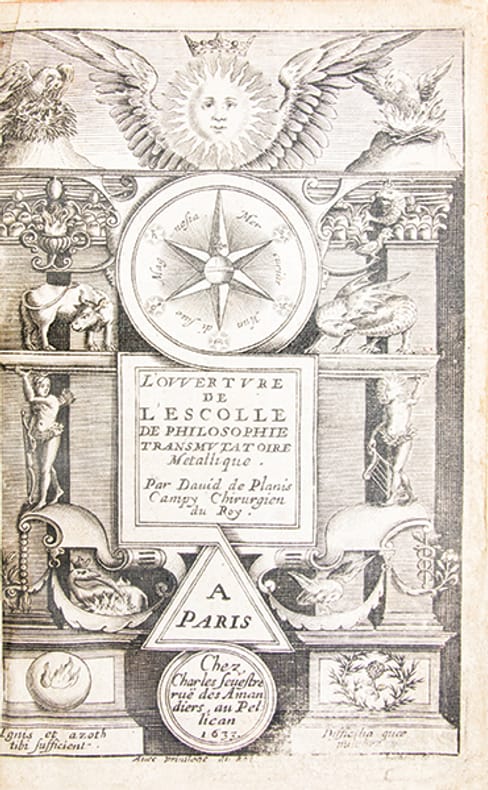
39278Petit in-8° (165 x 102 mm), veau havane, dos à 5 nerfs guillochés or, orné de caissons cloisonnés et fleuronnés, plats encadrés dun filet à froid frappés en leur centre des armes dAntoine-Charles de Gramont, filet sur les coupes, tranches rouges (ca 1710), (36), 185, (4) pages de privilège et errata, grande marque typographique au verso du dernier feuillet, page de titre frontispice gravée, portrait de lauteur à pleine page. Paris, chez Charles Sevestre, 1633.
4to. 2 vols. (out of 10). XVI, 222 pp. IX, (1), 256 pp. With 2 hand-coloured, engraved title pages and 225 hand-coloured, engraved plates (some folding), numbered 1-222, with a/b numbers for 114, 172, 198). Contemporary half calf with giltstamped green spine labels. Marbled endpapers. All edges sprinkled in red. The first two volumes of this rare work of decorative plates showing flowers and other plants, including fruits. Contains the first 225 of a total of 1090 engravings published until 1820. The Viennese physician Vietz, who combined artistic talent with a penchant for botany, began publication of this monumental ten-volume work in 1800; only the first three volumes were edited by him personally. The Natural History Museum, London, described its own copy thus: "Today, the work appears to be of extreme rarity, not being held in any other of the United Kingdom's national or public library collections. Only three copies have been found in North American libraries, of which two are certainly fragile and in need of conservation. One copy is in the Austrian National Library" (Great Flower Books [1990], p. 147). - Clean and well-preserved throughout. Nissen, BBI 2062. Stafleu/Cowan 16.153. Pritzel 9764. Wurzbach 50, 282f.
Folio (200 x 323 mm). 2 parts in one vol., with appendix. (14), 516, 40, (4) pp. Title-page printed in red and black. With engraved title by R. Hooghe and 111 (instead of 114) engraved plates after Witsen (1 folded). Contemporary full calf over wooden boards with giltstamped borders, spine, and spine-title. First edition. The standard work on shipbuilding by a Dutch author - the leading nation in naval architecture in the early modern period. This seminal work contains detailed descriptions and illustrations as well as an account on the history of navigation and ship building since antiquity, discussing construction techniques, different types of ships, and naval architecture from across the world as observed by the author during his travels. - Nicolas Witsen (ca. 1640-1717) was mayor of Amsterdam 13 times between 1682 and 1706. In 1693 he became administrator of the Dutch East India Company (VOC). In his free time he was a cartographer and maritime writer, as well as an expert on Russian affairs. - Binding somewhat rubbed; front hinges broken. Title-page waterstained; upper portion of the gutter waterstained in entire first half of the volume; occasional marginal tears, browning and light fingerstaining. Still a good working copy of the classic that in 1697 inspired Tsar Peter the Great to a four-month training period at the Dutch East India Company shipyards organised by Witsen. Landwehr, Romeyn de Hooghe 16. NNBW IV, 1473. Cf. Poggendorff II, 1344 (Latin title).
175840192DBNürnberg, bey Johann Josef Fleischmann, 1758. Gr.-Folio. Titel, 41 S. Mit 39 gestochenen Tafeln. Etwas späterer Halblederband mit goldgeprägtem Rückenschild und wenig Rückenvergoldung.
171430128Oeuvres Françoises de M. Vieussens dediées à Nosseigneurs des Etats de la Province de Languedoc (3 Titres en 2 Volumes - Complet), en 2 vol. in-4 reliure de l'époque pleine basane marron, dos à 5 nerfs orné, avec DANS LE PREMIER VOLUME : Traité Nouveau de la Structure et des Causes du Mouvement Naturel du Coeur. Première édition et Traité Nouveau de la Structure de l'Oreille. Première édition, Chez Jean Guillemette, Toulouse, 1715 (Coeur) et 1714 (Oreille), portrait de Vieussens par Poussin en frontispice, titre général (avec belle vignette aux armes du Languedoc), titre du Traité du Coeur (avec belle vignette allégorique), 4 ff. (Epistre avec beau bandeau et letre historiée), 8 ff. (préface et privilège), 1 f. (Tables), 141 pp., 5 ff. n. ch. (faux-titre du Traité de l'Oreille et tables), 1 f. (Titre), 5 ff. (Préface, Epistloa et Table des Chapitres), 102 pp. et 3 ff. n. ch. (Tables), avec les 14 planches dépliantes du Traité du Coeur (2 planches numérotées 11), et les 6 planches du Traité de l'Oreille - Et DANS LE SECOND VOLUME : Traité Nouveau des Liqueurs du Corps Humain. Première édition. Chez Jean Guillemette, Toulouse, 1715 , 2 ff. (titre général et titre du Traité des Liqueurs), 4 ff. (Préface et tables), 388 pp., 8 ff. n. ch. (tables) et 1 f.blanc, avec insertion de 2 ff. paginés de 255* à 258 * entre les pages 386 et 387, et avec 1 planche "dessinée par M. Lafon et gravée par Simonneau"
196859947London, Macmillan, 1968. Large8vo. In contemporary full green cloth with gilt lettering to spine. In ""Nature"", vol. 220, 1968. Entire vol. 220, October - December offered. Small white paper label pasted on to lower part of spine. Stamps to fore edges. Pasted down- and free end-papers with stamps and paper labels from Gettysburg College Library. ""Withdrawn""-stamps to pasted down front end-paper and front free end-paper. P. 650. [Entire volume: (2), 1366, III- XXVIII pp.].
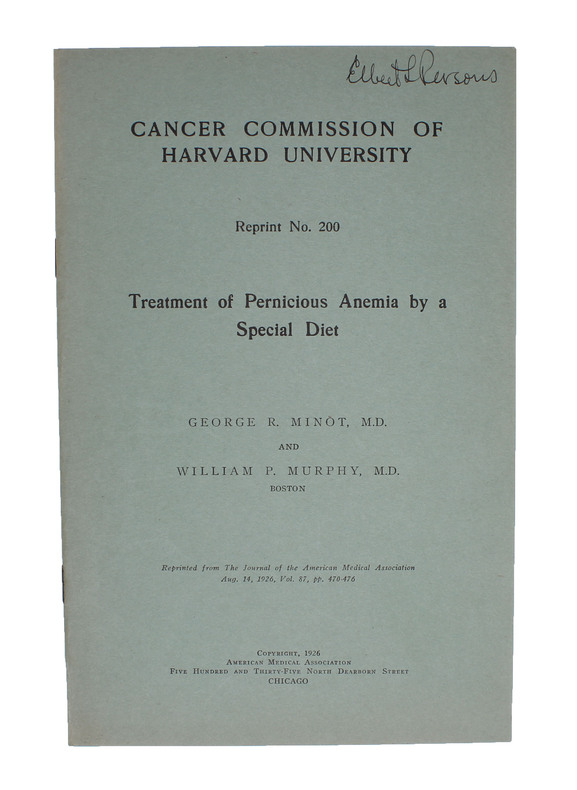
192651659Chicago, American Medical Association, 1926. 8vo. Offprint in the original printed wrappers. Previous owner's name to top right corner of front wrapper. A very fine and clean copy. 19 pp.
180916223Indbundet i 85 samt. hldrbd., her og der med brugsspor samt 1 papbd. Et bind med de første blade beskadiget og manglende forperm. Enkelte kobbere synes at mangle. Ialt mangler 5 bind af rækken (= Nyt Bibliothek..bd. 22,27,31,37 og 38).
155260622Strassburg, Balthassar Beck, 1552. 4to. In contemporary blindstamped half pigskin-binding over wooden boards with later marbled paper covering the boards. Endpapers renewed. Upper part of spine with title paper-label. Wear to extremities and front board partly detached. Last blank leaf with annotations in contemporary hand. Internally fine and clean. (6), XCVIII, (7), (blank), (4), CLV, (8) ff. One woodcut illustration in text.
London, Macmillan, 1968. Large8vo. In contemporary full green cloth with gilt lettering to spine. In ""Nature"", vol. 220, 1968. Entire vol. 220, October - December offered. Small white paper label pasted on to lower part of spine. Stamps to fore edges. Pasted down- and free end-papers with stamps and paper labels from Gettysburg College Library. ""Withdrawn""-stamps to pasted down front end-paper and front free end-paper. P. 650. [Entire volume: (2), 1366, III- XXVIII pp.].