Auenbrugger, LeopoldAntiquariat.de

98 727 résultats
176331169ABWien, Johannes Thomas Trattner, 1763. 8°. 95 S. Halbpergament der Zeit mit handschriftlichem Rückentitel und Marmorpapierbezug. + Wichtig: Für unsere Kunden in der EU erfolgt der Versand alle 14 Tage verzollt ab Deutschland / Postbank-Konto in Deutschland vorhanden +, A|B|C|D [4 Warenabbildungen]
Pagine: 4+140+2+2+XII+173+3+2+36+132+2 Facciate. . Formato: 24° . Rilegatura: Cartonato in pelle marrone, tre nervature, bordi in oro. Parte bassa del dorso con piccole mancanze di pelle. Due piccoli forellini nella parte alta del dorso. Non vi sono fori all'interno del volume. . Stato: Buono . Caratteristiche: Bruniture, Il frontespizio relativo all'opera di Ippocrate è rifilato, incidendo nella parte alta dell'indicazione dell'autore. Note di mano antica sparse nei margini del testo. Unione di tre testi fondamentali per quanto riguarda la medicina antica, il Qanun dell'Avicenna, l'Arte dei Medicinali di Galeno e gli Aforismi di Ippocrate. Tre opere, stampate dal Frambotti di Padova in tre date diverse ma legate dalla stessa motivazione. . Note epoca: 1642, 1638
189089205Challamel | Paris s. d. [1890] | 35.8 x 27.7 cm | Reliure de l'éditeur
8vo (162 x 232 mm). 387, (1) pp. With a folding lithographed plate. Publisher's original burgundy cloth. First Czech edition of Darwin's "On the Origin of Species", called "the most important single work in science" (Dibner) and "a turning point, not only in the history of science, but in the history of ideas in general" (DSB). "No work of science has ever been so fully vindicated by subsequent investigation, or has so profoundly altered humanity's view of itself and how the living world works" (Wilson). - The Czech translation predates the Latvian, Armenian, Ukrainian, Bulgarian, Romanian and Slovenian versions by several years. The translator, Professor Fratisek Klapálek, was a prominent entomologist, a founding member and the first chairman of the Czech Entomological Society. - Covers very lightly warped, but finely preserved altogether. Freeman 641. OCLC 62034158. Cf. PMM 344.
192686898Etablissements Pathé-Cinéma | Paris 1926 | 16 x 25 cm | relié
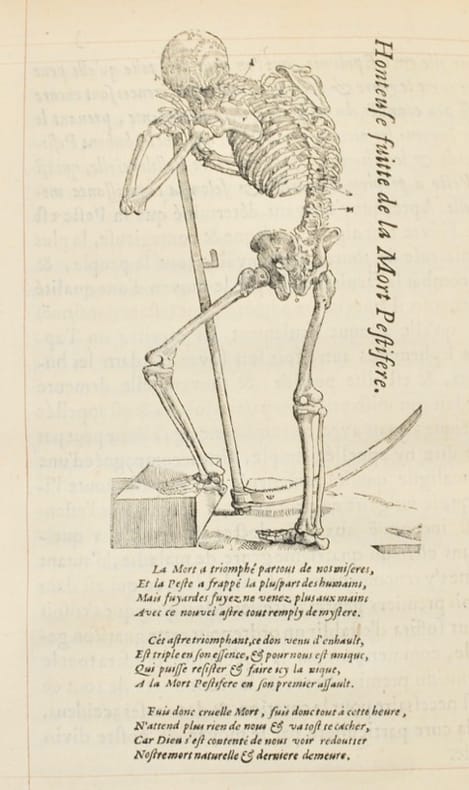
167142631A Paris, chez François Clouzier, Sébastien Cramoisy, 1671. In-4 de (18)-154 pp. les pages 97/98 forment un tableau in-folio replié.L'Antiloimotechnie ou l'art qui chasse la Peste, et tous ses accidents, qui sont, le Pourpre, la petire Verolle, la Rougeolle pourpre, la Dyssenterie, les Bubons, les Charbons, l'Estiomene, & la Gangrene, par une Methode generale de la Medecine, & par un remede experimenté appelé Alexipharmaque. 1671. In-4 de (10)-83-(1) pp.2 parties en 1 vol in-4, veau brun, dos orné à nerfs, armes gaufrées au centre des plats, tranches dorées (reliure de l'époque).
Edizione: Prima edizione . Pagine: VIII+157+10+2 . Illustrazioni: Al front. Colonna infuocata DEO DUCE ET VINDICE. Pg. 44 Incisione su legno, così come a pg. 110 e a pg. 113 ( Strumenti medici vari), le ultime due a piena pagina. . Formato: 16° . Rilegatura: Pergamena coeva, legatura molle. . Stato: Discreto . Caratteristiche: Dimensioni cm. 16,50 per cm. 10. Esemplare brunito, presenza di due foi di tarlo poste nel margine inferiore, senza interessare il testo per 55 pagine. Al frontespizio Guilhelmi Fabricii Hildani Inclytae Reipub. Bernensis Helvet. Medico-Cheirurgi ordinarii. L'autore fu padre della chirurgia tedesca moderna, scrisse 20 testi di medicina. Testo rarissimo a trovarsi, qui in prima edizione. Fu il marito di Marie Colinet, la prima a sviluppare la tecnica chirurgica del parto cesareo.Lavorò a Dusseldorf, Payerne, Lausanne e Bern. .
188586741Cannes s. d. [8 mars 1885] | 11.10 x 17.20 cm | une page et quart sur un bifeuillet
(6), 110 pp. With engr. frontispiece (M. Rein sc.). Modern marbled boards. 8vo. First edition in book form (parts had been published in 1720 in the periodical "Berlinische und Cölnische ordinaire Post-Zeitung"): descriptions of lamps capable of burning for prolonged periods without having to be refueled, invented by the Saxonian court mechanic Andreas Gärtner (1654-1727). Gärtner, a cabinet maker and mechanic, had learned his trade over twelve years travelling throughout Germany and Italy (Venice, Bologna, and Rome). By 1686 he was royal cabinet maker to the Dresden court, and later also royal mechanic. Delighting in complicated machanical models and devices, he soon became known as the "Saxon Archimedes". Unfortunately, most of his works perished in a fire at the Wackerbarth Palace in 1728. Gärtner's famous world clock (c. 1700), boasting 365 dials, has survived and still draws crowds at the Dresden Zwinger. The frontispiece shows some of his newly-invented lamps. - Rare; KVK locates 4 copies in Germany (Erlangen, Augsburg, and Munich); OCLC locates no copies in the U.S.; not in COPAC. - Insignificant browning. A very good, clean copy. Thieme/Becker XIII, 37ff.
Pagine: 804+240 facciate . Illustrazioni: Antiporta grande disegno A MANO Originale raffigurante Ippocrate, bellissimo, all'interno di cerchio il cui dimetro è di cm.15,50.Frontespizio e fine 2 marche con due mani da nuvole reggenti un bastone avvolto da due serpenti e un uccello aFormato: 4° . Rilegatura: Cartonato in pelle marrone con linee in oro demarcative ai piatti e cinque nervature al dorso . Stato: Buono . Caratteristiche: Segni di tarlo al margine destro bianco da pg. 147 a 179 non toccanti nessuna parola. Ulteriore forellino sempre su margine bianco da pg. 740 al termine volume. .
180291311Maillard Chez l'Auteur Agasse | Paris An x (1802) | 12.8 x 20.4 cm | Relié
4to. (10), 226, (26) pp. Title page printed in red and black. With engraved frontispiece (J. G. Puschner del et sc.), engr. separate double-page-sized title, and 28 double-page-sized engraved plates. Contemporary half vellum with ms. spine title; all edges coloured blue. A later edition of Kirchner's important manual of Jewish ceremonies and rites, first published in Jauer in 1716 (while Jungendres's expanded and well-illustrated edition first appeared in 1724). The plates show Rosh Chodesh, the Sabbath, Passover, Shavuot, Rosh Hashanah, Yom Kippur, Sukkot, Chanukkah, Purim, circumcision, engagement, marriage, divorce, burial, etc., as well as liturgical objects, costumes, and rooms. The Polish-born Kirchner had been a rabbi in Fürth before converting to Protestantism in 1713, giving up his birth name Gumpel Mardochai (though Jungendres's preface suggests that he later returned to his old faith). Many of his descriptions are representative of the stricter Polish rites, rather than those observed by the more lenient German community. The engravings by the Nuremberg artist Johann Georg Puschner (commissioned by Jungendres) depict scenes from the Jewish congregation and synagogue of Fürth. "Today most libraries offer merely the reprint published in 1974. This reproduces the Erlangen University Library's copy of an edition of which the exact year of printing is not known, as it is not fully printed, reading only '173...'. Thus, it is only known that another edition was produced in the 1730s - likely in 1730, and certainly in 1735" (cf. Herzig, p. 19). In the present copy, the year of printing has been completed by a contemporary hand to read "1739". Binding somewhat rubbed and stained; old library shelfmarks to flyleaf. Altogether a good, fairly wide-margined copy. A. Herzig, Das Interesse am Judentum zu Beginn des 18. Jahrhunderts: Paul Christian Kirchners 'Jüdisches Ceremoniel', in: Ashkenas 20 (2010), pp. 1-20. Cf. Lipperheide Oc 20. Hiler 500. Fürst II, 190. Mayer, Bibliography of Jewish Art, 1261. Not in Colas.
In-8 p. (mm. 230x168), mz. pelle ottocentesca, dorso a cordoni con ricca decorazione e tit. oro, tagli rossi, pp. XL,430,(2), frontespizio con titolo in rosso e nero e stemma del dedicatario Benedetto XIV inciso in legno, ornato da grandi capilettera figurati a vignetta pure xilografati. L’opera è illustrata f.t. da un ritratto dell’Autore in ovale e da 8 tavole, numerate e più volte ripieg., sulla struttura del cuore, inc. in rame: alcune da Nicola Oddi su disegni di Niccolò Ricciolini. Le tavole sono tutte dettagliatamente descritte. Da p. 369 alla fine “Joannis Mariae Lancisii dissertationes ‘De vena sine pari, et de gangliis nervorum”. Quarta edizione ma seconda romana. In quest’opera, pubblicata dopo la morte dell’Autore, vengono trattate le varie cause dell’allargamento del cuore e vengono descritti per la prima volta gli aneurismi di origine sifilitica, contribuendo in maniera sostanziale alla conoscenza della patologia. Cfr. Castiglioni, p. 567: "Giovanni Maria Lancisi (1654-1720), medico e cameriere segreto di tre pontefici, consigliere di Luigi XIV di Francia che ne aveva grandissima stima, godette somma autorità fra gli scienziati del suo tempo.. Fra i medici che seguirono il concetto ippocratico merita d’esser nominato in primissima linea il Lancisi, che studiò con acuto criterio diagnostico le malattie del cuore". - Garrison and Morton,2973 per la prima ediz. del 1728: “Lancisi noted the frequency of cardiac aneurysm and showed the importance of syphilis, asthma, palpitation, violent emotions and excess as causes of aneurysm. He was the first to describe cardiac syphilis” - Blake,254. Esemplare ben conservato, con timbri di appartenenza privata; ex libris “Vincenzo Gallucci”, l’illustre cardiochirurgo che eseguì il primo trapianto di cuore in Italia.
Large 8vo. (4), 314 pp. With figural woodcut vignette on title-page, 1 printed and 6 engraved folding plates of tables. Contemporary marbled calf with giltstamped title to gilt spine. Leading edges gilt. Edges in red. First edition of one of the most important works in the history of modern chemistry. "To persuade a new generation of chemists to join their ranks and to complete what Lavoisier had envisaged since 1773 - a revolution in chemistry - these men brought out a collaborative work, the 'Méthode [...]'. Originally suggested by Guyton de Morveau to eliminate the confused synonymy of chemistry, and prefaced by a memoir of Lavoisier, it emerged as a complete break with the past" (DSB VIII, 80). The result of this collaboration by de Morveau, Lavoisier, Berthollet, de Fourcroy, Laplace, and Monge is the system presented within the present work, which was to form the basis for the nomenclature still used today, the language of modern chemistry. "The work lists 55 known elements in a series of tables, introducing many new terms which have remained in standard use" (Norman Cat., 604). - Spine-ends damaged; lower corner of front cover bumped. Slight worming to front hinge (small defect at top end). Some browning and finger-smudging inside. First engraved plate water-stained. Front pastedown with contemp. French bookseller's label of the Viennese bookseller Jean-Baptiste Mangot (cf. Öhlberger, p. 203 and 290). Duveen 340. Duveen/Klickstein 126. Honeyman 1936. Norman 1291. DSB VIII, 87.
177743424Paris, Debure, 1777. In-8 de XVI-208 pp., portrait en frontispice, 26 planches numérotées, maroquin rouge, dos lisse orné, pièce de titre en maroquin vert, triple filet doré d'encadrement sur les plats, fleurons aux angles, doublure et gardes de papier dominoté, tranches dorées (reliure de l'époque).
192785330Les éditions de France | Paris 1927 | 11.50 x 18.50 cm | relié
170888653Jean-Baptiste Besongne | Rouen 1708 | 9.5 x 16.8 cm | Relié
in-4, pp. (36), 407, leg. coeva p.pergamena, titolo calligrafato lungo il dorso. Frontesp. inciso entro bordura architettonica a figure, 5 incisioni in rame e 26 silografie, assai belle, per lo più a piena pagina, raffig. anatomie, scene di parto, feti, e strumenti chirurgici; tra queste, la prima raffigurazione di un taglio cesareo, senza anestesia, ed una di un parto nella "posizione di Walcher". Dedica a Ottaviano Malipiero. La seconda e terza parte hanno frontespizio separato (quello della seconda riporta per errore "libro terzo"). Terza edizione del primo libro italiano di ostetricia; pubblicato nel 1595-96 (edizione di estrema rarità), ebbe enorme diffusione e ristampe sino al Settecento. "La Commare is divided into three books, the first dealing with natural labour, care of the pregnant woman and of the new born child; the second book takes up the abnormal presentations and their management, and the third deals with various maladies.." (Thoms, pp. 105). "The first Italian book on obstetrics. It is a work of importance for the study of the history of Caesarean section; in it Mercurio advocated the Caesarean operation in cases of contracted pelvis'"(Garrison and Morton). (Esempl. con qualche lavoro di tarlo restaurato, per lo più marginale; bordura del titolo lievem. rifilata in alto, arrossature).. BMC, XVII, 569. Krivatsy 7804; Wellcome 4259. Garrison Morton 6144. Govi, Classici, 141 (ed. 1595)..
161140476DBFrankfurt, Zacharias Plathenius, 1611. Folio. (8) Bl., 567 S., (15) S. (Index), 1 weisses Bl. Mit einem Holzschnittporträt verso auf Blatt zwei und einer Titelholzschnitt-Vignette. Flexibler Pergamentband aus der Zeit mit handschr. Rückentitel. + Wichtig: Für unsere Kunden in der EU erfolgt der Versand alle 14 Tage verzollt ab Deutschland / Postbank-Konto in Deutschland vorhanden +, A|B [2 Warenabbildungen]
18504322Mit lithogr. Frontispiz mit Tonplatte u. 15 (13 gest., 2 lithogr.) Tafeln. Berlin, C. Reimarus, W. Ernst, 1850. Kl.-Folio (35,8 x 27,0 cm). 3 Bl., 28 S., 1 Bl. Druckfehler. Orig.-Halbleinwandband. [7 Warenabbildungen]
174630129DBGotha, verlegts Christian Medius, (1746)-1751. 8°. Mit 6 gestochenen Tafeln in Band 1. Pappbände der Zeit mit späteren, handschriftlichen Rückenschildern. + Wichtig: Für unsere Kunden in der EU erfolgt der Versand alle 14 Tage verzollt ab Deutschland / Postbank-Konto in Deutschland vorhanden +, 30129D 7 Bände (von 8).
In-8°, pp (28), 104, legatura in pergamena coeva, titolo manoscritto al dorso, firma di appartenenza coeva, buona copia, estremamente rara. Questi due scritti vichiani, in edizione originale, furono inseriti come dedica e prefazione all’opera “La Sifilide di Gerolamo Fracastoro tradotta di Pietro Belli”. Il primo scritto è particolarmente importante essendo una presentazione elogiativa, scritta dal Vico stesso ma fatta firmare dal Belli, della Seconda Scienza Nuova al potente monsignor Ernesto von Harrach, nipote del Viceré di Napoli. Il Nicolini in “Bibliografia Vichiana”, 1, p. 89, afferma che “di questo libriccino non si conosce se non l’esemplare serbato nella collectio del Croce”. Gamba, 2244 In-8 °, pp (28), 104, contemporary vellum binding, handwritten title on the spine, contemporary owners’signature, good copy, extremely rare. These two Vichian writings, in original edition, were included as a dedication and preface to the work "La Sifilide di Gerolamo Fracastoro tradotta da Pietro Belli". The first writing is particularly important as it is a laudatory presentation, written by Vico himself but signed by Belli, of the Seconda Nuova Scienza to the powerful Monsignor Ernesto von Harrach, nephew of the Viceroy of Naples. Nicolini in “Vichiana Bibliography”, 1, p. 89, states that "of this little book we know only the copy kept in Croce’collection". Gamba, 2244
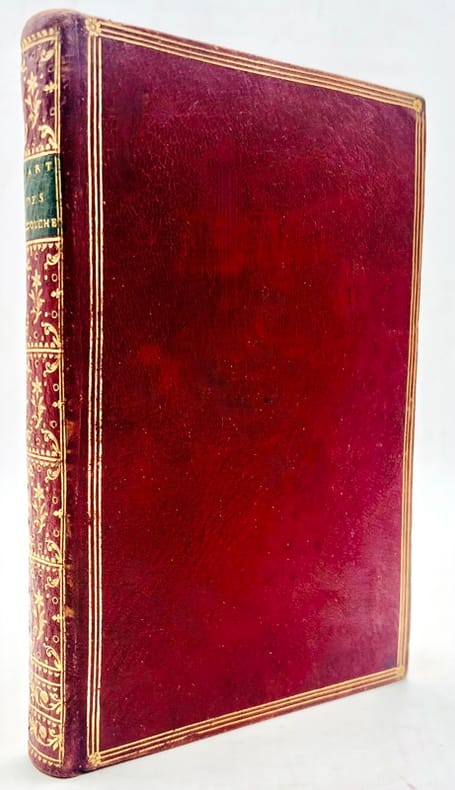
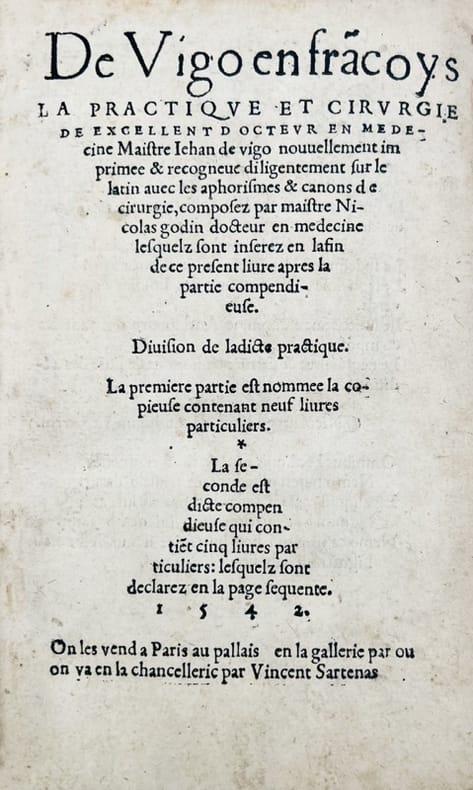
154244491Paris, Vincent Sartenas, 1542. Petit in-8 de 505-(7) ff. (sign. a-z8, &8, AA-RR8), table, maroquin brun, dos à nerfs titré orné du fleuron aldin doré répété quatre fois, double encadrement à froid et fleurons dorés aux angles, frise et roulette dorées intérieures, tranches dorées sur marbrure (Closs).
16966277Noo: 1 (und: No: 2). 1696. Lateinische und deutsche Handschrift von zwei Händen auf Papier. 2 Teile. Durchschossen. 4to. (20,8 x 17,0 cm). Möglicherweise Jena 1696. Geheftet, aber ohne Einband.
<p><span>per li Manolessi, In Bologna, 1672. In 4°, 22 cm, rilegatura coeva in piena pergamena, dorso a cinque nervi, titolo in oro su tassello. p. (24), 406, (2) Volume riccamente illustrato, prima antiporta architettonico a tutta pagina con porticato ornato dalle insegne alle armi del decicatario, il cardinale Francesco Barberini (stemma con tre api) e stemma degli accademici Gelati con il motto "Nec longum tempus", sullo sfondo la città di Bologna in lontananza ed una selva di alberi spogli ricoperti dal gelo (simbolo degli Accademici Gelati). Ritratto del cardinale Barberini, inciso da Hubert van Otteren al retro del frontespizio. Secondo frontespizio calcografico con impresa dell'Accademia dei Gelati incisa da Lorenzo Tinti su disegno di Agostino Carracci. 31 ritratti e 71 stemmi con le "imprese" degli accademici gelati a cui è sempre accompagnato un motto ed un aggettivo attribuito all'accademico rappresentato; La pubblicazione è a cura di Giovambattista Capponi, il cui nome figura nella dedicatoria e firma l'introduzuine come "animosissimo segretario". Testo entro doppia conrice, testatine incise su rame, capilettera, fregi e finalini xilografici in cui sono ricorrenti le iconografie del dedicatario e degli accademici (le api ed i rami "gelati"). Antico restauro al dorso sotto al tassello ed al margine della pagina 105-106. Le prime quattro carte leggermente brunite e qualche sporadico alone, ma</span> pagine per lo più bianche ed in ottimo stato. Alcuni errori di impaginazione carattestici dell'edizione. Bell'esemplare completo in tutte le sue parti, con incisioni fresche e nitide.</p>