98 727 résultats
8vo (160 x 228 mm). 2 vols. XVI, (2), 303, (1) pp. VII, 361, (3) pp. With a double-page plate in vol. 1 and a portrait frontispiece in vol. 2. Publisher's original green cloth. All edges gilt. First Hungarian edition of Darwin's "On the Origin of Species", called "the most important single work in science" (Dibner) and "a turning point, not only in the history of science, but in the history of ideas in general" (DSB). "No work of science has ever been so fully vindicated by subsequent investigation, or has so profoundly altered humanity's view of itself and how the living world works" (Wilson). - Translated by László Dapsy, revised by Tivadar Margó. Bindings a little rubbed, extremeties worn, interior quite clean. Original publishers' binding by Lajos Bóka of Pest signed with his blindstamp to the white lacquer endpapers. Freeman 703. OCLC 978009347. Természettudományi társulat vállalata II-III. Cf. PMM 344.
I: Zur Theorie der Lichtfortpflanzung in dispergierenden Medien. 1922. [Weil 120. Seelig 162. Schilpp-Shields 145. Boni 132]. - II: Zu Kaluzas Theorie des Zusammenhanges von Gravitation und Elektrizität. Erste [und zweite] Mitteilung. 1927. [Weil 156. Seelig 212]. - III: Riemann-Geometrie mit Aufrechterhaltung des Begriffes des Fernparallelismus. 1928. [Weil 161. Seelig 161. Boni 174]. - IV: Neue Möglichkeit für eine einheitliche Feldtheorie von Gravitation und Elektrizität. 1928. [Weil 162. Seelig 218. Cf. PMM 416]. - V: Einheitliche Feldtheorie und Hamiltonsches Prinzip. 1929. [Weil 166. Seelig 227. Schilpp-Shields 227. Boni 184. Cf. PMM 416]. - VI: Die Kompatibilität der Feldgleichungen in der einheitlichen Feldtheorie. 1930. [Weil 169. Seelig 239]. - VII: Zum kosmologischen Problem der allgemeinen Relativitätstheorie. 1931. [Weil 179. Seelig 249, Schilpp-Shields 249]. - VIII: Systematische Untersuchung über kompatible Feldgleichungen, welche in einem Riemannschen Raume mit Fernparallelismus gesetzt werden können. 1931. [Weil 180. Seelig 250. Schilpp-Shields 250]. - IX: Einstein & W. Mayer: Einheitliche Theorie von Gravitation und Elektrizität. 1931. [Weil 182. Seelig 251. Hook/Norman 701]. - X: Einstein & W. Mayer: Einheitliche Theorie von Gravitation und Elektrizität. Zweite Abhandlung. 1932. [Weil 185]. 10 of a total of 36 "Sonderausgaben aus den Sitzungsberichten" published under Einstein's name between 1914 and 1932. Such offprints of the session reports of the Academy of Sciences (largely with independent pagination) were presented to the author by the publisher in a limited number as vouchers or dedication copies. - The present offprints date from Einstein's middle and late period at the Berlin Academy. They mainly treat the connection between gravity and electricity/electromagnetism. Einstein strove for a "unified field theory", as the General Theory of Relativity did not allow for properly integrating the electromagnetic field into the geometry of space-time. After a first attempt at a solution in 1925, Einstein tackled the problem again three years later, "only to find that Riemann's conception of space, on which the general theory was based, would not permit of a common explanation of electromagnetic and gravitational phenomena. In a series of papers devoted to the development of 'A Uniform Theory of Gravitation and Electricity' he outlined a new theory of space with a view to the unification of all forms of activity that fall within the sphere of physics, giving them a common explanation. All that would then remain to complete a scientific unison is the correlation of the organic and inorganic" (PMM 416). - The present offprints reach from the first publication after the Nobel Prize to the last but one before Einstein's leaving Germany. Three articles were published in collaboration with Einstein's assistant, Walter Mayer. - One issue with slight crease to front cover, otherwise very well preserved throughout.
In-4 p. (mm. 320x220), mz. pelle settecentesca (risg. rifatti), dorso a cordoni con filetti e tit. oro, 4 cc.nn., 288 pp.num., testo su due colonne, marca tipografica al frontespizio, ornato da testate e grandi iniziali figurate a vignetta inc. su legno, con 9 tavole f.t. inc. in rame. Queste interessanti e famose tavole, su disegno di Angelo Carlesco da Pordenone, raffigurano strumenti chirurgici. L'opera è divisa in due parti: "Nella prima si tratta delli Tumori, Ferite, Ulceri, Rotture e Slocature - Nella seconda delle Operationi principali di Chirurgia. Tradotte in lingua Italiana. Et in questa seconda impressione aggiuntovi un Compendio della Chirurgia di Marco Aurelio Severino, diviso in Libri Sei, tradotto nell'Italiano utilissimo ai Professori di Chirurgia". Cfr. De Renzi,III, pp. 647-652 - Premuda, p. 144 e segg. - Cat. Piantanida,II,1905 - Wellcome Library,III, p. 4. Leggerm. corto di margine; con lievi uniformi arross. e tracce d’uso interc. nel t.; la p. 47 restaur. per piccolo strappo, ma certamente un buon esemplare. Gerolamo Fabrizio d'Acquapendente (1537-1619) fu uno dei più grandi anatomici e chirurghi del suo tempo.. Nei lavori di Fabrizio si trovano indicate macchine costruite a scopi ortopedici, come ad es. per la cura del collotorto, delle deviazioni della colonna vertebrale, ecc. Inventore ingegnoso di nuovi apparati, fu senza dubbio il chirurgo più in voga nell'Italia del Rinascimento, cosi' Castiglioni, p. 475.
in-folio, pp. (12), 359, illustrato da vignetta inc. sul titolo e 9 magnifiche tavole a piena pagina di strumenti chirurgici inc. in rame f.testo. Elegante legatura ottocentesca in p.pelle, decorata in oro. Vasto trattato seicentesco di chirurgia, assai importante, la cui prima edizione apparve a Padova in latino nel 1641. Fabrizzi (1533-1619) fu stimato professore di anatomia e chirurgia nel famoso Studio di Padova. Esemplare a pieni margini.. Wellcome, Medical Library, III, p.4. Pazzini n.79..
4to. (8), XLVIII, 362, (14) pp. With 22 folding engraved plates, title vignette, and 19 engraved text vignettes. Contemporary vellum with double fillets, blindstamped centrepiece, and ms. title to spine. All edges sprinkled in red. First edition of the Parisian astronomer's work about the application of Newton's Laws to astronomy. The plates mostly depict astronomical and mathematical diagrams. The attractive text vignettes by Charles Nicolas Cochin le jeune (1715-90) are an early example of his book decorations. - Fine copy with ms. note of ownership by "Ed. Declercq, Prof." and bookplate "Dr. Hautrive père". - Important work, recently edited on microfilm in the "Landmarks of science" series. Poggendorff I, 840.
4 opere in 6 parti in un vol. in 8°(185x120); pagg. 64, 48, 111, 22, 1 bianca, 61, 1 bianca, 64. Capilettera ornati e fregi silografici; testo francese. Piena pergamena floscia coeva con titolo manoscritto al dorso. Rara prima edizione francese di tutte le opere presenti, e tradotte da Du Teil. Glauber, famoso alchimista del '600 (Karlstat 1604 - Amsterdam 1668) scrisse fra le sue opere questo trattato di alchimia estremamente raro nell'edizione francese, dove viene" enseignèe là separation de l'ordes pierres à feu, sable, argile, et autres fossiles, par l'Esprit de Sel, ce qui né se peut faire par autre voye…." .Bell'esemplare genuino, lievissime saltuarie fioriture, tarletto restaurato al marg. sup per circa 32 pagg. , insignificante lesioni al testo per circa 20 Caillet, 4564, 4584.
Kl.-Folio (200 x 305 mm). (8), 42 SS. Mit gest. Titelvignette und 4 (davon 2 gefalteten) gest. Tafeln mit ca. 80 beweglichen Teilen. Halbleinenband des 19. Jhs. mit goldgepr. Deckeltitel "Anatomie". Zweite verbesserte und noch zu Lebzeiten Hellwigs erschienene Ausgabe des erstmals 1716 erschienenen anatomischen Ansichtenwerks, einer Überarbeitung von Johann Remmelins "Catoptorum Microscosmicum". Von besonderem Interesse sind die vier von J. H. Werner gestochenen anatomischen Tafeln mit vielen ausklappbaren Teilen (einige lose in der Bauchhöhle; sichtlich jedoch alle Teile vorhanden). Christoph von Hellwig (1663-1721) war Stadtphysicus zu Erfurt, Publizist und Schöpfer des "Hundertjährigen Kalenders". - Einband etwas beschabt und gering bestoßen Titelblatt aufgezogen und knapp beschnitten, dadurch fehlt ein Teil des Impressums. Tafel IV im Falz hinterlegt. Durchgehend gebräunt und braunfleckig sowie wasserrandig. Wellcome III, 240. Waller 4288.
(10), 671, (17) SS. Titel in rot und schwarz gedruckt. Mit gest. Frontispiz und 9 Kupfertafeln. Pergamentband der Zeit auf 3 durchzogenen Bünden mit hs. Rückentitel. Dreiseitiger Rotschnitt. 8vo. Erste Ausgabe. "The best early accounts of arsenic, zinc, and a variety of pyrites" (Hoover). Bei dem von Henckel beschriebenen neuen Blau handelt es sich um das Soda-Ultramarin, das er mit dem Berlinerblau verwechselte. Zur wissenschaftshistorischen Einordnung vgl. Partington: "Henckel accepts Becher's theory of three earths. He also accepts Stahl's phlogiston theory. Henckel thought minerals were formed on the third day of Creation and increased and improved since" (II, 707). - Vorsatz und Titel mit zeitgenöss. hs. Rezensionsnotizen. Das Frontispiz am linken Seitenrand knapp beschnitten. Gutes Exemplar. Partington II, 706. Pritzel 3955. DSB VI, 259. Ferchl 225. Hoover 399.
194960344BBNice, Verlag La Diane Française, 1949. 8°. 22,5 x 14,5 cm. 509 Seiten, [5] Blatt. Brauner Handeinband in Ganzleder auf fünf Bünden mit blindgeprägtem Rückentitel und Rundum-Grünschnitt. Leinenkassette. [12 Warenabbildungen]
in-8, pp. 334, bellissima legatura del XVII sec. in marocch. granata, doppia bordura e fregi in oro agli angoli dei piatti, dorso ornato, tagli dor. Seconda edizione (I, Paris 1567), molto importante e rara, di questri scritti medici e esoterici di Paracelso. Il commento di Leone Suavio occupa le pp.147-335. In questo magnifico esemplare non furono inserite in fine le 32 pp. contenenti la Vita di Paracelso, l'Indice e il Catalogus Auctorum.. Sudhoff n.99: ''one of the most important wraitings of the Paracelsian literature of that time''. Cat. Medical Books Manchester, 1817. Waller 7128..
167330177DBMünchen, Johann Jäcklin, 1673. Folio. 13 n.n. Bl., 196 S., 4 n.n. Bl., 200 S., 7 n.n. Bl. Index., 1 Bl. Druckermarke. Mit gestochenem Frontispiz und einem gestochenen Textkupfer. Pergamentband der Zeit mit goldgeprägter Deckelfiletierung und handschriftlichem Rückentitel. + Wichtig: Für unsere Kunden in der EU erfolgt der Versand alle 14 Tage verzollt ab Deutschland / Postbank-Konto in Deutschland vorhanden +, 30177D 2 Teile in 1 Band.
167340466DBMünchen, Johann Jäcklin, 1673. Folio. (14) Bl., 196 S., (4) Bl., 200 S., (7) Bl. (Index), 1 Bl. Druckermarke. Mit gestochenem Frontisp. und einem gestochenen Textkupfer. Pergamentband aus der Zeit. + Wichtig: Für unsere Kunden in der EU erfolgt der Versand alle 14 Tage verzollt ab Deutschland / Postbank-Konto in Deutschland vorhanden +, A|B 2 Teile in 1 Band. [2 Warenabbildungen]
Folio. 3 vols. 9, (3), 295, (1) pp. 9, (1), 296-546 pp. 16, 547-902 pp. With 364 colored lithogr. ornithological plates and numerous text illustrations. Conmtemp. half calf with title to gilt spine; faux raised bands colored black and raised with gilt fillets, enclosing the image of a bird). All edges marbled; marbled endpapers. A magnificent publication and the standard work on Scandinavian ornithology. Originally published between 1828 and 1838 in 105 installments. In addition to the original 184 plates, the present second edition contains reproductions of further drawings by the Wright brothers newly discovered in the Kungl. Vetenskaps-Akademien Stockholm and in the Helsingfors University Library. - "[D]ie Bilder schwedischer Vögel der Brüder von Wright [sind] so vorzüglich [...], daß man sie noch ein Jahrhundert später einer Neuausgabe für wert gehalten hat, wobei noch fast die gleiche Anzahl bisher unveröffentlichter Tafeln ans Licht gekommen ist" (Nissen, p. 54f.). - A fine, appealingly bound copy. Nissen, Vogelb. 1026. Anker 544. Wood 637.
in-folio, pp. (8), LXXXVIII, leg. del tempo m. pelle e ang., tit. oro al dorso (difetti alle cerniere). Tit. a stampa rossa e nera con vignetta inc. da Berger, due testatine ed un finaletto silogr. Dedica a Federico II di Prussia. Opera corredata di 13 tav. ripieg. f.t. disegnate da F.G.B. Hopffer ed inc. da vari incisori, 6 delle quali attengono al ''mostro di due corpi, due teste, quattro braccia, tre piedi ed unito per il petto e l'addome'' di cui si occupa la prima e più ampia delle quattro ''Osservazioni anatomiche'' che costituiscono il vol. Gli altri argomenti riguardano il latte materno, i calcoli, le vene del collo e della testa. Opera di grande rarità, non riscontrata in nessuno dei molti repertori consultati. Dell'autore (1734-1818), medico e professore d'anatomia membro dell'Accademia delle Scienze di Berlino, si è trovata solo un'altra opera registrata dalla Bibl. Walleriana (n. 10106). Ottimo esempl. a grandi margini.. Nat. Libr. of Medicine, B.M. 26/630..
Una cartella (22x28 cm) in piena pelle rossa, doppia cornice dorata con larga banda cesellata e intreccio vegetale con festoni angolati, placca centrale dorata con triplice motivo alla cattedrale e tiara con chiavi di San Pietro. Risguardie con carta marmorizzata. Bellissimo esempio di legatura “à la cathedral”. Contiene: documento titolato: “GREGORIO XVI. Comportiamo a Voi o caro e diletto Foglio la salute e l'Apostolica Benedizione... In fine: “Pontificato nostro anno decimo” (quindi 1841). In alto a sinistra: “Diletto figlio Giulio Podalisi marchesi Wespiniani” . Manoscritto di dimensioni 36x25 cm, con cornice in inchiostro nero (che sul lato destro ha inciso la carta lasciandone un lembo staccato) con l'autorizzazione a possedere e consultare “libri proibiti” per lo studio della sua professione di medico. Acclusa copia della stessa autorizzazione papale in latino. Di seguito altro manoscritto di dimensioni 33x22 cm, quattro pagine di cui tre bianche, con bordi ripiegati, datato Pavia 4 agosto 1843 con altra richiesta di poter possedere e consultare “libri proibiti” inoltrata al Papa Gregorio XVI con la firma del teologo Antonio Degola. – Giulio Podaliri (Recanati 1789-1863) fu medico e corrispondente di Giacomo Leopardi. Le due famiglie Leopardi e Podaliri avevano a Recanati palazzi vicini ma visioni politiche diverse, conservatrici e reazionarie quelle di Monaldo Leopardi, piuttosto liberali i Podaliri (“avevano accolto la rivoluzione con animo aperto”) pur essendo cattolicissimi. Ma tra Giacomo e Giulio e il fratello di questi Andrea vi furono rapporti di stima ed amicizia. Sulla figura di Giulio Podaliri essenziale resta la scheda biografica di Paola Magnarelli nel volume “Microcosmi leopardiani” a cura di Alfredo Luzi (Metauro edizioni, 2001). Di questi viene accennato “la frequentazione dell'ateneo pavese” negli stessi anni del Puccinotti. Uno dei documenti qui presentati non solo conferma gli studi pavesi del Podaliri, ma ne situa esattamente i tempi, così come la successiva attività che richiedeva la possibilità di leggere e studiare “libri proibiti”, che Giulio, nato in famiglia nobilitata da origini ecclesiastiche, non avrebbe certo potuto detenere liberamente, come invece il suo amico e collega Puccinotti. Il sodalizio con Puccinotti proseguì anche quando questi ottenne la cattedra a Macerata e il Podaliri fece domanda di essere al suo fianco, e pare sia stato proprio Monaldo a impedirlo, mentre il figlio Giacomo lo frequentò di certo nel 1826. Lasciata Recanati il Podaliri va a Frascati e poi a Roma come medico personale dei Borghese e del duca Cesarini Sforza. Morì a Recanati nelle Marche ormai riunite al Regno d'Italia.
in-folio, pp. 22, 334, leg. del tempo in p. pelle screziata, ricchi fregi oro e tassello granata al dorso (abili restauri al dorso e alle cuffie). Frontesp. a stampa rossa e nera, iniz. silogr., testo in parte su due colonne in car. corsivo e tondo. Dedica di Franc. Avogadri a Giovanni Delfino. Corredato di 19 tavole num. f.t. (di cui le prime 2 raffigurano tutti i denti) ed un antiporta (erroneam. posto in fine, dopo le tav.) finem. inc. in rame da Suor Isabella Piccini (manca probabilemente il ritratto dell'autore, presente nell'edizione dello stesso Poletti del 1698, di cui la presente è fedele ristampa). Rara edizione delle "Opera posthuma" del grande scienziato bolognese (1628-1694), interessante soprattutto per le osservazioni sui denti e per la "Epistola de structura glandularum conglobatarum" (pp. 289-298). "Malpighi was the founder of histology and the greatest of the microscopists. In 1660 he was the first to see the capillary anastomosis between the arteries and the veins, thus helping the completion of Harvey's work on the circulation. He was a great embryologist; his name is perpetuated in "Malpighian bodies", "Malpighi's layer" of the epidermis, "Malpighi's (splenic) Corpuscles"" (Garrison e Morton, n. 66, p. 10). - Bell'esempl.. C. Frati, Bibliogr. Malpighiana n. 9. Waller 6204. Graesse IV, 355, note. Brunet III, 1347, note. Cat. XLVI Rappaport (al n. 312 descrive quest'ediz. ma non registra alcun ritr.)..
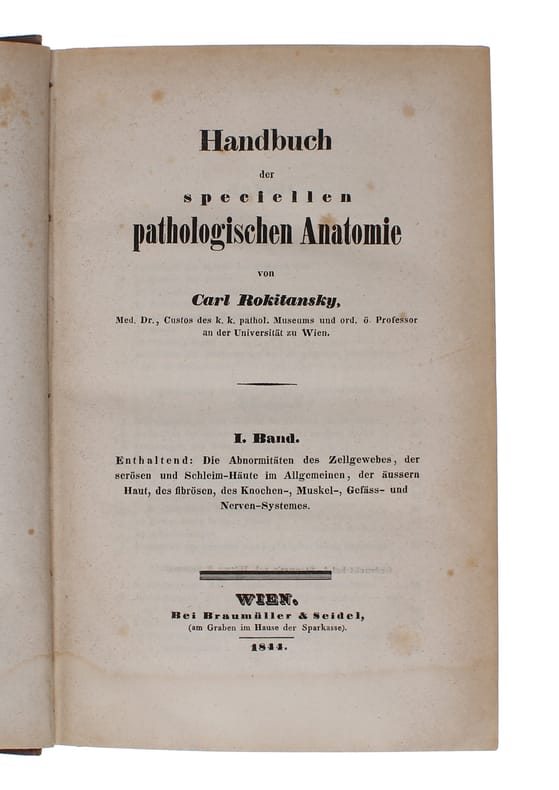
184660411Wien (Vienna), Braunmüller & Seidel, 1842, 1844 & 1846. 8vo. 3 volumes uniformly bound in contemporary half cloth with gilt lettering to spine. Spines discoloured and light wear to capitals. Stamp to first and last leaf in all volumes. Exlibris (Jens P. Hart Hansen) pasted on to verso of front board. Vague damstain to lower part of vol. 3. Brownspotting to first and last leaves in all volumes, otherwise a nice copy. (8), 572" XIV, (2), 882 XIV, (2), 632 pp.
195349147Chicago, 1953. Lex 8vo. Entire volume present. Contemporary brown half cloth with type-written paper title-label to spine. A nice and clean copy. Pp. 317-324. [Entire volume: VI, 10, (2), 819, (1) pp].
Chicago, 1953. Lex 8vo. Entire volume present. Contemporary brown half cloth with type-written paper title-label to spine. A nice and clean copy. Pp. 317-324. [Entire volume: VI, 10, (2), 819, (1) pp].
.REGIS GRATIA AC PRIVILEGIO AD SEPTENNIUM. Basileae, (in fine): J. Oporinus 1541.[Prima edizione-Greco] (cm.30) curioso cartonato originale con frammenti di pergamena manoscritta, doppi nervi esterni. -- cc. 6 nn., pp. 291 + 1 pag. bianca. Fregi e capilettera in xilografia. La prefazione di Heronymus Gemusaeus, è in latino, tutto il testo è in greco a piena pagina e molto elegante. Prima edizione rarissima del sec. XVI della celebre opera scientifica, botanica e medica, preceduta solo dall' edizione Aldina del 1498. Il nostro esemplare non porta al frontis il nome del Camerario e la sua prefazione, ma è una variante rara con la prefazione del Gemuseo. Manca a CHOIX, DURLING e WALLER mentre ADAMS e WELLCOME hanno solo l' edizione col Camerario. Qualche lievissima ombreggiatura a poche carte in fine altrimenti esemplare molto bello nitido e marginoso. Nella sua interessante legatura originale che sia all' interno che all' esterno dei piatti conserva frammenti cartacei e membranacei manoscritti del XIV e XV secolo. L' opera, verosimilmente doveva essere ricoperta in pergamena che attualmente manca. PRITZEL 9190; BM. STC. GERMAN 856; GRAESSE VII 124; FEDERICI " SCRITTORI GRECI " p. 163 illustra le due varianti.[f30] Libro
154140198ABBasel, Froben, 1541. Klein-Folio. 4 n.n. Bl., 1145 S., 1 w. Bl., 74 n.n. Bl. Mit gestochener Druckermarke auf dem Titel und dem letzten Blatt und 2 kleinen Holzschnitten im Text. Halbpergamentband der Zeit mit goldgeprägtem Rückenschild.
154140198DBBasel, Froben, 1541. Kl.-folio. 4 n.n. Bl., 1145 S., 1 weisses Bl., 74 n.n. Bl. Mit gestochener Druckermarke auf dem Titel und dem letzten Blatt und 2 kleinen Holzschnitten im Text. Halbpergamentband der Zeit mit goldgeprägtem Rückenschild.
176130077BBLeiden, Johann und Hermann Verbeek, 1761. Folio. 2 n.n. Bl., 295, 1 S. Mit 89 Kupfertafeln. Halblederband der Zeit mit goldgeprägtem Rückenschild.