Thiermair, Franz IgnazAntiquariat.de

98 727 résultats
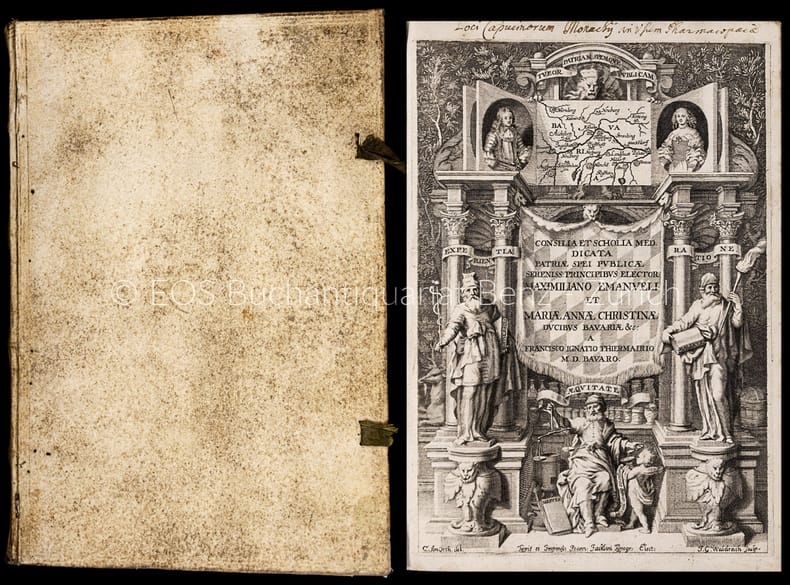
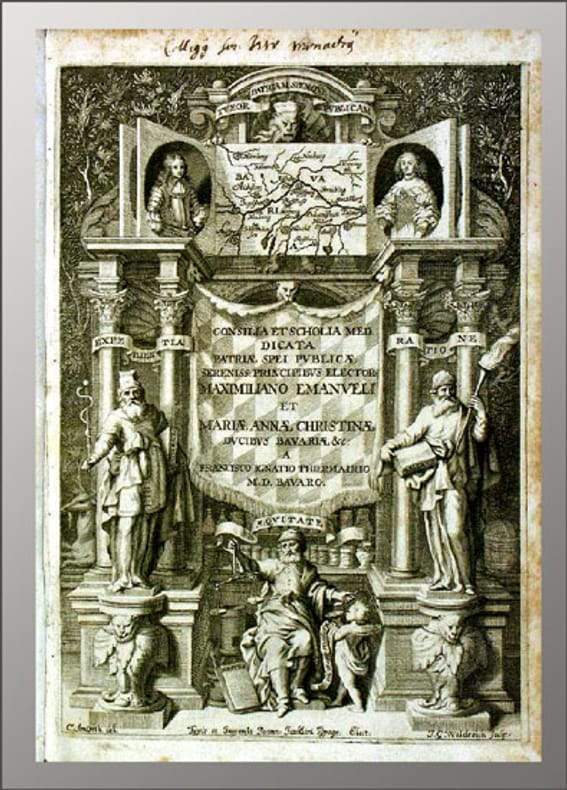
167330177BBMünchen, Johann Jäcklin, 1673. Folio. 13 n.n. Bl., 196 S., 4 n.n. Bl., 200 S., 7 n.n. Bl. Index., 1 Bl. Druckermarke. Mit gestochenem Frontispiz und einem gestochenen Textkupfer. Pergamentband der Zeit mit goldgeprägter Deckelfiletierung und handschriftlichem Rückentitel. 2 Teile in 1 Band.
167340466ABMünchen, Johann Jäcklin, 1673. Folio. 14 n.n2 n.n. Bl., XXIV, 600 S.. Bl., 196 S., 4 n.n. Bl., 200 S., 7 n.n. Bl. Index, 1 Bl. Druckermarke. Mit gestochenem Frontispiz und einem gestochenen Textkupfer. Pergamentband der Zeit. 2 Teile in 1 Band.
167330177BB2 Teile in 1 Band. München, Johann Jäcklin, 1673. Folio. 13 n.n. Bl., 196 S., 4 n.n. Bl., 200 S., 7 n.n. Bl. Index., 1 Bl. Druckermarke. Mit gestochenem Frontispiz und einem gestochenen Textkupfer. Pergamentband der Zeit mit goldgeprägter Deckelfiletierung und handschriftlichem Rückentitel.
167340466AB2 Teile in 1 Band. München, Johann Jäcklin, 1673. Folio. 14 n.n2 n.n. Bl., XXIV, 600 S.. Bl., 196 S., 4 n.n. Bl., 200 S., 7 n.n. Bl. Index, 1 Bl. Druckermarke. Mit gestochenem Frontispiz und einem gestochenen Textkupfer. Pergamentband der Zeit.
167340466DB2 Teile in 1 Band. München, Johann Jäcklin, 1673. Folio. (14) Bl., 196 S., (4) Bl., 200 S., (7) Bl. (Index), 1 Bl. Druckermarke. Mit gestochenem Frontisp. und einem gestochenen Textkupfer. Pergamentband aus der Zeit.
167330177DB2 Teile in 1 Band. München, Johann Jäcklin, 1673. Folio. 13 n.n. Bl., 196 S., 4 n.n. Bl., 200 S., 7 n.n. Bl. Index., 1 Bl. Druckermarke. Mit gestochenem Frontispiz und einem gestochenen Textkupfer. Pergamentband der Zeit mit goldgeprägter Deckelfiletierung und handschriftlichem Rückentitel.
1700K8L0EZ7PGV23The Netherlands 1700. Large agenda 8vo 20.5 x 12 cm. Recased ca. 1720 in its own original ca. 1700 blind-tooled parchment sewn on 3 tapes but previously on 5 cords leaving raised ridges in the parchment of the spine with a large centrepiece on each board in a frame of double fillets. Manuscript in dark brown ink on laid paper with 1 printed and 10 manuscript slips with recipes loosely inserted late 18th & early 19th centuries. pp. 15 16 23-188 197-386 387-412 minus 16 scattered pp. including integral paste-downs and about 160 pp. blank except for the page number. A recipe book in Dutch probably written beginning around 1720 but with additions to at least 1758. Most of the recipes are medicinal but about 15 written pages near the end separated from the others by numerous blanks contain culinary recipes. Among the medicinal recipes one also finds a few for ink shoe polish and other things. The medicinal recipes include treatments for the plague rabid dog bites jaundice worms warts scurvy toothache headache and many other ailments. Unusually the complier cites about a dozen sources for the medicinal recipes. The culinary recipes include several kinds of pancakes waffels and "poffertjes" a popular Dutch treat like tiny puffy pancakes tarts cookies and other sweet treats.A small number of leaves had been used for something else before the present text but they were removed and the rest recased in the original binding to begin the present manuscript. The only remaining clue to this earlier text is in the index leaves at the end where a small number entries at the heads of the pages are written in a different hand and in Latin with references to leaf numbers that are no longer present. They are clearly religious/theological.The manuscript as it now stands has minor marginal defects at the foot of about 40 leaves not affecting the text and occasional minor spots but is still in good condition. The binding is slightly loose due to the removed leaves and the parchment shows a few wrinkles and small spots but the tooling of the centrepiece is clear. A charming manuscript recipe book in Dutch both medicinal and culinary. unknown
- Février 1964, 26x30cm, documents et photographies conservés dans un classeur. - Photographic report of the établissements Arbel carried out for the manufacture of Captain Cousteau's diving saucer February 1964 | 26 x 30 cm | documents and photographs preserved in a binder Collection of documents formed of 33 original contemporary silver halide print photographs, a reproduction of a press clipping from La Voix du Nord and three mimeographed technical plans, united in a black binder with a label with the inscription «Production Report «press» - press-forming of the ½ spheres of Ct Cousteau's diving saucer - February 1964.» Handwritten title page. Signed, handwritten presentation: «Avec les amitiés du reporter photographe Wallemme Raoul» «With love from the photojournalist Wallemme Raoul.» Very beautiful and unique collection, testifying to the genius of the making of the Deep Star 4000, a diving saucer invented by Commander Cousteau. The reproduction of the press clipping glued at the beginning of our collection explains: «The French Office for Underwater Research in Marseille will build, on behalf of an American firm, a diving saucer, the 'S.P. 4000,' which can descend to a depth of 4000 metres. This machine, whose full-scale model has just been produced, must be completed in May 1964. It will be able to carry out its first trials the following month, before leaving for the United States where it take the name 'Deep Star.'» In 1964, the French Office for Underwater Research, led by Commander Cousteau, entrusted the company Arbel de Douai with the work of forming the hemispheres in Vasco Jet 90 steel intended for the manufacture of the diving saucer «S.P. 4000.» The 33 photographs collected in this album of internal archives recount all the stages of this conception. We see the metalworkers at work, dressed in suits worthy of science-fiction; the last shot immortalised the team posing proudly in front of photojournalist Raoul Wallemme's camera. It is the American company Westinghouse Corp who, under Cousteau's leadership and the French Office for Underwater Research, will manufacture the submersible. For certification purposes, the Vasco sphere manufactured by the Douai workshops will not be used by the American firm, who will prefer another model used by the US Navy. It will finally be used on another machine, the S.P. 3000 or Cyana. «In September 1971, a trial dive, luckily without crew, went wrong. Cyana, hanging on a cable and weighted with a heavy weight, is submersed off Sicily to a depth of 3 200m. A shackle opens, releasing the cable. The saucer remains unable to move, a few metres from the bottom. The sinking point is immediately marked by an ultrasonic beacon that can only beep for one month. A race against the clock begins: it is necessary to rearm the Archimède and urgently equip it with shears inspired by a charcutier's ham slicer! Fourteen days after the sinking, while the beacon still emits weakly, the Archimède finds the Cyana and cuts the cable that holds it prisoner. It was the deepest ever successful rescue!» (Ifremer website). The Cyana carried out more than 1 300 dives from Ifremer's different oceanographic vessels (Jean Charcot, Le Suroît, Le Noroît, Nadir, L'Atalante) and opportunity vessels (Castor, Ravello). Superb and unique testimony of French metalworking know-how at the service of Commander Cousteau and the pioneers of oceanography. [FRENCH VERSION FOLLOWS] Ensemble de documents constitué de 33 photographies originales en tirage argentique d'époque, d'une reproduction de coupure de presse de La Voix du Nord et de trois plans techniques ronéotypés, réunis dans un classeur noir portant sur le dos une étiquette comportant l'inscription «?Reportage fabrication «?presse?» - Emboutissage des ½ sphères de la soucoupe plongeante du Ct Cousteau - Février 1964?». Page de titre manuscrite. Envoi autographe signé?: «?Avec les amitiés du reporter photographe Wallemme Raoul.?» Très bel et unique ensemble
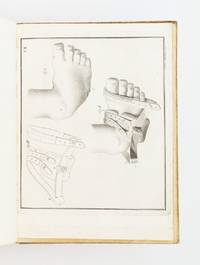
1803ST18718Pavia: Appresso Giuseppe Comini 1803. FIRST EDITION. 309 x 225 mm. 12 1/8 x 8 7/8". 42 pp. without the blank called for by Norman. <br/> Contemporary paper boards patterned to look like tree calf smooth spine. WITH FIVE ENGRAVED PLATES THREE OF THEM FOLDING BY FAUSTINO ANDERLONI. Norman 1900; Garrison-Morton 4308. See also: Heirs of Hippocrates p. 292; DSB XII pp. 136-39. ◆Two-inch dampstain to upper right corner of front cover also slightly affecting margins of first 10 leaves extremities a little worn but still a nearly fine copy--clean fresh and bright internally with excellent impressions of the plates in a sturdy contemporary binding.<br/> <br/> In excellent unsophisticated condition this is a rare copy of the first edition of what Garrison-Morton tells us is the "first accurate description of the pathological anatomy of congenital club-foot." In addition to correctly describing the anatomy of this common birth defect surgeon Antonio Scarpa also devised a brace for treating the malformation--detailed engravings of which are shown on the accompanying plates. A student of Morgagni Scarpa 1852-1932 quickly rose to prominence becoming a professor at the age of 20 and authoring several important works in the fields of otology cardiology ophthalmology and neuroanatomy among others. As DSB relates "his fame was so great that in 1805 he was personally complimented by Napoleon." According to Heirs of Hippocrates Scarpa was "a brilliant artist as well as a brilliant anatomist" who included his own anatomical drawings engraved by Faustino Anderloni in many of his published texts including the present work. The images here go beyond simply depictive to evoke an emotional response from the viewer who is invited to identify with the distress of the afflicted. Our first edition is a rare book: we could trace just two copies sold on RBH. Appresso Giuseppe Comini unknown
<br/> STATO: DA COLLEZIONE, MOLTO BUONO.<br/> TITOLO: Tre rare opere di medicina del primo Ottocento. Un volume del formato di cm.15,5x23,5, con rilegatura in mz.pelle coeva alle opere in esso contenute. I titoli (riportati in oro al dorso e su un'etichetta fustellata coeva applicata al piatto anteriore) sono i seguenti: - Scarpa,Antonio, Memoria chirurgica sui piedi torti congeniti dei fanciulli
Pagine: 1+16 (Carte)+976 (colonne)+18 (carte)+1+63 (carte) . Illustrazioni: Marca tipografica con motto BONA FIDE, ripetuta nel secondo frontespizio (index) . Formato: 4° . Rilegatura: Cartonato pergamena coeva con tre nervature scoperte e mancanza di parte della pergamena nella parte bassa del dorso. Angolo in alto a destra del cartonato usurato. Piatti con macchie antiche e antichissime scritte a mano ma ormai illeggibili.Stato: Buono . Caratteristiche: Presenza di gora estesa nella parte bassa del volume dalla prima carta alla ventesima circa (testo perfettamente leggibile). All'interno del volume appunti a margine da mano antica, probabilmente coeva. La Naturalis Historia è senza dubbio una delle opere più importanti di indagine naturale della antichità. STORIA NATURALE. Testo molto raro a rinvenirsi. . Note epoca: nel frontespizio furono grattate una X e due II dalla data, erroneamente, visto che quella stampata originariamente era corretta, come si nota nel secondo frontespizio.
In-4°; edizione originale. pp (8), 496, (16), al frontespizio marca tipografica incisa su legno; legatura in piena pergamena . Il naturalista Costeo, espone in quest’opera, sulla scorta di Teofrasto, la sua teoria di botanica in merito alla generazione delle piante, alle differenze tra le specie, alle mutazioni, all’origine delle piante, al loro odore e profumo, alle loro applicazioni in medicina. Bell’esemplare
in-8 gr., pp. (4), 746, con 8 tavole f.t. in litogr. (di cui 3, num. IV,V,IV, ma i.e. VI, riproducono facsimili di autografi di delinquenti). Legatura coeva in mezza pelle e percallina ai piatti, al dorso titoli e fregi in oro. Nel 1876 con la prima preziosa edizione di questa fondamentale opera "L'uomo delinquente" nasce l'antropologia criminale, intesa come "quella parte della medicina che studia l'uomo delinquente e in tale studio include non solo l'indagine sull'aspetto fisico, ma anche l'indagine sull'aspetto fisiologico, psicologico e psichiatrico delle personalità". In questa seconda edizione del 1878 Lombroso (Verona 1835 -Torino 1909) risponde alle obiezioni che erano state rivolte alla sua teoria, la quale, secondo alcuni critici, avrebbe limitato la spiegazione della delinquenza al dato costituzionale del criminale, trascurando le influenze dell'ambiente e l'aspetto psicologico. La presente nuova edizione viene quindi ampliata con studi sul significato del tatuaggio e sul gergo criminale, il suicidio, la prostituzione. Infine analizza il fenomeno criminale in base all'età, al sesso, al clima, all'alimentazione, alla povertà. Allegata al volume è una LETTERA AUTOGRAFA di 1 p. in-8, firmata "dal suo devoto amico C. Lombroso", datata Torino 23.1.94, indirizzata "All'ill. prof. Biffi" in cui ringrazia il direttore del manicomio di San Celso per la donazione di 150 lire per l'organizzazione del pranzo del Congresso romano: "...Accolga coi miei ringraziamenti i segni della più alta stima..". Probabilmente la missiva non venne mai inviata perchè sul verso del quarto foglio si legge un altro appunto autografo del Lombroso datato 13.5.1894 e firmato, in cui ribadisce l'offerta del Biffi. Ottimo esemplare.. Il Diz. Biografico degl Italiani, vol.65 pp.548-553, offre esaurienti notizie sull'illustre criminologo''..
2 opere in un vol. in-folio, ff. (12), pp. 513, ff. (1, per la marca tip.); ff. (2), 29, (5); leg. settec. in p. pelle marmorizz., (dorso rifatto, con tit. e fregi oro). Impresa tipogr. su entrambi i front. ed altra in fine a ciascuna delle due opere, testo in car. tondo, belle iniz. istor. Dedica del traduttore Alban Thorer (latinizzato Torinus) all'arcivescovo di Salisburgo Matteo. Prima edizione della prima traduzione latina (nello stesso anno si pubblicò anche a Parigi) della maggior parte delle opere di Paolo Egineta raccolte sotto il titolo generale "De arte medendi" in sei libri (I-V e VII), fatta dall'umanista tedesco Alban Thorer e basata sul testo greco dell'edizione Aldina del 1528. Il "De chirurgia", VI libro dell'opera, omesso dal Thorer in questa edizione del 1532, fu tradotto dal veneziano Giov. Bernardo Feliciano e pubblicato per la prima volta a Venezia da Lucantonio Giunta nello stesso anno e poi ristampato da Cratander e Bebelius l'anno successivo, a complemento della loro edizione. In fine al "De chirurgia" vi sono le "Castigationes" del Thorer ai 6 libri da lui tradotti. L'opera del celebre medico Paolo d'Egina (625-690 d.C.) è un compendio di medicina contenente una quantità di notizie preziose ed interessanti ed osservazioni originali; di particolare importanza è il libro "Della chirurgia" che offre un panorama assai completo sulle tecniche chirurgiche dell'epoca. Esempl. bello e marginoso (con lieve alone d'umido nel margine alto dei primi ff. e nel margine esterno degli ultimi).. Manca a STC., German Books. Wellcome I, 4863 e 4875. Durling 3549: "First edition of the first Latin translation of the major part of the work" e 3566..
4965P., Pierres, 1788, un volume in 4 (21cm x 27cm) relié en demi-basane, dos orné de filets dorés (reliure de l'époque), (4), 74pp., 472pp., 2 TABLEAUX DEPLIANTS, 15 PLANCHES hors texte
(Codice GM/1719) In 16° (127x80 mm) 267(32) pp. Seconda edizione (prima ed.: 1707) estremamente rara. Completa dell'index capitum e dell'index rerum et verborum. Trattato del medico e botanico svedese relativo ai veleni minerali, animali e vegetali, loro effetti, antidoti ed usi teapeutici. Lievi ingialliture sparse, qualche pagina brunita, antico ex libris manoscritto all'interno della copertina posteriore. Mancano sguardia anter. e antiporta. Frontespizio con forellini per antichi tarlini con perdita di qualche parola; minimi segni alla carta seguente. Buoni margini, testatina e capolettera a p.5. Legatura dell'epoca ancora solida ma segnata dal tempo, dorso in parte mancante, abrasioni ai piatti (uno in parte scollato). Tagli colorati. Testo completo e ben conservato di questa rarissima opera medica. ~~~ SPEDIZIONE IN ITALIA SEMPRE TRACCIATA
[Postincunabolo] (cm.31,5) ottima mz. pergamena antica restaurata. --cc. 56 nn. Capilettera ornati e figurati anche a fondo nero. Opera pertinente a varie materie: medicina, fisionomia, segreti, minerali ecc. in fine assai rilevante il capitolo sulle meraviglie delle nuove scoperte delle Indie. i margini bianchi di tutta l' opera contengono varie annotazioni manoscritte coeve. nonostante accurate ricerche, questa edizione manca a tutta la bibliografia consultata compreso Adams, Bm. Stc. e Cranz-Schmitt "A Bibliography of Aristotle" il censimento nazionale "Iccu" registra solo 3 copie nelle biblioteche italiane. Esemplare ottimamente restaurato. Alcune bruniture e aloni sparsi, piccole integrazioni al margine bianco e agli angoli di varie carte che mai interessano il testo. Altrimenti esemplare discreto con buoni margini, ben accettabile per la sua rarità. Le bibliografie consultate citano edizioni posteriori.[f72] Libro
1861300850London John Murray 1861. 1861. First edition. 8vo. Full gilt stamped dark green morocco by Riviere & Son rich gilt inner filets and dentelles; t.e.g. One volume extended to two by the addition of 135 extra engraved plates and views including eight hand colored together with the original 17 plates totaling 152 plates altogether. 2 volumes. 1st Edition. Hardcover. Fine/No Jacket. London, John Murray, 1861. hardcover books
1903elala1301Dublin: Fannin And Company Imprint Varies 1883-1903. 1903. Including index volume XXI. a complete series except for Vol. II. 8vo. numerous plates incl. lithographs & photographs & text illus. original cloth covers of Vols. IX X XI XII & XX stained. Including papers Vol. I on a locomotor ataxy by H.C.Tweedy a case of dissecting aneurism of the aorta by J.F.Knott a case of trephining of the skull for abscess of the brain by J.JKilgariff on excision of the hip by J.K.Barton on replantation and transplantation of teeth by R.T.Stack on induction of abortion by W.J.Smyly on carcinomatous sarcoma by H.R.Swanzy on penetrating wounds of the bladder by W.Stokes &c. Hardcover. Dublin: Fannin And Company [Imprint Varies], 1883-1903. Hardcover
1944188069Berlin, Hirschwald/Springer, 1875-1944. M. 6 Portr., 293 (dav. 44 farb.) Taf. u. zahlr. Textabb. Nahezu einheitl. Bibl.-Lwdbde.(bis Bd. 42-44 u. 64, dann mehrheitl. Hlwd.) m. goldgepr. Rtit. u. m. St. a. Vorsatz bzw. Tit. Bd. 15 u. 41 Taf. lose beiliegend. Wenige Taf. braunfl. Einbde. teilw. bestoßen. Bei späten Jahrgängen Seiten teilw. papierbedingt verklebt.
89912Paris, Philippe-Denys PIERRES, et DIDOT, 1780-1784, 12 tomes reliés en 6 volumes in-4 de 200x260 mm environ, plein veau marbré fauve de l'époque, dos à nerfs portant titres et tomaisons dorés sur pièces de titre en maroquin bordeaux, gardes marbrées, tranches rouges, agrémentés de bandeaux, culs-de-lampe. 1776 : (1) f., lvi-360-592 pages, (2) ff. (approbation et privilège), (1) f., avec un frontispice, 15 tableaux dépliants, 16 planches dépliantes et une figure dans le texte.1777-1778 : (1)f., xxii-(1)-324-648 pages, (2) ff. (privilège et avis au relieur), (1)f., avec 30 tableaux dépliants et 3 planches dépliantes.1779 : (1) f., xiv-268-690-(1) pages, (1) f., avec 15 tableaux dépliants et 15 planches.1780-1781 : (2) f., xvi-392-430 pages, (1) f., avec 30 tableaux et 15 planches.1782-1783 (1ère partie) : (1) f., xij-300-582 pages, (1) f., avec 30 tableaux et 2 planches.1783 (2ème partie) : (1) f., 223-359 pages, (1) f. Des rousseurs, rares erreurs de pagination, quelques défauts de marges, notes manuscrites sur la p. 581-582 du tome 1777-1778, des épidermures petites auréoles et frottements sur le cuir, quelques trous de ver, 2 coiffes légèrement ébréchées, coins émoussés, sinon bon état.
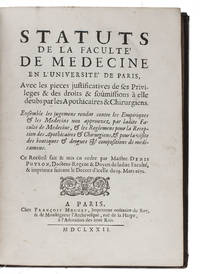
1672HCHB08RSGIM2Paris 1672. 4to. François Muguet Contemporary calf gold-tooled spine. With a few woodcut headpieces. 56 26 111 1 blank 4 20 56 22 2 blank 115 1 blank 43 1 blank 10 2 blank 16 4 16 pp. Collection of laws privileges and jurisprudence relating to the Faculty of Medicine of the University of Paris up to 1672. Most concern the publication of certain books the relationship of the Faculty with several guilds and the rules concerning the autopsy of corpses.The book opens with the university reform of 1600 which added many classical authors to the curriculum. For the Faculty of Medicine this meant the official establishment of Galen as the primary authority on botanical medicines. Interest in the work of Galen was highly stimulated by new translations from the Greek that had appeared in the 16th century and by 1600 the Paris Faculty was heavily mired in the doctrines of Galen which would remain so up until the 18th century.With a few contemporary annotations and corrections. Paper somewhat browned and with a few spots. A small corner of p. 11 of the index is cut out. Pp. 17-44 of the final part appear to be missing but this seems to be the case in every edition of this text we have located. Binding worn at the extremities with the head and foot of the spine damaged and a crack in the back hinge. A good copy.l Krivatsy 12063. unknown
4to. 278 pp. 18th century half vellum with marbled covers. Edges sprinkled. First and only edition of this rare and exceedingly curious book of secrets and popular medicine, a fantastical collection of miracles and notes on disparate topics by the native Tyrolean Theodor Albmair, former secretary to Emperor Ferdinand III. - "In the twenty-five discourses or chapters of his book, the author has something to say about not only the elements but all the fruits of the earth, whilst the most important chapter of all is the twenty-sixth; it is called 'Discorso particolare', and it deals with man in health and in sickness. The fourteenth 'Discorso' deals with bread, the fifteenth with wine" (Simon). Other subjects include gems and precious stones, moss, ambra and balms, metals, herbs, rare flowers and how to cultivate them; various animals, including such as supposedly dwell in fire, etc. "Ein rares, seltenes Buch" (Grass, Verzeichniß einiger Büchermerkwürdigkeiten, 1790, p. 8). - Binding rubbed and bumped. Interior somewhat brownstained throughout; some insignificant worming to lower corner (not touching text). Without flyleaves or final blank leaf. - Provenance: title-page has 18th century manuscript ownership of Giovanni Modesto Canciani, who probably commissioned the binding; last page of text has his handwritten statement: "1770: 20 Xbris liber iste a me Joanne Modesto Canciani totaliter usque ad hanc diem est perlectus" (last word trimmed by binder and then supplied again by the same writer). Additional stamped ownership of the Collegio Universitario Antonianum in Padua ("Antonianum Coll. Univ. Bibl.") with their shelfmarks to title-page. Very rare: OCLC lists only four copies in libraries (Wellcome Library; Univ. of Chicago; Univ. of Michigan; Bibliothèque de Genève); a single copy in auction records (André L. Simon's copy, sold at Sotheby's in 1981). Simon 80. Wellcome II, 26. Sinkankas 60-A ("not seen"). Agassiz I, 111. Böhmer IV, 1, 281. Haym, p. 517, no. 9. Brückmann, Bibliotheca animalis continuatio (1747), p. 12. Cat. of the Science Library in the South Kensington Museum (1891), p. 242. Cat. of the Library of the Museum of Practical Geology (1878), p. 9. OCLC 23632541. Not in Krivatsy, Rosenthal, Ferguson etc.
185589317Gide et Baudry éditeurs | Paris 1855-1859 | 14 x 22 cm | 5 volumes brochés
183589233Typographia commercial de P. Gueffier | Praia-Grande (Sao Paulo, Brésil) 1835 | 16 x 21.5 cm | Broché