Multiple ContributorsMareMagnum

34 831 résultats
Volume I, No. I of this publication. Contents include two long complete novels of war flying entitled "One Man's War", a tale of a Handley-Page night-bomber, and "Gas-Bag Aces", a tale of Seaplane and Blimp adventures of the Coast Defence Forces in the Great War; Terror in the Sky - A Pilotless R.A.F. Fighter crashes in the centre of New York; Murder in the Air - The Red Prop School trained the Foreign Legion of the Air; Cundall of the Camels - The remarkable life of a Camel pilot of the R.F.C. on the Western Front; Real Life Adventures - Crashing Aeroplanes for Movie Thrills and Thrills and Spills in Parachuting; and more. Interesting cover illustration depicts kilt-wearing machine-gunner. Above-average wear. Binding intact. Book
16922110502150908008Seo Genbei Other Collections Edition 1692. Soft Cover. Fine. Number of books: 22 Seo Genbei Other Collections Edition paperback
1943277008Kamnik district Slovenia: Tehnika RK VI 1943. 30pp. 8vo mimeographed text with images original tan wrappers with mimeographed cover.<br/> <br/> This rare surviving pamphlet from World War II was produced by the Yugoslav Partisans the most accomplished armed resistance movement against the Axis occupation of Europe. Starting out as a guerilla group the Partisans soon created a complete underground society based on Communist principles including schools government and medical institutions financial systems and publishing presses. This pamphlet produced by one such press likely hidden in the mountains or forests of Slovenia addresses an emergent need in such a new clandestine society: that for maps. It proceeds in logical order: geographical vocabulary instructions for making field maps and later more sophisticated and symbolic drafting techniques. Within this technical know-how it also communicates tactical military advice that the Partisan guerillas employed in their battles with Axis armies. This tactical quality of the publication is most in evidence in the pamphlets many striking diagrams which demonstrate the importance of visual knowledge in situations of survival.<BR> <BR> This pamphlet was one of many Partisan publications designed to educate protect and encourage members of the movement. It is particularly fascinating for its simple means of production since the secrecy of Partisan operations limited them to mechanical methods such as mimeographs--in witness here--as well as heliotypes linocuts and typewriting. Given its fragility the pamphlet is in excellent condition with clean text. Slight stains and some very small tears in margins. As one of the few Partisan publications on cartography this pamphlet is a rare and fascinating record of the World War II resistance.<br/> <br/> Tehnika RK VI unknown
19812110502151100476Japan Cultural Resource Center 1981. Soft Cover. Fine. Number of books: 3 Japan Cultural Resource Center paperback
19382080502106906007Not Available 1938. Soft Cover. Fine. The book is in fine condition. Not Available paperback
199512933Garage A5 dark blue: General Store Publishing House 1995. Paperback. Used: Acceptable. Paperback in good condition. 1995 1st edition 1st printing General Store Publishing House. - . ISBN 1-896182-36-4 1896182364. General Store Publishing House paperback
1960ZB255748Command and General Staff School 1960. volumes 40 42 44 45 47-49 52-55 57 59 62 63 70 71 75 76 78 1960-1998; mostly original paper wrappers library markings else textually clean; price is for the lot. - If you are reading this this item is actually physically in our stock and ready for shipment once ordered. We are not bookjackers. Buyer is responsible for any additional duties taxes or fees required by recipient's country. Photos available upon request. Command and General Staff School unknown
A complete suite of 10 signed and numbered prints by Maurice Asselin. Without the text pages or folding case. Edition limited to 100 sets. Includes 5 etchings and 5 lithographs, one printed in color. 13 x 10 inches (sheets). Loose as issued. Printed on fine wove paper. Perfect condition.
19082201030038xbvkBlackburn, R. Denham & Co. / Southport, Shackerley Literary Agency; 1908. viii pages incl. foretitlepage, photographic frontispice-plate on glossy paper, titlepage, Dedication, 'Prelude', 'Contents' and prefaces to the first (''Feb. 16th, 1907.'') and this second edition (''Jan. 1st, 1908.''); 92 pages, except the photoplate printed on untrimmed handmade rag-paper throughout. - Publisher's illustrated cardboard-wrapper, titled in red and black, ornamentally framed; 8vo.(ca. 19,5 x 13,5 cm).
43988H-J.Harpignies de l'Ecole de Barbizon.(1819-1916).Tableau 19ème à la mine de plomb et au lavis gris.45 centimètres de hauteur et 33 de large avant marie-louise.Encadrement doré de l'époque aux motifs grecs.Signé. Bon état.Bas du cadre à restaurer.
Paperback Like New. Ships from publishers directly but must allow a minimum of 20 - 25 business days shipping time.
2000mon0000174578Law School Admission Council 6/21/2010 12:00:01 A. perfect. Good. 1.6000 in x 10.7000 in x 8.4000 in. Law School Admission Council unknown
188083103c.1880. Charming country scene showing the river Thames with Windsor Castle in the background. Original watercolour. Size: 360 x 520 mm Excellent condition. unknown
82938aafs.d., vers 1830-50, les 2 dessins dans des passepartout ens.
2034aafFribourg, L.-J. Schmid, 1839, in-4°, IV (titre et table) + 71 p., illustré de 13 lithographies + 2 planches dépliantes + 1 planche hors-texte d'une partition (chanson avec paroles), pages 29 et 31 petites déchirures marginales, reliure en demi-cuir, dos orné, gardes en beau papier dominoté, plats en papier orange avec décor imprimé.
2110502151110174Ming Jiajing book stamp N.A. Soft Cover. Fine. Volume: 13 Ming Jiajing book stamp paperback
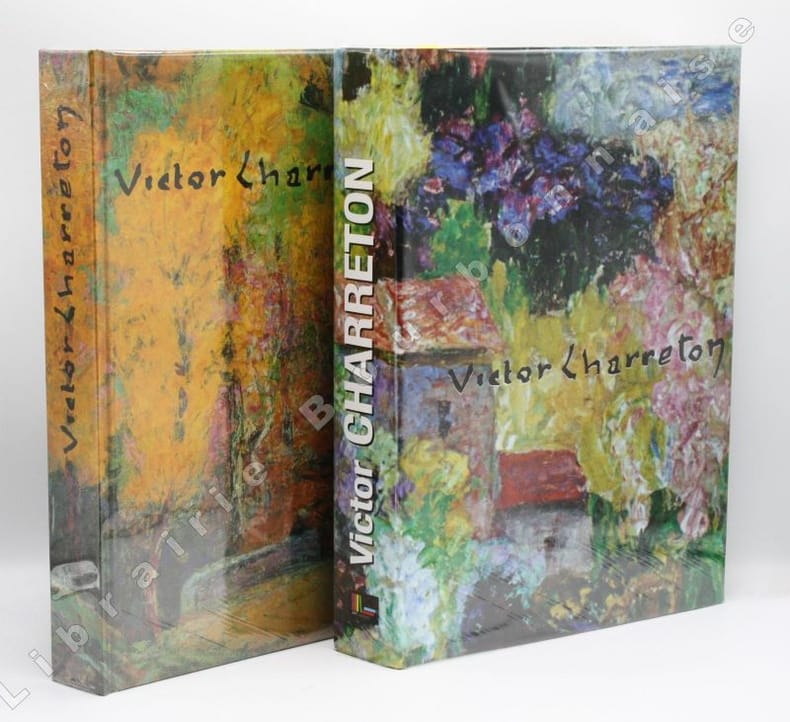
13210[La Sauvetat], Robert Chatin, Imprimerie Vatel à Brioude, 1995 - Paris, Art inprogress Editions, 2007 ; 2 forts vol. in-4. 597 pp.-1 f. / 733pp. Cartonnages illustrés de l'éditeur, avec une jaquette couleurs por le second volume. Exemplaires neufs.
19284601Paris Les Editions d'art Devambez 1928 grand in-4 en feuilles Paris, Les Editions d'art Devambez, 1928. 33,5 x 26 cm, grand in-4, (4) 109 (6) pp. - frontispice et 14 planches hors texte d'après Le Gréco, 8 larges en-têtes, vignette de titre et 7 culs-de-lampe également gravés, en feuilles sous couverture blanche rempliée et imprimée, chemise et étui.
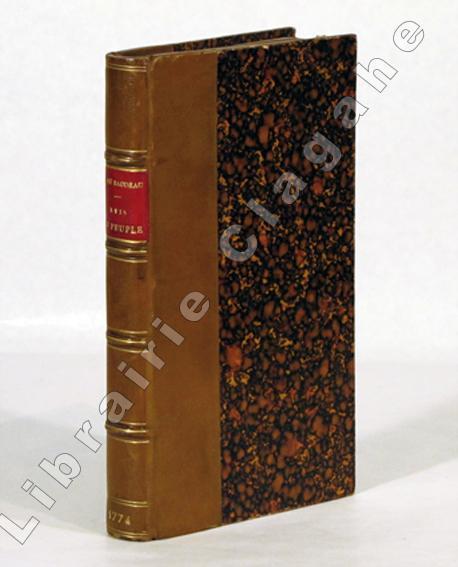
177418311Amsterdam et Paris, Fr. Ambr. Didot aîné, 1774 ; in-12 (178 mm), demi-veau caramel, dos à nerfs décorés de filets dorés, pièce de titre rouge, date en queue, non rogné (reliure du XIXe) ; 324 pp.
Acquaforte e puntasecca, circa 1900. Titolo a matita in basso e firma autografa in basso a destra “C. Biseo”. Magnifica prova, impressa con inchiostro verde su carta coeva, tracce di antica inquadratura, per il resto in eccellente stato di conservazione. Marcelle Renée Lancelot, coniugata Croce (Parigi, 26 gennaio 1854 – ca 1946), è stata una pittrice, scultrice e medaglista francese naturalizzata italiana. In seguito al matrimonio con lo scultore Leonardo Croce, prese la nazionalità italiana, cambiando il nome in Marcella. Visse per diversi anni a Roma, a partire dal 1895. Oltre alla pittura e alla scultura, si dedicò anche fin da giovane alla professione di medaglista. Cesare Biseo pittore, acquarellista e incisore, nasce a Roma, ove il padre, Gian Battista, valente pittore accademico di Brescia, si era da poco trasferito essendo stato chiamato a decorare il castello di Bracciano. Riceve dunque dal padre i primi insegnamenti artistici e, a seguito del genitore, trascorre da giovane un lungo periodo a Parigi. Nel 1869, in occasione dell’inaugurazione del Canale di Suez, il Kedivé d’Egitto lo chiama a decorare prima il suo palazzo in Alessandria e poi il Teatro dell’Opera al Cairo. Innamoratosi dell’Africa la visita più volte e nel 1875 con Edmondo De Amicis e il pittore Stefano Ussi fa parte della prima missione italiana in Marocco. Ne trae diversi albi di schizzi, che utilizza per illustrare, insieme ad Ussi, il libro di De Amicis, Marocco, edito nel 1877 dalla casa editrice Treves di Milano. Nello stesso anno accompagna De Amicis a Costantinopoli, illustrando poi l’omonimo libro dello scrittore pubblicato nel ’78 sempre dalla Treves. Il grande successo di entrambe le edizioni consacra Biseo “orientalista”, spingendolo ad intensificare la produzione di oli ed acquarelli a soggetto arabo. Intanto nel 1875, assieme a E. Roesler Franz e N. Cipriani, fonda a Roma la Società degli Acquerellisti, di cui diviene presidente nel 1881. La vena orientalista, infatti, non gli aveva fatto dimenticare la passione per i paesaggi della Campagna Romana, ritratti con grande fedeltà ed originali tagli di luce (“l’ardito effetto di sole”), evolvendo dall’originario gusto classico verso soluzioni sempre più veriste. Lo troviamo anche tra i soci fondatori del Gruppo dei XXV della Campagna romana, ove Pascarella gli affibbia il nomignolo di “cariate” per i suoi trascorsi egiziani. Ebbe lo studio a via Margutta e fu, come le foto di Oreste Sgambati stanno a dimostrare, un frequentatore assiduo del Caffè Greco, dove fu soprannominato “professorissimo” per la sua maestria a biliardo. Oltre agli affreschi ed alle decorazioni degli esordi, dipinge ugualmente bene ad olio e all’acquarello. Si è inoltre dedicato con successo all’acquaforte, come dimostrano le sue bellissime illustrazioni di libri. Il presente ritratto di Marcella Lancelot Croce, confrontando le biografie dei due artisti, risale al periodo tra il 1895 e il 1909, tra l'arrivo della pittrice a Roma e la scomparsa di Biseo. Opera non descritta da nessuno dei repertori consultati. Molto rara. Etching and drypoint, circa 1900. Title in pencil at bottom and autograph signature at bottom right "C. Biseo". Magnificent example, impressed in green ink on coeval paper, traces of old framing, otherwise in excellent condition. Marcelle Renée Lancelot (Paris, January 26, 1854 - ca 1946) was a French painter, sculptor and medallist naturalized Italian. Following her marriage to the sculptor Leonardo Croce, she took Italian nationality, changing her name to Marcella. She lived for several years in Rome, starting in 1895. In addition to painting and sculpture, she devoted herself to the profession of medallist since she was young. The present portrait of Marcella Lancelot Croce, comparing the biographies of the two artists, dates from the period between 1895 and 1909, between the painter's arrival in Rome and Biseo's death. Work not described by any of the repertories consulted. Very rare. Cesare Biseo painter, watercolorist and engraver, was born in Rome, where his father, Gian Battista, a talented academic painter from Brescia, had recently moved to decorate the castle of Bracciano. Receives therefore from the father the first artistic teachings and, following the parent, spends as a young man a long period in Paris. In 1869, on the occasion of the inauguration of the Suez Canal, the Kedivé of Egypt called him to decorate first his palace in Alexandria and then the Opera House in Cairo. Having fallen in love with Africa, he visited it several times and in 1875 with Edmondo De Amicis and the painter Stefano Ussi was part of the first Italian mission to Morocco. It draws several albums of sketches, which used to illustrate, along with Ussi, the book of De Amicis, Morocco, published in 1877 by the publisher Treves in Milan. In the same year accompanies De Amicis in Constantinople, then illustrating the homonymous book of the writer published in '78 always by Treves. The great success of both editions consecrates Biseo "orientalist", pushing him to intensify the production of oils and watercolors to Arab subject. Meanwhile in 1875, along with E. Roesler Franz and N. Cipriani, founded in Rome the Society of Watercolorists, of which he became president in 1881. The orientalist vein, in fact, had not made him forget the passion for the landscapes of the Roman countryside, portrayed with great fidelity and original cuts of light ("the bold effect of the sun"), evolving from the original classical taste towards more and more realistic solutions. We also find him among the founding members of the Group of XXV of the Roman Countryside, where Pascarella gives him the nickname of "cariate" for his Egyptian past. He had a studio in Via Margutta and was, as the photos of Oreste Sgambati demonstrate, a frequent visitor to the Caffè Greco, where he was nicknamed "professorissimo" for his mastery at billiards. In addition to the frescoes and decorations of the early days, he painted equally well in oil and watercolor. He also devoted himself successfully to etching, as evidenced by his beautiful book illustrations.
Acquaforte e puntasecca, 1882, da un soggetto di Théodore Rousseau. Impressione con firma autografa di Bracquemond; in basso a destra, timbro a secco della Printseller Association. Magnifica prova, del sesto stato su sei descritto da Beraldi, impressa su carta Cina, in eccellente stato di conservazione. Il dipinto di Rousseau da cui proviene l'acquaforte è Coucher de soleil : ou, Un abreuvoir ( ca. 1850-55 ), che è apparso all'asta da Sotheby's . New York, 17 febbraio 1993, lotto n. 12, intitolato Coucher de soleil dans les landes prés de Begaar e che oggi si trova in una collezione privata. Il quadro di Rousseau fu il primo dipinto dell'importante maestro acquistato dalla neonata galleria Arnold & Tripp, che aveva aperto nel gennaio 1881: fu acquistato da Georges Petit, esperto di Vente Hartmanna, per 20.000 franchi il 16 maggio 1881, e venduto il giorno seguente per 26.000 franchi al collezionista portoghese Pedro Eugenio Daupias. Arnold & Tripp, dopo aver acquistato e subito venduto il quadro Coucher de soleil, decisero di chiedere a Bracquemond di realizzare una lastra da cui ricavare delle copie da vendere. Questo indica che la galleria aveva mantenuto i diritti di riproduzione del dipinto, o almeno aveva un accordo con il proprietario in tal senso. L'identificazione del quadro da cui proviene l'acquaforte è quindi particolarmente interessante perché Bracquemond non fu incaricato di produrre un'incisione per promuovere la vendita del quadro, che la galleria aveva già venduto a Daupias nel maggio 1881. Piuttosto, come era comune con le incisioni, si rivolgeva al suo particolare mercato di collezionisti, sicuramente interessati ad avere un'incisione da un dipinto che era diventato parte di una famosa collezione di Lisbona, e che non avrebbero più potuto ammirare a Parigi. La scoperta del contratto stipulato tra la galleria parigina Arnold & Tripp e il pittore e incisore Felix Bracquemond è un fatto recente. Il contratto fa parte di un gruppo di sette lettere, contenute nel carteggio Arnold & Tripp, che illustrano tutti gli aspetti dell'affare, dal contratto formale del luglio 1881, alle varie fasi delle prove, fino alla lastra finale da presentare al Salone parigino del 1882. Per un’approfondimento sul tema, si rimanda al saggio di Paolo Serafini, An Inside View of the Print Market in Paris (1881) A Contract between Félix Bracquemond and the Arnold & Tripp Gallery to Realize a Plate after Théodore Rousseau, in “Getty Research Journal”, n. 10 (2018), pp. 207-224). Già nel contratto Bracquemond fa riferimento a sei stati della lastra, poi descritti da Henri Beraldi (cfr. Les Graveurs du XIXe siècle s…, t. 3, pp. 109-110). Etching and drypoint, 1882, inscribed beneath the image lower left B lower Publie par Arnold et Tripp. & Rue St Georges a Paris. In the image, lower right TH. R After a painting by Théodore Rousseau. Example in the sixth finale state, with the signature and the publisher’s address lower centre. Etched by Félix Bracquemond (1833–1914). Impression signed by Bracquemond, in pencil. Printsellers' Association's blind stamp at lower left. The painting from which the etching comes is Coucher de soleil : ou, Un abreuvoir ( ca. 1850-55 ), which appeared at auction at Sotheby's . New York , 17 February 1993 , lot no . 12 , titled Coucher de soleil dans les landes prés de Begaar and which today is held in a private collection. The Rousseau painting was the first painting by the important master purchased by the newborn gallery Arnold & Tripp gallery, which had opened in January 1881. The painting was bought from Georges Petit for 20,000 francs od 16 May 1881, and sold the following day for 26,000 francs to the Portuguese collector Pedro Eugenio Daupias. Arnold & Tripp, after having purchased and immediately sold the painting Coucher de soleil , decided to ask Bracquemond to produce a plate from which to derive copies to sell . This indicates that Arnold & Tripp had retained the reproduction rights for the painting , or at least had an agreement with the owner to that effect. The identification of the painting from which the etching comes is therefore particularly interesting because Bracquemond was not contracted to produce an engraving in order to promote the sale of the painting, which the gallery had already sold to Daupias in May 1881. Rather, as was common with artists' etchings, it was aimed at its own particular market of collector, surely interesting in having an engraving of a painting that had become part of a famous collection in Lisbon, and which they would no longer be able to admire in Paris. Recently, in the archives of the Getty Research Institute was discovered a contract between the Parisian gallery Arnold & Tripp and the painter and etcher Felix Bracquemond (1833-1914) in order to realize a plate after a painting by Théodore Rousseau. The contract is part of a group of seven letters, contained in the Arnold & Tripp correspondance, that illustrate all the aspects of the deal, from the formal contract in July 1881 , to the various phases of the proofs, toward the final plate to be presented at the Parisian Salon of 1882. (cfr. Paolo Serafini, An Inside View of the Print Market in Paris (1881) A Contract between Félix Bracquemond and the Arnold & Tripp Gallery to Realize a Plate after Théodore Rousseau, in Getty Research Journal, n. 10 (2018), pp. 207-224). H. Beraldi, tome 3, pp. 109 - 110; Paolo Serafini, An Inside View of the Print Market in Paris (1881) A Contract between Félix Bracquemond and the Arnold & Tripp Gallery to Realize a Plate after Théodore Rousseau, in “Getty Research Journal”, n. 10 (2018)
1870210511870 Huile sur toile, (1870), 26,5 x 21,5 cm., encadrée.
1882123261882. 233x354mm. 9¼x14". h. 1882-1830. 233 x 354mm. Pluma y aguada gris anverso y pluma reverso sobre papel avitelado amarillento Inscrito; "France" en el reverso. unknown
1805xs2314Paris, Allais, libraire, quai des Augustins, n°44 Relié 1805 Deux volumes in-4 (20,5 x 26,2 cm), reliure plein veau, dos lisse, 308 et 299 pages, complet des 20 planches dans le premier volume et des 13 planches dans le second ; coiffes et coupes usées, mors inférieur fendu aux coiffes au tome 2, mouillure sur le bord des planches au tome 1, par ailleurs bon état général. Livraison a domicile (La Poste) ou en Mondial Relay sur simple demande.
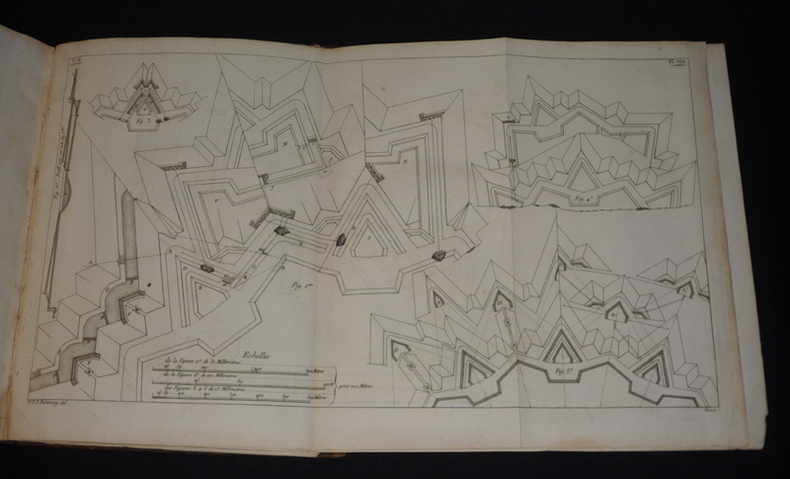
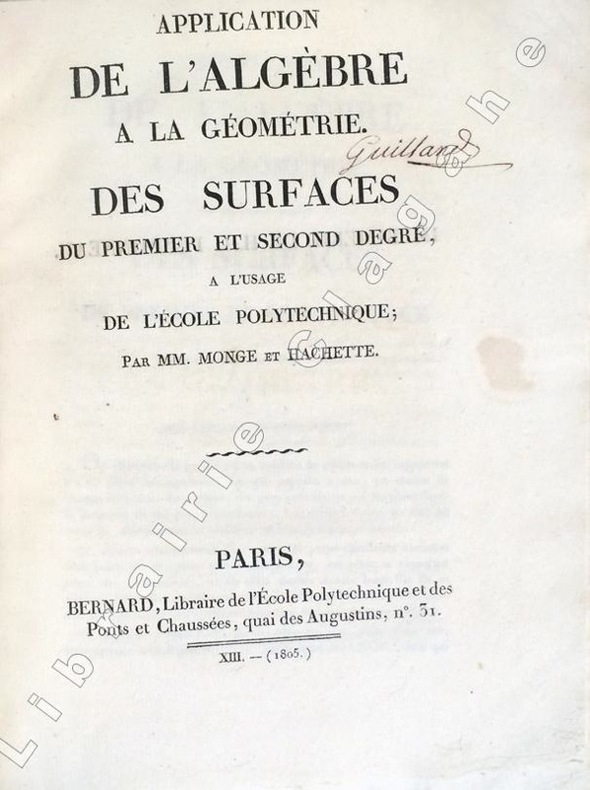
180517590Paris, Bernard (imprimerie de H.L. Perronneau), XIII-(1805) ; in-4, demi-basane marbré, dos lisse, titre en long (reliure moderne) ; (4), 56 pp., 1 planche hors texte gravée par Aubertin d'après L.J. Girard.