Andre BRETONBiblio.com
1 815 résultats
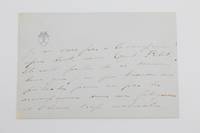
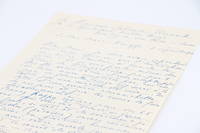
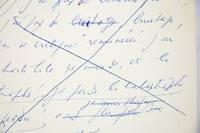
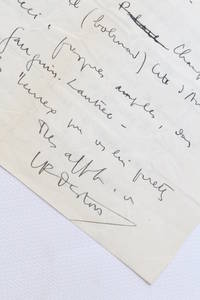
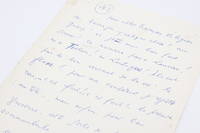
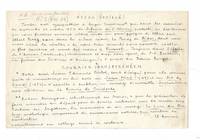
1952751671952. Fine. novembre 1952 20.90 x 13.40 cm une feuille André Breton autograph manuscript comprising two short texts titled ""Assez souillé !"" and ""Courrier transpyrénéen"" written for issue no. 1 of November 1952 of the journal Médium. 18 lines written in black ink in a careful hand on a white sheet. A tiny pinhole in the upper right margin of the sheet. ""Assez souillé !"" ""Enough soiled!"" recounts the reception given by the journal Médium to Céline's panegyric by Albert Paraz. The chronicle titled ""Courrier transpyrénéen"" ""Trans-Pyrenean Mail"" announces the publication of the latest work by critic Juan Eduardo Cirlot titled Surrealismo. Breton also mentions Robert Benayoun's work Le Livre du Non-Sens which would ultimately bear the title Anthologie du non-sens and appear in 1957 published by J.- J. Pauvert. unknown
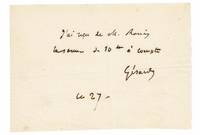
184973271s. l. 1849. Fine. s. l. 1837 ou 1849 13.40 x 9.40 cm un petit billet Autograph receipt signed ""Gérard"": ""J'ai reçu de M. Rouy la somme de 10F à compte. Gérard. Ce 27"" ""I have received from M. Rouy the sum of 10F on account. Gérard. This 27th"". Daniel Rouy was manager and cashier of the newspaper La Presse. Two transverse crease marks. This acknowledgment of debt simply dated ""ce 7"" ""this 7th"" could have been written in August 1849 if one refers to a letter to Ernesta Grisi companion of his friend Théophile Gautier in which the poet mentions such a debt: ""Je n'ai pu toucher l'argent qu'aujourd'hui mercredi. M. Rouy n'y était pas. J'y suis allé 4 fois aujourd'hui."" ""I was only able to collect the money today Wednesday. M. Rouy was not there. I went there 4 times today."" Pléiade volume 1 letter 143 of August 30 1849. However Michel Brix author of Nerval Glanes et miettes de presse and member of the Royal Academy of French Language and Literature of Belgium has very kindly pointed out to us that Nerval signed ""Gérard"" rather between 1837 and 1840 and that in 1849 he signed this kind of note ""Gérard de Nerval"". unknown
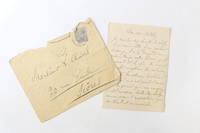
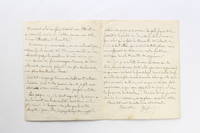
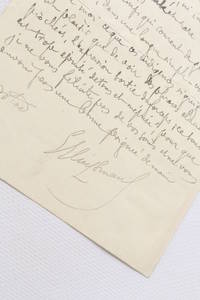
187863560s. l. Paris 1878. Fine. s. l. Paris n.d. 14 mai 1878 9.80 x 13.40 cm un feuillet remplié Autograph letter signed by Joris-Karl Huysmans addressed to Léon Cladel 40 lines written in black ink on 4 pages on a folded sheet envelope included. A 2cm tear without loss inherent to the fold of the sheet. In this caustic letter entirely imbued with Huysmanian poetic writing the author regrets that Dutch-Belgian visitors to the Universal Exhibition keep him away from the Sèvres landscapes where Léon Cladel lives. « Je sors de chez Leconte de Lisle il a reçu votre livre couleur de sang » ""I have just left Leconte de Lisle's he received your blood-colored book"". The importance of Léon Cladel's work and personality esteemed friend of the great writers of the time is perceptible from these opening lines. The « livre couleur de sang » ""blood-colored book"" witness to Huysmans' poetic force which shines through even in his private correspondence refers to l'Homme-de-la-Croix-aux-Bufs published by Edouard Dentu in 1878 a novel which was moreover reread by Flaubert also intimate with Cladel. « Je vous serre la main de tout cur mon puissant orfèvre et vous invite pour notre bonheur à tous à forger encore de belles uvres. » ""I shake your hand wholeheartedly my powerful goldsmith and invite you for all our happiness to forge more beautiful works."" Émile Zola would take up this eloquent analogy in Cladel's funeral oration: « . de ces belles uvres impeccables qu'il lançait ouvragées comme des joyaux de haut prix » "". those beautiful impeccable works he launched wrought like precious jewels"". This same year 1878 sees the Universal Exhibition settle in Paris an event which Huysmans seems compelled to attend: « c'est l'invasion hollando-belge venue pour l'exposition qui me tient et m'empêche » ""it is the Dutch-Belgian invasion come for the exhibition that holds me and prevents me"". The author's position regarding Belgium and Holland is ambiguous: Dutch through his father Huysmans makes numerous family and artistic visits to these countries and he is recognized there for his critical writings on painting. The author nevertheless prefigures here the disdain that would be found in À rebours a few years later: « Je cours à la recherche de chambres d'hôtels pour ces barbares aux toisons jaunes et le soir quand j'ai une minute de libre je les fais déambuler au travers de la capitale. Ils ouvrent des yeux comme des assiettes et jargonnent des exclamations admiratives. » ""I run in search of hotel rooms for these barbarians with yellow fleeces and in the evening when I have a free minute I make them wander through the capital. They open eyes like plates and jabber admiring exclamations."". Suffocated by the city and its society « Tout ça ça peut être drôle mais ça m'obsède singulièrement. J'espère que ça va enfin cesser et que je vais reconquérir un peu de cette pauvre liberté dont je suis si maigrement loti même en temps ordinaire » ""All that can be amusing but it obsesses me singularly. I hope it will finally cease and that I will reconquer a bit of that poor freedom of which I am so meagerly provided even in ordinary times"" Huysmans aspires to find nature again a desire which expresses itself through an elegiac exclamation: « Ah les coteaux de Sèvres ! Pardon ! » ""Ah the hills of Sèvres! Forgive me!"" A piquant letter from which emerge the themes dear to Huysmans' singular pen. unknown
189463596Paris 1894. Fine. Paris 8 février 1894 10.60 x 13.50 cm un feuillet remplié Autograph letter of Joris-Karl Huysmans signed to Camille Mauclair 44 lines written in black ink 3 pages on a folded sheet handwritten correction of the author. Two restorations using strips of paper in high and low fold of the letter the second band very slightly affects a word of the text a fold inherent in the enveloping of the letter. A long and beautiful letter in which all Huysmans' respect and interest are shown for the writings of the young Symbolist generation. Both author and literary critic Huysmans embodies a central figure for young poets like the 22-year-old Camille Mauclair who sends him one of his first poetic collections: "" The chapter on the symbol is perfect ; it is certainly the first time that we explain and with such lucidity we put things back in place. "" Heart of the symbolism and the poetic fiber of Huysmans the music of the language is particularly honored both in the lyrics and in the author's writing: "" the pieces on death on sensuality are woven into the most vivid language . and the fine writer who found the cold and ethereal absentee who wrote such sentences: ""we strive to determine our true ghost in the tumult of appearances "". "" Introduced by the mention of the myth of Narcissus Symbolist figure par excellence the letter shows the philosophical questions that underlie the movement. « Narcissus is God - It is not very beautiful to contemplate the soul . It is true that you in a melancholy return on the vanity of being have shown in a vibrant page the actors of ourselves as we are. The mystical evocations direct to Satan and more ambiguous to God echo the literary conversion of Huysmans who in 1894 prepares the writing of En Route the first part of his trilogy during direct ""black book"" that is there : ""Ah! the damn God! Really that makes me dream of a literature that feeds less his Satan as you say to a literature of humility! "" Accustomed to digressive theoretical reflections on literature Huysmans concludes his letter with: "" At bottom I am stupid to quibble over ideas because in short all the ones we express and that we will make are already in d ' other times and they are more or less new depending on whether they are more or less forgotten but what is not done before you what you own is the way to coat them. And that's where I admire you wholeheartedly because those are your sentences. "" unknown
188863597Paris 1888. Fine. Paris 20 juin 1888 12.40 x 16.70 cm un feuillet Autograph letter signed addressed to Jacques Le Lorrain from Joris-Karl Huysmans 30 lines written in black ink on 2 pages. Manuscript correction by the author. Fold inherent to the letter's mailing. Remarkable letter with sometimes obscure remarks where Huysmans emphasizes the importance and rarity of the writing craft at work in the novel Nu by the cobbler-poet Jacques Le Lorrain. « In these times when people rush books in simple language - you know as well as I what these indigences mean - it is a pleasure to see elucidated sentences labored over expression delivered with forceps ». Sharp as usual Huysmans positions himself as a fierce defender of literary writing experienced as labor which contemporary production seems to be abandoning: « this concern is too exhausted by all and despised for me not to congratulate you on your care ». Accustomed to receiving works from his colleagues Huysmans endeavors to highlight the innovative particularities of each author he receives: « Many pages are truly curious. Lorgeral on the grass closing his eyes listening to the voices - it's fresh and absolutely accurate. The scene of Juliette's armpit kissing. This work so well explained of man's jealousy for the child are particular original corners of this book whose very scrupulous style has captivated me. ». The author Huysmans distinguishes himself here always attentive to the right measure necessary according to him for literary expression: « you have managed to enhance the language to make it neither powerless nor inert. And I know how difficult and rare that is! » unknown
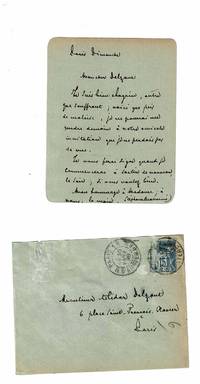
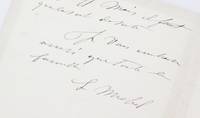
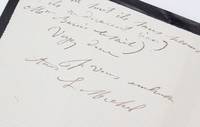
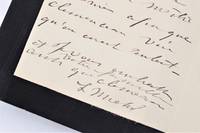
189876329Paris 1898. Fine. Paris 30 janvier 1898 11.40 x 8.80 cm une carte recto et une enveloppe Autograph postcard signed by Stéphane Mallarmé addressed to Alidor Delzant written on the front in black ink. Envelope enclosed. Alidor Delzant was a lawyer collector and bibliophile. Friend of the Goncourts he devoted a work to them and was secretary and testamentary legatee of Edmond. ""Je suis bien chagrin outre que souffrant ; voici que pris de malaise je ne pourrai me rendre demain à votre amicale invitation que je ne perdais pas de vue. Je vous ferai signe quand je commencerai à sortir de nouveau le soir ; si vous voulez bien."" ""I am quite grieved besides being unwell; here I am taken with malaise I will not be able to respond tomorrow to your friendly invitation which I had not lost sight of. I will give you a sign when I begin to go out again in the evening; if you would like."" unknown
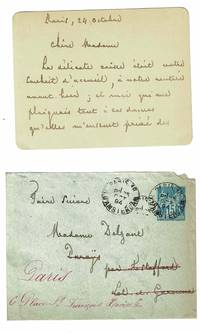
189476348Paris 1894. Fine. Paris 24 octobre 1894 11.40 x 8.80 cm une carte recto-verso et une enveloppe Autograph letter signed by Stéphane Mallarmé addressed to Gabrielle Delzant wife of his friend Alidor written on both sides in black ink. Envelope included. Alidor Delzant was a lawyer collector and bibliophile. A friend of the Goncourts he devoted a work to them and was Edmond's secretary and testamentary legatee. ""La délicate caisse était votre souhait d'accueil à notre rentrée avant-hier ; et moi qui me plaignais tant à ces dames qu'elles m'eussent privé des toutes dernières feuilles mortes voici qu'à un point de vue poétique différent ces pruneaux les remplacèrent aussitôt."" ""The delicate box was your welcoming wish upon our return the day before yesterday; and I who complained so much to these ladies that they had deprived me of the very last dead leaves here from a different poetic point of view these prunes replaced them at once."" unknown
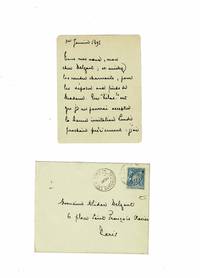
189276270Paris 1892. Fine. Paris 1er janvier 1892 8.80 x 11.40 cm une carte recto-verso et une enveloppe Autograph letter signed by Stéphane Mallarmé addressed to Alidor Delzant written on both sides in black ink. With envelope. Alidor Delzant was a lawyer collector and bibliophile. A friend of the Goncourts he devoted a work to them and served as secretary and testamentary legatee to Edmond. Charming letter in which the poet sends his wishes to his friend for the new year: ""Tous mes voeux mon cher Delzant ; et veuillez les rendre charmants pour les déposer aux pieds de Madame."" ""All my wishes my dear Delzant; and please make them charming to lay them at Madame's feet."" unknown
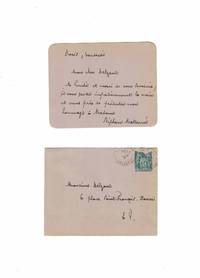
189576277Paris 1895. Fine. Paris 22 novembre 1895 11.40 x 8.80 cm une carte recto et une enveloppe Signed autograph card from Stéphane Mallarmé addressed to Alidor Delzant written on the recto in black ink. Envelope included. Alidor Delzant was a lawyer collector and bibliophile. Friend of the Goncourts he devoted a work to them and was Edmond's secretary and testamentary legatee. ""A lundi et merci de vous souvenir ; je vous presse impatiemment la main et vous prie de présenter mon hommage à Madame."" ""Until Monday and thank you for remembering; I impatiently press your hand and ask you to present my respects to Madame."" unknown
190079011s. l. Paris 1900. Fine. s. l. Paris s. d. ca 1900 12.50 x 8.40 cm une carte rédigée des deux côtés Autograph letter signed ""Paul"" and addressed to Natalie Clifford Barney written in black ink on both sides. Silver monogram of the poetess in the upper left corner of the recto. ""Je ne vais pas à la campagne après tout mon Tout-Petit. Ils sont partis de si bonne heure que j'ai pu trouver un prétexte pour ne pas les accompagner dans ma fatigue et l'heure trop matinale. Quand veux-tu que je vienne te chercher et où irons-nous Je serai prête à l'heure où tu voudras. J'aime tes jolies fleurs elles sont charmantes - j'ai porté une de tes roses hier au soir. A tout à l'heure mignon Tout-Petit - Paul"" ""I'm not going to the countryside after all my Little One. They left so early that I was able to find an excuse not to accompany them in my fatigue and the too early hour. When do you want me to come get you and where shall we go I'll be ready whenever you want. I love your pretty flowers they are charming - I wore one of your roses last evening. See you soon sweet Little One - Paul"" It was at the end of 1899 and through Violette Shillito that Renée Vivien - then Pauline Tarn - made the acquaintance of Natalie Clifford Barney ""this American more supple than a scarf whose sparkling face shines with golden hair sea-blue eyes implacable teeth"" Colette Claudine à Paris. Natalie who had just experienced a summer idyll with the sulfurous Liane de Pougy who had initiated her into sapphism paid only discreet attention to this new acquaintance. Renée however was completely captivated by the young American and would recount this coup de foudre in her autobiographical novel Une Femme m'apparut: ""J'évoquai l'heure déjà lointaine où je la vis pour la première fois et le frisson qui me parcourut lorsque mes yeux rencontrèrent ses yeux d'acier mortel ses yeux aigus et bleus comme une lame. J'eus l'obscur prescience que cette femme m'intimait l'ordre du destin que son visage était le visage redouté de mon avenir. Je sentis près d'elle les vertiges lumineux qui montent de l'abîme et l'appel de l'eau très profonde. Le charme du péril émanait d'elle et m'attirait inexorablement. Je n'essayai point de la fuir car j'aurais échappé plus aisément à la mort."" ""I recalled the already distant hour when I saw her for the first time and the shiver that ran through me when my eyes met her deadly steel eyes her sharp and blue eyes like a blade. I had the dark prescience that this woman was commanding me to destiny that her face was the dreaded face of my future. I felt near her the luminous vertigo that rises from the abyss and the call of very deep water. The charm of peril emanated from her and attracted me inexorably. I did not try to flee from her for I would have escaped death more easily."" ""Winter 1899-1900. Beginning of the idyll. One evening Vivien is invited by her new friend to the studio of Mrs. Barney Natalie's mother 153 avenue Victor-Hugo at the corner of rue de Longchamp. Natalie ventures to read verses of her composition. When Vivien tells her she loves these verses she replies that it is better to love the poet. An answer quite worthy of the Amazon."" J.-P. Goujon Tes blessures sont plus douces que leurs caresses There followed two years of unequal happiness punctuated by Natalie's recurring infidelities and Renée's morbid jealousy whose letters oscillated between impassioned declarations and painful mea culpas. ""Renée Vivien is the daughter of Sappho and Baudelaire she is the flower of evil 1900 with fevers broken flights sad voluptuousness."" Jean Chalon Portrait d'une séductrice In 1901 came an important break that would last almost two years; Renée despite Natalie's solicitations and the intermediaries she sent to win her back resisted. ""The two friends met again and it was in August 1905 the pilgrimage to Lesbos which constituted a disappointment for Natalie Barney and remained without sequel. . unknown
28374Known in the German-speaking world as "Ernst von Osterreich" this son of Holy Roman Emperor Maximilian II and Maria of Spain was educated with his brother Holy Roman Emperor Rudolf II; in 1573 and 1587 he was a candidate for the throne of Poland; from 1576 on he served as governor of the Archduchy of Austria in 1590 he was named governor of Inner Austria; from 1594 until his death he served as governor of Spanish Netherlands. ALS in Italian 1p lettersheet 7½" X 12" Vienna Austria 1579 March 26. Very good. Slight bit of age toning and quite minor foxing; inconspicuous small paper loss at left margin ¼" X 2¼" bears old but expert replacement. Overall attractive boldly written and easily legible. Writing to his cousin the Duke of Savoy Emmanuel Philibert 1528-80 Duke of Savoy 1553-80 it reads translation: "Sir: Mr. de la Cruz your ambassador gave me a letter from you several days ago and although I wanted to answer it before this I have been kept from it by various things and I hope you will not take offense at my delay. You may be sure that I shall always endeavor to do for you all that I can as I have often told Mr. de la Cruz who has probably so informed you. He has told me of the warmth and good will that you feel for me which I feel certain of and I do not know how to repay you except in kind as you may always find in everything that I can very well do you for. May God keep you as I would wish." Signed simply "Ernesto" with a flourish. Integral address leaf present on which Ernest notes "Al Señor duque de Saboya my primo" with a small deep burgundy wax seal bearing his family crest still present. A choice example of this autograph. Ernest died at the relatively young age of 42 making his autograph material quite scarce. unknown
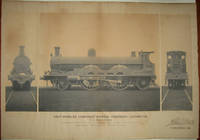
14695Influential British locomotive engineer executive and innovator; as Locomotive Superintendent of the London & North Western Railway Company from 1871 to 1903 his word was law and in the city of Crewe where the L. & N.W.R. operated its "Crewe Works" he was known as "The King of Crewe." Rare signed production photograph most likely a heliotype heavy stock 24" X 16" Crewe England 1891. Very good. Light even age toning except verso where acidic backing has darkened unevenly; several small archivally closed on verso edge tears; very slight waviness at some edges. This piece actually consists of three separate images tipped to the heavy 24" X 16" sheet: Center image 14" X 11½" shows this locomotive in close-up profile left side image 3½" X 11½" shows a frontal view and right side image also 3½" X 11½" shows a rear view. Titled "Eight-Wheeled Compound Express Passenger Locomotive" in large typeface below the center image with "F.W. Webb's System" below that in smaller typeface and two lines of technical statistics at the bottom "High-pressure Cylinders 15 in. diam. x 24 in. stroke. Low-pressure Cylinder 30 in. diam. x 24 in. stroke. Driving Wheels 7 ft. 1 in. diam. / Leading Wheels radial. Fixed Wheel base 8 ft. 3 in. Trailing Wheels ½ in. side play.". In the latter part of the 19th century Webb took a leading role in the development of compound locomotives -- those in which the steam operates more than one set of cylinders. The locomotive depicted here is part of the "Greater Britain" class a type of eight-wheeled express engine featuring an extra long combustion chamber and distinguished by their 7 foot 1 inch driving wheel; of these Webb designed ten models. The first of these appeared in 1891 -- and may well be the version depicted in this print. At the lower right corner above the printed text "Crewe Works 1891" Webb signs big and bold. Verso of this print bears an oval inkstamp of the L. & N.W.R. Mechanical Engineer's Office dated 30 September 1893. A superb and significant piece ideal for display. unknown
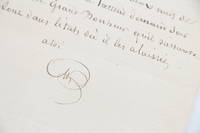
1866866021866. Fine. lundi soir 1866 13.30 x 20.90 cm une page sur un bifeuillet Autograph letter signed by Alexandre Dumas to his mistress Marie Richon. 6 lines on one page of a bifolium of laid paper with the writer's crowned initials. « Chère amoi sic Ton ami arrivé moulu brisé de deux nuits de voitures et de chemins de fer. Il t'attend demain soir mardi. Oh ce sera avec grand bonheur qu'il s'assurera que toutes choses sont dans l'état où il les a laissées a toi » Nothing is known of this affair with Marie Richon addressed to this mistress evidently sensitive to literature ""Fais-moi de bons vers pour mon retour"" he requests of her in another note. Actress society woman or woman of learning the mystery remains complete around this character who inspires in the insatiable Dumas a torrid correspondence. He notably arranged meetings with his mysterious conquest at his residence on Boulevard Haussmann where he had settled from 1865 onwards. A sentence from Dumas in another note tells us that she even met Dumas's daughter who lived with her father and endured the visits of his mistresses ""elle t'adore - ou plutôt nous t'adorons"" he would write to her. This missive can probably be situated during 1866 when the writer was preparing the theatrical adaptation of his novel Gabriel Lambert and mentions in a letter a reading of the play created at the Ambigu-Comique on March 16 1866. The last years of his life did not belie his immeasurable love of women; during this period rich in adventures he also shared his nights with the feminist and gerontophile Olympe Audouard as well as the famous Adah Isaacs Menken whose portraits alongside the writer were divulged by their indiscreet photographer. Handsome letter filled with anticipation from the hand of the great writer and addressed to a mysterious mistress still unknown to biographers. unknown
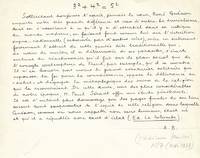
1953751691953. Fine. mai 1953 21 x 27 cm une feuille André Breton autograph manuscript signed ""A.B."" entitled ""3² 4² = 5²"" written for issue no. 7 of May 1953 of the review Médium. 18 lines written in black ink in careful handwriting on a white sheet. Two transverse folds of no significance. This is the final version of the text; an intermediate version of this article can be seen on the Breton Archives website. An interesting chronicle on Paul Sérant's work devoted to René Guénon and his work published by éditions La Colombe: ""Of this work one of the most considerable of our time M. Paul Sérant offers a penetrating study."" unknown
1868784821868. Fine. s. d. mai 1868 13.50 x 20.70 cm 2 pages sur un double feuillet Autograph letter signed by George Sand addressed to Alphonse Peyrat two pages written in black ink on a double sheet. Transverse folds inherent to mailing. Interesting letter evoking one of her faithful friends: Jean Patureau-Francoeur. George Sand had published a long obituary article in tribute to this close friend in L'Avenir national on May 2 1868. She described her late friend with great tenderness: ""C'était un simple paysan un vigneron des faubourgs de Châteauroux. Il avait appris tout seul à écrire et il écrivait très remarquablement avec ces naïves incorrections qui sont presque des grâces dans un style rustique et spontané. . Ce petit homme robuste à grosse tête ronde au teint coloré à l'il bleu étincelant et doux était doué d'une façon supérieure. Il voyait la nature il l'observait il l'aimait et il la savait. . Son existence parmi nous fut pénible agitée méritante. Naturellement un esprit aussi complet que le sien devait se passionner pour les idées de progrès et de civilisation. Il fut avant la Révolution le représentant populaire des aspirations de son milieu et il travailla à les diriger vers un idéal de justice et d'humanité. ."" ""He was a simple peasant a wine-grower from the suburbs of Châteauroux. He had taught himself to write and he wrote remarkably well with those naive incorrections that are almost graces in a rustic and spontaneous style. . This sturdy little man with his large round head his ruddy complexion his sparkling and gentle blue eyes was gifted in a superior way. He saw nature observed it loved it and understood it. . His existence among us was painful agitated meritorious. Naturally a mind as complete as his had to be passionate about ideas of progress and civilization. He was before the Revolution the popular representative of his milieu's aspirations and he worked to direct them toward an ideal of justice and humanity. ."" In 1848 Patureau was elected mayor of Châteauroux and became the spokesman for the workers of his commune. ""Au moment du coup d'État il fut poursuivi mais il se cacha dans des familles amies et échappa à la police. George Sand obtint difficilement sa grâce ce qui lui permit de regagner Châteauroux. Il fut arrêté en janvier 1858 à la suite de la loi de sûreté générale."" ""At the time of the coup d'état he was pursued but he hid with friendly families and escaped the police. George Sand obtained with difficulty his pardon which allowed him to return to Châteauroux. He was arrested in January 1858 following the general security law."" ""Il resta un mois au cachot sur la paille en plein hiver. Quand on le mit dans la voiture cellulaire qui le dirigeait vers l'Afrique il était presque aveugle et depuis il a toujours souffert cruellement des yeux"" ""He remained a month in the dungeon on straw in the middle of winter. When they put him in the prison van that was taking him to Africa he was almost blind and since then he has always suffered cruelly with his eyes"" George Sand. In September 1858 following an intervention by George Sand with her friend Jérôme-Napoléon Napoleon III's cousin he was released but remained under surveillance. He settled in Algeria after obtaining permission to come to Châteauroux to sell his house and vineyard and to fetch his family. In Algeria he lived by his trade as a wine-grower was part of the Agricultural Society of Philippeville and wrote a treatise on viticulture."" Maintron ""À présent je viens vous demander de me payer ce petit article le plus cher que vous pouvez et d'envoyer le prix directement à Joseph Patureau rue de cluis n°7 à Châteauroux. Indre. Et cela le plus tôt possible."" ""Now I come to ask you to pay me for this little article as dearly as you can and to send the payment directly to Joseph Patureau rue de cluis n°7 à Châteauroux. Indre. And this as soon as possible."" Jos unknown
1874773391874. Fine. 1874 13.20 x 20.70 cm 4 pages sur un double feuillet Autograph letter signed by Gustave Doré addressed to Paul Dalloz. Four pages written in black ink on a double sheet of white paper with envelope. Fine letter full of torment in which Gustave Doré dreads being supported again for the rank of officer in the Legion of Honor he who was made chevalier in 1861 after the publication of Dante's Inferno and thanks to Paul Dalloz's intervention. Doré thanks him moreover for this past influence: ""Je viens te remercier encore et du plus profond de mon cur de l'amitié toute dévouée que vous m'avez témoignée dans ces dernières circonstances ; et je t'assure que je te conserve pour ce fait des sentiments aussi reconnaissants que pour le service que tu m'as si spontanément et cordialement rendu il y douze ans."" ""I come to thank you again and from the depths of my heart for the devoted friendship you have shown me in these recent circumstances; and I assure you that I preserve for this fact feelings as grateful as for the service you rendered me so spontaneously and cordially twelve years ago."" He nevertheless asks him not to propose him for the rank of officer: ""Mais je viens réclamer de toi les mêmes amitiés te priant te suppliant même de t'arrêter complétement et absolument ce qui je n'en doute pas te coûtera plus encore qu'autre chose. J'ai beaucoup pensé à tout ce que tu m'as dit hier et je trouve que je me suis trompé tout à fait en te laissant t'engager si obligeamment dans ces démarches."" ""But I come to claim from you the same friendships asking you even begging you to stop completely and absolutely which I do not doubt will cost you more than anything else. I have thought much about everything you told me yesterday and I find that I was quite wrong to let you engage so obligingly in these steps."" Gustave Doré was nevertheless appointed officer of the Legion of Honor on January 15 1879.through Paul Dalloz's intervention. unknown
197884596Paris 1978. Fine. Paris s. d. 1978 14.50 x 20.50 cm une feuille Important autograph letter signed by Julien Gracq 53 lines in black ink addressed to his close friend and monographer Ariel Denis establishing him as his biographer. Julien Gracq expresses his regret that his friend Ariel Denis was not selected despite his intervention by the Berlin Academy to teach: ""Je vous avais recommandé de mon mieux mais je doute que cela ait été en Allemagne d'une grande efficacité. Je sais d'ailleurs que comme vous le pressentiez les concurents étaient en nombre."" ""I recommended you as best I could but I doubt that was very effective in Germany. I know moreover that as you suspected there were many competitors."" To help his friend the author of Rivage des Syrtes suggested to publisher Seghers who wanted to publish a work about him in his famous ""Poètes d'aujourd'hui"" collection the name of Ariel Denis having had no news from the first biographer considered for this publication: ""Ils me demandent de leur suggérer un nom. J'ai indiqué celui de Lautrat. Et j'ai indiqué le vôtre ne sachant bien sûr aucunement si un travail de ce genre pourrait vous plaire. Il va de soi que si Seghers s'adressait à vous vous devez être absolument libre d'accepter ou de refuser."" ""They ask me to suggest a name. I indicated Lautrat's. And I indicated yours not knowing of course at all whether work of this kind might please you. It goes without saying that if Seghers approached you you must be absolutely free to accept or refuse."" He also hopes to see his friend again soon before the summer holidays: "". si je ne vous revois pas avant juillet je vous souhiate des vacances à la fois paisibles et laborieuses en comptant vous revoir d'ici l'automne."" "".if I don't see you again before July I wish you holidays that are both peaceful and productive counting on seeing you again by autumn."" He concludes his letter with his judgments as an informed cinephile: ""J'ai surtout revu des films de Tati et je me suis beaucoup ennuyé dans une salle déserte au film de Mme Sagan."" ""I mainly rewatched Tati films and I was very bored in a deserted theater by Mme Sagan's film."" At Julien Gracq's instigation Ariel Denis would indeed accept Seghers' proposal to publish a volume in his ""Poètes d'aujourd'hui"" collection about the author of Au château d'Argol thereby becoming one of his best and most remarkable biographers. unknown
192487768Le Clos-Marie Roscoff 1924. Fine. Le Clos-Marie Roscoff 30 Août 1924 21 x 27.50 cm 1 page recto verso Autograph letter dated from Liane de Pougy addressed to the French archaeologist curator of the Saint-Germain museum and professor of art history at the École du Louvre Salomon Reinach 56 lines written in blue ink on a recto verso leaf written from her property Clos-Marie in Roscoff where the famous courtesan stayed until 1926. A small tear in the right margin of the letter and inherent to the folding of the missive. Liane de Pougy does not have time to be bored in her Roscoff property: ""J'écris beaucoup dans mes cahiers fleuris et je reçois des visites"" I write a lot in my flowered notebooks and I receive visits where her great friend Mathilde de Morny known as ""Missy"" famous Amazon of Tout-Paris comes to see her: ""Missy-Missou est revenue nous voir avec 2 amis. C'est bien elle-lui que vous avez vu à l'Opéra. Il ou elle eût été charmée de vous saluer mais ne vous as pas perçu. Il est reparti emmenant Max Jacob qui est déjà revenu."" Missy-Missou came back to see us with 2 friends. It is indeed she-he that you saw at the Opera. He or she would have been delighted to greet you but did not see you. He left taking Max Jacob who has already returned. Liane de Pougy receives many people: ""Nous attendons le jeune de Jacques de Maleisgne avec sa femme son nègre des animaux - des instruments banjo etc. Vous voyez qu'il y a de quoi s'occuper."" We are expecting young Jacques de Maleisgne with his wife his negro animals - instruments banjo etc. You see there is plenty to keep busy. complains about her health affected by weather conditions: ""En plus de mes occupations j'ai des douleurs alimentées par les pluies incessantes cependant ce matin ma fenêtre est ouverte sur un paysage riant."" In addition to my occupations I have pains fed by incessant rains however this morning my window is open on a smiling landscape. while appreciating with a certain melancholy the beauties of nature surrounding her: ""Les rosiers poussent drus leurs fleurs persistent les grenouilles et les limaces sont heureuses baveuses et ne demandent plus de roi ! Les guêpes bourdonnent tristement désenchantées de la saison ratée. et nous attendons l'hiver et ses feux ses lumières ses neiges ses fourrures et tous ses artifices."" The rose bushes grow thick their flowers persist the frogs and slugs are happy drooling and no longer ask for a king! The wasps buzz sadly disenchanted with the failed season. and we await winter and its fires its lights its snows its furs and all its artifices. Fine letter from the famous courtesan actress and author Liane de Pougy relating her friendships with the Tout-Paris of the Amazons. unknown
192386631Le Clos-Marie Roscoff Roscoff 1923. Fine. Le Clos-Marie Roscoff Roscoff 2 Septembre 1923 20.50 x 27 cm 1 page recto verso Autograph letter dated from Liane de Pougy to the French archaeologist curator of the Musée de Saint-Germain and professor of art history at the École du Louvre Salomon Reinach 56 lines written in blue ink on one double-sided sheet written from her property at Clos-Marie in Roscoff where the famous courtesan stayed until 1926. A small tear in the right-hand margin of the letter inherent in the enveloping of the missive; another slight tear at the foot without affecting the text. Liane de Pougy marvels at the youthful vigor of Reinach who had just turned 65: ' Many happy returns for your 65 years which find you so young so fresh so green with such playful studious feelings. My friend your youthful morals hold the secret of your physical youth—as Rosa Josepha said one sustains the other one preserves the other—and this seen head-on. ' while magnifying his radiant intelligence: 'To no longer produce but to sit atop the high throne of your trophies formed by all you have wrested from instinct to sacrifice to intellectuality. Why do people always say a well of knowledge instead of a luminous column a sky a sun a star etc.—in short something that makes us lift our heads' She is waiting for her friend and former lover the terrible and unfaithful Natalie Clifford-Barney:  'Natalie plans to come to Clos at the end of September. She has a wound to heal here—time fortunately has already done part of the work! I have sensitive feelings and like a musketeer a good heart but a bad temper. This is the 1st time the amazon has truly aimed at me. Let us speak of it no more'. Liane firmly expresses her wish not to be pitied or consoled for her romantic troubles:  'I have suffered in silence but without resignation. Do not speak of this to Nathanaël. Nathanaël means Philippe Max Jacob claims who lives and works near us in the most fascinating way. '. A beautiful letter by the celebrated courtesan actress and writer Liane de Pougy recounting with restrained candor her romantic disappointments with Natalie Clifford-Barney.  unknown
195484027Meudon 1954. Fine. Meudon 1954 20.70 x 26.80 cm une page sur un feuillet Autograph manuscript signed by Louis-Ferdinand Céline written in blue and pink ballpoint pens on a white paper sheet numbered 507 in the left corner. One transverse fold. Some pin holes in the upper margin stigmata of the organization of Céline manuscripts in ""bundles"". « j'ai pas de cinéma personnel j'ai pas de bruitage j'ai pas de critiques ""rémunérés"" j'ai que l'hostilité du monde et la catastrophe ! je perds la catastrophe je suis perdu ! . chienlit ! charlatan ! barbeau mou ! Comme ça vous m'intitulez si vous me trouvez pas dans la loge en plein enragement d'éléments ! je veux pas que vous. » The passage in our sheet presents some variations from the published version. Published in 1954 Normance is a direct sequel to Féérie pour une autre fois published two years earlier. Both parts were written during Céline's years of exile and imprisonment in Denmark. Upon his return to France in 1951 Céline undertook a work of ""polishing"" and published independently these two titanic texts originally envisioned as one. ""Céline while working on it thought of this novel as a second Voyage au bout de la nuit capable twenty years later of astonishing the public as much as the 1932 novel."" Henri Godard unknown
193463409Paris 1934. Fine. Paris 3 mai 1934 21 x 27 cm 2 pages sur un feuillet une enveloppe jointe Autograph letter signed ""LF Destouches"" addressed to the journalist Léon Deffoux. 24 lines written in black ink several underlines and erasures of Celine's hand. Envelope attached. Folds inherent to the enveloping of the mail as well as some very tiny pinholes in the right margin of the leaflet. unknown
195483969Meudon 1954. Fine. Meudon 1954 21.20 x 26.10 cm une page sur un feuillet Autograph manuscript signed by Louis-Ferdinand Céline written in blue ballpoint pen on a sheet of white paper numbered 243 in the left corner. Some stains as well as a central fold of no consequence. A tiny lack of paper at the lower right margin of the sheet. Some pinholes in the upper margin evidence of the organization of Céline's manuscripts in ""bundles"". ""pour aller traverser les lignes des barrages quelque chose !. au galop ! et je me suis bien fait sonner ! ça arrivera pas à Lauriac ! ni à Tartron ! ni Larengue !. Ils ont pris le bon versant de la vie : le flan !. pour ma concerne je regrette rien . c'est fait ! c'est fait ! la preuve ma tête. mais enfin pour la griserie cette sorte de bravoure somnambule j'admire les doués. je les respecte. j'arrive moi que par le stoïcisme le sang froid là ! hop !"" ""to go cross the lines barricades something!. at a gallop! and I really got myself beaten up! that won't happen to Lauriac! nor to Tartron! nor Larengue!. They took the right side of life: the flank!. as for me I regret nothing. it's done! it's done! the proof my head. but finally for the intoxication this sort of sleepwalking bravery I admire the gifted ones. I respect them. I only achieve it through stoicism cold blood there! hop!"" The passage from our sheet referring to Mauriac Sartre and Aragon conforms to the published version. Published in 1954 Normance is a direct sequel to Féérie pour une autre fois published two years earlier. The two parts were written during Céline's years of exile and imprisonment in Denmark. Upon his return to France in 1951 Céline undertook a work of ""polishing"" and published these two titanic texts independently originally conceived as one. ""Céline while working on it thought of this novel as a second Voyage au bout de la nuit capable twenty years later of astonishing the public as much as the 1932 novel."" Henri Godard unknown
188783960s. l. Paris 1887. Fine. s. l. Paris 19 novembre 1887 11.30 x 17.70 cm 1 pages 1/2 sur un bifeuillet Autograph letter signed by Louise Michel addressed to Lucien Barrois; one and a half pages written in black ink on a bifolium of white paper with black border. Transverse folds inherent to mailing. ""Chauvière et d'autres amis communs vous prient bien de tâcher que Clemenceau recommande au professeur qui a la chaire de Russe au Collège de France et à la Sorbonne notre ami Gregorieff comme aide. Il paraît qu'avec un mot de Rochefort et de Clemenceau il serait immédiatement accepté ."" ""Chauvière and other mutual friends earnestly ask you to try to have Clemenceau recommend our friend Gregorieff as assistant to the professor who holds the Russian chair at the Collège de France and at the Sorbonne. It appears that with a word from Rochefort and Clemenceau he would be immediately accepted ."" The novelist P. Gregorieff had given some Russian lessons to Louise Michel. Moving letter testimony to the unfailing devotion of the former Communard. unknown
188583963s. l. Paris 1885. Fine. s. l. Paris 16 juillet s. d. ca 1885 13.40 x 21.10 cm 1 page 1/2 sur un bifeuillet Autograph letter signed by Louise Michel addressed to Lucien Barrois; one and a half pages written in black ink on a bifolium of white paper with black border. Transverse folds inherent to posting. Mrs. Vernier will be released from prison thanks to Louise Michel's assistance: ""elle sort le mois prochain et elle le mérite bien elle vous est bien reconnaissante. Remerciez Clémenceau Lafont et Clovis Hugues avec Laguerre peut-être tous les quatre qui ont apostillé la demande."" ""she is released next month and she well deserves it she is very grateful to you. Thank Clémenceau Lafont and Clovis Hugues with Laguerre perhaps all four who endorsed the request."" A moving letter testimony to the unwavering devotion of the former Communard. unknown
188583956s. l. Paris 1885. Fine. s. l. Paris 20 avril 1885 11 x 17.70 cm 2 pages sur un bifeuillet et un feuillet encollé sur la 3e page Autograph letter signed by Louise Michel addressed to Lucien Barrois; two pages written in black ink on a white paper bifolium with black border. One sheet in the hand of a naval adjutant from Brest pasted on the third page. Transverse folds inherent to postal delivery. Louise Michel asks the recipient of this letter for advice regarding her young cousin: ""Ignorant si Clémenceau aurait le temps d'écrire un mot de recommandation pour quelques leçons à mon petit cousin Dacheux je vous le dis d'abord afin que vous preniez un moment où ce sera possible pour le dire à Clemenceau. Je vous avoue que je n'ai pas trop compris la lettre du petit parce qu'il en est resté une bonne partie dans l'encrier il écrit si mal."" ""Not knowing if Clémenceau would have time to write a word of recommendation for some lessons for my young cousin Dacheux I tell you first so that you may find a moment when it would be possible to mention it to Clémenceau. I confess that I did not quite understand the boy's letter because a good part of it remained in the inkwellhe writes so poorly."" Moving letter testimony to the unwavering devotion of the former Communard. unknown