Pierre LOUSBiblio.com
1 815 résultats
189577509Paris 1895. Fine. Paris 12 novembre 1895 12.50 x 20 cm 4 page sur un double feuillet Autograph letter signed by Pierre Louÿs signed with his initial addressed to Georges Louis. Four pages written in blue ink on a double sheet. Envelope enclosed bearing on the verso the intact wax seal with the writer's cipher. Transverse fold inherent to the mailing. Important letter addressed to his brother Georges Louis with whom Pierre Louÿs maintained a very intimate relationship and whom he considered as his own father. The question of the real identity of Pierre Louÿs' father still fascinates biographers today: ""His father Pierre Philippe Louis . had married in 1842 Jeanne Constance Blanchin who died ten years later after giving him two children Lucie and Georges. In 1855 he remarried Claire Céline Maldan and from this union was born in 1857 a son Paul; then in 1870 our writer who received the first names Pierre Félix. This late birth the differences in character between father and son the former's disaffection towards the latter the profound intimacy that always reigned between Louÿs and his brother Georges all this has led certain biographers and critics to suspect that the latter was in reality the father of the writer. The exceptionally intimate and constant relationship that Pierre and Georges maintained between them all their lives could be an argument in this sense. Of course no irrefutable proof has been discovered and probably never will be. Nevertheless certain letters . are quite troubling. In 1895 for example Louÿs writes seriously to his brother that he knows the answer to 'the most poignant question' he could ask him a question he has had 'on his lips for ten years.' The following year in the midst of Aphrodite's triumph he thanks Georges effusively and ends his letter with this sentence: 'Not one of my friends has a FATHER who is for him what you are for me.' Arguing from the close intimacy of Georges and Claire Céline during 1870 and the jealousy that the father never ceased to show towards his younger son Claude Farrère did not hesitate to conclude in favor of Georges Louis. And what to make of this dedication by Louÿs to his brother on a Japan paper copy of the first edition of Pausole: To Georges his eldest son / Pierre."" Jean-Paul Goujon Pierre Louÿs As attested by the enclosed envelope Pierre Louÿs sends this letter to his brother while the latter is exercising the function of France's delegate to the International Commission of Egyptian Debt and is in Cairo. Like a good socialite Pierre tells his brother about his new encounters: ""I met yesterday at a friend's house one of the sons of your minister Marcellin Berthelot. I have known all four of them for a long time but I see little of them. One of them André is a friend of Henri Mougeot with whom he has rented along with two or three other young men a house in Chevreuse and a mistress in Paris. . The other Daniel is a professor at the School of Pharmacy. A remarkable chemist they say. Philippe does nothing special . Finally René the youngest is Blum's oldest friend and his great rival of former times in the general competition. . It is Philippe who formed five or six years ago with Léon Daudet and Georges Hugo such a famous trinity. He is also known for having written a sonnet containing six rhymes in omphe which stupefied Heredia."" But these worldly matters do not distance Pierre Louÿs from literature. Indeed his first novel entitled Aphrodite is about to appear and he wonders to whom he could dedicate it. He first thought of José Maria de Heredia but. ""H. refuses . the dedication of Aphr. because he still has two daughters to marry. I myself had put a thousand reservations in my offer and his response after all is not unobliging. I know on the other hand that he repeats before strangers and indifferent persons everything he told me about the book and in the same hyperbolic terms. Finally he gave me unknown
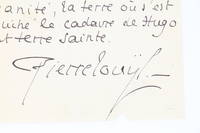
192078161Paris 1920. Fine. Paris s. d. novembre 1920 13.50 x 18 cm 4 pages sur 4 feuillets Autograph letter signed by Pierre Louÿs addressed to Georges Louis. Four pages written in blue ink on four sheets. Handsome letter addressed to his brother Georges Louis with whom Pierre Louÿs maintained a very intimate relationship and whom he considered as his own father. The question of Pierre Louÿs's real father's identity still fascinates biographers today: ""His father Pierre Philippe Louis . had married in 1842 Jeanne Constance Blanchin who died ten years later after having given him two children Lucie and Georges. In 1855 he remarried Claire Céline Maldan and from this union was born in 1857 a son Paul; then in 1870 our writer who received the first names Pierre Félix. This late birth the differences in character between father and son the former's disaffection toward the latter the profound intimacy that always reigned between Louÿs and his brother Georges all this has led certain biographers and critics to suspect that the latter was in reality the writer's father. The exceptionally intimate and constant relationship that Pierre and Georges maintained between them throughout their lives could be an argument in this sense. Of course no irrefutable proof has been discovered and probably never will be. Nevertheless certain letters . are quite troubling. In 1895 for example Louÿs writes gravely to his brother that he knows the answer to 'the most poignant question' he could ask him a question he has had 'on his lips for ten years.' The following year at the height of Aphrodite's triumph he thanks Georges effusively and ends his letter with this sentence: 'Not one of my friends has a FATHER who is to him what you are to me.' Arguing from the close intimacy between Georges and Claire Céline during the year 1870 and from the jealousy that the father never ceased to show toward his younger son Claude Farrère did not hesitate to conclude in favor of Georges Louis. And what to think of this dedication by Louÿs to his brother on a deluxe copy of the first edition of Pausole: To Georges his eldest son / Pierre."" Jean-Paul Goujon Pierre Louÿs This letter was written after the First World War: ""The project to open the Panthéon to heroes who offered everything to the Fatherland even losing their name for her is excellent. And it would be for the archbishopric of Paris an unhoped-for opportunity to spontaneously render to our great dead of the crypt the respects that it alone in the world denies them. It would thus repair an error that has lasted too long for its glory. Cemeteries are deconsecrated. No theological reason can attribute to them a more religious character than to the basement of a monument surmounted by a colossal cross and sanctified by ashes."" Indeed in November 1920 Charles Dumont the general budget reporter expressed his wish to bring the unknown soldier into the Panthéon. Finally only the ceremony took place there and the remains of the most famous of the combatants remained as everyone knows under the Arc de Triomphe. The only soldier to join the Panthéon Maurice Genevoix would not enter until a hundred years later on November 11 2020. Louÿs concludes his letter with a very handsome tribute to the writer he has always admired: ""One is ill-advised to forbid the faithful such a pilgrimage. They do it. For immense humanity the earth where Hugo's corpse lay down is holy ground."" unknown
191677521Paris 1916. Fine. Paris 15 mai 1916 11 x 16 cm 6 pages sur un double feuillet et un feuillet simple Autograph letter from Pierre Louÿs signed with his initial addressed to Georges Louis. Six pages written in violet ink on a double leaf and a single leaf. Central creases inherent to posting. Very fine letter addressed to his brother Georges Louis with whom Pierre Louÿs maintained a very intimate relationship and whom he considered as his own father. The question of the real identity of Pierre Louÿs's father still fascinates biographers today: ""His father Pierre Philippe Louis . had married in 1842 Jeanne Constance Blanchin who died ten years later after giving him two children Lucie and Georges. In 1855 he remarried Claire Céline Maldan and from this union was born in 1857 a son Paul; then in 1870 our writer who received the first names Pierre Félix. This late birth the differences in character between father and son the former's disaffection toward the latter the profound intimacy that always reigned between Louÿs and his brother Georges all this has led certain biographers and critics to suspect that the latter was in reality the writer's father. The exceptionally intimate and constant relationship that Pierre and Georges maintained between themselves all their lives could be an argument in this sense. Of course no irrefutable proof has been discovered and none will probably ever be discovered. Nevertheless certain letters . are quite disturbing. In 1895 for example Louÿs writes seriously to his brother that he knows the answer to ""the most poignant question"" he could ask him a question he has had ""on his lips for ten years."" The following year in the full triumph of Aphrodite he thanks Georges effusively and ends his letter with this sentence: ""Not one of my friends has a FATHER who is to him what you are to me."" Arguing from the close intimacy of Georges and Claire Céline during the year 1870 and the jealousy that the father never ceased to show toward his younger son Claude Farrère did not hesitate to conclude in favor of Georges Louis. And what to think of this dedication by Louÿs to his brother on a deluxe paper copy of the first edition of Pausole: For Georges his eldest son / Pierre."" Jean-Paul Goujon Pierre Louÿs A true reflection on literature and the choice of words this letter was written while Pierre Louÿs was working on a work that would appear the following year: Poëtique. ""Louÿs decides . to write a Poëtique which will be like the testament of his work as well as a message to young writers. He had always reflected on poetic art and accumulated dozens of notes both on poets and on poetry itself."" Ibid. To reflect on poetic art is precisely what he does in this fine letter: ""Regarding negation I wondered why the principle I tried to establish nuance ruse or error was not classical. I believe the answer is: Chimène. - We take the word as a text to teach high school students that negation is an additional force. - Ex. ""Je ne te hais point"" ""I do not hate you"" more expressive than ""Je t'aime"" ""I love you"". But no. Rodrigue has just said: ""Votre haine"" ""Your hatred"". It is Rodrigue who imprints the image. The response ""Je ne te hais point"" ""I do not hate you"" is the passage from shadow to light: it is to speak the nuance. . It is terribly delicate to write ""ne pas"" ""not""."" Then in a period of great trouble and isolation the poet is touched by Paul Valéry's support: ""The other day I had written a long letter to Valéry about my ""Poëtique."" - He answered me immediately a letter where he began by thanking me for all that he had felt of affection for him in the very fact that I had spent part of my evening with him without his being there. I answer him in turn - as much as I remember - ""It is so rare friends who suspect affection beneath something. There are hardly more than two kinds of people: those who do not lift the stone because they are certain there is not unknown
194183134Paris: S. n. 1941. Fine. S. n. Paris 13 juin 1941 14 x 19.50 cm trois feuilles recto-verso Autograph letter dated June 13th Carlo Rim having specified in pencil at the head of the first leaf 1941 and signed by Raimu addressed to his great friend Carlo Rim 98 lines in black ink on three leaves recto-verso. Folds inherent to mailing. Raimu rails against the incapacity and indecision of those responsible for a film project entitled l'Arlésienne quite a symbol! of which Carlo Rim was part: ""L'arlésienne ne pourra pas se faire parce que monsieur gendre Prouvost et cie sont des couillons. Et des gens sans aucune descisions. Donc affaire morte."" ""l'Arlésienne cannot be made because monsieur son-in-law Prouvost and company are fools. And people without any decisions. So the matter is dead."" "". tous les mois il change d'idées et dieu sait s'il en a mais tout cela se termine par des idées. jamais il ne tournera pas plus le tien que celui des autres il a peut-être de l'argent mais il ne veut pas le sortir. Genre Prouvost."" "". every month he changes his mind and God knows he has ideas but all this ends with ideas. he will never shoot yours any more than those of others he may have money but he doesn't want to spend it. That's Prouvost for you."" Raimu ever so irascible does not calm down and drowns his friend's last hopes about the forthcoming realization of l'Arlésienne: ""Mon vieux Carlo à l'heure actuelle les deux pauvres studios de Nice sont pris jusqu'à fin septembre par des gens qui eux prennent les descisions et qui verse de l'argent. donc tu vois mon pauvre vieux ce sont tous des bonimenteurs Honnebelle - Prouvost. des gens plein aux as mais ils ne veulent pas les sortir."" ""My dear Carlo at present the two poor studios in Nice are booked until the end of September by people who do make decisions and who put up money. so you see my poor friend they are all smooth talkers Honnebelle - Prouvost. people loaded with money but they don't want to spend it."" "". il trouvera 100 excuses pour ne pas tourner et elles lui seront faciles."" "". he will find 100 excuses not to shoot and they will come easily to him.""and ends his epistolary diatribe with this glacial criticism:""Mon Carlo il n'y a plus rien à faire en province que de la barraque et à écarter les marchands de boniments. because que depuis la fille du puisatier je n'ai entendu que des bobards. En plus il faudrait faire des films à la noix."" ""My Carlo there is nothing left to do in the provinces but fairground shows and to ward off the peddlers of smooth talk. because since la fille du puisatier I have heard nothing but tall tales. Plus we would have to make trashy films."" Carlo Rim was a Provençal writer author notably of ""Ma belle Marseille"" a caricaturist a filmmaker: ""Justin de Marseille"" ""L'armoire volante"" ""La maison Bonnadieu"" and was notably the friend of Fernandel Raimu and Marcel Pagnol but also of Max Jacob and André Salmon whom he met in Sanary. S. n. unknown
190078897s. l. Paris 1900. Fine. s. l. Paris s. d. ca 1900 9.50 x 5.60 cm une carte rédigée des deux côtés Autograph manuscript card signed ""Pauline"" and addressed to Natalie Clifford Barney written in black ink on both sides. Two small pinholes at the top of this card which accompanied a bouquet: ""Méchante d'être partie si vite ! - voici des orchidées blanches - elles te défendront contre les doutes et les pensées tristes. Elles te protègeront et t'assureront de ma profonde et éternelle tendresse. Ne sois pas en retard ce soir. Je compterai les secondes aux battements de mon coeur. Ces fleurs ce sont mes lèvres mon âme et mon coeur qui vont vers toi - Toujours."" ""Naughty to have left so quickly! - here are white orchids - they will defend you against doubts and sad thoughts. They will protect you and assure you of my deep and eternal tenderness. Don't be late tonight. I will count the seconds to the beating of my heart. These flowers are my lips my soul and my heart going towards you - Always."" It was at the end of 1899 and through the intermediary of Violette Shillito that Renée Vivien - then Pauline Tarn - made the acquaintance of Natalie Clifford Barney ""cette Américaine plus souple qu'une écharpe dont l'étincelant visage brille de cheveux d'or de prunelles bleu de mer de dents implacables"" ""this American more supple than a scarf whose sparkling face shines with golden hair sea-blue eyes and implacable teeth"" Colette Claudine à Paris. Natalie who had just experienced a summer idyll with the scandalous Liane de Pougy who had initiated her into sapphism paid only discreet attention to this new acquaintance. Renée however was completely captivated by the young American and would relate this love at first sight in her autobiographical novel Une Femme m'apparut: ""J'évoquai l'heure déjà lointaine où je la vis pour la première fois et le frisson qui me parcourut lorsque mes yeux rencontrèrent ses yeux d'acier mortel ses yeux aigus et bleus comme une lame. J'eus l'obscur prescience que cette femme m'intimait l'ordre du destin que son visage était le visage redouté de mon avenir. Je sentis près d'elle les vertiges lumineux qui montent de l'abîme et l'appel de l'eau très profonde. Le charme du péril émanait d'elle et m'attirait inexorablement. Je n'essayai point de la fuir car j'aurais échappé plus aisément à la mort."" ""I evoked the already distant hour when I saw her for the first time and the shiver that ran through me when my eyes met her eyes of mortal steel her eyes sharp and blue like a blade. I had the obscure presentiment that this woman was giving me destiny's order that her face was the dreaded face of my future. I felt near her the luminous vertigo that rises from the abyss and the call of very deep water. The charm of peril emanated from her and attracted me inexorably. I did not try to flee her for I would have escaped death more easily."" ""Hiver 1899-1900. Débuts de l'idylle. Un soir Vivien est invitée par sa nouvelle amie dans l'atelier de Mme Barney mère de Natalie 153 avenue Victor-Hugo à l'angle de la rue de Longchamp. Natalie s'enhardit à lire des vers de sa composition. Comme Vivien lui dit aimer ces vers elle lui répond qu'il vaut mieux aimer le poète. Réponse bien digne de l'Amazone."" ""Winter 1899-1900. Beginning of the idyll. One evening Vivien is invited by her new friend to Mme Barney's studio Natalie's mother 153 avenue Victor-Hugo at the corner of rue de Longchamp. Natalie ventures to read verses of her composition. When Vivien tells her she loves these verses she replies that it is better to love the poet. A response quite worthy of the Amazon."" J.-P. Goujon Tes blessures sont plus douces que leurs caresses Two years of unequal happiness followed punctuated by Natalie's recurring infidelities and Renée's pathological jealousy whose letters oscillated between impassioned declarations and painful mea culpas. ""Renée Vivien c'est la fille de Sappho et de Baudelaire c'est la f unknown
190078898s. l. Paris 1900. Fine. s. l. Paris s. d. ca 1900 9.50 x 5.60 cm une carte rédigée des deux côtés Autograph manuscript card signed ""Pauline"" and addressed to Natalie Clifford Barney written in black ink on both sides. ""Repose-toi aujourd'hui chérie. Je suis inquiète de toi et cela me rend affreusement triste. Repose-toi bien n'est-ce pas Mon si fragile bonheur sois très prudente et ménage ta jolie santé frêle qui m'est si précieuse. A ce soir mais si tu es fatiguée envoie-moi un mot je viendrai chez toi."" ""Rest today darling. I am worried about you and it makes me terribly sad. Rest well won't you My so fragile happiness be very careful and take care of your pretty frail health which is so precious to me. Until tonight but if you are tired send me a word I will come to you."" It was at the end of 1899 and through Violette Shillito that Renée Vivien - then Pauline Tarn - made the acquaintance of Natalie Clifford Barney ""this American more supple than a scarf whose sparkling face shines with golden hair sea-blue eyes and implacable teeth"" Colette Claudine à Paris. Natalie who had just lived a summer idyll with the sulfurous Liane de Pougy who had initiated her into sapphism paid only discreet attention to this new acquaintance. Renée however was totally captivated by the young American and would relate this love at first sight in her autobiographical novel Une Femme m'apparut: ""I evoked the already distant hour when I saw her for the first time and the shiver that ran through me when my eyes met her eyes of mortal steel her sharp blue eyes like a blade. I had the obscure presentiment that this woman was giving me destiny's order that her face was the dreaded face of my future. I felt near her the luminous vertigo that rises from the abyss and the call of very deep water. The charm of peril emanated from her and attracted me inexorably. I did not try to flee her for I would have escaped death more easily."" ""Winter 1899-1900. Beginning of the idyll. One evening Vivien is invited by her new friend to Mme Barney's studio Natalie's mother 153 avenue Victor-Hugo at the corner of rue de Longchamp. Natalie ventures to read verses of her own composition. When Vivien tells her she loves these verses she replies that it is better to love the poet. A response quite worthy of the Amazon."" J.-P. Goujon Tes blessures sont plus douces que leurs caresses Two years of unequal happiness followed punctuated by Natalie's recurring infidelities and Renée's pathological jealousy whose letters oscillated between passionate declarations and painful mea culpa. ""Renée Vivien is the daughter of Sappho and Baudelaire she is the flower of evil 1900 with fevers broken flights sad voluptuousness."" Jean Chalon Portrait d'une séductrice In 1901 came an important rupture that would last almost two years; Renée despite Natalie's solicitations and the intermediaries she sends to win her back resists. ""The two friends saw each other again and it was in August 1905 the pilgrimage to Lesbos which constituted a disappointment for Natalie Barney and remained without consequence. . The spring was definitively broken. The two former friends ceased to see each other from 1907 and Vivien died without their having met again."" J.-P. Goujon Ibid. Precious and very rare card from Sappho 1900 to the Amazon. unknown
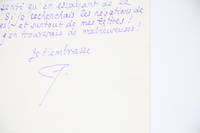
190679816s. l. Paris 1906. Fine. s. l. Paris s. d. ca. 1906 11.50 x 16 cm 1 page 1/2 sur un double feuillet Autograph letter signed by Renée Vivien addressed to Charles Maurras written in violet ink on a double leaf of headed paper adorned with a border of violets. Transverse folds inherent to mailing envelope included. Beautiful letter of thanks: ""Monsieur En feuillettant votre si intéressant volume : De l'Avenir de l'Intelligence j'ai relu avec un plaisir ému les pages - trop indulgentes vraiment ! - que vous avez consacré à mes ouvrages. Merci infiniment. Et veuillez agréer mes très reconnaissants sentiments de confraternité littéraire. Renée Vivien"" ""Sir While leafing through your most interesting volume: De l'Avenir de l'Intelligence I reread with moved pleasure the pages - too indulgent really! - that you dedicated to my works. Thank you infinitely. And please accept my most grateful sentiments of literary confraternity. Renée Vivien"" Charles Maurras had indeed devoted a dithyrambic chapter of his work to the Muse of violets whose verses he compared to those of Verlaine: ""Le vieux faune sentimental des Fêtes galantes et de Parallèlement reconnaîtrait chez Renée Vivien beaucoup plus qu'une élève certainement une des Surs une de ces Amies terribles qu'il a chantées. Quant à Baudelaire il lui dirait : ""Ma fille"" aux premiers regards échangés. Baudelairisme profond central générateur."" ""The old sentimental faun of Fêtes galantes and Parallèlement would recognize in Renée Vivien much more than a student certainly one of the Sisters one of those terrible Friends he sang of. As for Baudelaire he would say to her: 'My daughter' at first glance. Deep central generative Baudelairism."" unknown
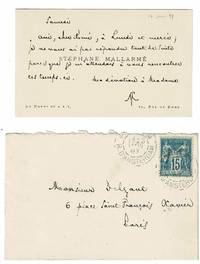
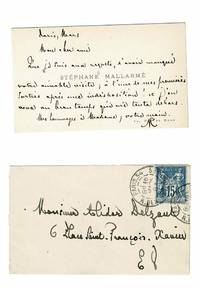
189776333Paris: S. n. 1897. Fine. S. n. Paris 23 janvier 1897 10.20 x 6.30 cm une carte de visite et son enveloppe Signed autograph visiting card from Stéphane Mallarmé addressed to Alidor Delzant. Envelope included. Alidor Delzant was a lawyer collector and bibliophile. Friend of the Goncourts he devoted a work to them and was Edmond's secretary and testamentary legatee. ""Ami cher ami à lundi et merci ; je ne vous ai pas répondu tout de suite parce que je m'attendais à vous rencontrer ces temps-ci."" ""Friend dear friend until Monday and thank you; I did not answer you right away because I expected to meet you these days."" S. n. unknown
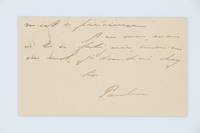
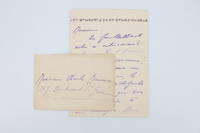
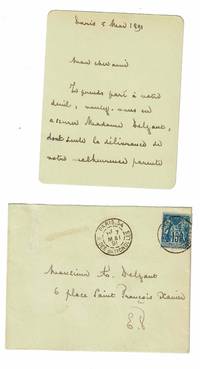
189176346Paris 1891. Fine. Paris 5 mai 1891 11.40 x 8.80 cm une carte recto-verso et une enveloppe Signed autograph card from Stéphane Mallarmé addressed to Alidor Delzant written on both sides in black ink. Envelope included. Alidor Delzant was a lawyer collector and bibliophile. Friend of the Goncourts he devoted a work to them and was Edmond's secretary and testamentary legatee. ""Je prends part à votre deuil voulez-vous en assurer Madame Delzant dont seule la délivrance de votre malheureuse parente par elle entourée de soins peut adoucir le chagrin. . Heureusement vous êtes un de ceux avec qui l'on se sent partout et même loin."" ""I share in your grief would you please assure Madame Delzant of this for whom only the deliverance of your unfortunate relative surrounded by her care can soften the sorrow. . Fortunately you are one of those with whom one feels comfortable everywhere and even from afar."" unknown
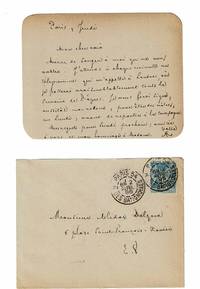
189676347Paris 1896. Fine. Paris 2 avril 1896 11.40 x 8.80 cm une carte et une enveloppe Signed autograph card from Stéphane Mallarmé addressed to Alidor Delzant written on the recto in black ink. Envelope included. Alidor Delzant was a lawyer collector and bibliophile. Friend of the Goncourts he devoted a work to them and was Edmond's secretary and testamentary legatee. ""Merci de songer à moi qui ne vous oublie. J'attends à chaque minute un télégramme qui m'appelle à Londres où je passerai vraisemblablement toute la semaine de Pâques."" ""Thank you for thinking of me who does not forget you. I am expecting at any moment a telegram calling me to London where I will most likely spend the entire Easter week."" unknown
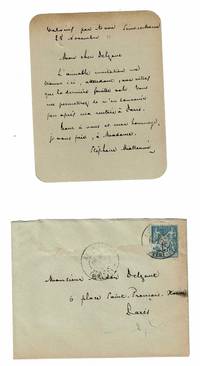
189676336Valvins 1896. Fine. Valvins 25 novembre 1896 11.40 x 8.80 cm une carte recto-verso et une enveloppe Autograph card signed by Stéphane Mallarmé addressed to Alidor Delzant written on both sides in black ink. Envelope included. Alidor Delzant was a lawyer collector and bibliophile. Friend of the Goncourts he devoted a work to them and was secretary and testamentary legatee of Edmond. ""L'aimable invitation me trouve ici attendant aux vitres que la dernière feuille vole. Vous me permettrez de m'en souvenir peu après ma rentrée à Paris."" ""The kind invitation finds me here waiting at the windows for the last leaf to fly away. You will allow me to remember it shortly after my return to Paris."" unknown
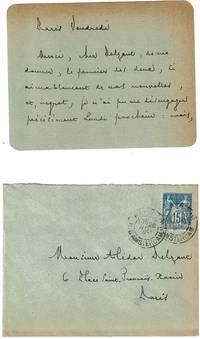
189776331Paris 1897. Fine. Paris 26 novembre 1897 11.40 x 8.80 cm une carte recto-verso et une enveloppe Autograph signed postcard by Stéphane Mallarmé addressed to Alidor Delzant written on both sides in black ink. Envelope included. Alidor Delzant was a lawyer collector and bibliophile. Friend of the Goncourts he devoted a work to them and was secretary and testamentary legatee of Edmond. ""Merci cher Delzant de me donner le premier des deux si aimablement de vos nouvelles ; et ingrat je n'ai pu me désengager précisément lundi prochain : mais ici je mets les pieds dans le plat que diriez vous du suivant 6 décembre où je serais des vôtres "" ""Thank you dear Delzant for giving me first of the two so kindly your news; and ungrateful as I am I could not free myself precisely next Monday: but here I put my foot in it what would you say to the following December 6th when I could join you"" unknown
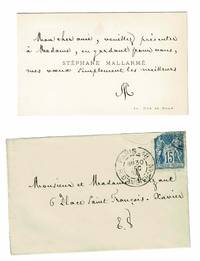
189276335Paris: S. n. 1892. Fine. S. n. Paris 30 décembre 1892 10.40 x 6.30 cm une carte de visite et son enveloppe Signed autograph visiting card from Stéphane Mallarmé addressed to Alidor Delzant. Envelope included. Alidor Delzant was a lawyer collector and bibliophile. Friend of the Goncourts he devoted a work to them and was Edmond's secretary and testamentary legatee. ""Mon cher ami veuillez présenter à Madame en gardant pour vous mes voeux simplement les meilleurs."" ""My dear friend please present to Madame while keeping for yourself my simply best wishes."" S. n. unknown
189376340Paris: S. n. 1893. Fine. S. n. Paris 16 mars 1893 10.40 x 6.30 cm une carte de visite et son enveloppe Visiting card with autograph signature by Stéphane Mallarmé addressed to Alidor Delzant. With envelope. Alidor Delzant was a lawyer collector and bibliophile. Friend of the Goncourts he devoted a work to them and was Edmond's secretary and testamentary legatee. ""Que je suis aux regrets d'avoir manqué votre aimable visite ; à l'une de mes premières sorties après une indisposition ! et j'en veux au beau temps qui me tenta dehors."" ""How I regret having missed your kind visit; during one of my first outings after an indisposition! and I blame the fine weather that tempted me outside."" S. n. unknown
1932008529Croton Falls NY: Spiral Press. SIGNED first edition. Limitied to 300 copies. Hard cover in original cloth. Published Croton Falls NY: Spiral Press 1932. 4to. 8 1/4" x 11 1/4" unpaginated drawings by William Spratling illustrated with b/w plates and architectural plans and renderings. Bound in dark blue publisher's cloth with gilt embossed titles to cover and spine gilt cover design beveled edges pictorial map endpapers. Inscribed by Morrow to Mr. and Mrs. Reeve Schley: "For Mr. and Mrs. Reeve Schley who knew Casa Manana. with a Merry Christmas from Elizabeth Morrow. December 1932." A rare work and important resource on Mexican architecture and pottery by Elizabeth Cutter Morrow on Cuernavaca Mexico where she and her husband U.S. Senator Dwight Morrow who was Ambassador to Mexico from 1927 to 1930 bought adjoining plots to build a house inspired by the local historic architecture. The book is divided into three sections. Section one describes the town of Cuernavaca. Section two contains architectural plans and details for the home and gardens. Section three contains photo reproductions of the Mexican furnishings in the house including water jars jewelry boxes and woven garments. American-born expatriate artist and designer William Spratling created drawings for the new house and illustrated the text. Elizabeth Morrow was an American poet in the early 20th century who became the first female head of Smith College. Morrow was the mother of Anne Morrow Lindbergh distinguished American author and wife of aviation pioneer Charles Lindbergh. Near fine. Rare. . Near Fine. Hard. 1st. 1932. Spiral Press unknown
40474This Union officer served on the staff of Brigadier General James Shields whose troops faced Stonewall Jackson's Confederate troops in the Shenandoah Valley in June 1862 and later commanded the Second Louisiana Regiment Cavalry; he was a good friend of famed Irish soldier Miles W. Keogh 1840-76 killed in the Battle of the Little Bighorn who served under him in the Papal Army during the Italian rebellion in 1860 and who fought with him in the Battle of Port Republic; he's reported to have become enamored with famed Southern spy "Belle" Boyd" at one point and to have unwittingly revealed military secrets to her. Outstanding pencilled ANS 2pp recto and verso heavy stock 4" X 2½" card "Conrad's Bridge" Virginia n.d. ca. early June 1862. Addressed to "General" probably James Shields. Very good. Lightly age toned.In this remarkable small report Keily reports in a small tight but fairly legible hand to his commander that "Col. Carroll moves his comm'd. at p.m. and will push on as rapidly as possible some cannonading heard this morning in the direction of Harrisonburg I would respectfully submit that if the Infantry did not move rapidly enough to carry out your views at Wainesborough before Jacksons arrival there a reconnaisance composed of cavalry conducted cautiously might attain the object with a good Guide which we have procured I would be glad to undertake it -- respectfully" and signs off adding his rank "Capt. A.D.C" beneath. A rather light challenging to transcribe postscript reads "P.S. Just received information from a reliable source that Jackson has --- --- --- Train on the --- Pt. Republic Road." It's difficult to precisely date Keily's note but General Shields did write General McDowell on June 4 1862 that "Colonel Carroll. after a forced night's march reached Conrad's Bridge this morning at 5 o'clock which bridge he found burned" -- which likely dates Keily's letter from this date or shortly after. Whether Shields took Keily up on his offer to lead a cavalry reconnaissance is unclear. Shields 1810-79 is perhaps best remembered as the Illinois politician who almost fought a duel with Abraham Lincoln in 1842; he's also the only person in American history to serve as U.S. senator from three different states Illinois Minnesota and Missouri; as a brigadier general of volunteers in the Civil War his lackluster performance as commander of the 2nd Division of the V Corps in the Army of the Potomac during the crucial Valley Campaign caused him to resign his commission. On June 9th the Battle of Port Republic took place a costly Confederate victory in which Jackson's 6000 troops faced off 3500 Union troops losing just over 800 men to the Union's loss of just over 1000 men -- a battle at which Keily himself was severely wounded in the face while leading a charge of Ohio cavalry up a hill into a barrage of Confederate artillery fire. The following year after painful recuperation Keily ended up on the staff of General Charles P. Stone in New Orleans recruiting cavalry troops in that occupied state. Late in the war he was court-martialed for "conduct unbecoming an officer" but the charges were shown false and by the end of the war he was brevetted a brigadier general. Keily died from yellow fever in Louisiana at age 38 shortly after the war's end making his autograph material quite scarce -- and a choice war-date item such as this most desirable. This remarkable war-date communication sheds interesting light on Shields as commander during the disastrous Valley Campaign. unknown
1286Tallahassee FL: Original Letter 1979. Ephemera. Single Sheet. Near Fine. 8 1/2 X 11 Inches. Rare TLS Typed Letter Signed from Pulitzer Prize winning author Michael Shaara. Letter on author's personal "Tallahassee" stationery. Shaara was a lifetime writer but consistently struggled with the page. and publishers apparently. As time would tell he had but one truly great book in him although he dreamed of an autobiographical Shakespeare novel that would top "The Killer Angels". Interestingly Shaara also wrote the book "For the Love of the Game" later published and adapted to the Kevin Costner film of the same name. The Killer Angels was Shaara's Pulitzer Prize winner and is most certainly the book he is remembered for. <br /> <br /> In part "Please excuse me for taking so long to answer your letter. First I was out of the country and then when I go back I was sick for a while - one problem was drugs overdose after a motorcycle accident." Boldly signed at the conclusion in blue ink. A very candid conversational letter in classic Shaara style. Original Letter unknown
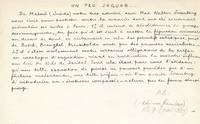
1953751661953. Fine. mai 1953 21 x 27 cm une feuille André Breton autograph manuscript titled ""Un peu jaguar."" written for issue no. 7 of May 1953 of the journal Médium. 12 lines written in black ink in a careful hand on a white sheet. Two transverse folds of no consequence. This is the final version of the text; an intermediate version of this article is visible on the Archives Breton website. An interesting chronicle concerning the Swedish painter Max Walter Svanberg: ""De Malmö Suède notre très admiré ami Max Walter Svanberg nous écrit pour protester contre la manière dont ont été récemment présentées ses toiles à Paris."" ""From Malmö Sweden our much admired friend Max Walter Svanberg writes to us to protest the manner in which his paintings were recently presented in Paris."" ""It was in 1953 that Breton and his friends discovered Svanberg's work. In 1954 he illustrated the entirety of issue 3 of the surrealist journal Médium and in 1955 Breton wrote the preface for his first solo exhibition in Paris at the ""À l'étoile scellée"" gallery."" Archives Breton unknown
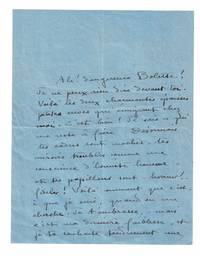
193574179s. l. Paris 1935. Fine. s. l. Paris s. d. circa 1935 17.70 x 22.50 cm 2 pages sur un feuillet Beautiful autograph letter signed by Colette addressed to her friend Bolette Natanson. Two pages written in ink on blue paper. Transverse creases inherent to the folding of the missive. This letter was probably addressed to Bolette following a gift made to her ""old friend"": ""Ah! dangerous Bolette! I can say nothing in front of you. Here are the two charming thick little vessels that emigrate to my home."" This is an opportunity for Colette very pleased with this new gift to humorously devalue the designer's previous works: ""From now on your frames are ugly your mirrors troubled like an honest man's conscience and your butterflies are - horror! - faithful!"" The famous ""butterflies"" naturalized and enclosed in glass frames are visible in several photographs of the writer in her home. Having evolved since her earliest childhood in artistic circles - she is the daughter of Alexandre and niece of Thadée Natanson the creators of the famous Revue Blanche - Bolette Natanson 1892-1936 became friends with Jean Cocteau Raymond Radiguet Georges Auric Jean Hugo and also Colette. Passionate about sewing she left Paris for the United States with Misia Sert great friend of Coco Chanel and was hired by Goodman. With her husband Jean-Charles Moreux they created in 1929 the gallery Les Cadres on boulevard Saint-Honoré and frequented numerous artists and intellectuals. Their success was immediate and they multiplied projects: the creation of the fireplace for Winnaretta de Polignac the decoration of the château de Maulny the arrangement of Baron de Rothschild's private mansion the creation of frames for industrialist Bernard Reichenbach and finally the realization of Colette's beauty institute storefront in 1932. Bolette Natanson also framed the works of her prestigious painter friends: Bonnard Braque Picasso Vuillard Man Ray André Dunoyer de Segonzac etc. Despite this meteoric rise she would end her life in December 1936 a few months after her father's death. unknown
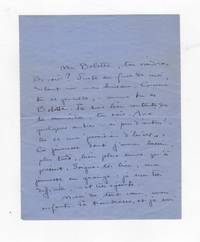
193574177s. l. Paris 1935. Fine. s. l. Paris s. d. circa 1935 17.70 x 22.50 cm 2 pages sur un feuillet Fine autograph letter signed by Colette to her friend Bolette Natanson. Two pages written in ink on blue paper. Horizontal folds inherent to the mailing of the letter. As ever protective and maternal with her friend Colette compliments her: ""Comme tu es gentille - comme tu es Bolette"". Nineteen years her senior she praises the youth of ""her child"": ""Tu es ma 'provision d'hiver' la jeunesse dont j'aurai besoin plus tard bien plus encore qu'à présent. Soigne-toi bien ma jeunesse en grange"". Having grown up from early childhood in artistic circlesshe was the daughter of Alexandre and the niece of Thadée Natanson the founders of the celebrated Revue BlancheBolette Natanson 1892-1936 formed friendships with Jean Cocteau Raymond Radiguet Georges Auric Jean Hugo and Colette. Passionate about dressmaking she left Paris for the United States with Misia Sert a close friend of Coco Chanel and was employed at Goodman. With her husband Jean-Charles Moreux they opened in 1929 the gallery Les Cadres on boulevard Saint-Honoré and moved in the company of numerous artists and intellectuals. Their success was immediate and they multiplied commissions: the fireplace for Winnaretta de Polignac the decoration of the Château de Maulny the arrangement of Baron de Rothschilds townhouse the creation of frames for the industrialist Bernard Reichenbach and finally the design of the shopfront for Colettes beauty institute in 1932. Bolette Natanson also framed the works of her distinguished painter friends: Bonnard Braque Picasso Vuillard Man Ray André Dunoyer de Segonzac and others. Despite this dazzling ascent she took her own life in December 1936 a few months after the death of her father. unknown
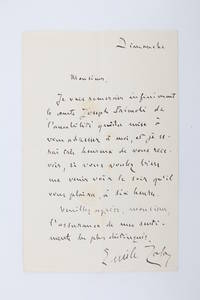
189480728s. l. Rome Rome 1894. Fine. s. l. Rome Rome Dimanche 4 novembre 1894 13.20 x 20.50 cm une page sur un double feuillet et une enveloppe Autograph letter signed by Emile Zola addressed to Ugo Ojetti. One page written in black ink on the first page of a double sheet. Folding inherent to postal transmission. Envelope included. This letter was addressed by the father of naturalism to journalist Ugo Ojetti when he had just arrived in Rome: ""Monsieur je vais remercier infiniment le comte Joseph Primoli de l'amabilité qu'il a mise à vous adresser à moi et je serai très heureux de vous recevoir si vous voulez bien me venir voir le soir qu'il vous plaira à six heures."" ""Sir I wish to thank Count Joseph Primoli infinitely for the kindness he has shown in directing you to me and I shall be very happy to receive you if you would be so good as to come and see me any evening that suits you at six o'clock."" Having arrived a few days earlier in the eternal city to conduct research for Rome Emile Zola hoped to meet Count Joseph Primoli there. The latter was unfortunately in Paris but he sent him this young journalist from La Tribuna who would serve as his guide but also as secretary. The two men clearly got along well and Zola even authorized Ojetti to adapt an opera libretto from his famous Nana. The project would unfortunately never come to fruition. Joseph Napoléon Count Primoli 1851-1927 was the great-great-nephew of Napoleon Bonaparte. Very close to the imperial family under the Second Empire he subsequently remained faithful to the salon of his beloved aunt Princess Mathilde in her private mansion on rue de Berri. His refined and witty conversation worked wonders there and he met as a passionate bibliophile some of the greatest writers of his time: Gustave Flaubert Théophile Gautier the Goncourts and Guy de Maupassant. unknown
184077244Paris 1840. Fine. Paris jeudi 7 mai 1840 13.60 x 20.90 cm une page sur un double feuillet Autograph letter signed by George Sand addressed to publisher Léon Curmer. One page written in black ink on a double sheet. This letter was published in the complete correspondence compiled by Georges Lubin. ""Monsieur J'ai parcouru votre recueil avec beaucoup d'intérêt et j'accepte la collaboration que vous m'avez offerte mais je ne pourrais m'occuper de vous satisfaire que dans six semaines ou deux mois. Si cette époque vous convient veuillez bien me le faire savoir ainsi que les conditions de la rédaction."" ""Sir I have perused your collection with great interest and I accept the collaboration you have offered me but I could not undertake to satisfy you for six weeks or two months. If this timing suits you please let me know as well as the conditions of the writing."" The ""recueil"" ""collection"" in question here is none other than Les Français peints par eux-mêmes. Sand would not however collaborate on this monumental compendium of types preferring instead several years later Le Diable à Paris published under the direction of her close friend publisher Hetzel. unknown
1902602371902. Fine. 4 février 1902 11.50 x 9 cm Une carte recto-verso ""Paris February 4 1902 I regretted my dear friend not to see you! The poet did not walk as you have seen I had gone for a walk on the quays. That's for lunch at Crespel Saturday at noon ½. Would you write to him if you do not see him before. What I am shaved by reporters about Hugo's centenary! It is to be believed that all the newspapers and magazines will make a number apart! What we are going to defecate imbecilities sic on his remains! A reporter confessed to me that he had been visiting about Hugo the members of the Academy of Medicine !! and also the painters. It appears that it will be monumental on this side. So Saturday dear friend and good to you Huysmans Seen Madame Leclaire more and more exasperated by the idea of staying in Ligugé! "" unknown
195080911s. l. Klarskovgaard 1950. Fine. s. l. Klarskovgaard 17 novembre 1950 21 x 34 cm 1 page sur un feuillet Autograph letter signed with the paraph of Louis-Ferdinand Céline addressed to his lawyer Master Thorvald Mikkelsen. One page written in blue ink on a large sheet of white paper; number ""566"" in Céline's hand in red pencil at the top left. Transversal folds inherent to mailing. This letter was very partially transcribed in Année Céline 2005. Early November 1950 Gaby Paul had come to visit Céline and Lucette at Klarskovgaard: ""Mme Gen Paul a repris la route de Montmartre toute ravie de votre accueil ! A moi de vous remercier chaleureusement car enfin j'espère que votre généreuse réception me sera comptée ""à indulgence""."" ""Mme Gen Paul has taken the road back to Montmartre delighted with your welcome! It is for me to thank you warmly because I finally hope that your generous reception will be counted in my favor as 'indulgence'."" Through her intermediary Céline evidently received news of his former Montmartre companions: ""Je ne sais pas quels crimes j'ai commis mais pour ces fourbes canailles du 18eme Arrt. ma légende de bistrot en bistrot est devenue un Super Niebelung d'horreurs ! C'est rigolo. Au point qu'aucun n'ose me venir voir ici !"" ""I don't know what crimes I committed but for these deceitful scoundrels of the 18th district my legend from bistro to bistro has become a Super Niebelung of horrors! It's amusing. To the point that none dare come to see me here!"" In 1947 Céline pursued by French justice for his collaborationist involvement was confined in Denmark. It was in May 1948 accompanied by Lucette and Bébert that he arrived at his lawyer Master Thorvald Mikkelsen's home at Klarskovgaard. The latter owned a large property by the Baltic Sea and invited the exile to stay there. On February 21 1950 as part of the épuration the writer was definitively sentenced in absentia by the civic chamber of the Paris Court of Justice for collaboration to one year of imprisonment which he had already served in Denmark. The Swedish Consul General in Paris Raoul Nordling intervened on his behalf with Gustav Rasmussen Danish Foreign Minister and managed to delay his extradition. On April 20 1951 Jean-Louis Tixier-Vignancour his lawyer since 1948 obtained Céline's amnesty under the title of ""severely disabled veteran of the Great War"" by presenting his file under the name Louis-Ferdinand Destouches without any magistrate making the connection. Céline would leave Denmark the following summer after three years spent at his lawyer's home. unknown
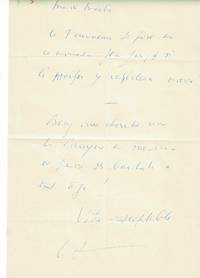
195076185s. l. Klarskovgaard 1950. Fine. s. l. Klarskovgaard 28 octobre 1950 21 x 34 cm 1 pages sur un feuillet Partly unpublished autograph letter signed by ""your touchy LF"" Louis-Ferdinand Céline addressed to his lawyer Maître Thorvald Mikkelsen. One page written in blue ink on a large sheet of white paper; number ""563"" in Céline's hand in the upper left corner in red pencil. Transverse folds inherent to the mailing. This letter was very partially transcribed in the Année Céline 2005. Céline after days of suffering from the cold is delighted to announce to his friend that he has received heating: ""Le fourneau se pose en ce moment. Je ne sais pas si la maison y résistera l'on verra !"" ""The stove is being installed right now. I don't know if the house will withstand it we shall see!"" This letter also mentions his Swedish friend Ernst Bendz like him a doctor and writer: ""Benz sic vous cherche un La Bruyère en suédois - on passe des bachots à tout âge !"" ""Bendz is looking for a La Bruyère in Swedish for you - one takes exams at any age!"" In 1947 Céline pursued by French justice for his collaborationist involvement was confined in Denmark. It was in May 1948 accompanied by Lucette and Bébert that he arrived at his lawyer Maître Thorvald Mikkelsen's home in Klarskovgaard. The latter owned a large property by the Baltic Sea and invited the exile to stay there. On February 21 1950 as part of the purge the writer was definitively condemned in absentia by the civic chamber of the Paris Court of Justice for collaboration to one year of imprisonment which he had already served in Denmark. The Swedish Consul General in Paris Raoul Nordling intervened on his behalf with Gustav Rasmussen the Danish Foreign Minister and managed to delay his extradition. On April 20 1951 Jean-Louis Tixier-Vignancour his lawyer since 1948 obtained Céline's amnesty as a ""severely disabled veteran of the Great War"" by presenting his file under the name of Louis-Ferdinand Destouches without any magistrate making the connection. Céline would leave Denmark the following summer after three years spent at his lawyer's home. unknown