Louise MICHELBiblio.com
1 815 résultats
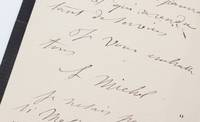
188583957s. l. Paris 1885. Fine. s. l. Paris 12 juin 1885 11 x 16.90 cm 2 pages 1/2 sur un bifeuillet Autograph letter signed by Louise Michel addressed to Lucien Barrois; two and a half pages written in black ink on a white paper bifolium with black border. Transverse folds inherent to postal delivery. Louise Michel requests help for one of her acquaintances: ""Madame Maron à qui Lafont ou Clémenceau avait fait avoir promesse à la mairie d'un terme de son loyer elle en doit trois n'a plus entendu parler de rien et il faut qu'elle déménage pour aller en face où elle paiera moins. Sa propriétaire l'aurait attendue avec un terme payé sur les trois. Il faut enfin que ce soit vous qui rappeliez cette pauvre femme qui a rendu tant de services."" ""Madam Maron for whom Lafont or Clémenceau had secured a promise from the town hall for one term of her rent she owes three has heard nothing more and must move across the street where she will pay less. Her landlady would have waited for her with one term paid out of the three. You must finally be the one to remind them of this poor woman who has rendered so many services."" Moving letter testimony to the unwavering devotion of the former Communard. unknown
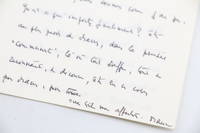
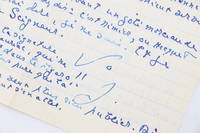
196987858s. l.: S. n. 1969. Fine. S. n. s. l. 11 Décembre 1969 10 x 7.50 cm une feuille une enveloppe Autograph card dated and signed by Maurice Blanchot to his sister Marguerite 12 lines in black ink. Manuscript envelope included. ""Cher marg voici donc des paroles comme testamentaires accueille-les non comme venant de moi mais d'une recherche qui a par hasard et sans mérite ni démérite passée par moi qui m'y suis soumis comme j'ai pu qu'est-ce qui importe finalement être au plus près de chacun dans la pensée ""communiste"" là où tout souffre tout se reconnait se découvre être en ce coeur pour chacun pour tous. Avec toute mon affection. Maurice."" Dear Marg here then are words like testamentary ones receive them not as coming from me but from a search which has by chance and without merit or demerit passed through me who submitted to it as I could what matters finally to be as close as possible to each one in ""communist"" thought where everything suffers everything recognizes itself discovers itself to be in this heart for each one for all. With all my affection. Maurice. S. n. unknown
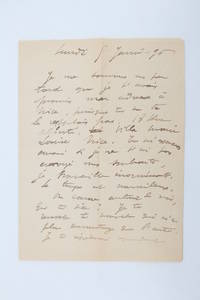
189180763s. l. 1891. Fine. s. l. 5 janvier 1891 14.20 x 19.20 cm 3 pages sur un double feuillet Autograph letter signed by Maurice Leblanc to an unknown recipient; three pages written in black ink on a double leaf. Transverse folds inherent to posting. At the beginning of this year Maurice Leblanc left the Norman coast to spend the winter in Nice: ""Je me souviens un peu tard que je t'avais promis mon adresse à Nice puisque tu ne te la rappelais pas. 18 rue Alberti villa Marie-Louise Nice. Tu m'excuseras aussi si je ne t'ai pas envoyé mes souhaits je travaille énormément le temps est merveilleux on cause autour de moi que te dire "" ""I remember rather late that I had promised you my address in Nice since you couldn't recall it. 18 rue Alberti villa Marie-Louise Nice. You'll also excuse me if I haven't sent you my wishes I'm working enormously the weather is wonderful people are chatting around me what can I tell you"" Though he had then published only one work he gives his opinion to his correspondent on a text the latter had sent him: ""Je te répèterai répondant ce que je t'ai dit pour ton style : il n'est pas assez travaillé tu écris un peu au hasard de ta plume on ne sent pas de nerfs là-dessous d'os de solide c'est du style de journal de lettre mais pas de style littéraire. Pourquoi n'essayes-tu pas de réfléchir sur chaque phrase avant de l'écrire."" ""I'll repeat in response what I told you about your style: it's not worked enough you write somewhat at random with your pen one doesn't feel any sinew underneath bone solidity it's newspaper style letter style but not literary style. Why don't you try to reflect on each sentence before writing it."" unknown
1899622111899. Fine. 1899 17.80 x 23.10 cm 2 feuillets et un quart Autograph manuscript signed by Octave Mirbeau for his article ""Au conseil municipal"" published in Le Journal on July 12 1899 90 lines in black ink on three leaves manuscript correction by the author typographical indications in blue pencil. Staining due to ink and paper. Significant of the denunciatory attitude that Mirbeau maintained in his articles this manuscript critical of the unworthy treatment of artists of genius by society is a final draft used for printing as indicated by the capital letters that delimit the paragraphs. The original leaves have been remounted on laid paper here pages from an 18th-century work Dissertatio Medica to facilitate their handling. unknown
1902613441902. Fine. 1902 18.10 x 22.90 cm 2 feuillets et un quart Autograph manuscript signed by Octave Mirbeau 99 lines in black ink on 3 leaves with manuscript corrections by the author and one correction in blue pencil by a typographer. Manuscript used for the composition and printing of the article ""Habitudes"" published on April 20 1902 in the Journal a daily newspaper launched in 1892 by Fernand Xau. The beginning of Mirbeau's career was essentially driven by journalism which allowed him to publish and earn a living despite his lack of inclination for the activity. Quickly feared for his pamphleteering activity Gustave Mirbeau distilling a biting irony stands here against injustice institutionalized by the State and society. Led by the dense and effective writing of Gustave Mirbeau this manuscript is probably a final draft as suggested by the conformity of the two texts and the rare corrections made to the original notably by the blue pencil of a typographer. On the verso of the last leaf is found an earlier version of the first lines of the article. unknown
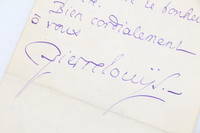
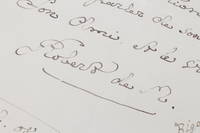
189686610Paris 1896. Fine. Paris 1896 13 x 20.50 cm 3 pages sur un double feuillet Autograph letter signed by Pierre Louÿs addressed to his publisher Alfred Vallette 50 lines written in purple ink on a double sheet. Pierre Louÿs responds to his friend and publisher Alfred Vallette after a controversy launched by a journalist from Comoedia a controversy that could damage their friendship: ""Je ne suis pour rien dans l'écho publié par Comoedia. Mais ce que vous en citez suffit à me montrer que le rédacteur s'est mal informé."" ""I had nothing to do with the piece published by Comoedia. But what you quote from it is enough to show me that the writer was misinformed."" and he intends to remind him that they had not been able to agree on the publishing terms for Aphrodite and that he envisioned only a confidential distribution for his latest book: ""L'histoire de notre édition est très simple. Vous m'avez proposé un traité que je n'ai pas trouvé bon ; j'ai préféré le ""compte d'auteur"" et je ne peux pas vous accuser d'avoir mal prévu le succès du livre puisque moi-même j'avais écrit mon roman pour vingt amis et quelques inconnus."" ""The story of our edition is very simple. You offered me a contract that I did not find good; I preferred the 'author's account' and I cannot accuse you of having poorly predicted the book's success since I myself had written my novel for twenty friends and a few strangers."" This is why the father of Aphrodite is astonished by the triumph achieved by the work: ""Si une diseuse de bonne aventure nous avait prédit alors qu'Aphrodite dépasserait un jour le 300e mille nous l'aurions traitée comme une pauvre folle."" ""If a fortune teller had predicted then that Aphrodite would one day exceed 300000 copies we would have treated her as a poor madwoman.""; the latter consecrating his fame and wealth in the literary world: ""J'ai en outre une seconde raison pour ne pas vous en vouloir du traité que j'ai signé avec vous : c'est qu'en préservant mes droits d'autuer sur ce roman j'ai fait sans le savoir ma fortune. C'est à cela seul que je dois mon indépendance littéraire et cette inestimable liberté du silence qui n'est pas l'idéal de tous mais qui me paraît être le bonheur du poëte."" ""I have furthermore a second reason for not resenting the contract I signed with you: it is that by preserving my author's rights on this novel I made my fortune without knowing it. It is to this alone that I owe my literary independence and this invaluable freedom of silence which is not everyone's ideal but which seems to me to be the poet's happiness."" Very fine autograph on Pierre Louÿs's literary triumph. unknown
191177520Paris 1911. Fine. Paris Lundi 11 septembre 1911 13.50 x 18 cm 5 pages sur un double feuillet et un feuillet libre Autograph letter signed by Pierre Louÿs addressed to Georges Louis. Five pages written in violet ink on a double leaf and a loose leaf. A press article pasted on the recto of the single leaf. Transverse creases inherent to posting. Fine letter addressed to his brother Georges Louis with whom Pierre Louÿs maintained a very intimate relationship and whom he considered as his own father. The question of the real identity of Pierre Louÿs's father still fascinates biographers today: ""His father Pierre Philippe Louis . had married in 1842 Jeanne Constance Blanchin who died ten years later after giving him two children Lucie and Georges. In 1855 he remarried Claire Céline Maldan and from this union was born in 1857 a son Paul; then in 1870 our writer who received the first names Pierre Félix. This late birth the differences in character between father and son the former's disaffection toward the latter the profound intimacy that always reigned between Louÿs and his brother Georges all this has led certain biographers and critics to suspect that the latter was in reality the writer's father. The exceptionally intimate and constant relationship that Pierre and Georges maintained between themselves all their lives could be an argument in this sense. Of course no irrefutable proof has been discovered and none will probably ever be discovered. Nevertheless certain letters . are quite disturbing. In 1895 for example Louÿs writes seriously to his brother that he knows the answer to ""the most poignant question"" he could ask him a question he has had ""on his lips for ten years."" The following year in the full triumph of Aphrodite he thanks Georges effusively and ends his letter with this sentence: ""Not one of my friends has a FATHER who is to him what you are to me."" Arguing from the close intimacy of Georges and Claire Céline during the year 1870 and the jealousy that the father never ceased to show toward his younger son Claude Farrère did not hesitate to conclude in favor of Georges Louis. And what to think of this dedication by Louÿs to his brother on a deluxe paper copy of the first edition of Pausole: For Georges his eldest son / Pierre."" Jean-Paul Goujon Pierre Louÿs Pierre Louÿs comments in this letter on Thomas Edison's visit to Paris: ""Edison is in France. Toward the end of last month a journalist questioned him. I regret not having kept the article."" The writer then launches into a true dialogue from his memories of said article paraphrasing the inventor in the manner of a witness who himself attended the interview: ""To the simple question ""Are you pleased with your trip"" Edison answered with amiable phrases and immediately on his own he brought the conversation to the subjects: Monoplane. War. He said I only repeat from memory the sense of what I read: He said in substance: ""You are not yet enthusiastic enough about the value of your new weapon: it is formidable. You take aeroplanes for scouts. Say first: combatants. From the heights where the monoplane evolves easily today there is an effective military power but especially an incalculable moral power."" He explained himself thus: ""Give grenades to an aviator who will drop them. Even if they are not very dangerous even if they rarely hit their target the entire enemy army will scatter like a flock of sheep under the flight of the eagle. Five six grenades falling from the sky will provoke panic terror. Nothing is frightening for a crowd like a peril that comes from above."" "" This ""remarkable interview"" related by the writer who finds that ""the theory is correct"" underlines the visionary character of Edison who seems here to relate the facts of the coming First World War. The erudite Pierre Louÿs illuminates this theory of ""Edison the prophet"" with his classical culture: ""It agrees with the old phrases about the limits of b unknown
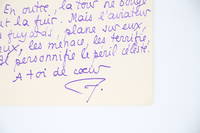
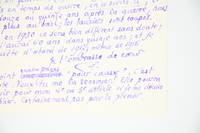
191677523Paris 1916. Fine. Paris Lundi 11 septembre 1916 13 x 20.50 cm 3 pages sur 2 feuillets Autograph letter signed with initial by Pierre Louÿs addressed to Georges Louis. Two pages written in purple ink on two sheets. Central folds inherent to posting. Fine letter addressed to his brother Georges Louis with whom Pierre Louÿs maintained a very intimate relationship and whom he considered as his own father. The question of Pierre Louÿs' real paternal identity still fascinates biographers today: ""His father Pierre Philippe Louis . had married in 1842 Jeanne Constance Blanchin who died ten years later after giving him two children Lucie and Georges. In 1855 he remarried Claire Céline Maldan and from this union was born in 1857 a son Paul; then in 1870 our writer who received the Christian names Pierre Félix. This late birth the differences in character between father and son the former's disaffection towards the latter the profound intimacy that always reigned between Louÿs and his brother Georges all this has led certain biographers and critics to suspect that the latter was in reality the writer's father. The exceptionally intimate and constant relationship that Pierre and Georges maintained between themselves throughout their lives could be an argument in this direction. Of course no irrefutable proof has been discovered and probably never will be. Nevertheless certain letters . are quite troubling. In 1895 for example Louÿs writes gravely to his brother that he knows the answer to 'the most poignant question' he could ask him a question he has had 'on his lips for ten years'. The following year at the height of Aphrodite's triumph he thanks Georges effusively and ends his letter with this sentence: 'Not one of my friends has a FATHER who is to him what you are to me.' Arguing from the close intimacy between Georges and Claire Céline during the year 1870 and from the jealousy that the father never ceased to show towards his younger son Claude Farrère did not hesitate to conclude in favor of Georges Louis. And what should we think of this dedication by Louÿs to his brother on a Japan paper copy of the first edition of Pausole: To Georges his eldest son / Pierre."" Jean-Paul Goujon Pierre Louÿs In this interesting letter Louÿs discusses at length the difficulty writers face in living by their pen. Titling his missive ""Continuation of our conversation about war and literature"" he first makes a very pessimistic observation: ""In the 16th century It was even worse! In the 16th the independent man of letters did not exist at all - to write one needed an office a benefice - or land and income rare fortune among writers. . It is only in the 19th century that we find a very small number of conscientious writers living by their pen. And even then. Do you want to count them Hugo almost alone succeeds. Lamartine fails and is obliged to beg pitifully at the end of his life. Gautier who had magnificent gifts only subsists by writing in newspapers . you see what I mean: Theatre and Journal."" He continues: ""That works well in peacetime. - In 1890 l'Echo de Paris inserted prose poems in the first column. - In ""date illegible because crossed out ""le Figaro had a literary supplement. . But in wartime in this century and ten twelve or fifteen years after the war we shall go to the woods no more; the laurels are cut down. Oh! In 1930 it will doubtless be very different; but I shall be 60 in fifteen years; and I worry first about 1917; even about 1916."" This very pessimistic letter was written at a period when Louÿs was at his worst ""The man who wrote these pages was a solitary man reclusive sick drugged surrounded by dubious creatures and having as confidant only this adored brother who would die less than a year later."" Ibid. unknown
1955059850Hollywood; Kentucky; Scotland Etc.: Schmidt 1955. First Edition . Hardcover. Good. Finely Tooled Leather Autograph Album Made In Austria For High-End Dept. Store J. W. Robinson Los Angeles And Begun Circa 1930 By The Schmidt Family On Highland Avenue Los Angeles.Chipping To Corners And Front Spine Edge Repairable. Many Pages Of Autographs In U.S. And Scotland Including About 116 From Hollywood Personalities: Tony Duquette Gene Barry Red Buttons Vincente Minnelli Ray Stark Ryan O'neal William Hollingsworth Cyd Charisse Tony Martin James Mitchum Gene Kelly Barry Sullivan William Frye Samuel Goldwyn Jr. Sidney Howard Stan Kamen Hugh O'brien Polly And Edgar Bergen Agnes Moorehead Ivan Rollefson Hermione Baddeley Murray Korda Greer Garson Edward G. Robinson William Wyler George Cukor Samuel Goldwyn Jr. Sidney Howard Gene Kelly Delbert Mann Etc. Clearly From 1930'S - 1940'S More Autographs Some Indecipherable But Large Selection All Hollywood Names. Scarce Signatures Of Some Of The Early Directors And Producers. <br/> <br/> Schmidt hardcover
1939006737New York: Saturday Evening Post 1939. Handwritten Manuscript . No Binding. Very Good. 11" x 8 1/2. The complete text of Durant's article "The Crisis in Christianity" later published August 5 1939 in the Saturday Evening Post. Two original handwritten draft manuscripts in ink with extensive revisions and final typescript in carbon with a few handwritten changes in ink.The first draft is 19 pp. on lined yellow paper legal size with extensive revisions throughout. The second draft is 17 pp. on brighter lined yellow paper with some revisions. The final draft is typewritten here in a carbon copy with a few minor corrections. <br/> <br/> (Saturday Evening Post) unknown
24932Shortly after Joseph Pulitzer acquired the "New York World" in 1883 he hired this Russian-born writer journalist and artist -- whose fine etched portraits helped make him one of the fathers of modern newspaper illustration and incidentally helped make Pulitzer's new venture influential and profitable; he also illustrated such books as the first American edition of Tolstoy's "Ivan the Fool" 1891. Stunning original signed ink sketch heavy stock 7¼" X 9 3/4" art board n.p. n.y. Very good. Pleasantly age toned to a creamy vellum color; lower left corner triangular roughly 4" X 2¼" and lower right corner ditto roughly 2 3/4" X 1" creased and strengthened on verso but not terribly noticeable or disfiguring on recto; mounting traces on verso. A stunning head-and-shoulders portrait of General William T. Sherman in uniform later years gazing intently at the viewer. Finely executed in great detail Sherman appears tired and rather haggard with thinning hair and white beard. The eyes in particular are exceptionally well done and lifelike grabbing the viewer with their piercing intensity. Gribayedoff signs quite small at lower left noting "after photo" below his signature. We have not been able to pinpoint the occasion for this portrait or the specific photographs on which it is based but likely it accompanied a "New York World" story about Sherman. Gribayedoff originals are quite scarce and desirable. Despite mild corner damage a most handsome piece. unknown
30826The only child of George Washington's long-time personal secretary Tobias Lear was actually born in the early "White House" in Philadelphia and Washington was his godfather; his mother died when he was two Thomas Jefferson and Alexander Hamilton were among her pallbearers and he went on to become a successful attorney in Washington DC; Gilbert Stuart painted a well-known portrait of him. Outstanding AMS 2pp recto and verso 7 3/4" X 12 3/4" Portsmouth NH 1817 August 20. Very good. Three light horizontal original folds; mild age toning and slight edgewear. This attractively and boldly penned document is titled "Christmas Hymn" and contains the full text of a Christmas song whose original we have not been able to determine. Begins "Hail holy morn upon whose beams / A thousand radiant Seraphs rode / Bright from the Sapphire throne of God. / Bursting upon the Shepherd's dreams.- / While poised upon the glittering wing / A thousand choral voices sing / Glad tidings of great joy we bring / Be peace proclaimed on Earth / And Heaven's high arch with rapture ring." Goes on for several more stanzas closing with: "Thus for the gift that thou hast given / Hereafter we shall learn to rain / On days of everlasting Praise / Tun'd to the Gold en Harps of Heaven." He then concludes "Written from recollection for my Dear Cousin Miss Mary Storer" boldly dated and signed. Storer was the given name of Lear's mother Mary "Polly" Lear the first of Tobias Lear's three wives who was related to the Washington family. There were a great many prominent Storers in early Portsmouth history among them a Mary Storer born around 1785 who might well have been the recipient of this keepsake. Whether Lear's "recollection" of this hymn refers to him recalling a hymn he himself had written years before or to a hymn written by another is not clear and certainly warrants further research. A most unusual and extremely interesting document. unknown
20956Known as "Gentleman Jim" this influential Country Western singer of the '50s and '60s achieved great popularity with such hits as "He'll Have to Go" 1960; he died at age 40 in a plane crash in Tennessee. Color IPS verso heavy stock 3½" X 5½" n.p. n.d. Near fine. Handsome color picture postcard issued by RCA Victor Records the recto featuring a nice half-length portrait of Reeves in tie and red sweater. Verso features message and address portions and across this in bold large script as red as his sweater Reeves writes "To / Donald / Best of luck always / Gratefully / Jim Reeves." The signature itself which runs from the lower left corner to the upper right corner measures a full 5½"! A superb example of this rarity. unknown
191475220Paris 1914. Fine. Paris 1914 13.60 x 21.20 cm en feuillets Autograph letter signed by Colette addressed to her friend the man of letters and lawyer Adrien Peytel two pages written in black ink in hurried handwriting on a double sheet with L'Eclair newspaper letterhead. A central fold inherent to the folding of the letter for mailing. Fine letter from Colette testimony to the confusion that seized France at the dawn of the Great War: ""Nothing is working. I am stuck here for a piece they are asking me to write."" The writer worries: ""I have no news from Sidi Henry de Jouvenel. I am creating a whole head of worries for myself. I don't know where he is he wrote to me that he was leaving with the 29th for the Somme. Ah! la la la la la la."" ""Colette a entendu sonner le tocsin en Bretagne où elle passait un séjour ensoleillé avec le baron Henry de Jouvenel et leur fille dans sa maison de Rozven. La guerre la surprend en plein bonheur à quarante et un ans. . Son mari appelé dès le 2 août devant rejoindre le 29e régiment d'infanterie à Verdun elle a aussitôt envoyé sa fille à peine âgée d'un an avec sa nurse au château de Castel Novel en Corrèze - chez sa belle-mère. Et elle est rentrée à Paris."" ""Colette heard the tocsin ringing in Brittany where she was spending a sunny stay with Baron Henry de Jouvenel and their daughter in her house at Rozven. The war surprised her in the midst of happiness at forty-one years old. . Her husband called up from August 2nd having to join the 29th infantry regiment at Verdun she immediately sent her daughter barely a year old with her nurse to the château de Castel Novel in Corrèze - to her mother-in-law's. And she returned to Paris."" Dominique Bona Colette et les siennes unknown
195784396Paris 1957. Fine. Paris 29 Avril 1957 21 x 27 cm une feuille une enveloppe Autograph letter dated and signed by Jacques Chardonne addressed to his friend Roger Nimier 54 lines in blue ink regarding Paul Morand's style spiritual father of the Hussards Roger Nimier and Antoine Blondin being considered much against their will as leaders of this literary movement. Fold marks inherent to the letter's mailing envelope included. Jacques Chardonne intends to challenge two false ideas concerning Paul Morand the first being stylistic in nature: ""There is a double misunderstanding regarding Morand. He has been seen as a 'modern'. but he is essentially a 'naturalist'; his artistic doctrine is exactly that of Maupassant and Flaubert."" holding the latter as a major writer: ""But he has infinitely more talent and intelligence than the writers of the naturalist school."" ; the second of a psychological nature: ""He is hygiene and wisdom incarnate in his person. But through his work he has debased the youth who came after him. It is he who nearly killed Sagan."" Jacques Chardonne then ironizes about Françoise Sagan's talents while exalting the predominance and mastery of his friend Paul Morand in everything he undertakes: ""It is Morand who bought Sagan's terrible cars. But he knows how to drive."" while recalling the cautious advice that Bernard Frank gave to the author of Bonjour tristesse : ""Bernard Frank says: your car doesn't hold the road. Sagan vexed accelerates. And everything capsizes."" As a literary elder brother Jacques Chardonne reassures Roger Nimier about his own talent: ""Morand is very pleased with you. I say that Gaston Gallimard seems to have much friendship for you."" and congratulates his correspondent on the quality of Artaban a review to which Roger Nimier contributes Jacques Chardonne being honored in a recent issue: "". surprised to see myself on the front page; the text fills me with pride. I have scorned honors in order to be honored. I could not have been better served than in this little text."" and attributes the authorship of the text concerning him to one of his Hussard disciples: "". I tell myself: it's Nimier or Hecquet or Milliau. Truth be told I don't know. And I thank the Lord."" Overwhelmed by so many tributes paid to him Jacques Chardonne lucid prefers to avoid being too much in the spotlight: ""That is why I no longer want to publish anything. As soon as one applauds you you must leave."" Very handsome letter from Jacques Chardonne praising his friend Paul Morand spiritual father of the Hussards and evoking Françoise Sagan's terrible car accident in an Aston Martin on April 13 1957. A premonitory evocation: Roger Nimier would kill himself five years later on the western highway on September 28 1962 also at the wheel of an Aston Martin. unknown
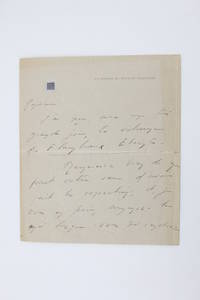
190879911s. l. Paris 1908. Fine. s. l. Paris 1908 13 x 15 cm 3 pages 1/2 sur un double feuillet Autograph letter signed by Renée Vivien addressed to her publisher Edward Sansot written in black ink on a double sheet of headed paper bearing the poet's monogram and her address at 23 avenue du Bois de Boulogne. Transverse folds inherent to mailing two tiny marginal tears without loss at the fold. Fascinating letter written by the Muse of the violets in the last months of her life: ""J'ai reçu avec une très grande joie les volumes des Flambeaux éteints. Remerciez bien de ma part votre soeur d'avoir fait les corrections et je vous en prie amenez-la moi lorsque vous reviendrez Avenue du Bois. Pour les six exemplaires de Sillages décollés donnez-les - je n'ai pas beaucoup d'amis et me soucie peu de distribuer des volumes au hasard. Maintenant s'il est trop tard lorsque ma lettre vous parviendra et que les exemplaires me parvinssent quand même ne soyez pas désolé - cela m'est indifférent je vous les ferai envoyer. Mes meilleurs sentiments d'amitié littéraire. Renée Vivien. Je vous envoie en même temps sept volumes à distribuer au hasard parmi vos amis littéraires."" ""I received the volumes of Flambeaux éteints with very great joy. Please thank your sister on my behalf for having made the corrections and I beg you bring her to me when you return to Avenue du Bois. For the six unbound copies of Sillages give them away - I do not have many friends and care little about distributing volumes at random. Now if it is too late when my letter reaches you and the copies reach me nonetheless do not be sorry - it is indifferent to me I will have them sent to you. My best feelings of literary friendship. Renée Vivien. I am sending you at the same time seven volumes to distribute at random among your literary friends."" The publication of Flambeaux éteints marks the first collaboration between the poet and her new publisher Edward Sansot. In these last painful years of life Sansot and his friend Charles-Brun are her only two links with the literary world whose critics - once highly laudatory - have finally turned their backs on her. It must be said that Renée Vivien has decided to withdraw all her books from commerce and is gradually sinking into solitude and depression. Handsome letter bearing witness to the last literary years of Sappho 1900. unknown
190883382Artagnan: S. n. 1908. Fine. S. n. Artagnan 1908 20.50 x 26.50 cm 7 feuillets recto Autograph letter signed by the dandy count 68 lines written in black ink on seven folios recto probably addressed to his friend and bibliographer the critic Henri Lapauze: ""Artagnan My dear friend the interesting review which I would very much like to know. has escaped me. Can you send it to me; or at least a date indication that would allow me to find it As for what you write to me about my ""social successes"" you don't think the first word of it fortunately for us! - otherwise you would start by ""not speaking to me"" as Favre used to say; and you would be quite right. Well! in all things one must consider not only the end but the true and the false the good and the bad the authentic and the counterfeit as I believed I could write even about snobbery! When it comes to letters - even more so to ladies of letters on no point does this difference stand out with such clarity. - who knows this better than you No once again we must not and this is very important let the mockeries of what we know how to do prevent us from manifesting ourselves. That would play too well into the hands of the monkeys who already have enough coconut trees as it is. For this reason I believed I should offer the noble Engadin larches the favor of hearing me. And their murmur did not reproach me for it. I am going to write to a certain Lady of letters in the good sense of the term to speak to her about her beautiful book. Your friend and hers Robert de M. Sept 08. Via Vic-Bigorre Hts Pyr. P.S.: urgent Only you can affirm to me with sufficient guarantee that Liem is still alive as I believe and wish to affirm in an article which being in press requires the information without delay. When you are reconciled with an etcher whom you do not like I will offer you for an engraving exhibition a portrait of me by him which at least you will love. If I have not read your critique of my book on the other hand I have taken note of the one you devoted to the amiable young man whom it was necessary to punish for having said three times during a dinner: Marie Murat. perhaps it would have been enough to make him copy seventy times seven times. In any case you will have been harsh. The crime deserved it. Perhaps also one day you will speak ill of me although that seems unlikely to me. But what I can affirm is that. it will not be for that! ."" Fold marks inherent to envelope mailing. S. n. unknown
196218081<p>Very Good softcover. Staple bound with pictorial thin card covers. Front cover is bright and clean with full autograph signatures of New York Governor Nelson A. Rockefeller and of New Jersey Governor Richard J. Hughes in blue ink; rear cover is bright and clean but for few small light coffee stains and very slight age darkening at tail edge; tightly bound; bright clean interior; rear pocket is intact with three color reproductions of the bridge in Fine condition. Cf OCLC #10504670 "Brochure on the history design and construction engineers etc. involved from the original opening of the George Washington Bridge in 1931 to the opening of the second deck of the George Washington Bridge in 1962.". Original envelope from Port of New York Authority laid in is scuffed lightly soiled with chips and tears along edges.</p> New York: Port of New York Authority paperback
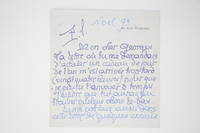
189377475Paris 1893. Fine. Paris 1893 13.50 x 14.50 cm quatre pages sur un feuillet remplié Autograph letter signed by Pierre Louÿs dated Christmas 1893 addressed to Georges Louis. Four pages written in blue ink on a double blue sheet bearing the writers initials and headed 49 rue Vineuse. A fine letter addressed to his brother Georges Louis with whom Pierre Louÿs maintained a deeply intimate relationship and whom he regarded as his own father. The question of Pierre Louÿss true parentage continues to fascinate biographers: His father Pierre Philippe Louis . married Jeanne Constance Blanchin in 1842; she died ten years later having borne him two children Lucie and Georges. In 1855 he married Claire Céline Maldan and from this union was born in 1857 a son Paul; then in 1870 our writer who received the given names Pierre Félix. This late birth the differences in temperament between father and son the fathers indifference toward the latter and the profound intimacy that always united Louÿs and his brother Georgesall of this has led some biographers and critics to suspect that Georges was in fact the writers father. The exceptionally close and lifelong bond between Pierre and Georges might well support such an argument. Of course no conclusive proof has ever been found and doubtless never will be. Still certain letters . are quite troubling. In 1895 for example Louÿs gravely wrote to his brother that he knew the answer to the most painful question he could ever put to him a question that had been on his lips for ten years. The following year at the height of Aphrodites success he thanked Georges effusively and closed his letter with these words: Pas un de mes amis n'a un PERE qui soit pour lui comme tu es pour moi. Arguing from the close relationship between Georges and Claire Céline in 1870 and from the jealousy the father continually displayed toward his younger son Claude Farrère did not hesitate to side with Georges Louis. And what are we to make of this dedication by Louÿs to his brother in a copy on japon of the original Pausole: Pour Georges son fils aîné / Pierre. Jean-Paul Goujon Pierre Louÿs Pierre Louÿs sent this letter to his brother when the latter had just taken up his post as Frances delegate to the International Commission of the Egyptian Debt and was in Cairo: La lettre où tu me demandais d'acheter un cadeau de jour de l'an m'est arrivée trop tard vingt quatre heures pour que je puisse l'envoyer à temps. J'espère que tu auras pu trouver quelque chose là-bas. Lacking a gift Pierre sent his brother a portrait of himself: En même temps que ma dernière lettre j'ai mis à la poste pour toi une photo du photographe ordinaire de Jane Hading et qui représente un Pierre posthume et sentimental assez ressemblant tout de même. L'épreuve n'était pas très propre mais c'était la seule que j'eusse encore reçue. Only a handful of photographic portraits of the writer are known today and we have been unable to identify the photograph mentioned here. The year 1893 marked several literary successes for Pierre Louÿs who until then had published only Astarté at his own expense in 1891 and together with his friend from the École Alsacienne André Gide and Paul Valéry had founded La Conque an anthology of the youngest poets whose first issue appeared on 15 March 1891. In quick succession came Chrysis ou la cérémonie matinale the translation of the Poésies de Méléagre and finally Lêda ou la louange des bienheureux ténèbres. The latter work is even mentioned in this letter: Mallarmé m'a écrit des choses pompeuses sur Lêda; mais de sa part cela ne signifie rien. Louÿs had been acquainted with Mallarmé since the early 1890s and met many leading figures at his celebrated Tuesdays among them Henri de Régnier. Deeply admiring the verses of the Symbolist master whom he considered the supreme incarnation of the artist one who has sacrificed everything to his ideal Ibid. Louÿs se unknown
1944058006New York 1945: Ballet Russe De Monte Carlo 1944. First Edition . Illustrated Wrappers. Very Good. B/W Photographs and Color Plates. Large size program inscribed by Frederic Franklin over a full page photograph in mid-step; Nathalie Krassovska over a full page photograph while en point; Leon Danielian over a full-page photograph in mid-leap; Ruthanna Boris Yurek Lazowski Dorothy Etheridge Maria Tallchief Mary Ellen Moylan over their own full page individual photographs; Michel Katcharoff; Nicholas Magallanes; and on a page with Ballanchine at center and Nijinska Fokine Schwezoff and Agnes Demille at corners by George Balanchine as "G. Balanchine". <br/> <br/> Ballet Russe De Monte Carlo unknown
1927018151New York : Boni & Liveright Inc. 1927. 1st Edition 1st Printing. Green Cloth. Very Good/Near Fine Dustjacket. 8 3/8 " High. Three Different Editions: A Fine Copy Of The Signed Limited First Edition Of The Book Signed By O'neill In A Near Fine Original Slipcase. Also Included Is The First Trade Edition Near Fine In A Near Fine Unfaded Dust Jacket Not Price-Clipped. Also Included Is A Unique Copy Of The Third Printing February 1928 The Printing Just Before The First Production Of The Play At The Pasadena Playhouse. Prepared By Or For Claude D. Seaman Of The Standard Lighting Company Los Angeles With His Name On Front Endpaper Carefully Blocked In Ink. Printed Heading By Hand On First Blank "World Premiere/ Of O'neill's/ "Lazarus Laughed"/ Pasadena Community Playhouse/ April 9 - 1928"; Repeated On Verso; Half Title With Line For Author's Signature But He Was Not Present And This Line Is Thus Blank; Verso With "World Premiere." Text Repeated With Lines For Director Musical Director Director Of Movement Art Director Production Manager Business Manager And The Chairman Of The Production Committee Each Line Signed By The Person Holding That Position; Title Page; Verso Is Copyright Page; Synopsis Page; Verso Are Lines Drawn And Extended To Each Of The "Characters" Listed On The Following Page Each Line Signed By The Person Who Played That Part Maurice Wells Thus Signing Twice 14 Signatures In All; "World Premiere" Text Repeated At Foot Of Characters Page And Again On Verso; "Act One" Title Page; Verso Repeats Then "World Premiere.' Text Followed By Lijnes For Each Of The Producing Staff / Setting Including The Designer James Hyde And 11 Others. With Laid In Loosely The Los Angeles Newspaper Review By The Spectator Of The Production Which Shortly Moved To The Hollywood Music Box Theatre With A Clipped Newspaper Ad For The Production Citing A Cast Of 250 And A Production Cost Of $100000. The Play Has Since Been Produced Only Four Times Due In Part To The Expense And Difficulty But Also To Its Philosophical Didactic Yet Confrontational Tone Which Has Not Set Well With General Audiences Since The Original Use Of This Dramatic Form Several Thousand Years Past. Irving Pichel 1891-1954 Played The Title Role. He Also Played The Servant Sandor In Dracula's Daughter Fagin In The 1933 Film Oliver Twist And About 57 Other Films 1930-1939 With Minor Roles In Films He Later Directed. He Directed Films 1932-1954 Including The Most Dangerous Game She Earthbound Hudson's Bay The Moon Is Down They Won't Believe Me The Miracle Of The Bells Destination Moon And Santa Fe. In 1947 Hje Was One Of The Hollywood 19 Subpoened By The House Un-America Activities Committee; He Was Not Called To Testify But Was Blacklisted Requiring Him To Work Outside The Us. Victor Jory 1902-1982 Was Canadian Attended School In Pasadena Appeared In Theatre All Over The Us And Made His Motion Picture Debut In 1930 Later Appearing In Over 150 Pictures And Dozens Of Tv Episodes. Note That This Book Is Not Signed By O'neill. Gilmor Brown Producer Of The Play Was Director Of Public Speaking And Dramatics At Caltech Later Director Of The Pasadena Playhouse And Responsible For Making It Into One Of The Premier Small Theatres In The U.S. From The 1920'S Into The 1950'S Routinely Featuring Prominent Starring Actoirs And Furnishing An Entree For Many Actors Who Later Became Successful In Motion Pictures And Tv. <br/> <br/> Boni & Liveright, Inc. hardcover
1880634971880. Fine. s. d. circa 1880 - une feuille Letter written in ink on Vergé paper without date or address. An old handwriting indicates the letter was addressed to Zola information that can not be verified. Daudet relates the impression that the publisher Georges Charpentier left him during a dinner. The importance of the friendly group formed by the writers of the time is here particularly pregnant: "" I want to write him a word to propose to come with us five "". Presumably written after the death of Jules Goncourt probably in the 1880s as suggested by the use of the only surname Goncourt the letter evokes a cold between Goncourt and Charpentier: "" Goncourt may not be delighted; but he is too well brought up to let him see . "" unknown
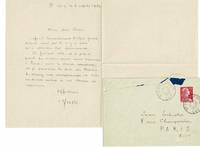
195676379Saint-Cirq-Lapopie 1956. Fine. Saint-Cirq-Lapopie 9 octobre 1956 13.50 x 18 cm 1 page sur un double feuillet et une enveloppe Autograph letter signed by André Breton addressed to Jean Schuster; one page written in black ink on a double sheet of white paper. Envelope included. The writing of this letter coincides with the publication date of the very first issue of the journal Le Surréalisme même: ""At last! Considering the closed object let us say that there is nothing left but to await events."" Breton then at his house in Saint-Cirq-Lapopie plans to return to Paris for this occasion: ""This was necessary - and the great cold of the morning - to bring us back to Paris: we will be there Friday and I will stop by the Musset in the evening."" Jean Schuster 1929-1995 joined the Surrealist group in 1947. Close to Benjamin Péret and André Breton he would become the latter's literary executor. unknown
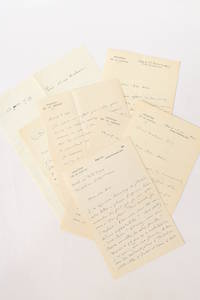
193964406Paris et Richelieu Paris 1939. Fine. Paris et Richelieu Paris 1939-1940 21 x 27 cm en feuillets Set of 6 autograph letters signed by André Rolland de Renéville 21 pages in black and blue ink. The letters are dated with one exception between June 28 1939 and May 27 1940 and include various addresses at the head of the pages. Folds inherent in envelopes. unknown
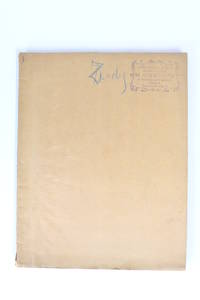
193864165Paris: Agence générale de copies dramatiques et littéraires H. Compère 1938. Fine. Agence générale de copies dramatiques et littéraires H. Compère Paris s. d. circa 1938 20.50 x 27.50 cm broché et en feuilles Autograph manuscripts and typescripts by André-Ferdinand Hérold for the libretto of Zadig musical comedy premiered on June 24 1938 at the Opéra-Comique with music by Jean Dupérier. Several hundred typewritten and manuscript pages numerous corrections in ink and pencil in the librettist's hand stamp of the general agency for dramatic and literary copies H. Compère on the front cover and first endpaper of the paperbound copy. The paperbound copy contains a complete version of the libretto and all the ensembles are incomplete fragments of several states of the text which as indicated by a note from a previous owner cannot be reclassified in logical order. Some fragments appear to be drafts of poems. Agence générale de copies dramatiques et littéraires H. Compère unknown