66 615 résultats
Mostly 4to. Altogether 16 pp. With 4 autogr. envelopes and some addenda. Detailed correspondence (in German) with Frantisek Kalivoda on the publication of a special edition of "Telehor" devoted to Moholy-Nagy, with praise of the recipient's work, ("It's amazing what you manage to achieve"), and of a prospective title ("The title 'thesis -- antithesis -- synthesis' is wonderfully Marxist - or Hegelian"), and declaring that "My one desire is, through telepathy and telesympathy, to make your work easy and pleasant". The papers comprise 3 sketches within text of paintings, and a sketched design for the outer covers of the special edition of "Telehor". - In detail: 1) 12. VIII. [1934]. 2 pp. With autograph envelope. - 2) 25. VIII. [1934]. 2 pp. With small coloured sketch, and autogr. envelope. -3) 27. II. 1935. 2 pp. - 4) 19. IV. 1935. 2 pp. With small sketch in pencil. - 5) 10. VI. 1935. 4 pp. With two small sketches. - 6) 9. VIII. 1935. 4 pp. With autogr. envelope. - 7) 9. X. 1935. 2 pp. With autogr. envelope. - Addenda: 1) Typescript signed by Moholy-Nagy, an introduction to an exhibition on Dutch fabric production, March 1935, 1p., folio. - 2) A typescript article by Kalivoda on the relationship between the artist and the city of Brünn, 1965, in Czech and German (punchholes in margins, folds, browned).
1 S. Qu.-8vo. Neun Takte mit unterlegtem Text des Anfangs von Henris Romanze "La brise souffle au loin" aus dem fünften Akt der "Sizilianischen Vesper", geschrieben nur wenige Tage nach deren Uraufführung am 13. Juni am Théatre Impérial de L’Opéra im Rahmen der Pariser Weltausstellung. - Auf der Versoseite des aus einem Stammbuch stammenden Blattes findet sich der launige Eintrag des Komponisten und Dirigenten Angelo Mariani, der inmitten eines zweizeiligen Systems mit vier Takten seinen Namen niederschreibt und in den Noten festhält, wie dieser zu singen sei. Die Widmung des mit Verdi bis ins Jahr darauf eng befreundeten Musikers datiert mit Bologna, 23. Oktober 1867 und gilt einer Signora. Knapp ein Jahr darauf kam es zum Bruch der beiden, da nach Verdis Auffassung Marianis mangelndes Engagement den Ausschlag dafür gegeben hatte, dass die Uraufführung der auf Verdis Initiative hin von 13 Komponisten geschriebenen "Messa per Rossini" - die an Rossinis erstem Todestag am 13. November in Bologna hätte uraufgeführt werden sollen - nicht zustandegekommen war. Die Gemeinschaftsproduktion der 13 Tonsetzer geriet in der Folge in Vergessenheit, wurde erst 1970 wiederentdeckt und nach insgesamt knapp 120 Jahren dann schließlich auch uraufgeführt. - Stellenweise gering fleckig, sonst tadellos erhalten.
- Honfleur 28 février 1859, 13,1x20,5cm, 3 pages sur un feuillet remplié. - Précieuse lettre autographe signée de Charles Baudelaire à Auguste Poulet-Malassis, éditeur des Fleurs du Mal, datée du 28 février 1859 et écrite à Honfleur. 64 lignes à l'encre noire, quelques passages soulignés, présentée sous une chemise en demi-maroquin noir moderne. Baudelaire semble obsédé par «?l'affaire Sainte-Beuve/Babou?». Il s'agit d'une des innombrables querelles qui suivirent le procès des Fleurs du Mal, dans laquelle l'écrivain Hippolyte Babou accuse Sainte-Beuve de ne pas avoir pris la défense de Baudelaire lors du procès. Des passages de cette lettre furent cités par Marcel Proust dans son célèbre Contre Sainte-Beuve, déplorant la lâcheté de Sainte-Beuve dans l'affaire du procès des Fleurs du Mal et l'attachement immérité que Baudelaire portait à l'écrivain. Le poète écrit à son éditeur de Honfleur, où il s'est retiré depuis janvier auprès de sa mère, figure sacrée «?qui hante le cur et l'esprit de son fils?». La lettre est écrite huit jours après un autre rebondissement dans l'affaire du procès des Fleurs du mal. Baudelaire, en proie à des sentiments complexes, se confie à Malassis alors que le 20 janvier, son ami Hippolyte Babou avait attaqué Sainte-Beuve dans un article de La Revue française. Il l'accusait de ne pas avoir défendu Baudelaire lors du procès du recueil?: «?Il glorifiera Fanny [d'Ernest Feydeau], l'honnête homme, et gardera le silence sur Les Fleurs du Mal?» écrivit-il. Car malgré les prières de Baudelaire, Sainte-Beuve n'avait finalement jamais publié d'article défendant Les Fleurs du Mal. à la suite de cette attaque de Babou, Baudelaire reçut une «?lettre épouvantable?» de Sainte-Beuve?: «?Il paraît que le coup [...] avait frappé vivement [Sainte-Beuve]. Je dois lui rendre cette justice qu'il n'a pas cru que je puisse insinuer de telles choses à Babou?». Bien qu'indigné par de telles accusations, Sainte-Beuve n'en tint pas Baudelaire responsable. La virulence dont fait preuve Sainte Beuve étonne Baudelaire, qui déclare à Poulet-Malassis?: «?Décidément, voilà un vieillard passionné avec qui il ne fait pas bon se brouiller [...] Vous ne pouvez pas vous faire une idée de ce que c'est que la lettre de Sainte-Beuve. Il paraît que depuis douze ans il notait tous les signes de malveillance de Babou?». Baudelaire assiste, impuissant, à la querelle entre deux hommes estimés, et témoigne surtout de son attachement à Sainte-Beuve, qui est mis en danger par l'article de Babou?: «?Ou Babou a voulu m'être utile (ce qui implique un certain degré de stupidité), ou il a voulu me faire une niche ; ou il a voulu, sans s'inquiéter de mes intérêts, poursuivre une rancune mystérieuse?». Baudelaire vouait en effet une admiration sans bornes à «?l'oncle Beuve?», sénateur, académicien et maître incontesté de la critique, dont l'avis faisait loi dans les cénacles littéraires parisiens. Il guettait depuis des années un encouragement officiel de Sainte-Beuve, qui aurait conforté sa carrière chancelante, entachée par le scandale des Fleurs du Mal. Le poète se trouve donc tiraillé entre sa vénération pour Sainte-Beuve et son amitié de longue date pour Hippolyte Babou - qui, selon la légende, lui aurait suggéré le titre Les Fleurs du Mal. Il confie son désarroi à Poulet-Malassis?: «?Ce qu'il y avait de dangereux pour moi là-dedans, c'est que Babou avait l'air de me défendre contre quelqu'un qui m'a rendu une foule de services?». On peut se demander à quels services Baudelaire pouvait faire référence, sachant que Sainte-Beuve fit en somme assez peu pour sa carrière. Cette lettre fut citée dans le Contre Sainte-Beuve, célèbre et terrible réquisitoire de Marcel Proust publié à titre posthume en 1954. Proust y accuse Sainte-Beuve de méconnaître l'incontestable génie poétique de Baudelaire, et souligne sa lâcheté durant le procès des Fleurs du Mal. En effet, afin de protéger ses fonctions sénatoriales, Sainte-Beuve n'avait rien écrit en faveur de Baude
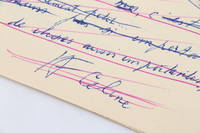
- s.l. [Meudon] 1954 (entre l'été 1954 et janvier 1955), 26,5x33,5cm, 24 feuillets montés sur onglets et reliés. - Early draft of D'un château l'autre [Castle to Castle], unpublished autograph manuscript n.p. [Meudon] 1954 (summer 1954-januray 1955), 26,5x33,5cm, 24 leaves mounted on boards, bound. Exceptional set of 24 manuscript leaves by Louis-Ferdinand Céline from D'un château l'autre [Castle to Castle], mounted on boards under protective paper. Every page is numbered in Céline's hand in the upper left corner (from 632 to 634, 636 to 651 and 653 to 657), and written in blue ballpoint pen. They feature the usual characteristics of Céline's manuscripts: stains, traces of paper clips... important variations to the published text, crossed-out lines and words, modifications, and repetitions. Bound in full black chagrin, gilt title and author on spine, gilt mention "manuscrit autographe" on the first cover's bottom right corner. A splendid working manuscript, typical of Celinian writing. "Céline began writing D'un château l'autre in the summer of 1954 and finished it in the spring of 1957. [...] At Gallimard, we were kept informed of the manuscript's progress: "I am at the 1300th page, 50th draft...I can think without foolish optimism that I will soon reach the end (about a month)." A few weeks later, the book was nearly complete: "My "bear" is here, it's fine lacework." Completed in March, the book went on sale on June 20, 1957." (F. Gibault, Céline. 1944-1961 - Cavalier de l'apocalypse). This manuscript is one of these numerous "drafts" and was not chosen in the final version of the text. It is most likely one of the earliest versions written before 1955. It contains a long unpublished passage about the "shivering" Nazi-sympathizing Frenchmen ("collabos") exiled in Sigmaringen. Although he was part of them, Céline paints a very harsh portrait of the thousand French collaborators who took refuge in the former Hohenzollern castle. He reworked the passage extensively, erased it, and wrote it again. This violent excerpt will ultimately be left out of the published novel altogether. Céline describes the lavish apartments of Baron Commandant von Raumnitz. In the Gallimard published version, Raumnitz's "secret rooms" will be cut short and very much toned down. Some of the pages stray from the storyline and evoke present-day events: in the grip of paranoia, Céline gives derogatory nicknames to the most prominent figures of French intelligentsia, namely Jean-Paul Sartre ("Tartre"), and Louis Aragon renamed "Larengon". Some "characters" appear in our version under their real names, especially Jean Paulhan who will be nicknamed Norbert Loukoum in the published version after a quarrel between the two writers. This new name will appear in early 1955. Remarkable unpublished manuscript draft of D'un château l'autre. [FRENCH VERSION FOLLOWS] Exceptionnel ensemble de 24 feuillets, montés sur onglets sur des cartons sous serpentes. Les feuillets autographes, tous numérotés de la main de Céline en coin supérieur gauche (de 632 à 634, de 636 à 651 et enfin de 653 à 657), sont rédigés au stylo bille bleu et présentent les stigmates céliniens usuels : taches, traces de trombones... Ils présentent d'abondantes variantes, lignes et mots biffés, modifications et reprises. Reliure à la bradel en plein papier chagriné noir, dos lisse janséniste, titre et auteur à l'or, premier plat estampé à l'or en bas à droite de la mention « manuscrits autographes ». Très beau manuscrit de travail, témoignage du cheminement et des égarements de la pensée célinienne. « D'un château l'autre a été commencé par Céline pendant l'été 1954 et achevé au printemps 1957. [...] Chez Gallimard, on était tenu au courant de l'état de l'avancement du manuscrit : « Je suis à la 1300e page, 50e mouture...je peux penser sans optimisme idiot que je parviendrai bientôt à la fin (environ un mois). » Quelques semaines plus tard, le livre était pratiquement achevé : « Mon ours est l
195483743s. l. Meudon 1954. Fine. Céline's Ars Poetica: ""I capture all the emotion on the surface! I cram it into my metro! s. l. Meudon s. d. 1954 10 x 21 cm 34 feuillets Manuscript pages from Conversations with Professor Y' n.p. Meudon n.d. 1954 various sizes from 10x21 cm to 27x21 cm 34 sheets. Autograph manuscript by Louis-Ferdinand Céline 34 sheets of various sizes written in blue and sometimes pink ballpoint pen. Some of the pages are numbered by Céline at top left. The last folio numbered 159 is signed by the writer at the bottom. Two leaves contain previously unpublished passages: the first a few lines long refers to the Professeur. The second leaf numbered 136 features another full-page text on the verso which we did not find in the Professeur Y' or in any of the published works of Céline. Céline refers in this unpublished passage to article 75 of the penal code condemning to the death penalty any French citizen found guilty of intelligence with the enemy. It also mentions a certain ""Me Johann Niels Borggensen"" no doubt a pseudonym for his lawyer Thorvald Mikkelsen: "".supposedly to protect me from police curiosity! holy cow! he was having a ball.when you've got the warrant up your arse crossed out: article 75 anyone can do what they like with you! what a joke! we can do what we like with you.it wouldn't have been Borggensen perhaps someone else would have been worse.give me article 75 and I'll put the whole of France in a Mouse hole for you! and Germany with it! and England such a nag and Europe with it! no bomb needed! H ! Y ! Z ! I'll make you fit the atom into a."" Important set of working manuscripts bearing witness to the writing of Conversations with Professor Y' Céline's true Ars poetica. Since the first part of Féerie pour une autre fois' Fable for Another Time was not as successful as expected Céline wanted to give the release of the second part - Normance - as much publicity as possible and restore his reputation after his years of exile in Germany and Denmark. Instead of writing the usual promotional note prière d'insérer he suggested to publisher Gaston Gallimard this eulogy written in the style of an imaginary interview between himself and Professor Y alias Colonel Réséda a prostatic old man. This zany ""interviouwe"" was published in several parts in the Nouvelle Revue française in 1954 and the finished work through Éditions Gallimard the following year. Céline speaks fervently of his style and his conception of literature and vehemently criticizes the world of letters and public taste. Unlike Céline's other works the genesis of this text crucial to the understanding of his oeuvre is poorly documented and its manuscripts are rare. The Pléiade edition of Celinian novels contains only a few pages of an earlier version very close to the published text. This set of pages covering every passage of the text contains both heavily crossed-out sheets and neatly rewritten notes. It bears witness to the different stages of the writer's work: drafting an initial sheet crossing out and rewriting on the same page then transcribing short passages on separate notes. The last page of the text is extensively crossed out and rewritten resulting in a slightly different version of the published version. The manuscript also contains the famous metaphor of the metro typical of the writer's emotive style compared here to the ""dry language"" of his peers: ""Did you see Have you noticed All caught up in my metro!. what do I leave on the surface. the worst rubbish in cinema!. foreign languages then!. translations!. retranslations of our worst rubbish that they use for their ""parlants"" talking pictures superb foreign languages!. in addition to the psychology! the psychological mumbo jumbo!. all the crap. . Me it's something else! me I'm much more brutal! me I capture all the emotion!. all the emotion on the surface! all at once! I decide! I stick it in the metro! my metro! all t unknown
- s.d. (1866), reliure et étui : 23x28,5cm / feuillets : 17,8x23cm, 18 pages sur 18 feuillets, en feuilles. - n.d. (1866), binding and slipcase: 23 x 28.5cm / leaves: 17.8 x 23cm, 18 pages on 18 leaves, in leaves. Complete autograph manuscript signed by Emile Zola entitled "Profils parisiens - Les Repoussoirs", 18 pages written in black ink on mounted 18 lined leaves. Many crossing-outs and corrections. This text had been published for the first time on 15 March 1866 in Marseille in the magazine La Voie nouvelle and was then published - with three others that make up the Esquisses parisiennes [Parisian Sketches]- following the novel Le Vu d'une morte [A Dead Woman's Wish], published with Achille Faure in November 1866. Later binding (20th century) in half green morocco, spine with a lengthwise gilt title, marbled paper boards, marbled paper slipcase lined in slightly cracked morocco. Beautiful yet fairly unknown text from Zola's early years, one of the first published by the writer, then twenty-six years old and earning his first stripes in the literary world. This chronicle, half-way between the novella and the philosophical tale, tells the story of the "vieux Duranteau" "old Duranteau"'s project, a bold and opportunist entrepreneur who wants to set up an agency of "repoussoirs" "turn-offs", in other words, ugly and available women for rent, supposed to enhance the beauty of the female customers using their services: "Avouez que vous avez été pris au piège et que parfois vous vous êtes mis à suivre les deux femmes. Le monstre, seul sur le trottoir, vous eût épouvanté ; la jeune femme au visage muet vous eût laissé parfaitement indifférent. Mais elles étaient ensemble, et la laideur de l'une a grandi la beauté de l'autre. Eh bien ! Je vous le dis tout bas, le monstre, la femme atrocement laide, appartient à l'agence Duranteau. Elle fait partie du personnel des Repoussoirs. Le grand Duranteau l'avait louée à raison de vingt francs la course. " "Admit that you were entrapped and that sometimes you began to follow the two women. The monster, alone on the pavement, would have frightened you; the young women with the silent face would have left you perfectly indifferent. But they were together, and the ugliness of one increased the beauty of the other. So? I tell you in a whisper, the monster, the excruciatingly ugly woman, belongs to the Duranteau agency. She is part of the Repoussoirs staff. The great Duranteau had rented her for the fare of twenty francs." Our manuscript is consistent with the version published in La Voie nouvelle. Emile Zola's signature at the end of the first leaf is evidence that it is unquestionably the copy that he sent to the Marseille newspaper, especially as the text published in Le Vu d'une morte contains some variations. Henri Mitterrand highlights the rarity of Zola's manuscript articles and chronicles; Zola was nevertheless an extremely prolific literary journalist and published close to a hundred short fictions: "Tous les manuscrits de ces « papiers » sont perdus, sauf ceux, autographes, des « Confidences d'une curieuse »" "All the manuscripts of these "papers" are lost, except those, handwritten, of "Confidences d'une curieuse"". (H. Mitterrand, Zola, T. I) It must be said that the young Zola had just left his position as an errand boy at the Librairie Hachette to finally take up a career as a writer. This work, as well as paying the bills, showed him the inner workings of the publishing world and contributed to the publication of his first works: Contes à Ninon [Stories for Ninon] and La Confession de Claude [Claude's Confession]. We already detect cynicism and the Zolian revolt in Les Repoussoirs. The writer manages, through the synthetic literary genre of the novella, to address a good number of the themes that will soon resurface in the great social epic that will make up the twenty volumes of the Rougon-Macquart. [FRENCH VERSION FOLLOWS] Manuscrit autographe complet signé d'Emile Zola inti
2 SS. 4to. An den nicht namentlich genannten Schriftsteller und Bibliothekar Philipp Joseph von Rehfues (1779-1843) in Stuttgart, der ihm eine seiner gegen die französische Fremdherrschaft gerichteten "Reden an das deutsche Volk" zugesandt hatte: "Ew. Wohlgeboren haben mich durch die baldige Mittheilung Ihrer patriotischen Schrift höchlich verbunden. Sie muß einen würdigen Platz einnehmen unter so manchen andern, welche die Behandlung des reichen Stoffes mit wahrhaft deutscher Gesinnung unternommen. Ist man nun über Gehalt und Zweck vollkommen einig; so kann bey solchen wohlgemeinten und lobenswürdigen Tagesschriften nur die Frage entstehen: bringen sie dasjenige zur Sprache, was der guten Sache für jetzt und künftig förderlich ist? und, welchen Beyfall kann ihnen der Rede-Künstler, der Aestheticker zollen? Beydes, mit Grund, ruhig und im Zusammenhange zu thun, haben sich vorzügliche Männer vereinigt, deren in der allgemeinen Literatur-Zeitung schon abgedruckte Anstrengungen Ew. Wohlgeboren vielleicht nicht unbekannt geblieben sind. Ich bin gewiß, daß man daselbst auch dieser neuen bedeutenden Arbeit alle Gerechtigkeit wird widerfahren lassen [...]". - An den Rändern stärker, sonst nur gering fleckig. Sophienausgabe Bd. 24, Nr. 6734 (nach dem Konzept).
3 SS. auf Doppelblatt. Gr.-4to. Auf Briefpapier des "Simplicissimus" - Albert Langen Verlag. An seinen Jugendfreund, den späteren Kunsthistoriker und Romanisten Otto Grautoff (1876-1937): "Lieber Grautoff: besten Dank für Deinen letzten Brief, in dem wieder interessante Dinge standen. Du thust, als ob ich von der Assistentenangelegenheit schon etwas gewußt hätte. Keineswegs! Du hattest mir das letzte Mal nur den Namen des Professors K. genannt, nichts weiter. Aber es wäre wahrhaftig aller Ehren werth. K. Bibliotheksassistent! Gehören dazu nicht überhaupt 'studirte' Leute? Ich bin schon lange erstaunt und erfreut über Deine Entwicklung. Auch Deine 'Vorträge', Dein 'Buch' etc. machen mir starken Eindruck. Hast Du Dich etwa auch äußerlich so verändert? Wahrscheinlich hast Du einen großen Backenbart und eine goldene Brille? [...] Hattest Du das Gedicht, das schöne Momente hat, für den Simplicissimus berechnet? Ach, dazu ist es zu melancholisch und zu persönlich. 'Wir' brauchen aufgeweckte und überlegene Sachen ... was aber 'mich' nicht hindert, ebenfalls hie und da Verse zu schreiben, wie die, welche ich Dir, trotz ihrer Unfertigkeit, vielleicht beilegen werde. - Mit meiner Prosa geht es mir besser. Fischers Rundschau bringt nächstens wieder einmal eine Novelle von mir, und auf jeder Karte 'erwartet' Dr. Bie 'in voller Spannung' meinen Roman. Sein Wohlwollen und Interesse rührt ganz einfach, und ich kann ihn nur bitten, es nicht erlahmen zu lassen, denn er muß sich noch gedulden; es fehlt noch etwa ein Drittel des Buches. Gestern Abend habe ich übrigens einen neuen Abschnitt im Familienkreise vorgelesen [...]". - Am ersten Blatt verso, um 90 Grad nach rechts geneigt, Manns von Platen beeinflusstes, vom Verfasser nicht veröffentlichtes Gedicht "Nur Eins": "Wir, denen Gott den trüben Sinn gegeben / Und alle Tiefen wies, wo Scham und Graun / Sind ewig fremd den Fröhlichen im Leben, / Die harmlos auf des Daseins Spiele schaun. // Und weil der Menschen Seele zu ergründen / Hohnvoll auch mich der Drang gefangen hält, / Will ich es euch mit schwerem Worte künden: / Erkenntnis ist die tiefste Qual der Welt. // Denn Eines ist es, was in allem Leiden / Uns stark erhält und aufrecht fort und fort, / Ein trostreich Spiel voll höchster, feinster Freuden / Den Unglückseligsten: Es ist das Wort." Unbedeutende Randeinrisse. - Nach Grautoffs Tod im Pariser Exil erwarb der Verleger Kurt Leo Maschler (1898-1986) die Korrespondenzsammlung von dessen Witwe Erna Grautoff. Nach Maschlers Flucht aus Österreich 1938 wurde der zurückgelassene Bestand von der Gestapo der ÖNB überstellt und von dieser in deren Autographensammlung einsigniert (am unteren Rand die ÖNB-Signatur von 1939: Autogr. 141/58-42). 1949 wurde die Sammlung an Maschler rückgestellt (vgl. ÖNB, Allg. Verwaltungs- u. Korrespondenzakten 00/1949 A); erworben aus dem Nachlaß Maschler. T. Mann, Briefe an Otto Grautoff 1894-1901 und Ida Boy-Ed 1903-1928, hg. von Peter de Mendelssohn (Frankfurt a. M. 1975), S. 108f. Die Briefe Thomas Manns. Regesten und Register. Bd. I. Briefe 1889-1933, bearb. und hg. von Hans Bürgin u. a. (Frankfurt a. M. 1976) 98/12. Nicht bei T. Mann, Große Frankfurter Ausgabe, Briefe I (1889-1913) (Frankfurt a. M. 2002).
246:178 mm. Mounted on cardboard. Fine head and shoulders portrait. - Mild toning and scratching.
Small folio (ca 24 x 30 cm). Ca. 170 letters in Algerian Arabic, pasted to 100 numbered leaves. Contemporary papered boards (severely rubbed and bumped) with remnants of a green calfskin spine. A vast ensemble of handwritten letters in Arabic, assembled by the Franco-Algerian typesetter A. Duchâteau who used the collection both to perfect his command of practical Arabic in various local dialects and as a typographical style guide. Most of the letters were written by local dignitaries, including Beys, Kaïds, Sheikhs, provincial leaders and village chiefs. To obtain them, Duchâteau must have drawn upon various sources such as his own relations and other Algerian families, the French community, and the military. About a third of the letters include Duchâteau's French translations or at least notes about their origin, giving dates or details of their content or identifying the recipient. - Duchâteau worked as typesetter for the Algiers-based "Bastide" printing house in the early 1850s. Specializing in Arabic typography, he was especially close to Louis-Jacques Bresnier (1814-69), the first professor of Arabic in Algiers. It was Duchâteau who attended to the printing of the Arabic parts of Bresnier's chrestomathies and language guides, and it is apparent that the album also served as documentation for the professor's own publications, such as his "Chrestomathie arabe: lettres, actes, et pièces diverses" (1857). In the preface to his "Cours pratique et théorique de langue arabe", published by Bastide in 1855, Bresnier explains that his work could only be realized thanks to the talent of Duchâteau: "Two modest and excellent artists, Messrs. Ch. Portmann, lithographer, and A. Duchateau, an Arabic typesetter, understood and supported the author's work with remarkable intelligence and skill." - Some of these letters are of great historical interest, enabling us to trace in them the frequently poorly-documented history of Algeria between the late 18th and mid 19th century. The ensemble includes, inter alia, a letter from the Bey of Constantine, Hussein Bey (1807); letters addressed to Napoleon III, who is referred to as "Sultan" and "Lord Prefet"; a letter from a brotherhood leader asking permission to bring a number of faithful into his Zaouira; a document regarding the prisoners of Constantine; a letter from Mufti Hanefi of Constantine requesting the replacement of the hezzab of the mosque; letters from the interpreter Ismael Ben El Had Mohammed Amin El Sekkat, from Kaïd Belkaum Ben Minia, from Messrs. El Hadj Merouan & El Hadj ben Fouka, from Sid Said EI Hadj, a regional chief (1817), several letters to and from physicians, letters related to invitations, festivities and gatherings, requests to the authorities for intervention, commercial letters, and letters of thanks. A single letter in Hebrew is also included. Inserted at the beginning are 6 lithographed leaves of letter specimens as used by Bresnier in his courses, annotated by hand (likely that of Bresnier himself) with extensive remarks in French and Arabic on the vocabulary and phrasing. - An important source for the history of French Algeria and the history of Arabic typography in the mid-19th century.
8vo. (8), 79 pp. Bound with both original giltstamped cloth-structured wrappers in later half cloth. First edition. Inscribed by the author on flyleaf to Therese Henriques (1833-83), in whose home Andersen was a frequent visitor during the last 15 years of his life: "Fru Therese Henriques som fra Pjanoet forstaaer at fortælle digterisk Eventyr og Historier bringes denne lille Bouquet med hjertelig Hengivenhed H. C. Andersen" ("Mrs. Therese Henriques, who from the piano understands how poetically to weave fairy tales and stories, is given this little bouquet with heartfelt devotion. H. C. Andersen"). - Henriques's house was full of life and happy days as a large circle of both Danish and foreign musicians and artists visited the salons and parties held there. The friendship with Henriques was actually established in August Bournonville's home, where the poet first heard the young, talented Therese Henriques play the piano. Immediately, a warm friendship between the two was kindled, and it would last a lifetime. Provenance: descendants of Henriques family.
8vo. 3 pp. on bifolium. Vivid algebraic word problem with five unknowns, solution, and discussion. Some brownstaining; label mounted on reverse of 2nd leaf.
1 p. 8vo. With ms. address. Brahms's letter to composer and conductor Julius Bernuth begins with three bars from Mozart's "Magic Flute" (Act 1, Scene 3), with Tamino's words "So ist denn alles Heuchelei", followed by some personal words by Brahms.
137 x 84 mm. Seven bars from "Dort in den Weiden" (op. 97, no. 4: "Sechs Lieder für eine Singstimme mit Begleitung des Pianoforte", 1886), the words departing slightly from the printed version: "An Rheines Strand da steht ein Haus -!". - Perfectly preserved.
8vo. 1 page. To a friend, criticizing a philosophical work similar to those of Nicolas Malebranche and René Descartes, but lacking in style and even in correct French, wherein the author claims fire to be the main principle of everything, and the atmosphere to be nothing more than a mass of aqueous molecules which charge, moisten, and minimize the power of fire, without giving the proper scientific facts confirming his theory, concluding with the observation that the age of experimental philosophy has come to supersede that of visions: "Cet ouvrage n'est pas sans idées. C'est une réverie de la tournure de celles de Malebranche et de Descartes, mais point de stile, quelquefoi même pas de Français. Si ce qu'il y a là dedans de systematique etait tombé dans la tête de Bufon, à force d'expressions, De Subtilités et de couleur, je ne sais ce qu'il n'en aurait pas fait. Dans l'état où cela est, point de sensation d'espérer. Selon l'auteur, Le feu est le principe de tout, excepté de son ouvrage. Quand on se propose de demonstrer qu'il n'y a point d'air, mais que notre athmosphère n'est qu'un amas de molecules aqueuses qui chargent, mouillent et [...] appesantissent Les ailes du feu, il faudrait commencer par l'aprovisionner d'un bon nombre de faits, et la reponse à tous ceux qu'on peut apposer, n'est ce rien? [...] Le reigne de la philosophie experimentale est venu, et celui des visions est passé [...]". - With pencil attribution at the lower edge. Number 24 stamped on verso. Traces of former mounting; slightly brownstained. Roth/Varloot, Correspondence XVI, 980.
4to. ¾ page. In German. To the gastroenterologist Isidor Held (1876-1947), thanking him for the gift of a book by Upton Sinclair (probably "Dragon Harvest"), "from which I see how the machinery of world politics is reflected in his brain" and looking forward with hope and trepidation to what will follow the defeat of Nazi Germany: "I am happy with the progress the Germans have made and tremble before the next chapter [...]" (transl.). - Einstein had befriended Held, an Austrian-born physician settled in New York, through their joint efforts to help scientists and doctors escape Nazi Germany. The two men were by this time watching the collapse of Nazism and hoping that a new peaceful German leadership would emerge from the ashes of war, although Einstein here expresses his fear for the future of Europe. Held appears to have sent Einstein a copy of the latest Upton Sinclair novel, "Dragon Harvest" (1945), which was set during the period between the Munich Crisis and the Fall of Paris. It is not clear if Held had realised that Einstein and Sinclair knew each other; Einstein had contributed a preface to Sinclair's "Mental Radio" (1930), and Sinclair made Einstein a friend of his fictional hero Lanny Budd, an American socialist. - On stationery with blindstamped letterhead. Slightly spotty and wrinkled.
8vo. 1 p. Written on the reverse side of a portion of a 1946 letter written to Gandhi from a young Western follower, George Mammen. Gandhi has penned some closely-written notes - clearly a draft for a letter. He writes, in fountain pen ink: "Our India will have need of you. You have had your training. You will give India the benefit of that training. It would be sad only if after the trials and suffering ["of war" stricken out] that our soldiers have been through, they forget the lessons of their eyes, the moment the peril is lifted. But one thing you should remember, under national Govt, you won't be pampered. You won't have all those lavish remunerations and privileges which a foreign Govt. bribed you with at the expense of India. India is destitute. You can serve her only by showing her destitution and poverty. Otherwise you will earn not the gratitude but the execration of your country. [Now writing at the top of the page:] You will, I know, fully share in this freedom, only to breathe the air of freedom with your countrymen". - Somewhat wrinkled and dust-soiled; small pinhead-sized holes on top.
4to. 1 p. on a bifolium. In German. To the classicist Heinrich Karl Eichstädt, then serving as director of the Philological Seminary at Jena, requesting biographical and bibliographical information: "You would do me a great kindness if you were to provide me with the following notes which I request: Linné - year of birth; dear of death; Hofrat Büttner: year of birth; year of death; Professor Batsch: first name; year of birth; year of death; Rupp's Flora Jenensis: first edition? [...]" (transl.). - All answers, with the exception of the last, are supplied in Eichstädt's own hand. "Flora Jenensis" by the botanist Heinrich Bernhard Rupp was published in 1718. - Occasional light wrinkling, otherwise in excellent condition. Published in: Sophienausgabe, Vierte Abteilung: Briefe, vol 28: March-December 1817, no. 7711.
180 x 230 mm. 50 ff. 50 pages written by Sven Hedin in Swedish; last sheet signed and dated. - Kuropatkin was a general of the Russian army and minister of war. During his tenure, tensions with Japan increased, leading to the Russo-Japanese War in 1904/05. Hedin first met Kuropatkin in Ashgabat in 1880, and "I met him several times later, at Samarkand, Tashkent, and St. Petersburg; and I remember his name with gratitude, for he was one of the men who made travelling easier for me" (My Life As An Explorer, trans. by Alfhild Hübsch. New Delhi and Madras, Asian Educational Services, p. 87). - Hedin's reminiscences of Kuropatkin were first published, in a very similar version, in the newspaper "Stockholms Dagblad" on 17 September 1904; a German translation appeared on the same day in the journal "Die Woche" (38, pp. 1663-1667). Abridged versions appeared in more than 100 daily papers, e.g. in "Lunds Tagblad" (20 September: "Sven Hedin om Kuropatkin och kriget"). The "Times" (1 November 1904) ran a version omitting the comparison between Lord Roberts and Kuropatkin, inserting instead a new paragraph about Lord Curzon. The present Swedish version could not be traced in print.
1 p. 8vo. Together with a b/w photograph. To the Belgian writer Marcel Lecomte, apologizing for being indisposed: "Mon cher ami, J'ai été empêché au dernier moment. Veuillé bien me faire signe dés que tu seras de retour. Je suppose que ceci te ressemblera un peu à ce moment: [drawing]. A bientôt et amitiés / Magritte". - Magritte's illustration shows Lecomte walking backwards upon arriving at the Brussels Gare du Midi with his books. A similar motif is seen in the enclosed photograph. - Reproduced on the dust jacket of Lecomte's "Poésies complètes" (Paris, La Difference, 2009). Provenance: from the collection of the painter Lou Gérardy (half-sister of the novelist Béatrix Beck), the poet's lover.
Folio. 1¼ pages. 12 staves with text in German. Tenor trombone part for Mendelssohn's 1933 revision of the oratorio "Israel in Egypt" by Georg Friedrich Handel. The trombone in heard in the fanfare in E flat, as well as after the two choruses "Singet unserm Gott denn er hat geholfen wunderbar" and "Heil dreimal Heil dem heißgeliebten König, Heil, ewig Heil dem theuren Vaterland". - "As a conductor, Mendelssohn advocated the works of the baroque composers Bach and Handel with particular zeal. He used his stays in London to study Handel's original scores. In the Queen's Library he made important discoveries with regard to the oratorio 'Israel in Egypt', and the results were incorporated into his performances of 'Israel', which he conducted a total of five times, or the first time in Düsseldorf in 1833 for the Niederrheinisches Musikfest, in a version tailored to the practical necessities of the venue. The unavailable organ was replaced by additional wind parts, and the score, then a two-part structure, was supplemented by insertions from other works by Handel or recitatives assigned to this oratorio. The 'trumpet overture' composed by Mendelssohn was prefixed to the work - a workaround solution, since the performance would, unusually, have started with a recitative" (cf. Thomas Hennig, "Die Aufführungen des "Israel in Aegypten" unter Leitung Mendelssohns"). - Somewhat spotted and browned; minor damage to edges.
Small folio (249 x 325 mm). 2 pp. on a single leaf. Brown ink on 12-stave paper with words and music. The alto parts for "Ruhethal" and for the beginning of "Jagdlied", the final two of the six songs that make up Mendelssohn's "Sechs Lieder im Freien zu singen", op. 59 (MWF F 21-22). The songs were composed for mixed a capella chorus, without accompaniment, between 1837 and 1843; the present songs were written on March 3 and 5, 1843. Dedicated to Henriette Benecke, his wife's aunt with whom the Mendelssohns lodged during their 1842 visit to London, the work was first published in 1844. The music in the hand of Amadeus Eduard Anton Henschke (1804-54), with the words of the text added by Mendelssohn himself, and his note and signature at the end of "Ruhethal": "Noten von Henschke, Text von Felix Mendelssohn Bartholdy". - "Ruhethal" ("Adagio") sets a poem by the Swabian poet Ludwig Uhland (1787-1862), "Wenn im letzten Abendstrahl goldne Wolkenberge steigen", 35 measures in D major and 2/4 time. "Jagdlied" (" Allegro molto quasi Presto") is based on the poem by Joseph von Eichendorff (1788-1857), "Durch schwankende Wipfel schießt goldener Strahl", in B minor, the relative minor of the preceding song's scale, in 4/4 time, comprising the first 17 measures, including a stricken-out passage. - A horizontal tear in the central fold and another near the bottom have been professionally repaired. "Ruhethal" and the edges of "Jagdlied" a little browned from former mounting and presentation.
4to. 2 pp. Framed. Very rare letter by the great explorer, written (in German) to his publisher (possibly Nicolaus Möller in Copenhagen?), asking him to enlighten him as to the possible receipt of outstanding payments. Niebuhr writes that he would be interested to know whether "Messrs. van Ghelen, Brönner, and the Typographical Society in Berne [...] have paid. I do hope that it was not illness that prevented sending me an answer [...] I will, however, include here a list of what each and every gentleman is to pay. - Mr van Ghelen in Vienna owes, after having settled a bill, 54 Reichsthaler and 4 Groschen, and is instructed to pay me 2 Reichsthaler in Louisd'or on behalf of Professor [Maximilian] Hell [...] For 5 copies of the 'Reisebeschreibung nach Arabien', 1st volume, Mr Brönner in Frankfurt owes 5 Reichsthaler and 20 Groschen each [...] The Typographical Society in Berne owes payment for 4 copies of the 'Reisebeschreibung', part 1, at 5 Reichsthaler and 20 Groschen each, [...] and 4 Reichsthaler 4 Groschen for 1 copy of 'Beschreibung von Arabien'" (transl.). - Of the utmost rarity.
Small 8vo. 1 p. With autogr. envelope. To G. Austin Taylor, on the introduction of rabies in a new country, as related by a Dr. Hampshire: "La question de l'introduction fortuite et relativement récente de la rage dans un pays, telle que vous m'en avez donné connaissance tantôt, en compagnie de Mr le Dr Hampshire est intéressante au point de vue de l'histoire de cette maladie. Permettez-moi de vous prier de demander à Mr le Dr Hampshire de m'en écrire une relation aussi authentique que possible et de la faire traduire en français si ce n'est pas abuser de votre complaisance [...]".
Small folio and 8vo. Altogether 66 pp. on 22 bifolia and 1 single sheet, one with autograph address on verso, one with pencil notes on verso. Emotional correspondence between Proudhon and the entrepreneur Aloysius Huber (1815-65) about the Besançon-Mulhouse railway project. In the early 1850s several rival companies vied for a government concession for the route, including the company founded by Huber, an Alsatian veteran of the Revolution of 1848 who had been Proudhon‘s neighbour at Doullens gaol. Proudhon managed to arouse the interest of Jerome Bonaparte in the projected railway, and in the process seems to have convinced himself that the plan had an idealistic side, as a decentralised pattern of small railroads would be superior - at least according to his social theories - to a unified system. As Huber struggled to obtain a concession, he regularly informed Proudhon of his progress in the matter, frequently appearing in a rather desperate mood, at one point even proclaiming in frustration: "un diable les chemins de fer!" (23 May 1853). - Completely invested in the project, Huber considers his obtaining the concession "a matter of life and death", and invokes Jean-Gilbert Victor Fialin, Duc de Persigny, Minister of the Interior, who supposedly told Proudhon that all it takes is a company presenting favourable conditions: "Le moment est decisif et c'est pour nous, pour moi sutout qui n'ai pas d'autre avenir, une question de vie et de mort [...] Quant tu es allé auprès de M. de Persigny, celui-ci t'a repdondu qu'il suffisait de présenter une pareille compagnie avec des conditions aussi avantageuses pour que le gouvernement lui accorde la concession [...]" (8 April 1851). He urges Proudhon to act quickly, fearing that one of the other companies might beat them to the concession: "Ne perdons pas de temps, mon cher Proudhon, je t'assure que si la concession du chemin de fer de Besançon à Mulhouse ne nous est pas accordée, elle sera très prochainement accordée à une autre compagnie […]" (16 Jan. 185?). - Some six weeks after he agreed to function as solicitor in the project, Proudhon appears irritated, doubting the sincerity of the company as well as its need of Huber himself: "Je te l'ai dit dès le commencement: Je ne crois pas de deux choses […] or que ta Compagnie soit sérieuse […] or qu'elle ait besoin de toi […]" (17 Feb. 1853). Huber repeatedly mentions his dire financial situation, as he is struggling with substantial debt: "En attendant, je suis moi-même profondement decouragé, je me suis donné tant de peine, j'ai fait tant de dettes dans l'intérêt de ma compagnie, que je ne saurai jamais comment me liquider […]" (23 July 1853). - Eventually, the railway concession went to Pereire, a former Saint-Simonian who became an economic pillar of the Bonapartist regime. Pereire offered an indemnity of 40,000 francs to be shared between Proudhon and Huber as compensation for their disappointment. In one of his letters Huber wonders whether Proudhon will take the money (in the end he did not): "Que veux-tu faire avec les vingt mille francs qui sont à la disposition chez M. Pereire? Les prends-tu? o en fais-tu présent à ce Juif? ou enfin veux-tu que je les prenne? […]" (24 Sept. 1853). - Includes further documents on the same matter: ALS by Huber to the Minister of Public Works; ALS by Huber to a friend; autograph transcript by Huber of an article in "La Patrie"; ALS by Camillo Marsuzi de Aguirre with autograph reply signed by Huber; ADS by Proudhon describing three rivaling companies. - Occasional small marginal flaws and traces of worming; one letter with some loss to text. Not in the Correspondance de P.-J. Proudhon. For Huber, who in 1838 had participated in a conspiracy to assassinate Louis-Philippe I and may later have worked as a police agent, see J.-P. Kintz, "Aloyse Huber", in Nouveau dictionnaire de biographie alsacienne 17 (1991), p. 1678.