66 595 résultats
8vo. Altogether 5 ½ pp. on bifolia. To a Mr. Durolles, probably an official at the Ministry of Defence, concerning the conscriptions of Monet's son Michel (1878-1966) and his stepson Jean-Pierre Hoschedé (1877-1961). With regard to Michel, Monet first informs his contact that he was transferred to the "Commis et ouvriers militaires" and that he can now do what is necessary to transfer Michel to Vernon, close to Giverny: "J'apprends ici que mon fils Michel a obtenu son changement de 7ptme de Ligue à la 3me section de commis et ouvriers militaires. Je me hate de vous en informer, comme vous m'y avez autorisé afin que vous pourriez de suite faire le necessaire pour le faire placer à Vernon, ce qui sera le comble de nos vœux, aussi je en ai pas besoin de vous dire combien nous vous en serons reconnaissante [...]" (Jan. 1901, recipient's note). - In the second letter from 26 February 1901, Claude Monet explains that Michel has received information that he will be retransferred to Rouen. Monet asks the recipient to make Michel's posting in Vernon permanent before the transfer to Rouen becomes official: "Je viens encore faire appel à votre aimable obligeance. Mon fils Michel qui grâce à vous a été envoyé à Vernon, et ou il se trouve très bien, a appris officieusement par un camarade qui est employé à la direction de Rouen, qu'il était question de le faire revenir à Rouen, parce que l'on vient d'envoyer un autre soldat à Vernon et par ce fait il y a un homme de plus à l'effectif de cette ville. Cela n'est pas officiel mais pourrait le devenir, mon fils en a la crainte et me demande à vous écrire afin d'user de votre influence pour le faire classer définitivement à Vernon. Si ce n'est abuser de votre obligeance je vous serais bien vivement reconnaissant d'intervenir auprès de votre collègue de Rouen. Vous demandant de bien vouloir le faire le plustot [!] possible avant que la chose ne devienne officiel [!]. Tous mes remerciments [...]". Both letters were sent from London, where Claude Monet stayed in 1901. - Regarding his stepson Jean-Pierre Hoschedé, Monet informs Durolles that the former minister Léon Bourgeois had successfully intervened on Jean-Pierre's behalf so that he would be allowed to continue his studies in Paris before being drafted: "J'apprends à l'instant par Monsieur Léon Bourgeois l'ancien Ministre qui porte beaucoup d'intérêt à mon beaufils que sur sa demande et dans le but de lui procurer plus de temps à ses études, il vient d'obtenir qu'il soit détaché au Ministère de la guerre. Je m'empresse de vous en informer au cas ou vous ne le sauriez deja et je tiens à vous remercier encore de votre obligeante sollicitude à son egard [...]" (13 April 1899). - Michel Monet and Jean-Pierre Hoschedé grew up like siblings since the Hoschedé family had moved to live with the Monets in Vétheuil in 1878. Alice Hoschedé took care of Monet's first wife Camille, who suffered from terminal cancer, and the eight children. Camille died in 1879, and Ernest Hoschedé soon left the household, only visiting sporadically and later unsuccessfully asking his wife to return to him. In 1883 the family moved to Giverny and in 1892, one year after Ernest Hoschedé's death, Claude Monet and Alice married. - Letter from 13 April 1899 on mourning stationery with letterhead; the other two letters on stationery with embossed letterhead of the Savoy Hotel, London. Well preserved.
Folio. 4 pp. on bifolium. Self-reflexive notes in the manner of a diary: "[...] Il est des heures où je ferme les yeux en plein jour - où j'éprouve le besoin de ne plus penser où je voudrais être comme ce terrassier que je vois là bas travaillant comme une bête de somme, pour après tomber de fatigue physique et ne plus penser à rien - car depuis que je suis, je crois vraiment ne jamais avoir cessé d'être en éveil, la nuit, le jour, les fêtes, les repos forcés, m'ont jamais pu empêcher ma malheureuse cervelle d'être toujours en travail [...] Rien ne me laisse indifférent, tout mon malheur est là. Je prends feu sur tout. Si j'éprouve le besoin de fermer les yeux et de me cacher la face pour demander un peu de paix, ce n'est qu'un moment de répit car aussitôt un démon tentateur vient me reprocher mon repos et faire briller à mes yeux grands ouverts sur le monde, des beautés nouvelles [...] J'ai soif et j'ai faim - car je suis un gueux - et cette nourriture là est plus rare et plus difficile à trouver que la nourriture matérielle - une communion comme j'ai eu le bonheur d'en avoir une - et avec un être si supérieur ne se retrouve pas; Aujourd'hui nous avons énormément de jeunes hommes instruits, bacheliers, agrégés, licenciés - toute la lyre - mais je suis certain que tout ce qu'on leurs a appris n'en fait pas des êtres supérieures; c'est comme la bonne éducation et les habitudes mondaines, vous avez des gens distingués ou aimables mais nullement supérieures, ni doués [...]".
8vo. 2 pp. To General Christensen, in Danish. Andersen states that it has been a "peculiar pleasure" to make his correspondent's acquaintance, remarking "There are men to whom we feel drawn at once at the first meetings, and who become dear to us, and you are such a man. It is wonderful to me to think of, that we will probably never meet again, for I don't think I will ever come to America, although I am certainly not wanting in the desire". The author further adds that he promised Christensen's wife a small bouquet, "but the flowers must be fresh; it is the colour grouping that has an effect, if the flowers are dried the effect is mostly gone. I must therefore choose such colours that will keep best, but the appearance at best is not promising; yet it is flowers and greens from Danish soil, and my cordial greeting, and remembrance of the land of your birth, you must take as an evidence of my sincere good will" and also writes "You will soon depart for the great land beyond the ocean, bring my friends, old and young, my heartfelt love, and if you meet Mr. Marcus Spring and his wife Rebecca, remember me to them [...] Remember me also to the publishers of the Riverside Magazine and my dear friend there, Mr. Horace C. Scudder [...]". - Accompanied by a contemporary English translation in the hand of Christensen and also including an A.L.S. by Christensen, two pages, 8vo, Copenhagen, 7th April 1903, to Miss. M. D. Holliday in Brooklyn, New York, in English. Christensen states that he is anxious to meet his correspondent's wishes, as a proof of his friendship, and sends her "a letter which I received [from] Hans Christian Andersen more than 32 years ago, on my first visit to my native city after 20 years absence", further commenting "It is a valuable memento indeed - the signatures of the roy[al?] persons are very difficult, almost impossible to obtain [...] But Andersen's letter is worth them all!" - Marcus Spring (1810-1874) American Cotton Merchant, creator of the Raritan Bay Union, a utopian community in New Jersey. Husband of Rebecca Buffum (1812-1911) from 1836. - Horace Scudder (1838-1902) American Man of Letters and Editor, best known for his children's books. - All three letters are slightly worn to the edges, evidently a result of them having been removed from an album, only very slightly affecting a few words of text, but not the signatures.
144:103 mm auf etwas größerem Untersatzkarton. Sieben Takte aus seiner am 28. März 1885 in Pilsen uraufgeführten dramatischen Kantate für Solisten, Chor und Orchester "Svatební košile". Die Widmung ist für den italienischen Komponisten und Alpinisten Leone Sinigaglia, der 1894 seine Heimatstadt Turin gen Wien verlassen hatte, um bei Eusebius Mandyczewski seine Kompositionsstudien zu vertiefen. "Vor seinem Wiener Aufenthalt komponierte er ungefähr 50 Werke. Er knüpfte Kontakte zu Brahms, Goldmark und Mahler und wurde ein enger Freund Dvoráks, der ihm Privatunterricht in Prag und Vysoká erteilte (1900/01) und Sinigaglias Interesse für das Volkslied weckte. Nach seiner Rückkehr nach Turin (1901) begann er, ab 1902 systematisch die Volkslieder des Berglandes von Cavoretto (bei Turin) zu sammeln (ca. 500). Kurz bevor Sinigaglia, der mit seiner Schwester Alina im Spital Mauriziano von Turin Zuflucht genommen hatte, von der faschistischen Polizei verhaftet werden sollte, starb er an einem Schlaganfall". - Das Portrait aus dem Atelier Edmund Tietz, Wien, mit dessen gedrucktem Signet am Trägerkarton. Adelmo Damerini, Art. "Sinigaglia, Leone", in MGG, s.v.
Large 4to. 2 pp. on bifolium. With autogr. address. To the German translator and poet Adolf Böttger (1815-1870), who had sent him his recently published poem "Düstere Sterne". Eichendorff acknowledges Böttger's "rich, poetic talent", but refuses to participate in a lyrical anthology, as he has no suitable poem at hand and is not in the mood to write a ballad. - Adolf Böttger was one of the most highly esteemed English-German translators of the 19th century; his major project was the translation of the complete works of Byron. - Edges slightly frayed, and small clipped section on fol. 2 (not touching text). Not mentioned in Koch; presumably unpublished.
8vo. 3½ pp. on bifolium (letter) and 4 pp. on 4 ff. Four autograph draft menus for private dinners, two annotated with the names of the hosts and the dates, 17 February 1907 and 18 March 1908, three with prices for 10 or 12 covers at 12s 6d. - "Consommé Rossini / Saumon Royale / [...] Caneton de Rouen a l'orange / Fonds d'artichauts [...]" (Menu for "Powell Esq. Dimanche 17-2-07", annotated in blue crayon). Together with two more menus transcribed by a clerk (on headed paper of The Carlton Hotel, London); 3 drafts with slight damage to paper through clipping, otherwise in good condition. - The letter is written to a "Charles", referring to a reference he has supplied for a former assistant at the Savoy: "[...] il était jeune encore je suppose que depuis lors il a du se fortifier, il était déjà assez debrouillard, tout dernièrement il m'a demandé un certificat de son séjour au Savoy, je lui ai fait remettre le certificat comme chef mais en réalité il n'était pas chef garde manger mais ceci n'est pas une raison pour ne pas remplir aujourd'hui une place de chef [...]".
Folio. 8 pp. The present ms., a telling example of Hauer's idiosyncratic tastes and style, discusses matters such as "Musico-Symbolism", "Absolute Music", "Is There Such a Thing as Religion?", "Musicians' Idea-Music", the "Composition Compost Heap of Judaeo-Greek-Latin-Christian Cultural Ideas", "Twelve-Tonal Playing", and "Plagi-au-thor Societies". - Multiply stamped; slightly browned due to paper, otherwise in perfect condition.
Zusammen 11 SS. auf 3 Doppelbll. und 4 Einzelbll. 4to. Mit eh. Adresse (Faltbriefe). Mit mehreren Beilagen, darunter Gegenbriefe Haslingers, Briefe von Hummels Sohn Eduard, Empfangsscheine von Haslinger u. a., Briefe Dritter, Quittungen u. s. w. Inhaltsreiche Korrespondenz mit seinem ihm freundschaftlich verbundenen Verleger Tobias Haslinger über Verlags- und Vertragsangelegenheiten und zur Übersendung eines "Neuen Rondo", das dem Grafen Wass gewidmet ist (9. X. und 5. XI.), sowie mit der Erinnerung an ein noch ausständigen Honorars aus dem Vorjahr: "Ich habe bisher vergebens auf die Übersendung meines Honorars von 80# gewartet; ich liebe die Ordnung und liebe richtig zu empfangen wie zu zahlen. - Ich muß Ihnen bei dieser Gelegenheit auch mittheilen, daß ich mit allen meinen Verlegern die Einrichtung getroffen habe, 'daß jedesmal bei Abgang des Manuscripts auch der auf den Verleger trassirte Wechsel über die Honorarssumme mit-abgeht' weil ich auf andere Art nichts verabfolge als gegen gleich baare Bezahlung, es wären denn Summen von mehreren Tausenden [...]" (30. I. 1835). - Schon im Brief v. 1. IX. beklagt er, daß er "seit länger als einem Monat keinen Brief von Eduard erhalten habe"; und im Monat darauf dürfte eine Reihe von Haslingers Briefen zusammen eingetroffen sein, in denen er Hummel Bericht von Eduard erstattet, der zu dieser Zeit bei Haslinger eine Lehre zum Musikalienhändler absolvierte: "Ich kann nicht anders als Ihnen sehr dafür danken; obgleich es für mich wünschenswerther gewesen wäre, diese Briefe statt auf Einmal, in ordentlicher Monatsfrist wie sie datirt sind zu erhalten [...] Ich habe auch Eduarden heute einen Brief geschrieben und ihm befohlen mir augenblicklich zu schreiben und mir über alle Ihre Punkte eine wahre Erklärung und Grund anzugeben. - Sie können nicht glauben wie weh es mir thut, dieß alles von Eduard's Leichtsinn zu hören. - Ich wünsche, daß Sie keine so traurige Erfahrung an Ihrem Sohne, der nicht minder Hang zum Verschwenden Anlage zu haben scheint als der Meinige, machen mögen; denn glauben Sie sicher, fremde Augen sehen oft besser als die der Eltern [...]" (28. X.). - Beiliegend u. a. 1 eh. Schriftstück mit U. von Hummel an Haslinger betreffs einer Geldüberweisung von Haslinger an Hummels Sohn für dessen Auslagen (1834), 4 eh. Briefe mit U. von Eduard Hummel an Haslinger (der v. 26. VII. 1833 mit halbseitiger eh. Nachschrift von Hummels Vater) und 5 (davon 2 eh.) Briefe Haslingers an Hummel, darunter einer, in dem er von einem exquisiten Erwerb berichtet: "Händels Werke [...] habe ich, unter uns gesagt, in der Beeth. Versteigerung, durch ein ausserordentliches Zusammentreffen von für mich günstigen Verhältnissen, um den Preis von f. 102. C.M. erstanden. Ich werde Ihnen nicht zu sagen brauchen, daß mir alsbald darauf, und von mehreren Seiten mehr als das Doppelte dafür gebothen worden [...]" (eh. Brief v. 2. XII. 1827). - Unveröffentlicht.
Zusammen 17 SS. auf 16 Bll. 4to. Meist mit eh. Adresse (Faltbriefe). Inhaltsreiche Korrespondenz mit seinem ihm freundschaftlich verbundenen Verleger Tobias Haslinger über Verlags- und Vertragsangelegenheiten sowie über finanzielle Fragen im Familienkreis (1), Reisepläne (2), die zur Zeit wütende Cholera (3), ein Beethoven-Arrangement (4) und seinen Aufenthalt in London (5). - 1) "Ich habe Ihren letzten Brief (aber mit Schre[c]ken) erhalten; denn ich sah daraus, daß Sie meiner Schwiegermutter [...] 100 fl. C. M. gegeben haben. Lieber Freund, Sie wissen nicht wie sehr ich von der Famillie [sic] gemißbraucht werde, und was ich bereits seit vorigem Jahr für Rechnungen bei Beer und andern zahlte; das Ding kann nicht länger so fort gehen denn es wäre nur unmöglich so leichtsinnige Wirthschaft zu unterhalten und meine eigene Famillie [sic] darum zu bestehlen. Meine Schwiegermutter ist alt und schwach; diese leichtsinnigen Menschen wissen ihre Schwäche zu benutzen, und mißbrauchen dadurch meine Güte aufs Höchste [...]" (16. II.). - 2) "[...] ich und mein Eduard gehen den 20tn. d. weg, über Frankfurth wo ich mich nicht aufhalte, villeicht [!] ein paar Tage in Man[n]heim, 8 Tage in Stuttgardt, ein paar Tage vielleicht in Carlsruhe, einige Tage in Straßburg, 8 Tage in Paris; und so gedenke ich circa 20t. April in London zu seyn [...]" (11. III.). - 3) "[...] Es freut uns zu hören, daß Ihre liebe Frau und viele Ihrer Freunde die Madame Cholera glücklich überstanden haben; überhaupt scheint es, daß die Wiener Ärzte in ihrer Praktik mehr taugen als die Berliner gelehrten Ärzte, die sich heute noch herumzanken ob sie anste[c]kend sey oder nicht? [...]" (2. XI.). - 4) "[...] Die Cholera will nichts von uns wissen, dagegen tormentirt mich wie gewöhnlich der böse Novemb. u. Dec. - ich hatte einen Schnupfhusten wie ich in meinem ganzen Leben noch keinen hatte, und nun leide ich an Brustschmerzen von der heftigen Anstrengung [...] Was das Arrangiren der Beethovenschen Sinfonie zu 4 Händen anbelangt scheint mir weniger zweckmäßig, da sie od. wenigstens die Meisten meines Wissens schon von Czerny u. and. à 4 m. arrangirt sind, und ich die brauchbarsten davon schon selbst auf die Art wie die Haydn u. Mozartischen für Schultz arrangirt habe [...]" (4. XII.). - 5) "[...] Die Geschäfte gehen dieß Jahr weniger als voriges Jahr in London; die Auflösung des Parlaments hat die ganze Season verdorben. Auch Paganini, der einen großen Schlag zu machen beabsichtig[t]e, hatte doppelte Preise angesetzt und wurde dermaßen in allen hiesigen Zeitungen dieserwegen heruntergerissen, daß er (um nicht den höchsten Skandal zu erleben) auf die einfachen Preise zurückgehen mußte bevor er auftratt [!]; er wird zwar noch immer keine schlechten Geschäfte machen, doch nur halb so gut als er sich's erwartet hat. Daß er große Sensation machen würde und mußte war natürlich; doch zweifle ich sehr daß er es über 6 Konzerte bringen wird und davon dürften die Letztern schon ziemlich schwach ausfallen, denn man ist Hier [sic] im Ganzen viel zu unmusikalisch, und die Zahl der Liebhaber ist zu klein [...]" (6. VI.). - Unveröffentlicht.
6 pages in-8 sur papier de riz "à lettre", toutes les env. sont cons. Très intéressante correspondance de Leiris avec sa femme lors de son voyage dans le cadre des amitiés franco-chinoises en 1955, contrepoint au Journal de Chine, qui sera publié en 1994. I: "Ce papier à lettre - trouvé sur la table de la chambre que je partage avec Lurçat - te donnera une idée de la gentillesse de nos hôtes! A Moscou, nous avons vu Le Lac des Cygnes au Bolchoï, par une danseuse telle que je n'en ai jamais vue, devant Boulganine et Krouchtchev recevant le ménage Grotewohl. En Sibérie, l'avion s'arrêtait à des guest-houses genre isba, auberges de campagne qui faisaient penser au troisième tableau de Boris Godounov. [...] Dorénavant, il faudra que nous nous arrangions pour prendre nos habitudes dans l'Est : c'est sans commune mesure avec le reste [...]" (22 sept.). - II: "[...] Hier, dîner d'une trentaine de plats, à nous offert dans un restaurant réputé de Pékin par le vice-ministre aux Relations Culturelles! Le plus étonnant en Chine c'est, décidément, qu'on y est absolument pas dépaysé, en dépit de tout l'exotisme du décor. Cela tient au fait qu'avec les gens les rapports sont parfaitement normaux et non pas ce qu'ils sont dans les pays africains ou antillais. Cet après-midi nous allons visiter la Cité Interdite, qui est la plus belle partie de la ville, - le reste valant surtout pour le pittoresque [...]" (26 sept.). - III: "Me voilà depuis ce matin en Mandchourie et cela change beaucoup, car il fait assez froid! [...] A la différence de Pékin, cette région-ci fait un peu bout de monde et c'est assez étonnant de voir là-dedans des constructions industrielles. Sartre et le Castor, avec qui j'ai déjeuné ces jours derniers, partent demain pour Shanghaï : pour des raisons d'organisation et d'hébergement, on s'arrange toujours pour que les divers invités ne soient pas tous ensemble au même endroit de sorte que ce n'est pas très commode de se voir si l'on ne fait pas partie d'une même délégation [...]" (5 octobre). - IV: "[...] Ce matin , avec deux de mes collègues, nous sommes allés au local de travail de la Troupe n°3 de l'Opéra de Pékin et l'accueil a été bouleversant : acclamations par toute la troupe, plus les machinistes, etc. [...] formant une double haie d'honneur sur notre passage, démonstrations d'entraînement devant nous, splendide spectacle sur scène, remise de cadeaux et de bouquets de fleurs, etc. On nous a même fait revêtir des costumes d'acteurs chinois et affublés de grandes barbes pour nous photographier! Tout ce qu'on voit ici est suffoquant et la difficulté sera, au retour, de le faire saisir à ceux qui, ne l'ayant pas vu, nous regarderons comme des fous[...]" (21 octobre). - V: "[...] A mesure que la fête de demain approche, c'est de plus en plus magnifique : une foule énorme a dû passer dehors une bonne partie au moins de cette dernière nuit, à regarder les groupes de jeunesse s'entraîner à la danse. Nous avons eu hier soir un banquet d'environ 2.000 couverts présidé par Chou En-lai, avec toasts portés à de nombreuses reprises tandis que l'orchestre jouait alternativement des airs chinois et des airs européens (dont une valse viennoise et l'Ouverture de Carmen). J'ai pu déjeuner avec Sartre et le Castor et il est probable que nous serons en même temps à Shanghaï. Mais les programmes sont très minutés et le fait que, pour des raisons d'ailleurs strictement linguistiques, on est sous la dépendance des interprètes empêche quelque peu de se voir [...]".
8vo. 2 pp. With original autograph transmittal envelope. In Pencil. Monet writes a short note to French novelist and critic Georges Lecomte, thanking him for the recent article in "The Renaissance": "Mon cher ami, Excusez-moi je vous en prie, de ne vous avoir encore remercié du bel article que vous m'avez consacré dans la Renaissance, mais j'avais seulement de revenir d'un petit séjour […] et je m'empresse de vous adresser avec mes remerciements mon souvenir de bonne amitié".
8vo. Together 4 pp. To his lawyer Johannes Roede (1875-1958), brother of the pianist and collector Halfdan Nobel Roede, concerning Munch's financial problems and poor reputation. In the letter on stationery from a hotel in Opdal, Munch complains about his financial difficulties despite his owning several apartments. He contemplates renting or selling his properties in order to be able to afford moving. - The letter on Gothenburg hotel stationery is no less pessimistic. Munch explains that his property in Ekely, which he bought in 1916 for 55,000 crowns, had been overpriced, as his childhood friend, the architect Henrik Bull, estimates that it is worth hardly more than 60,000 crowns so many years later. In addition, Munch relays a conversation with Jens Thiis, the director of the National Gallery in Oslo, centered around his poor reputation. Apparently, Munch was perceived as primarily concerned with letting his properties, while supposedly neglecting his paintings, which he is said to keep in bad condition. - On stationery of the "Opdal Turisthotel" and the "Grand Hôtel Haglund" in Gotheburg. Traces of folds and buckles. The letter from Gothenburg with minor tears to the upper margin. Includes an autograph envelope by Johannes Roede's wife Ellen.
12 x 7.5 cm; containing a notebook, 10 ff. (blank) and two satin-lined pockets. Binding in straight-grain red morocco, the covers edged with an applied gold frame, the upper cover with a mounted plaque reading "Souvenir", the lower cover similarly decorated but reading "D'Amitie", fastened at the foredge with a gold pencil. The covers and doublures bear a total of four mounted miniatures framed in gold under glass. These are (upper cover) Queen Maria Theresa of Habsburg-Lorena-Este (wife of Victor Emmanuel I of Sardinia), the miniature signed by Angelo Vacca; (front doublure) Maria Theresa of Savoy, Duchess of Lucca; (rear doublure) Maria Anna of Savoy, later Empress of Austria (as wife to Ferdinand I); the young Maria Christina of Savoy (rear cover, also signed by Vacca). - Maria Christina appears to be five or six years old in her portrait, which places the production of this charming keepsake at about 1817-1818. The artist was presumably the same for all four, Angelo Vacca (the younger) of Turin. He was one of the principal painters for the court of King Victor, which helps place the production of this charming piece squarely in the royal milieu. Stylistically, this is a precursor of the popular twentieth century Cosway bindings. A few earlier French examples exist, but as a class 18th and early 19th century bindings with original miniature paintings are rare, and we have not seen any with attached gold plaques and decoration such as the present example. - Light wear, but overall in very attractive condition. An extraordinary survival, presumably a gift from the Italian royal family.
4to. 2½ pp. on bifolium. With autogr. address. To "Monsieur Bertrand, Pasteur de l'Eglise française à Berne", discussing an anonymous letter which very much upsets Voltaire because of the fake attribution to somebody else: "Me voilà toujours cloué à mes Délices, mon cher Monsieur, en proye aux maladies et aux ouvriers. Je travaille à me défaire de tout cela pour venir rendre mes hommages à Berne. J'y viendrai lire le cathechisme dont vous me parlez, car en vérité - je me sens un peu de votre Relligion: je suis indulgent comme vous, j'aime Dieu et le genre humain, et je ne damne personne. Ce n'est pas que l'auteur de la Lettre anonime n'ait fait une action damnable ou tout au moins condamnable: ce n'est point-là du fanatisme tout pur, c'est une méchanceté réfléchie: j'avoue avec vous que l'auteur est un fou, mais c'est un fou très-dangereux. Il écrit une lettre de Lausanne contre les premiers Eclésiastiques et les premiers magistrats du pays; il me dit dans cette lettre que ceux qui me font l'honneur de venir chez moi écrivent à Berne contre moi. Il envoye sa lettre cachetée à un de ses parens à Berne, et le prie de mettre le dessus de la Lettre. Ce parent se prête innocemment à cette manœuvre dont il ne soupçonne pas la malignité. Ce sont des choses qu'on peut aisément savoir de Mr. Roberty employé à la Poste de Berne. Pour comble de perversité ce brouillon a cacheté sa lettre d'un cachet surmonté de la Lettre 'H' et a répandu lui-même dans Lausanne qu'un magistrat de Berne m'avait écrit une lettre de reproches. Mes amis m'ont conseillé d'écrire à Mr. de Haller, me flattant qu'il pourait me mettre au fait de cette manœuvre dans laquelle on semblait abuser de son nom, et qu'il en était indigné. On m'avait dit qu'il avait quelque intendance sur les postes, et c'est cette raison quo me détermine à prendre la liberté de m'adresser à lui. Je n'osai pas lui éxpliquer ce que la lettre anonime contenait ; je me contentai de lui parler en général pour obtenir quelques éclaircissements. Je suis actuellement tout éclairci : je sais de quelle main ce tra[vail ?] infame est parti, et je suis persuadé que vos magistrats ne souffriraient point qu'un homme écrivît de Lausanne des calomnies contre les premiers de Lausanne, et les envoyât par la poste de Berne pour faire croire que sa lettre est écrite par quelqu'un de ses souverains. Cet abus de toutes les Loix, et ce manque de respect à ses maîtres n'est pas tolérable. Je vous supplie, Monsieur, de vouloir bien communiquer ma lettre à Mr. Freudenreich et à Mr. de Haller. Je sais qu'il y a bien des tracasseries à Lausanne, mais je ne m'en mêle point. Je n'ai été qu'une seule fois dans cette ville. On m'a dit que de jeunes ministres n'ont pas pour leurs anciens toute la considération qu'ils leur doivent ; que quelquefois même ils prêchent les uns contre les autres ; mais ce n'est pas à moi à prendre connaissance de ces petits scandales ; un malade doit se tenir au coin de son feu, et un étranger doit se taire.Bon soir mon cher philosophe relligieux et humain. Mille respects je vous en prie à Monsieur C. C. de Freudenreich et à M. le Baron de Haller". - Somewhat browned and spotty; small damages to edges; paper cut-out due to opening seal on fol. 2 (not touching text). - Provenance: Asta Hoepli, Zurich, May 26, 1933, lot 47.
- 19 août 1915, 22,2x28,6cm, 2 pages sur un feuillet. - 19 August 1915, 22,2x28,6cm, 2 pages on a leaf. Autograph letter in German signed by the painter Franz Marc to his mother Sophie Marc (née Maurice); two pages in black ink. Trace of horizontal and vertical fold. Unpublished letter. Marc's wartime correspondence with his wife Maria has been published, with only a few letters to his mother (Franz Marc, Briefe, Aufzeichnungen und Aphorismen, Berlin, Paul Cassirer, 1920). Lengthy unpublished letter from Franz Marc to his mother during the First World War, written a few months before his death in Verdun. In the horror of the conflict, the future martyr of German expressionism recalls childhood images and tells horse stories from the front. Stationed on the Alsace front, the famed animal painter recounts a hilarious wild boar hunt improvised during a horseback ride, reminding him of an illustrated childhood tale: The Three Jovial Hunstmen by Randolph Caldecott (1880). Franz Marc reveals here an inspiration for his famous horses, which gave their name to the "Blaue Reiter" movement created in 1911 with Wassily Kandinsky. The horses in Caldecott's Huntsmen resemble Franz Marc's paintings from 1905-1910. This anecdote is also related to "hunting horses" sketched on the front, and a postcard sketch of the same "Jagende Pferde" sent to the poet Else Laske-Schüler in September 1915. The letter gives a glimpse of Franz Marc's daily life on the front. By a cruel irony of fate, he fought in the native region of his mother Sophie Marc née Maurice, born in 1847 in the Alsatian village of Guebwiller. When war broke out in August 1914, he joined the army hoping for a renewal of Europe like many fellow artists and intellectuals. Due to the circumstances of the war, the painter wrote his letter in German and not in French, as he was accustomed to do in his correspondence with his mother. His mother's influence was decisive in his aesthetic and spiritual approach: Marc's tireless quest for "purity" inherited from his Calvinist upbringing eventually led him to abstraction, already present in his sketches as he wrote this letter. He gives news of a future promotion, thanks his mother for sending him food and fills the page with the story of his miraculous hunt: "I have one more amusing story to tell: as I was riding out at dawn (before breakfast), I suddenly noticed a young boar (a wild boar) beside me in a ditch. I immediately called my fellow riders; he was surrounded - I already felt sorry for the poor animal, but the pity came too late! - Two of them jumped in, one grabbed him by the ears, the other poked him and the roast for the steward's table was retrieved. A most comical scene ensued: We ordered the youngest [soldier] to go home with the boar and got him on horseback; but no sooner did the horse feel the boar on his back (horses are very afraid of boars) than he reared up and threw the rider and the pig into a great arc. Fortunately, nothing happened and the embarrassed rider had to walk the boar back, then the horse really reared up as soon as he was approached. A real amateur rider! I was thinking of Dad's old English picture book: the jovial huntsman!" With this light-hearted anecdote, the painter reveals a source of inspiration still unknown to critics and historians. The Three Jovial Huntsmen certainly influenced the young Franz Marc, whose own horses painted in the 1910s (including the Weidende Pferde I, Lenbachhaus, Munich) are unmistakably marked by Caldecott's British style. In the following years, he added to this subject his kaleidoscopic touch and his emblematic blue, red and yellow colors charged with spiritual symbolism. Franz Marc also painted blue wild boars in 1913 (Museum Ludwig, Cologne). The story of this hunt is also completely new, since he asked his mother to tell it to his wife Maria to avoid writing a second letter "es ist lang: welch, sowas zweimal erzählen" (it's long: to tell the same thing twice). This
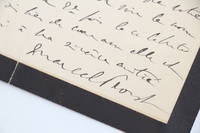
190484876s. l. 1904. Fine. Because I also want success I am extremely material in my wishes for those I love and I wish them every pleasure from the highest to the crudest. s. l. mardi 25 octobre 1904 12.60 x 20.40 cm 12 pages sur 3 bifeuillets Autograph letter signed by Marcel Proust addressed to René Peter. Twelve pages written in black ink on three bifolia framed in black. Tears at the ends along the folds of the bifolia not affecting the text. Published in Kolb IV n°168. A very long letter from Proust full of innuendo to the playwright René Peter. Praising Peter's success Proust confesses to his own vanity as a writer and his literary ambitions. He subtly lets his jealousy for Peter's mistress shine through and declares his absolute devotion to Reynaldo Hahn. This is one of the first letters he sends to his childhood friend after recently reconnecting with him. Proust eternally plagued by ailments remains a recluse and apologizes for missing the rehearsal of Peter's new play Le Chiffon. Peter's three-act comedy with music by Reynaldo Hahn premiered at the Athénée the following month and was a huge success with around sixty performances before the end of the year. The young Proust relies on the glowing opinion of Hahn who had attended the rehearsals and the missive becomes a love letter for the composer and his impeccable judgement: ""Reynaldo told me that your play was delightful and ravishing which is not quite the same thing that he laughed and cried in it as he never laughs or cries in the theater and that the language was exquisite. Of that I was certain. But knowing nothing about you I couldn't know if you had dramatic genius. I am certain of it now because even if I do not know a judge as severe as ridiculously severe as Reynaldo I also do not know one who has more taste giving his enthusiasm very great value in my eyes. In a characteristic tangle of confession and denial Proust barely hides his ambitions and his quest for recognition. He hopes and prays for the same laurels he places on Peter's head: your poor and charming mother who like all those who love and who have lived life bruising all our tenderness has suffered so much is witnessing this great happiness these first rays of glory on your charming forehead which Vauvenargues says softer as the rising sun. I only speak of them in quotations having never known them myself! He will even end up instilling his own literary vocation into the fictional life of the narrator of In Search of Lost Time although the narrator's journey as a man of letters is more marked by disappointments than rays of glory so long awaited by Proust himself. However it culminates in Time Regained with an epiphany: the narrator now knows what to write and above all how to write it. The letter marks the beginnings of the Proust-Peter-Hahn trio whose complicity was such that they formed a special vocabulary of which only they had the secret. The river of words in this letter perfectly illustrates the undeniable link between desire and intellectual admiration: Because I also want success I am extremely material in my wishes for those I love and I wish them every pleasure from the highest to the crudest. Despite these displays of generosity the writer cannot however mask a certain jealousy towards Robert Danceny the fictional co-author of Le Chiffon who was none other than Peter's mistress Mme Dansaërt. Proust elegantly but explicitly refers to her: It makes me happy to think that the charming woman who I am assured is hiding under the male name of your collaborator shares half of your work. I am not talking about your success because whether she worked with you or not she would always have shared your success with her heart having I believe a deep friendship for you. Typical of a Proust transposing his desires through fiction the writer will form various dramatic and morbid scenarios between Peter and this young woman in the following years: I unknown
- s.l. (Vincennes) s.d. (circa 1781), 15,7x20,1cm, une feuille. - SADE Donatien Alphonse François, Marquis de Autograph letter to his wife. Hommages à la Présidente: "Faire noyer vive l'exécrable coquine qui depuis neuf ans [...] suce mon sang..." N. p. [Vincennes Castle] n. d. (circa 1781), 157 x 201 mm (6 3/16 x 7 15/16 "), single leaf "The more I think about it, however, the more I think you have to have quite a nerve to dare write to a poor suffering unfortunate..." Autograph letter unsigned from the Marquis de Sade to his wife. One page, closely written in ink on 31 lines. This letter was written during Sade's imprisonment at Vincennes, probably in April 1781, if one is to believe the occasional indicators of date referenced by the writer. Sade mentions the end of his "exile from Marseilles", referring to the decision of the court in Aix-en-Provence to overturn his conviction for debauchery and libertinage on the 14 July 1778, but which nonetheless banned him from living in or visiting Marseilles for three years. Sade also mentions one of the defining episodes of his life, his flight to Italy between January and November 1776: "they may as well have killed me straight off as left me in that foreign country where I was." Sade also mentions the "amazing favor" that befell him of "moving house", which is to say his potential transfer to the fort at Montélimar. In April 1781, Madame de Sade, through the good offices of her friend Madame de Sorans, got authorization from the King for her husband to be transferred to the prison there. Sade explains in the letter: "I think you have to have quite a nerve to dare write to a poor suffering unfortunate who has been beset these nine years...telling him to thank, ever so humbly, the woman who obtained for him the amazing favor of moving house." Sade is here no doubt referring to the famous Madame de Sorans, a lady of Louis XVI's sister's bedchamber and a friend of his wife's who, out of a spirit of adventure, accepted the task of petitioning the King in his favor. It was to Commissioner Le Noir, referenced in this letter, that Renée-Pélagie left the task of breaking the news to the prisoner: "Ah, I see now what this nice little visit by M. Lenoir means, I'm used to seeing him in the middle of my incarcerations." Despite the fact that, as Pauvert points out in Sade vivant, this change of "house" occupied the Marquis' thoughts to a large extent, he was never actually moved, preferring to stay in the gaols of the keep at Vincennes. At this point, Sade had been imprisoned for several years and this letter, full of movement, reveals his thirst for freedom. This letter was written when Madame de Sade withdrew to the convent at Sainte-Aure. If she saw this act as a liberation from the yoke of her marriage, the Marquis for his part was obsessed by the idea of his own liberation and mentions a potential date: October 1783. His long incarceration, which began in 1777, would last till April 1790, when lettres de cachet were abolished. Madame de Sade's visits were not reauthorized by the prison authorities until 13 July 1781, after four years and five months of separation. Several important themes in Sade's correspondence already appear in this letter from his first years in prison. First of all, his hatred for his mother-in-law, the Présidente de Montreuil, an "execrable wretch who drinks [my] blood...disgraces [her] children, who has not yet done scattering her horrific deeds and platitudes" and whom he would like to "drown alive". The Marquis also complains of his poor physical health: "my head spins and in my condition I hardly need any more misery", using very Sadean epithets to express his despair. "A poor suffering unfortunate who has been beset these nine years"; "what have I done, what have I done dear Lord, to suffer for twelve years?". Provenance: family archives.
- s.n., s.l. 17 août 1780, 10x16cm, 2 pages sur un feuillet. - Handwritten letter to his wife. Sufferance and philosophy: "Punish as much as you like, but do not kill me: I did not deserve it [...] Ah! If you could read to the bottom of my heart, see everything that happens there, I think you would give up using it!" August 17, 1780, 10 x 16 cm, loose leaves Handwritten letter from the Marquis de Sade addressed to his wife. One recto-verso leaf written in fine, tight writing. It has the partial date at the top "ce jeudi 17" "this Thursday 17th." Two slight signs of folding. The end of the letter was mutilated at the time, probably by the prison administration which destroyed the Marquis' licentious correspondence. So, several months later, in March 1781 his wife wrote to him: "My dear, you really must change your style so that your letters can reach me whole. If you give the truth, it offends, turns against you. If you give any untruths, they say: this is an incorrigible man, always with the same head that ferments, ungrateful, false etc. In any case, your style can only harm you. So change it." The letter was found as it was when, in 1948, the Marquis' trunk, that had been sealed by the family since 1814, was open and it was published in this reduced form in the correspondence of the Marquis de Sade. Provenance: family archives. This letter was written on 17 August 1780, during the Marquis' incarceration in Vincennes Prison. Following the umpteenth altercation with the prison guard, the right to go for a walk was taken away from him on 27 June and was not reinstated until 9 March the following year. The Marquis' physical and mental health is strongly affected by not being able to go out and he constantly begs Renée-Pélagie for the right to be quickly reinstated: "I urge you to let me get some fresh air: I absolutely cannot take it any longer." The suffering caused by these deprivations is a pretext for setting up a mechanism of guilt and blackmail with his wife: "There, three days that I have felt an awful dizziness, with blood rushing to my head so much so that I do not know how I have not fainted. One of these days, they will find me dead and you will be responsible, after having warned you as I do and having asked you for the help which I need to avoid it." Here, the Marquis is intentionally pulling on Renée-Pélagie's heartstrings, really putting her Christian values to the test and giving her the role of grand inquisitor: "You can grant me what I ask for, whilst keeping, on your signal, the same strength." We note, as in Tancrède's letter, a new appearance of "signal," which masks completely different semantics. An essential component of the Marquis' prison mindset, this encoded language, like the fantasised interpretations of his correspondents' letters, feeds the theories of researchers, philosophers, mathematicians... and poet biographers. As such, Gilbert Lely estimates that, far from being symptomatic of psychosis, the return to signals is "his psyche's defence reaction, a subconscious struggle against despair where, without the help of such a distraction, his motivation could have declined." Missing from his correspondence during his eleven years of freedom, these enigmatic semantic depths, "a real challenge to semiological judgement" (Lever p.637), reappear in his Charenton diary. This letter is also an opportunity for the Marquis to deploy his rhetorical panel, confronting the sadistic antonyms in the same sentence. "Pleasure" is synonymous with "abominable" "revolting," "cemetery"and "garden" are superimposed, "I suffer" is conjugated as "I enjoy" and "softness" stands alongside "darkness." The mastered practice of this eloquence exercise is united with the depths of Sadian thought: sufferance and pleasure are closely mixed, simultaneously endured, inflicted and desired. Through these associations, we glimpse the sensitive Manicheism of the Marquis's philosophical thought, which reaches its climax at the en
182375940s. d. [ca 1823] | 12 x 18.20 cm | Six pages sur deux feuillets rempliés
195483744Meudon 1954 | 20 x 27 cm | 16 feuillets (9 pour le premier manuscrit + 7 pour le second)
12mo (4), 8vo (20) and 4to (1). 68½ pp. on 6 single leaves and 19 bifolia. All but one to the publisher Maurice Lachâtre (1814-1900), who fled to San Sebastián in Spain after the end of the Paris Commune, many discussing the communards' fate in exile and work on the "Mémorial de la Commune". - 9 letters by Arthur Arnould about his work "Paris et la Commune", several chapters of which he sends to Lachâtre for his "Mémorial": "Je me décide donc à vous envoyer non pas un travail complet, mais seulement quelques chapitres détachés, formant chacun un ensemble [...]" (Luina di Pazzallo près Lugano, 30 Aug. 1875). The others mainly about the proofs for the "Mémorial", but also discussing his state of health, the political situation in France, and his travels. - 2 letters by Armand Adam about the deplorable political situation in France and the journal "Radical": "Si jamais des temps meilleurs nous permettent de reprende à Paris la publication du Radical je serai heureux d'examiner avec vous la proposition que vous avez bien voulu me faire autrefois, et je crois que nous pouvons nous entendre. Mais, ces temps meilleurs, je ne les vois pas proches [...]" (Paris, 14 April 1874). - 2 letters by Eugène Chatelain, one describing his professional situation as a doctor, the other expressing his relief at hearing of Lachâtre's well-being: "J'ai appris à Londres ces jours derniers que vous étiez en Angleterre. Je suis heureux de cette nouvelle, car lorsque je me cachais à Paris après la chute de la Commune [...], on m'avait assuré que vous aviez été fusillé avec quelqu'un de chez vous. Vous êtes vivant, tant mieux! [...]" (Saint Helier, Jersey, 8 Sept. [?] 1872). - 1 by André Alavoine informing him that he is no longer the publisher of the journal "Lanterne", mentioning that he remains in close relations to Henri Rochefort nonetheless: "Je viens de communiquer votre lettre à l'administration de La Lanterne, car il est bon de vous dire que nous ne sommes plus, depuis quelques mois déjà, les éditeurs et imprimeurs de la Lanterne [...] Néanmoins, je suis resté en très-bons rapports avec Rochefort [...]" (Genève, 25 Aug. 1875). On headed stationery of the "Ziegler & Cie" printing house. - 1 by Edmond Adam about the conviction of Gustave Courbet in connection with the destruction of the Colonne Vendôme: "Courbet n'a pas été condamné pour les dommages géneraux commis par la Commune mais pour un dommage particulier, la destruction de la Colonne Vendôme, qui luia été attribué personellement [...]" (Boulevard Poissonnière, 16 July 1874). On stationery with printed address. - 1 by Henri Salles about Lachâtre's offer to Victor Hugo, concerning the employment of amnestied persons: "Vous avez bien voulu offir à Victor Hugo de prendre chez vous quelques amnestiés pour les employer au courtage en librairie [...]" (no place, 17 July 1879). On headed stationery of the "Comité general d'aide aux amnestiés". - 1 by Francis Jourde mentioning Lachâtre's "Mémorial de la Commune", calling it a revolutionary work: "J'ai reçu il y a quelques jours votre Memorial de la Commune; je suis partisan de l'action et du combat, donc, toute oeuvre revolutionnaire est toujours la bienvenue quelles que soient ses tendances et les doctrines qu'elle represente [...]" (Rue du jeu des enfants, 30 June, no year). - 1 by Jean Larocque about his fate after the end of the Commune: "Plus heureux je pus me cacher après le 28 mai, et dans l'hôtel où, peu de jours après, fut arrêté Régère, puis dans une institution des environs de Paris. Manquant de toutes ressources, je me disposais à reparaitre pour chercher du travail [...]" (Leominster, 17 May 1872). - 1 by E. Rajoux about the heavily guarded Swiss border and the articles he can offer for the "Mémorial de la Commune": "La frontière est très surveillée [...] Si je découvre - et je cherche toujours - un moyen de transit quelquonque, je vous en préviendrai. Vous me demandez quelques articles pour le Mémorial de la Commune, j'accède avec plaisir à votre demande [...]" (Yverdon, Sept. 1875). - 1 by Ferdinand Revillon about his fate after the end of the Commune and his former collaboration on Félix Pyat's journal "Le Combat": "J'étais réfugé, le lendemain des derniers massacres de mai 71, chez une personne qui m'offrit asile et chez laquelle je restai pendant plusieurs mois caché [...] j'ai collaboré au journal de Félix Pyat, Le Combat, avant la Commune, tout en exerçant ma carrière de critique musical et de compositeur de musique [...]" (Geneva, 15 April 1876). - 1 by Eugène Protot expressing his dismay at Lachâtre's marriage, which he calls a business union: "A mon avis ce n'est pas un mariage, ce n'est pas même une union libre que vous organisez, mais une espèce de société commerciale [...]" (London, 5 Aug. 1880). - Further letters by Maxime Vuillaume (Altorf, 18 May 1876) and Jules Guesde (Prison de St. Pélagie, 1 Sept. 1889, with two clippings, probably both from his newspaper "L'Égalité"), one each, as well as another letter signed "Georges" (Lyon, 18 May 1876). - 1 letter by Amilcare Cipriani to Henri Oriol (no place, 27 Sept. 1888).
8vo (140 x 190 mm). Ca. 100 ff. with five entries, written on rectos only. Full mottled calf by Hubert & Lerner, Vienna. All edges gilt. Anna Freud's guest book from Hochrotherd in the Vienna Woods, where she and her partner Dorothy Tiffany Burlingham had bought an old farmhouse as a weekend and holiday home in 1930. Several major figures in the psychoanalytic movement signed the book: Sigmund Freud signed the first page, dating his inscription 26 July 1932 (with a three-word sentiment in German: "halb als Papa"). Marie Bonaparte (Princess George of Greece and Denmark), the French author and psychoanalyst, appears to have joined her together with Freud; her inscription bears the same date, and also carries a sentiment thanking the recipient for a good meal. After a hiatus of one leaf, Ernest Jones, Freud's lifelong friend and his biographer, signed the book, dated 24 August 1934, noting that it was "a souvenir of a delightful and eventful experience". - Max Halberstadt, the Hamburg photographer best known for his portraits of Freud, his father-in-law, signed on 2 February 1936: "Via Hochrotherd nach Johannesburg". A few months after this inscription, Halberstadt emigrated to South Africa; his wife and daughter followed him in August 1936. - René Laforgue, the French psychoanalyst, and his wife Paulette, conclude the series with a signature and sentiment (again in German) dated 30 September 1936: "Hier haben wir trotz Winter und Kälte Ruhe und Wärme gefunden" ("Here we have found peace and warmth despite the winter and the cold"). - In 1934, Anna Freud took over the chairmanship of the teaching institute of the Vienna Psychoanalytical Association from Helene Deutsch (who turned her back on Austrofascism the following year and emigrated with her family to the United States) and was also a member of its board. In February 1937, together with Burlingham and Edith Jackson, she opened a day nursery - the Jackson Nursery - on Rudolfsplatz in Vienna, from where the Freuds and Dorothy Burlingham emigrated to London via Paris at Whitsun 1938.
10 volumes, all in original cloth, 5 with original dust jacket. A remarkable private collection of 10 early biographies and works supporting Gandhi, each signed by the author. While Western biographers began to take interest in Gandhi beginning with Romain Roland (1924), this collection includes only association or signed copies of works by Indian authors. Represented here are both those who had followed Gandhi from his earliest political machinations in South Africa, as well as his early followers who subsequently emigrated to America in order to raise public awareness of the Indian Independence movement. In contrast to the author-signed works of Western biographers, which can be encountered in the trade today, works signed by Indian authors of this period are notoriously rare. Includes individually: 1) Muzumdar, Haridas T. Gandhi the Apostle. His Trial and His Message. Chicago: Universal Publishing Co., 1923. Blue cloth. Inscribed "Presented to my good friend Charles E. Sekera by Haridas T. Muzumdar / Evanston, Xmas, 1924". - First edition. An exceptionally early work in support of Gandhi, addressed to American readers to drum up financial and popular support for the Indian Independence movement in the U.S. A close friend and one of the earliest biographers of Gandhi, this was Haridas's first published book, when he was just 24 years old and living in New York City. - 2) Gandhi, Mohandas K. / Muzumdar, Haridas T. (ed.). Sermon on the Sea. Chicago: Universal Publishing Co., 1924. Yellow cloth. Inscribed "To Prof. John E. Kirkpatrick, from his friend Haridas T. Muzumdar / Olivet Conference, Aug. 1925". - First U.S. edition of Gandhi's famous tract, penned in South Africa in 1909 and also known under the title Indian Home Rule or Hind Swaraj. It includes his quotes "One who is free from hatred requires no sword" and "only fair means can produce fair results". This copy was presented by the editor and early Gandhi activist Muzumdar to a fellow American academic, shortly after its publication. - 3) Hossain, Syud. Gandhi. The Saint as Statesman. Los Angeles: Sutton House, 1937. Black cloth, with original dustjacket. Inscribed on flyleaf "With best wishes / Syud Hossain". - First edition. Dr Syud Hossain was instrumental in forging links between American-based Indian nationalists and the Indian National Congress. Co-founder of the National Committee for Indian Independence (headquartered in Washington, DC), Hossain spearheaded the Indian lobby for self-rule from abroad. "Immaculately dressed, polished in manners, brilliant in oratory, Hossain captivated his audiences from coast to coast," said A. K. Mozumdar, a colleague and fellow activist of Hossain. The Los Angeles Times described him as "the most distinguished Indian visitor in America since Tagore" while according to the New York-based Foreign Policy Association, "of the hundreds of speakers who have addressed our conferences during the past five years, none were more brilliant or authoritative than Mr Hossain". In September 1945, Hossain suggested to Jawaharlal Nehru that he return to India to work towards Hindu-Muslim harmony and stand for elections. After consulting Asaf Ali and Gandhi, Nehru cabled back: "Gandhiji thinks you can do more important work in America". Hossain briefly served as India's first ambassador to Egypt, where he died in 1949. - 4) Muzumdar, Haridas T. Gandhi Triumphant! The Inside Story of the Historic Fast. New York: Universal Publishing Co., 1939. Blue cloth. Signed by Muzumdar in Hindi and in English on flyeaf. - First edition. An account of Gandhi's Rajkot Fast to protest the local ruler's refusal to enact administrative reforms in that state. The fast lasted only 3 days, 3-5 March 1939. The work also includes four original articles by Gandhi: "States and the People"; "Rajkot"; "Rajkot and Jaipur"; and "Kicks and Kisses". - 5) Raman, T. A. What does Gandhi Want? New York: Oxford University Press, 1942. Yellow cloth, with original dust-jacket. Inscribed "To Dr. and Mrs. Aldridge, with sincere regard / T. A. Raman", and with a loose letter from Raman dated October, 1942, "Herewith one of the first copies of my book. It is to be published on the 29th. Please let me know what you and Dr. Aldridge think of it. With kindest regards from us both, Sincerely Yours, T. A Raman" on hotel stationery. - First edition. Educated in Madras, Raman was an Indian nationalist who emigrated to become the London editor of the United Press of India. Here, he presents Gandhi's solutions to the World War raging at the time, including remarks on Indian's participation. "Mr. Raman first met Gandhi at Marseilles in 1931 when he joined the Indian leader's staff at the Indian Round Table Conference. Thereafter he was constantly in touch with Gandhi and other Indian leaders, following them to India, where he became a close associate of Gandhi…" (dustjacket). - 6) Prabhu, R. K. & Rao, U. R. The Mind of Mahatma Gandhi. [Madras]: Geoffrey Cumberlege for the Oxford University Press Indian Branch, 1946. Red cloth, with original dustjacket. Inscribed "Mr. Chester Bowles, The American Embassy, New Delhi / With best compliments from U. R. Rao / 30.11.51, Bombay". - Second edition. An outstanding association copy, presented to the American Ambassador to India following Independence. The work is a compilation of select quotations from Gandhi to illustrate his philosophy and thought. Chester Bowles (1901-86) served as ambassador from 1951 to 1953 and enjoyed a privileged relationship with Prime Minister Nehru, who otherwise famously distrusted most U.S. influence. - 7) Shridharani, Krishnalal. The Mahatma and the World. New York: Duell, Sloan & Pearce, 1946. Red cloth with original dustjacket. Inscribed "To Mrs. James B. Pratt, to Edith and to David, my American friends, a parting salute / New York, May 3, 1946" and signed by Shridharani in both English and Hindi. - First edition. Shridharani was arrested and imprisoned in 1930 for protesting the Salt Tax alongside Gandhi, and left India in 1934 to pursue degrees at NYU and then Columbia University. After campaigning for support for Indian Independence in the United States, he returned to India in 1946 where he taught at the Gujarati Sahitya Parishad, and died in 1960 in Delhi. This is an excellent association copy, inscribed to the widow of James Bissett Pratt (1875-1944, an ardent Western admirer of Tagore and an academic advisor of Shridharani), just before Shridharani left New York to return to India. - 8) Imam-ud-Din, S. J. Gandhi and Christianity. Lahore: Northern India Printing & Publishing Co., [1947]. Red cloth. Signed by Imam-Ud-Din on flyleaf. - First edition, rare. The author, aware that much of Gandhi's Western popularity lay in his success appealing to Christian groups, here essentially compares the Mahatma to Jesus Christ. - 9) Murthy, Nadig Krishna. Mahatma Gandhi and other Martyrs of India. Columbia (MO): Journal Press, 1948. Inscribed "With Best Compliments to Mr. H. R. McConnell / Nadig Krishna Murthy / May 29, 1948". Dark blue gilt-embossed cloth, a little stained. - First edition, extremely rare. The only other copy we have traced resides at SOAS in London. Published just following Gandhi's death on January 30th, 1948, the book contains a preface written by Prime Minister Nehru. Briefly resident at the University of Missouri, Murthy returned to India where he made a name for himself as a journalist. - 10) Polak, H. S. L. et al. Mahatma Gandhi. London: Odhams Press, 1949. Blue cloth with original dustjacket. Inscribed "Miss Ruth C. Manchester / With all good wishes & warm appreciation & sincere thanks for your kind hospitality during my short stay in the United States. From Manilal Gandhi, 7/6/49". - First edition, signed by Gandhi's son following his father's assassination. Henry Polak (1882-1959) was Gandhi's closest friend in South Africa, having lived side-by-side with Gandhi and his family from 1903 onwards. Gandhi's second son Manilal (1891-1956) was also close to Polak and succeeded him as editor of Indian Opinion in 1916. Like his father, Manilal was a tireless campaigner and was arrested during the 1930 Salt March. This association copy of Polak's biography was signed by Manilal just a year after his father's death, during Manilal's only visit to the United States - where he sat in at a General Assembly session of the United Nations and met with Albert Einstein. In 1952 Manilal was again arrested in South Africa for protesting Apartheid, spending 38 days in jail at the age of 61.
I: Manuskript von Clara Malraux. 100 Bll., teils beidseitig beschrieben. 4to. - II: Typoskript. 74 Bll., einseitig beschrieben. 4to. - III: Typoskript "Gustav Janouch: Franz Kafka sagte … Erinnerungen und Aufzeichnungen". Prag, 1947. 182 einseitig beschr. Bll. 4to. - IV: Typoskript "Anmerkungen und Erläuterungen". Titel und 19 einseitig beschr. Bll. 4to. Mit zahlreichen Beilagen (s. u.). Die "Gespräche mit Kafka", die der Prager Autor Gustav Janouch nach eigener Angabe 1920 als 17-Jähriger geführt und später aufgezeichnet hatte, erschienen 1951 bei S. Fischer und machten in der Kafkaforschung sogleich Furore. Wie Janouch in der erweiterten Ausgabe 1968 schrieb, kam es schon "sehr bald zu einer französischen, italienischen, schwedischen, amerikanischen, südslawischen, spanischen - ja! - und sogar zu einer japanischen Ausgabe" (S. 7). Das vorliegende Dossier enthält (I) das 100 teils beidseitig beschriebene Blatt umfassende Werkmanuskript von Clara Malraux, die für Calmann-Lévy in Paris die französische Übersetzung besorgte, welche 1952 erscheinen sollte, sowie (II) eine 74 Blatt starke, unvollständige maschinschriftliche Fassung bis Kapitel 60 ("Franz Kafka parle ... Souvenirs et notes"). - Die Anmerkungen in der deutschsprachigen Erstausgabe stammten von Jana Vachovec, der Frau von Janouchs Freund Georg Vachovec, die 1947 unter dem Pseudonym "Alma Urs" von dessen Erinnerungsbuch ein maschinschriftliches Original nebst 2 Durchschlägen (deren einer hier als III vorliegt) angefertigt hatte (S. 13f.). Bei dem hier weiters vorliegenden (IV) deutschsprachigen Typoskript der "Anmerkungen und Erläuterungen" handelt es sich um eine Vorstufe der in der Abschrift enthaltenen "Anmerkungen und Erläuterungen". Die Anmerkungen (in III und IV) folgen in ihrer Numerierung noch Janouchs Unterteilung in Kapitel, während sie im Buch auf Seitenzahl und Zeile verweisen; überdies enthalten sie noch kleine Fehler, die in der Buchausgabe korrigiert wurden (so etwa heißt Otto Pick im Typoskript noch "Oskar", und Brods Gattin Else wurde im Typoskript noch am 21. IX. 1890 und nicht am 21. VIII. 1883 geboren). Umgekehrt finden sich allerdings auch in der Buchausgabe kleine Fehler, die im Typoskript noch korrekt waren: So ist etwa das Geburtsjahr von Felix Weltsch unstrittig 1884 und nicht, wie es in der Buchausgabe heißt, 1889 (Anm. zu S. 23, Zeile 2). - Neben den erwähnten Originalmanuskripten und -typoskripten enthält das Dossier noch eine nicht von Claire Malraux stammende hs. französische Fassung der "Anmerkungen und Erläuterungen" (46 einseitig beschr. Bll.) sowie ein unvollständiges Typoskript davon (24 Bll. inkl. einiger Doubletten), 6 Aufsätze über Kafka aus den 1940er und 1950er Jahren, zahlreiche bis in die 1990er Jahre hineinreichende, meist französische Zeitungsausschnitte zu Kafka und einen eigenh. Brief mit U. von Gustav Janouch an Max Brod (dat. 6. III. 1950, 2 SS. auf Doppelblatt, 8vo; in tschechischer Sprache). - I + II: in gutem Zustand; III: fleckig und merklich lädiert infolge starker Inanspruchnahme (vgl. hierzu die erweiterte Ausgabe S. 14f.). I: Gespräche mit Kafka. Erinnerungen und Aufzeichnungen. Frankfurt a. M., S. Fischer, 1951 (EA). - II: Erweiterte Ausgabe. Ebd., 1968.
Zusammen 225 SS. auf 166 Bll. Verschiedene Formate. Mit zahlreichen Beilagen (Eintrittskarten, Prospekte, Zeitungsausschnitte u. dgl.). Ernst Thost, der Sohn des Malers Rudolf Thost und Vater des Schauspielers Bruno Thost, studierte u. a. bei Erich Wunderlich an der TH Hannover und promovierte 1928 über "Das Klima des nördlichen Württemberg" (Stuttgart, Fleischhauer & Spohn, 1930). Sein ganzes Berufsleben verbrachte Thost als Mitarbeiter der Schwäbischen Sternwarte in Stuttgart, die am 8. Januar 1922 nach einjähriger Bauzeit eingeweiht worden war, und trat 1964 in den Ruhestand. Der vorliegende Splitternachlass enthält überwiegend Korrespondenzen mit verschiedenen Naturwissenschaftlern, darunter als prominentestem Albert Einstein, den Thost im Herbst 1922 wohl in Fragen der Lehrplangestaltung angeschrieben hatte und der ihm unterm 25. V. 1923 antwortete: "Ich bin der Meinung, dass unsere Schulpläne schon all zu sehr materiell überlastet sind, man sollte den Pflichtstoff so viel als möglich verringern, und den [!] Lehrer darüber volle Freiheit lassen, was er ausserdem mit den Schülern betreiben will. Hat so der Lehrer genügend Muse [!], so kann er, wenn es seiner Meinung entspricht, wohl auch den Grundgedanken der Relativitäts-Theorie behandeln natürlich nur in so weit als es ohne Vermehrung des mathematischen Apparates möglich ist". Viele Jahre später hielt Thost noch in einem Gedächtnisprotokoll fest, was ihm bei einem Besuch Einsteins im November 1925 erinnerlich war (1½ SS., um 1950). - Zu den anderen Wissenschaftlern, mit denen Thost korrespondierte und die hier teils mehrfach vertreten sind, zählen u. a. Rudolf Benkendorff, Manfred Bräuhäuser, Heinrich von Ficker, Hugh Ivan Gramatzki, Georg Grimm, Theodor Haering, Sven Hedin, August Kopff, Joseph Plassmann, Adolf Sauer, Karl Schneider-Carius, Albert Schweitzer, Diederich Wattenberg, Kurt Wegener, Max Wolf, Erich Wunderlich, Carl und Hermann Wurster sowie Gustav von Zahn. Weitere Schriftstücke stammen von Malern, Musikern, Schauspielern und Schriftstellern wie Ludwig Anschütz, Peter Bamm, Theodor Esser, Otto Flath, Kai Möller, Asta Nielsen, Willy Reichert, Andrés Segovia und Paul Wegener sowie von zwei Bundespräsidenten, nämlich Theodor Heuss und Heinrich Lübke. - Sehr umfangreich ist die Korrespondenz mit "Elisabeth Wegener V.", wie Wegeners fünfte Gattin und auch Witwe, die Schauspielerin Elisabeth Wegener (geb. Rohwer, 1903-89), gern unterzeichnet: Von ihr finden sich hier 36 Briefe und Karten aus den Jahren 1948 bis 1976, in denen sie so manches über das Leben ihres verstorbenen Gatten Paul, das Theater der Nachkriegsjahre und die Beschwerlichkeiten eines Lebens ohne Pensionsanspruch zu berichten weiß. - Der Brief Einsteins in recht desolatem Zustand (mehrfach mit Klebestreifen auf Trägerpapier montiert), die übrigen Schriftstücke in überwiegend gutem, wenn auch häufig montiertem und arrangiertem Zustand mit zahlreichen Randglossen aus der Hand Thosts.