SAINT EXUPERY (Antoine de).Livre Rare Book

66 592 résultats
1939124898Paris Gallimard 1939 1 vol. relié in-12, cartonnage éditeur de toile bleue avec globe doré sur le premier plat, 218 pp. Deuxième tirage, achevé d'imprimer le 31 mai 1939, trois mois après l'édition originale. Un des 975 exemplaires numérotés sur héliona (Huret, IR/17), comprenant un long et très émouvant envoi où l'on retrouve tout l'esprit de camaraderie dépeint par Saint Exupéry parmi les pilotes de l'Aéropostale : "Pour Monsieur Roger Deveau qui a succédé comme patron de l'aviation civile à Casablanca au héros de la page 30 et qui, au lieu de m'engueuler si méchamment par radio, m'aurait plutôt offert à boire pour me consoler d'une nuit si pénible... En souvenir d'une vieille amitié professionnelle et des parties d'échecs que j'ai la joie de lui avoir gagnées (car je suis mauvais joueur et déteste perdre...). En souvenir enfin de tous les camarades vivants et disparus. Antoine de Saint Exupéry". Quelques légères rousseurs.
4to. ¾ p. With autogr. address. A hitherto unpublished letter to his sister Pauline Périer-Lagrange. On the point of leaving Milan, he invites his sister to wait for him on the way to make the trip with him to Paris. "Mes affaires me rappellent à Paris, ma chère amie. Il est possible que je parte le 12 novembre, mais c'est le 15 au plus tard que je me mettrai en route. Je suppose que tu attendras un moment plus brillant pour faire le voyage de Paris. Cependant, si tu as la possibilité de le faire, je suis d'avis de partir, vu que l'occasion est chauve, comme dit don Japhet d'Arménie. Si tu n'as rien de mieux à faire, rends-toi à Cularo le 15 nov. Tu ne m'y attendras pas: 3 jours au plus. Sinon viens à Bourgoin le 16 ou le 17. J'embrasse tendrement ton mari. Je ne resterai que 20 à 24 h. au plus à Cularo; depuis la mort de notre pauvre grand-père, je n'ai plus de coeur dans cette ville. | Chapuis". - As soon as Stendhal arrived in Paris at the end of November 1813, he was to be charged with the defense of his native city Grenoble, a mission which proved impossible considering the superiority of the coalition forces. Like many high-ranking Napoleonic officials, Stendhal found no place in the strictly diminished government of the Bourbon Restoration under King Louis XVIII, and became a Napoleon's nostalgic and liberal, an oppositionist. He once more went to Milan and became the literary man and writer he is known as.
194556982Un des 700 exemplaires numérotés (n° 312 imprimé pour Henri de S...), préface de Maurice Garçon, 1 vol. in-folio en feuilles sous emboîtage éditeur rigide, Ateliers d'Impressions et de Cartonnages d'Art, s.d. [ 1945 ], 3 ff. et 20 planches en héliogravure
61319o.J. Hamburg, 7. V. 1773, 8°. Zus. 2 Seiten, davon 2/3 S. eigenh..
Small oblong 4to. 1 p. “Im Lebenstheater ist die Freude das große | Ballett, die Liebe die dramatische Idylle, | leider nur in Einem Act; die Ehe wird für | die harmoniereiche Oper gehalten, geht | aber sehr oft in ein ordinäres Spectakel- | Stück über; das Wircken des Menschen | soll sich zum Effect-Drama gestalten, | doch meistens wird nur eine lokale Pos- | se daraus; das große weltbekannte Traum- | spiel ist der Tod”. - Fine, only minimally browned leaf with tiny tear in bottom left margin. - Includes: I: Collector's folder with ms. notes about the writer and stamp of the Werner Eberhard Müller collection, Leipzig. II: Photograph of the artist in the role costume of Blasius Rohr in "Glück, Mißbrauch und Rückkehr oder Das Geheimniß des grauen Hauses" (96:64 mm; photographed by Hermann Klee and published by Neumann, Vienna).
- mercredi 5 novembre [1823], 19,7x29,9cm, une feuille rempliée. - Handwritten letter to "Julie" (Louise de Pron): "I would like to circulate with your blood in my veins and go into your heart, to see if I occupy it entirely" Wednesday 5 November [1823] | 19,7 x 29,9 cm | one double leaf Handwritten dated letter from the painter Eugène Delacroix to the love of his youth, the mysterious "Julie", now identified as being Madame de Pron, by her maiden name Louise du Bois des Cours de La Maisonfort, wife of Louis-Jules Baron Rossignol de Pron and daughter of the Marquis de La Maisonfort, Minister of France in Tuscany, patron of Lamartine and friend of Chateaubriand. 27 lines on a folded leaf. Two marginal tears on the fold of the leaf. Discreet tears to the upper part. Note in pencil from a previous bibliographer on the upper right (« No 11 »). This letter remains one of the last to his lover in private ownership, all of Delacroix's correspondence to Madame de Pron being kept at the J. Paul Getty Research Institute (Los Angeles). It was only transcribed in the Burlington Magazine in September 2009, alongside the long article by Michèle Hanoosh, Bertrand and Lorraine Servois, whose research finally revealed the identity of the famous recipient. "Love me like I love you, as love wants us to love." Writing in the heat of passion, the young Eugène gave free rein to his amorous form in this true epistolary work of art, where desires and memories, romanticism and prosaicness combine, and from which the great pictorial themes of the genius Delacroix emerge. In April 1822, when he presented his first large painting Dante et Virgile aux Enfers, at the Salon, Delacroix discovered Paradise thanks to his meeting with Madame de Pron, mistress of his close friend Charles Soulier who asked him to paint the portrait of her son, Adrien. No one knows if this portrait that has never been found was ever completed, but it served as a pretext for the secret meetings of the two lovers in the studio on rue de Grès. Louise's beauty had been immortalized a few years earlier by the delicate stroke of Élisabeth Vigée-Lebrun, who painted a portrait of her with an oriental hairstyle in a naturally elegant pose. Their adventure lasted a little over a year, but it was one of the most intense passions of the artist's life. He was not, however, the only lover of this astonishing woman, whose alcoholic and violent husband had just been interned at the Royal House of Charenton after being declared insane. Alone, Madame de Pron found comfort in the arms of a group of lovers, including Soulier, a friend of Delacroix, and General de Coëtlosquet, whom she would marry after her divorce was finalized in 1829. These scandalous affairs could, under no pretext, been made public; and Delacroix, in his letters and notebooks, therefore nicknamed his lover "Julie" (in reference to La Nouvelle Héloïse), "J." or "Cara". His discretion was such that even his biographers could not until recently discover the mysterious identity of Delacroix's most burning passion. The future painter of harems from Algiers was himself, therefore, one of Madame de Pron's men. Although he respects his rivals, one of whom is a close friend and the other a future sponsor for whom he will later paint his surprising Nature morte au homard, (Louvre Museum), Delacroix suffers from the polyandry of his mistress, while he himself abandoned Émilie Robert, his lover and model for Scènes du Massacre de Scio. Delacroix's letters bear the mark of "Julie"'s painful inconsistency, and of the precariousness of this mad love for an aristocrat of high lineage, married, mother, twelve years his senior and already promised to her noble and rich cousin. But that is of little importance because "Love [...] is a tyrant: it wants everything, and when it has everything, it wants the impossible." The beauty of the lovers' love letters shares the same perfection of the painter's works; Delacroix multiplies his sketch
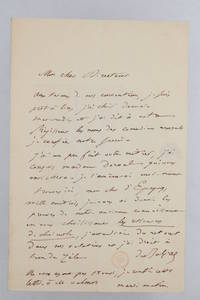
184183639s. l. Passy Paris 1841. Fine. s. l. Passy Paris « mardi matin » 28 décembre 1841 13.50 x 21.60 cm une page sur un double feuillet enveloppe jointe Autograph letter signed by Honoré de Balzac to Jean-Baptiste Violet d'Epagny director of the Odéon theater. One page in black ink on a double sheet. Enclosed and pasted on the second page is the envelope of this letter written in Balzac's hand.""My dear director under the terms of our agreements I am ready to read I have chosen tomorrow Wednesday and I have told your stage manager the names of the actors to whom I entrust our play. I've done a bit of your job I've conquered Madame Dorval who will make you rich I'll bring her myself. Find here my dear d'Épagny a thousand regards I have given you proof of our old acquaintance by choosing you for Les Ressources de Quinola I shall expect a return in our relations and I am entitled to a great deal of zeal."" Les Ressources de Quinola is both in the spirit Les Fourberies de Scapin and Les Noces de Figaro. From the 1840s until his death Balzac's ambition was to achieve a reputation comparable to his illustrious predecessors Molière and Beaumarchais. Although this proved to be a hope as vain as it was determined Balzac never doubted failure after failure that his success was imminent. On July 15 1841 d'Épagny was appointed director of the Odéon . as any theater director would have done in his place he spent summer vacations organizing his winter programme. He asked Balzac for a play and Balzac complied choosing Les Ressources de Quinola. . We all know what a fuss was made about Balzac's play and how childishly naive the author was in filling the room with the highest Parisian society and foreign elite in order to make snobs want to join such a brilliant assembly. . Madame Dorval more astute than the author refused the role intended for her as soon as Balzac read . She did well for one never saw a more complete failure"" L'Amateur d'autographes mai 1911 Interesting letter revealing the beginnings of the creation of Les Ressources de Quinola and the author's habit of reading his play for the actors who then voted to accept or reject it. Provenance: Arthur Meyer collection then ""AGR"" stamp on letter and envelope. unknown
195283726Saint-Jean-Cap-Ferrat 1952. Fine. Saint-Jean-Cap-Ferrat août 1952 20.80 x 34 cm 52 pages Autograph manuscript by Jean Cocteau early version of the poetry collection Appogiatures - published in 1953 by Éditions du Rocher in Monaco - comprising 47 leaves of thick paper taken from a large drawing pad and 5 smaller leaves of thin paper written in blue ink and blue ballpoint pen. Numerous deletions and corrections. The leaves are numbered up to 25 including one number 8 bis and most bear a small cross or the mythical Cocteau star. The last leaf containing the poem titled ""Lettre"" is dated in the poet's hand August 15 1952. Also in Cocteau's hand the first leaf bears the final title above which is crossed out the initially envisaged title - Soucoupes volantes - the date 1952 and the place - St Jean Cap Ferrat; it also features a crossed-out dedication: ""À la mémoire de Baudelaire et de Max Jacob qui nous apprirent ces exercices de style."" While the collection clearly shows the influence of Baudelaire's Petits Poèmes en prose and Max Jacob's Le Cornet à dés this tribute was not retained in the published version and was replaced by a dedication to the publisher Henri Parisot. An exceptional ensemble containing 33 of the 51 published poems 11 texts rejected on the advice of publisher Henri Parisot and published in ""En marge d'Appogiatures"" uvres poétiques complètes de la Pléiade pp. 818-831 and 6 unpublished texts. David Gullentops in the edition of Jean Cocteau's uvres poétiques complètes in the Pléiade notes the existence of a second set of manuscripts and typescripts preserved at the Bibliothèque Historique de la Ville de Paris BHVP. He further indicates that he had access to no manuscript of the poem ""Lanterne sourde."" Yet this poem is indeed part of our ensemble which would thus be the first version of the collection envisioned by Cocteau. Jean Cocteau began writing this collection of poems in verse and prose commissioned by his friend the publisher Henri Parisot at the end of July 1952 while staying at Saint-Jean-Cap-Ferrat in Francine Weisweiller's Villa Santo-Sospir. The first version of the collection was completed in mid-August as attested by the two dates on our manuscript ""août 1952"" and ""15 août 1952"" and this entry in Cocteau's diary: ""J'ai terminé la mise au point des courts poèmes en prose pour Parisot. Il y en aura vingt-six à moins que le mécanisme continue ce que je ne souhaite pas car à la longue ces exercices d'écriture illustrés par Baudelaire et Max Jacob fatiguent."" Le Passé défini Tome 1 1951-1952 August 14 1952. Our ensemble would thus be a mixture of the first poems sent to Henri Parisot written with a pen and several added texts written with a ballpoint pen. This hypothesis is supported by the writing of the final title Appogiatures on the title page of our manuscript; Cocteau relates this change again in his diary dated August 29 1952: ""Ai . classé les poèmes pour Parisot sous le titre : Appogiatures."" Our early manuscript version contains significant variants concerning the titles of the poems; thus the poem ""Livre de bord"" was initially titled ""Le Spectacle"" likewise for ""Au poil"" for which Cocteau had previously chosen ""La langue française"" or ""Le tableau noir"" originally titled ""Le lièvre et la tortue."" The order of the poems was also considerably modified for printing: our ensemble shows that Cocteau wished to begin the collection with ""Le voyageur"" which would finally be replaced by ""Seul"" and moved to second position. Also noteworthy in our dossier is the presence of eight poems entirely in verse: these would be removed Appogiatures becoming a collection exclusively in prose. The ensemble heavily deleted and corrected also presents long passages suppressed in the published version for example this very beautiful extract from the poem ""Scène de ménage"" evoking the ""countess"" Francine Weisweiller: ""Et les larmes de la comtesse se disaient : nous sommes la mer. Et la mer se unknown
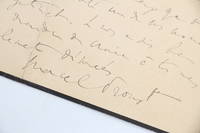
190886094s. l. 1908. Fine. Proust and the future of pastiche: ""it seems to me that it could perhaps become a more discreet more fragile and more elegant form of literary criticism"" s. l. s. d. 1908 ou 1919 11.60 x 17.80 cm 4 pages sur un feuillet remplié Autograph letter signed by Marcel Proust to his friend Maurice de Fleury a psychiatrist and famed man of letters close to Émile Zola who wrote a collection of short stories as well as various medical works on neurasthenia insomnia epilepsy Chiara Carraro Philip Kolb. Four pages written in black on a bifolium with ""Island Mill"" watermark and framed in black. Usual traces of folds. Published in Kolb VIII no. 32 p. 74-75. Superb letter extolling the merits of literary pastiche by one of the greatest writers of the genre: Marcel Proust. The writing of this letter may coincide with the publication of Proust's series of pastiches on the Lemoine Affair a scam set up by a French engineer of that name who claimed to be able to make genuine diamonds. The articles were printed on the front page of the literary supplement of 'Le Figaro' between 1908 and 1909 or date from its publication in volume under the title 'Pastiches et mélanges' in 1919. The autograph letter is presented in a midnight blue half morocco chemise with marbled paper boards beige suede lined pastedowns and a slipcase edged with the same morocco. Proust warmly thanks his correspondent Maurice de Fleury whom he describes as a ""scholar and writer"" for his favorable reception of his ""little pastiches"": ""Your double merit should make you doubly severe: and you excuse pastiche that inferior genre!"" Votre double mérite devrait vous rendre doublement sévère : et vous excusez le pastiche ce genre inférieur ! acknowledging with irony the still precarious place of this unusual genre although popular during Proust's lifetime. Pastiche was perceived more as a stylistic musing or even a student exercise than a true creation worthy of literary praise. Yet here the writer considers it here a refreshing addition to the strict hierarchy of genres that still prevailed: ""Handled however by your hands more beautiful than mine it seems to me that it could perhaps become a more discreet more fragile and more elegant form of literary criticism. Very proud minds could devote themselves to it and very fine minds like yours very attached to greatness seriousness duty as wise could take pleasure in it and follow these games."" Manié pourtant par vos mains plus belles que les miennes il me semble qu'il pourrait peut-être devenir comme une forme indirecte plus discrète plus frêle et plus élégante de critique littéraire. Des esprits très fiers pourraient s'y adonner et des esprits très fins. comme le vôtre très attraché par la grandeur le sérieux le devoir aussi sage pourrait s'y plaire suivre ces jeux. With these words Proust asserts the interest of 'critical pastiche' which was already well established and acted as an empirical analysis of an author's style. Since his years as a student in Condorcet the writer had regularly indulged in this activity with according to him varying degrees of success: ""I have also sometimes made pastiches of medical literature! these writings are now lost If I could have found them again or started them again but all that is too far away I would have published them if I had known that you read this for fun. I don't need to tell you that considered inimitable you are not among the authors I pastiched. But . others are less perfect and combined some very interesting qualities with small flaws that could be imitated and caricatured."" J'ai été aussi quelques fois à faire des pastiches de littérature médicale ! Si j'avais pu les retrouver ou les recommencer mais tout cela est trop loin je les aurais publiés si j'avais su que vous lisiez cela pour vous amuser. Je n'ai pas besoin de vous dire que jugé inimitable vous n'y figurez pas. Mais . d'autres sont moins parf hardcover
- Mercure de France, Paris 1904, 12x19cm, relié sous étui. - First edition of the French translation by Marcel Proust, a first impression copy numbered in the press. Contemporary Bradel binding in half cloth, covers preserved, chemise-slipcase in morocco signed by P. Goy & C. Vilaine. Handsome autograph inscription from the author to his young frien, the writer Max Daireaux. [FRENCH VERSION FOLLOWS] Edition originale de la traduction française établie par Marcel Proust, un des exemplaires de première émission numérotés à la presse. Reliure à la bradel en demi percaline indigo, dos lisse orné d'un motif floral doré, double filet en queue, pièce de titre de chagrin rouge, plats de papier marbré, couvertures conservées, reliure de l'époque; chemise-étui en plein maroquin noir, dos lisse, date dorée en queue, intérieur de daim bleu marine, chemise-étui signée de P. Goy & C. Vilaine. Précieux envoi autographe de l'auteur à son jeune ami écrivain Max Daireaux. S'il a bien connu la famille Daireaux à Neuilly ce n'est qu'en 1908 à leur retour de Buenos Aires que Proust se lie d'amitié avec le jeune Max, de treize ans son cadet. Ils entretiendront, pendant plusieurs années, une importante correspondance essentiellement littéraire. On note ainsi que la première lettre de Proust à ce nouvel ami, écrite en septembre 1908 sous forme de poème dédicatoire, est jointe à un exemplaire des Plaisirs et les jours. Plus tard, Proust appuiera la publication des écrits de son protégé dans le Figaro et, en 1913, sollicitera ses lumières scientifiques lors de la correction de son manuscrit de la Recherche. Il lui soulignera à cette occasion qu'il a utilisé dans "Les Jeunes filles" une anecdote survenue chez les Daireaux: " Il n'y a (dans le second volume) qu'un seul mot bête et il a été dit par moi chez vous..." (lettre du 19 juin 1913).
117 Blatt, davon etliche leer, etwa 12 Blatt alt entfernt. Brauner Original-Lederband (beschabt, Rücken mit kleinen Fehlstellen, Innengelenke gebrochen) mit überaus reicher Rücken- und Deckelvergoldung sowie Buntpapiervorsätzen und Goldschnitt, Innendeckel mit gekröntem Monogramm "J. G. S." und der Jahreszahl 1751. Qu.-8vo (185:125 mm). Stammbuch von Johann Georg Schlupper aus Münchberg, in verschiedenen Diensten des Markgrafen von Bayreuth. Als bemerkenswerteste Beiträger dieses rund 100 Einträge umfassenden Albums sind die drei Kleinknecht-Brüder zu erwähnen, die sich allesamt in Bayreuth und darüber hinaus als Musiker einen Namen gemacht haben. Allen voran Jacob Friedrich Kleinknecht (1722-94), der sich hier mit einer kleinen Notenhandschrift verewigt hat (dat. Bayreuth, 3. IV. 1757). Kleinknecht wurde 1743 Flötist, später Violinist der Bayreuther Hofkapelle. 1748 erschienen erste Kompositionen von ihm im Druck, später wurde er Hofkomponist und 1764 Musikdirektor der Bayreuther Hofkapelle. Auch seine beiden Brüder Johann Wolfgang Kleinknecht (1715-86) und Johann Stephan Kleinknecht (1731-1806), ebenfalls Musiker an den Höfen von Bayreuth und Ansbach, lieferten jeweils einen Eintrag (ebenfalls 1757). Des weiteren sind zu nennen: Johann Adam Ludwig Wezel (1736-1808), Hofmeister zu Bayreuth, Bibliothekar zu Ansbach; Gottlieb Friedrich Wilhelm Wezel (1738 - nach 1800), kgl. Preußischer Kriegsrat, Kammersekretär zu Bayreuth; Johann Daniel Wezel, Justiz- und Polizeidirektor zu Aisch; Johann Andreas Lübeck (1723-82), Verlagsbuchhändler in Bayreuth; Ferdinand Heinrich Frenzel (1723-64), Pfarrer zu Weißdorf und Schriftsteller; Andreas Nicolaus Funk (1699-1758), Pfarrer in Ahrenberg; Georg Wolfgang Fischer, Postbeamter in Bayreuth; Johann Benedict Scholler, Militär, Stadt- und Landphysikus in Bayreuth; Johann Wilhelm Hofmann, Kammerkanzlist und Kopist zu Bayreuth. - Mitunter leicht gebräunt und fleckig, teils leicht gelockert. Höchst interessantes Forschungsobjekt zur Geschichte des Bayreuther Hofes mit Notenautograph von Jacob Friedrich Kleinknecht.
Oblong 8vo (197 x 114 mm). French and German manuscript on paper. 41 ff. with 12 entries. Includes 13 watercolour drawings, 6 ink and ink wash drawings, 5 pencil drawings, 1 gouache and 1 embroidery. Contemporary giltstamped full brown calf with ornamented brass clasp and bosses to the corners and centres of both covers, the centre bosses inscribed with "Souvenir" (front) and the monogram "CL" (back). With light blue leather end papers. All edges gilt. Remarkable friendship album kept by Clara Lafontaine, daughter of Pierre François Lafontaine, a French emigrant in St Petersburg and officer in the service of the Tsars. Clara’s brother Jean Baptiste Joseph Lafontaine (1796-1859) returned to France in 1802/03 and became successful as a playwright under the pen-name W. Lafontaine. - The family was associated with bourgeois expatriates in Russia as well as with the local bourgeoisie and aristocracy. Three entries stem from members of the princely Trubetskoy family. With some degree of certainty they can be identified with Sofia Andreevna Trubetskaya (1796-1848) and her children Sergey Vasilyevich Trubetskoy (1814-59) and Maria Trubetskoy (1819-95). Additionally, a beautiful loosely inserted gouache showing a tulip and other flowers is inscribed: "Given by the princess Marie Trubetskoy". Sergey Vasilyevich, who became a cavalry lieutenant and was the legal father of the famous princess Sofia Sergeyevna Trubetskaya, purportedly an illegitimate child of Tsar Nicholas I, enriched his sentimental entry with a swan feather. - The first entry in the book can be attributed to Franz Ludwig von Wissell (1797-1853), who served in the Hanoverian army and rose to the rank of an Lieutenant Colonel. Wissell’s entry is followed by five pages of watercolours, one on blue paper, all by the same hand. The drawings of a man in Persian costume, of an English bulldog, a ruin at night, a remarkable and charming Cupid with bow and arrow in Russian costume, and an infantryman in a blue and white uniform are all inscribed “Meurville” or “Meurville ainé"; while they are of high quality, the artist remains unidentified. - The following entry, a long, humorous narrative describing a friendship book containing rather abortive entries, can with some likelihood be ascribed to the French educator Jean François Antoine Cournand (1797-1842), who lived in St Petersburg with his family and is the father of the pianist and last Chopin student Marie Roubaud de Cournand. An entry by one "Catinka" or Catherine Ratouin from 25 August 1825, apparently the day she left St Petersburg for France, seems to be connected to the previous entry, as it is followed by a watercolour drawing and a washed pencil caricature which are both signed by Courand. A particularly charming, anonymous watercolour drawing on one of the following pages shows a horse-drawn sleigh with two people. The page is marked by a pressed shamrock. - Both Gotthard J. Fehst (29 March 1829) and Adolph Vincent Martinsen (10 June 1830) are members of prestigious bourgeois families from Reval (now Tallinn) who left their entries in Clara Lafontaine’s book. Fehst or another family member also contributed a small pencil drawing of Roman ruins on blue paper. The page containing Fehst's entry is loose, with another ink drawing of a bird-hunting scene signed by "Meurville ainé" on the verso. The only German entry "Je schmerzlicher die Trennung / Je freudiger das Wiedersehen", dated 22 July 1830, remains unidentified. - Carla Lafontaine’s young nieces Sophie and Camille wrote charming entries on 26 April 1832 in St Petersburg. While the six-year-old Sophie left mostly scribbles, Camille expresses her sadness about the geographical distance between her and her beloved aunt: "Ma bonne tante je te regrette de tout mon cœur et t’aime de même, pense souvent à ta petite nièce". The final entry can be attributed to the German-British merchant Franz Heinrich Hermann Overbeck (1804-88), father of the theologian Franz Overbeck (1837-1905) who would become known as a close friend of Friedrich Nietzsche. The final two drawings in the album are probably the most striking ones: a pencil sketch of a hound and a washed ink drawing of another hound, both by the same hand. Intriguingly, the pencil sketch is signed "Lagrénée": both Louis Jean François Lagrenée and his younger brother Jean-Jacques were French painters briefly active in St Petersburg, but they died well before the album was started. However, Louis-Jean's son Anthelme-François Lagrénée (1774-1832) followed in his father’s footsteps and spent time in St Petersburg during the 1820s in the service of Tsar Alexander I. As the two drawings are pasted into the album and are of a quality suggesting a trained artist, they may well be the work of Anthelme-François Lagrenée. - Leather somewhat chafed, interior showing some brownstains and browning to the margins, but well preserved.
Deutsche, lateinische und französische Handschrift auf Papier. 90 Bll. mit ca. 90 Einträgen, 3 Aquarellen und einer Silhouette. Lose in grüner Pappmappe der Zeit mit Rückenvergoldung, aufgeklebtem Rückentitel "Pro Memoria", goldener Deckelbordüre, goldgeprägtem Monogramm "G TH B 1790" und Goldschnitt. Außergewöhnlich hübsches Album amicorum, das durch oft sehr persönliche Einträge enger Freundinnen und Freunde des Besitzers sowie durch schöne Kalligraphie besticht. Der 1771 geborene Georg Thomas Bach besuchte die Realschule seiner Heimatstadt Nürtingen, wo er später selbst lehren sollte, und setzte seine Ausbildung wohl in Stuttgart oder Nürnberg fort. Das Stammbuch lässt nicht auf ein studentisches Milieu schließen; die Einträge stammen zumeist von evangelischen Pfarrern, Vikaren und Pädagogen. Neben zahlreichen württembergischen Kleinstädten besuchte Bach auch Altona, Frankfurt am Main und Göttingen. - In Nürtingen trug sich der Begründer der dortigen Realschule Jakob Friederich Klemm (1733-93) ein, dem auch die Einführung des von John Spilsbury um 1760 erfundenen Puzzles in Deutschland zugeschrieben wird, ferner der erste Realschullehrer (und damit ein Amtsvorgänger Bachs) Georg Friedrich Ettensberger (1756-1824), der Verwaltungsbeamte Karl Christoph Friedrich Gock (1776-1849), Friedrich Hölderlins Halbbruder, sowie Nathaniel Köstlin (1744-1826), Diakon und Privatlehrer Hölderlins. Bachs Mutter Veronika Dorothea verabschiedet ihren Sohn mit einem Psalmenzitat und den Worten: "Diese Lehre gibt dir mit auf den Weg deine dich liebende Mutter". - In Stuttgart verewigte sich Konrad Friedrich Schüle (1771-1833), Gesellschafter des Textilunternehmens Kolb & Schüle, im nahegelegenen Grafenberg Christian Gottlob Pregizer, der spätere Stadtpfarrer von Haiterbach und Namensgeber der radikalpietistischen "Pregizer-Gemeinschaft". Mit Christoph Friedrich Cuhorst (1727-93), Johann Immanuel Friedrich Schmid (1756-1821) und Johann Christian Zügel (1723-95) sind auch die Pfarrer von Unternsingen, Bickelsberg und Ditzingen im Stammbuch vertreten. Christoph Ludwig Flattich (1756-1822) stand seinem Vater, dem bedeutenden evangelischen Pädagogen Johann Friedrich Flattich, als Vikar in Münchingen zur Seite, als er seinen Eintrag verfasste; später wirkte Flattich als Pastor in Suppingen. Am 14. Juni 1790 trug sich Johann Ludwig Mannhardt (1749-1816) ein, Klosterhofmeister in Maulbronn und Bruder des bedeutenden Theologen Johann Wilhelm Mannhardt. - In Altona traf Bach 1791 auf Hinrich van der Smissen (1742-1814), Enkel des gleichnamigen berühmten mennonitischen Unternehmers und Reeders, sowie auf zwei weitere Mitglieder der Familie und den niederländischen Botaniker George Voorhelm Schneevoogt (1775-1850) in jüngsten Jahren. Interessant sind auch zwei 1794 entstandene Einträge aus Nürnberg: zum einen der des Spezereienhändlers Johann Christoph Karg (1733-1806), ein enger Freund und Briefpartner Lavaters, zum anderen der von Georg Michael Eisenbach (1728-1804), der 1783, zwei Jahre nach Erlass des Toleranzpatents Josephs II., erster Pastor von Eferding in Oberösterreich wurde. Wie bereits in früheren Positionen geriet Eisenach mit den Kirchenobrigkeiten in Konflikt und wurde 1788 aus Österreich ausgewiesen, woraufhin er sich als Privatlehrer in Nürnberg niederließ. - Ein Mitglied der Familie van der Smissen ergänzte seinen auch kalligraphisch herausragenden Eintrag um ein kleines Aquarell der Zwei-Wege-Metapher. Der Eintrag eines Christian Gottfried Hellfeld in Schleusingen ist verso um ein hübsches kleines Emblem mit französischem Motto ("Vivre pour mourir et mourir pour vivre") bereichert. Louise Huzelin, Tochter des Schnaitheimer Pastors Ludwig Christoph Huzelin (1725-83), begegnet uns auch als Silhouette. Ein besonders schönes Aquarell, das eine Ideallandschaft mit phantastischen Blumenornamenten zeigt, lässt sich keinem Beitrag zuordnen. Zuletzt können auch die besonders intimen Zeilen einer Maria Bach hervorgehoben werden. Der ursprüngliche Eintrag vom 22. April 1830 wurde verso zweifach ergänzt: "Wer wünscht so viel zu ihrem Glück / Als die welche dieses schreibt / O denken sie recht oft zurück" sowie "Fält [!] Ihnen dieses Blätchen in die Hände so erinnern Sie sich an den froh verlebten Abend im Juli 1843 und denken sie auch zuweilen in müssigen Stunden an [...]". - Einband minimal bestoßen. Die Seiten von Sammlerhand in Blei numeriert, teilweise minimal fleckig und angestaubt, mit vereinzelten kleinen Einrissen und Knicken.
Deutsche, lateinische, griechische, niederländische, französische, italienische, arabische, hebräische und englische Handschrift auf Papier. Titel, 1 w. Bl., 538 (statt 548) teils w. SS., 3 Bll. reg., SS. 549-557, mit 163 Einträgen. Lederband der Zeit mit reicher Rückenvergoldung, goldgepr. Deckelbordüre, Goldschnitt und patroniertem Brokatpapiervorsatz. Qu.-4to (214 x 175 mm). Die meist sorgfältig und gut leserlich geschriebenen Einträge im Stammbuch des jung verstorbenen Erlanger Theologen Scheler (1733-60) stammen überwiegend von Coburger, Erlanger und Leipziger Kommilitonen und Professoren (meist Theologen, aber auch Archäologen, Historiker, Mediziner und Naturwissenschaftler) wie Johann Sebastian Albrecht (1695-1774), Johann Christian Arnold (1724-65), Johann Christoph Georg Bodenschatz (1717-97), Christian Friedrich Börner (1683-1753), Johann Andreas Buttstedt (1701-65), Johann Friedrich Christ (1701-56), Christian August Crusius (1715-75), Heinrich Wolfgang Fratzscher (1694-1757), Johann Christian Hebenstreit (1686-1756), Kaspar Jakob Huth (1711-60), Abraham Gotthelf Kästner (1719-1800), Johann Erhard Kapp (1696-1756), Erdmann Rudolph Fischer (1687-1776), Jean-Jacques Meynier (1710-83), Philipp Ludwig Statius Müller (1725-76), Matthias Georg Pfann (1719-62), Joachim Ehrenfried Pfeiffer (1709-87), Adam Rudolph Solger (1693-1770), Johann Christian Stemler (1701-73), Johann Ernst Basilius Wiedeburg (1733-89), Johann Samuel Wiesner (1723-80), Christian Ernst v. Windheim (1722-66) und Karl Christian Woog (1714-71); ferner von verschiedenen Familienmitgliedern sowie: Bartenstein, Beulwitz, Brenner, Briegleb, Ehrenberger, Ernesti, Eyring, Frobenius, Frommann, Goebel, Happach, Kessel, Linck, Marschall, Pfeiffer, Pfündel, Reutlinger, Rossmann, Sauerteig, Sayn-Wittgenstein-Hohenstein, Seckendorff, Slevogt, Speßhardt, Stein, Tabor, Uz, Winkler v. Mohrenfels, Zerbst u. v. m. Auf S. 449 ein Eintrag des Fabeldichters und Moralphilosophen Christian Fürchtegott Gellert (1715-69), datiert Leipzig, Oktober 1752, auf S. 521 ein undatierter Eintrag des Künstlers Johann Heinrich Meil (1730-1820), der auch Gellerts Fabeln illustrierte. Am Schluss ein Register. Die 1769-72 datierten Einträge auf SS. 303-311 gelten einem nicht genannten Nachfahren des 1760 verstorbenen ersten Eigners. 123 der paginierten Bll. sind unbeschrieben. Es fehlen die SS. 61f., 279f., 483f., 515f. und 519f. Gering gebräunt, kaum stockfleckig. Anfangs mit kl. Randmängeln. Der dekorative Einband leicht berieben, vorderes Gelenk unten mit kleinen Wurmspuren, vorderes Vorsatzblatt mit Knickspur. Farblithogr. Exlibris "Scheler" von Lorenz M. Rheude (Schutt-Kehm 38.202).
Qu.-4to (206 x 142 mm). Meist deutsche und französische sowie lateinische und selten griechische Handschrift auf Papier. Ca. 300 Einträge auf zus. 428 SS.: 1-18, 21-52, 55-84, 87-88, 93-222, 225-252, 255-306, 309-318, 321-358, 361-368, 371-402, 405-431, (15, mit Namensregister) SS. (davon 67 SS. weiß und 43 SS. mit dem Wörtchen "belegt"). Mit 3 montierten Gouachen auf festerem Papier und hs. Paginierung. Marmorierter Lederband der Zeit mit floraler und ornamentaler goldgepr. Rückenverzierung, die Deckel mit goldgepr. breiten Bordüren, vorn mit Monogramm "P.E.C.", rückseitig mit Jahreszahl "1773. Kleisterpapiervorsätze nach Herrnhuter Art und dreiseitigem Goldschnitt. In Pappschuber der Zeit. Sehr umfangreiches, wichtiges Jenaer Studentenstammbuch, illustriert mit drei sorgfältig ausgeführten Gouachen. Das von "Freund und Bruder" G. Fr. Hoechstetter "A. S. C. Windshemio" dem Eigner zugedachte Album enthält eine große Zahl aus ganz Deutschland, von Waldeck bis Lübeck, stammenden Einträgen, meist zum Thema Freundschaft und Liebe, wie jener eines gewissen A. J. P. Weis: "Seit die Götter mir ein Mädchen gaben / Muß ich ganz und gar vergehn, / Seh ich es, vor Zärtlichkeit, / Seh ichs nicht, vor Herzeleid. / Ewig wünscht ich es zu sehen, / Oder nie gesehn zu haben [...]" (S. 35). In weitere Beiträgen vertreten sind: der Silhouetteur Johann Friedrich Anthing, Johann Christoph Bezold, Biedenweg, K. L. Birkel von Buchwaldt aus Hollstein, Fr. Buddeus, J. L. Cramer, D. Cruse, Karl Baron Eckbrecht von Dürckheim (pfälzisch-elsässischer Uradel), Karl Friedrich Eichhorn, der Theologe Johann Philipp Gabler (1753-1826), Johann Paul Ludwig Gehring, der protestantische Theologe Martin Hamaliar, G. G. Harder, Johann Christoph Hartung aus der Grafschaft Limburg, L. W. J. Hülshoff, Bernhard Gottlieb Huldreich von Hellfeld (1759-1788), der Moralphilosoph und Aufklärer Justus Christian Hennings (1731-1815), J. P. von Hinckeley, G. F. B. Höchstetter, C. L. Jacobi, der spätere Sachsen-Coburgische Landschaftsdirektor Christian Ferdinand Frh. von Könitz, der Mediziner Christian Loeber, Georg Marienburg, J. F. Meermann, A. Ch. Niehaus, G. Ohmstede, C. C. von der Osten ("Hannoveranus"), Wilhelm Pollich, F. W. von Prangen, Christian. Jakob Rambusch, Leberecht von Rath, der Jurist und Syndikus der Universität sowie Hofgerichtsrat und Professor der Rechte Johann August Reichardt (1741-1808), L. L. Ribbentrop aus der Grafschaft Lippe, J. Fr. Rosenbusch, "V. H. Salfeldt de Quedlinbourg", der Rechtswissenschaftler Heinrich Gottfried Scheidemantel, H. C. A. von Schoenfels, F. C. Severin aus Waldeck, Johann Ernst Simler, Michael Stephan aus Siebenbürgen, Julius Dietrich Tannen (studierte 1770-74 in Jena), der Rhetoriker und Philologe sowie Geologe Johann Ernst Immanuel Walch (1725-78), der Rektor der Universität Karl Friedrich Walch, der Quedlinburger Theologe und später in Halle (Saale) tätige Georg Christian Westphal (1752-1808), F. v. Witzleben, J. W. Wunderlich, Karl Anton Friedrich von Wurmb, "C. G. Baron de Zschock" u. v. m. - Die Gouachen zeigen eine allegorische Titelillustration in reichem Rocaille-Rahmen, dann eine Darstellung mit einer schönen allegorischen Frauenfigur (Venus) in weiter Landschaft und zum Schluss eine anzügliche Illustration mit einem Mönch und einer Nonne beim innigen Beichten mit dem Spruch "Solus cum Sola non praesumitur orare Pater noster" ("Wenn 'Er' und 'Sie' allein sitzen, beten sie kein Vaterunser") und der Übertitelung "Vollkommner Ablaß". - Teilweise leicht tintenfleckig, frisch und gut erhalten. Am Gegenblatt zum Titel der hs. Eintrag "Secretär Clausing lebte und starb in Großvater [...]'s Hause. Bemerkung von August Krohn". Ein Eintrag kopfüberstehend. Der Einband etwas beschabt und berieben, der Schuber stärker berieben.
Large oblong 8vo. 43 ff. in carmine red velvet cassette with four gilt brass fittings and moirée satin endpapers. All edges gilt; red calf spine. The 33 entries, some written on the album leaf, others in letters or separate sheets of paper mounted within the album, are by the poets and playwrights Eduard von Bauernfeld, Ignaz Franz Castelli, Franz Grillparzer ("Was man den Kindern thut / Ist doppelt gut; / Weil im Erfolg, den Jeder sieht / Man ihre Ältern miterzieht"), Friedrich Halm (i. e. Baron Münch-Bellinghausen), Paul Maria Lacroma, Heinrich Laube, Betty Paoli, Otto Prechtler and Moritz Gottlieb Saphir; the scholars Helene von Druskowitz, Carl Helm, Ernst Pauer and Johann Emanuel Veith; the composer J. Hoven (i. e. Johann Vesque von Püttlingen: five-bar muscial quotation with the text: "und wäre nicht das Bißchen Liebe, so gäb' es nirgends einen Halt"); the singers Alois Ander and Emil Götze; the actors and actresses Marie Bayer-Bürck, Carl and Elisabeth Fichtner, Amalie Haizinger, Stella Hohenfels, Carl von La Roche, Carl Lucas, Louise Neumann, Carl and Julie Rettich, Mathilde Wildauer, Charlotte Wolter and Zerline Würzburg (wife of Ludwig Gabillon) and the dancer Fanny Elßler (fragment). A signature by Emperor Franz Joseph is mounted into the album. The pretty collection is topped off by a watercolour (signed Franz Steinfeld) and an oil landscape (signed "J. W.", corners broken). - Includes an ALS by Ignaz Franz Castelli (dated Vienna, 25 March 1864).
4to (196 x 244 mm). 40 ff. (some blank) containing ca. 90 entries by writers, musicians, and actors, as well as by family members, teachers, and classmates. Original navy leather with gilt cover borders. All edges gilt. A fine document of a young autograph collector's passion for the world of the stage, and of the Viennese "World of Yesterday" described by Stefan Zweig, remarkable for its surprising number of eminent contributors. - Alice Wagner, born in Zadar, Croatia (then under Austrian rule) eight days before the assassination of Archduke Franz Ferdinand in Sarajevo, was the daughter of the mechanical engineer Rudolf Wagner and his wife Anna; she spent her childhood in Vienna's middle-class 9th district. The earliest contributors to her album - apparently a gift for her 11th birthday - are her teachers, school friends, and relatives, and after gathering a dozen of such entries between 1925 and 1929, her interest in her collection appears to have waned. Yet after a hiatus of a year, now aged nearly seventeen, Alice finds a new use for the navy-blue volume: clearly a devotee of the theatre and opera, she turns to pursuing the signatures of the great performers and writers of the stage. In 1931 she obtains the signatures of singers Käthe Dorsch and Hans-Heinz Bollmann, as well as of playwrights Anton Wildgans and of Christa Winsloe, who recommends to her young admirer the movie version of her play, "Mädchen in Uniform" (ignoring the age restriction passed on the then-notorious film). - In the year 1932 alone Alice gathers no fewer than 37 dated contributions, which include internationally prominent writers such as Thomas Mann, Ernst Toller, Erich Kästner, and Jakob Wassermann, but also Viennese celebrities such as Stefan Zweig, Felix Braun, Felix Salten, Richard Beer-Hofmann, Max Mell, Franz Theodor Csokor, Ernst Lothar, Franz Lehár, Robert Stolz, Hans Moser, Otto Tressler, and even the physician Julius Wagner-Jauregg. The most peculiar entry is that by the satirist Alexander Roda Roda, who - long a happily married man, first by common-law and then legally - signs himself as the 18-year-old Alice's "fiancé" on August 4th, at 7:27 p.m. precisely. Underneath this tongue-in-cheek inscription the cabaret artist Fritz Grünbaum adds his own name on 28 April 1933, whimsically appointing himself "best man"; and underneath his entry, the actor Paul Morgan adds his own name on 10 October 1933. Further contributors of the years 1933/34 include Max Brod, Arnold Zweig, Attila Hörbiger, Tilla Durieux, Oskar Maria Graf, and Paula Wessely; undated entries include Ernst Deutsch and Max Pallenberg, Bruno Walter, Karl Schönherr, and Ferdinand Bruckner. - Contributions dry up after 1934, possibly reflecting as much the now 21-year-old Alice's changing interests as the increasing political constraints on Viennese culture, first under Austro-fascism and then following the National Socialist "Anschluss". On 9 March 1939 the Wagners, who were Jewish, were evicted from their home in the well-to-do Ayrenhoffgasse and were forced to move into a "Jew house" in the third district, where Jewish tenants were concentrated before deportation. At their address at Untere Weißgerberstrasse 5, apartment 7, the Austrian Holocaust victims' database records six known victims aged between 7 and 71 years, all deported to Minsk in November 1941 and to Auschwitz in November 1942. Alice Wagner escaped the fate of her housemates (which was also that of several of the contributors to her album, such as her "best men" Fritz Grünbaum and Paul Morgan): in July 1941 she married a 40-year-old Romanian, left Vienna, and in March 1942 gave birth to a daughter. It is not known how the family survived the remaining war years, but they returned to Vienna in early 1947 and moved into a house in Berggasse, not far from Sigmund Freud's old office. Her parents, too, survived the Holocaust. Her album gives poignant evidence of the last flaring up of the old Viennese and German cultural scene before its collapse. - A detailed list of contributors is available upon request.
Mit 1 Feder- und 1 Bleistiftzeichnung. 94 Bll. mit ca. 130 Eintragungen. Grüner feingenarbter Lederband der Zeit mit etwas Jugendstil-Goldprägung und Goldschnitt. 8vo. Bemerkenswertes und ungemein reichhaltiges Autographenalbum eines Opernliebhabers mit Einträgen von zahlreichen Größen der Opern-, Musik- und Theaterwelt aus dem Umfeld der Wiesbadener Oper und der Bayreuther Festspiele. Darunter: Aino Ackté (Sopranistin, 1876-1944; 32), Bela Alten (Sopranistin, 1877-1962; 55), Roald Amundsen (Polarforscher, 1872-1928; 93), Friedrich Simon Archenhold (Naturwissenschaftler und Astronom, 1861-1939; 6), Hermann Bahr (Schriftsteller, 1863-1934; 44) und Anna Bahr-Mildenburg (Sopranistin, 1872-1947; 44), Michael Balling (Bratschist und Dirigent, 1866-1925; 43), Felix Berber (Violinist, 1871-1930; 64), Carl Braun (Tenor, 1885-1960; 31, mit Notenzeile), Gustav Brecher (Dirigent und Komponist, 1879-1940; 8, mit Notenzeile), Carel Burrian (Tenor, 1870-1924; 65), Fritz Busch (Dirigent, 1890-1951; 80, mit Notenzeile) Mme Charles Cahier (Altistin, 1870-1951; 68), Teresa Carreño (Pianistin, 1853-1917; 84)., Enrico Caruso (Tenor, 1873-1921; 20, mit eh. Selbstportrait in Feder), Houston Stewart Chamberlain (Schriftsteller, 1855-1927; 42), Susanne Dessoir (Sopranistin, 1869-1953; 81) Ilona Durigo (Altistin, 1881-1943), Eleonora Duse (24), Mischa Elman (Violinvirtuose, 1891-1967; 83), Otto Ernst (Schriftsteller, 1862-1926; 26 und 83), Karl Ettlinger (Schriftsteller, 1882-1939; 83), John Forsell (Bariton, 1868-1941; 68) Max Friedlaender (Musikwissenschaftler, 1852-1934; 35), Vally (Valerie)Friedrich-Höttges (Sängerin, 1887-1958; 82) Wilhelm Furtwängler (90), Ludwig Ganghofer (73), Jeannette Grumbacher de Jong (Sopranistin, 1872-nach 1932; 86), Ellen Gulbranson (Sopranistin, 1863-1947; 29), Lilly Hafgren (Sopranistin, 1884-1965; 46), Karl Halir (Violinist und Konzertmeister, 1859-1909; 21), Gerhart Hauptmann (60), Sven Hedin (56), Hugo Heermann (Violinist, 1844-1935; 78), Frieda Hempel (Sopranistin, 1884-1955; 27), Heinrich Hensel (Tenor, 1874-1935; 77) Gudrun Hildebrandt (Schauspielerin, D. n. b.; 11), Josef Kainz (Schauspieler, 1858-1910; 61), Herbert von Karajan (Eintrag von 1972; 57), Tilly Koenen (Mezzosopranistin, 1873-1941; 79), Thomas Koschat (Komponist, 1845-1914; 38, mit Notenzeile), Felix von Kraus (Bassist, 1870-1937; 51 und 82), Fritz Kreisler (71), Jan Kubelik (Violinvirtuose und Komponist, 1880-1940; 70) Léon Laffitte (Tenor, 1875-1938; 81), Arno Landmann (Orgelvirtuose und Komponist, 1887-1966; 83), Martha Leffler-Burckhard (Sopranistin, 1865-1954; 71), Lilli Lehmann (Sopranistin, 1848-1929; 34), Paul Lincke (Operettenkomponist, Kapellmeister, 1866-1946; 12, mit kl. Notenbeispiel "Luna-Walzer"), Flore Luithlen-Kalbeck (Sopranistin, gest. 1948; 86), Ottilie Metzger-Lattermann (Altistin, 1878-1943; 3), Alexander Moissi (Schauspieler, 1879-1935; 85), Karl Muck (Dirigent, 1859-1940; 30, mit Notenzeile), Elly Ney (22, mit Notenzeile), Arthur Nikisch (Dirigent, 1855-1922; 58), Siegfried Ochs (Dirigent und Komponist, 1858-1929; 35), Elisabeth Ohlhoff (Sopranistin, 1884-1954; 82), Fritz von Ostini (Schriftsteller; 1861-1927; 72), Carl Julius Pappenheim (Zeitungsverleger, 1850-1927; 18), Ernst von Possart (Schauspieler und Bühnenleiter, 184-1921; 7 und 64), Margarete Preuße-Matzenauer (Kammersängerin, geb. 1881; 1), Paul Prill (Kapellmeister, 1860-1930; 78), Max Reger (82), Wolfgang Reimann (Organist und Chorleiter, 1887-1971; 51, mit Notenzeile), Anton van Rooy (Baß-Bariton, 1870-1932; 63), Moritz Rosenthal (Pianist, 1862-1946; 69) Kurt Rotter (Musikschriftsteller und Volksliedsammler, 1881-1945; 43), Marcell Salzer (Rezitator und Schauspieler, 1873-1930; 62), Adele Sandrock (59), Vasily Safonov (Pianist und Dirigent, 1852-1918; 69), Max von Schillings (Komponist, 1868-1933; 64, mit Notenzitat) Paul Schmedes (Tenor, 1860-1930; 74), Rolf Schroeder (Pianist und Konzertbegleiter, geb. 1898; 89, mit ganzseitiger Handzeichnung), Elisabeth Schwarzkopf (Sopranistin, 1915-2006; 91), Marcella Sembrich (Koloratursopranistin, 1858-1935; 72), Alfred Sittard (Organist, Komponist, Michelkantor, 1878-1942; 73), Leo Slezak (Tenor, 1873-1946; 61), Walter Soomer (Baß-Baritonist, 1878-1955; 93), Agnes Sorma (Schauspielerin, 1862-1927; 33), Frieda Stahl-Spiess (Pianistin, D. n. e.; 72 und 92) Bernhard Stavenhagen (Pianist, 1862-1914; 49), Fritz Steinbach (Kapellmeister und Komponist, 1855-1916; 87, mit Notenzeile), Richard und Pauline Strauss (21) Joseph Szigeti (Violionist, 1892-1973, 76, mit Notenbeispiel), Henry Thode (Kunsthistoriker, 1857-1920; 40), Siegfried Wagner (Sohn von Richard W., Dirigent und Festspieldirektor in Bayreuth, 1869-1930; 42), Harry Walden (Schauspieler, 1875-1921; 25) Wolfram Waldschmidt (Musikschriftsteller, 1874-1935; 81), Edyth Walker (Sängerin, 1867-1950; 9, mit Notenzeile), Erika Wedekind (Sopranistin, Schwester von Frank W., 1868-1944; 10), Felix Weingartner (Dirigent, Komponist, 1863-1942; 69), Clarence Whitehill (Baß-Bariton, 1871-1932; 37), Ernst Frh. von Wolzogen (Schriftsteller, 1855-1934; 28) und Konrad von Zawilowski (Baritonist, 1880-1952; 82). - Einband etwas berieben, Ecken und Kapitale etwas beschabt.
Folio. 50 pp. Dated 16 Oct. 1844 to 21 April 1845. Bound in loose covers with a handwritten title "Log of the proceedings of HMS 'Agincourt' - H. W. Bruce Esqr., Captain. Bearing the Flag of Rear Adml. Sir Th. Cochrane RN, From the 16th October 1844 to the 8th March 1845 [sic], Rept. by - Elphinstone D. D. Aplin, Mate". The log contains detailed daily entries tracking the ship's travels to Asia, including Chusan, Hong Kong, and Singapore. Each day's entry provides the ship's bearings, speed, wind direction, and distance travelled, and contains remarks on the ship's maneuvers, signals, and activities. In addition to the necessary constant maintenance plus sail and course correction, ship activities included cutlass drill and mustering of the crew for general review, church services, and leisure time ashore for recreation and amusement. Occasional punishments are listed, with entries on 13 March 1845, "Punished Ed Bhilsly with 48 lashes for insolence", and 20 March, "Punished Jno. Elliott with 36 lashes for Insubordination". - Expected wear to the covers (including tears, toning, and small areas of paper loss); interior pages are in fine condition. The journalist, Elphinstone D'Oyley D'Auvergne D. Aplin, joined the Royal Navy in 1838 and was appointed as acting lieutenant on the HMS Agincourt on 2 April 1845, while making the last entries in this log. He rose to command the HMS Hecla in the mid-to-late 1850s, and in 1861 commanded the HMS Centaur in China during the Taiping Rebellion.
Folio. 19 ff. of thick dark cardboard. With 7 pen-and-ink drawings and 7 photographs. Contemporary brown calf with brass corner fittings. All edges gilt. The splendid album celebrating the 25th anniversary of the women's shelter and retirement home, which was established in 1883 and rebuilt in 1906/07 after plans by Karl Holzer. It begins with a portrait photograph of Archduchess Marie Valerie, who functioned as the institution's patron in 1903. The portrait is followed by a history of the building on ff. 2-5. Seven pen-and-ink drawings on ff. 6-12 show an exterior view, the hall, parlour with hall, dining hall, bedroom, kitchen and garden front, while ff. 13-19 show seven photographs of the main front, dining hall, parlour, hall with staircase, kitchen, chancery and the old building existing until 1906/07. - The album describes the history of the women's home, tracing its existence back to 1881, when several Viennese women joined to found an association aiming at providing single elderly, poor but educated women with affordable flats and meals in a Viennese home for women. - Located near Schönbrunn, the shelter in the Frauenheimgasse today is operated by the Catholic relief and social service organisation Caritas. - Lacks the clasp. Binding slightly rubbed and a little cracked near the upper joint. Flyleaves somewhat waterstained, cardboard leaves rubbed at the edges.
193 Fouragezettel mit den Unterschriften französischer Offiziere. Gruppenweise oder einzeln abgelegt in zeitgenöss. vorgedruckten Archivumschlägen der französischen Armee, diese ihrerseits in 4 Sammlungsmappen um 1900. Beiliegend 1 maschinschriftlicher "Katalog des Konvoluts von Formularen der Régie des Fourrages, Place de Leipzig, Okt. 1806-März 1807". 100 SS. Sämtlich in Halbleinen gebunden und mit handschriftl. Deckeltitel, jeweils Kl.-Folio (ca. 23:28 cm). Hübsche, umfassende Sammlung von Fouragequittungen aus dem während des Vierten Koalitionskriegs besetzten Leipzig mit den Unterschriften bedeutender napoleonischer (teils kommandierender) Offiziere, darunter Jacques Allain (1773-1851), Louis Hullin de Boischevalier (1770-1809), Louis-Jacques de Coehorn (1771-1813), Joseph Goll (1771-1850), Jean-Michel Haudebault (1766-1837), Louis-Joseph Maupoint (1766-1850), Simon Prévost de Vernois (1778-1859), Jean-Gaspard René (1769-1808), Auguste Talhouet (1788-1842), Jean-Marie de Varlet (1775-1857) und Charles-Louis Vimeux (1787-1859). - Obwohl das Rückgrat auch des napoleonischen Heers weiterhin die billigere und wendigere Infanterie bildete und Napoleons Hauptaugenmerk als Feldherr stets der Artillerie galt, waren Pferde unerlässlich nicht nur als Kavallerieeinheiten im Kampf, sondern auch für die Heereslogistik, gerade für den Transport der schweren Geschütze. Allerdings waren Pferde zu Beginn des 18. Jahrhunderts für die erschöpfte französische Staatskasse ein besonders rares Gut: Die meisten Gestüte lagen außerhalb der Landesgrenzen, und die mit der Flucht des Adels entstandenen Lücken unter der Kavallerieoffizieren hatten sich nur allmählich aus den nachrückenden Rängen sowie durch Remigranten füllen lassen. Umso peinlicher war die Buchführung über alle Ausgaben für die fast unvertretbar kostspieligen Tiere, insbesondere über die unablässige Fouragierung. Die vorliegende Sammlung von Quittungen, gemeinsam abgelegt in von der Armee vorgedruckten Umschlägen, zeugt von der genauen Organisation des Verpflegungsvorgangs. Als nach der Schlacht bei Jena und Auerstedt am 14. Oktober 1806 Preußen und Sachsen von Frankreich besetzt wurden, zog Marschall Davoust am 18. Oktober in Leipzig ein; schon die erste hier überlieferte Fouragequittung datiert vom 19. Oktober. Die Quittungen sind von Sekretärshand - teils auf Vordrucken - geschrieben und von den verschiedenen Offizieren, Unteroffizieren, Soldaten und Militärbeamten unterschrieben und von Sekretären gegengezeichnet. Zumeist tadellos erhalten in den originalen Archivumschlägen, gegenüber deren zeitgenössischen Aufschriften nur wenige Blätter fehlen. Anfang des 20. Jahrhunderts in vier Mappen abgelegt und in einem maschinschriftlichen Katalog erfasst, die Schreiber biographisch erschlossen. Gegenüber dem um 1928 vorliegenden Bestand fehlt heute eine "kleine Mappe", hauptsächlich Quittungen von Bory, Guyardet, Siry, Souplet, Thevenet und Varlet umfassend (davon noch die Formularumschläge mit 2 Quittungen vorhanden). - Provenienz: Der ungenannte Bestandsbildner (nach seinem selbst angelegten Katalog wohnhaft in Zehlendorf und anscheinend aus in Appelwerder/Westpreußen begüterter Offiziersfamilie, noch 1918 an der Salonikifront; sein nicht identifiziertes Adelswappen auf S. 1 gestempelt) hatte die zwischenzeitlich verstreute Sammlung hauptsächlich zwischen 1918 und 1928 (mit zwei Ergänzungen bis 1938) aus Angeboten verschiedener Händler wieder zusammengetragen, darunter R. Hönisch und W. Hiersemann in Leipzig, H. Burmeister und J. A. Stargardt in Berlin. Erworben aus Privatbesitz.
Various formats. Altogether 47 ff. on 57 pp. Mostly with envelopes. A collection of almost 40 letters (and some cards) to Emilie Schindler, often expressing admiration, well-wishes and birthday congratulations, for example: 1) "Sehr Geehrte Frau Schindler / Sie kennen mich nicht [...] Waehrend des Holocaust verlor ich meine 3 nahen Verwandten [...] Ich las das Buch 'Schindlers Arche' und war mehr als beeindruckt von diesen Dokument [...] Darf ich Ihnen zu Ihrem 80sten Geburtstag meine waermsten Wuensche senden!" ("Dear Mrs Schindler / You do not know me [...] I lost my 3 close relatives in the Holocaust [...] I read the book 'Schindler's Ark' and was much impressed by this document [...] May I send you my warmest wishes for your 80th birthday!", transl.) . - 2) A birthday card sent from Leopold "Poldek" Pfefferberg, the Polish-American survivor who inspired Thomas Keneally to write "Schindler's Ark". - 3) A card reading "I have heard what you did to save Jewish lives during World War II. You are a remarkable woman [...]". - 4) A letter dated December 31st 1994 from a writer who lost her entire family but asks Emilie Schindler if she can visit her to thank her personally for her work. - 5) A letter sent from Israel, dated 30th August 1987, reading: "[...] Sie haben nicht nur 1200 Menschen ihr Leben geschenkt, Sie haben auch gezeigt, was es bedeutet Mensch zu sein" ("[...] You have not only given 1200 people their lives, you have also shown what it means to be a human being [...]"). - 6) "[...] I sincerely believe that your personal heroism was equal or more probably bigger than of any of the soldiers in the field [...]", 11. IX. 1987).
2 SS. auf Doppelblatt. 4to. Mit eh. Adresse. In französischer Sprache an den Astronomen John Herschel mit Dank für dessen mit Charles Babbage verfasste Werke, mit einer Empfehlung des Generals und Ingenieurs Guillaume Piobert, der Herschel in England zu treffen hoffe, und mit dem Bedauern, demselben noch kein Exemplar seiner neuen Schrift über elektrodynamische Phänomene ("Théorie des phénomènes électro-dynamiques [...]", Méquignon-Marvis, 1826) mitgeben zu können: "Monsieur, je désirais depuis longtemps vous écrire pour vous remercier de l'envoi que vous avez bien voulu me faire de plusieurs des ouvrages dont vous êtes l'auteur ou que vous avez publiés en commun avec monsieur Babbage [...] je profite maintenant d'une occasion favorable pour vous faire parvenir celle-ci, Mr. piobert capitaine d'artillerie et ancien élève de l'école polytechnique, qui a continué de s'occuper utilement des sciences depuis qu'il est sorti de cette école [...] part dans peu de jours pour l'angleterre où il espère avoir l'honneur de vous voir [...] Je regrette beaucoup qu'un ouvrage que j'imprime actuellement sous le titre de théorie des phénomènes électrodynamiques, et qui j'espère achevera complètement tout ce qui se rapporte à la démonstration de la formule fondamentale de cette théorie et aux nombreuses applications de cette formule, ne soit pas achevé d'imprimer pour prier Mr. piobert de vous en porter un exemplaire [...]".
187089636Sans nom d'éditeur | Sans lieu d'édition s. d. [1870] | 40.5 x 27.9 cm | Relié
8vo. 327 pp. Publisher's original printed wrappers. Inscribed by the author. First edition, inscribed to the managing director of the "Freier Verlag" (whose name has been effaced): "[Herrn Hans Huber] / In treuer Kameradschaft / Hugo Ball". Three years previously, the author had co-founded (with Hans Arp, Tristan Tzara, and Marcel Janco) the famous "Cabaret Voltaire" in Zurich, regarded as the cradle of Dadaism. In his present book he provides a historical analysis and critique of the "idea of the German state", which he held responsible for destroying "German thought". Prophetically, he writes: "It is my steadfast conviction that the destruction of the Prusso-German arbitrary power, as postulated by President Wilson in his famous address at Mount Vernon, will not be sufficient to protect the world from another German assassination [...]. It is of the utmost importance for the envisaged League of Nations to become fully aware of the historic strength of this foiled German plot, of the moral depletion of a people that has suffered for a thousand years under to most terrible theocracy [...]". The radical Ball, influenced by the great theorists of Anarchism, had spent most of the War years in exile in Switzerland, where he died in 1927, aged 41. Presentation copies of his books are rare.