Felix FENEONBiblio.com
1 815 résultats
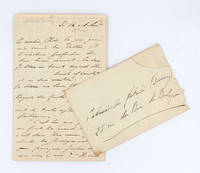
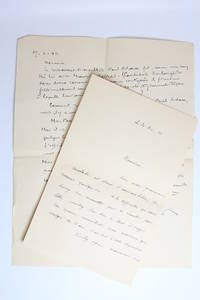
194273853s. l. 1942. Fine. s. l. 17 février 1942 21 x 27 cm 2 feuilles Autograph letter signed by Félix Fénéon to Gabriel Mourey 18 lines in black ink folds from mailing. A key witness and actor of his time the art critic and collector Félix Fénéon assists the writer Gabriel Mourey in his search for the correspondence between Paul Adam and Maurice Barrès: ""Le romancier et occultiste Paul Adam fut comme vous savez très lié à Maurice Barrès. Candidats boulangistes dans deux circonscriptions lorraines contiguës il firent fraternellement une campagne électorale et journalistique à laquelle leur amitié ne survécut guère. Comment retrouver tous les papiers de Paul Adam mort il y a une vingtaine d'années Mme Paul Adam vit-elle encore. - je n'en sais rien. Mais il est probable que vive une de ses soeurs veuve depuis quelques trois ans de ce L. Cappiello auteur de tant d'affiches - peintre elle aussi et de plus fort sourde. Leur demeure était 8 rue Lechatelier XVIIe. Par Mme L. Cappiello vous retrouverez peut-être des papiers barrésiens laissés par Paul Adam. Pour le cas où vous chercheriez dans cette direction je note que que j'ai été en excellents termes avec toute la famille et que vous pouvez donc user de mon nom à votre gré."" A leading figure of the avant-garde Fénéon possessed a singular gift for discovering major artists. A deliberately discreet and eccentric dandy he devoted himself almost religiously to all that contributed to a new artistic sensibility. A staunch defender of the Neo-Impressionists Seurat and Signac and a friend of Mallarmé Camille Pissarro Paul Adam and Gustave Kahn Fénéon was successively an anarchist and a communist and directed a dozen small reviews. He published groundbreaking works such as Rimbauds Illuminations André Gides Paludes and James Joyces Dedalus. A prolific journalist he wrote for numerous publications often unsigned or under fanciful pseudonyms such as Gil de Bache Porphyre Kalouguine and even Thérèse or Louise. A rare letter from Félix Fénéon discussing his contemporaries. Also included is an autograph letter signed by Fanny Fénéon wife of Félix Fénéon dated 30 December 1941 written while her husband was ill and bedridden; 10 lines in black ink with folds from mailing. ""Mon mari gravement malade est dans l'impossibilité de recevoir quelqu'un. Si la difficulté que vous désirez lui remettre peut se résoudre par lettre veuillez lui dire ce dont il s'agit. Une réponse immédiate vous montrera que malgré ses 80 ans il est tout à votre disposition. ."" unknown
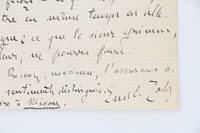
188379106Bénodet 1883. Fine. Bénodet 10 septembre 1883 13.20 x 20.30 cm 2 pages sur un double feuillet Signed autograph letter by Emile Zola - apparently unpublished - addressed to an unknown correspondent written in black ink on a double sheet. Folds inherent to mailing. Interesting letter relating the translation of Emile Zola's works and the legal disputes inherent to their clandestine distribution. This missive is visibly addressed to a correspondent considered for the German translation of La Joie de vivre: ""I would ask you to give me the promptest possible response regarding the translation of La Joie de vivre; for I am already receiving proposals from Germany and I would like to know where I stand."" In this autumn of 1883 Zola - though vacationing in Brittany - is very occupied with managing the translation of his works which he handles directly with publishers. We see here the determination with which he conducts negotiations: ""I repeat that I will only accept a fixed sum paid in advance. It is simpler and without possible surprises."" But things are not simple and Zola whose works already enjoy great success must fight against the clandestine publication of his novels. Completely overlooked by biographers the disputes with Hungarian publisher Gustav Grimm are nonetheless a leitmotif of Zolian correspondence: ""Monsieur Grimm of Budapest is a simple thief who has my novels translated as they are published in French newspapers without any authorization. Already the Neue Freie Presse of Vienna has sued him in my name. But it appears we have no treaty with Hungary. I await the signing of a treaty which they say is imminent."" Indeed Grimm had already published without Zola's authorization German translations of two novels: Nana 1881 and Pot-Bouille Der häusliche Herd 1882. These illegal publications discouraged German publishers Curt Busch and George Kuhr who very interested in distributing the novel to German-speaking readers declared forfeit. Gustav Grimm who finally agreed to respect commercial treaties won the battle and published the very first German translation of La Joie de vivre in 1889 under the title Die Lebensfreude. The man whom Zola here calls a ""simple thief"" would finally obtain authorization to distribute the German translation of the entirety of the twenty volumes of the Rougon-Macquart between 1892 and 1899. Interesting letter revealing the editorial mechanisms of the Rougon-Macquart and testifying to the ardor with which Zola conducted negotiations inherent to the translation of his great hereditary fresco. unknown
195285249Ciboure 1952. Fine. Ciboure 30 Janvier 1952 13.50 x 21 cm deux pages sur un double feuillet Autograph letter signed by Pierre Benoit sent from his priority in Ciboure 22 lines in blue ink. The letter is on Académie française letterhead. Central fold marks perforations from filing in a binder causing no losses. ""30 January 1952 My dear friend Here I am back. The need for a little peace to put correspondence in order makes me delay by a few days the pleasure of seeing you. I retain that of writing to you and of telling you - something a bit ridiculous on my part since the said issue contains an article by your servant - that I found the November-December issue of the Courrier de la Compagnie truly very successful. Deberly's successor has truly outdone himself. I feel as much pride as if I had something to do with it. . As I will certainly not be back for a week could you honor me here with a few words in response which would be more than welcome Sincerely yours. Pierre Benoit. Ciboure - Basses-Pyrénées."" unknown
182787771Paris 1827. Fine. ""the time for planting has come"" Paris 14 mars 1827 16.20 x 19.30 cm trois pages et demi sur un bifeuillet ""the time for planting has come"" Autograph letter signed by François-René de Chateaubriand dated March 14 1827. 3 1/2 pages in black ink on a bifolium addressed to Michel-Augustin Varcollier. Chateaubriand writes to the husband of his goddaughter Atala Stamaty-Varcollier the first to bear the name of the heroine of his famous novel that propelled him onto the literary scene in 1801. Head of the Fine Arts Division of the Seine Prefecture Michel-Augustin Varcollier acted as Chateaubriand's intermediary in the development of the grounds of l'Infirmerie Marie-Thérèse his wife Céleste's grand project to house elderly priests and nobles widowed by the French Revolution. Here Monsieur is a bill from Madame de Chateaubriand to M. de Chabrol inviting him to attend Marie-Thérèse's council meeting which will take place next Wednesday the 21st at 2 a.m."". M. de Chabrol was kind enough to suggest Friday of this week but it has been impossible to gather MM. the Counselors for that day. Kindly explain this to Monsieur de Chabrol. . I have obtained permission from the Prefect of Police to place palisades along the walls. Now I need permission from M. le Préfet de Paris to plant within these palisades. I'm going to pretend I've already got it because the time for planting has come. I have no doubt that Mr. Préfet will continue his gestures of kindness. There is still to complete the work on the trellis on my little boulevart sic to give two coats of paint to the barriers. I recommend myself to M. de Fresnes for the completion of this great work. I must thank him and you Monsieur for all the kindness you have shown me.""  unknown
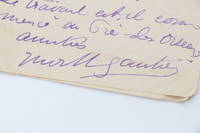
191080834Alger Algiers 1910. Fine. Alger Algiers s. d. ca 1910 10.50 x 16.50 cm 1 page sur un double feuillet Autograph letter signed by Judith Gautier addressed to Céleste Chrétien her housekeeper. One page written in violet ink on a double sheet. Transverse folds inherent to the mailing. ""I receive this letter from Mr Lemoine and I don't know what to reply to him not knowing your reasons. Tell me what I should do. Has the work begun at Pré aux Oiseaux"" unknown
190078982s. l. Londres London 1900. Fine. s. l. Londres London Le 16 octobre 1900 11.30 x 17.50 cm 10 pages sur 2 doubles feuillets et 1 feuillet simple Very long autograph manuscript letter by Renée Vivien signed ""Ton fervent Paul"" written in black ink on two double sheets and one single sheet. Transverse creases inherent to the mailing envelope included. Moving letter recounting Renée Vivien's first encounters with suffering and death. Having returned to her family in London the Violet Muse watches over her dying cousin : ""Mon pauvre cousin va de plus en plus mal. Je crains horriblement que ce ne soit la fin. Il est la plupart du temps en proie à la fièvre et au délire. Ou bien il dort d'un mauvais sommeil de prostration et de faiblesse à la suite des piqûres de morphine. . Cela me fait mal de voir le pauvre squelette qui me sourit si faiblement ce visage est marqué déjà par la mort il y a la trace de sa serre qui ne relâche pas."" ""My poor cousin is getting worse and worse. I am horribly afraid this may be the end. He is most of the time prey to fever and delirium. Or else he sleeps a bad sleep of prostration and weakness following morphine injections. . It pains me to see the poor skeleton who smiles at me so weakly this face is already marked by death there is the trace of its grip that does not let go."" Pain is omnipresent in this letter-torrent: ""J'ai vu une chose horrible aujourd'hui à l'hôpital en allant voir mon cousin. On a apporté sur un brancard une chose épouvantable - un corps couvert d'un drap et une tête d'homme aux joues brûlées - et de cela sortait des gémissements et des hurlements et des râles. Il me semble que je ne pourrai jamais oublier l'affreuse chose inerte qui m'a frôlée de si près cette après-midi. Il paraît que c'était un ouvrier terriblement blessé par une explosion de gaz qui a eu lieu dans une fabrique à une heure cette après-midi. Ah ! la sinistre chose qu'on portait là-bas ! On entend parler d'accidents et de blessures et de mort et on n'y fait pas attention jusqu'à ce qu'on voie ce que c'est. L'horreur de tout cela m'obsède ce soir et s'ajoute à mon abattement et à ma mélancolie."" ""I saw a horrible thing today at the hospital while going to see my cousin. They brought on a stretcher a dreadful thing - a body covered with a sheet and a man's head with burned cheeks - and from this came moans and howls and death rattles. It seems to me I will never be able to forget the awful inert thing that brushed so close to me this afternoon. It appears it was a worker terribly injured by a gas explosion that occurred in a factory at one o'clock this afternoon. Ah! the sinister thing they were carrying there! One hears talk of accidents and injuries and death and pays no attention to it until one sees what it is. The horror of all this obsesses me tonight and adds to my dejection and my melancholy."" At this time Renée Vivien had not yet published anything and even devalued her verses in favor of those of the Amazon: ""Ce matin Chère la joie que m'a causée ta lettre et l'émotion profonde de ton beau sonnet - ce vers « Is there no touch beyond the touch of hands » et ces deux autres : « Is there no love that burns an unseen fire » « Beyond the finish of expressed desire » sont de toute splendeur poétique. . C'est toi qui portes au front la grande lumière c'est dans ton cur que chante la musique sublime parler de mes vers à moi Ils sont pauvres à faire pleurer."" ""This morning Dear the joy your letter caused me and the profound emotion of your beautiful sonnet - this verse 'Is there no touch beyond the touch of hands' and these two others: 'Is there no love that burns an unseen fire' 'Beyond the finish of expressed desire' are of all poetic splendor. . It is you who bears the great light on your brow it is in your heart that the sublime music sings speak of my verses me They are poor enough to make one weep."" Written in a period preceding the sentimental storms this ve unknown
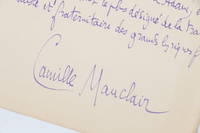
189983424s. l.: S. n. 1899. Fine. S. n. s. l. s. d. 1899 15 x 19.50 cm 8 feuillets Autograph manuscript signed entitled ""La force et la destruction"" about Paul Adam's novel La Force which has just been published 8 leaves in blue ink with some corrections. The article was certainly published in the Revue Blanche. In this laudatory critique of the novel La Force published by Paul Ollendorff: "". c'est un très grand poème épique."" "". it is a very great epic poem."" as well as of Paul Adam's already prolific work: ""Un écrivain qui à trente-cinq ans avant ce livre en a signé vingt-trois autres dont aucun n'est médiocre et dont dix sont de premier ordre."" "". un inépuisable agitateur d'idées d'aperçus de rêves et de beautés."" ""A writer who at thirty-five before this book had signed twenty-three others none of which is mediocre and ten of which are first-rate."" "". an inexhaustible agitator of ideas insights dreams and beauties."" Camille Mauclair demonstrates to the readers of the Revue Blanche of socialist and anarchist allegiance that Paul Adam is one of them: ""Mais le peuple ne sait peut-être pas combien ce romancier cet artiste de style est près de lui dévoué à sa cause véritablement son apôtre en face de la bourgeoisie. c'est en luttant de front contre les iniquités les laideurs et les égoïsmes de la classe possédante que M. Adam a imposé son nom."" ""But the people perhaps do not know how close this novelist this artist of style is to them devoted to their cause truly their apostle in the face of the bourgeoisie. it is by fighting head-on against the iniquities ugliness and selfishness of the possessing class that Mr. Adam has established his name."" Despite success and unlike many of his fellow poets and novelists Paul Adam has not gone astray: "". un mandarin des lettres refugié dans des rêves compliqués et indifférents à l'époque aux souffrances et aux injustices."" "". les autres décadents égotistes ou symbolistes. se réfugiaient prudemment dans la tour d'ivoire ou dans les honteux culte du moi en attendant l'académisme ou le suffrage des snobs."" "". a literary mandarin taking refuge in complicated dreams and indifferent to the times to suffering and injustices."" "". the other decadents egoists or symbolists. prudently took refuge in the ivory tower or in the shameful cult of the self awaiting academicism or the approval of snobs."" and is animated by an acute political and social consciousness: "". sa voix fut une des plus éloquentes parmi celles qui saluèrent dans l'anarchisme les beaux côtés de sa morale civique l'idéal internationaliste la haine des castes le relèvement de l'individu considéré comme unité et commune mesure de la société."" "". Au moment où la panique multipliait autant les dénonciateurs que les poltrons M. Paul Adam signa résolument un magnifique éloge de Ravachol.""' "". his voice was one of the most eloquent among those who greeted in anarchism the beautiful aspects of its civic morality the internationalist ideal the hatred of castes the elevation of the individual considered as unit and common measure of society."" "". At the moment when panic multiplied denouncers as much as cowards Mr. Paul Adam resolutely signed a magnificent eulogy of Ravachol.""' Finally Camille Mauclair precisely analyzes the significance of ""La force"": Avec une frappante justesse Paul Adam oppose la force véritable la hauteur d'esprit à la suprématie de l'épée."" ""M. Paul Adam nous montre l'éternel symbole de Prométhée de l'intelligence créatrice enchaîné entre la Force et la Violence."" "". étant adversaire du chauvinisme et du militarisme. de mettre en lumière tous leurs motifs de gloire pour mieux en montrer l'écoeurant non-sens la nullité la débilité devant la vie pensante et l'action féconde."" ""With striking accuracy Paul Adam opposes true force elevation of spirit to the supremacy of the sword."" ""Mr. Paul Adam shows us the eternal symbol of S. n. unknown
190886215Grenade Granada 1908. Fine. Grenade Granada 1908 20.50 x 27 cm huit pages sur deux doubles feuillets une enveloppe Humorous autograph letter signed by Claude Farrère then on a Mediterranean cruise and posted from the Hotel Washington Irving in Granada 8 pages on two double sheets in which he notably recounts his exploits with the fairer sex. Fold marks inherent to postal handling envelope included. Claude Farrère leaving Tangier for Granada via Gibraltar humorously narrates his latest feminine conquest and his rivalry with another suitor: ""Yesterday morning as the Cassini was about to leave Tangier - where I had a delicious flirtation with a young girl!! . We spotted a human being on the quarterdeck. which human being was screaming like a suckling pig caught by the tail in a door. It was my successor. Suppose this good man had had less powerful lungs: we would not have heard him."" He thanks Pierre Louÿs for his latest letter to which he hastens to respond: ""I picked up your letter yesterday. And you see I don't wait twenty-four hours to answer you. I note indeed that as soon as one is away more than fifteen days all conversation becomes impossible. Judge for yourself!!!"" while clarifying things about the too numerous women he has seduced to the point that Pierre Louÿs can no longer keep track: ""I would have sworn on my life that I had narrated to you in detail my adventure with Mlle M.; I must have searched a good hour in my memories for what the initials CG could represent!!! That's where we stand. It's maddening."" But Claude Farrère sometimes exposes himself to the risks of his abundant sentimental victories and ironically boasts of his setbacks: ""M.M. possesses about twenty letters from me. at least one that I remember and which is a profession of sadism. I no longer sleep. Trust pretty flirtatious persons after that who write you delicate horrors to procure prose for posthumous publication!!!"" He also details for him in a playful and epic manner his last evening aboard the Cassini and the marks of sympathy he received: ""My departure from the Cassini was the most perfectly grotesque thing on earth and even of the five oceans. Toasts effusions feasts. R. solemnly informs me that I am 'warmly' proposed for the cross by him and the admiral. I who knew it classic and profound stupefaction. Thereupon the launch comes alongside my suitcases embark I follow them. the crew had been sleeping for two hours theoretically. But barely does the launch push off savage howling clamors vivats hurrahs. Without saying anything all these good people had patiently waited for it to be time to shout. Naturally I began to cry. Finally total idiocy."" He concludes this missive by enumerating the Andalusian cities he will visit: ""I leave the day after tomorrow for Seville then Córdoba and Toledo."" unknown
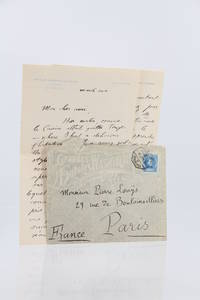
193686641Aix-en-Provence 1936. Fine. Aix-en-Provence 2 Avril 1936 13 x 21 cm une page une enveloppe Autograph letter dated and signed addressed to the writer and literary critic Noël B. de La Mort pen name of Noël Bayon 15 lines in blue ink. Crease marks inherent to folding for mailing envelope included. Noël B. de La Mort wishes to meet Edouard Peisson but the latter is seldom in Paris: ""Mais je vis la plus grande partie de l'année dans le midi."" But I live most of the year in the south. but he remains at his correspondent's disposal: ""Je suis disposé toutefois à répondre toutes les questions que vous me poserez par lettre."" I am willing however to answer any questions you may ask me by letter. unknown
197685089Fleury-Mérogis 1976. Fine. Fleury-Mérogis 18 Octobre 1976 21 x 29.50 cm une page recto verso Autograph letter dated and signed by Jacques Mesrine dated Monday October 18 1976 68 lines in blue ink on one recto-verso page addressed to his love of the time Jeanne Schneider thanks to whom the manuscript of theInstinct de mort was discreetly smuggled out of prison. Jacques Mesrine then incarcerated at Fleury-Mérogis prison seeks to reassure his love whom he is helping through his lawyers so that she might obtain provisional freedom: ""C'est que je sens que cela va être bon et cela malgré que les avocates m'avaient déconseillé de le faire. tu sais que je fais de la prémonition mais dans le bon sens. Je sais que ma lettre les fait réfléchir. cela j'en suis certain. C'est la première fois que j'interviens pour toi. Ca aussi a de l'importance."" ""It's that I feel this is going to be good despite my lawyers having advised me against doing it. you know I have premonitions but in a good way. I know my letter makes them think. of this I am certain. This is the first time I'm intervening for you. That too is important."" and thanks to whom she should regain freedom: ""Mais le plus important est que tu retrouves cette pute de liberté. Après ce sera aux avocates de jouer pour un régime plus souple. Je te parle comme si tu étais déjà libre.Que ""veux-tu"" j'y crois."" ""But the most important thing is that you regain this damn freedom. After that it will be up to the lawyers to work for a more lenient regime. I'm talking to you as if you were already free. What can I say I believe in it."" Overflowing with enthusiasm and certainty for the success of these proceedings regarding Jeanne's provisional freedom and sure of the weight of his intervention the indomitable Mesrine fumes at the idea of a hypothetical refusal by the prison authorities: ""Quel affreux pirate qui te donne de l'espoir. Non mon ange je ne sais absolument rien. Sauf que le Président a dit que je le menaçais sur ma lettre. J'ai été très dur et à juste raison car la plaisanterie a assez durée. Toi tu supporteras ton refus. moi je ne l'accepterai plus. C'est pas plus compliqué que cela. Car tu as assez payé. même trop."" ""What a terrible pirate giving you hope. No my angel I know absolutely nothing. Except that the President said I was threatening him in my letter. I was very harsh and rightly so because the joke has gone on long enough. You will endure your refusal. I will no longer accept it. It's no more complicated than that. Because you have paid enough. even too much."" Public enemy No. 1 takes the opportunity again to shatter this reputation as a bloodthirsty beast that sticks to his skin: ""Si les journalistes savaient que toutes les infirmières entraient seules dans ma cellule et en toute confiance on serait loin du ""fauve"" et de la prise d'otages à la Buffet. Les infirmières ont toujours été sacrées pour moi. Elles sont intouchables comme pas mal d'autres personnes mais cela les pédés de journalistes l'ignorent ; car ils ne sont pas dans mes pensées et c'est regrettable parfois."" ""If journalists knew that all the nurses entered my cell alone and in complete confidence we would be far from the 'beast' and the hostage-taking like Buffet. Nurses have always been sacred to me. They are untouchable like many other people but those journalist faggots don't know this; because they are not in my thoughts and that's sometimes regrettable."" Jacques Mesrine speaks of the creation of his work L'instinct de mort and his health in a fatalistic manner: ""Autrement tout est ok sauf mes douleurs au coeur qui me reprennent. mais je laisse faire car je n'aime pas prendre de médicaments. Et puis le mécanisme s'arrêtera le jour ""J"" du destin. Peut-être dans tes bras. qui sait ""Otherwise everything is ok except my heart pains that are returning. but I let it be because I don't like taking medication. And then the mechanism will stop on the 'D' day of d unknown
193086491Paris: S. n. 1930. Fine. S. n. Paris s. d. ca 1930 14 x 21.50 cm une page recto verso Autograph letter by François Mauriac signed with his initials 28 lines in blue ink on letterhead from his Parisian residence on avenue Théophile Gautier addressed to Abbé Casy Rivière. Fold mark inherent to envelope insertion. François Mauriac discusses his upcoming summer travels: "". je pars le 20 en auto pour les Pyrénées et ne serai à Malagar que vers le 1 sept. Regrets ! ."" "". I leave on the 20th by car for the Pyrenees and will only be at Malagar around September 1st. Regrets! ."" but also literary activity and certain religious allegiances attributed to the magazine La Table ronde: ""Le Léautaud a paru pendant mon séjour à Florence et je l'ai beaucoup regretté. Cela ne se renouvellera plus. Mais n'allez pas croire que le T.R. soit une revue catholique. Je suis à peu près le seul à l'être dans la rédaction. Et c'est bien pourquoi je ne souhaite nullement qu'un vicaire la lise."" ""Léautaud was published during my stay in Florence and I greatly regretted it. This will not happen again. But don't think that T.R. is a Catholic magazine. I am about the only one to be so on the editorial staff. And that's exactly why I do not wish at all for a vicar to read it."" He ends the missive with this revelation concerning his productivity as a vacationer: ""Je lutte désespérément pour mon travail personnel contre tout ce qui m'en détourne surtout lorsque je suis loin de Paris."" ""I desperately struggle for my personal work against everything that distracts me from it especially when I am away from Paris."" S. n. unknown
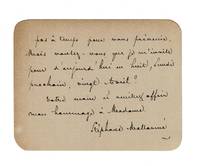
189676326Paris 1896. Fine. Paris 12 avril 1896 11.40 x 8.80 cm une carte recto-verso et une enveloppe Autograph postcard signed by Stéphane Mallarmé addressed to Alidor Delzant written on both sides in black ink. Envelope included. Alidor Delzant was a lawyer collector and bibliophile. Friend of the Goncourts he devoted a work to them and was Edmond's secretary and testamentary legatee. ""Here I am not having gone to London warned late that the reason for my journey was no longer necessary: I replaced this with a trip to the countryside from which I do not return in time to warn you. But would you like me to invite myself for today in eight . "" unknown
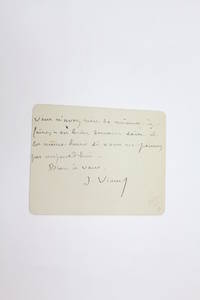
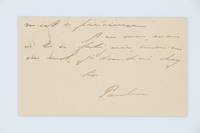
191073229Hendaye 1910. Fine. Hendaye s. d. 11.30 x 9 cm une feuille Autograph note by Pierre Loti signed Julien Viaud. 8 lines in black ink on a card. ""Malade depuis hier matin je ne puis aller jusqu'à vous. J'aurais grand plaisir à vous voir ce soir entre 5 et 6h si vous n'avez rien de mieux à faire - où bien demain soir à la même heure si vous ne pouvez pas aujourd'hui"". ""Ill since yesterday morning I cannot come to you. I would have great pleasure in seeing you this evening between 5 and 6 o'clock if you have nothing better to do - or tomorrow evening at the same time if you cannot today"". unknown
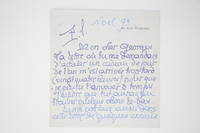
189377475Paris 1893. Fine. Paris 1893 13.50 x 14.50 cm quatre pages sur un feuillet remplié Autograph letter signed by Pierre Louÿs dated Christmas 1893 addressed to Georges Louis. Four pages written in blue ink on a double blue sheet bearing the writers initials and headed 49 rue Vineuse. A fine letter addressed to his brother Georges Louis with whom Pierre Louÿs maintained a deeply intimate relationship and whom he regarded as his own father. The question of Pierre Louÿss true parentage continues to fascinate biographers: His father Pierre Philippe Louis . married Jeanne Constance Blanchin in 1842; she died ten years later having borne him two children Lucie and Georges. In 1855 he married Claire Céline Maldan and from this union was born in 1857 a son Paul; then in 1870 our writer who received the given names Pierre Félix. This late birth the differences in temperament between father and son the fathers indifference toward the latter and the profound intimacy that always united Louÿs and his brother Georgesall of this has led some biographers and critics to suspect that Georges was in fact the writers father. The exceptionally close and lifelong bond between Pierre and Georges might well support such an argument. Of course no conclusive proof has ever been found and doubtless never will be. Still certain letters . are quite troubling. In 1895 for example Louÿs gravely wrote to his brother that he knew the answer to the most painful question he could ever put to him a question that had been on his lips for ten years. The following year at the height of Aphrodites success he thanked Georges effusively and closed his letter with these words: Pas un de mes amis n'a un PERE qui soit pour lui comme tu es pour moi. Arguing from the close relationship between Georges and Claire Céline in 1870 and from the jealousy the father continually displayed toward his younger son Claude Farrère did not hesitate to side with Georges Louis. And what are we to make of this dedication by Louÿs to his brother in a copy on japon of the original Pausole: Pour Georges son fils aîné / Pierre. Jean-Paul Goujon Pierre Louÿs Pierre Louÿs sent this letter to his brother when the latter had just taken up his post as Frances delegate to the International Commission of the Egyptian Debt and was in Cairo: La lettre où tu me demandais d'acheter un cadeau de jour de l'an m'est arrivée trop tard vingt quatre heures pour que je puisse l'envoyer à temps. J'espère que tu auras pu trouver quelque chose là-bas. Lacking a gift Pierre sent his brother a portrait of himself: En même temps que ma dernière lettre j'ai mis à la poste pour toi une photo du photographe ordinaire de Jane Hading et qui représente un Pierre posthume et sentimental assez ressemblant tout de même. L'épreuve n'était pas très propre mais c'était la seule que j'eusse encore reçue. Only a handful of photographic portraits of the writer are known today and we have been unable to identify the photograph mentioned here. The year 1893 marked several literary successes for Pierre Louÿs who until then had published only Astarté at his own expense in 1891 and together with his friend from the École Alsacienne André Gide and Paul Valéry had founded La Conque an anthology of the youngest poets whose first issue appeared on 15 March 1891. In quick succession came Chrysis ou la cérémonie matinale the translation of the Poésies de Méléagre and finally Lêda ou la louange des bienheureux ténèbres. The latter work is even mentioned in this letter: Mallarmé m'a écrit des choses pompeuses sur Lêda; mais de sa part cela ne signifie rien. Louÿs had been acquainted with Mallarmé since the early 1890s and met many leading figures at his celebrated Tuesdays among them Henri de Régnier. Deeply admiring the verses of the Symbolist master whom he considered the supreme incarnation of the artist one who has sacrificed everything to his ideal Ibid. Louÿs se unknown
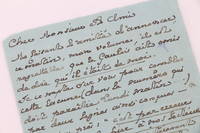
189883371s. l.: S. n. 1898. Fine. S. n. s. l. 1898 11 x 14 cm une feuille Autograph letter signed by the dandy count on a closed pneumatic card of 18 lines written in black ink addressed to his friend and journalist Henri Lapauze in which stung to the quick in his pride Robert de Montesquiou asks the latter imposing this correction upon him to kindly rectify the almost unforgivable error of the Gaulois: ""Cher monsieur et ami me faisant l'amitié d'annoncer ce matin mon volume il est regrettable que le Gaulois ait omis de dire qu'il était de moi. Je compte sur vous pour combler cette lacune dans le numéro qui doit paraître lundi matin par deux lignes ainsi conçues - ou à peu près : ""c'est par erreur que signalant hier à nos lecteurs l'apparition d'un intéressant volume de critique intitulé Autels priviliégés nous avons omis de dire que l'auteur était le Cte Robert de Montesquiou. Merci cher monsieur et à bientôt. Robert de M."" ""Dear sir and friend doing me the kindness of announcing my volume this morning it is regrettable that the Gaulois omitted to say that it was by me. I count on you to fill this gap in the issue that is to appear Monday morning with two lines conceived thus - or thereabouts: 'it is by error that signaling yesterday to our readers the appearance of an interesting volume of criticism entitled Privileged Altars we omitted to say that the author was Count Robert de Montesquiou. Thank you dear sir and see you soon. Robert de M.'"" S. n. unknown
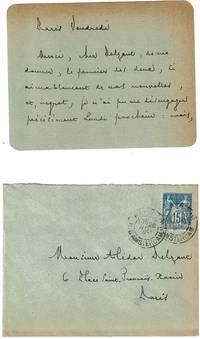
189776331Paris 1897. Fine. Paris 26 novembre 1897 11.40 x 8.80 cm une carte recto-verso et une enveloppe Autograph signed postcard by Stéphane Mallarmé addressed to Alidor Delzant written on both sides in black ink. Envelope included. Alidor Delzant was a lawyer collector and bibliophile. Friend of the Goncourts he devoted a work to them and was secretary and testamentary legatee of Edmond. ""Merci cher Delzant de me donner le premier des deux si aimablement de vos nouvelles ; et ingrat je n'ai pu me désengager précisément lundi prochain : mais ici je mets les pieds dans le plat que diriez vous du suivant 6 décembre où je serais des vôtres "" ""Thank you dear Delzant for giving me first of the two so kindly your news; and ungrateful as I am I could not free myself precisely next Monday: but here I put my foot in it what would you say to the following December 6th when I could join you"" unknown
192487768Le Clos-Marie Roscoff 1924. Fine. Le Clos-Marie Roscoff 30 Août 1924 21 x 27.50 cm 1 page recto verso Autograph letter dated from Liane de Pougy addressed to the French archaeologist curator of the Saint-Germain museum and professor of art history at the École du Louvre Salomon Reinach 56 lines written in blue ink on a recto verso leaf written from her property Clos-Marie in Roscoff where the famous courtesan stayed until 1926. A small tear in the right margin of the letter and inherent to the folding of the missive. Liane de Pougy does not have time to be bored in her Roscoff property: ""J'écris beaucoup dans mes cahiers fleuris et je reçois des visites"" I write a lot in my flowered notebooks and I receive visits where her great friend Mathilde de Morny known as ""Missy"" famous Amazon of Tout-Paris comes to see her: ""Missy-Missou est revenue nous voir avec 2 amis. C'est bien elle-lui que vous avez vu à l'Opéra. Il ou elle eût été charmée de vous saluer mais ne vous as pas perçu. Il est reparti emmenant Max Jacob qui est déjà revenu."" Missy-Missou came back to see us with 2 friends. It is indeed she-he that you saw at the Opera. He or she would have been delighted to greet you but did not see you. He left taking Max Jacob who has already returned. Liane de Pougy receives many people: ""Nous attendons le jeune de Jacques de Maleisgne avec sa femme son nègre des animaux - des instruments banjo etc. Vous voyez qu'il y a de quoi s'occuper."" We are expecting young Jacques de Maleisgne with his wife his negro animals - instruments banjo etc. You see there is plenty to keep busy. complains about her health affected by weather conditions: ""En plus de mes occupations j'ai des douleurs alimentées par les pluies incessantes cependant ce matin ma fenêtre est ouverte sur un paysage riant."" In addition to my occupations I have pains fed by incessant rains however this morning my window is open on a smiling landscape. while appreciating with a certain melancholy the beauties of nature surrounding her: ""Les rosiers poussent drus leurs fleurs persistent les grenouilles et les limaces sont heureuses baveuses et ne demandent plus de roi ! Les guêpes bourdonnent tristement désenchantées de la saison ratée. et nous attendons l'hiver et ses feux ses lumières ses neiges ses fourrures et tous ses artifices."" The rose bushes grow thick their flowers persist the frogs and slugs are happy drooling and no longer ask for a king! The wasps buzz sadly disenchanted with the failed season. and we await winter and its fires its lights its snows its furs and all its artifices. Fine letter from the famous courtesan actress and author Liane de Pougy relating her friendships with the Tout-Paris of the Amazons. unknown
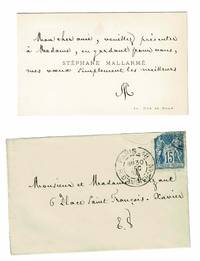
189276335Paris: S. n. 1892. Fine. S. n. Paris 30 décembre 1892 10.40 x 6.30 cm une carte de visite et son enveloppe Signed autograph visiting card from Stéphane Mallarmé addressed to Alidor Delzant. Envelope included. Alidor Delzant was a lawyer collector and bibliophile. Friend of the Goncourts he devoted a work to them and was Edmond's secretary and testamentary legatee. ""Mon cher ami veuillez présenter à Madame en gardant pour vous mes voeux simplement les meilleurs."" ""My dear friend please present to Madame while keeping for yourself my simply best wishes."" S. n. unknown
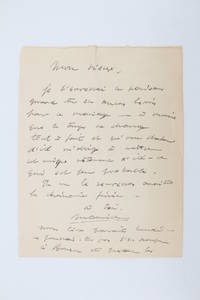
190080760s. l. 1900. Fine. s. l. s. d. ca 1900 14.70 x 18.90 cm Une page et 1/2 sur un feuillet Autograph letter signed by Maurice Leblanc to an unknown recipient whom he addresses as ""Mon vieux""; one and a half pages written in black ink on a sheet. Transverse folds inherent to mailing. The letter concerns the loan of a garment: ""Je t'enverrai ce pardessus quand tu en auras besoin pour ce mariage - à moins que le temps ne change tout à fait et qu'une chaleur d'été m'oblige à mettre cet unique vêtement d'été - ce qui est peu probable. Tu me le renverras aussitôt la cérémonie finie."" ""I'll send you this overcoat when you need it for this wedding - unless the weather changes completely and summer heat forces me to wear this only summer garment - which is unlikely. You'll send it back to me as soon as the ceremony is over."" Maurice Leblanc also mentions the release of one of his works ""Mon livre paraît lundi - ne pourrais-tu pas t'en occuper à Rouen et presser les libraires de faire leurs commandes et de t'arranger pour n'en point manquer "" ""My book comes out Monday - couldn't you take care of it in Rouen and press the booksellers to place their orders and arrange not to run out"" before concluding his letter: ""Tout le monde va bien. Chez Geo c'est affolant. On s'en va à Bordeaux du 21 avril au 4 mai."" ""Everyone is well. At Geo's it's frantic. We're going to Bordeaux from April 21 to May 4."" unknown
190078898s. l. Paris 1900. Fine. s. l. Paris s. d. ca 1900 9.50 x 5.60 cm une carte rédigée des deux côtés Autograph manuscript card signed ""Pauline"" and addressed to Natalie Clifford Barney written in black ink on both sides. ""Repose-toi aujourd'hui chérie. Je suis inquiète de toi et cela me rend affreusement triste. Repose-toi bien n'est-ce pas Mon si fragile bonheur sois très prudente et ménage ta jolie santé frêle qui m'est si précieuse. A ce soir mais si tu es fatiguée envoie-moi un mot je viendrai chez toi."" ""Rest today darling. I am worried about you and it makes me terribly sad. Rest well won't you My so fragile happiness be very careful and take care of your pretty frail health which is so precious to me. Until tonight but if you are tired send me a word I will come to you."" It was at the end of 1899 and through Violette Shillito that Renée Vivien - then Pauline Tarn - made the acquaintance of Natalie Clifford Barney ""this American more supple than a scarf whose sparkling face shines with golden hair sea-blue eyes and implacable teeth"" Colette Claudine à Paris. Natalie who had just lived a summer idyll with the sulfurous Liane de Pougy who had initiated her into sapphism paid only discreet attention to this new acquaintance. Renée however was totally captivated by the young American and would relate this love at first sight in her autobiographical novel Une Femme m'apparut: ""I evoked the already distant hour when I saw her for the first time and the shiver that ran through me when my eyes met her eyes of mortal steel her sharp blue eyes like a blade. I had the obscure presentiment that this woman was giving me destiny's order that her face was the dreaded face of my future. I felt near her the luminous vertigo that rises from the abyss and the call of very deep water. The charm of peril emanated from her and attracted me inexorably. I did not try to flee her for I would have escaped death more easily."" ""Winter 1899-1900. Beginning of the idyll. One evening Vivien is invited by her new friend to Mme Barney's studio Natalie's mother 153 avenue Victor-Hugo at the corner of rue de Longchamp. Natalie ventures to read verses of her own composition. When Vivien tells her she loves these verses she replies that it is better to love the poet. A response quite worthy of the Amazon."" J.-P. Goujon Tes blessures sont plus douces que leurs caresses Two years of unequal happiness followed punctuated by Natalie's recurring infidelities and Renée's pathological jealousy whose letters oscillated between passionate declarations and painful mea culpa. ""Renée Vivien is the daughter of Sappho and Baudelaire she is the flower of evil 1900 with fevers broken flights sad voluptuousness."" Jean Chalon Portrait d'une séductrice In 1901 came an important rupture that would last almost two years; Renée despite Natalie's solicitations and the intermediaries she sends to win her back resists. ""The two friends saw each other again and it was in August 1905 the pilgrimage to Lesbos which constituted a disappointment for Natalie Barney and remained without consequence. . The spring was definitively broken. The two former friends ceased to see each other from 1907 and Vivien died without their having met again."" J.-P. Goujon Ibid. Precious and very rare card from Sappho 1900 to the Amazon. unknown
190777513Tamaris Tamaris-sur-mer 1907. Fine. Tamaris Tamaris-sur-mer 19 juin 1907 13.50 x 20.50 cm 4 pages sur un double feuillet Autograph letter signed by Pierre Louÿs addressed to Georges Louis. Four pages written in purple ink on a double sheet. Envelope included. Fine letter addressed to his brother Georges Louis with whom Pierre Louÿs maintained a very intimate relationship and whom he considered as his own father. The question of Pierre Louÿs's real paternal identity still fascinates biographers today: ""His father Pierre Philippe Louis . had married in 1842 Jeanne Constance Blanchin who died ten years later after giving him two children Lucie and Georges. In 1855 he remarried Claire Céline Maldan and from this union was born in 1857 a son Paul; then in 1870 our writer who received the first names Pierre Félix. This late birth the differences in character between father and son the first's disaffection toward the second the profound intimacy that always reigned between Louÿs and his brother Georges all this has led certain biographers and critics to suspect that the latter was in reality the writer's father. The exceptionally intimate and constant relationship that Pierre and Georges maintained between them throughout their lives could be an argument in this sense. Of course no irrefutable proof has been discovered and none will probably ever be discovered. Nevertheless certain letters . are quite troubling. In 1895 for example Louÿs writes seriously to his brother that he knows the answer to 'the most poignant question' he could ask him a question he has had 'on his lips for ten years.' The following year in the midst of Aphrodite's triumph he thanks Georges effusively and ends his letter with this sentence: 'Not one of my friends has a FATHER who is to him what you are to me.' Arguing from the close intimacy of Georges and Claire Céline during the year 1870 and from the jealousy that the father never ceased to show toward his younger son Claude Farrère did not hesitate to conclude in favor of Georges Louis. And what to think of this dedication by Louÿs to his brother on a Japan paper copy of the first edition of Pausole: To Georges his eldest son / Pierre."" Jean-Paul Goujon Pierre Louÿs Written from Tamaris where the writer is on vacation and attempting to buy Psyché this fine letter forms a veritable ode to literature and bibliophilia. Louÿs ""fills two pages of letter on this question"" and indeed writes: ""When I leave I always lock everything up so that my maids don't browse through my books in my absence which would be disastrous. I unfortunately have book titles that could sometimes tempt them. . What to do Leave you the keys I would certainly do so if I were leaving for six months but for a short absence. . I don't have duplicates and . the key to my study locks up my desk which is the soul of the house."" Georges very quickly transmitted to his brother the love of books and texts and the latter recalls here this profound spiritual communion: ""When I look at my library I constantly regret that you don't benefit from it more. I would always like to unite it with yours and that the day when your life is free you would only have to leave your bedroom to take from my place what you desire."" Although happy to take some leave he misses his brother: ""That's somewhat what prevents me from loving Biarritz it's that I see there a threat of such complete separation for us both. . I couldn't follow you there and I would only see you one or two months a year; that frightens me. My wish would be that we choose two small adjoining houses near Paris. . But it's not time to speak of it."" This sentimental reverie of a future together quickly gives way to a long passage concerning international politics and the game of European alliances. Georges is then Director of Political Affairs at the Quai d'Orsay and the two brothers naturally discuss this subject: ""The circle of alliances built in recent unknown
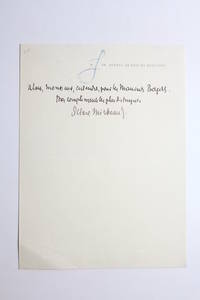
189773703s. l. Paris 1897. Fine. s. l. Paris 1897 13.50 x 18.30 cm une feuille Autograph letter signed by Octave Mirbeau. 2 lines in black ink on a folded sheet letterhead paper ""68 avenue du bois de Boulogne"". ""Alors Monsieur entendu pour les Mauvais Bergers"". The Mauvais bergers corresponds to Octave Mirbeau's tragedy a social drama performed at the Renaissance Theatre on December 15 1897 with Sarah Bernhardt and Lucien Guitry in the leading roles. unknown
191080835Alger Algiers 1910. Fine. Alger Algiers s. d. ca 1910 13.70 x 18 cm 4 pages sur un double feuillet Autograph letter signed by Judith Gautier addressed to Céleste Chrétien her housekeeper. Four pages written in black ink on a double sheet. Transverse folds inherent to mailing. Judith Gautier here discusses the visit of her friend the musician Chalmers Clifton - whom she liked to nickname Charmeur - to Dinard: ""Voici les dernières instructions : le voyageur arrivera dimanche soir à 7 heures 20. Il faudra le prendre à la gare vous ou Francis et le conduire tout droit à la maison qu'il ne connait pas. Il apporte des draps au cas où il n'y en aurait pas. Il les donnera pour qu'on fasse le lit et on le conduira tout de suite à Michelet pour dîner il faudra prévenir pour qu'on garde un dîner. . Mr Clifton est un très jeune américain tout à fait charmant et qui a l'air d'une demoiselle. Soignez-le bien."" ""Here are the final instructions: the traveler will arrive Sunday evening at 7:20. You or Francis will need to meet him at the station and take him straight to the house which he doesn't know. He is bringing sheets in case there aren't any. He will give them so the bed can be made and he will be taken immediately to Michelet for dinner you must warn them to save a dinner. . Mr. Clifton is a very young American who is quite charming and looks like a young lady. Take good care of him."" unknown
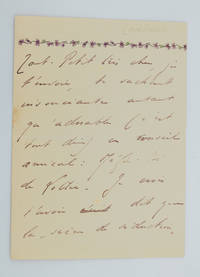
190679012s. l. Paris 1906. Fine. s. l. Paris s. d. ca 1906 11.50 x 15.90 cm 4 pages sur un double feuillet Autograph letter by Renée Vivien addressed to Natalie Clifford Barney and written in violet ink on a double sheet bordered with violets. Transverse folds inherent to mailing. Interesting letter of warning against the opportunist ""Lottie"": ""Tout-Petit très cher je t'envoie te sachant insouciante autant qu'adorable c'est tout dire ce conseil amical : Méfie-toi de Lottie. Je crois t'avoir dit que la « scène de séduction » chez moi était très savamment préparée et combinée. Lottie a besoin d'argent. Elle en cherche avec âpreté. Elle me demande maintenant une « lettre d'introduction » pour Lugné-Poë. et moi qui ne le connais pas ! Elle « t'embêtera » . c'est le mot cru le seul qui convient Elle est exaspérée contre moi parce que je n'ai pas succombé et surtout parce que je ne lui donnerai pas d'argent. Si elle m'en avait demandé loyalement franchement au nom des jours d'autrefois j'aurais cédé mais cette comédie amoureuse me répugne Je te le répète : Méfie-toi Ne la vois point si cela t'est possible."" ""Very dear Little One I send you knowing you to be as carefree as you are adorable which says everything this friendly advice: Beware of Lottie. I believe I told you that the 'seduction scene' at my place was very cleverly prepared and planned. Lottie needs money. She seeks it eagerly. She now asks me for a 'letter of introduction' to Lugné-Poë. and I who don't know him! She will 'bother you'. that's the crude word the only one that fits She is exasperated with me because I did not succumb and especially because I will not give her money. If she had asked me loyally frankly in the name of days gone by I would have given in but this amorous comedy disgusts me I repeat: Beware Do not see her if it is possible for you."" Charlotte ""Lottie"" Stern Countess Venturini was an actress also known by the name of Yorska and a close friend of Sarah Bernhardt. Alice Pike Barney Natalie's mother painted a very beautiful profile of her in pastel entitled ""Vamp of 1900"" and today preserved at the Smithsonian American Art Museum in Washington. The Jacques Doucet library holds eighteen autograph letters that she addressed to Natalie Clifford Barney. It was at the end of 1899 and through the intermediary of Violette Shillito that Renée Vivien - then Pauline Tarn - made the acquaintance of Natalie Clifford Barney ""cette Américaine plus souple qu'une écharpe dont l'étincelant visage brille de cheveux d'or de prunelles bleu de mer de dents implacables"" Colette Claudine à Paris. Natalie who had just lived through a summer idyll with the scandalous Liane de Pougy who had initiated her into sapphism paid only discreet attention to this new acquaintance. Renée on the other hand was completely captivated by the young American and would relate this love at first sight in her autobiographical novel Une Femme m'apparut: ""J'évoquai l'heure déjà lointaine où je la vis pour la première fois et le frisson qui me parcourut lorsque mes yeux rencontrèrent ses yeux d'acier mortel ses yeux aigus et bleus comme une lame. J'eus l'obscur prescience que cette femme m'intimait l'ordre du destin que son visage était le visage redouté de mon avenir. Je sentis près d'elle les vertiges lumineux qui montent de l'abîme et l'appel de l'eau très profonde. Le charme du péril émanait d'elle et m'attirait inexorablement. Je n'essayai point de la fuir car j'aurais échappé plus aisément à la mort."" ""Winter 1899-1900. Beginning of the idyll. One evening Vivien is invited by her new friend to Mme Barney's studio Natalie's mother 153 avenue Victor-Hugo at the corner of rue de Longchamp. Natalie ventures to read verses of her composition. When Vivien tells her she loves these verses she replies that it is better to love the poet. A response quite worthy of the Amazon."" J.-P. Goujon Tes blessures sont plus douces que leurs caresses Two year unknown
1860640961860. Fine. s. d. circa 1860 20.60 x 27.60 cm un feuillet remplié DUMAS Alexandre Naïs et Chloé. Unpublished handwritten sapphic poem signed by Alexandre Dumas N. d. c. 1860 206 x 276 cm one folded leaf Autograph manuscript poem signed by Alexandre Dumas bearing the title Naïs et Chloé 84 verses in black ink on a blue folded leaf of paper. A few tiny tears without damage to the text invariably produced when a leaf of paper is folded. A very rare manuscript of a long unpublished poem depicting the love of Naïs and Chloé the writing of which is motivated by the admiration and tribute paid by Alexandre Dumas to one of the greatest figures of ancient poetry Sappho. A prolific novelist Dumas rarely tried his hand at poetry; Naïs et Chloé by its length constitutes a hapax in the literary production of this writer. The text remains unpublished to this day and is here enhanced by the elegant calligraphy of its author. The poem is made up of 21 quatrains among which stands a remarkable insertion of the most famous verse by Sappho to the beloved woman the title of which is preserved in the very body of the text. This embedding is part of the verve with which Dumas defends the poetic and evocative force of the writing of Sappho whom he elevates to the rank of the star of the world of Poetry: Il est au sein des mers s'appuyant à l'Asie Entre l'heureuse Smyrne et la sombre Lemnos Une île aux bois fleuris chers à la Poésie A qui Venus donna le doux nom de Lesbos. Quand du chantre divin la voix fut étouffée Que du nom d'Euridice elle eut frappé l'écho Le flot roula tête et la lyre d'Orphée Sur la rive où plus tard devait naître Sapho Sapho naquit la lyre en ses mains fut remise Les sons qu'elle en tira jusqu'à nous sont venus. Translated with conscientious care by the author the poem borrowed from Sappho in which that most famous verse emerges this one I say is equal to the gods is found in several places in Dumas' work particularly in the chapter entitled les vers saphiques of San Felice and in a collection of articles dedicated to the great female figures where she sits alongside Joan of Arc and Margaret of Anjou. For Dumas it is a matter of remaining faithful to the written verses and rendering their sensuality often blurred by previous translators: The translations of these two poets often appear to lack not only ancient color but are inadequate in their lesbian ardor Les étoiles du monde Galerie historique des femmes les plus célèbres de tous les temps et de tous les pays. Above and beyond this translation Dumas is imbued with the lyricism of Sappho without losing his own romantic vein and he paints the sapphic love of Naïs and Chloé in an erotic light: Oh seule palpitante échevelée et nue Une main sur ma gorge et l'autre. Oh ma Naïs Serre moi dans tes bras et sois la bien venue Car à force d'amour. tiens. tiens je te trahis Et l'on n'entendit plus alors dans la nuit sombre Que le bruit des baisers répétés par l'écho Car Nais et Cloé se taisaient et dans l'ombre Clinias s'enfuyait en maudissant Sapho. The poem testifies to the continuous interest that the authors of the late 19th century showed toward sapphism and to the personage of the reader-voyeur here embodied by Cleinias whose most famous occurrence remains Zola's Nana. Exceptional and long autograph sapphic poem by Alexandre Dumas. $ 10 000 unknown