Robert de MONTESQUIOUBiblio.com
1 815 résultats
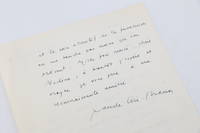
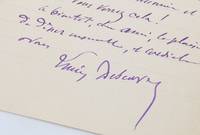
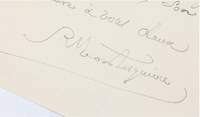
190783361s. l.: S. n. 1907. Fine. S. n. s. l. 21 mai 1907 25.50 x 20 cm une feuille Autograph letter signed by the dandy count 22 lines written in pencil addressed to his friend and bibliographer the critic Henri Lapauze: ""Neuilly Cher ami voici ce que je vous envoie d'accord avec Monsieur Schmoll qui m'en a téléphoné ce matin. Ne soyez pas effrayé par l'importance physique de ce document elle ne vient que de la grosseur des caractères. L'étendue n'en demeure pas moins normale. J'ajoute que les pièces ont été choisies parmi les transformées et remaniées comme elles le sont d'ailleurs à peu près toutes. Il serait désirable que cette publication eut lieu demain pour ne pas retarder l'apparition du volume. Dans ce cas j'enverrais ce soir pour la correction. La place sera celle que vous voudrez pourvu que ce soit en première page ou ""cheval"" - Votre femme m'a écrit une lettre délicieuse son éloge coule de source. Bien à vous deux. R. Montesquiou 21 mai 07."" Avec la mine de son crayon Robert de Montesquiou a trop appuyé en traçant un trait en dessous de son patronyme ce qui a occasionné un petit trou. ""Neuilly Dear friend here is what I am sending you in agreement with Monsieur Schmoll who telephoned me about it this morning. Do not be frightened by the physical importance of this document it only comes from the size of the characters. The extent nonetheless remains normal. I add that the pieces have been chosen among the transformed and reworked as they are moreover almost all of them. It would be desirable that this publication take place tomorrow so as not to delay the appearance of the volume. In this case I would send this evening for correction. The placement will be whatever you wish provided it is on the front page or ""cheval"" - Your wife wrote me a delightful letter her praise flows naturally. Best to you both. R. Montesquiou May 21st 07."" With the lead of his pencil Robert de Montesquiou pressed too hard while drawing a line under his surname which caused a small hole. Fold marks inherent to being placed in an envelope. S. n. unknown
197284434Paris 1972. Fine. Paris 26 Avril 1972 21 x 27 cm une page Autograph letter dated and signed by Raymond Queneau 17 lines in black ink addressed to Monsieur Lauwaert. Raymond Queneau and his wife Janine are sorry they cannot spend a few days with their friends: "" Ma femme doit entrer en clinique ces jours-ci pour un traitement de radiothérapie souffrant d'une sciatique aiguë"" ""My wife must enter the clinic these days for radiotherapy treatment suffering from acute sciatica"" hoping this is only a postponement: "". nous espérons bien venir en septembre et pouvoir récupérer longuement une meilleure santé car la meilleure non plus n'a pas été brillante cet hiver."" "". we very much hope to come in September and be able to recover better health for a long time as mine hasn't been brilliant this winter either."" A touching letter from Raymond Queneau about his wife's fragile health she being destined to pass away a few months later on July 18 1972. unknown
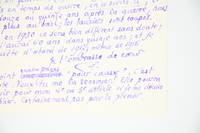
191677523Paris 1916. Fine. Paris Lundi 11 septembre 1916 13 x 20.50 cm 3 pages sur 2 feuillets Autograph letter signed with initial by Pierre Louÿs addressed to Georges Louis. Two pages written in purple ink on two sheets. Central folds inherent to posting. Fine letter addressed to his brother Georges Louis with whom Pierre Louÿs maintained a very intimate relationship and whom he considered as his own father. The question of Pierre Louÿs' real paternal identity still fascinates biographers today: ""His father Pierre Philippe Louis . had married in 1842 Jeanne Constance Blanchin who died ten years later after giving him two children Lucie and Georges. In 1855 he remarried Claire Céline Maldan and from this union was born in 1857 a son Paul; then in 1870 our writer who received the Christian names Pierre Félix. This late birth the differences in character between father and son the former's disaffection towards the latter the profound intimacy that always reigned between Louÿs and his brother Georges all this has led certain biographers and critics to suspect that the latter was in reality the writer's father. The exceptionally intimate and constant relationship that Pierre and Georges maintained between themselves throughout their lives could be an argument in this direction. Of course no irrefutable proof has been discovered and probably never will be. Nevertheless certain letters . are quite troubling. In 1895 for example Louÿs writes gravely to his brother that he knows the answer to 'the most poignant question' he could ask him a question he has had 'on his lips for ten years'. The following year at the height of Aphrodite's triumph he thanks Georges effusively and ends his letter with this sentence: 'Not one of my friends has a FATHER who is to him what you are to me.' Arguing from the close intimacy between Georges and Claire Céline during the year 1870 and from the jealousy that the father never ceased to show towards his younger son Claude Farrère did not hesitate to conclude in favor of Georges Louis. And what should we think of this dedication by Louÿs to his brother on a Japan paper copy of the first edition of Pausole: To Georges his eldest son / Pierre."" Jean-Paul Goujon Pierre Louÿs In this interesting letter Louÿs discusses at length the difficulty writers face in living by their pen. Titling his missive ""Continuation of our conversation about war and literature"" he first makes a very pessimistic observation: ""In the 16th century It was even worse! In the 16th the independent man of letters did not exist at all - to write one needed an office a benefice - or land and income rare fortune among writers. . It is only in the 19th century that we find a very small number of conscientious writers living by their pen. And even then. Do you want to count them Hugo almost alone succeeds. Lamartine fails and is obliged to beg pitifully at the end of his life. Gautier who had magnificent gifts only subsists by writing in newspapers . you see what I mean: Theatre and Journal."" He continues: ""That works well in peacetime. - In 1890 l'Echo de Paris inserted prose poems in the first column. - In ""date illegible because crossed out ""le Figaro had a literary supplement. . But in wartime in this century and ten twelve or fifteen years after the war we shall go to the woods no more; the laurels are cut down. Oh! In 1930 it will doubtless be very different; but I shall be 60 in fifteen years; and I worry first about 1917; even about 1916."" This very pessimistic letter was written at a period when Louÿs was at his worst ""The man who wrote these pages was a solitary man reclusive sick drugged surrounded by dubious creatures and having as confidant only this adored brother who would die less than a year later."" Ibid. unknown
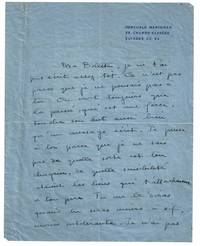
193674160Paris 1936. Fine. Paris s. d. 12 mars 1936 17.80 x 22.60 cm 2 pages sur un feuillet Fine autograph letter signed by Colette addressed to her friend Bolette Natanson. Two pages written in ink on blue headed paper from the Marignan building the writer's residence between 1936 and 1938. Transverse folds inherent to the folding of the letter for mailing. Moving letter addressed by Colette to her close friend following the death of her father Alexandre Natanson: "". ce dimanche va être un dimanche bien pénible. Je t'écris à l'heure juste où tu conduis ton père."" ""this Sunday is going to be a very painful Sunday. I am writing to you at the very moment when you are laying your father to rest."" Conscious of the suffering and ""chagrin"" ""grief"" of her ""chère Bolette"" ""dear Bolette"" she affectionately offers her support ""On croit toujours que la pensée qui est une force touche son but aussi bien qu'un message écrit."" ""We always believe that thought which is a force reaches its target as well as a written message."" ending her letter with a very beautiful declaration: ""Beaucoup de visages humains se penchent vers le tien et tu ne les aimes pas tous. Le mien que tu ne verras pas te suit de loin et s'inquiète de toi."" ""Many human faces lean toward yours and you do not love them all. Mine which you will not see follows you from afar and worries about you."" Bolette would commit suicide a few months later. Having evolved since her earliest childhood in artistic circles - she was the daughter of Alexandre and the niece of Thadée Natanson the creators of the famous Revue Blanche - Bolette Natanson 1892-1936 became friends with Jean Cocteau Raymond Radiguet Georges Auric Jean Hugo and also Colette. Passionate about couture she left Paris for the United States with Misia Sert a great friend of Coco Chanel and was hired at Goodman. With her husband Jean-Charles Moreux they created in 1929 the gallery Les Cadres on boulevard Saint-Honoré and frequented numerous artists and intellectuals. Their success was immediate and they multiplied their projects: the creation of the fireplace for Winnaretta de Polignac the decoration of the château de Maulny the arrangement of Baron de Rothschild's private mansion the creation of frames for industrialist Bernard Reichenbach and finally the creation of the storefront for Colette's beauty institute in 1932. Bolette Natanson also framed the works of her prestigious painter friends: Bonnard Braque Picasso Vuillard Man Ray André Dunoyer de Segonzac etc. Despite this meteoric rise she would end her life in December 1936 a few months after her father's death. unknown
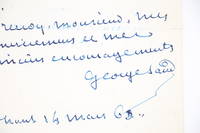
186376837Nohant Nohant-Vic 1863. Fine. Nohant Nohant-Vic 14 mars 1863 13.40 x 20.60 cm 3 pages sur un double feuillet Autograph letter signed by George Sand addressed to René Biémont. Three pages written in blue ink on a double sheet bearing at the head of the first page the blind stamp of Sand's initials. Envelope included. Folds inherent to mailing. This letter was published in the complete correspondence of George Sand established by Georges Lubin. Fine letter of congratulations addressed to René Biémont after sending his work Le Petit Fils d'Obermann: ""Your little book is very original and you show qualities of talent that will develop if you look ahead."" As an attentive reader much solicited by her young peers Sand develops her literary criticism: ""Obermann and his grandson the monk belong to the past. They are true and the timid Jean is well drawn. There is grandeur and truth in this exceptional type. But Constant d'Heurs is too passive to events. He should react against this powerless man and cure him or pity him more ."" Sententiously she thus concludes her letter: ""Do not complain of thankless work and accept it as a good thing three-quarters of life sacrificed to some duty makes the last quarter very strong and very alive. It is very good to be attached to poetry and thwarted in the possession of a beautiful dream. As soon as one can savor it without respite it fades or becomes troubled. I speak to you from experience. One is never happier and more inspired than when one believes one does not have time to be so."" Very fine testimony to the leading role that George Sand played on the literary scene of the Second Empire. unknown
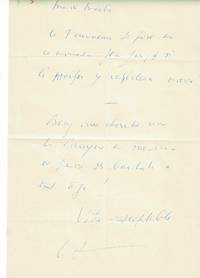
195076185s. l. Klarskovgaard 1950. Fine. s. l. Klarskovgaard 28 octobre 1950 21 x 34 cm 1 pages sur un feuillet Partly unpublished autograph letter signed by ""your touchy LF"" Louis-Ferdinand Céline addressed to his lawyer Maître Thorvald Mikkelsen. One page written in blue ink on a large sheet of white paper; number ""563"" in Céline's hand in the upper left corner in red pencil. Transverse folds inherent to the mailing. This letter was very partially transcribed in the Année Céline 2005. Céline after days of suffering from the cold is delighted to announce to his friend that he has received heating: ""Le fourneau se pose en ce moment. Je ne sais pas si la maison y résistera l'on verra !"" ""The stove is being installed right now. I don't know if the house will withstand it we shall see!"" This letter also mentions his Swedish friend Ernst Bendz like him a doctor and writer: ""Benz sic vous cherche un La Bruyère en suédois - on passe des bachots à tout âge !"" ""Bendz is looking for a La Bruyère in Swedish for you - one takes exams at any age!"" In 1947 Céline pursued by French justice for his collaborationist involvement was confined in Denmark. It was in May 1948 accompanied by Lucette and Bébert that he arrived at his lawyer Maître Thorvald Mikkelsen's home in Klarskovgaard. The latter owned a large property by the Baltic Sea and invited the exile to stay there. On February 21 1950 as part of the purge the writer was definitively condemned in absentia by the civic chamber of the Paris Court of Justice for collaboration to one year of imprisonment which he had already served in Denmark. The Swedish Consul General in Paris Raoul Nordling intervened on his behalf with Gustav Rasmussen the Danish Foreign Minister and managed to delay his extradition. On April 20 1951 Jean-Louis Tixier-Vignancour his lawyer since 1948 obtained Céline's amnesty as a ""severely disabled veteran of the Great War"" by presenting his file under the name of Louis-Ferdinand Destouches without any magistrate making the connection. Céline would leave Denmark the following summer after three years spent at his lawyer's home. unknown
191280804Alger Algiers 1912. Fine. Alger Algiers 14 mars 1912 11.30 x 15.20 cm 4 pages sur un feuillet double Autograph letter signed by Judith Gautier addressed to Céleste Chrétien her maid; four pages written in black ink on a double sheet. This letter mentions the visit of Francis a carpenter by profession and Céleste Chrétien's husband to Paris: ""Does Francis still want to come and spend a few days in Paris Can he do so without harming his work They are going to perform Tristane with marionettes. I would like to have him to help me and I think it would amuse him. I would send him a first-class railway pass he would sleep and eat at my place so as not to incur any expenses. The performance takes place Saturday the 23rd at 4 o'clock; and there will be a dress rehearsal the day before or two days before."" It was in 1910 that Judith Gautier published in La Revue de Paris a triptych in verse entitled Tristane which she had performed in her Little marionette theatre inaugurated in May 1897 at 4 rue Charras in Paris. This theatre which contained about a hundred seats was quickly allocated a subsidy by the Ministry of Fine Arts. unknown
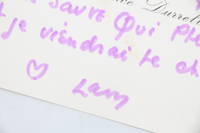
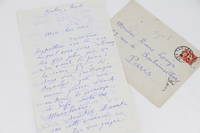
198086623Rhodes 1980. Fine. Rhodes s. d. ca 1980 13 x 8 cm une carte postale une enveloppe Suggestive autograph carte de visite signed by Lawrence Durrell addressed to Jani Brun written in brown and mauve felt-tip pens with accompanying envelope. ""dear Buttons. Oui telephonez moi quand tu es à Sauve-qui-pleut et je viendrai te chercher un coeur dessiné. Larry."" After many years spent in Greece Egypt and Rhodes the travel writer Lawrence Durrell was forced to flee Cyprus following popular uprisings that led the island to its independence from the British crown. Rich only in a shirt and a typewriter but crowned with the success of his novel Bitter Lemons of Cyprus Les citrons acides he arrived in France in 1956 and settled in the Languedoc village of Sommières. In the ""Tartès house"" his large dwelling surrounded by trees he wrote the second part of his work his monumental Avignon Quintet devoted himself to painting and received his illustrious friends including the couple Henry Miller and Anaïs Nin violinist Yehudi Menuhin London publisher Alan G. Thomas and his two daughters Penelope and Sappho. Among the olive trees and under the Mediterranean sun he met in the mid-1960s the young and vivacious ""Jany"" Janine Brun a thirty-year-old woman from Montpellier of devastating beauty who worked at the Antiquities department of the Sorbonne in Paris. She was nicknamed ""Buttons"" in memory of their first meeting where the young woman wore a dress covered with buttons. Henry Miller also fell under the charm of ""Buttons"" praising her beauty and eternal youth in exceptional unpublished letters. The three companions spent memorable Parisian evenings of which we retain precious autograph traces through their epistolary exchanges. Recommended by Durrell she made numerous trips notably to England from where she received vast correspondence from the writer as well as original works of art signed with his artist pseudonym Oscar Epfs. unknown
190886173Toulon 1908. Fine. Toulon 20 Juillet 1908 13.50 x 21.50 cm deux pages et demie sur un double feuillet une enveloppe Autograph letter signed by Claude Farrère then serving in the military 47 lines in blue ink written from Toulon to his friend Pierre Louÿs. Fold marks inherent to mailing envelope included. The soldier Claude Farrère thanks his friend for defending him during a dispute opposing him to a certain Monsieur B even though it was hardly worth devoting so much importance to him: ""Monsieur B read in some Annales that his fierce enemy was busy waging war in Safi against the Muslims. By incredible misfortune it happened that I had returned from there. His stupor was then so great that he lost his head."" ""Now I will never tell you to what extent I was moved by your role and by V.'s role in the whole affair."" Confident in his qualities as a fencer and marksman Claude Farrère allows himself this gentle and humorous jibe at his friend and seeks to reassure him at the risk of falling into anachronism: ""Lose the disastrous habit of seeing me killed each time someone speaks of swords around. On the contrary it is I who will kill the others. I do a great deal of fencing now. And I shoot the pistol like the late William Tell. Therefore be quiet. There. When shall we meet"" unknown
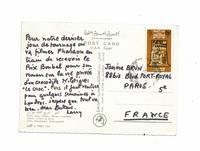
197173360Egypte Egypt 1971. Fine. Egypte Egypt 1971 10.50 x 15 cm une carte postale Autograph postcard signed ""Larry"" by Lawrence Durrell addressed to Jani Brun written in black felt-tip pen on the verso of a photograph of an Egyptian bas-relief. The writer to his young Montpellier lover: ""For our last day of filming we're going to film Pharaoh receiving the Bonbel Prize for his novel about the private life of a Nile crocodile: 'Le croc'. Then I have to return to London for a few weeks. I hope all is well dear Buttons."". After many years spent in Greece Egypt and Rhodes the traveling writer Lawrence Durrell was forced to flee Cyprus following popular uprisings that led the island to its independence from the British crown. Rich only with a shirt and a typewriter but crowned with the success of his novel Bitter Lemons of Cyprus Les citrons acides he arrived in France in 1956 and settled in the Languedoc village of Sommières. In the ""Tartès house"" his large residence surrounded by trees he wrote the second part of his work his monumental Avignon Quintet devoted himself to painting and received his illustrious friends including the couple Henry Miller and Anaïs Nin violinist Yehudi Menuhin London publisher Alan G. Thomas and his two daughters Penelope and Sappho. Among the olive trees and under the Mediterranean sun he met in the mid-1960s the young and sparkling ""Jany"" Janine Brun a thirty-something woman from Montpellier of devastating beauty who worked at the Department of Antiquities at the Sorbonne in Paris. She was nicknamed ""Buttons"" in memory of their first meeting where the young woman wore a dress covered with buttons. Henry Miller also fell under the charm of ""Buttons"" praising her beauty and eternal youth in exceptional unpublished letters. The three companions spent memorable Parisian evenings of which we retain precious autograph traces through their epistolary exchanges. Recommended by Durrell she made numerous trips notably to England from where she received vast correspondence from the writer as well as original works of art signed with his artist pseudonym Oscar Epfs. unknown
198586224Sion-sur-l'Océan Sion-sur-l'Océan 1985. Fine. Sion-sur-l'Océan Sion-sur-l'Océan 13 Août ca 1985 15 x 10 cm une carte postale Autograph postcard signed by Julien Gracq 19 lines in black ink addressed to his friend and monographer Ariel Denis written from his Vendée retreat on the verso of a photographic reproduction showing the Sion-sur-Océan coast from aerial view. Julien Gracq discusses his reading of Joyce and compares the Irish landscapes and climate to those of Vendée : ""Ici aucune trace des brumes d'Irlande il fait inaltérablement beau sans même un orage."" Here no trace of Irish mists the weather is unalterably beautiful without even a storm. and inquires about his friend's professional future : ""Comment s'arrangent vos perspectives universitaires pour l'année à venir Problème qui je sais assombrit toujours un peu vos fins de vacances et dont j'espère qu'il va se régler à votre satisfaction."" How are your university prospects working out for the coming year A problem which I know always casts a slight shadow over your vacation endings and which I hope will be resolved to your satisfaction. unknown
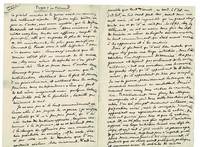
1911761441911. Fine. 29 juin 1911 13.50 x 21 cm 2 pages sur un feuillet double Signed autograph manuscript by Alain bearing the title ""Propos d'un Normand"" and the mention ""sans retard"" in the upper left of the first leaf two pages written in black ink on a double sheet. This text was published in the Propos d'un Normand de 1911. Interesting manuscript written following the appointment of Adolphe Messimy to the post of Minister of War: ""Ce général ministre avait en somme très noblement répondu. Il faudra enfin décider un jour ou l'autre sans aucun mystère que la Défense Nationale est républicaine."" ""This general minister had in sum responded very nobly. We must finally decide one day or another without any mystery that National Defense is republican."" Indeed the newly elected minister sought to redefine relations between political power and military authorities. Alain reproaches the military world for its opacity ""Comment la France sera-t-elle défendue Nous n'en savons rien. . chez nous même les députés ne s'en font aucune idée."" ""How will France be defended We know nothing about it. . even our deputies have no idea."" before proposing solutions: ""Donc il faudrait qu'il soit bien entendu que chaque chef garde une large initiative dans l'exécution d'un programme déterminé. Et ce programme ne dépend pas seulement de la science militaire ; c'est aux ministres avec le conseil des grands chefs qu'il appartient de le déterminer."" ""Therefore it should be well understood that each leader retains broad initiative in executing a determined program. And this program does not depend solely on military science; it is up to ministers with the counsel of senior leaders to determine it."" From 1903 Alain published weekly chronicles titled ""Propos"" in La Dépêche de Rouen et de Normandie. More than 3000 of these ""Propos"" concise articles inspired by daily current events would appear from February 1906 to September 1914. unknown
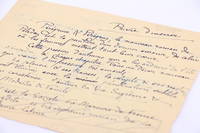
193286589Paris: S. n. Mercure de France 1932. Fine. S. n. Mercure de France Paris 22 Mai 1932 21.50 x 17.50 cm une feuille Manuscript publisher's slip written by Sar Péladan for the publication of his Pérégrine & Pérégrin at Mercure de France. Fold mark inherent to mailing. Manuscript with corrections. ""Prière d'insérer Pérégrine & Pérégrin le nouveau roman de Péladan est la peinture d'un dernier amour de celui où les femmes mettent tout leur coeur. Cette passion d'automne qui a les ardeurs de l'été s'encadre à chaque chapitre dans un décor nouveau quii varie l'impression des amants. La jalousie & les transes la volupté & ses réactions sont étudiées avec la même crossed out word pénétratiion subtile qui caractérise l'autuer du Vice suprême& la modestie & vanité. C'est la société du Mercure de France qui édite le dixseptième roman de la décadence latine this sentence having been crossed out."" S. n. [Mercure de France] unknown
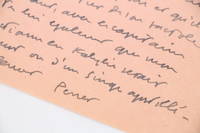
196085174s. l. 1960. Fine. s. l. s. d. ca 1960 21 x 27 cm une page Autograph letter signed by Jacques Perret 22 lines in black ink addressed to a colleague probably Roger Nimier. Fold mark inherent to postal dispatch. Jacques Perret awaits a letter from Roger Nimier that is running late: ""Your note arrived late given that I no longer live on rue de la clé but at 5 rue de l'Ancienne Comédie. Gordon Pym has not yet arrived but that doesn't surprise me coming from him."" and inquires about his correspondent's health: "". I learned that you had heart troubles; before long I will go see if everything has returned to order."" He enthuses about the success his friend Antoine Blondin is enjoying: ""When you see Blondin tell him that my thoughts follow him in his glory and that he should reserve half a setier of his treasure to drink when the day comes. Also tell him that my boy who is operating in Kabylia would be quite pleased with a word or an apostilled sign."" Jacques Perret a royalist writer fierce partisan of French Algeria and virulently anti-Gaullist was stripped of his civil rights and then in 1963 struck from the military medal roll despite protests from some of his fellow writers suspects that his political positions do not favor honorary decorations: ""I find that we were made to sign a manifesto manifestly designed to torpedo my ribbon."" unknown
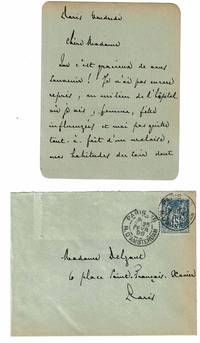
189876332Paris 1898. Fine. Paris 25 février 1898 11.40 x 8.80 cm une carte recto-verso et une enveloppe Autograph signed postcard by Stéphane Mallarmé addressed to Gabrielle Delzant wife of his friend Alidor written on both sides in black ink. Envelope included. Alidor Delzant was a lawyer collector and bibliophile. Friend of the Goncourts he devoted a work to them and was secretary and testamentary legatee of Edmond. ""Que c'est gracieux de vous souvenir ! Je n'ai pas encore repris au milieu de l'hôpital où je vis femme fille influenzées et moi pas quitte tout-à-fait d'un malaise mes habitudes du soir."" ""How gracious of you to remember! I have not yet resumed in the midst of the hospital where I live with wife and daughter suffering from influenza and myself not entirely free of discomfort my evening habits."" unknown
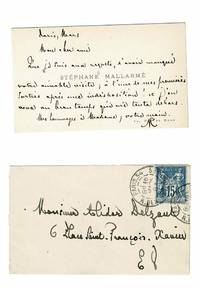
189376340Paris: S. n. 1893. Fine. S. n. Paris 16 mars 1893 10.40 x 6.30 cm une carte de visite et son enveloppe Visiting card with autograph signature by Stéphane Mallarmé addressed to Alidor Delzant. With envelope. Alidor Delzant was a lawyer collector and bibliophile. Friend of the Goncourts he devoted a work to them and was Edmond's secretary and testamentary legatee. ""Que je suis aux regrets d'avoir manqué votre aimable visite ; à l'une de mes premières sorties après une indisposition ! et j'en veux au beau temps qui me tenta dehors."" ""How I regret having missed your kind visit; during one of my first outings after an indisposition! and I blame the fine weather that tempted me outside."" S. n. unknown
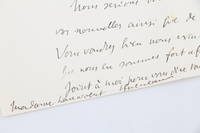
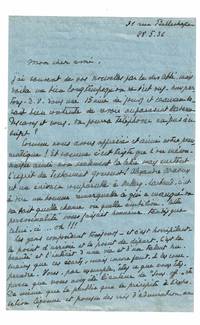
193676136Paris 1936. Fine. Paris 28 mai 1936 13.40 x 21 cm 2 pages sur un feuillet Autograph letter signed by Lucien Daudet addressed to Lucien Descaves; two pages written in black ink on a sheet of blue paper. Folds inherent to mailing. Fine letter discussing Alexandre Arnoux talent and the Prix Goncourt: ""Alexandre Arnoux est un écrivain comparable a Vallery sic Larbaud c'est-à-dire un homme remarquable à qui a manqué on ne sait quelle chance ou quelle ambition. . Quelquefois je m'imagine ce que devrait être l'Académie Goncourt dans son véritable esprit Goncourt et son prestige ici et en Europe si les Dix étaient vous mon frère Claudel Gide Max Jacob Cendrars Malraux Neveux etc."" ""Alexandre Arnoux is a writer comparable to Vallery sic Larbaud that is to say a remarkable man who lacked we know not what chance or what ambition. . Sometimes I imagine what the Goncourt Academy should be in its true Goncourt spirit and its prestige here and in Europe if the Ten were you my brother Claudel Gide Max Jacob Cendrars Malraux Neveux etc.""Alphonse Daudet Lucien's father was the first president of the Goncourt Academy in 1897. unknown
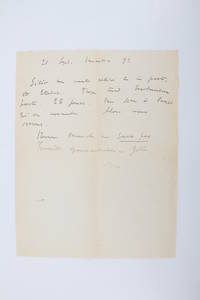
189380761Vaucottes Vattetot-sur-mer 1893. Fine. Vaucottes Vattetot-sur-mer 21 septembre 1893 15.60 x 20.10 cm quelques lignes sur un feuillet Autograph letter signed by Maurice Leblanc to an unknown recipient; a few lines written in black ink on a sheet. Transverse folds inherent to mailing. ""Sitôt ton mot retiré de la poste été Etretat. Trop tard. Natanson parti. 28 jours. Ne sera à Paris qu'en novembre. Alors nous verrons. Revue Blanche ne paie pas. Tempête épouvantable - grêle."" ""As soon as your note was collected from the post office went to Etretat. Too late. Natanson left. 28 days. Won't be in Paris until November. Then we'll see. Revue Blanche doesn't pay. Terrible storm - hail."" unknown
190574262s. l.: S. n. 1905. Fine. S. n. s. l. s. d. circa 1905 15 x 19 cm trois pages sur une double feuille Autograph letter signed by the dandy count three pages 27 lines written in black ink to his friends the Lapauzes that he is delighted to see them again soon even if they impose upon him the presence of a certain Sarah who is not among the people the poet seems to appreciate: ""Dear friends I will not do you the affront of not telling you that I would have preferred just the two of you alone"" words underlined but as the beautiful verse says: You do what you do / What you do is right."" For this meeting arranged at the Petit Palais of which Henry Lapauze becomes curator in 1905 after having been assistant director for the four preceding years Robert de Montesquiou ""a late riser who has the cowardice - or if you prefer the wisdom to choose the afternoon"" timidly expresses in a surge of wounded pride and revenge that he already regrets the possibility of his absence: "".only a throat irritation carelessly treated and unexpectedly could keep me away at the last moment. But I don't want to believe it. Let us arrange ourselves around Sarah!"" Henry Lapauze 1867-1925 was a journalist art critic then in 1905 curator of the Petit Palais converted four years earlier into a museum and whose collections he considerably enriched by acquiring notably the Courbet Henner Falguière collections with at the twilight of his life a marked predilection for the Decorative Arts of which he was one of the ardent promoters. S. n. unknown
197685081Fleury-Mérogis 1976. Fine. ""She's an exceptional woman . I considered her like a mother . Woe to anyone who would touch a single hair on her head."" Fleury-Mérogis 22 Septembre1976 21 x 29.50 cm une page recto verso Autograph letter dated and signed by Jacques Mesrine dated Saturday September 22 1976 67 lines in blue ink on one page recto verso addressed to his love of the time Jeanne Schneider thanks to whom the manuscript of Instinct de mort was discreetly smuggled out of prison. Jacques Mesrine then incarcerated at Fleury-Mérogis prison and deprived of human warmth is enthusiastic about all the visits he receives in the visiting room thus dispelling the myth of the antisocial bandit devoid of human feelings: ""And after that they'll say I'm a savage! No quite the contrary and people who have had contact with me want to see me again. This gave me immense pleasure and do you know what happened next. she's also going to ask to see you. Apparently I'm missed by the nurses 'mister smile' that's the secret."" He particularly appreciated the visit from the nurse at La Santé prison who would also be their wedding witness with Jeanne Schneider and whom he praises: "". an enormous surprise! You'll never guess who came to see me! My nurse from La Santé. yes my darling. that charming lady with white hair whom you had seen in the visiting room at La Santé and who is to be our witness at our wedding . She's an exceptional woman a former military nurse and quite well-placed in the ministry. During my 2 and a half years at La Santé I considered her like a mother this woman is so devoted it's unthinkable. Woe to anyone who would touch a single hair on her head."" Public enemy No. 1 takes the opportunity again to break this reputation as a bloodthirsty beast that sticks to him: ""If journalists knew that all the nurses entered my cell alone and with complete confidence we'd be far from the 'beast' and hostage-taking à la Buffet. Nurses have always been sacred to me. They are untouchable like quite a few other people but those journalist faggots don't know that; because they're not in my thoughts and that's regrettable sometimes."" Jacques Mesrine the rebel is surprised to find himself appreciating his prison solitude: ""Do you know that I'm beginning to like it here. What calm you know manou my isolation I bear it insofar as I have peace. In detention it's not proven that I would have it. It's my reactions I'm afraid of. and the mentality of so-called crooks is increasingly disgusting! . in my isolation there's good and bad. but personally I don't want to complain. because there's no reason to do so."" and ends his letter with paternal considerations for his daughter who is not very assiduous at school and for whom he worries: ""I'm going to find out if Sabrina has been regularly attending her classes. I hope so because if the opposite were the case. no mercy this time. But what worry this kid can represent and what powerlessness I have to control her being here!"" Rare and very fine letter from Jacques Mesrine overflowing with reverence for the nursing profession and regrettable detestation for that of journalists. unknown
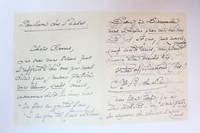
188977511Paris 1889. Fine. Paris jeudi 4 avril 1889 12.50 x 20 cm 4 pages sur un double feuillet Autograph letter signed by Pierre Louÿs addressed to his father four pages written in black ink on a double sheet of white paper. Transverse folds inherent to folding for mailing. This letter was sent by the young Pierre Louÿs while he was studying at the Janson-de-Sailly lycée Paris - 16th arrondissement. This is very likely one of Pierre Louÿs's last letters to his father ten days before the latter's death: ""Do you know that in less than two weeks I will be beside you . May I hope that by then you will have regained some strength"" The question of Pierre Louÿs's real paternal identity still fascinates biographers today: ""His father Pierre Philippe Louis . had married in 1842 Jeanne Constance Blanchin who died ten years later after giving him two children Lucie and Georges. In 1855 he remarried Claire Céline Maldan and from this union was born in 1857 a son Paul; then in 1870 our writer who received the first names Pierre Félix. This late birth the differences in character between father and son the first's disaffection toward the second the profound intimacy that always reigned between Louÿs and his brother Georges all this has led certain biographers and critics to suspect that the latter was in reality the writer's father. The exceptionally intimate and constant relationship that Pierre and Georges maintained between them throughout their lives could be an argument in this sense. Of course no irrefutable proof has been discovered and none will probably ever be discovered. Nevertheless certain letters . are quite troubling. In 1895 for example Louÿs writes seriously to his brother that he knows the answer to 'the most poignant question' he could ask him a question he has had 'on his lips for ten years.' The following year in the midst of Aphrodite's triumph he thanks Georges effusively and ends his letter with this sentence: 'Not one of my friends has a FATHER who is to him what you are to me.' Arguing from the close intimacy of Georges and Claire Céline during the year 1870 and from the jealousy that the father never ceased to show toward his younger son Claude Farrère did not hesitate to conclude in favor of Georges Louis. And what to think of this dedication by Louÿs to his brother on a Japan paper copy of the first edition of Pausole: To Georges his eldest son / Pierre."" Jean-Paul Goujon Pierre Louÿs Pierre Louÿs was only nine years old when his mother died suddenly. The father from then on entrusted his education to his brother Georges twenty years his senior and Pierre then joined him in Paris where he attended the École Alsacienne then the Janson-de-Sailly lycée. Despite the little affection shown to him the young man writes every week to his ""dear papa"" residing at Dizy-Magenta near Épernay. The young man inquires about his poor health: ""May I hope that by then you will have regained some strength No doubt. Your eczema we hope will not have worsened; and the green leaves that are beginning to appear will perhaps give you hope yourself for improvement next summer."" The ""improvement"" would sadly never come and Pierre Philippe Louis would breathe his last on April 14 1889. In the meantime Pierre Louÿs gives family news more precisely about Germaine his sister Lucie's daughter: ""Today I went to rue de la Santé to get news of Germaine. I found the little one who had been operated on in very good condition very cheerful and in good health. She was up and playing on the floor. . Finally I ended my day by going to my aunt Marie's and to Elisabeth's. Everyone is well in both houses."" As usual always anxious not to disappoint his father he finally transmits his school results: ""I return to the lycée tomorrow did Georges tell you that I was second in English"" unknown
193483171Paris 1934. Fine. Paris 20 avril 1934 13.50 x 21 cm une feuille Autograph letter signed on letterhead of the periodical ""Le journal"" by Lucien Descaves 15 lines in blue ink probably addressed to Raymond Escholier who published at Floury in 1934 a biography of Honoré Daumier. Fold mark inherent to envelope insertion. ""20 avril 34 Cher ami. Je suis désolé de vous avoir oh ! bien involontairement contrarié mais je rendais compte de votre livre comme je parlerai de celui que vous allez m'envoyer et que j'attends avec impatience. Alors je dirai ce que Daumier vous doit et ne doit pas à Suarès. Si j'aime Daumier et ses amis . Vous verrez cela ! A bientôt cher ami le plaisir de dîner ensemble et cordialement vous. Lucien Descaves."" ""20 April 34 Dear friend. I am sorry to have oh! quite involuntarily upset you but I was reviewing your book as I will speak of the one you are going to send me and which I await with impatience. So I will say what Daumier owes you and does not owe to Suarès. If I love Daumier and his friends. You will see that! See you soon dear friend for the pleasure of dining together and cordially yours. Lucien Descaves."" unknown
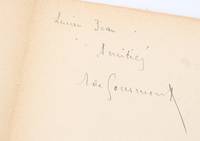
190084926s. l. 1900. Fine. s. l. s. d. ca 1900 8.50 x 11.50 cm une page sur un feuillet double Autograph letter signed by Remy de Gourmont addressed to a writer with whom he collaborates 1 page on a double sheet 14 lines in black ink regarding a sum owed to a publisher: ""On lui doit 3 fr versables quand Ducoté aura donné les fonds du mois de juillet."" ""We owe him 3 francs payable when Ducoté has provided the funds for the month of July."" Two small stains on the verso of the autograph letter. unknown
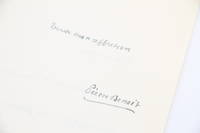
195085247La Roche-Posay 1950. Fine. La Roche-Posay s. d. ca 1950 13.50 x 21 cm une page Autograph letter signed by Pierre Benoit sent from La Roche-Posay 15 lines in blue ink about friendship and his wife's failing health. Central fold marks perforations from filing in a binder causing no losses. ""La Roche-Posay. Very dear friend I will be in Paris from the 27th to October 2nd. Sad journey. My wife is not well at all and I am joining her to try to find out what is wrong. . . I will do everything to see you during my stay. If without these circumstances one didn't bother friends what would they be for"" Don't write to me! I am the one who will telephone you. All my affection. Pierre Benoit."" unknown
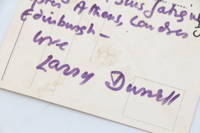
198083025Edimbourg Edinburgh 1980. Fine. Edimbourg Edinburgh 4 octobre 1980 10 x 14.50 cm une carte postale une enveloppe Suggestive autograph postcard signed by Lawrence Durrell addressed to Jani Brun written in violet felt-tip pen on the verso of a reproduction of a sculpture representing a satyr envelope attached. ""Buttons dear. J'arrive mardi pour deux nuits à Paris - au Royale. Si tu es libre de me joindre. faites moi signed. Suis fatigué après Athens Londres Edinburgh! Love. Larry Durrell."" ""Buttons dear. I arrive Tuesday for two nights in Paris - at the Royale. If you are free to join me. let me know. Am tired after Athens London Edinburgh! Love. Larry Durrell."" After many years spent in Greece Egypt and Rhodes the traveling writer Lawrence Durrell was forced to flee Cyprus following popular uprisings that led the island to its independence from the British crown. Rich only with a shirt and a typewriter but crowned with the success of his novel Bitter Lemons of Cyprus Les citrons acides he arrived in France in 1956 and settled in the Languedoc village of Sommières. In the ""Tartès house"" his large dwelling surrounded by trees he wrote the second part of his work his monumental Avignon Quintet devoted himself to painting and received his illustrious friends including the couple Henry Miller and Anaïs Nin violinist Yehudi Menuhin London publisher Alan G. Thomas and his two daughters Penelope and Sappho. Among the olive trees and under the Mediterranean sun he met in the mid-1960s the young and vivacious ""Jany"" Janine Brun a thirty-something woman from Montpellier of devastating beauty who worked at the Antiquities department of the Sorbonne in Paris. She was nicknamed ""Buttons"" in memory of their first meeting where the young woman wore a dress covered with buttons. Henry Miller also fell under the charm of ""Buttons"" praising her beauty and eternal youth in exceptional unpublished letters. The three companions spent memorable Parisian evenings of which we keep precious autograph traces through their epistolary exchanges. Recommended by Durrell she made numerous trips notably to England from where she received extensive correspondence from the writer as well as original works of art signed with his artist pseudonym Oscar Epfs. unknown