Renee VIVIENBiblio.com
1 815 résultats
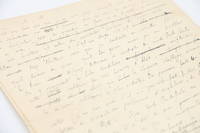
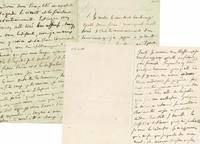
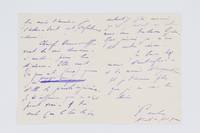
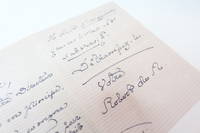
190579002s. l. Paris 1905. Fine. s. l. Paris s. d. 1905-1906 11.50 x 15.90 cm 3 pages sur un double feuillet Autograph letter signed ""Pauline"" by Renée Vivien addressed to Natalie Clifford Barney and written in violet ink on a double sheet bordered with violets. Transverse creases inherent to the mailing. Icy and a fresh attempt at rupture or at the very least a rebuff this letter is completely devoid of courtesy and tenderness: ""Je ne suis pas pareille à toi - j'ai de l'orgueil et de la fierté - cet orgueil tu l'as blessé cette fierté tu l'as froissée - je ne m'exposerai plus à des dégoûts de ce genre. Tes lettres te seront renvoyées sans être lues - ne m'envoie pas de fleurs elles seront refusées. Je vois peu de gens dans l'horreur où je vis des êtres j'en verrai moins encore - cela me procurera peut-être la paix. Je me demande seulement pourquoi tu m'as importunée pour me revoir si ce n'était pour m'humilier et me dégoûter de toi encore davantage. Adieu puisque je ne te reverrai plus de ma vie. Pauline"" ""I am not like you - I have pride and dignity - you have wounded that pride you have bruised that dignity - I will no longer expose myself to such disgust. Your letters will be returned unread - do not send me flowers they will be refused. I see few people in the horror I feel for human beings I will see even fewer - that will perhaps bring me peace. I only wonder why you bothered me to see me again if it was not to humiliate me and disgust me with you even more. Farewell since I will never see you again in my life. Pauline"" Moving letter revealing the suffering and isolation of the Muse of violets sliding inexorably toward her tragic end. It was at the end of 1899 and through the intermediary of Violette Shillito that Renée Vivien - then Pauline Tarn - made the acquaintance of Natalie Clifford Barney ""cette Américaine plus souple qu'une écharpe dont l'étincelant visage brille de cheveux d'or de prunelles bleu de mer de dents implacables"" ""this American more supple than a scarf whose sparkling face shines with golden hair sea-blue eyes implacable teeth"" Colette Claudine à Paris. Natalie who had just experienced a summer idyll with the scandalous Liane de Pougy who had initiated her into Sapphism paid only discrete attention to this new acquaintance. Renée however was completely subjugated by the young American and would relate this coup de foudre in her autobiographical novel Une Femme m'apparut: ""J'évoquai l'heure déjà lointaine où je la vis pour la première fois et le frisson qui me parcourut lorsque mes yeux rencontrèrent ses yeux d'acier mortel ses yeux aigus et bleus comme une lame. J'eus l'obscur prescience que cette femme m'intimait l'ordre du destin que son visage était le visage redouté de mon avenir. Je sentis près d'elle les vertiges lumineux qui montent de l'abîme et l'appel de l'eau très profonde. Le charme du péril émanait d'elle et m'attirait inexorablement. Je n'essayai point de la fuir car j'aurais échappé plus aisément à la mort."" ""I evoked the already distant hour when I saw her for the first time and the shiver that ran through me when my eyes met her mortal steel eyes her sharp blue eyes like a blade. I had the obscure prescience that this woman was giving me destiny's orders that her face was the dreaded face of my future. I felt near her the luminous vertigo that rises from the abyss and the call of very deep water. The charm of peril emanated from her and attracted me inexorably. I did not try to flee her for I would have escaped death more easily."" ""Hiver 1899-1900. Débuts de l'idylle. Un soir Vivien est invitée par sa nouvelle amie dans l'atelier de Mme Barney mère de Natalie 153 avenue Victor-Hugo à l'angle de la rue de Longchamp. Natalie s'enhardit à lire des vers de sa composition. Comme Vivien lui dit aimer ces vers elle lui répond qu'il vaut mieux aimer le poète. Réponse bien digne de l'Amazone."" ""Winter 1899-1900. Beginning of the idyll. One evening Vivie unknown
196970624Paris 1969. Fine. Paris 18 juillet 1969 21.60 x 28 cm 1 page sur un feuillet enveloppe jointe Autograph letter signed by Lawrence Durrell addressed to his lover Jani Brun dating from the beginning of their relationship. One page in blue ballpoint pen. Envelope included. The writer addresses here one of the first letters of his correspondence with his young friend from Montpellier which extended over more than two decades. Still unaccustomed to the French language he asked for help translating his letter: ""J'espère bien mieux te connaître . Gérard a traduit ceci de l'anglais pour moi. Comprendrais-tu si la prochaine fois j'écrivais en anglais . "" ""I hope to get to know you much better . Gérard translated this from English for me. Would you understand if next time I wrote in English . "" After many years spent in Greece Egypt and Rhodes the traveling writer Lawrence Durrell was forced to flee Cyprus following popular uprisings that led the island to its independence from the British crown. Rich only with a shirt and a typewriter but crowned with the success of his novel Bitter Lemons of Cyprus Les citrons acides he arrived in France in 1956 and settled in the Languedoc village of Sommières. In the ""Tartès house"" his large residence surrounded by trees he wrote the second part of his work his monumental Avignon Quintet devoted himself to painting and received his illustrious friends including the couple Henry Miller and Anaïs Nin violinist Yehudi Menuhin London publisher Alan G. Thomas and his two daughters Penelope and Sappho. Among the olive trees and under the Mediterranean sun he met in the mid-1960s the young and vivacious ""Jany"" Janine Brun a woman from Montpellier in her thirties with devastating beauty who worked in the Antiquities department of the Sorbonne in Paris. She was nicknamed ""Buttons"" in memory of their first meeting where the young woman wore a dress covered with buttons. Henry Miller also fell under the charm of ""Buttons"" praising her beauty and eternal youth in exceptional unpublished letters. The three companions spent memorable Parisian evenings of which we retain precious autograph traces through their epistolary exchanges. Recommended by Durrell she made numerous trips notably to England from where she received vast correspondence from the writer as well as original works of art signed with his artist pseudonym Oscar Epfs. unknown
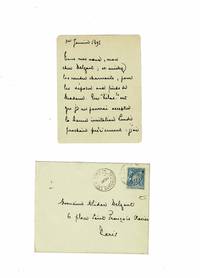
189276270Paris 1892. Fine. Paris 1er janvier 1892 8.80 x 11.40 cm une carte recto-verso et une enveloppe Autograph letter signed by Stéphane Mallarmé addressed to Alidor Delzant written on both sides in black ink. With envelope. Alidor Delzant was a lawyer collector and bibliophile. A friend of the Goncourts he devoted a work to them and served as secretary and testamentary legatee to Edmond. Charming letter in which the poet sends his wishes to his friend for the new year: ""Tous mes voeux mon cher Delzant ; et veuillez les rendre charmants pour les déposer aux pieds de Madame."" ""All my wishes my dear Delzant; and please make them charming to lay them at Madame's feet."" unknown
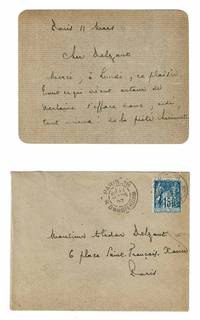
189776330Paris 1897. Fine. Paris 11 mars 1897 11.40 x 8.80 cm une carte recto-verso et une enveloppe Autograph postcard signed by Stéphane Mallarmé addressed to Alidor Delzant written on both sides in black ink. Envelope enclosed. Alidor Delzant was a lawyer collector and bibliophile. Friend of the Goncourts he devoted a work to them and was secretary and testamentary legatee of Edmond. ""Tout ce qui vécut autour de Verlaine s'efface donc aidé tant mieux ! de la piété charmante et tendre de Madame Delzant. La gloire du Poëte se fait toujours solitaire."" ""Everything that lived around Verlaine thus fades away helped so much the better! by the charming and tender piety of Madame Delzant. The Poet's glory always stands alone."" Delzant had announced to Mallarmé the death of Eugénie Krantz Verlaine's last mistress. Delzant's wife had frequented her during visits to the sick at Bonsecours hospital in Montrouge. unknown
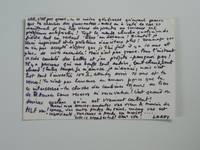
197070299Sommières 1970. Fine. Sommières s. d. circa 1970 15 x 10 cm une carte postale Autograph postcard signed by Lawrence Durrell addressed to Jani Brun written in black felt-tip pen on the verso of a view of the banks of the Vidourle at Sommières. Admirable and humorous confession by the writer to his young lover: ""Tout le monde cherche quelqu'un de fidèle tout en restant 'libre' en échange ! Bientôt je serai impuissant et le problème n'existera plus !"" ""Everyone is looking for someone faithful while remaining 'free' in return! Soon I will be impotent and the problem will no longer exist!"". Durrell reflects on his numerous feminine conquests ""Pour l'instant je suis comblé de belles et j'en profite - pourquoi pas !"" ""For now I am overwhelmed with beauties and I'm taking advantage of it - why not!"" and gives precious advice to his addressee who had chosen to remain independent despite the writer's entreaties: ""Tu n'es pas heureuse en amour parce que tu es intéressée - tu cherche sic des combines toujours au lieu de te donner sans réserve ni réservation ! C'est quand on deviens sic esclave qu'on est vraiment heureux !"" ""You are not happy in love because you are self-interested - you are always looking for schemes instead of giving yourself without reserve or reservation! It's when one becomes a slave that one is truly happy!"" After many years spent in Greece Egypt and Rhodes the traveler-writer Lawrence Durrell was forced to flee Cyprus following popular uprisings that led the island to its independence from the British crown. Rich only in a shirt and a typewriter but crowned with the success of his novel Bitter Lemons of Cyprus he arrived in 1956 in France and settled in the Languedoc village of Sommières. In the ""maison Tartès"" his large house surrounded by trees he wrote the second part of his work his monumental Avignon Quintet devoted himself to painting and received his illustrious friends including the couple Henry Miller and Anaïs Nin violinist Yehudi Menuhin London publisher Alan G. Thomas and his two daughters Penelope and Sappho. Among the olive trees and under the Mediterranean sun he met in the mid-1960s the young and sparkling ""Jany"" Janine Brun a thirty-something from Montpellier of devastating beauty who worked at the Department of Antiquities at the Sorbonne in Paris. She was nicknamed ""Buttons"" in memory of their first meeting when the young woman wore a dress covered with buttons. Henry Miller also fell under the charm of ""Buttons"" praising her beauty and eternal youth in exceptional unpublished letters. The three companions spent memorable Parisian evenings of which we retain precious autograph traces through their epistolary exchanges. Recommended by Durrell she made numerous trips notably to England from where she received extensive correspondence from the writer as well as original works of art signed with his artistic pseudonym Oscar Epfs. unknown
190078899s. l. Paris 1900. Fine. s. l. Paris s. d. ca. 1900 12.30 x 16.50 cm 1 page1/2 sur un double feuillet Autograph manuscript letter by Renée Vivien signed ""Pauline"" addressed to Natalie Clifford Barney and written in black ink on a double sheet with the poetess's silver monogram letterhead. A very charming letter evoking the flowers so dear to Renée ""Tout-Petit que j'aime je t'envoie des pensées toutes blanches. Garde-les dans ta chambre auprès de toi où sont mes vraies pensées tu le sais."" ""Little one I love I send you pansies all white. Keep them in your room near you where my true thoughts are you know."" as well as a gift from her ""tout petit chéri"" ""dear little one"": ""J'adore mes tablettes tu te rappelles les tablettes des deux petites joueuses de flûte - seulement elles les ont perdues et moi je ne veux pas perdre les miennes. J'ai écrit dessus en grec J'aime Natalie ! Cela m'a fait tant de plaisir ! - quelle bonne et jolie pensée tu as eue là ! -"" ""I adore my tablets do you remember the tablets of the two little flute players - only they lost them and I don't want to lose mine. I wrote on them in Greek I love Natalie! It gave me such pleasure! - what a good and lovely thought you had there! -"" Renée Vivien's Hellenist passion was born from her encounter with Eva Palmer during their stay in the United States where she accompanied Natalie Clifford Barney. This beautiful twenty-six-year-old redhead who it is said had translated all of Plato's Symposium with the Amazon gave Renée her first lessons in ancient Greek and awakened in her the passion for the poetess Sappho that never left her thereafter. It was at the end of 1899 and through Violette Shillito that Renée Vivien - then Pauline Tarn - made the acquaintance of Natalie Clifford Barney ""this American more supple than a scarf whose sparkling face shines with golden hair sea-blue eyes and implacable teeth"" Colette Claudine à Paris. Natalie who had just lived a summer idyll with the sulfurous Liane de Pougy who had initiated her into sapphism paid only discreet attention to this new acquaintance. Renée however was totally captivated by the young American and would relate this love at first sight in her autobiographical novel Une Femme m'apparut: ""I evoked the already distant hour when I saw her for the first time and the shiver that ran through me when my eyes met her eyes of mortal steel her sharp blue eyes like a blade. I had the obscure presentiment that this woman was giving me destiny's order that her face was the dreaded face of my future. I felt near her the luminous vertigo that rises from the abyss and the call of very deep water. The charm of peril emanated from her and attracted me inexorably. I did not try to flee her for I would have escaped death more easily."" ""Winter 1899-1900. Beginning of the idyll. One evening Vivien is invited by her new friend to Mme Barney's studio Natalie's mother 153 avenue Victor-Hugo at the corner of rue de Longchamp. Natalie ventures to read verses of her own composition. When Vivien tells her she loves these verses she replies that it is better to love the poet. A response quite worthy of the Amazon."" J.-P. Goujon Tes blessures sont plus douces que leurs caresses Two years of unequal happiness followed punctuated by Natalie's recurring infidelities and Renée's pathological jealousy whose letters oscillated between passionate declarations and painful mea culpa. ""Renée Vivien is the daughter of Sappho and Baudelaire she is the flower of evil 1900 with fevers broken flights sad voluptuousness."" Jean Chalon Portrait d'une séductrice In 1901 came an important rupture that would last almost two years; Renée despite Natalie's solicitations and the intermediaries she sends to win her back resists. ""The two friends saw each other again and it was in August 1905 the pilgrimage to Lesbos which constituted a disappointment for Natalie Barney and remained without consequence. . unknown
191388289Londres 1913. Fine. It is no longer a question of conquering the world; but of pacifying it. Work let us work together for world peace. Londres 12 décembre 1913 20 x 25.50 cm en feuillets Complete autograph manuscript in French by Anatole France 7 pages in black ink on 7 leaves and a signed autograph note on a bifolium. Complete and extensively corrected speech by Anatole France on the occasion of a banquet given in his honor in London. The future Nobel Prize winner for Literature delivers a passionate appeal for peace between nations and an ode to England - its philosophy literature and politics - less than a year before WW1. The writer offered this manuscript with a signed note: Keep dear colleague and friend keep these leaves of paper if they are of any value to you. Anatole France London December 12 1913. Anatole France's English biographer witnessed this speech which foreshadowed the absolute necessity of a close relationship between France and England based on their long and rich relationship: ""In December 1913 the Master paid a brief but memorable visit to this country. The central event of his sojourn in London was the banquet given in his honour at the Savoy Hotel. On this occasion it was apparently decided in those remote and exalted circles where such decisions are made that the socialist should be ignored his turn was to come later with the Fabians but that honour could and should be paid to the man of genius the foremost man of letters of the day. The feast was therefore presided over by a peer the late Lord Redesdale himself a gifted writer. The company was numerous and distinguished. . Monsieur France though an inimitable talker is not a speaker and on this occasion he read his discourse. All that I now remember of it was the rich deliberate music of the voice that uttered it and the words which he repeated with strange insistency: 'Travaillons de concert a la paix du monde''Let us work together for the peace of the world.' This was in December 1913. The exhortation thus reiterated seemed even then to be fraught with ominous significance and now looking back over the years of horror that were so soon to follow one wonders whether this old man with his strange inscrutable eyes and musical melancholy voice had somehow seen the shadow of the coming catastrophe."" J. Lewis May Anatole France the man and his work: an essay in critical biography p. 98-99. The manuscript contains numerous crossed-out and rewritten passages and shows the genesis of the writing of this beautiful speech: M.M. I am not sure that I am not dreaming. Welcomed with this splendid cordiality by so many men whose names works and thoughts represent so much greatness strength and beauty. . Your compatriots have authored masterpieces of this kind for two centuries. Need I remind you of Richardson and Fielding Swift and Daniel Defoe Walter Scott Dickens and Thackeray George Elliott . the novel is in England in its favorite soil like the apple in Normandy and the orange in Valencia. Why It takes a large volume or a single word to explain it. Well let's say it in a word. This word Lord Redesdale gave us a foretaste of it. It is that the novel is intimate cordial and familiar by nature and that the English has a familiar intimate and cordial spirit. Gentlemen I am not dreaming: it is a banquet I see the shining cups and the benevolent faces of the guests. And I can understand why you invited me. I am a symbol an allegory for you. I represent at this table the French literati just as at the festivals of the French Revolution the citizen Momoro represented the goddess Reason. Without being a goddess or particularly reasonable this idea puts me at ease and I won't quibble too much with you about the choice of your symbol. I tell myself that perhaps you didn't mind having a Frenchman at your table who having the weakness to write at least had the merit which you greatly value of never d unknown
1823759401823. Fine. s. d. ca 1823 12 x 18.20 cm Six pages sur deux feuillets rempliés Almost entirely unpublished handwritten letter from the painter Eugène Delacroix to the love of his youth the mysterious Julie now identified as being Madame de Pron by her maiden name Louise du Bois des Cours de La Maisonfort wife of Louis-Jules Baron Rossignol de Pron and daughter of the Marquis de La Maisonfort Minister of France in Tuscany patron of Lamartine and friend of Chateaubriand. 90 lines 6 pages on two folded leaves. A few deletions and two bibliographical annotations in pencil on the upper part of the first page no114. This letter is one of the last to his lover in private ownership all of Delacroix's correspondence to Madame de Pron being kept at the Getty Research Institute Los Angeles. Only nine of the ninety lines of this unpublished letter were transcribed in the Burlington Magazine in September 2009 alongside the long article by Michèle Hanoosh Bertrand and Lorraine Servois whose research finally revealed the identity of the famous recipient. Sublime love letter from twenty-four-year-old Eugène Delacroix addressed to his lover Madame de Pron twelve years his senior who unleashed the liveliest passion in him. This episode of the painter's youth then considered the rising star of Romanticism for a long time remained a mystery in the biography of Delacroix who was careful to preserve the anonymity of his lover thanks to various pseudonyms: Cara the Lady of the Italians and even Julie as in this letter in reference to the famous epistolary novel Julie ou la Nouvelle Héloïse by Rousseau. For obvious reasons Delacroix did not sign his name on any of the letters in correspondence with the lady. A great figure of the legitimate aristocracy the recipient of this feverish letter is Madame de Pron daughter of the Marquis de La Maisonfort Minister of France in Tuscany patron of Lamartine friend of Chateaubriand. Her beauty was immortalized in 1818 by Élisabeth Vigée-Lebrun who painted her portrait in pastel with an oriental hairstyle. Delacroix and Madame de Pron met in April 1822 when the portrait of the latter's son Adrien was commissioned a pupil at the Lycée Impérial now Lycée Louis-le-Grand. Delacroix had been commissioned for the portrait by his close friend Charles Soulier Madame de Pron's lover who despite himself served as an intermediary for Delacroix. In the absence of Soulier who had gone to Italy the painter and the young women established an intense romantic relationship. The portrait commission became a pretext for their tender meetings in his studio on rue de Grès while no trace of the child's painting has been found to this day. Their adventure lasted a little over a year but it was one of the most intense passions of the artist's life. Our letter undoubtedly corresponds to the last throes of their relationship in the month of November 1823. After one of their visits at the end of a hiatus of several months Delacroix writes to her again under the influence of emotion: I come home with a shaken heart what a wonderful evening! . Sometimes I say to myself: why did I see her again In the calm sanctuary where I lived even in the middle of the invisible places that I had formed . I managed to silence my heart. Madame de Pron had indeed decided to bring an end to their intimate relationship see her letter from 10 November 1823: I want sweet friendship . I do not want to torment you Getty Research Institute. Losing all discernment and with blind devotion Delacroix attempts to revive their affair: Make me lie prove to me that your soul is indeed that of the Julie that I once knew since mine has regained its charming emotions and its worries. But the painter runs into Soulier and General de Coëtlosquet also lovers of Madame de Pron. Delacroix had narrowly avoided a final disagreement with Soulier who had almost seen a letter from Madame de Pron in h unknown
190679020Paris 1906. Fine. Paris 3 mars 1906 12.40 x 16.80 cm 3 pages 1/2 sur un double feuillet Autograph letter signed ""Paule"" from Renée Vivien addressed to Natalie Clifford Barney and written in purple ink on a double sheet with violet letterhead and address of 23 avenue du Bois de Boulogne. Transverse folds inherent to posting. Charming letter allowing hope for an appeasement in Renée Vivien's amorous ubiquity who seems to have finally chosen Hélène de Zuylen: ""Je t'envoie des vers. Les aimes-tu Ils ne me plaisent qu'à moitié c'est déjà beaucoup ! Tu as oublié que tu voulais te tuer pour moi. A part ce léger détail tu as été parfaite Mon amie t'aime je t'adore tout est parfaitement ordonné . N'est-ce pas que mon amie est parfaitement bonne et charmante Je l'aime tant d'une façon si poignante si simple et si bête. ce qui est après tout la meilleure façon d'aimer !"" ""I am sending you verses. Do you love them They only half please me that's already a lot! You have forgotten that you wanted to kill yourself for me. Apart from this slight detail you have been perfect My friend loves you I adore you everything is perfectly ordered . Is it not true that my friend is perfectly good and charming I love her so much in such a poignant simple and silly way. which is after all the best way to love!"" One senses here however a still very deep attachment of the Muse of violets to the Amazon: ""Je baise tes mains d'autrefois et tes mains d'aujourd'hui Et je t'aime plus que je ne sais le dire."" ""I kiss your hands of yesteryear and your hands of today And I love you more than I know how to say."" It was at the end of 1899 and through the intermediary of Violette Shillito that Renée Vivien - then Pauline Tarn - made the acquaintance of Natalie Clifford Barney ""cette Américaine plus souple qu'une écharpe dont l'étincelant visage brille de cheveux d'or de prunelles bleu de mer de dents implacables"" ""this American more supple than a scarf whose sparkling face shines with golden hair sea-blue pupils implacable teeth"" Colette Claudine à Paris. Natalie who had just lived a summer idyll with the scandalous Liane de Pougy who had initiated her into sapphism paid only discrete attention to this new acquaintance. Renée however was totally captivated by the young American and would relate this thunderbolt in her autobiographical novel Une Femme m'apparut: ""J'évoquai l'heure déjà lointaine où je la vis pour la première fois et le frisson qui me parcourut lorsque mes yeux rencontrèrent ses yeux d'acier mortel ses yeux aigus et bleus comme une lame. J'eus l'obscur prescience que cette femme m'intimait l'ordre du destin que son visage était le visage redouté de mon avenir. Je sentis près d'elle les vertiges lumineux qui montent de l'abîme et l'appel de l'eau très profonde. Le charme du péril émanait d'elle et m'attirait inexorablement. Je n'essayai point de la fuir car j'aurais échappé plus aisément à la mort."" ""I evoked the already distant hour when I saw her for the first time and the shiver that ran through me when my eyes met her eyes of mortal steel her sharp blue eyes like a blade. I had the obscure presentiment that this woman was giving me destiny's order that her face was the dreaded face of my future. I felt near her the luminous vertigos that rise from the abyss and the call of very deep water. The charm of peril emanated from her and attracted me inexorably. I did not try to flee from her for I would have escaped death more easily."" ""Hiver 1899-1900. Débuts de l'idylle. Un soir Vivien est invitée par sa nouvelle amie dans l'atelier de Mme Barney mère de Natalie 153 avenue Victor-Hugo à l'angle de la rue de Longchamp. Natalie s'enhardit à lire des vers de sa composition. Comme Vivien lui dit aimer ces vers elle lui répond qu'il vaut mieux aimer le poète. Réponse bien digne de l'Amazone."" ""Winter 1899-1900. Beginning of the idyll. One evening Vivien i unknown
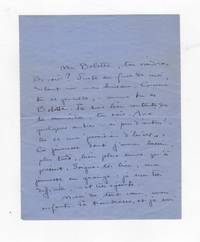
193574177s. l. Paris 1935. Fine. s. l. Paris s. d. circa 1935 17.70 x 22.50 cm 2 pages sur un feuillet Fine autograph letter signed by Colette to her friend Bolette Natanson. Two pages written in ink on blue paper. Horizontal folds inherent to the mailing of the letter. As ever protective and maternal with her friend Colette compliments her: ""Comme tu es gentille - comme tu es Bolette"". Nineteen years her senior she praises the youth of ""her child"": ""Tu es ma 'provision d'hiver' la jeunesse dont j'aurai besoin plus tard bien plus encore qu'à présent. Soigne-toi bien ma jeunesse en grange"". Having grown up from early childhood in artistic circlesshe was the daughter of Alexandre and the niece of Thadée Natanson the founders of the celebrated Revue BlancheBolette Natanson 1892-1936 formed friendships with Jean Cocteau Raymond Radiguet Georges Auric Jean Hugo and Colette. Passionate about dressmaking she left Paris for the United States with Misia Sert a close friend of Coco Chanel and was employed at Goodman. With her husband Jean-Charles Moreux they opened in 1929 the gallery Les Cadres on boulevard Saint-Honoré and moved in the company of numerous artists and intellectuals. Their success was immediate and they multiplied commissions: the fireplace for Winnaretta de Polignac the decoration of the Château de Maulny the arrangement of Baron de Rothschilds townhouse the creation of frames for the industrialist Bernard Reichenbach and finally the design of the shopfront for Colettes beauty institute in 1932. Bolette Natanson also framed the works of her distinguished painter friends: Bonnard Braque Picasso Vuillard Man Ray André Dunoyer de Segonzac and others. Despite this dazzling ascent she took her own life in December 1936 a few months after the death of her father. unknown
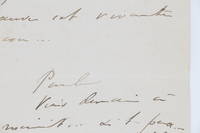
190578939s. l. Paris 1905. Fine. s. l. Paris s. d. ca. 1905 12.50 x 16.70 cm 4 pages sur un double feuillet Autograph letter signed ""Pauline"" and ""P.M.T."" by Renée Vivien addressed to Natalie Clifford Barney and written in black ink on a double folio with silver-violet letterhead and the address 3 rue Jean-Baptiste Dumas. Transverse fold inherent to mailing. Very fine love and reproach letter written after the long two-year separation and probably upon return from Mytilene Lesbos: ""Est-ce vraiment pour moi que tu restes demain Tout-Petit . Qui le saura jamais . Ce doute que le passé justifie un peu entrave mes plus hautains élans et fait de moi la créature misérable et triste que je suis."" ""Is it really for me that you stay tomorrow Little One . Who will ever know . This doubt which the past somewhat justifies hampers my most haughty impulses and makes me the miserable and sad creature that I am."" Renée weakened by Natalie's infidelities struggles to trust her again ""Je ne puis croire en toi"" ""I cannot believe in you"" but continues despite her suffering to be entirely devoted to her: ""Tu m'as dédaignée alors que tu aurais été pour moi la révélation miraculeuse - Tu m'as dédaignée. Et aujourd'hui tu t'étonnes de ne point me trouver telle que tu m'aurais rêvée toi qui n'as pas pris le soin de me façonner à ta guise ! Ecoute. Tu es comme un potier qui voyant à ses pieds un argile informe le repousserait et qui plus tard voyant un de ses élèves en fait une statue imparfaite exhalerait en termes amers sa colère et son dédain."" ""You scorned me when you would have been for me the miraculous revelation - You scorned me. And today you are surprised not to find me as you would have dreamed me you who did not take the care to shape me to your liking! Listen. You are like a potter who seeing at his feet an unformed clay would push it away and who later seeing one of his students make an imperfect statue from it would exhale in bitter terms his anger and disdain."" Torn between pain and desire Renée nevertheless calls for her lover: ""Viens demain à minuit.si tu peux. si tu veux. si Ilse n'en décide pas autrement et si ton caprice te le permet."" ""Come tomorrow at midnight.if you can. if you want. if Ilse doesn't decide otherwise and if your whim allows it."" These reunions would not last however: torn between Baroness Hélène de Zuylen and Natalie Renée would chain together travels; in turn to Holland Germany Switzerland and Venice she would confide her hesitations to Kérimé Turkhan-Pacha her epistolary companion from the Bosphorus. It was at the end of 1899 and through Violette Shillito that Renée Vivien - then Pauline Tarn - made the acquaintance of Natalie Clifford Barney ""cette Américaine plus souple qu'une écharpe dont l'étincelant visage brille de cheveux d'or de prunelles bleu de mer de dents implacables"" ""this American more supple than a scarf whose sparkling face shines with golden hair sea-blue eyes implacable teeth"" Colette Claudine à Paris. Natalie who had just lived a summer idyll with the sulfurous Liane de Pougy who had initiated her into sapphism paid only discreet attention to this new acquaintance. Renée on the other hand was totally captivated by the young American and would relate this love at first sight in her autobiographical novel Une Femme m'apparut: ""J'évoquai l'heure déjà lointaine où je la vis pour la première fois et le frisson qui me parcourut lorsque mes yeux rencontrèrent ses yeux d'acier mortel ses yeux aigus et bleus comme une lame. J'eus l'obscur prescience que cette femme m'intimait l'ordre du destin que son visage était le visage redouté de mon avenir. Je sentis près d'elle les vertiges lumineux qui montent de l'abîme et l'appel de l'eau très profonde. Le charme du péril émanait d'elle et m'attirait inexorablement. Je n'essayai point de la fuir car j'aurais échappé plus aisément à la mort."" ""I evoked the already distant hour when unknown
197684696Fleury-Mérogis 1976. Fine. Fleury-Mérogis 31 Décembre 1976 21 x 29.50 cm une page recto verso Autograph letter dated and signed by Jacques Mesrine dated Friday December 31st 1976 approximately 70 lines in blue ink on one recto verso page addressed to his love of the time Jeanne Schneider thanks to whom the manuscript of Instinct de mort was discreetly smuggled out of prison. Jacques Mesrine then incarcerated at Fleury-Mérogis prison wondered about the difficulties he might encounter if his Instinct de mort were to appear soon and with which sufficiently courageous publisher it could be edited: ""Je vais voir avec mon avocate pour les ""presses de la cité"" car je crois que l'on peut tirer un trait sur Simone. De toute façon il sera publié par celui acceptera d'en courir le risque"" ""I'm going to see with my lawyer about the ""presses de la cité"" because I think we can draw a line under Simone. In any case it will be published by whoever will accept to run the risk"" He also advised his beloved on her working conditions: ""Au sujet de ton boulot. j'espère que tu as discuté avec ta patronne car les horaires ne sont pas légaux. ne te laisse pas faire à ce sujet. Vis à vis du procureur tu es obligé de travailler. cela ne veut pas dire être esclave au boulot."" ""About your job. I hope you discussed with your boss because the hours are not legal. don't let yourself be taken advantage of on this subject. With regard to the prosecutor you are obliged to work. that doesn't mean being a slave at work."" and worried about the future of his daughter Sabrina: ""Demain j'espère la visite de la puce. je vais avoir une très sérieuse conversation avec elle au sujet de l'avenir. Car elle ne fait rien en classe. donc le mieux pour elle est de travailler pour obtenir un CAP en quelque chose. Elle veut jouer les adultes. alors il va falloir qu'elle se conduise en adulte."" ""Tomorrow I hope for a visit from the little one. I'm going to have a very serious conversation with her about the future. Because she does nothing in class. so the best thing for her is to work to get a vocational certificate in something. She wants to play at being an adult. so she'll have to behave like an adult."" Public enemy No. 1 evoked the coming new year: "".l'année nouvelle qui s'annonce. que nous réservera-t-elle. je l'ignore mais rien de bon si la logique se fait loi. cela ne m'empêchera pas de garder mon moral."" "".the new year that is coming. what will it hold for us. I don't know but nothing good if logic becomes law. that won't stop me from keeping my morale up."" Jacques Mesrine alone in his cell on the evening of December 31st New Year's Eve ended this beautiful letter with affectionate thoughts for Jeanne Schneider: ""Ce soir j'ai la tête un peu vide. tu comprends mais j'ai le coeur plein de toi et c'est cela qui compte. je vais me mettre dans les draps et penser à toi. Ton vieux voyou pose de tendres bécots sur tout ce qui est toi. Bonne nuit chaton. Te quiero."" ""Tonight my head is a bit empty. you understand but my heart is full of you and that's what counts. I'm going to get into the sheets and think of you. Your old rogue places tender kisses on everything that is you. Good night kitten. Te quiero."" and with this humorous note: "".tu connais cette blague : c'est une femme condamnée à mort. arrivée devant la guillotine elle embrasse le verre que l'on vient de lui servir. Le procureur demande : ""elle est folle que fait-elle"". L'avocat lui répond ""elle embrasse son dernier rhum"" Pas mal hein. un petit sourire ma puce."" "".do you know this joke: it's a woman condemned to death. arrived in front of the guillotine she kisses the glass that has just been served to her. The prosecutor asks: ""is she crazy what is she doing"". The lawyer replies ""she's kissing her last rum"" Not bad eh. a little smile my darling."" Rare and very beautiful letter from Jacques Mesrine in which we see him preoccupied with his daughter's future where he sho unknown
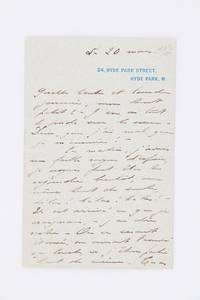
190079031s. l. Londres London 1900. Fine. s. l. Londres London Le 20 mars 1900 9.90 x 15.20 cm 4 pages sur un double feuillet Very long autograph manuscript letter from Renée Vivien signed ""Pauline"" written in black ink on a double sheet of headed paper from 24 Hyde Park Street. Transverse folds inherent to posting. Fine love letter sent from London while Renée was with her family: ""Quelle lente et lourde journée mon tout petit ! j'en ai tout le poids sur le cur Dieu que j'ai mal que je m'ennuie ! Ce matin j'avais un faible rayon d'espoir je croyais peut-être te rejoindre bientôt ou même tout de suite hélas ! hélas ! hélas ! Il est arrivé ce que je craignais j'ai dû rester On se serait étonné on aurait trouvé ça louche si j'étais partie tout de même."" ""What a slow and heavy day my little one! I have all its weight on my heart God how I hurt how I'm bored! This morning I had a faint ray of hope I thought perhaps to rejoin you soon or even right away alas! alas! alas! What I feared has happened I had to stay People would have been surprised they would have found it suspicious if I had left anyway."" This was only a few months since Renée and Natalie began seeing each other and we can read here the importance this relationship held for the Muse of violets who never ceased to flagellate herself: ""Ta pauvre lettre où chaque mot respire la mélancolie et la souffrance me brise le cur. Je souffre en la lisant tout ce que tu as souffert. Pardonne-moi Natalie ma bien-aimée ! Tes reproches sont si doux qu'ils me déchirent l'âme plus que toutes les récriminations amères qu'un autre être moins aimant m'aurait criées. J'ai eu tort cent fois tort mille fois tort de rester pourquoi donc ai-je obéi à un fantôme de Devoir à un spectre de Pitié qui je ne sais pourquoi m'obsède et vient m'ôter des heures divines que le Destin pitoyable m'accorde. La réalité c'est l'Amour il n'y a que lui rien n'est en dehors de lui et on souffre toujours de l'avoir sacrifié à quelque chose si sainte soit-elle."" ""Your poor letter where each word breathes melancholy and suffering breaks my heart. I suffer in reading it everything that you have suffered. Forgive me Natalie my beloved! Your reproaches are so sweet that they tear my soul more than all the bitter recriminations that another less loving being would have cried to me. I was wrong a hundred times wrong a thousand times wrong to stay why then did I obey a phantom of Duty a specter of Pity which I don't know why obsesses me and comes to take from me divine hours that pitiful Destiny grants me. Reality is Love there is only it nothing is outside of it and one always suffers from having sacrificed it to something however sacred it may be."" Very fine letter imbued with the devouring passion of the Muse of violets for her Amazon. It was at the end of 1899 and through the intermediary of Violette Shillito that Renée Vivien - then Pauline Tarn - made the acquaintance of Natalie Clifford Barney ""cette Américaine plus souple qu'une écharpe dont l'étincelant visage brille de cheveux d'or de prunelles bleu de mer de dents implacables"" ""this American more supple than a scarf whose sparkling face shines with golden hair sea-blue eyes implacable teeth"" Colette Claudine à Paris. Natalie who had just lived a summer idyll with the sulfurous Liane de Pougy who had initiated her to sapphism paid only discreet attention to this new acquaintance. Renée however was totally subjugated by the young American and would relate this love at first sight in her autobiographical novel Une Femme m'apparut: ""J'évoquai l'heure déjà lointaine où je la vis pour la première fois et le frisson qui me parcourut lorsque mes yeux rencontrèrent ses yeux d'acier mortel ses yeux aigus et bleus comme une lame. J'eus l'obscur prescience que cette femme m'intimait l'ordre du destin que son visage était le visage redouté de mon avenir. Je sentis près d'elle les vertig unknown
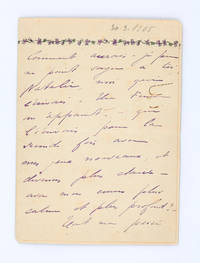
190578968s. l. Paris 1905. Fine. s. l. Paris 30 mars 1905 11.50 x 15.90 cm 6 pages 1/2 sur deux doubles feuillets Autograph letter signed ""Pauline"" by Renée Vivien addressed to Natalie Clifford Barney and written in violet ink on two double sheets edged with violets. Transverse folds inherent to posting. Very fine love letter evoking the only novel by the Violet Muse Une femme m'apparut. ""Comment aurais-je pu ne point songer à toi Natalie moi qui écrivais « Une femme m'apparut » - qui l'écrivais pour la seconde fois avec mes yeux nouveaux et devenus plus clairs - avec mon cur plus calme et plus profond "" ""How could I not have thought of you Natalie I who was writing 'Une femme m'apparut' - who was writing it for the second time with my new eyes which had become clearer - with my heart calmer and deeper"" Published in 1904 this novel - the only one of Renée's literary career - tells the love story of the narrator and ""Vally"" Natalie Clifford Barney from their beginning to their tragic end and the ""apparition"" of the savior Hélène de Zuylen. Reconciled with the Amazon Renée undertakes to rewrite the book which will appear at the beginning of 1906: ""Literary and stylistic improvement No. The concern to justify herself anew but this time in the face of Natalie Barney is beyond doubt. Remorse too: now the apparition that gives the book its title is no longer Eva-Hélène de Zuylen but Lorely-Natalie Barney and this from page 2. When we know that during the summer of 1904 unexpected reunions in Bayreuth came to unite Natalie Barney and Vivien we better understand the meaning of this new version of the novel Renée only returns to her amorous past to deliver us a second version revised and corrected. She thus erases the final choice she had suggested in the first version. Complete palinode confirmed by the very text of the letters that Vivien will write to Natalie Barney in 1904 and especially in 1905."" J.-P. Goujon Tes blessures sont plus douces que leurs caresses This confusion of feelings shows through this letter filled with oxymorons: ""je goûte une tristesse charmante à t'évoquer . quand je songe à toi j'évoque ma plus belle douleur"" ""I taste a charming sadness in evoking you . when I think of you I evoke my most beautiful pain"" The sadness - mixed with unconditional love - is here pushed to its paroxysm: ""Ne te laisse pas attrister par ma lettre grise de ce soir. Il y a des heures ternes - ce sont peut-être les meilleures - Dans tous les cas ce sont les plus vraies . Et ceux qui sont comme tu le dis « ingrats et joyeux » sont fort à plaindre."" ""Do not let yourself be saddened by my grey letter this evening. There are dull hours - these are perhaps the best - In any case these are the truest . And those who are as you say 'ungrateful and joyful' are much to be pitied."" Vivien effaces herself completely in favor of her beloved even proposing to live in her place: ""Va - si tu le peux - là où je voudrais être - à Mytilène. Je verrais l'île merveilleuse à travers tes prunelles - tu me ferais respirer tous ses parfums - A dire vrai le courage m'a manqué pour y aller. Je n'avais plus la force ni le désir de partir ainsi."" ""Go - if you can - where I would like to be - to Mytilene. I would see the marvelous island through your eyes - you would make me breathe all its perfumes - To tell the truth I lacked the courage to go there. I no longer had the strength nor the desire to leave thus."" ""Ne peux-tu toi aller à Mytilène et me rapporter des roses de là-bas "" ""Cannot you go to Mytilene and bring me roses from there"" Yet it is together that the two lovers will soon undertake the journey to Lesbos; it will be the last of their story. It was at the end of 1899 and through Violette Shillito that Renée Vivien - then Pauline Tarn - made the acquaintance of Natalie Clifford Barney ""cette Américaine plus souple qu'une écharpe dont l'étincelant visage brille de cheveux d'or de prunelles bleu de mer d unknown
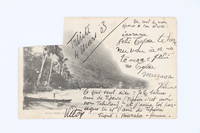
190379067Tahiti Tahiti 1903. Fine. Tahiti Tahiti 4 mars 1903 14 x 9 cm une carte postale ""Tépéva is my name"". Handwritten postcard signed sent from Tahiti and addressed to Émile Mignard Tahiti 4 March 1903 14 x 9 cm one postcard Handwritten signed postcard from Victor Segalen sent from Tahiti and addressed to émile Mignard. A few lines written in black ink around the black and white photographic reproduction of a view of Bora-Bora correspondent's address handwritten on the verso. Some minor stains a cut corner likely due to the removal of the stamp. Doctor Segalen seems to have taken a wife: A word from my wife to you: written by the hand of said wife iaorana fetii Tepeva te here neivou ia se no te mea e fetii no Tapeva Maraéa Vahine. Written by Segalen again Which means: I greet you friend of Tépéva Tépéva is my name in Tahitian and I love you because you are a friend of Tépéva. signed Maraéa-wife. Segalen's biography makes no mention of this exotic wife. Emile Mignard 1878-1966 also a doctor and Brest-born was one of Segalen's closest childhood friends whom he met at the Jesuit Notre-Dame-de-Bon-Secours School. The writer interacted with this comrade in an abundant and closely followed correspondence in which he described with humor and intimacy his daily life in all corners of the world. It was at Mignard's wedding on 15 February 1905 that Segalen met his wife Yvonne Hébert. unknown
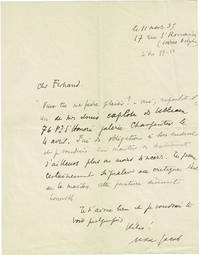
193575865Paris 1935. Fine. Paris 31 mars 1935 21 x 27 cm une page sur un feuillet Unpublished autograph letter signed by Max Jacob addressed to Fernand Pouey. One page written in black ink on a sheet. Two transverse folds inherent to mailing. Remarkable letter in which Max Jacob asks a strange favor of his friend: ""Un de nos amis explose sic des tableaux 76 Fg St Honoré galerie Charpentier le 4 avril. J'ai des obligations à son endroit et je voudrais lui montrer des sentiments d'ailleurs plus ou moins sincères. Tu peux certainement signaler au critique d'art de la maison cette peinture sûrement honorable."" ""One of our friends is exploding sic paintings 76 Fg St Honoré galerie Charpentier on April 4th. I have obligations toward him and I would like to show him feelings that are more or less sincere. You can certainly point out to the house art critic this surely honorable painting."" The mysterious ""friend"" mentioned in this letter could be the painter Balthus who exhibited at the Galerie Charpentier in early April 1935. unknown
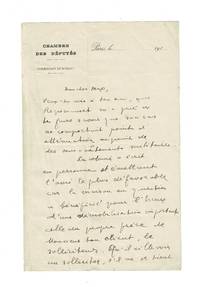
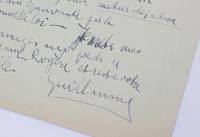
191875931Paris 1918. Fine. Paris s. d. ca 1918 13.30 x 21 cm 2 pages sur un feuillet Unpublished autograph letter signed by Guillaume Apollinaire addressed to Max Jacob. Two pages written in black ink on a sheet with the letterhead of the Chamber of Deputies. Folds inherent to mailing. Unpublished letter concerning the deputy Charles Régismanset then Director at the Ministry of Colonies: ""Veux-tu dire à ton ami que Régismanset m'a prié de te faire savoir que son cas ne comportait point d'atténuation au point de vue des sous-vêtements militaires."" ""La colonie a écrit en personne et émettant l'avis le plus défavorable car la maison en question a bénéficié pour l'heure d'une démobilisation importante."" ""These 'colonies' are hardly distant. He is seconded to Rue Oudinot to the office of Minister Henri Simon who was pleased to be able to assist a poet he had long admired. His duties are rather vague. Assigned to the Press Service he oversees the Bulletin d'Informations coloniales et étrangères occasionally contributing discreetly a task that leaves him sufficient freedom for his own work. His direct superior Charles Régismanset himself a writer calls upon him whenever a 'bushman' passing through might provide information on Bambara customs or Guinean witch doctors."" Pierre-Marcel Adéma Guillaume Apollinaire ""Viens tout de même me voir dirait le père Janvier qui doit pour le moins parler aussi bien que le père de Victor Hugo surtout viens avant janvier et toujours plus haut Excelsior viens j'ai quelque chose d'éditorial à te dire."" unknown
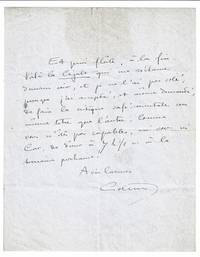
192075260Marseille 1920. Fine. Marseille s. d. circa 1920 19.80 x 25.20 cm une page sur un feuillet Autograph letter signed by Colette addressed to her friend the man of letters and lawyer Adrien Peytel nine lines written in black ink. Some folding marks inherent to the mailing of the letter. ""And then damn it enough already. Here La Cigale is calling me for tomorrow evening and I haven't stolen it since I accepted and even asked to do the café-concert criticism on the same level as the other."" unknown
189574263s. l.: S. n. 1895. Fine. S. n. s. l. s. d. circa 1895 12.50 x 17 cm une page et demie sur une feuille Autograph letter signed by the dandy count of a page and a half 13 lines written in black ink to his friend the journalist from Le Gaulois Henry Lapauze so that he might use his decisive influence in the publication of a text: ""Il doit s'imaginer que ce texte est subversif. Détrompez-le."" ""He must imagine that this text is subversive. Disabuse him of this notion."" initially validated by Arthur Meyer but which Robert de Montesquiou wants to ensure through his friend will indeed be printed: ""J'ai vu votre directeur qui accepte en principe. Cependant comme votre intervention pour faire est déterminante j'insiste auprès de vous."" ""I have seen your director who accepts in principle. However as your intervention to make it happen is decisive I insist upon you."" Henry Lapauze 1867-1925 was a journalist art critic then in 1905 curator of the Petit Palais converted four years earlier into a museum and whose collections he considerably enriched by acquiring notably the Courbet Henner Falguière collections with in the twilight of his life a marked predilection for the Decorative Arts of which he was one of the ardent promoters. S. n. unknown
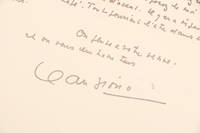
195284966s. l. 1952. Fine. s. l. ca 1952 21 x 27 cm une feuille Autograph letter signed by Jean Giono 14 lines in black ink addressed to Roland Laudenbach who jointly ran the magazine Opéra with his friend Roger Nimier. Fold marks inherent to the mailing. ""Cher Roland j'y pense : Voulez-vous quelque chose pour Opéra de qualité d'assez sensationnel et qui fuisse faire sept à huit numéros peut-être plus à votre gré Le Journal. Le Journal de 1936 à 1949. Si cela vous plait parlez en avec Nimier pensez à un chiffre proposez le moi ça ira sûrement et c'est d'accord. Il y en a déjà pas mal de tapé ! Tout le journal l'être dans un mois. On pense à votre venue et on vous embrasse tous. Jean Giono."" Dear Roland I'm thinking: Would you like something for Opéra Something quality rather sensational that could run for seven to eight issues perhaps more as you wish The Journal. The Journal from 1936 to 1949. If this appeals to you discuss it with Nimier think of a figure propose it to me it will surely work out and we're in agreement. Quite a bit of it is already typed! The entire journal will be ready in a month. We're thinking of your visit and we all embrace you. Jean Giono. A very visual letter bearing Jean Giono's handsome signature. unknown
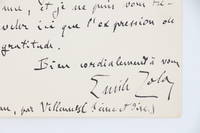
188279109Médan 1882. Fine. Médan 16 novembre 1882 13.60 x 21.40 cm 2 pages sur un double feuillet - enveloppe jointe Autograph letter signed by Emile Zola - apparently unpublished - addressed to Léon Carbonnaux written in black ink on a double sheet. Folds inherent to mailing. Envelope included. Important testimony to the colossal documentation work and the capital role of Emile Zola's informants in depicting his immense natural and social fresco. This letter was sent to Léon Carbonnaux department head at Bon Marché who transmitted precious information to Emile Zola for the creation of the eleventh volume of the Rougon-Macquart series: Au Bonheur des Dames. Only two letters from Léon Carbonnaux to Emile Zola are known: they can be consulted in the digitization of the preparatory file for Bonheur des Dames made available online by the Bibliothèque nationale de France. However we know thanks to this same file which contains a long section entitled ""Notes Carbonnaux"" that this department head at Bon Marché provided a significant amount of information to Zola particularly about employee customs and their remuneration. The two men undoubtedly met when Emile Zola eager for information about the functioning of department stores conducted field research in February and March 1882. ""J'ai pris l'inventaire comme cadre à un de mes chapitres. D'ailleurs je n'ai spécialement besoin que du travail dans le rayon des confections et dans le rayon des soieries. Il est inutile de me renseigner sur les autres rayons."" ""I have taken the inventory as the framework for one of my chapters. Moreover I specifically only need the work in the ready-to-wear department and in the silk department. It is unnecessary to inform me about the other departments."" Thanks to this important letter we understand that it was Léon Carbonnaux who provided the essential information to Emile Zola for writing his very beautiful eleventh chapter devoted to the inventory: ""Vous avez eu l'obligeance de me donner certains détails sur l'inventaire. Vous m'avez dit qu'on choisissait le premier dimanche d'août qu'on fermait les portes et que tous les employés s'y mettaient. On vide toutes les cases n'est-ce pas on jette les marchandises sur les comptoirs ou à terre et l'inventaire n'est terminé que lorsqu'il n'y a plus absolument rien en place."" ""You were kind enough to give me certain details about the inventory. You told me that the first Sunday in August was chosen that the doors were closed and all the employees set to work. All the compartments are emptied aren't they The merchandise is thrown onto the counters or on the ground and the inventory is only finished when there is absolutely nothing left in place.""The final version of Bonheur des Dames contains all the precious information provided by the department head of Bon Marché: ""Le premier dimanche d'août on faisait l'inventaire qui devait être terminé le soir même. Dès le matin comme un jour de semaine tous les employés étaient à leur poste et la besogne avait commencé les portes closes dans les magasins vides de clientes. . Neuf heures sonnaient. . Dans le magasin inondé de soleil par les grandes baies ouvertes le personnel enfermé venait de commencer l'inventaire. On avait retiré les boutons des portes des gens s'arrêtaient sur le trottoir regardant par les glaces étonnés de cette fermeture lorsqu'on distinguait à l'intérieur une activité extraordinaire. C'était d'un bout à l'autre des galeries du haut en bas des étages un piétinement d'employés des bras en l'air des paquets volant par-dessus les têtes ; et cela au milieu d'une tempête de cris de chiffres lancés dont la confusion montait et se brisait en un tapage assourdissant. Chacun des trente-neuf rayons faisait sa besogne à part sans s'inquiéter des rayons voisins. D'ailleurs on attaquait à peine les casiers il n'y avait encore par terre que quelques pièces d'étoffe. La machine devait s'échauffer si l'on voulait finir le soir même. unknown
191383938s. l. Paris 1913. Fine. ""I will come to see you to speak to you about naturalization I am appalled by the new law"" s. l. Paris s. d. ca. juin 1913 15.70 x 24.50 cm une page sur un feuillet Unpublished autograph letter signed by Guillaume Apollinaire addressed to Jean Royère one page written in black ink on a sheet. Transverse folds inherent to posting. Very fine letter of thanks from poet to poet. ""I thank you for the admirable article you devoted to me. You have felt my soul like no one else."" Jean Royère had indeed written a laudatory article upon the publication of Alcools in the June 20 1913 issue of La Phalange: ""Here gathered in an 18mo of barely two hundred pages is almost the entire poetic work of Apollinaire. Fifteen years of poetry rest in this small volume. I therefore do not open it without almost a preconceived admiration. In poetry abundance means sterility and one only writes three volumes in a year through inability to devote one's life to a book. Apollinaire evidently will leave only one book of verse like Baudelaire and Mallarmé like Rimbaud: this is a considerable chance of immortality for the true poet is one who has this too rare gift of condensation."" "". I will come to see you in the coming days to thank you first and also to speak to you about naturalization I am appalled by the new law."" The poet here alludes to the Three Year Law dubbed the Barthou Law increasing the duration of military service from two to three years in view of preparing the French army for a possible war with Germany. If Apollinaire's biography prefers to focus on the publication of his works in this year 1913 the letters his mother addresses to her son show that the latter moves heaven and earth to avoid military service and be naturalized as quickly as possible: ""For your papers an Italian colonel attached to the ministry of war who was witness for your act of recognition had written to me once to give me the steps to follow so that you would be exempted from military service in Italy and for your French naturalization. I am going to write to him moreover to ask him to see to the Town Hall."" letter from Angelika Kostrowicka of July 12 1913. War would come soon and on August 3 1914 the day after mobilization the stateless poet would file a request for voluntary enlistment accompanied by a naturalization request. The latter would only be granted to him in 1916. An interesting letter written at the dawn of the Great War bearing witness to Guillaume Apollinaire's two passions: poetry and France. unknown
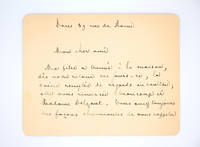
189375921Paris 1893. Fine. Paris 13 octobre 1893 11.40 x 8.90 cm une carte recto verso - enveloppe jointe Signed autograph card from Stéphane Mallarmé addressed to Alidor Delzant written in black ink on both sides. With envelope. Alidor Delzant was a lawyer collector and bibliophile. A friend of the Goncourts he devoted a work to them and was Edmond's secretary and testamentary legatee. A friendly card in which Mallarmé thanks Alidor Delzant for a surprise sent: ""Ma fille a trouvé à la maison dès notre retour ces jours-ci la caisse remplie de regards en coulisse ; elle vous remercie beaucoup et Madame Delzant. Vous avez toujours des façons charmantes de vous rappeler à vos amis même quand ils se souviennent."" ""My daughter found at home upon our return these past days the crate filled with sidelong glances; she thanks you very much and Madame Delzant. You always have charming ways of reminding your friends of yourself even when they remember."" The ""regards en coulisse"" are likely apricots or prunes. unknown
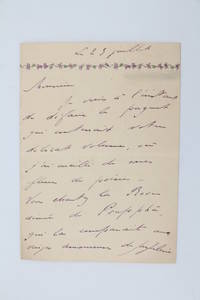
190779815s. l. Paris 1907. Fine. s. l. Paris Le 23 juillet ca. 1907-1908 11.50 x 16 cm 2 pages sur un double feuillet Handwritten signed letter addressed to a poet: You sing the rose loved by Psapphâ who compared it to the loving virgins of Mitilini Paris 23 July ca1907-1908 11.5 x 16 cm 2 pages on a double leafHandwritten signed letter from Renée Vivien addressed to a poet written in violet ink on a double leaf of paper decorated at the head with a border of violets. Transverse folds from having been sent. Monsieur Je viens à l'instant de défaire le paquet qui contenait votre délicat volume où j'ai cueilli de rares fleurs de poésie. Vous chantez la rose aimée de Psapphâ qui la comparait aux vierges amoureuses de Mytilène. Parmi vos poèmes je préfère : ''Sa Voix"" ""Sa Grâce"" et ""Les Mains et l'Apothéose"" . Renée Vivien Monsieur I have just this minute undone the package that contained your delicate volume where I picked rare flowers of poetry. You sing the rose loved by Psapphâ who compared it to the loving virgins of Mitilini. Among your poems I prefer: Sa Voix"" ""Sa Grâce"" and ""Les Mains et l'Apothéose"" . Renée Vivien Despite the precision of the titles mentioned it has not been possible for us to identify the poet to whom Vivien sent this letter of thanks. These titles are reminiscent of the poems of the Muse aux violettes herself. unknown
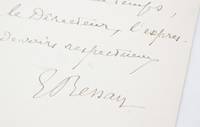
188486688Bellevue Meudon 1884. Fine. Bellevue Meudon 17 Octobre 1884 13 x 20.50 cm une page sur un double feuillet Autograph letter dated and signed by Ernest Renan to Louis Liard then director of higher education at the Ministry of Public Instruction 14 lines in black ink and on letterhead of the Collège de France of which he has been administrator since the previous year. Postal fold mark inherent to mailing a small tear at the head of the letter at the date level. Ernest Renan requests a meeting in order to discuss with his correspondent the future of the Collège de France: ""Oserai-je vous prier de me fixer l'heure et le jour où je pourrai sans vous déranger vous entretenir de quelques affaires très importantes pour le Collège de France et qui sont assez pressées ."" ""Dare I ask you to set the time and day when I could without disturbing you discuss with you some very important matters for the Collège de France which are rather urgent."" Louis Liard noted in pencil in the upper left corner of the letter: La 1ere lettre que j'ai reçu de Renan. The first letter I received from Renan. unknown