66 595 résultats
193177544Paris 6 avril 1931 | 14.60 x 19.30 cm | une page sur une carte lettre
190783363S. n. | New York 4 février 1903 | 13.50 x 17.50 cm | deux feuillets recto-verso
189875918Valvins 23 juin 1898 | 8.90 x 11.50 cm | une carte recto verso - enveloppe jointe
189676347Paris 2 avril 1896 | 11.40 x 8.80 cm | une carte et une enveloppe
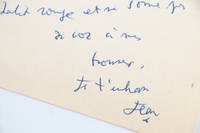
195388024Saint-Jean-Cap-Ferrat 1953. Fine. Saint-Jean-Cap-Ferrat 29 Août 1953 21 x 27 cm une page Autograph letter dated and signed by Jean Cocteau 26 lines in blue ink to Olivier Quéant editor of the magazine Plaisir de France sent from villa Santo-Sospir. Fold marks inherent to postal handling. Quéant journalist and notably editor of the magazine Plaisir de France maintained a fine friendly and literary correspondence with the writer. He notably delivered a glowing review of Antigone at its premiere in 1944: ""depuis Racine l'on avait rien écrit d'aussi beau d'aussi grand et d'aussi profondément humain"" since Racine nothing so beautiful so great and so profoundly human had been written L'Illustration. Jean Cocteau at the twilight of his life rebels and complains about his diminished and merely symbolic role in French theater of the 1950s. The second sentence of this letter will be taken up almost word for word in the famous verses of his longest poem Requiem 1962: ""Il est juste qu'on m'envisage / Après m'avoir dévisagé"" It is right that I should be considered / After having been stared at which will also serve as his epitaph. Despite official recognition Cocteau felt until his death ""méconnu inconnu invisible"" misunderstood unknown invisible Jean Cocteau sur le fil du siècle 2003 - a malaise masterfully expressed through these lines. ""Voilà plusieurs années que j'accepte d'être en secret mis à ma place et publiquement remis à ma place. Bref de n'être pas envisagé mais dévisagé. Il est beau de recevoir des lettres ""retournées"" où Anouilh me dit ""Sans vos pièces je n'aurais pas écrit une ligne des miennes"" et Giraudoux ""Rilke avait raison. Nos figures blanches à côté du hâle de tes séjours dans l'antiquité."" Il est beau d'être comme le Pisanelle - enterré sous les roses ."" For several years I have accepted being secretly put in my place and publicly put back in my place. In short not being considered but stared at. It is beautiful to receive ""returned"" letters where Anouilh tells me ""Without your plays I would not have written a line of mine"" and Giraudoux ""Rilke was right. Our pale faces beside the tan of your sojourns in antiquity."" It is beautiful to be like Pisanello - buried under roses . Interesting and touching missive from Cocteau with disordered and furious handwriting twisting and stretching in the manner of a calligram. unknown
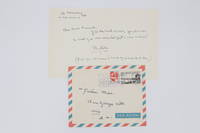
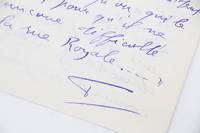
196678869Paris 1966. Fine. Paris 17 novembre 1966 20.70 x 13.50 cm une page sur un feuillet enveloppe jointe Handwritten signed letter addressed to Docteur Francis Mars: ""j'ai du mal à vous pardonner le mal que vous vous êtes fait à vous-même ! I find it difficult to forgive you for the harm you have done to yourself! Paris 17 November 1966 20.7 x 13.5 cm one page on a leaf envelope attached Handwritten letter signed by Natalie Clifford Barney addressed to Doctor Francis Mars a few lines written in black in on a leaf of headed paper from 20 rue Jacob Paris VIe envelope attached. Central fold from having been sent. ""Cher ami Francis j'ai du mal à vous pardonner le mal que vous vous êtes fait à vous-même ! Natalie PS: Je ne serai à Nice que vers le 5 déc. My dear friend Francis I find it difficult to forgive you for the harm you have done to yourself! Natalie PS: I will not be in Nice until around 5 Dec. Francis Mars from Nice was a mutual friend of Natalie Clifford Barney and her companion the artist-painter Romaine Brooks. The two women who had been in a relationship for almost fifty years did not live together: Natalie lived in Paris and only joined Romaine in Nice for the winter. unknown
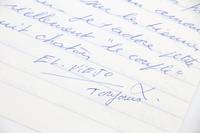
197684900Fleury-Mérogis 1976. Fine. ""Le pire que l'on puisse faire à un juge c'est lui enlever toute autorité devant les autres et crois moi il l'a bien compris"" ""The worst thing you can do to a judge is to remove all his authority in front of others and believe me he understood it well"" Fleury-Mérogis 2 Décembre1976 21 x 29.50 cm une page recto verso Autograph letter dated and signed by Jacques Mesrine dated Thursday December 2 1976 65 lines in blue ink on one recto-verso page addressed to his love at the time Jeanne Schneider thanks to whom the manuscript of Instinct de mort was discreetly smuggled out of prison. Jacques Mesrine then incarcerated at Fleury-Mérogis prison feels unwell and helpless far from his companion and from all human warmth: ""Ce soir je suis très mal foutu. il est 19 heures et je me couche juste après la fin de ta lettre. de rien de grave. juste une grande fatigue à rien faire"" ""Tonight I feel really awful. it's 7 PM and I'm going to bed just after finishing your letter. nothing serious. just very tired from doing nothing"" As a good father Jacques Mesrine rejoices in his daughter's happiness: ""Je suis heureux que sa veste lui plaise. de plus c'est la mode. son Loïc chéri ne va plus la reconnaître."" ""I'm happy that she likes her jacket. plus it's fashionable. her dear Loïc won't recognize her anymore."" and shows himself neither surprised nor more than amused that his daughter wants to embrace the Jewish religion: ""Comme cela la puce veut prendre la religion juive. encore une idée à elle. oui je sais elle a fait croire à ses copains qu'elle était juive. car eux l'étaient.si cela l'amuse je la laisse libre. mais ça démontre aussi un dédoublement de personnalité."" ""So the little one wants to take up the Jewish religion. another one of her ideas. yes I know she made her friends believe she was Jewish. because they were. if it amuses her I leave her free. but it also shows a split personality."" Public enemy No. 1 evokes with a certain pride his latest confrontation with his judge a fierce revenge of the insubordinate against the penitentiary universe that crushes men: ""Aujourd'hui j'ai eu la visite du juge Madre. Tu aurais rigolé car il a eu droit à tout mon vocabulaire. il en perdait la parole j'ai pris mon pied sic A un moment il me dit ""mais c'est quand même moi qui commande. Réponse de ton bibi : ""Ici pédé"" c'est moi ton patron"". Il était vert et les flics se marraient comme des perdus."" ""Today I had a visit from Judge Madre. You would have laughed because he got my full vocabulary. he was speechless I had a ball At one point he tells me 'but I'm still the one in charge. Your boy's response: 'Here faggot I'm your boss.' He was green and the cops were laughing like crazy."" and against all submission to any form of power or violence: ""Le pire que l'on puisse faire à un juge c'est lui enlever toute autorité devant les autres et crois moi il l'a bien compris. Il était venu avec 5 anti-commandos. L'un avait la bombe de gaz à la main. au cas où Loin d'être impressionné. cela me rend con."" ""The worst thing you can do to a judge is to remove all his authority in front of others and believe me he understood it well. He had come with 5 anti-commandos. One had the gas canister in his hand. just in case Far from being impressed. it makes me crazy."" The eternal rebel ends his letter with a beautiful testimony of tenderness for his beloved: ""Là ma puce je vais prendre mon lit en marche.Ton vieux voyou pose ses lèvres sur le tiennes en une douce caresse d'amour. je t'adore petite fille. car nous sommes réellement le ""couple"" et plus encore. Bonne nuit chaton."" ""There my little one I'm going to take to my bed. Your old rogue places his lips on yours in a sweet caress of love. I adore you little girl. because we are truly the 'couple' and even more. Good night kitten."" Rare and very fine letter by Jacques Mesrin unknown
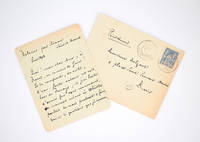
189875918Valvins 1898. Fine. Valvins 23 juin 1898 8.90 x 11.50 cm une carte recto verso - enveloppe jointe Autograph letter-card signed by Stéphane Mallarmé addressed to Alidor Delzant written in black ink on both sides. With the original envelope. Enclosed with this letter is a quatrain in Mallarmés hand: ""Tout en les éternisant / Bracquemond ici fait vivre / Les traits d'Alidor Delzant / A nous ouvert comme un livre."" Alidor Delzant was a lawyer collector and bibliophile. A friend of the Goncourt brothers he devoted a book to them and served as Edmonds secretary and testamentary executor. A delightful card in which the poëte ordinaire refers to the making of his portrait by his friend the painter Whistler: ""j'ai honte d'avoir fui dans ma verdure au moment même où Whistler parlait de mon portrait à faire"". ""On June 1st as he had promised Whistler who in his last letter with an affection verging on tenderness addressed him as mon Mallarmé he went to the painters studio on the rue Notre-Dame-des-Champs. You will see someone from the woods somewhere between the wild boar and the nightingale he had warned playfully in announcing his visit. Painter and poet ended the day dining on the rue du Bac where the all-too-ephemeral Trixie was now absent. In the half-light after dinner Whistler near a lamp seemed to resurrect in appearance the extraordinary Poe. Doubtless he then repeated to Mallarmé his intention of painting him. The next day without waiting for the Monet exhibition soon to be held at Georges Petit the Mallarmés went on to Valvins. Jean-Luc Steinmetz Stéphane Mallarmé This was most likely the execution of another portrait of Mallarmé of which no trace remains Whistler having already produced one that served as the frontispiece to Vers et Prose in 1893. He also alludes to Bracquemonds etched portrait of Delzant: ""Je comprends du reste l'eau-forte valant cet exil de Paraÿs . Redites mon affectueuse admiration toujours à Monsieur Bracquemond."" unknown
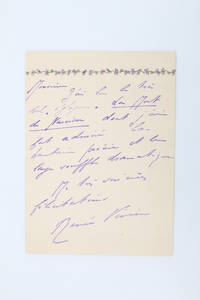
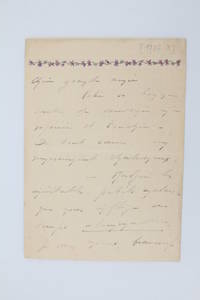
190479913s. l. Paris 1904. Fine. s. l. Paris s. d. ca 1904 11.50 x 16 cm une page sur un double feuillet Handwritten signed letter addressed to the poet Jean-Marc Bernard: I read the very beautiful eclogue La Mort de Narcisse whose haughty poetry and dramatic breath I admired very much. Paris ca 1904 11.5 x 16 cm one page on a double leafHandwritten signed letter from Renée Vivien addressed to Jean-Marc Bernard written in violet ink on a double leaf of paper decorated at the head with a border of violets. Transverse folds from having been sent. Monsieur J'ai lu le très bel ""églogue"" La Mort de Narcisse dont j'ai fort admiré la hautaine poésie et le large souffle dramatique. Mes très sincères félicitations. Renée Vivien. Monsieur I read the very beautiful eclogue La Mort de Narcisse whose haughty poetry and dramatic breath I admired very much. My very sincere congratulations. Renée Vivien. Jean-Marc Bernard was one of the founders of the poetic satirical and monarchist magazine Les Guêpes which welcomed contributions from Paul-Jean Toulet and Francis Carco among others. Together with the latter two he was part of the École fantaisiste a collective of young poets eager to break with the Parnassians and symbolists and whose ambitions were soon to be swept away by the arrival of the Great War. Jean-Marc Bernard lost his life on the front line destroyed by a shell at the age of thirty-three. unknown
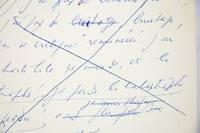
195484027Meudon 1954. Fine. Meudon 1954 20.70 x 26.80 cm une page sur un feuillet Autograph manuscript signed by Louis-Ferdinand Céline written in blue and pink ballpoint pens on a white paper sheet numbered 507 in the left corner. One transverse fold. Some pin holes in the upper margin stigmata of the organization of Céline manuscripts in ""bundles"". « j'ai pas de cinéma personnel j'ai pas de bruitage j'ai pas de critiques ""rémunérés"" j'ai que l'hostilité du monde et la catastrophe ! je perds la catastrophe je suis perdu ! . chienlit ! charlatan ! barbeau mou ! Comme ça vous m'intitulez si vous me trouvez pas dans la loge en plein enragement d'éléments ! je veux pas que vous. » The passage in our sheet presents some variations from the published version. Published in 1954 Normance is a direct sequel to Féérie pour une autre fois published two years earlier. Both parts were written during Céline's years of exile and imprisonment in Denmark. Upon his return to France in 1951 Céline undertook a work of ""polishing"" and published independently these two titanic texts originally envisioned as one. ""Céline while working on it thought of this novel as a second Voyage au bout de la nuit capable twenty years later of astonishing the public as much as the 1932 novel."" Henri Godard unknown
197684675Paris 1976. Fine. Paris 11 Octobre 1976 21 x 29.50 cm une page recto verso Autograph letter dated and signed by Jacques Mesrine dated Monday October 11 1976 70 lines in blue ink on one recto-verso page addressed to his love of the time Jeanne Schneider thanks to whom the manuscript of Instinct de mort was discreetly smuggled out of prison. Jacques Mesrine then incarcerated at La Santé showers with gifts the people he loves because he wants their happiness: ""Comme cela j'ai payé une mobylette à mes trois gamines. Toi ce sera une quatre roues sic."" ""Like this I paid for a moped for my three girls. For you it will be four wheels sic."" He shows all his affection for a young girl named Betty whom he seems to cherish more than his own daughter Sabrina: ""Peut-être que je recherche en Betty ce que je ne trouve pas en Sabrina et que Mury m'a refusé ! Tu sais mon ange ; à 15 ans j'aurais tellement aimé avoir un copain de 40 ans à qui je puisse tout dire qui sache m'aider ou m'offrir mon rêve. Peut-être que ce cadeau je me le fais à moi-même."" ""Maybe I'm looking for in Betty what I don't find in Sabrina and what Mury refused me! You know my angel; at 15 I would have loved so much to have a 40-year-old friend to whom I could tell everything who would know how to help me or offer me my dream. Maybe this gift I'm giving it to myself."" for whom he has no more confidence feeling betrayed: ""Mais on ne devient jamais l'ami de quelqu'un qui vous juge. Pas plus que pour Sabrina ! qui elle m'a trompé dans ma confiance donc dans mon amour. Quand on use les sentiments ils ne redeviennent jamais les mêmes."" ""But one never becomes the friend of someone who judges you. No more than with Sabrina! who deceived my trust and therefore my love. When feelings are worn out they never become the same again."" Public enemy No. 1 takes great pride in his relationship with Jeanne Schneider based on honesty: ""C'est peut-être pour cela que je me suis toujours refusé à te mentir - quitte à te faire souffir. Je n'ai aucun passé.mais un seul présent ""Toi"". C'est peut-être cela qui fait que notre amour dure depuis 10 ans "" ""Maybe that's why I've always refused to lie to you - even if it means making you suffer. I have no past.but only one present 'You'. Maybe that's what makes our love last for 10 years "" Jacques Mesrine then turns to material considerations so important for a prisoner: ""J'ai reçu ton linge. Je ne risque pas d'avoir froid cet hiver. Le polo est très bien."" ""I received your clothes. I won't risk being cold this winter. The polo shirt is very good."" before castigating the inhumanity of the prison system and its indifference to suffering: ""Mais nous n'avons rien à attendre des juges et si ma lettre au président a été ferme c'est le genre de lettre qu'il comprendra mieux que le style ventre à terre."" ""But we have nothing to expect from judges and if my letter to the president was firm it's the kind of letter he will understand better than the groveling style."" As an eternally untamed man Jacques Mesrine never ceases to advocate fighting against the prison administration: ""On ne se défend pas en mettant sa tête dans le sable comme l'autruche ! Dès l'instant où l'on prend une arme dans la main. il faut s'attendre à payer ! que Michou le comprenne ce n'est pas le moment d'être ""bébé"" mais celui d'être femme."" ""You don't defend yourself by putting your head in the sand like an ostrich! From the moment you take a weapon in your hand. you must expect to pay! let Michou understand this is not the time to be a 'baby' but to be a woman."" Jacques Mesrine ends this beautiful letter with a moving declaration of love full of optimistic humor: ""Ton vieux tigre pose de doux bécots sur tout ce qui est toi. Bonne nuit chaton et un moral d'acier est de rigueur ok. Je t'adore chanceuse & Ton mystère Jacques !! ""Te adoro A toi seule."" ""Your old tiger puts gentle kisses on everything that is you. Good night kitten and a steel hardcover
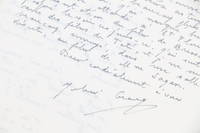
197884596Paris 1978. Fine. Paris s. d. 1978 14.50 x 20.50 cm une feuille Important autograph letter signed by Julien Gracq 53 lines in black ink addressed to his close friend and monographer Ariel Denis establishing him as his biographer. Julien Gracq expresses his regret that his friend Ariel Denis was not selected despite his intervention by the Berlin Academy to teach: ""Je vous avais recommandé de mon mieux mais je doute que cela ait été en Allemagne d'une grande efficacité. Je sais d'ailleurs que comme vous le pressentiez les concurents étaient en nombre."" ""I recommended you as best I could but I doubt that was very effective in Germany. I know moreover that as you suspected there were many competitors."" To help his friend the author of Rivage des Syrtes suggested to publisher Seghers who wanted to publish a work about him in his famous ""Poètes d'aujourd'hui"" collection the name of Ariel Denis having had no news from the first biographer considered for this publication: ""Ils me demandent de leur suggérer un nom. J'ai indiqué celui de Lautrat. Et j'ai indiqué le vôtre ne sachant bien sûr aucunement si un travail de ce genre pourrait vous plaire. Il va de soi que si Seghers s'adressait à vous vous devez être absolument libre d'accepter ou de refuser."" ""They ask me to suggest a name. I indicated Lautrat's. And I indicated yours not knowing of course at all whether work of this kind might please you. It goes without saying that if Seghers approached you you must be absolutely free to accept or refuse."" He also hopes to see his friend again soon before the summer holidays: "". si je ne vous revois pas avant juillet je vous souhiate des vacances à la fois paisibles et laborieuses en comptant vous revoir d'ici l'automne."" "".if I don't see you again before July I wish you holidays that are both peaceful and productive counting on seeing you again by autumn."" He concludes his letter with his judgments as an informed cinephile: ""J'ai surtout revu des films de Tati et je me suis beaucoup ennuyé dans une salle déserte au film de Mme Sagan."" ""I mainly rewatched Tati films and I was very bored in a deserted theater by Mme Sagan's film."" At Julien Gracq's instigation Ariel Denis would indeed accept Seghers' proposal to publish a volume in his ""Poètes d'aujourd'hui"" collection about the author of Au château d'Argol thereby becoming one of his best and most remarkable biographers. unknown
193177544Paris 1931. Fine. Paris 6 avril 1931 14.60 x 19.30 cm une page sur une carte lettre Signed autograph note by Reynaldo Hahn addressed to Madame Serge André and written on a white paper letter-card in blue ink. Central fold inherent to the mailing. Dominique André is a poetess novelist and playwright. She notably published under the pseudonym Claude Isambert. ""J'ai trop tardé chère Madame à vous remercier de votre livre et du plaisir qu'il m'a procuré. Plaisir amer et trouble - mais rare. Ce qui est particulièrement remarquable en ces pages c'est leur extrême distinction."" ""I have delayed too long dear Madame in thanking you for your book and the pleasure it has given me. Bitter and troubled pleasure - but rare. What is particularly remarkable in these pages is their extreme distinction."" unknown
190885189Toulon 1908. Fine. Toulon 30 Mars 1908 13.50 x 21.50 cm 8 pages sur deux doubles feuillets une enveloppe Long autograph letter signed by Claude Farrère approximately 160 lines in blue ink 8 pages on two double leaves to his friend Pierre Louÿs thanking him notably for his thoughtfulness. Traces of folds inherent to being placed in an envelope envelope included. Claude Farrère praises his friend's thoughtfulness towards him: ""Thank you for your letter. not only because it is exquisite - six times more than you can believe - but much more because I know very well that you told it to me so as 'not to worry me.' as you say."" and is amazed by the problems raised by these recent articles: ""Said in parentheses I am quite stunned by the one relating to controversial articles. Not only have I not written any."" He is more concerned about the suspicions he arouses regarding his alleged opium consumption: ""I was informed by my own commander that the ministry based on my first book supposed that opium was not foreign to me. The same commander protested arguing that for so many months that I had served under his orders he had absolute certainty that I had not committed the slightest sin! But I doubt that his word is very appreciated in Paris."" and about the hatred that an officer bears him. Despite these problems Claude Farrère wants to reassure his friend: ""I want my dear friend for you to be absolutely at peace about me. I absolutely don't care myself."" while lamenting that the latter is abandoning the south of France this year: ""Tamaris without you how do you expect the celestial mechanism to continue turning And me You would systematically push me to suicide. Don't forget that I'm writing a quite bloody book and that I live in the iniquitous society of people who for a half-yes or a quarter-no disembowel themselves!"" He concludes his letter with new rumors concerning him: ""Of course Madame de X has gratuitously supposed horrible things: I am not the lover of the other lady from the milliner's. Come now! how could a young man such as myself decent and too well brought up cf. Madame P.L.'s opinion etc."" unknown
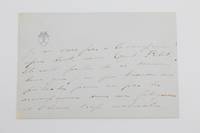
190079011s. l. Paris 1900. Fine. s. l. Paris s. d. ca 1900 12.50 x 8.40 cm une carte rédigée des deux côtés Autograph letter signed ""Paul"" and addressed to Natalie Clifford Barney written in black ink on both sides. Silver monogram of the poetess in the upper left corner of the recto. ""Je ne vais pas à la campagne après tout mon Tout-Petit. Ils sont partis de si bonne heure que j'ai pu trouver un prétexte pour ne pas les accompagner dans ma fatigue et l'heure trop matinale. Quand veux-tu que je vienne te chercher et où irons-nous Je serai prête à l'heure où tu voudras. J'aime tes jolies fleurs elles sont charmantes - j'ai porté une de tes roses hier au soir. A tout à l'heure mignon Tout-Petit - Paul"" ""I'm not going to the countryside after all my Little One. They left so early that I was able to find an excuse not to accompany them in my fatigue and the too early hour. When do you want me to come get you and where shall we go I'll be ready whenever you want. I love your pretty flowers they are charming - I wore one of your roses last evening. See you soon sweet Little One - Paul"" It was at the end of 1899 and through Violette Shillito that Renée Vivien - then Pauline Tarn - made the acquaintance of Natalie Clifford Barney ""this American more supple than a scarf whose sparkling face shines with golden hair sea-blue eyes implacable teeth"" Colette Claudine à Paris. Natalie who had just experienced a summer idyll with the sulfurous Liane de Pougy who had initiated her into sapphism paid only discreet attention to this new acquaintance. Renée however was completely captivated by the young American and would recount this coup de foudre in her autobiographical novel Une Femme m'apparut: ""J'évoquai l'heure déjà lointaine où je la vis pour la première fois et le frisson qui me parcourut lorsque mes yeux rencontrèrent ses yeux d'acier mortel ses yeux aigus et bleus comme une lame. J'eus l'obscur prescience que cette femme m'intimait l'ordre du destin que son visage était le visage redouté de mon avenir. Je sentis près d'elle les vertiges lumineux qui montent de l'abîme et l'appel de l'eau très profonde. Le charme du péril émanait d'elle et m'attirait inexorablement. Je n'essayai point de la fuir car j'aurais échappé plus aisément à la mort."" ""I recalled the already distant hour when I saw her for the first time and the shiver that ran through me when my eyes met her deadly steel eyes her sharp and blue eyes like a blade. I had the dark prescience that this woman was commanding me to destiny that her face was the dreaded face of my future. I felt near her the luminous vertigo that rises from the abyss and the call of very deep water. The charm of peril emanated from her and attracted me inexorably. I did not try to flee from her for I would have escaped death more easily."" ""Winter 1899-1900. Beginning of the idyll. One evening Vivien is invited by her new friend to the studio of Mrs. Barney Natalie's mother 153 avenue Victor-Hugo at the corner of rue de Longchamp. Natalie ventures to read verses of her composition. When Vivien tells her she loves these verses she replies that it is better to love the poet. An answer quite worthy of the Amazon."" J.-P. Goujon Tes blessures sont plus douces que leurs caresses There followed two years of unequal happiness punctuated by Natalie's recurring infidelities and Renée's morbid jealousy whose letters oscillated between impassioned declarations and painful mea culpas. ""Renée Vivien is the daughter of Sappho and Baudelaire she is the flower of evil 1900 with fevers broken flights sad voluptuousness."" Jean Chalon Portrait d'une séductrice In 1901 came an important break that would last almost two years; Renée despite Natalie's solicitations and the intermediaries she sent to win her back resisted. ""The two friends met again and it was in August 1905 the pilgrimage to Lesbos which constituted a disappointment for Natalie Barney and remained without sequel. . unknown
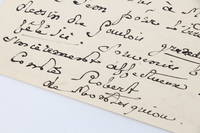
190783363New York: S. n. 1907. Fine. S. n. New York 4 février 1903 13.50 x 17.50 cm deux feuillets recto-verso Autograph letter signed by the dandy count 54 lines written in black ink on two leaves recto-verso addressed to his friend and bibliographer the critic Henri Lapauze: ""4 février Westminster hôtel New-York Cher monsieur et ami j'ai le plaisir de vous adresser ci-joint une copie manuscrite du salut d'ouverture qui servira de prélude de bienvenue à la première de mes conférences dont la date est fixée à demain. J'espère que vous ferez bon accueil à cet envoi de l'absent et le publierez en bonne place. Les documents ci-joints vous aideront à faire rédiger les lignes explicatives dont je vous demande d'accompagner l'article. Merci à vous à Mr Galdemar et à Sem pour son irrésistible dessin du Gaulois grandement fêté ici. Souvenir bien sincèrement affectueux. Comte Robert de Montesquiou. Je tiens à ajouter que je suis heureux de vous donner la primeur de ce document en témoignage et souvenir de nos bons rapports. J'ajoute que tout semble se disposer pour le succès de mon entreprise. Et vous connaissez assez les lois humaines mondaines et polémiques pour savoir que le tapage de presse accueillant ici les étrangers un peu notables ajoute à la curiosité de l'auditoire. J'espère ne pas trop la décevoir et ceci est le secret de demain. J'ai énuméré dans les pages que je vous adresse les raisons qui m'ont dicté le choix du sujet de ma première conférence. Je n'y reviens pas."" ""February 4th Westminster hotel New-York Dear Sir and friend I have the pleasure of sending you herewith a manuscript copy of the opening greeting which will serve as a welcome prelude to the first of my lectures the date of which is set for tomorrow. I hope you will give a good reception to this missive from the absent one and publish it in a prominent place. The enclosed documents will help you have written the explanatory lines I ask you to accompany the article with. Thank you to Mr Galdemar and to Sem for his irresistible drawing of the Gaulois greatly celebrated here. Most sincerely affectionate regards. Count Robert de Montesquiou. I want to add that I am happy to give you the exclusive rights to this document as testimony and remembrance of our good relations. I add that everything seems to be arranged for the success of my enterprise. And you know well enough the human worldly and polemical laws to know that the press commotion welcoming rather notable foreigners here adds to the audience's curiosity. I hope not to disappoint it too much and this is tomorrow's secret. I have enumerated in the pages I am sending you the reasons that dictated my choice of subject for my first lecture. I will not return to this."" Small pin holes that held the two leaves together. S. n. unknown
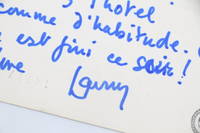
197986609Rhodes 1979. Fine. Rhodes Octobre 1979 21 x 10 cm une carte postale Evocative autograph postcard signed by Lawrence Durrell addressed to Jani Brun written in blue felt-tip pen on the verso of a reproduction of a sculpture depicting a seahorse fountain in Rhodes. Minor angular fold marks on the postcard. ""Rhodes ! J'arrive à Paris Dimanche 19 pour deux nuits. Sera tu la sic Disponible Je decend chez l'hotel Royale comme d'habitude. Le tournage est fini ce soir ! Ouf ! Love. Larry."" ""Rhodes! I'm arriving in Paris Sunday the 19th for two nights. Will you be there Available I'm staying at the Hotel Royale as usual. Filming is finished tonight! Phew! Love. Larry."" After many years spent in Greece Egypt and Rhodes the travelling writer Lawrence Durrell was forced to flee Cyprus following popular uprisings that led the island to independence from the British crown. Rich only with a shirt and a typewriter but crowned with the success of his novel Bitter Lemons of Cyprus he arrived in France in 1956 and settled in the Languedoc village of Sommières. In the ""Tartès house"" his large residence surrounded by trees he wrote the second part of his work his monumental Avignon Quintet devoted himself to painting and received his illustrious friends including the couple Henry Miller and Anaïs Nin the violinist Yehudi Menuhin the London publisher Alan G. Thomas and his two daughters Penelope and Sappho. Among the olive trees and under the Mediterranean sun he met in the mid-1960s the young and vivacious ""Jany"" Janine Brun a woman from Montpellier in her thirties of devastating beauty who worked in the Antiquities department at the Sorbonne in Paris. She was nicknamed ""Buttons"" in memory of their first meeting where the young woman wore a dress covered with buttons. Henry Miller also fell under the charm of ""Buttons"" praising her beauty and eternal youth in exceptional unpublished letters. The three companions spent memorable Parisian evenings of which we retain precious autograph traces through their epistolary exchanges. Recommended by Durrell she made numerous trips particularly to England from where she received extensive correspondence from the writer as well as original works of art signed with his artist pseudonym Oscar Epfs. unknown
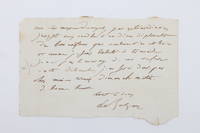
1839803451839. Fine. s. d. ca 1839 13 x 8 cm une feuille Signed handwritten letter to Louis Desnoyers ca 1839 13 x 8 cm one leaf Handwritten letter signed by Honoré de Balzac addressed to Louis Desnoyers written on a white piece of paper in black ink. My dear Mr Desnoyers extraordinarily today I attend a diplomatic dinner of good-natured folk who want to laugh and drink and as I am in a stupor at work I have not had the courage to refuse this debauchery; I will therefore not be at home. Come early Sunday morning. / Yours / de Balzac. Louis Desnoyers plays an important role in the foundation of the Société des gens de lettres which aims to protect literary and artistic property and to create a solidarity fund. Balzac supported the creation of this Society of which Desnoyers was vice-president. Amusing letter testimony of Balzac's love of good food. unknown
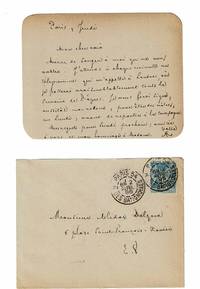
189676347Paris 1896. Fine. Paris 2 avril 1896 11.40 x 8.80 cm une carte et une enveloppe Signed autograph card from Stéphane Mallarmé addressed to Alidor Delzant written on the recto in black ink. Envelope included. Alidor Delzant was a lawyer collector and bibliophile. Friend of the Goncourts he devoted a work to them and was Edmond's secretary and testamentary legatee. ""Merci de songer à moi qui ne vous oublie. J'attends à chaque minute un télégramme qui m'appelle à Londres où je passerai vraisemblablement toute la semaine de Pâques."" ""Thank you for thinking of me who does not forget you. I am expecting at any moment a telegram calling me to London where I will most likely spend the entire Easter week."" unknown
190779804s. l. Paris 1907. Fine. s. l. Paris s. d. ca. 1907-1908 11.50 x 16 cm 2 pages 1/2 sur un double feuillet Autograph letter signed by Renée Vivien addressed to Marcelle Tinayre written in black ink on a double sheet of headed paper decorated with a border of violets. Transverse creases inherent to mailing. Also a writer Marcelle Tinayre was close to Renée Vivien who entrusted her first verses to her to read. Upon Vivien's death Tinayre paid tribute to her through several texts notably a very beautiful tribute article published in the review Schéhérazade in 1910 entitled ""Trois images de Renée Vivien"". ""Chère grande amie Votre si bonne carte de souvenir m'a réjouie et touchée. De tout coeur un remerciement chaleureux. Malgré les inévitables petits malaises que nous inflige ce temps abominable je vais mieux beaucoup mieux. Aussi serais-je très heureuse si vous et Monsieur Tinayre étiez libres le 12 et pouviez venir dîner chez moi. J'aurai le plaisir de vous présenter ma soeur et mon beau-frère qui seront à Paris. Vous devinez quelle joie me causera leur présence ! Croyez à toute mon admiration à toute ma sympthie. Renée Vivien."" ""Dear great friend Your so kind remembrance card delighted and touched me. A warm thank you from the heart. Despite the inevitable small ailments this abominable weather inflicts upon us I am better much better. So I would be very happy if you and Monsieur Tinayre were free on the 12th and could come dine at my home. I will have the pleasure of introducing my sister and brother-in-law who will be in Paris. You can imagine what joy their presence will bring me! Believe in all my admiration all my sympathy. Renée Vivien."" The Muse of violets was indeed very close to Toinette her younger sister who lived in London with her husband Francis. Renée Vivien was moreover the godmother of their son Paul a very rare name then in England in honor of his aunt and in 1911 Toinette would give birth to a daughter whom she would name Renée in tribute to her deceased sister. Very beautiful testimony to the friendship that Renée Vivien bore toward Marcelle Tinayre a writer friend who contributed to perpetuating the memory of Sappho 1900. unknown
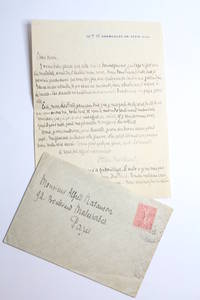
190673701Cormeilles-en-Vexin 1906. Fine. Cormeilles-en-Vexin 22 août 1906 ou 1908 12.60 x 17 cm une feuille Friendly autograph letter signed by Octave Mirbeau addressed to the playwright and founder of the Revue Blanche Alfred Natanson. 12 lines in black ink on a folded sheet letterhead paper ""Cormeilles-en-VexinS.&O."" envelope included. ""Cher ami J'avais bien pensé que cette vieille bonne femme qui tape si fort sur les matelas avait du écorcher mon nom. Mais dans l'incertitude car je pouvais penser aussi que vous étiez pris avec quelqu'un de très sérieux . Ceci mon cher Fred pour vous dire que je suis parti de chez vous triste de ne pas vous avoir vu voilà tout et sans le moindre sentiment mauvais. Vous savez que j'ai pour vous une affection solide et je vous connais assez gentil pour moi pour me permettre de supposer des sottises. ."" ""Dear friend I had indeed thought that this old good woman who beats the mattresses so hard must have mangled my name. But in uncertainty for I could also think that you were busy with someone very serious . This my dear Fred to tell you that I left your house sad not to have seen you that's all and without the slightest bad feeling. You know that I have a solid affection for you and I know you well enough to be kind to me to allow myself to suppose foolish things. ."" With an amusing postscript: ""Ne prêtez pas attention à ce gribouillage. L'auto a je ne sais pas quoi j'y travaille. et n'y fait rien de bon. d'ailleurs. Et mon mécanicien se prend la tête à deux mains noires d'huile grasse ."". ""Don't pay attention to this scribbling. The car has something wrong I don't know what I'm working on it. and it's not doing any good. anyway. And my mechanic is holding his head in his two hands black with greasy oil ."". Mirbeau was particularly close to the Revue Blanche group since its launch in Paris in 1891. But it was from the Dreyfus affair that his intimate and lasting friendship with the Natanson brothers Thadée Alexandre and Alfred was strengthened. After aesthetic disagreements about Art Nouveau and the Nabis Mirbeau finally reunited with Thadée around 1900 in a now common inclination for the young Nabis painters of the Revue Blanche Bonnard Vallotton and Vuillard. The Revue Blanche played an essential role in France as confirmed by historian Paul-Henri Bourrelier: ""Most of the most prominent writers painters musicians politicians intellectuals of the late 19th and early 20th centuries collaborated with it or were associated with it. Created financed and directed by the three Natanson brothers young Polish Jews with the enthusiastic complicity of their classmates from the Condorcet lycée La Revue blanche quickly became a place of debate on all subjects that stirred France. It led political battles under the impulse of anarchists like Fénéon Mirbeau; socialists such as Blum G. Moch Péguy; Dreyfusards and founders of the League of Human Rights like Reinach and Pressensé."" unknown
195283140Paris 18 décembre 1952 | 21 x 27 cm | une feuille
184086612s. d. [circa 1840] | 9.80 x 13.80 cm | une page sur un feuillet
194576388New York 23 octobre 1945 | 17.10 x 25.40 cm | 2 pages sur un feuillet et une enveloppe
194186762Paris s. d. [ca 1941] | 14 x 15.50 cm | une page sur un double feuillet